PI-CONTROL IN HYBRID FIRE TESTING
E. Mergny, G. Drion, J-M Franssen
INTRODUCTION
Hybrid testing has been successfully developed over the past decades in earthquake engineering and begins to be applied to fire engineering (Hybrid Fire Testing or HFT). The first attempt of HFT was done by Korzen et al. [1] and other researchers have followed suit. In most cases, an elastic response of the numerical substructure was considered. Yet, the numerical substructure can exhibit a nonlinear behaviour, notably if it is exposed to fire. This nonlinear response can be assessed by numerical simulation using a FEM model as presented in Mostafaei et al. [2] that uses a non-linear model for the numerical substructure.
Recently, Mergny et al. [3] proposes a framework based on linear control system theory for a displacement control procedure. It uses proportional integral controller to address identified stability issues and control the time properties in hybrid fire testing. However, the research did not address the issue of delay, error and sensitivity.
STATE SPACE REPRESENTATION OF HYBRID FIRE TESTING
Formally, [3] showed that HFT can be expressed as a discrete control problem and formulated the following state equation for the system:
𝐮PSi+1 = −𝐊NSi −1𝐊 PSi𝐮PSi+ 𝐮NSi TH − 𝐊 NSi −1𝐅 PSTHi (1)
𝐮PS is the displacement vector of the tested specimen (imposed by actuators) and is the state variable.
𝐊PS and 𝐊NS are the stiffness matrices of the physical and numerical substructure (PS and NS). 𝐅PSTH and
𝐮NSTH are the thermal forces of PS and thermal displacements of NS. −𝐊NSi
−1𝐊
PSi is the dynamics matrix
of the system. The HFT is stable if the module of the eigenvalues of this matrix is lower than 1. This condition is hardly never reached for multiple-DOF HFT. A PI-controller was consequently developed in [3]. The displacement 𝐮PS is corrected at every time step Δti :
𝐮PSi+1 = 𝐮PSi+ 𝐋P𝐞i+ 𝐋J𝐉i (2)
𝐞i=(𝐮NSi− 𝐮PSi) is the instantaneous error and 𝐉i the sum of 𝐞i over time. 𝐋p
and
𝐋Jare gain matricesand are diagonal. As showed in [3], they are designed based on the location of the eigenvalues of the dynamics matrix of the state equation of the complete system:
[𝐮PSi+1 𝐉i+1 ] = [ 𝐈 − 𝐋p𝐊NSi −1𝐊 PSi− 𝐋p 𝐋j −𝐊NS−1i𝐊PSi− 𝐈 𝐈 ] [𝐮PSi 𝐉i ] + [ 𝐋p𝐮NSi TH − 𝐋 p𝐊NSi −1𝐅 PSi TH 𝐮NSTHi− 𝐊NS−1i𝐅PSTHi ] (3)
The matrix 𝐊NS and an estimation of the matrix 𝐊PS are essential for determining the gain matrices.
DELAY
Delay Δti is an issue in HFT because the temperature (and thus displacements) changes continuously
and disturb the system. Its value depends on the speed of the actuators and the computing time and is variable. The dynamics matrix in equation (3) is independent of the delay and thus the stability is not affected. However, it should be low enough to capture the behaviour of the specimen.
The value is thus limited by the Nyquist-Shannon theorem [4]: the sampling frequency should be at least twice the highest frequency contained in the signal, here 𝐮PS. Initially, this input is not known. To apply
this theorem, the minimum information that is necessary is the expected highest rate of 𝐮PS during the
test. This condition must be verified before the HFT.
ERROR
Measurement errors will directly affect the equation (2) and (3): the correction is made based on altered values of 𝐮NSi and 𝐮PSi. An error on the estimation of the stiffness of the PS 𝐊PS
EST will influence the
design of the gain matrices 𝐋p and 𝐋J and can be critical and lead to instability. The sensitivity of the
APPLICATION
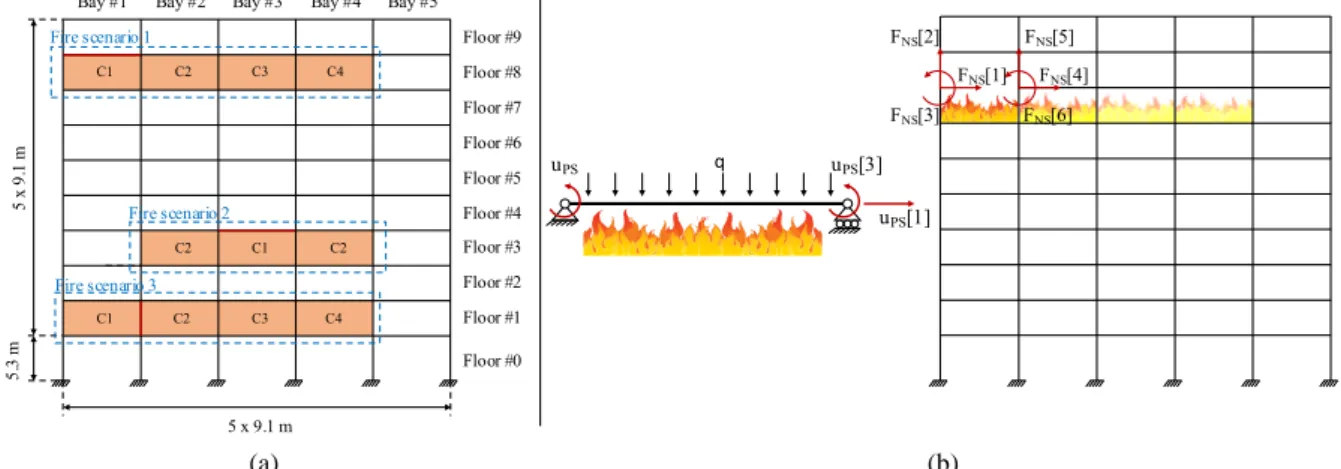
The sensitivity of the method to the estimation of the stiffness of PS is numerically tested on 3 fire scenarios performed with a multi-storey frame (Sadek et al. [5], Figure (a)). The hereunder results correspond to the first fire scenario showed on Figure 1 (b).
(a) (b)
Figure 1 – Multi-storey frame and fire scenarios (PS in red, C=Compartement) – PS and NS in fire scenario 1
A speed of 1mm/s was considered for the electrical actuators. The time for computing 𝐮NSi is variable.
It was estimated that the delay of 60 s would be sufficient to perform the application of the displacement and the numerical calculation. The hypothesis is made that the displacement rate is not higher than the temperature rate. The Nyquist-Shannon theorem is verified using this input.
A random error was introduced in the forces and displacements of the PS, considering uniform distribution that is the worst case. Overestimated and underestimated 𝐊PSEST are considered in %. Results of the left rotation and left bending moment over time are shown on figure 2 (a) and (b) (Ref is the correct behaviour). They show that the stability and the accuracy of the solution for this scenario is not sensitive to overestimated and low underestimated stiffness. An underestimation higher than 25% is critical because the system becomes unstable. Results are similar for the two other scenarios.
(a) (b)
Figure 2 – Left rotation (a) – Left bending moment (b)
REFERENCES
[1] Korzen et al. 1999. Zeitschrift für Angewandte Mathematik und Mechanik. [2] Mostafaei et al. 2013. Fire Safety Journal.
[3] Mergny et al. 2018. 10th International Conference on Structures in Fire SiF’18. [4] Shannon. 1949. Proceedings of the Institute of Radio Engineers.
[5] Sadek et al. 2010. NIST Technical Note 1669.
F S F S 1 F S F S F S F S u S 1 u S u S C1 C C C C C1 C Floor 1 Floor Floor Floor Floor Floor Floor Floor 8 Floor .1 . 1 . Floor 0 a 1 a a a a C1 C C C Fire scenario 1 Fire scenario Fire scenario -0,08 -0,07 -0,06 -0,05 -0,04 -0,03 -0,02 -0,01 0,00 0,01 0 4000 8000 12000 r lef t [ra d ] t [s] ref 0% -25% -20% -10% 10% 20% 25% 50% 0 20000 40000 60000 80000 100000 120000 140000 0 4000 8000 12000 M lef t [Nm ] t [s]