HAL Id: hal-01625093
https://hal-mines-paristech.archives-ouvertes.fr/hal-01625093
Submitted on 27 Oct 2017
HAL is a multi-disciplinary open access
archive for the deposit and dissemination of
sci-entific research documents, whether they are
pub-lished or not. The documents may come from
teaching and research institutions in France or
abroad, or from public or private research centers.
L’archive ouverte pluridisciplinaire HAL, est
destinée au dépôt et à la diffusion de documents
scientifiques de niveau recherche, publiés ou non,
émanant des établissements d’enseignement et de
recherche français ou étrangers, des laboratoires
publics ou privés.
Critical recrystallization during sub-solvus annealing in
a polycrystalline Nickel- based superalloy
Marie-Agathe Charpagne, Suzanne Jacomet, Julien Thebault, Nathalie
Bozzolo
To cite this version:
Marie-Agathe Charpagne, Suzanne Jacomet, Julien Thebault, Nathalie Bozzolo. Critical
recrystal-lization during sub-solvus annealing in a polycrystalline Nickel- based superalloy. Journées annuelles
SF2M, SF2M (Société Française de Métallurgie et des Matériaux), Oct 2017, Lyon, France.
�hal-01625093�
Journées Annuelles SF2M 2017
Critical recrystallization during sub-solvus annealing in a polycrystalline
Nickel-based superalloy
Marie-Agathe CHARPAGNE a, Suzanne JACOMET b , Julien THEBAULT c , Nathalie BOZZOLO b
a Materials Department, University of California at Santa Barbara, Santa Barbara, California 93101, USA
b PSL Research University, MINES ParisTech, CEMEF Centre de mise en Forme des Materiaux, CNRS,UMR 7635, CS 10207
Rue Claude Daunesse, F-06904 Sophia Antipolis, France
c Safran Aircraft Engines, 171 boulevard de Valmy - BP 31 92702 Colombes Cedex
Abstract
Selective and exaggerated growth of some grains is a phenomenon which is likely to occur during annealing following forging operations, in Nickel-based superalloys. It has been investigated in the Rene 65 alloy in terms of metallurgical characteristics of such grains, mechanisms and kinetics. The nature of this phenomenon, which is commonly reported as abnormal grain growth, is discussed based on the obtained results and appears to be a case of critical recrystallization.
Introduction
Polycristalline Nickel-based superalloys are widely used as structural materials in the aircraft and energy industries. Their mechanical integrity, thanks to their microstructure, has to be guaranteed. Most applications require a fine and homogeneous microstructure consisting of equiaxed grains of 10-30 μm in diameter. Conventional cast and wrought superalloys are forged at high temperature, at which grain boundary migration and recrystallization are triggered. Most processes include a final annealing treatment, which aims at lowering the overall dislocation density and erasing heterogeneities in its distribution among the different grains. This treatment is performed in the sub-solvus domain, so second-phase precipitates should pin the grain boundaries. However, observations have shown that some grains can grow in an exaggerated manner during that treatment, despite the presence of pinning particles. The appearance of such grains leads to a bimodal grain size distribution and the resulting heterogeneous microstructures are very similar to those having undergone abnormal grain growth. However, the exact mechanism and origin of appearance of such grains is still not well understood. Recent publications have highlighted the role of the level and distribution of stored energy on the development of such grains [1,2]. Abnormal grain growth occurs at low strains, as a limited number of recrystallization nuclei are likely to be present in the microstructure. The microstructural features of those grains (low dislocation density, front velocity and grain size profile as a function of strain) have lead some authors to propose a scenario of critical recrystallization for their formation. Those grains are thus either already present in the microstructure, as recrystallization nuclei, or either both nucleate and grow during the treatment. Agnoli et al. have mentioned the existence of an incubation time before the appearance of such grains [3]. The distribution of stored energy in the sensitive microstructures has also been
shown to be favourable for rare nucleation events by grain boundary bulging [2,4]. Both observations are in favour of the second hypothesis. Under the first hypothesis, the rarity of recrystallization nuclei would make them difficult to observe. However, Charpagne et al. have recently reported the existence of a new recrystallization mechanism, occurring at low strain levels in polycrystalline Nickel-based superalloys [5–7]. This new mechanism consists in the formation of recrystallized γ grains around primary γ’ precipitates. Couples of γ’ precipitate - γ grains have the same crystallographic orientation [8]. This recrystallization mechanism is dominant in the microstructures that are sensitive to abnormal grain growth. The aim of the present work is to study the influence of such grains on the occurrence of abnormal grain growth phenomena.
Material and procedures
The material selected for this study is Rene 65, a polycristalline γ-γ’ Nickel-based superalloy designed by General Electric and ATI Allvac [9]. Its chemical composition is inspired by those of Rene 88DT, which has been adapted for cast and wrought processing : 13 Cr – 16 Co – 3.7 Ti – 2.1 Al – 4 Mo – 4 W – 1 Fe – 0.7 Nb – 0.05 Zr – 0.016 B – bal Ni [10]. The samples have undergone an annealing treatment and forging operations triggering hetero-epitaxial recrystallization, described in [7]. The deformed microstructures have been characterized by means of a coupled EDS-EBSD technique [8], using the Bruker Quantax Crystalign package (XFlash 5030 EDS detector and e-Flash HR EBSD camera), mounted in a Zeiss Supra 40 FEG-SEM. The forged samples have then been submitted to the standard solution treatment, consisting in an hour exposure at Tsol. The solution treated
microstructures have been analyzed by means of optical and electron microscopy in order to determine the critical deformation conditions for abnormal grain growth. Based on those results, one sample has been selected for an in-situ annealing experiment using the stage described in [11] mounted in a FEI XL30 FESEM, enabling to follow the microstructure evolutions step by step. EBSD maps have been post-processed using the TSL OIM 5.3 software.
Metallurgical features of the abnormally grown grains
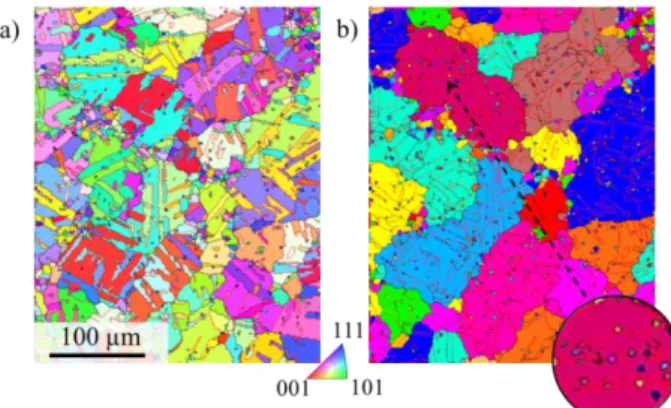
Figure 1 shows the typical microstructure configuration after exaggerate grain growth. Fig. 1-a. shows that those grains have a high density of twin boundaries. Fig. 1-b. is arbitrarily coloured (one colour per grain), ignoring twin boundaries. This reveals the large grain size and the large amount of primary γ’ precipitates located inside those
Journées Annuelles SF2M 2017 grains. Those features are common with those reported in
previous studies [2,4,12,13]. The average GOS parameter of those grains is lower than 0.5°. Their stored energy is thus below the noise associated with the EBSD data collection.
Microstructure development along a strain gradient
Figure 2 reports the typical profile of evolution of the maximum and average grain size along the strain gradient of one of the samples. The maximum grain size reaches a peak (point A), corresponding to the appearance of the first overgrown grain. The microstructure is then heterogeneous and more and more large grains invade the microstructure while their size decreases (point B). As the strain increases, the grain size distribution becomes fine and homogeneous again (point C). This profile is also typical from static recrystallization processes.
Figure 1. EBSD maps of ovegrown grains in a sample forged and annealed at Tsol for one hour.
Figure 2. Maximum and average grain sizes in a sample forged at 1040°C, 0.001s-1, water quenched and then
annealed at Tsol for one hour.
Incubation time prior abnormal grain growth
Based on the profile presented on Figure 2, the strain εcrit
at which the first large grain appears has been measured, for various time exposures at 1065°C. (εcrit corresponds to
point A on Figure 2). This critical strain decreases as the annealing time increases and the diameter of the largest grain increases. The large grains thus appear in the most deformed areas of the microstructure and the overgrown grain front moves towards the lower strain levels as the time exposure at Tsol increases. The existence of an
incubation time for the phenomenon is another characteristic in favour of the first scenario.
t (min) 0 10 20 30 40 60 εcrit - 0.19 0.17 0.15 0.14 0.05
DMAX(μm) - 40 55 70 75 170
Table 1. Critical strain for the appearance of the first abnormal grain and corresponding maximum grain size
after forging at 1040°C and 0.001 s-1.
In-situ evolution of the hetero-epitaxial grains
A sample forged at 1040°C and 0.01s-1 has been solution treated in-situ in a SEM, by steps of 2 to 5 seconds. All hetero-epitaxial grains have been identified in the initial microstructure and their evolution has been followed step by step in all EBSD maps. Several large grains have developed on the surface of the sample. None of them results from the growth of any of the hetero-epitaxial grains. Instead, the precipitates that were initially surrounded by hetero-epitaxial grains are rather located at the boundaries of the large grains: over 75% of them are located at the grain boundaries of the overgrown grains.
Conclusion
Those results suggest that the phenomenon of abnormal grain growth observed in Rene 65 during solution treatment is more likely to be a case of critical recrystallization, in which a limited number of nuclei form and invade the microstructure. The newly discovered hetero-epitaxial recrystallization mechanism does not seem to promote the formation of those large grains but seem however to limit their growth by pinning their boundaries more efficiently. Their role in this phenomenon remains to be further investigated.
References
[1] N. Bozzolo, et al. Mater. Sci. Forum. 753 (2013) 321–324.
[2] A. Agnoli, et al. Metall. Mater. Trans. A. 46 (2015) 4405–4421.
[3] A. Agnoli, PhD dissertation, 2013.
[4] V.M. Miller et al., Metall. Mater. Trans. A. 47 (2016) 1566–1574.
[5] M.-A. Charpagne et al., J. Alloys Compd. (2016). [6] M.-A. Charpagne et al., Superalloys 2016, TMS,
2016.
[7] M.-A. Charpagne et al., Recryst. Grain Growth VI proceedings, 2016.
[8] M.-A. Charpagne et al., J. Microsc. 263 (2016) 106–112.
[9] B.J. Bond et al., 8th Int. Symp. Superalloys718 Deriv.,2014:107–118.
[10] C.M. Heaney et al., 8th Int. Symp. Superalloy 718 Deriv., 2014: pp. 67–77.
[11] N. Bozzolo et al., Mater. Charact. 70 (2012) 28– 32.
[12] R. Watson et al., Eurosuperalloys 2014 proceedings, 7004.