Resisting colonisation: Worker cooperatives’ conceptualisation and behaviour in a Habermasian perspective
Abstract: This article contributes to understanding the role and position of worker
cooperatives in society, providing an socio-political explanation to their existence as well as conceptual tools that can be used to imagine and implement economic democracy practices. It uses and complexifies Habermas’ social theory and its separation between system and lifeworld to show that cooperatives may act, intentionally and idealistically, at the interface of these two domains. This positioning enables cooperatives to participate in resisting colonisation of the lifeworld by endowing individuals with resources favouring
communicative action and by redefining institutional arrangements within the system. This article identifies factors explaining the varying degrees of resistance to colonisation by cooperatives. It also contributes to theorising the potential effects of organizing work in an economically democratic way.
Keywords: Colonisation / Communicative action / Economic democracy / Habermas / Worker cooperatives
1. Introduction
Economic democracy supposes redistributing the locus and usage of power, revisiting hierarchies to render them more just. It can be enacted in workplace situations through a set of rules and practices including collective ownership, flat hierarchies and participation of all workers in decision-making (Malleson, 2014). This praxis of democracy in the workplace means that workers, as owners, can potentially and idealistically exert control and agency over their professional existence, democratically managing, working, producing and most importantly profiting collectively (Malleson, 2014; Sainseaulieu et al., 1983). These practices have the potential to empower workers at the individual level (Atzeni and Ghigliani, 2007), equipping them with the resources to function democratically, and develop solidarity for the broader community (Majee and Hoyt, 2009). In turn, this may enable workers to better shape and control the fabric of their lives. Why is achieving this ideal so difficult?
This article explores the conditions of worker cooperatives in terms of economic democracy using the social theory of Habermas as an organizing structure. Habermas
(1987) theorised a vision of modern society as a colonisation process by “the system” on the “human lifeworld” evidenced by increasing economic inequalities and a growing sense of powerlessness felt by individuals in relation to their ability to self-determine their lives. While the human lifeworld favours communicative action enabling individuals to make sense of their world, the system in place encroaches there through the forces of the state and the economy, instrumentalizing and rationalizing social relations. Colonisation thus threatens the fabric of democracy, reducing individuals’ ability to empower themselves and determine their own lifeworld trajectories (Cook, 2001). This theoretical article conceptualizes worker cooperatives as potential resisters to colonisation.
Our contributions are threefold. Firstly, following the use of Habermas’ social theory, the role and position of worker cooperatives in society is expounded. . When choosing to institutionalize workplace democracy, these firms may locate themselves at the interface of the lifeworld and the system thereby providing themselves with the opportunity to resist the colonisation of the former. Such a positioning of formal economic organisations questions the clear-cut distinction between the two spaces as separate entities initially presented by Habermas (1987). Secondly, a socio-political dimension (Cornish et al., 2016; Pestoff, 2017; Wright, 2010) to understand the raison d’être of cooperatives is proposed, which goes beyond the traditional explanations for their creation. Like social movements, they form to address the shared needs of their members who value the lifeworld. . Finally, given the insight generated through the implementation of the cooperative principles, a contribution to theorising the potential effects of organizing work in an economically
democratic way is provided. The institutionalization of democracy at the organizational level remains an important but under-researched area (Battilana et al., 2018).
Following this introduction, the second section presents Habermas’ colonisation thesis, depicting how the lifeworld and the system operate. The third part then focuses on the concept of economic democracy and how this lends itself to the workplace practices implemented in worker cooperatives. The fourth section outlines how the ideal-typical enactment of cooperative principles may place cooperatives at the interface of the lifeworld and system, equipping them with resources to potentially resist lifeworld colonisation and to redefine the institutional arrangement imposed by the system. The fifth section distances itself from this ideal-typical picture of cooperatives and uses illustrative cases found in the literature to highlight some of the difficulties cooperatives encounter when principles and
practice mismatch and resistance to colonisation dwindles. The final section outlines the article’s contributions, its limitations and areas for future research.
2. Habermas’ colonisation thesis
The German critical theorist Jürgen Habermas has developed a large theoretical body of knowledge that sketches a comprehensive social, ethical and political theory. In his book,
The Theory of Communicative Action (1987), Habermas offers a vision of modern societies
that is articulated around two levels, the human lifeworld and the system. The boundary between system and lifeworld is porous since social processes are conceived of as interchange between them (Baxter, 1987). System and lifeworld interpenetrate and reciprocally influence each other, each hosting a different type of social action that Habermas distinguishes according to their patterns of coordination. The first type, communicative action, denotes the process of reaching mutual understanding through argumentation, interpretation and deliberation, and is located in the lifeworld (Fairtlough, 1991; Habermas, 1987). The second type, strategic action, results from individual
instrumental calculations of utility and is located in the system (Baxter, 1987; Habermas, 1987).
Lifeworld and system
The lifeworld is that panoramic constellation of contexts, realities and understandings “that give coherence and direction to our lives” (Habermas, 1987: 131) and around which
individuals attempt to communicate and interpret meaningful definitions in order to
navigate through it successfully (Fleming, 2008; Heath, 2011). For Habermas, places such as the family, the school or the pub are loci for communicative action, enabling democratic discourse to emerge in the search for consensus. As such, they provide the base for the practice of democracy (Cook, 2001). Drawing on Parsons, Habermas (1987) distinguishes three components that structure the lifeworld and which he considers as key resources for communicative action. First, the ‘society’ component includes networks, social ties,
communities of practices and social groups in which actors secure solidarity (Habermas, 1987). It is the institutional frame within which they experience a given situation (Baxter, 1987). Second, ‘personality’ corresponds to the patterns of motivation and the stock of competences for speech and action through which actors can assert their own individual and
collective identity (Baxter, 1987; Habermas, 1987). And third, ‘culture’, corresponds to the “cultural tradition that shapes actors’ interpretive schemes and value-standards” (Baxter, 1987: 47). The cultural component of the lifeworld builds on shared tradition and knowledge (Edwards, 2008) that enables mutual understanding between actors (Habermas, 1987). These components are interconnected and have a two-way relationship with communicative action; on the one hand, they constitute its key resources and on the other, they are
continuously reproducing these resources through communicative action (Edwards, 2008). In contrast, the system is governed by a functional logic, mainly enabling
instrumental and strategic action. It is subdivided in two main substructures: the administrative system (state and related institutions, such as state-sanctioned political parties) and the economy (Habermas, 1987; Heath, 2011). These sub-systems’ main function is the production and circulation of goods and services to ensure the material reproduction of society (Habermas, 1987).
The economic and administrative sub-systems are structured by formal
organisations, which Habermas (1987) considers following the Weberian ideal-type of bureaucratic organisation (Baxter, 1987). That is, these organisations are hierarchically structured, with concentrated control and power. As such, they operate according to the system’s strategic action patterns. However, Habermas (1987) recognizes the presence of communicative action within formal organisations, where “members act communicatively with reservations” (Habermas, 1987: 310). The lifeworld communicative action pattern can thus be found within the system, even though strategic action prevails, given the power wielded by organisations.
Beyond the constrained penetration of the lifeworld in formal organisations, interchange relations between the system and the lifeworld takes place through four roles that people endorse: consumer, employee, citizen, client (Habermas, 1987). Money and power are the media used to operate these relations. For instance, lifeworld interchanges with the economic sub-system when employees exchange labour-power for income or when the client pays taxes to the state in exchange for public services.
Colonisation
Habermas argues that the pattern of interchange relations between system and lifeworld, which he denotes as the mediatisation of the lifeworld (Baxter, 1987; Heath, 2011), takes
“the form of a colonisation” when “systemic mechanisms suppress social integration” (Habermas, 1987, p. 196) and destroy the lifeworld’s communicative fabric (Edwards, 2009a). It has this destructive potential because economic and political interference in everyday life extends a (system-related) strategic rationality into the lifeworld, coordinating action on the basis of money (the market) and power (state bureaucracy). Thereby, such rationalisation disregards communicative action aimed at consensus building (Edwards, 2009a; Habermas, 1987). As a result, the real needs and wishes of lifeworld’s participants become blurred, leading them to progressively take on the aspirations defined by the system at the expense of their own. This leads to an instrumentalisation of social relations and a reification of society (Heath, 2011; Jütten, 2011). Consequently, as Cook (2001) argues, colonisation threatens self-determination and empowerment, which lie at the heart of the democratic project.
Habermas (1987) identifies two processes through which colonisation is conducted: juridification and commodification. These processes respectively express the increasing influence of media, power and money in the lifeworld. Juridification corresponds to state-led actions implemented to spread bureaucracy and to extend its power by intensifying legal interference in the lifeworld. In particular, Habermas considers the welfare state as an example of juridification. This process subjects communicatively-structured domains of action, i.e. lifeworld domains such as the family, to the systemic imperatives of power (and the state) and thus results in a loss of freedom for individuals (Edwards, 2009b; Jütten, 2011). Although the welfare state offers individual entitlements, it relies on general legal conditions that must be dealt with administratively (Blichner and Molander, 2008). Overall, Habermas (1987) argues that, once the spaces where communicative action takes place are colonised by bureaucratic procedures over which citizens have no control, democracy is in danger (Cook, 2001).
Commodification corresponds to the intensification of market presence in the lifeworld. It translates the increased monetisation of interactions and the transformation of individuals into consumers in all aspects of their life. The market logic promoted through commodification ultimately allows the expression of any social interaction in terms of private property. According to Habermas (1987), commodification endangers democracy as it destroys the authenticity governing communicative action and reduces consensus building to a monetary trade-off. An example of commodification is provided by Edwards (2009b) in
her description of the integration of neo-liberal market-inspired policies in the restructuring of UK public sector education, by the introduction of private sector management practices in schools such as performance-related pay. Both processes relate, to some extent, to a desire for hegemony as defined by Gramsci, where everyday practices, such as culture, recreation and interpersonal relations have become infiltrated with the logic of the dominant ideology (Fleming, 2008).
In order to reclaim the private sphere and fight against colonisation, enacting practices that foster communicative forms of solidarity is required. Habermas observes the rise of “new social movements” which, he explains, emerge in reaction to the colonisation of the lifeworld (1981, 1987). He characterizes these movements as ‘new’ to contrast them with more traditional class (worker) movements in that they focus on who we are and how we live (Crossley, 2003; Edwards, 2009a). Situated in the lifeworld, new social movements aim to defend endangered lifestyles or to put new lifestyles into practice (Habermas, 1981). For example, environmental movements seek to preserve the natural and cultural
environment against the overuse of resources due to excessive production driven by the search for increased profits. Anti-corporate movements such as Reclaim the Streets and Ad-Busters seek to take back ownership of public space from corporations – which they claim is colonised through advertisements (Crossley, 2003). These new social movements create communicative action while aiming to counter the depoliticisation and the rationalisation of the public sphere, thereby fuelling democracy through empowerment and
self-determination (Cook, 2001).
3. Cooperatives and the ideal of economic democracy
Cooperative firms are often portrayed as ‘alternative’ organizations (Cheney et al., 2014; Author D et al., 2016; Wright, 2010). Their ownership structure, their democratic
governance processes and the fact that they pursue both social and economic objectivesdistinguishes them from the traditional, hierarchical model, where profit maximisation for distribution to shareholders is the priority. Inherent in this values-driven organisational model lies the practice of democracy in governance (Borzaga and Defourny, 2001), which supports the expression of democratic principles in the workplace for worker cooperatives.
Workers in these cooperatives own their organisation as they invest both capital and labour. Formally, they control the organisation democratically, usually by voting the major strategic orientations and electing the managers at general assemblies, following the principle of one worker, one vote (Audebrand, 2017). Variations exist in the way and the extent to which workers participate in decision-making, from direct participation by majority voting or by consensus, to election of representatives, to very little involvement in daily decision-making (Batstone, 1983; Dow, 2003). Democratic practice can also be enabled when individuals in cooperatives mobilize hitherto untapped resources. Workers may enjoy higher individual motivation when profit-sharing and self-interest go hand in glove and are mutually rewarded (Luhman, 2006), in turn increasing productivity. This level of motivation may also be fuelled by an interest in and concern for the welfare of members of the wider cooperative community. In line with Sainseaulieu et al. (1983), Luhman (2006) points out how overall solidarity can be built when an individual’s aspirations coincide with
organizational goals, empowering the former’s autonomy and level of participation.
However, on a global level, worker cooperatives remain fairly marginal players even though their number is rising (Cheney et al., 2014): 2,366 in France, more than 17,000 in Spain (inlcuding the famous Mondragon group (Agirre et al., 2014)) and 357 in the United States1. Beyond the legitimacy deficit associated with worker cooperatives (Rothschild, 2009), the implementation and practice of economic democracy brings tensions and paradoxes (Audrebrand, 2017) that stem from both the distinctive characteristics of
cooperatives and from external market and competition pressures. The need to perform on the market creates pressures on democratic practices, which may be curtailed in favour of control and monitoring functions to ensure efficiency of worker-members (Varman and Chakrabarti, 2004). Economic performance of worker cooperatives may also suffer from the high transaction costs generated by coordination problems relating to collective decision-making and ownership (Hansmann, 1996) or from difficulties in attracting managers due to the egalitarian values tied to economic democracy, for instance with regard to pay (Johnson, 2006). Audebrand (2017) also lists organising tensions between the need for hierarchical control and democratic decision-making: ”belonging tensions” between the desire for individuality and communality by the worker-members and “learning tensions”, for example, the drive to become mainstream versus remaining an alternative organisation.
According to Cornforth et al. (1988), three trajectories leading to degeneration, i..e, the loss of democratic features, can be identified. Firstly, there is constitutional degeneration by which democracy transforms into oligarchy as ownership is held by an elite minority. Secondly, capitalist degeneration is rooted in market pressures that drive alignment to h the dominant organisational model in the environment. Such pressures may stem, for instance, from the undercapitalization of cooperatives and their greater use of debt financing, as compared to capitalist enterprises. This results in lower capital accumulation because worker-members are less inclined to invest profits in their enterprise for long-term investments because of diverging time horizons (Dow, 2003). Thirdly, internal pressures leading to managerialist control can result from an instrumental use of democracy and participatory decision-making by management as ways of organizing, exercising and
legitimizing their political power (Desmond and Wilson, forthcoming). Democracy may also be threatened when some groups of employees achieve a dominant position in decision-making by having a more influential voice thanks to, for instance, their technical expertise (Timming, 2015).
While some authors argue that the very nature of cooperatives feeds a degeneration process systemically-embedded in their life-cycle-- and therefore inescapable -- recent studies offer evidence that this is not always the case (Diefenbach, 2019; Storey et al., 2014). These authors, however, do concur, that these organisations operate under constant threat of degeneration As democracy is “placed within a bundle of contradictions” (Varman and Chakrabarti, 2004: 184), its implementation in organizations and its institutionalization against the dominant hierarchical model is a permanent challenge (Audebrand, 2017). Section 5 below extends on this theme.
4. Cooperative principles, economic democracy and resistance to colonisation The cooperative principles (see Table 1) are guidelines for cooperatives to put the core values on which they are based into practice: self-help, self-responsibility, democracy, equality, equity and solidarity (ICA, 2015). These principles are inspired from the Rochdale Society of Equitable Pionneers (Ratner, 2013) and they are monitored and updated by the International Cooperative Alliance (ICA) (ICA, 2015). Cooperative principles are not legally binding but rather ideals that not all cooperatives put into practice in the same way and to the same extent (Fonteyne and Hardy, 2011; ICA, 2015).
TABLE 1 here
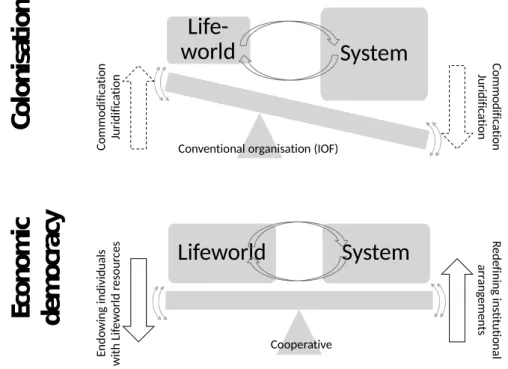
This article contends that these principles enable cooperatives to imagine and to implement economic democracy, contributing to resistance of colonisation in two ways, as illustrated in Figure 1: (1) their implementation endows individuals with lifeworld resources and (2) it allows them to participate in redefining priorities of institutional arrangements within the system. This section discusses the potential of cooperatives to resist colonisation based on the ideal-typical understanding of their configurations and through the application of the seven cooperative principles promoted by the ICA. The following section relaxes these idealistic assumptions to focus on the evolving democratic reality in which cooperatives actually operate.
FIGURE 1 here
4.1. Cooperative principles as endowing individuals with lifeworld resources
Worker cooperatives, despite being formal organisations that operate in the economic sub-system, have the potential to create and/or to strengthen the three types of lifeworld resources favouring communicative action –society, personality and culture – through practices that are grounded in the cooperative principles (see Figure 2).
FIGURE 2 here
Society
Firstly, worker cooperatives may contribute to the societal dimension of the lifeworld by endowing their members and their environment with trust and social capital (Majee and Hoyt, 2009; Hatak et al., 2016) that form a base to resist juridification and commodification (Ciscel and Heath, 2001). They do so through implementation of cooperative principle 2, which stresses the democratic control of the organisation by its members. Such democracy is more likely to be ensured by the ‘one-worker one-vote’ governance principle, which assumes equality among workers in decision-making. Involving workers in governance also requires transparency in communicating information to worker-owners in order for them to
make sound decisions (ICA, 2015; Marchington, 2005). Both equality and transparency facilitate the creation of trust and social capital (Uslaner, 2003).
Secondly, cooperatives seek to satisfy the common needs of their members and those of their community (cooperative principles 3 and 7). In other words, much like new social movements, a cooperative brings together persons who share the same needs, offering commonly-shared solutions. This implies that relations are not solely expressed in terms of (monetary) private gains, but in terms of needs. This may strengthen the society component of the lifeworld by enabling the cooperative to form a community of practice (O’Donnell et al., 2003). Joining forces in this way generates solidarity among members. Moreover, placing problem-solving as a priority over profit-making may create trust with the workers (Borzaga and Tortia, 2006) and with other stakeholders to form a community spirit (Hatak et al., 2016).
Cooperatives may also create trust and reinforce society through the commonwealth of cooperatives created in following principle 6 of cooperation among cooperatives. The internationally shared values borne by the ICA form a common ground for action through mutual understanding and shared expectations (Author D et al., 2016; Somerville, 2007) that facilitate trust among cooperatives and among cooperative members. Also, this principle forms a base for the ICA and other apex organizations to unite cooperatives, develop (individual) networks and structure society.
Personality
The second dimension of the lifeworld cooperatives may contribute to is that of personality. Open and voluntary membership (principle 1) implies that individuals voluntarily adhere to a value-laden organization that addresses their common needs. Such collective action aiming to fulfill a common objective contributes to creating a shared identity among cooperative members (Defourny and Develtere, 2009). Hence, workers joining a cooperative are likely to endorse a certain identity that defines them both socially and collectively.
Cooperatives may further strengthen personality through role concentration. Following principles 1, 2 and 3, workers own and control the organisation. Beyond the redefinition of roles among organizational stakeholders in comparison to conventional enterprises, this role concentration generates complexity with regard to individual identity (Mamouni Limnios et al., 2018; Author D et al., 2016). Workers, whose role traditionally
remains confined to the lifeworld, endorse roles and identities that are usually associated with the system – i.e. firm owner, organisation director, economic decision-maker. Instead of being diluted, the identity of the worker is given more power, which in turn reinforces personality.
The international cooperative identity articulated by the ICA and the cooperation among cooperatives (principle 6) may also create the background for shaping a collective identity (Author D et al., 2016; Somerville, 2007). This formalized identity rests on a shared set of values and principles that cooperatives and their members are encouraged to put in practice and to promote. The transnational character of this identity contributes to
strengthening the lifeworld against state power, while the grounding in moral values supports the resitance to commodification.
Culture
Cooperatives may contribute to reinforcing the third element of lifeworld, culture, by creating shared frames of references and practices. They bring together willing individuals experiencing a common need who focus on finding a solution to meet this need on their own (cooperative principles 1, 3 and 4). Experiencing a common need creates a shared frame of reference for the cooperative members with regard to a specific issue. In response to this common need, individuals may decide what is best for themselves – the ‘how we live’ -- that is characteristic of new social movements according to Habermas (1981). This may enable reducing (institutional) voids in which bureaucracy could interfere to expand the power of the state.
Cooperatives may also strengthen the culture dimension of the lifeworld by endowing workers with democratic decision-making skills (discussion, negotiation,
consensus building) (principles 2 and 5) that are required for economic democracy to work (Meek and Woodworth, 1990). By implementing such democratic practice and by offering education and training, cooperatives are likely to foster collective communicative action, which in turn will facilitate the creation of shared understanding and practices among worker-members.
Summing up, worker cooperatives have the potential to strengthen the constitutive elements of the lifeworld through the implementation of cooperative principles. They thereby provide resources (Edwards, 2008) that facilitate resistance to colonisation. Worker
cooperatives thus contribute to society by creating social capital;,they support personality by creating a collective identity, and they foster culture through the development of shared practices. Cooperative principles do not only influence the lifeworld; they also act on the system by redefining the institutional arrangements that underlie its components.
4.2. Cooperative principles redefining institutional arrangements in the system
There are three main ways by which cooperatives may distance themselves from the system’s institutional orders, generating a space to resist the colonization of the lifeworld.
Firstly,l cooperatives participate in reallocating power, potentially generating more equality among individuals than would be found under capital ownership. In other words, economic democracy enables cooperatives to distance themselves from the plutocratic principles inherent in the capitalist ideology. In contrast to the hierarchical structure that predominates in conventional organizations (Baxter, 1987), in worker cooperatives worker-owners tend to have an equal say in their governance. Moreover, worker cooperatives have been found to be an instrument for poverty alleviation (Birchall, 2003) and for the reduction of power imbalance and economic inequalities (Paranque and Willmott, 2014), including those related to gender (Miller, 2011). Cooperatives also tend to move away from market ideology as they have made it more difficult to speculate on ownership rights given that the share price is not marketable but redeemed at par value in case of owner exit (derived from principles 1 and 2).
Secondly, worker cooperatives tend to revalorize labour in comparison to capital. This happens because of role concentration among members and focuses on fulfilling members’ common needs. Because individuals take on the multiple roles of workers, owners and controllers in cooperatives (principles 1, 2 and 3), there is no primacy of capital over labour. Instead, cooperatives reverse the conventional situation of the commodification of labour - i.e. the labour hired by the capital – by putting capital at the service of worker-members’ objectives. In worker cooperatives, the common need of members is job stability, although this goal may be pursued at the expense of workers’ income stability (Pencavel, 2013).
Thirdly, cooperatives are more likely than other types of organisations to participate in replacing money over finance as a priority in the system, thereby strengthening
democracy (Walby, 2013). Their focus on addressing members’ needs (principle 3) and community concerns (principle 7) leads them to look more toward economic value creation
over shareholder wealth creation (Pencavel, 2013).. s. In addition, this priority for value creation is also likely to create social capital and trust with external stakeholders such as suppliers and customers (Majee and Hoyt, 2009), further strengthening democracy (Putnam, 1995).
Moving away from the ideal-typical model of the cooperative, we now examine cases of actual worker cooperatives to see how they deal with the implementation of democratic practices in the workplace.
5. On a spectrum of resistance to colonisation
Worker cooperatives operate in economic, social and legal realities that put their
democratically-driven values and the full implementation of cooperative principles under constant pressure (Audebrand, 2017). Their inherent fragile nature makes them ideal candidates for degeneration (Cornforth, 1995; Somerville, 2007). However, an examination of this process in several worker cooperatives shows that cooperatives can adapt to this over-arching threat in different ways and to varying degrees. In some cases they resist degeneration altogether; other cases show cooperatives that abandon one or more of their cooperative principles, avoiding outright degeneration;whilst some others finally surrender to the pressure. There are also cases of single cooperatives that regenerate following degeneration. Through the three brief examples of different worker cooperatives described in the literature and offered below, we contend that these organizations can be positioned on a spectrum of resistance to the colonisation threat of degeneration
1. The Auckland Philharmonic Orchestra (AP), studied by Bathurst and Monin (2010), has evolved from strong resistance to colonisation at its creation to degeneration. AP was founded in 1980 as a cooperative because its musicians rejected the top-down management and decision-making approaches imposed by the precedent symphony, which they found unaligned with their needs. At a time when the system had colonised their lifeworld as musicians, they seized the potential for resistance by creating a worker cooperative and strove over a period of 30 years to maintain this alternative form. However, a more corporate-driven group of younger musicians emerged, arguing in favour of a separation between management and music-making, limiting the musicans’ roles to that of employee. The thorny question of ensuring AP’s financial viability, arising in part due to the external pressure exerted by financial sponsors, swayed the balance in favour of advocates for
corporatization resulting in the commodification of the organisation and its labour, leading the orchestra to degenerate and abandon its cooperative status.
2. Samiti is a maintenance and cleaning services cooperative in India, studied by Varman & Chakrabarti (2004) over a seven-year period. It succeeded in resisting the constant threat of degeneration. The cooperative was founded to transform the contracts of low-skilled temporary workers, affiliated to a technological institute, into permanent jobs. These
worker-members, positioned on the lowest level of the social hierarchy, initially encountered huge difficulties in imposing their voice. Treated as subservient employees and subjected to a paternalistic management style, they gradually appropriated a certain level of democratic consciousness. They learned to defend their own lifeworld interests and democratic values as a cooperative; to behave as owners when negotiating with the various stakeholders involved in the daily operations of the cooperative and to give voice to similarly-positioned workers in the wider community. In other words, they gained lifeworld resources through a narrower implementation of the cooperative principles, which they used to fully embrace the two roles of employee and owner turning an oligarchic organisation into a more democratic one (Diefenbach, 2019). Doing so allowed them to infilitrate the system with their lifeworld and resist colonisation. They eventually established a sustainable business that continues to achieve both its social and economic objectives.
3. Equal Exchange (EEX), studied by Kennelly and Odeken (2016), started out as a worker cooperative sourcing and marketing fair trade coffee and cocoawith a strong, idealistic intention to improve the lives of its worker-members, consumers and producers. On the spectrum of resistance to colonisation, this cooperative delivers nuanced picture of how cooperatives partially resist by adapting their internal structure and rules to deal with external realities. Over the years, EEX encountered growth and commercial success, adding a number of new product lines in other fair-trade products and increasing the number of worker-members as well as non-members. The development of an expansionary policy culminated in the purchase of a non-cooperative business, a decision taken by the
management without members’ official consent. This reflected how democracy had become to some extent a façade legitimizing management’s power (Desmond and Wilson,
forthcoming). Having compromised on democratic principles, the cooperative now seems to occupy a middle ground, remaining a cooperative in name but with a vertical management system. This failure by the cooperative to redefine institutional arrangements created new
potential for resistance. This led to a form of regeneration (Storey et al., 2014) by reaffirming the ethos of workplace democracy and supporting its implementation in various areas, including strengthened education and information of members, thereby endowing them with more lifeworld resources.
These cases illustrate how worker cooperatives vary in the style and intensity with which they resist colonisation. Such variation exists among cooperatives as well as over time for the individual cooperative. They also show how the lifeworld, system, and
colonisation concepts can help to identify organizational and systemic factors that influence the degree and application of economic democracy in practice. As Varman & Chakrabarti (2004) point out, the institutionalization of democracy is a long, drawn out process. Over a given period, a cooperative may modify how it implements the cooperative principles to respond to internal and/or environmental demands.
Finally, the cases show two influences on a cooperative’s position on the spectrum of resistance. Firstly, resistance is likely to be higher when worker-members are willing to embrace the roles of both employee and owner, thereby crossing the bridge between lifeworld and system and expanding the interface position of the cooperative. Secondly, resistance is likely to be higher in situations when individuals feel their lifeworld being strongly threatened by colonisation.
6. Contributions and conclusion
Following Habermas’ social theory, this article highlights how practicing economic
democracy in worker cooperatives has the potential to foster resistance of colonisation of the lifeworld by the system. The possible positioning of cooperatives at the interface of lifeworld and system allows them to act on both spaces. On the one hand, lifeworld
resources are likely to be strengthened by the implementation of the cooperative principles. On the other hand, these principles may enable cooperatives to follow other norms and practices than those institutionalised by the system. In other words, through the
implementation of economic democracy, worker cooperatives can enable individual workers to reclaim their private sphere and reshape their lifeworld with norms that do not conform to the market rules under which their firm operates. However, we have noted that
vary the degree of economic democracy they implement over time, creating variance in their capacity to resist colonisation.
This article makes several theoretical contributions. Firstly, it shows the relevance of, and adds complexity to, Habermas’ social theory to analyse worker cooperatives and their role in society. Where Habermas (1987) posits two distinct blocks that interact (Heath, 2011): the lifeworld and the system, this article shows the potential of worker cooperatives to act at their interface. As formal economic organisations, worker cooperatives would be considered as part of Habermas’ system. However, like new social movements, by following their shared principles and implementing economic democracy, cooperatives do not totally conform to the institutionalised norms of the system (Edwards, 2009a; Habermas, 1981). The article thus contributes to blurring the distinctiveness between system and lifeworld that Habermas (1987) considers as clear-cut. Cooperatives, and probably other types of organisations that simultaneously pursue social and economic goals, create a space at the intersection of the system and the lifeworld, where communicative action can develop through the enhancement of lifeworld resources, as a vehicle of the system. Cooperatives can thus be positioned along a spectrum of resistance, with degeneration as a factor leading them to move further away from the ideal-typical situation.
Second,ly the colonisation thesis provides new, more socio-political insights on cooperatives (Cornish et al., 2016; Pestoff, 2017; Wright, 2010). Typically, the existence of cooperatives is justified by economies on transaction costs (Hansmann, 1988) or by the presence of market or state failures, in particular to respond to information assymetry, to address a monopolistic situation or to produce and provide a public good (Author C, 2014). Here, an alternative explanation that parallels Habermas’ thesis on the emergence of new social movements (1981) is provided. Cooperatives are created to address shared needs (Defourny and Develtere, 2009) and therefore to defend their members’ grammar of life. This positioning of cooperatives places them in a potential role of resistance to both commodification and juridification. It also delivers a conception and a language for the commitment of worker cooperatives that could aid the movement in articulating for itself, and for others, why maintaining cooperative principles is so difficult in practice.
We extend the understanding of the varying nature of resistance through worker cooperatives in at least two ways. Firstly, given the dynamic relationships between the lifeworld and the system (Fairtlough, 1991; Habermas, 1987; Heath, 2011), which usually
results in the dominance of the system through the colonisation process, the interface between them is also evolving. Hence, the potential for developing and reinforcing lifeworld resources, and thus for resistance, grows in proportion to the extent that the system
succeeds in colonising the lifeworld. Second,ly in worker cooperatives, the same individuals are placed at both ends of the relationship between the lifeworld and the system because they are simultaneously the employees providing labour power in exchange for income (Habermas, 1987) and the owners who decide on the hiring and pay policies of their organisation. This puts these individuals in a situation where they need to balance and combine communicative and strategic action. Given the dynamic nature of the exchanges, these individuals are likely to prioritize different roles at different times, resulting in variations in the degree of resistance that the cooperative can wield.
Finally, this article also contributes to theorising the potential effects of organizing work in an economically democratic way and more specifically the impact of following implementation of the cooperative principles. Battilana et al. (2018) have reported the growing tendency for organizations to adopt a more hybrid form of organizing in order to respond to the multiple objectives they embrace. Consequently, the hierarchical model that values profit only is becoming less representative of efficient revenue production and more democratic models of organizing that also favour social and environmental concerns are being called for. Worker cooperatives offer a distinctive landscape for further elaborating alternative organisational theory (Audebrand, 2017). Furthermore, by embedding its understanding in a broader social theory, this article enables going beyond existing studies to examine economic democracy and its effects across levels of analysis (individual,
organisational and institutional).
The theoretical nature of this article comes with several limitations, providing paths for future research. First, we conceptualised resistance to colonisation by worker
cooperatives as varying on a broad spectrum, yet our analysis remained general regarding the origins of such variations. This paper lays the foundations for future empirical studies to refine our understanding of the actual mechanisms through which economic democracy is implemented in worker cooperatives and how cooperative principles enhance lifeworld resources. For example, ethnographic research could examine the actual practices of
workplace democracy relating to communicative action and answer such questions as: what organisational factors such as decision-making processes or governance design are
influencing lifeworld resources and how? A large scale survey and diary data collection among workers in cooperatives could also contribute to determining how and to what extent individuals’ lifeworld is enriched by communicative action in the workplace through the implementation of democratic practices. Second, the analysis here was confined to worker cooperatives and findings cannot be generalised to all cooperatives. Future research is necessary to examine the broader application to other types of cooperatives (e.g. consumer or multistakeholder cooperatives) and to other economic democracy initiatives (e.g.
participatory budget). Another promising path for research resides in prolonging the
developed social and political view of cooperatives by creating dialogue between Habermas’ social theory and other theories, such as prefigurative politics (Cornish et al., 2016) or institutional theory. For instance, as cooperatives have the potential to be instruments of resistance to colonisation, they could also be understood as an instrument of institutional work (Lawrence and Suddaby, 2006) in relation to the system’s established norms. By creating a link with Habermas’ theory, this article may provide new theoretical and empirical avenues on worker cooperatives and economic democracy.
Endnotes
1. Source of statistics: for France, DG SCOP (2018) http://www.les-
scop.coop/export/sites/default/fr/_media/docs-organisation/Rapport_d_activite_2017_CG_Scop.pdf; for Spain, COCETA (2018)
http://www.coceta.coop/coceta.asp; for the US, Democracy Institute (2018)
https://institute.app.box.com/s/fcxez74qvpgxoanup435fl1ll1wza1xo
References
Agirre I, Reinares P and Agirre A. (2014) Antecedents to market orientation in the worker cooperative organization: The Mondragon Group. Annals of Public and Cooperative
Economics 85(3): 387-408.
Atzeni M and Ghigliani P. (2007) Labour process and decision-making in factories under workers' self-management: Empirical evidence from Argentina. Work, Employment
and Society 21(4): 653-671.
Audebrand LK. (2017) Expanding the scope of paradox scholarship on social enterprise: The case for (re)introducing worker cooperatives. M@n@gement 20(4): 368-393.
Bathurst RJ and Monin N. (2010) Finding myth and motive in language: A narrative of organizational change. Journal of Management Inquiry 19(3): 262-272.
Batstone E. (1983) Organization and orientation: A life cycle model of French co-operatives.
Economic and Industrial Democracy 4(2): 139-161.
Battilana J, Fuerstein M and Lee M. (2018) New prospects for organizational democracy? How the joint pursuit of social and financial goals challenges traditional
organizational designs. In: Rangan S (ed) Capitalism beyond mutuality? Perspectives
integrating philosophy and social science. Oxford: Oxford University Press, 258-288.
Baxter H. (1987) System and life-world in Habermas's Theory of communicative action.
Theory and Society 16(1): 39-86.
Birchall J. (2003) Rediscovering the cooperative advantage. Poverty reduction through
self-help, Geneva: International Labour Organization.
Blichner LC and Molander A. (2008) Mapping juridification. European Law Journal 14(1): 36-54.
Borzaga C and Defourny J. (2001) The emergence of social enterprise. London: Routledge. Borzaga C and Tortia E. (2006) Worker motivations, job satisfaction, and loyalty in public and
nonprofit social services. Nonprofit and Voluntary Sector Quarterly 35(2): 225-248. Ciscel DH and Heath JA. (2001) To market, to market: Imperial capitalism's destruction of
social capital and the family. Review of Radical Political Economics 33(4): 401-414. Cheney G, Santa Cruz I, Peredo AM and Nazareno E. (2014) Worker cooperatives as an
organizational alternative: Challenges, achievements and promise in business governance and ownership. Organization 21(5): 591-603.
Cook D. (2001) The two faces of liberal democracy in Habermas. Philosophy Today 45(1): 95-104.
Cornforth C. (1995) Patterns of cooperative management: Beyond the degeneration thesis.
Economic and Industrial Democracy 16(4): 487-523.
Cornforth C, Thomas A, Spear R and Lewis J. (1988) Developing successful worker
cooperatives, London: Sage.
Cornish F, Haaken J, Moskovitz L and Jackson S. (2016) Rethinking prefigurative politics: Introduction to the special thematic section. Journal of Social and Political
Psychology 4(1): 114-127.
Crossley N. (2003) Even newer social movements? Anti-corporate protests, capitalist crises and the remoralization of society. Organization 10(2): 287-305.
Defourny J and Develtere P. (2009) The social economy: The worldwide making of a third sector. In: Defourny J, Develtere P, Fonteneau B, et al. (eds) The worldwide making of
the social economy: Innovations and changes. Leuven: Uitgeverij Acco, 15-40.
Desmond J and Wilson F. (forthcoming) Democracy and worker representation in the management of change: Lessons from Kurt Lewin and the Harwood studies. Human
Relations.
Diefenbach T. (2019) Why Michels’ ‘iron law of oligarchy’ is not an iron law – and how democratic organisations can stay ‘oligarchy-free’. Organization Studies 40(4): 545– 562.
Dow GK. (2003) Governing the firm: Workers’ control in theory and practice, Cambridge: Cambridge University Press.
Edwards G. (2008) The `Lifeworld' as a resource for social movement participation and the consequences of its colonization. Sociology 42(2): 299-316.
Edwards G. (2009a) Habermas and social movement theory. Sociology Compass 3(3): 381-393.
Edwards G. (2009b) Public sector trade unionism in the UK: Strategic challenges in the face of colonization. Work, Employment and Society 23(3): 442-459.
Fairtlough GH. (1991) Habermas' concept of “Lifeworld”. Systems practice 4(6): 547-563. Fleming T. (2008) We are condemned to learn: Towards higher education as a learning
society. Level3. (accessed 21 December, 2016).
Fonteyne W and Hardy DC. (2011) Cooperative banking and ethics: Past, present and future.
Ethical perspectives 18(4): 491-514.
Habermas J. (1981) New social movements. Telos 49: 33-37.
Habermas J. (1987) Theory of communicative action, Volume two: Lifeworld and system: A
critique of functionalist reason, Boston: Beacon Press.
Hatak I, Lang R and Roessl D. (2016) Trust, social capital, and the coordination of relationships between the members of cooperatives: A comparison between member-focused cooperatives and third-party-focused cooperatives. VOLUNTAS 27(3): 1218-1241.
Hansmann HB. (1988) Ownership of the firm. Journal of Law, Economics, and Organization 4(2): 267-304.
Heath J. (2011) System and lifeworld. In: Fultner B (ed) Jürgen Habermas: Key concepts. New York: Routledge, 74-90.
Heras-Saizarbitoria I and Basterretxea I. (2016) Do co-ops speak the managerial lingua franca? An analysis of the managerial discourse of Mondragon cooperatives. Journal
of Co-operative Organization and Management 4(1): 13-21.
ICA. (2015) Guidance note to the co-operative principles, Brussels: International Co-operative Alliance.
Johnson P. (2006) Whence democracy? A review and critique of the conceptual dimensions and implications of the Business Case for organizational democracy. Organization 13(2): 245-274.
Jütten T. (2011) The colonization thesis: Habermas on reification. International Journal of
Philosophical Studies 19(5): 701-727.
Kennelly JJ and Odekon M. (2016) Worker cooperatives in the United States, Redux.
WorkingUSA 19(2): 163-185.
Lawrence T and Suddaby R. (2006) Institutions and institutional work. In: Clegg S, Hardy C, Lawrence T, et al. (eds) The SAGE Handbook of organization studies. 2nd ed. London: Sage, 215-254.
Luhman JT. (2006) Theoretical postulations on organization democracy. Journal of
Management Inquiry 15(2): 168-185.
Majee W and Hoyt A. (2009) Building community trust through cooperatives: A case study of a worker-owned homecare cooperative. Journal of Community Practice 17(4): 444-463.
Malleson T. (2014) After Occupy: Economic democracy for the 21st century, Oxford: Oxford University Press.
Mamouni Limnios E, Mazzarol T, Soutar GN and Siddique KH. (2018) The member wears Four Hats: A member identification framework for co-operative enterprises. Journal of
Co-operative Organization and Management 6(1): 20-33.
Marchington M. (2005) Employee involvement: Patterns and explanations. In: Harley B, Hyman J and Thompson P (eds) Participation and democracy at work. Essays in
Meek CB and Woodworth WP. (1990) Technical training and enterprise: Mondragon's educational system and its implications for other cooperatives. Economic and
Industrial Democracy 11(4): 505-528.
Miller GR. (2011) Gender and participation in decision-making in labor-managed firms: The context of the USA. Economic and Industrial Democracy 32(1): 87-113.
O’Donnell D, Porter G, McGuire D, Garavan TN, Heffernan M and Cleary P. (2003) Creating intellectual capital: A Habermasian community of practice (CoP) introduction.
Journal of European Industrial Training 27(2/3/4): 80-87.
Paranque B and Willmott H. (2014) Cooperatives—saviours or gravediggers of capitalism? Critical performativity and the John Lewis Partnership. Organization 21(5): 604-625. Pencavel J. (2013) Worker cooperatives and democratic governance. In: Grandori A (ed)
Handbook of Economic Organization: Integrating Economic and Organization Theory.
Cheltenham: Edward Elgar, 462-480.
Pestoff V. (2017) The social and political dimensions of co-operative enterprises. In: Michie J, Blasi JR and Borzaga C (eds) The Oxford Handbook of Mutual, operative, and
Co-owned Business. Oxford: Oxford University Press, 76-94.
Putnam RD. (1995) Bowling alone: America's declining social capital. Journal of Democracy 6(1): 65-78.
Ratner C. (2013) Cooperation, community, and co-ops in a global era, Heiderlberg: Springer. Rothschild, J. (2009) Workers’ cooperatives and social enterprises: A forgotten route to social
equity and democracy. American Behavioral Scientist 52(7): 1023-1041
Sainseaulieu R, Tixier P-E and Marty M-O. (1983) La démocratie en organisation: Vers des
fonctionnements collectifs de travail, Paris: Librairie des Méridiens.
Somerville P. (2007) Co-operative identity. Journal of Co-operative Studies 40(1): 5-17. Storey J, Basterretxea I and Salaman G. (2014) Managing and resisting ‘degeneration’ in
employee-owned businesses: A comparative study of two large retailers in Spain and the United Kingdom. Organization 21(5): 626-644.
Timming AR. (2015) The ‘reach’ of employee participation in decision-making: Exploring the Aristotelian roots of workplace democracy. Human Resource Management Journal 25(3): 382-396.
Uslaner EM. (2003) Trust, democracy and governance: Can government policies influence generalized trust? In: Hooghe M and Stolle D (eds) Generating social capital. New York: Palgrave MacMillan, 171-190.
Varman R and Chakrabarti M. (2004) Contradictions of democracy in a workers’ cooperative.
Organization Studies 25(2): 183-208.
Walby S. (2013) Finance versus democracy? Theorizing finance in society. Work, Employment
and Society 27(3): 489-507.
Wright EO. (2010) Envisioning real utopias, London: Verso.
Tables and figures
Table 1: Cooperative principles, as adopted in 1995 by the ICA
Principle Explanation
. all persons able to use their services and willing to accept the responsibilities of membership. 2
.
Democratic member control Cooperatives are democratic organizations, controlled by their members, who actively participate in setting their policies and making decisions. Elected members are accountable for their actions and all members have equal voting rights (one-man, one-vote).
3 .
Member economic participation Members contribute equitably to, and democratically control, the capital of their
cooperative, of which part becomes the common property of the organization. They usually receive limited compensation on capital subscribed and allocate surpluses for the development of the cooperative.
4 .
Autonomy and independence Cooperatives are autonomous, self-help
organisations controlled by their members. If they enter into agreements with other organisations, including governments, or raise capital from external sources, they do so on terms that ensure democratic control by their members and
maintain their co-operative autonomy. 5
.
Education, training and information Cooperatives provide education and training for their members, elected representatives,
managers and employees so they can contribute effectively to the development of their co- operatives. They inform the general public – particularly young people and opinion leaders – about the nature and benefits of co-operation. 6
.
Co-operation among co-operatives Cooperatives serve their members most effectively and strengthen the co-operative movement by working together through local, national, regional and international structures. 7
.
Concern for community Cooperatives work for the sustainable development of their communities through policies approved by their members.
Life-world
System
Lifeworld
System
Co
lo
ni
sa
ti
on
Ec
on
om
ic
de
m
oc
ra
cy
En d o w in g in d iv id u al s w it h L ife w o rl d r es o u rc es Red ef in in g i n st itu tio n al ar ra n ge m en ts C o m m o d if ic at io n Ju ri d if ic at io nConventional organisation (IOF)
Cooperative C o m m o d ific at io n Ju rid ific at io n
Figure 1: Influence of economic democracy in rebalancing lifeworld and system
1. Voluntary and open membership 2. Democratic member control 3. Member economic participation 4. Autonomy and independence 5. Education, training and information 6. Co-operation among cooperatives 7. Concern for community Society Perso-nality Culture Cooperative principles Lifeworld