Toward low energy cities : A case study of the urban area of Liège
Sigrid Reiter*, Anne-Françoise Marique
*Corresponding author : Prof. Sigrid Reiter, University of Liège, LEMA, Chemin des chevreuils, 1 (Bât. B52), 4000 Liège, Belgium, e-mail : [email protected], URL: http://www.ulg.ac.be/cms/j_5871/repertoires?uid=U205356
Keywords : urban modeling, buildings energy consumption, transport energy consumption, GIS, forecast scenarios
Summary
Within the framework of sustainable development, it is important to take into account environmental aspects of urban areas related to their energy use. In this article, a methodology is proposed for assessing residential energy uses for buildings and transport at the city scale. This method is based on the use of GIS tools combined with a statistical treatment of urban and transport criteria. The methodology allows to model buildings and transport energy use at the city scale, as well as to consider the possible evolution of the city energy consumption and to simulate the effects of some strategies of urban renewal. An application is given to study different energy management strategies for the urban area of Liège. Buildings and transport energy consumption are compared at the city scale and their possible evolution in the future is highlighted. Forecast scenarios on future energy policies for Liège’s building stock show that the European Directive on the Energy Performance of Buildings and even more selective energy policies applied only on new buildings are not sufficient to widely decrease buildings energy consumptions at the city scale. The renovation of the existing
building stock has a much larger positive impact on city energy consumption reductions. The methodology developed in this article can be adapted and/or reproduced on many other urban regions in Belgium but also in Europe or even further.
<heading level 1> Introduction
In the actual context of growing interests in environmental issues, reducing energy consumptions in the building and the transport sectors appears as important policy targets. Urban areas are supposed to present high potentialities in terms of energy reduction. This is why the Directive on the Energy Performance of Buildings (EC 2003) came into force in 2002 with legislation in European Member States by 2006. However, existing models and regulation often adopt the perspective of the individual building as an autonomous entity, and neglect the importance of phenomena linked to larger scales (Ratti et al. 2005), while decisions made at the neighborhood level have important consequences on the performance of individual buildings and on the transport habits of the inhabitants (Popovici & Peuportier 2004). Moreover, if politicians, stakeholders and even citizens are now aware of the issue of energy consumptions in buildings, efforts and regulations to control transport needs and consumptions stay more limited. Nevertheless, transport and mobility are crucial in terms of urban planning.
This research focuses on energy management at the city level. First, a methodology is elaborated for assessing energy uses of residential buildings and transport of inhabitants at the city scale. Then, an application study uses this methodology in order to model the energy use for residential buildings and transport of the urban area of Liège (in Belgium). This case study compares buildings and transport energy consumptions at the city scale, as well as their
allows us to test some strategies of urban renewal comparing the effects of the European Directive on Energy Performance of Buildings with even more selective energy policies on new buildings and with renovation strategies on the existing building stock of the urban area of Liège.
The structure of this article is developed in seven sections: introduction, state of the art and method, study area and cartographic work, modeling the energy consumption at the city scale, forecast scenarios, discussion on the results and conclusion.
<heading level 1> State-of-the art and method
This section proposes a brief survey of the most important references on city energy management and the methodology developed in this research.
<heading level 2> State-of-the art
Since 1993, the International Energy Agency (IEA) has provided projections about global energy consumption using a World Energy Model. In 2008, the World Energy Outlook recognized that the factors that were influencing city energy use were different from the energy use profiles of the countries the cities were in as a whole (OECD & IEA 2008). Friedman & Cooke (2011) prove the same for New York City and the US database. The IEA suggests that, in industrialized countries, the energy use per capita of city residents tends to be lower than the national average. By contrast, urban residents in China use more energy per capita than the national average due to higher average incomes and better access to modern services in cities (OECD & IEA 2008).
A lot of scientific articles have already studied energy consumption at the city scale, focusing on relationships between transport energy consumption and building density. Based
on data from 32 big cities located all over the world, Newman and Kenworthy (1989, 1999) have highlighted a strong inverse relationship between urban density and transport consumption. In studies on Nordic cities, Naess (1996) observed also that the use of energy for transportation is reduced with higher urban densities. Banister (1997) explains the influence of urban density on energy consumption related to mobility by the average home-to-work distance reduction and the more amenable public transport supply in dense urban areas. But Breheny (1995) argues that there are not strong evidences that containment policies promote transport energy savings. In the sample of cities used by Newman and Kenworthy, Breheny and Gordon (1997) demonstrated that the density coefficient and its statistical significance decrease when petrol price and income are included as explanatory variables. Different studies underline also the importance of the price of travel and the influence of socio-economic factors on transport behaviors (Boarnet and Crane 2001 ; Van de Coevering and Schwanen 2006). Souche (2010) studying 10 cities around the world (through the IUTP database) shows that the two variables the most statistically significant for transport energy consumption assessment are the transport cost and the urban density.
On the basis of various case studies, Ewing and Cervero (2001) evaluated quantitatively the impact of urban density, local diversity, local design and regional accessibility on the mean vehicle travel distances. The elasticity was evaluated at -0.05 for urban density, -0.05 for local diversity, -0.03 for local design and -0.2 for regional destination accessibility. It means that if the density of a district is multiplied by two, private car commutes are only reduced by 5%. Note that the impact of the destination accessibility is larger than the three others parameters combined, suggesting that areas of high accessibility, such as city centers, may produce substantially lower transport energy consumption than
dense and mixed developments in less accessible areas. Ewing and colleagues (2008) find that the most compact metropolitan areas in the US generate 35% less mean vehicle travel distances per capita than the most sprawling metropolitan areas. Finally, more compact developments (including density, functional mix and transit accessibility) can reduce mean vehicle travel per capita by 25-30% (Ewing and Cervero 2010).
Various studies argue that more compact urban forms would significantly reduce energy consumption both in the building and transport sectors (Urban Task Force 1999, Steemers 2003, Ewing et al 2008b). Connecting urban form to buildings energy use, lower density and detached housing tend to require more energy than multi-unit developments or attached housing (Steadman et al. 1998; Steemers 2003; Ewing & Rong 2008; Marique & Reiter 2012a).
<heading level 2> The method
There are a lot of modeling tools to assess energy management of a specific building: TRNSYS, EnergyPlus, TAS, SIMULA, COMFIE, etc. However, such an approach makes it difficult to generalize the results in order to determine the best strategies at the urban scale. At the neighborhood scale, Steemers (2003) analyzed urban areas of 400 x 400 meters in order to establish the relations between urban form and buildings energy consumptions. The analysis was based on three geometric parameters: building depth, street prospect and urban compactness. A similar analysis was performed by Ratti and colleagues (2005). The selected variables were the distance between facades, orientation of the facades and lighting
obstructions. This methodology allows studying deeply the influence of an urban context on the buildings energy consumption but is too complex to be applied at the city scale.
On the other hand, there are two types of modeling methods used to predict energy consumption at a larger scale (for example, for national predictions): the top-down and bottom-up approaches. These methodologies have already been described in details (Swan and Ugursal 2009; Kavgic et al. 2010). The top-down modeling is generally used to investigate the inter-relationships between the energy and economy sectors. They study the influence of economic variables such as income or fuel prices on the energy consumption of countries. These models lack details on the building stock to be able to quantify the effectiveness of some specific energy policy measures on the urban energy performance. Bottom-up methods are based on typologies and components clustering modeling approach. These components can be buildings (Shimoda et al. 2004; Tommerup and Svendsen 2006; Uihlein and Eder 2010), urban blocks (Wallemacq et al. 2011) or neighborhoods (Yamaguchi et al. 2007). This implies that they need extensive databases to support the choice and description of each component of their typologies. This is usually done by a combination of building physics modeling, empirical data (for example from housing surveys), statistics on national or regional data sets and some assumptions about buildings performance. The bottom-up method is very useful to assess the energy consumption of existing building stocks. One example of the bottom-up method applied to buildings energy consumption studies is the Energy and Environment Prediction (EEP) model (Jones et al. 2001), based on 100 building types commonly found in England.
The following studies are good examples of a bottom-up modeling approach applied to energy studies related to transport. Boussauw and Witlox (2009) have developed a
commute-energy performance index and tested it for Flanders and the Brussels-capital region in Belgium. This commute-energy performance index is based on statistical data available at the district scale in order to investigate the link between spatial structure and energy consumptions for home-to-work travels at the regional scale. Marique and Reiter (2012b) have adapted and completed this index to develop a more detailed method to assess transport consumptions at the neighborhood scale. The method takes into account transport energy consumptions of residents for four purposes of travel (work, school, shopping and leisure). An application of this method and a sensitivity analysis are presented concerning the comparison of four suburban districts located in Belgium (Marique & Reiter 2012b).
The proposed method uses an Urban GIS and statistical treatments of urban and transport data in order to develop an energy model at the city scale. This methodology combines building and transport energy consumption studies as well as top-down and bottom-up modeling approaches. The method combines national statistics, that are not associated with buildings and transport (top-down approach), with local data related to buildings and transport (bottom-up approach). For example, the forecast evolution of demographic data is deducted from global trends of recent years (top-down approach), while the energy consumption of transport and buildings are obtained thanks to empirical data and results of energy modeling (bottom-up approach). This combined approach provides a set of data as accurate as possible and the opportunity to compare different urban design strategies for limiting energy consumption in cities. An application study of this method on the urban area of Liège is developed in the next sections of this article, allowing describing more accurately the method. <heading level 1> Study area and cartographic work
The case study concerns the urban area of Liège, which is a typical regional city (600000 inhabitants) in Belgium, and more specifically the energy consumption of the residential buildings and transport of residents at the city scale. Spatialization of the urban area of Liège was performed using the PICC (“Projet Informatique de Cartographie Continue”), that is a computer project of continued mapping from the Public Service of the Walloon Region of Belgium, providing spatial data in the form of vector map layers that characterize the natural environment (rivers, forests), the built environment (buildings) and the infrastructure (roads, railways, etc.) at scale 1/1000.
In the first part of the method, a large number of variables were selected to characterize the energy efficiency of urban areas (including buildings and transport energy consumption), using an extensive literature review on this subject. The cadastral data and several energy criteria taken from the literature (net built density, type of buildings, built compactness, area of urban block, buildings’ date of construction, indexes of energy performance for transport consumption, expected modal shares for alternatives to the car, etc.) have been linked though an urban GIS to the PICC data to spatialize these energy criteria through the urban area of Liège. It is however important to note that some plots of the PICC found no match in the database of the cadaster. No data was taken into account for the buildings constructed on these plots. Note that these differences arise because the data from the PICC were developed from aerial rectified photographs and the data from the cadaster were developed from digital cadastral maps. These data can be considered acceptable because only 383 buildings could not be taken into account, which represents only 0.2% of the residential building stock of the urban area of Liège.
Then, a statistical treatment of these parameters was performed using a Principal Component Analysis. This methodology (Lebart et al. 1982; Volle 1993), allows crossing a large number of criteria and grouping them according to their similarities. This statistical treatment reduced the number of our selected criteria to characterize the energy performance of the residential building stock of Liège. Six criteria were chosen:
Buildings’ date of construction (before 1930, from 1931 to 1969, from 1970 to 1985, from 1985 to 1996, from 1996 to today), depending on the types of construction related to Belgian regulations. These data are available in the cadaster.
Building’s renovation. Cadaster mentions the buildings that have undergone significant upgrades together with the year of the work. The most common energy upgrades consist in adding insulation in the roof and replacing windows. Adding insulation in the slab and the walls is pretty rare in the Walloon Region of Belgium (MRW 2007).
Type of buildings (two, three or four frontages). Indeed, for the same level of insulation, a terraced house uses less energy to be heated than a detached house (Marique and Reiter 2012a). These data are available in the cadaster.
Type of housing (collective or individual). These data are available in the cadaster.
Index of energy performance for residents’ transport for home-to-work travels. This index has been developped by Marique and Reiter (2012b) for the Walloon Region of Belgium.
Index of energy performance for residents’ transport for home-to school travels. This index has been developped by Marique and Reiter (2012b) for the Walloon Region of Belgium.
The “energy performance index” (IPE) represents the energy used by one person for one travel from home to destination (in kWh/person.trip). It takes into account the distances travelled, the means of transport used and their relative consumption rates. IPE is calculated according to the following equation, where , i represents the territorial unit; m the mean of transport used (diesel car, fuel car, train, bus, bike, on foot); Dmi the total distance travelled by the means of transport m in the district i for home-to-work (or home-to-school) travels; fm the consumption factor attributed to means of transport m and Ti the number of workers (or students) in the territorial unit i. Consumption factors (fm) used in the paper were calculated for the Walloon region of Belgium by Marique & Reiter (2012b) on the basis of regional and local data: 0.61 kWh/person.km for a diesel car, 0.56 kWh/person.km for a fuel car, 0.45 kWh/person.km for a bus, 0.15 kWh/person.km for a train and 0 for non-motorized means of transportation because these do not consume any energy.
(1) Energy performance index (i) = (∑m Dmi * fm) /Ti
The two transport indexes are based on statistical data coming from national censuses, carried out every ten years in Belgium. These data are available at the census block scale for the survey carried out in 1991 and at the individual scale for the last survey carried out in 2001. It should be noted that the transport data based on the first national survey in 1991 are less accurate than the buildings data, based on the cadastral values known for each building, because of the assumption that statistical data are evenly distributed in each census block. Nevertheless, these data are sufficiently accurate for a study at the city scale.
The result of this cartographic work is the spatialization of the six chosen energy criteria through the urban area of Liège. More details on how the GIS was used can be found in Wallemacq et al (2011). Figure 1 presents the mapping of the index of energy performance for home-to-schools travels through the urban area of Liège (IPE, in kWh per student for one way to school). This map shows obviously that peripheral areas tend to generate much more energy consumptions than the central areas of the urban zone.
Figure 1: Mapping of the index of energy performance for home-to-school travels (IPE, in kWh/worker for one way to school) through the urban area of Liège
The method used to assess residential energy consumption for buildings and transport is developed and tested for Walloon cities but it is transposable to other regions or cities. Input data for buildings and transportation models come from national surveys or are collected using a GIS that are both commonly used tools in numerous regions and countries. Surveys similar to the one used in our model are for example carried out by the French National
Institute of Statistics (INSEE) in France, the Office for National Statistics (ONS) in the United Kingdom or the Census and Statistics of Population (IDESCAT) in Catalonia whereas GIS oriented towards urban planning are now largely used by researchers and territorial communities. It should be interesting to apply the developed method to others case studies on differing urban and transport system layouts to compare their performances.
<heading level 1> Modeling the energy consumption at the city scale
The city energy modeling is organized into two topics: residential buildings energy consumption and transport energy consumption of residents.
<heading level 2> Residential buildings energy consumption
For the first topic, a typology of Liège’s residential building stock is drawn up by crossing the four chosen buildings energy criteria: buildings date of construction, buildings’ renovation, type of building and type of housing. Note that the urban area of Liège has 64079 terraced houses, 52314 semi-detached houses, 32478 detached houses and 13897 community buildings.
Energy consumptions (including heating, hot water and lighting) are known for each of these types of buildings through empirical surveys on the Walloon building stock (ICEDD 2005; CEEW 2007; Kints 2008). Cooling requirements were neglected because they are minimal in Belgium. In fact, these empirical surveys show that heating represents the largest part of the overall energy consumption of Belgian households (76%). Home appliance, production of hot water and cooking represent respectively 10%, 11% and 3% of the total. The energy requirements of residential buildings at the city scale were calculated by adding the
results from the energy consumption analysis for each type of house according to their distribution in the urban area of Liège.
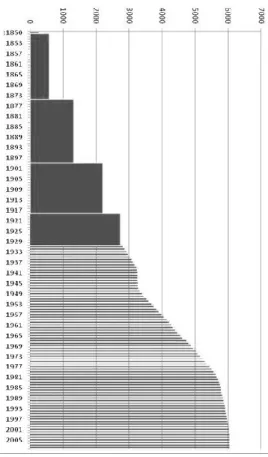
When these values are related to each building, it is possible to establish the actual residential building energy use at the city scale. Moreover, on the basis of the cadaster, we can study the evolution of the energy consumption of the whole urban area of Liège since 1850 that is the first date of construction of a building identified in the cadaster (see Figure 2). Before 1931, the dates of buildings construction are aggregated for periods lasting from 20 to 25 years, which explains the larger width of the bars in the Figure 2. This graph shows a very high growth of the energy consumption of Liège’s urban area during the last century, reaching 6048 GWh for the year 2010.
Figure 2: Evolution of the energy consumption of the urban area of Liège (in GWh/year) since 1850.
<heading level 2> Transport energy consumptions of residents
For modeling transport energy consumption, we followed the methodology developed by Marique & Reiter (2012b), using values available in each census block about car ownership, travel distances, main mode of transport used, the number of working days per week and per worker, etc. We have considered the two last Belgian censuses.
The annual consumption of a worker or a student is obtained by the following calculation: IPE* annual number of trips (to work or school), assuming 253 working days per year and 180 school days per year. Finally, the annual consumption calculated for a person is multiplied by the number of workers/students in the area, giving for the year 2010 a global value for residential transport consumption of 941.9 GWh, from which 841.6 GWh are due to home-to work travels and 100.3 GWh to home-to school travels.
Comparing residential energy consumption for buildings and transport at the city scale during the year 2010, buildings energy consumption reaches 6048 GWh while transport energy consumption account only for 941.9 GWh. It is thus clear that policies to reduce energy consumption must first focus on the existing building stock, because it generates much more energy consumption than residential transport.
Note that home-to-work and home-to-school travels represent only a part of the mobility of a household. Leisure and shopping are namely two important purposes of travel (Hubert and Toint, 2002). Unfortunately, Belgian national censuses do not give information about those purposes of travel. Even if many studies dedicated to transport and energy consumption only focus on home-to-work data because they are the most often available, the
limits of this method arise from the fact that data about only two types of trips (home-to-work and home-to-school travels) are available in Belgian national censuses.
Following Hubert (2004), the mean percentage of work travels and home-to-schools travels compared to the total number of travels in Belgium are 30% and 17% of all trips; moreover, these account respectively for 45% and 9 % of all the distances travelled. These data were defined through an enquiry of 3076 workers and 1619 students. If we add to the transport energy consumption calculated precisely according to the method explained, an approximate value for travels to shops and leisure based on the IPE indexes previously calculated and taking into account the proportions of transport distances proposed by Hubert (2004), the global energy consumption for residential transport in the city of Liège in 2010 increases widely and reaches from 1454.5 GWh to 1802.2 GWh, depending on whether the IPE index for home-to school or home-to work travels is used. Nevertheless, this final value for the energy consumption of the residential transport of the urban area of Liège remains more than three times lower than the buildings energy consumption.
Home-to-school travels consume less energy than home-to-work travels because distances from home to school are shorter than distances from home to work and because the use of public transport is higher for home-to-school travels than for home-to-work ones. This first conclusion shows the importance to favor residential densification of buildings near main employment areas. A good mix between work, schools, shops and dwellings in each neighborhood or group of neighborhoods, which allows reduced travel distances, seems to be a good strategy to reduce transport energy consumptions.
The most important actual energy policy measure in the EU is the Directive on the Energy Performance of Buildings, EPB (Directive 2002/91/EC). It focuses on energy efficiency when new buildings are built or when big buildings (larger than 1000m²) undergo a major renovation. However, there might be energy efficient measures that are environmental efficient and cost effective also on the existing residential building stock, on smaller buildings and/or lighter renovation processes. Note that in the Danish implementation of the EPB directive all existing buildings are covered by the energy efficiency measures when they undergo a major renovation (Tommerup & Svendsen 2006). It is thus useful to model some forecast scenarios to compare the effects of the European Directive on Energy Performance of Buildings (EPB directive) with even more selective energy policies on new buildings and with renovation strategies on the existing building stock.
The demographic data of the population of our study area are known at the census block scale. The simplest hypothesis would estimate that the residential building stock changes proportionally to the population. However, the number of buildings in urban area of Liege during the last eight years did not increase as rapidly as the population during those years. We have thus established a base curve of the evolution of the built stock according to the statistics of its evolution between 2000 and 2008. This trend is represented by the following equation:
Y = 477.35 ln (x) + 161348 (1)
with x = forecast year – 2000 and Y = Number of buildings. This curve follows very well the recent trend of development of the residential building stock since the coefficient of determination calculated from the data observed between 2000 and 2008 amounts to 99.7%.
First, six scenarios of residential buildings energy consumption improvements will be compared. Then, two forecast scenarios for the transport energy consumption evolution will be explained. The main assumption of this forecast modeling is that the urban growth is distributed evenly across the different census blocks of the urban area.
<heading level 2> Scenario 1: new buildings following EPB
In this first scenario, the existing building stock remains unchanged, but new buildings are constructed according to the actual standard on the energy performance of buildings (EPB): the building's energy consumption should not exceed 115 kWh/m² per year. It is therefore the most likely evolution of Liège’s building stock if the energy policies are not changed in the future. Following this first scenario, the energy consumption for the city of Liège in 2061 is estimated at 6067.74 GWh per year (see figure 3).
<heading level 2> Scenario 2: strengthening of energy policy on new buildings
Considering that 5% of new housing stock will have low energy performances (LE: 95 kWh/m² per year), 2% of buildings very low energy performances (VLE: 65 kWh/m² per year) and 1% will reach the standard passive house (50 kWh/m² per year), the buildings energy consumption decreases by 679 MWh for the year 2061 compared to the first scenario, which represents a reduction of only 0.01% for a period of fifty years.
Achieving 10% reduction in energy consumption of all buildings constructed after 2010 would require that the new stock meets the following constructive standards: 63% of buildings achieving the EPB standard, 21% of LE buildings, 10% of VLE buildings and 5% of passive buildings. But on the whole building stock, this reduction generates a very small decrease in
energy consumption (0.06%) compared to Scenario 1, corresponding to the actual regulations (see figure 3).
<heading level 2> Scenario 3: 40% reduction of the energy consumption of the old building stock
A rate of renovation of buildings of 0.6% per year is chosen to simulate a realistic policy for energy renovation of the existing building stock equal to two thirds of the total rate of renovations observed in the Walloon Region on an annual basis. It is also assumed that the energy management is carried out efficiently: the oldest and least energy efficient buildings are the first to be renovated. Renovating of this old building stock will be incorporated as a reduction of 40% of energy consumption in comparison to the initial energy performance of these renovated buildings, which corresponds in the context of the urban area of Liège to the roof insulation of the individual terraced houses built before 1930 and to the roof insulation and the windows improvement of detached houses built between 1931 and 1969, not yet renovated. Following Verbeek and Hens (2005), insulation of the roof is the most effective and durable measure for energy performance increase of households in Belgium.
It appears that the renovation of existing buildings can drastically reduce energy consumption across the urban area. The total estimated consumption amounts to 5439.27 GWh/year in 2061, of which 99.5% is attributed to the existing stock. The decrease in total energy consumption is therefore 10.36% (628.46 GWh/year) compared to 6067.74 GWh/year for Scenario 1 (see figure 3).
This scenario aims to assess the amount of energy that could be saved if the existing building stock was renovated, at a rate of 0.6% per year, to meet the current EPB standard in Belgium (115 kWh/m² per year), while all the new buildings meet the same energy performances. Following this scenario 4, the estimated energy consumption for the city of Liège will reach 5307.20 GWh/year in 2061. It is 760.54 GWh/year (13%) less compared to scenario 1 (see figure 3).
<heading level 2> Scenario 5: renovation of all the existing building stock reaching EPB
The renovation of all the buildings of the residential building stock of Liège to the level of the current EPB standard in Belgium (115 kWh / m² per year), would result in significant reductions in energy consumption of the urban area (see figure 3). Indeed, the total energy consumption would drop to 3178.23 GWh/year only, which represents a reduction of 47.6% compared to 6067.74 GWh/year of the scenario 1 (where the new buildings reached already the standard EPB, but where no renovation was undertaken).
However, to achieve the complete renovation of the existing housing stock by 2061, the rate of renovation of the urban area of Liege should increase sharply, to a minimum of 1.92% per year, which would require strong policies to accelerate and strengthen the process of renovating existing buildings.
<heading level 2> Scenario 6: all the existing building stock reaching EPB and new buildings reaching the passive standard
This scenario uses the same renewal policy that the previous scenario but it is also assumed that each new dwelling built from 2012 will reach the passive standard (50 kWh/m² per year).
The result of scenario 6 is very close to the previous scenario. The total energy of the urban area in 2061 amounts to 3161.57 GWh/year, which represents only a reduction of 0.5% compared to scenario 5.
Figure 3: Energy consumption of the urban area of Liège (in GWh/year) from 2000 to 2061, following the six forecast scenarios. The lines showing scenarios 1 and 2 as well as scenarios 5 and 6 are joined because the results are too close at this scale.
<heading level 2> Scenarios 7 and 8: forecast scenarios for transport energy consumptions
The evolution of the mean energy performance indexes for home-to work and home-to school travels between 1991 and 2001 allowed us to determine the percentage of increase in the IPE during ten years: 32.3% for work travels and 8.03% for school travels. Based on this increase for the two IPE indexes as well as an increase in student numbers by 4.3% and the number of workers by 3% every 10 years, the energy consumption for residential transport in 2061 will reach 3955.3 GWh for home-to work travels and 187.76 GWh for home-to school travels, giving a total of 4140 GWh for these two types of travels. This scenario shows that if the increase rate in transport consumption in the future would be identical to what happened
in the past, the total energy consumed at the city scale would increase widely. In addition, by performing the same approximations on travels to shops and leisure as above, the total residential energy consumption for transport would reach between 5084.32 GWh and 8183.9 GWh in 2061. Thus, without specific transport policies, urban planning strategies or important vehicles energy performance improvements, residential energy consumptions due to transport are likely to exceed in the future the energy consumption related to the existing building stock in the urban area of Liège.
However, Ewing and colleagues (2008) assume that transport energy consumption in the US in 2030 will be at the same level than in 2005, because the number of vehicles and the mean vehicle travel kilometer will continue to increase while the energy performance of vehicles will be improved. Taking into account this scenario of a steady state of the transport energy consumption of the urban area of Liège until 2061 implies that the buildings energy consumption will remain higher at the city scale than the transport energy consumption, regardless of the chosen scenario for the evolution of the building stock.
<heading level 1> Discussion
The studied scenarios show that the actual city energy challenge lies mainly in the renovation of the existing building stock. Indeed, the first two scenarios and the small difference between scenarios 5 and 6 show that it is not possible to ensure a significant reduction in energy consumption at the city scale by applying only energy policies for new buildings, like the standard EPB already in use or by enhancing the performance of new buildings to low energy level, very low energy level and even to the passive housing standard.
However, scenarios of existing housing stock renewal (scenarios 3 to 5) can significantly reduce the overall consumption of the urban area of Liege in the following proportions:
10.36 % of energy consumption reduction in 2060 through a renovation of the oldest buildings reducing 40% of their energy consumption at a renovation rate of 0.6% of the building stock per year.
13 % of energy consumption reduction in 2061 through a renovation reaching the EPB level of the oldest buildings at a renovation rate of 0.6% of the building stock per year.
47.6 % of energy consumption reduction in 2061 through a renovation reaching the EPB level of all the existing residential building stock, which corresponds to a renovation rate of 1.92 % per year.
Thus, the National climate change targets in Belgium will be impossible to reach without a strategic increase of the existing housing stock renovation. Finally, at the city scale, the buildings renovation rate seems to be much more important that the level of insulation reached.
While current energy consumptions related to the existing housing stock of the urban area of Liège are significantly higher than transport energy consumptions of residents, the forecast scenarios on transport consumptions show that this gap will be reduced and may even be reversed by 2060 if solutions for reducing energy consumptions related to residential transport are not implemented. It seems that transport will become an increasing challenge for energy consumptions limitation at the city scale. At this respect, favoring more compact urban developments while improving the energy performance of the vehicles and increasing public transport use should be investigated.
<heading level 1> Conclusion
The literature review on cities energy consumption shows that density tends to receive the greatest scientific attention, although alone its travel impacts are modest. It is therefore important to make a distinction between density as an isolated parameter and compact development or smart growth, sometimes studied under the term density, that reflect the cumulative effects of various land use factors such as density, functional mix, transit accessibility, walkability or parking management.
This article presented a methodology to model residential energy use at the city scale, using GIS tools combined with a statistical treatment of urban and transport criteria. This method assesses energy uses of residential buildings and transport of residents at the city scale. It should help developing strategies of urban design and urban renewal as well as improving urban management and policy making.
An application of this method was done on the urban area of Liège. This applied study allowed to conclude that the European Directive on the Energy Performance of Buildings and even more selective energy policies on new buildings are not sufficient to widely decrease the energy consumption of Liège’s building stock but that renovation of the existing building stock has a much larger positive impact on city energy consumption reductions.
The proposed methodology presents the advantage to allow comparing energy requirements in the building sector and in the transport sector as well as to test forecast scenarios. This method is thus a powerful tool to highlight which strategy would be the most efficient to reduce total energy consumptions at the city scale. Some further developments of this method are planned to include more precisely the energy consumption related to travels
for leisure and shopping. The methodology developed in this paper can be adapted and/or reproduced on many other territories in Belgium but also in Europe or even further.
<heading level 1> Acknowledgements
This research has been funded by the Special Funds for Research of the French Community of Belgium, within the University of Liege, and by the Walloon Region of Belgium in the framework of the SAFE project. All authors disclose any potential sources of conflict of interest.
<heading level 1> References
Banister, D., C. Wood, and S. Watson. 1997. Sustainable cities- transport, energy and urban form. Environment and Planning B 24 (1): 125-143.
Boarnet, M., and R. Crane. 2001. Travel by design. The influence of urban form on travel. New-York: Oxford University Press.
Boussauw, K. and F. Witlox. 2009. Introducing a commute-energy performance index for Flanders, Part A, Transportation Research 43: 580–591.
Breheny, M. 1995. The compact city and transport energy consumption. Transactions of the Institute of British Geographers N.S. 20(1): 81-101.
Breheny, M.J., and I.R. Gordon. 1997. Urban densities, travel behaviour and the limits to planning. In Proceedings of BEPAC/EPSRC Conference on Sustainable Buildings, edited by A.K.M. Azad. Abingdon, UK : Northern Illinois University.
CEEW (Cellule Etat de l’Environnement Wallon). 2007. Rapport analytique sur l’état de l’environnement wallon 2006-2007. [Report on the state of the Walloon environment in
(http://etat.environnement.wallonie.be/index.php?page=le-rapport-analytique-2006-2007)
EC (European Commission). 2003. Directive 2002/91/EC of the European Parliament and of the Council of 16 December 2002 on the Energy performance of buildings, Official Journal of the European Union L 001: 65-71.
Ewing, R., K. Bartholomew, S. Winkelman, J. Walters, and D. Chen. 2008(b). Growing cooler : The evidence on urban development and climate change. Washington DC ; Urban Land Institute.
Ewing, R., K. Bartholomew, S. Winkelman, J. Walters, and G. Anderson. 2008. Urban development and climate change, Journal of Urbanism 1 (3): 201-216.
Ewing R, Cervero R. 2001. Travel and the built environment: A synthesis. Transp Res Rec 1780 : 87-114.
Ewing, R. and R. Cervero. 2010. Travel and the Built Environment: A Meta-Analysis. Journal of the American Planning Association 76 (3): 265-294.
Ewing, R. and F. Rong. 2008. The impact of urban form on US residential energy use. Housing Policy Debate 19 (1): 1-30.
Friedman, K., and A. Cooke. 2011. City versus national energy use : implications for urban energy policy and strategies. Procedia Engineering 21: 464-472.
Hubert, J.-P. 2004. Mobilité urbaine, périurbaine, rurale en Belgique : où sont les différences ? [Urban, suburban and rural mobility in Belgium : where are the differences ?], Les Cahiers Scientifiques du Transport 45: 83-100.
Hubert, J.-P., and P. Toint. 2002. La mobilité quotidienne des belges. [Daily mobility of Belgians]. Namur : Presses Universitaires de Namur.
ICEDD (Institut de Conseil et d’Etudes en Développement Durable). 2005. Bilan énergétique wallon 2005. Consommations du secteur du logement 2005. [Walloon energy balance in 2005. Housing consumption in 2005]. Belgium : Ministère de la Région Wallonne.
Jones, P.J., S. Lannio, and J. Williams. 2001. Modelling building energy use at urban scale. In Proceedings of the 7th International IBPSA Conference. Rio de Janeiro, Brazil: International Building Performance Simulation Association.
Kavgic, M., A. Mavrogianni, D. Mumovic, A Summerfield, Z. Stevanovic, and M. Djurovic-Petrovic. 2010. A review of bottom-up building stock models for energy consumption in the residential sector, Building and Environment 45 : 1683-1697.
Kints, C. 2008. La rénovation énergétique et durable des logements wallons. Analyse du bâti existant et mise en évidence des typologies de logements prioritaires. [Energy and sustainable renovation of Walloon housings. Analysis of existing buildings and identification of typologies of housing renovation priority]. Belgium : Université catholique de Louvain. (http://www.lehr.be/Reports/UCL_Les_logements_wallons.pdf ). Lebart, L., A. Morineau, and J.-P. Fenelon. 1982. Traitement des données statistiques –
méthodes et programmes. [Statistical data processing – methods and programs], Bordas Éd., Paris : Dunod.
Marique, A.-F. and S. Reiter. 2012(a). A Method to Evaluate the Energy Consumption of Suburban Neighbourhoods. HVAC&R Research 18 (1-2) : 88-99.
MRW (Ministère de la Région Wallonne). 2007. Enquête sur la qualité de l’habitat en Région wallonne 2007. [Survey on the quality of housing in the Walloon in 2006-2007]. Report « Study and documents » n°5. Belgium : Ministère de la Région wallonne. Naess, P. 1996. Urban form and energy use for transport. A nordic experience. Oslo : N.T.H.
Newman, P., and J.R. Kenworthy. 1989. Cities and Automobile Dependence, A sourcebook. Gower : Aldershot.
Newman, P., and J.R. Kenworthy. 1999. Sustainability and Cities: overcoming automobile dependence. Island Press : Washington DC.
OECD & IEA (Organisation for Economic Co-operation and Development & International Energy Agency). 2008. World Energy Outlook 2008. Paris : International Energy Agency.
Popovici, E., and B. Peuportier. 2004. Using life cycle assessment as decision support in the design of settlements. In Sustainable architecture, edited by M. H. de Wit. Proceedings of the 21th PLEA Conference on Passive and Low Energy Architecture. Eindhoven, The Netherlands : Technische Universiteit Eindhoven.
Ratti, G., N. Baker, and K. Steemers. 2005. Energy consumption and urban texture, Energy and Buildings 37 (7) : 762-776.
Shimoda, Y., T. Fujii, T. Morikawa, and M. Mizuno. 2004. Residential end-use energy simulation at city scale. Building and Environment 39: 959-967.
Souche, S. 2010. Measuring the structural determinants of urban travel demand, Transport policy 17: 127-134.
Steadman, P., S. Holtier, F. Brown, J. Turner, T. De La Barra and P.A. Rickaby. 1998. An integrated building stock, transport and energy model of medium sized. Report to the EPSRC. Cambridge, UK.
Steemers, K. 2003. Energy and the city: density, buildings and transport. Energy and Buildings 35 : 3–14.
Swan, L.G., and V.I. Ugursal. 2009. Modeling of end-use energy consumption in the residential sector : a review of modeling techniques. Renewable and Sustainable Energy Reviews 13 : 1819-1835.
Tommerup, H., and S. Svendsen. 2006. Energy savings in Danish residential building stock, Energy and Buildings 38 (6) : 618-626.
Urban Task Force, 1999. Towards an Urban Renaissance, London : E&FN Spon.
Uihlein, A. and P. Eder. 2010. Policy options towards an energy efficient residential building stock in the EU-27. Energy and Buildings 42 : 791-798.
Van de Coevering, P., and T. Schwanen. 2006. Re-evaluating the impact of urban form on travel patterns in Europe and North-America. Transport Policy 13: 229-239.
Verbeek, G., and H. Hens. 2005. Energy savings in retrofitted dwellings : economically viable? Energy and Buildings 37 : 747-754.
Volle, M. 1993. Analyse des données. [Data analysis]. Paris: Economica.
Wallemacq, V., A.-F. Marique, and S. Reiter. 2011. Development of an urban typology to assess residential environmental performance at the city scale. In Architecture and Sustainable Development, edited by M. Bodart and A. Evrard. Proceedings of the 27th PLEA Conference. Louvain-la-Neuve, Belgium : Université catholique de Louvain.
Yamaguchi, Y., Y. Shimoda, and M. Mizuno. 2007. Proposal of a modeling approach considering urban form of evaluation of city level energy management, Energy and Buildings 39 : 580-592.
<heading level 1> About the Authors
Sigrid Reiter is a professor at the University of Liège in Liège, Belgium. Anne-Françoise Marique is a PhD student at the University of Liège in Liège, Belgium
Figure 1: Mapping of the index of energy performance for home-to-school travels (IPE, in kWh/worker for one way to school) through the urban area of Liège
Figure 3: Energy consumption of the urban area of Liège (in GWh/year) from 2000 to 2061, following the six forecast scenarios. The lines showing scenarios 1 and 2 as well as scenarios 5 and 6 are joined because the results are too close at this scale.