“Tracking Papyrus and Parchment Paths”:
A New International Project on Coptic Literature
Paola Buzi, Julian Bogdani, Nathan Carlig, Maria Chiara Giorda, Agostino Soldati
The purpose of the new project presented in these pages is to offer an innovative approach to the study of the evolution of Coptic literature and, more specifically, to the corpus of writings produced in Egypt between the third and the late eleventh centuries, and expressed in the different dialects of the Coptic language. Its aim is to provide a new perspective on the cultural landscape of Christian Egypt by interweaving literary, histor-ical, codicological and archaeological data, and producing a series of scholarly tools, till now unavailable, in a digital environment, including an archaeological Atlas of late antique and early mediaeval Coptic literature that will be searchable at different chronological, regional and thematic levels.
As part of the above-described research activities and goals, a complete catalogue of the Coptic papyrus codices preserved in the Museo Egizio will be produced, as well as an edition of their titles and scribal sub-scriptions. The fragmentary codices in question, purchased in Egypt by Bernardino Drovetti in the 1820s, are a unique example of an entire well-preserved late antique institutional library – very likely originally belonging to the cathedral of This/Thinis& – reflecting the literary tastes and dogmatic orientations before what can be defined as the ninth-century Coptic book revolution, which significantly changed bookmaking in Christian Egypt. The library of Thi(ni)s is a crucial and transitional instance in the history of Coptic books, which saw on the one hand the creation of new codicological and palaeographical features and on the other the progressive emergence of multiple-text codices.
:ثحبلا صخلم
نم ضرغلا
،ىطبقلا بدلآا روطت ةساردل ًاركتبم جهن ميدقت وه ثحبلا اذه ىف اهضرع متي ىتلا ةديدجلا ةساردلا
رشع ىداحلا نرقلا ةياهن ىتح ثلاثلا نرقلا نيب رصم ىف ةجتنملا تاباتكلا ةعومجم ىلإ ًاديدحت رثكأ لكشبو
قلا ةغلل ةفلتخم تاجهل ىف اهنع ريبعتلا مت ىتلاو
رصم ىف ىفاقثلا دهشملل ديدج روظنم ريفوت وه اهفده .ةيطب
جاتنإو ،)ةميدقلا بتكلا ةسارد( ةيجولوكيدوكلاو ةيرثلآاو ةيخيراتلاو ةيبدلأا تانايبلا لخادت للاخ نم ةيحيسملا
روصعلا رخاوأ بدلأ ىرثآ سلطأ للاخ نم ةيمقر ةئيب ىف ةرفوتم ريغ نلآا ىتح ةيملعلا تاودلأا نم ةسلس
قلا
ةيميلقلإاو ةينمزلا تايوتسملا فلتخم يلع ثحبلل ةلباقلاو ،ىطسولا روصعلا نم ىطبقلا بدلأاو ةميد
.ةيعوضوملاو
ةيطبقلا ىدربلا تاطوطخمل لماك سرهف نم ققحتلا متيس هلاعأ ةفوصوملا ةيثحبلا فادهلأاو ةطشنلأا نم ءزجكو
رشنلا رادو بتاكلا مسأ نع تامولعمو اهنيوانع نم ةخسن ىلإ ةفاضلإاب ،ونيروتب ىرصملا فحتملاب ةظوفحملا
. ةيف ترشن ىذلا خيراتلاو
نحن
ةأزجم ةطوطخم رشع ةعبس ةسارد ددصب
ماع ىتيفورد ونيدرانرب ةطساوب رصم نم اهؤارش مت ىتلاو
1820
نم ،ةميدقلا روصعلا رخاوأ ىلإ دوعت ىتلا بتكلا نم ةعومجمل لماكلا ديجلا ظفحلل ديرف لاثم دعت ىهو ،م
نكمي ام لبق ةيدئاقعلا تاهجوتلاو ةيبدلأا قاوذلأا سكعت ىتلاو سيز ةيئاردتاك ىلإ لصلأا ىف ىمتنت نأ لمتحملا
ةبتكم نإف ،ةيحيسملا رصم ىف بتكلا ةعانص ريبك لكشب ترَيغ ىتلاو ةيباتكلا ةروثلل عساتلا نرقلا ةنأب ةفيرعت
ةيجولوكيدوك ةديدج حملام قلخ ةهج نم تدهش ىتلا ةيطبقلا بتكلا خيرأت ىف ىلاقتنإو مساح لاثم ىه سيز
دعتلا ةبكرملا صوصنلل ىجيردت روهظ ىرخأ ةهج نمو ةيتايحو ةيمقرو
.ةيد
:ثحبلا صخلم
نم ضرغلا
،ىطبقلا بدلآا روطت ةساردل ًاركتبم جهن ميدقت وه ثحبلا اذه ىف اهضرع متي ىتلا ةديدجلا ةساردلا
رشع ىداحلا نرقلا ةياهن ىتح ثلاثلا نرقلا نيب رصم ىف ةجتنملا تاباتكلا ةعومجم ىلإ ًاديدحت رثكأ لكشبو
قلا ةغلل ةفلتخم تاجهل ىف اهنع ريبعتلا مت ىتلاو
رصم ىف ىفاقثلا دهشملل ديدج روظنم ريفوت وه اهفده .ةيطب
جاتنإو ،)ةميدقلا بتكلا ةسارد( ةيجولوكيدوكلاو ةيرثلآاو ةيخيراتلاو ةيبدلأا تانايبلا لخادت للاخ نم ةيحيسملا
روصعلا رخاوأ بدلأ ىرثآ سلطأ للاخ نم ةيمقر ةئيب ىف ةرفوتم ريغ نلآا ىتح ةيملعلا تاودلأا نم ةسلس
قلا
ةيميلقلإاو ةينمزلا تايوتسملا فلتخم يلع ثحبلل ةلباقلاو ،ىطسولا روصعلا نم ىطبقلا بدلأاو ةميد
.ةيعوضوملاو
ةيطبقلا ىدربلا تاطوطخمل لماك سرهف نم ققحتلا متيس هلاعأ ةفوصوملا ةيثحبلا فادهلأاو ةطشنلأا نم ءزجكو
رشنلا رادو بتاكلا مسأ نع تامولعمو اهنيوانع نم ةخسن ىلإ ةفاضلإاب ،ونيروتب ىرصملا فحتملاب ةظوفحملا
. ةيف ترشن ىذلا خيراتلاو
نحن
ةأزجم ةطوطخم رشع ةعبس ةسارد ددصب
ماع ىتيفورد ونيدرانرب ةطساوب رصم نم اهؤارش مت ىتلاو
1820
نم ،ةميدقلا روصعلا رخاوأ ىلإ دوعت ىتلا بتكلا نم ةعومجمل لماكلا ديجلا ظفحلل ديرف لاثم دعت ىهو ،م
نكمي ام لبق ةيدئاقعلا تاهجوتلاو ةيبدلأا قاوذلأا سكعت ىتلاو سيز ةيئاردتاك ىلإ لصلأا ىف ىمتنت نأ لمتحملا
ةبتكم نإف ،ةيحيسملا رصم ىف بتكلا ةعانص ريبك لكشب ترَيغ ىتلاو ةيباتكلا ةروثلل عساتلا نرقلا ةنأب ةفيرعت
ةيجولوكيدوك ةديدج حملام قلخ ةهج نم تدهش ىتلا ةيطبقلا بتكلا خيرأت ىف ىلاقتنإو مساح لاثم ىه سيز
دعتلا ةبكرملا صوصنلل ىجيردت روهظ ىرخأ ةهج نمو ةيتايحو ةيمقرو
.ةيد
Preamble: The evolution and role
of Coptic literature in early Egyptian
Christianity
[PB]
1After three centuries of Ptolemaic rule, Roman Egypt appeared strongly marked by multiethnicity, mul-ticulturality, and multilingualism. While Egyptian (Demotic) continued to be used as the current lan-guage, Greek was the main linguistic tool for what concerned literary production and all the bureau-cratic aspects related to official affairs, while Latin had a marginal role, being the language of the cives
romani (mainly soldiers) and law.
In such a complex cultural, religious and linguistic situation, despite the resistance of the traditional cults, Christianity slowly but progressively emerged. Although there are no concrete elements to confirm the traditional attribution of the evangelization of Egypt to the apostle Mark, it is very likely that the new religion reached the Egyptian Mediterranean coast quite early and that it was perceived early on as a new and potentially strong cohesive factor. The role of Alexandria, the cultured city par excellence, with its renowned philosophical circles and institu-tions, was certainly determinant in this respect.2
From the end of the second century onward, the cultural richness of Christian Egypt was further in-creased by the emergence of a “new”, partly artificial language that represents the last phase of the ex-ceptionally long Egyptian linguistic tradition.3 This
new phase of the Egyptian language, characterized by a variety of regional dialects, which was only later destined to become also vernacular, was Coptic. In the framework of a Church in construction, it is not surprising that the first phase of the literary production in Coptic consisted of the systemat-ic translation, from Greek, of biblsystemat-ical works (third-fourth centuries). Egyptian Christianity, however, was not a homogeneous reality in the first centu-ries. Besides translations of Old and New Testament works, therefore, we also find philosophical treatises that appear to have been produced within religious groups whose doctrinal choices and exegetical prac-tices were rather different from those of the commu-nities representing the “orthodox” Christianity. This is the case, for instance, of the “Gnostic” and, more in general, heterodox texts found in Naǧ‘ Ḥammādī
and the Manichaean texts uncovered in Madīnat Māḍī and Kellis.
At the same time, however, other groups of people, belonging to a more traditional Christian milieu, were responsible for the translation of a large num-ber of Greek homilies. This process, destined to last a long time, initially focused mainly on the production of the Cappadocian Fathers and of John Chrysos-tom. Consequently, Coptic literature often preserves Greek works that have been lost in their original lan-guage.4
Between the fourth and fifth centuries, Coptic Egypt was ready for a decisive step: the creation of an orig-inal literature, an enterprise for which the role of monasticism – one of the most significant cultural phenomena in Christian Egypt – was decisive. After the pioneering experience of Antony, the celebration of a genuine, “national” religiosity embodied by fig-ures of Egyptian anchorites, whose greatness lay in the choice of a modest life, became the fulcrum of several other texts produced at the same time or im-mediately Pachomius’ foundation of the first coeno-bitic monastery, whose life was regulated by a set of rules. The apophthegmata patrum – i.e., sentences at-tributed to the desert fathers – present several oth-er figures of monks as models of genuine Egyptian Christianity, fixing an ideal and stereotyped image of monastic life.
With the figure of Shenoute, archimandrite of a con-federation of monasteries coordinated by the so-called White Monastery, located not far from Pan-opolis, Coptic finally rose to the role of the literary language of Christian Egypt.5 To the deliberately
“anti-literary” stance of Pachomius and his follow-ers, expressed by their use of the genres of letters and rules, Shenoute opposed a complete adhesion to the genres of Greek and Alexandrian literature, be-coming the author of homilies whose contents are extremely effective and engaging. In Shenoute’s pro-duction, alongside works written for the monastic community, there was also room for texts inspired by the author’s aversion for the plurality of hetero-dox currents, such as Origenism, Melitianism, Man-ichaeism. Shenoute’s vehemence in his homilies re-veals that Christian Egypt was going through one of its most critical moments as far as doctrinal disputes are concerned.6
purposes of a Church that was now completely in-dependent.
The Arab conquest did not seem to affect Coptic lit-erary production, which appears to be, at least at this early stage, still quite lively. It was, however, inevitably, a precarious balance. The last phase of Christian Egyptian literature written in Coptic was characterized by the selection and rearrangement – sometimes under new titles – of those texts that appeared still useful for liturgical purposes and for the promotion of the local religious identity. The ev-ident result of this work is the Alexandrian
Synaxari-um, preserved in Arabic and consisting of a selection
of hundreds of brief hagiographic texts arranged according to the liturgical calendar. The Arabic lan-guage, however, became increasingly intrusive, evolving from a bureaucratic and legislative tool into the new and exclusive language of Egypt. From the early eleventh century onward, a new phase began for Coptic literature, namely, its translation into Ara-bic.9 Coptic-Arabic literature was thus born.10
Purpose of the project and expected
results
[PB]
The purpose of the new project presented in these pages – whose acronym is “PAThs” – is to offer an innovative approach to the study of the above-de-scribed evolution of Coptic literature and more spe-cifically to the corpus of writings – almost exclusively of religious content – produced in Egypt between the third and the end of the eleventh centuries in the dif-ferent dialects of the Coptic language. The aim is to provide a new perspective on the cultural landscape of Christian Egypt by interweaving literary, histori-cal, codicological and archaeological data, and pro-ducing a range of so far unavailable digital scholarly tools, including an archaeological Atlas of late an-tique and early mediaeval Coptic literature that will be searchable at different chronological, regional and thematic levels. This Atlas is intended to illustrate the strong interconnection between intellectual and ma-terial production, on the one hand, and geographical provenance, on the other. In this respect, Christian Egypt represents a unique opportunity, since no oth-er Meditoth-erranean region has yielded such a rich ar-chaeological and bibliological documentation. The fifth century saw the most significant religious
upheavals, culminating with the Council of Chalce-don (451), which over time determined a fracture, both dogmatic and hierarchical, with most of the other Churches. The Coptic literary tradition thus be-came slowly but more and more evidently detached from the Greek “international” one.7 This was when
the Coptic Church was truly born. After the extreme-ly confused hierarchical and religious situation that immediately followed the Council, the separation of Egypt from the positions of the “Great Church” increased the Copts’ pride in their identity, and lit-erature was not long in supporting this orientation, above all by means of a historiographic production. Between the fifth and sixth centuries, both original literary production and translation of homiletic texts went on. At the same time, an interest in hagiog-raphic texts – individual or, more often, collected in cycles – began to rise in Coptic literature, which had reached its full-fledged linguistic potential. These texts inherited the general characteristics of similar works previously translated from Greek, but now mainly featured local martyrs as their main charac-ters. The most striking result of such a literary pro-cess, which was to continue at least until the eighth century, are the so-called “epical martyrdoms” – lit-erary texts that strongly contributed to creating a Coptic identity through the memory of the violence suffered by the faithful. These text are all character-ized by the same elements: an evil emperor (usually Diocletian), an edict of persecution, a cruel judge, a long series of punishments inflicted on the martyr, and an equally long series of miracles performed by him before and after his death.8
The sixth century, however, was also the era of the cultural circle gathered around the figure of the pa-triarch Damian, who was responsible for the reor-ganization of the Egyptian Church after the Chalce-donian schism. Beyond the individual personalities of the authors, the literary production of this peri-od – destined to be used at the most important mo-ments of aggregation (masses, festivals, celebrations of saints and martyrs) of the Egyptian ekklesía – had two main aims: firstly to preserve those Greek pa-tristic texts that were compatible with the anti-Chal-cedonian choice of Coptic Egypt, and secondly to produce new works that would serve the liturgical
It is hardly necessary to emphasize the fact that Egypt can be regarded as one of the principal labora-tories where what we define as “book” was gradual-ly evolved and perfected.11 “PAThs” will study Coptic
books as material artifacts (showing how the writing support, shape and layout change according to con-tent and purpose), as intellectual products (that is as a selection and combination of texts: particular atten-tion will be devoted to multiple-text codices), but also as ritual objects (for example as part of a “funerary kit”, a sort of Christian Book of the Dead), yet always strictly relating them to their archaeological settings. Moreover, “PAThs” will try to establish and promote a shared terminology for Coptic codicology.12
In brief, by taking into account a large corpus of works, manuscripts and archaeological sites and in-terrelating them, “PAThs” ultimately aims to produce a new state-of-the-art of Coptic studies, in which literature will no longer be regarded as a cultural phenomenon independent of its material context, and which will go beyond the traditional narrow disciplinary subdivisions (especially in the fields of philology and archaeology) that have typified Coptic studies so far.
The ambitious purpose of the project is to provide a diachronic outline of the geography of Coptic liter-ary production, which will be analyzed through an innovative and multidisciplinary approach, combin-ing philology, codicology, history, archaeology and digital humanities, in order to explore the entire li-fecycle of Coptic works, from production to dissem-ination and storage, in relation to the geographical contexts of origin of both the texts themselves and their writing supports.
By means of an analysis of philological aspects, dia-lects, style, content, scribal subscriptions, titles, and internal elements, Coptic texts will be related not only to the physical spaces where they were cop-ied and disseminated but, more importantly, to the places where they were conceived, in order to recon-struct the identity of the cultural milieu (for instance a monastic community or an episcopal see) respon-sible for the creation of literary genres and specific works. This approach is particularly congenial for hagiographic and monastic literary production (for example cycles of martyrdoms, which represent an important part of Coptic literature), where
ideolog-ical and devotional motifs may be extremely telling. The most visible product of the project will be the above-mentioned archaeological Atlas of late an-tique and early mediaeval Egypt. It will be interac-tive, in-depth, upgradable,13 and searchable at
dif-ferent chronological, regional and thematic levels. It will document, among other data:
·
the places where Coptic manuscripts have been found and/or produced, and used, with a focus on monastic settlements, episcopal sees, tombs, and urban contexts;·
other works in combination with which a specif-ic text was transmitted, in order to identify modes and ideologies in Coptic literary production, which were subject to changes (for example, the VitaOnuphrii was transmitted with different works in
different periods), but also to the tastes of individ-ual patrons;
·
the plausible places where the works were con-ceived and created, with particular attention to monastic and hagiographic production, which pro-vide more clues for such an investigation;·
the codicological features of the manuscripts (book format, writing support, ruling system, presence of a binding, etc.) and their development in relation to a specific period and a specific region;·
information related to the manuscript makers and related contexts (places where they practiced their trade, places where they obtained their writing supports, etc.);·
information concerning the copyists (family rela-tionships, normal professions, times of execution). “PAThs” will integrate into its portal the just de-scribed archaeological Atlas of Coptic literature with a relational database composed of several “ta-bles”, all of them in keeping with the purpose of creating a concrete link between literary produc-tion and related geographical and archaeological context. The Atlas will include:·
A complete classification of Coptic literature, by means of the attribution of a Clavis Coptica (CC) en-try to each work and each title (the latter often be-ing created later than the work to which it is attrib-uted and therefore an independent literary prod-uct in itself)14 , and a stable identifier to eachcol-ophon or scribal subscriptions. Coptic colcol-ophons provide valuable information, such as the names
served institutional late antique library – very likely originally belonging to the cathedral of Thi(ni)s, lo-cated not far from Abydos –, reflecting the literary tastes and dogmatic orientations before what can be defined as the ninth-century Coptic book revolution, which significantly changed bookmaking in Chris-tian Egypt.21
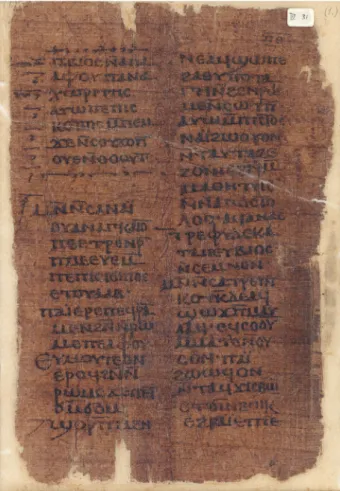
We should not forget that in Egypt the shift from papyrus to parchment as a writing support was a technical innovation that directly affected the num-ber of works transmitted by a single manuscript and sometimes even its contents. In this respect, the Thi(ni)s codices are the latest known example of an Egyptian library entirely transmitted by papyrus co-dices (probably datable between the end of the sev-enth century and the beginning of the eighth), and at the same time offer a rare occasion to study the criteria by which several literary works were assem-bled in one codex. It is interesting to note that only four out of these at least seventeen codices seem to be single-text manuscripts. What is even more im-portant is that these single-text manuscripts do not transmit only biblical works, as happened in the past, but also other literary genres. This is the case of the Vita Epiphanii and, surprisingly, of a work of Shenoute (De iudicio supremo), a rare example of a work of the famous archimandrite transmitted out-side the Shenoutean federation. All the other man-uscripts are multiple-text codices containing from two to nine works and already present most of the physical elements that will characterize the last and better-known phase of Coptic books. The layout is normally in two columns, with few exceptions, and the titles always stand before the works they refer to, but only rarely mention a date. Subscriptiones (or final titles) occasionally survive, but no longer refer to the main titles. As regards their contents, the mul-tiple-text codices of Turin show that Coptic culture was still evolving. There was a strong presence of Greek patristic works translated into Coptic in the fifth century (the so-called “classical translations”, ac-cording to Tito Orlandi’s classification), some apoc-rypha (such as the Acta Pilati), old-style works that reflect the theological controversies of the end of the fourth century (for instance, the Vita Aphou (Fig. 1), that was transmitted only by the Turin codex), some original works of the sixth century (such as Damian and professions of copyists – the latter often not
working regularly as scribes –, places of copying, donors, etc., but they still need to be satisfactorily explored15 . As is well known, the CC classification
has been initiated in the framework of the Corpus
dei Manoscritti Copti Letterari (CMCL)16 , but it needs to be expanded, updated, and disseminated, in or-der to become a completely reliable tool for stand-ard use among specialists of late antique Egypt.
·
A complete classification of the Coptic manuscript tradition, involving the attribution of stable identi-fiers to each manuscript (or rather, to each original “codicological unit”),17 in order to have univocalcoordinates of reference to the entire Coptic book production. Such a classification is progressively expandable as new manuscripts are discovered.18
·
A complete census of sites where individual manu-scripts or entire “collections” have been found, vis-ualizing them in historical maps. A tentative iden-tification of places and geographical areas where specific works and literary genres have been con-ceived. As already said, such an attempt is particu-larly reasonable and sustainable for hagiographic and monastic literary production (for example, cy-cles of martyrdoms, encomia of monastic charac-ters, etc.), where ideological and devotional motifs may be extremely telling. By means of internal ele-ments, style and titles the project will try to anchor a corpus of works to a specific place or to a limited geographical area.19·
A complete archive of names of copyists, commis-sioners, donors, institutions and places involved in the production of manuscripts.·
A classification of the book formats, writing sup-ports and other relevant codicological features of the manuscripts, in relation to the texts that they transmit.“PAThs” and the papyrus codices
of the Museo Egizio
[PB]
As part of the above-described research activities and goals, a complete catalogue of the Coptic pa-pyrus codices preserved in the Museo Egizio will be produced. The fragmentary codices in question, purchased in Egypt by Bernardino Drovetti in the 1820s,20 are a unique example of an entire
well-pre-of Alexandria, De Nativitate), a few pseudepigraphal works – that is new works attributed to old or false authors – and a selection of normative works, such as the Gnomai Concilii Nicaeni. There is, however, no trace of classical or “pagan” works.
“PAThs” and the scribal subscriptions
of the Coptic codices from Thi(ni)s
[AS]
Among the aims pursued by “PAThs”, as previously stated, are a complete census (as well as a concur-rent attribution of a stable identifier number) and an edition, accompanied by an English translation, of all the extant Coptic colophons drafted between the third and the eleventh centuries.
The study of Coptic scribal subscriptions is a some-what neglected domain, with the exception of van Lantschoot’s sophisticated Recueil, where almost all the Ṣa‘īdic colophons known up to the 1929 were masterfully (re-)edited, though without translation, and explained in a learned commentary.23 Rarely
reaching the literary elaborateness that such para-texts often exhibit in other manuscript traditions of the Christian and Islamic Orient, the Coptic col-ophons, though bearing an annus Martyrum, have been usually exploited by scholars merely for manu-scripts dating purposes. The exact dating of a man-uscript, however, appears to be only a tangential de-tail compared to the host of information contained in them, whence PAThs’ main outcome (the archaeo-logical Atlas illustrating the geography and archaeol-ogy of Coptic literature) will tap its lifeblood. Two papyri in the Museo Egizio of Turin are sig-nificant examples of the relevance of colophons as sources for historical geography, prosopography and social history.24 They may also provide an
im-portant clue about the origin of the papyrus codices mentioned above, as well as the origin of the copious unidentified fragments constituting the bulk of the Turin collection of Coptic literary manuscripts from Ǧirǧa, ancient Thi(ni)s.25
Ms. inv. no. Provv. 6266 (Fig. 2) is the almost ful-ly preserved final page of a lost codex.26 It offers a
terse scribal subscription informing us about the owner institution, the ‘catholic church’ of Thi(ni)s (ll. 1-2: ⲛ̄ⲧⲕⲁⲑⲟⲗⲓⲕⲏ | ⲉⲕⲕⲗⲏⲥⲓⲁ ⲛⲧⲓⲛ) and the identity of the copyist, the “humblest reader” (l. 4: ⲡⲓⲉⲗⲁⲭⲓⲥⲧⲟⲥ ⲛⲁⲛⲁⲅⲛⲱⲥⲧⲏⲥ) Geōrgios. The blurry Greek chrono-logical annotation does not much light on the date of the vanished codex: the 19th day of Hathōr of a
third indiction (l. 6: μηνὸς Αθυρ ιθ τρίτης ⲛ̄δικ(ίωνος)). However, the few lines are followed by an accurate numbered list of the contents of the lost book (l.
Fig. 1. Vita Aphou (Coptic Codex III), Turin Cat. 7120, sheet 31. Scanned image: Museo Egizio.
The codices that can be reconstructed with certainty are normally composed of quires of four bifolia (but Codex VI has surely irregular quires), the first four pages being normally blank. The pagination, when regular, is on each page, but there are interesting cases of irregular pagination.22 The first and last
page of each quire bear a quire number.
In sum, the library of Thi(ni)s is a crucial and transi-tional instance in the history of Coptic books, which saw on the one hand the creation of new codicologi-cal and palaeographicodicologi-cal features and on the other the progressive emergence of multiple-text codices. Our task will be to perform a structural analysis of these texts, and to define their history and the context in which they were produced, used and circulated.
21: ⲛⲁⲓ̈ ⲛⲉⲧⲥⲏϩ ⲉⲡⲉⲓϫⲱⲱⲙⲉ) by the same hand, albeit in smaller format.
relatives for whom she was beseeching heavenly re-lease. Eugène Revillout, the first scholar to deal with the document, informs us that it was originally en
tête de la masse from which Codex III was recovered.
He thus daringly supposed that the anonymous riche
veuve égyptienne de Thébaïde, perhaps in fulfillment
of a vow made by her departed spouse, bestowed the library (now kept in Turin) on the church and mon-astery of Alexandria consecrated to St. John the Bap-tist and founded by the patriarch Theophilus, which is sometimes mentioned in the literary works com-prising the library. Van Lantschoot’s correct reading of the slightly damaged toponym following the men-tion of the topos quoted in the note (l. 4: ⲛ̄ⲧ̣ⲓⲛ) allows us to trace the Turin codices to Thi(ni)s.28
“PAThs” and Coptic hagiography
[MCG]
One of the main objectives of the “PAThs” project is to create an annotated catalogue of a number of literary texts that are particularly valuable because of their type, contents and chronology: this will al-low us to demonstrate the complexity of Coptic lit-erature and the diversity of the contexts in which these texts were produced, utilized, and circulated. This part of the work will be based on the applica-tion of an analytical reading template specifically developed for the study of hagiographic texts, which will be recorded, dated, indexed and catalogued, tak-ing advantage of the secondary bibliography at our disposal, most notably Tito Orlandi’s works and all the information provided by the above-mentioned CMCL website. This template will shed light, mainly but not exclusively, on data related to Egyptian and non-Egyptian onomastic and toponomastic materi-als, to be compared with similar data obtained from titles and colophons.
A “qualitative survey” – that is, an observation of relevant topics and pivotal issues (devotional motifs, crucial historical moments, meaningful expressions, etc.) emerging from the reading when one is not looking for a specific answer – will enable users to collect other data that cannot be directly categorized in a template, but that might provide a basis for fu-ture projects and research.
Both of these operations – the application of a schematized reading template and the “qualitative
Fig. 2. Final sheet of a lost codex, Turin Provv. 6266. Scanned image: Museo Egizio.
An even more interesting text is preserved by Ms. Provv. 8548.27 This single leaf carries only the scribal
subscription – a prayer on behalf of the donor of the manuscript –, which very likely concluded a codex; the remaining part is totally lost. It is written in a rather coarse hand and bears no date, but, as tenta-tively suggested by van Lantschoot, could be reason-ably situated between the eighth and ninth centuries, or earlier. Both Christian Demut and faith in divine omniscience (l. 2: ⲡϫⲟⲉⲓⲥ ⲡⲛⲟⲩⲧⲉ ⲥⲟⲟⲩⲛ ⲛ̄ⲛⲉⲩⲣⲁⲛ) are the reason for the silence – also otherwise attested – about the name of the woman who bestowed the book (l. 1: ⲡⲁ]ⲓⲡⲉ ⲡⲉⲣⲏⲧ ⲛ̄ⲧⲁⲛⲓⲙ ⲛ̄ⲥϩⲓⲙⲉ) to the monas-tery of St. John the Baptist in Thi(ni)s (ll. 3-4: ⲉⲡⲧⲟⲡⲟⲥ ⲙ̄[ⲡ]ϩⲁⲅⲓⲟⲥ ⲁⲡⲁ | [ⲓ]ⲱϩⲁⲛⲛⲏⲥ ⲡⲃⲁⲡⲧⲓⲥⲧⲏⲥ ⲛ̄ⲧ̣ⲓⲛ). The name of her deceased husband (ll. 5-6: ⲙ̄ⲛⲡⲉⲥⲙⲁⲕⲁⲣⲓⲟⲥ | ⲛϩ̣̣ⲁⲓ) is equally withheld, as are those of the other
survey” – will grant us deeper and more detailed knowledge of Coptic literature, its history (in terms of phases and literary genres), and its geography.29
One of the focuses of this work will be the monastic world, in order to shed light on the production and diffusion of specific texts. In this respect, another by-product of “PAThs” will be the study of the histo-ry of Egyptian monasticism.
The method employed is based on historical-critical analysis (reading, translating and comments on the text in its original language) and interdisciplinary approaches, particularly by connecting the products of archaeology to the study of sources (literature and documents, not only in Coptic but also in Greek, whenever they can contribute to a more complete reconstruction of a textual family). The aim of this part of the project is to transform the current patch-work of literary knowledge into a more coherent and comprehensive overview of Coptic literature, based upon comparison and interconnectivity.
·
As for the creation of the archaeological Atlas of Coptic literature, this part of the work will be crucial for:·
mapping and localizing networks of places (mon-asteries, churches, basilicas, martyria) where texts were produced;·
analysing the dissemination and circulation of some specific texts;·
reconstructing the cultural and religious contexts of production and utilisation of literature, with special regard to social and economic peculiarities;·
studying the relationships between monasteries, secular families and social networks, with a focus on female roles.The first case study we have chosen is the so-called “dossier of apa Claudius”, composed of four
enco-mia in honour of this martyr and attributed to
dif-ferent authors. This set of texts shows us how the Coptic minority organized itself and constructed its self-representation through a communication strat-egy borrowed from another minority, i.e., the mar-tyrs on whom the violence organized by pagan im-perial institutions was inflicted. This is allowing us to build a geography of sacred spaces based on the interconnection of monasteries, churches and
mar-tyria. We will soon apply the same method to the
lit-erary works preserved in the Thi(ni)s codices.
“PAThs” and the codicological aspects
of Coptic books
[NC]
The codicological finalities of the “PAThs” project are mainly two: 1) a complete census of Coptic lit-erary manuscripts and 2) a codicological description of each manuscript. The census aims at listing the manuscripts in codex form, as well as the horizontal and vertical rolls (sometimes called rotuli) contain-ing all the Coptic literary genres (with the exclusion of magical and liturgical texts). The census will also take into account literary ostraca (with the exception of biblical ones) when they are testimonies of the dissemination of Coptic literature.
Each manuscript – that is each ancient and original ‘codicological unit’ – will be provided with an identi-fication number and a codicological description. The codicological description is founded on a protocol developed by the “PAThs” team, which records infor-mation about the manufacturing of the manuscript, its writing material (papyrus, parchment, paper) and its form.
In the case of codices, special attention will be given to the fashioning of the quires and their succession, and to the binding, when something of it survives. The dimensions of each page, of the writing frame and of the margins will be recorded, as well as the number of columns per page, the number of lines per column, and the number of letters per line, in order to provide detailed information about how the man-uscript was assembled and written, and to identify groups of manuscripts sharing the same characteris-tics and possibly the same context of production and provenance. As stated above, in this perspective the papyrus Coptic literary manuscripts from Thi(ni)s, preserved in the Museo Egizio, are an especially spe-cial case study thanks to their excellent state of con-servation and their known provenance.
The digital arcaheological Atlas of Coptic
literature: its characteristics and its goals
[JB]
The archaeological Atlas of the Coptic literary man-uscripts, the principal output of the “PAThs” project,
will form a complex system whose kernel will be a series of relational online databases, which will be freely available for consultation, as well as for further implementation, and will make exclusive use of net-work technologies. All these resources will therefore be easily accessible and usable, thanks to multi-plat-form and largely available tools such as web brows-ers. This technological choice is aimed at abolishing any usage barrier and to lower, as much as possible, the learning curve both for experts and specialists – who, in close collaboration with one another, will increment the datasets with their research results – and for the end users of the published material. Although the archaeological Atlas constitutes the main product of the project, the individual archives – the archive of Coptic literary manuscripts, of the places of book production, dissemination, and re-covery, of the authors and their works, etc. – can be consulted independently. This is a key aspect, because an essential goal of the “PAThs” project is to become a touchstone in everything that concerns the production, dissemination, cataloguing, classifi-cation and study of Coptic literature.
The relational databases will be encompassed in customized geographical interfaces, capable of ful-ly representing the complexity of the collected data in dynamic thematic maps and on different levels of analysis. Generic users will enjoy all the benefits of a well-organized system of “guided tours”, presenting queries capable of guiding them through the com-plexity of scientific research and the results it has obtained. In addition to this, more granular research tools will be made available to specialists interested in making complicated custom queries and access-ing deeper and more complex layers of information. A strict relational identification scheme of manu-scripts, places, persons, literary genres, etc., will provide pinpointed links between all the entities considered. It will be possible, for example, to query the Atlas by simply clicking on a region or place – Thi(ni)s, for instance – and obtain a full report on the manuscripts found there, sites of ancient manu-script production, the names of scribes active in that place at different periods, etc.
Special attention will be devoted to similar projects. Several international agreements have already been signed, and these collaborations will be further
ex-panded, also in technical terms, in order to provide a free circulation of the linked data.
The whole information system will be developed using only open source software, libraries and pro-tocols, in order to encourage the collaboration of ex-ternal participants even in the earlier phases of de-velopment. We strongly believe that an open source and collaborative pattern of development will guar-antee a longer lifespan to the information platform, since the durability and sustainability of software and protocols is an important issue in digital herit-age projects.
Further information concerning
the “PAThs” project
“PAThs – Tracking Papyrus and Parchment Paths: An Archaeological Atlas of Coptic Literature. Liter-ary Texts in their Geographical Context. Production, Copying, Usage, Dissemination and Storage” – is an ERC Advanced project (2015 n°687567) directed by Paola Buzi. It is based at Sapienza University of Rome (Italy).
The team is currently composed of Paola Buzi (Prin-cipal Investigator, Coptologist), Julian Bogdani (ar-chaeologist and specialist of GIS and WebGIS and digital humanities applied to archaeology), Nathan Carlig (codicologist), Maria Chiara Giorda (historian), Agostino Soldati (philologist), Angela Bernardo (pro-ject coordinator with technical tasks), Angelo Col-onna (Egyptologist), Ilaria Rossetti (Egyptologist), Francesco Berno (Historian of early Christianity), Francesco Valerio (philologist and codicologist) and Tea Ghigo (PnD candidate specialising in archae-ometric analysis of inks).
Official address of the project: “PAThs”
Dipartimento di Storia Culture Religioni Sapienza Università di Roma
Piazzale Aldo Moro 5, 00185 Roma
paths.uniroma1.it [email protected]
Notes
1 Part of this section will also appear in Early Christianity 8 (2017), fasc. 4, pp. 3-12, forthcoming. 2 Davis, The Early Coptic Papacy, pp. 2-14.
3 Allen, The Ancient Egyptian Language, pp. 1-8. 4 Orlandi, in Fiaccadori (ed.), Autori classici 93-104. 5 Orlandi, in Dictionnaire de Spiritualité, XIV,
coll. 797-804; Orlandi, in Nagel (ed.), Carl-Schmidt-Kolloquium pp. 129-142; Emmel, Shenoute’s Literary Corpus.
6 Simonetti, in Camplani (ed.), L’Egitto cristiano,
pp. 11-38.
7 Orlandi, in Siniscalco (ed.), Le antiche Chiese orientali,
pp. 39-120.
8 Delahaye, Annalecta Bollandiana 40 (1922), pp. 5-154,
299-364.
9 Rubenson, Medieval Encounters 2.1 (1996) , pp. pp. 4-14;
Papaconstantinou, Le Muséon 120 (2007), pp. 273-299.
10 For the history of Coptic literature, see Orlandi,
in Camplani (ed.), Egitto Cristiano, pp. 39-120 and Boud’hors, in Scott Fitzgerald (ed.), The Oxford Handbook, pp. 224-246.
11 Petrucci, in Coco (ed.), La lettura spirituale, pp. 5-25;
Crisci, in Muzerelle and Ornato (eds.), Il codice
miscellaneo, pp. 109-144; Bagnall, Early Christian Books, pp 1-24.
12 For a first systematic reflection on Coptic codicology,
see Buzi, Emmel, Coptic Codicology, pp. 137-153.
13 For more technical details about the archaeological
Atlas, see the section by Julian Bogdani.
14 Buzi, Titoli ed autori nella tradizione copta.
15 On research aspects related to colophons, see the
section by Agostino Soldati.
16 HTTP://WWW.CMCL.IT/ (last access: November
2017).
17 On the classification and codicological description of
Coptic literary manuscripts, see the section by Nathan Carlig.
18 This classification will take into consideration the
results of previous and important projects, such as “Trismegistos” HTTP://WWW.TRISMEGISTOS. ORG/ (last access: January 2017), with which “PAThs” has already established a formal collaboration.
19 On these aspects, see the section by Maria Chiara
Giorda.
20 Botti, Rendiconti dell’Accademia dei Lincei 30 (1921),
pp. 128-315; Orlandi, Le Muséon 87 (1974), pp. 139-151; Orlandi, Augustinianum53 (2013),, pp. 501-530.
21 Buzi, in Bausi et al. (eds.), The Emergence of
Multiple-Text Manuscripts, pp. 93-110; Buzi, Egyptian & Egyptological Documents5 (2015/2016) [2017], pp. 57-67.
22 Buzi, in Bausi et al. (eds.), The Emergence
of Multiple-Text Manuscripts, pp. 93-110; Buzi, Egyptian & Egyptological Documents 5 (2015/2016) [2017], pp. 57-67.
23 van Lantschoot, Recueil des colophons des manuscrits chrétiens d’Égypte; generally, on Coptic colophons see now Buzi, Emmel, Coptic Codicology, pp. 137-153 as well as Buzi, in Sirinian et al., Colofoni armeni a confronto, pp. 203-217.
24 On the collection and the codices composing it, see
above, n. 20.
25 About this place see Timm, Das
christlich-koptische Ägypten ; see also Verreth, A Survey of Toponyms, p. 787b.
26 Re-edited by van Lantschoot, Recueil des colophons, I.1,
pp. 180-181, CV, commentary in I.2, pp. 72-73.
27 First edition by Revillout, Journal Asiatique, S. VIII,
I (1873), pp. 218-219; improved re-edition in van Lantschoot, Recueil des colophons, I.1, pp. 181-182, CVI, commentary in I.2, p. 74.
28 See, at least, Orlandi, Les papyrus coptes, p. 116, as well
as Orlandi, The Turin Coptic Papyri, p. 525.
29 HTTPS://GITHUB.COM/PATHS-ERC/COPTIC-TEXTS
Bibliography
Allen, J.P., The Ancient Egyptian Language. An Historical Study, Cambridge 2013, pp. 1-8.
Bagnall, R.S., Early Christian Books in Egypt, Princeton 2009, pp 1-24.
Boud’hors, A., “The Coptic Tradition”, in J. Scott
Fitzgerald (ed.), The Oxford Handbook of Late Antiquity, Oxford 2012, pp. 224-246.
Botti, G., “La collezione Drovetti e i papiri del R. Museo Egizio in Torino”, Rendiconti dell’Accademia dei Lincei 30 (1921), pp. 128-315.
Buzi, P., Titoli ed autori nella tradizione copta: Studio storico e tipologico, Pisa 2005.
Buzi, P. “The Ninth-Century Coptic Book Revolution and the Emergence of Multiple-Text Manuscripts”, in: A. Bausi, M. Maniaci and M. Friedrich (eds.), The Emergence of Multiple-Text Manuscripts, Berlin 2016, pp. 93-110.
Buzi, P., “Titoli e colofoni: riflessioni sugli elementi paratestuali dei manoscritti copti saidici”, in A. Sirini-an, P. Buzi and G. Shurgaia, Colofoni armeni
a confronto. Le sottoscrizioni dei manoscritti in ambito armeno e nelle altre tradizioni scrittorie del mondo mediterraneo. Atti del colloquio internazionale, Bologna, 12-13 ottobre 2012 (Orientalia Christiana Analecta, 299), Roma, Pontificio Istituto Orientale, 2016, pp. 203-217.
Buzi, P., “Amedeo Peyron and the Coptic Codices from This”, Egyptian & Egyptological Documents, Archives, Libraries 5 (2015/2016) [2017], pp. 57-67.
Buzi, P., S. Emmel, “Coptic Codicology”, in: A. Bausi et al. (eds.), Comparative Oriental Manuscript Studies: An Introduction, Hamburg 2015, pp. 137-153.
Crisci, E., “I più antichi codici miscellanei greci: materiali per una riflessione”, in: D. Muzerelle and E. Ornato (eds.), Il codice miscellaneo: tipologie e funzioni. Atti del Convegno Internazionale, Cassino 14-17 maggio 2003, Segno e Testo 2, (2004), pp. 109-144.
Davis, S., The Early Coptic Papacy: The Egyptian Church and Its Leadership in Late Antiquity, Cairo 2004, pp. 2-14.
Delahaye, H., “Les Martyrs d’Égypte”, Analecta Bollandiana 40 (1922), pp. 5-154, 299-364.
Emmel, S., Shenoute’s Literary Corpus (CSCO 599-600, Subsidia 111-112), Louvain 2004.
van Lantschoot, A., Recueil des colophons des manuscrits chrétiens d’Égypte, I: Les colophons coptes des manuscrits
sahidiques (Bibliothèque du Muséon, 1), Louvain 1929. Orlandi, T., “Les papyrus coptes du Musée Egyptien
de Turin”, Le Muséon 87 (1974), pp. 139-151. Orlandi, T., “Shenoute d’Atripé”, in: Dictionnaire de
Spiritualité, XIV, Paris 1989, coll. 797-804.
Orlandi, T., “Traduzioni dal greco al copto: quali e perché” in: G. Fiaccadori (ed.), Autori classici in lingue del Vicino e Medio Oriente, Roma 1990, pp. 93-104.
Orlandi, T., “Egyptian Monasticism and the Beginnings of the Coptic Literature”, in: P. Nagel (ed.), Carl-Schmidt-Kolloquium an der
Martin-Luther-Universität 1988, Halle 1990, pp. 129-142. Orlandi, T., “Letteratura copta e cristianesimo nazionale
egiziano”, in: A. Camplani (ed.), Egitto Cristiano: Aspetti e problemi in età tardo-antica, Roma 1997, pp. 39-120. Orlandi, T., “La letteratura copta e la storia dell’Egitto
cristiano”, in: P. Siniscalco (ed.), Le antiche Chiese orientali: Storia e letteratura, Roma 2005, pp. 85-117. Orlandi, T., “The Turin Coptic Papyri”, Augustinianum 53
(2013), pp. 501-530.
Papaconstantinou, A., “‘They Shall Speak the Arabic Language and Take Pride in It’: Reconsidering the Fate of Coptic after the Arab Conquest”, Le Muséon 120 (2007), pp. 273-299.
Petrucci, A., “Leggere nel Medioevo”, in: L. Coco (ed.), La lettura spirituale: scrittori cristiani tra Medioevo ed età moderna, Milano 2005, pp. 5-25.
Revillout, E., “Le Concile de Nicée, d’après les textes coptes: Exposition de foi – Gnomes du Sainte Concile (papyrus du Musée de Turin)”, Journal asiatique (S. VII), I (1873) pp. 210-288.
Rubenson, S., “Translating the Tradition: Some
Remarks on the Arabization of the Patristic Heritage in Egypt”, Medieval Encounters 2.1 (1996), pp. 4-14. Simonetti, M., “Teologia e Cristologia nell’Egitto
Cristiano”, in: A. Camplani (ed.), L’Egitto cristiano: Aspetti e problemi in età tardo-antica, Roma 1997, pp. 11-38.
Timm, S. Das christlich-koptische Ägypten in arabischer Zeit: eine Sammlung christlicher Stätten in Ägypten in arabischer Zeit, unter Ausschluß von Alexandria, Kairo, des Apa-Mena-Klosters (Dēr Abū Mina), der Skētis (Wādi n-Naṭrūn) und der Sinai-Region, VI, Wiesbaden 1992, pp. 2682-2685.
Verreth, H., A Survey of Toponyms in Egypt in the Graeco-Roman Period (Trismegistos Online Publications 2, Vers. 2.0, http://www.trismegistos. org/top.php) Leuven 2013.