HAL Id: hal-00548066
https://hal.archives-ouvertes.fr/hal-00548066
Submitted on 27 Apr 2019
HAL is a multi-disciplinary open access
archive for the deposit and dissemination of
sci-entific research documents, whether they are
pub-lished or not. The documents may come from
teaching and research institutions in France or
abroad, or from public or private research centers.
L’archive ouverte pluridisciplinaire HAL, est
destinée au dépôt et à la diffusion de documents
scientifiques de niveau recherche, publiés ou non,
émanant des établissements d’enseignement et de
recherche français ou étrangers, des laboratoires
publics ou privés.
The osmotic framework adsorbed solution theory:
predicting mixture coadsorption in flexible nanoporous
materials.
François-Xavier Coudert
To cite this version:
François-Xavier Coudert. The osmotic framework adsorbed solution theory: predicting mixture
coad-sorption in flexible nanoporous materials.. Physical Chemistry Chemical Physics, Royal Society of
Chemistry, 2010, 12 (36), pp.10904-13. �10.1039/c003434g�. �hal-00548066�
The
Osmotic Framework Adsorbed Solution Theory:
Predicting
Mixture Coadsorption in Flexible Nanoporous Materials†
François-Xavier
Coudert
∗Predictive analytical methods are crucial tools in the design of adsorptive gas separation processes. While they are widely used for rigid nanoporous solids, there is a lack for flexible materials, including the very topical and promising dynamic metal–organic frameworks (MOFs), which display such eye-catching phenomena as gate opening and breathing. We present here the Osmotic Framework Adsorbed Solution Theory (OFAST), which predicts the evolution of structural transitions and selectivity upon adsorption of fluid mixtures in flexible nanoporous solids, using as sole input experimental pure components isotherms.
1
Introduction
Porous metal–organic frameworks (MOFs) are an exciting class of nanoporous materials, displaying an extremely large range of crystal structures and host–guest properties. Among their nu-merous prospective applications, such as gas storage, catalysis and sensing, adsorptive gas separation is gaining considerable attention.1Indeed, compared to other classes of microporous
materials currently used in such processes (e.g., zeolites, acti-vated carbons, and silica gels), MOFs show a great potential due the wide possibilities of pre- or postsynthetic functional-ization of their organic linkers. Moreover, a growing number of candidates for adsorptive separation processes are materi-als exhibiting a flexible porous framework, which respond to externally imposed control parameters (pressure, temperature, or adsorption of guest molecules) by changes in their struc-ture. These systems have received much attention recently, and include such diverse phenomena as swelling (progressive, con-tinuous deformation upon host adsorption or removal),2gate
opening (transition from a closed, nonporous phase to an open, microporous structure)3,4and breathing (two successive
struc-tural transitions, 1→2→1).5
A large number of adsorptive gas separation processes are used today in industry, using adsorbents such as zeolites and activated carbons. The technical design of any adsorption pro-cess relies on information about the adsorption equilibria of multicomponent systems in a large number of different ther-modynamic conditions, whose experimental determination is
† Electronic Supplementary Information (ESI) available: detailed mathematical derivations. See DOI: 10.1039/b000000x/
Chimie ParisTech and CNRS, 11 rue Pierre et Marie Curie, F-75005 Paris, France. Tel: +33 (0)1 44 27 67 51; E-mail: [email protected]
‡ Footnotes should appear here. These might include comments relevant to but not central to the matter under discussion, limited experimental and spectral data, and crystallographic data.
expensive and time-consuming, considering the very large di-mensionality of the parameter space for this problem. Thus, the industrial success of adsorptive separation processes, which rely on finding optimal conditions for gas separation in a given adsorbent, is linked to a great extent to the existence of a host of methods that predict multicomponent equilibrium properties based on pure component adsorption data. The simplest of these methods is the Ideal Adsorbed Solution Theory (IAST),6
but many more elaborate methods are used to take into account the nonideality of fluid mixtures.7
For flexible nanoporous materials, however, the well-known coadsorption models are not applicable, as they fail to take into account the guest-induced changes in the structure upon adsorption. There is thus a need for theoretical models allow-ing the prediction of structural transitions and coadsorption properties of mixtures in flexible nanoporous materials. This is exemplified by the severe lack of experimental data on gas coadsorption in flexible MOFs8,9, compared to the published
data available for pure component adsorption.1
In this paper, we explain how to couple the standard adsorbed solution theories with thermodynamic equations of the osmotic ensemble (which describe the host phase equilibria) to predict coadsorption in flexible nanoporous materials, with pure com-ponent adsorption isotherms as the only input. We termed this family of theoretical methods OFAST, for Osmotic Framework Adsorbed Solution Theory. The simplest variant of OFAST, rely-ing on IAST for prediction of coadsorption in each phase and Langmuir fits of the experimental isotherms, was very recently il-lustrated and showcased on archetypical systems exhibiting gate opening and breathing.10Here, we present the generic
deriva-tion of the OFAST method from thermodynamic equaderiva-tions, the approximations made to obtain the simple ‘‘IAST+Langmuir’’ variant and the particular properties of its implementation. We then study the sensitivity of this method to the fits of the
ex-perimental data. Finally, we present and validate a very simple, approximate analytical expression for the gate-opening pressure upon adsorption of mixtures.
2
The OFAST method
2.1 Coadsorption in the osmotic ensemble
The appropriate thermodynamic ensemble to describe the ad-sorption of fluids in a flexible material is the osmotic en-semble,11–15where the control parameters are the number of
molecules of the host framework,Nhost, the mechanical
con-straint exerted on the systemσ, the temperature T, and the chemical potentials of the adsorbed fluids,{µi}. If we restrict the current study to materials with only a few metastable frame-work structures, it was demonstrated in earlier frame-work that the use of an ‘‘osmotic subensemble’’ adequately describes the equi-librium between host structures upon adsorption.15,16This is
especially appropriate for materials that present abrupt phase transitions between well-defined frameworks structures, as op-posed to phenomena like continuous swelling upon adsorption. The use of equations derived in the osmotic subensemble was validated on a large range of systems and phenomena, including such contrasting behaviors as the ‘‘breathing’’ of MIL-53 (Al) and the ‘‘gate opening’’ of Cu(4,4′-bipy)(dhbc)
2. In this
sec-tion, we present the thermodynamic framework to study the structural transitions induced in flexible nanoporous materials by the coadsorption of fluid mixtures. To this effect, we extend the framework developed for pure-component adsorption in ref. 16 and show what are the necessary assumptions to obtain reasonably simple equations linking mixture adsorption, host properties and structural transitions.
We consider the thermodynamic equations describing the adsorption of a mixture of fluids,i∈ {A, B, . . .}, inside a porous flexible material that is in equilibrium between a given num-ber of metastable structures k ∈ {α, β, . . .}. Following the ‘‘osmotic subensemble’’ approach, to each metastable phase k of host framework structure is associated a value of the os-motic potential restricted to that phase, Ωos
k. This potential
depends on the control parameters of the ensemble: Ωos
k =
Ωos
k(Nhost,σ , T,{µi}). It is equal to the sum of the Gibbs free
energy of the isolated host structure in phasek, G(k)host, and the grand canonical potential for the adsorbate in the structure considered as rigid, Ωk.
In order to express the grand canonical potential as a function of quantities directly available from experiments or simulations, we calculate it from its derivatives, using the fundamental rela-tion involving the chemical potential of the adsorbates:17–19
(∂µ∂Ω
i)Vk,T ,µj≠i= −Ni
(1)
As we consider here the process of coadsorption of a mixture of fluids of fixed composition inside the porous material, the chemical potentials of the fluids are not at all independent. In-deed, if we note y= {yA,yB, . . .} the molar composition of the
fluid (such that ∑ yi = 1), and P the total external pressure of
the gas mixture, then the chemical potentials are functions ofP and the composition:µi= µi(P, y). In the example of an ideal
mixture of ideal gases, this function would be: µi(P, y) = µ○i + RT ln (
yiP
P○) (2)
Thus, for the adsorption of a fluid mixture in the material, the variation of the grand potential with pressure is given by:
(∂Ω∂P )
Vk,T= − ∑i
Ni(∂µ∂P ) = − ∑i i
NiVm,i (3)
whereVm,iis the partial molar volume of fluidi in the mixture.
The osmotic grand potential restricted to phasek can thus be written as:16 Ωos k(T, P, y) = Ωosk(T, P = 0, y) + ∫ P 0 ( ∂Ω ∂P )Vk,T dp = Ghost k (T) − ∫ P 0 (∑i N (k)
i (T, p, y)Vm,i(T, p, y)) dp
= Fhost
k (T) + PVk− ∫ P 0 (∑i N
(k)
i (T, p, y)Vm,i(T, p, y)) dp
(4) whereNi(k)(P) is the adsorbed quantity of fluid i (i.e. the partial coadsorption isotherm) in therigid framework structure of phasek, Vkis the unit cell volume of the phase, and we equated
the mechanical constraintσ with the total external pressure P. While eq. 4 is in theory enough to allow us to calculate the osmotic potential from properties of the mixture (partial molar volumes) and of the adsorption (isotherms), it can be signifi-cantly simplified in some commonly-encountered cases. As a first simplification, if the mixture of fluids is ideal, the molar volume is then independent of the mixture composition:
Ωos
k(T, P, y) = Fhostk (T) + PVk
− ∫0P(∑
i
Ni(T, p, y)Vm,i(T, p)) dp (5)
Moreover, if the fluids themselves can be considered as ideal gases, then the equation simplifies even further to yield:
Ωos k(T, P, y) = Fkhost(T) + PVk− RT ∫ P 0 ∑iN(k)i (T, p, y) p dp = Fhost k (T) + PVk− RT ∫ P 0 Ntot(k)(T, p, y) p dp (6)
whereN(k)
tot is the total quantity of fluid adsorbed inside the
pores of the material. In particular, in the very common case of a host material in equilibrium between two structures (and of an ideal mixture of ideal gases), the osmotic potential difference between the two phases follows a very simple equation:
∆Ωos(T, P, y) = ∆Fhost
(T) + P∆V − RT ∫0P∆Ntot(T, p, y)
p dp (7)
2.2 Predicting structural transitions upon adsorption of
fluid mixtures
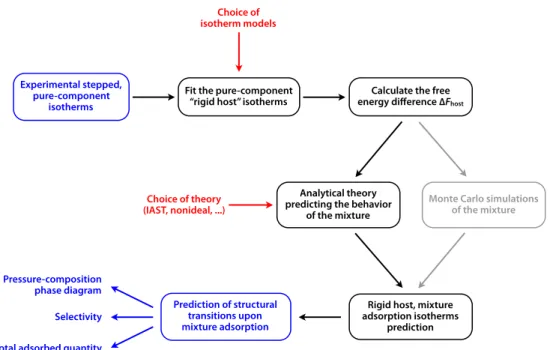
In this section, we describe the general principles of the OFAST (Osmotic Framework Adsorbed Solution Theory) method to predict structural transitions upon adsorption of fluid mixtures in flexible nanoporous materials (schematized in Fig. 1). In particular, we show how all the terms needed in equations 4, 5 and 6, which determine the relative stability of the host phases, can be derived from experimental, pure-component adsorption isotherms.
Using eq. 4 (or eq. 5 or 6 if the mixture or the fluids can be con-sidered ideal), we can compute for a given composition of the fluid mixture and a given pressure the thermodynamic potential associated with each host phase. The most stable phase for each set of thermodynamic conditions is then the structure corre-sponding to the lowest osmotic potential, and the guest-induced structural transitions of the host upon coadsorption correspond to the pressures at which Ωos
k(T, P, y) = Ωosk′(T, P, y). In the
hypothesis that structural transitions happen near the thermody-namic equilibrium (i.e. that hysteresis loops are not too large),20
it is thus possible to predict and rationalize the behavior of flex-ible nanoporous materials upon adsorption of mixtures of fluid, based simply on properties of themixture — Vm,i(T, p, y) — on
properties of the emptyhost material — Fhost
k andVk— and on
thepartial adsorption isotherms of the mixture — Ni(k)(T, p, y). These few properties can be determined in a number of ways and, with the exception of the unit cell volumes (Vk) which are
known from the cristallographic structures of the material, they are not trivial to determine.
The determination of the relative free energies (Fk) is a point
of great difficulty. It was demonstrated in previous work on adsorption-induced structural transitions that they can be de-duced from experimental isotherms and transition pressures,16
avoiding the uncertainties of an experimental determination by calorimetry21or a theoretical prediction by first-principles
simulations (which have difficulties calculating accurately en-tropies). The determination of relative free energiesFk, up to an
additive constant, is made possible by the special case of eq. 4 for a pure component fluid:
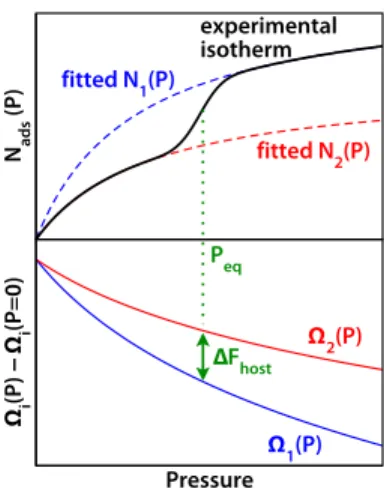
Ωosk(T, P) = Ghostk (T) − ∫ P 0 N (k)(T, p)V m(T, p)dp (8) Nads (P) Pressure Ωi (P) − Ωi (P=0) experimental isotherm fitted N1(P) fitted N2(P) Peq ∆Fhost Ω1(P) Ω2(P)
Fig. 2 Example of determination of the free energy difference ∆Fhost between two phases of flexible material from fits of an experimental,
stepped pure-component adsorption isotherm.16
Thus, if ‘‘rigid host’’ adsorption isothermsN(k)(P) for the pure
component can be extrapolated as partial fits from an experi-mental stepped isotherm (as shown in Fig. 2, upper panel; each part of the stepped isotherm is fitted by a separate Langmuir equation, see Ref. 16 for details), the relative free energies of the host phases can be calculated from the structural transition pressures and integration of the fitted isotherms. This process is highlighted in Fig. 2.
Before fitting the experimental sorption isotherms, it should be noted that the thermodynamic quantities needed for the analysis are the total adsorbed amount (or ‘‘absolute quanti-ties’’), rather than the excess amount adsorbed that is typically obtained as a result of volumetric or gravimetric experiments. In particular, these two quantities will differ widely at high pres-sure, e.g. in the case of supercritical adsorption. They are linked by the following equation:
Nabs = Nex+ ρbulkVp (9)
whereNabsis the absolute amount adsorbed,Nexis the excess
adsorption,ρ is the fluid bulk density and Vpis the pore volume
of the solid, which can come from experimental measurements of helium adsorption or from molecular simulation.22,23This
topic has been well explored, notably in order to link experi-mental excess data with the results of molecular simulations of adsorption, whose output is the absolute adsorption. In the present work, we used the experimental pore volumes reported for each structure studied.
Finally, the partial adsorption isotherms of the mixture N(k)
i (P) (or the total isotherm, Ntot(P), in the case of ideal
gases) can be determined using a variety of means. The di-rect measurement by an experimental setup for coadsorption, while possible, is known to be technically demanding. A
di-Experimental stepped, pure-component
isotherms
Fit the pure-component “rigid host” isotherms
Choice of isotherm models
Calculate the free energy difference ∆Fhost
Monte Carlo simulations of the mixture Analytical theory
predicting the behavior of the mixture
Choice of theory (IAST, nonideal, ...)
Rigid host, mixture adsorption isotherms prediction Prediction of structural transitions upon mixture adsorption Pressure-composition phase diagram Selectivity Total adsorbed quantity
Fig. 1 Schematic description of the OFAST method for predicting the evolution of structural transition upon adsorption of fluid mixtures in
flexible materials. In addition, the use of Monte Carlo simulations as an alternative to analytical theories for prediction of mixture coadsorption is indicated in gray.
rect determination by molecular simulation is possible and has been successfully applied in the past for related systems:24–26
the best tool for such a challenge is certainly the use of Grand Canonical Monte Carlo simulations coupled with forcefields val-idated on thermodynamics properties of the single-component adsorption of the various fluids considered.27However, this
still requires the exploration of a large parameter space, includ-ing mixture composition, pressure and the different phases of the host material. In order to perform a rapid prediction of coadsorption of mixtures in flexible materials, we propose here the use analytical models developped to predict coadsorption properties based on single-component quantities. These models include the Ideal Adsorbed Solution Theory (IAST) of Myers and Prausnitz,6nonideal adsorbed solution models7,28and the
Vacancy Solution Theory (VST).29While these models are no
panacea for the prediction of mixture adsorption in microp-orous solids, they have been extensively studied in the past and both their areas of validity and their weaknesses have been as-sessed. In particular, they are known to be fairly reliable for adsorption of small gas molecules, or mixtures of apolar fluids of a similar chemical nature (such as mixtures of hydrocarbons). In conclusion, by putting the methods described above to-gether in a single scheme, we obtain the OFAST method. The method, outlined in fig. 1, relies on experimental, stepped pure-component isotherms as an input.30These isotherms are fitted
to obtain ‘‘rigid host’’ pure-component isotherms and to
cal-culate the free energy differences between phases. An analyti-cal model is then used to obtain mixture coadsorption data in each host phase, and the osmotic subensemble equations then allow the prediction of structural transitions and a composition– pressure phase diagram for the flexible framework. The two main choices present in the method are the choice of isotherm models for fitting pure-component experimental data, and the choice of an analytical model for the prediction of coadsorption behavior. The most simple choices to implement the OFAST method is to use the Langmuir equation for pure-component isotherms, and the IAST for coadsorption prediction. More complicated alternatives could be considered, including non-ideal models of fluid mixtures7,28and other functional forms
for the fitting of isotherms. Indeed, recent work on MOFs with dynamic frameworks by Wang et al. have successfully used the Langmuir–Freundlich equation in an extension of our group’s earlier work on the osmotic ensemble.31We show in the
fol-lowing that the particular combination ‘‘Langmuir+IAST’’ is numerically fast to solve, describes real-life systems in good agreement with available experimental data, and can even yield analytical solutions in the most simple cases.
3
Combining
IAST
and
Langmuir
pure-component isotherms
In this section, we show how the generic OFAST method can be applied when combining Langmuir isotherms for fitting pure-component isotherms, and IAST for predicting mixture coadsorption. We first introduce notations and give a quick summary of the IAST equations, then combine them with Lang-muir isotherms and determine the asymptotic behavior of their solution.
3.1 The IAST equations
We introduce here the IAST equations for the case of adsorption of a mixture of two fuilds B and C inside a nanoporous materials with fixed structure, based on known pure-component adsorp-tion isotherms of B and C in the pores, noted asN∗
B(T, P) and
N∗
C(T, P). We use the IAST to predict the thermodynamics of
adsorption of a mixture of B and C inside the nanopores. The input quantities are the composition of the external fluid mix-ture, given by the molar fractionsyBandyC= 1 − yB, and the
total fluid pressure,P. The unknown quantities, which will be calculated by solving the IAST equations, are the composition of the adsorbed fluid, given by the adsorbed molar fractions xBandxC = 1 − xB, and the total quantity of adsorbed fluid,
Ntot. From these quantities, the values of other related
proper-ties can then be calculated, such as the adsorption selectivity, α= xB/xC
yB/yC, and the adsorbed quantities of B and C,NB= xBNtot
andNC= (1 − xB) Ntot.
In order to computexB andNtotfor a certain value of yB
andP (given N∗
B(T, P) and NC∗(T, P)), the IAST introduces
the intermediate variablesP∗
B andPC∗. There are then four IAST
equations: xB= P ∗ C− P P∗ C− PB∗ (10) P yB= xBPB∗ (11) 1 Ntot = xB N∗ B(PB∗)+ 1− xB N∗ C(PC∗) (12) ∫ P∗ B 0 N ∗ B(p)d ln p = ∫ P∗ C 0 N ∗ C(p)d ln p (13)
This last equation can be rewritten as: ∫ P ∗ B 0 N∗ B(p) p dp= ∫ P∗ C 0 N∗ C(p) p dp (14)
These four equations involve four unknowns (xB,Ntot,PB∗and
P∗
C). They can be solved numerically if the expressions of
N∗
B(T, P) and NC∗(T, P) are known, either as analytical fits or
smoothed interpolation of the experimental data.
3.2 IAST applied to Langmuir pure-component isotherms
We now consider the adsorption of the same mixture of two gases B and C, with the additional hypothesis that pure-component adsorption of each fluid inside the porous material can be appropriately described by a Langmuir isotherm:
N∗ i(P) = KiP 1+KiP Ni (15) whereKiis the Henry constant for adsorption, which measures
the affinity of the gas for the material, andNiis the maximum
adsorbed quantity, i.e. the number of adsorbed gas molecules at the plateau of the isotherm. In that case, IAST equation 14 is as follows: NBln(1 +KBP ∗ B NB ) = NC ln(1 +KCP ∗ C NC ) (16) When combined with equations 10 and 11, it reduces to a single equation that determinesP∗
B in terms of known quantities:
P yCPB∗ P∗ B− PyB = NC KC ⎡⎢ ⎢⎢ ⎢⎣(1 + KBPB∗ NB ) NB NC − 1⎤⎥⎥⎥ ⎥⎦ (17) While equation 17 is analytical, there is no general expres-sion for its solution in closed form. It is, however, much sim-pler to solve than the full system of IAST equations, especially since it does not involve numerical integration. In all cases presented in this article, we found that a simple Newton root-finding algorithm with a starting value slightly larger thanP yB
(typically, P yB(1 + 10−3)) converges systematically. Because
the OFAST method then needs to numerically integrate the coadsorption isotherms (eq. 7), both this steady convergence and the ability to solve the IAST equations in little computa-tional time have allowed us to calculate a hundred points of a pressure-composition phase diagrams in a matter of minutes on a commodity PC with Mathematica.32
3.3 Asymptotic behavior
While the IAST equation describing the coadsorption of two fluids for which pure-component adsorption follows Langmuir isotherms (eq. 17) has no analytical solution, it is possible to establish the behavior ofP∗
B(P) in the limits of low or high
pres-sure, as a power series inP. All quantities of interest, including the selectivityα and the total adsorbed quantity Ntot(of
spe-cial interest because it is a cruspe-cial part of eq. 7), can thus be expressed as power series inP. For the sake of readability, the mathematical derivations of these power series is not given here but in Appendices A and B (see supporting information). We show here the (first order) asymptotic behavior ofα and Ntot
be-cause, to our knowledge, these expressions for the high-pressure asymptotes are not available in the existing literature.
-2 0 2 4 log P -0.5 0 0.5 1 1.5 log α
low pressure limit
high pressure asymptote
Fig. 3 An example of selectivity for a mixture of two fluids following
Langmuir pure-component isotherms (solved numerically, in black), compared to the low-pressure (blue) and high-pressure (red) asymptotic behaviors established in the text.
At low pressure (P→ 0), the first-order expressions are: {αNtot= K= P (yB/KCBKB+ yCKC) (18)
In the limit of high pressure (P→ ∞), the first-order terms are (in the case whereNB> NC):
⎧⎪⎪⎪ ⎪⎪⎪⎪⎪ ⎪⎨ ⎪⎪⎪⎪⎪ ⎪⎪⎪⎪ ⎩ α(P → ∞) ≃ NC KC × ( KB NB) NB NC × (PyB) NB NC−1 Ntot= NB⎡⎢⎢⎢ ⎢⎣1− ( NB− NC NC ) ( yCKC NC ) ( P yBKB NB ) −NBNC⎤⎥ ⎥⎥ ⎥⎦ (19) Figure 3 presents a numerical example of selectivity in a binary mixture of fluids that have single-component Langmuir-type adsorption, compared to the both the low-pressure and high-pressure expressions. The high high-pressure asymptote can clearly be seen as a straight line (of slopeNB/NC− 1) in this log-log
scale.
4
Application to two archetypical flexible MOFs
In this section, we apply the OFAST method as described above to two cases of flexible metal–organic framework. Well-characterized flexible porous MOFs where adsorption isotherms for more than one adsorbent has been recorded are scarce, and experimental data for mixture coadsorption are even rarer. Hence, we show here how the OFAST method applies to of two quite different phenomena observed in flexible MOFs: gate opening (or gated adsorption) in Cu(4,4′-bipy)(dhbc)
2, and
breathing (two successive structural transitions, in the form 1→2→1) in MIL-53 (Al). While preliminary results on these
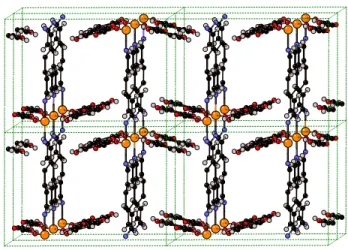
Fig. 4 Structure of the Cu(4,4′-bipy)(dhbc)
2coordination polymer
shown as a 2 × 2 × 2 supercell viewed along thea axis. Atom colors are
as follows: Cu – orange, N – blue, C – black, O – red, H – gray.
archetypical materials were reported in a previous study,10we
extend here these results to include approximate, simple analyt-ical expressions for gate-opening and breathing pressures, an analysis of the sensitivity of the results to uncertainties in the parameters extracted from experimental data, and a discussion on the universality of the shape of the pressure-composition phase diagrams observed in the two specific cases reported here.
4.1 Gate opening of Cu(4,4′
-bipy)(dhbc)2
A number of flexible hybrid frameworks present a structural transition from a nonporous structure to a porous one upon adsorption of guest molecules. This process is called gate open-ing (or gate adsorption) and has been reported in a number of compounds.3,33–35These materials are expected to find
applica-tions as sensors, switches or actuators. Because the pressure at which the structural transition (referred to as ‘‘gate-opening pressure’’) happens generally depends on the guest, these mate-rials are stated as having an important potential for gas separa-tion. The reason for this is probably that the pure component adsorption isotherms lead to belief that in a mixture, one com-ponent would adsorb but the other would not. We show, on the example of Cu(4,4′-bipy)(dhbc)
2, why this is not generally true
and we predict how the gate-opening pressure for adsorption of a mixture evolves as a function of its composition.
Cu(4,4′-bipy)(dhbc)
2⋅ H2O (4,4′-bipy = 4,4′-bipyridine;
dhbc = 2,5-dihydroxybenzoate) was synthesized by Kitagawa et al. a few years ago3and is known to exhibit a guest-induced
structural transition upon adsorption of a large variety of gases (CO2, O2, CH4and N2) at 298 K. The as-synthesized structure of
this compound has been solved, and the crystal-to-crystal struc-tural transition occurs between two phases hereafter labeled 1
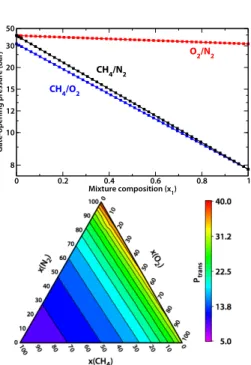
0 0.2 0.4 0.6 0.8 1 Mixture composition (x1) 8 10 12 15 20 30 50
Gate-opening pressure (bar)
CH 4/O2 CH 4/N2 O 2/N2
Fig. 5 Gate-opening pressure (in reciprocal scale) for adsorption of
binary mixtures in Cu(4,4′-bipy)(dhbc)
2, as a function of mixture
composition. Top panel: for O2/N2(red), CH4/N2(black), and
CH4/O2(blue) binary mixtures; symbols correspond to numerical
solution of the equations, while lines show the analytical expression
obtained: 1/Pmixture=x1/P1+x2/P2. Lower panel: for the CH4/O2/N2
ternary mixture.
and 2, whose structures have not been solved. The dehydrated material (1) shows no microporosity and, upon gas adsorption, its channels open up at a given (guest-dependent) gate-opening pressure to yield a fully open structure (2). The framework structure of 2 is the same as that of the as-synthesized material, and is shown in Fig. 4.
In order to predict the behavior of Cu(4,4′-bipy)(dhbc) 2upon
adsorption of mixtures of O2, CH4and N2, we use Langmuir
fits of the experimental adsorption isotherms for the pure com-ponents3and the value of free energy difference between
struc-tures 1 and 2, which was calculated from the isotherms to be 4 kJ/mol (±0.5 kJ/mol) at 298 K.16Using the OFAST method
with IAST and the Langmuir fits, we can numerically calculate the integral in Eq. 7 and determine the gate-opening pressure for each possible mixture, as well as adsorption selectivity as a function of composition and pressure. Fig. 5 shows the evo-lution of gate-opening pressure for the N2/O2, N2/CH4and
O2/CH4binary mixtures (top panel) as well as for a ternary
mixture of the three gases (bottom panel). The gate-opening pressure varies smoothly and monotonically between the gate-opening pressures for the respective pure components. It is also to be noted that, because the gate-opening pressure for CH4(around 8 bar) is much lower than that of O2and N2(i.e.
PCH4≪ PO2 ≈ PN2), the main factor determining the transition
pressure upon adsorption of the ternary mixture is the CH4
molar fraction,xCH4.
Because the evolution of the gate-opening pressure with mix-ture composition is so smooth, we investigated the possibility to derive an analytical formula for it from the IAST/Langmuir equations. Noting that, for all adsorbents, the gate opening happens before the plateau of the isotherm is reached, we de-veloped a Langmuir-type solution to the IAST equation, exact at low pressure to the second order inP (see Appendix C, in the supporting information). This approach allows to obtain a simple, approximate expression for the gate opening pressure of a mixture: Pgate(y) = (∑ i yi Pgate,i) −1 (20) where the sum overi runs over all components of the mixture. In this approximation, the gate-opening pressure of the mixture is thus the weighted harmonic mean of the gate-opening pres-sures for its components, the weights being the molar fraction of the components. This approximation is plotted for all three bi-nary mixtures as solid lines on the upper panel of Fig. 5, and can be compared to the the numerical solution of the full OFAST equations (the symbols). It can be seen that the agreement is ex-cellent for all mixtures, showing the value of this approximation. Furthermore, the agreement is also excellent for the ternary mixture, though it is not represented here. This is especially noteworthy because the approximation proposed here for the gate-opening pressure is very simple, and can be used without
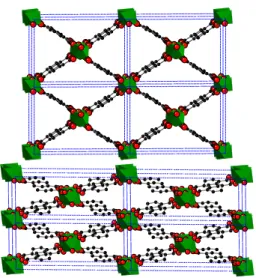
Fig. 6 View of the 2 × 2 × 2 supercell of the lp (top) and np (bottom)
forms of MIL-53 (Al).
any calculation at all to predict roughly the gate-opening pres-sure for adsorption of mixtures, as long as it happens before the plateau of the isotherms.
4.2 Breathing in MIL-53
The MIL-53 metal–organic framework family36has attracted a
great deal of attention due to the massive flexibility it exhibits and the so-called ‘‘breathing’’ phenomenon, which consists of two successive guest-induced structural transition upon adsorp-tion. The MIL-53 framework topology is formed of unidimen-sional chains of corner-sharing MO4(OH)2octahedra (M=Al3+,
Cr3+) linked by 1,4-benzenedicarboxylate (BDC) ligands, which
results in linear lozenge-shaped channels large enough to ac-commodate small guest molecules. This structure may oscillate between two distinct states, a large pore form (lp) and a narrow pore form (np; see Fig. 6), upon adsorption and desorption of gases. There is a 38% difference in cell volume between these two forms. The list of guests that induce this breathing includes CO2, H2O, CnH2n+2(n≥ 2) and para-xylene, but neither H2,
CH4, norortho- and meta-xylene at room temperature.5,37,38
This was shown to be due to the difference in adsorption affinity for the gas between the lp and np phases.16In the simplest case
of Langmuir adsorption, it was further demonstrated that the difference in adsorption enthalpy ∆Hads = Hads(np)− H(lp)ads
con-ditions the occurence of breathing at a given temperature: if ∆Hadsis above a certain critical value, breathing takes places
because gas adsorption favors strongly the np phase at interme-diate pressure; if ∆Hadsis too small, breathing does not occur.39
Finally, at low enough temperature, the stable phase of the empty MIL-53 (Al) is the np phase40, and the breathing phenomenon
is replaced by a single phase transition akin to gate opening.41
0 0.2 0.4 0.6 0.8 1 x(CH 4) 0 2 4 6 8
Pressure (bar) np phase lp phase
approx.
Fig. 7 Phase diagram of MIL-53 (Al) upon adsorption of a mixture of
CO2and CH4, as a function of pressure and mixture composition.
Top: the dashed blue line shows the analytical approximation to the
closing pressure. Bottom: CO2/CH4selectivity is superimposed on
the phase diagram.
Knowing that only some fluids induce breathing at a given temperature raises the question of what happens for a binary mixture of two components, one of which does trigger the two successive structural transition while the other does not. The first report of adsorptive gas separation using MIL-53 was pub-lished by Finsy et al., who studied CH4/CO2separation using
a fixed-bed of MIL-53 (Al) pellets.8 We applied the OFAST
method to MIL-53 (Al), and showed that its prediction were consistent with the data collected by Finsy.10Here, we briefly
summarize these results before studying their dependence on all models parameters (such as parameters obtained while fitting the experimental isotherms) and discussing the generality of the features of the composition–pressure phase diagram obtained in the particular case of a CH4/CO2mixture in MIL-53 (Al).
Relying on Langmuir fits of the experimental adsorption isotherms for CO2and CH4performed in ref. 39, and applying
the OFAST method, we can calculate a composition–pressure phase diagram of MIL-53 (Al) upon adsorption of CH4and CO2.
This phase diagram, shown in Fig. 7, has many features worthy of note: firstly, there is a critical CO2composition of around
parameter value uncertainty KCOlp 2 2.2 bar −1 0.1 bar−1 NCOlp 2 10.1 0.1 KCOnp2 11 bar−1 ±2 bar−1 NCOnp2 2.7 ±0.2 KCHlp 4 0.55 bar−1 ±0.01 bar−1 NCHlp 4 8.0 ±0.2 KCHnp4 0.55 bar−1 * NCHnp4 2.1 *
Table 1 Uncertainties of the parameters fitted from experimental CO2
and CH4isotherms in MIL-53 (Al).5,16,39* indicates parameters that
are not determined from experimental data, but derived from
molecular simulation data.42
of the reopening transition (the higher-pressure np→lp transi-tion) with composition is nonmonotonical, and has a maximum around 8 bar. This maximal pressure is significantly higher than that of pure CO2, which is around 5 bar. Thirdly, and last, the
CO2/CH4adsorption selectivity predicted by IAST (Fig. 7,
bot-tom panel) is much higher in the narrow-pore phase of the material than in its large-pore structure, as can be expected from the pure-component isotherms.
We now turn our attention to the sensitivity of the results to changes in the model parameters. The parameters fitted from experimental pure-component isotherms are reported in Table 1, along with estimated the uncertainty for each parameter. It can be seen that the parameters carrying the larger uncertainties are those pertaining to CO2adsorption in the np phase. The
reason for this is that the low-pressure part of the experimental adsorption isotherm, which corresponds to the np phase and from which these two parameters are fitted, includes only a few disperse points. These uncertainties could be reduced if more detailed low-pressure data were available. We have also analyzed the uncertainty on ∆Fhost, the difference in free energy
of the two empty phases of the material, which is a result of our model, calculated from the isotherm fits and the pressure at which structural transitions happen. This quantity, as a result, has two sources of uncertainty. The first is the uncertainties in the fitting parameters; it yields an uncertainty of roughly±10%. The second is due to the fact that the equilibrium pressure of the structural transition, on which the model is based, can only be determined within a certain range, because of the presence of hysteresis in the experimental isotherms. Thus, the free energy difference can be located in a certainrange, but may not be given a precise value if, for example, adsorption-desorption hysteresis is too broad. In the case of CO2adsorption in MIL-53 (Al) at
room temperature, we have further refined the value initially published (2.5 kJ/mol) and propose here the more accurate range of ∆Fhost= 2.0 kJ/mol (±0.8 kJ/mol).
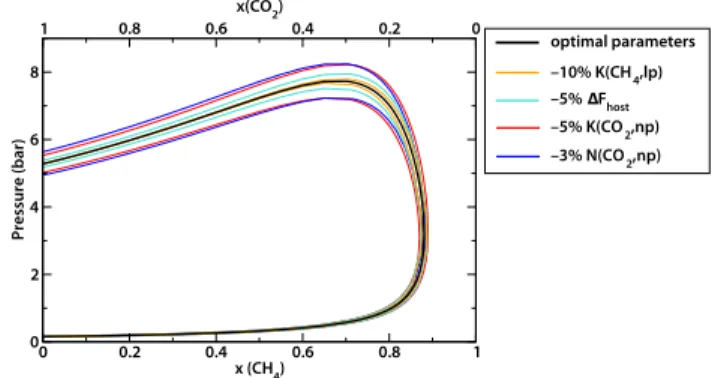
0 0.2 0.4 0.6 0.8 1 x (CH4) 0 2 4 6 8 Pressure (bar) 1 0.8 0.6 0.4 0.2 0 x(CO2) –10% K(CH4,lp) –5% ∆Fhost –5% K(CO2,np) –3% N(CO2,np) optimal parameters
Fig. 8 Composition–presure phase diagrams of MIL-53 (Al) upon
CO2/CH4adsorption, with symmetric variations of the model
parameters with the largest uncertainties.
Having now determined uncertainties of all parameters in the model, we can wonder what is their influence on the outcome of the OFAST method, i.e. on the pressure–composition phase diagram of MIL-53 (Al) and on the predicted coadsorption selectivities. We show in Figure 8 the effect of varying model pa-rameters on this phase diagram; for reasons of clarity, only four parameters with the larger uncertainties are represented. It can be seen that, while the exact positions of phase transitions and particular points on the diagram are modified (0.1≤ xlim≤ 0.15,
7≤ Pmax≤ 8 bar), its shape and general features are preserved.
In particular, the value of the critical CO2composition required
for breathing does not change much, and the nonmonotonical behavior of the reopening pressure as a function of composition is independent of the exact values of the model parameters. Sim-ilarly, we studied the influence of parameters to the CO2/CH4
selectivity. We showed that small variations of the parameters can lead to large changes in the values of selectivity (e.g., the selectivity range of the np phase can vary between 10–20 and 18–40), but the general behavior remains the same, with the narrow-pore structure having a much higher selectivity than the fully open structure.
We showed in previous work10 that the {CO
2/CH4,
MIL-53 (Al)} pressure–composition phase diagram resulting from OFAST predictions is consistent with the experimental results of Finsy et al.8The results of this work were obtained by
break-through experiments on a fixed-bed of MIL-53 (Al) pellets and, as such, do not directly represent the thermodynamic adsorp-tion equilibrium. However, Hamon et al9very recently
pub-lished a study of adsorption of CO2/CH4mixtures in the pores
of MIL-53 (Cr). These newer results, in a material rather close to MIL-53 (Al) in structure and pure-component adsorption properties, include stepped adsorption isotherms and in situ Raman spectra. From the later, np/lp phase compositions were calculated as a function of mixture composition and vapour pressure. Both sets of data show that the evolution of closing
and reopening pressure is in qualitative agreement with the predictions of OFAST. For example, the high-pressure reopen-ing transition is seen to take place at increasreopen-ing pressure (8, 9 and 11 bars) for mixtures with an increasing composition in methane (xCO2 = 0, 0.25 and 0.5 respectively). Similarly, the
low-pressure closing transition pressure is seen to increase with the composition in methane (as seen from the curves of phase composition calculated from Raman results), although this ef-fect is hard to quantify due to the large uncertainties of the data at low pressure. Moreover, there is a certain critical composi-tion of the mixture for which the breathing effect disappears or is barely noticeable (even though the exact composition value differs, fromxCO2 ≈ 0.12 in the model to xCO2 ≈ 0.25 in the
experimental data). Thus, all the experimental results available to date are in qualitative agreement with the predictions of the OFAST method.
Finally, we present here an analysis of the {CO2/CH4,
MIL-53 (Al)} pressure–composition phase diagram based on approx-imate analytical expressions obtained in Section 3.3 and Ap-pendix C, with the aim of determining whether the shape and features of the phase diagram observed in this particular sys-tem can be expected to be more generic. We first focus on the low-pressure, lp→np closing transition. Since it happens at low pressure, before the plateau of the adsorption isotherms is reached, we can propose an analytical expression for the closing pressure that resembles Eq. 20:
Plp→np≃ x(CO2) PCO2 lp→np + xP(COCH42) lp→np (21)
However, because CH4does not induce breathing at room
tem-perature, the termPCH4
lp→npis a negative, fictious transition
pres-sure. In this case, by fitting the numericaly-obtained phase diagram, we determine its value to bePCH4
lp→np ≃ −3 bar. The
analytical approximation, which is displayed as a blue dashed line in Fig. 7, is in excellent agreement with the numerical tran-sition pressure for compotran-sitions down to 0.15. This shows, as in the case of gate opening, the very wide range of validity of this approximation. Based on this, we expect this part of the composition–pressure diagram of MIL-53 to be a generic fea-ture, that would be applicable to other gas mixtures and other breathing materials.
In contrast, the analytical expression for the higher-pressure reopening np→lp transition is much more complicated. The existence of the nonmonotonical evolution of the reopening pressurePnp→lp, and thus that of a maximum, is linked with
the negative slope ofPnp→lp(xCO2) for xCO2 close to 1. It can
be shown that the existence of this maximum is not a generic feature of the OFAST equations for breathing materials, but only
exists when the equation below holds true: ⎡⎢ ⎢⎢ ⎢⎢ ⎢⎢ ⎣ (Nnp CO2− N np CH4) ( Knp CH4 Nnp CH4 ) (K np CO2 Nnp CO2 ) − Nnp CO2 Nnp CH4⎤⎥⎥⎥ ⎥⎥ ⎥⎥ ⎦ > ⎡⎢ ⎢⎢ ⎢⎢ ⎢⎢ ⎢⎣ (Nlp CO2− N lp CH4) ⎛ ⎝ Klp CH4 Nlp CH4 ⎞ ⎠ ⎛ ⎝ Klp CO2 Nlp CO2 ⎞ ⎠ − Nlp CO2 Nlp CH4 ⎤⎥ ⎥⎥ ⎥⎥ ⎥⎥ ⎥⎦ (22)
The existence of this maximum relies on a balance between the adsorption affinities (enthalpic in nature) and the maximal adsorbed quantities (an entropic effect). It might not hold for some combinations of gases in MIL-53, or in other breathing materials, though we have not found to date a specific counter-example to present.
5
Conclusion
The coupling of adsorbed solution theories and the thermo-dynamic osmotic ensemble, composing the OFAST method, allows the prediction of coadsorption of mixtures in flexible nanoporous materials undergoing guest-induced phase transi-tions, with pure component adsorption isotherms as the only input. The quantities that can be calculated concern both the material (stability of each host phase with respect to total fluid pressure and composition) and the mixture (coadsorption selec-tivity, total adsorbed quantity). Herein, we derived the generic equations for OFAST, as well as the specific equations using Langmuir fits and the Ideal Adsorbed Solution Theory. We gave examples of applications of this method to binary and ternary gas mixture adsorbed in two archetypical flexible MOF, exhibiting phenomena called gate opening and breathing. We detailed some of the properties of the numerical resolution of the method, determined the low- and high-pressure asymptotic behavior of the analytical solutions, and tested the generality of the predicted pressure–composition phase diagrams and stud-ied their sensitivity to parameters of the model. We derived a simple, approximate analytical expression for the gate-opening pressure of a mixture.
Finally, we would like to stress the fact that the OFAST method can be used with any choice of adsorbed solution the-ory, and any choice of isotherm model for fitting experimental data. As such, the quality of the results obtained are not limited to ideal solutions, but can be refined as much as the conven-tional methods for rigid hosts have been. We believe the OFAST method should prove crucial in designing adsorptive separation processes, by guiding the difficult and expensive experimental search for optimal materials and working conditions for gas separation.
Acknowledgments
I thank Anne Boutin, Caroline Mellot-Draznieks and Alain Fuchs for discussions and insightful comments on this manuscript.
Notes and references
1 J.-R. Li, R. J. Kuppler and H.-C. Zhou,Chem. Soc. Rev., 2009, 38, 1477–1504. 2 C. Serre, C. Mellot-Draznieks, S. Surblé, N. Audebrand, Y. Filinchuk and
G. Férey,Science, 2007, 315, 1828–1831.
3 R. Kitaura, K. Seki, G. Akiyama and S. Kitagawa,Angew. Chem. Int. Ed., 2003, 42, 428–431.
4 S. Kitagawa and K. Uemura,Chem. Soc. Rev., 2005, 34, 109–119.
5 S. Bourrelly, P. L. Llewellyn, C. Serre, F. Millange, T. Loiseau and G. Férey,J. Am. Chem. Soc., 2005, 127, 13519–13521.
6 A. L. Myers and J. M. Prausnitz,AIChE J., 1965, 11, 121–127.
7 R. T. Yang,Gas separation by adsorption processes, Imperial College Press, London, 1997.
8 V. Finsy, L. Ma, L. Alaerts, D. E. De Vos, G. V. Baron and J. F. M. Denayer, Microporous Mesoporous Mater., 2009, 120, 221–227.
9 L. Hamon, P. L. Llewellyn, T. Devic, A. Ghoufi, G. Clet, V. Guillerm, G. D. Pirngruber, G. Maurin, C. Serre, G. Driver, W. van Beek , E. Jolimaître, A. Vimont, M. Daturi and G. Férey,J. Am. Chem. Soc., 2009, 131, 17490– 17499.
10 F.-X. Coudert, C. Mellot-Draznieks, A. H. Fuchs and A. Boutin,J. Am. Chem. Soc., 2009, 131, 11329–11331.
11 J. K. Brennan and W. G. Madden,Macromolecules, 2002, 35, 2827–2834. 12 B. J. Banaszak, R. Faller and J. J. de Pablo,J. Chem. Phys., 2004, 120, 11304–
11315.
13 R. Q. Snurr, A. T. Bell and D. N. Theodorou,J. Phys. Chem., 1994, 98, 5111– 5119.
14 J. Shen and P. A. Monson,Mol. Phys., 2002, 100, 2031–2039.
15 M. Jeffroy, A. H. Fuchs and A. Boutin,Chem. Commun., 2008, 3275–3277. 16 F.-X. Coudert, M. Jeffroy, A. H. Fuchs, A. Boutin and C. Mellot-Draznieks,
J. Am. Chem. Soc., 2008, 130, 14294–14302.
17 B. K. Peterson and K. E. Gubbins,Mol. Phys., 1987, 62, 215–226. 18 J. Puibasset and R. J. M. Pellenq,J. Chem. Phys., 2005, 122, 094704. 19 F. Cailliez, G. Stirnemann, A. Boutin, I. Demachy and A. H. Fuchs,J. Phys.
Chem. C, 2008, 112, 10435–10445.
20 If the systems studied are far from thermodynamic equilibrium, other models need to be used. An example of one such model is reported in the recent work of Neimark et al.43.
21 A. Navrotsky,Phys. Chem. Miner., 1997, 24, 222–241.
22 A. V. Neimark and P. I. Ravikovitch,Langmuir, 1997, 13, 5148–5160. 23 A. L. Myers, J. A. Calles and G. Calleja,Adsorption, 1997, 3, 107–115. 24 H. Chen and D. S. Sholl,Langmuir, 2006, 22, 709–716.
25 D. Cao and J. Wu,Carbon, 2005, 43, 1364–1370.
26 R. Krishna and J. M. van Baten,Chem. Eng. J., 2007, 133, 121–131. 27 A. H. Fuchs and A. K. Cheetham,J. Phys. Chem. B, 2001, 105, 7375–7383. 28 M. B. Sweatman and N. Quirke,Langmuir, 2002, 18, 10443–10454. 29 S. Suwanayuen and R. P. Danner,AIChE J., 1980, 26, 68–76.
30 It should be stressed that not all stepped isotherms are caused by adsorption-induced structural transitions of the host material. There are many examples of stepped adsorption isotherms in zeolites15,44or MOFs45that stem from structural rearrangements of the adsorbed phase.
31 Z. Wang and S. M. Cohen,J. Am. Chem. Soc., 2009, 131, 16675–16677. 32 Wolfram Research, Inc., Mathematica, Version 7.0, Champaign, IL (2008). 33 D. Li and K. Kaneko,Chem. Phys. Lett., 2001, 335, 50–56.
34 D. Tanaka, K. Nakagawa, M. Higuchi, S. Horike, Y. Kubota, T. C. Kobayashi, M. Takata and S. Kitagawa,Angew. Chem. Int. Ed., 2008, 47, 3914–3918. 35 A. J. Fletcher, K. M. Thomas and M. J. Rosseinsky,J. Solid State Chem., 2005,
178, 2491–2510.
36 C. Serre, F. Millange, C. Thouvenot, M. Nogues, G. Marsolier, D. Louër and G. Férey,J. Am. Chem. Soc., 2002, 124, 13519–13526.
37 G. Férey, M. Latroche, C. Serre, F. Millange, T. Loiseau and A. Percheron-Guegan,Chem. Commun., 2003, 2976–2977.
38 L. Alaerts, M. Maes, L. Giebeler, P. A. Jacobs, J. A. Martens, J. F. M. Denayer, C. E. A. Kirschhock and D. E. De Vos,J. Am. Chem. Soc., 2008, 130, 14170– 14178.
39 F.-X. Coudert, C. Mellot-Draznieks, A. H. Fuchs and A. Boutin,J. Am. Chem. Soc., 2009, 131, 3442–3443.
40 Y. Liu, J.-H. Her, A. Dailly, A. J. Ramirez-Cuesta, D. A. Neumann and C. M. Brown,J. Am. Chem. Soc., 2008, 130, 11813–11818.
41 A. Boutin, M.-A. Springuel-Huet, A. Nossov, A. Gédéon, T. Loiseau, C. Volkringer, G. Férey, F.-X. Coudert and A. H. Fuchs,Angew. Chem. Int. Ed., 2009, 48, 8314–8317.
42 P. L. Llewellyn, G. Maurin, T. Devic, S. Loera-Serna, N. Rosenbach, C. Serre, S. Bourrelly, P. Horcajada, Y. Filinchuk and G. Férey,J. Am. Chem. Soc., 2008, 130, 12808–12814.
43 A. V. Neimark, F.-X. Coudert, A. Boutin and A. H. Fuchs,J. Phys. Chem. Lett., 2010, 1, 445–449.
44 B. Smit and T. L. M. Maesen,Chem. Rev., 2008, 108, 4125–4184. 45 K. S. Walton, A. R. Millward, D. Dubbeldam, H. Frost, J. J. Low, O. M. Yaghi