June 29, 2010
WASP-8b: a retrograde transiting planet in a multiple system
?,??
Didier Queloz
1, David Anderson
2, Andrew Collier Cameron
3, Micha¨el Gillon
4, Leslie Hebb
3, Coel Hellier
2, Pierre
Maxted
2, Francesco Pepe
1, Don Pollacco
5, Damien S´egransan
1, Barry Smalley
2, Amaury H.M.J Triaud
1, St´ephane
Udry
1, and Richard West
61 Observatoire Astronomique de l’Universit´e de Gen`eve, Chemin des Maillettes 51, CH-1290 Sauverny, Switzerland
2 Astrophysics Group, Keele University, Staffordshire, ST55BG, UK
3 School of Physics & Astronomy, University of St Andrews, North Haugh, KY16 9SS, St Andrews, Fife, Scotland, UK
4 Institut d’Astrophysique et de G´eophysique, Universit´e de Li`ege, All´ee du 6 Aoˆut, 17, Bat. B5C, Li`ege 1, Belgium
5 Astrophysics Research Centre, School of Mathematics & Physics, Queens University, University Road, Belfast, BT71NN, UK
6 Department of Physics and Astronomy, University of Leicester, Leicester, LE17RH, UK
Received 12 April 2010/ accepted 21 June 2010
ABSTRACT
We report the discovery of WASP-8b, a transiting planet of 2.25 ± 0.08 MJupon a strongly inclined eccentric 8.15-day orbit, moving
in a retrograde direction to the rotation of its late-G host star. Evidence is found that the star is in a multiple stellar system with two other companions. The dynamical complexity of the system indicates that it may have experienced secular interactions such as the Kozai mechanism or a formation that differs from the “classical” disc-migration theory.
Key words. stars: planetary systems – stars: individual: WASP-8– Planet-star interactions – technique: photometry– technique: spectroscopy– technique: radial velocities
1. Introduction
Transiting planets provide a wealth of information on the struc-ture and formation of planets. The measurement of planet ra-dius combined with its mass has found a surprising diversity in the mean densities and in particular “inflated” hot Jupiters. Spectroscopic measurement of the Rossiter-McLaughlin effect on the radial velocity during transits indicates that some of these planets may not be aligned with the rotation axes of their stars (see references in Winn (2010)). The diversity in the observed spin-orbit misalignments is somewhat similar to that seen ear-lier in period and eccentricity distribution of planets detected by radial velocity surveys (see refs in Udry & Santos (2007) and references therein). The recent sharp rise in the detections of transiting planets is the outcome of successful ground-based wide transit searches surveys among which WASP (Pollacco et al. 2006) is the most prolific.
These discoveries have stimulated theoretical investigations of alternative formation scenarios to the migration theory (Lin et al. 1996; Wu & Murray 2003). These alternative theories ac-count for the discoveries of eccentric hot Jupiters on orbits not aligned with the rotation equator of their star (Wu & Murray 2003; Fabrycky & Winn 2009; Nagasawa et al. 2008; Barker & Ogilvie 2009).
Send offprint requests to: [email protected]
? Based on observations made with HARPSspectrograph on the
3.6-m ESO telescope and the EULER Swiss telescope at La Silla Observatory, Chile
??
Radial velocity data are only available in electronic form at the CDS via anonymous ftp to cdsarc.u-strasbg.fr (130.79.128.5) or via http://cdsweb.u-strasbg.fr/cgi-bin/qcat?J/A+A/
2. Observations
2.1. The WASP-8 multiple stellar system
The star WASP-8 (TYC2 7522-505-1) at α(2000): 23h 59m 36.07s, δ(2000): −35◦1’ 52.9”, was observed in 2006 and 2007 by the WASP-south telescope (Pollacco et al. 2006). It is a V = 9.79 magnitude star with a Tycho (B−V) color of 0.73 which is indicative of a G8 spectral type. The Infra-red Flux Method (IRFM) (Blackwell & Shallis 1977), using GALEX, TYCHO-2, USNO-B1.0 R-magnitude, and 2MASS broad-band photometry, yields a distance of 87±7 pc.
WASP-8 is identified in the CCDM catalogue (CCDM 23596-3502) as the A component of a system of three stars. The B component is a 15th magnitude red star, 4 arcsec south of A, and the third component C is a 10th magnitude star (HIP 118299, HD224664) 142 arcsec north of A. The radial velocity of HD224664 is 4.7 km s−1 and stable over two years (Mayor priv com.) but differs from the WASP-8 value of -1.5 km s−1.
The proper motions of the components also differs. It is there-fore unlikely that C and A are physically associated.
We measured the photometry and position of WASP-8 and its nearby star (B component) with the Euler CCD camera of the 1.2m swiss Euler telescope at La Silla (see Fig. 1). By com-paring with nearby stars, we obtained a magnitude difference ∆mV = 4.7, ∆mI = 3.5. A separation and a projected angle
was measured on the deconvolved images (Gillon et al. 2007) and we obtained 4.83 ± 0.01” and PA = 170.7 ± 0.1◦(only internal errors being considered). Assuming that WASP-8 and its B component are part of a multiple system, the color in-dices would represent those of an M star. A similar photometric analysis of the individual 2MASS archive images indicates that ∆mJ = 2.7, ∆mH= 2.2, and ∆mK = 2.1, which are also
indica-tive of an M star. The value mentioned in the Washington Visual
Fig. 1. Original (left) and deconvolved (right) V-band image from the Euler telescope of the A and B component of WASP-8.
Double Star Catalog measured 70 years ago indicates 4.0” and PA=170◦(Mason et al. 2001). This suggests little, if any, rela-tive motion of the two stars over the 70-year time span between these observations. When compared with the proper motion in right ascension of WASP-8, about 100 mas/yr (Zacharias et al. 2004), this indicates a common proper motion pair. Given the distance of WASP-8 the sky-projected separation of the pair is about 440 AU. Using available differential photometry, we esti-mate the temperature of the B component to be about 3700 K.
2.2. Photometric and radial-velocity observations
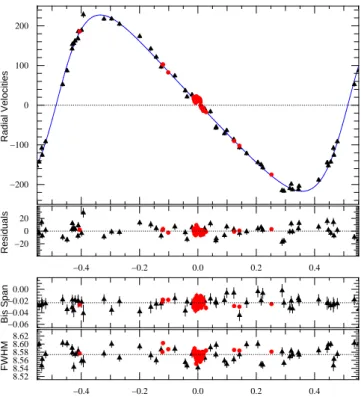
WASP-8 was recorded simultaneously by two cameras of the WASP-south telescope during two seasons (2006 and 2007). Altogether 11 224 independent photometric points were recorded with a typical sampling of 8 minutes. Transit events were detected in data from the first observation season. This triggered radial velocity follow-up observations of WASP-8 in November 2007 with the Coralie spectrograph mounted at the Swiss Euler telescope (Baranne et al. 1996; Queloz et al. 2000; Pepe et al. 2002). With a combined analysis of the radial-velocity data and the photometry including additional WASP data from the 2007 season, a transit period of 8.15 days was found. No changes to the spectroscopic profile were detected, ruling out a blended eclipsing binary or starspots as the cause of the radial-velocity variation (Queloz et al. 2001) (see bottom diagram in Fig 2). In the next season, observations with CORALIE were continued, revealing an additional drift in the γ velocity of the system (Fig. 3). No second-order curvature term was detected.
On 25 August 2008, following up on the confirmation of the planet, a complete and densely sampled transit event was recorded in R band with the Euler telescope to improve the deter-mination of the transit parameters (Fig. 4). On 4 October 2008, a spectroscopic transit was measured with the HARPS spectro-graph installed on the 3.6m telescope at La Silla. During the se-quence, 75 spectra (44 in the transit) were measured with an exposure time of 300 s, corresponding to a typical signal-to-noise ratio per pixel of 50. The radial velocity measurement from these spectra shows an obvious Rossiter-McLaughlin ef-fect with a shape suggesting a non-coplanar orbit (Fig. 4). In addition, four spectra were measured on the same night before and after the transit to help us to determine the rate of change in the radial velocity outside the transit. Three measurements were obtained later at other phases of the system to improve the matching and zero point correction between CORALIE and HARPSdata. During the measurement of the transit sequence, a significant change in telescope focus happened at JD 54744.592, improving the flux entering the fiber by a factor of 2.
−200 −100 0 100 200 −0.4 −0.2 0.0 0.2 0.4 −20 0 20 −0.06 −0.04 −0.02 0.00 −0.4 −0.2 0.0 0.2 0.4 8.52 8.54 8.56 8.58 8.60 8.62 Radial Velocities Residuals Bis Span FWHM . . . .
Fig. 2. Top: Overall Keplerian fit to the RV data for Wasp-8b. Black triangles indicates Coralie data and red dots the Harps data. The long-term drift was removed to plot the velocity in phase (the zero is set at the time of the transit). Bottom: Bissector span and FWHM (in km s−1unit) plotted with the
phase of the orbit. The HARPS radial velocity data were shifted to correct from the γ velocity difference with CORALIE .
4400 4450 4500 4550 4600 4650 4700 4750 4800 4850 4900 4950 5000 5050 5100 −200 −100 0 100 200 . . BJD − 2450000.0 [days] RV [m/s] . .
Fig. 3. CORALIE radial velocity measurements (red dots) of WASP-8superimposed on the best-fit solution (solid line).
3. Determination of system parameters
3.1. Spectral analysis
The individual HARPS spectra were coadded and used for a de-tailed spectroscopic analysis of WASP-8. The results are dis-played in Table 1. As in previous WASP-papers (Cameron et al. 2007), the analysis was performed using the uclsyn spectral synthesis package and atlas9 models without convective over-shooting with Hαand HβNa i D and Mg i b lines as diagnostics
−20 −10 0 10 20 30 −10 0 10 0.98 0.99 1.00 1.01 −0.03 −0.02 −0.01 0.00 0.01 0.02 0.03 −0.015 −0.010 −0.0050.000 0.005 0.010 0.015 Phase
Residuals & Radial Velocities (m.s
−1
)
Residuals & Flux
. .
. .
Fig. 4. Top: Radial velocity measurement phased with the tran-sit (mid-trantran-sit is at 0). Black triangles are CORALIE data and red dots HARPS data. Bottom: Normalized transit photometry measurement of WASP-8. Black triangles indicates SuperWASP data and red dots the R-band Euler photometry data. The best-fit model is superimposed in blue.
for Teff and (log g). The abundances and the microturbulence
were determined in a similarly way to the work of Gillon et al. (2009) and used as additional Teffand log g diagnostics (Smalley
2005).
The Li i 6708Å line is detected in the spectra indicating an abundance of log A(Li/H) + 12 = 1.5 ± 0.1, which implies an age of 3-5Gyr according to Sestito & Randich (2005). However, Israelian et al. (2009) noted that stars with planets have lower lithium abundances than normal solar-type stars, so the lithium abundance may not be a good age indicator for them.
The rotational broadening v sin i was measured by fitting the observed HARPS profiles of several unblended Fe i lines. A typ-ical value of macroturbulence vmac= 2 km s−1was adopted and
an instrumental profile determined from telluric absorption lines. We found that v sin i= 2.0 ± 0.6 km s−1, which is typical of a G dwarf of intermediate age.
3.2. Analysis of the planetary system
This whole data set was found to detect without doubt a planet transiting the star WASP-8. We analyzed together the photomet-ric (WASP and Euler data) and the radial velocity data, includ-ing the spectroscopic transit sequence in this context. Our model was based on the transit modeling by Mandel & Agol (2002) and
Table 1. Stellar parameters of WASP-8 derived from spectro-scopic analysis. The quoted error estimates include those given by the uncertainties in Teff, log g, and ξt, as well as atomic data
uncertainties. Teff 5600 ± 80 K [Na/H] +0.22 ± 0.07 log g 4.5 ± 0.1 [Mg/H] +0.21 ± 0.04 ξt 1.1 ± 0.1 km s−1 [Si/H] +0.29 ± 0.09 vsin i 2.0 ± 0.6 km s−1 [Ca/H] +0.24 ± 0.12 [Fe/H] +0.17 ± 0.07 [Sc/H] +0.23 ± 0.05
log A(Li/H)+12 1.5 ± 0.1 [Ti/H] +0.24 ± 0.08
[V/H] +0.30 ± 0.08
dist 87±7 pc [Cr/H] +0.17 ± 0.09
age 3-5 Gyr [Co/H] +0.29 ± 0.07
[Ni/H] +0.23 ± 0.07
Fig. 5. Comparison of the best-fitting stellar parameters from the transit profile and spectroscopic analysis with evolutionary mod-els interpolated at [Fe/H]=0.17. The isochrones are 100 Myr, 1 Gyr, 5 Gyr and 10 Gyr. The evolutionary tracks are indicated for 0.9, 1.0 and 1.1 Msun.
the radial velocity description by Gim´enez (2006). The best-fit model parameters and their error bars were computed using a MCMC convergence scheme that solves all parameters together. For details of the code and fitting techniques, we refer to Triaud et al. (2009); Collier Cameron et al. (2007). To obtain a coherent solution, we determined the mass of the star by comparing the spectroscopically-determined effective temperature and the stel-lar density outcome of the MCMC adjustment, with evolution-ary tracks and isochrones of the observed metallicity from the stellar evolution model of Girardi et al. (2000). We converged iteratively on a stellar mass of 1.04(+0.02 -0.09) M and an age
younger than 6 Gyr (see on Fig. 5).
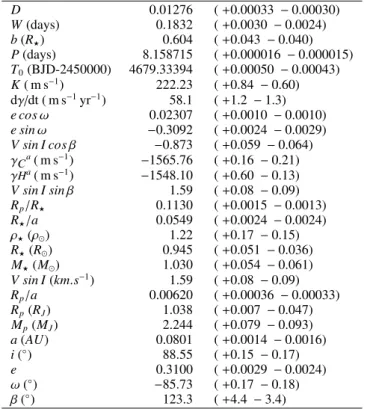
The free parameters of our model were the depth of transit D, the width of transit W, the impact parameter b, the period P, the epoch of transit centre T0, the RV semi-amplitude K, e cos ω
& e sin ω (e being the eccentricity and ω the angle of the peri-astron), and V sin I cos β & V sin I sin β, with V sin I being the projection of the stellar equatorial rotation, and β the projection of the angle between the stellar spin axis and the planetary or-bit axis. In addition, we employed free normalization factors for each lightcurve (WASP and Euler) and each set of radial velocity (γHfor HARPS and γCfor CORALIE ), which enabled variations
to be made in instrumental zero points. From these parameters, physical parameters were derived to characterise the planetary system. The best-fit set of parameters that minimize the χ2r
(re-Table 2. Fitted and physical parameters of the WASP-8 planetary system. The error bars are calculated at 68 % of the statistical distributions. D 0.01276 (+0.00033 − 0.00030) W(days) 0.1832 (+0.0030 − 0.0024) b(R?) 0.604 (+0.043 − 0.040) P(days) 8.158715 (+0.000016 − 0.000015) T0(BJD-2450000) 4679.33394 (+0.00050 − 0.00043) K( m s−1) 222.23 (+0.84 − 0.60) dγ/dt ( m s−1yr−1) 58.1 (+1.2 − 1.3) e cosω 0.02307 (+0.0010 − 0.0010) e sinω −0.3092 (+0.0024 − 0.0029) V sin I cosβ −0.873 (+0.059 − 0.064) γCa( m s−1) −1565.76 (+0.16 − 0.21) γHa( m s−1) −1548.10 (+0.60 − 0.13) V sin I sinβ 1.59 (+0.08 − 0.09) Rp/R? 0.1130 (+0.0015 − 0.0013) R?/a 0.0549 (+0.0024 − 0.0024) ρ?(ρ ) 1.22 (+0.17 − 0.15) R?(R ) 0.945 (+0.051 − 0.036) M?(M ) 1.030 (+0.054 − 0.061) V sin I(km.s−1) 1.59 (+0.08 − 0.09) Rp/a 0.00620 (+0.00036 − 0.00033) Rp(RJ) 1.038 (+0.007 − 0.047) Mp(MJ) 2.244 (+0.079 − 0.093) a(AU) 0.0801 (+0.0014 − 0.0016) i(◦) 88.55 (+0.15 − 0.17) e 0.3100 (+0.0029 − 0.0024) ω (◦ ) −85.73 (+0.17 − 0.18) β (◦ ) 123.3 (+4.4 − 3.4) (a)computed at JDB=2454691.15781
duced χ2 is 0.86) are listed in Table 2 as well as their related computed physical parameters. With this best-fit solution one computes for the CORALIE data χ2 = 204 with 48
measure-ments, and for HARPS data χ2 = 188 with 82 measurements
which implies that additional jittering is present that is not ac-counted for by the fitted model. Since the main deviation is re-lated to the CORALIE data, the uncertainties in the orbital so-lutions are most likely underestimated. However, the error bars in the Rossiter parameters are driven mostly by the HARPS on-transit data, and one can assume that they are almost correct.
Our best-fit solution corresponds to a giant planet with an eccentric (e = 0.3) 8.16-day orbit and an additional long-term radial-velocity drift of 58 m s−1yr−1. The planet is dense with 2.25 Mj and a radius of 1.04 Rj, in contrast to the
sub-stantial fraction of ‘inflated” hot Jupiters. Surprisingly, the pro-jected angle between the orbital and stellar spin axes is found to be β = 123.3◦, indicative of a retrograde orbit. We note that V sin I = 1.59 km s−1 is in accordance with the line rotation
broadening v sin i (in Table 1) derived by the spectral analysis. We checked whether the partial defocusing of HARPS dur-ing the transit spectroscopic sequence had any effect on our re-sult. We divided the series into two subsets and considered for each of them an independent offset (γ). We obtain a solution with a marginal improvement in the χ2. By comparing the
solu-tion obtained from these two sets with that for the complete set, the angle β was changed by 1.5 σ. The defocusing problem does not affect the results of this paper.
4. Discussion
The detection of a hot Jupiter on an eccentric orbit that is mis-aligned with the stellar rotation axis and moving in a retrograde
direction raises many questions about the origins of this sys-tem. Although the answer is beyond the scope of this paper, the visual faint companion and the drifting γ velocity of the system are key components of the puzzle. From the observed separation between the A and B components, one can derive a most likely orbital semi-major axis (a = 1.35ρ ≈ 600 AU) (Duquennoy & Mayor 1991). The observed radial-velocity drift is therefore unlikely to be related to the B component of the bi-nary ( ˙γ < GMa−2 < 1 m s−1yr−1), suggesting that these is an
additional closer companion of both unknown mass and period. The lack of curvature indicates that the companion is more mas-sive than the transiting planet. This intermediate body is very likely to play a significant dynamical role in the system.
Apart from the complex dynamics of the whole system, the planet WASP-8b is a ”standard” hot Jupiter. It orbits a metal-rich star, which accounts for the observed increase in the inci-dences of hot Jupiters with the metallicity of the host star (Udry & Santos 2007). The period of WASP-8b is longer than the 3-4 days typical value, but considering the eccentricity of its orbit, its periastron distance is typical of hot Jupiters.
The orbit misalignment of the planet with the stellar rotation axis of WASP-8 is measured with the β parameter. The true angle between the axes of the stellar and planetary orbits is usually called ψ and is statistically related to β through sin I (unknown) and the orbital inclination (i) (see Fabrycky & Winn (2009) for details). When β deviates significantly from zero, this provides us with a lower limit to the ψ. When β is beyond 90◦, the orbital spin has the opposite direction to the stellar rotation provided that the orbit does not transit the star between its pole and its limb. According to Eq. 9 from Fabrycky & Winn (2009), this condition is met when I > 3.6 degree. By combining V sin I, with the estimated age of the star, one can exclude such a small Iangle. Interpreted with the large β value, we can conclude that a true retrograde orbit is the most likely scenario for WASP-8b.
The origin of the unusual shape and orientation of the orbit of WASP-8b is possibly related to the Kozai mechanism (Kozai 1962; Wu & Murray 2003) or the outcome of a violent dynam-ical interaction history. The evidence of two other bodies and a possible series of secular effects (Takeda et al. 2008) make the WASP-8system unique and interesting for additional dynamical studies and a test case for formation scenarios of hot Jupiters that constitute an alternative to the disc-migration mechanism.
References
Baranne, A., et al. 1996, A&AS, 119, 373
Barker, A. J., & Ogilvie, G. I. 2009, MNRAS, 395, 2268 Blackwell, D. E., & Shallis, M. J. 1977, MNRAS, 180, 177 Cameron, A. C., et al. 2007, MNRAS, 375, 951
Collier Cameron, A., et al. 2007, MNRAS, 380, 1230 Duquennoy, A., & Mayor, M. 1991, A&A, 248, 485 Fabrycky, D. C., & Winn, J. N. 2009, ApJ, 696, 1230
Gillon, M., Magain, P., Chantry, V.,et al. 2007, ASP Conf. series 366, 113 Gillon, M., et al. 2009, A&A, 496, 259
Gim´enez, A. 2006, ApJ, 650, 408
Girardi, L., Bressan, A., Bertelli, G., & Chiosi, C. 2000, A&AS, 141, 371 Israelian, G., et al. 2009, Nature, 462, 189
Kozai, Y. 1962, AJ, 67, 591
Lin, D. N. C., Bodenheimer, P., & Richardson, D. C. 1996, Nature, 380, 606 Mandel, K., & Agol, E. 2002, ApJ, 580, L171
Mason, B. D., Wycoff, G. L., Hartkopf, et al. 2001, AJ, 122, 3466 Nagasawa, M., Ida, S., & Bessho, T. 2008, ApJ, 678, 498 Pepe, F., Mayor, M., Galland, et al. 2002, A&A, 388, 632 Pollacco, D. L., et al. 2006, PASP, 118, 1407
Queloz, D., et al. 2000, A&A, 354, 99 Queloz, D., et al. 2001, A&A, 379, 279
Smalley, B. 2005, Memorie della Societa Astronomica Italiana Suppl., 8, 130 Sestito, P., & Randich, S. 2005, A&A, 442, 615
Takeda, G., Kita, R., & Rasio, F. A. 2008, ApJ, 683, 1063 Triaud, A. H. M. J., et al. 2009, A&A, 506, 377 Udry, S., & Santos, N. C. 2007, ARA&A, 45, 397 Winn, J. N. 2010, arXiv:1001.2010
Wu, Y., & Murray, N. 2003, ApJ, 589, 605