HAL Id: hal-02142936
https://hal.archives-ouvertes.fr/hal-02142936
Submitted on 29 May 2019
HAL is a multi-disciplinary open access
archive for the deposit and dissemination of
sci-entific research documents, whether they are
pub-lished or not. The documents may come from
teaching and research institutions in France or
abroad, or from public or private research centers.
L’archive ouverte pluridisciplinaire HAL, est
destinée au dépôt et à la diffusion de documents
scientifiques de niveau recherche, publiés ou non,
émanant des établissements d’enseignement et de
recherche français ou étrangers, des laboratoires
publics ou privés.
Microscopic Mechanism of Chiral Induction in a
Metal–Organic Framework
Jack Evans, François-Xavier Coudert
To cite this version:
Jack Evans, François-Xavier Coudert. Microscopic Mechanism of Chiral Induction in a Metal–Organic
Framework. Journal of the American Chemical Society, American Chemical Society, 2016, 138 (19),
pp.6131-6134. �10.1021/jacs.6b02781�. �hal-02142936�
Microscopic
Mechanism of Chiral Induction in a Metal–Organic Framework
Jack
D. Evans and François-Xavier Coudert
∗Chimie ParisTech, PSL Research University, CNRS, Institut de Recherche de Chimie Paris, 75005 Paris, France
E-mail: [email protected]
Abstract: The recently reported process of chiral induction in a metal–organic framework (MOF) by nonchiral guest ad-sorption, demonstrated on the prototypical MOF-5, may rev-olutionize the production of MOFs for enantioselective sep-aration and catalysis. Herein, we describe an investigation employing multi-scale molecular simulation to discover the microscopic mechanism of chiral induction and investigate the stability of the resulting framework. Our results explain how the molecular size and chemical nature of N-methyl-2-pyrrolidone (NMP) give rise to the chiral transformation in MOF-5, whereas it cannot occur for other guest molecules, such as N,N-dimethylformamide (DMF). Moreover, we show that the guest-free CMOF-5 structure is energetically unsta-ble, with either the achiral conventional structure or a closed pore structure preferred, demonstrating that chirality will not be retained upon activation of CMOF-5. While this limits the usability of chiral induction in MOFs, our study opens new avenues for the use of other guest molecules and provides microscopic insight into this unexpected outcome of guest-framework interactions in a soft porous crystal.
Metal–organic frameworks (MOFs) are a class of nanoporous materials constructed in a modular approach by the combination of inorganic nodes and organic links.1There is fervent research in the production of chiral MOF materials for particular applications in enantioselective separation and catalysis.2,3Traditionally, chiral MOFs are produced by using chiral starting materials4or as a result of specific framework topologies.5Often, however, these materials are observed as racemic conglomerates.6
Recently, Zaworotko and coworkers7 reported the exciting
preparation of a chiral polymorph of the prototypical metal–organic framework MOF-5 (also known as IRMOF-1).8This was achieved by conducting conventional solvothermal synthesis in the presence of enantiopure proline or, alternatively, post-synthetic modifica-tion by immersion in N-methyl-2-pyrrolidone (NMP), an achiral solvent. The framework CMOF-5 crystallizes in the cubic chiral space group P213 and appears as a distorted structure of the familiar
MOF-5, as demonstrated in Figure 1. This report of CMOF-5 sug-gested that the production and stability of a chirally induced MOF is strongly correlated to the adsorption of guest molecules: although induction of chirality by chiral guest adsorption has been reported before,9,10 its occurrence upon adsorption of achiral molecules is novel and entirely unexpected. NMP was observed to be crucial for chiral formation; upon subsequent solvent exchange with a vari-ety of organic solvents a crystal-to-crystal transformation to achiral MOF-5 occurs. It is unclear so far how the action of NMP leads to chiral induction and whether an activated sample of CMOF-5 retains a chiral structure after NMP evacuation.
In this investigation, we examine the intrinsic stability of CMOF-5 using quantum chemistry calculations at the density functional theory (DFT) level, which have been thoroughly used to probe the mechanical stability of crystalline materials.11,12DFT simulations
Figure 1. Structures of (a) achiral MOF-5 and (b) the ∆ enantiomer of chiral MOF-5 (CMOF-5). Hydrogen atoms have been omitted for clarity. (Zn4O, blue; O, red; C, grey)
suggest that chiral induction produces a metastable guest-loaded state which is unlikely to be stable upon guest removal. Further-more, by combining DFT calculations with Monte Carlo (MC) sim-ulations we probe the mechanism for this guest-induced polymor-phism.
We began this study by looking at the behavior of the chiral CMOF-5 structure in the absence of guest molecules. Starting from the ∆-CMOF-5 and Λ-CMOF-5 crystal structures, we removed the NMP solvent molecules and produced an ordered model. We then performed DFT energy minimization, optimizing both atomic co-ordinates and unit cell parameters. Calculations were performed using the CRYSTAL14 software13,14with localized TZVP basis sets and the solid-adapted hybrid exchange–correlation functional PBESOL015,16(see Supporting Information for full details and in-put files). We observe that although some differences are present in the crystallographic structures, the ∆ and Λ enantiomers of CMOF-5 behave identically. Upon energy minimization, in the absence of NMP, both structures relax back to the achiral MOF-5 struc-ture. This indicates that CMOF-5 is not stable upon guest evac-uation but spontaneously reverts back to the parent MOF-5 frame-work. We measure the energy difference between the two to be 9.33 − 11.1 kJ/mol per Zn4O unit. This is likely to severely limit
the use of chiral CMOF-5 to applications that do not require evac-uation of the framework.
In an effort to capture the role of guests in chiral induction, we then placed 24 molecules of N-methyl-2-pyrrolidone (NMP) and N,N-dimethylformamide (DMF) in the ∆-CMOF-5 unit cell. Guests were positioned in the asymmetric unit to create an ordered structure that retains the P213 symmetry of CMOF-5 while
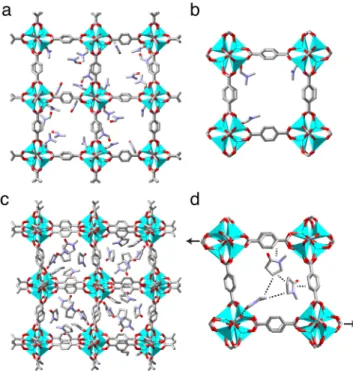
avoid-ing atom–atom overlap. Optimization of both lattice parameters and atomic positions resulted in the converged structures illustrated in Figure 2, with sharp contrast between the two guests. Like evac-uated CMOF-5, the structure loaded with DMF relaxes to an achi-ral MOF-5 structure, Figure 2a,b with cell parameters and geometry similar to guest-free MOF-5 (no twisting of the linker). Conversely, the structure with NMP retained the chirality and geometric char-acteristics attributed to CMOF-5, Figure 2c,d; namely, a twist in the phenyl plane dihedral angle and adjacent Zn4O cluster angle, in good agreement to the reported crystal structure.
The contrasting interaction of DMF and NMP with the frame-work can be qualitatively understood by observation of the local clustering of guests in the converged structure, Figure 2b,d. DMF is found in close distances to the Zn4O cluster, and with a strong adsorption enthalpy of 98.1 kJ/mol (see Table 1). This is in agree-ment with a recent study which reports this strong binding is key to the formation of cobalt substituted MOF-5 analogues.17 NMP, in contrast to DMF, is observed to converge closer to the phenyl lig-and since it is unable to achieve close contact to the Zn4O cluster because of its size of NMP. Furthermore, NMP is found in close contact (≈ 4 Å) to adjacent NMP molecules, with guest–guest in-teractions stronger than DMF. This NMP-mediated “bridging” of neighboring aromatic rings creates the internal shearing stress that induces chirality in CMOF-5 by twisting the linkers. Notably, the interaction between NMP and the framework is dispersive in nature. Additionally, we find this “bridging” mechanism to be loading de-pendent revealed by further optimizations, with 12 NMP molecules per unit cell, converged to give the achiral MOF-5 structure.
While the DFT simulations detailed above give insight into NMP and DMF adsorption in MOF-5, and the reasons behind NMP in-ducing chirality, they form by their nature a static picture. To obtain a thermodynamic description of guest adsorption at a higher scale we employed classical Monte Carlo (MC) simulation in the NVT ensemble to describe DMF and NMP adsorption. We employed the RASPA classical simulation package,19and a detailed description
Figure 2. Local minima identified by DFT optimizations for DMF (a, b) and NMP (c, d) loaded structures of CMOF-5. 2 × 2 × 2 unit cells (a, c) illustrate the extent of chiral induction and a closer view (b, d) depicts the distinct local ordering of guest molecules. Additionally, close contacts (d, dotted lines) are depicted and the change in framework, simplified in two-dimensions. Hydrogen atoms have been omitted for clarity.
Table 1. Interaction energies of DMF and NMP in CMOF-5 as cal-culated from DFT optimizations with Grimme’s DFT-D2 correction,18 in units kJ.mol−1 per guest molecule. Energies are calculated for both guest-MOF and guest-guest interactions.
∆Eguest−MOF ∆Eguest−guest
24×DMF -98.1 -10.1
12×DMF -173 7.56
24×NMP -48.9 -18.5
of the methodology can be found in the Supporting Information. In good agreement with the DFT simulations, MC simulations show that DMF and NMP adsorb in different sites in the frame-work’s pore space. The distribution density of the guests averaged over the MC simulation is displayed in Figure 3. DMF adsorbs to the Zn4O clusters with a second site at the centre of the cage, in a similar appearance to that described of benzene.20,21As with
the configuration observed by DFT optimization, we find NMP ad-jacent to the ligands and in well-defined positions. Unlike DMF, the cloud of density probability for NMP shows the guest-mediated benzene–benzene bridging that is responsible at the microscopic level for chiral induction. This visualization is confirmed by cal-culation of radial distribution functions (RDFs) between the frame-work and oxygen atom of the guest, plotted in Figure 3c. This shows that average distances between NMP and the metal cluster is ≈ 1 Å larger than for DMF.
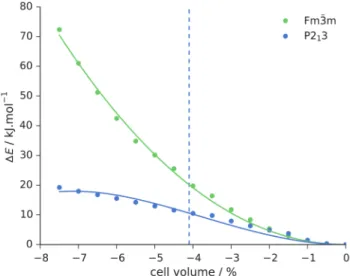
This detailed picture of guest adsorption, obtained by multi-scale molecular simulation, shows that it is the specific position of ad-sorbed NMP guests which is crucial to the formation of CMOF-5. Unsurprisingly, we find DFT optimizations of guest-free CMOF-5 to converge to give the achiral structure of MOF-5. To explore the energy landscape of guest-free CMOF-5 we conducted constrained cell DFT optimizations, beginning from the CMOF-5 structure, and compared these to the symmetry of conventional MOF-5, as plotted in Figure 4.
Figure 3. Average density distributions of DMF and NMP in MOF-5 at 298 K, a and b respectively. The surface is shown here for a density value of 0.5 Å−3. In addition, radial distribution functions (c) of DMF and NMP oxygen atoms and the framework present the different interactions observed.
The energy landscape of P213 (CMOF-5) crystal symmetry is in
stark contrast to that of the achiral Fm¯3m (MOF-5). Upon fitting third-order Birch–Murnaghan equations of state to the resulting en-ergies22 (see Supporting Information for full details) we find the Fm¯3m crystal symmetry gives a bulk modulus of 13.5 GPa, equiv-alent to that reported for MOF-5 by alternative methods.11,23
How-Figure 4. Energy landscape with respect to cell volume, computed by DFT simulation, for different symmetries of MOF-5. Moreover, the relative volume of CMOF-5 reported by single crystal X-ray crystallography (dot-ted vertical line) and third-order Birch–Murnaghan equations of state are depicted (solid lines).
ever, the P213 structure is softer with non Birch–Murnaghan
be-havior as identified by the poor fit and negative B00, the first deriva-tive of bulk modulus with respect to changes of volume. A num-ber of materials, including ZIF-824 and MIL-53(Cr)25 show sim-ilar behavior, attributed to structural transitions with the applica-tion of hydrostatic pressure. Examining P213 framework structures
at large deformations by DFT optimizations we discovered a local minimum energy structure corresponding to a previously unreal-ized closed pore analogue of MOF-5. This structure has -51.6% cell volume, compared to the conventional MOF-5 structure, and is found to exhibit no geometrically accessible surface area or pore volume. Though this previously undiscovered structure is stable, the transition requires NMP adsorption, the application of hydro-static pressure and subsequent NMP desorption. Notwithstanding, similar features of this transition have been observed for MOF-5 during water adsorption and negative thermal expansion.26,27
Resulting from the simulations presented here, the mechanism for chiral induction in MOF-5 requires a very specific deformation of cell volume. In the case for CMOF-5, this is achieved by the oc-cluded NMP guest, which owing to its size can not adsorb closely to Zn4O cluster. Notably, there is precedence for guest-induced volume shrinkage in MOFs.28,29However, NMP adsorption is a unique case where the framework deformation results in a chiral structure accomplished by more favorable torsional and angle de-formation to the Zn4O cluster than compression of bond lengths. It is the specific adsorption pattern of NMP, creating symmetry-lowering shear stress by bridging neighboring aromatic rings in the organic linker.
In summary, we have explored the recently reported chiral in-duction of MOF-5 by a multi-scale molecular simulation approach. Though it may have been foreseeable to be general in nature this ef-fect is discovered to result from very specific interactions between NMP and MOF-5. Furthermore, DFT simulations have illustrated the instability of a guest-free CMOF-5 framework and the discov-ery of a closed pore analogue of MOF-5. To produce a stable guest-free framework by chiral induction, for applications including gas adsorption, an additional modification step is required to stabilize (or tie) the structure in the unstable chiral form. Similar methods have been recently exploited to stabilize a flexible porous organic cage.30Nonetheless, the details of chiral induction uncovered here
give excellent insight for future experimental studies to discover new examples of this approach to chiral MOF synthesis.
Acknowledgement We thank Lydéric Bocquet for stimulating discussions. We acknowledge PSL Research University for fund-ing (project DEFORM, grant ANR-10-IDEX-0001-02), HPC plat-forms provided by a GENCI grant (x2016087069) and the Chemi-cal Structure Association Trust Grant.
Supporting
Information Available
Details of computational methods, comparison of chiral enan-tiomers, tabulated structural features, interaction energies, Birch– Murnaghan coefficients and additional figures.
References
(1) Furukawa, H.; Cordova, K. E.; O’Keeffe, M.; Yaghi, O. M. The Chem-istry and Applications of Metal-Organic Frameworks. Science 2013, 341, 1230444–1230444.
(2) Hu, A.; Ngo, H. L.; Lin, W. Chiral Porous Hybrid Solids for Practical Heterogeneous Asymmetric Hydrogenation of Aromatic Ketones. J. Am. Chem. Soc.2003, 125, 11490–11491.
(3) Ma, L.; Abney, C.; Lin, W. Enantioselective catalysis with homochiral metal–organic frameworks. Chem. Soc. Rev. 2009, 38, 1248.
(4) Kim, K.; Seo, J. S.; Whang, D.; Lee, H.; Jun, S. I.; Oh, J.; Jeon, Y. J. Nature2000, 404, 982–986.
(5) Kepert, C. J.; Prior, T. J.; Rosseinsky, M. J. A Versatile Family of Intercon-vertible Microporous Chiral Molecular Frameworks: The First Example of Ligand Control of Network Chirality. J. Am. Chem. Soc. 2000, 122, 5158–5168.
(6) Morris, R. E.; Bu, X. Induction of chiral porous solids containing only achiral building blocks. Nat. Chem. 2010, 2, 353–361.
(7) Zhang, S.-Y.; Li, D.; Guo, D.; Zhang, H.; Shi, W.; Cheng, P.; Wojtas, L.; Zaworotko, M. J. Synthesis of a Chiral Crystal Form of MOF-5, CMOF-5, by Chiral Induction. J. Am. Chem. Soc. 2015, 137, 15406–15409. (8) Yaghi, O. M.; Li, H.; Eddaoudi, M.; O’Keeffe, M. Nature 1999, 402, 276–
279.
(9) Lin, Z.; Slawin, A. M. Z.; Morris, R. E. Chiral Induction in the Ionothermal Synthesis of a 3-D Coordination Polymer. J. Am. Chem. Soc. 2007, 129, 4880–4881.
(10) Zhang, J.; Chen, S.; Nieto, R. A.; Wu, T.; Feng, P.; Bu, X. A Tale of Three Carboxylates: Cooperative Asymmetric Crystallization of a Three-Dimensional Microporous Framework from Achiral Precursors. Angew. Chem., Int. Ed.2010, 49, 1267–1270.
(11) Ortiz, A. U.; Boutin, A.; Fuchs, A. H.; Coudert, F.-X. Anisotropic Elas-tic Properties of Flexible Metal-Organic Frameworks: How Soft are Soft Porous Crystals? Phys. Rev. Lett. 2012, 109.
(12) Ortiz, A. U.; Boutin, A.; Coudert, F.-X. Prediction of flexibility of metal–organic frameworks CAU-13 and NOTT-300 by first principles molecular simulations. Chem. Commun. 2014, 50, 5867.
(13) Dovesi, R.; Orlando, R.; Erba, A.; Zicovich-Wilson, C. M.; Civalleri, B.; Casassa, S.; Maschio, L.; Ferrabone, M.; Pierre, M. D. L.; D’Arco, P.; Noël, Y.; Causà, M.; Rérat, M.; Kirtman, B. C RYSTAL14 : A program for the ab initio investigation of crystalline solids. Int. J. Quantum Chem. 2014, 114, 1287–1317.
(14) Peintinger, M. F.; Oliveira, D. V.; Bredow, T. Consistent Gaussian basis sets of triple-zeta valence with polarization quality for solid-state calcula-tions. J. Comput. Chem. 2012, 34, 451–459.
(15) Perdew, J. P.; Ruzsinszky, A.; Csonka, G. I.; Vydrov, O. A.; Scuseria, G. E.; Constantin, L. A.; Zhou, X.; Burke, K. Restoring the Density-Gradient Expansion for Exchange in Solids and Surfaces. Phys. Rev. Lett. 2008, 100.
(16) Adamo, C.; Barone, V. Toward reliable density functional methods without adjustable parameters: The PBE0 model. J. Chem. Phys. 1999, 110, 6158. (17) Brozek, C. K.; Michaelis, V. K.; Ong, T.-C.; Bellarosa, L.; López, N.; Griffin, R. G.; Dinc˘a, M. Dynamic DMF Binding in MOF-5 Enables the Formation of Metastable Cobalt-Substituted MOF-5 Analogues. ACS Cent. Sci.2015, 1, 252–260.
(18) Grimme, S. Semiempirical GGA-type density functional constructed with a long-range dispersion correction. J. Comput. Chem. 2006, 27, 1787– 1799.
(19) Dubbeldam, D.; Calero, S.; Ellis, D. E.; Snurr, R. Q. RASPA: molecular simulation software for adsorption and diffusion in flexible nanoporous materials. Mol. Simul. 2015, 42, 81–101.
(20) Amirjalayer, S.; Tafipolsky, M.; Schmid, R. Molecular Dynamics Simu-lation of Benzene Diffusion in MOF-5: Importance of Lattice Dynamics. Angew. Chem., Int. Ed.2007, 46, 463–466.
(21) Amirjalayer, S.; Schmid, R. Mechanism of benzene diffusion in MOF-5: A molecular dynamics investigation. Microporous Mesoporous Mater. 2009, 125, 90–96.
(22) Birch, F. Finite Elastic Strain of Cubic Crystals. Phys. Rev. 1947, 71, 809– 824.
(23) Graham, A. J.; Allan, D. R.; Muszkiewicz, A.; Morrison, C. A.; Mog-gach, S. A. The Effect of High Pressure on MOF-5: Guest-Induced Modi-fication of Pore Size and Content at High Pressure. Angew. Chem., Int. Ed. 2011, 50, 11138–11141.
(24) Chapman, K. W.; Halder, G. J.; Chupas, P. J. Pressure-Induced Amor-phization and Porosity Modification in a Metal-Organic Framework. J. Am. Chem. Soc.2009, 131, 17546–17547.
(25) Ma, Q.; Yang, Q.; Ghoufi, A.; Férey, G.; Zhong, C.; Maurin, G. Guest dependent pressure behavior of the flexible MIL-53(Cr): A computational exploration. Dalton Trans. 2012, 41, 3915–3919.
(26) Greathouse, J. A.; Allendorf, M. D. The Interaction of Water with MOF-5 Simulated by Molecular Dynamics. J. Am. Chem. Soc. 2006, 128, 10678– 10679.
(27) Zhou, W.; Wu, H.; Yildirim, T.; Simpson, J. R.; Walker, A. R. H. Origin of the exceptional negative thermal expansion in metal-organic framework-5 Zn 4 O ( 1 , 4 - benzenedicarboxylate ) 3. Phys. Rev. B 2008, 78. (28) Coudert, F.-X.; Fuchs, A. H.; Neimark, A. V. Comment on “Volume
shrinkage of a metal–organic framework host induced by the dispersive attraction of guest gas molecules”. Phys. Chem. Chem. Phys. 2014, 16, 4394.
(29) Joo, J.; Kim, H.; Han, S. S. Volume shrinkage of a metal–organic frame-work host induced by the dispersive attraction of guest gas molecules. Phys. Chem. Chem. Phys.2013, 15, 18822.
(30) Liu, M.; Little, M. A.; Jelfs, K. E.; Jones, J. T. A.; Schmidtmann, M.; Chong, S. Y.; Hasell, T.; Cooper, A. I. Acid- and Base-Stable Porous Or-ganic Cages: Shape Persistence and pH Stability via Post-synthetic “Ty-ing” of a Flexible Amine Cage. J. Am. Chem. Soc. 2014, 136, 7583–7586.