Published in: (1996), pp. 159-161 Status : Postprint (Author’s Version)
THE THRESHOLD PHOTOELECTRON AND CONSTANT ION STATE
SPECTRA OF THE THREE DICHLOROETHYLENE ISOMERS.
B. Leyh1, R. Locht
Département de Chimie Generate et de Chimie Physique, Université de Liège, Institut de Chimie, Bât.
B6, Sart-Tilman par B-4000 Liège 1, Belgium.
K. Hottmann and H. Baumgärtel.
Institut fur Physikalische und Theoretische Chemie, Freie Universität Berlin, Takustrasse 3, 14195 Berlin, Germany.
As part of our project related to the investigation of the halogenated ethylenes, we already reported on the spectroscopy of monofluoroethylene (vinylfluoride), 1,1-difluo-roetylene (vinylidene fluoride) [1] and monochloroethylene (vinylchloride) [2]. In these reports the photoabsorption spectrum, the threshold photoelectron spectrum and the Constant Ion State spectra (CIS) were described.
In the present work we report on the investigation of the threshold and CIS-spectra of the 1,1-, cis 1,2- and trans 1,2-dichloroethylene. The present work was performed on the 3m-NIM-l beamline at the synchrotron radiation facility BESSY. Light is dispersed by a 3m-NIM monochromator equipped with a 2400 / mm platinum grating and its entrance and exit slits were adjusted at 200µm. The threshold photoelectrons are selected by a tandem-type electron spectrometer consisting of two 180° electrostatic deflectors [3].
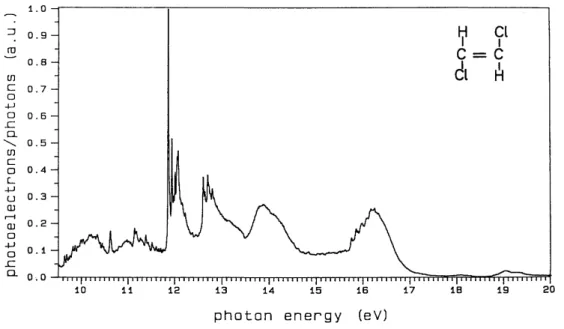
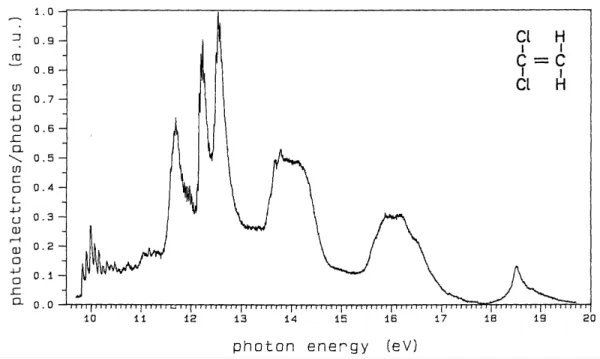
The threshold photoelectron spectra (TPES), extending from 9.5 eV to 20 eV photon energy, related to the three above mentioned compounds are displayed in fig. 1-3. Compared to the corresponding He(I)-photoelectron spectra (PES) [4], the relative intensities of the successive bands considerably differ. The first band related to the ground ionic state is considerably quenched, whereas the high energy band in the 18.5-19 eV range is enhanced, particularly for the 1,1-isomer. The TPES spectra of the two 1,2-isomers show about the same characteristics. All three spectra have been analyzed in detail under high resolution conditions.
Within the first band of the 1,1-dichloroethylene (IEadiab.=9.830 eV) new Progressions
are detected (see fig.3). Beside a 1290 cm-1 (C=C stretching) and a 640 cm"1 (C-Cl stretching) progressions, a 260 cm-1 and 390 cm-1 progressions are observed which can be ascribed to CCl2 deformation and rocking modes. Furthermore, this band extends to about 10.5 eV in the
He(I)-PES, whereas it spreads up to 11.4 eV in the TPES and shows an abundant fine structure. The assignement has to be carried out with the help of the corresponding photoabsorption spectrum. The bands observed at higher energies show about the same characteristics.
The first vibronic band of the cis-1,2- and trans-1,2-isomers exhibits fine structure of increasing complexity. To disentangle these features, high resolution (low pass energy)
1
Published in: (1996), pp. 159-161 Status : Postprint (Author’s Version)
spectra could be recorded, allowing us to make an extended assignment. As mentioned previously in this work, the relative intensities of the vibronic transitions are drastically modified, as compared to the corresponding He(I)-PES. Numerous new features show up in the TPES, e.g. the "band" extending between 10.3 eV and 11.8 eV in the trans- 1,2-isomer. The intensity of the higher lying vibronic states in these TPES spectra are also considerably modified. A closer investigation of the weak bands above 19 eV will also be possible. Furthermore, for all these compounds the CIS-spectra were recorded for a large number of selected vibronic states. These CIS curves will all be examined in detail.
Fig. 1: The threshold photoelectron spectrum of cis 1,2-dichloroethylene between 9.5-20 eV photon energy.
Fig. 2: The threshold photoelectron spectrum of trans 1,2-dichloroethylene between 9.5-20 eV photon energy
Published in: (1996), pp. 159-161 Status : Postprint (Author’s Version)
Fig. 3: The threshold photoelectron spectrum of 1,1-dichloroethylene between 9.7-20 eV photon energy.
Acknowledgement.
R.L. and B.L. gratefully acknowledge the financial support of the European Community under the contract n° EU-HCM-CHGE-CT93-0027.
References.
[1]. B. Leyh, R. Locht, K. Hottmann and H. Baumgärtel, BESSY Jahresber. (1995) 163. [2]. B. Leyh, R. Locht, K. Hottmann and H. Baumgärtel, BESSY Jahresber. (1995) 166. [3]. K. Hottmann, H.-W. Jochims and H. Baumgärtel, BESSY Jahresber. (1987) 398. [4]. A.D. Wittel and P.A. Bock, Chem.Ber. 107 (1974) 317.