Université de Montréal
Corrélats neuronaux de l’expertise auditive
par
Jean-Pierre Chartrand
Département de psychologie Faculté des arts et des sciences
Thèse présentée à la Faculté des études supérieures en vue de l’obtention du grade de
Doctorat en Psychologie Option neuropsychologie clinique
8 Juillet, 2010
Université de Montréal
Faculté des études supérieures et postdoctorales
Cette thèse intitulée :
Corrélats neuronaux de l’expertise auditive
Présentée par : Jean-Pierre Chartrand
a été évaluée par un jury composé des personnes suivantes :
Franco Lepore, président-rapporteur et représentant du doyen de la FES Pascal Belin, directeur de recherche
Isabelle Peretz, co-directrice Sylvie Hébert, membre du jury Claude Alain, examinateur externe
Résumé
La voix humaine constitue la partie dominante de notre environnement auditif. Non seulement les humains utilisent-ils la voix pour la parole, mais ils sont tout aussi habiles pour en extraire une multitude d’informations pertinentes sur le locuteur. Cette expertise universelle pour la voix humaine se reflète dans la présence d’aires préférentielles à celle-ci le long des sillons temporaux supérieurs. À ce jour, peu de données nous informent sur la nature et le développement de cette réponse sélective à la voix. Dans le domaine visuel, une vaste littérature aborde une problématique semblable en ce qui a trait à la perception des visages. L’étude d’experts visuels a permis de dégager les processus et régions impliqués dans leur expertise et a démontré une forte ressemblance avec ceux utilisés pour les visages.
Dans le domaine auditif, très peu d’études se sont penchées sur la comparaison entre l’expertise pour la voix et d’autres catégories auditives, alors que ces comparaisons pourraient contribuer à une meilleure compréhension de la perception vocale et auditive. La présente thèse a pour dessein de préciser la spécificité des processus et régions impliqués dans le traitement de la voix. Pour ce faire, le recrutement de différents types d’experts ainsi que l’utilisation de différentes méthodes expérimentales ont été préconisés.
La première étude a évalué l’influence d’une expertise musicale sur le traitement de la voix humaine, à l’aide de tâches comportementales de discrimination de voix et d’instruments de musique. Les résultats ont démontré que les musiciens amateurs étaient meilleurs que les non-musiciens pour discriminer des timbres d’instruments de musique mais aussi les voix humaines, suggérant une généralisation des apprentissages perceptifs causés par la pratique musicale. La seconde étude avait pour but de comparer les potentiels évoqués auditifs liés aux chants d’oiseaux entre des ornithologues amateurs et des participants novices. L’observation d’une distribution topographique différente chez les ornithologues à la présentation des trois catégories sonores (voix, chants d’oiseaux, sons de l’environnement) a rendu les résultats difficiles à interpréter. Dans la troisième étude, il était question de préciser le rôle des aires temporales de la voix dans le traitement de
catégories d’expertise chez deux groupes d’experts auditifs, soit des ornithologues amateurs et des luthiers. Les données comportementales ont démontré une interaction entre les deux groupes d’experts et leur catégorie d’expertise respective pour des tâches de discrimination et de mémorisation. Les résultats obtenus en imagerie par résonance magnétique fonctionnelle ont démontré une interaction du même type dans le sillon temporal supérieur gauche et le gyrus cingulaire postérieur gauche. Ainsi, les aires de la voix sont impliquées dans le traitement de stimuli d’expertise dans deux groupes d’experts auditifs différents. Ce résultat suggère que la sélectivité à la voix humaine, telle que retrouvée dans les sillons temporaux supérieurs, pourrait être expliquée par une exposition prolongée à ces stimuli.
Les données présentées démontrent plusieurs similitudes comportementales et anatomo-fonctionnelles entre le traitement de la voix et d’autres catégories d’expertise. Ces aspects communs sont explicables par une organisation à la fois fonctionnelle et économique du cerveau. Par conséquent, le traitement de la voix et d’autres catégories sonores se baserait sur les mêmes réseaux neuronaux, sauf en cas de traitement plus poussé. Cette interprétation s’avère particulièrement importante pour proposer une approche intégrative quant à la spécificité du traitement de la voix.
Abstract
The human voice is the most meaningful sound category of our auditory environment. Not only is the human voice the carrier of speech, but it is also used to extract a wealth of relevant information on the speaker. Voice-sensitive areas have been identified along the superior temporal sulci of normal adult listeners. Yet little data is available on the nature and development of this selective response to voice. In the visual domain, a vast literature focuses on a similar problem regarding face perception. Several studies have identified processes and regions involved in visual expertise, demonstrating a strong resemblance to those used for faces.
In the auditory domain, very few studies have compared voice expertise to expertise for other sound categories. Such comparisons could contribute to a better understanding of voice perception and hearing. This thesis aims to clarify the nature of the processes and regions involved in voice perception. Different types of experts and different experimental methods were used in three separate studies.
The first study assessed the influence of musical expertise on timbre voice processing, by using using behavioral voice and musical instrument discrimination tasks. The results showed that amateur musicians performed better than non-musicians in both tasks, suggesting a generalization of auditory abilities associated with musical practice. The second study compared event related potentials evoked by birdsongs in bird experts and non-expert participants. Because a different topographical distribution was observed among bird experts in all sound categories, a definitive interpretation was difficult to make.
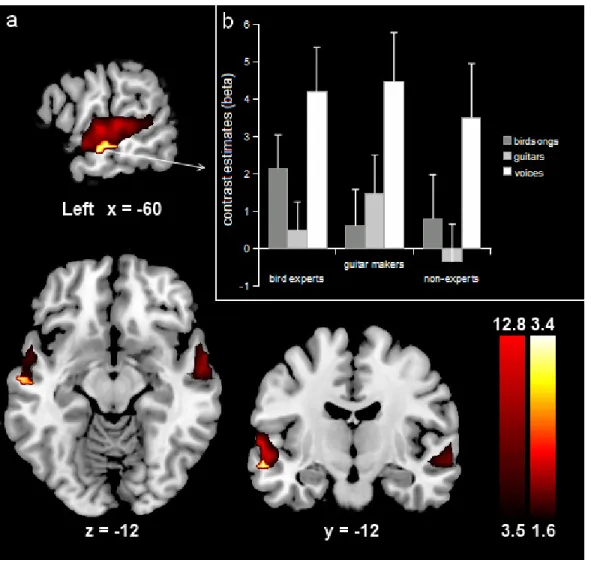
In the third study, we asked whether the voice-sensitive areas would be recruited by different categories of sounds of expertise in guitar makers, bird experts and non-experts. The behavioral data showed an interaction between the two groups of experts and their respective category of expertise for memory and discrimination tasks. The functional magnetic resonance imaging results showed an interaction of the same type in the left superior temporal sulcus and the left posterior cingulate gyrus. The results show that the
voice selective areas do not exclusively process voice stimuli but could also contribute to expert-level processing of other sound categories. Therefore, cortical selectivity to human voice could be due to a prolonged exposure to voice.
The data presented demonstrate several behavioral and anatomo-functional similarities between cerebral voice processing and other types of auditory expertise. These common aspects can be explained by a functional and economical brain organization. Consequently, sound processing would rely on shared neural networks unless necessary. This interpretation is particularly important to suggest an integrative approach for studying voice processing specificity.
Table des matières
Résumé... i
Abstract ... iii
Table des matières... v
Liste des tableaux... vi
Liste des figures ... vii
Liste des sigles et des abréviations... viii
Remerciements... x
Introduction générale ... 1
Présentation des objectifs de recherche et des études ... 4
Articles théoriques et empiriques... 7
Article 1 : Auditory recognition expertise and domain specificity... 8
Article 2 : Superior voice timbre processing in musicians ... 34
Article 3 : Brain response to birdsongs in bird experts... 49
Article 4 : Auditory expertise recruits voice-selective auditory cortex ... 67
Discussion générale... 86
Entraînement musical et traitement de la voix... 87
Réponse corticale aux chants d’oiseaux... 90
Localisation anatomo-fonctionnelle de l’expertise auditive ... 92
La voix est-elle spéciale? ... 98
Conclusion ... 99
Bibliographie... 101
Liste des tableaux
Article 4 : Auditory expertise recruits voice-selective auditory cortex
Supplementary table 1 : Auditory training in both groups of experts ... 84 Supplementary table 2 : Stimuli length and task trials for the behavioral tasks ... 85
Liste des figures
Article 1 : Auditory recognition expertise and domain specificity
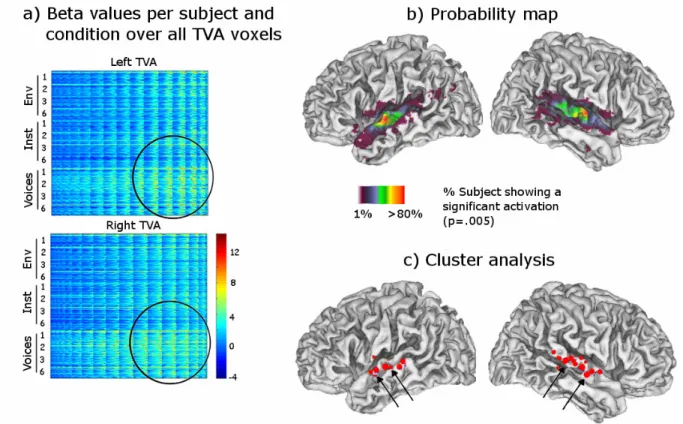
Figure 1 : Representation of spatial variability across the Temporal Voice Area
(TVA)... 32
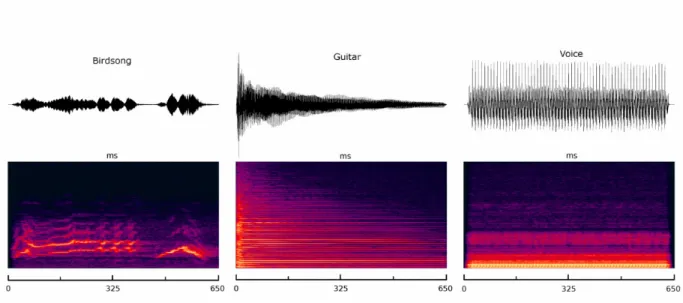
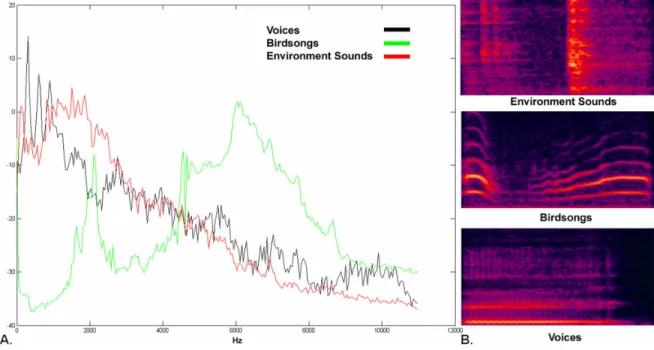
Figure 2 : Spectral analysis of complex sound stimuli ... 33
Article 2 : Superior voice timbre processing in musicians
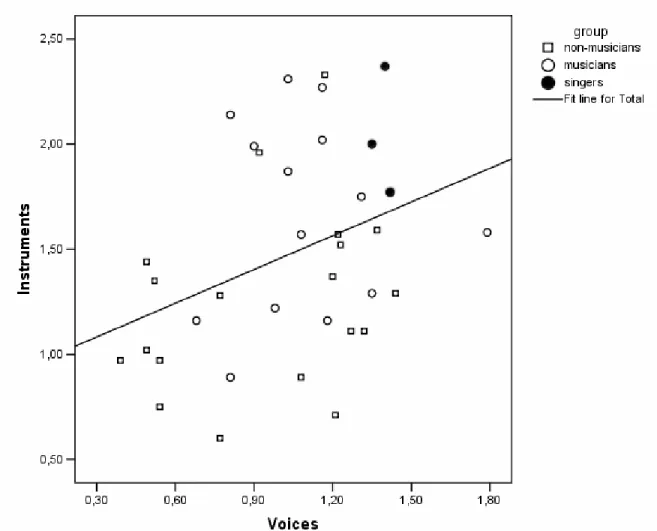
Figure 1 : Mean performance (+SE) for non-musicians and musicians at both voice and instrument discrimination tasks... 47Figure 2 : Correlation between instrument and voice discrimination tasks performance for both musicians and non-musicians... 48
Article 3 : Brain response to birdsongs in bird experts
Figure 1 : Auditory stimuli... 63Figure 2 : Auditory-evoked potentials ... 64
Figure 3 : N1 and P2 amplitudes... 65
Figure 4 : Electroencephalography scalp topography... 66
Article 4 : Auditory expertise recruits voice-selective auditory cortex
Figure 1 : Experts’ and non-experts’ behavioral performance with auditory memory and discrimination tasks... 75Figure 2 : Group-average ROIs (red) corresponding to the vocal vs non-vocal contrast from the localizer run ... 76
Supplementary figure 1 : Brain activation (red) corresponding to the positive group x sound interaction with a whole brain analysis ... 82
Supplementary figure 2 : Brain regions covered by the 17 interleaved ascending slices during the one-back runs ... 83
Liste des sigles et des abréviations
ANOVA Analysis of variance EEG Electroencephalography
IRMf Imagerie par résonance magnétique fonctionnelle fMRI Functional magnetic resonance imaging
FFA Fusiform face area
GCPg Gyrus cingulaire postérieur gauche GCP Gyrus cingulaire postérieur
MEG Magnétoencéphalographie / Magnetoencephalography MS Millisecondes / Milliseconds
S Secondes / Seconds
SE Standard error
STG Superior temporal gyrus
STS Sillon temporal supérieur / Superior temporal sulcus TEP Tomographie par émission de positons
À mes parents, sans qui rien de tout ceci n’aurait été possible.
Remerciements
Au cours de la réalisation de ma thèse, les mots d’encouragements furent très nombreux. Cependant, je retiens surtout les appuis authentiques que j’ai reçus. Cette page est donc dédiée aux personnes qui ont su, au fil des ans, m’appuyer de la manière la plus franche qui soit.
Ce document se voulant être une thèse, je ne peux commencer qu’en remerciant la personne qui m’a à la fois permis de la commencer...et de la terminer! J’offre mes plus sincères remerciements à Pascal, qui m’a accueilli dans son jeune laboratoire alors que j’étais moi-même débutant. Malgré la distance physique qui nous a séparés pendant une bonne partie de la réalisation de cette thèse, j’ai toujours senti qu’il était derrière moi et que mon projet faisait partie d’un travail d’équipe. Parmi ses qualités qui m’auront marqué tout au long du doctorat, je retiens surtout sa confiance, son enthousiasme et son empressement fou à essayer de nouvelles idées. J’espère bien un jour intégrer ces belles qualités (mais à plus faible dose, sans offense bien sûr!).
Je dois aussi remercier Isabelle, ma co-directrice, qui s’est chargée de m’intégrer à son équipe au moment où je me suis retrouvé orphelin de mon laboratoire vocal. D’un ton calme et rassurant, elle s’est toujours montrée disponible pour m’orienter et me rassurer dans plusieurs étapes cruciales de mon projet de thèse. En tant que co-directrice, elle possédait la balance du pouvoir, et ce fut très apprécié.
Mes remerciements s’adressent ensuite à mes parents. Pour des parents, il est peut-être difficile de comprendre adéquatement le parcours de son enfant aux études graduées. Tout ce que je peux dire, c’est qu’ils m’ont toujours offert un appui inconditionnel. Par ailleurs, ces remerciements ne pourraient être complets sans la mention des valeurs familiales qui m’ont influencé de près ou de loin dans la réalisation de ce projet. Provenant de ma mère, il s’agit de son sens de l’organisation et de la prévision sans égal alors que chez mon père, il s’agit de son optimisme candide et puissant. À eux deux, ils ont réussi à me transmettre un désir de vaincre l’adversité, peu importe la forme qu’elle peut prendre.
L’immensité de la reconnaissance et de la redevance que ces influences m’inspirent ne pourrait être traduite par de simples mots.
Puisqu’il est question de souligner les contributions familiales, je dois inévitablement mentionner mon chère frère Jean-Luc. Il s’agit de la personne qui me permet continuellement de conserver une attitude ludique, jeune et rebelle, malgré l’apparition récente de quelques cheveux blancs que je peux compter sur les doigts de ma main. La quantité de spectacles musicaux que nous sommes allés voir au cours des dernières années est un bon exemple des activités « frèresques » qui m’auront donné l’occasion de décrocher à plusieurs moments critiques!
Je dois aussi beaucoup à ma copine Julie, avec laquelle je partage un parcours très similaire depuis le début du baccalauréat. Dès nos premières rencontres, je me doutais que nos attitudes semblables nous mèneraient loin. Un doctorat plus tard, j’ai toujours la même conviction. Un gros merci à celle qui croit en mes idées et qui me supporte dans celles qui lui plaisent moins! Du même côté de la famille, je lance un petit clin d’oeil à mes beaux-parents, qui m’ont toujours offert un appui empathique, ayant eux aussi traversé la même épreuve académique.
Je voudrais remercier particulièrement certains de mes amis proches, dont Karl, René et Guylaine, avec qui j’ai pu partager mes bonnes et moins bonnes expériences. Je remercie aussi tous les autres amis qui estiment que leur contribution devrait être souligée ici. Je garde de très bons souvenirs des étudiants et collègues du BRAMS et du CERNEC que j’ai eu la chance de côtoyer de près ou de loin. Je suis persuadé qu’il sera très difficile pour moi de retrouver un milieu de travail aussi riche et stimulant. J’en profite pour souhaiter bon courage aux personnes qui lisent ce texte en s’imaginant l’impossible : la fin de leur propre thèse!
Finalement, j’aimerais aussi remercier un objet inanimé qui m’a suivi tout au long de mon doctorat et qui ne m’a jamais laissé tomber : mon ordinateur portable. Ayant accusé de durs coups physiques et subi une variété de climats, ce dernier s’est toujours porté garant de mes requêtes. Merci Thinkpad T42!
La voix humaine. Cette composante prédominante de notre environnement auditif est principalement associée à la production du langage. Bien que porteuse de la parole, la voix humaine comporte plusieurs informations importantes qui permettent d’identifier notre locuteur, son âge, son sexe ou son état affectif. La présence d’une multitude d’informations contenues dans la voix fait de celle-ci un véritable « visage auditif » (Belin, Bédard, & Fecteau, 2004). D’autre part, le cerveau humain possède une capacité exemplaire pour extraire ces informations. À titre d’exemple, c’est avec aisance que l’on peut rapidement reconnaître la voix d’un pair ou détecter l’efficacité d’une blague dans le rire d’une amie. Considérant ces habiletés du cerveau qui sont propres à la voix humaine, on pourrait qualifier les humains d’ « experts » en voix. Une question pourtant non-résolue demeure dans la nature et le développement de ces habiletés pour la voix humaine. Une meilleure compréhension de ce phénomène aurait des répercussions importantes sur notre conception du système auditif et de ses mécanismes, tant sur le plan comportemental que cérébral. C’est en se basant sur la notion que tous les humains sont experts pour traiter la voix humaine que la présente thèse tentera d’éclaircir cette question.
La voix humaine prend une place considérable dans notre environnement sonore, et ce depuis le tout jeune âge. En effet, la voix de la mère est un signal acoustique prépondérant dans l’environnement amniotique (Fifer & Moon, 1994). Très rapidement, les nouveau-nés démontrent des signes physiques de préférence à la voix de leur mère, tels qu’un ralentissement du battement de coeur ou une augmentation du débit de la tétée (DeCasper & Fifer, 1980; Fifer & Moon, 1994). Des données plus récentes indiqueraient même une préférence pour la voix de la mère avant la naissance, chez le foetus à terme (Kisilevski et al., 2003). Cette prise de contact très précoce avec la voix humaine, de même qu’une exposition répétée à celle-ci, devraient se traduire par la présence de marqueurs dans les aires auditives cérébrales.
En effet, depuis une dizaine d’années, on reconnaît la présence d’aires préférentielles à la voix dans les lobes temporaux chez l’humain (Belin, Zatorre, Lafaille, Ahad, & Pike, 2000; Belin, Zatorre, & Ahad, 2002). Plus précisément, on observe une plus grande activité cérébrale au niveau des sillons temporaux supérieurs bilatéraux lorsqu’on
présente des extraits de voix humaine, comparativement à des sons non-vocaux naturels ou à des sons de voix humaine qui ont été embrouillés. La nature et le développement de cette réponse sélective à la voix le long des sillons temporaux supérieurs demeurent cependant peu explorés. À ce jour, peu de données nous informent sur la cause de cette spécialisation du cerveau pour la voix (Belin, Bédard, & Fecteau, 2004).
Une version analogue de cette problématique a déjà été abordée dans le domaine visuel, en référence à la spécificité du traitement des visages par le gyrus fusiforme (Kanwisher, McDermott, & Chun, 1997). La présence de données divergentes a favorisé le maintient de deux camps très polarisés (Gauthier & Bukach, 2007). D’un côté, un groupe estime que le gyrus fusiforme répond sélectivement aux visages et qu’il contient des processus qui sont spécifiques à ceux-ci (Kanwisher, 2000; Kanwisher & Yovel, 2006). À l’autre pôle, on croit que le gyrus fusiforme serait impliqué dans tout traitement de catégorie visuelle homogène pour laquelle un individu aurait été suffisamment exposé pour développer une expertise visuelle (Gauthier, Skudlarski, Gore, & Anderson, 2000; Gauthier & Bukach, 2007).
Ce débat concernant la spécificité des visages, couramment surnommé « problème de l’expertise », est nourri par plusieurs études comportementales et d’imagerie cérébrale comparant l’expertise visuelle acquise dans d’autres domaines à celle des visages, laquelle serait universelle chez la plupart des humains (voir Kanwisher & Yovel (2006) pour une revue de la littérature). Dans le cas de la perception de la voix, on pourrait également considérer que la grande majorité des individus seraient des experts pour en extraire différentes informations. Contrairement au domaine visuel, il semblerait y avoir très peu d’études comparant directement l’expertise auditive et l’expertise pour la voix humaine. Certaines études ont par contre examiné l’influence de l’expertise musicale sur la perception de différents aspects langagiers (Besson, Schön, Moreno, Santos, & Magne, 2007; Lee & Hung, 2008; Nikjeh, Lister, & Frisch, 2009; Wong, Skoe, Russo, Dees, & Kraus, 2007). Les données suggèreraient un transfert des habiletés acquises à travers la pratique musicale dans le traitement du langage, démontrant que la spécificité du langage peut être comprise à partir d’une expertise auditive telle que l’expertise musicale. Selon
nous, l’expertise auditive serait tout aussi pertinente pour mieux comprendre la spécificité de la perception de la voix.
Présentation des objectifs de recherche et des études
Le but de la présente thèse est de préciser la spécificité des processus et régions impliqués dans le traitement de la voix. Comme il a été fait en vision, nous estimons qu’il serait pertinent de recruter des experts qui ont été exposés à une catégorie homogène de stimuli auditifs pendant une longue période, et dont l’expérience serait davantage comparable à celle que l’on retrouve pour la voix humaine plutôt qu’à d’autres catégories de sons de l’environnement. Par exemple, la capacité de certains ornithologues amateurs d’identifier plus de 200 chants d’oiseaux différents est similaire à la capacité des êtres humains à identifier leurs pairs par le timbre de leur voix. La comparaison des processus et régions impliqués dans l’expertise auditive avec ceux impliqués dans le traitement de la voix permettrait de raffiner nos connaissances sur le fonctionnement des aires auditives et d’évaluer l’effet de l’expérience sur le développement de celles-ci. Chacune des sections qui suivent sera présentée sous forme d’article.
Premier article : perception de la voix et spécificité
Dans ce premier article de recension de la littérature, nous aborderons tout d’abord la problématique de l’expertise en faisant un résumé de la littérature dans le domaine visuel. Il sera ensuite question de la perception de la voix et les différentes expertises auditives. Finalement, nous proposerons qu’une question telle que « La voix est-elle spéciale? » peut être investiguée en partie avec l’étude de l’expertise auditive.
Deuxième article : discrimination du timbre chez les musiciens
Bien que la majeure partie de cette thèse soit orientée sur les méthodes d’imagerie cérébrale, le deuxième article abordera la question de la spécificité de la voix à l’aide de données comportementales. Dans l’étude qui y est décrite, nous évaluerons en quoi une expertise musicale peut influencer le traitement de la voix humaine, à l’aide de tâches de discrimination de voix humaines et d’instruments de musique.
Hypothèses de la première étude: Une expérience en pratique musicale devrait avoir un effet positif sur le traitement non-langagier de la voix humaine. En d’autres termes, les musiciens amateurs recrutés devraient être meilleurs que les non-musiciens pour traiter des timbres d’instruments de musique et de voix humaine. Cette hypothèse est formulée à partir des données qui ont démontré l’avantage des musiciens dans le traitement de matériel non-musical (e.g., Münzer, Berti, & Pechmann, 2002).
Troisième article : potentiels évoqués chez les ornithologues amateurs
S’inspirant des données en électroencéphalographie (ÉEG) et en magnétoencéphalographie (MEG) démontrant de plus grandes ondes auditives reliées à l’instrument de pratique chez les musiciens (Pantev, Roberts, Schulz, Engelien, & Ross, 2001; Shahin, Bosnyak, Trainor, & Roberts, 2003), le troisième article aura comme objectif d’identifier et de comparer les potentiels évoqués liés aux chants d’oiseaux chez des ornithologues amateurs et des participants novices. Les données récoltées proviendront de la présentation de chants d’oiseaux, de voix humaines et de sons de l’environnement lors d’une tâche de détection de cible de type oddball.
Hypothèses de la deuxième étude : La perception de chants d’oiseaux chez les ornithologues amateurs devrait provoquer de plus grandes ondes auditives P2, comparativement aux participants novices.
Quatrième article : rôle des aires de la voix dans l’expertise auditive
Finalement, l’étude présentée dans le quatrième article s’inspire fortement d’un des articles qui a lancé le débat de l’expertise dans le domaine visuel (i.e., Gauthier, Skudlarski, Core, & Anderson, 2000). Dans cette étude, il sera question de préciser le rôle des aires temporales de la voix dans le traitement de catégories d’expertise chez deux groupes d’experts auditifs, notamment des ornithologues amateurs et des luthiers. Ces deux populations sont choisies en fonction de pratiques auditives qui selon nous ressemblent à celles couramment utilisées pour la voix humaine. De plus, le recrutement de deux groupes d’experts permet d’avoir un plan symétrique : chaque groupe d’expert sera comparé à
l’autre groupe qui sera alors considéré novice. Cette étude comportera une partie comportementale et une partie en imagerie par résonance magnétique fonctionnelle (IRMf).
Hypothèses de la troisième étude: Une interaction entre le groupe d’expertise et la catégorie d’expertise devrait être décelée, tant au niveau des tâches comportementales qu’au niveau des activations cérébrales qui répondent habituellement à la voix (STS). Plus précisément, les ornithologues amateurs devraient être meilleurs que les luthiers pour la mémorisation et la discrimination des chants d’oiseaux. Cette supériorité comportementale devrait se traduire en une plus grande réponse corticale aux chants d’oiseaux qu’aux sons de guitares. Les résultats inverses sont attendus pour les luthiers.
Article 1 : Auditory recognition expertise and domain specificity
Jean-Pierre Chartrand, Isabelle Peretz et Pascal Belin
Running head: AUDITORY RECOGNITION EXPERTISE
Auditory recognition expertise and domain specificity Jean-Pierre Chartrand¹, Isabelle Peretz¹, and Pascal Belin¹ ².
¹BRAMS, Université de Montréal, Montréal, Canada
²Centre for Cognitive Neuroimaging, University of Glasgow, Glasgow, UK
Correspondence and requests for reprints to Jean-Pierre Chartrand,
Département de Psychologie, C.P. 6128, succursale Centre-Ville, Montréal, Québec, Canada, H3C 3J7
Tel : + 1 1 (514) 343-6111 ext. 2995; fax: +1 1 (514) 343-2175;
Abstract
Auditory recognition expertise refers to one's ability to accurately and rapidly identify individual sound sources within a homogeneous class of stimuli. Compared to the study of visual expertise, the field of expertise in sound source recognition has been neglected. Different types of visual experts have been studied extensively both in behavioral and neuroimaging studies, leading to a vigorous debate about the domain specificity of face perception. In the present paper, we briefly review what is known about visual expertise and propose that the same framework can be used in the auditory domain to ask the question of domain specificity for the processing and neural correlates of the human voice. We suggest that questions like “are voices special ?” can be partially answered with neuroimaging studies of “auditory experts”, such as musicians and bird experts, who rely on subtle acoustical parameters to identify auditory exemplars at a subordinate level. Future studies of auditory experts can not only serve to answer questions related to the neural correlates of voice perception, but also broaden the understanding of the auditory system.
Section: 7. Cognitive and Behavioral Neuroscience
1. Introduction
Every once in a while, we happen to meet people who excel in specific activities, fields of knowledge or cognitive tasks. These people, called experts, have been trained for years in order to be faster or be more proficient in their domain of expertise. This fascination for people who have developed specific skills over time is witnessed by the numerous studies conducted in cognitive, motor and especially vision research. Radiologists, chick sexers, bird, dog, and car experts all seem to have behavioral similarities with human face experts (i.e., virtually all healthy adults). They all seem to have both qualitative and quantitative advantages over novices in recognizing individual exemplars of the visual category of their expertise. Processing these different classes of stimuli of expertise might rely on similar processes, and consequently, on similar cortical regions. This possibility raises questions regarding the modularity of face processing because it would entail that faces are not special (Nachson, 1995). This has led to hotly debated and polarized opinions about the uniqueness of face recognition and its neural correlates. Proponents of the domain-specificity hypothesis argue that face perception is carried out by highly specialized processes and dedicated brain regions (Kanwisher, 2000). Opponents to this hypothesis adhere instead to the expertise hypothesis by which faces recruit general mechanisms that are fine-tuned by experience (Gauthier and Bukach, 2007). No comparable research effort has taken place in the auditory domain, even though it has been suggested that the human voice is an ‘auditory face’ (Belin et al., 2004), and that specific cortical regions are involved in voice processing (Belin et al., 2002). Questions about cognitive and anatomical modularity of voice processing have only been raised recently (Belin et al., 2004). Questions such as ‘in what way are voices special?’ and ‘is voice expertise a simple exposure and learning effect?’ can shed light on the development and functioning of the auditory system. Indeed, studying different types of auditory experts can open new avenues for understanding the modularity of auditory and voice perception. However, we will first examine the visual expertise literature.
2. The visual expertise debate
2.1 Functional modularity for visual objects
The most studied form of visual expertise is face processing. Face recognition is a relatively universal domain of expertise in humans ((Carey, 1992) and (Diamond and Carey, 1986)). Different behavioral studies show that face recognition is somewhat different from object recognition. For instance, when face recognition performance is compared to recognition performance for other categories of objects, participants usually identify faces more frequently and as quickly at the subordinate level as at the basic level (e.g., Bill Clinton vs. a human) (Tanaka, 2001). Subordinate-level categories are more informative about the objects they represent, but different exemplars categorized at a subordinate level are more similar to one another and require more effort to discriminate between them (Tanaka and Gauthier, 1997). For example, two human face exemplars offer more information if they are categorized at a subordinate level, but are more difficult to discriminate (e.g. Stephen Harper vs George W. Bush). Basic-level categories, inversely, offer less information but are much more discernible. For example, the “human” category is easily distinguished from another living being category, such as “dog”, but contains less information about facial features of its exemplars. This preference for the use of subordinate-level labels for human faces can be linked to the daily need to identify people by their unique identity rather than by their basic category (e.g. faces or humans). Non-facial categories can also be preferentially processed at the subordinate level by visual experts, hence supporting the expertise hypothesis. Tanaka and Taylor (1991) have shown that bird and dog experts use subordinate-level categories and names to describe birds and dogs, whereas novices tend to use basic levels (e.g., dog for novices vs. Bloodhound for dog experts). Moreover, experts were as fast when they used subordinate-level as when they used basic-level categorizations, contrarily to the novices who were faster for the basic-level names.
Another difference between face and object recognition is demonstrated by the face-inversion effect (Yin, 1969). This effect suggests that face-specific mechanisms, as opposed to other visual mechanisms involved in object recognition, are more disrupted when visual
stimuli are turned upside-down. Inversion effects have also been observed in dog experts (Diamond and Carey, 1986), suggesting that mechanisms considered being face-specific could also be involved in expertise object recognition.
Another important question in the expertise debate is whether novices can be trained to become experts. This question is of primary interest, because it addresses the effect of training and exposure on behavioral markers of expertise. In fact, novices can be trained in the laboratory to recognize a category of novel and non-natural objects, such as “greebles” ((Gauthier and Tarr, 1997) and (Gauthier et al., 1998)). “Greebles” are 3D-rendered objects that share a common configuration. They all have a vertically-oriented body with four protruding parts, and can be categorized into different classes that are referred to as “gender” and “family”. Gauthier and Tarr (1997) trained participants to recognize 30 different greebles at three levels of categorization: family, gender, and individual levels. These participants were then tested to identify upright and inverted Greeble parts in three conditions: studied-configuration, transformed-configuration or isolated part. The results demonstrated that experts who had extensive practice with a homogeneous object category such as Greebles showed recognition effects usually associated with faces, such as being more sensitive to configuration changes.
In sum, expertise effects have been observed with visual objects such as cars, birds, faces and greebles. These data seem to support that face and object processing expertise involve the same mechanisms. However, it may be that different classes of objects involve distinct mechanisms that produce similar configuration effects. Brain imaging studies provide some additional information in this regard.
2.2. Anatomical modularity for object perception
Several functional neuroimaging studies have identified a cortical region, called the Fusiform Face Area (FFA) that responds preferentially and consistently to faces (e.g., Kanwisher et al., 1997). In subsequent work, this region has been shown to be also involved in processing objects of expertise other than faces. For example, Gauthier et al. (2000) reported that objects of visual expertise (birds and cars) activate the right FFA more
strongly than non-expertise stimuli in bird and car experts. There was also a high correlation between a behavioral test of object expertise and the relative activation of the FFA for birds and cars. This led the authors to conclude that the FFA would be involved in visual expertise, rather than in face processing per se. While Xu (2005) has replicated this finding, other studies have obtained non-significant trends for FFA activations with Lepidoptera experts (Rhodes et al., 2004) or negative results with car and 3D artificial object experts ((Grill-Spector et al., 2004) and (Yue et al., 2006)). Moreover, it can be argued that face-specific processes can be recruited for face-like stimuli after training, since birds and cars could be visually interpreted with face-like configurations (Kanwisher, 2000).
It is worth mentioning that conventional fMRI procedures have a limited spatial resolution. This has a great impact when comparing regions as small as the FFA, which is represented by a small number of voxels. Using high resolution fMRI, a recent study conducted by Grill-Spector et al. (2006) (corrigendum: Grill-Spector et al., 2007) showed that the FFA is a heterogeneous region of higher and lower face-selective patches. Thus, previous studies asserting the presence of a highly selective face module were in fact describing averages of high and lower face-selective subregions.
Since the current data do not support either the domain-specificity or the expertise hypothesis, we may provisionally assume that face and objects of expertise rely on similar cortical regions and processes. The FFA controversy primarily questions the existence of a face-dedicated brain module. Yet, the visual expertise framework addresses broader questions about the development and plasticity of the visual system (Bukach et al., 2006). By studying greeble laboratory training, Gauthier et al. (1999) observed that training-induced expertise with greebles led to increased right FFA activations. These results suggest that expertise can in part explain the specialization of the FFA for faces. The surprising part is that only seven hours of training were sufficient to lead to functional cortical changes. This is an example of how researchers in the field of visual expertise have developed interesting methods and paradigms that can be used to further study the learning visual brain. These methods can also be borrowed and adapted to research in the auditory
domain to study expertise. Although research in auditory recognition expertise is much less advanced, let us summarize what is currently known about auditory experts.
3. Voice perception
It has been proposed that we are all experts at face recognition. The same can be suggested about our ability to recognize voices, although forensic studies on earwitness identification show that voices are poorly recognized ((Hollien et al., 1983) and (Olsson et al., 1998)). Nevertheless, the human voice is probably the most meaningful sound category of our auditory environment. Contained in the human voice timbre are information that enable us to identify a speaker's gender (Mullennix et al., 1995), age (Linville, 1996), and emotional state (Scherer, 1995). These types of information are also present in human faces, but on some occasions they may not be available, such as when speaking to someone on the phone. Thus, the voice can be considered as an “auditory face” (Belin et al., 2004), from which rich linguistic and non-linguistic information can be extracted.
In addition to these considerations, cortical regions along the right superior temporal sulcus (rSTS) have been shown to respond preferentially to human voices over non-vocal sounds and scrambled non-speech vocal sounds ((Belin et al., 2000) and (Belin et al., 2002)). These bilateral regions, also called temporal voice areas (TVA), are spatially limited across participants, suggesting a clear anatomo-functional regionalization (Fig. 1). Clinical studies have also confirmed that voice discrimination or recognition can be impaired mostly after right-hemisphere lesions ((Peretz et al., 1994) and (Van Lancker and Kreiman, 1987)). These studies lead us to believe that there exists a form of voice expertise comparable to face recognition expertise. Could there be, as in the visual domain, other types of “voice” or sound experts?
Little is known about auditory experts, other than musicians, but there exist people who are highly trained to identify certain irregularities in the production of voice. Speech therapists and voice pathologists need to develop special skills to assess and diagnose voice pathologies. Kreiman et al. (1993) suggest that these professionals assess pathological voices using mental representations that they develop through their careers. Consequently
these representations might vary across them, being influenced by internal and external factors such as memory, attention, and the acoustical context of the task ((Kreiman et al., 1992) and (Gerratt et al., 1993)). These professionals also differ in their use of strategies (Kreiman et al., 1992). Bhuta et al. (2004) assessed whether there was a correlation between subjective voice assessment (GRBAS scale) and objective acoustical voice assessment. Out of 19 acoustical parameters, only three noise parameters correlated with the perceptual voice analysis scale. The authors suggested that perhaps noise is the information voice professionals perceive in a dysphonic voice. No studies have assessed the link between non-pathological voice characteristics and individuals' strategies and performance in different conditions (Kreiman, 1997). Thus, the study of voice experts does not provide much insight for understanding voice or auditory recognition expertise.
4. Auditory experts
Expertise in object recognition has been studied mainly in the visual domain, but some visual objects, such as birds and musical instruments, can also be recognized through audition. Bird experts and musicians can be considered as “auditory experts”, relying on unique sound information to identify individual sound sources at a subordinate level. Bird experts have developed excellent skills at recognizing birds visually, but sometimes they might just hear a bird and not even see it. In order to identify these non-visible birds, they need to identify them by their songs, or calls in some instances. Just as the visual objects they represent, birdsongs are different across species, and even sometimes inside the same species. Bird experts have thus developed the ability to identify birdsongs in an auditory environment. The same can be said about musicians, when they need to identify a specific musical instrument in an orchestra for example. Much information is available about these two groups, because bird experts have been studied in vision research ((Tanaka and Taylor, 1991) and (Gauthier et al., 2000)), and musicians have been studied extensively for their musical and auditory skills.
No sample of auditory experts has been studied as extensively as musicians. Several reasons can explain this. First, they are easily available, and differ in levels of training. Some of them are trained at an academic level, which translates into a more uniform motor,
cognitive, perceptual and conceptual knowledge across professionals. Other musicians, who have been trained at an amateur level, can differ from non-musicians due to years of practice (e.g. Tervaniemi et al., 2006). Also, questions about the development of expertise can be raised, since children can start learning a musical instrument as young as four years old. Musicians can be easily compared to novices, that is, non-musicians, who are capable of sophisticated listening strategies although they are not professionally trained (for a review, see Bigand and Poulin-Charronnat, 2006). In sum, both the homogeneity and heterogeneity of abilities and practices found in musicians are important reasons that make them an interesting sample of auditory experts. Musicians have been largely studied with musical stimuli, comparing their musical skills to non-musicians. These skills include superior pitch, temporal and also spatial processing in music conductors (Münte et al., 2001).
Musicians are known to have better pitch discrimination than non-musicians. Pitch discrimination studies generally demonstrate that trained musicians have a frequency discrimination threshold about half the size of non-musicians' ((Spiegel and Watson, 1981) and (Kishon-Rabin et al., 2001)). Moreover, if the participants are classical instrumentists with over ten years of practice, the observed threshold difference between musicians and non-musicians is multiplied by a factor of two (Micheyl et al., 2006). Another pitch-related ability influenced by musical training is absolute pitch. Absolute pitch is the ability to easily identify the pitch of a tone without any prior reference. The development of this ability seems to require both genetic factors and early musical training (Baharloo et al., 1998). These data demonstrate that musical background and practice are intimately associated with pitch discrimination and recognition in musicians. Musicians are also more accurate at processing temporal information. More precisely, they are superior at processing immediate temporal information, as opposed to temporal tasks that involve encoding of an interval stimulus in long-term memory (Rammsayer and Altenmuller, 2006). Finally, music conductors show improved auditory localization in the peripheral space, compared to musicians and non-musicians ((Münte et al., 2001) and (Nager et al., 2003)). Interestingly, congenitally and late-onset blind people also present such improved auditory spatial abilities ((Röder et al., 1999) and (Fieger et al., 2006)). Moreover, people
who were blinded in infancy show better pitch direction judgement than late-onset blind people and control participants (Gougoux et al., 2004). Usually, factors such as the need to orient with sounds and reorganization of the visual cortex are used to explain such observations in blind people. These people might have developed such abilities with different types of stimuli in their everyday lives. On the other hand, musicians are of particular interest to the present topic because they gained their training with a restricted class of auditory stimuli. In this case, a pertinent question to ask is whether the skills acquired in the context of musical training can transfer to categories of stimuli other than musical instruments.
4.1 Transfer of auditory abilities in musicians
A few studies have assessed musicians' performance in perceptual tasks not exclusive to music, such as pitch and timbre discrimination. These studies focus on musicians' transfer of auditory skills to nonmusical stimuli. Such studies have investigated musicians' ability to decode speech prosody ((Magne et al., 2006), (Schön et al., 2004) and (Thompson et al., 2004)) and detect pitch violations in foreign languages (Marques et al., 2007). These studies show evidence for musicians' advantage in processing pitch and contour both in music and language. The results suggest the existence of shared processes in music and language.
Central to the auditory recognition expertise problem is the perception of timbre, because it is the most useful acoustical parameter that musicians and non-musicians alike use to recognize musical instruments. Timbre can be defined as an “attribute of auditory sensation in terms of which a listener can judge that two sounds, similarly presented and having the same loudness and pitch, are different” (ANSI, 1973). For instance, a violin tone can be easily discriminated from a guitar tone of the same pitch and loudness, by listening to its usually slower attack and particular spectral envelope. Essentially, violin and guitar notes are easily distinguishable because they have different timbres.
Musicians seem to outperform non-musicians in processing musical instruments' timbre. McAdams et al. (1995) evaluated the perceptual structure of musical timbre in
musicians, amateur musicians and non-musicians. Using a three-dimensional spatial model, they identified the logarithm of the attack time, the spectral centroid (the proportion of low and high frequency energies) and the spectral flux (the variation of spectral energies across time) to be the acoustic correlates of the dimensions used by the participants to discriminate timbres in a dissimilarity-rating task. They also observed that musicians, compared to amateur musicians and non-musicians, appeared to be more precise and coherent in their judgments. Thus, musicians do not seem to differ in the way they process musical instruments. They are just more consistent in their answers.
Münzer et al. (2002) compared musicians to non-musicians in timbre recognition tasks with different categories of sounds: musical timbre (chords), speech (phoneme combinations such as fa, li…) and pure tones. The authors found that musicians had better recognition performance than non-musicians. Another study confirms this timbre processing advantage in musicians. Chartrand and Belin (2006) compared the performance of musicians and non-musicians in two timbre discrimination tasks: one using instrumental timbres, the other using voices. In the voice task, the participants were instructed to indicate if pairs of syllables were pronounced from the same speaker. In the instrumental discrimination task, the participants had to indicate if two melodies of three notes were played on the same instrument. The musicians performed better at both tasks, but they tended to be slower. This latter effect can be interpreted in different ways. The first possibility is that the tested musicians had better auditory skills before their musical training even started, explaining why they also have better voice discrimination performance. Another possibility is that the musicians' training with musical timbres may have caused improved timbre processing irrespective of the sound category. The latter would support the hypothesis that the discrimination of voices and musical instruments share similar resources, supporting a domain-generality hypothesis.
4.2 Neuroimaging studies of the perception of musical instruments in musicians and non-musicians
Musicians' cortical response to musical tones is well documented due to a growing number of EEG and MEG studies showing enhanced brain responses to N1 and P2 components of the evoked potentials. Pantev et al. (1998) identified the auditory evoked field component N1m to be larger in musicians than in non-musicians, when passively exposed to piano tones. The augmented N1m dipole moment in musicians was found to be specific to the instruments of practice (Pantev et al., 2001; but see Lütkenhöner et al., 2006, for negative results). The P2 component seems to show robust effects of musical expertise. In an EEG study, Shahin et al. (2003) had violinists, pianists and non-musicians listen passively to violin, piano and pure tones. Piano and violin tones evoked larger P2 amplitudes in musicians, compared to control participants. Contrary to the results of Pantev et al. (2001), both piano and violin tones evoked similar amplitudes in violinists and pianists. Moreover, the P2 and P2m component has been found to increase with increasing spectral complexity of stimuli in musicians ((Kuriki et al., 2006) and (Shahin et al., 2005)). The effect is also less marked in non-musicians ((Shahin et al., 2005) and (Kuriki et al., 2007)). In summary, the results suggest both use-dependency and spectral complexity effects in P2(m) enhancements. However, these P2 effects are still poorly understood. A study of Sheehan et al. (2005) evaluated the impact of speech discrimination training on P2 amplitudes. The experimental group received speech discrimination training, while the control group was only exposed to the stimuli. While only the trained group gained better speech discrimination performance, P2 amplitudes were enhanced in both groups. Thus, the hypothesis that P2 enhancement automatically reflects an increase in behavioral discrimination performance is not supported. Higher P2 amplitudes seem to be unspecific effects of exposure to complex sounds and speech stimuli.
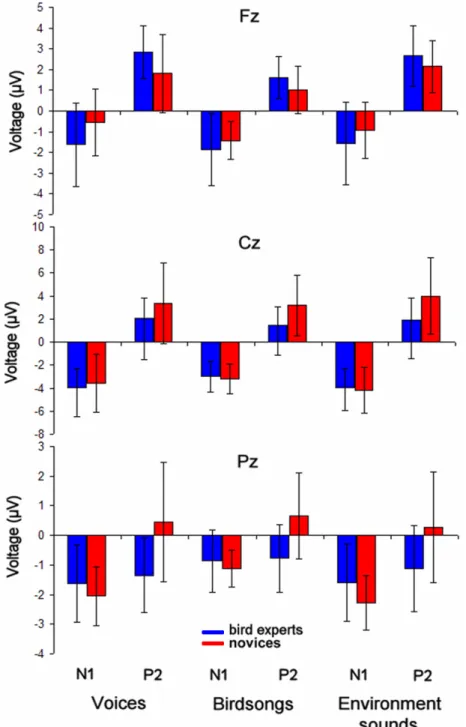
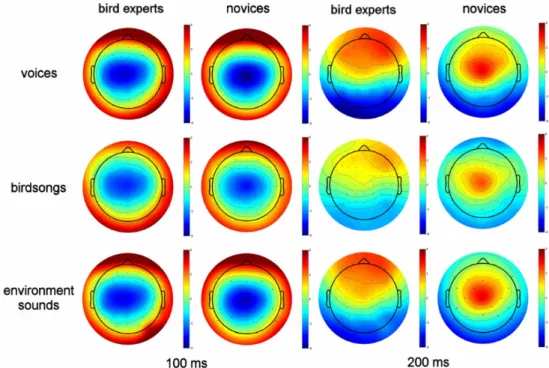
In an attempt to test the hypothesis that experience with a specific class of sound stimuli could evoke larger P2 components, Chartrand et al. (2007) investigated the auditory evoked potentials of birdsongs in bird experts. Bird experts and novices were exposed to three sound categories: birdsongs, environmental sounds and human voices. Similar
amplitudes were found for the N1 components across groups. On the contrary, P2 amplitudes seemed to be more frontally distributed in bird experts, but this was observed not only for birdsongs but also for the other two sound categories. These results reflect a difference in sound processing in bird experts, which may be explained by the use of a different strategy during the task, or an attentional effect elicited by the perception of birdsongs. Furthermore, birdsongs do not contain as many harmonics as those found in musical instruments or voices. This difference in harmonic complexity was reflected in lower P2 amplitudes for birdsongs, both in musicians and non-musicians. Based on these results, it is quite difficult to ascertain that the auditory P2 component is related to timbre processing, which is thought to be the main mechanism involved in auditory recognition expertise.
Nevertheless, the generators of the P2 component appear located in the secondary auditory cortex (Shahin et al., 2003) in agreement with fMRI studies of timbre processing. In an fMRI study, Menon et al. (2002) investigated functional brain activations when participants were presented with series of six-note melodies played with two different synthesized timbres: Timbre A had a low spectral centroid, no spectral flux and a fast attack (15 ms), while Timbre B had a higher spectral centroid, greater spectral flux and a slow attack (80 ms). Two significant clusters of brain activations were found bilaterally only when Timbre B was compared to Timbre A. Equal levels of activations were found in the right and left temporal lobes, surrounding the primary auditory cortex, as well as the belt regions of the superior temporal gyri (STG) and the superior temporal sulci (STS). However, the left temporal activations were posterior to the right temporal activations suggesting an hemispheric asymmetry in neural processing of timbre. Converging fMRI results have been obtained by Warren et al. (2005). Alternating between noise and harmonic sounds while changing the spectral envelope resulted in a lateralized activation of the middle right STS. It is interesting to note that the two studies, which manipulated different physical parameters of timbre, found anterior STS activations. These brain activations are similar to the ones observed with voice perception studies.
In principle, brain damage to the STS should result in processing difficulties of timbre. We are aware of only one study in which a deficit in timbre recognition has been noted (Kohlmetz et al., 2003). In that study, the patient selectively lost musical timbre perception for percussion and piano tones after a right temporal lesion. It was interpreted as the result of a difficulty to perceive rapid changes of the auditory spectrum, necessary for the identification of piano and percussion timbres but not for wind and string instruments. Unfortunately, the patient was not tested in voice recognition. Thus, the domain specificity of the disorder cannot be assessed.
5. Conclusions: is the expertise controversy transposable to the auditory domain?
The goal of the present article was to suggest the use of an expertise framework in the auditory domain in order to assess domain specificity in voice recognition. We have identified musicians and bird experts as potential auditory experts, who are able to recognize highly familiar sound sources. This ability should be compared with their ability to recognize human voices. To illustrate this idea, we first described vision studies with expert object recognition. In the auditory domain, however, there is as yet no clear consensus about what is an “auditory object” ((Kubovy and Van Valkenburg, 2001) and (Griffiths and Warren, 2004)). Here, we considered musical timbres as a distinct category. In the case of bird experts, we considered birdsongs, which involve both spectral and temporal changes. These differences between birdsongs and musical instruments are shown in Fig. 2. Although the spectral envelope is important in the identification of musical instruments, it is not the sole basis for timbre recognition. The analysis of complex sounds also includes the analysis of temporal envelope changes (Warren et al., 2005). In future studies, it will be interesting to see if two classes of experts, like musicians and bird experts, rely on the same acoustical information and cortical regions to identify their objects of expertise at a subordinate level. To this aim, we plan to use an fMRI procedure highly similar to that of Gauthier et al. (2000), and present different auditory exemplars of birds, musical instruments, voices and environmental objects to musicians and bird experts. We predict that bird experts and musicians would show similar cortical activations in the rSTS to those of voice.
Finally, it is important to note that the study of auditory recognition expertise could also benefit from promising experimental designs and procedures currently used in auditory research fields like voice, speech and music processing. For instance, the use of sound morphing can enable us to create novel exemplars from combining two natural categories of sounds like voices and musical instruments (Bélizaire et al., 2007). This technique could permit us to create entire classes of hybrid or novel auditory objects.
References
ANSI, 1973. Psychoacoustical Terminology. S3.20. American National Standards Institute, New York.
Baharloo, S., Johnston, P.A., Service, S.K., Gitschier, J., Freimer, N.B., 1998. Absolute pitch: an approach for identification of genetic and nongenetic components. Am. J. Hum. Genet. 62, 224–231.
Belin, P., Zatorre, R.J., Lafaille, P., Ahad, P., Pike, B., 2000. Voice-selective areas in human auditory cortex. Nature 403,309–312.
Belin, P., Fecteau, S., Bédard, C., 2004. Thinking the voice: neural correlates of voice perception. Trends Cogn. Sci. 8, 129–135.
Belin, P., Zatorre, R., Ahad, P., 2002. Human temporal-lobe response to vocal sounds. Cogn. Brain Res. 13, 17–26.
Bélizaire, G., Fillion-Bilodeau, S., Chartrand, J.P., Bertrand-Gauvin, C., Belin, P., 2007. Cerebral response to ‘voiceness’: a functional magnetic resonance imaging study. NeuroReport 18, 29–33.
Bhuta, T., Patrick, L., Garnett, J.D., 2004. Perceptual evaluation of voice quality and its correlation with acoustic measurements. J. Voice 18, 299–304.
Bigand, E., Poulin-Charronnat, B., 2006. Are we ‘experienced listeners’? A review of the musical capacities that do not depend on formal musical training. Cognition 100, 100–130.
Bukach, C.M., Gauthier, I., Tarr, M.J., 2006. Beyond faces and modularity: the power of an expertise framework. Trends Cogn. Sci. 10, 159–166.
Carey, S., 1992. Becoming a face expert. Philos. Trans. R. Soc. Lond., B Biol. Sci. 335, 95–103.
Chartrand, J.P., Belin, P., 2006. Superior voice timbre processing in musicians. Neurosci. Lett. 405, 164–167.
Chartrand, J.P., Fillion-Bilodeau, S., Belin, P., 2007. Brain response to birdsongs in bird experts. NeuroReport 18, 335–340.
Diamond, R., Carey, S., 1986. Why faces are and are not special: an effect of expertise. J. Exp. Psychol. Gen. 115, 107–117.
Fecteau, S., Armony, J. L., Joanette, Y., & Belin, P., 2004. Is voice processing species-specific in human auditory cortex? An fMRI study. NeuroImage. 23, 840-848.
Fieger, A., Röder, B., Teder-Sälejärvi, W., Hillyard, S.A., Neville, H.J., 2006. Auditory spatial tuning in late-onset blindness in humans. J. Cogn. Neurosci. 18, 149–157.
Gauthier, I., Bukach, C., 2007. Should we reject the expertise hypothesis? Cognition 103, 322–330.
Gauthier, I., Tarr, M.J., 1997. Becoming a ‘greeble’ expert: exploring mechanisms for face recognition. Vision Res. 37, 1673–1682.
Gauthier, I., Skudlarski, P., Gore, J.C., Anderson, A.W., 2000. Expertise for cars and birds recruits brain areas involved in face recognition. Nat. Neurosci. 3, 191–197.
Gauthier, I., Tarr, M.J., Anderson, A.W., Skudlarski, P., Gore, J.C., 1999. Activation of the middle fusiform ‘face area’ increase with expertise in recognizing novel objects. Nat. Neurosci. 2, 568–573.
Gauthier, I., Williams, P., Tarr, M.J., Tanaka, J., 1998. Training ‘greeble’ experts: a framework for studying expert object recognition processes. Vision Res. 38, 2401–2428.
Gerratt, B.R., Kreiman, J., Antonanzas-Barroso, N., Berke, G.S., 1993. Comparing internal and external standards in voice quality judgments. J. Speech Hear. Res. 36, 14–20.
Gougoux, F., Lepore, F., Lassonde, M., Voss, P., Zatorre, R., Belin, P., 2004. Neuropsychology: pitch discrimination in the early blind. Nature 430, 309.
Griffiths, T.D., Warren, J.D., 2004. What is an auditory object? Nat. Rev., Neurosci. 5, 887–892.
Grill-Spector, K., Sayres, R., Ress, D., 2007. Corrigendum: high-resolution imaging reveals highly selective nonface clusters in the fusiform face area. Nat. Neurosci. 10, 133.
Grill-Spector, K., Sayres, R., Ress, D., 2006. High-resolution imaging reveals highly selective nonface clusters in the fusiform face area. Nat. Neurosci. 9, 1177–1185.
Grill-Spector, K., Knouf, N., Kanwisher, N., 2004. The fusiform face area subserves face perception, not generic within-category identification. Nat. Neurosci. 7, 555–562.
Hollien, H., Bennett, G., Gelfer, M.P., 1983. Criminal identification comparison: aural versus visual identification resulting from a simulated crime. J. Forensic Sci. 28, 208–221.
Kanwisher, N., 2000. Domain specificity in face perception Nat. Neurosci. 3, 759–763.
Kanwisher, N., McDermott, J., Chun, M.M., 1997. The fusiform face area: a module in human extrastriate cortex specialized for face perception. J. Neurosci. 17, 4302–4311.
Kishon-Rabin, L., Amir, O., Vexler, Y., Zaltz, Y., 2001. Pitch discrimination: are professional musicians better than non-musicians? J. Basic Clin. Physiol. Pharmacol. 12,
125–143.
Kohlmetz, C., Müller, S.V., Nager, W., Münte, T.F., Altenmüller, E., 2003. Selective loss of timbre perception for keyboard and percussion instruments following a right temporal lesion. Neurocase 9, 86–93.
Kreiman, J., 1997. Listening to voice: theory and practice in voice perception research. In: Johnson, K., Mullenix, J.W. (Eds.), Talker Variability in Speech Processing. Morgan Kaufmann Publishers Inc., San Francisco, pp. 88–108.
Kreiman, J., Gerratt, B.R., Kempster, G.B., Erman, A., Berke, G.S., 1993. Perceptual evaluation of voice quality: review, tutorial, and a framework for further research. J. Speech Hear. Res. 36, 21–40.
Kreiman, J., Gerratt, B.R., Precoda, K., Berke, G.S., 1992. Individual differences in voice quality perception. J. Speech Hear. Res. 35, 512–520.
Kubovy, M., Van Valkenburg, D., 2001. Auditory and visual objects. Cognition 80, 97– 126.
Kuriki, S., Ohta, K., Koyama, S., 2007. Persistent responsiveness of long-latency auditory cortical activities in response to repeated stimuli of musical timbre and vowel sounds. Cereb. Cortex 17, 2725–2732.
Kuriki, S., Kanda, S., Hirata, Y., 2006. Effects of musical experience on different components of MEG responses elicited by sequential piano-tones and chords. J. Neurosci. 26, 4046–4053.
Lütkenhöner, B., Seither-Preisler, A., Seither, S., 2006. Piano tones evoke stronger magnetic fields than pure tones or noise, both in musicians and non-musicians. NeuroImage 30, 927–937.
Magne, C., Schön, D., Besson, M., 2006. Musician children detect pitch violations in both music and language better than nonmusician children: behavioral and electrophysiological approaches. J. Cogn. Neurosci. 18, 199–211.
Marques, C., Moreno, S., Castro, S.L., Besson, M., 2007. Musicians detect pitch violation in a foreign language better than nonmusicians: behavioral and electrophysiological evidence. J. Cogn. Neurosci. 19, 1453–1463.
McAdams, S., Winsberg, S., Donnadieu, S., De Soete, G., Krimphoff, J., 1995. Perceptual scaling of synthesized musical timbres: common dimensions, specificities, and latent subject classes. Psychol. Res. 58, 177–192.
Menon, V., Levitin, D.J., Smith, B.K., Lembke, A., Krasnow, B.D., Glazer, D., Glover, G.H., McAdams, S., 2002. Neural correlates of timbre change in harmonic sounds. NeuroImage 17, 1742–1754.
Micheyl, C., Delhommeau, K., Perrot, X., Oxenham, A.J., 2006. Influence of musical and psychoacoustical training on pitch discrimination. Hear. Res. 219, 36–47.
Mullennix, J.W., Johnson, K.A., Topcu-Durgun, M., Farnsworth, L.M., 1995. The perceptual representation of voice gender. J. Acoust. Soc. Am. 98, 3080–3095.
Münte, T.F., Kohlmetz, C., Nager, W., Altenmüller, E., 2001. Neuroperception. Superior auditory spatial tuning in conductors. Nature 409, 580.
Münzer, S., Berti, S., Pechmann, T., 2002. Encoding of timbre, speech and tones: musicians vs. non-musicians. Psychol. Beitr. 44, 187–202.
Nachson, I., 1995. On the modularity of face recognition: the riddle of domain specificity. J. Clin. Exp. Neuropsychol. 17, 256–275.
Nager, W., Kohlmetz, C., Altenmüller, E., Rodriguez-Fornells, A., Münte, T.F., 2003. The fate of sounds in conductors' brains: an ERP study. Brain Res. Cogn. Brain Res. 17, 83–93.
Olsson, N., Juslin, P., Winman, A., 1998. Realism of confidence inearwitness versus eyewitness identification. J. Exp. Psychol., Appl. 4, 101–118.
Pantev, C., Roberts, L.E., Schulz, M., Engelien, A., Ross, B., 2001. Timbre-specific enhancement of auditory cortical representations in musicians. NeuroReport 12, 169–174.
Pantev, C., Oostenveld, R., Engelien, A., Ross, B., Roberts, L.E., Hoke, M., 1998. Increased auditory cortical representation in musicians. Nature 392, 811–814.
Peretz, I., Kolinsky, R., Tramo, M., Labrecque, R., Hublet, C., Demeurisse, G., Belleville, S., 1994. Functional dissociations following bilateral lesions of auditory cortex. Brain 117, 1283–1301.
Pernet, C., Charest, I., Bélizaire, G., Zatorre, R.J., Belin, P., 2007. The Temporal Voice Areas: spatial characterization and variability. 13th Annual Meeting of the Organization for Human Brain Mapping. Neuroimage 36, Suppl 1, S109.
Rammsayer, T., Altenmuller, E., 2006. Temporal information processing in musicians and nonmusicians. Music Percept. 24, 37–48.
Rhodes, G., Byatt, G., Michie, P.T., Puce, A., 2004. Is the fusiform face area specialized for faces, individuation, or expert individuation? J. Cogn. Neurosci. 16, 189–203.
Röder, B., Teder-Sälejärvi, W., Sterr, A., Rösler, F., Hillyard, S.A., Neville, H.J., 1999. Improved auditory spatial tuning in blind humans. Nature 400, 162–166.
Scherer, K.R., 1995. Expression of emotion in voice and music. J. Voice 9, 235–248.
Schön, D., Magne, C., Besson, M., 2004. The music of speech: music training facilitates pitch processing in both music and language. Psychophysiology 41, 341–349.
Shahin, A., Roberts, L.E., Pantev, C., Trainor, L.J., Ross, B., 2005. Modulation of P2 auditory-evoked responses by the spectral complexity of musical sounds. NeuroReport 16, 1781–1785.
Shahin, A., Bosnyak, D.J., Trainor, L.J., Roberts, L.E., 2003. Enhancement of neuroplastic P2 and N1c auditory evoked potentials in musicians. J. Neurosci. 23, 5545–5552.
Sheehan, K.A., McArthur, G.M., Bishop, D.V.M., 2005. Is discrimination training necessary to cause changes in the P2 auditory event-related brain potential to speech sounds? Cogn. Brain Res. 25, 547–553.
Spiegel, M.F., Watson, C.S., 1981. Factors in the discrimination of the tonal patterns. III. Frequency discrimination with components of well-learned patterns. J. Acoust. Soc. Am. 69, 223–230.
Tanaka, J.W., 2001. The entry point of face recognition: evidence for face expertise. J. Exp. Psychol. Gen. 130, 534–543.
Tanaka, J.W., Gauthier, I., 1997. Expertise in object and face recognition. In: Medin, D.L., Schyns, P.G. (Eds.), Mechanisms of Perceptual Learning. Advances in Research and Theory, Vol. 36. Academic Press Inc., London, pp. 83–125.
Tanaka, J.W., Taylor, M., 1991. Object categories and expertise: is the basic level in the eye of the beholder? Cognit. Psychol. 23, 457–482.
Tervaniemi, M., Castaneda, A., Knoll, M., Uther, M., 2006. Sound processing in amateur musicians and nonmusicians:event-related potential and behavioral indices. NeuroReport 17, 1225–1228.
Thompson, W.F., Schellenberg, E.G., Husain, G., 2004. Decoding speech prosody: do music lessons help? Emotion 4, 46–64.
Van Lancker, D., Kreiman, J., 1987. Voice discrimination and recognition are separate abilities. Neuropsychologia 25, 829–834.
Warren, J.D., Jennings, A.R., Griffiths, T.D., 2005. Analysis of the spectral envelope of sounds by the human brain. NeuroImage 24, 1052–1057.
Xu, Y., 2005. Revisiting the role of the fusiform face area in visual expertise. Cereb. Cortex 15, 1234–1242.
Yin, R.K., 1969. Looking at upside-down faces. J. Exp. Psychol. 81, 141–145.
Yue, X., Tjan, B.S., Biederman, I., 2006. What makes faces special? Vision Res. 46, 3802– 3811.