HAL Id: hal-00329448
https://hal.archives-ouvertes.fr/hal-00329448
Submitted on 8 Nov 2005
HAL is a multi-disciplinary open access
archive for the deposit and dissemination of
sci-entific research documents, whether they are
pub-lished or not. The documents may come from
teaching and research institutions in France or
abroad, or from public or private research centers.
L’archive ouverte pluridisciplinaire HAL, est
destinée au dépôt et à la diffusion de documents
scientifiques de niveau recherche, publiés ou non,
émanant des établissements d’enseignement et de
recherche français ou étrangers, des laboratoires
publics ou privés.
Coordinated Cluster/Double Star observations of
dayside reconnection signatures
M. W. Dunlop, M. G. G. T. Taylor, J. A. Davies, C. J. Owen, F. Pitout, A.
N. Fazakerley, Z. Pu, H. Laakso, Y. V. Bogdanova, Q.-G. Zong, et al.
To cite this version:
M. W. Dunlop, M. G. G. T. Taylor, J. A. Davies, C. J. Owen, F. Pitout, et al.. Coordinated
Clus-ter/Double Star observations of dayside reconnection signatures. Annales Geophysicae, European
Geosciences Union, 2005, 23 (8), pp.2867-2875. �hal-00329448�
Annales Geophysicae, 23, 2867–2875, 2005 SRef-ID: 1432-0576/ag/2005-23-2867 © European Geosciences Union 2005
Annales
Geophysicae
Coordinated Cluster/Double Star observations of dayside
reconnection signatures
M. W. Dunlop1,2, M. G. G. T. Taylor3, J. A. Davies1, C. J. Owen3, F. Pitout4, A. N. Fazakerley3, Z. Pu5, H. Laakso4, Y. V. Bogdanova3, Q.-G. Zong6, C. Shen7, K. Nykyri2, B. Lavraud8, S. E. Milan9, T. D. Phan10, H. R`eme11,
C. P. Escoubet4, C. M. Carr2, P. Cargill2, M. Lockwood1, and B. Sonnerup12
1Space Science and Technology Department, Rutherford Appleton Laboratory, Chilton, Oxfordshire, OX11 0QX, UK 2The Blackett Laboratory, Imperial College London, London, SW7 2AZ, UK
3Mullard Space Science Laboratory, University College London, Dorking, Surrey, RH5 6NT, UK 4ESA/ESTEC, Keplerlaan 1, 2200 AG Noordwijk, The Netherlands
5School of Earth and Space Sciences, Peking University, Beijing 100871, China 6Centre for Space Physics, Boston University, Boston, Massachusetts, MA 02215, USA
7Centre for Space Science and Applied Research, Chinese Academy of Sciences, Beijing 100080, China 8Space Science and Applications, Los Alamos National Laboratory, Los Alamos, NM 87545, USA 9Department of Physics and Astronomy, University of Leicester, Leicester, LE1 7RH, UK
10Space Sciences Laboratory, University of California, Berkeley, California, CA 94720, USA 11Centre d’Etude Spatiale des Rayonnements, Toulouse Cedex 4, France
12Thayer School of Engineering, Dartmouth College, Hanover, New Hampshire, NH 03755, USA
Received: 17 February 2005 – Revised: 9 May 2005 – Accepted: 8 April 2005 – Published: 8 November 2005 Part of Special Issue “Double Star – First Results”
Abstract. The recent launch of the equatorial spacecraft of
the Double Star mission, TC-1, has provided an unprece-dented opportunity to monitor the southern hemisphere day-side magnetopause boundary layer in conjunction with north-ern hemisphere observations by the quartet of Cluster space-craft. We present first results of one such situation where, on 6 April 2004, both Cluster and the Double Star TC-1 spacecraft were on outbound transits through the dawnside magnetosphere. The observations are consistent with ongo-ing reconnection on the dayside magnetopause, resultongo-ing in a series of flux transfer events (FTEs) seen both at Cluster and TC-1, which appear to lie north and south of the reconnection line, respectively. In fact, the observed polarity and motion of each FTE signature advocates the existence of an active reconnection region consistently located between the posi-tions of Cluster and TC-1, with Cluster observing northward moving FTEs with +/− polarity, whereas TC-1 sees −/+ po-larity FTEs. This assertion is further supported by the appli-cation of a model designed to track flux tube motion for the prevailing interplanetary conditions. The results from this model show, in addition, that the low-latitude FTE dynamics are sensitive to changes in convected upstream conditions. In particular, changing the interplanetary magnetic field (IMF) clock angle in the model suggests that TC-1 should miss the resulting FTEs more often than Cluster and this is borne out by the observations.
Correspondence to: M. W. Dunlop ([email protected])
Keywords. Space plasma physics (Magnetic reconnection)
– Magnetospheric physics (Magnetopause, cusp, arid bound-ary layers) – Radioscience (Instruments and techniques)
1 Introduction
Reconnection of the Earth’s dayside magnetic field with the interplanetary magnetic field (IMF) readily facilitates the transfer of momentum and energy from the solar wind into the Earth’s magnetosphere. The process of plasma pene-tration through the magnetopause via reconnection was first discussed by Dungey (1961), assuming a purely southward-directed IMF field which presents the optimal conditions for reconnection in the subsolar region. Different IMF orienta-tion and solar wind condiorienta-tions give rise to varying rates of reconnection (Smith and Lockwood, 1996) as well as vari-ations in the location of the reconnection site (e.g. Crooker, 1979; Gosling et al., 1991; Kessel et al., 1996). The mor-phology and dynamics of this momentum and energy trans-fer is still a very active area of space plasma research, in particular the nature of flux transfer events (FTEs) (Russell and Elphic, 1978). FTEs are considered to be the signatures of transient or bursty reconnection, with newly reconnected flux at the subsolar region convecting tailward in the form of a tube-like structure threading the magnetopause (Russell and Elphic, 1978, 1979; Smith and Lockwood, 1996; Rijn-beek et al., 1982, 1984). FTEs were originally characterised
2868 M. W. Dunlop et al.: Coordinated Cluster/Double Star observations of dayside reconnection signatures
Figure Captions
Fig 1. Cluster s/c1 and Double Star TC-1 tracks in GSM coordinates for the interval 03 to 08 UT on 6 April 2004. The Cluster orbit also shows two spacecraft configurations (scaled up by a factor x50). Each orbit has hour markers. Model field lines are shown for the projection into the X,Z plane and cuts through the bow shock and magnetopause are shown for the X,Y plane. For the X,Z plane field lines are drawn from the Tsyganenko ’89 model for guidance.
Fig 2. Summary of the PEACE, HIA, and FGM measurements for the interval shown. The plots for PEACE and HIA are in the same format for Cluster 3 and TC-1 respectively in both cases and show spin and pitch angle averaged, differential energy flux. The FGM plots show data from all four cluster spacecraft (1-black, 2-red, 3-green, 4-magenta) and TC-1 (in blue). A number of the FTE signatures are indicated by arrows at the top of the plot. The FTE discussed in the text is indicated also by the vertical red line (timed at Cluster). The lagged, IMF clock angle, obtained from ACE data, is shown in the bottom panel.
Fig 3. A multi spacecraft plot of the magnetic field in LMN (MVA) coordinates. The analysis of Cluster gives: [n=0.720 0.163 0.675, m=-0.379 -0.722 0.579, l=-0.582 0.672 0.458], λ=5 and TC-1 gives [n=0.233 -0.682 -0.694, m=-0.679 -0.625 0.385, l=0.696 -0.381 0.609] , λ=3 (components in GSM). Clear FTEs are observed at Cluster (all spacecraft) with +/- polarity. The FTEs at TC-1 are less clear, but most have -/+ (reverse) polarity.
Fig 4. Results from the Cooling model. The Figure is projected in the YZ plane, looking earthward from the Sun. The concentric dotted circles represent the radius of the magnetopause at 5 RE intervals along the X direction, with the innermost circle representing
X= 5 RE. The diamonds represent the position of the cusps for a magnetopause standoff distance of 9 RE. The triangle represents the
position of Double Star and the square the position of Cluster at the time of the FTE in question. Pairs of open reconnected flux tubes are initiated along the merging line (dot-dashed), with the motion of each tube calculated for a total of 500 seconds, which is represented by the extent of the line, with the solid line representing flux tubes connected to the northern cusp, and the dashed lines connected to the southern cusp. The IMF orientation is indicated by an arrow in the upper right hand of the figure and the components are stated at the bottom of the plot. The location information pertains to the mid point of the merging line. Other parameters are discussed in the text. Figure 4a shows the results for parameters representing the FTE signature seen at Cluster ~5:20 UT and at TC-1 at ~5:18:50 UT. Figure 4b shows the effect of modifying the IMF clock angle which moves the region of FTE evolution such that one can envisage Double star to move out of this region under certain clock angle values.
Fig 1
Fig. 1. Cluster s/c1 and Double Star TC-1 tracks in GSM coordinates for the interval 03:00 to 08:00 UT on 6 April 2004. The Cluster orbit
also shows two spacecraft configurations (scaled up by a factor x50). Each orbit has hour markers. Model field lines are shown for the projection into the X,Z plane and cuts through the bow shock and magnetopause are shown for the X,Y plane. For the X,Z plane field lines are drawn from the Tsyganenko ’89 model for guidance.
according to their bipolar oscillation in the magnetic field component normal to the magnetopause, with subsequent studies (e.g. Daly et al., 1981; Thomsen et al., 1987) detailing the intricate mixing of magnetosheath and magnetospheric plasma populations associated with these signatures. In addi-tion, FTE signatures have also been attributed to the effect of solar wind pressure pulses, inducing large-amplitude magne-topause waves (e.g. Sibeck et al., 1989), although the appar-ent correlation of their occurrence with periods of southward-directed magnetic field (e.g. Rijnbeek et al., 1984; Lock-wood, 1991) favours the reconnection interpretation.
In the context of the Russell and Elphic model, the po-larity of the magnetic field signature of an FTE can be used as an indication of which hemisphere the flux tube is con-nected to (e.g. Rijnbeek et al., 1982; Berchem and Russell, 1984), at least sufficiently near the subsolar region, where the magnetosheath flow is sub-Alfvenic. It is also expected that these events will have corresponding signatures in the high-altitude cusp region, as an extension of the low latitude boundary layer (LLBL), although the characteristic signa-tures could differ from dayside exterior boundary layer ob-servations (Lockwood et al., 2001). Recent high-latitude, in situ measurements (Lockwood et al., 2001; Owen et al., 2001) by the four spacecraft of the European Space Agency’s Cluster mission (Escoubet et al., 2001) have provided ex-tremely detailed and revealing multi-point measurements of the high-latitude magnetopause. Because of the often spo-radic nature of the interaction of the solar wind with the mag-netosphere, simultaneous coverage over a range of different magnetopause sites, previously only available through for-tuitous spacecraft conjunctions (e.g. Wild et al., 2005), pro-vides key information not available with single point
mea-surements. The recent launch of the Double Star TC-1 space-craft into an equatorial orbit provides a unique opportunity to investigate the dayside magnetopause region simultane-ously at northern (Cluster) and southern (TC-1) latitudes. In this paper we present preliminary results of the analysis of a Double Star/Cluster conjunction, investigating the evolution of FTEs across the dayside magnetopause. We put our results in context by comparing them to a model of flux tube motion across the magnetopause (Cooling et al., 2001) to ascertain limits on the size and location of the expected reconnection site.
2 Instrumentation/experimental arrangement
The Cluster spacecraft (Escoubet et al., 2001) were launched in pairs in July and August 2000 into a polar orbit, with an orbital period of 57 h and with a perigee and apogee of 4 and 19.6 Earth radii (RE), respectively. Since the orbital plane
of Cluster is fixed in the inertial frame of the Earth, apogee precesses through 24 h of Local Time (LT) with a 12-month periodicity. In April 2004, apogee was in the pre-noon sec-tor, near 10:00 LT. In this paper we compare observations from Cluster with those from the first of the pair of Double Star spacecraft, TC-1 (Liu et al., 2005, this issue). The TC-1 spacecraft was launched in December 2003 into an equato-rial orbit at 28.2◦inclination, with an orbital period of 27.4 h, a perigee altitude of 570 km and an apogee of 13.4 RE.
Fig-ure 1 presents the tracks of both the Cluster and TC-1 space-craft for the interval that extends from 03:00 to 08:00 UT on 6 April 2004, in the X-Z (left hand panel) and X-Y (right hand panel) planes, in the Geocentric Solar Magnetic (GSM)
M. W. Dunlop et al.: Coordinated Cluster/Double Star observations of dayside reconnection signatures 2869 coordinate system. Also shown is the configuration of the
Cluster spacecraft array, at two points along the orbit; the inter-spacecraft separations were a few hundred kilometres during this pass. The interval corresponds to an outbound magnetopause traversal by Cluster, which crosses through the dayside magnetosphere to exit into the magnetosheath at high northern latitudes as shown (note that the actual magne-topause crossing occurred at ∼04:30 UT at Cluster). The plot also shows that TC-1 was also outbound and passed through the magnetopause in the pre-noon sector, dawnwards of Cluster. The TC-1 spacecraft, however, was located in the southern hemisphere. It happened that both the four Cluster spacecraft and TC-1 exited the magnetopause within half an hour of each other.
We concentrate, in this preliminary study, on data from the magnetic field and thermal plasma instruments on Clus-ter and TC-1. This is facilitated by common instrumenta-tion on the two missions. The four Cluster spacecraft and in fact both Double Star satellites carry FluxGate Magne-tometers (FGM). Each FGM instrument comprises a pair of fluxgate magnetic field sensors mounted on an axial boom, although Double Star uses a sensor design different to that used on Cluster (for descriptions of each, see Balogh et al., 2001 and Carr et al., 2005, this issue). The PEACE – Plasma Electron And Current Experiment – instrument on Cluster, as discussed by Johnstone et al. (1997), comprises two sep-arate electron sensors, LEEA (Low-Energy Electron Ana-lyzer) and HEEA (High-Energy Electron AnaAna-lyzer). The payload of Double Star TC-1 includes the Cluster flight spare of the PEACE/LEEA sensor whilst the spare PEACE/HEEA sensor is carried on the polar Double Star TC-2 spacecraft (Fazakerley et al., 2005, this issue). Similarly, whilst the CIS – Cluster Ion Spectrometry (R`eme et al., 2001) – experiment onboard Cluster comprises both CODIF (COmposition DIs-tribution Function) and HIA (Hot Ion Analyser) components, TC-1 carries only the HIA instrument (R`eme et al., 2005, this issue), which provides three-dimensional distributions of the ions which are assumed to be protons.
3 Results
3.1 Solar wind conditions
During the interval of interest, that extended from 03:00 to 06:00 UT on 6 April 2004, the IMF (when lagged to the Earth), as diagnosed by the MAG experiment (Smith et al., 1998) on the ACE spacecraft (Stone et al., 1998), was pre-dominantly southward (BZnegative) and exclusively
dawn-ward (BY negative). For most of this interval, BZ, was
around −5 nT (in GSM coordinates) and the BY component
varied between −8 and −4 nT, so that the IMF clock angle (see bottom panel of Fig. 2) varied. We highlight here that during the interval 04:00–05:40 UT (lagged time), the clock angle first decreased from around −100 to −150 deg. at 05:00 UT and subsequently increased back to ∼−100 deg. The solar wind density, from the ACE/SWEPAM instrument
(McComas et al., 1998) reduced from 6 to 3 cm−3 through
the interval, whilst the solar wind velocity varied between 500 and 560 km/s, resulting in a prevailing solar wind dy-namic pressure of ∼3–2 nPa. The existing IMF conditions were conducive to dayside low-latitude (subsolar) reconnec-tion (see, for example, Moore et al., 2002).
3.2 Cluster/Double Star observations
Data from all four Cluster spacecraft and for the Double Star TC-1 spacecraft, for the interval under study where both spacecraft underwent outbound traversals from the magne-tosphere into the magnetosheath, are summarised in Fig. 2. Cluster crosses the magnetopause at high northern latitudes and dawnward of local noon at about 10:00 LT and TC-1 crosses the magnetopause at high southerly latitudes, further dawnward at ∼08:00 LT. The first and second panels of Fig. 2 present spectrograms of spin-averaged, differential electron energy flux from the HEEA sensor of PEACE on the Clus-ter spacecraft 3 and TC-1, respectively. The third and fourth panels present differential ion energy flux from the HIA sen-sor for the same two spacecraft. The lower panels show mag-netic field data from FGM on all Cluster spacecraft and on TC-1, with the lagged, IMF clock angle at the bottom. A number of distinct features within the interval are immedi-ately apparent. Exits into the magnetosheath are clear both in the plasma and magnetic field data, and indicate magne-topause crossings at 04:15 UT for TC-1 and 04:33 UT for Cluster (the latter indicated by the large magnetic shear at 04:33 UT). Due to the southerly and dawnward location of the TC-1 spacecraft the X and Y components of the magne-tospheric field are reversed compared to Cluster. In addition, some significant draping of the magnetosheath field between the spacecraft locations is apparent. This effect is revealed in the different value of the XGSMcomponent which is
neg-ative at TC-1 and positive at Cluster. Both of these factors result in a much lower local magnetic shear across the mag-netopause at TC-1 so that the magnetic field signature of the magnetopause crossing at TC-1 is less clear than at Cluster. The plasma data from TC-1 shows a number of partial cross-ings of the boundary layer before final entry into the magne-tosheath.
Superimposed on the underlying time series signatures of both Cluster and TC-1, in both the magnetosphere and mag-netosheath, are a number of transient, mixed plasma signa-tures characteristic of FTEs. For the interval near the magne-topause crossings (∼04:10–04:35 UT), both magnetosheath and magnetospheric FTE signatures are seen at each space-craft location. Since there is a low magnetic shear across the magnetopause at TC-1, the observation of FTEs at this spacecraft suggests that these signatures are not locally gen-erated, but arise from a (possibly common) distant recon-nection site. Furthermore, it is apparent that, in the interval between 04:30 UT and 05:30 UT when both spacecraft are in the magnetosheath, there are significantly more and better defined FTEs observed at the Cluster spacecraft than at TC-1. We investigate further below the degree to which the FTE
2870 M. W. Dunlop et al.: Coordinated Cluster/Double Star observations of dayside reconnection signatures
Fig 2
Fig. 2. Summary of the PEACE, HIA, and FGM measurements for the interval shown. The plots for PEACE and HIA are in the same format
for Cluster 3 and TC-1, respectively, in both cases and show spin and pitch angle averaged, differential energy flux. The FGM plots show data from all four cluster spacecraft (1-black, 2-red, 3-green, 4-magenta) and TC-1 (in blue). A number of the FTE signatures are indicated by arrows at the top of the plot. The FTE discussed in the text is indicated also by the vertical red line (timed at Cluster). The lagged, IMF clock angle, obtained from ACE data, is shown in the bottom panel.
M. W. Dunlop et al.: Coordinated Cluster/Double Star observations of dayside reconnection signatures 2871
Fig 3
(a)
Fig. 3. A multi spacecraft plot of the magnetic field in LMN (MVA) coordinates. The analysis of Cluster gives: [n=0.720 0.163 0.675,
m=−0.379 −0.722 0.579, l=−0.582 0.672 0.458], λ=5 and TC-1 gives [n=0.233 −0.682 −0.694, m=−0.679 −0.625 0.385, l=0.696 −0.381 0.609] , λ=3 (components in GSM). Clear FTEs are observed at Cluster (all spacecraft) with +/− polarity. The FTEs at TC-1 are less clear, but most have −/+ (reverse) polarity.
occurrence and behaviour are as a result of the respective spacecraft locations and observed changes in IMF clock an-gle. Indeed, for a number of these signatures, FTEs are found to occur within 1–2 min of each other at Cluster and TC-1, both on the magnetosheath and magnetospheric sides of the magnetopause and therefore possibly arise from a common merging point (see the model comparison below). One such common FTE, discussed below, is indicated by the vertical red line in Fig. 2.
In order to show these FTE signatures more clearly, Fig. 3 presents magnetic field components in minimum variance (MVA) coordinates (Sonnerup and Cahill, 1967) for Cluster and TC-1 from 04:00 to 05:30 UT on 6 April 2004. The anal-ysis is performed independently on the magnetic field data from the Cluster and TC-1 spacecraft for a short (∼4 min) interval around the main magnetopause crossing. The order-ing of the interval shown is clearly much better in the case of Cluster than for TC-1, which is as a result of the less well defined magnetopause crossing (in the magnetic field) in the case of TC-1. We refer to these MVA coordinates as LMN, since for both Cluster and TC-1, the intermediate and maxi-mum eigenvectors lie closely parallel (<5◦) to the LM coor-dinates in the system of Russell and Elphic (1978), defined such that N is in the outward, magnetopause boundary nor-mal direction, L lies in the boundary and points north (such that the L-N plane contains the GSM Z-axis), and M also lies in the boundary, pointing west. The clearest FTEs in the
data from both spacecraft are identified by the dashed, verti-cal arrows (red for Cluster and blue for TC-1). The last pair of these corresponds to the FTE already mentioned and in-dicated (for Cluster) by the vertical line in Fig. 2. All FTEs marked on Fig. 3 are listed in Table 1.
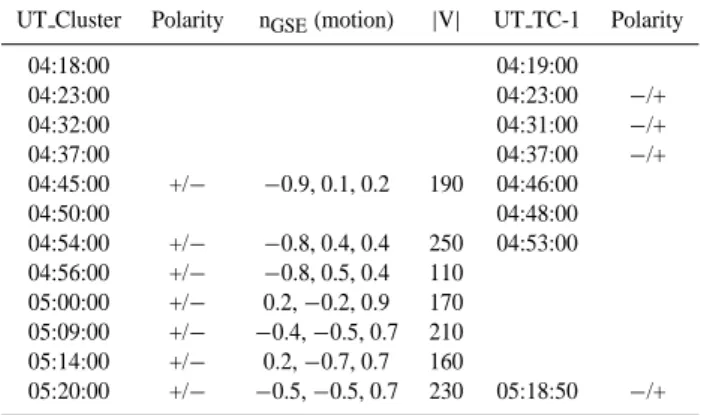
In the case of Cluster, all of the FTEs indicated in Fig. 3 have been analysed to determine their orientation and mo-tion and the results of this analysis is briefly summarised in Table 1. The four Cluster spacecraft provide timing infor-mation that easily verifies (see, for example, the techniques in Dunlop et al., 2002) that all FTEs at Cluster are moving consistently northwards and each one with different X and Y motions, depending on the time of the FTE. The FTE speeds range from ∼170 km/s to ∼250 km/s. The observed motion of the FTEs changes from eastward (+YGSM) to westward
(-YGSM) as we move through the magnetosheath interval,
and this is related to the change in IMF clock angle during this interval. All FTEs observed at Cluster show standard +/− polarity (as can be observed in Fig. 3), consistent with a draped flux tube signature moving predominantly north-ward. Conversely, the signatures at TC-1 are much less clear and are fewer in number during the same magnetosheath in-terval. Moreover, where it can be ascertained, the FTEs at TC-1 show −/+ (reverse) polarity, consistent with a location southward of a reconnection line.
These observations suggest that quasi-steady, or sporadic reconnection is ongoing somewhere between the Cluster and
2872 M. W. Dunlop et al.: Coordinated Cluster/Double Star observations of dayside reconnection signatures (a) Fig 3 (a) (b) (b) Fig 4
Fig. 4. Results from the Cooling model. The figure is projected in the YZ plane, looking earthward from the Sun. The concentric dotted
circles represent the radius of the magnetopause at 5 REintervals along the X direction, with the innermost circle representing X=5 RE.
The diamonds represent the position of the cusps for a magnetopause standoff distance of 9 RE. The triangle represents the position of
Double Star and the square the position of Cluster at the time of the FTE in question. Pairs of open reconnected flux tubes are initiated along the merging line (dot-dashed), with the motion of each tube calculated for a total of 500 s, which is represented by the extent of the line, with the solid line representing flux tubes connected to the northern cusp, and the dashed lines connected to the southern cusp. The IMF orientation is indicated by an arrow in the upper right hand of the figure and the components are stated at the bottom of the plot. The location information pertains to the mid point of the merging line. Other parameters are discussed in the text. Panel (a) shows the results for parameters representing the FTE signature seen at Cluster ∼05:20 UT and at TC-1 at ∼05:18:50 UT. Panel (b) shows the effect of modifying the IMF clock angle which moves the region of FTE evolution such that one can envisage Double Star to move out of this region under certain clock angle values.
Table 1. Catalogue of Cluster FTE motions for the FTEs marked
on Fig. 3. The normal, n, is obtained directly from timing analysis and represents the direction of the velocity, V. Polarities are marked for each spacecraft. These were not clearly resolved for four of the TC-1 FTEs.
UT Cluster Polarity nGSE(motion) |V| UT TC-1 Polarity
04:18:00 04:19:00 04:23:00 04:23:00 −/+ 04:32:00 04:31:00 −/+ 04:37:00 04:37:00 −/+ 04:45:00 +/− −0.9, 0.1, 0.2 190 04:46:00 04:50:00 04:48:00 04:54:00 +/− −0.8, 0.4, 0.4 250 04:53:00 04:56:00 +/− −0.8, 0.5, 0.4 110 05:00:00 +/− 0.2, −0.2, 0.9 170 05:09:00 +/− −0.4, −0.5, 0.7 210 05:14:00 +/− 0.2, −0.7, 0.7 160 05:20:00 +/− −0.5, −0.5, 0.7 230 05:18:50 −/+
Double Star spacecraft locations, such that Cluster is better located to observe any resultant FTEs. The motion of the flux tubes, although consistently northward at Cluster, appears to be sensitive to prevailing conditions (the changing IMF clock angle) and precise spacecraft locations. Furthermore, it is
possible that some nearly coincident signatures arise from a common reconnection onset, which would send north and south branches of reconnected flux to each of the Cluster and TC-1 locations, respectively. These features, and whether they arise from the establishment of multiple or a common X-line, can be tested to some degree using the model of flux tube motion discussed below.
3.3 Model comparison
We have employed the model of Cooling et al. (2001) to study the motion of newly reconnected field lines across the dayside magnetopause. This model initially determines, for given IMF conditions and known magnetopause position, the draping and strength of the magnetosheath field and the flow velocity and density over the entire surface of a paraboloid magnetopause, so setting up a test for a reconnection geome-try. This model was a development from that of Cowley and Owen (1989), in which a planar approximation to the topause was adopted. If, for a given location on the magne-topause, the applied condition for steady state reconnection between the magnetosheath and modelled magnetopause is satisfied, the subsequent motion of the newly reconnected field lines across the magnetopause into the magnetotail is traced. The corresponding reconnection X-line of predefined length (taken here to be 5 RE), centred at a chosen location,
M. W. Dunlop et al.: Coordinated Cluster/Double Star observations of dayside reconnection signatures 2873 is constructed in the direction of the merging current
calcu-lated at the reconnection site. We do not detail the model here, except by noting these inputs to the model (taken from the known local conditions). The output of the model is sum-marised by Fig. 4 and discussed below. In general, the selec-tion of the reconnecselec-tion point implicitly accepts component reconnection as a viable possibility but the model can use the magnetic shear and corresponding magnetopause current to suggest the most likely X-line location, which would gener-ally be the position corresponding to the anti-parallel recon-nection condition.
We have run the Cooling model initially commensurate with conditions in the solar wind just before 05:00 UT on 6 April 2004, to be optimum for an FTE signature seen at Cluster at ∼05:20 UT and at TC-1 at ∼05:18:50 UT. To this end the model was input with values of the IMF-B=(5,
−5, −5)GSE, a solar wind density of ∼6 cm−3, a solar wind
velocity of ∼520 km/s, and a fitted magnetopause position (to match the magnetopause crossing locations at TC-1 and Cluster) of ∼9 RE at the subsolar point. The results are
shown in Fig. 4a, which shows a map on the dayside hemi-sphere. The cusp positions are shown by the diamonds and the set of solid and dashed lines are tracks of the motion of each flux tube northward and southward of the reconnection line, respectively. The set of flux tube tracks deeply engulf both spacecraft and their geometry suggests that oppositely directed FTEs, from northward moving and southward mov-ing branches, may well be seen at each spacecraft location (indicated by the square, Cluster, and triangle, TC-1, sym-bols). Moreover, the tracks at Cluster, emanating from the whole length of the X-line, show a wide spread of Y direc-tions, suggesting that FTEs may be observed with speeds having different Y components, as is the case. Thus, for this run, the merging line position and flux tube evolution fits well with the direction and timing of the FTE motion observed by Double Star and Cluster. Moreover, for the par-ticular linked pair of tracks passing through the spacecraft positions, the southward branch of the model flux tube ar-rives at TC-1 about 70 s before the one at Cluster: as was the case for the particular pair of FTEs observed at ∼05:20 UT (Cluster) and ∼05:18:50 UT (TC-1). Note that in the model, the velocity is known along the track of each flux tube and each track has a particular, known length, so that the pre-dicted time to arrive at all positions along the length of the track is known and the times of the FTE pair, in particular, can be calculated.
Comparative runs were also made to explore the sensitiv-ity of the results to different clock angles and X-line loca-tion. An example of this is shown in Fig. 4b, using the min-imum clock angle that occurred during the interval 03:30 to 05:40 UT. In this case, one can see that such modification of the driving conditions could result in the convection flow of reconnected flux tubes turning more dawnward, moving TC-1 to the edge of the FTE convection region, and so reducing the number of clear FTEs observed by TC-1 as compared to those observed by Cluster during this crossing. This fits very well with the observation that TC-1 sees few clear FTEs
be-tween 04:30 and 05:30 UT. In addition it is evident that the northern pattern of tracks, which shows a spread of Y di-rections are possible for any FTE motion, is fairly stable to changing conditions, again consistent with Cluster observing FTEs all through the interval, with consistent polarity, but each with different motion in the YGSEdirection.
A modified version of the Cooling model, in which the condition for steady-state reconnection was relaxed, was de-veloped by Wild et al. (2005) to aid a comparative study of FTE signatures observed by Cluster and Geotail. This mod-ification enabled the authors to compare the expected flux tube motion with the FTE signatures without constraining the location of the reconnection site using an assumed threshold to the reconnection process. The authors were able to demon-strate that their observations were consistent with the motion of northward (southward) and tailward moving flux tubes an-chored in the northern (southern) hemisphere passing in close proximity to the Cluster (Geotail) spacecraft, and infer an approximate position of the reconnection site, which in that case was near-equatorial. In the present study, TC-1 lies fur-ther south and fur-therefore furfur-ther from the X-line studied by Wild et al. (2005), Cluster and TC-1 being nearly equidis-tant from the X-line. Nevertheless, both studies suggest that a single reconnection site, near the subsolar point, is the very likely explanation of the events.
4 Conclusions
In this paper we have presented data during a magnetopause conjunction between Cluster and the Double Star, TC-1 spacecraft, for which both spacecraft are outbound, with Cluster situated north and just dawnward of the sub-solar re-gion and TC-1 situated south and further dawnward of the sub-solar region. The data suggest a period of ongoing re-connection with a common X-line extending over limited LT (modelled at ∼5 RElength) located between Cluster and
TC-1. In particular, a series of FTE signatures are observed at both spacecraft locations with those at Cluster having +/− polarity (and a northward motion, confirmed by four space-craft timing analysis) and those at TC-1 have −/+ polarity (implying a southward motion), consistent with moving flux tubes arising from a single reconnection line. The position of TC-1, which crosses into the magnetosheath earlier than Cluster, is consistent with the FTEs observed at TC-1 hav-ing significant southward and dawnward directions of mo-tion. The Cluster-FTEs (with speeds ranging over ∼170– 250 km/s) move either duskward or dawnward until around 05:00 UT and then move predominantly dawnward. More-over, the FTE observations by TC-1 are more concentrated around a short time after its exit into the magnetosheath (be-fore Cluster crosses the magnetopause) and subsequently, TC-1 does not see as many or such clear signatures as Cluster until after 05:00 UT. Both this change in the FTE motion at Cluster and the FTE occurrence at TC-1 can be understood since, during the same period, the IMF clock angle is vari-able, ranging between −120 to −100 deg., until just after
2874 M. W. Dunlop et al.: Coordinated Cluster/Double Star observations of dayside reconnection signatures 05:00 UT, subsequently becoming more negative, at around
−140 deg.
This interpretation is quantitatively borne out by the ap-plication of the Cooling model, which places the X-line near the sub-solar point, but extending dawnward (a result of the strong negative IMF-BY). The precise location of the X-line
is selectable in the model and was chosen here to result in a good timing fit for the expected flux tube motion. We note that this selection of the reconnection point implicitly accepts component reconnection as a viable possibility, although the model may be run so as to identify an anti-parallel location. There are periods between Cluster and TC-1 where common FTE signatures are possible (i.e. the opposite branches of the Cooling model), however. One possible, common signature occurs at 05:20 UT, where TC-1 sees the signature ∼70 s be-fore Cluster. The model has been run for the particular con-ditions most relevant to that FTE and results in coincident tracks for the north and south branches of flux tubes, which arrive at each spacecraft location very close to the respec-tive times observed. Overall, the X-line fit agrees well with all the features mentioned above as observed by both Clus-ter and TC-1. Subsequent runs of the Cooling model were carried out to examine the effect of modified X-line loca-tion and clock angle, and suggest that TC-1 can often miss the convection region of the FTEs and that the dawn-dusk motion, in particular with the case of Cluster, is modified by slight change in the solar wind conditions (as occurs be-tween 04:30–05:30 UT). We note that the sampling by both spacecraft of other common flux tube signatures may de-pend upon proximity of the spacecraft to the magnetopause and this analysis does not preclude other north/south pairs of reconnected flux tubes being missed more often by TC-1, which exits into the magnetosheath earlier than Cluster.
In summary, we have shown here:
– A close magnetopause conjunction between Cluster and
TC-1, dawnward of noon, with Cluster at high latitude and TC-1 south of the sub-solar region, during a period of ongoing reconnection, with an X-line between the spacecraft.
– A series of FTE signatures are observed in both
space-craft that are consistent in polarity and motion with this geometry.
– The Cluster-FTEs move predominantly dawnward at
times later than 05:00 UT but some have duskward mo-tion at earlier times.
– TC-1 crosses into the magnetosheath earlier than
Clus-ter and fewer TC-1 FTEs are observed than ClusClus-ter FTEs.
– A possible common signature (flux tube branches
arising from the same reconnection point) occurs at
∼05:20 UT, an interpretation quantitatively born out by the application of the Cooling model.
– Comparative runs of the model confirm changes
aris-ing from: modified X-line location and modified clock-angle and confirm that TC-1 can often miss FTEs and that their dawn-dusk motion at Cluster can be modified by slight changes in clock angle.
This preliminary study is part of a wider activity to fo-cus on the opportunities arising from the simultaneous flight of the Cluster and Double Star missions. The current work represents an example of the capability of such mission syn-ergy and further work will address a wider database of such events.
Acknowledgements. This preliminary study was born from an ISSI working group on “Comparative Cluster-Double Star measure-ments of the Dayside Magnetosphere” and the authors would like to thank ISSI, Berne, Switzerland, for its sponsorship of this group. We also acknowledge C. W. Smith, N. F. Ness and the Bartol Research Institute (BRI), D. J. McComas, R. Skoug and the Los Alamos National Laboratory for use of the level 2 ACE MAG and ACE Solar Wind Experiment data, respectively. This work is also supported by the CNSF Grant 40390150 and Chinese Fundamental Research Project G200000784.
Edited by: T. Pulkkinen
Reviewed by: J. A. Wild and another referee
References
Balogh, A., Carr, C. M., Acuna, M. H., Dunlop, M. W., Beek, T. J., Brown, P., Fornacon, K.H., Georgescu, E., Glassmeier, K. -H., Harris, J., Musmann, G., Oddy, T., and Schwingenschuh, K.: The Cluster magnetic field investigation: overview of in-flight performance and initial results, Ann. Geophys., 19, 1207–1217, 2001,
SRef-ID: 1432-0576/ag/2001-19-1207.
Berchem, J. and Russell, C. T.: Flux transfer events on the magne-topause: spatial distribution and controlling factors, J. Geophys. Res., 89, 6689–6703, 1984.
Cooling, B. M. A., Owen, C. J., and Schwartz, S. J.: Role of mag-netosheath flow in determining the motion of open flux tubes, J. Geophys. Res., 106, 18 763–18 775, 2001.
Cowley, S. W. H. and Owen, C. J.: A simple illustrative model of open flux tube motion over the dayside magnetopause, Planet. Space Sci., 37, 1461–1475, 1989.
Crooker, N. U.: Dayside merging and cusp geometry, J. Geophys. Res., 84, 951, 1979.
Daly, P. W., Williams, D. J., Russell, C. T., and Keppler, E.: Particle signature of magnetic flux transfer events at the magnetopause, J. Geophys. Res., 86, 1628–1632, 1981.
Dungey, J. W.: Interplanetary magnetic field and the auroral zones, Phys. Rev. Lett., 6, 47–48, 1961.
Dunlop, M. W., Balogh, A., Glassmeier, K.-H., et al.: Four-Point Cluster Application Of Magnetic Field Analysis Tools: The Dis-continuity Analyser, J. Geophys. Res., 107, 1385, 2002. Escoubet, C. P., Fehringer, M., and Goldstein, M.: Introduction: the
Cluster mission, Ann. Geophys., 19, 1197–1200, 2001,
SRef-ID: 1432-0576/ag/2001-19-1197.
Fazakerley, A. N., Carter, P. J., Watson, G., et al.: The Double Star plasma electron and current experiment, Ann. Geophys., 23, 2733–2756, 2005.
M. W. Dunlop et al.: Coordinated Cluster/Double Star observations of dayside reconnection signatures 2875
Gosling, J. T., Thomsen, M. F., Bame, S. J., Elphic, R. C., and Russell, C. T.: Observations of reconnection of interplanetary and lobe magnetic field lines at the high-latitude magnetopause, J. Geophys. Res., 96, 14 097–14 106, 1991.
Johnstone, A. D., Burge, S., Carter, P. J., Coates, A. J., Coker, A. J., Fazakerley, A. N., Grande, M., Gowan, R. A., Gurgiolo, C., Hancock, B. K., Narheim, B., Preece, A., Sheather, P. H., Win-ningham, J. D., and Woodliffe, R. D.: PEACE: A plasma electron and current experiment, Space Sci. Rev., 79, 351, 1997. Kessel, R. L., Chen, S.-H., Green, J. L., Fung, S. F., Boardsen, S.
A., Tan, L. C., Eastman, T. E., Craven, J. D., and Frank, L. A.: Evidence of high-latitude reconnection during northward IMF: Hawkeye observations, Geophys. Res. Lett., 23, 583–586, 1996. Liu, Z.-X., Escoubet, C. P., Pu, Z., et al.: The Double Star mission,
Ann. Geophys., 23, 2707–2712, 2005.
Lockwood, M.: Flux Transfer Events at the Dayside Magnetopause: Transient Reconnection or Magnetosheath Dynamic Pressure Pulses?, J. Geophys. Res., 96, 5497–5509, 1991.
Lockwood, M., Fazakerley, A., Opgenoorth, H., et al.: Coordinated Cluster and ground-based instrument observations of transient changes in the magnetopause boundary layer during northward IMF, Ann. Geophys., 19, 1641–1654, 2001,
SRef-ID: 1432-0576/ag/2001-19-1641.
McComas, D. J., Bame, S. J., Barker, P., Feldman, W. C., Phillips, J. L., Riley, P., and Griffee, J. W.: Solar wind electron proton alpha monitor (SWEPAM) for the Advanced Composition Ex-plorer, Space Sci. Rev., 86, 561–612, 1998.
Moore, T. E., Fok, M.-C., and Chandler, M. O.: The dayside reconnection X line, J. Geophys. Res., 107(A10), doi:10.1029/2002JA009381, p.SMP 26, 2002.
Owen, C. J., Fazakerley, A. N., Carter, P. J., Coates, A. J., Krauk-lis, I. C., Szita, S., Taylor, M. G. G. T., Travnicek, P., Wat-son, G., WilWat-son, R. J., Balogh, A., and Dunlop, M. W.: Clus-ter PEACE observations of electrons during magnetospheric flux transfer events, Ann. Geophys., 19, 1509–1522, 2001,
SRef-ID: 1432-0576/ag/2001-19-1509.
R`eme, H., Aoustin, C., Bosqued, J. M., Dandouras, I., et al.: First multispacecraft ion measurements in and near the Earth’s mag-netosphere with the identical Cluster ion spectrometry (CIS) ex-periment, Ann. Geophys., 19, 1303, 2001,
SRef-ID: 1432-0576/ag/2001-19-1303.
R`eme, H., Dandouras, I., Aoustin, C., Bosqued, J. M., et al.: The HIA instrument on board Tan Ce 1 Double Star near-equatorial spacecraft and its first results, Ann. Geophys., 23, 2757–2774, 2005.
Rijnbeek, R. P., Cowley, S. W. H., Southwood, D. J., and Russell, C. T.: Observations of reverse polarity flux transfer events at the Earth’s dayside magnetopause, Nature, 300, 23–26, 1982. Rijnbeek, R. P., Cowley, S. W. H., Southwood, D. J., and Russell,
C. T.: A survey of dayside flux transfer events observed by ISEE 1 and 2 magnetometers, J. Geophys. Res., 89, 786–800, 1984. Russell, C. T. and Elphic, R. C.: Initial ISEE magnetometer results:
magnetopause observations, Space Sci. Rev., 22, 681–715, 1978. Russell, C. T. and Elphic, R. C.: ISEE observations of flux transfer events at the dayside magnetopause, Geophys. Res. Lett., 6, 33– 36, 1979.
Sibeck, D. G., Baumjohann, W., Elphic, R. C., Fairfield, D. H., Fennell, J. F., Gail, W. B., Lanzerotti, L. J., Lopez, R. E., Luehr, H., Lui, A. T. Y., Maclennan, C. G., McEntire, R. W., Potemra, T. A., Rosenburg, T. J., and Takahashi, K.: The Magnetospheric Response to 8-Minute Period Strong-Amplitude Upstream Pres-sure Variations, J. Geophys. Res., 94, 2505–2519, 1989. Smith, M. F. and Lockwood, M.: Earth’s magnetospheric cusps,
Rev. Geophys., 34, 233–260, 1996.
Smith, C. W., L’Heureux, J., Ness, N. F., Acu˜na, M. H., Burlaga, L. F., and Scheifele, J.: The ACE Magnetic Fields Experiment, Space Sci. Rev., 86, 613–632, 1998.
Sonnerup, B. U. O. and Cahill, L. J.: Magnetopause structure and attitude from Explorer 12 Observations, J. Geophys. Res., 72, 171–183, 1967.
Stone, E. C., Frandsen, A. M., Mewaldt, R. A., Christian, E. R., Margolies, D., Ormes, J. F., and Snow, F.: The Advanced Com-position Explorer, Space Sci. Rev., 86, 1–22, 1998.
Thomsen, M. F., Stansberry, J. A., Bame, S. J., Fuselier, S. A., and Gosling, J. T.: Ion and electron velocity distributions within flux transfer events, J. Geophys. Res., 92, 12 127–12 136, 1987. Wild, J. A., Milan, S. E., Cowley, S. W. H., Bosqued, J. M., Reme,
H., Nagai, T., Kokubun, S., Saito, Y., Mukai, T., Davies, J. A., Cooling, B. M. A., Balogh, A., and Daly, P. W.: Simultaneous in-situ observations of the signatures of dayside reconnection at the high and low latitude magnetopause, Ann. Geophys., 23, 445– 460, 2005,