ABSTRACT: Nowadays, the steel industry is able to produce structural members made of high strength steel grades up to S690/S700. However, the use of such members in constructions is still rather limited mainly because it is relatively difficulty for a designer to easily identify the projects where there is an economical interest of using high strength steel for such members. In the framework of a RFCS European project entitled “ATTEL – Performance-based approaches for high strength tubular columns and connections under earthquake and fire loadings”, a study has been performed at the University of Liège to identify the structural typologies, with account of their specific loading conditions, where the use of tubular column made of high strength steel is economically interesting.
Key words: Economic interest; High strength steel; Building frame; Circular tube; Optimum design. 1. INTRODUCTION
In many structures, the use of high strength steel (HSS), i.e. with an elastic strength higher than 460MPa, offers an economical benefit in comparison with normal steel (NS)[2, 7, 8, 10]. The reason relies mainly on the fact that the cost increases slower than the strength. Moreover, structures using HSS are usually lighter than the ones made of NS leading to a reduction of the costs related to the transportation, fabrication and painting. However, as the stiffness of HSS structures is smaller than the one of NS structures, the second-order effects and, consequently, the serviceability requirements considerably limit the advantages of the use of HSS. The interrelation between the advantages and the drawbacks of HSS leads to the complicate question of knowing whether there is an economic interest of using HSS instead of NS for structural members. This question has not yet been adequately considered in the literature.
The present work aims at investigating building frames with steel and/or composite columns (made of circular steel tubes) with the objective of defining the domains where the use of HSS is economically interesting. Two topics will be addressed: (1) to provide a general view of the economic benefit of the use of HSS; (2) to establish the basis for choosing the material (HSS or NS) for framed structures at the pre-design stage.
2. ADOPTED STRATEGY
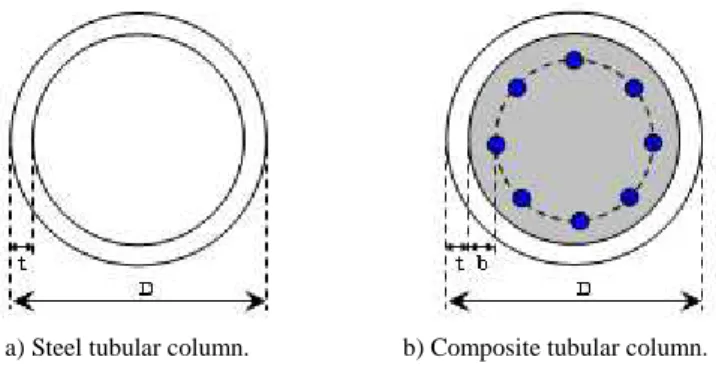
The present investigation focuses on the economical interest of using HSS for steel or composite hollow section columns such as depicted in Fig. 1. The use of HSS for beams has not been considered herein seen that, in most cases, the design of these members is governed by Serviceability Limit States (SLS). In this research, steel with yield strengths varying from 500 N/mm2 to 700 N/mm2 are
∗ corresponding author: [email protected]
Use of high strength steel tubular columns in structures:
Economic study
V.L. Hoang, J.F. Demonceau ∗ & B. Rossi
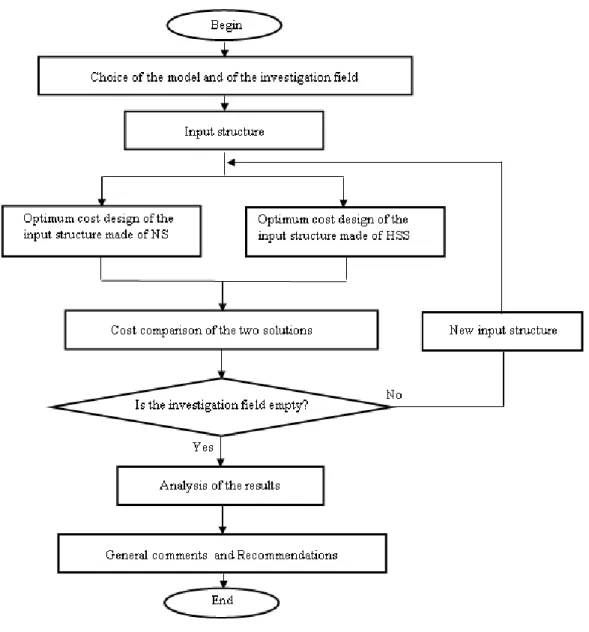
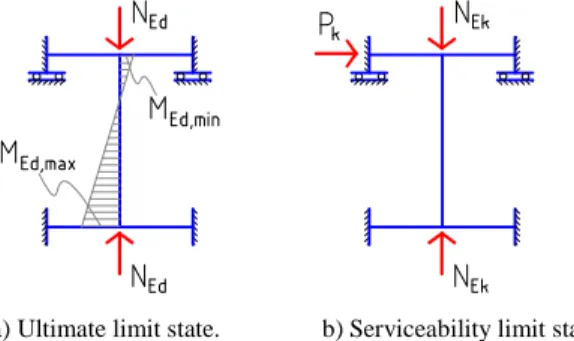
considered as HSS while NS relates to S355 steel. For sake of simplicity, only isolated columns extracted from sway or non-sway frames, as depicted in Fig. 2, have been investigated, although the study of the columns through global frame modelling is more accurate (in particular for sway frames). For the conducted studies, the adopted strategy is described in Fig.3. For each considered configuration, an optimal cost design is performed using HSS and NS (Section 3). The strength, stability and stiffness requirements according to Part 1-1 of Eurocode 3 [4] and Part 1-1 of Eurocode 4 [6] are taken into account in the optimum cost design of steel and composite columns respectively. Concerning the analysis of structures made of HSS, the rules of Part 1-12 of Eurocode 3 [5] are used. The obtained solutions are then compared (Section 4). The geometry, the applied loads and the material properties are the variables of the problem and are changed with the purpose of covering a wide range of practical applications. The material costs are also considered as variables. In Section 5, the field of investigation (or the range of variations of each variable) is provided in more details. Finally, according to the obtained results, general comments are derived in Section 6.
a) Steel tubular column. b) Composite tubular column. Figure 1. Cross sections of the considered columns.
a) Column in non-sway frames. b) Column in sway frames. Figure 2.Considered models for columns.
Figure 3. Adopted strategy.
3. OPTIMAL COST DESIGN
The optimal cost design provides the cheapest solution amongst the admissible ones respecting the necessary safety conditions as recommended in the Eurocodes.
As described within this section, the optimal cost design is decomposed of three main steps: (1) Use of the design recommendations given in the Eurocodes to determine the safety conditions for columns (Section 3.1);
(2) Definition of a cost function being the object function to be minimized (Section 3.2); (3) Translation of the problem into suitable mathematical expressions and selection of an appropriate algorithm to solve the problem (Section 3.3).
3.1. Column analysis and design
The different steps of the analysis and design of the columns are briefly described here below. Load cases:
The ultimate limit states (ULS) and the serviceability limit states (SLS) have to be checked for each column. For the ULS, the design values of the loads (i.e. including safety coefficients) are considered in the computations while the characteristic values of the loads (i.e. without safety coefficients) are adopted for the SLS (Fig.4).
a) Ultimate limit state. b) Serviceability limit state. Figure 4. Adopted load values for the ultimate and serviceability limit states.
Effective length:
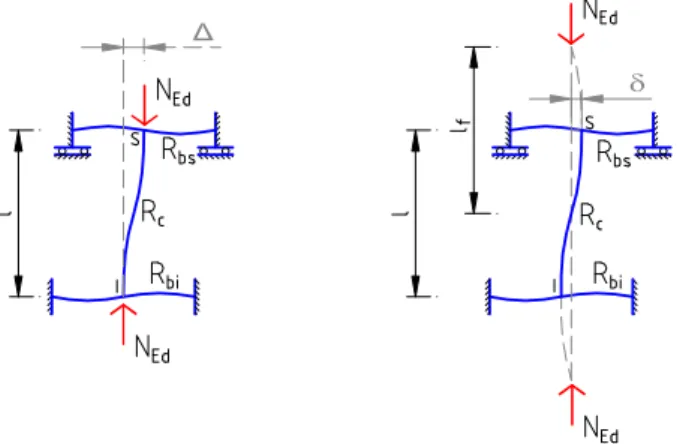
Wood’s approach [12] for the computation of the effective lengths is adopted in the present work. Accordingly, the effective length depends on the stiffness coefficients of the members connected at the extremities of the considered column,
c s s c s bs R R k R R R + = + + , (1) c i i c i bi R R k R R R + = + + , (2)
where Rc is the stiffness of the considered column; Rs and Ri are the stiffness’s of the upper and lower columns respectively; Rbs and Rbiare respectively the sum of the stiffness of all beams connected at the top (node “s”) and at the bottom (node “i”) of the considered column (Fig.5).
Knowing kiandks, the effective length of the column can be estimated using charts that were established by Wood [12]. To allow a systematic computation of the effective lengths, the following formulae approximating Wood’s charts are preferred (see [3]):
1 0,145( ) 0, 265 2 0,364( ) 0, 247 s i i s f s i i s k k k k l l k k k k + + − = − + −
for non-sway columns, (3)
1 / 2 1 0,37( ) 0,01 1 0,9( ) 0,8 s i i s f s i i s k k k k l l k k k k − + + = − + +
for sway columns, (4)
Figure 5. Parameters for the computation of the effective length.
It is worth noting that the P-∆ effects are taken into account if the effective length is calculated using Eq. (4); therefore, the bending moment MEd,max (Fig.4a) to be considered for checking the column resistance should be computed using the first order theory, even if one considers sway frames.
Horizontal displacement:
The horizontal displacement at the top of the considered column (when included in a sway frame) may be predicted using Eq.(5) [9], with account of the second-order effects:
3 3( ) 1 1 12 4 3 3 2 1 / k i s i s c i s i s Ek cr P l k k k k EI k k k k N N + − ∆ = + − − + − , (5)
where EIc is the bending stiffness of the considered steel/composite column; Pk is the characteristic value of the applied horizontal load; NEk is the characteristic value of the applied vertical load (Fig.4b);
cr
N is the Euler elastic buckling load of the column. In this work, the horizontal displacement is limited to 1/250 of the column height.
Classification of cross-sections and member buckling verification:
In the present study, only cross-section of class 1, 2 or 3 are considered. As previously mentioned, the design recommendations from Eurocodes 3 and 4 [4, 5, 6] are followed to verify the stability of the considered column.
Additional assumptions:
For the design of the columns, the following additional assumptions are made:
- It is assumed that the beams connected at the extremities of the designed NS and HSS columns are the same and that similar beams are connected to the bottom and top ends of the NS or HSS columns, i.e.Rbs=Rbi=Rb;
- The stiffness of the upper and lower columns at the extremities of the NS or HSS considered columns are assumed to be the same as the designed one, i.e.Rs=Ri=Rc.
Using these two last assumptions, Equations (1) and (2) become
2 2 c s i c b R k k k R R = = = + . (6)
According to the first assumption, Rb is the same for the NS and the HSS columns. However, the value
of k differs due to a different Rc value for the NS and the HSS columns.
3.2. Cost function and variables
The following parameters may be considered as variables for the optimisation: - For the steel columns: diameter D and thickness t (Fig. 1a);
- For the composite columns: diameter D, thickness t, distance b between the rebars and the internal face of the tube (Fig. 1b), area of rebars, class of the concrete and grade of the rebars. The class of the concrete and the grade of the rebars are discontinuous quantities. Thus, these values will not be directly included in the optimisation process and will be fixed at the beginning of the design although still varying quantities. Concerning the distance b, the capacity of the section under static loading is increasing as b decreases (the constructive condition has to be respected). Accordingly, the closer to the tube the rebars are (i.e. the smaller the value of b), the higher the capacity of the section (all other parameters being kept constant). As a consequence, the parameter b is not included in the optimisation process and is fixed at the beginning of the optimisation.
Moreover, in order to be able to compare the two solutions, the cost of several quantities (e.g. steel, rebar and concrete) must be defined taking into account its variability with respect to the time and the region. Since the objective is to draw general conclusions useful for any time and place, a large field of the mentioned costs should be investigated, obviously leading to a greater complexity of the problem. To avoid this, the following problem for composite columns is considered: two solutions of columns are compared with the same length, class of concrete and density (%) of rebar, under the same load, but using two different values of steel strength for the tubes. The variations of length, loads, concrete class, and rebar density will be considered as the parameters (input variables) of the optimum research problem. Therefore, the following cost function is adopted:
( a a cs cs)
C=l A c +A c , (7)
where Aa is the area of the steel tube;Acs is the area of concrete and rebar; ca,ccs are, respectively, the cost per volume of steel and of reinforced concrete (euros/m3). So, when calculating the cost, the concrete and rebars are considered as one single material (reinforced concrete). The parameter ccs
obviously depends on the class of concrete and the density of rebars.
Finally, two variables have to be considered: the diameter D and the thickness t. In reality, market catalogues for steel tubes provide discontinuous quantities for the couple D and t. But, in the present research, in order to generalize the results and simplify the mathematical problem, they are considered as continuous quantities.
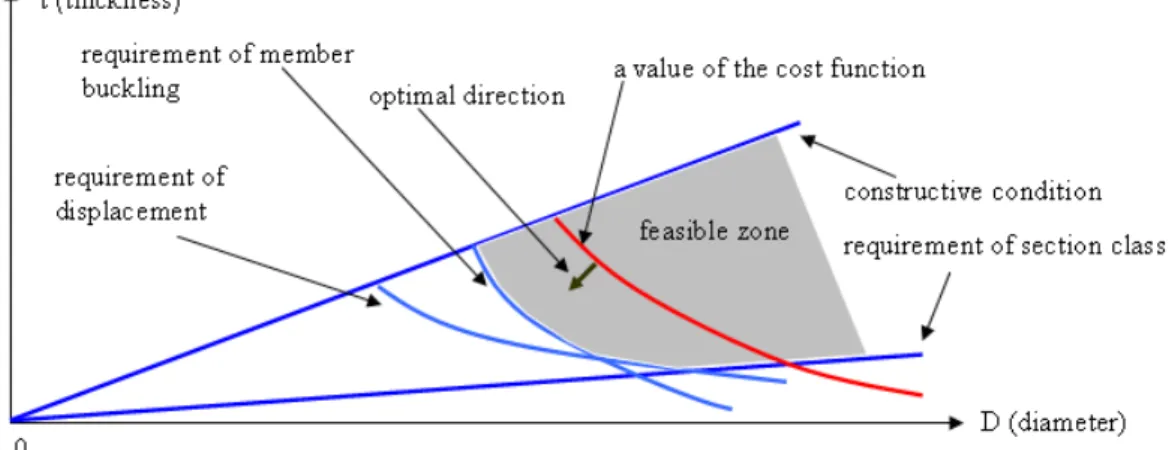
3.3. Graphic interpretation of the optimisation procedure
The optimum procedure can be qualitatively interpreted using Fig.6.
Figure 6. Graphic representation of the optimal cost research problem.
The method of feasible direction is chosen to solve the problem. The explanation of this method is abundantly reviewed in the literature (e.g. [8]).
4. COST COMPARISON
Currently, the steel grade S355 is the most popular in construction, it is thus chosen as the reference material (i.e. as “NS”). Eq.(7), with the sub-scripts “355” and “HSS” to distinguish the reference steel and HSS, can be rephrased as:
C355=l A( a,355ca,355+A ccs cs), (8) CHSS=l A( a HSS, ca HSS, +A ccs cs). (9) From Eqs. (8) and (9), one has:
, 355 , 355 355 ,355 ,355 355 ( / / ) / ( / ) a HSS HSS cs HSS cs HSS a cs cs A c c A c c C C A A c c + = + ,
it is clear that ifCHSS/C355<1, then HSS is of economic interest; on the contrary, if CHSS/C355>1 then NS is of economic interest; the neutral case occurs ifCHSS/CNS≈1.
5. FIELD OF INVESTIGATION
The following ranges of variation for the parameters form the field of investigation: - The columns length l varies from 3 to 8 m;
- The compression force NEd varies from 500 to 6000 kN;
- The maximum bending moment MEd,max to compression force NEd ratio varies from 0 to 0.75
m, which reflects what is commonly met in real frames;
- According to [5], S500, S550, S620 and S690 steels have to be considered as HSS (with fy =
500, 550, 620 and 690MPa respectively). In the present work, various steel grades within 500 and 700 MPa are considered.
- The characteristic value of the compressive concrete cylinder strength fck varies between 25
and 40 N/mm² and the density of rebar varies from 0% to 6%;
- The cost of HSS to cost of S355 ratio cHSS/c355 lays between 1,1 to 1,6. According to [2], these
values are: c500/c355 = 1,138; c550/c355 = 1,260; c620/c355 = 1,340 and c690/c355 = 1,382.
- The cost of reinforced concrete to the cost of S355 ratio ccs/c355 ranges from 0,02 to 0,05. At
the moment, this value in Belgium is around 0,03.
6. RESULT ANALYSIS, GENERAL COMMENTS AND APPLICATIONS Results analysis
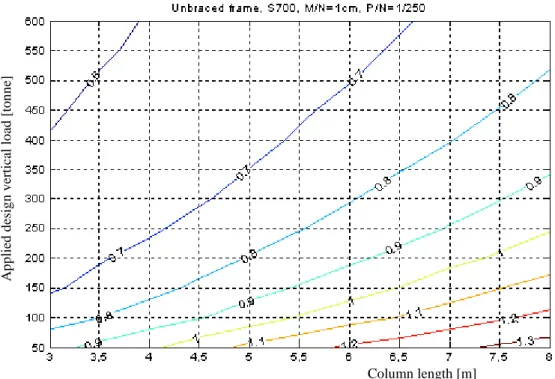
Hundreds of computations have been performed in order to cover the field of investigation as described in the previous section. The obtained results are reported in the form of charts as the one provided in Fig.7 where the HSS column volumes to the NS column volumes ratio considering the same loads are depicted. The horizontal axis represents the column length (in meter) and the vertical axis provides the design compression load NEd (in tonne). This particular graph corresponds to the following
specific situation: the column is in an un-braced frame, the considered HSS grade is S700, k = 0 (see equation 6), MEd /NEd = 1cm and Pk /NEd = 1/250 (see Fig. 4). Using this figure, a second graph can be
derived. It defines the domains where the use of HSS has an economical interest (see Fig. 8). The neutral line in Fig. 8 indicates when the HSS option has the same cost that the NS option. In the zone above this line, the use of HSS is economical while, below this line, the conclusion is reversed. The position of the neutral line depends on the steel grade, the type of frame, the eccentricity, the horizontal load magnitude, the rigidity of the beam system and so on. In each zone, the economic benefit is proportional to the distance from the neutral line. The selected graphs may be found in [1].
Figure 7. Example of graphs obtained after the optimum design of a steel column (ratio of steel volumes).
Figure 8. Qualitative graph providing the domain of economic interest of HSS that can be derived from each case study.
General comments
From the so-derived graphs, the following comments may be drawn:
- In many cases, for steel columns, the use of HSS leads to considerable economic profit. As expected, the use of HSS in case of stocky columns provides the greatest advantage while NS is more
Column length [m] Ap p li ed d es ig n v er ti ca l lo ad [ to n n e] Column length Ap p li ed d es ig n v er ti ca l lo ad
economic in case of slender columns. Moreover, the interest of using HSS decreases when the eccentricity increases.
- In braced/non-sway frames made of steel columns, the domain of interest of HSS is the greatest. In the case of unbraced/sway frames, the benefit in using HSS is quite low due to the limitation in terms of horizontal displacements leading to a minimum inertia to be ensured by the column. From the conducted investigations, it can be concluded that the use of HSS for columns in sway frames has no economical interest, except in very few specific situations.
- For the composite columns, even if different relative costs ccs/c355 and cHSS/c355have been considered, very few cases where the use of HSS is economical have been identified.
The above remarks are summarized in Table 1.
Table1. Summary of the conclusions of the analysis.
Application
In more details, using the charts established during the present study, the user could better choose the material (HSS or NS) for the structure just as it is suggested in the following steps:
- Step 1: determination of the unit costs for both HSS and NS columns (euros/t). These costs shall include the material, transport as well as fabrication costs.
- Step 2: determination of the internal loads for the considered columns. The two following procedures are suggested to estimate these loads:
o The first method consists in the following procedure:
Firstly, prior to any computation, a first reasonable member sizes estimate is chosen on the basis of the engineer’s expertise;
Secondly, a global analysis of the frame is performed to predict the value of the axial load NEd;
If the considered structure is un-braced/sway, a second analysis is performed to estimate Pk (Fig. 4).
o The second method considers each storey as separate systems and, for each storey: Firstly, the vertical load and horizontal load applied to the considered storey are calculated;
Then, the above mentioned loads acting are divided by the number of columns included within the storey;
- Step 3: with the cost provided in Step 1 and the column loads determined in Step 2, the charts established within this study enable the user to assess whether HSS is of economic interest.
7. CONCLUSIONS
A research about the economic interest of the use of HSS circular tubes in steel and composite columns under static loading is described in this paper. The general idea is to compare the costs of columns made of HSS and NS. In order to find comparable designs in each category, the optimal cost design, taking into account the safety requirements of the current Eurocodes, is adopted. By using an automatic computation procedure, a large field of investigation covering almost all realistic possibilities is examined.
With steel columns, the following conclusions can be drawn: (1) in many case, the use of HSS leads to considerable economic profit in comparison with S355 steel, especially in case of stocky columns for which the greatest advantage is observed; (2) the interest of using HSS decreases when the eccentricity of the axial load increases; (3) the domain of interest of the use of HSS in braced/non-sway frames is thought to be relatively large; (4) the economic benefit of the use of HSS in un-braced/sway frames is smaller than the one in the case of braced frames. Using the charts developed within the present work, the user is able to determine the ratio between the required area of HSS to the required area of NS for his column. And, therefore, looking at the current costs of steels, he can establish whether the HSS column costs less.
With composite columns, there are very few case studies for which the use HSS tubes provide a profit.
ACKNOWLEDGEMENTS
This work was carried out with a financial grant from the Research Fund for Coal and Steel of the European Community, within ATTEL project: “Performance-Based Approaches for High Strength Steel Tubular Columns and Connections under Earthquake and Fire Loadings”, Grant N0 RFSR-CT-2008-00037.
REFERENCES
[1] ATTEL project: Performance-based approaches for high strength tubular columns and connections under earthquake and fire loadings. RFCS European project, Deliverable 2 – Design of the specimens, 2010.
[2] Corbett KT., Bowen RR. and Petersen CW.: High strength steel Pipeline Economics. Proceeding of The Thirteenth International Offshore and Polar Engineering Conference, Honolulu, Hawaii, USA, May 2003.
[3] de Saxce G., Nguyen DH.: Pour une formulation unifiée du problème d’analyse et le problème d’instabilité par flambage des barres. Internal report, University of Liege, 1984.
[4] Eurocode 3: Design of steel structures - Part 1-1: General rules and rules for buildings. CEN-2005. [5] Eurocode 3: Design of steel structures - Part 1-12: Additional rules for the extension of EN 1993 up
to steel grades S700. CEN-2007.
[6] Eurocode 4: Design of composite steel and concrete structures, Part 1-1: General rules and rules for buildings. CEN-2005.
[7] Galambos TV., Hajjar JF., Earls CJ.: Required Properties of High-Performance Steels. NISTIR 6004, National Institute of Standard and Technology, USA 1997.
[8] Johansson B., Collin P.: Eurocode for high strength steel and application in construction. Lulea University of technology - Sweden, 2006.
[9] Massonnet Ch., Save M.: Calcul plastique des constructions, Volume 1. Edition NELISSEN, Belgium, 1976.
[10] Veljkovic M., Johansson B.: Design of hybrid steel girders. Journal of Constructional Steel Research, 60(2004): 535-547.
[11] Venderplaats GN. Numerical optimisation techniques for engineering design: with applications. McGraw-Hill, 1984.
[12] Wood RH. Effective lengths of columns in multi-storey buildings. The Structural Engineer, 52,(1974), 7.