© ACM, (2007). This is the author's version of the work. It is posted here by permission of ACM for
your personal use. Not for redistribution. The definitive version was published in the Proceedings of
the Second Workshop on Use of P2P, GRID and Agents for the Development of Content Networks.
Scheduling Data-Intensive Bags of Tasks in P2P Grids
with BitTorrent-enabled Data Distribution
Cyril Briquet
[email protected]
[email protected]
Xavier Dalem
S´ebastien Jodogne
[email protected]
Pierre-Arnoul de Marneffe
[email protected]
Department of Electrical Engineering and Computer ScienceUniversity of Li`ege
Montefiore Institute, B37, B-4000 Li`ege, Belgium
ABSTRACT
Scheduling Data-Intensive Bags of Tasks in P2P Grids leads to transfers of large input data files, which cause delays in completion times. We propose to combine several existing technologies and patterns to perform efficient data-aware scheduling: (1) use of the BitTorrent P2P file sharing proto-col to transfer data, (2) data caching on computational Re-sources, (3) use of a data-aware Resource selection schedul-ing algorithm similar to Storage Affinity, (4) a new Task selection scheduling algorithm (Temporal Tasks Grouping), based on the temporally grouped scheduling of Tasks shar-ing input data files. Data replication is also discussed.
The proposed approach does not need an overlay network or Predictive Communications Ordering, making our opera-tional implementation of a P2P Grid middleware easily de-ployable in unstructured P2P networks. Experiments show that performance gains are achieved by combining BitTor-rent, caching, Storage Affinity and Temporal Tasks Group-ing. This work can be summarized as combining P2P Grid computing and P2P data transfer technologies.
Categories and Subject Descriptors
H.3.4 [Information Storage and Retrieval]: Systems and Software—Distributed systems ; H.3.5 [Information Storage and Retrieval]: Online Information Services— Data sharing
General Terms
Algorithms, Performance
Keywords
Grid, peer-to-peer, P2P, BitTorrent, data sharing, caching, replication, bag of tasks, scheduling
Permission to make digital or hard copies of all or part of this work for personal or classroom use is granted without fee provided that copies are not made or distributed for profit or commercial advantage and that copies bear this notice and the full citation on the first page. To copy otherwise, to republish, to post on servers or to redistribute to lists, requires prior specific permission and/or a fee.
UPGRADE-CN’07, June 26, 2007, Monterey, California, USA. Copyright 2007 ACM 978-1-59593-718-6/07/0006 ...$5.00.
1. INTRODUCTION
A Peer-to-Peer (P2P) Grid [1, 2, 3, 4] is a Grid [5] in which entities are under distinct, or even unrelated control [6], and resources such as computing time are exchanged between the Peers. The lack of trust between Peers implies that no Peer has access to the internal management data of other Peers. Therefore, Peers have to model the behavior of other Peers through repeated interactions in order to reach reciprocity of resource exchanges.
Applications that can be structured as a set of indepen-dent computational Tasks are called Bags of Tasks [1, 2] (BoT). Scheduling a BoT whose Tasks share large input data (Data-Intensive BoT) is not trivial in a P2P Grid. Data transfers should be taken into account to avoid that multiple simultaneous data transfers become a bottleneck.
Several recent works [1, 7, 8, 9, 10, 11, 12] integrate data management with Task scheduling using patterns such as data replication and caching. It has also been proposed to use the BitTorrent P2P file sharing protocol [13, 14] to trans-fer input data of Tasks in Desktop Grids [15, 16, 17]. How-ever, either the proposals aren’t well adapted to P2P Grids, or they don’t fully prevent potential bottlenecks resulting from the simultaneous multiple transfers of large data.
This paper brings together P2P Grid computing and P2P data transfer technologies. In the context of P2P Grids, we propose a novel combination of data-aware Task scheduling patterns, data caching, replication. and relying on BitTor-rent for data transfers.
The rest of the paper is structured as follows: Section 2 de-scribes the P2P Grid model, Section 3 reviews related work and motivates this work, Section 4 presents our proposal of data-aware Task scheduling in P2P Grids, Section 5 dis-cusses the possibility of asynchronous, proactive data repli-cation, Section 6 evaluates the performance of the proposed Task scheduling mechanism, and finally Section 7 concludes.
2. GRID MODEL
The Lightweight Bartering Grid Architecture [3] (LBG architecture) specifies a lightweight P2P Grid architecture where computing time is exchanged (with so-called bartering methods) between Peers.
Independent entities under separate administrative con-trol are represented by software agents, called Peers. The role of Peers is to process Bags of Tasks submitted by their
users. A Bag of Tasks [1, 2] (BoT) is a set of indepen-dent computational Tasks. So-called Bags of Tasks con-stitute an important class of applications, covering domains such as computer vision, data mining, geographical informa-tion systems (GIS), image processing, discrete optimizainforma-tion, massive search (i.e. pattern matching, protein docking, . . .), parameter sweeps.
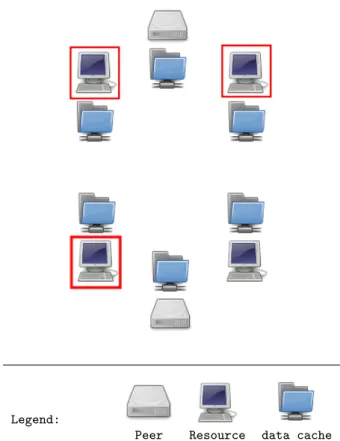
Peers use their own computational Resources or Resources belonging to other Peers. In the latter case, a Peer using the Resources of another Peer is a consumer and a Peer running Tasks of another Peer is a supplier. Resources of a given Peer may be supplied (see figure 1) to execute work units of other Peers at the Task level.
In the LBG architecture, a Grid is a transient Peer-to-Peer network that emerges in a bottom-up fashion and where Peers exchange Resource usage time. Resource exchange is a way to potentially speed up BoT completion time. Indeed, synchronized consumption by a given Peer of Resources be-longing to multiple Peers may dramatically reduce BoT com-pletion times.
A Peer can be seen as a system that receives and pro-cesses computing requests (BoTs) submitted by its users or by other Peers. The main components of a Peer are a set of thread-safe, loosely coupled managers. Each Peer man-ages incoming BoTs, queued and scheduled Tasks, as well as the data associated with these Tasks. It also manages information about the state of its Resources, and the state of the Resources supplied by other Peers. It negotiates Re-source exchange with other Peers, schedules and manages the execution of Tasks.
3. MOTIVATION AND RELATED WORK
3.1 Data-Intensive Bag of Tasks Scheduling
Data-Intensive Bags of Tasks [9, 10, 11] constitute a sub-class of the Bags of Tasks applications, where the amount of processed data is large, leading to data transfer times that are long compared to computing times. These applications have also been called PHD (Processors of Huge Data [9]). With increasing capacities of data acquisition, most of the applications domains mentioned in the previous Section can be structured as Data-Intensive BoTs.
At the same time, with the development of Grid comput-ing technologies, large-scale sharcomput-ing of resources is increas-ingly being performed on a wider range of infrastructures, some of which are not managed at all and whose components are therefore very unreliable, i.e. home computers, unman-aged desktop computers. The goal of these technologies is to provide reliability and nontrivial [18] Quality of Service (QoS) to their users in an unreliable environment. Exam-ples include Desktop Grids [19] and Peer-to-Peer Grids [1, 3], the former being more focused on cycle stealing within an organization, and the latter being more oriented towards collaboration between entities from separate, even unrelated control domains.
In P2P Grids, runtimes and data transfer times may be variable, and conflicts in resource usage may be the norm rather than the exception. Scheduling BoTs in such un-controlled environments is therefore a challenge, requiring the use of techniques taking the lack of trust and reliability into account. Well-known strategies to efficiently schedule Data-Intensive BoTs include (1) data caching and (2) data replication, and to (3) take account of data placement
when scheduling.
A recent example of synchronous data replication in a Desktop Grid, in the context of life sciences applications [11], proposes an integer programming scheduling algorithm. It is limited to a steady state context. It is therefore not applica-ble in the context of this paper, because of the unreliability and constant change of Peer-to-Peer environments.
It has been shown [10] that data replication can be per-formed asynchronously from Task scheduling, with simple and cost-efficient algorithms, as long as the Task scheduler is aware of data placement.
Note also that Data-Intensive BoTs implicitly require data replication, in the sense that shared input data files have to be simultaneously transferred multiple times when Tasks are scheduled to different Resources at the same time. In this paper, we introduce the Task scheduling pattern that consists in simultaneously scheduling a maximum of Tasks needing the same input data. We call this pattern Temporal Tasks Grouping.
However, the costs incurred by data replication can be very high, in terms of transfer times and of infrastructure overload. The overload of Peers might lead to bottlenecks due to the thrashing caused by the handling of management threads or by the saturation of network bandwidth. An-other scheduling strategy is to avoid data replication, and use data caching instead. A proposed Task scheduling al-gorithm [12] taking advantage of data caching groups Tasks sharing the same input data on the same computational re-sources. We call this pattern Spatial Tasks Grouping. Task execution parallelism is of course reduced with Spatial Task Grouping.
The Storage Affinity [9] Task scheduling algorithm in the OurGrid [1] P2P Grid middleware takes data placement into account. It schedules Tasks first to computational resources where most of the required input data is already available, before considering other resources where data repli-cation is required. Given the fact that it is operating in a P2P environment, Storage Affinity has to deal with the un-availability of accurate data about computing times. Task replication is proposed as a heuristic to find good Task-to-computational resource assignments. This has the side effect that any BoT de facto becomes Data-Intensive, in the sense that its input data has to be transferred multiple times, in-creasing the amount of network traffic. Storage Affinity is definitely well adapted to P2P Grids, but suffers from the high cost of multiple simultaneous data transfers that would be required by Temporal Tasks Grouping.
The previous paragraphs can be summarized as follows. (1) Temporal Tasks Grouping allows greater parallelism in Tasks scheduling, leading to lower overall BoT runtimes. However, simultaneously transferring the input data of sev-eral Tasks scheduled at the same time rapidly leads to bot-tlenecks. (2) Spatial Tasks Grouping entirely avoids the problem of multiple simultaneous data transfers. Of course, Tasks sharing the same input data. are not necessarily si-multaneously scheduled. It is then more difficult to offer nontrivial QoS [18], and BoT runtimes are higher. (3) Ac-tivating Temporal Tasks Grouping and Storage Affinity to-gether may enable to maintain good performance in all set-ups, as they are complementary. However, this requires to find a way to prevent network bottlenecks when temporally grouping Tasks.
3.2 Simultaneous Transfers of the Same Data
A possible efficient way for a Peer to transfer the same data multiple times is to use a set of data caches scattered over the P2P Grid. This leverages the bandwidth of several Peers and partially redistributes the transfer load across the P2P Grid. Recent work includes the Super-Peer model [7] and the File Mover overlay network [8]. They however both require the explicit deployment of Peer-independent data caches as well as of a routing substrate, or overlay.
Another efficient way for a Peer to transfer the same data multiple times is to use the BitTorrent [13, 14] P2P file shar-ing protocol. BitTorrent does not need an overlay to be con-structed on top of Peers and, as such, is easy to deploy. A recent study [20] shows that BitTorrent performs nearly as well as overlay-based techniques in over-provisioned network cores, but also indicates that BitTorrent sustains “equivalent undegraded performance” when the available bandwidth de-creases. In other words, BitTorrent has good performance in managed and over-provisioned networks and, as opposed to overlay-based techniques, maintains good performance in bandwidth-constrained networks that are more typical to P2P Grids environments.
An efficient way to greatly reduce the cost of transmit-ting multiple times the same data to different resources in a Desktop Grid has been recently and independently proposed in two studies [15, 16]. The idea is to use BitTorrent [13, 14] to distribute Tasks data throughout the Grid.
Let us briefly discuss how BitTorrent works. A Peer, called a seeder, that wants to share a file with BitTorrent first starts by splitting it into pieces. It then launches a tracker, or may use a publicly available tracker, to which it invites Peers to connect to get introduced to one another. Each Peer initially downloads a first piece from any of the Peer communicated by the tracker, and then begins to ex-change pieces with these other Peers. A Peer invites other Peers to collaborate by uploading pieces to them. With Bit-Torrent, as opposed to what happens with direct file trans-fers protocols, network links between Peers are exploited (see figure 2): As each downloader is also an uploader, the network load is removed from the seeder and distributed to all Peers. As opposed to other P2P file sharing protocols, Peers using BitTorrent do not have to wait for a file trans-fer to be completed to begin uploading pieces of it to other Peers. Indeed, BitTorrent enables Peers to simultaneously act as downloaders and uploaders as soon as they begin to download a file, while allowing them to continue to act as uploaders when the file transfer has been completed.
In the context of this paper, an advantage of BitTorrent over regular File Transfer Protocol (FTP) is that the total transfer time of a file by multiple downloaders is not linearly dependent on, and increases remarkably slowly with, their number. Coupling Grid scheduling and BitTorrent data transfer therefore offers a very interesting perspective: As more Tasks sharing input data are scheduled at the same time, the overall cost of the multiple simultaneous data transfers remains close to the cost of transferring it only once. This enables to use Temporal Tasks Grouping, with-out excluding the use of Spatial Tasks Grouping.
In the first mentioned study about Grid scheduling relying on BitTorrent [15], a model of BitTorrent transfer times is proposed (building upon previous work [17]), as well as sev-eral BitTorrent-aware versions of classic, knowledge-based scheduling heuristics (BT-MinMin, BT-MaxMin,
BT-Suffer-age). This very interesting work is, to the best of our knowl-edge, the first proposal of coupling Grid scheduling and Bit-Torrent data transfer. The BT-X knowledge-based schedul-ing heuristics [15] are designed to operate in a cluster or Desktop Grid environment. They require “knowledge about communication performance and CPU load performance”. However, this data is not generally easy to obtain, and specifically not to be trusted in a P2P environment. Fur-thermore, the proposed heuristics use a modified version of BitTorrent, whose loose reciprocity-based policy (i.e. the choking algorithm, whose operation may be described as enforcing loose reciprocity) has been replaced by Predic-tive Communications Ordering (PCO). This is only possi-ble when Peers downloading input data can be controlled, which is not the case in P2P Grids. For these two reasons (requirement of hard-to-obtain knowledge and PCO), the BT-X heuristics cannot be applied to the context of this paper.
In the second mentioned study [16], a Computer Vision Learning problem, structured as a Data-Intensive Bag of Tasks application, is presented and shown to be success-fully computed with a non-dedicated, proprietary Desktop Grid. In this context, BitTorrent is used to simultaneously transfer half-gigabyte-sized data to several dozens comput-ing resources.
To complete this review of related work, we explain why GridFTP [21, 22] is not an appropriate technology in the context of this paper, i.e. simultaneously transferring the same data file to multiple Peers in a P2P Grid. Histori-cally, GridFTP has targeted controlled, high performance environments in general, and cluster-to-cluster file transfers in particular. A key strength of GridFTP is striping sup-port. Striping is the ability to perform striped data trans-fers, i.e. parallel transfers of a file through several network interfaces. Clearly, GridFTP-based striping cannot be used in the P2P setup considered in this paper, where Resources are unmanaged, not high end, and rarely with more than one network interface or huge network bandwidth. More impor-tantly, GridFTP does not exploit the network links between downloaders, which is the key strength of BitTorrent as con-sidered in this paper. However, as Allcock et al. [22] have pointed out, GridFTP “could be used to good effect as a data transfer tool in” BitTorrent to augment the reliability and performance of TCP/IP connections between Peers.
4. DATA-AWARE TASK SCHEDULING
We propose to combine several existing patterns to per-form efficient data-aware scheduling of Bags of Tasks in P2P Grids: (1) use of the BitTorrent P2P file sharing protocol to transfer data (see figure 2), (2) data caching on computa-tional resources, (3) use of a data-aware Resource selection algorithm similar to Storage Affinity, (4) a novel data-aware Task selection scheduling algorithm, Temporal Tasks Group-ing, based on the temporally grouped scheduling of Tasks sharing input data files.
The rest of this Section is as follows: Section 4.1 intro-duces data management and explains how data is managed by Resources. Building on the available support for data management and transfer, Section 4.2 presents the proposed Data-Aware Task scheduling mechanism, first by explaining Task selection (Temporal Tasks Grouping) and then Storage Affinity-like Resource selection (Spatial Task Grouping).
Legend:
Peer Resource data cache Figure 1: A Peer in consumer role (top) uses its 2 Resources, as well as 1 Resource supplied by an-other Peer (bottom) in supplier role.
Figure 2: A Peer shares a file with several Re-sources. FTP data sharing (left) - only network links with the Peer are exploited. BitTorrent data shar-ing (right) - network links between all downloaders are also exploited, leading to file download times es-sentially independent of the number of downloaders.
4.1 Data Management
4.1.1 Data Managers
The data transfer mechanism can be simply described as follows: Input data files of a given Task are transferred synchronously, at Task submission time, to the Resource to which this Task is submitted. Data transfers may be performed with either BitTorrent or with FTP, given the context and scheduling decisions, as will be explained in Section 4.2.2. The timing of data transfers, or data schedul-ing, depends on the timing of Tasks execution, or Tasks scheduling, which will be explained in Section 4.2.
Data transfers are managed by components called Data Managers. One Data Manager equips each Peer and each Resource. A Peer Data Manager manages the input data files of queued Tasks, while a Resource Data Manager man-ages downloaded input data files.
Each Data Manager has several responsibilities: (1) data storage (on both Peers and Resources), (2) BitTorrent data sharing (tracking and seeding on Peers in consumer role, and seeding only on Resources) and FTP data sharing (on Peers in consumer role only), and (3) BitTorrent and FTP data downloading (Resource only). As can be seen, respon-sibilities of a Peer Data Manager and of a Resource Data Manager overlap but are not equal. In other words, each Peer hosts a BitTorrent tracker, a BitTorrent client, and an FTP server, and each Resource hosts a BitTorrent client and an FTP client. Note that all these data clients and servers are embedded within the implemented middleware, not requiring extra support from the underlying systems.
A simple file naming scheme is used to provide Grid-wide naming unicity (e.g. peer name.user name.file name). Metadata information is associated with each file, includ-ing Grid filename combined either with BitTorrent torrent metadata or an FTP URL.
When an input data file has to be transferred from a Peer (in consumer role) to a Resource of another Peer (in sup-plier role), the file metadata is first sent to the other Peer, which forwards it to its Resource. It is the Resource that actually initiates and controls the file download (similarly to the Super-Peer model [7]). If FTP is selected, the file is directly downloaded from the Peer sharing it. If BitTor-rent is selected, the file is simultaneously downloaded and shared with other Peers and Resources already sharing or downloading it. The data path between a consumer Peer and a Resource may therefore not be direct, and the Re-source may download an input data file entirely from other Resources which have already downloaded (parts of) it. As long as an input data file is not cleared from data storage of a Resource or Peer, it remains available for download.
4.1.2 Resource Data Management
Each Resource Data Manager is equipped with a data cache that manages the storage of data files. The only sup-ported operation on a Resource data cache is synchroniza-tion with a working set communicated by the Peer that owns the Resource. A Resource data cache is controlled by 3 pa-rameters: (1) a cache size, (2) a working set and (3) a cache replacement policy.
The cache size bounds the maximum number of files that can be stored and is configured statically.
The working set is the set of files that the data cache should have in storage. It is communicated by the Peer
regularly, as well as each time a Task is being run. Each item in the working set is the metadata of a file, containing a BitTorrent torrent metadata or a FTP URL as explained above.
When a file in the working set is not present in the data cache, the Resource downloads it from its owner Peer or from another consumer Peer in the P2P Grid, depending upon the origin of the Task using this file. The Resource may also very well download it from other Peers when BitTorrent is used.
A consumer Peer always includes in the working set the files needed by the Task to run, or by the Task currently being run on the Resource to which it is scheduled. The Peer always guarantees that the working set can always be fully stored in the cache: The Peer never schedules a Task to a Resource with insufficient cache size.
The cache replacement policy selects which files to eject from the cache when the insertion of files from the working set causes an overflow (e.g. when the number of files exceeds the cache size). Files not part of the working set are ejected from the cache following a Least Recently Used (LRU) policy until the working set is fully stored. It means that the least recently used (and not in the working set) files are ejected from the cache.
4.2 Task Scheduling
The performance of a set of BitTorrent data transfers is better when they happen simultaneously, as opposed to FTP data transfers. As data transfer scheduling depends on Task scheduling, the goal of the proposed scheduling algorithms is to schedule at the same time Tasks sharing the same input data files.
4.2.1 Task Selection
Let us now discuss in which order the Tasks are scheduled. Let θ = θ0,. . . , θn−1be a Bag of Tasks. Let ∆ibe the set of
input data files (simply called data in the following) of Task θi, ∆ji its jthinput data file and |∆ji| the size (in bytes) of
the latter.
Two Tasks θi, θkare said to be related when they have at
least one data in common, i.e. ∃j, l : ∆j
i = ∆lk. A set of
Tasks θ is said to be connected if every θi is related to at
least one other Task, i.e. ∀i∃k : θi, θkare related. Note that
any BoT can be partitioned into disjoint connected sets of Tasks by repeatedly applying a transitive closure algorithm. A sequence σ(θ) of a connected set θ of Tasks is an ordering of θ. A subsequence ¯σs(θ) is a section of this ordering, and its
length is noted | ¯σs(θ)|. The distance between two input data
sets of tasks θi, θkis the sum of the sizes of the data of θkthat
are not shared with θi: d(∆i, ∆k) =Pl|∆lk|, ∀l : ∆lk /∈ ∆i.
To schedule at the same time Tasks sharing data, it could be efficient to minimize the sum of distances between sub-sequent Tasks within sequences. This would require to take into account the variability of the number of available Re-sources, and to solve an asymmetric Travelling Salesman Problem [23] for each sequence. Instead, we propose the Temporal Tasks Grouping (TTG) algorithm to schedule Tasks sharing data at the same time. TTG deals with a sequence of Tasks, and is applied to all sequences of a BoT, which are then sorted.
To explain the Temporal Tasks Grouping algorithm, let us introduce the following definitions. Two Tasks are said to be data-equal when they have all their data in common,
Original Tasks input data files of Bag of Tasks θ ∆0 ∆1 ∆2 ∆3 ∆4 ∆5 ∆6 ∆7
{g} {i} {g} {r} {g} {g} {d} {r} Sorted Tasks input data files of Bag of Tasks θ
∆0 ∆2 ∆4 ∆5 ∆3 ∆7 ∆1 ∆6
{g} {g} {g} {g} {r} {r} {i} {d} Figure 3: Tasks of Bag of Tasks θ (here with 1 data file per Task) are grouped into data-equal sub-sequences, which are in turn sorted by decreasing length | ¯σs(θ)|.
i.e. d(∆i, ∆k) = 0. A data-equal subsequence of θ is an
ex-tensive subsequence of data-equal Tasks, meaning that the Tasks immediately before and after the subsequence are not data-equal to those belonging to it. We propose to sort the data-equal subsequences of a sequence by decreasing length | ¯σs(θ)| (see figure 3).
TTG therefore ensures that the scheduling of data-equal Tasks is temporally grouped, so as to maximize efficiency of BitTorrent transfers. It also ensures that the largest groups of data-equal Tasks are scheduled first, at a time when a large number of suppliers is supposed to be available.
Multiple data-equal subsequences of similar length may then be sorted using a nearest neighbour algorithm [23] (the metric being the distance d(∆i, ∆k) between Tasks).
Im-portantly, this ordering can be performed at the submission time of the BoT. Task selection is simple and consists in following the precomputed ordering.
4.2.2 Resource Selection
Data placement, or Spatial Task Grouping, is explicitly taken into account when selecting a Resource to schedule a Task locally and implicitly when a Task is scheduled to a supplier Peer, which might have one Resource storing the required data in its cache. Let ∆Rx be the contents of the
data cache of Resource Rx. At a given time, it contains
data accumulated from previous Task executions. When a Peer is scheduling Task θi locally, a Resource is located by
minimizing the distance d(∆i, ∆Rx) between the data cache
of each Resource and the input data set ∆i of the Task to
schedule. This distance, computed dynamically, represents the transfer cost of scheduling θi on Rx and requires data
tracking support. The minimum distance will usually be small, as there will probably be one Resource whose data cache already stores most of data of ∆i due to the
execu-tion of previous Tasks. This minimizaexecu-tion is equivalent to maximizing Storage Affinity [12].
Finally, as it would not be efficient to share the input data of Tasks with data-equal subsequences that are short either in length or number, a Peer should share some of its data with FTP rather than BitTorrent. For this decision, we rely on recent related work proposing a simple analytical time model of multiple simultaneous transfers of a given file through BitTorrent [15, 17]. The model is a function of the number of downloaders, file size, server bandwidth, protocol latency, and involves a factor of the number of downloaders that is logarithmic.
5. DATA REPLICATION
5.1 Replication May Increase Reputation
5.1.1 Reactive, Synchronous Data Transfers
The objective of the Temporal Tasks Grouping algorithm is that consumer Peers simultaneously schedule as many Tasks of a BoT sharing input data files as possible, on mul-tiple supplier Peers, preferably where these input data files are already available. Resources (from a supplier Peer that is going to run a Task) first download the required input data if it is not already present in their data cache. This algorithm requires very little management data, and espe-cially none from other Peers. Its main benefit is that it max-imizes parallelization of Tasks execution and is compatible with data-aware Task scheduling that can avoid unnecessary data transfers [9, 12]. In a P2P Grid, available Resources of a Peer may vary during the execution of a BoT. Another benefit of Temporal Tasks Grouping is that it is adaptive as it can opportunistically makge good use of extra supple-mentary Resources as they become available by scheduling Tasks sharing data with already scheduled Tasks.
To use Temporal Tasks Grouping, BitTorrent support [15, 16, 17] is mandatory in order to control the cost of multiple simultaneous transfers of the same large data. As explained in Section 4.1, data transfers are performed synchronously when input data files needed by a given Task are not present in the data cache of the Resource where the Task has been scheduled. In this case, data scheduling simply depends on Task scheduling.
5.1.2 Proactive, Asynchronous Data Transfers
In order to increase its reputation as a supplier, a Peer could ask its Resources to download extra copies of a popular input data file that has a good chance of being required in a near future by Tasks from another Peer. If this input data file is actually required by some future Supplying Tasks, it will already be available, thus decreasing the response time. The rationale is based on the well-known locality principle: If several Tasks (of a given consumer Peer) sharing the same input data have been run in a recent past, more of them will be run in a near future, at nearby locations.
To achieve this, we propose that supplier Peers proactively and asynchronously command some of their idle Resources to download input data, using BitTorrent, either from them-selves or from other consumer Peers. The cost of doing so is low due to the joint use of Temporal Tasks Grouping and BitTorrent, which enable extra transfers at low cost. Proac-tive, asynchronous data transfers are independent from reac-tive, synchronous data transfers but happen concurrently so as to benefit from the joint use of BitTorrent and Temporal Tasks Grouping.
5.2 Asynchronous Data Scheduling
Our proposal of proactive, asynchronous data transfers is similar to, yet slightly different from, previous related state of the art work [10] in the sense that it must be pull-based rather than push-pull-based. Suppliers, rather than con-sumers, initiate data replication for two reasons. (1) Firstly, lack of trust in P2P Grids precludes that a consumer Peer pushes data to supplier Peers independently of a Task to
run (i.e. without control of reciprocity of actions). This limitation is important because it removes a possible vec-tor for Denial of Svec-torage attacks (i.e. a malicious Peer up-loads data to another Peer until its storage resources are exhausted). (2) Secondly, supplier Peers have a double inter-est in proactively downloading data from probable consumer Peers. (2a) Supplying a lot of Resources to few consumers is better (bartering reputation-wise) than supplying few Re-sources to a lot of consumers. And, as the goal of consumer Peers bartering with one another, it is intrinsically good for a consumer to gather instantaneously as many Resources as possible. (2b) The cost of doing so can be controlled bandwidth-wise, thanks to BitTorrent’s efficient handling of flash crowds of downloaders, and storage-wise, thanks to the fact that the Peer can limit the amount of storage involved as it chooses to initiate the proactive data transfers.
As explained in Section 4.1, each Resource is equipped with a data cache. The content of a data cache is controlled by its working set, which is communicated by the Peer own-ing the Resource. The workown-ing set of a Resource may be updated synchronously with Task scheduling, and also asyn-chronously. A working set communicated synchronously al-ways includes the input data file of the scheduled Task. A working set communicated asynchronously should include input data files that are predicted to be required in a near future by Tasks soon to be scheduled. A key decision is therefore to decide which input data files will probably be required by the owner Peer, or in other words, which ones new Supplying Tasks will depend on.
Ranganathan proposed a popularity metric [10] that is defined as the number of times an input data file is required as input to scheduled Tasks. To take into account popularity recency, popularity tracking will be limited to the K most recent Tasks submitted to the Peer, using a sliding window technique.
In a spirit similar to BitTorrent’s optimistic unchoking policy [13, 14], adding some randomness will augment the di-versity of the replicated data. Replicating not only the most popular input data files but also a small number of randomly selected input data files will increase the probability of mod-erately popular data to be replicated. We propose to fill the working set of a given Resource with two distinct sets: the most popular data (intrinsic high utility), and some random data (utility diversity) among the K most recent scheduled Supplying Tasks. These two sets are assigned weights of 0.8 and 0.2, respectively. Note that replicating input data files because they are popular is also well aligned with the use of BitTorrent in the sense that popular files will be stored on many Resources, thus providing a large number of potential download sources and a more balanced network load.
To summarize, there are two forms of data scheduling that may happen concurrently: (1) reactive, synchronous data transfers that may occur each time a Task is scheduled to a Resource, if input data files are not already present in the data cache of this Resource, and (2) proactive, asyn-chronous data transfers that may occur when a Peer decides to replicate popular input data files to idle Resources. Effi-cient data replication requires that BitTorrent and Tempo-ral Tasks Grouping are jointly used. Selecting popular input data files for replication is efficient for two reasons: (1) be-cause of the locality principle, and (2) bebe-cause it is making full use of BitTorrent’s features.
6. EXPERIMENTS
6.1 Environment
The proposed Task selection scheduling algorithm (Tem-poral Tasks Grouping), the Resource selection scheduling al-gorithm minimizing data transfers (Storage Affinity), caching support, both modes of data transfers (synchronous, reac-tive, and asynchronous, proactive) have been implemented in the Java language (J2SE 5.0 [24]), and BitTorrent and FTP support are embedded thanks to the use of Java li-braries.
This implementation is deeply integrated with the Light-weight Bartering Grid middleware [3], a recent P2P Grid middleware similar to OurGrid [1, 2]. The BitTorrent tracker and client, as well as the FTP server and client are off-the-shelf versions of, respectively, Azureus [25] (version 2.5.0.4), Apache FTP server [26] (version 20061027, slightly patched to enhance security by denying several FTP commands), and edtFTPj [27] (version 1.5.3), which are all widely avail-able implementations of the BitTorrent and FTP protocols. This 100% Java implementation is therefore easily deploy-able as-is on a great number of platforms.
The algorithms presented in this paper have been evalu-ated on a cluster of 28 ix86 PC (Intel P-IV 3GHz with 1Gb RAM), all equipped with commodity hard drives, and con-nected with switched 100Mbps Ethernet. Any PC of this cluster may be used as a Resource or a Peer.
6.2 Deployment
In a P2P Grid, each Peer hosts its own data server, as opposed to a Desktop Grid, that must rely on a centralised data server. Each Peer runs both a BitTorrent client, a BitTorrent tracker, as well as an FTP server, and offers data caching support for the input data files of the Tasks of its users. Each Resource runs a BitTorrent client and an FTP client, and offers data caching support. Thus, each Resource contributes to data transfers within the P2P Grid, as it acts as a transient data server to other Resources by participating to BitTorrent downloads.
A P2P Grid with several Peers, one acting as a consumer and one or more acting as suppliers, is deployed. The con-sumer Peer does not own any Resource, as the focus of this paper is on data transfers required by Tasks executed on Resources of multiple Peers. Note that Tasks executed on Resources controlled by the Peer to which they were sub-mitted simply constitute a special case of Tasks executed on Resources of multiple Peers, as far as the data transfers are concerned. A simulated user submits Bags of Tasks to the consumer, but not to the suppliers. One 256 MB input data file is associated to each Task. The activity of each Task consists in simply pausing for 2 seconds and then hashing its associated input data file, so as to minimize and control the impact of Task runtimes on the overall runtime of Bags of Tasks.
The local scheduling policy used by Peers is FIFO with limited preemption (and requeueing) of Tasks from other Peers as needed, in order to give priority to incoming lo-cal Tasks. To avoid unnecessary preemption, Tasks from other Peers are scheduled only when there is no queued local Tasks. The Peer supplying policy is based on Favors rank-ing, following the Network of Favors model [2]. Therefore, a Peer without queued local Tasks always accepts incom-ing Tasks from other Peers, in order to promote its rankincom-ing
towards other Peers and contribute to the sustainability of the P2P Grid. Note that in order to avoid interferences arising from queueing issues in the presented experiments, the deployed consumer has no Resources, and the deployed suppliers are not submitted any local Tasks, but instead are asked by the consumer to process some of its Tasks.
6.3 Results
6.3.1 Scenario 1
The following scenario is investigated: There is one con-sumer Peer with no Resources and 3 supplier Peers owning 8 Resources each. A user submits Bags of 100 Tasks to the consumer Peer.
Experiments are controlled with five parameters. (1) Task selection scheduling using Temporal Tasks Grouping (TTG), which is done statically. (2) Resource selection scheduling of the Resource minimizing data transfers, i.e. with highest Storage Affinity (SA), which is done dynamically. (3) Data transfer protocol (BitTorrent or FTP). (4) The level of shar-ing (i.e. redundancy) of input data in a BoT is taken into account. A measure of the sharing of input data between Tasks of a BoT, the Shared Data Ratio (SDR), is used. The SDR is defined as the size of the unique input data files among all Tasks of the BoT, divided by the total size of all input data files of the Tasks. If there is no sharing of data, SDR = 1.0. The SDR decreases towards 0 as the sharing increases (0 < SDR ≤ 1.0). In this scenario, a medium SDR (0.25) is used, to simulate BoTs with some data re-dundancy, so as to be representative of real-world Bags of Tasks. (5) Resource cache size, i.e. the number of input data files that can be stored on a Resource.
Two metrics are measured: BoT response time and Peer cache hit ratio. BoT response time is the elapsed time (in seconds) between BoT submission time to a Peer and the time when results of all Tasks have been uploaded back to the user. Users typically expect low BoT response times. The mean cache hit ratio of a Peer (a real number between 0.0 and 1.0) is the mean of the cache hit ratios of Resources of a given Peer. Peer administrators typically expect high cache hit ratios.
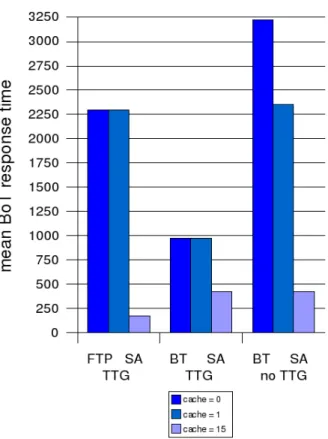
Figure 4 shows 3 sets of measured BoT response times. Each set includes response times for a cache with a capacity of 0, 1 and 15 files, respectively. The 3 sets correspond to, respectively, { FTP + SA + TTG }, { BitTorent + SA + TTG } and { BitTorrent + SA + no TTG }.
The cache hit ratio converges around 0.75 for all expe-riments with caching support (i.e. cache size > 0), except when BitTorrent and Temporal Task Grouping are both ac-tivated. In this situation where BitTorrent and TTG are activated, there is indeed little opportunity for cache hits, as Tasks requiring the same input data files are scheduled simultaneously on different Resources.
A first conclusion is that, as expected, BitTorrent trans-fers clearly outperform FTP transtrans-fers in all but one setup (FTP with large cache capacity). As BitTorrent has a larger overhead than FTP, its advantage over FTP grows as the transfers become larger. Therefore, when cache capacity is large (15 files), FTP transfers happen only once for each file as the cache hit ratio is very high. With large cache capacity, which reduce the amount of transfers to be ac-tually performed, BitTorrent overhead dominates the BoT response time, which becomes a little longer than what is
Figure 4: Mean BoT response time (in seconds) achieved with FTP transfers.
A second conclusion is that caching has a huge impact. BitTorrent without support from Temporal Task Grouping benefits proportionally the most from data caching, proba-bly because even when a cache miss happens on a given Re-source, other Resources act as uploaders when their cache holds the expected data.
A third conclusion is that Temporal Task Grouping en-ables the full power of BitTorrent, which leads to small re-sponse times even with very low levels of caching. It is in-teresting to note that allowing the deployment of Resources with limited cache capacities has a strong practical interest, as files may be very large.
6.3.2 Scenario 2
The following scenario is investigated: There is one con-sumer Peer with no Resources and 1 supplier Peer owning 8 Resources. A user submits 8 times the same Bag of 8 Tasks to the consumer Peer. The 8 Tasks are associated with a different 256 MB input data file (SDR = 1.0), and stored in random order within the BoT.
Transfers are performed with BitTorrent. Resource se-lection with highest Storage Affinity is activated and then deactivated, and a cache size of 1 is used. Given the small cache size, it is important to correctly schedule Tasks on Resources that already store the required data.
In this controlled setup showing inter-BoT data sharing (sometimes referred to as inter-Job data sharing [9]), the cache hit ratio is very high (0.88) in both cases. Resource se-lection with highest Storage Affinity avoids most data trans-fers for all BoTs following the first submitted BoT, decreas-ing the mean BoT response time from 242s to 116s.
6.3.3 Scenario 3
Finally, the following scenario is investigated: There is one consumer Peer with no Resources and 1 supplier Peer owning 8 Resources. A user submits Bags of 100 Tasks to the consumer Peer. The 100 Tasks have the same 256 MB input data file. The SDR (= 0.01) of such Bags of Tasks is very low, as is typically the case for so-called parameter sweeps applications.
Transfers are performed with BitTorrent. Temporal Tasks Grouping and selection of Resource with highest Storage Affinity are enabled. The mean BoT response time is 2319s when caching is deactivated. It decreases sharply to 201s with a cache size of 1, with little variations for a larger cache size. The theoretical minimum BoT response time for a setup with FTP transfers and Resource caching support would be ∼ 205s. The observed response time in this FTP setup is actually 303s, which is good but still slower than in the BitTorrent setup. As can be seen, BitTorrent transfers coupled with caching support on Resources is very efficient even with a small number of downloaders, i.e. 8 download-ers.
6.4 Discussion
BitTorrent data transfers, data caching support on Re-sources, and Task scheduling with Temporal Grouping all have an important impact on BoT response times, and gain from being combined.
BitTorrent brings important benefits in most setups, ex-cept where its overhead dominates the response time, i.e. when there is not much data to transfer.
Caching of course brings important benefits too. Deter-mining optimal cache capacity will be explored in future work. It is however already clear that a large cache capacity brings better benefits. But when BitTorrent is used without Temporal Task Grouping support, even a very limited cache capacity brings some benefits. Alternatively, when the effect of Temporal Task Grouping is limited, for example in setups with high SDR (e.g. all files within a BoT are different), even limited small caching support is very imporant.
The effect of Storage Affinity is to ensure that, when scheduling a given Task, a Peer selects one of the Resources that have the input data files of this Task stored in its data caches. Deactivating Storage Affinity would severely de-grade response time performance and cache hit ratio when scheduling Bags of Tasks with large input data files exhibit-ing a high SDR.
The effect of Temporal Tasks Grouping is to group the scheduling of Tasks so as to maximize the number of simul-taneous downloaders of input data files. This allows BitTor-rent to produce maximum benefits as it scales really well with the number of simultaneous transfers of the same file. BitTorrent, caching and Temporal Tasks Grouping must all be activated to enable data replication to bring extra ben-efits. Further experiments will be required to measure how much benefits can be achieved with the proposed data repli-cation process based on pull-based, proactive, asynchronous data transfers. Note that the cost of limited data replication is very low thanks to the scalability of BitTorrent and the maximization of simultaneous downloads of input data files created by Temporal Tasks Grouping.
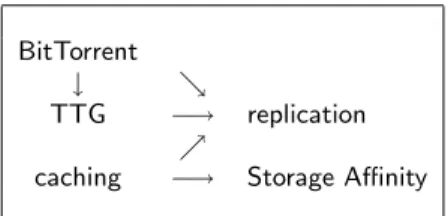
Figure 5 summarizes the dependencies that exist between the technologies presented in this paper. BitTorrent and caching support must be activated for the other technologies
BitTorrent ↓ &
TTG −→ replication %
caching −→ Storage Affinity Figure 5: Technology dependencies to have a favorable impact.
We recommend without restriction that BitTorrent and caching support are systematically activated in P2P Grids. Storage Affinity can be activated without restriction in al-most all setups. On Peers where Resources exhibit large variation in computing power, Storage Affinity should also be combined with a performance-aware Resource selection algorithm. Alternatively, Storage Affinity may be combined with Task Replication [9], that relies on redundancy of Task execution as an efficient but somewhat costly way to com-pensate for unfortunate Tasks/Resources assignments. Al-ternatively again, Storage Affinity may be combined with the learning of reliability models of Resource supplying [28], as a way to avoid unfortunate Tasks/Resources assignments in the first place, rather than have to compensate for them. We also recommend that Temporal Tasks Grouping be ac-tivated in almost all setups, and should be combined with a Task selection algorithm aware of expected Peer perfor-mance when Peers in the P2P Grid show large variation in performance. Temporal Tasks Grouping and Storage Affin-ity are complementary: Because the benefits of caching are very high, Temporal Tasks Grouping should be activated when there is no caching support, as Storage Affinity re-quires caching support to be of any use. And if Temporal Task Grouping is deactivated, caching support, even very limited, should definitely be enabled. The proposed pull-based data replication should be activated only when Tem-poral Tasks Grouping is expected to perform well, and the tuning of its parameters require further study.
Finally, it should be noted that the consumer Peers stud-ied in the presented experiments always consume Resources from the same set of Peers. In a general setup, the neigh-bourhood of a given Peer may vary over time. Therefore, a consumer Peer should seek to schedule on the same Peers any Task that would require the same input data files as Tasks previously scheduled some time before, provided that caching support is activated on the Resources of these Peers. Simultaneously scheduling on multiple Peers several Tasks requiring the same input data files remains efficient indeed, thanks to the activation of BitTorrent.
7. CONCLUSIONS
This work can be summarized as bringing together P2P Grid computing and P2P data transfer technologies. It synthesizes several previous works in Grid Task schedul-ing (schedulschedul-ing Tasks sharschedul-ing data distributed with BitTor-rent [1, 3], push-based asynchronous proactive data replica-tion [10]) and P2P Grid Task scheduling (Storage Affinity algorithm [9] and Super-Peer model [7]).
Several technologies and patterns are combined and inte-grated to provide efficient scheduling of Data-Intensive Bags of Tasks in P2P Grids: (1) systematic use of the BitTorrent
P2P file sharing protocol to transfer large shared data, so as to prevent network bottlenecks, (2) Resource caching sup-port that avoids transfer of data recently downloaded by the Resource, (3) a Resource selection scheduling algorithm that minimizes the amount of input data to be transferred when scheduling a given Task, (4) a new Task selection schedul-ing algorithm (Temporal Tasks Groupschedul-ing) targetschedul-ing Data-Intensive Bags of Tasks in P2P Grids, and based on the temporally grouped scheduling of data-equal Tasks of a Bag of Tasks by consumer Peers, (5) pull-based, proactive, asyn-chronous replication of consumer Peers’ data by supplier Peers.
Experiments show that combining BitTorrent data trans-fers, Task selection scheduling with Temporal Task Group-ing, and Resource caching support is very efficient in a P2P Grid for all setups, even with very small cache sizes, for both low and high data sharing within Bags of Tasks, and includ-ing in the special, important case of parameter sweeps.
Adding the use of a data-aware Resource selection algo-rithm minimizing data transfers (Storage Affinity) is impor-tant as it optimizes the cache hit ratio, but should be inte-grated with an algorithm taking into account the computing power of Resources in case of large performance variation of the Resources of the managed Peer.
From a deployment perspective, BitTorrent support, nee-ded on each Peer and Resource, is embednee-ded within the implemented middleware. Our proposed solution is easy to deploy in unstructured P2P networks, as BitTorrent does not rely on an overlay network and Predictive Communica-tions Ordering is not needed.
Our implementation of an operational middleware demon-strates that off-the-shelf BitTorrent support can be deeply integrated with a P2P Grid middleware and brings consid-erable performance gains.
As future work, it will interesting to evaluate the appli-cation of Temporal Tasks Grouping to large Bags of Tasks. We also intend to explore various combinations of cache ca-pacity, SDR, and network bandwidth. It will also be inter-esting to evaluate pull-based, proactive, asynchronous data replication: in particular, evaluating when it is optimal to trigger proactive replication and what is the best policy for assigning weights to the sets of replicated data (popular and random data). Future work could also explore the impact of heuristics taking Task runtimes into account when schedul-ing. For example, a version of the MinMin or MaxMin [17] heuristics modified to use predicted, rather than communi-cated, knowledge as runtime data.
Acknowledgement
We want to thank Claire Kopacz and Elisabeth Spilman for their help in the preparation of this manuscript. We also want to thank the anonymous reviewers for their construc-tive comments. Figures 1 and 2 include icons from the Tango library (http://tango.freedesktop.org/), under Creative Commons Attribution Share-Alike license.
8. REFERENCES
[1] W. Cirne, F. Brasileiro, N. Andrade, L. Costa, A. Andrade, R. Novaes, and M. Mowbray, “Labs of the World, Unite!!!” in J. Grid Computing. Springer, 2006.
[2] N. Andrade, W. Cirne, F. Brasileiro, and
P. Roisenberg, “OurGrid: An Approach to Easily Assemble Grids with Equitable Resource Sharing,” in Proc. Workshop on Job Scheduling Strategies for Parallel Processing, Seattle, WA, USA, 2003. [3] C. Briquet and P.-A. de Marneffe, “Description of a
Lightweight Bartering Grid Architecture,” in Proc. Cracow Grid Workshop, Cracow, Poland, 2006. [4] N. Drost, R. V. van Nieuwpoort, and H. E. Bal,
“Simple Locality-Aware Co-allocation in Peer-to-Peer Supercomputing,” in Proc. GP2P, Singapore, May 2006.
[5] F. Berman, A. J. G. Hey, and G. Fox, Eds., Grid Computing: Making the Global Infrastructure a Reality. Wiley, April 2003.
[6] C. Briquet and P.-A. de Marneffe, “What is the Grid ? Tentative Definitions Beyond Resource Coordination,” University of Li`ege, Li`ege, Belgium, Tech. Rep., 2006. [7] P. Cozza, C. Mastroianni, D. Talia, and I. Taylor, “A
Super-Peer Protocol for Multiple Job Submission on a Grid,” in Proc. CoreGrid Workshop on Grid
Middleware, Euro-Par, August 2006.
[8] C. Anglano and M. Canonico, “The File Mover: An Efficient Data Transfer System for Grid Applications.” in Proc. CCGrid, Chicago, IL, USA, 2004.
[9] E. Santos-Neto, W. Cirne, F. Brasileiro, and A. Lima, “Exploiting Replication and Data Reuse to Efficiently Schedule Data-intensive Applications on Grids,” in Proc. Workshop Job Scheduling Strategies for Parallel Processing, New York, NY, USA, 2004.
[10] K. Ranganathan and I. Foster, “Decoupling Computation and Data Scheduling in Distributed Data-Intensive Applications,” in Proc. HPDC, Edinburgh, Scotland, 2002.
[11] F. Desprez and A. Vernois, “Simultaneous Scheduling of Replication and Computation for Data-Intensive Applications on the Grid,” in J. Grid Comp. Springer, 2006.
[12] F. A. B. da Silva, S. Carvalho, and E. R. Hruschka, “A Scheduling Algorithm for Running Bag-of-Tasks Data Mining Applications on the Grid,” in Proc. Euro-Par, Pisa, Italy, 2004.
[13] B. Cohen, “Incentives Build Robustness in BitTorrent,” in Proc. Workshop on Economics of Peer-to-Peer Systems, Berkeley, CA, USA, 2003. [14] A. Legout, G. Urvoy-Keller, and P. Michiardi,
“Understanding Bittorrent: An experimental perspective,” INRIA, Sophia Antipolis, France, Tech. Rep., 2005.
[15] B. Wei, G. Fedak, and F. Cappello, “Scheduling Independent Tasks Sharing Large Data Distributed with BitTorrent,” in Proc. Grid, Seattle, WA, USA, 2005.
[16] S. Jodogne, C. Briquet, and J. Piater, “Approximate Policy Iteration for Closed-Loop Learning of Visual Tasks,” in Proc. European Conference on Machine Learning, Berlin, Germany, 2006.
[17] B. Wei, G. Fedak, and F. Cappello, “Collaborative Data Distribution with BitTorrent for Computational Desktop Grids,” in Proc. ISPDC, Lille, France, 2005. [18] I. Foster, “What is the Grid ? a three Point
Checklist,” Grid Today, July 2002.
[19] R. Olejnik, B. Toursel, M. Tudruj, and E. Laskowski, “DG-ADAJ: a Java Computing Platform for Desktop Grid,” in Proc. Cracow Grid Workshop, Cracow, Poland, 2005.
[20] S. Al Kiswany and M. Ripeanu, “A Simulation Study of Data Distribution Strategies for Large-scale Scientific Data Collaborations,” in Proc. CCECE, Vancouver, BC, Canada, April 2007.
[21] “GridFTP.” [Online]. Available:
http://www.globus.org/grid software/data/ [22] W. Allcock, J. Bresnahan, R. Kettimuthu, M. Link,
C. Dumitrescu, I. Raicu, and I. Foster, “The Globus Striped GridFTP Framework and Server,” in Proc. SC, Seattle, WA, USA, 2005.
[23] E. Lawler, J. Lenstra, K. A. Rinnooy, and D. Shmoys, Eds., The Traveling Salesman Problem: A Guided Tour of Combinatorial Optimization, ser. Wiley Series in Discrete Mathematics & Optimization. New York: Wiley, 1985.
[24] “J2SE 5.0 API Specification.” [Online]. Available: http://java.sun.com/j2se/1.5.0/docs/api/
[25] “Azureus.” [Online]. Available: http://azureus.sourceforge.net/
[26] “Apache ftp server.” [Online]. Available: http://incubator.apache.org/ftpserver/ [27] “edtFTPj.” [Online]. Available:
http://www.enterprisedt.com/
[28] C. Briquet and P.-A. de Marneffe, “Learning Reliability Models of Grid Resource Supplying,” in Proc. Cracow Grid Workshop, Cracow, Poland, 2005.