DEVE
LOPMENT OF COPP
E
R-C
ATALYZE
D ARYLATION REACTIONS
USING TR
IARYLB
JS
MUTH REAG
EN
T
S
T
HES
IS
SU
BMITTE
D
IN PARTIA
L FU
L
FJLM
ENT OF TH
E
REQUIREM
ENTS FOR THE D
EGREE
OF MAS
TER IN
C
HE
M
ISTRY
BY
TAB
I
N
DA AHMAD, TABINDA AHMAD
Avertissement
La diffus
i
on de ce mémoire se fait dans le respect des droits de son auteur
,
qui a signé
le formulaire Autorisation de reprodu
i
re et de diffuser un travail de recherche de cycles
supérieurs (SDU-522 - Rév.0?-2011 ). Cette autorisation stipule que
«
conformément
à
l
'
article 11 du Règlement no
8
des études de cycles supérieurs
,
[l
'
auteur] concède
à
l'Université du Québec
à
Montréal une licence non exclusive d
'
utilisation et de
publication de la totalité ou d
'
une partie importante de [son] travail de recherche pour
des fins pédagogiques et non commerc
i
ales
.
Plus précisément
,
[l
'
auteur] autorise
l
'
Un
i
versité du Québec à
Montréal
à
reproduire
,
d
i
ffuser
,
prêter
,
distribuer ou vendre des
copies de [son] travail de recherche
à
des f
i
ns non commerc
i
ales sur quelque support
que ce soit
,
y compris l
'
Internet. Cette licence et cette autorisation n
'
entra
î
nent pas une
renonciation de [la] part [de l
'
auteur]
à
[ses] droits moraux ni
à
[ses] droits de propriété
intellectuelle
.
Sauf entente contraire
,
[l
'
auteur] conserve
la
liberté de diffuser et de
commercialiser ou non ce travail dont [il] possède un exemplaire.
"
DÉV
E
LOPP
E
M
E
NT D
E RÉACT
I
ONS
D
'
ARYLAT
IO
N CATAL
YS
ÉES
PAR
LE
CUIVRE
UTILISANT LES TR
I
ARYLBISMUTHS CO
MM
E
R
ÉACT
I
F
M
ÉMO
IR
E
PR
ÉSEN
T
É
COMME
E
XJG
ENCE
PARTI
E
LL
E
D
E LA
MAÎTRI
SE EN C
HIMIE
PAR
TABIND
A AHMAD
, TABINDA AHMAD
1
would
like to
express
deep
gratitude
to my
supervisor
,
Prof.
A
l
exandre
Gagnon
,
for
providing me the chance
of
doing my master degree in his
group
.
I thank him for his
assistance
,
guidance and support
throughout my Master
;
without
him 1
would
not
have been
able
to
complete
my thesis.
Also
,
my
acknowledgments go
to
the
members
of
the Gagnon
group:
Pauline
,
Martin
,
Julien
,
Max
,
Adrien and Emeline for
their
excellent assistance and spiritual support
for
me during my
studies
.
In particular
,
I
would
like to thank Rabi
,
Rahul
and Nazir,
for
their
advice and
their
friendly assistance with various
problems
ali the
time
and
their help
outside
the lab.
I
would
like
to acknowledge
my
friends
and
family who supported
me during my
time
here. 1
would
like to
thank
my close
friend, Yasmina
,
who
,
as a good friend
,
was
always willing
to help
and give
her
support.
1
would also
like to thank my beloved
parents
and
my
sister Tabeer.
They
were always supporting
me
and encouraging
me
with
their best
wishes
.
I must
express
my
gratitude
to my
aunt
for
standing
beside me
through my
studies
.
Finally
,
I
would
like to
acknowledge
Paraza Pharma
for
financial
support.
I
would
like to thank
Chantal for
ber training
,
guidance and
for being
a wonderful friend.
Last
,
I
would
like to
thank
Dr.
Arshad
Siddiqui and Dr.
Farzana
Masood
for
being
such a
nice uncle
and aunt and for
their
generous support
during my
studies.
I would like to
dedicate this thesis
to my grandparents
,
Masood Alarn and Anwar
Jahan Zaidi
RÉSUMÉ ... Xl
CHAPTER 1
1.0 INTRODUCTION ... 1
1.1 Preparation of Different Types of Triarylbismuth Compounds ... 2
1.1.1 Preparation of Triarylbismuth Reagents ... 3
1.1.2 Preparation of Mixed Organobismuth Reagents ... 4
1.1.3 Preparation of Tria rylbismuth Reagents Having Acidic Substituents ... 4
1.1.4 Preparation ofTriarylbismuth Reagents Having Deactivating Groups ... 5
1.1.5 Preparation of Highly Functionalized Triarylbismuth Reagents by Functional Group Manipulation ... 6
1.1.6 Preparation ofTriarylbismuth Reagents Having Formyl groups ... 6
1.1.7 Preparation ofThiolatobismuth Reagents ... 7
1.1.8 Preparation of Ortho Functionalized Triarylbismuth Reagents Having Electron Withdrawing Groups ... 7
1.1.9 Preparation ofTris-(p-nitrophenyl)bismuth Reagents ... 8
1.1.10 Preparation ofTris-(heteroa ryl)bismuth Reagents ... 9
1.1.11 Preparation of Cyclopropylbismuth Reagents ... 10
1.2 Objectives of the Project ... 11
1.3 Results and Discussion ... 11
1.4 Structural Characterization of Selected Triarylbismuth Reagents ... 17
CHAPTER Il 2.1 INTRODUCTION ... 21
2.1.1 N-Arylation Reaction of Aliphatic and Aromatic Amines using Triarylbismuth Reagents ... 21
2.1.2 N-H Bond Formation using Triarylbismuth Reagents ... 22
2.1.3 N-Arylation of Diversely Substituted Hydrazines Using Triarylbismuth Reagents ... 22
VI
2.1.5 Resin-Bound Bismuthanes as N-and 0-Arylating Reagents ... 24
2.1.6 0-Arylation of Aliphatic Alcohols using Triarylbismuth Reagents ... 26
2.1.7 lnsitu Oxidation of Arylbismuth (Ill) to Arylbismuth (V) ... 26
2.1.8 0-Arylation of Tertiary Alcohols Under Anhydrous Conditions ... 26
2.1.9 Conversion ofTriarylbismuth Reagents into Symmetrical Biaryl Products .... 27
2.1.10 Cross-Coupling Reactions of Triarylbismuth Re agents with Aryl Hal ides and Aryl Triflates ... 28
2.1.11 Cross-Coupling Reactions of Allylic Bromides with Triarylbismuth Reagents .. ... 30
2.1.12 Arylation of Allylic Acetals with Triarylbismuth Reagents ... 30
2.1.13 Arylation of Allylic Carbonates with Triarylbismuth Reagents ... 31
2.1.14 Coupling of Baylis-Hillman Adducts with Triarylbismuth Reagents ... 31
2.1.15 Arylation of Vinyl Epoxides with Triarylbismuth Reagents ... 32
2.1.16 Reaction of Carbon Monoxide with Triarylbismuth Reagents ... 32
2.2 Objective of the Project ... .33
2.3 Results and Discussion ... 34
2.4 Synthesis of Highly Functionalized Diaryl Ethers by Copper Mediated 0-Arylation of Phenols Using Trivalent Arylbismuth Re agents ... 34
2.5 Copper-Catalyzed 0-Arylation of N-Protected 1,2-Amino Alcohols Using Functionalized Trivalent Organobismuth Reagents ... 40
2.6 Formation of C-0 bond via Copper-Catalyzed 0-Arylation of Phenols ... 46
CHAPTER Ill 3.1 INTRODUCTION ... 48
3.1.1Preparation of 3-0-Aryl Chloramphenicol Derivatives via Chemoselective Copper -Catalyzed 0-Arylation of (1R,2R)-(-)-N-BOC-2-Amino-1-(4-nitrophenyl)-1,3 -propanediol Using Triarylbismuthines ... 47
3.2 Objective of the project.. ... 53
3.3 Challenges of the project ... 54
3.4 Contribution of authors ... 54 3.5 Supplementary information ... · ... SS
CHAPTER IV Conclusion ... .55 CHAPTERV EXPERIMENTAL PART ... .58 CHAPTERVI 4.1 CHARACTERIZATION OF COMPOUNDS ... 77 REFERENCES ... 133 PUBLICATION ... 134
Â
Angstroma
Alpha Abs Absorbance Ac Acetyl a rom. Aromatic ~ Be ta B Base Bz Benzoyl c Concentrationc
Carbono
c
Degree Celcius cm CentimeterCOSY COrrelation SpectroscopY
d Doublet
dd Doublet of doublets
DCM Dichloromethane
DIC Diisopropylcarbodiimide
DIPEA N,N-diisopropylethylamine DMF N,N-Dimethylformamide
DMSO Dimethyl sulfoxide
eq. ESI
g
H h He x HMBC Hz IR Mm
Me MHz minml
mmolmm
m/z NOE NOESY ppm Pyr EquivalentElectrospray ionization Gram
Hydrogen
Hour Hexanes
Heteronuclear Multiple Bond Correlation
Hertz Infra red Coupling constant Mol ar, concentration Multiplet Methyl MegaHertz Minute Milliliter Millimole Millimeter Mass/charge ratio
Nuclear overhauser effect
Nuclear Overhauser Effect Spectroscopy Parts per million
Rf Retention factor
NMR Nuclear MagneticResonance
s Singlet
TBAB Tetrabutylammonium bromide
THF Tet ra hyd rofu ra n
TLC Thin layer chromatography
TMS Tetramethylsilane
Il Micro
Ill Micro liter
Le
bismuth
est
w1
élément
présent
en faible
quantité dans la nature.
Cependant
le
processus de raffinage des métaux nous permet de nous
en
procurer de manière plus
faci
le. Le
bismuth dispose aussi
de
caractéristiques
uruques telles que la non-to
x
icité
et
une bonne
stabilité
,
chose
qui
le
rend utile dans l
'
industrie
de la
chimie ve11e.
Parmi les composés organobismuth qui
sont
co1mus
,
on
trouve les
composés
alkylbi
smuth et arylbismuth.
Dans
ce
travail
,
l'accent sera
mis
sur
l'utilisation
de
composés de type triarylbismuth. Il
est à noter que les
composés organobismuths sont
présents
sous
deux
formes:
les triarylbismuths(III)
et
les triarylbismuths(V). Dans le
passé et
dmant plusiems années
,
les
composés organobismuth ont été utilisés dans de
nombreuses réactions organiques synthétiques importantes.
Le but de ce travail
est
d'appliquer les triarylbismuths(III) conm1e réactifs dans
les
réactions d'arylation catalysées par le cuivre.
Ainsi,
la première partie de mon travail
consiste à synthétiser
les différents composés de bismuth triaryl(lll) qui portent des
groupes
fonctionnels. Les réactifs de type triarylbismuth peuvent
être facilement
obtenus par
l'addition
d'un réactif de Grignard sur le chlorure de bismuth et cela afin
d
'
obtenir des réactifs organobismuth fonctionnalisés avec des rendements
allant
de
modérés
à
bon. Les triarylbismuthanes sont stables
dans l
'a
ir
et
peuvent être
purifiés
par une
simple chromatographie sm gel
de
silice. En outre,
les organobismuthanes
montrent une remarquable tolérance
aux groupes
fonctionnels ce qui fait d'eux des
candidats
idéaux pour
le
développement de méthodologies orientées
vers
des
applications de chimie médicinale.
La deuxième partie de mon projet
consiste à
appliquer
le
triarylbismuth(III)
en
tant
que réactif dans
les
réactions d'arylation catalysées par
le
cuivre. Des protocoles
efficaces pour la 0-arylation catalysée utilisant des phénols
,
des 1
,
2 -arrunoalcools N
-protégés ou du
chloramphenicol
par du cuivre
en
utilisant des réactifs de
triarylbismuth fonctimmalisés
ont été
développés.
Une
quantité catalytique d'acétate
de cuivre a favorisé une réaction de
couplage croisé
C-0 dans des conditions douces.
Cette
réaction tolère une
grande
diversité de
groupes
fonctionnels donnant accès
à
une ganm1e de B-aryloxyamines ou aryl éthers qui
sont importants pom la synthèse de
composés pertinents médicalement ainsi que des motifs structuraux très importants de
nombr
e
u
x
pr
o
duit
s e
t p
o
l
y
m
è
re
s
n
a
tur
e
l
s
biol
og
iqu
e
m
e
nt acti
fs
d
a
n
s
l
'
indu
s
tri
e
d
e
l
a
s
ci
e
nc
e
d
es
m
a
t
é
ri
a
u
x
Bismuth is
prese
nt in
small amount
in nature
,
but
can easily
be
accessed
by the
refining
process of
metals.
Bismuth
bas
sorne unique
features
,
such as a
low
toxicity
and
high
stability. This
makes
bismuth
useful in
green chemistry.
Different classes
of organobismuth compounds are known such as alkylbismuth and
arylbismuth compounds.
In this
work,
the
focus
lays
on the
use
of triarylbismuth
compounds. Organobismuth compounds are
present in
two forms:
triarylbi
smuth(III)
and
triarylbismuth(V)
compounds. For
the past
severa)
yea
rs,
organobismuth
compounds
have been used in many important
synthetic organic
reactions.
The aim of this work was to
synthesize
triarylbismuth(III) compounds and to app
l
y
them
as reagents
in
various copper catalyzed arylation
reactions.
The first
part
was
to
synthesize
different triarylbismuth(III) compounds bearing
functional groups. Triarylbismuth reagents can
be
easily accessed via
the
addition of
Grignard
reagents
onto bismuth
chloride to
afford
functionalized
organobismuth
reagents
in moderate to
good
yields.
Triarylbismuthanes are air
and moisture
stable
and
can be purified by
simple silica gel chromatography.
In
addition
,
organobismuthanes show remarkable functional group
tolerance,
making them
ideal
candidates for
the development
of
methodologies
oriented
towards medicinal
chemistry applications.
The second
part
of
the project
was
to
apply triarylbismuth(III) as
reagents
in
copper-catalyzed
arylation reactions.
fficient
protocols
for the copper-catalyzed 0-arylation
of
phenols, N
-protected
1
,2-aminoalcohols
and chloramphenicol
using
functionalized
triary
lbi
smuth reagents
were
developed.
Catalytic
amount
of copper acetate
promoted
a C-0
cross-coupling reaction under mild
conditions. These reactions tolerate a wide
diversity
of functional groups giving access to a range of
~-aryloxyaminesor aryl
ethers which are
important
for
the
synthesis of
medicinally relevant compounds
and
very
important structural motifs
of
nun1erous biologically
active
natural products
and
polymers
in
the
material
science industries
.
SYNTHESIS
1.
INTRODUCTION
The
element
bismuth, the
64
111most
abundant compow1d
in the
Eat1h
'
s crust
[1], is
a
rme
element and
therefore not
very
commonly used. Bismuth bas many interesting
properties [2]: it is the most diamagnetic
of ali
metals,
it has the
l
owest
thermal
conductivity (in exception of
mercury),
it has
a
high
electrical
resistance,
it is the
heaviest
stable element
,
it is not toxic or
carcinogen
(in
contradiction
to the
other
heavy metals like
msenic
and
l
ead) and
it is not radioactive. Bismuth comes
as
a
side
product in the process
of refining
lead, copper, tin,
si! ver
and
gold ores which
is a low
cost process.
Due to low toxicity of bismuth,
it can
be use
for green chemistry as
we
il.
In this century, the development of reactions that follow the principles of
green
chemistry is
a
must, because
of
the
environmental
principles that the field of resemch
and
industry me dealing
with.
In bismuth compoW1ds,
bismuth is most!
y
present in the oxidation
states + 3 and +5.
Bismuth(III) compounds can be
easily
transformed into bismuth(V) compoW1ds using
a vm
·iety
of oxidizing agents such as
peroxides,
peracids and hypervalent iodine
reagents. A
few cases
of
bismuth(!)
and
bismuth(II)
compounds
have been
reported
,
but those
oxidation states are
rare [3
, 4].
Compounds where
the bismuth center hasan
oxidation
state
of
+
3 have
some
Lewis
ac
id
properties due to the Lanthanide
contraction.
The e
l
ectron configuration of
bismuth is [Xe]4}
45i
06
i
6p
3,so
the
4f
electrons are weakly shielded.
The
concept
of organobismuth chemistry (compounds
containing
a C-
Bi bond)
started
in 1850
with
the
synthesis of
triethylbismuthine by Lowig and
Schweizer
[5].
The above compound
is
spontaneously
flanm1able in
air.
On the
contrm
·
y
,
triphenylbismuthine,
first synthesized
by
Michaelis and
Polis
in
1887 [6]
,
is
mr-stable. A
lar
ge
number
of
deri
va
tives
of triphenylbismuthine
have
s
ince been
prepared. The first tetraaryl and
p
e
ntaarylbismuth
compounds were only
syn
thesized
in 1952 by
Wittig and Clauss
[7].
Triarylbismuth compounds
are
organometallic
reagents
where
the bismuth is
at
the
oxidation state of+ 3 and exist
in
the fonn of
BiAr
3 or Ar3
-nBiX
11(n
= 0 to
3)
[8-11].
The
bi
s
muth-carbon bond is
one of
the
weakest among element-carbon
bonds: the
mean bond dissociation
energy of triphenylbismuthine (Ph
3
Bi) is 193
.9
±
10.8 kJ
/
mol
compared
to
321
±
21
kJ
/
mol
for
triphenylphosphine
(Ph
3
P) and
373.7
±
4.2
kJ
/
mol
for
triphenylamine
(Ph
3
N)
[12].
A
unique reactivity
was
bence
expected
and
demonstrated b
y
the
arylation
reactions
of a great array of substrates. The organic
derivatives
of
bismuth
compounds were first
used
for
medicinal preparations. In the
1980s
,
Barton and
Finet reported a series of
arylation
reactions
using
triphenylbismuth
and
triph
e
nylbismuth diacetate
as
the
arylating agents
[9
,
13
,
14].
Oganobismuth
compounds
have come
out as an
important class
of organometallic
reagents
with
many
applications
in different
areas
in past
severa!
years
[15
,
16]
,
as
organobismuth chemistry
bas undergone
growth rapidly and some
novel
organobismuth
compounds have
been reported
[17-19].
Many types of
orgm1obismuth compounds
have proved to be
efficient reagents
in
C
-
,
N
-
and
0-arylation reactions
[20]
,
benzoylation
reactions
[21],
cross-coupling reactions
[22]
,
etc. However,
the
organometallic
chemistry
of
bismuth has developed
relatively
slowly compared
to that
of other
main
group
metals [23
, 24].
1.1 Preparation of Different Types of Triarylbismuth Compounds
In the
pa
s
t
severa!
years,
man
y
organobismuth compounds
have been discovered
along with
the development
of
the
chemistry of organobismuth species. This
class
of
compounds can
be prepared by
severa!
methods including metathesis
,
oxidative
addition
,
reduction
,
transmetallation
,
thermolysis
,
disproportionation
,
electrochemical
coupling and others.
1.1.1
Preparation of Triarylbismuth Rea gents
The organometallic route
,
i.e.
the addition of
an
organometallic reagent
on
bismuth
chloride
,
is the most trivial
and frequently
used method
for
the
synthesis of
triarylbismuthines. A wide variety of symmetrical tertiary
bismuthines possessing
groups such as alkyl
,
fluorine
, methoxy
and chlorine at different positions
on the
aryl
moiety can be prepared using Grignard reagents and organolithium reagents as shown
in Scheme 1.
Ar
3Bi can also
be prepared on large scale using this route
[25
, 26].
Scheme 1 1. Mg, Et20 or THF 2. BiCI3 1. Buli, THF, -78°C 2. BiCI3, -78oC to RT X: Cl, Br X: Br
This approach
consists
of two-step
procedure:
an organomagnesium
reagent is first
formed by the reaction
of an aryl
bromide
with
magnesium turnings in
tetrahydrofuran
or
diethyl
ether as
the
solvent
under inert
atmosphere and
the thus
formed organomagnesium species
is then added cautiously over
bismuth
chloride or
bismuth bromide
as a
bismuth
source
under
controlled
temperature.
Aryl
chlorides
can also
be used [27].
Triarylbismuth compounds can also
be prepared
from
organolithium
reagents
obtained via
the halogenlmetal
exchange
method
as
mentioned in scheme
1.
1.1.2 Preparation of Hindered Organobismuth Reagents
The above
method
can also
be used
for
the preparation
of
hindered
organobismuthines and
diarylbismuth halides
as shawn
in
Scheme 2.
Scheme 2 Bi-Cl 1. Mg, in THF Bi 2. BiCI3,
6
+ 12
2
3R: Me, Et, iPr
Suzuki and
co-workers reported the
synthesis of
crowded triarylbismuthines
where
bulky
aryl groups were
transferred
from
an
organomagnesiurn or organolithiurn
to
bismuth
chloride
[28].
Compound
2
,
where
R
Me
[tris-(2
,
4
,
6
-trimethylphenyl)bismuthine]
and
R
=
Et
[tri
s
-(2
,
4
,
6-triethylphenyl)bismuthine]
,
can
be
synthesized
by heating
the
reaction mixture
at
reflux
with
phenylmagnesium
halide
at
0
°
C.
When
sorne
bulky
groups
like isopropyl R
=
i-Pr
are present
,
only two
aryl groups are
transferred
to
BiCh
at
room temperature
,
giving chloro
-b
is
-
(2
,
4
,
6
-triisopropylphenyl)bismuth
(Ar
2BiCI)
as an
isolated product.
1.1.3 Preparation of Triarylbismuth
Reagents
Having Acidic Substituents
For
the
synthesis of
triarylbismuth compounds bearing
acidic groups
,
a
protecting
group
is
generally
required. The
selected
protecting
group shou
ld
be
stable
during the
formation of
the
Grignard
reagent
(which is
later
added over
Bi
Ch) and
the Bi-C
bond
should
not be cleaved during the deprotection
step. For example,
the
synthesis
reagent
with
BiCh
fo
ll
owed
by
oxidative chlorination
to
give
the
ary
lbi
smuth(V)
dichloride
on which
the MOM protecting
group was
then removed
,
affording
triarylbismuth bearing a
free
phenol. The Bi
-
C
bonds in
ary
lbi
smuth(V)
are known to
be more
stab
l
e
toward
acidic conditions compared
to the corresponding bonds in
ary
lbi
smuths(III).
Deprotection
was
performed using
aqueous
HCl in DCM.
Reduction
of
the Bi(V) center to Bi(III) by reaction
w
ith
hydrazine
gave
phenolic
hydroxyl
group on
triarylbismuth
as shown
in
Scheme 3
[17].
Scheme 3
; O ; O ; O
0 \ 0 \ 0 \
0-
Br
1. Mg, THF, RT(
OJ.
Bi
S02CI2( OJ.
BiCI
2
2
.
1/3 BiCI3 CH2CI2, -35oC 3 3 HCI (aq) CH 2CI2 HO HO( q
BiCI,
(~Bi
NH2NH2 EtOH, RT 31.1.4
Preparation of Triarylbismuth Reagents
Having
Deactivating
Groups
Triarylbismuth
compow1ds having
electron-withdrawing groups
can
a
l
so
be prepared
by the traditional Grignard method
as
proposed by Murafugi and Sugihara [29
,
30].
The
required functionalized Grignard reagents
were
prepared
u
sing
the Knochel
method
[
3
1
,
32
]
via
iodine magnesium
exc
h
ange
in tetrahydrofuran
at
-40
°
C
or
-
20
°
C
using
a
r
y
l
iodide
and
isopropylmagnesium bromide to
generate
the aryl Grignard
reagent
followed
by dropwise addition
over
BiCI
3at
-40
°
C as shown
in
Scheme
4.
Scheme 4 GF- o -1 iPrMgBr GF- - o -MgBr THF, -40°C BiCI3 (
-Dt
---"--- G F~
;) 3s
i -40°C toRT FG:CN FG: C02Et1.1.5 Preparation of Highly Functionalized
Organobismuthanes
Reagents by
Functional Group Manipulation
Due to robustness
of
the Bi-C bond,
alteration
of functional
groups can
be done
directly on
selected organobismuthanes. As reported
by
om group
,
triarylbismuths
canying an alcohol
functional
group can
be
synthesised
by refluxing the
ester
derivative
of
triarylbismuth
with
6
equivalents of
methylmagnesium bromide in
THF
for an hour
as shawn
in
Scheme
5 [33].
Scheme 5 MeMgBr (6.0 equiv) THF, reflux 1 h ' r rBii i J r
H
~
~H
1.1.6
Preparation of Organobismuth Reagents Having Formyl Groups
The synthesis of
tris
-
(
4-formylphenyl)bismuthine
was
done by iodine-ex
change
method
at 25
°
C
[31
,
32].
Protection
of
the
fom1yl group as an
imine
was
required
as
Scheme 6
H
r-0---~
'! 1 N-'
iPr 1. iPrMgBr, THF,2s•c
2. BiCI3 ,-
4o
•
c
to RT1.1.7
Preparation ofThiolatobismuth Reagents
Si02
Thiolatobismuth reagent [Bi(SAr)
3]can
be
obtained as an
int
ermediate
in the process
of
formation
of Ar
3Bi as shown
in
Scheme
7. lt can be
synthesized either
by reaction
of
bismuth(III)
oxide with 2
,
6-dimethoxybenzenethiol (ArSH)
in
(CH
3)2CO
in the
presence
of catalytic amount of
HN0
3(Scheme
7
;
Eq
1)
or
by
reaction of
bismuth
chloride
with ArSH
in MeOH
(Scheme
7
;
Eq 2)
,
affording
Bi(SAr)
3as
reported by
Wada and
co-workers
[34]
,
which on further reaction w
ith
a
n
organo
lithium
reagent
gives Ar
3Bi
(Sc
h
eme 7; Eq 3).
Scheme 7 (±) 0.5 Bi203 H cat OCH31
CH3COCH3 , RT\
(cf
:
},
"'
Q-
sH
eq. 1 3 Ar-Li 3 Ar3Bi\
1
hexane/Et20 OCH3 BiCI 3 , Et3N 3 equiv. OCH3 eq.3 MeOH, RT eq.21.1.8 Preparation of
Ortho
Functionalized Tr
i
arylbismuth
Reagents
Having
Electron-Withdrawing Groups
This
class
of
reagents
can
be prepared by
the
"
bali mill
"
technique [35]
which
is
a
copper
,
copper
iodide
and calcium carbonate at
room
temperature for about
12 hours
in
a
bail
mill apparatus as shown in Scheme 8. This
procedure bas
some
limitations
due to
the
interaction between
the
ortho functional group (cyano
,
nitro)
and
reactive
metal intermediates.
A
combination
of
Bi
and Cu or Cui
is
essential for
the present
reaction
and
the
combined
use
of Cu
powder
and Cui gave
better results than the
separate
use
of either one of
these. Without
copper,
no triarylbismuthanes
were
formed
.
Commercia
l
bismuth powder proved to be
J
ess satisfactory for
the present
purpose.
This observation
demonstrates
a crucial role of
the nascent bismuth
smface
in
the formation of organobismuth
compounds.
Thus
,
with an
idea to modulate
the
milling
rate of
bismuth
shots
,
about 0.5
-
0
.
7 molar
equivalents of calcite grains were
added
to the reaction mixture
,
since
both bismuth
and calcite are
located
at grade 3 on
the
Mohs
hardness
sca
l
e.
Scheme 8Bi, Cul, Cu, CaC03 bali mill, RT, 12h
R1: H, F, Cl, Br, CF3, N=CHC6H5 , OMe, C02Et
R2
: H
, F, CF31.1.9 Preparation of Tris-(p-nitrophenyl)bismuth Reagents
Various methods that have
already
been
illustrated above can
be used to prepare
triarylbismuth compounds bearing
a
nitro
group. For exan1ple
,
the iodine-lithiwn
exchange starting from
4-iodonitrobenzene
and
phenyllithium to
generate
the
utilized
to afford tris
-
(p
-nitr
opheny
l
)bismuth, as s
h
own
m
Scheme 9
[29].
Scheme 91. Phli, THF, -100°C
02N- o - -l
2. BiCI3 , -1
oo
o
c
to RT1.1.10 Preparation
of Tris-(heteroaryl)bismuth
Reagents
These
reagents
can
be prepared
via addition of Grignard or organo
-lithium
reagents
over
bismuth
sa
lt
s. For example, tris
-
(3
-m
ethy
l-
2
-thi
eny
l
)bismut
hin
e was
prepared
from
the
corresponding organomagnesium
reagent
[
36) whereas
tris-(N-methyl-5-indolyl)bismuthine
[
37
]
and
tris-(1
-m
ethy
l-
2
-p
yrro
l
y
l
)bismut
hin
e
[
38]
were
synthesized
by
lithium-h
a
l
ogen exchange fo
ll
owed
by
addit
i
o
n
of
bismuth
chloride
.
A
more recent method
in
vo
l
ving the formation of an organozinc
reagent
was
developed by
Condon
et
al. for the synthesis of
tri
s
-
(heteroaryl)bismuth
reagent [39]
as shown
in
Scheme 1 O. In this
approach
,
h
eteroarylzinc reagents were
prepared by
coba
lt-
cata
l
yze
d
bromine/zinc
exchange
by reduction of aryl halide
wit
h
zinc
dust
[
40].
In
the
next
step
,
the
in
situ
forrned organozinc
reagent
was added over
bismuth
c
hl
oride
.
Scheme 10
xrJ-Br
CoBr2 (7%)
allyl chloride (0.17 equiv.)
Zn (3.5 equiv.)
20°C, 18h
X: S,O
Another
protocol
,
where
heteroaryl
zi
nc
reagents
[39)
are obtained
by
with ZnCb and a second
transmetallation
with
BiC,h
,
was
developed to
afford
tris-(heteroaryl)bismuth
reagents
as shawn
in
Scheme
11.
Scheme 11
1. n-Buli, -78°C, 30 min 2. ZnCI2, -78°C to 20°C, 1 h
(ArHet)Br (ArHet)JBi
1.1.11 Preparation of Tricyclopropylbismuth
Tricyclobismuth can
be prepared by the
addition of
cyclopropylmagnesium bromide
over BiCh
as shawn
111Scheme
12 by
our group.
lt
was found
that
tricyclopropylbismuth is not pyrophoric [41].
Therefore
,
a simple work
-up
and
trituration in hexanes provided the desired
compound as a white solid
[ 42].
Scheme 12
'if
Mg Br 4 1. BiCI3 THF 2. work-up 51.2 Objective
s
of the Project
The objective of
this project
was
to
synthesize organobismuthines whkh are an
attractive class of organometallic
reagents that can be accessed from
inexpensive and
non-taxie
bismuth salts. Triarylbismuthines are particularly interesting due to their air
and
moisture
stability and
high
functional group
tolerance.
The strategy that we
explored consists of introducing the incompatible functional
group
by performing
a
functional
group transformation directly
on the organobismuth species.
In
the course
of our studies
,
we found
that the
C
-
Bi bond
of organobismuthines
is resistant to
acidic
,
reductive
,
and even oxidative conditions
,
thus
enabling
the transformation
of
the
functional group
into a more
elaborated
functional
group. We
report herein
a
detailed
study on
the preparation of highly functionalized triarylbismuth reagents by
functional
group
manipulation.
To fm1her gain
insight into the
structure of
triarylbismuthines
,
we
crystallized and
analyzed
by
X-ray
diffraction
severa
!
derivatives of triarylbismuth reagents bearing different functional groups at different
positions
;
we published these results in
JOC
2016
p5401.
1.3 RESULTS AND
DISCUSSION
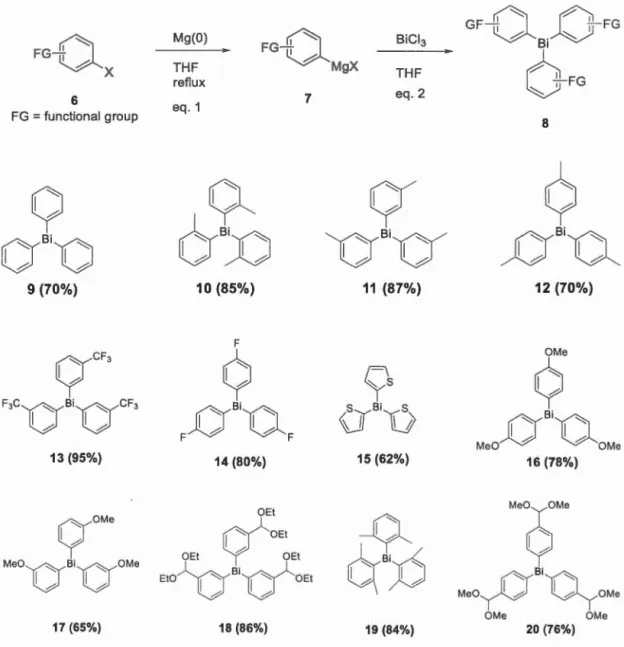
The synthesis of organobimuth
reagents
was
performed in two
steps as shown
in
Scheme 13.
First
,
reagent
7
was obtained
by reaction
of magnesium
with organic
hal ide 6
as shawn
in
equation
1
of scheme
13. The usual route
for
the
synthesis of
Grignard reagents is the oxidative addition
of magnesium metal to organic halides in
a polar and aprotic so
l
vent such as THF. However
,
since
organomagnesium reagents
are
highly
sensitive
to moisture
,
an inert atmosphere
was
maintained to
avoid
the
hydrolysis
of the Gr
i
gnard reagent. In the second step
,
the
organomagnesium reagent
was slowly added
dropwise to the
solution of bismuth chloride
in
THF at a controlled
temperature
of
-1
o
o
c
to
afford
the
corresponding triarylbismuth reagent 8
as shawn
in
equation 2 of scheme 13.
Scheme 13
GF-
Q c
-
F
G
F
G
O
Mg(O)FG-
Q
BiCI3 1 ~ ~ 1 Bi 1~THF
~ MgXx
THF
reflux6-
1FG
6 7 eq.2F
G
=
functional group eq. 1 8Q
~
y
Q
O BiûC
t
x::
v
Biv
~
Bi
ü
l
h-
l
h-
lh-
l
h-9 (70%) 10 (85%) 11 (87%) 12 (70%) F YCF3Q
OMe .QÇs
Q
F3C ÙBio C F 3 Ù Biù ( J rsi\ i ) 1 .Q 1 .QI.Q
1 /; Ù Biù F F MeOl
.Q OMe 13 (95%) 14 (80%) 15 (62%) 16 (78%) OEI·~
Q
"'
Y OMe~
çf
o"
l"'
.&
OEI OEI
q
·
)C)
.&
MeOÙ Biù OMe
EtO
~
B
i
~
OE
l
1 .&
1 .&
1.&
y OBiÛ yMeO
1 .&
OMeOMe OMe
17 (65%) 18 (86%) 19 (84%) 20 (76%)
Fig
u
re 1
:
Functionalized O
r
ganobism
u
th Reagents
Us
in
g
thi
s
pr
o
t
oco
l
,
we we
r
e a
bl
e
t
o sy
nth
es
i
ze a
br
oa
d r
a
n
ge of
tri
a
r
y
lbi
s
muth
reage
n
ts co
nt
a
inin
g a
l
ky
l
,
m
e
tho
xy
,
fl
u
or
in
e, ace
t
a
l
a
nd h
e
t
e
r
oa
r
y
l
g
r
o
up
s a
t di
ffe
r
e
nt
p
os
iti
o
n
s of
th
e ary
l m
o
i
ety i
n m
o
d
era
t
e
t
o goo
d
y
i
e
ld
s as s
h
ow
n in
F
i
g
ur
e
l.
He
r
e
,
th
e
1
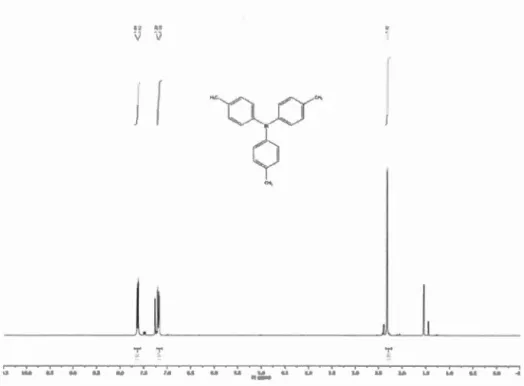
The
1H-NMR
spectrum of compound
12
shows characteristic signa
i
s for
the
p
-m
ethyl
group at 2
.
3
ppm
(Figure 2)
,
which confirms
the
obtention of
the desired product.
Two
doublets
are also
indicative
of a para
-di
substituted
phenyl ring.
J
r
1
j
. . _ _ _
l
.,.
-·~ ,.. \.1. 4}...,.,...., ~.. l~ ... l i u
Figure
2:
1H-NMR
Spectrum
of
Compound 12
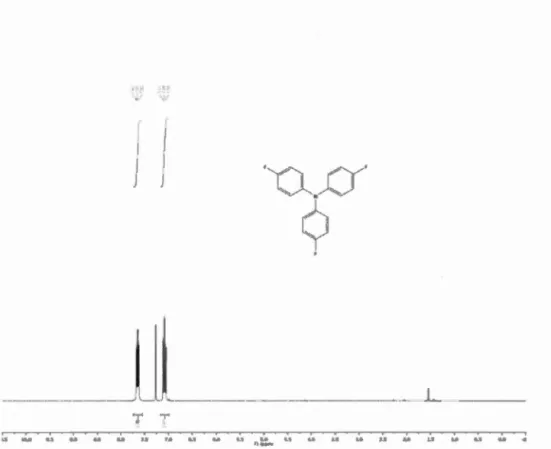
Compound
14 was
characterized by
1H
-NMR.
The
spectra shows
the formation
of
the
• • 1 ' 'IV
r
1
1
J
1
Figure 3:
1H-NMR
Spectrum of Compound
14
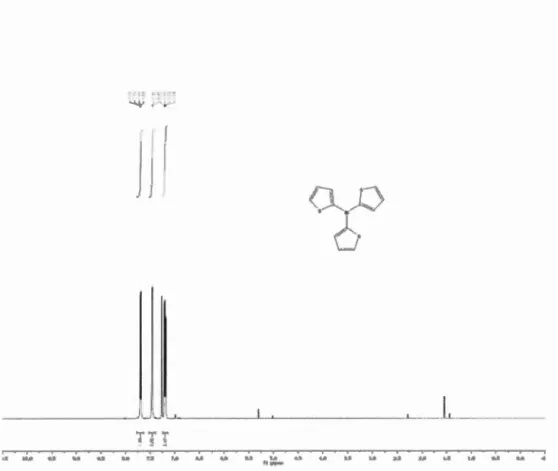
The
1H-NMR
spectrum of
isolated
compound
15
shows
the
characteristic signa
i
s for
the thiophene protons
,
confim1ing
the
fonnation ofthe
desired
compound without any
•$ «U! . ' \ • • .,._ $.» 71o- 1.0 •-'- •• ~~ ,. t.\ 1* a1 •• .J'lo :,- u: JR Q$.' .J) 4
"•
Figure 4:
1H-NMR
Spectrum of Compound 15
The
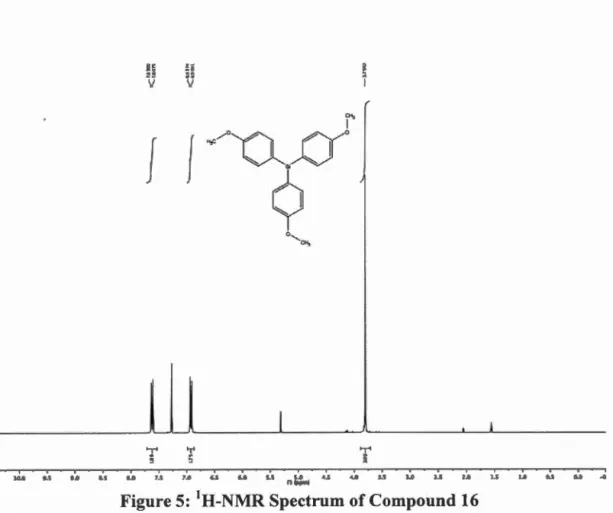
1H-NMR
spectrum of compound
16
shows
the presence
of a
methoxy
group on
the
aromatic
ring
which
is
activating
because the
oxygen atom of
the methoxy
group
donates its lone pair into the
aromatic
ring
via
resonance
,
making it more
electron
rich.
As a consequence
,
an
upfield
shift
is
observed
for the aromatic protons
compared
to the
para-tolyl
derivative 12.
The
resonace
of
the OMe in phenyl
ring
affects
the
8 of
H
on
the phenyl ring, not the H
of
the OMe.
Since
it is
a Csp
3-
H
,
the
OMe cornes
out at
the lower ppm
as shown
in
Figure 5.
J J
1
l1.s to.o 9.~ ~.o a.s 11.0 -G
Figure 5:
1H-NMR Spectrum of Compound 16
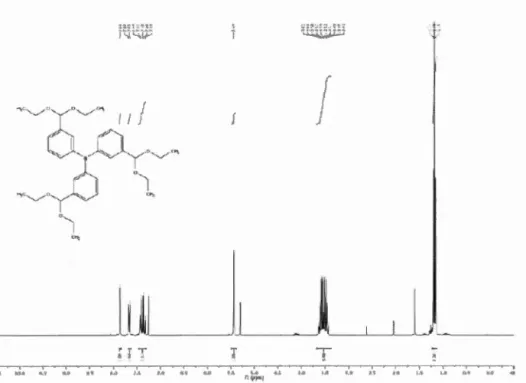
The
1H-NMR
spectrum
of isolated
compound
20
shows
the
characteristic signais for
the
acetal group as a 3H
triplet
at
1
ppm
,
2H
quartet
at 3.56
ppm
and
lH
singlet
at
5.5
ppm.
Aromatic
protons at
around
7 ppm
are also observed
in the fom1
of
two
doublets
,
confirming the presence of
a
para-substitued
phenyl ring
as shown
in
Figure 6
.
,-r "",.
.
l
i
'
·
·
"""'-../", 1/'>.,/ "'-1 ,.,_ • T -s l ~ 1 -~· .. , • ..,. ... - - - · · r ···--···r·----··r····-..-···-.,.-· ··•·· .. r·--····-·-·r·· ····-· ··rllj~ ~ .. <t' ~ .. ~}.\ J'lo o:;~ <otl l1o L-<1
flt,olfaf
r
J
T
~ · r ... r ··· , .,.. ··•···· 1-·~·-1 - ·1 -...-1\ H' l<o • ' )\ .>Q ;.\ l r. !-~ ,,.,Figure 6:
1H-NMR
Spectrum of Compound
20
1.4
Structural Characterization of Selected Triarylbismuthines
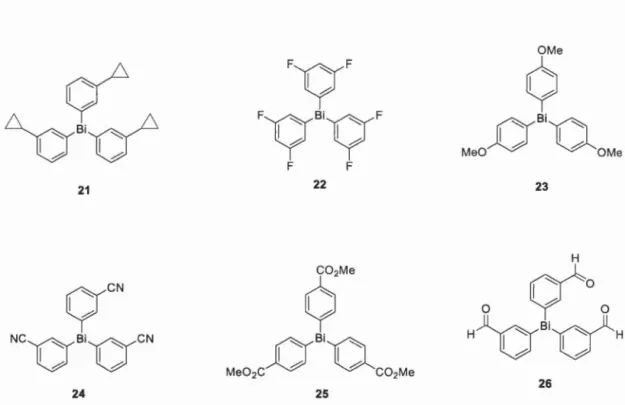
To
understand more deeply the
structure of
the triarylbismuthines
,
compound
21, 22,
23, 24,
25,
26
and
27 in
figure
7 were crystallized and analyzed
by X-ray diffraction.
The results show that the organobismuthines have a distorded pyramidal
structure and
that the
C
-
Bi bond lengths
vary from
2.24À to
2.27 À whereas
the C-Bi-C bond
angles
vary
between
91
°
and
98
°
.
Interestingly
,
the nature and position of the
substituent appears
to have
littl
e
impact on the
structure of the organobismuthine.
It
should
be noted that the
small
bond
angle
is due to the relativistic
effect of the !one
pair of
6s
orbital
of bismuth which
leads to
formation of C
-
Bi bonds with
the P
x,
p
y,
21 24
~·
'
Y
'
'Y
"
'
Y'
Bi
o
1_..-:; MeO OMe F F 22 23 26Table 1:
X-Ray Structures
of
Sorne
Organobismuth Reagents
C-Bi
bond length
C-Bi-C bond angle
FG
Ortep diagram
c,-Bi C,-Bi C,-Bi C,-Bi--C1 C1-Bi--C, C,-Bi--C,(Â) (Â) (Â)
21
2.254 2.256 2.253 95.73 94.94 92.47 3-c-Pr22
2.264 2.263 2.255 92.93 93.09 96.20 3,5-diF223
93.78 93.81 2.250 2.251 2.251 93.80 4-MeO24
2.273 2.263 2.269 93.07 98.04 91.77 3-CN25
2.262 2.260 2.255 93.33 94.81 92.11 4-C02Me26
2.266 2.266 2.266 92.02 92.02 92.02 3-CHO27
2.254 2.264 2.2541 91.50 94.58 95.61 3-(CH20H)ORGANIC
SYN
THESIS
2.1
INTRODUCTION
Organobism
uth
reagents
,
like
other organometa
lli
c reagents
,
have been
weil studied
and frequently
used
as a reagents in organic synthesis
[43
,
44]. Due to
environmenta
l
factors
,
the use
of
non-toxic reagents
r
epresents
th
e
ideal
approac
h
in
organic
synthesis. Thus
,
thi
s
class
of
reagent is ideal
for ary
l
ation reactions
[20
,
45
,
46].
Organobismuth
reagents undergo different major
types of ary
l
ation reactions: (a)
C
-and 0
-
arylation; (b) 0
-
ary
l
ation; (c) 0- and N
-
arylation (d) C-S ary
l
at
i
on
[
20
,
46].
2.1.1
N
-Arylation Reactions of
Aliphatic and Aromatic Amines Using
Triarylbismuth
Reagents
N
-
Arylation of a
l
iphatic and aromatic ammes with Ar
3Bi(0Ach under neutral
conditions cata
l
yzed
by
copper
powder
was
reported by Barton
and co
-
workers
[ 4 7].
In
a subsequent study
,
they reported a
Cu(0Ac)
2mediated
N
-
arylation of aliphat
i
c
and aromatic amines with Ar
3Bi under mildconditions as shown
in
Sc
h
eme
14.
These
react
i
ons are sensitive
to
steric
hindrance
on
the
an1i
n
e
and dependent
on
its basicity
[48].
Scheme 14FG- o -NH2
+
Ph3Bi+
Cu(OAch1.2 equiv. 0.5 equiv.
2.1.2 N-H Bond Formation
Using
Triarylbi
s
muth Reagents
Later
,
Barton
'
s work was
modified by
C
han
w
h
ere a
tertiary
amine was
introduced
as
a
promoter [
49].
By
add
i
tion of
triethylan1ine
o
r
pyridine
,
the scope of
the
ary
l
atio
n
reaction
of N
-
H
compounds
was exte
nd
e
d
to
other subst
r
ates s
u
ch as an1ides
,
imides
,
ureas
,
car
b
amates a
nd
s
ul
fo
n
ami
d
es wit
h
the
y
i
e
ld r
angi
n
g from 6
to
82% as s
ho
w
n
in
Sc
h
e
m
e
15.
Scheme 15 02N- oNH2+
Ph3Bi+
Cu(OAe)2 1.2 equiv. 0.5 equiv. Ph3Bi+
Cu(OAe)2 1.2 equiv. 0.5 equiv. Et3N 0.1 equiv. Pyridine 1 equiv.2.1.3
N-Arylation
of Diversely
Substituted
Hydrazines
Using
Triarylbismuth
Rea
gents
The ary
l
ation
of
substit
ut
ed
h
ydrazines s
u
c
h
as
B
oc
2N- NH
Boc
and Cbz(Boc)N
-NHBoc
was
reported by Maeorg and Ragnarsson
et al
(Sc
h
e
m
e
1
6)
[50-5
2
].
Scheme 16 Boe Boe \ ' N-N ' ' H Boe
1-2 equiv. Ar3Bi, 1.5 equiv. Cu(OAeh
1.5 equiv. Et3N, CH2CI2, RT
Ar: Ph, 4-MeC6H4 , 4-MeOC6H4
Boe Boe
\ '
N-N
1 '
2.1.4 N-Arylation of Azo Compounds Using Triarylbismuth Reagents
The
copper-catalyzed
arylation of azo
compounds using triarylbismuth
reagents
is
a
reaction
which
is
conducted
in methanol. In this transformation,
the
methanol
serves
as a source of
proton rather
than a solvent. The
reaction is performed in
acetonitrile
and was found
to be
regioselective
, delivering
the aryl group on
the nitrogen
which
is
connected to the
ary
l
gro
up
already in place rather than
on
the nitrogen
which
is
connected
to the BOC protecting
group (Scheme
17) [53].
Scheme 171.2 equiv. Ar23Bi,
Ar1- N=N-Boc
0.1 equiv. Cu(OAch, 5 equiv. MeOH
CH3CN, 55-75°C
Ar1: Ph, o-Tol, 2,4-(N02hC6H3, 4-N02C6H4
Ar2: Ph, 1-Np, o-Toi
These
types of reactions can be performed under mild conditions by using different
solvents such
as acetonitrile, methanol
,
N-Methyl
-
2-Pynolidone (NMP) and
different
copper salts such as
copper(II) chloride,
copper(II) chloride hydrate or copper(II)
acetate.
The presence of
slightly electron
donating
groups (for example
methyl) or
electron withdrawing groups (for examp
l
e
nitro) on the aryl moiety of the azo
compound
does not have any
significant
impact on the
efficiency
of the reaction.
The
Scheme 18 Ar1"- ,Boe
N
-
N
Ar 2 /1
"H protolysis Ar1"- ,BoeN-N
/ 'B·A 2 2 1 r 2 ArP'
2Bi0AcA
\
~BoeN
-
N
A~ 'cuOAe2.1.5 Resin-Bound Bismuthanes
as
N
-
and
0-Arylating
Reagents
Resin-bound bismuthanes
were
used in
N- and 0
-
arylation reactions
[54]
and
in
Suzuk.i cross-coupling
reactions in
solid-phase
organic
synthesis
[55].
These
reagents
can be
prepared
from commercially available chloromethyl polystyrene
,
p
-i
odophenol
as
linker
precursor and
diarylbismuth
triflate HMP A complex
.
These arylating
reagents are
designed in
a way that there
is
a sufficient
distance between
two types of
aryl groups
,
which
is important
to
protect the
carbon-bismuth
bond
and to allow the
selective split of two aryl transfer groups
during the
chemical
process.
Accordingly
,
the phenoxy group
has been
selected as a spacer since
most
electron poor aryl groups
are known
to
be selectively
transferred in
arylat
i
on
reactions
(Scheme
19) [56].
Scheme 19 res in:
-
0
n
o
-o-
Bi
cr
q
R: H, 4-F, 4-MeR
25
RIn
Scheme 20
,
p
-
ch
l
orobenzani
lid
e
and
oxazolidin
-
2-one were arylated
using
resin-bound bismuth
as
the arylating reagent
in
the presence
of copper(II) acetate
,
pyridine
as a
base
in
methylene dichloride
as
the
so
l
vent
,
providing mild
conditions for
this
reaction.
This
method is
l
ess attractive
than
Chan's
method due to
it
s
l
ow
productivity
whic
h
could be due
to
possible
indigent
diffusion
of
poorly
solub
l
e
copper(II)
acetate
int
o
the resin
[
49].
Scheme 20 1 equiv. resin 1.5 equiv. Cu(OAch 2 equiv. R: H, F, Me 1 equiv. resin 1.5 equiv. Cu(OAch 2 equiv.
2.1.6
0-Arylation
of Aliphatic Alcohols Using Triarylbismuth Reagents
The
use
of arylbismuth(III) as
0-phenylating reagents is less
common re
l
ative
to
arylbismuth(V).
Dononov
and co-workers
reported the 0-arylation
of aliphatic
phenols under mild
conditions
using
copper(II) acetate as
the
catalyst (Scheme 21)
[57].
Scheme 21
p-Toi 3Bi
+
ROH+
2 Cu(OAch p-Toi-ORR: Bu, Me
2.1.7 In-situ Oxidation of Arylbismuth(III) to Arylbismuth(V)
Pentavalent
arylbismuth
reagents
can
be
obtained via oxidation
of trivalent
ary
lbi
smuths
using iodobenzene-diacetate [58], benzoyl peroxide [59] or potassiwn
peroxymonosulfate
(OXONE
®
)
[60]. In the presence of copper(II) pivalate
and
potassiwn peroxymonosulfate
,
bismuth(V)
species were
formed during
aryl
transfer
reactions
as
reported by Sheppard
(Scheme 22)
[61].
Scheme 22 Ph3Bi (1 equiv.) OXONE™ (0.5 equiv.) Cu(OPivh (1. equiv.) acetone,