HAL Id: inserm-00841128
https://www.hal.inserm.fr/inserm-00841128
Submitted on 7 Jul 2013
HAL is a multi-disciplinary open access
archive for the deposit and dissemination of
sci-entific research documents, whether they are
pub-lished or not. The documents may come from
teaching and research institutions in France or
abroad, or from public or private research centers.
L’archive ouverte pluridisciplinaire HAL, est
destinée au dépôt et à la diffusion de documents
scientifiques de niveau recherche, publiés ou non,
émanant des établissements d’enseignement et de
recherche français ou étrangers, des laboratoires
publics ou privés.
Nonnegative Joint Diagonalization by Congruence Based
on LU Matrix Factorization
Lu Wang, Laurent Albera, Amar Kachenoura, Huazhong Shu, Lotfi Senhadji
To cite this version:
Lu Wang, Laurent Albera, Amar Kachenoura, Huazhong Shu, Lotfi Senhadji. Nonnegative Joint
Diag-onalization by Congruence Based on LU Matrix Factorization. IEEE Signal Processing Letters,
Insti-tute of Electrical and Electronics Engineers, 2013, 20 (8), pp.807 - 810. �10.1109/LSP.2013.2267797�.
�inserm-00841128�
Nonnegative Joint Diagonalization by Congruence
Based on LU Matrix Factorization
Lu Wang, Student Member, IEEE, Laurent Albera, Senior Member, IEEE, Amar Kachenoura,
Huazhong Shu, Senior Member, IEEE, and Lotfi Senhadji, Senior Member, IEEE
Abstract—In this letter, a new algorithm for joint
diagonaliza-tion of a set of matrices by congruence is proposed to compute the nonnegative joint diagonalizer. The nonnegativity constraint is im-posed by means of a square change of variables. Then we formulate the high-dimensional optimization problem into several sequential polynomial subproblems using LU matrix factorization. Numer-ical experiments on simulated matrices emphasize the advantages of the proposed method, especially in the case of degeneracies such as for low SNR values and a small number of matrices. An illus-tration of blind separation of nuclear magnetic resonance spec-troscopy confirms the validity and improvement of the proposed method.
Index Terms—Blind source separation, independent component
analysis, LU factorization, nonnegative joint diagonalization by congruence, nuclear magnetic resonance spectroscopy.
I. INTRODUCTION
Consider a set of real symmetric matrices sharing the common structure:
(1) where denotes an unknown transformation matrix, and is a set of unknown real diagonal ma-trices. is called a joint diagonalizer of . According to different applications, the matrices can be time-delayed covariance matrices, or higher order cumulant matrix slices. The objective of Joint Diagonalizing by Congruence (JDC) such matrices consists of estimating up to a scale factor and a permutation of columns. Such a problem appears in many signal processing contexts such as Blind Source Separation (BSS) and Independent Component Analysis (ICA). Some BSS applications involve a nonnegative mixing matrix . For instance, in Nuclear Magnetic Resonance
Manuscript received April 02, 2013; revised June 02, 2013; accepted June 04, 2013. Date of publication June 12, 2013; date of current version June 18, 2013. The associate editor coordinating the review of this story and approving it for publication was Prof. Arrate Munoz-Barrutia.
L. Wang, A. Kachenoura and L. Senhadji are with the INSERM, U1099 and the LTSI, Université de Rennes 1, Rennes, 35042, France, and also with the Centre de Recherche en Information Biomédicale Sino-Français (CRIBs), Rennes, France (e-mail: [email protected]; [email protected]; [email protected]).
L. Albera is with the INSERM, U1099 and the LTSI, Université de Rennes 1, Rennes 35042, France, with the Centre INRIA Rennes-Bretagne Atlantique, Rennes 35042, France, and also with the Centre de Recherche en Information Biomédicale Sino-Français (CRIBs), Rennes 35042, France (e-mail: [email protected]).
H. Shu is with the Laboratory of Image Science and Technology, School of Computer Science and Engineering, Southeast University, Nanjing 210096, China, and also with the Centre de Recherche en Information Biomédicale Sino-Français (CRIBs), Nanjing 210096, China (e-mail: [email protected]).
(NMR) spectroscopy, columns of represent the positive con-centration of source metabolites [13]. Therefore we propose to impose a nonnegativity constraint on the matrix in the JDC problem. Generally, can be estimated either indirectly or di-rectly [4]:
1) Indirect algorithms, such as JAD [3], FFDIAG [22], QDIAG [18], LUJ1D [1], FLEXJD [21], J-DI [14] and CVFFDIAG [19], estimate from the inverse of a transformation ma-trix , which minimizes the non-diagonal parts of
using the following criterion:
(2) where eliminates the non-diagonal parts of its input and denotes the Frobenius norm. These algorithms use additional constraint on , such as orthogonality [3] or unit-determinant [1], in order to avoid the trivial solution . There also exist some other criterions. For example, LUJ2D [1] minimizes a scale and permutation invariant criterion. An information theoretic criterion is proposed by Pham [12] and adopted by Joho [8] and Todros et al. [16], which requires the target set to be positive definite. However, the nonneg-ativity of can be hardly guaranteed in such approaches. 2) ACDC [20] and the subspace fitting algorithm [17] directly
estimate and the set in order to best approximate the target set by minimizing the following criterion:
(3) Herein the nonnegativity of can be enforced explicitly. In this letter, we present a nonnegative JDC algorithm based on criterion (3), which is committed to seek a nonnegative joint di-agonalizer . The nonnegativity constraint is imposed by means of a square change of variable. Then the high-dimensional op-timization problem is formulated into several sequential polyno-mial subproblems using LU matrix factorization. Numerical ex-periments on simulated matrices emphasize the advantages of the proposed method, especially in the case of degeneracies such as for low Signal to Noise Ratio (SNR) values and a small number of matrices. An illustration of blind separation of NMR spec-troscopy confirms the validity and improvement of the proposed method.
II. NONNEGATIVEJOINTDIAGONALIZATION
A way of including the nonnegativity constraint in (3) is through a square change of variable with
as originally proposed in [5] for Nonnegative Matrix Factoriza-tion (NMF), where stands for Hadamard product. Then (3) can be reformulated as the following unconstrained problem:
Minimizing (4) is the main purpose of this paper. To estimate , based on LU matrix factorization, the high dimensional optimiza-tion is reduced to search a sequence of sparse triangular matrices. Let’s recall the following definition:
Definition 1: A unit triangular matrix is a triangular matrix
whose main diagonal elements are equal to 1.
Then any matrix with full column rank can be factorized as , where is a unit lower triangular matrix, and , and are unit upper triangular matrix, diagonal matrix and permutation matrix, respectively. Hence, due to the fact that and the indeterminacies of the JDC problem, the matrix solving (4) can be chosen as
without loss of generality. Now, let’s consider the following definition and lemma:
Definition 2: An elementary triangular matrix is a unit triangular matrix whose non-diagonal elements are zeros ex-cept the -th entry, which is equal to .
Lemma 1: Any unit lower (or upper) triangular matrix
be-longing to can be factorized as a product of
elementary lower (or upper, respectively) triangular ma-trices.
The proof of lemma 1 is straightforward by reducing (or ) into an elementary triangular matrix whose all non-diagonal ele-ments are zeros, using Gaussian elimination. Lemma 1 yields that can be written as a product of elementary triangular matrices:
(5)
where is defined for the sake of convenience: it stands for when and for when with being the total number of elementary lower and upper triangular matrices. The sizes of all the and matrices are and , respectively, ex-cept that of which is . Ideally the mini-mization of (4) consists of finding matrices and the diagonal matrix set such that is a global minimum. As Yeredor’s ACDC (Alternating Columns and Diagonal Centers) algorithm [20], the algorithm proposed in this paper alternates between two minimization schemes:
• The AC (“Alternating Columns”) phase1minimizes (4) with
respect to (w.r.t) one matrix of , while keeping its other factors as well as fixed.
• The DC (“Diagonal Centers”) phase minimizes (4) w.r.t the diagonal matrix set while keeping fixed.
Hence, we name the proposed algorithm .
A. AC Phase
In this phase, we minimize (4) w.r.t . Instead of si-multaneously computing these matrices, each with a selected index is identified sequentially. Suppose that and are the current estimate of and , respectively. The up-date of by one is . Then we can show the following lemma:
1The update of by right multiplying with different index
affects the -th column of sequentially. Thus we retain the terminology ‘Al-ternating Columns phase’.
Lemma 2: The Hadamard square of the update is given by:
(6) where and denote the -th and -th columns of respec-tively, and is the -th column of the identity matrix.
The proof of lemma 2 is omitted due to lack of space. The optimization of (4) w.r.t only consists of minimizing the following cost function:
(7)
Inserting (6) into (7), the only unknown variable can be com-puted by minimizing the following cost function:
(8) with:
(9) where denotes the -th entry of . Equation (8) shows that is a 8-th degree polynomial in . The global min-imum can be obtained by computing the roots of its derivative and selecting the root yielding the smallest value of . Once the optimal is computed, the matrix is updated by computing .
However, it is observed that if the matrix set well fulfills the model (1), classical non-constrained JDC methods can give nonnegative . In this situation, imposing the nonnegativity con-straint explicitly is unnecessary and increases the computational burden. Therefore, the nonnegativity constraint can be relaxed by decomposing directly instead of using . Each parameter can be found by minimizing the following 4-th degree polynomial:
(10) In practice, it is suggested to compute by minimizing (10) first. If all the elements in the -th column of have the same sign, the update is adopted, where denotes the absolute value. Otherwise, is computed by minimizing (8). Then the AC procedure is repeated to estimate
with the next index. The processing of all the factors is called a full AC iteration.
B. DC Phase
In this phase, the minimization of (4) w.r.t the diagonal ma-trices can be separated into distinct linear least square subproblems:
(11) The optimal solution of given by [20] is:
(12)
where , and .
converts a matrix into a column vector by stacking its columns vertically.
In this context, one sweep is referred to the combination of one full AC iteration and one DC phase. The overall numerical com-plexity per sweep is , which is higher than
of ACDC [20]. In practice, several sweeps are necessary to en-sure convergence. One can stop the algorithm when the value of , or the decrease of between two successive sweeps falls below a fixed positive threshold. Such a stopping criterion is guaranteed to be met since is non-increasing in each sweep. We observed empirically that the proposed algo-rithm converges linearly.
III. SIMULATIONRESULTS
In this section, the proposed method is compared with several state-of-the-art JDC methods and BSS algorithms. The performance is measured in terms of the error between the true joint diagonalizer and its estimate , as well as the source and its estimate when a BSS context is considered. So the scale and permutation invariant distance defined in [7] is chosen as the preferred measure:
(13) where the solution (13) requires to sweep all the permu-tation matrices , and:
(14)
with and denoting the -th columns of and , respec-tively. Moreover, we repeat all the experiments with 500 inde-pendent Monte Carlo trials. All the algorithms stop either when the relative error of the corresponding criterion between two suc-cessive sweeps is less than or when the number of sweeps exceeds 2000. In the following experiments, all the algorithms are initialized by identity matrices. All the simulations are im-plemented in Matlab v7.14 and run on Intel Duad-Core 2.8 GHz CPU with 32 Gb memory.
A. Simulated JDC Model
In this test, the behavior of the proposed method is evaluated and compared with several classical nonorthogonal JDC methods, including one direct-type method, namely ACDC [20], and three indirect-type methods, namely FFDIAG [22], LUJ1D [1] and UWEDGE [15]. The synthetic matrix set is generated randomly according to (1) with , and
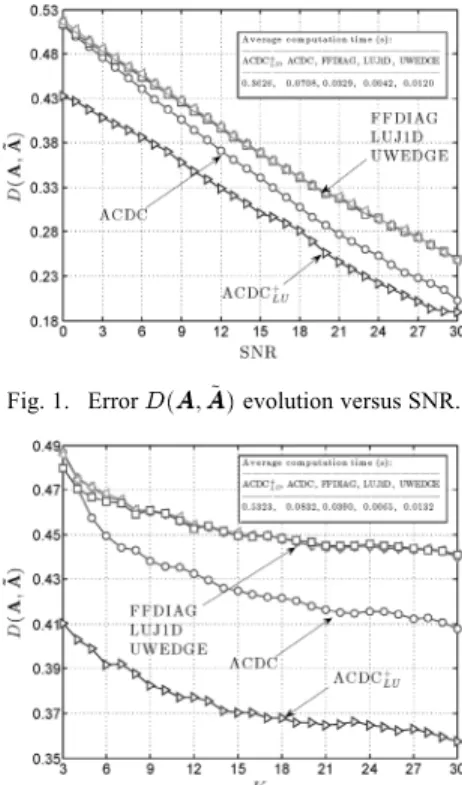
Fig. 1. Error evolution versus SNR.
Fig. 2. Error evolution versus the number of matrices.
. and the diagonal part of are drawn from the zero-mean unit-variance Gaussian distribution. Each resulting target matrix is perturbed by a random symmetric “noise” matrix as follows [4], [22]:
(15) where is a scalar controlling the noise level and is drawn from a standard normal distribution. Then the SNR is defined as . We study the influence of SNR and the effect of the number of matrices to be jointly diagonalized.
Fig. 1 shows the average error as a function of SNR ranging from 0 dB to 30 dB with . One can notice that the direct-type algorithms ACDC and the proposed method achieve better estimations than indirect-type methods. maintains a competitive advantage over ACDC, es-pecially when SNR values are below 15 dB. Fig. 2 depicts the average error of the compared algorithms as a function of the quantity varying from 3 to 30 with an SNR of 5 dB. As the quantity grows, direct-type algorithms produce a larger performance gain than indirect-type. It can be seen that the proposed method gives the smallest estimation errors. The interest of using nonnegativity is then significant in this experimental context. The average running time of the compared algorithms in the above experiments is presented in the upper right corners of Fig. 1 and 2, respectively. It shows that the proposed algorithm requires more time but can achieves better results.
B. BSS Application on NMR Spectroscopy Data
In addition to the good performance of the proposed method in simulated JDC model, we further illustrate its capability for BSS. is compared with three well-known BSS algo-rithms, namely the ICA methods CoM2 [6] and SOBI [2], and a
Fig. 3. NMR spectroscopy source metabolites, mixtures and estimated metabo-lites by , CoM2, SOBI and NNLS.
TABLE I
AVERAGEESTIMATINGERRORS OFMIXINGMATRIX ,
SOURCES ANDCOMPUTATIONTIME OFFOURMETHODS
FORBSSOFNMR SPECTROSCOPYSIGNALS
NMF method based on alternating NonNegativity Least Squares (NNLS) [9], through an experiment carried out on simulated NMR spectroscopy data [11]. Two source metabolites, namely the Choline (Cho) and Myo-inositol (Ins) (see Fig. 3(a)), are generated by means of Lorenzian functions with fixed parameters for a realistic representation [10]. It is assumed that the linear mixing model is valid, where is an additive white Gaussian noise with an SNR of 30 dB. 10 linear observations (see Fig. 3(b)) are created with similarly generated as in the previous section. The matrix set is built using 100 4-th order cumulant matrix slices.
Table I shows the average estimation errors of the mixing matrices, that of the source metabolites and the computation time of the compared methods. From the results of NNLS and , it is obvious that the nonnegativity con-straint allows us to improve the estimation since the two sources are not totally independent. In addition, the proposed
method gives the smallest estimating errors both for and . The estimated sources displayed in Fig. 3(c) to 3(f) coincide with the results shown in Table I. Regarding the unconstrained methods, SOBI can not separate both sources and CoM2 can not eliminate the influence of the Ins peak in the estimated Cho metabolite. NNLS gives a good result, but the two metabolites still slightly exist in each other’s estimate. As far as is concerned, the estimated source metabolites are quasi-perfect. It appears that, in this experimental context, the proposed technique based on a nonnegativity constraint improves the BSS perfor-mance in an acceptable running time.
IV. CONCLUSION
In this letter, we propose a novel nonnegative joint diagonaliza-tion by congruence algorithm named which computes
a nonnegative joint diagonalizer. Simulation results illustrate its improvement in dealing with degenerate JDC models and its po-tential usefulness in BSS applications.
REFERENCES
[1] B. Afsari, “Simple LU and QR based non-orthogonal matrix joint di-agonalization,” in ICA 2006, Springer LNCS Series, 2006.
[2] A. Belouchrani, K. Abed-Meraim, J. F. Cardoso, and E. Moulines, “A blind source separation technique using second-order statistics,” IEEE
Trans. Signal Process., vol. 45, no. 2, pp. 434–444, 1997.
[3] J. F. Cardoso and A. Souloumiac, “Jacobi angles for simultaneous diag-onalization,” SIAM J. Matrix Anal. Appl., vol. 17, pp. 161–164, 1996. [4] G. Chabriel and J. Barrère, “A direct algorithm for nonorthogonal ap-proximate joint diagonalization,” IEEE Trans. Signal Process., vol. 60, no. 1, pp. 39–47, 2012.
[5] M. Chu, F. Diele, R. Plemmons, and S. Ragni, Optimality, Computa-tion, Interpretation of Nonnegative Matrix Factorizations Wake Forest Univ., Winston-Salem, NC, USA, 2004, Tech. Rep..
[6] P. Comon, “Independent component analysis, a new concept?,” Signal
Process., vol. 36, no. 3, pp. 287–314, 1994.
[7] P. Comon, X. Luciani, and A. L. F. de Almeida, “Tensor decomposi-tions, alternating least squares and other tales,” J. Chemometr., vol. 23, pp. 393–405, 2009.
[8] M. Joho, “Newton method for joint approximate diagonalization of positive definite hermitian matrices,” SIAM J. Matrix Anal. Appl., vol. 30, no. 3, pp. 1205–1218, 2008.
[9] H. Kim and H. Park, “Nonnegative matrix factorization based on alter-nating nonnegativity constrained least squares and active set method,”
SIAM J. Matrix Anal. Appl., vol. 30, no. 2, pp. 713–730, 2008.
[10] S. Moussaoui, “Séparation de sources non-négatives: application au traitement des signaux de spectroscopie,” Ph.D. dissertation, Univ. Henri Poincaré, Nancy, France, 2005.
[11] H. Parastara, M. Jalali-Heravia, and R. Taulerb, “Is independent com-ponent analysis appropriate for multivariate resolution in analytical chemistry?,” Trends Analyt. Chem., vol. 31, pp. 134–143, 2012. [12] D. T. Pham, “Joint approximate diagonalization of positive
defi-nite hermitian matrices,” SIAM J. Matrix Anal. Appl., vol. 22, pp. 1837–1848, 2001.
[13] P. Sajda, S. Du, T. R. Brown, R. Stoyanova, D. C. Shungu, X. Mao, and L. C. Parra, “Nonnegative matrix factorization for rapid recovery of constituent spectra in magnetic resonance chemical shift imaging of the brain,” IEEE Trans. Med. Imag., vol. 23, no. 12, pp. 1453–1465, 2004.
[14] A. Souloumiac, “Nonorthogonal joint diagonalization by combining Givens and hyperbolic rotations,” IEEE Trans. Signal Process., vol. 57, no. 6, pp. 2222–2231, 2009.
[15] P. Tichavský and A. Yeredor, “Fast approximate joint diagonalization incorporating weight matrices,” IEEE Trans. Signal Process., vol. 57, no. 3, pp. 878–891, 2009.
[16] K. Todros and J. Tabrikian, “QML-based joint diagonalization of posi-tive-definite hermitian matrices,” IEEE Trans. Signal Process., vol. 58, no. 9, pp. 4656–4673, 2010.
[17] A. J. van der Veen, “Joint diagonalization via subspace fitting tech-niques,” in Proc. ICASSP’01, 2001, vol. 5, pp. 2773–2776.
[18] R. Vollgraf and K. Obermayer, “Quadratic optimization for simulta-neous matrix diagonalization,” IEEE Trans. Signal Process., vol. 54, no. 9, pp. 3270–3278, 2006.
[19] X. F. Xu, D. Z. Feng, and W. X. Zheng, “A fast algorithm for nonuni-tary joint diagonalization and its application to blind source separa-tion,” IEEE Trans. Signal Process., vol. 59, no. 7, pp. 3457–3463, 2011. [20] A. Yeredor, “Non-orthogonal joint diagonalization in the least-squares sense with application in blind source separation,” IEEE Trans. Signal
Process., vol. 50, no. 7, pp. 1545–1553, 2002.
[21] G. Zhou, S. Xie, Z. Yang, and J. Zhang, “Nonorthogonal approximate joint diagonalization with well-conditioned diagonalizers,” IEEE
Trans. Neural Netw., vol. 20, no. 11, pp. 1810–1819, 2009.
[22] A. Ziehe, P. Laskov, G. Nolte, and K.-R. Muller, “A fast algorithm for joint diagonalization with non-orthogonal transformations and its application to blind source separation,” J. Mach. Learn. Res., vol. 5, pp. 777–800, 2004.