Running head: REFLECTION AMPLIFIERS IN ONLINE COURSES
This is the author’s post-print of:
Verpoorten, D., Westera, W., & Specht, M. (2011). Reflection amplifiers in online courses: a classification framework. Journal of Interactive Learning Research, 22(2), 167-190.
Reflection amplifiers in online courses:
a classification framework
Abstract
This paper provides a theoretical framework for "reflection amplifiers" that are used in online courses. Such reflection amplifiers are intervention techniques that aim at provoking reflective practices in learning, in order to enhance the quality and effectiveness of learning and promote meta-cognition. A literature survey identified a sample of 35 different
techniques, revealing a great variety of reflection amplifiers in today’s educational practice. For the support of research into this topic, the paper provides a theoretical classification framework structured along two
relevant attributes of reflection amplifiers: (a) the type of interaction which enacts the reflection amplifiers, and (b) the educational objective of the reflective activities. The framework provides a concrete and ordered expression of pursued reflective or meta-learning approaches. It has been used to create a mapping of the 35 identified techniques, enabling their detailed positioning, qualification and comparison. The framework also helps guiding future research activities and to create awareness among
online course developers about the different approaches available. The paper concludes with the identification of relevant research challenges associated with the topic.
Opportunities to reflect
For many years, both teachers and researchers have been stressing the importance of reflection for learning (Aviram, 2008; Peters, 2004). Reflection is claimed to promote deeper and more effective learning both in regular classrooms (Watkins, 2001) and in eLearning settings (Means, Toyama, Murphy, Bakia, & Jones, 2009). It is generally acknowledged that stimulating reflective skills will prepare knowledge workers to cope with requests for new knowledge acquisition and ongoing personal
development in the information society (Rychen & Salganik, 2003; European Commission, 2006).
Today’s electronic learning environments offer many new
opportunities for reinforcing reflection by prompting learners about their own learning. The survey in this paper identifies 35 different applied prompting techniques. These may vary from simple informative prompts which summarise the learning goals to more complex and interactive tools that invoke the learners to verbalise certain aspects of their learning. In this paper we will use the term "reflection amplifier" for these techniques: a reflection amplifier is a deliberate and well-considered prompting
evaluate their own learning (Amulya, 2004). Although a wide variety of reflection amplifiers can be observed in online courses (Verpoorten, Westera, & Specht, 2009), there is only little research evidence available about the assumed effects and usage. Importantly, theoretical foundation is lacking as to what type of reflection amplifier should be used to procure or support particular learning outcomes. As a first step into this research, this paper provides a theoretical framework which identifies the relevant attributes of reflection amplifiers. The framework can be used to guide future research activities in reflection amplifiers and to create awareness among online course developers about the different approaches that are available for boosting reflection activities by learners.
First, the paper elaborates the underlying rationale of the work by summarising the main research findings about the role of reflection in learning. Next, 35 reflection amplifiers found in the literature are
summarised. Then, the classification framework for reflection amplifiers is introduced and explained. Subsequently, the framework is used for a mapping of the 35 reflection amplifiers found in the literature. In
conclusion, a research agenda with respect to promoting learner reflection in teaching and learning practice is outlined.
Review of research on reflection
Reflection is generally assumed to be an essential factor of learning
(Heargraves, 2005). It may take place before, during and after action. Its practice in schools is supposed to gradually develop the learners'
awareness of what helps and hampers a consistent orchestration of the various dimensions of their learning (Ertmer & Newby, 1996). Prominent authors endorse the importance for learners to develop observations about their own learning experiences. Examples would be Schön’s ladder of reflection (Schön, 1994), Bateson’s notion of deutero-learning
(Bateson, 1977), and Kolb’s reflective observer stage (Kolb, 1984).
Despite the claimed importance of reflection for learning, Watkins (2001), Claxton (2006) or Csapó (1999) observe that there is a lack of clear
theoretical approaches and tested practices.
The concept of reflection is akin to constructs like meta-cognitive development (Gama, 2004), learning to learn (Watkins, 2001), and self-regulated learning (Isaacson & Fujita, 2006; Ridley, Schutz, Glanz, & Weinstein, 1992; Zimmerman, 1995), respectively. This proximity has lead to a variety of different interpretations and understandings of the word "reflection" amongst teachers and educational researchers. Schraw (1998) or Zimmerman (quoted in Jackson, 2004) claim that there is no clear distinction between cognitive and meta-cognitive skills. As for this article, reflection is defined as an active process of witnessing one’s own learning experience and evaluating its different aspects. Reflection is considered as a means by which learners can build and evolve a mental model of the learning process they are committed to and of their position inside this process (Seel, Al-Diban, & Blumschein, 2002), so that
Despite its long history (Flavell, 1979), research on reflection and adjacent concepts is still highly topical and linked with urgent, worldwide societal needs. The co-ordinating idea of this paper is that reflection can be prompted and supported by using "reflection amplifiers", that is, structured opportunities for learners to examine and evaluate their learning experience (Amulya, 2004). It is assumed that instructional practice should not simply aim at engaging learners at the level of
presenting information for understanding and use, but also direct them at meta-levels of learning.
Overview of existing reflection amplifiers
A literature survey has been carried out to identify existing
approaches for promoting reflection in online learning. This survey yields a sample of 35 reflection amplifiers that (a) embody different approaches, (b) are well-documented, and (c) have actually been used by learners. A detailed analysis of these reflection amplifiers is beyond the purpose of the paper. Appendix 1 supplies the gathered reflection amplifiers along with a textual label, an extremely compact definition and references. Although this sample is limited in size, it is assumed to represent the diversity of current teaching practice adequately. Extended explanations of the course contexts and the applied reflection amplifiers can be found in the associated references. Later on in this paper we will present a
mapping of the various reflection amplifiers on to the classification framework. The main observation flowing from the literature survey is
that reflection amplifiers are being used in online courses in a wide
variety, without any co-ordinating framework or theoretical basis to build on. Such basis will be presented in the next section.
A general classification framework for reflection amplifiers
When considering reflection amplifiers as instruments that foster the process of reflection, both the inputs and outputs of this reflection process are supposed to be important determinants. The inputs of the process can simply be conceived as the various modes of interaction that occur when the learner is confronted with a reflection amplifier. The outputs of the process essentially correspond with the particular
objectives that are pursued by the reflection amplifier, viz. the skills involved and trained. By their nature, the inputs and the outputs of the reflection process are the principal candidates for devising a
classification framework. Figure 1 displays the general lay-out of this two-dimensional framework.
Figure 1. A two-dimensional classification framework for reflection
amplifiers
The horizontal dimension of the framework complies with the inputs of the reflection process. It depicts the kind of actions requested from the learners to enact a reflection amplifier. Based on an analysis of the reflection amplifiers inventory, three major sub-categories of inputs (interaction types) have been identified.
Interaction type 1: Receiving information
This category of interaction induces the reflective experience by
requesting the learners to look at or ponder upon externally provided cues or information related to the learning context and the learners’ positioning within it. Reflection amplifiers in this category do not imply an observable action of the learner, except, possibly, the time spent in the contemplation
process. From the system perspective, this category most often implies that some personal data are tracked, recorded and shown.
Interaction type 2: Giving information (Responding)
This category of interaction induces the reflective experience by asking the learners to give a quick insight into their behaviours or performances through the use of a scale. From the system perspective, this category requests the presentation of scoring/rating/ticking artefacts to the learner.
Interaction type 3: Verbalizing information
This category of amplifiers induce a reflective experience by asking the learners to produce a mental or written discourse about certain
aspects of their learning. From the system perspective, this category may involve making available an annotation tool or prompts for reflective pauses.
The vertical dimension corresponds with the outputs or targets of the reflection process, the pedagogical effects that the amplifiers are
supposed to procure. This dimension has been subdivided into three
outputs (instructional purposes) that are likely to be achieved through the use of reflection amplifiers.
Instructional purpose a: training reflection on content and task level
Expected benefit of this category of reflection amplifiers is the enhanced understanding of the nature of the learning content and the associated tasks. The awareness of these elements is considered a crucial contextual determinant of learning, at least in formal education where
learners are self-regulated, autonomous coordinators locked in a system (Pilgerstorfer, 2005). A basic instructional issue related to this category of amplifiers is how students will mix and coordinate externally regulated elements (learning goals, assessment criteria, assignments…) with the possibilities of self-regulated action.
Instructional purpose b: training reflection on learning processes
This category of reflection amplifiers refers to one's own process of learning. It gathers techniques that foster an externalization of mental activities, bearing either on pre-existing cognitive processes or triggered by the amplifier itself. This distinction relates to the debate about the conscious or non-conscious nature of meta-learning (Koriat & Levy-Sadot, 2000; Schraw & Moshman, 1995).
Instructional purpose c: training reflection on the whole learning experience
This category deals with the expression, explanation and assessment of one's own learning experience as a whole. It covers
techniques which stimulate reflection by requesting from the learners an integration and a restructuration of several dimensions of their learning experiences. This concerns a high-order competency which includes
discussing the learner’s emotional/motivational state and other attitudinal aspects. This restructuring process is usually done post-practice. The output of the process is a comprehensive and self-critical narrative or judgment of what components of the process have effectively contributed
to the learning. From there, a diagnostic can be drawn by the learner and advice for enhanced future self-regulation can be derived.
Clearly, it would have been possible to arrange the reflection amplifiers along other dimensions, for instance according to the line of inquiry they come from (self-regulated learning, meta-cognition, learning to learn), the level of complexity of their implementation, or their location in the learning process (before the action, during the action, after the action). However, our two final clustering keys are consistent with the aforementioned motives to undertake this research: (a) tackling
pedagogical concerns: rows are centred on the training of reflective abilities; (b) taking into account the multimedia aspects of reflection amplifiers: columns relate to the interactions learners have with the instruments. The principal dimensions realise a connection between the how (input) and the why (objectives) of the reflection process.
Reflection amplifiers classes defined by the framework
The two axes and their sub-categories now define nine cells in the framework, each of which denoting a specific class of reflection skills trained by a subset of reflection amplifiers. Figure 2 displays the
framework, while each cell now contains a brief indication of its specific purpose.
Figure 2. The separate cells in the classification framework and their
purposes.
Below, a brief explanation of the types of reflection skills that are covered by the separate cells is provided.
1. Understanding the learning task. Reflection amplifiers in this class provide information or hints for students to internalize the rationale, the objectives, the success criteria or the associated resources tied to a learning task.
2. Estimating one’s state of knowledge. This class covers reflection throughout the engagement of learners in a rating episode.
3. Taking the evaluator's viewpoint. This class triggers reflection about the nature of the learning task by asking learners to evaluate its significance from the instructor's viewpoint.
4. Interpreting one’s actual status. This class collates reflection amplifiers that give learners clues likely to help them developing informed choices and orienting actions. Clues can be static, like a help-seeking behaviour guide, or dynamic, like providing an updated status of the learner’s position in the learning process.
5. Awareness of comprehension. This class gathers amplifiers that promote reflection through a (periodic) process of self-evaluation (the ability to assess one's own cognition) while learning. This self assessment habit is intricately linked to self-management.
6. Explaining one’s learning activities. This class presupposes that learners engage in the production of text, speech, annotations or schemes, while interacting with the course contents.
7. Awareness of one’s learning footprints. This class induces reflection by the presentation of personal data which mirrors the process of learning and its critical moments.
8. Judging one’s own learning. This class fosters reflection through the learners' rating or report of the progress they believe having made in the learning areas as a consequence of the course they were taking.
9. Composing one’s learning narrative. This class gathers reflection amplifiers that foster comprehensive evaluation of the learning
experience. Tools similar to learning diaries, e.g. reflective journal, thinking book, personal portfolio, or blog, imply the coordination and the restructuring of personal information in a meaningful and self-critical narrative. This post-practice reflection should not be limited to a debriefing. Useful insights for an enhanced regulation of
learning should ideally stem from it.
Mapping reflection amplifiers onto the classification framework
The main purpose of the framework presented above is to provide some order and key characteristics of useful techniques that foster a reflective approach to learning. Abstract descriptions of categories and classes also provide a way to start conversations about reflection (and associated constructs) in the practice of education. In this section, the explained classification framework is used to sort and organize the set of reflection amplifiers that arose from the literature survey. Locating any reflection amplifier in the classification framework inherently involves attaching a formal description to it. For instance, the identified type
"Permanent reflecting tool", like the portfolio (cf. reflection amplifier 32 in table 3 of the Appendix) denotes an artefact which is supposed to support reflection on the whole learning experience (output), and uses
Figure 3. Mapping of reviewed reflection amplifiers onto the proposed
classification framework. Figures in brackets refer to their description in the Appendix.
A validation process of the mapping was carried out. 8 e-learning experts, from 3 institutions, were requested to locate the 35 amplifiers in the framework. Only the very short descriptions of the amplifiers (see the Appendix) were available to them. On the basis of this compact piece of information, the location of 17 reflection amplifiers was confirmed with a level of inter-subjective agreement of 5/8 or more (these amplifiers are in bold type in the table). Experts usually located the 18 remaining
amplifiers in the same column (a different column is chosen only 17 times out of 280) but can diverge as to the line. It means that the output
dimension (trained reflection skill) leaves more room for different interpretations than the input dimension (interaction type). This is especially visible when it comes to the distinction between reflection targeting external elements (row 1: content and task) or personal elements (row 2: personal learning processes). Follow-up interview
sessions with experts confirm that the natural interplay between these two skills can lead to hesitations regarding the positioning of an amplifier in the first or in the second line. When provided with additional explanation about the ambiguities were elucidated and experts agreed that the initial location was appropriate. Talking in terms of dominant targeted skill instead of exclusive targeted skill appeared opportune in the light of the discussions.
In conclusion, the mapping exercise provides a synthetic and synoptic view of the selected reflection amplifiers. To teachers or
instructional designers who ponder over possibilities to infuse reflective practice in a course, the classification framework offers a means to evaluate and compare different reflection amplifiers within the same category and across categories. The validation process demonstrates that the kind of interaction implied and the type of reflection skills addressed by reflection amplifiers can profitably be used as descriptors thereof. Even when hesitations occur with regard to the trained skill, the framework and its controlled vocabulary help to engage discussion over the roles and
significance of the different techniques. As a descriptive aid, the model can be used to analyze an existing opportunity for reflection. As a
prescriptive aid, it can help choosing the most appropriate technique for new training sequences or for the enhancement of existing ones.
Further lines of inquiry
Part of the meta-learning activity consists in building a mental model of the learning context and of oneself inside this context (Seel, 2001), so that actions can be tuned to it. The purpose of this article has therefore been to review and categorize a selection of instruments fostering
students' reflection about task-related and self-related aspects of their learning activity. The inventory from the literature and the classification framework show that reflection amplifiers materialize a "reflective
learning" trend which deserves further investigation both from a
theoretical and a practical perspective. The last part of this paper outlines a multidimensional agenda for this investigation by explaining 4 relevant challenges
Challenge 1 – Dissemination and acceptance of the idea.
An obvious condition to the dissemination of reflective practice is a wider acceptation and better understanding of its core ideas. Despite growing evidence that investing learning time in developing the abilities of participants to reflect on how they are learning has a positive impact on what they learn, systematic articulation between learning and meta-learning is not often deployed in courses. A broader acceptance partly
entails a demonstration to the teachers and to the learners of the pay-offs and benefits of this articulation. Research work on acceptance must go along with investigation of sensible patterns for simultaneous or
sequential combination of different reflection amplifies in courses. Bannert (2006), for instance, observes that many learners have difficulties in
performing meta-cognitive activities spontaneously, in effect resulting in lower learning outcomes. She concludes that offering meta-cognitive support is not sufficient; care has to be taken, that these instructional prompts are utilized in the intended manner in order to increase learning outcomes. Learners that are the most likely to benefit for an increase of opportunities for reflection must also be identified. This hints at setting up research into the favourable and specific conditions for usage in practical settings.
Challenge 2 – Exploring the value of tracked data for instruction.
Several reflection amplifiers are based on the mirroring of personal tracked data. It is plausible that developing self-analytic behaviours could be trained by exploiting the unique tracking facilities of electronic
environments. Although mining learners' interactions is a common concern of adaptive system improvement, the goal remains an
administrative background treatment of this data and hardly the mirroring of their actions to students. A few authors have expressed interest for the exploitation of different kinds of interaction "footprints", but the targeted stakeholders have mostly been researchers (Leclercq, Fernandez, & Prendez, 1992; Perry & Winne, 2006) or instructors (Diagne, 2009), and
not students. For instance, Nagi and Suesawaluk (2008) recommend tutors to make use of the students' data tracked by the Moodle eLearning platform in order to better regulate their courses. Scheuer & Zinn (2007) or Mazza & Dimitrova (2004) use information visualization techniques that take student tracking data collected by CMS and generates graphical
representations that can be used by instructors to gain an understanding of what is happening in distance learning classes. Mazza's work lead to the production of Gismo, a tool managing the visualization of data tracked in Moodle (Mazza & Botturi, 2007). In a similar vein and on the same
platform, Zhang & al (2007) have developed a CMS log analysis tool, called Moodog, to track students’ online learning activities. A few
researchers have made attempts to place learning traces in the hands of lifelong learners who therefore turn to be agents and researchers in their own learning processes (Winne, 2005). However, the use of those
footprints by the learners appears to remain close to zero (Narciss et al., 2007; Specht et al., 2001). It means that the mere presence of any meta-learning prompter is not enough to improve meta-meta-learning, unless
students are somehow motivated to use it. Johnson & Sherlock (2008) also observe that self-analytics tool can be unwelcome because they represent an incentive to change learning habits, which is hard for many learners. Nevertheless, they conclude that this kind of prompts amplify conversations about learning, which may be a condition for initiating the self-changing process. A systematic investigation of the reflection
amplifiers based on the feedback to learners of their personal tracked data deserves attention.
Challenge 3 – "Widgetizing" reflection amplifiers.
Another challenge is technical in kind. Is it possible to develop generic amplifiers that could be plugged into courses? This widget approach, in line with the pick-and-mix approach conveyed by Web 2.0, is worth exploring for delivering mainstream user friendly techniques. In this context, the value of a "learning dashboard" should be assessed: such dashboard would be an information and communication space which condenses, combines and explains situation-related (targeted learning goals, available learning resources, mandatory and optional tasks, needed and trained skills, time allocations, marks, etc.), self-related (tasks
completed, achieved learning goals, resources consulted, etc.) and social-related learning cues. The dashboard would simultaneously be a place for answers and for questions regarding personal learner information and fixed/imposed learning situation components. The dashboard would also take on Azevedo (2005) who suggests a new way of thinking about educational technologies that focuses on the use of computers as meta-cognitive tools designed to detect, trace, monitor, and foster learners’ self-regulated learning of conceptually challenging topics. The dashboard steers the learner’s attention toward meta-learning actions, which is an essential condition to the efficient and meaningful execution of the tasks. It also makes this targeted information available to the learners,
except the exploratory studies mentioned above, only few studies have tried to systematically address the benefits that mirroring interaction with the course might yield for the student. A systematic investigation and presentation of those benefits can be put on the research agenda.
Challenge 4 – Exploring links between reflection and personalization.
There is very few research available (Verpoorten, Renson, Westera, & Specht, 2009; Waldeck, 2007) about what makes a student feel that a unit of learning is personalized, and about the impact of this feeling. What makes learning personal? What fosters its ownership? Promotion of meta-learning, through the use of reflection amplifiers, may boost this inner perception of personalised learning. The relationship between reflective practice and sense of personalization merit further investigation.
Conclusion
This paper has contributed to studying the ways, conditions and effects of learning with (and without) explicit reflective thinking. It has provided a list, a classification framework of reflection amplifiers, and a mapping of the two, as levers towards systematized way of looking at and talking about tools for helping students to reflect. Also it has outlined the research challenges that go with the promotion of meta-learning
dimensions, the investigation of the relationship between reflection, self-awareness and learning and the challenges raised by the funnelling of online courses into this approach.
References
Amulya, J. (2004). What is Reflective Practice? Cambridge, MA:
Massachusetts Institute of Technology Center for Reflective Practice. Attwell, G., Chrzaszcz, A., Hilzensauer, W., Hornung-Prahauser, V., &
Pallister, J. (2007). Grab your future with an e-portfolio – Study on
new qualifications and skills needed by teachers and career
counsellors to empower young learners with the e-portfolio concept and tools – Summary Report. Retrieved October 15, 2009, from
http://www.mosep.org/study
Ausubel, D. P. (1960). The use of advance organizers in the learning and retention of meaningful verbal material. Journal of Educational
Aviram, R. (2008). Navigating through the Storm: Education in
Postmodern Democratic Society. Rotterdam: Sense Publishers.
Azevedo, R. (2005). Computer Environments as Metacognitive Tools for Enhancing Learning. Educational Psychologist, 40(4), 193 - 197. Baird, J. R., & Mitchell, I. J., (1986). Improving the quality of teaching and
learning: An Australian case study - The PEEL project. Melbourne:
Monash University.
Bannert, M. (2006). Effects of reflection prompts when learning with hypermedia. Journal of Educational Computing Research, 4, 359-375.
Bateson, G. (1977). Vers une écologie de l’esprit (Vol. I) [Towards an ecology of mind]. Paris: Seuil.
Bilodeau, H. (1999). Les objectifs pédagogiques dans les activités
d’apprentissage de cours universitaires à distance [Learning goals in
higher education learning tasks]. Distances, 3(2), 33-68. Bull, S. & Mabbott, A. (2006). 20000 Inspections of a
Domain-Independent Open Learner Model with Individual and Comparison Views. In M. Ikeda, K. Ashley & T-W. Chan (Eds.), Intelligent
Tutoring Systems: 8th International Conference (pp. 422-432).
Berlin, Heidelberg: Springer-Verlag.
Claxton, G. (2005, September). Expanding the capacity to learn: a new
end for education?. Keynote speech presented at the British
Educational Research Association Annual Conference, University of Warwick, UK.
Cobine, G. R. (1995). Writing as a response to reading. (ERIC Clearinghouse on Reading, English, and Communication, No. ED386734)
Coffield, F., Moseley, D., Hall, H., & Ecclestone, K. (2004). Learning styles
and pedagogy in post-16 learning. A critical and comprehensive review of learning style research, highlighting 13 core learning styles. London: Learning and Skills Research Centre.
Csapó, B. (1999). Improving thinking through the content of teaching. In H. Hamers, J. van Luit & B. Csapó (Eds.). Teaching and learning
thinking skills, pp. 37-62. Lisse, Swets and Zeitlinger, Lisse (1999)
de La Garanderie, A. (1989). Défense et illustration de l'introspection [Introspection: rationale and cases]. Paris: Le Centurion.
Diagne, F. (2009). Instrumentation de la supervision de l’apprentissage
par la réutilisation d’indicateurs: Modèles et Architecture [Models
and architecture of reusable indicators for the support of learning supervision]. Unpublished doctoral dissertation. Université Joseph Fourier, Grenoble, France.
Ertmer, P. A., & Newby, T. J. (1996). The expert learner: Strategic, self-regulated, and reflective. Instructional Science, 24(1), 1-24. EuropeanCommission. (2006). Proposal for a recommendation of the
European Parliament and of the Council on key competences for lifelong learning - COM(2005)548 final. Brussels: European
Flavell, J. H. (1979). Metacognition and cognitive monitoring : A new area of cognitive-developmental inquiry. American Psychologist, 3, 906-911.
Gama, C. (2004). Integrating Metacognition Instruction in Interactive
Learning Environments. Unpublished doctoral dissertation,
University of Sussex – Brighton.
Glahn, C., Specht, M., & Koper, R. (2007). Smart indicators on learning interactions. In E. Duval, R. Klamma & M. Wolpers (Eds.), EC-TEL
2007, 56-70. Berlin, Heidelberg: Springer.
Gummesson, G., & Nordmark, E. (2007, September). Reflective learning
during an online course. Paper presented at the Annual meeting of
the U21 Health Sciences group, Honk Kong. Retrieved October 15, 2009, from
http://www.u21health.org/meetings/hongkong2007/docs/conferenc e/Reflective_Learning_HRS.pdf
Heargraves, D. (2005). About Learning - Report of the Learning Working
Group. Retrieved October 15, 2009, from
http://www.demos.co.uk/publications/aboutlearning
Isaacson, R., & Fujita, F. (2006). Metacognitive knowledge monitoring and self-regulated learning: Academic success and reflections on
learning. Journal of the Scholarship of Teaching and Learning, 6(1), 39-55.
Jackson, N. (2004). Developing the Concept of Metalearning. Innovations
Diaz, J, Rifqui, M., R., Bouchon-Meunier, B., Jhean-Larose, S., Denhière, G. (2008, September). Imperfect Answers in Multiple Choice
Questionnaires. Paper presented at the 3rd European conference on
Technology Enhanced Learning, Maastricht, The Netherlands. Johnson, M., & Sherlock, D. (2008, October). Personal Transparency and
self-analytic tools for online Habits. Paper presented at the
Workshop “Stimulating Personal Development and Knowledge Sharing”, Sofia, Bulgaria
Kay, J. (2006, June). Scrutable adaptation: because we can and must. Paper presented at the 4th International Conference Adaptive Hypermedia and Adaptive Web-Based Systems, Dublin, Ireland. Kolb, D. A. (1984). Experiential Learning. Englewood Cliffs, NJ:
Prentice-Hall.
Koriat, A., & Levy-Sadot, R. (2000). Conscious and Unconscious
Metacognition: A Rejoinder. Consciousness and Cognition, 9(2), 193-202.
Leclercq, D., Fernandez, A., & Prendez, M. P. (1992). OLAFO, Hypermédia
destiné à entraîner à l'apprentissage de l'espagnol écrit [OLAFO, an
hypermedia dedicated to writing skills in Spanish language]. Unpublished manuscript. University of Liège, Belgium. Leclercq, D. (1982). Confidence Marking: its use in testing. In
Postlethwaite & Choppin (Eds.), Evaluation in Education, 161-287. Oxford: Pergamon.
Mazza, R., & Botturi, L. (2007). Monitoring an Online Course With the GISMO Tool: A Case Study. Journal of Interactive Learning
Research, 18(2), 251-265.
Mazza, R., & Dimitrova, V. (2004). Visualising student tracking data to
support instructors in web-based distance education. Paper
presented at 13th international World Wide Web conference on Alternate track papers and posters, New York, USA.
McNamara, D. S., O'Reilly, T., Rowe, M., Boonthum, C., & Levinstein, I. B. (2007). iSTART: A web-based tutor that teaches self-explanation and metacognitive reading strategies. In D. S. McNamara (Ed.),
Reading comprehension strategies: Theories, interventions, and technologies, 397-420. Mahwah, NJ: Erlbaum.
Means, B., Toyama, Y., Murphy, R., Bakia, M., & Jones, K. (2009).
Evaluation of evidence-based practices in online learning: A meta-analysis and review of online learning studies. Retrieved October 15,
2009, from http://www.ed.gov/rschstat/eval/tech/evidence-basedpractices/finalreport.pdf
Mitchell, I., & Mitchell, J. (2008). The Project for Enhancing Effective
Learning (PEEL): 22 Years of Praxis. In A. P. Samaras, A. R. Freese, C.Kosnik, C. Beck (Eds.) Learning Communities In Practice (pp7-18). USA: Springer.
Mitrovic, A., & Martin, B. (2002). Evaluating the Effects of Open Student Models on Learning. In Adaptive Hypermedia and Adaptive
Nagi, K., & Suesawaluk, P. (2008). Research analysis of moodle reports to
gauge the level of interactivity in elearning courses at Assumption University, Thailand. Paper presented at the International
Conference on Computer and Communication Engineering, Kuala Lumpur.
Narciss, S., Proske, A., & Koerndle, H. (2007). Promoting self-regulated learning in web-based learning environments. Computers in Human
Behavior, 23(3), 1126–1144.
Nicol, D. J., & MacFarlane-Dick, D. (2006). Formative assessment and self-regulated learning. A model and seven principles of good feedback practice. Studies in Higher Education, 31(2), 199-216. Pegler, C. (2006). Giving students a choice – experiences with online
courses and learning objects. Unpublished manuscript.
Multi-National Forum of Teaching Scholars.
Perry, N. E., & Winne, P. H. (2006). Learning from learning kits: gStudy traces of students’ self-regulated engagements using software.
Educational Psychology Review, 18, 211-228.
Peters, O. (2004). Distance education in transition. New trends and challenges (4th ed). Studien und Berichte der Arbeitsstelle
Fernstudienforschung der Carl von Ossietzky (Vol. 5). Oldenburg:
Universität Oldenburg.
Pilgerstorfer, M. (2005). Metacognition. Current Issues in Technology
http://css.unigraz.at/courses/TeLearn/SS06/Presentations/Metacogn ition.ppt
Plaisant, C. (2004). The challenge of information visualization evaluation. Paper presented at the Proceedings of the working conference on Advanced visual interfaces, Gallipoli, Italy.
Quellmalz, E., & Hoskyn, J. (1997). Classroom assessment of reasoning strategies. In G. D. Phye (Ed.), Handbook of Classroom Assessment. San Diego, CA: Academic Press.
Richmond, V., McCroskey, P., Kearney, P., & Plax, T. G. (1987). Power in the classroom VII: Linking behavior alteration techniques to
cognitive learning. Communication Education, 36, 1-12.
Ridley, D., Schutz, P., Glanz, R., & Weinstein, C. E. (1992). Self-regulated learning: the interactive influence of metacognitive awareness and goal-setting. Journal of Experimental Education 60(4), 293-306. Robison, T., & Tanimoto, S. (2008). Towards a More Transparent Tutor:
Opening up Assessment and Control Processes to Learners. Paper
presented at the Workshop for Metacognition and Self-Regulated Learning in Educational Technologies at Intelligent Tutoring Systems.
Roll, I., Aleven, V., McLaren, B., & Koedinger, K. (2007). Designing for Metacognition - Applying Cognitive Tutor Principles to the Tutoring of Help Seeking. Metacognition and Learning, 2, 125-140.
Ruelland, D., & Brisebois, A. (2002). An Electronic Performance Support
System for the eLearner. Paper presented at the Proceedings of the
International Conference on Computers in Education. Rychen, D. S., & Salganik, L. H. (2003). Key Competencies for a
Successful Life and a Well-Functioning Society. Cambridge, MA:
Hogrefe Publishing.
Sanchez-Alonso, S., & Vovides, Y. (2007). Integration of metacognitive skills in the design of learning objects. Computers in Human
Behavior, 23(6), 2585-2595.
Scheuer, O., Zinn, K. (2007). How did the e-learning session go? - The
Student Inspector. Paper presented at the13th International
Conference on Artificial Intelligence in Education, Los Angeles, USA Schön, D. (1994). Le praticien réflexif. À la recherche du savoir caché
dans l'agir professionnel [The Reflective Practitioner: How
Professionals think in Action]. Montréal: Editions Logiques. Schraw, G. (1998). Promoting general metacognitive awareness.
Instructional Science, 26(1), 113-125.
Schraw, G., & Moshman, D. (1995). Metacognitive theories. Educational
Psychology Review, 7(4), 351-371.
Seel, N., Al-Diban, S., & Blumschein, P. (2002). Mental Models & Instructional Planning. In J. Spector, & T. Anderson (Eds.),
Integrated and Holistic Perspectives on Learning, Instruction and Technology, 129-158.
Seel, N. M. (2001). Epistemology, situated cognition, and mental models: Like a bridge over troubled water. Instructional Science, 29(4), 403-427.
Stadtler, M., & Bromme, R. (2008). Effects of the metacognitive computer-tool met.a.ware on the web search of laypersons.
Computers in Human Behavior, 24(3), 716-737.
Todorovich, J. R., Wirth, C. K., Zhang, J. J., Tillman, M. D., & Fleming, D. S. (2004). Measuring Student Compliance in Elementary Physical Education. Teaching Elementary Physical Education, 15(4), 38-40. van den Boom, G., Paas, F., van Merrienboer, J., & van Gog, T. (2004).
Reflection prompts and tutor feedback in a Web-based learning environment: Effects on students' self-regulated learning
competence. Computers in Human Behavior, 20, 551-567.
van der Baaren, J., Schuwer, R., Kirschner, P., & Hendriks, M. (2008). Finding your way into an open online learning community. Journal of
Interactive Media in Education. Retrieved October 15, 2009, from
http://jime.open.ac.uk/2008/04/
Verpoorten, D., Poumay, M., Delcomminette, S., & Leclercq, D. (2006).
From Expository Teaching to First e-Learning Course Production: Capture in a 17 Online Course Sample of a Pedagogical Pattern Facilitating Transition. Paper presented at the 6th IEEE International
Conference on Advanced Learning Technologies , Kerkrade, The Netherlands.
Verpoorten, D., Renson, J.-M., Westera, W., & Specht, M. (2009, July).
Personalised learning: a familiar concept to teachers? And which teachers? - A questionnaire-based survey of 43 secondary school teachers. Paper presented at the "Making it personal!" conference,
Greenwich, UK.
Verpoorten, D., Westera, W., & Specht, M. (2009). Infusing reflective
practice in eLearning courses – Can widgets help? Paper presented
at the Second International Workshop on Mashup Personal Learning Environments (MUPPLE09), Nice.
Waldeck, J. H. (2007). Answering the Question: Student Perceptions of Personalized Education and the Construct's Relationship to Learning Outcomes. Communication Education, 56(4), 409-432.
Watkins, C. (2001). Learning about Learning Enhances Performance. London: Institute of Education, University of London.
Winne, P. (2005). A Perspective on State-of-the-art Research on Self-regulated Learning. Instructional Science, 33(5-6), 559-565. Zhang, H., Almeroth, K., Knight, A., Bulger, M., & Mayer, R. (2007).
Moodog: Tracking Students’ Online Learning Activities. Paper
presented at the ED MEDIA Conference, Vancouver, Canada. Zimmerman, B. J. (1995). Self-regulation involves more than
metacognition: A social cognitive perspective. Educational
Appendix
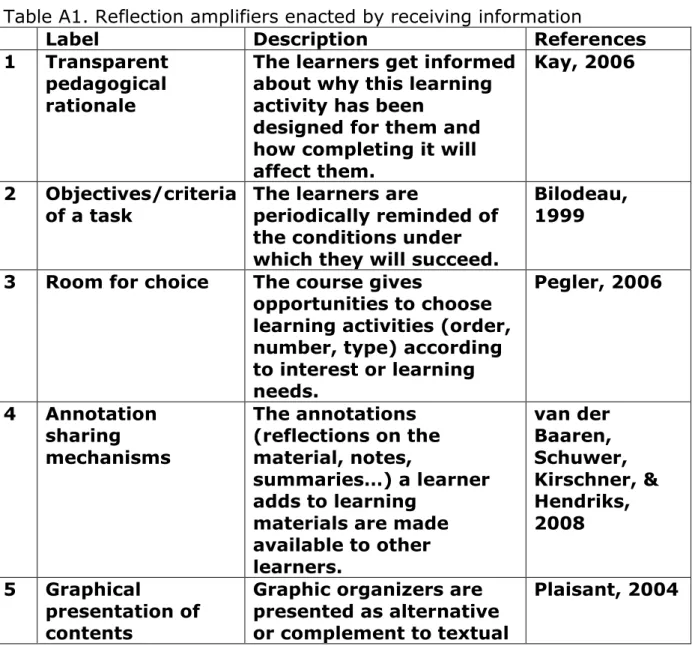
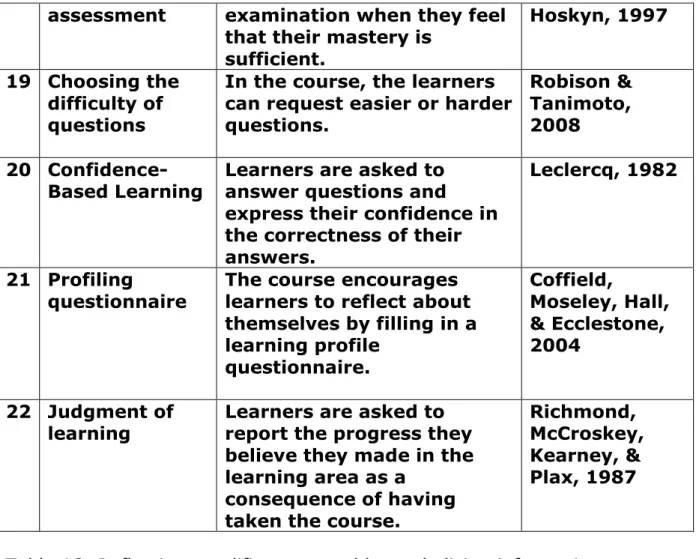
In the tables below, the reflection amplifiers are provided with a textual label, and explained with an extremely compact definition and references. The literature review provided in general several references for each reflection amplifier. Hereafter is provided the one considered as the most illustrative. For practical reasons (size) the reflection amplifiers are clustered into separate tables according the type of interaction
involved (receiving/giving/verbalizing information).
Table A1. Reflection amplifiers enacted by receiving information
Label Description References
1 Transparent
pedagogical rationale
The learners get informed about why this learning activity has been
designed for them and how completing it will affect them.
Kay, 2006
2 Objectives/criteria
of a task
The learners are
periodically reminded of the conditions under which they will succeed.
Bilodeau, 1999
3 Room for choice The course gives
opportunities to choose learning activities (order, number, type) according to interest or learning needs. Pegler, 2006 4 Annotation sharing mechanisms The annotations (reflections on the material, notes, summaries…) a learner adds to learning
materials are made available to other learners. van der Baaren, Schuwer, Kirschner, & Hendriks, 2008 5 Graphical presentation of contents
Graphic organizers are presented as alternative or complement to textual
structure: mind-maps, heuristic schemas, spider webs, contrast matrices, etc.
6 Structure for
regulative support
The course includes a "dashboard", viz. a page that bundles personal indicators allowing the learners to keep an updated status of their situation in the course and to better control it.
Bull &
Mabbott, 2006
7 Growing progress
visualization tool
Visual displays (progress sliders, understanding meters, etc.) enabling the learners to determine their progress (actions and mastery) towards the learning goals. Glahn, Specht, & Koper, 2007 8 Mirroring of personal tracked data
Different kinds of learner interactions with the course are tracked and recorded to make
personal traces available.
Narciss, Proske, & Koerndle, 2007 9 Meta-cognitive modelling
The teacher or a subject-matter expert displays modelling behaviour, showing how to think about the material (knowledge, skills, procedures, etc.) Sanchez-Alonso & Vovides, 2007 10 Help seeking behaviour guide
The course provides guidelines for using help at the right moment.
Roll, Aleven, McLaren, & Koedinger, 2007 11 Compare with yardstick Learners get opportunities for comparing aspects of their learning experience (time spent, exercises completed, estimation of knowledge, own
performance…) to some external yardstick
(teacher, peer, expert, classroom average,
Todorovich, Wirth, Zhang, Tillman, & Fleming, 2004
oneself in similar circumstances,
compliance ratio, etc.). 12 Records of
marks/remarks
The marks and the remarks received from the instructor(s) are stored and can be
consulted by the student.
Ruelland & Brisebois, 2002
Table A2. Reflection amplifiers enacted by giving information
Label Description References
13 Enhanced
Multiple Choice Question
Learners answer enriched Multiple Choice Questions. The proposed answers include meta-level options like "All answers correct", "None of the answers correct", "The question is absurd", "The terms of the problem are too ill-defined for giving a correct
answer", etc. Diaz et al., 2008 14 Ease-of- learning/self-efficacy judgments
The learners engage in a self-assessment of their perceived ability for the task. Ruelland & Brisebois, 2002 15 Indicators of understanding
Learners are asked to
qualify their understanding with simple indicators like "lost/foggy/got it" or equivalent. Stadtler & Bromme, 2008 16 Formative assessment
The course offers
assessment intended to generate feedback on performance to improve, helping learners to assess their own learning.
Nicol & MacFarlane-Dick, 2006 17 Interruptive monitoring Periodically on-the-fly questions appear about perceived performance. Learners provide a score on an appropriate scale.
Van den Boom & al, 2004
assessment examination when they feel that their mastery is
sufficient.
Hoskyn, 1997
19 Choosing the difficulty of questions
In the course, the learners can request easier or harder questions. Robison & Tanimoto, 2008 20 Confidence-Based Learning
Learners are asked to answer questions and
express their confidence in the correctness of their answers.
Leclercq, 1982
21 Profiling
questionnaire
The course encourages learners to reflect about themselves by filling in a learning profile questionnaire. Coffield, Moseley, Hall, & Ecclestone, 2004 22 Judgment of learning
Learners are asked to report the progress they believe they made in the learning area as a
consequence of having taken the course.
Richmond, McCroskey, Kearney, & Plax, 1987
Table A3. Reflection amplifiers enacted by verbalizing information
Label Description References
23 Where and Why Is It Wrong?
Learners receive pieces of work for which they are asked to say what is wrong and why.
Mitrovic & Martin, 2002
24 Students set the test
Learners are asked to make up the questions they could get for their exam.
Baird &
Mitchell, 1986
25 Writing on the reading
The course provides annotation tool(s) along with the electronic learning material. Cobine, 1995 26 Practice of evocation (pausing to reflect)
Learners are requested to recall important or puzzling facts/ideas/concepts from the previous learning
episode. de La Garanderie, 1989 27 Questions generation
Learners are invited to post questions about the
Verpoorten, Poumay,
material for which they receive a feedback. Delcomminette, & Leclercq, 2006 28 Self-explanations
The course trains the learners to generate explanations about the content of an exercise, a strategy, a text, a learning goal, an example, etc.
McNamara, O'Reilly, Rowe, Boonthum, & Levinstein, 2007 29 Justify your choice
Learners are asked to
justify choices they made in the course. Baird & Mitchell, 1986 30 Eliciting intentions before a task
The course makes room for the learners to reflect about how to handle the task and their expectations to
encounter any problems through it.
Ausubel, 1960
31 Comment on "learning footprints"
The course includes
assignment(s) requesting learners to ponder upon their tracked traces after a learning episode.
Johnson & Sherlock, 2008
32 Permanent reflecting tools
The course asks learners to verbalize and record their thinking activities related to learning tasks in a learning diary or a similar tool (e.g. blog, portfolio) Attwell, Chrzaszcz, Hilzensauer, Hornung-Prahauser, & Pallister, 2007 33 Explicit reflective activities
The course includes self-reflective activities
encouraging students to analyse various aspects of their performance. Gummesson & Nordmark, 2007 34 Comments on Comments
The learner is asked to write a comment in
response to the instructor's comments.
Baird &
Mitchell, 1986
35 Test debriefing Learners are formally invited to question their own results and to analyse successes/failures,
strengths/weaknesses, areas to review, errors or misconceptions.
Mitchell & Mitchell, 2008