Science Arts & Métiers (SAM)
is an open access repository that collects the work of Arts et Métiers Institute of
Technology researchers and makes it freely available over the web where possible.
This is an author-deposited version published in: https://sam.ensam.eu
Handle ID: .http://hdl.handle.net/10985/10477
To cite this version :
Tales CARVALHO RESENDE, Salima BOUVIER, Tudor BALAN, Farid ABED-MERAIM, Simon-Serge SABLIN - Work-hardening predicition using a dislocation based model for automotive Interstitial Free (IF) steels - In: 1st International Conference on Material Modeling, Allemagne, 2009-09-15 - Technische Mechanik - 2009
Any correspondence concerning this service should be sent to the repository Administrator : [email protected]
Science Arts & Métiers (SAM)
is an open access repository that collects the work of Arts et Métiers ParisTech
researchers and makes it freely available over the web where possible.
This is an author-deposited version published in: http://sam.ensam.eu
Handle ID: .http://hdl.handle.net/null
To cite this version :
Tales CARVALHO-RESENDE, Salima BOUVIER, Tudor BALAN, Farid ABED-MERAIM, Simon-Serge SABLIN - Work-hardening predicition using a dislocation based model for automotive Interstitial Free (IF) steels - In: 1st International Conference on Material Modeling, Allemagne, 2009-09-15 - Proceedings of the 1st ICMM - 2009
Any correspondence concerning this service should be sent to the repository Administrator : [email protected]
Work-hardening predicition using a dislocation based model for
automotive Interstitial Free (IF) steels
T. Carvalho-Resende, S. Bouvier, T. Balan, F. Abed-Meraim, S-S. Sablin
With a view to environmental, economic and safety concerns, car manufacturers need to design lighter and safer vehicles in ever shorter development times. In recent years, High Strength Steels (HSS) like Interstitial Free (IF) steels which have higher ratios of yield strength to elastic modulus, are increasingly used for sheet metal parts in automotive industry to reduce mass. The application of simulation models in sheet metal forming in the automotive industry has proven to be beneficial to reduce tool costs in the design stage and optimizing current processes. The Finite Element Method (FEM) is quite successful to simulate metal forming processes but accuracy depends both on the constitutive laws used and their material parameters identification.
The purpose of this study is to present, a work-hardening physically-based model at large strain with dislocation density evolution approach. This approach can be decomposed as a combination of isotropic and kinematic contributions. The predictive capabilities of the model are investigated for different Interstitial Free (IF) steels of grain sizes varying in the 5.5-22µm value range. Different loadings paths are analyzed and stress-strain curves have been experimentally assessed and they are compared to the model predictions.
1 Introduction
Road vehicles dominate global oil consumption and are one of the fastest growing energy en-uses. The transport sector is responsible for nearly 60% of world oil demand and road transport accounts for nearly 80% of the total transport energy. Transport accounts for around 25% of energy-related carbon dioxide (CO2) emissions. One of
the most important challenges for the automotive industry in the upcoming years is to meet the demand of reducing the fuel consumption with a contemporaneously increase of safety properties.
Using High Strength Steels (HSS) like Interstitial Free (IF) steels as the metal of choice in the automotive industry will help society to meet the demands of its increasing commitment to the environment. In the past, significant gains in automobile efficiency have been achieved through aerodynamic, design and drive train improvements. As performance limits are approached in these areas, the recent interests in alternative materials that will allow lighter designs. IF steels are increasingly used in sheet metal forming parts in automotive industry due to higher ratios of yield strength to elastic modulus.
Sheet metal forming processes are among the oldest and most widely used industrial manufacturing processes. They allow producing thin walled parts of complicated shape. The process consists, in general, in the plastic deformation of an initial flat blank subjected to the action of the tools (punch, die) while constrained on the periphery by a blank-holder.
During the last years, numerous commercial codes based on inverse or incremental approaches heave been developed and updated for stamping simulation of thin sheets. The huge advantages of theses codes have been recognized to evaluate forming defects (fracture, wrinkling, springback) as well as deformation paths. In the future, there will be a strong demand of commercially viable high-level simulations capable of shortening vehicle development times, reducing tool costs in the design stage and enabling coordination with overseas production facilities. The goal in manufacturing must be to establish “prototype-free” manufacturing.
The finite element simulation is quite successful to simulate sheet metal forming processes but the robustness depends both on the constitutive laws implemented and on their material parameters identification. Some effort is still required to improve the considered behavior models and to identify them in the most optimal way. Classical
phenomenological models roughly consist in the fitting of functions on experimental results. They provide only crude tools, the quality of which depends both on the complexity of the chosen functions and the type of experiments used to identify them.
For robust and time-effective finite element simulations, it is vital to use top-notch plasticity models based on physics.
This article focuses on some recent developments in the field of material characterization. To improve the constitutive modeling of IF steels, a work-hardening physically based model at large strain with dislocation density evolution approach is proposed. The model consists on a combination of isotropic and kinematic contributions. The predictive capabilities of the model are assessed in case of IF steels, from three different steelmakers, with grain sizes varying in the 5.5-22 µm value range. Different loading paths are analyzed, namely the uniaxial tensile test, the simple and Bauschinger simple shear tests. The article ends with some concluding remarks and future trends.
2 Experimental procedure
In this study, 7 different IF steels provided by two different steelmakers (A, B, C) were analyzed. Some properties of the tested materials are compiled in
Mean grain sizes (µm) Y0 (Mpa) Steelmaker Mechanical tests Litterature source
22 119 A - Uniaxial tensile test
- Bauschinger test Haddadi et al., 2006 17 90 B - Uniaxial tensile test Galtier et al., 2003 15 100 B - Uniaxial tensile test Galtier et al., 2003
12 197 C - Bauschinger test -
8.5 120 B - Uniaxial tensile test Galtier et al., 2003
8 218 C - Bauschinger tensile test -
5.5 210 B - Uniaxial tensile test Galtier at al., 2003 Figure 1. Properties from the 7 different studied IF steels.
M is the Taylor factor and takes into account the texture development. In order to simplify, the Taylor factor M is taken as a mean value and constan. We suppose that the Taylor factor is M = 3. µ stands for the shear modulus and is equal to 80GPa. The magnitude of the Burgers vector b is 0.25nm-1. Finally, the Taylor constant α is set to be equal to 0.4 according to Galtier et al. (2003).
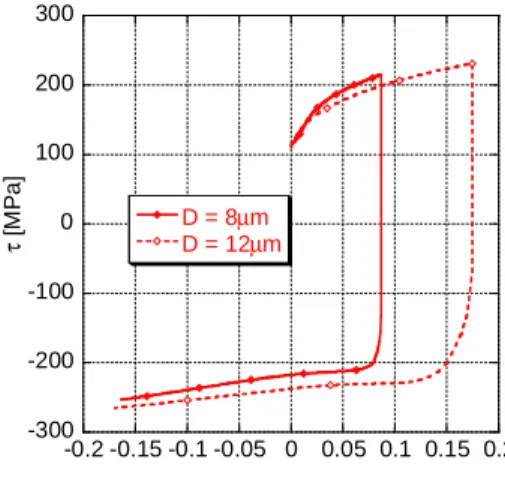
An experimental investigation was carried out by Haddadi et al. (2006) for the analysis of the mechanical behavior of IF steels. It shows that IF steels reveal a strong Bauschinger effect and that work-hardening stagnation (presence of plateau) is observed during the reversed deformation of Bauschinger simple shear tests. Two different loading paths are analyzed, namely the uniaxial tensile test and Bauschinger simple shear test. Experimental curves in rigid-plastic domain are depicted in Figures 2, 3 and 4.
-300 -200 -100 0 100 200 300 400 -0.3 -0.2 -0.1 0 0.1 0.2 0.3 0.4 D = 22µm D = 22µm εp or γ σ o r τ [ M P a ]
0 100 200 300 400 500 600 0 0.05 0.1 0.15 0.2 D = 17µm D = 15µm D = 8.5µm D = 5.5µm εp σ [M P a ]
Figure 3. Experimental curves of uniaxial tensile test (Galtier et al., 2003)
-300 -200 -100 0 100 200 300 -0.2 -0.15 -0.1 -0.05 0 0.05 0.1 0.15 0.2 D = 8µm D = 12µm τ [ M P a ] γ Figure 4. Experimental curves of Bauschinger simple shear test
3 Numerical procedure
Numerical procedure is based on a classical phenomenological model widely used in the literature (Lemaitre and Chaboche, 2001) combining isotropic and kinematic hardening . Based on the von Mises criterion, the yield function
f
is given by:(
)
(
0)
0
=
−
−
+
=
f
φ
σ
X
Y
R
, (1)where
X
denotes the kinematic hardening,Y
0 the initial yield strength andR
the isotropic hardening.φ
is a function of the Cauchy stressσ
given by:(
)
3
(
) (
)
´
:
´
2
−
=
−
−
φ
σ
X
σ
X
σ
X
, (2)The associated flow stress is written as:
p
=
∂
λ
∂
D
ɺ
σσσσ
f
, (3) whereλ ε
=
p iɺ
is the plastic multiplier.ε
pi
stands for the equivalent plastic strain rate. The superposed dot indicates time differentiation.
The evolution law of the isotropic hardening
R
evolves with respect to accumulated plastic strainε
P. It is assumed to follow a Voce rule:0
0
(
)
( )
=
−
=
iɺ
P R satR
C R
R
R
ε
, (4)Integrating equation. (4) we obtain :
(
1
−)
=
−
P R C satR
R
e
ε , (5)where
C
R andR
satare material parameters,R
sat being the asymptotic value of the isotropic hardening stressR
at infinitely large plastic strain andC
R controls the rate of isotropic hardening.The evolution equation for the kinematic hardening is given by an Armstrong-Frederick’s saturation law:
p
2
3
=
λ
X
C X
X satD -
C
XX ɺ
, (6)where
C
X andX
sat are material parameters.C
X characterizes the saturation rate ofX
andX
satcharacterizes the saturation value ofX
. Hereafter,( )
stands for the objective rate.Armstrong-Frederick’s law 1D expression gives:
(
1
−)
=
−
p X C satX
e
εX
,
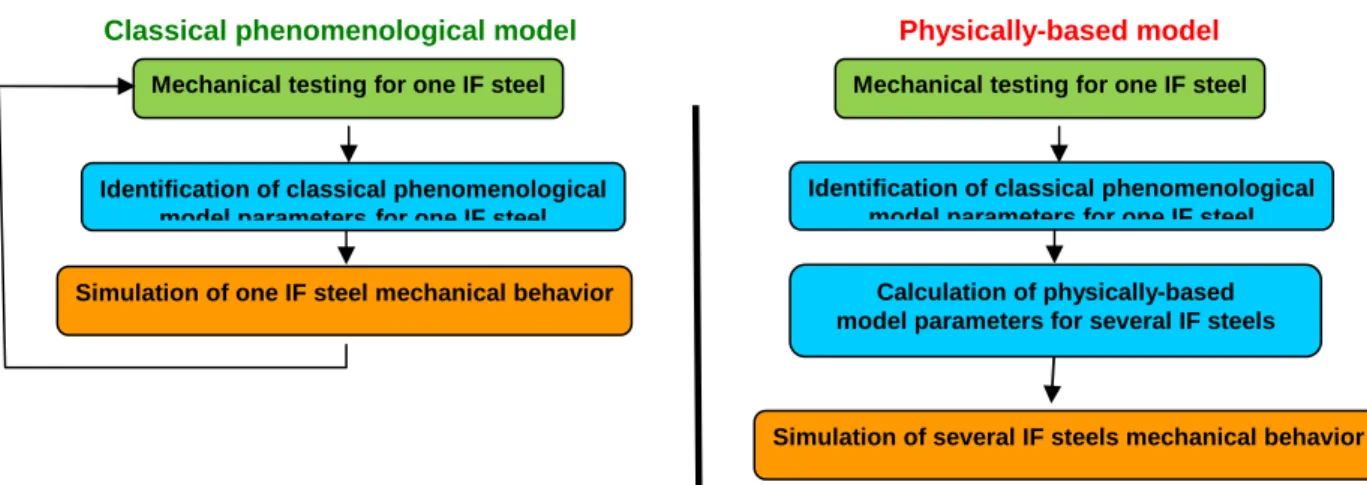
(7)The aim of this work is to predict work-hardening by introducing physically-based data into classical phenomenological. The purpose of this work is to predict work-hardening behaviour for different IF steels provided by different steelmakers with different grain by introducing physically-based data into classical phenomenological. Therefore, it enables to reduce mechanical testing as depicted in Figure 5.
Figure 5. Numerical procedure for calculation of physically-based model’s parameters.
Our starting point is the well-known Kocks and Mecking single parameter approach (Mecking and Estrin, 1987). This approach is based on the observation of plasticity which relates the local flow stress τ to the dislocation density ρ through:
Classical phenomenological model Physically-based model
Mechanical testing for one IF steel
Identification of classical phenomenological model parametersfor one IF steel
Simulation of one IF steel mechanical behavior
Mechanical testing for one IF steel
Simulation of several IF steels mechanical behavior Identification of classical phenomenological
model parameters for one IF steel
Calculation of physically-based model parameters for several IF steels
b
τ αµ ρ
=
, (8)where µ stands for the shear modulus,
b
for the magnitude of the Burgers vector and α is a constant.Evolution law of dislocation density with respect to shear stress for a coarse-grained (or monocrystalline) single-phase material, which can be regarded as “structureless” (Mecking and Estrin, 1987) is given by the following equation:
(
1 2)
d
k
k
d
ρ
ρ
ρ
γ
=
−
, (9)where the first term stands for the dislocation storage rate which results in hardening. The second term stands for the dislocation annihilation rate which results in softening.
k
1 andk
2 are constants.The macroscopic stress σ and the macroscopic strain ε are respectively:
M
M
σ
τ
ε γ
=
=
. (10)M
is the Taylor factor and takes into account the texture development. In order to simplify,M
is taken as a mean value and is constant. As we are working in high strain, we suppose that the macroscopic strainε
is equal to the equivalent plastic strain εp.Thanks to the previous assumptions, we can relate the isotropic phenomenological model material parameters, R
C
andR
sat with physically-based data according to equation (11).2 1 2
(
,
)
(
, ,
, , , )
=
=
R satC
f M k
R
f M k k
α µ
b
(11)Concerning kinematic hardening contribution, the same methodology as for isotropic hardening was adopted and enables to introduce physically-based data into phenomenological model kinematic parameters. The kinematic hardening is due to dislocation pill up on the boundary of the grain (Sinclair et al., 2006). The pile-ups produce a back stress opposing the applied stress on the slip plane. Back stress expression is given by:
back stress
M
b
n
D
αµ
σ
=
, (12)where
n
is the number of dislocation that have been stopped at the boundary on a given slip band andD
is the grain size.At larger strains, the influence of grain size on work-hardening disappears owing to process associated with dynamic recovery at boundaries (Sinclair et al., 2006). Indeed, it is said that there is a critical number of dislocations which can be stored in the vicinity of a grain boundary, so that the grain boundary effectively becomes transparent at larger strains. Therefore, it is necessary to consider an evolution law for the strain dependence of the number of dislocations stopped at a grain boundary:
0
1
pdn
n
b
n
d
λ
ε
=
−
, (13)where
n
0isn
critical value and the ratioλ
b
gives the number of dislocations per slip band geometricallyWith the previous hypothesis, we can express the kinematic phenomenological model material parameters,
C
Xand
X
sat with physically-based data according to equation (14).0 0
( , ,
)
(
, , ,
, )
=
=
X satC
f
b n
X
f M
b n D
λ
µ
(14)The physically-based model we have presented contains 4 fitting parameters (
k k
1, , ,
2λ
n
0). These parameterscan be easily calculated after identification of phenomenological Voce and Armstrong-Frederick laws parameters. It is important to note that physically-based parameters (
k k
1, , ,
2λ
n
0) are specific for each kind ofmetal. Therefore, IF steels and aluminium alloys would have different physically-based paramenters
(
k k
1, , ,
2λ
n
0).4 Results and discussions
Voce and Armstrong-Frederick laws parameters (i.e.
C R
R,
sat,
C
X,
X
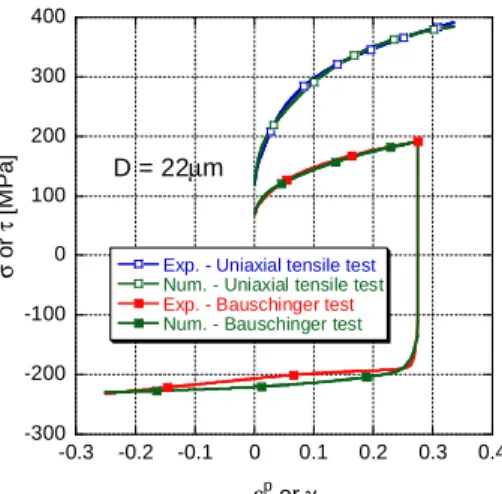
sat) were identified for IF steel with mean grain size equal to 22µm. The identification of parameters was carried out using an uniaxial tensile test and a Bauschinger simple shear test. Results are presented in Figure 6.. According to equations. (11) and (14), an optimized (k k
1, , ,
2λ
n
0) fitting parameters set can be calculated. Results are given in Figure 7.0
Y
(MPa)C
RR
sat(MPa)C
XX
sat(MPa)119 9.2 220 113 169.5
Figure 6. Numerical procedure for calculation of physically-based model’s parameters.
1
k
(nm-1)k
2λ
(nm)n
00.06 6.1 440 13.5
Figure 7. IF steels physically-based model’s parameters.
Obtained curves with physically based parameters are given in Figure 8.
-300 -200 -100 0 100 200 300 400 -0.3 -0.2 -0.1 0 0.1 0.2 0.3 0.4 Exp. - Uniaxial tensile test
Num. - Uniaxial tensile test Exp. - Bauschinger test Num. - Bauschinger test
εp or γ σ o r τ [ M P a ] D = 22µm
Figure 8. Identification of a physically-based model described by an isotropic hardening with Voce law and a kinematic hardening with Armstrong and Frederick law.
As depicted in Figure 8, physically based model is able to fit accurately the experimental results for uniaxial tensile test and Bauschinger simple shear test. In order to predict other IF steels work-hardening’s behavior, optimized IF steels (
k k
1, , ,
2λ
n
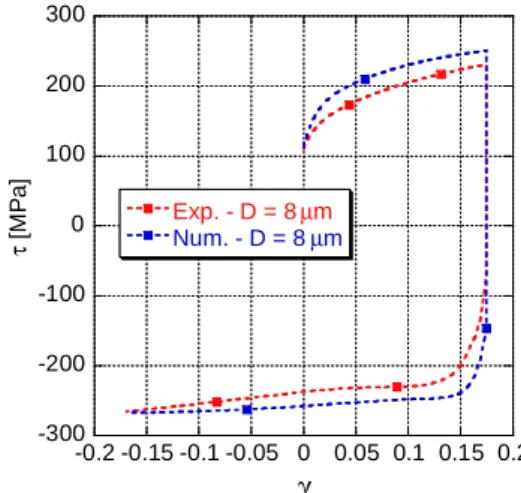
0) fitting parameters were used. Only modifications between these IF steelsconsisted on changing grain size D and initial yield stress Y0. Figures 9 and 10 shows that physically based model
is also able to predict accurately work-hardening beahvior of IF steels from different steelmakers and with different mean grain sizes, varying in the 5.5-22µm value range. However, we can observe in Figures 9 and 10 taht this model reaches its limit for work-hardening’s prediction for mean grain sizes below 10 µm.
0 100 200 300 400 500 600 0 0.05 0.1 0.15 0.2 Exp. - D = 17µm Num. - D = 17µm Exp. - D = 15µm Num. - D = 15µm Exp. - D = 8.5µm Num. - D = 8.5µm Exp. - D = 5.5µm Num. - D = 5.5µm εp σ [ M P a ]
Figure 9. Uniaxial tensile test work-hardening prediction of a physically-based model described by an isotropic hardening with Voce law and a kinematic hardening with Armstrong and Frederick law using IF steels physically based fitting parameters.
-300 -200 -100 0 100 200 300 -0.2 -0.15 -0.1 -0.05 0 0.05 0.1 Exp. - D = 12 µm Num. - D = 12 µm τ [ M P a ] γ
Figure 10. 12µm IF steel Bauschinger simple shear test work-hardening prediction of a physically-based model described by an isotropic hardening with Voce law and a kinematic hardening with Armstrong and Frederick law using IF steels physically based fitting parameters.
-300 -200 -100 0 100 200 300 -0.2 -0.15 -0.1 -0.05 0 0.05 0.1 0.15 0.2 Exp. - D = 8 µm Num. - D = 8 µm γ τ [ M P a ]
Figure 11. 8µm IF steel Bauschinger simple shear test work-hardening prediction of a physically-based model described by an isotropic hardening with Voce law and a kinematic hardening with Armstrong and Frederick law using IF steels physically based fitting parameters.
5 Conclusion
The aim of this work was a work hardening physically based model of the large strain deformation of ultra-thin sheets aluminium alloys and the verification of the predictive capabilities.
For this purpose, a physically-based data was introduced into phenomenological parameters. This model is able to describe work-hardening’s behavior for different loading paths taking into account several data from microstructure (i.e. grain size, texture, etc...). Introduction of microstructure data in a classical phenomenological model allows us to point out this work’s originality which allows achieving this model’s predictive character. Indeed, several IF steels work-hardening’s behaviour could be predicted thanks to an unique physically-based parameters set by only changing grain size D and initial yield stress Y0. However, this model reaches its limit for
work-hardening’s prediction for mean grain sizes below 10µm. Moreover, IF steels present work-hardening stagnation under reversed deformation. Therefore, in order to extend this model to metals presenting work-hardening stagnation, an extended approach based on the physics of the dislocations will be necessary. Further work would consist on implementing this model in ABAQUS/Explicit in order to simulate industrial forming applications.
6 Acknowledgments
The authors gratefully acknowledge Renault by supporting and financing this project. The authors also acknowledge Pierre-Paul Jeunechamps for providing the classical model described by Voce and Armstrong-Frederick laws.
References
Galtier, A..; Bouaziz, O.; Lambert, A.: Influence of steel microstructure on their mechanical properties, Mécanique & Industries 3, (2003), 457-462.
Lemaitre., L; Chaboche, J.L.: Mécanique des matériaux solides. Dunod (2001)
Mecking, H.; Estrin, Y.: Microstructure-related constitutive modelling of plastic deformation, Proceedings of the 8th Risø Conference (1987), 123.
Haddadi, H.; Bouvier, S.; Banu, M.; Teodosiu, C.: Towards an accurate description of the anisotropic behaviour of sheet metals under large plastic deformations: modelling, numerical analysis and identification, International Journal of Plasticity 2, (2006), 2226-2271.
Rauch, E.F.; Gracio, J.J.; Barlat, F.: Work-hardening model for polycristalline metals under strain reversal at large strain, Acta Materialia 55, (2007), 2939-2948.
Sinclair, C.W.; Poole, W.J.; Bréchet, Y.: A model for the grain size dependent work-hardening of copper, Scripta Materialia 55, (2006), 739-742.