Agricultura no. 1 - 2 (113-114)/2020 Agriculture
- 201 -
ABORTIONS IN CATTLE AND SHEEP HERDS IN
ALGERIA, DESCRIPTIVE STUDY AND RISK FACTORS
DECHICHA1)* Amina Samia, N. MOULA2), I. GHARBI1), D. BAAZIZE-AMMI1),
K. AKLOUL1), D. GUETARNI3)
1)Institute of Veterinary Sciences, University of Blida 1, BP 270 Road of Soumaa Blida, Algeria 2)Department of Animal Production, Faculty of Veterinary Medicine, University of Liege, Liege
4000, Belgium.
3)Department of Biology, Faculty of Nature and Life Sciences, University of Blida 1, BP 270
Road of Soumaa. Blida, Algeria.
* Corresponding author: [email protected]
Abstract. The objective of this study is to evaluate the epidemiological situation of
abortions on cattle and sheep herds and to identify some risk factors related to them. A descriptive analysis of 139 dairy cattle and 34 sheep farms showed that abortions affect 40.29% and 79.41% of cattle and sheep herds respectively; with an average abortion rate of 11.86% and 4.55% per herd respectively. The identification of risk factors was performed by univariate analysis followed by multiple logistic regression analysis. The results identified three risk factors for cattle (herd size, contact with animals from neighboring farms and presence of stillbirths/malformations) and four risk factors for sheep by univariate analysis only (housing in zriba, presence of stillbirths/malformations, infertility and presence of weak lambs). In conclusion, abortions are an important health problem in livestock farming. Identifying risk factors could help to make optimal decisions to minimize economic losses.
Keywords: Abortion threshold, Epidemiological form, Reproductive disorders.
INTRODUCTION
Algeria with an estimated herd of more than 1.9 million cattle, 26.4 million sheep and 4.8 million goats (Anagriculture, 2018), is one of the seven African countries with the largest numbers of small ruminants (Akakpo et al., 2009). However, national needs for milk and red meat are only partially covered, requiring permanent import (Bessaoud et al., 2019).
It seems that beyond the numerical importance of these farms, they continue to be marked by the extensive nature of production systems that are highly dependent on climatic hazards, fodder availability, sanitary and genetic constraints.
The health issue is largely dominated by the loss of products caused by embryo mortalities, abortions, dystocia and stillbirths. Abortions are multifactorial entities whose origin may be infectious (Dechicha et al., 2010; Clothier and Anderson, 2016; Vidal et al., 2017; Ghanem and Nishibori, 2018); other factors may also contribute to their triggering or increase their impact. Some are intrinsic, such as age, genetics or health status, others are extrinsic, such as livestock management, feeding or stress (Clothier and Anderson, 2016; Rani et al., 2018).
The incidence of abortion is difficult to assess and therefore underestimated. In general, an abortion rate of less than 5% is considered acceptable in dairy cattle farming (Holler, 2012) and a rate varying from 2 to 5% is considered normal in sheep farming (Menzies, 2007).
Agricultura no. 1 - 2 (113-114)/2020 Agriculture
- 202 -
In Algeria, estimates of the incidence, losses and risk factors associated with abortions have been poorly studied, leading to a critical lack of data on the epidemiological situation of livestock abortions.
This situation is due to the fact that abortions are not subject to mandatory reporting; moreover, no abortive disease apart from brucellosis is legislated whatever its zoonotic impact.
The objective of this study is to assess the epidemiological situation of abortions and to identify certain risk factors associated with cattle and sheep farming.
MATERIAL AND METHODS
Location: The study was conducted in dairy cattle farms located in Blida
department (36°28'N latitude and 2°49'E longitude), an area considered to be a dairy basin, located 47 km south-west of Algiers, and in sheep farms located in Djelfa department (34°65'N latitude and 3°26'E longitude), an agro-pastoral region located 300 km south of Algiers.
Sampling: For cattle herds, a stratified random sample was taken from
veterinary inspection database comprising 626 approved dairy farms. The analysis was carried out using Epidata and Epi Info 6 software (Epitable Program) taking into account the weight of each stratum (subdivision) of the department, the method (1/10) with random draw for the identification of the farms to be studied and a minimum number of 4 cows per farm. A sample of 139 farms (from 4 to 154 heads) with a total of 2227 heads was defined.
For sheep herds, the determination of a representative sample was not possible due to the absence of databases of sheep farms (Transhumant and nomadic farms). We selected our sample taking into consideration the accessibility and acceptance of breeders to participate in the survey. The sample covered 34 farms (from 6 to 525 heads) with a total of 5349 heads.
Survey: Data collection was carried out by means of a questionnaire completed
during an interview with the farmer during a single visit to the farm. It includes open (short answers) and closed (multiple choice answers) questions which deal with the situation of abortions, characteristics, practices and management of livestock and finally the history of the reproductive disorders in these farms.
Abortion: Abortion defined in this study is the farmer's visual observation of
rejection of a non-viable fetus and /or its membranes before term in a pregnant diagnosed female.
A herd "with abortion" is qualified as such when at least one abortion has been recorded during the year preceding the survey.
The overall rate of abortion per herd is determined by the number of aborted females on the number of pregnant females in a herd during the year preceding the survey.
Risk factors: The risk factors associated with abortions are classified into three
groups:
- Husbandry characteristics: herd size (number of animals), type of housing for sheep (built barn or zriba*), barn area (m2), presence of exercise area, calving paddock,
Agricultura no. 1 - 2 (113-114)/2020 Agriculture
- 203 -
other animal species, contact with animals from neighboring farms and hygiene in husbandry.
- Husbandry practices and management: breeding services (artificial insemination, natural mating and estrous synchronization), disposal of fetus and fetal membranes and purchasing animals without quarantine.
- History of reproductive disorders observed during the previous three years: infertility, stillbirths and malformations and birth of weak lamb (for sheep farms). Zriba*: rudimentary constructions used as shelter in sheep farms.
Statistical analysis: The epidemiological study of abortions is carried out by a
general descriptive statistical analysis with the SYSTAT software version 10.
For the study of risk factors, the variables were grouped into classes. The relationships between each of the potentially explanatory variables and the status "with or without abortions" are studied during a two-step procedure. A univariate analysis was performed using chi-square test (X²) and exact Fischer test respectively for cattle and sheep farms. The links were considered significant for p <0.05. The degree of dependence of abortions on various factors was determined by the odds ratios. The multivariate analysis was based on the logistic regressions in a model including the variables with p ≤ 0.05 identified in the first step. It was performed on SAS software (2001).
RESULTS AND DISCUSSIONS
Farms characteristics: The majority of cattle farms had between 4 and 10 heads (49.64%), stables with an average surface area greater than 100 m2 (50.36%); an exercise area (56.83%); neighboring farms (79.14%) and satisfactory hygiene practice (89.21%); however, 87.77% of these farms do not have calving paddock.
For sheep farms, the majority of them had between 100 and 300 heads (50%), associated with other animal species (82.35%) and 55.88% housed the animals in zriba.
Descriptive study of abortions
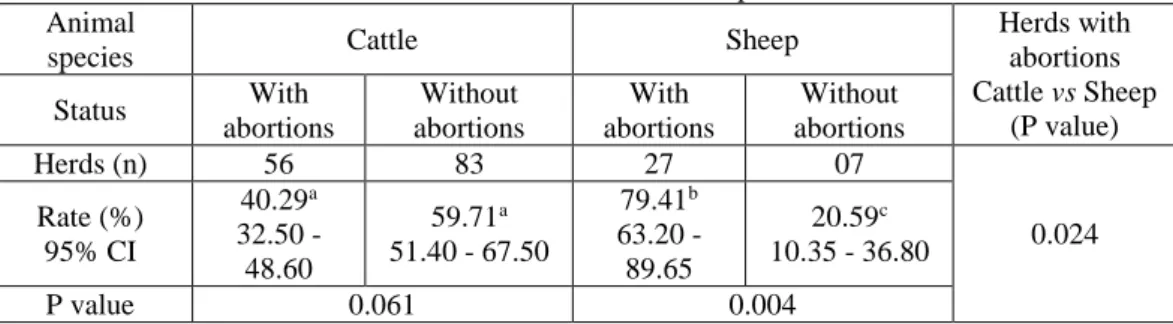
Abortions rates in cattle and sheep herds: The descriptive analysis has shown
that the rates of farms with abortions are 40.29% and 79.41% respectively for cattle and sheep. A statistical comparison of herds "with abortion" in both species, shows that there are more abortions in sheep herds than in cattle herds (Table 1). These rates reveal a worrying situation where more than a third of cattle herds and more than two-thirds of sheep herds are exposed to abortion annually.
Table 1 Abortions rates in cattle and sheep herds
Animal
species Cattle Sheep
Herds with abortions Cattle vs Sheep (P value) Status With abortions Without abortions With abortions Without abortions Herds (n) 56 83 27 07 0.024 Rate (%) 95% CI 40.29a 32.50 - 48.60 59.71a 51.40 - 67.50 79.41b 63.20 - 89.65 20.59c 10.35 - 36.80 P value 0.061 0.004
Agricultura no. 1 - 2 (113-114)/2020 Agriculture
- 204 -
However, it should be noted that these rates represent only the visible part of the interruption of gestation and that early and late embryonic mortalities as well as early fetal mortalities are not taken into account. According to Santos et al. (2004), gestational losses in dairy cows from fertilization to term could represent up to 60%.
In practice, just a fraction of these abortions are detected by the breeder. According to Forar et al. (1996), only 20% of fetal mortalities are detected through the expelled fetal membranes between 31 and 260 days of gestation, and according to Kinsel (1999), only 46% of abortions are actually detected. Norman et al. (2012), report that the real number of abortions would be 2.2 to 5 times greater than the number of observed abortions.
Average abortion rates: The average abortion rates are 11.86% and 4.55% for
cows and ewes respectively. Classification of herds shows that 89.36% and 35.71% of cattle and sheep herds respectively are above the tolerated abortion threshold (Table 2).
Table 2 Average abortion rates for cows and ewes
Herds with abortions Pregnant females Aborted females Abortion rate (95% CI) Limits per herd (%) Herds with more than 5% abortions (%) Cattle (n=56) 649 77 11.86a (9.60 - 14.58) 1.81 à 100 42 (89.36) Sheep (n=27) 2109 96 4.55b (3.74 - 5.53) 0.5 à 12.5 5 (35.71)
The letters a and b in the same column mean a significant difference (p <0.05).
Abortion rate calculation is decisive for the sustainability and economic viability of a farm; it makes it possible to situate oneself in relation to a threshold above which investigations must be considered. Indeed, a fetal loss of 3 to 5% per year in cattle farming (Hovingh, 2009) and 2 to 5% in sheep farming (Menzies and Miller, 1999) is considered acceptable.
However, large disparities in abortion rates have been reported in literature; for example 1.5% and 10.4% were respectively reported by Carpenter et al. (2006) and Lucchese et al. (2016) for cattle, and 12.10% and 34% were reported respectively by Benkirane et al. (2015) and Movassaghi et al. (2016) for sheep.
These variations are partly explained by the difference in abortion definition itself; indeed, Thurmond et al. (1990) define abortion as a fetal death between 52 and 260 days of gestation, while Norman et al. (2012) define it as a fetal death from 150 days of gestation.
Furthermore, the method to detect abortions differs from one study to another, some authors rely on the observation of aborted fetus and membranes while others rely on gestational and hormonal diagnosis.
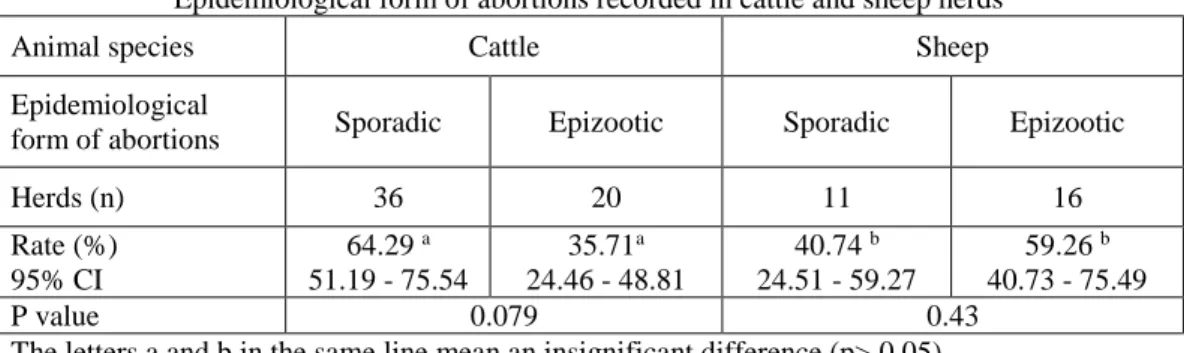
Epidemiological form of abortions: Epidemiological form of observed
abortions does not show a significant difference between herds with "sporadic" or "epizootic" abortions, p = 0.079 and p = 0.43 for cattle and sheep herds respectively (Table 3). According to numerous studies, the diagnosis of abortion cause can be orientated by its epidemiological form.
Agricultura no. 1 - 2 (113-114)/2020 Agriculture
- 205 -
Table 3 Epidemiological form of abortions recorded in cattle and sheep herds
Animal species Cattle Sheep
Epidemiological
form of abortions Sporadic Epizootic Sporadic Epizootic
Herds (n) 36 20 11 16 Rate (%) 95% CI 64.29 a 51.19 - 75.54 35.71a 24.46 - 48.81 40.74 b 24.51 - 59.27 59.26 b 40.73 - 75.49 P value 0.079 0.43
The letters a and b in the same line mean an insignificant difference (p> 0.05)
Sporadic abortions are more likely to be the result of congenital anomalies, hormonal imbalance or any disturbance of the fetal-placental unit (Khodakaram-Tafti and Ikede, 2005; Risvanli et al., 2009). Infectious agents such as fungal, Ureaplasma
diversum, Campylobacter fetus and Listeria monocytogenes would be also responsible
for sporadic abortions (Anderson, 2007; Syrjälä et al., 2007; Campero et al., 2005; Barkallah et al., 2014).
In contrast, serial abortions are more likely to result from infectious agents such as BHV-1, Schmallenberg virus and Neospora caninum in cows (Graham, 2013; Borel et al., 2014; Sager et al., 2005) and Salmonella Abortusovis which could cause serial abortions in 30 to 50% of pregnant ewes (Wirz-Dittus et al., 2010).
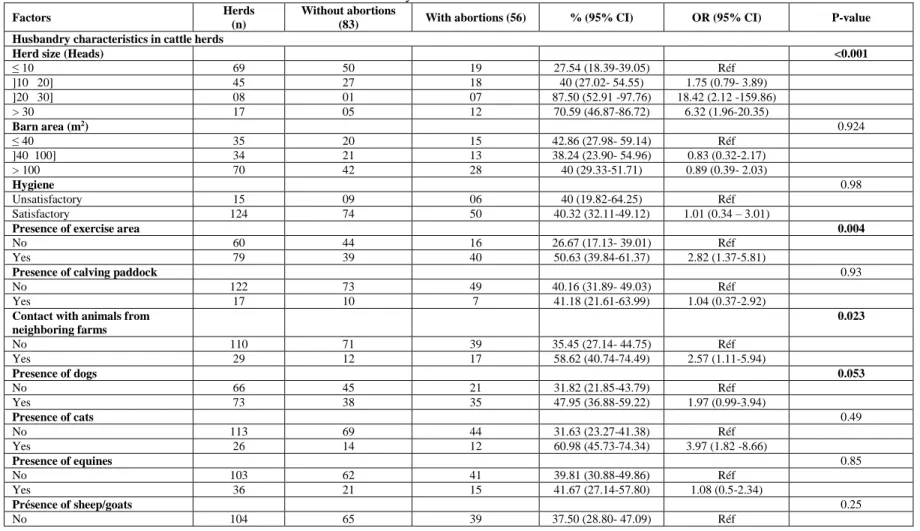
Risk Factors: For cattle herds, the results of univariate analysis by Chi-square test reveal that herd size, presence of an exercise area, contact with animals from neighboring farms, presence of dogs in the farm, presence of stillbirths/malformations and finally infertility problems show a significant link (p<0.05) with herds that have abortions (Table 4).
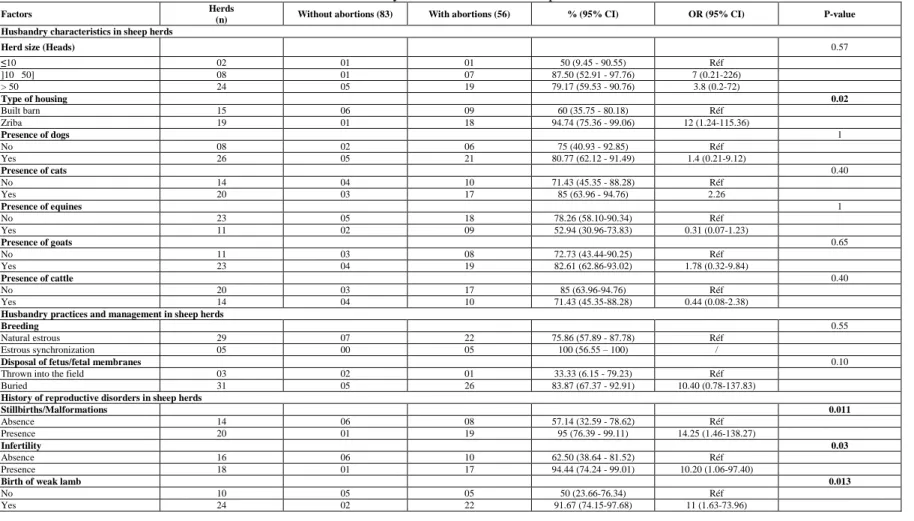
For sheep herds, the results of univariate analysis by Fisher's exact test reveal that animals housed in zriba, presence of stillbirths and malformations, presence of infertility problems and the birth of weak lambs are significantly related (p<0.05) to herds that have abortions (Table 5).
Table 4 Univariate analysis of risk factors in cattle herds
Factors Herds
(n)
Without abortions
(83) With abortions (56) % (95% CI) OR (95% CI) P-value
Husbandry characteristics in cattle herds
Herd size (Heads) <0.001
≤ 10 69 50 19 27.54 (18.39-39.05) Réf ]10 20] 45 27 18 40 (27.02- 54.55) 1.75 (0.79- 3.89) ]20 30] 08 01 07 87.50 (52.91 -97.76) 18.42 (2.12 -159.86) > 30 17 05 12 70.59 (46.87-86.72) 6.32 (1.96-20.35) Barn area (m2) 0.924 ≤ 40 35 20 15 42.86 (27.98- 59.14) Réf ]40 100] 34 21 13 38.24 (23.90- 54.96) 0.83 (0.32-2.17) > 100 70 42 28 40 (29.33-51.71) 0.89 (0.39- 2.03) Hygiene 0.98 Unsatisfactory 15 09 06 40 (19.82-64.25) Réf Satisfactory 124 74 50 40.32 (32.11-49.12) 1.01 (0.34 – 3.01)
Presence of exercise area 0.004
No 60 44 16 26.67 (17.13- 39.01) Réf
Yes 79 39 40 50.63 (39.84-61.37) 2.82 (1.37-5.81)
Presence of calving paddock 0.93
No 122 73 49 40.16 (31.89- 49.03) Réf
Yes 17 10 7 41.18 (21.61-63.99) 1.04 (0.37-2.92)
Contact with animals from neighboring farms 0.023 No 110 71 39 35.45 (27.14- 44.75) Réf Yes 29 12 17 58.62 (40.74-74.49) 2.57 (1.11-5.94) Presence of dogs 0.053 No 66 45 21 31.82 (21.85-43.79) Réf Yes 73 38 35 47.95 (36.88-59.22) 1.97 (0.99-3.94) Presence of cats 0.49 No 113 69 44 31.63 (23.27-41.38) Réf Yes 26 14 12 60.98 (45.73-74.34) 3.97 (1.82 -8.66) Presence of equines 0.85 No 103 62 41 39.81 (30.88-49.86) Réf Yes 36 21 15 41.67 (27.14-57.80) 1.08 (0.5-2.34) Présence of sheep/goats 0.25 No 104 65 39 37.50 (28.80- 47.09) Réf
Yes 35 18 17 48.57 (32.99-64.43) 1.57 (0.72-3.40)
Husbandry practices and management in cattle herds Breeding
Natural service 57 35 22 38.60 (27.06-51.57) Réf 0.84
Artificial insemination 46 26 20 43.48 (30.21-57.75) 1.22 (0.55-2.69)
Both 36 22 14 38.89 (24.78-55.14) 1.01 (0.43-2.38)
Presence of bull on the farm 0.33
No 74 47 27 36.49 (26.44-47.87) Réf
Yes 65 36 29 44.62 (33.17-56.66) 1.4 (0.71-2.77)
Disposal of fetus/ Fetal membranes
Thrown into the field 98 58 40 40.82 (31.61-50.71) Réf 0.84
Buried 41 25 16 39.02 (25.66-54.27) 0.93 (0.44-1.96)
Purchasing animals without
quarantine 0.46
No 87 54 33 37.93 (28.45-48.43) Réf
Yes 52 29 23 44.23 (31.60-57.66) 1.3 (0.65-2.61)
History of reproductive disorders in cattle herds Stillbirths/ Malformations Absence 106 73 33 31.13 (23.11-40.48) Réf <0.0001 Presence 33 10 23 44.23 (31.60-57.66) 5.09 (2.18-11.89) Infertility Absence 76 59 17 22.37 (14.46-32.93) Réf <0.0001 Presence 63 24 39 61.90 (49.56-72.88) 5.64 (2.69-11.84)
Table 5 Univariate analysis of risk factors in sheep herds
Factors Herds
(n) Without abortions (83) With abortions (56) % (95% CI) OR (95% CI) P-value
Husbandry characteristics in sheep herds
Herd size (Heads) 0.57
≤10 02 01 01 50 (9.45 - 90.55) Réf ]10 50] 08 01 07 87.50 (52.91 - 97.76) 7 (0.21-226) > 50 24 05 19 79.17 (59.53 - 90.76) 3.8 (0.2-72) Type of housing 0.02 Built barn 15 06 09 60 (35.75 - 80.18) Réf Zriba 19 01 18 94.74 (75.36 - 99.06) 12 (1.24-115.36) Presence of dogs 1 No 08 02 06 75 (40.93 - 92.85) Réf Yes 26 05 21 80.77 (62.12 - 91.49) 1.4 (0.21-9.12) Presence of cats 0.40 No 14 04 10 71.43 (45.35 - 88.28) Réf Yes 20 03 17 85 (63.96 - 94.76) 2.26 Presence of equines 1 No 23 05 18 78.26 (58.10-90.34) Réf Yes 11 02 09 52.94 (30.96-73.83) 0.31 (0.07-1.23) Presence of goats 0.65 No 11 03 08 72.73 (43.44-90.25) Réf Yes 23 04 19 82.61 (62.86-93.02) 1.78 (0.32-9.84) Presence of cattle 0.40 No 20 03 17 85 (63.96-94.76) Réf Yes 14 04 10 71.43 (45.35-88.28) 0.44 (0.08-2.38)
Husbandry practices and management in sheep herds
Breeding 0.55
Natural estrous 29 07 22 75.86 (57.89 - 87.78) Réf
Estrous synchronization 05 00 05 100 (56.55 – 100) /
Disposal of fetus/fetal membranes 0.10
Thrown into the field 03 02 01 33.33 (6.15 - 79.23) Réf
Buried 31 05 26 83.87 (67.37 - 92.91) 10.40 (0.78-137.83)
History of reproductive disorders in sheep herds
Stillbirths/Malformations 0.011 Absence 14 06 08 57.14 (32.59 - 78.62) Réf Presence 20 01 19 95 (76.39 - 99.11) 14.25 (1.46-138.27) Infertility 0.03 Absence 16 06 10 62.50 (38.64 - 81.52) Réf Presence 18 01 17 94.44 (74.24 - 99.01) 10.20 (1.06-97.40)
Birth of weak lamb 0.013
No 10 05 05 50 (23.66-76.34) Réf
Agricultura no. 1 - 2 (113-114)/2020 Agriculture
- 209 -
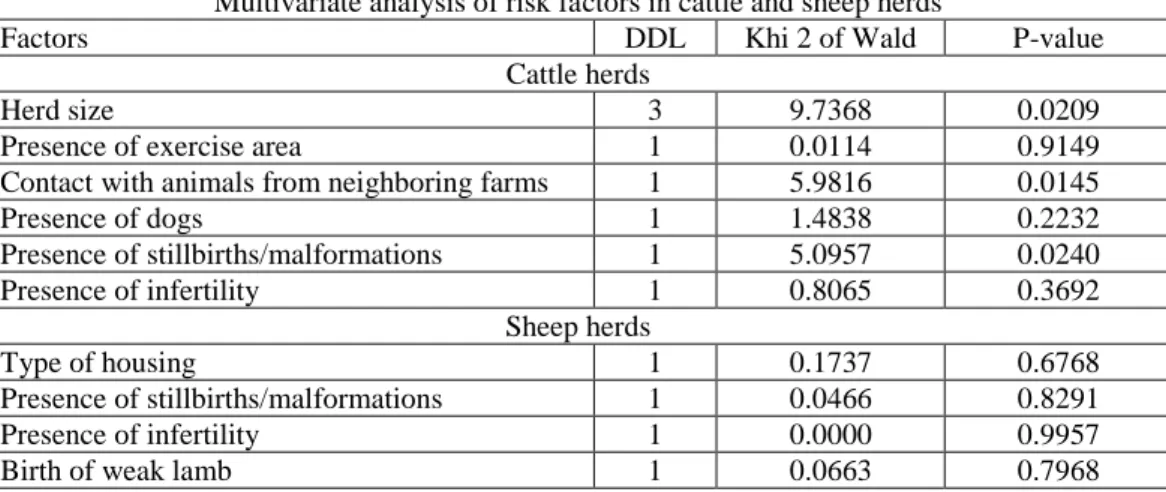
The results of final multivariate logistic regression analysis show that for cattle: herd size, contact with animals from neighboring farms and the problems of stillbirths/ malformations are risk factors for abortions. However, for sheep herds, no factor constitutes a risk for abortion in the final analysis (Table 6).
Table 6 Multivariate analysis of risk factors in cattle and sheep herds
Factors DDL Khi 2 of Wald P-value Cattle herds
Herd size 3 9.7368 0.0209 Presence of exercise area 1 0.0114 0.9149 Contact with animals from neighboring farms 1 5.9816 0.0145 Presence of dogs 1 1.4838 0.2232 Presence of stillbirths/malformations 1 5.0957 0.0240 Presence of infertility 1 0.8065 0.3692 Sheep herds Type of housing 1 0.1737 0.6768 Presence of stillbirths/malformations 1 0.0466 0.8291 Presence of infertility 1 0.0000 0.9957 Birth of weak lamb 1 0.0663 0.7968
For cattle, about herd size, we found that there are significantly more farms "with abortion" among those with large population. This finding is corroborated by some studies such as those of Jamaluddin et al. (1996) and Dougall et al. (2005), while other authors such as Lee and Kim (2007) have not reported an association.
The relationship between abortion and herd size could be explained by the increased microbial load within farms with a big numbers of heads, thus exposing pregnant females to more abortive pathogens. In addition, cleaning and disinfection procedures in large farms are more difficult to implement, compromising thereby good hygiene practices.
The presence of neighbouring farms showed a significant effect on abortions. It would seem that a probable link can be established when animals from neighbouring farms meet on the same pasture or if contaminated equipment is used in common between the different farms. Indeed, according to Reviriego et al. (2000) and Cowie et al. (2014) the use of common pastures or paths and contact with other herds is a risk factor for brucellosis in small ruminants and cattle.
The link between stillbirths / malformations and abortions in the present study could be explained by the teratogenicity of many abortifacient agents such as BVD, Blue tongue virus and Schmallenberg virus (Grooms, 2004; Kelling, 2007; Herder et al., 2012). In addition, these same agents may not cause abortion in some females when contamination occur during late gestation but allow the birth of an infected newborn which will succumb some time after birth. Syrjala et al. (2007) reported that 7% and 10% of congenital malformations cases were respectively associated with abortions and stillbirths. Moreover, Waldner (2014) reported that the stillbirth of a calf within one hour of calving would increase the risk of maternal abortion in subsequent gestations.
For sheep, there is a link between abortion and living in zriba; this type of housing is often found in steppe areas where herds are managed according to three
Agricultura no. 1 - 2 (113-114)/2020 Agriculture
- 210 -
modes: sedentarism, semi-sedentarism and transhumance (Yabrir et al., 2015). The hygienic conditions of zriba are often incorrect, due to the high density of animals. In fact, transhumant and nomadic herders hold the largest numbers of animals and do not attach importance to the housing hygiene given their frequent movements.
In addition, the animals on these farms are constantly in contact on the grazing areas and at the watering points, thus promoting the mixing of populations and contamination by abortive agents. Indeed, according to Al talafhah et al. (2003) the level of seropositivity to brucellosis increases significantly in sheep farms practicing common grazing.
In the present study, we noted an association between farms "with abortions" and problems of stillbirths and malformations, infertility and birth of weak lamb, this can be explained by the exposure of these farms to infectious abortifacient agents. Thus, according to Gautier and Corbiere (2011), among the diseases those lead to late abortions and/or postnatal mortalities, Q fever which causes abortions almost exclusively, chlamydophylosis which leads to abortions of an enzootic nature, premature births and weak lambs and also toxoplasmosis.
Furthermore, according to Innes et al. (2009), an infection with Toxoplasma gondii at mid-gestation can lead to the birth of a stillborn or weak lamb, while an infection later in gestation can result in a live, clinically normal but infected lamb.
Viruses such as the Border disease virus (BDV); Blue tongue virus (BTV) or schmallenberg virus can also cause malformations, sterility, abortions, stillbirths and birth of small and weak lambs (Nettleton et al., 1998; Sperlova and Zendulkova, 2011; Herder et al., 2012).
CONCLUSIONS
The results of the present study have shown that abortions constitute an important health problem in both cattle and sheep farms, with abortion rates largely exceeding the acceptable threshold in some farms, indicating that they are a significant cause of production loss.
In addition, these abortions occur indifferently sporadically and epizootically for the two species, hence the probable involvement of infectious agents, some of which may be zoonotic.
Risk factor analysis generates information on harmful parameters for gestation, which helps to make optimal decisions in order to better manage livestock and minimize economic losses.
REFERENCES
1. Akakpo, A.J., Têko-Agbo, A., Koné, P. (2009). L’impact de la brucellose sur l’économie et la santé publique en Afrique. Conf. OIE, 71-84. https://www.oie.int › doc › ged
2. Al-Talafhah, A.H., Lafi, S.Q., Al-Tarazi, Y. (2003). Epidemiology of ovine brucellosis in Awassi sheep in Northern Jordan. Preventive Veterinary Medicine, 60: 297–306. PMID: 12941554
3. Anagriculture. (2018). Assises nationales de l’agriculture. statistiques. https://www.anagriculture2018.dz
Agricultura no. 1 - 2 (113-114)/2020 Agriculture
- 211 -
4. Anderson, M.L. (2007). Infectious causes of bovine abortion during mid-tolate-gestation. Theriogenology, 68: 474–48. Doi:10.1016/j.theriogenology.2007.04.001
5. Barkallah, M., Gharbi, Y., Hassena, A.B., Slima, A.B., Mallek, Z., Gautier, M., Greub, G., Gdoura, R., Fendri, I. (2014). Survey of Infectious Etiologies of Bovine Abortion during Mid- to Late Gestation in Dairy Herds. PLoS ONE 9(3): e91549. Doi: 10.1371/journal.pone.0091549. eCollection 2014.
6. Benkirane, A., Essamkaoui, S., El Idrissi, A., Lucchese, L., Natale, A. (2015). A sero-survey of major infectious causes of abortion in small ruminants in Morocco. Veterinaria Italiana, 31; 51 (1):25-30. Doi.org/10.12834/VetIt.389.1814.1
7. Bessaoud, O., Pellissier, J.P., Rolland, J.P., Khechimi, W. (2019). Rapport de synthèse sur l’agriculture en Algérie. Projet d’appui a l’initiative ENPARD mediterranée. https://www.iamm.ciheam.org › ress_doc › opac_css › doc_num
8. Borel, N., Frey, C.F., Gottstein, B., Hilbe, M., Pospischil, A., Franzoso, F.D., Waldvogel, A. (2014). Laboratory diagnosis of ruminant abortion in Europe. The Veterinary Journal, 200: 218–229. Doi.org/10.5167/uzh-95873
9. Campero, C.M., Anderson, M.L., Walker, R.L., Blanchard, P.C., Barbano, L., Chiu, P., Martínez, A., Combessies, G., Bardon, J.C., Cordeviola, J. (2005). Immunohistochemical identification of Campylobacter fetus in natural cases of bovine and ovine abortions. Journal of Veterinary Medicine (52):138–141. Doi: 10.1111/j.1439-0450.2005.00834.x.
10. Carpenter, T.E., Chriel, M., Andersen, M.M., Wulfson, L., Jensen, A.M., Houe, H., Greiner, M. (2006). An epidemiologic study of late-term abortions in dairy cattle in Denmark, July 2000–August 2003. Preventive Veterinary Medicine, 77: 215–229. Doi: 10.1016/j.prevetmed.2006.07.005.
11. Clothier, K., Anderson, M. (2016). Evaluation of bovine abortion cases and tissue suitability for identification of infectious agents in California diagnostic laboratory cases from 2007 to 2012.Theriogenology 15; 85(5):933-938. Doi: 10.1016/j.theriogenology.2015.11.001
12. Cowie, C.E, Marreos, N., Gortazar, C., Jaroso, R., White, P.C.L., Balseiro, A. (2014). Shared risk factors for multiple livestock diseases: A case study of bovine tuberculosis and brucellosis. Research in veterinary science (97)3: 491-497. Doi :org/10.1016/j.rvsc.2014.09.002
13. Dechicha, A.S., Gharbi, S., Kebbal, S., Chatagnon, G., Tainturier, D., Ouzrout, R. Guetarni, D. (2010). Serological survey of etiological agents associated with abortion in two Algerian dairy cattle breeding farms. Journal of Veterinary Medicine and Animal Health 2 (1): 001-005. https://www. academicjournals.org › JVMAH › article-abstract
14. Forar, A.L., Gay, J.M., Hancock, D.D., Gay, C.C. (1996). Fetal loss frequency in ten Holstein dairy herds. Theriogenology, 45 (8): 1505-1513. Doi.org/10.1016/0093-691X(96)00118-5
15. Gautier, J.M., Corbiere, F. (2011). La mortalité des agneaux : état des connaissances. Rencontre. Recherche. Ruminants, 18 : 262-265.
16. Ghanem, M.E., Nishibori, M. (2018). Haplotypes associated with fetal death and abortion in Holstein cows with special reference to the situation in Japan. The Journal of Animal Genetics 46: 25–30. Doi: 10.5924/abgri.46.2
17. Graham, D.A. (2013). Bovine herpes virus-1 (BOHV-1) in cattle a review with emphasis on reproductive impacts and the emergence of infection in Ireland and the United Kingdom. Irish Veterinary Journal 66(1): 15. Doi: 10.1186/2046-0481-66-15
18. Grooms, D.L. (2004). Reproductive consequences of infection with bovine viral diarrhea virus. The veterinary clinics of North America Food Animal practice 20: 5-19. Doi:10.1016/j.cvfa.2003.11.006
Agricultura no. 1 - 2 (113-114)/2020 Agriculture
- 212 -
19. Herder, V., Wohlsein, P., Peters, M., Hansmann, F., Baumgartner, W. (2012). Salient lesions in domestic ruminants infected with the emerging so-called Schmallenberg virus in Germany. Veterinary Pathology, 49: 588-591. Doi:10.1177/0300985812447831
20. Holler, L.D. (2012). Ruminant Abortion Diagnostics. The veterinary clinics of North America Food Animal practice 28(3):407-18. Doi: 10.1016/j.cvfa.2012.07.007
21. Hovingh, E. (2009). Abortions in Dairy Cattle – I Common Causes of Abortions, publication 404-288. Virginia cooperative extension.
https://www.pubs.ext.vt.edu/content/dam/pubs_ext_vt_edu/404/404-288/404-288_pdf.
22. Innes, E.A., Barley, P.M., Buxton, D., Katzer, F. (2009). Ovine toxoplasmosis. Parasitology 136:1887–1894. Doi: 10.1017/S0031182009991636.
23. Jamaluddin, A.A., Case, J.T., Hird, D.W., Blanchard, P.C., Peauroi, J.R., Anderson, M.L. (1996). Dairy cattle abortion in California: evaluation of diagnostic laboratory data. Journal of Veterinary Diagnostic Investigation, 8: 210-218. Doi: 10.1177/104063879600800211 24. Kelling, C.L., (2007). Viral diseases of the fetus. In: Youngquist RS, Threlfall WR, editors. Current therapy in large animal theriogenology. 2nd ed., St. Louis: Elsevier: 399–408.
25. Khodakaram-Tafti, A., Ikede, B.O. (2005). A retrospective study of sporadic bovine abortions, stillbirths, and neonatal abnormalities in Atlantic Canada, from 1990 to 2001.The Canadian Veterinary Journal 46(7): 635–637. PMCID: PMC1168881
26. Kinsel, M.L. (1999). An epidemiological approach to investigating abortion problems in dairy herds. Proc. Ann. Conf. Am. Assoc. Bov. Pract. (32nd): 152-160.
27. Lee, J.I., Kim, I.H.P. (2007). Pregnancy loss in dairy cows: the contributing factors, the effects on reproductive performance and the economic impact. Journal of Veterinary Science, 8(3): 283–288. Doi:10.4142/jvs.2007.8.3.283
28. Lucchese, L., Benkirane, A., Hakimi, I., El Idrissi, A., Natale, A. (2016). Seroprevalence study of the main causes of abortion in dairy cattle in Morocco. Veterinaria Italiana 52 (1), 13-19. Doi: 10.12834/VetIt.388.1813.1
29. McDougall, S., Rhodes, F.M., Verkerk, G.A. (2005). Pregnancy loss in dairy cattle in the Waikato region of New Zealand, New Zealand Veterinary Journal, 53(5): 279-287. Doi: 10.1080/00480169.2005.36561
30. Menzies, P.A. (2007). Abortion in sheep: diagnosis and control. In: Youngquist RS, Threlfall WR, editors. Current therapy in large animal theriogenology. 2nd ed., St. Louis: Elsevier p: 667–80.
31. Menzies, P.I., Miller, R. (1997). Abortion in sheep: Diagnosis and control. Youngquist RS Ed. Current therapy in large animal therigenology. ed 1 Philadelphia, WB Saunders p:617-627.
32. Movassaghi, A.R, Rassouli, M., Fazaeli, A., Salimi-Bejestani, M.R. (2016). Outbreak of ovine congenital toxoplasmosis in Iran, confirmed by different diagnostic methods. Journal of Parasitic Disease 40(1):152–156. Doi 10.1007/s12639-014-0467-x
33. Nettleton, P.F., Gilray, J.A., Russo, P., Dlissi, E. (1998). Border disease of sheep and goats. Veterinary Research, BioMed Central, 29 (3-4): 327-340.
34. Norman, H.D., Miller, R.H., Wright, J.R., Hutchison, J.L., Olson, K.M. (2012). Factors associated with frequency of abortions recorded through Dairy Herd Improvement test plans. Journal of Dairy Science, 95 (7): 4074–4084. Doi: 10.3168/jds.2011-4998.
35. Rani, P., Dutt, R., Singh, G., Chandolia, R.K. (2018). Embryonic Mortality in Cattle-A Review. International Journal of Current Microbiology and Applied Sciences. Vol 7 (7): 1501-1516. Doi: https://doi.org/10.20546/ijcmas.2018.707.177
36. Reviriego, F.J., Moreno, M.A., Domínguez, L. (2000). Risk factors for brucellosis seroprevalence of sheep and goat flocks in Spain. Preventive Veterinary Medicine, 28, 44(3-4):167-73. PMID:10760400
Agricultura no. 1 - 2 (113-114)/2020 Agriculture
- 213 -
37. Risvanli, A., Bulut, H., Zonturlu, A.G., Demiral, O., Saat, N., Kilic, A. (2009). The Role of Immunologic Factors In abortions observed in Sheep and Goats. The International Journal of Applied Research in Veterinary Medicine 7(3): 91-96
38. Sager, H., Hüssy, D., Kuffer, A., Schreve, F., Gottstein, B. (2005). First documentation of a Neospora-induced abortion storm (exogenous transplacental transmission of
Neospora caninum) in a Swiss dairy farm. Schweizer Archiv für Tierheilkunde, 147: 113–120.
Doi: 10.1024/0036-7281.147.03.113
39. Santos, J.E., Thatcher, W.W., Chebel, R.C., Cerri, R.L., Galvao, K.N. (2004). The effect of embryonic death rates in cattle on the efficacy of estrus synchronization programs. Animal Reproduction Science 82-83: 513-535. Doi:10.1016/j.anireprosci.2004.04.015
40. Sperlova, A., Zendulkova, D. (2011). Bluetongue: a review. Veterinarni Medicina, 56, (9): 430-452. Doi.org/10.17221/3206-VETMED
41. Syrjälä, P., Anttila, M., Dillard, K., Fossi, M., Collin, K., Nylund, M., Autio, T. (2007). Causes of bovine abortion, stillbirth and neonatal death in Finland 1999–2006. Acta Veterinaria Scandinavica 49 (Suppl 1):S3 Doi:10.1186/1751-0147-49-S1-S3
42. Thurmond, M.C., Picanso, J.P. (1990). A surveillance system for bovine abortion. Preventive Veterinary Medicine 8 (1):41-53. Doi:10.1016/0167-5877(90)90021-9
43. Vidal, S., Kegler, K., Greub, G., Aeby, S., Borel, N., Mark, P., Dagleish, M.P., Posthaus, H., Perreten, V., Rodriguez-Campos, S. (2017). Neglected zoonotic agents in cattle abortion: tackling the difficult to grow bacteria. BMC Veterinary Research 13:373. Doi 10.1186/s12917-017-1294-y
44. Waldner, C.L. (2014). Cow attributes, herd management, and reproductive history events associated with abortion in cow-calf herds from Western Canada. Theriogenology, 81:840-848. Doi: 10.1016/j.theriogenology.2013.12.016.
45. Wirz-Dittus, S., Belloy, L., Hüssy, D., Waldvogel, A.S., Doherr, M.G. (2010). Seroprevalence survey for Salmonella Abortusovis infection in Swiss sheep flocks. Preventive Veterinary Medicine, 97: 126–130. Doi.org/10.1016/j.prevetmed.2010.08.007
46. Yabrir, B., Laoun, A., Chenouf, N. S., Mati, A. (2015). Caractéristiques des élevages ovins de la steppe centrale de l’Algérie en relation avec l’aridité du milieu : Cas de la wilaya de Djelfa. Livestock Research for rural development 27 (10).http:// www.lrrd.org› lrrd27 › yabr27207