HAL Id: hal-01166509
https://hal.univ-antilles.fr/hal-01166509
Submitted on 22 Jun 2015
HAL is a multi-disciplinary open access
archive for the deposit and dissemination of
sci-entific research documents, whether they are
pub-lished or not. The documents may come from
teaching and research institutions in France or
abroad, or from public or private research centers.
L’archive ouverte pluridisciplinaire HAL, est
destinée au dépôt et à la diffusion de documents
scientifiques de niveau recherche, publiés ou non,
émanant des établissements d’enseignement et de
recherche français ou étrangers, des laboratoires
publics ou privés.
Drawing, Handwriting Processing Analysis: New
Advances and Challenges
Céline Rémi, Lionel Prevost, Eric Anquetil
To cite this version:
Céline Rémi, Lionel Prevost, Eric Anquetil. Drawing, Handwriting Processing Analysis: New
Ad-vances and Challenges. 17th Biennial Conference of the International Graphonomics Society, Jun
2015, Pointe-à-Pitre, Guadeloupe. 2015, 979-10-95177-01-2. �hal-01166509�
Drawing, Handwriting Processing
Analysis:
New Advances and Challenges
Edited by
C. Rémi, L. Prévost & E. Anquetil
Proceedings of the 17
thBiennial Conference
of the
I
nternational
G
raphonomics
S
ociety
Drawing, Handwriting Processing Analysis:
New Advances and Challenges
Céline Rémi
Lionel Prévost
Drawing, Handwriting Processing Analysis: New Advances and Challenges
Proceedings of IGS 2015
Editors: Céline Rémi, Lionel Prévost, Eric Anquetil
ISBN 979-10-95177-01-2
Published by:
UNIVERSITE DES ANTILLES
Service commun de la documentation, bibliothèques et édition numériques
Campus de Schoelcher BP 7210 97275 Schœlcher cedex, Martinique
Phone+596-596-72-75-35
Contact for Additionnal Copies :
LAMIA
Campus de Fouillole BP 592 97217 Pointe-à-Pitre cedex, Guadeloupe
[email protected]
17
thBiennal Conference of the
International Graphonomics Society - IGS 2015
Table of contents
Welcome from the Chairs...p. 7
Conference Committees...p. 9
Reviewers...p. 11
Partners and Sponsors...p. 12
Program...p. 15
Invited Presentations...p. 20
Session 1: Handwriting Analysis and Recognition 1 (Chair : G PIRLO)
Online Sketch Recognition with Incremental Fuzzy Models ...…...p. 25
Lukas Tencer, Marta Režnáková and Mohamed Cheriet
Feature evaluation for discriminating handwriting fragments………....p. 29
Claudio De Stefano, Francesco Fontanella, Angelo Marcelli, Antonio Parziale and
Alessandra Scotto di Freca
Session 2: Medical Applications 1 (Chair : S GAUCHER-CAZALIS)
Predicting Hand Forces from Scalp Electroencephalography During Isometric Grip and Object
Grasping………..………p. 33
Andrew Paek, Alycia Gailey, Pranav Parikh, Marco Santello and Jose Contreras-Vidal
Session 3: Education and Handwriting 1 (Chair : C REMI)
Ortho-syllable and syllable affect the dynamics of adjectives handwriting in French…….………..p. 37
Eric Lambert and Pauline Quémart
How Handwriting Evolves: An Initial Quantitative Analysis of the Development of Indic Scripts..p. 41
Vinodh Rajan
Session 4: Handwriting Analysis and Recognition 2 (Chair : A FISHCHER)
An algorithm based on visual perception of similarity for handwriting comparison……….p. 47
Antonio Parziale, Stanislao Davino and Angelo Marcelli
Recognize multi-touch gestures by graph modeling and matching………...….p. 51
The generation of synthetic handwritten data for improving on-line learning………...…p. 55
Marta Režnáková, Lukas Tencer, Réjean Plamondon and Mohamed Cheriet
Session 5: Medical Applications 2 (Chair : J VAILLANT)
Omega-Lognormal Analysis of Oscillatory Movements as a Function of Brain Stroke
Risk Factors ………..….p. 59
Albert Bou Hernandez, Andreas Fischer and Réjean Plamondon
Monitoring Neuromotricity On-line: a Cloud Computing Approach………..…..….p. 63
Olivier Lefebvre, Pau Riba, Charles Fournier, Alicia Fornes, Josep Llados, Réjean
Plamondon and Jules Gagnon-Marchand
A neurocomputational model of spinal circuitry for controlling the execution of arm voluntary
movements………..……p. 67
Antonio Parziale, Jacopo Festa and Angelo MarcellI
Session 6: Education and Handwriting 2 (Chair : J-L VELAY)
Handwriting Analysis with Online Fuzzy Models………...p. 71
Manuel Bouillon and Eric Anquetil
Evaluation of Different Handwriting Teaching Methods by Kinematic and Quality Analyses….…p. 75
Pierluigi D'Antrassi, Agostino Accardo, Paola Ceschia, Iolanda Perrone and Carmen
Mandarino
Exploring for scribbling profiles in kindergarten children………...………..p. 79
Céline Remi, Jean Vaillant, Réjean Plamondon, Lionel Prevost and Thérésa Duval
Session 7: Forensic Sciences 1 (Chair : A MARCELLI)
A Dissimilarity Measure for On-Line Signature Verification Based on the Sigma-Lognormal
Model………..p. 83
Andreas Fischer and Réjean Plamondon
Hyper-spectral Analysis for Automatic Signature Extraction………...………….p. 87
Muhammad Imran Malik, Sheraz Ahmed, Faisal Shafait, Ajmal Saeed Mian, Andreas Dengel,
Marcus Liwicki and Christian Nansen
Stability/Complexity Analysis of Dynamic Handwritten Signatures………….………p. 91
Giuseppe Pirlo, Donato Impedovo and Tommaso Ferrante
Session 7: Forensic Sciences 2 (Chair : H HARRALSON)
Characteristics of Constrained Handwritten Signatures: An Experimental Investigation…………..p. 95
Giuseppe Pirlo, Donato Impedovo and Fabrizio Rizzi
Heidi H. Harralson, Clare Kaufman and Martin W. B. Jarvis
Training- and Segmentation-Free Intuitive Writer Identification with Task-Adapted
Interest Points………..……… p. 103
Angelika Garz, Marcel Würsch and Rolf Ingold
A Survey of Forensic Handwriting Examination Research in Response to the NAS Report……..p. 107
Heidi H. Harralson, Elizabeth Waites and Emily J. Will
Poster (Chair : J NAGAU)
Relationships between Handwriting Features and Executive Control among Children with
Developmental Dysgraphia………...……p. 111
Sara Rosenblum
The timing of eye-hand movements during signature simulations………..……….p. 115
Avni Pepe and Jodi Sita
Stress and Motor Learning: Does the Presentation of Physical or Cognitive Stress Influence Motor
Skill Acquisition?...p. 119
Christopher Aiken, Sarah Odom and Arend Van Gemmert
Subspace method with multi scale wavelet for identification of handwritten lines……….p. 123
Takeshi Furukawa
Haar like features for query by string word spotting………..………..p. 127
Nicole Vincent, Adam Ghorbel and Jean-Marc Ogier
Writer identification – clustering letters with unknown authors………..………p. 131
Johanna Putz-Leszczynska
An assessment of dynamic signature forgery creation methodology and accuracy……….…p. 135
Luiz Felipe Belem de Oliveira and Richard Guest
Universum Learning for Semi-Supervised Signature Recognition from Spatio-Temporal Data...p. 139
Welcome from the Chairs
Nous kontan vwè zot
Bienvenue
Drawing, Handwriting Processing Analysis: New
Advances and Challenges
Conference Committees
Conference Chair
Conference Co-Chair
Scientific Chair
Honorary Chair
Program Committee
Reviewers
Giuseppe Pirlo, University of Bari Aldo Moro
Richard Nock, Université des Antilles et de la Guyane
Jean Vaillant, Université des Antilles et de la Guyane
Angelo Marcelli, DIEM Universita' di Salerno
Nicole Vincent, Universite Paris Descartes Paris 5
Marcus Liwicki, DFKI
Andreas Fischer, Ecole Polytechnique de Montreal
Heidi Harralson,
Richard Guest, University of Kent
Sara Rosenblum, University of Haifa
Hans Leo Teulings, NeuroScript
Josep Llados, Computer Vision Center, Universitat Autònoma de Barcelona
Claudio De Stefano, DIEI, Università di Cassino e del Lazio meridionale
Bilan Zhu, Tokyo University of Agriculture and Technology
Jose Contreras Vidal, University of Houston
Arend Van Gemmert, Louisiana State University
Masaki Nakagawa, Tokyo Univ. of Agri.& Tech.
Umapada Pal, Indian Statistical Institute
Seiichi Uchida, Kyushu University
Andreas Dengel, German Research Center for Artificial Intelligence
Anna Barnett, Oxford Brookes University
Annie Vinter, University of Bourgogne
Toshiyuki Kondo, Tokyo University of Agriculture and Technology
Adel Alimi, REGIM Lab., ENIS, University of Sfax, Tunisia
Ching Y. Suen, CENPARMI (Centre for Pattern Recognition & Machine Intelligence), Computer Science
& Software Engineering Department, Concordia University
Acknowledgements for our partners and sponsors
Silver
International Graphonomics Society
http://www.graphonomics.org
Lab of Mathematics and Computer Science
of the University of French West Indies
http://lamia.univ ag.fr/
Society Script & Go
http://www.scriptandgo.com/
Communauté d’agglomération Cap Excellence
http://www.capexcellence.net/
Bronze
University of French West Indies –
http://www.univ ag.fr
Guadeloupean Pole of the University of French West Indies
Guadeloupean Cultural Service of the University of French West Indies
https://fr fr.facebook.com/UagPoleGuadeloupeCommissionCulture
Society Neuroscript
http://www.neuroscriptsoftware.com/
Department of Ingenierie of UA
http://calamar.univ ag.fr/uag/ingenieur/
Saint Claude City
http://www.ville saintclaude.fr/
Others
Handwriting
The most taught motor skill
Yet too little researched
.
Pen tablet, touch tablet, mouse
Import online, offline data
Audiovisual stimuli, interactive targets
Experimental settings
Quantify features
Integrate external apps, Matlab
Summarize, visualize, animate
Norm database
Multi-site studies
5 6 7 8 7 8 9 10 11 12 13 14 EEEGGG000CCC03.TFSample= 0 Stroke= 0 Segment= 0 Pressure=9 Norm.Jerk=0.0 Vert.Size=0.0 LoopSurface=0.0
Site=NS User=DIP Date=11Aug14 15:13
y( cm ) x(cm) 5 6 7 8 0 1 2 3 4 5 6 7 8 EEEGGG000CCC03.TF
Sample= 0 Stroke= 0 Segment= 0 Pressure=9 Norm.Jerk=0.0 Vert.Size=0.0 LoopSurface=0.0
Site=NS User=DIP Date=11Aug14 15:22
y(
cm
)
Time (s)
Google: handwriting movement software
www.neuroscriptsoftware.com
Tempe, Arizona, USA
Tel. +1-480-350 9200
Script&Go
« At Script&Go our goal is to improve the productivity and working conditions of today’s
mobile professionals. Simplifying their processes and saving them time as well as money
through the development of software, that is our mission. »
M. Benoît Jeannin, CEOBased on 20 years of research and 6 years of industrial collaboration
Expertise in measuring and tracing hand writing
Includes all the educational exercises for pupils aged 3 7
Trace both finger and stylus
Based in Rennes, France, the company Script&Go creates solutions on tablets dedicated to mobile professionals and based
on writing, gesture and symbol recognition software. These solutions are designed to simulate what you would do on paper,
this facilitates digital data entry and communication. Our software also enables you to use diagrams and building plans on
site.
Script&Go is a young, growing company which already has solid references and big national clients, especially in the fields of
energy, construction, transport and telecom. Besides the success of these professional applications we are also dedicated to
The
project « IntuiScript »
has been selected during the call for the third national project (investments for the future): «
innovative services and digital content for learning fundamentals at school » in the sector of E education. IntuiScript is being
developed by the company Script&Go, of which the E education department is managed by Laure Gilbert, and the research
team IntuiDoc (IRISA laboratory) managed by Eric Anquetil, Professor at INSA Rennes.
The objective of the project is to offer an approach dedicated
to learning to
write in this digital age
through the use of hybrid tablets (tactile and stylus
enabled). The targeted audience are preschools and elementary schools, most
notably,
children aged 3 to 7.
The interesting element of the solution resides in the development of a digitally
enriched educational tool which is at the service of current pedagogical
practices. This tool is to be easily
remodelled
by the teacher and
personalized
corresponding to the needs of each child.
The tests start in the first semester of 2015 for
a duration of 32 months,
the
software will be subjected to a panel of more than 1000 students.
PROGRAM AT A GLANCE
Sunday, 21 Monday, 22 Tuesday, 23 Wednesday, 24 Thursday, 25
L’esplanade Pointe à Pitre Fouillole Pointe à Pitre Fouillole EH4 room Saint Claude Camp Jacob Amphitheater G Archimède
08H00 Registration 08H00 Touristic Tour 08H00 08H30 Opening Session
09H00 Registration 09H30 Keynote Speech 1 09H30 Keynote Speech 3
10H00 Coffee Break 10H30 Coffee Break 10H30 Coffee Break 10H30 Keynote Speech 4 11H Oral Session 1 11H Oral Session 5
Handwriting & Recognition
11H30
Oral Session 7 Touristic Tour 11H50 Poster and Demo
Teaser
cruising to “Les Saintes
”
12H30 Poster and Demo Session 1
13H00 Lunch 12H45 Lunch 13H00 Lunch 14H20 Keynote Speech 2 14H05 Oral Session 6 14H20 Oral Session 8 15H20 Oral Session 2
Medical Applications 15H50 Poster and Demo
Session 2
15H25
Free Time 16H20 Coffee Break
16H50 Oral Session 3 16H50 Pause Education &
Handwriting
17H00
Social Program 17H00 Award and Closing Session
17H40 Pause 17H30 Botanical Garden 17H30 Farewell Cocktail 18H00 17H30 Registration 18H00 Rencontre autour de l’écriture et ses difficultés 18H30 Cocktail 18H30 Bus Departure 18H00 Welcome Reception 19H30 19H00 Gala Dinner 20H00 21H30 Bus Departure
PROGRAM
L : Long presentation (25’ + 5’), S : Standard presentation (15’ + 5’), Poster and Demo teaser (5’)
JUNE, SUNDAY, 21 (
campus of fouillole,
l’Esplanade,faculty of science
)
17H30
Registration
18H00
Welcome party
19H30
Surrounding Caribean sea, with traditional cocktail and Caribean Jazz ambiance.
JUNE, MONDAY, 22
(
Campus of Fouillole, Faculty of Science, Méhaut EH4 room)
08H00 Registration
08H30 Opening Session (Chair C. REMI)
09H30 Keynote Speech: Pr. Réjean Plamondon (Chair : A MARCELLI)
Personal digital bodyguard for e-security, e-health and e-learning
10H30 Coffee Break
11H00 Oral Session 1: Handwriting Analysis and Recognition 1 (Chair : G PIRLO)
11H00
L: An Incremental Approach towards Online Sketch Recognition
Lukas Tencer, Marta Režnáková and Mohamed Cheriet
11H30
S: Feature evaluation for discriminating handwriting fragments
Claudio De Stefano, Francesco Fontanella, Angelo Marcelli, Antonio Parziale and
Alessandra Scotto di Freca
11H50 Pause
12H00 Poster and Demo Teaser (Chair : J NAGAU)
12H05
Relationships between Handwriting Features and Executive Control among Children with
Developmental Dysgraphia
Sara Rosenblum
12H10
The timing of eye-hand movements during signature simulations
Avni Pepe and Jodi Sita
12H15
Stress and Motor Learning: Does the Presentation of Physical or Cognitive Stress Influence
Motor Skill Acquisition?
Christopher Aiken, Sarah Odom and Arend Van Gemmert
12H20
Subspace method with multi scale wavelet for identification of handwritten lines
Takeshi Furukawa
12H25
Haar like features for query by string word spotting
Nicole Vincent, Adam Ghorbel and Jean-Marc Ogier
12H30
Writer identification – clustering letters with unknown authors
Johanna Putz-Leszczynska
12H35
An assessment of dynamic signature forgery creation methodology and accuracy
Luiz Felipe Belem de Oliveira and Richard Guest
12H40
Universum Learning for Semi-Supervised Signature Recognition from Spatio-Temporal Data
14H00 Keynote Speech: Dr. Max Ortiz Catalan(Chair : A MARCELLI)
Skeletal attachment and neural control of artificial limbs
15H00 Oral Session 2: Medical Applications 1 (Chair : S GAUCHER-CAZALIS)
15H00
L: Predicting Hand Forces from Scalp Electroencephalography During Isometric Grip and
Object Grasping
Andrew Paek, Alycia Gailey, Pranav Parikh, Marco Santello and Jose Contreras-Vidal
15H30 Poster and Demo Session
16H00 Coffee Break (Poster and Demo Session)
16H30 Oral Session 3: Education and Handwriting 1 (Chair : C REMI)
16H30
L: Ortho-syllable and syllable affect the dynamics of adjectives handwriting in French
Eric Lambert and Pauline Quémart
17H00
S: How Handwriting Evolves: An Initial Quantitative Analysis of the Development of Indic
Scripts
Vinodh Rajan
17H20
End of the scientific sessions of IGS2015 first day
18H00
Concomittant to IGS2015 meeting with Guadeloupean actors of handwriting learning
and its rehabilitation (Chair : J-L HENRY)
(Free access – language : French)
Thème : Réalités et défis de l’apprentissage de l’écriture
19H30
et de la prise en charge de ses difficultés en Guadeloupe
JUNE, TUESDAY, 23
(
Campus of Fouillole, Faculty of Science, Méhaut EH4 room)
09H00
Registration
09H30
Keynote Speech: Dr. Tracy A. Hammond (Chair : E ANQUETIL)
The personal nature of sketching and the impact of sketch recognition systems
10H30
Coffee Break
11H00
Oral Session 4: Handwriting Analysis and Recognition 2 (Chair : A FISHCHER)
11H00
L: An algorithm based on visual perception of similarity for handwriting comparison
Antonio Parziale, Stanislao Davino and Angelo Marcelli
11H30
L: Recognize multi-touch gestures by graph modeling and matching
Zhaoxin Chen, Eric Anquetil, Harold Mouchère and Christian Viard-Gaudin
12H00
L: The generation of synthetic handwritten data for improving on-line learning
Marta Režnáková, Lukas Tencer, Réjean Plamondon and Mohamed Cheriet
12H45
Lunch
14H00
Oral Session 5: Medical Applications 2 (Chair : J VAILLANT)
14H00
L: Omega-Lognormal Analysis of Oscillatory Movements as a Function of Brain Stroke
Risk Factors
Albert Bou Hernandez, Andreas Fischer and Réjean Plamondon
14H35
L: Monitoring Neuromotricity On-line: a Cloud Computing Approach.
Olivier Lefebvre, Pau Riba, Charles Fournier, Alicia Fornes, Josep Llados, Réjean
Plamondon and Jules Gagnon-Marchand
15H25
Free time
17H00
Bus departure
17H30
Botanical Garden Valombreuse
18H30
Cocktail (+ surprises)
19H30
Gala Dinner
21H45
Bus departure
June, Wednesday, 24
(
Campus Camp Jacob, Amphitheater G Archimède)
8H00
Bus departure to St-Claude Campus
10H00 Coffee Break / Registration
10H30 Keynote Speech: Dr. Jean Luc Velay (Chair : L PREVOST)
Translating graphical movements into sounds and music to facilitate handwriting
rehabilitation
11H30 Oral Session 6: Education and Handwriting 2 (Chair : J-L VELAY)
11H30
L: Online Handwriting Analysis with Fuzzy Models
Manuel Bouillon and Eric Anquetil
12H00
L: Evaluation of Different Handwriting Teaching Methods by Kinematic and Quality
Analyses
Pierluigi D'Antrassi, Agostino Accardo, Paola Ceschia, Iolanda Perrone and
Carmen Mandarino
12H30
L: Exploring the Kinematic Dimensions of Kindergarten Children’s Scribbles
Céline Remi, Jean Vaillant, Réjean Plamondon, Lionel Prevost and Thérésa Duval
13H00 Lunch
14H20 Oral Session 7: Forensic Sciences 1 (Chair : A MARCELLI)
14H20
L: A Dissimilarity Measure for On-Line Signature Verification Based on the
Sigma-Lognormal Model
Andreas Fischer and Réjean Plamondon
14H50 L: Hyper-spectral Analysis for Automatic Signature Extraction
Muhammad Imran Malik, Sheraz Ahmed, Faisal Shafait, Ajmal Saeed Mian, Andreas
Dengel, Marcus Liwicki and Christian Nansen
15H20
L: Stability/Complexity Analysis of Dynamic Handwritten Signatures
Giuseppe Pirlo, Donato Impedovo and Tommaso Ferrante
15H50
Pause
14H20 Oral Session 7: Forensic Sciences 2 (Chair : H HARRALSON)
15H50
S: Characteristics of Constrained Handwritten Signatures: An Experimental
Investigation
Giuseppe Pirlo, Donato Impedovo and Fabrizio Rizzi
16H10
S: Handwriting and Visual Impairment: A Forensic Analysis of J. S. Bach's
Signatures
16H30
S: Training- and Segmentation-Free Intuitive Writer Identification with
Task-Adapted Interest Points
Angelika Garz, Marcel Würsch and Rolf Ingold
16H50
S: A Survey of Forensic Handwriting Examination Research in Response to the NAS
Report
Heidi H. Harralson, Elizabeth Waites and Emily J. Will
17H10 Pause
17H30 Award & Closing Session (Chair : R PLAMONDON)
18H00 Farewell Cocktail
Invited Presentations
Prof. Réjean Plamondon, IGS 2015, Honorary Chair
Title:
Abstract :
Personal Digital Bodyguards PDB
(e-security
(e-health)
(e-learning)
Lognormality Principle
the lognormality of the neuromuscular impulse responses is a
basic global feature reflecting the behaviour of individuals who are in perfect control of their
movements
Biography: Réjean Plamondon received a B.Sc. degree in Physics, and M.Sc.A. and Ph.D. degrees in
Electrical Engineering from Université Laval, Québec, P.Q., Canada in 1973, 1975 and 1978
respectively. In 1978, he joined the faculty of the École Polytechnique, Université de Montréal,
Montréal, P.Q., Canada, and became a Full Professor in 1991. He has been Head of the Department of
Electrical and Computer Engineering from 1996 to 1998 and President of École Polytechnique from
1998 to 2002. He is now Head of Laboratoire Scribens at this institution. Along the various stages of
his career, Professor Plamondon have been working in Pattern Recognition particularly on the study of
emerging phenomena and behavior in biological and physical systems exploiting various convergence
theorems. Over the last thirty years, Professor Plamondon has been involved in many pattern
recognition projects, particularly in the field of on-line and off-line handwriting analysis and processing.
He has proposed many original solutions, based on exhaustive studies of human movement generation
and perception, to problems related to the design of automatic systems for signature verification and
handwriting recognition, as well as interactive electronic pen pads to help children learning handwriting
and powerful methods for analyzing and interpreting neuromuscular signals. His main contribution has
been the development of a kinematic theory of rapid human movements which can take into account,
with the help of a unique set of lognormal functions, the major psychophysical phenomena reported in
studies dealing with rapid movements. The theory has been found successful in describing the basic
kinematic properties of velocity profiles as observed in finger, hand, arm, head and eye movements.
Professor Plamondon has studied and analyzed these bio signals extensively in order to develop
creative and powerful methods and systems in various domains of engineering. In the last twelve years,
he has also been deeply involved in the generalization of his kinematic theory to the study of emerging
phenomena in physical systems, mainly focussing on the unification of general relativity and quantum
mechanics. He published, in June 2012, “Patterns in Physics: Toward a Unifying Theory,", a book on
this topic, and recently summarized the conducting thread used all along his research career in “Strokes
against Stroke, Strokes for Strides, Pattern Recognition,vol.47, No.3, pp. 929-944. Full member of the
Canadian Association of Physicists, the Ordre des Ingénieurs du Québec, the Union nationale des
écrivains du Québec, Dr Plamondon is an also active member of several international societies. He is a
lifelong Fellow of the Netherlands Institute for Advanced Study in the Humanities and Social Sciences
(NIAS; 1989), of the International Association for Pattern Recognition (IAPR; 1994) and of the
Institute of Electrical and Electronics Engineers (IEEE; 2000). From 1990 to 1997, he was the
President of the Canadian Image Processing and Pattern Recognition Society and the Canadian
representative on the board of Governors of IAPR. He has been the President of the International
Graphonomics Society (IGS) from 1995 to 2007. He has been involved in the planning and
organization of numerous international conferences and workshops and has worked with scientists
from many countries all over the world. He is the author or co-author of more than 300 publications
and owner of four patents. He has edited or co-edited five books and several Special Issues of scientific
journals. He has also published a children book, a short story and three collections of poems. He
recently received the IAPR/ICDAR 2013 outstanding achievement award “for theoretical
contributions to the understanding of human movement and its applications to signature verification,
handwriting recognition, instruction, and health assessment, and for promoting on-line document
processing in numerous multidisciplinary fields.”
Jean-Luc Velay
Title:
Abstract:
Biography :
Max Ortiz Catalan
Title:
Abstract:
Dr. Tracy Anne Hammond
Title:
abstract:
Online Sketch Recognition with Incremental Fuzzy Models
Lukas TENCER a, Marta REŽNÁKOVÁ a and Mohamed CHERIET a
a École de technologie supérieure (Département de Génie de la Production Automatisée)
1100 Rue Notre-Dame Ouest H3C 1K3, Montreal, CANADA
Abstract. In this paper, we present a novel method for recognition of handwritten sketches. Unlike previous
approaches, we focus on online retrieval and ability to build our model incrementally, thus we do not need to know all the data in advance and we can achieve very good recognition results after as few as 15 samples. The method is composed of two main parts: feature representation and learning and recognition. In feature representation part, we utilize SIFT-like feature descriptors in combination with soft response Bag-of-Words techniques. Descriptors are extracted locally using our novel sketch-specific sampling strategy and for support regions we follow patch-based approach. For learning and recognition, we use a novel technique based on fuzzy-neural networks, which has shown good performance in incremental learning. The experiments on state-of-the-art benchmarks have shown promising results.
1. Introduction
"It is better to see once than to hear a hundred times." Is saying old Russian proverb, which clearly favorizes visual form of communication. Since ancient times, it was specifically sketch, which allowed people to communicate visual information, record memories. Even after thousands of years, sketching is one of few ways, how majority of people can render their mental images (see Fig. 1). Since direct visualization of mental images using “mind-reading” techniques is clearly progressing (Miyawaki et al., 2008). Though they are far away from practical use and therefore sketch is the momentarily the best option for a human being to capture mental image. Also, as proved by recent research results (Walther, Chai, Caddigan, Beck, & Fei-Fei, 2011), sketches are sufficient enough to create stimuli at the same level as real-world images. This fact also justifies our choice of features based on edges.
I. II.
Figure 1. I. Sketches through the history. a) cave painting b) sketches from Leonardo da Vinci c)
sketches from Pablo Picasso; II. Examples from our database
Unlike batch approaches, our approach does not rely on the fact, that the whole dataset is available a priori. In real-world, applications should be adaptable to the user, and it should be intelligent to learn new examples. To have one model, which represents the system “forever” is not feasible. As the user is using the sketching system more and more, his performance improves and the old model becomes obsolete and cannot capture user’s performance anymore, as noted before for gestures. Therefore, we aim to develop a model, which can learn incrementally and adapt to user’s drawing performance. At last, even though prior works did have available wide variety of data, this statement is not always true for commercial applications. Once sketch-based interaction is integrated into the system, it needs to capture user’s sketching performance as soon as possible, with minimum number of examples. Therefore, our second motivation in the learning part of our work is to learn from scratch, with a minimum amount of prior learning data.
Prior works in the area of sketch-based focused mostly on area-specific recognition of sketches within very limited domain. These include user interfaces, chemical diagrams, architectural designs, faces or mathematical
equations (Caetano, Goulart, Fonseca, & Jorge, 2002) (Ouyang & Davis, 2007) (Tang & Wang, 2004) (Jr & Zeleznik, 2007). Therefore presence of structure and prior knowledge about the domain allows high recognition rates in these cases. Other prior works focused on more general applications and they approached sketch recognition independent of the domain of application. These techniques, are usually based on graphical models (T. Sezgin & Davis, 2007) (T. M. Sezgin & Davis, 2008) (T. M. Sezgin & Davis, 2005) (Alvarado & Davis, 2004) and require significant amount of data during the training phase, or they generate training data artificially by applying noise function to examples (T. M. Sezgin & Davis, 2005). Since we are aiming incremental learning, none of these approaches satisfies our primal condition on a good performance with a low amount of data. The most advanced approach so-far was introduced by Eitz (Eitz, Hays, & Alexa, 2012), although this one processed images in batch-manner; thus no incremental learning was performed.
2. Sketch Representation
As an input for our recognition system at learning and recognition stages is a binary image, which represents sketched image. In our method we focus on descriptors, which emphasize information abundant in sketches, that is edge orientation. After experimentation with various descriptors (Histogram Of Gradients (HOG), Edge Histogram Descriptor (EHD)), we observed best results for Scale Invariant Feature Transform (SIFT) descriptor and therefore we decided to use it in our method. Although original SIFT method as presented by (Lowe, 2004) is composed of two separate parts, interest point detection and feature extraction, we need to adapt the original technique for application to sketched images.
Our proposed descriptor is patch-based and calculated on local support region. Since many previous applications used densely sampled small regions, in case of sketches we need to lean toward larger support regions, because small regions do not capture sufficient amount of sketched regions. Size of our region depends on size of the image and amount of sampled points, so that area covered by sampled patches is about 𝑄 = 50 𝑡𝑖𝑚𝑒𝑠 the size of the image (𝑝_𝑤𝑖𝑑𝑡ℎ, 𝑝_ℎ𝑒𝑖𝑔ℎ𝑡 = (𝑖𝑚𝑔_𝑠𝑖𝑧𝑒 ∙ 𝑄)/𝑛_𝑝𝑜𝑖𝑛𝑡𝑠). We have experimented with different amounts of sampled area and we have found minimal gain in increase over 50, although an increase in computational cost was significant. This yields for images of size 256 × 256 as they are stored in testing dataset, size of support region that accounts for 9% of total image area for each patch, which is at size of about 70 pixels with 600 sampled interest points.
Our main adaptation for SIFT-like descriptors for sketches lies in a change of interest point detector. As noted by (Eitz, Hildebrand, Boubekeur, & Alexa, 2010), most prominent interest points lies on sketched lines. We would like to add an assumption, that it is also in between and in close distance to sketched lines, where we can find fine regions to sample interest points. Therefore we propose interest point detector, based on importance sampling on, between and around sketched lines, with a soft gradient between importance of different regions.
Once we have obtained sampled interest points, we calculate a descriptor on a given support region. We subdivide the image into 4 × 4 grid and calculate orientation histogram for each of the regions. Final descriptor is created by concatenation of the histograms for all of the regions, contribution of each pixel to the histogram of the region is weighted by Gaussian placed in the middle of the region. Normalization is applied to achieve better scale invariance. The final representation of the image is then collection of features 𝐹 = {𝑓 }, where 𝑓 is descriptor extracted for single local patch.
The final descriptor for representing sketches is calculated based on bag-of-words representation. For this representation, we first need to acquire a visual codebook, which we will use to encode the sketch. We construct the visual codebook by clustering the space of descriptors into 𝑘 disjunct clusters, so the inner cluster scatter is minimal. The vocabulary of visual words is then represented as 𝑉 = {𝑣 }.
Once we obtain 𝑉, then we can represent the image as a frequency histogram of visual words, where each extracted descriptor is assigned to the nearest bin given 𝐿 distance. Although this can be further improved by considering “soft” response histogram. In this version of the descriptor, not frequency is stored, but the relative distance to each of the visual words, this is accumulated for all the extracted local patches. Gaussian kernel is used to determine the distance between visual word and a given sample.
3. Sketch Recognition
For the recognition part, we use an online learning model, where the samples are learned incrementally and inference is calculated in real time. Thus, we will divide this section into learning and inference and describe the method used for this work. The whole model described in this paper is a hybrid ART (Adaptive Resonance Theory) and TS (Takagi-Sugeno) fuzzy neural networks originally created for online handwritten recognition.
Learning of the model is composed of two parts: generating rules for TS network and learning parameters of the rules. Generation of the rules is thus driven by ART-2A neural network, which is self-adaptive unsupervised clustering method. Here, the number of rules is not necessary set and does not equal the number of classes in the system. This is following the fuzzy logic, where all classes are defined by the possibility of occurrence within each rule.
The learning process of rule manipulation is based on an update of committed rule in a case of resonance and generating of a new rule in a case of reset. To decide this, a choice function (1) is compared with a vigilance ρ. If (2) is satisfied, resonance occurs, otherwise the reset is detected.
𝑡 =
𝑥 ∙ 𝑤 𝑖𝑓 𝑗 𝑖𝑠 𝑖𝑛𝑑𝑒𝑥 𝑜𝑓 𝑐𝑜𝑚𝑚𝑖𝑡𝑡𝑒𝑑 𝑛𝑜𝑑𝑒
𝛼 ∙ 𝑖 𝑖𝑓 𝑗 𝑖𝑠 𝑖𝑛𝑑𝑒𝑥 𝑜𝑓 𝑢𝑛𝑐𝑜𝑚𝑚𝑖𝑡𝑡𝑒𝑑 𝑛𝑜𝑑𝑒 𝑇 = 𝑚𝑎𝑥 𝑡 ≥ 𝜌
Then, the rule to be updated is either winning one (if resonance) or a new rule (if reset) and the update is performed (3), where 𝑤 is a weight vector and λ a learning parameter.
𝑤 = 𝒩(𝜆 ∙ 𝑥 + (1 − 𝜆) ∙ 𝑤 )
After clustering updates, the TS network is to be learned. Each rule is in a form of (4), where both IF and THEN (antecedent and consequent) parts are learned separately. For antecedent part, we are using the incremental density update (5-7). 𝑅 : 𝐼𝐹 𝑥 𝑖𝑠 𝑃 𝑇𝐻𝐸𝑁 𝑦 = 𝜋 𝑥, … , 𝑦 = 𝜋 𝑥 𝛽 = 𝑁 𝑁 + 𝑁 𝛼 −2𝑥𝜌 + 𝛾 𝑁 = 𝑁, + 1 𝛼 = 𝑥 𝛾 = 𝛾, + 𝑥 = 𝛾, + 𝛼, , 𝛾, = 0 𝜌 = 𝜌, + 𝑥 , 𝜌, = 0
When learning the THEN part, the learning is not competitive as in the previous parts, but based on fuzzy logic. Thus, for each sample all the rules are updated with a proper increment (8-9).
𝛱 = 𝛱, + 𝐶 𝛽 𝑥 𝑦 − 𝛱, 𝛽 𝑥 ; 𝛱 = 𝜋 𝐶 = 𝐶, −
𝐶, 𝛽 𝑥𝛽 𝑥 𝐶, 1 + 𝛽 𝑥 𝐶, 𝛽 𝑥
The inference if based purely on TS fuzzy network, where as shown in (4), the fuzzy results of each rule 𝑦 are calculated as linear combinations of proper parameters and input sample. Then, their results are weighted by the antecedent density (5) and a final inference for every class in the system is derived (10). Then the choice of the winning class is set by the maximum over all such inferences.
𝑦 = 𝛽 𝜋 𝑥
5. Experiments and Results
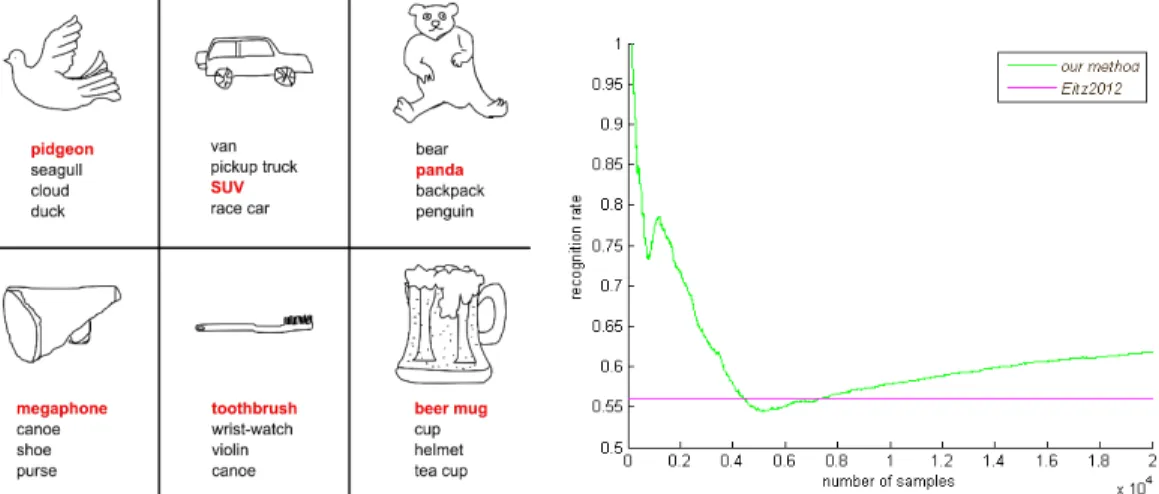
In this work, we have used state-of-the-art dataset of sketched images collected by Eitz (Eitz et al., 2012). It consists of 20,000 sketches in 250 categories (see Fig. 1). Categories consists of objects regularly encountered in everyday life and are aimed to capture general semantics of objects. Best reported results on this dataset are by (Eitz et al., 2012) at 56% (where chance is 4%), although it processes the data in batch manner, not in incremental manner.
We evaluate the performance of our system during the whole process of learning, thus precision should be high with every incoming sample. As evaluation criterion, we use several metrics. First criterion is simple accuracy evaluated as a ratio correctly classified element over total number of processed elements until current time 𝑡 . In second criterion, we change the success recognition criterion. We consider an example to be recognized correctly, if correct label is one of first 𝑛 returned examples, where 𝑛 is set to be 2% of total number of classes. At last, we use fall-off function to increase the effect of recent errors and decrease penalization for errors, which happened in a distant past. We use two falloff functions, linear and Gaussian with a cut-off threshold at 95% of values.
As we can see Fig. 2, our results are very promising, although at the beginning of the training the performance is low. This is mostly due to low number of examples present for a given class. Also according to our observations, errors are more frequent, when new class is introduced. Using evaluation criterion of top 𝑛 samples, we can see increased accuracy, even at the beginning of training. One can observe qualitative results in Fig. 2. where we present top 𝑛 labels for selected queries. At last, we can see the recognition rate for the whole learning process in Fig. 2. Decreased performance in the beginning is caused by insufficient number of labeled samples.
Our method is capable of performance in real-time and execution of incremental learning and recognition of a single example takes about 340ms on standard desktop PC.
(1) (2) (4) (5) (7) (8) (9) (10) (3) (6)
Figure 2. a) Results of the recognition algorithm, showing top 4 results. True label is
highlighted in red. b) And Recognition rate evaluation, comparison of our method and the best result of state-of-the-art Eitz2012 method
6. Conclusion and Future Work
We presented a method capable of retrieval of sketched objects of everyday life. This method can process incoming data in incremental manner and is capable of learning the representation of classes in interactive and on-line mode. This is achieved through a combination of special sketch-specific features and incremental fuzzy-neural learning method. Up to our knowledge, there is no state-of-the-art method capable of incremental learning of sketched images, which can over-perform our technique.
Although our system is working in incremental manner, it still needs pre-processing to obtain the codebook. To remove this obstacle we need to devise an efficient unsupervised incremental learning algorithm, so besides incremental learning in feature space, we can also construct incrementally the visual codebook. Also the representation of the codebook itself is shallow, and we may consider higher level hierarchy to represent composite primitives as hierarchy levels in the codebook, so we can achieve higher rate of recognition. At last we are looking into combining visual and semantic retrieval for sketch-based image recognition, thus we will develop an approach to combine these two slightly distant metaphors.
The authors would like to thank to SSHRC Canada and NSERC Canada for their financial support.
References
Alvarado, C., & Davis, R. (2004). SketchREAD: a multi-domain sketch recognition engine. Proceedings of the 17th Annual
ACM Symposium …, 6(2).
Caetano, A., Goulart, N., Fonseca, M., & Jorge, J. (2002). Javasketchit: Issues in sketching the look of user interfaces. AAAI
Spring Symposium
Eitz, M., Hays, J., & Alexa, M. (2012). How do humans sketch objects? ACM Transactions on Graphics (TOG), 31(4), 1–10. Eitz, M., Hildebrand, K., Boubekeur, T., & Alexa, M. (2010). Sketch-Based Image Retrieval: Benchmark and
Bag-of-Features Descriptors. Visualization and Computer Graphics, IEEE Transactions on, 17(11), 1624–1636. Jr, J. L., & Zeleznik, R. (2007). MathPad 2: a system for the creation and exploration of mathematical sketches. ACM
SIGGRAPH 2007 Courses.
Lowe, D. G. (2004). Distinctive Image Features from Scale-Invariant Keypoints. International Journal of Computer Vision,
60(2), 91–110.
Miyawaki, Y., Uchida, H., Yamashita, O., Sato, M., Morito, Y., Tanabe, H. C., … Kamitani, Y. (2008). Visual image reconstruction from human brain activity using a combination of multiscale local image decoders. Neuron, 60(5), Ouyang, T., & Davis, R. (2007). Recognition of hand drawn chemical diagrams. Proceedings of the National Conference on
Artificial …, 846–851.
Sezgin, T., & Davis, R. (2007). Sketch interpretation using multiscale models of temporal patterns. Computer Graphics and
Applications, …, (February), 28–37.
Sezgin, T. M., & Davis, R. (2005). HMM-based efficient sketch recognition. In Proceedings of the 10th international
conference on Intelligent user interfaces (pp. 281–283). ACM.
Sezgin, T. M., & Davis, R. (2008). Sketch recognition in interspersed drawings using time-based graphical models.
Computers & Graphics, 32(5), 500–510.
Tang, X., & Wang, X. (2004). Face Sketch Recognition. IEEE Transactions on Circuits and Systems for Video Technology,
14(1), 50–57.
Walther, D. B., Chai, B., Caddigan, E., Beck, D. M., & Fei-Fei, L. (2011). Simple line drawings suffice for functional MRI decoding of natural scene categories. Proceedings of the National Academy of Sciences of the United States of
Feature Evaluation for Discriminating Handwriting Fragments
Claudio DE STEFANO a , Francesco FONTANELLA a , Angelo MARCELLI b , Antonio PARZIALE b and Alessandra SCOTTO di FRECAa a
Dipartimento di Ingegneria Elettrica e dell’Informazione University of Cassino and Southern Lazio
Via Di Biasio, 43 04303, Cassino (FR), ITALY
b
Dipartimento di Ing. dell'Informazione, Ing. Elettrica e Matematica Applicata (DIEM) University of Salerno
Via Ponte don Melillo, 1 84084, Fisciano (SA), ITALY
(destefano, fontanella)@unicas.it, (amarcelli, anparziale)@unisa.it, [email protected]
Abstract. The large majority of methods proposed in literature for handwriting recognition assume that words are produced drawing large parts of the ink without lifting the pen, other than horizontal bars and dots. This fundamental assumption, however, does not always hold: while some educational systems provide explicit training for producing continuous handwriting, minimizing the number of pen-up during the production of a word, others do not. As a consequence, whenever the handwriting presents pen-up within a word, the recognition performance can drop significantly. In a preliminary study, we presented an algorithm for discriminating among different types of ink appearing in handwriting, namely isolated characters, cursive, dots, horizontal and vertical bars, based on the use of a suitable set of features. In this paper, we have characterized the discriminative power of each considered feature according to different measures and we have proposed a method for combining the different feature rankings. We have also used the Fischer’s Linear Discriminant Analysis (LDA) for exhaustively selecting the best feature subsets with increasing number of features. Finally, we have compared the results obtained by using the feature subsets provided by LDA with those obtained with the feature subsets selected according to our feature ranking. The experimental results, on different datasets of handwritten words, showed that our approach successfully achieves its aim allowing to reduce the computational cost without affecting the overall performance of the recognition process.
1. Introduction
Handwriting generation studies, and more in general studies on motor control and trajectory planning, show that the complex movements involved in handwriting are composition of elementary movements, each corresponding to an elementary shape or stroke. Such strokes are drawn one after the other during handwriting and the fluency emerges from the time superimposition of them (Plamondon 1995, Grossberg & Paine 2000). Following this line of thought, we have conjectured that handwriting recognition can be achieved by providing the system with a reference set, i.e. a set of words whose transcripts are given, decomposing each of the reference word into strokes, and matching the strokes with the transcript so as to associate to each of them the ASCII code corresponding to the character the stroke belongs to. Once the reference set has been provided, handwriting recognition can be achieved by looking within the unknown word for sequences of strokes whose shape resembles that of sequences of strokes found in the reference set, labeling the sequence of the unknown as the matching ones in the reference set, and then combining the labels according to the writing order (De Stefano & al., 2010).
There are cases, however, when our conjecture does not hold. Those are the cases when the word is not produced by keeping the pen-tip in constant contact with the paper, so to have a continuous ink, but lifting the pen here and there while drawing. While such a habit is still within the domain of handwriting generation models, that can explain why and under which circumstances such a behavior appears, it may produce undesired effects in our prototype. Because of the pen lift, in fact, some of the movements do not produce an ink trace on the paper, and therefore some of the strokes are missed. So the sequence of strokes cannot be reconstructed completely, and some of the invariants may disappear, compromising the results of whole process.
To deal with those cases, we proposed in a preliminary study (De Stefano & al., 2011) a method for extracting from a word image the sub-images corresponding to pieces of ink produced without lifting the pen. Each sub-image was described by a suitable set of features and then classified as cursive, isolated character, vertical line, horizontal line, dot or noise. According to this approach, sub-images corresponding to cursive fragments can be processed as described before, while those containing characters can be passed to an OCR module. Thus, the recognition of the whole word can be obtained by composing the results of each module according to the position of the corresponding sub-images in the word image.
To better understand the effectiveness of the above approach, in this study we have characterized the discriminative power of each considered feature in classifying the pieces of ink produced without lifting the pen
as isolated characters or cursive. The basic motivation of our work is to answer this main question: “is it possible to describe handwriting movements just analyzing static images?” We will show that with a suitable set of features extracted from the original images it’s often possible to associate each pieces of ink to one of the above two classes.
The remainder of the paper is organized as follows: Section 2 describes the set of considered features, Section 3 illustrates the feature evaluation measures, while the analysis and the discussion of the experimental results, together with some concluding remarks, are eventually left to Section 4.
2. Feature description
The aim of the feature extraction process is that of allowing the classification of connected components of ink traces, possibly produced by writers without lifting the pen, in two main classes: isolated characters and cursive. The basic idea is that a simple shape is generated by a simple motor program. The simpler the motor program, the smaller the quantity of ink the connected component contains. However, in order to improve the fluency of handwriting, a writer may introduce extra strokes, or ligatures, to connect the last stroke of a character and the first of the following one, instead of lifting the pen between the final point of the former and the initial point of the latter. Accordingly, we expect that images of isolated characters will contain less ink (and less strokes) than those of cursive, and that the ink will not span prevalently along the writing direction (De Stefano & al., 2011)
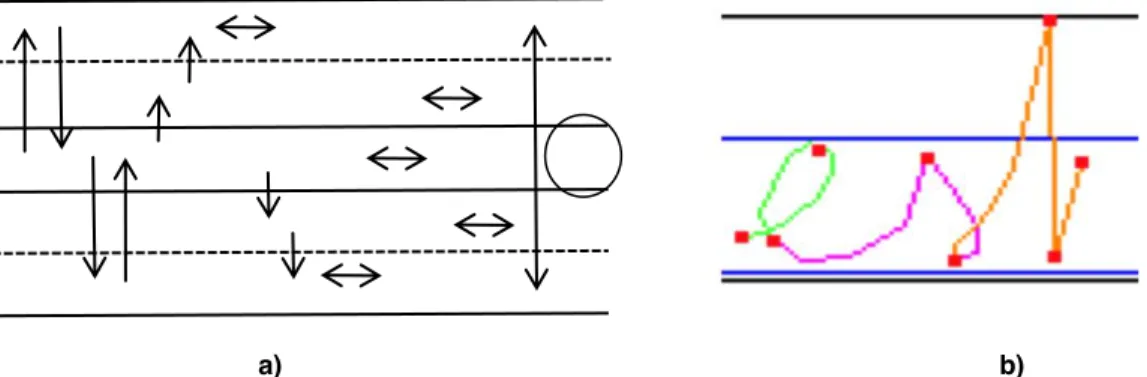
In order to estimate the features of connected components of ink traces, we proceed as follows: The word image is processed for extracting the bounding box of each connected component (see Figure 1a). Then, each component is analyzed by considering its size, the number and the distribution of its black pixels and the size of the word it belongs to (see Figure 1b). In particular, we consider the coordinates of the top-left and bottom right vertices of the bounding box (Xmin , Ymin , Xmax , Ymax), the width and the height of the bounding box (Wcomp ,
Hcomp), the total number of pixels and the number of black pixels included in the bounding box (Pcomp , BPcomp),
the width and the height of the bounding box of the word (Wword , Hword).
Starting from these basic features, an additional set of features is computed, whose description is reported in Table 1. The features HR, AR and PAR are meant to capture the spatual, and hence the temporal, extension of the handwriting, while FF is meant to capture the spatial density of ink.
In order to evaluate the shape complexity of the ink trace, we have considered the number of transitions between white and black pixels along consecutive rows/columns of the component. These values have been arranged in two histograms, namely ink-mark on the horizontal (IMx) and vertical (IMy) axis, where each bin
represents the above number of transitions for a group ∆ along a row or a column, respectively (see Figure 1b). These features can be seen as a measurement of the complexity of the ink: an empty or flat ink-mark on both horizontal and vertical axis suggests that the component presents scattered black pixels and is likely to be noise, whereas higher values correspond to more complex shapes.
Finally, we have estimated the center-zone of the word and we have considered as features the y-coordinate of the upper side of the center-zone (say CZYmin ). Table 2 summarizes the whole set of considered features.
Figure 1: the image of word "Trani" with the bounding box of each connected component and the center zone; a connected component extracted from the word image (right).
Table 1: description of additional features
height ratio (HR) aspect ratio (AR) proportional aspect ratio (PAR) fill factor (FF)
word comp H H HR = comp comp H W AR = word comp H W PAR = comp comp BP P FF =
Table 2: the set of adopted features
F1 F2 F3 F4 F5 F6 F7 F8 F9 F10 F11 F12
3. Feature evaluation
Two different approaches have been followed for evaluating the effectiveness of each feature and for identifying the subset of them having the highest discriminative power. The first approach is based on the use of standard univariate measures, while the second one uses the Fischer’s Linear Discriminant Analysis (LDA).
In the first case, we have considered five standard univariate measures, where each of them ranks the available features depending on their ability in discriminating pieces of ink belonging to either isolated characters or cursive. In our study, we have considered the following univariate measures: Chi-square (CS) (Liu & Setiono, 1995), Relief (R) (Kononenko, 1994), Gain Ratio (GR), Information Gain (IG) and Symmetrical Uncertainty (SU) (Hall, 1999). The final ranking of all the features is computed by using the Borda Count rule, according to which, a feature receives a score that depends on its position in the rankings provided by each univariate measure. Once the final ranking has been obtained, subsets including increasing number of features (top1; top1 and top2; etc.) are used by a Support Vector Machine (SVM) classifier for testing their discriminating power.
The second approach for evaluating the behavior of subsets including increasing number of features is based on the use of the Fischer’s Linear Discriminant Analysis (LDA). In this case we have exhaustively generated from the 12 available features, all the possible subsets of k distinct features, without repetitions, varying k from 1 to 12. Thus we created 4095 feature subsets, including 12 sets with only 1 feature, 66 sets with 2 features, 220 sets with 3 features, and so on up to the only set of 12 features. For each subset, the separation index S between the two classes has been computed. Denoting with 0 and 1 the two classes to be discriminated, S is defined as the ratio of the variance between classes to the variance within classes, using the mean vectors µ0, µ1 and the
covariance matrices Σ0, Σ1 of class 0 and 1, respectively, and
ω
is described in (De Stefano & al., 2014)(
)
ω
ω
µ
µ
ω
σ
σ
r
r
r
r
r
)
(
)
(
0 1 2 0 1 2 2Σ
+
Σ
−
=
=
T within betwwenS
The parameter S is a measure of how well the feature subset is able to discriminate between the two classes. It is worth noticing that S is a non-decreasing function with respect to the number of features included in a subset. This is the reason why we used S for ranking subsets including the same number of features. Once the best subset including k distinct features has been determined using the parameter S (with k ranging from 1 to 12), we used once again the SVM classifier for testing the discriminating power of that subset.
4. Experimental results
In order to ascertain the effectiveness of the proposed approach, two real world datasets involving handwritten words have been taken into account, namely RIMES and ELSAG database.
The RIMES database is a publicly available dataset used for performance evaluation of handwriting recognition systems (Grosicki, & 2008). It is composed of French words written by more than 1300 volunteers. To validate our algorithm, we extracted 4047 words from the test set and we showed them to 6 human experts. For each word, an expert had to classify manually each connected component and provide its transcript. At the end of this process, 9869 components were manually classified and transcribed, 5101 of them were cursive and 4768 isolated characters.
In the ELSAG database, a set of images representing postal addresses, acquired at 200/300 dpi, was processed in order to segment single words. Then, from each word, the connected components of ink traces, corresponding to cursive or isolated character, were extracted and described by using the above mentioned features. Moreover, in order to evaluate the classification results, each fragmented word image has been shown to 10 experts, and they were asked to label each fragment, to produce the ground truth. At the end of this process, a dataset of 26143 labeled samples has been obtained, containing 15838 isolated characters and 10305 cursive.
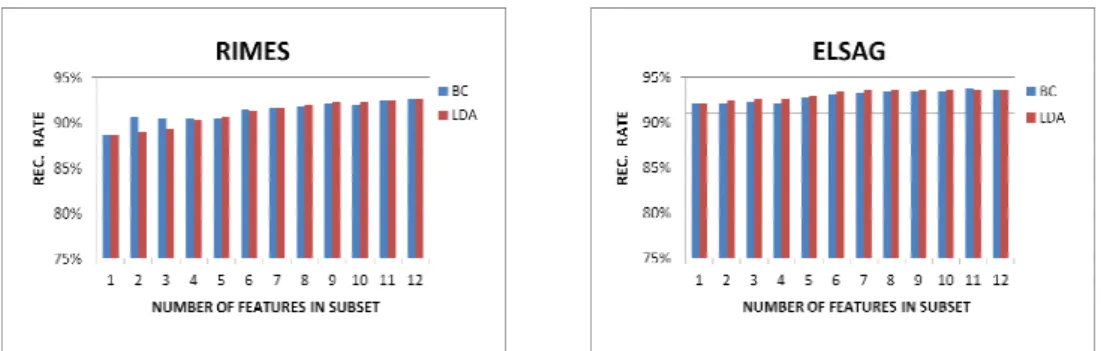
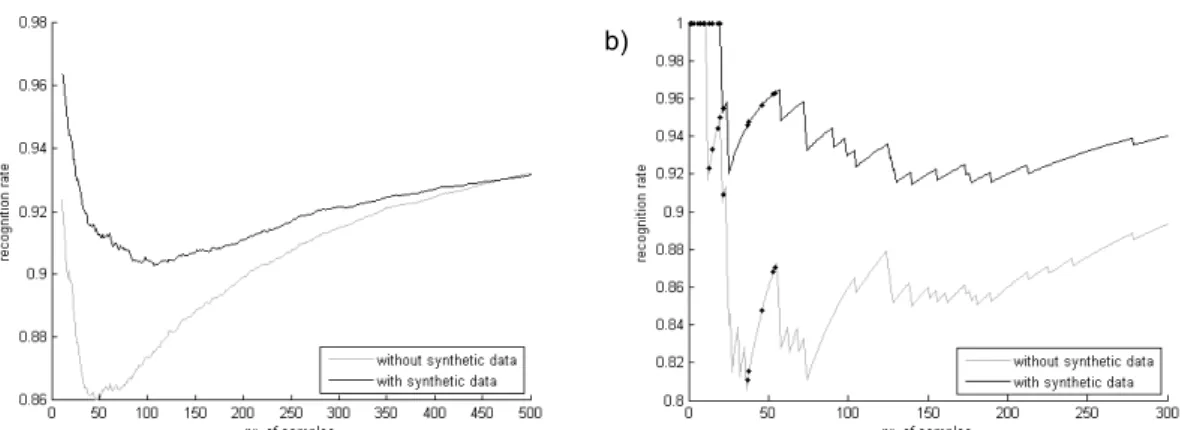
Feature evaluation based on the univariate measures has been applied to both databases, producing the results summarized in Table 3. Similarly, LDA approach produced the results reported in Figure 2, where the occurrence of each feature in the optimal subsets selected by LDA is shown. On the basis of these results and applying the previously discussed criteria, we obtained for both evaluation approaches, 12 subsets with increasing number of features, starting from the one including just 1 feature to that including all the 12 features. The effectiveness of each feature subset has been evaluated by implementing a SVM classifier using those features and measuring the recognition performance. In particular, we used for the SVM’s the standard algorithm of regularized Support Vector Classification (C-SVC) with a Radial Basis Function kernel. The classification results reported in Figure 3 refer to the application of the 10-fold validation approach and show the plot of the recognition rate as a function of the number of features.
The analysis of these results confirms the effectiveness of the considered features, allowing us to obtain a maximum recognition rate equal to 92.55% and 93.65% for RIMES and for ELSAG database, respectively. The data in the plot show that satisfactory results can be obtained even considering only the top 3 features according
to the Borda Count overall ranking: in this case, in fact, a recognition rate of about 90% is obtained for RIMES database, while a recognition rate higher than 92% is obtained for ELSAG database. It is worth noticing that the results of the Borda Count are comparable, or in some cases better, than those obtained by the LDA. This aspect is particularly meaningful since the univariate measures combined by the Borda Count perform the feature ranking considering one feature at a time, while LDA performs an exhaustive search considering all the possible feature combination, thus implying a very high computational cost.
Future work will include exploiting the information about the classification reliability. Such kind of information would allow the designer of the system the implementation of a reject option for accepting only the high reliable classification on the basis of few features, thus limiting the use of more complex and computationally expensive feature only to the confused cases.
Table 3: Feature ranking according to the Borda Count overall measure. For each row, the leftmost value indicates the best feature, while the rightmost value denotes the worst one.
!"#$%
!"#
!$#
!%%#
!&#
!'#
!%#
!(#
!)#
!%"#
!%*#
!+#
!,#
$&%'(
!"#
!$#
!%%#
!'#
!%#
!&#
!(#
!%*#
!)#
!,#
!+#
!%"#
Figure 2: Occurrence of each feature in the optimal subsets selected by LDA for RIMES database (left) and ELSAG database (right).
Figure 3: SVM classification results with 10 fold validation on features subsets for RIMES database (left) and for ELSAG database (right).
References
Plamondon, R. (1995). A kinematic theory of rapid human movements. Part I: Movement representation and generation, Biological Cybernetics, 72, 297-307.
Grossberg, S., & Paine, R.W. (2000). A neural model of corticocerebellar interactions during attentive imitation and predictive learning of sequential handwriting movements, Neural Networks, 13: 999-1046.
De Stefano, C., Marcelli, A., Parziale, A., Senatore, R. (2010). Reading Cursive Handwriting, Proc. Int. Conf. on Frontiers in Handwriting Recognition - ICFHR 2010, Kolkata (INDIA), November 16-18, pp. 95-100.
De Stefano, C., Marcelli, A. & Parziale, A. (2011). Segmenting Isolated Characters Within Cursive Words”, Proc. of the 15th International Graphonomics Society Conference (IGS 2011), Cancun, MEXICO, IGS press, pp. 156-159.
De Stefano, C., Fontanella, F., Marrocco, C., Scotto di Freca, A., “GA-based feature selection approach with an application to handwritten character recognition”, Pattern Recognition Letters, Vol. 35, pp. 130-141.
Liu, H. & Setiono, R. (1995). Chi2: Feature Selection and Discretization of Numeric Attributes. In: ICTAI, IEEE Computer Society, pp 88–91.
Kononenko, I. (1994). Estimating Attributes: Analysis and Extensions of RELIEF. In: European Conference on Machine Learning, pp 171–182.
Hall, M. (1999). Correlation-based Feature Selection for Machine Learning. PhD thesis, University of Waikato.
Grosicki, E. & al. (2008). RIMES evaluation campaign for handwritten mail processing. Proc. of the Int. Conf. on Frontiers in Handwriting Recognition, Montreal, Canada, pp. 1- 6.