
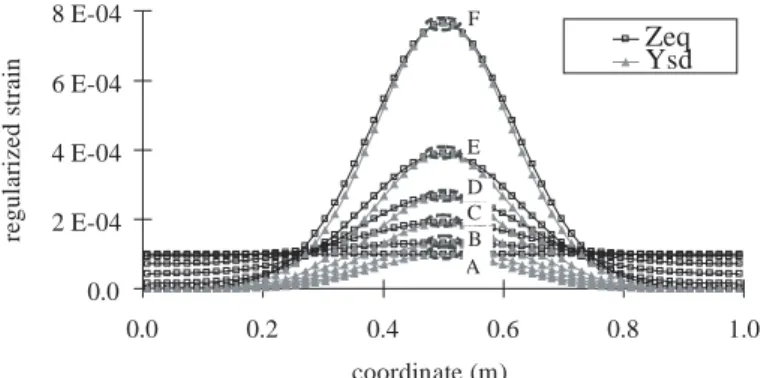
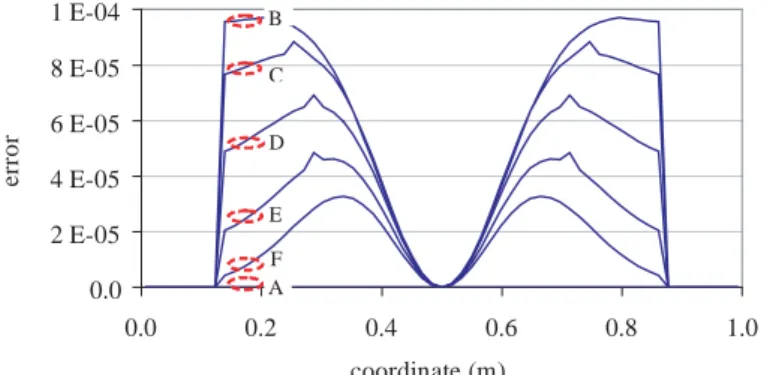
How to extract a crack opening from a continuous damage finite-element computation?
Texte intégral
Figure


Documents relatifs
/ La version de cette publication peut être l’une des suivantes : la version prépublication de l’auteur, la version acceptée du manuscrit ou la version de l’éditeur. Access
• Alternative formulation for a good conditioning of the system matrix â Quasi optimal convergence.. • Necessary and sufficient geometrical conditions remain open â Inclusion
Property 5 (Rupture of the bar at the center of a localization zone) At the end of the damage process, when the stress has decreased to 0, the damage takes the critical value 1 at
In this paper, a simple and practical finite element (FE) model coupled to a quasi-brittle damage law to describe the initiation and progressive propagation of
In the case of elastic-damageable models, under the assump- tion of proportional, prescribed-displacement loading, the model substitution method preserves not only the energy
As for the compressible Navier-Stokes system (we refer to [3], [11], [17], [6]) both of these systems have been studied in the context of the existence of global strong solutions
To be in line with the new development agenda the identification criteria relating to structural handicaps could take into account not only the economic vulnerability as presently
To prove the optimal convergence of the standard finite element method, we shall construct a modification of the nodal interpolation operator replacing the standard
