HAL Id: hal-02066041
https://hal-imt.archives-ouvertes.fr/hal-02066041
Submitted on 13 Mar 2019
HAL is a multi-disciplinary open access
archive for the deposit and dissemination of
sci-entific research documents, whether they are
pub-lished or not. The documents may come from
teaching and research institutions in France or
abroad, or from public or private research centers.
L’archive ouverte pluridisciplinaire HAL, est
destinée au dépôt et à la diffusion de documents
scientifiques de niveau recherche, publiés ou non,
émanant des établissements d’enseignement et de
recherche français ou étrangers, des laboratoires
publics ou privés.
Distributed under a Creative Commons Attribution| 4.0 International License
Learning How to Correct a Knowledge Base from the
Edit History
Thomas Tanon, Camille Bourgaux, Fabian Suchanek
To cite this version:
Thomas Tanon, Camille Bourgaux, Fabian Suchanek. Learning How to Correct a Knowledge Base
from the Edit History. World Wide Web Conference, May 2019, San Francisco, United States.
�10.1145/3308558.3313584�. �hal-02066041�
Learning How to Correct a Knowledge Base
from the Edit History
Thomas Pellissier Tanon
Télécom ParisTechCamille Bourgaux
DI ENS, CNRS, ENS, PSL Univ. & InriaFabian Suchanek
Télécom ParisTechABSTRACT
The curation of a knowledge base is a crucial but costly task. In this work, we propose to take advantage of the edit history of the knowl-edge base in order to learn how to correct constraint violations. Our method is based on rule mining, and uses the edits that solved some violations in the past to infer how to solve similar violations in the present. The experimental evaluation of our method on Wikidata shows significant improvements over baselines.
KEYWORDS
knowledge base; history; data cleaning; rule mining; Wikidata
ACM Reference Format:
Thomas Pellissier Tanon, Camille Bourgaux, and Fabian Suchanek. 2019. Learning How to Correct a Knowledge Base from the Edit History. In Pro-ceedings of the 2019 World Wide Web Conference (WWW ’19), May 13– 17, 2019, San Francisco, CA, USA. ACM, New York, NY, USA, 11 pages. https://doi.org/10.1145/3308558.3313584
1
INTRODUCTION
Knowledge bases (KBs) play a key role in many applications and lay at the core of the Semantic Web. They contain entities (such as persons, cities, etc.) and statements about them (such as rela-tionships between persons, places of residence, etc.). In this work, we focus on RDFS-style KBs, such as Wikidata [38], YAGO [35] or DBpedia [7]. The data quality of a KB is crucial for its usability. However, it is usually very costly to check the correctness of the data, because KBs can be huge (Wikidata, e.g., contains about 50 millions entities). Moreover, KBs are often built using methods that are error-prone. For instance YAGO and DBpedia are automatically extracted from Wikipedia. Wikidata, for its part, is a collaborative KB that anyone can edit, with more than 18,000 active contributors. A way of avoiding or at least detecting some of the flaws in the data is to imposeconstraints on the KB. Such constraints can enforce that some information must be present (e.g., imposing that every human being has a birth date), or that some statements may not occur (e.g., ensuring that a person is not also a city). Constraints are related to, but different from, ontological rules: A constraint imposes a certain condition, whereas an ontological rule infers certain statements. For example, consider a KB that contains the statement “Spinoza is a human being” without knowing any birth date for Spinoza, and consider a rule “All human beings have a
This paper is published under the Creative Commons Attribution 4.0 International (CC-BY 4.0) license. Authors reserve their rights to disseminate the work on their personal and corporate Web sites with the appropriate attribution.
WWW ’19, May 13–17, 2019, San Francisco, CA, USA
© 2019 IW3C2 (International World Wide Web Conference Committee), published under Creative Commons CC-BY 4.0 License.
ACM ISBN 978-1-4503-6674-8/19/05. https://doi.org/10.1145/3308558.3313584
birth date”. If the rule is taken as an ontological rule, then it would just infer that Spinoza has some birth date. If the rule is taken as a constraint, in contrast, the KB would be considered incorrect. Con-straints are thus similar in spirit to database integrity conCon-straints. In practice, constraints often have exceptions. Therefore, it is useful to allow data that does not respect them (in Wikidata, e.g., con-straint violations are simply flagged). Nonetheless, by design, most of the constraint violations are not exceptions but actual errors and proposing to repair them is a good starting point when it comes to improving KB quality.
In this paper, we aim at learning how to repair constraint viola-tions. Our goal is to help a KB editor by suggesting how to clean the data locally (providing a solution to a particular constraint violation) or globally (providing rules that can be automatically applied to all constraint violations of a given form once validated by the editor). To do that, we take advantage of theedit history of the KB. We use it to minecorrection rules that express how differ-ent kinds of constraint violations are usually solved. To the best of our knowledge, this is the first work that builds on past users corrections in order to infer possible new ones. We validate our framework experimentally on Wikidata, for which the whole edit history of more than 700 millions edits is available. Our experiments show substantial improvements over baselines. More concretely, our contributions are as follows:
• a formal definition of the problem of correction rule mining, • a dataset of more than 67M past corrections for ten different
kinds of Wikidata constraints (13k constraints in total),1 • a correction rule mining algorithm, together with an
imple-mentation for Wikidata, CorHist,2
• a suggestion tool for users to correct data based on our mined correction rules,3
• an experimental evaluation based both on the prediction of the corrections in the history and on user validation of the suggested local corrections.
2
RELATED WORK
We start with a brief discussion of works relevant to our problem along three axes: constraints for KBs, KB cleaning, and rule learning. Constraints. Constraints have long been used in databases and KBs to express rules that the data should follow. Databases typi-cally operate under the closed world assumption, where missing facts are considered to be false. This allows for “completeness” constraints such as tuple generating dependencies. KBs, in con-trast, operate under the open world assumption, where missing
1
available at https://doi.org/10.6084/m9.figshare.7712720
2
available at https://github.com/Tpt/corhist
3
facts are not necessarily false. They thus classically have only “cor-rectness” constraints, such as disjointness or functionality axioms (corresponding to special cases of denial constraints and equality generating dependencies in databases).
To express also completeness constraints, several works propose to use description logics, with varying semantics [28, 37]. Another possibility is to use queries that should or should not hold as con-straints (see e.g., [24] for methods for writing constraint queries in SPARQL). Other approaches define constraint languages to specify conditions for RDF graph [9] validation, such as SHACL [22] or ShEx [8]. It has been argued in [30] that description logics under the closed world assumption are also suitable for constraint checking in RDF, which can then be implemented with SPARQL queries. In our work, we follow a similar path, using description logic axioms as constraints for RDFS KBs, because it corresponds best to what we observe in current real-world KBs.
Contrary to the above works, we do not aim atexpressing con-straints, but atrepairing their violations. The correction rules we learn for this purpose are similar in spirit to active integrity con-straints [11], which specify for each constraint a set of possible repair actions. This type of constraints has recently been applied to description logic KBs as well [32]. Conditioned active integrity constraints add conditions for choosing among the possible actions, and we propose, in a similar spirit, to take into account the context of the constraint violation to correct it. Different from the existing work [11, 32], our goal is to mine correction rules automatically from the edit history of the KB.
Knowledge base cleaning. Several recent approaches have dealt with the interactive cleaning of KBs. The proposed methods detect when a constraint is violated, compute the responsible facts, and then interact with the user to find out how to update the KB. The goal is then to minimize the number of questions the user has to answer. This is done in various ways, which include taking into account the dependencies among the facts to check or the interac-tion between several constraints violainterac-tions to define heuristics to choose the best question to ask the user [2, 3, 5, 6].
Other approaches to improve the quality of a KB rely on statistics, clustering, or structural aspects of the KBs. The work of [31] uses statistics to add missing types to the KB, and to detect wrong state-ments. The work of [25] exploits the observation that cycles in the KB often contain wrong “IsA” relations. Again other approaches [1] use crowdsourcing to detect Linked Data quality issues. We refer the reader to Section 7.2 of [1] for a recent overview of approaches for data quality assessment.
Our method also exploits KB constraints. However, it differs from the above in that itlearns the corrections automatically from the edit history. It thus taps a source of knowledge that has so far not been exploited.
Rule learning. Mining logical rules by finding correlations in a dataset is a well-established research topic. In particular, learning patterns in the data can be used for completing KBs [14, 36]. An algorithm for learning conjunctive patterns from a KB enriched with a set of rules is described in [20]. Methods similar to association rule mining have also been used for induction of new ontological rules from a KB [33]. A more recent trend is to use embedding-based models for KB completion. A comparison between these models and
usual rule learning approaches is reported in [27] and significant recent works in this area include [19, 39, 40].
In this paper, we use a vanilla rule mining algorithm inspired by [14]. Our contribution is not the rule mining per se, but the application of rule mining to the edit history of a KB in order to mine correction rules. This avenue has, to the best of our knowledge, never been investigated.
3
PRELIMINARIES
In this work, we use description logics (DL) [4] as KB language and as constraint language, because they are the foundation of the Semantic Web standard OWL [16].
Syntax. We assume a set NCofconcept names (unary predicates, also called classes), a setNRofrole names (binary predicates, also called properties), and a setN
Iofindividuals (also called constants). AnABox (dataset) is a set of concept or role assertions of the form A(a) or R(a, b), where A ∈ NC,R ∈ NR,a, b ∈ NI. ATBox (ontology) is a set of axioms whose form depends on the DLL in question, and expresses relationships between concepts and roles (e.g., concept or role hierarchies, role domains and ranges...). Aknowledge base (KB)K= T ∪ A is the union of an ABox A and a TBox T .
In this work, we assume thatT is a flat QL TBox [23], i.e., that L differs from the standardRDF Schema (RDFS) [17] only by allowing inverse roles in role inclusions. More precisely,T can contain con-cept inclusions of the formA1⊑A2(subclass),∃P ⊑ A (domain or range), and role inclusionsP1⊑P2(subproperty), whereA(i)∈ NC andP(i):= R | R−withR ∈ NR.
A KB can also be written as a set ofRDF triples ⟨s, p, o⟩ where s is the subject, p is the property, and o the object, using special properties to translate concept membership and relationships be-tween concepts and roles [29]. A concept assertionA(a) is written as⟨a, rdf:type, A⟩, and a role assertion R(a, b) as ⟨a, R, b⟩. Flat QL TBox axioms can also be represented by single triples. For example, A1⊑A2is written as⟨A1, rdfs:subClassOf, A2⟩ and ∃R
−⊑A is written as⟨R, rdfs:range, A⟩.
Semantics. We recall the standard semantics of DL KBs. An inter-pretation has the form I= (∆I, ·I), where∆Iis a non-empty set and·Iis a function that injectively maps eacha ∈ NItoaI∈∆I (unique name assumption),⊤ to∆I, eachA ∈ NCtoAI⊆∆I, and eachR ∈ NRtoRI ⊆∆I×∆I. The function·Iis straightforwardly extended to general concepts and roles, e.g.(¬B)I = ∆I\BI, (R−)I = {(c,d) | (d, c) ∈ RI}, {a1, . . . , an} = {a I 1, . . . , a I n}, (∃P · B)I= {c | ∃d : (c,d) ∈ PI, d ∈ BI}, (B 1⊓B2)I= B I 1 ∩B I 2, (B1⊔B2)I= B1I∪B2I. An interpretationI satisfies an inclusion G ⊑ H, if GI⊆HI; it satisfies an axiom(func P ) if PIis functional; it satisfies an axiom(trans P ) if PIis transitive; and it satisfiesA(a) (resp.R(a, b)), if aI∈AI(resp.(aI, bI) ∈RI). We writeI |= α if I satisfies the DL axiomα.
An interpretationI is a model of K= T ∪ A if I satisfies all axioms inK. A KB is consistent if it has a model. A KB K entails a DL axiomα if I |= α for every model I of K.
Queries. A conjunctive query (CQ) takes the formq(®x) = ∃®yψ (®x, ®y), whereψ is a conjunction of atoms of the form A(t) or R(t, t′) or of equalitiest = t′, wheret, t′are individual names or variables from
®
x ∪ ®y. If ®x = ∅, q is a Boolean CQ (BCQ). A BCQ q is satisfied by an interpretationI, written I |= q, if there is a homomorphism π mapping the variables and individual names of q into ∆Isuch that:π(a) = aI for everya ∈ NI,π(t) ∈ AIfor every concept atomA(t) in ψ , (π(t), π(t′)) ∈RIfor every role atomR(t, t′) inψ , andπ(t) = π(t′) for everyt = t′inψ . We also consider as BCQs the queriestrue and false which are respectively always and never satisfied by an interpretation. A BCQq is entailed from K, written K |= q, iff q is satisfied by every model of K. A tuple of constants ®
a is a (certain) answer to a CQ q(®x) if K |= q(®a) where q(®a) is the BCQ obtained by replacing the variables fromx by the constants ®a.® We denote byanswers(q(®x), K) the set of answers of q(®x) over K. Aunion of CQs (UCQ) is a disjunction of CQs and has as answers the union of the answers of the CQs it contains.
Canonical model. It is well-known that a flat QL KB K has a canonical model IKsuch that for every BCQq, K |= q iff IK |= q. The domain ofIKis the set of individual names that occur inK andAIK = {a | A |= B(a), T |= B ⊑ A} for every A ∈ N
Cand RIK = {(a,b) | A |= P(a,b), T |= P ⊑ R} for every R ∈ N
R[23].
4
CONSTRAINTS
This section defines the constraints that can be imposed on a KB, and relates the problem of checking that a KB complies with these constraints to CQ answering over this KB.
Defining constraints. In this work, we consider two types of constraints: consistency constraints (which express that some state-ments are contradictory), and completeness constraints (which im-pose that certain statements should hold in the KB as soon as some others do). While violations of consistency constraints can only be solved by removing statements, those of completeness constraints can also be solved by adding statements.
Definition 1 (Constraint): Constraints are built from complex con-cepts and roles defined by the following grammar rules:
blahP := R | R−
blahB := ⊤ | A | B ⊓ B | B ⊔ B | ∃P · {a1, . . . , an} | ∃P · B whereR ∈ NR,A ∈ NC,a1, . . . , an ∈ NI.
A consistency constraint is a concept inclusion of the formB1⊑ ¬B2or of the formB ⊑ {a1, . . . , an}, a role inclusion of the form P1⊑ ¬P2, or a functionality axiom of the form (func P ).
A completeness constraint is a concept inclusion of the formB1⊑ B2, a role inclusion of the formP1⊑P2, or a transitivity axiom of the form (trans P ).
This definition of constraints covers the “constraining” versions of the majority of the most popular DL axioms used on the Web of Data according to the ranking done by [15].
We assume without loss of generality that concepts of the form B1⊔B2or{a1, . . . , an} withn > 1 appear only on the right side of inclusions, and not at all in negative inclusions of the form B1 ⊑ ¬B2. For example, we assume that∃P · (B1⊔B2) ⊑C is rewritten as∃P · B1⊑C, ∃P · B2⊑C, and B ⊑ ¬∃P · {a1, . . . , an} is rewritten asB ⊑ ¬∃P · {a1}, . . . , B ⊑ ¬∃P · {an}. As usual, we abbreviate∃P · ⊤ as ∃P.
Example 1: As a running example, we consider the following KB K= T ∪ A and set of constraints C inspired from Wikidata. Our TBox T expresses that human beings and deities are persons. Our
ABox A provides information on several individuals. Our constraints C state that there are three possible genders (consistency constraint), that those who have a mother or are a mother must be persons or animals, that a mother must have gender female, and that ifa has motherb, then b must have child a (completeness constraints).
T = { Human ⊑ Person, Deity ⊑ Person }
A= { Deity(Zeus), Deity(Rhea), hasGender(Zeus, masculine), hasGender(Rhea, female), hasMother(Zeus, Rhea), hasChild(Rhea, Zeus), Human(Spinoza),
hasMother(Spinoza, Marques) } C= { Γ0= ∃hasGender
−
⊑ {male, female, nonbinary}, Γ1= ∃hasMother ⊑ Person ⊔ Animal,
Γ2= ∃hasMother − ⊑ Person ⊔ Animal, Γ3= ∃hasMother − ⊑ ∃hasGender · {female}, Γ4= hasMother ⊑ hasChild −} ◁
We say that a KBK satisfies a constraintΓ ∈ C if IK |= Γ, where IKis the canonical model ofK. Otherwise, K violatesΓ. Example 2: In our running example, the KB K satisfiesΓ1 since ∃hasMotherIK = {Zeus, Spinoza} and I
K |= Person(Zeus) and IK |= Person(Spinoza). However, it violates Γ2 because IK ̸|= Person(Marques) ∨ Animal(Marques) while Marques ∈ ∃hasMother−IK. It violates Γ
3 and Γ4 for similar reasons. Fi-nally, {hasGender(Zeus, masculine), Γ0} has no model because of the unique name assumption (which enforces that the interpretation of masculine differs from those of male, female and nonbinary). Hence, IKcannot be a model ofΓ0. Thus, K violatesΓ0. ◁ Note the semantic difference between the constraints and the ax-ioms of the TBox: The axiom(Human ⊑ Person) in the TBox makes every human an answer to the query asking for persons. In contrast, if we had put the axiom in the set of constraints, it would have required all human beings in the KB to be explicitly marked as per-sons. As another example, consider the axiom(func hasBirthdate) (which says that everyone can have at most one birth date). If this axiom appears in the TBox, it renders the KB inconsistent whenever a person is given two distinct dates of birth. This has severe conse-quences on the reasoning capabilities, since everything is entailed from an inconsistent KB. If this axiom is in the set of constraints, in contrast, then distinct dates of birth lead only to the violation of the constraint. This gives us relevant information without having any impact on the usability of the KB.
Checking constraints. We show that our setting allows us to check constraint satisfaction via CQ answering. For this purpose, we use a functionπ, which maps each constraint Γ ∈ C to a rule of the form∃ ®yφ(®x, ®y) → ∃®zφ′( ®x, ®z). This function is defined recursively as shown in Table 1. The left side of the rule is called thebody and its right side thehead.
Example 3:In our running example, we obtain the following rules: Γ0(x) : ∃yhasGender(y, x) →x =male∨x =female∨x =nonbinary Γ1(x) : ∃yhasMother(x,y) → Person(x) ∨ Animal(x)
Γ2(x) : ∃yhasMother(y, x) → Person(x) ∨ Animal(x)
Γ3(x) : ∃yhasMother(y, x) → ∃z(hasGender(x, z) ∧ z = female) Γ4(x,y) : hasMother(x,y) → hasChild(y, x) ◁
Table 1: Translation of DL axioms into rules. Variables that appear in the right column and not in the left one are fresh.
π(⊤, x) = true π(A, x) = A(x) π({a1, . . . , an}, x) = x = a1∨ · · · ∨x = an π(R, x,y) = R(x,y) π(R−, x,y) = π(R,y, x) π(B1⊓B2, x) = π(B1, x) ∧ π(B2, x) π(B1⊔B2, x) = π(B1, x) ∨ π(B2, x)
π(∃P · B, x) = ∃y(π(P, x,y) ∧ π(B,y)) π(B ⊑ C) = π(B, x) → π(C, x) π(P ⊑ Q) = π(P, x,y) → π(Q, x,y) π(B ⊑ ¬C) = π(B, x) ∧ π(C, x) → false π(P ⊑ ¬Q) = π(P, x,y) ∧ π(Q, x,y) → false
π(func P) = π(P, x,y) ∧ π(P, x, z) → y = z π(trans P) = π(P, x,y) ∧ π(P,y, z) → π(P, x, z)
The following proposition shows that this transformation is sound and that the rule body and head can be rewritten as CQ and UCQ. Proposition 1: For every constraintΓ ∈ C, π(Γ) can be rewritten as a ruleΓ(®x) : b(®x) → h(®x) where b(®x) is a CQ, h(®x) is a UCQ, and for every flat QL KB K, K satisfiesΓ iff answers(b(®x), K) ⊆ answers(h(®x), K).
Proof. By our assumptions on the form of the concepts that occur in the left side of the inclusions or in the right side of a negative inclusion,b(®x) := ∃®yφ(®x, ®y) is a CQ. It is easy to show by struc-tural induction that for every conceptB (resp. role P), π(B, x) (resp. π(P, x,y)) can be written as a UCQ q(x) (resp. q(x,y)) and that answers(q(x), K)= BIK(resp.answers(q(x, y), K)= PIK). IfΓ is a completeness constraint of the formB1 ⊑ B2(resp.P1 ⊑ P2), or a consistency constraint of the formB ⊑ {a1, . . . , an}, the result follows immediately sinceK satisfiesΓ iff IK |= Γ. If Γ is a consistency constraint of the formB1 ⊑ ¬B2 (resp.P1 ⊑ ¬P2),answers(b(®x), K) = B IK 1 ∩B IK 2 (resp.answers(b(®x), K) = PIK 1 ∩P IK
2 ) and is empty iffΓ is satisfied. Since in this case h(®x) := false, answers(h(®x), K) = ∅, and the desired relation holds. IfΓ is of the form (func P), since the answers of h(x,y, z) := y = z overK are all possible tuples of the form (a, b, b), PIK is func-tional iffanswers(b(x, y, z), K) ⊆ answers(h(x, y, z), K). Finally, if Γ is of the form (trans P), b(x,y, z) := π(P, x,y) ∧ π(P,y, z) and h(x,y, z) := π(P, x, z), and it is easy to see that PIKis transitive iff answers(b(x, y, z), K) ⊆ answers(h(x, y, z), K). □ Constraint violations. A constraint instanceΓ(®a) of a constraint Γ(®x) is obtained by replacing the variables ®x by the individual names ®
a in Γ(®x). This notion allows us to define constraint violations: Definition 2 (Constraint violation):A violation of a constraintΓ(®x) in K is a minimal subset V ⊆ K such that there exists ®a such that V violatesΓ(®a) and K violates Γ(®a). We denote by Violations(K, Γ(®x)) the set of violations ofΓ(®x).
In this definition, the requirement thatK violatesΓ(®a) may seem superfluous. Yet, ifΓ is a completeness constraint, it may be the case that someV ⊆ K violatesΓ(®a), while K satisfies it.
Example 4: In our running example, it is easy to see that the sub-set V0 = {hasGender(Zeus, masculine)} is a violation of Γ0. Con-sider now V = {hasMother(Spinoza, Marques)}. V is a violation ofΓ2,Γ3andΓ4. Indeed, it violatesΓ2(Marques),Γ3(Marques), and Γ4(Spinoza, Marques) and K does not satisfy any of these constraint instances. However, even if V violatesΓ1(Spinoza), V is not a vi-olation ofΓ1because {Human(Spinoza), Human ⊑ Person} ⊆ K satisfies the head ofΓ1(Spinoza). ◁ If a constraint instanceΓ(®a) is violated, ®a ∈ answers(b(®x), K) and ®
a < answers(h(®x), K), so its violations are the minimal subsets of K responsible fora ∈ answers(b(®x), K). The next proposition relates® constraint violations andjustifications. A justification (also known as an explanation, axiom pinpointing, or MinAs) for the entailment of a BCQ is a minimal subset of the KB that entails the BCQ [21, 34]. Proposition 2: If K violatesΓ(®a) : b(®a) → h(®a), a subset V ⊆ K is a violation ofΓ(®a) iff V is a justification of K |= b(®a).
5
CORRECTIONS
We now turn to correcting constraint violations.
Solutions. We will make use of atomic modifications of the KB to define solutions to constraint violations.
Definition 3 (Atomic modification): An atomic modification of a KB K is a pairm = (M+, M−) of two sets of assertions or L-axioms that takes one of the following forms:
Addition:m = ({⟨s,p, o⟩}, ∅), where ⟨s,p, o⟩ < K Deletion:m = (∅, {⟨s,p, o⟩}), where ⟨s,p, o⟩ ∈ K
Replacement:m = ({⟨s,p, o⟩}, {⟨s′, p′, o′⟩}), where ⟨s, p, o⟩ < K, ⟨s′, p′, o′⟩ ∈ K, and ⟨s, p, o⟩ differs from ⟨s′, p′, o′⟩ in exactly one component.
Thus, an atomic modification consists of two setsM+andM−, each of which is either the empty set or a singleton set.M+will be added to the KB, andM−will be removed from the KB. Since the sets contain at most one triple, we slightly abuse the notation and identify the singletons with their elements (e.g., we will denote the addition of⟨s, p, o⟩ simply by (⟨s, p, o⟩, ∅)). A replacement is equivalent to a sequence of a deletion and an addition. We chose to keep it as an atomic modification because it corresponds to common knowledge base curation tasks, such as correcting an erroneous object for a given subject and predicate, or fixing a predicate misuse. Atomic modifications can be used to solve a constraint violation, as follows:
Definition 4 (Solution): A solution to a violation V of a constraint instanceΓ(®a) in K is an atomic modification (M+, M−) such that there exists K′⊆ K such that (V ∪ K′∪ M+) \ M−satisfiesΓ(®a). We call (M+, M−) a solution to V forΓ(®a) in K.
Note that Γ(®a) can still be violated in (K ∪ M+) \ M− if K contains other violations ofΓ(®a) for which (M+, M−) is not a solution. For example, ifΓ(a) : ∃xR(a, x) ∧ A(a) → false, and K= {R(a,b), R(a, c), A(a)}, the deletion of R(a,b) is a solution to the violation{R(a, b), A(a)}, but {R(a, c), A(a)} still violates Γ(a). Note also that every constraint violation has at least one solution, which consists of the deletion of any of its elements. Solutions may also be additions or replacements, as in the following example: Example 5: In our running example, the deletion (∅, hasGender (Zeus, masculine)) and the replacement (hasGender(Zeus, male),
hasGender(Zeus, masculine)) are two possible solutions to V0 for Γ0(masculine).
The deletion (∅, hasMother(Spinoza, Marques)) is a solution to V for the three constraint instances Γ2(Marques), Γ3(Marques) and Γ4(Spinoza, Marques). The additions (Human(Marques), ∅), (hasGender(Marques, female), ∅) and (hasChild(Marques, Spino− za), ∅) are solutions to V for respectivelyΓ2(Marques),Γ3(Marques) andΓ4(Spinoza, Marques). ◁ Good solutions. Our goal is to find “good” solutions to constraint violations, i.e., solutions that make the KB as close to the real world as possible. The basic requirement for a “good” solution is that it deletes only erroneous facts, and that it adds only true facts. We also prefer replacements over deletions as long as they fulfill this condition. For instance, in our running example, the replace-ment(hasGender(Zeus, male), hasGender(Zeus, masculine)) is bet-ter than the deletion(∅, hasGender(Zeus, masculine)), because it corrects erroneous information instead of simply erasing it.
In some cases, there may be no “good” solution that consists of a single atomic modification. Consider for example a completeness constraint of the formA ⊑ ∃P · B violated by {A(a)}. If A(a) is true, we should actually add bothP(a, b) and B(b) for some b. We choose to define solutions as atomic modifications nevertheless to simplify the problem by reducing the size of possible solutions. This is a limitation of our approach since we will not be able to learn solutions that are not atomic. However, we will still be able to learn to addB(b) to solve the aforementioned constraint violation in the case whereP(a, b) is already present.
The main difficulty in finding good solutions to constraint vio-lations is that we do not have access to an oracle that knows the validity of all facts. This is the problem that all KB cleaning ap-proaches face (cf. Section 2). Our idea is to exploit the history of the KB modifications to learn how to correct constraint violations. Definition 5 (Edit history):The edit history of a KB is a sequence of KBs (Ki)0≤i ≤p = (Ti∪Ai)0≤i ≤psuch that Ki+1= (Ki∪M+i)\Mi−, where (Mi+, Mi−) is an atomic modification.
The edit history allows us to pinpoint how constraint violations have been corrected in the past. In order to avoid learning from vandalism or mistakes, we consider only those corrections that have not been reversed:
Definition 6 (Past correction): A past correction is a solution (M+, M−) to a violation V of a constraint instanceΓ(®a) in Ki such that there exist B and D such that the current KB Kp= (Ki∪ B) \ D with M+⊆ B, M−⊆ D, M+∩ D= ∅, M−∩ B= ∅.
Intuitively,(B, D) corresponds to the sequence of additions and deletions that leads fromKi to the current state of the KBKp, that contains the solution, and that does not “undo” it.
Relevant past corrections. During the history of a KB, users can change not just the assertions of the KB, but also the TBox. However, the TBox is typically much smaller and more stable than the ABox. Therefore, the edit history of the TBox is not a rich ground for correction rule mining. Moreover, we are interested in learning solutions that correct constraint violations in thecurrent KB Kp. We thus consider only those past corrections that would have been corrections also under the current TBox. For example, assume that the TBox containedC ⊑ B. Assume that C(a) was added to correct a
violation of the constraintA ⊑ B. If, in the meantime, the inclusion C ⊑ B has been removed, we do not want to learn from this past correction. The following definition formalizes these requirements. Definition 7 (Relevant Past Correction):A relevant past correction (M+, M−) to a violation V of a constraint instanceΓ(®a) in Ki is a past correction such that (i) M+∪ M−contains only assertions, and (ii) (V ∩ Ai) ∪ Tp contains a violation V′ofΓ(®a) such that (M+, M−) is also a solution to V′in Ai∪ Tp.
We will now see how we can use the relevant past corrections to mine correction rules.
6
FROM HISTORY TO CORRECTION RULES
In this section, we propose an approach based on rule mining to learncorrection rules for building solutions to constraint violations.
6.1
Extraction of the Relevant Past Corrections
Algorithm 1 constructs the set of relevant past corrections from the KB history. It consists of three main steps. First, it constructs pat-terns to spot KB modifications that could be part of a relevant past correction. Then it uses these patterns to extract atomic modifica-tions that solved some violation in the past. Finally, the relevant past corrections are obtained by pruning those that have been reversed.
Algorithm 1 Construction of PCDataset
Input: set of constraints C, current TBox Tp, history(Ki)0≤i ≤p Output: set of relevant past corrections PCDataset
// Construct correction seed patterns for allΓ ∈ C such that Γ(®x) : b(®x) → h(®x) do
Patterns(Γ) := {(_, A(®x))|A(®x)∈b′( ®x), b′(®x)∈rewrite(b(®x), Tp)} ifΓ is a completeness constraint then
Patterns(Γ) ∪= ({(A(®x), _) | A(®x) ∈ h′(®x),
h′( ®x) ∈ rewrite(h(®x), T p)}) // Extract past corrections
for 0 ≤i ≤ p − 1 do
if (M+i, Mi−) such that Ki+1= (Ki∪ Mi+) \ Mi−matches some pattern inPatterns(Γ) then
PCDataset ∪= {⟨(M+i, Mi−), Γ(®a), V, i⟩ |
V ∈ Violations(Ki, Γ(®a)) \ Violations(Ki+1, Γ(®a))} // Remove reversed past corrections
for ⟨(M+i, Mi−), Γ(®a), V, i⟩ ∈ PCDataset do if M+i ⊈ KporM−i ∩ Kp, ∅ then
PCDataset \= {⟨(Mi+, Mi−), Γ(®a), V, i⟩}
Let us explain our algorithm with our running example. Con-sider the constraint Γ0(x) : ∃yhasGender(y, x) → x = male ∨ x = female ∨ x = nonbinary. Assume that ⟨Zeus, hasGender, masculine⟩ was added between K1andK2, but then replaced by⟨Zeus, hasGender, male⟩ between K100andK101. The first goal of the algorithm is to find out that the removal of⟨Zeus, hasGender, masculine⟩ between K100andK101(as part of the replacement) may be part of a relevant past correction. We call this deletion acorrection seed. Formally, a correction seed is a deletion(∅, M−) or an addition (M+, ∅) such that (i) there exists 0≤i ≤ p − 1 such that Ki+1= (Ki∪ Mi+) \ M−i withMi−= M−
Table 2: Dataset PCDataset of relevant past corrections extracted for our running example.
Relevant past correction Constraint instance Violation KB index ({⟨Zeus, hasGender, male⟩}, {⟨Zeus, hasGender, masculine⟩}) Γ0(masculine) {⟨Zeus, hasGender, masculine⟩} 100
(resp.Mi+= M+) and (ii) there exists a KBTp∪ D, where D is a set of assertions, such thatTp∪ D contains a violation V of some constraint instance and(∅, M−) (resp. (M+, ∅)) is a solution to V. Looking for correction seeds instead of computing the constraint violations for all constraints on all KB versions has the advantage of significantly reducing the search space.
To find such correction seeds efficiently, the first step of the algorithm precomputes for each constraint a set of atomic modifi-cation patterns that the possible correction seeds would match. In the example there would be only one pattern: the deletion pattern (_, ⟨?, hasGender, ?⟩), where _ can be anything so that it matches both the deletion of⟨?, hasGender, ?⟩ and its replacements. Since we only consider past corrections that involve assertions, and want them to be relevant for the current TBox, computing the correction seed patterns can be done via query rewriting of the CQs in the bodyb(®x) and the head h(®x) of the constraint w.r.t. Tp. Indeed, if T is a flat QL TBox, any CQq(®x) can be rewritten w.r.t. T into a UCQq′( ®x) such that for every ABox A, answering q(®x) over T ∪ A amounts to answeringq′(®x) over A [23]. Each atom that occurs in the rewriting of the body of a constraint corresponds to a deletion pattern, and each atom that occurs in the rewriting of the head of a completeness constraint corresponds to an addition pattern. We collect the patterns for the constraintΓ in the set Patterns(Γ). Note that it is not possible to solve a consistency constraint with an addition, which is why such constraints have only deletion patterns. The second step of the algorithm verifies, for each correc-tion seed, whether it solved some constraint violacorrec-tion in the past – i.e., whetherKi contains some violations of some con-straint instances that are not in Ki+1. If so, the modification between Ki and Ki+1 is a solution that solved these viola-tions in Ki. In the example we would have found the vio-lation {⟨Zeus, hasGender, masculine⟩} of Γ0(masculine) in K100, which is not in K101. So we would have extracted that (⟨Zeus, hasGender, male⟩, ⟨Zeus, hasGender, masculine⟩) is a solu-tion that solved the violasolu-tion{⟨Zeus, hasGender, masculine⟩} of Γ0(masculine) in K100. We store this information as a tuple in the relevant past corrections dataset (thePCDataset), as shown in Ta-ble 2. Finding the constraint instances violated inKiorKi+1is done via CQ answering (Proposition 1), and computing their violations amounts to computing BCQ justifications (Proposition 2).
The final step of the algorithm removes corrections that have been reversed. The result is thus the set of relevant past corrections.
6.2
Correction Rule Mining
Correction rules. The previous algorithm has given us a list of relevant past corrections (the PCDataset, exemplified in Table 2). We now present our approach to minecorrection rules from this dataset and the KB history.
Definition 8 (Correction rule): A correction rule is of the form r := [Γ(®x)] : E(®x, ®y, ®z) → (M+( ®x, ®y), M−( ®x, ®y)), where
• Γ(®x) is a constraint that can be partially instantiated, i.e., some of its variables have been replaced by constants,
• (M+(®x, ®y), M−(®x, ®y)) is a pair of sets of at most one triple, • E( ®x, ®y, ®z) is a set of atoms called the context of the violation
such that M−(®x, ®y) ⊆ E(®x, ®y, ®z),
and both (M+(®x, ®y), M−(®x, ®y)) and E(®x, ®y, ®z) are built from NC∪ NR∪ {rdf:type} ∪ NI∪ ®x ∪ ®y ∪ ®z.
A correction rule can be applied to a KB K when there exist tuples of constants ®a, ®b such that K violates Γ(®a) (recall that this can be decided via CQ answering by Proposition 1) and K |= ∃®zE(®a, ®b, ®z). The result of the rule application is then (M+( ®a, ®b), M−( ®a, ®b)). Note that while the variables fromE(®x, ®y, ®z) that do not appear in Γ(®x) or in the head of r can be existentially quantified, those that occur in the head ofr have to be free: they have to be mapped to individuals occurring in the KB in order to construct the result. Example 6: In our running example, we would like to learn the following correction rules:
r1:= [Γ0(masculine)] : {hasGender(y, masculine)} → (hasGender(y, male), hasGender(y, masculine)) r2:= [Γ2(x)] : {hasMother(y, x), Human(y)}
→ (Human(x), ∅)
The context of the second rule says that ifx is the mother of a human, thenx must also be a human. The rule obtained by replacing Human by Animal would express how to solve a violation of Γ2in the context
wherey is an animal. ◁
Mining correction rules. We mine correction rules with Algo-rithm 2. This algoAlgo-rithm is an adaptation of the algoAlgo-rithm in [13, 14] to our context, where we learn rules not from a KB but from the PCDataset and the KB history. We first adapt the definitions of the confidence and support from [13, 14] to our case. Thesupport of the body of a correction ruler for a constraint Γ is the number of violations ofΓ stored in the PCDataset that could have been corrected by applyingr. Such violations are associated with an instanceΓ(®a) of the partially instantiated Γ(®x) that appears in r and with an indexi such that Ki |= ∃®zE(®a, ®b, ®z) for some ®b. These two conditions imply thatr could be applied to the KB Ki. More-over, we need to check that the result of applyingr to Ki actu-ally gives a solution toV. For example, consider the case where PCDataset contains both ⟨(∅, R(a, b))), Γ(a), {R(a, b), A(a)}, i⟩ and ⟨(∅, R(a, c))), Γ(a), {R(a, c), A(a)}, j⟩ for Γ(a) : ∃xR(a, x) ∧ A(a) → false. Both violations count for the support of the body of [Γ(a)] : R(a, x) → (∅, R(a, x)) but only the second one counts for the sup-port of the body of[Γ(a)] : R(a, c) → (∅, R(a, c)), even in the case whereKi |= R(a, c). Formally, sup
bod(r) = |BSup| where BSup= {V | ⟨_, Γ(®a), V, i⟩ ∈ PCDataset, ∃®b Ki |= ∃®zE(®a, ®b, ®z) and the result of the application ofr to Ki is a solution toV }.
Thesupport of the ruler measures when the past correction is exactly the result of the application of the rule in the cases where it could be applied. Formally,sup
rule(r) = |RSup|, where RSup= {V | ⟨(M+( ®a, ®b), M−( ®a, ®b)), Γ(®a), V, i⟩ ∈ PCDataset,
andKi |= ∃®zE(®a, ®b, ®z)}.
Finally, theconfidence of a correction ruler is conf (r) = suprule(r ) supbod(r ). Algorithm 2 Correction rule mining
Input: PCDataset, (Ki)0≤i ≤p,minsup, minconf ,θ Output: correction rules
// Generate basic rules BasicR := ∅
for all ⟨(M+( ®a, ®b), M−( ®a, ®b)), Γ(®a), V, i⟩ ∈ PCDataset do r0:= [Γ(®a)] : M
−( ®a, ®b) → (M+( ®a, ®b), M−( ®a, ®b)) BasicR ∪= {σ(r0) |C ⊆ ®a ∪ ®b, σ : C ↣ Var,
suprule(σ(r0)) ≥ minsup, conf (σ(r0)) ≥ minconf } // Refine the context part of the rules
q := [], q.enqueueAll(BasicR) whileq is not empty do
r := q.dequeue() Outputr
for all operatorsop do for allr′∈op(r) do
if suprule(r′) ≥ minsup and conf (r′) ≥ conf (r) + θ then q.enqueue(r′)
Algorithm 2 shows our mining algorithm. It takes as input the PCDataset computed by Algorithm 1, the KB history, a minimum support threshold, a minimum confidence threshold, and a regular-ization thresholdθ. These thresholds are chosen empirically (see Section 7.3). The algorithm produces correction rules (Definition 8). For this purpose, it first generates a trivial ruler0for each entry of the PCDataset. This rule has as context simply the deletion part of the constraint past correction. This trivial rule is then transformed into several more general rules, which we callbasic rules, each of which is obtained fromr0by replacing some of the constants by variables. Formally, the algorithm uses all partial substitutionsσ from constants to distinct fresh variables. It retains only those basic rules that meet the minimum support and confidence thresholds.
In the second step, the algorithm incrementally refines each rule by building up its context partE( ®x, ®y, ®z). This works similarly to the mining algorithm of [14]: Each refinement step adds one atom built from the KB concept and role names and the variables and constants that appear in the rule, plus at most one fresh variable. For this purpose, the algorithm uses the operators defined in [14]. If the resulting rule meets the minimum support threshold, and improves the confidence by at leastθ, the rule is retained.
Note that Algorithm 2 outputs only rules that would have been returned by the algorithm of [13, 14] if evaluated with our confi-dence function. It prunes more rules because of the use of theθ and theminconf thresholds that are also used to do an early pruning of the rules during the context construction. Algorithm 2 can be easily parallelized by running it independently on each constraint and/or having multiple workers working on the same queue.
Applying correction rules. When all rules have been mined, they are sorted by decreasing confidence, breaking ties by help of the support (as it is done in [26] to build classifiers from rules). This set of rules then forms a program that can be used to fix constraint violations as follows. Given a violationV of a constraintΓ in K, choose the first ruler in the program that is relevant for Γ (i.e., that contains[Γ(®x)] where Γ(®x) is a partially instantiated version of Γ). Then check whetherr can be applied to V. The correction is the result of the rule application.
Example 7: Assume we mined the rulesr1andr2of the preceding example with confidence 0.9 and 0.8 respectively, and another rule r3:= [Γ0(x)] : {hasGender(x,y)} → (∅, hasGender(x,y)) with con-fidence 0.5. The correction program is (r1, r2, r3). To correct a violation ofΓ0, i.e. a wrong value for the hasGender property, the program first checks whetherr1is applicable. If so, it replaces masculine by male. Otherwise, it falls back tor3and removes the wrong value. To correct a violation ofΓ2, it ignoresr1that is not related toΓ2and either applies r2if the context matches or does nothing. ◁
7
EXPERIMENTS ON WIKIDATA
This section describes CorHist, which implements the framework introduced for Wikidata, and presents its experimental evaluation.
7.1
Wikidata
Wikidata is a generalist collaborative knowledge base. The project started in 2012, and as of July 2018, it has collected more than 500M statements about 50M entities. The data about each entity is stored in a versioned JSON blob, and there are more than 700M revisions. Wikidata encodes facts not in plain RDF triples but in a reified representation, in which each main⟨s, p, o⟩ triple can be annotated with qualifiers and provenance information [38].
Wikidata knows the propertyinstanceOf which is similar to rdf:type. It does not have a formally defined TBox, but knows properties such as subClassOf, subPropertyOf, and inverseOf. However, only the propertysubClassOf is used to flag the con-straint violations. Therefore, we use only this property in our TBox, which thus contains simple concept inclusions.
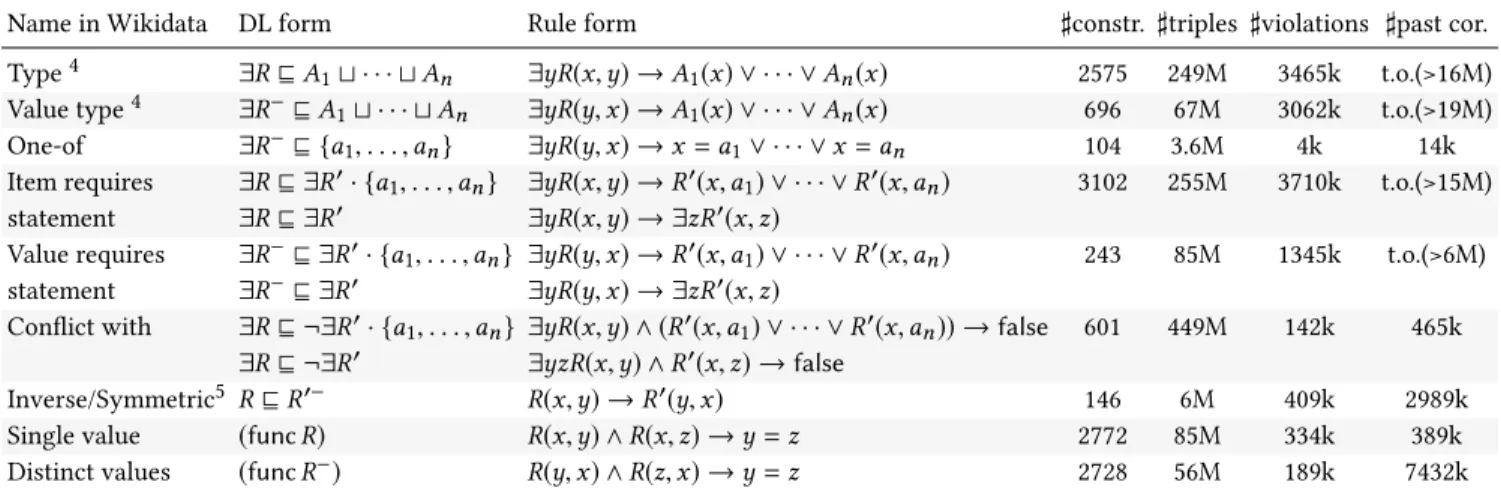
We consider the setC of constraints built from ten types of Wikidata property constraints (see Table 3). They are the top Wiki-data property constraints that can be expressed in DL, covering the majority of the most used constraints, as well as 71% of Wiki-data property constraints. The remaining constraints are mainly about string format validation with regular expressions (52% of the remaining constraints) and about qualifiers (31% of them).
7.2
Dataset Construction
We stored the RDF version [10, 18] of the Wikidata edit history in an RDF quad store. We used named graphs for the global state of Wikidata after each revision, and for the triple additions and deletions. Our dataset stores 390M annotated triples about 49M items extracted from the July 1st, 2018 full database dump.
We extracted the relevant past corrections as explained in Sec-tion 6.1. Wikidata revisions do not correspond exactly to atomic modifications in our sense. For example, Wikidata bots are able to change multiple unrelated facts about the same entity at the same
Table 3: Wikidata property constraints.R is the property for which the constraint is given. A constraint has several lines when it uses a property whose set of values may be specified or not. ♯constr. is the total number of constraints of the given type in Wikidata. ♯triples is the sum for all these constraints of the numbers of triples with the propertyR on which they apply. ♯violations is the number of violations for this constraint in Wikidata on July 1st, 2018. ♯past cor. is the number of past corrections we extracted from Wikidata history. t.o. indicates that we were not able to extract all past corrections because of timeout so that we sample them (we then indicate the number of corrections we extracted).
Name in Wikidata DL form Rule form ♯constr. ♯triples ♯violations ♯past cor. Type4 ∃R ⊑ A1⊔ · · · ⊔An ∃yR(x,y) → A1(x) ∨ · · · ∨ An(x) 2575 249M 3465k t.o.(>16M) Value type4 ∃R−⊑A1⊔ · · · ⊔An ∃yR(y, x) → A1(x) ∨ · · · ∨ An(x) 696 67M 3062k t.o.(>19M) One-of ∃R−⊑ {a1, . . . , an} ∃yR(y, x) → x = a1∨ · · · ∨x = an 104 3.6M 4k 14k Item requires ∃R ⊑ ∃R′· {a1, . . . , an} ∃yR(x,y) → R
′(x, a
1) ∨ · · · ∨R ′(x, a
n) 3102 255M 3710k t.o.(>15M) statement ∃R ⊑ ∃R′ ∃yR(x,y) → ∃zR′(x, z)
Value requires ∃R−⊑ ∃R′· {a1, . . . , an} ∃yR(y, x) → R ′(x, a
1) ∨ · · · ∨R ′(x, a
n) 243 85M 1345k t.o.(>6M) statement ∃R−⊑ ∃R′ ∃yR(y, x) → ∃zR′(x, z)
Conflict with ∃R ⊑ ¬∃R′· {a1, . . . , an} ∃yR(x,y) ∧ (R ′(x, a
1) ∨ · · · ∨R ′(x, a
n)) → false 601 449M 142k 465k ∃R ⊑ ¬∃R′ ∃yzR(x,y) ∧ R′(x, z) → false
Inverse/Symmetric5 R ⊑ R′− R(x,y) → R′(y, x) 146 6M 409k 2989k Single value (func R) R(x,y) ∧ R(x, z) → y = z 2772 85M 334k 389k Distinct values (func R−) R(y, x) ∧ R(z, x) → y = z 2728 56M 189k 7432k
time. Wikidata users also sometimes prefer to delete a statement then add another one with the same property instead of directly modifying the value, in order to clear the existing qualifiers and references. Therefore, we artificially created a replacement modifi-cation for every deletion with a neighboring addition by the same user, which shares at least two components of the triple (analo-gously for additions). For example, if the correction seed is the deletion of⟨Zeus, hasGender, masculine⟩, and if this revision or a neighboring one adds⟨Zeus, hasGender, male⟩, then we consider this a replacement. However, if the same revision added the triple ⟨Zeus, hasMother, Rhea⟩, then we would not consider this a replace-ment, because it does not share two components with the first one. Since the TBox consists of simple concept inclusions and the constraint bodies contain only roles, the deletion patterns for cor-rection seeds correspond directly to the atoms of the constraint body. In the same vein, only atoms in the head of theType or Value type constraints need to be rewritten. To find the constraint viola-tions solved by a correction seed, we make use of the fact that the correction seed allows us to know the constraint instanceΓ(®a), and we look for matches of the constraint instance body.
To speed up the execution for the four constraint types which have the highest numbers of past corrections,Type, Value type, Item requires statement and Value requires statement, we did not extract all the past corrections but sample them as follows. We compute only the relevant past corrections that where applied betweenKi andKi+1wherei is a multiple of s := max(1, N /106) withN the number of triples with the propertyR of the constraint at hand. This sampling allows us to get a sufficient ground for rule mining
4
The Wikidata constraintType can be qualified to modify its meaning. We ignore these cases, which are marginal: they concern less than6% of theType constraints. The same goes analogously forValue type.
5
Inverse and Symetric are two distinct kinds of constraints in Wikidata but we treat them together sinceSymetric is actually a special case of Inverse.
for each constraint. In practice, it affects only the most frequent 0.9% ofType, 2% of Value type, 0.5% of Item requires statement, and 3% ofValue requires statement constraints.
7.3
Mining Rules
The output of our method is a set of correction rules that form a program (Section 6.2). To evaluate such a program, we apply it to each of the constraint violations stored in thePCDataset, using the associated stage of the KB to evaluate the part of the context which is not the deletion part of the correction. Then we check whether the correction we compute is exactly the same as the one associated to the constraint violation in thePCDataset. The precision p of the program is given by the fraction of the corrections computed by the program that are actually the same as those that have been applied. Therecallr of the program is the fraction of the constraint violations stored inPCDataset for which the program gives some correction. TheF1 score isF1= 2p ·r
p+r.
CorHist mines rules as explained in Section 6.2. In order to de-crease the computation time, we only allow one atomp(s, o) in E( ®x, ®y, ®z) \ Body(®x, ®y), where Body(®x, ®y) corresponds to the part of the context that matches part of the constraint body, such thats is a variable ofx ∪ ®® y and o is a fresh variable or a constant.
Rules were mined per constraint. For each constraint, we split the set of extracted past corrections into a 70% training set, a 10% cross-validation set, and a 20% test set. The training set is used to mine the rules, the cross-validation set is used to determine the confidence threshold that maximizes the F1 score of the obtained program, and the test set is used to evaluate the final program.
Table 4 gives examples of rules mined by CorHist. Several of these rules show the crucial importance of the instantiation of the constraint and/or of the context to be able to choose the correction. For instance, the rule for theSingle value constraint uses the fact that an entity involved in a property “member of sport team” is
Table 4: Example of mined rules.
Constr. type ConstraintΓ Correction rule
Type ∃isAListOf ⊑ List [Γ(s)] : isAListOf(s, o) ∧ WikiDisambiguationPage(s) → (∅, isAListOf(s, o))
Value type ∃foundInTax−⊑ Taxon [Γ(human)] : foundInTax(s, human) ∧ hasPart(s, v) → (foundInTax(s, homoSapiens), foundInTax(s, human)) One-of ∃mannerDeath−⊑ {. . . } [Γ(trafficAcc)] : mannerDeath(s, trafficAcc) → (causeDeath(s, trafficAcc), mannerDeath(s, trafficAcc)) Item req. stm.∃heritageStatus ⊑ ∃country [Γ(s)] : heritageStatus(s, monumentInFornminnesregistret) → (country(s, Sweden), ∅) Val. req. stm. ∃residence−⊑ ∃country [Γ(s)] : diplomaticRelation(s, v) → (country(s, s), ∅)
Conflict ∃filmplID ⊑ ¬∃filmplFilmID [Γ(s)] : filmplID(s, o) → (∅, filmplID(s, o)) Inv./Sym. geneticAssoc ⊑ geneticAssoc− [Γ(s, o)] :→ (geneticAssoc(o, s), ∅)
Single val. (func sexOrGender) [Γ(s)] : sexOrGender(s, maleOrg) ∧ sportsTeam(s, v) → (∅, sexOrGender(s, maleOrg)) Distinct val. (func ncbiLocusTag−) [Γ(s)] : ncbiLocusTag(o, s) ∧ molecularFunction(o, v) → (∅, ncbiLocusTag(o, s))
probably a human being, and thus that if it has several values for the functional property “sex or gender” and one of them is a value reserved for non-human organisms in Wikidata, this value is proba-bly wrong. In the same vein, the rule for theItem requires statement constraint recognizes that an entity has a heritage designation that is specific to Sweden (“monument in Fornminnesregistret”), to con-clude that its country is Sweden. The rules also propose fixes to misused predicates: in Wikidata, the property “manner of death” is intended for the general circumstances of a person’s death (such as “accident”), while the property “cause of death” is intended to give
more precise causes (such as “traffic accident”).
7.4
Evaluation against the Test Set
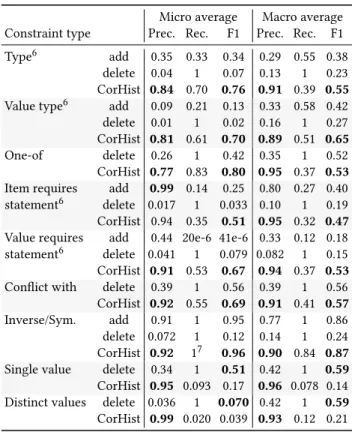
Table 5 presents the results of the evaluation of the mined programs against the test set. We computed both the micro and macro av-erage of the precision, recall and F1 score per kind of constraint. The micro average aggregates over the whole set of relevant past corrections for the given kind of constraint, whereas the macro average computes the scores for each constraint of this given kind, and then computes the average. Both numbers are important: The micro average gives more weight to correction rules that fix many violations. It thus measures the overall impact of the correction rules on the dataset. However, if few rules had a large impact, then it would be easier to formulate these rules by hand. Our method, in contrast, can also find rules that by themselves solve less violations, but together contribute a large mass of corrections. To illustrate this, we also report the macro average: It measures the average performance across different constraints.
We compare our approach with two baselines: The first one, called “delete”, is the most basic one and uses the fact that all Wikidata constraint bodies contain an atom of the formR(x,y) and the TBox contains only concept inclusions, so that all con-straint violations contain an assertion that matchesR(x,y). The “delete” baseline simply deletes this assertion. For the completeness constraints we define an additional baseline, “add”, which tries to add a new triple to solve the constraint violation. ForInverse and Symmetric constraints this baseline adds the missing reverse edge and performs very well. ForItem requires statement, Value requires statement, Type and Value type, it adds the missing triple only if it is possible to know the expected value from the constraint rule.
6
Computed from a sample of the set of relevant past corrections. OneType constraint, sixValue type constraints and one Val. req. stm constraint were omitted due to time-out.
7
The actual value is greater than 0.995 and rounded to 1 for consistency.
Table 5: Evaluation of the correction rules mined by CorHist with a minimal support of 10, a minimal confidence between 0.5 and 1 and a regularization threshold of 0.05, and compar-ison with the baselines. Best precision and F1 scores in bold.
Micro average Macro average Constraint type Prec. Rec. F1 Prec. Rec. F1
Type6 add 0.35 0.33 0.34 0.29 0.55 0.38 delete 0.04 1 0.07 0.13 1 0.23 CorHist 0.84 0.70 0.76 0.91 0.39 0.55 Value type6 add 0.09 0.21 0.13 0.33 0.58 0.42 delete 0.01 1 0.02 0.16 1 0.27 CorHist 0.81 0.61 0.70 0.89 0.51 0.65 One-of delete 0.26 1 0.42 0.35 1 0.52 CorHist 0.77 0.83 0.80 0.95 0.37 0.53 Item requires add 0.99 0.14 0.25 0.80 0.27 0.40 statement6 delete 0.017 1 0.033 0.10 1 0.19 CorHist 0.94 0.35 0.51 0.95 0.32 0.47 Value requires add 0.44 20e-6 41e-6 0.33 0.12 0.18 statement6 delete 0.041 1 0.079 0.082 1 0.15 CorHist 0.91 0.53 0.67 0.94 0.37 0.53 Conflict with delete 0.39 1 0.56 0.39 1 0.56 CorHist 0.92 0.55 0.69 0.91 0.41 0.57 Inverse/Sym. add 0.91 1 0.95 0.77 1 0.86 delete 0.072 1 0.12 0.14 1 0.24 CorHist 0.92 17 0.96 0.90 0.84 0.87 Single value delete 0.34 1 0.51 0.42 1 0.59 CorHist 0.95 0.093 0.17 0.96 0.078 0.14 Distinct values delete 0.036 1 0.070 0.42 1 0.59 CorHist 0.99 0.020 0.039 0.93 0.12 0.21
For example, forType constraints of the form ∃yR(x,y) → A(x) it applies the correction(A(x), ∅). Value type constraints are han-dled in the same way. However, this baseline is not able to figure out what is the relevant addition correction for a constraint of the form∃yR(x,y) → A1(x) ∨ A2(x) because there is no way to know a priori ifA1orA2should be added. ForItem requires statement constraints of the form∃yR(x,y) → R′(x, a), the “add” baseline ap-plies(R′(x, a), ∅) (similarly for Value requires statement constraints). However, it cannot find a correction if there are multipleai.
Figure 1: Example of a replacement correction suggested by CorHist for a violation of the constraint ∃countryOfCitizenship ⊑ ¬∃sexOrGender · {maleOrg, femaleOrg}.
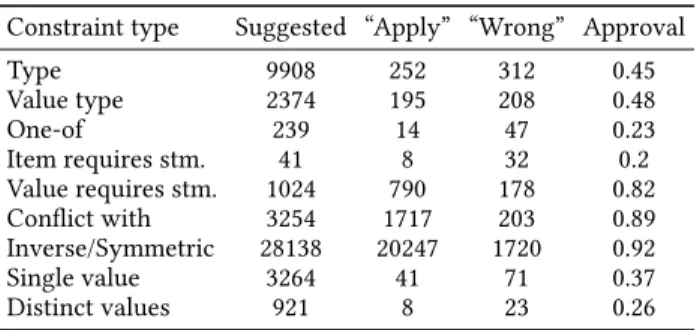
Table 6: Human evaluation of the suggested corrections. Constraint type Suggested “Apply” “Wrong” Approval
Type 9908 252 312 0.45 Value type 2374 195 208 0.48 One-of 239 14 47 0.23 Item requires stm. 41 8 32 0.2 Value requires stm. 1024 790 178 0.82 Conflict with 3254 1717 203 0.89 Inverse/Symmetric 28138 20247 1720 0.92 Single value 3264 41 71 0.37 Distinct values 921 8 23 0.26
As shown in Table 5, the precision of our approach significantly outperforms the two baselines – often by a very high margin. Re-garding the recall, we manage to keep a reasonable, and sometimes even good, recall (see best F1 scores in Table 5), except forSingle andDistinct value. The very low recall obtained for these two kinds of constraints is easily explainable because they are mostly used on predicates that link Wikidata to other databases (91% of theSingle and 95% of theDistinct constraints), and we cannot get meaningful information about the target database to mine corrections.
7.5
User Evaluation
To see whether our corrections are accepted by the community, we designed a user study. We created a tool that suggests our cor-rections to Wikidata users for validation (available at https://tools. wmflabs.org/wikidata- game/distributed/#game=43). The user can choose a constraint type, and the tool then suggests corrections for random violations of constraints of this type (Figure 1). The violations for which corrections are suggested are provided by query.wikidata.org, which limits their number for performance reasons. For each proposed correction, the user has to choose be-tween three options: apply the proposed correction to Wikidata, tag it as wrong, or get another correction to review. We ran the experiment for 3 months and 47 Wikidata users participated.
Table 6 presents the results. The number of corrections reviewed is highly unbalanced between the kinds of constraints, mainly be-cause a few users evaluate a lot of suggestions, and have a predilec-tion for some kinds of constraints. It is thus difficult to draw conclu-sions for those kinds of constraints for which very few corrections have been evaluated. However, we can still make some interesting observations. In particular, the proposed corrections marked as wrong give us insights about possible weaknesses of our approach.
For the constraints which got a significant number of evaluations, our approach seems to perform well forInverse and Symmetric, Conflict with and Value requires statement constraints, with approval rates above 80%. The other approval rates are lower. This is partly due to biases in the data. For example, when a gender is missing, our approach proposes the value “male” by default, because of the over-representation of men in Wikidata. Another issue is the quality of the constraints, which in Wikidata are sometimes questionable or difficult to understand (e.g., an incomplete set of possible types or values for completeness orOne-of constraints).
However, even lower approval scores do not mean that our ap-proach would be useless: Psychological research [12] shows that people find it much easier to choose from given options than to come up with an answer by themselves. The actual time needed to come up with an answer may vary, but if it takes just 3 times longer to come up with an answer than to accept or reject our proposed correction, then achieving a precision of 40% is already useful: If we have a precision of 40%, and if a free-form answer takes timet, then the expected answer time with our tool is 40%×1
3×t +60%× 4 3×t < t.
8
CONCLUSION AND FUTURE WORK
We have introduced the problem of learning how to fix constraint violations from a KB history. We have also presented a method based on rule mining to this end. Our experimental evaluation on Wikidata shows significant improvement over baselines. Our tool is live on Wikidata and has already allowed users to correct more than 23k constraint violations. While our evaluation focused on Wikidata for which the whole edit history was available, we believe that our method can be applied in other settings, for example using edits done during the partial cleaning of an automatically extracted KB. For future work, it would be interesting to evaluate the impact of parameters such as the size of the context part of the correction rule in terms of rule quality. We also plan to extend the learning dataset with external knowledge (such as other KBs), or with information extracted from other sources (for instance from Wikipedia). We believe that this will allow finding even more precise correction rules, thus making KBs ever more precise and more useful.
ACKNOWLEDGMENTS
REFERENCES
[1] Maribel Acosta, Amrapali Zaveri, Elena Simperl, Dimitris Kontokostas, Fabian Flöck, and Jens Lehmann. 2018. Detecting Linked Data quality issues via crowdsourcing: A DBpedia study. Semantic Web 9, 3 (2018), 303–335. https: //doi.org/10.3233/SW- 160239
[2] Abdallah Arioua and Angela Bonifati. 2018. User-guided Repairing of Inconsistent Knowledge Bases. InProceedings of the 21th International Conference on Extending Database Technology, EDBT 2018, Vienna, Austria, March 26-29, 2018. 133–144. https://doi.org/10.5441/002/edbt.2018.13
[3] Ahmad Assadi, Tova Milo, and Slava Novgorodov. 2018.Cleaning Data with Constraints and Experts. InProceedings of the 21st International Workshop on the Web and Databases, Houston, TX, USA, June 10, 2018. 1:1–1:6. https://doi.org/10. 1145/3201463.3201464
[4] Franz Baader, Diego Calvanese, Deborah L. McGuinness, Daniele Nardi, and Peter F. Patel-Schneider (Eds.). 2003.The Description Logic Handbook: Theory, Implementation, and Applications. Cambridge University Press.
[5] Moria Bergman, Tova Milo, Slava Novgorodov, and Wang-Chiew Tan. 2015. QOCO: A Query Oriented Data Cleaning System with Oracles. PVLDB 8, 12 (2015), 1900–1903.https://doi.org/10.14778/2824032.2824096
[6] Meghyn Bienvenu, Camille Bourgaux, and François Goasdoué. 2016. Query-Driven Repairing of Inconsistent DL-Lite Knowledge Bases. InProceedings of the Twenty-Fifth International Joint Conference on Artificial Intelligence, IJCAI 2016, New York, NY, USA, 9-15 July 2016. 957–964.
[7] Christian Bizer, Jens Lehmann, Georgi Kobilarov, Sören Auer, Christian Becker, Richard Cyganiak, and Sebastian Hellmann. 2009. DBpedia - A crystallization point for the Web of Data.Journal of Web Semantics 7, 3 (2009), 154–165. https: //doi.org/10.1016/j.websem.2009.07.002
[8] Iovka Boneva, José Emilio Labra Gayo, and Eric G. Prud’hommeaux. 2017. Se-mantics and Validation of Shapes Schemas for RDF. InThe Semantic Web - ISWC 2017 - 16th International Semantic Web Conference, Vienna, Austria, October 21-25, 2017, Proceedings, Part I. 104–120. https://doi.org/10.1007/978-3-319-68288-4_7 [9] Richard Cyganiak, David Wood, and Markus Lanthaler. 2014. RDF 1.1 Concepts and Abstract Syntax. http://www.w3.org/TR/2014/ REC- rdf11- concepts- 20140225/
[10] Fredo Erxleben, Michael Günther, Markus Krötzsch, Julian Mendez, and Denny Vrandečić. 2014. Introducing Wikidata to the Linked Data Web. InThe Semantic Web - ISWC 2014 - 13th International Semantic Web Conference, Riva del Garda, Italy, October 19-23, 2014. Proceedings, Part I. 50–65. https://doi.org/10.1007/ 978- 3- 319- 11964- 9_4
[11] Sergio Flesca, Sergio Greco, and Ester Zumpano. 2004. Active integrity constraints. InProceedings of the 6th International ACM SIGPLAN Conference on Principles and Practice of Declarative Programming, 24-26 August 2004, Verona, Italy. 98–107. https://doi.org/10.1145/1013963.1013977
[12] Steven C Funk and K Laurie Dickson. 2011. Multiple-choice and short-answer exam performance in a college classroom.Teaching of Psychology 38, 4 (2011), 273–277.
[13] Luis Galárraga, Christina Teflioudi, Katja Hose, and Fabian M. Suchanek. 2015. Fast rule mining in ontological knowledge bases with AMIE+. VLDB J. 24, 6 (2015), 707–730. https://doi.org/10.1007/s00778- 015- 0394- 1
[14] Luis Antonio Galárraga, Christina Teflioudi, Katja Hose, and Fabian M. Suchanek. 2013. AMIE: association rule mining under incomplete evidence in ontological knowledge bases. In22nd International World Wide Web Conference, WWW ’13, Rio de Janeiro, Brazil, May 13-17, 2013. 413–422. https://doi.org/10.1145/2488388. 2488425
[15] Birte Glimm, Aidan Hogan, Markus Krötzsch, and Axel Polleres. 2012. OWL: Yet to arrive on the Web of Data?. InWWW2012 Workshop on Linked Data on the Web, Lyon, France, 16 April, 2012.
[16] Bernardo Cuenca Grau, Boris Motik, Zhe Wu, Ian Horrocks, Achille Fokoue, and Carsten Lutz. 2009. OWL 2 Web Ontology Language Profiles. https: //www.w3.org/TR/owl2- profiles/
[17] Ramanathan Guha and Dan Brickley. 2014. RDF Schema 1.1. http://www.w3. org/TR/2014/REC- rdf- schema- 20140225/
[18] Daniel Hernández, Aidan Hogan, and Markus Krötzsch. 2015. Reifying RDF: What Works Well With Wikidata?. InProceedings of the 11th International Workshop on Scalable Semantic Web Knowledge Base Systems co-located with 14th International Semantic Web Conference (ISWC 2015), Bethlehem, PA, USA, October 11, 2015. 32–47.
[19] Vinh Thinh Ho, Daria Stepanova, Mohamed H. Gad-Elrab, Evgeny Kharlamov, and Gerhard Weikum. 2018. Rule Learning from Knowledge Graphs Guided by Embedding Models. InThe Semantic Web - ISWC 2018 - 17th International Semantic Web Conference, Monterey, CA, USA, October 8-12, 2018, Proceedings, Part I. 72–90. https://doi.org/10.1007/978-3-030-00671-6_5
[20] Joanna Józefowska, Agnieszka Lawrynowicz, and Tomasz Lukaszewski. 2010. The role of semantics in mining frequent patterns from knowledge bases in description logics with rules.TPLP 10, 3 (2010), 251–289. https://doi.org/10.1017/ S1471068410000098
[21] Aditya Kalyanpur, Bijan Parsia, Matthew Horridge, and Evren Sirin. 2007. Finding All Justifications of OWL DL Entailments. InThe Semantic Web, 6th International Semantic Web Conference, 2nd Asian Semantic Web Conference, ISWC 2007 + ASWC 2007, Busan, Korea, November 11-15, 2007. 267–280. https://doi.org/10. 1007/978- 3- 540- 76298- 0_20
[22] Holger Knublauch and Dimitris Kontokostas. 2017. Shapes Constraint Language (SHACL). https://www.w3.org/TR/shacl/
[23] Roman Kontchakov and Michael Zakharyaschev. 2014. An Introduction to De-scription Logics and Query Rewriting. InReasoning Web. Reasoning on the Web in the Big Data Era - 10th International Summer School 2014, Athens, Greece, September 8-13, 2014. Proceedings. 195–244. https://doi.org/10.1007/978-3-319-10587-1_5 [24] Dimitris Kontokostas, Patrick Westphal, Sören Auer, Sebastian Hellmann, Jens
Lehmann, Roland Cornelissen, and Amrapali Zaveri. 2014. Test-driven evaluation of linked data quality. In23rd International World Wide Web Conference, WWW ’14, Seoul, Republic of Korea, April 7-11, 2014. 747–758. https://doi.org/10.1145/ 2566486.2568002
[25] Jiaqing Liang, Yanghua Xiao, Yi Zhang, Seung-won Hwang, and Haixun Wang. 2017. Graph-Based Wrong IsA Relation Detection in a Large-Scale Lexical Taxon-omy. InProceedings of the Thirty-First AAAI Conference on Artificial Intelligence, February 4-9, 2017, San Francisco, California, USA. 1178–1184.
[26] Bing Liu, Wynne Hsu, and Yiming Ma. 1998. Integrating Classification and Association Rule Mining. InProceedings of the Fourth International Conference on Knowledge Discovery and Data Mining (KDD-98), New York City, New York, USA, August 27-31, 1998. 80–86.
[27] Christian Meilicke, Manuel Fink, Yanjie Wang, Daniel Ruffinelli, Rainer Gemulla, andHeinerStuckenschmidt.2018. Fine-GrainedEvaluationofRule-and Embedding-Based Systems for Knowledge Graph Completion. InThe Seman-tic Web - ISWC 2018 - 17th International SemanSeman-tic Web Conference, Monterey, CA, USA, October 8-12, 2018, Proceedings, Part I. 3–20. https://doi.org/10.1007/ 978- 3- 030- 00671- 6_1
[28] Boris Motik, Ian Horrocks, and Ulrike Sattler. 2009. Bridging the gap between OWL and relational databases.J. Web Sem. 7, 2 (2009), 74–89. https://doi.org/10. 1016/j.websem.2009.02.001
[29] Boris Motik and Peter Patel-Schneider. 2009. OWL 2 Web Ontology Language Mapping to RDF Graphs. https://www.w3.org/TR/owl- mapping- to- rdf/ [30] Peter F. Patel-Schneider. 2015. Using Description Logics for RDF Constraint
Checking and Closed-World Recognition. InProceedings of the Twenty-Ninth AAAI Conference on Artificial Intelligence, January 25-30, 2015, Austin, Texas, USA. 247–253.
[31] Heiko Paulheim and Christian Bizer. 2014. Improving the Quality of Linked Data Using Statistical Distributions.Int. J. Semantic Web Inf. Syst. 10, 2 (2014), 63–86. https://doi.org/10.4018/ijswis.2014040104
[32] Christos Rantsoudis, Guillaume Feuillade, and Andreas Herzig. 2017. Repairing ABoxes through Active Integrity Constraints. InProceedings of the 30th Interna-tional Workshop on Description Logics, Montpellier, France, July 18-21, 2017. [33] Viachaslau Sazonau, Uli Sattler, and Gavin Brown. 2015. General Terminology
Induction in OWL. InThe Semantic Web - ISWC 2015 - 14th International Semantic Web Conference, Bethlehem, PA, USA, October 11-15, 2015, Proceedings, Part I. 533–550. https://doi.org/10.1007/978- 3- 319- 25007- 6_31
[34] Stefan Schlobach and Ronald Cornet. 2003. Non-Standard Reasoning Services for the Debugging of Description Logic Terminologies. InIJCAI-03, Proceedings of the Eighteenth International Joint Conference on Artificial Intelligence, Acapulco, Mexico, August 9-15, 2003. 355–362.
[35] Fabian M. Suchanek, Gjergji Kasneci, and Gerhard Weikum. 2007. Yago: a core of semantic knowledge. InProceedings of the 16th International Conference on World Wide Web, WWW 2007, Banff, Alberta, Canada, May 8-12, 2007. 697–706. https://doi.org/10.1145/1242572.1242667
[36] Thomas Pellissier Tanon, Daria Stepanova, Simon Razniewski, Paramita Mirza, and Gerhard Weikum. 2017. Completeness-Aware Rule Learning from Knowledge Graphs. InThe Semantic Web - ISWC 2017 - 16th International Semantic Web Conference, Vienna, Austria, October 21-25, 2017, Proceedings, Part I. 507–525. https://doi.org/10.1007/978- 3- 319- 68288- 4_30
[37] Jiao Tao, Evren Sirin, Jie Bao, and Deborah L. McGuinness. 2010. Integrity Constraints in OWL. InProceedings of the Twenty-Fourth AAAI Conference on Artificial Intelligence, AAAI 2010, Atlanta, Georgia, USA, July 11-15, 2010. [38] Denny Vrandečić and Markus Krötzsch. 2014. Wikidata: a free collaborative
knowledgebase.Commun. ACM 57, 10 (2014), 78–85. https://doi.org/10.1145/ 2629489
[39] Bishan Yang, Wen-tau Yih, Xiaodong He, Jianfeng Gao, and Li Deng. 2014. Em-bedding Entities and Relations for Learning and Inference in Knowledge Bases. CoRR abs/1412.6575 (2014). arXiv:1412.6575 http://arxiv.org/abs/1412.6575 [40] Fan Yang, Zhilin Yang, and William W. Cohen. 2017. Differentiable Learning of
Logical Rules for Knowledge Base Reasoning. InAdvances in Neural Information Processing Systems 30: Annual Conference on Neural Information Processing Systems 2017, 4-9 December 2017, Long Beach, CA, USA. 2316–2325.