THE
MAKING
OF
SCIENCE,
TECHNOLOGY
AND
INNOVATION
POLICY:
CONCEPTUAL
FRAMEWORKS
AS
NARRATIVES,
1945-2005
Benoît GODIN
2009
Centre Urbanisation Culture Société Institut national de la recherche scientifique
385, rue Sherbrooke Est Montréal (Québec) H2X 1E3
Telephone : 514-499-4074 Facsimile : 514-499-4065 www.ucs.inrs.ca
TABLE OF CONTENTS
INTRODUCTION ... 1
Frameworks as Narratives ... 4
The Logic (Rhetoric?) of Narratives ... 14
The Policy (Political?) Process ... 21
PART I ... 25
CHAPTER ONE ... 25
The Linear Model of Innovation: The Historical Construction of an Analytical Framework ... 25
A Political Rhetoric ... 28
An Industrial Perspective ... 36
A Statistical Classification ... 40
Economists Appropriate the Model ... 52
Conclusion ... 61
CHAPTER TWO ... 67
The Making of Statistical Standards: The OECD Frascati Manual and the Accounting Framework ... 67
National Accounting ... 69
The Frascati Manual ... 80
Accounting for Science ... 81
What Accounting Measures? ... 91
Accounting and Science Policy ... 103
The Efficiency of Research ... 113
Conclusion ... 116
CHAPTER THREE ... 123
Science and Efficiency: the Input-Output Framework ... 123
The Production Function ... 127
The Economics of Science ... 138
An Accounting Framework ... 144
Conclusion ... 148
CHAPTER FOUR ... 155
Integrating Science and Technology into the Econometric Equation ... 156
Studying Growth and Productivity at the OECD ... 161
The New Economy ... 171
Synthesizing Academic Works ... 175
Internationalizing the Statistics ... 176
Developing a Visual Rhetoric ... 178
Conclusion ... 179
CHAPTER FIVE ... 183
Competitiveness and Trade in High-Technology ... 183
A Very Basic Ratio ... 185
Variations on a Theme ... 188 Research Intensity ... 189 Technology Intensity ... 193 High Technology ... 198 Conclusion ... 207 CHAPTER SIX ... 213
The Political Agenda on Globalization, its Framework and Measurement ... 213
The Globalization Framework ... 215
The Globalization of Technology ... 221
Measuring the Internationalization of R&D ... 223
Renewed Interest in the Technological Balance of Payments ... 225
Other Impacts of Globalization on S&T Statistics ... 226
What Did the Numbers Say? ... 228
Conclusion ... 234
PART II ... 237
CHAPTER SEVEN ... 237
National Innovation System: the System Approach in Historical Perspective ... 237
National Innovation System at OECD ... 239
The System Approach ... 244
Measuring the Research System ... 256
Conclusion ... 259
The Knowledge-Based Economy: Conceptual Framework or
Buzzword? ... 265
Machlup’s Construction ... 267
Measuring Knowledge ... 269
The Message ... 274
The Knowledge-Based Economy at the OECD ... 276
Defining the Knowledge-Based Economy ... 279
Measuring the Knowledge-Based Economy ... 281
An Umbrella-Concept ... 285
Conclusion ... 290
CHAPTER NINE ... 295
The Information Economy: The History of a Framework Through its Measurement ... 295
The Economics of Information ... 299
The Ad Hoc Group on Scientific and Technical Information (1962) ... 301
The Ad Hoc Group on Information Policy (1965) ... 303
The Economics of Information Panel (1965) ... 305
The Information Economy ... 319
The Working Party on Information, Computer, and Communications Policy (1976) ... 322
The Group of Experts on ICC Statistics (1982) ... 329
The Information Society ... 342
The Working Party on Economic Implications of Information Technologies (1988) ... 348
The Working Party on Indicators for the Information Society (1999)355 Conclusion ... 363
CONCLUSION ... 367
Appendix 1... 375
Labels Used for Modern Societal Transformations, 1950-1984 ... 375
Appendix 2... 379
Methodological Documents from the Directorate for Science, Technology and Industry (OECD) ... 379
Appendix 3... 380
Indicators of Knowledge Flows in National Innovation
Systems ... 381
Appendix 5... 383
Indicators from The Knowledge-Based Economy: A Set of Facts and Figures ... 383
Appendix 6... 385
Indicators from Towards a Knowledge-Based Economy ... 385
Appendix 7... 389
Basic Data for Information Policy ... 389
Appendix 8... 391
Basic Statistics for STI Indicators ... 391
Appendix 9... 393
Policy Issues for ICC Statistics ... 393
Appendix 10 ... 395
ICCP Red Series ... 395
Appendix 11 ... 399
INTRODUCTION
In recent years, policy analysts have studied policy as a process of argumentation1
Policy-makers construct their problem through conceptual frameworks that structure policy action. As E. Goffman suggested, frameworks (or frames) are principles of organization “which govern the subjective meaning we assign to social events”, principles that transform fragmentary information into a structured and meaningful whole
. Gone are the analyses of politics based on rational choice and instrumental rationality, as well as the study of policy cycles (agenda-setting → policy formulation → adoption → implementation → evaluation), at least among critical authors. Policy-making is conceptual construction, from its very first step – the problem to be addressed – to the last – action.
2
. More recently, D. Schon put it as follows: a frame is a “way of selecting, organizing, interpreting, making sense of reality”, and “provides guideposts for knowing, analyzing, persuading and acting”3
Generally, a frame “[1] constructs the situation, [2] defines what is problematic about it, and [3] suggests what courses of action are
.
1 G. Majone (1989), Evidence, Argument, and Persuasion in the Policy Process, New Haven: Yale University Press; D. Stone (1988) [2002], Policy Paradox: The Art of Political Decision Making, New York:
Norton & Co; D. Stone (1989), Causal Stories and the Formation of Policy Agendas, Political Science Quarterly, 104 (2), p. 281-300; F. Fischer and J. Forester (eds.) (1993), The Argumentative Turn in Policy
Analysis and Planning, Durham: Duke University Press; F. Fischer
(2003), Reframing Public Policy: Discursive Politics and Deliberative
Practices, Oxford: Oxford University Press.
2 E. Goffman (1974), Frame Analysis: An Essay on the Organization of Experience, Cambridge (Mass.): MIT Press, p. 10.
3 M. Rein and D. Schon (1993), Reframing Policy Discourse, in F. Fischer
and J. Forester (eds.), The Argumentative Turn in Policy Analysis and Planning, op. cit., p. 145-166, p. 146. See also: M. Rein and D. Schon (1991), Frame-Reflective Policy Discourse, in P. Wagner et al. (eds.),
Social Sciences and Modern States, Cambridge: Cambridge University
appropriate. It provides conceptual coherence, a direction for action, a basis for persuasion, and a framework for the collection and analysis of data”4
1. Identifies a problem, its origins and the issues involved; . For the purposes of this book, I define a conceptual framework as an argument or discourse that acts as an organizing principle to give meaning to a socioeconomic situation and answers to a series of analytical and policy questions. Ideally, a conceptual framework:
2. Suggests an explanation of the current situation;
3. Offers evidence, often in terms of statistics and indicators; 4. Recommends policies and courses of action.
Policy frameworks are often constructed as narratives or stories that give meaning to situations5. This is not peculiar to policy. Narratives are present everywhere. They are an integral part of the discipline of history, where there is a long-running debate on the role of narratives in the discipline6. Narratives are also present in ordinary life, as Goffman has studied, as well as in science: think of theories on the origins of the universe7, or the origins of life and humans8
4 M. Rein and D. Schon (1993), Reframing Policy Discourse, op. cit.,
p. 153. Fischer identifies the three steps as follows: defining the problem situation, identifying policy intervention, anticipating outcomes. See F. Fischer (2003), Reframing Public Policy, op. cit., p. 168.
. Economic
5 T. J. Kaplan (1986), The Narrative Structure of Policy Analysis, Journal of Policy Analysis and Management, 5 (4), p. 761-778.
6
H. White (1973), Metahistory: the Historical Imagination in Nineteenth-Century Europe, Baltimore: Johns Hopkins University Press; P. Ricoeur (1983), Temps et récit I: L’intrigue et le récit historique, Paris, Seuil.
7 S. Hawking (1988), A Brief History of Time: From the Big Bang to Black
Holes, Toronto: Bantam Dell Pub Group; H. Kragh (1996), Cosmology and Controversy: the Historical Development of Two Theories of the Universe, Princeton: Princeton University Press.
8 P.J. Bowler (1984), Evolution: the History of an Idea, Berkeley:
University of California Press; P. J. Bowler (1989), The Invention of
theory is also full of narratives9, as is sociology. In the latter case, for example, you can think of the discipline as being composed of narratives on modernity10. Finally, narratives are present in matters concerning technology. D. Nye, for example, has documented how people appropriated technology in nineteenth century America for community creation, identity and self-representation11. M. Hard and A. Jamison have looked at the intellectuals’ appropriation of technology in this century, as discourses on modernity12
This book looks at conceptual frameworks in science studies and science policy, and at the narratives involved. It is based on work conducted over the last ten years on science policy and on statistics about science, technology and innovation (see
.
www.csiic.ca). This introductory chapter offers an overview of the book. It offers a brief
tour d’horizon of the frameworks developed over the twentieth
century and discusses the logic, or rhetoric, of narratives. This chapter is a summary and a guide to the main arguments of the book. The rest of the book goes deeper into each of the conceptual frameworks.
The book is organized in two parts. The first looks at the emergence of conceptual frameworks in science policy and documents how they contributed to the gradual emergence of an economic doctrine. The second part studies more recent frameworks and the new rhetoric, if any, involved. The book uses an intergovernmental organization as
9 D. N. McCloskey (1990), If You’re So Smart: The Narrative of Economic Expertise, Chicago: University of Chicago Press.
10
P. Wagner (1994), A Sociology of Modernity: Liberty and Discipline, London: Routledge.
11 D. E. Nye (2003), America as Second Creation: Technology and
Narratives of New Beginnings, Cambridge (Mass.): MIT Press; D. E. Nye (1997), Narratives and Space: Technology and the Construction of American Culture, New York: Columbia University Press. See also: J. F. Kasson (1977), Civilizing the Machine: Technology and Republican Values in America, 1776-1900, New York: Penguin.
12 M. Hard and A. Jamison (1998), Intellectual Appropriation of Technology: Discourses on Modernity, Cambridge (Mass.): MIT Press.
example – the Organization for Economic and Co-Operation Development (OECD) – and emphasizes the role of statistics in science policy. As a matter of fact, for decades the OECD has been an influential think-tank for its member countries in matters of policy, and one of its main tasks is collecting statistics as evidence for the views promoted.
FRAMEWORKS AS NARRATIVES
Science policy is about 60 years old. The first modern arguments for science policy came from V. Bush, followed by the US President’s Scientific Research Board13. The (OECD) came next: from the 1960s, the organization started publishing policy documents that have had a major influence in member countries14
Over the twentieth century, at least eight conceptual frameworks have been developed in the study of science, technology and innovation, and have been used for policy purposes. These frameworks can be organized around three generations (Table 1). The first conceptual framework was that on cultural lags, from American sociologist William F. Ogburn in the 1920-30s
. The policies suggested over the years, at both the national and international levels, relied on conceptual frameworks that furnished a rationale for action.
15
13 V. Bush (1945), Science: The Endless Frontier, North Stratford: Ayer Co.
Publishers, 1995; US President’s Scientific Research Board (1947),
Science and Public Policy, New York: Arno Press, 1980.
. According to Ogburn’s story, society is experiencing an exponential growth of inventions but is insufficiently adapted. There are lags between the material culture and the adaptive culture. Therefore, there is need for society to adjust
14 One early and major document was: OECD (1963), Science and the Policies of Government, Paris: OECD.
15 This framework is not discussed in this book. See: B. Godin (2009), The Invention of Innovation: William F. Ogburn and the Use of Invention,
Project on the Intellectual History of Innovation, Montreal: INRS, Forthcoming.
in order to reduce the lags. Society has to innovate in what he called social inventions, or mechanisms to maximize the benefits of technology. There is also a need for society to forecast and plan for the social effects of technology.
Table 1. Major Conceptual Frameworks Used in Science Policy
First generation
Cultural Lags
Linear model of innovation
Second generation
Accounting Economic Growth Industrial competitiveness
Third generation
National Innovation System Knowledge-Based Economy Information Economy (or Society)
The framework on lags has been very influential. It has served as basic narrative to Recent Social Trends (1933) and Technology and
National Policy (1937), two major policy documents in the United
States, the first on social indicators and the second on technological forecasting. It was also used during the debate on technological unemployment in the 1930s. Lastly, the framework on lags was the first of a series of conceptual frameworks concerned with innovation as a sequential process. It is in fact to this framework that we owe the idea of “time lags” (between invention and its commercialization) and the idea of technological gaps.
The best-known of the sequential frameworks is what came to be called the “linear model of innovation”. The precise source of the linear model remains nebulous, as its origin has only recently been documented (chapter 1). Authors who used, improved or criticized the model in the last fifty years rarely acknowledged or cited any
original source. The model was usually taken for granted. According to others, however, it comes directly from V. Bush’s Science: The
Endless Frontier (1945). To still others, the model does not exist, but
among its opponents. It is a straw man. In fact, however, the linear model does exist, and comes from economic historian W. Rupert Maclaurin at MIT in the 1940s.
Few people, including bureaucrats, really believed in this framework. The story behind the framework is rather simple. It suggests that innovation follows a linear sequence: basic research → applied research → development. In one sense, the model is trivially true, in that it is hard to disseminate knowledge that has not been created. The problem is that the academic lobby has successfully claimed a monopoly on the creation of new knowledge, and that policy-makers have been persuaded to confuse the necessary with the sufficient condition that investment in basic research would by itself necessarily lead to successful applications. Be that as it may, the framework fed policy analyses by way of taxonomies and classifications of research and, above all, it was the framework most others compared to.
The frameworks on cultural lags and on the linear model of innovation came from academics. The next generation of frameworks owes a great deal to governments and international organizations, above all the OECD. This latter organization is an influential think-tank for its member countries. It is not an advocacy think-think-tank looking for media exposure and defending partisan or ideological ideas16
16 D. E. Abelson (2002), Do Think Tanks Matter? Assessing the Impact of
Public Policy Institutes, Montreal: McGill-Queens.
, but rather a research-oriented think tank that feeds concepts to national policy-makers for better understanding of issues in science, technology and innovation policies. Other organizations that have acted as think tanks in the short history of science, technology and innovation policy are the US National Bureau of Economic Research (NBER), the US RAND Corporation and the British Science Policy Research Unit (SPRU). However, the OECD has a
specific role as the source of ideas for national policy-makers. As with most think tanks, and like management gurus, the organization simplifies policy analysis through the use of metaphors and imagery17
From its very beginning, science policy was defined according to the anticipated benefits of science. Because science brings benefits, so the story goes, there is a need to manage science, and management requires data. To contribute to this end, the OECD produced a methodological manual for national statisticians, the Frascati manual (1962), aimed at conducting and standardizing surveys of research and development (chapter 2). The manual offered a statistical answer and an accounting framework to three policy questions or issues of the time: the allocation of resources to science, the balance between choices or priorities, and the efficiency of research.
, but as an international organization, it brings immediate (although sometimes relative) legitimacy to discourses and frameworks, partly because the member countries themselves define the agenda of the organization. In this sense, the OECD frameworks are witnesses to national priorities and policies.
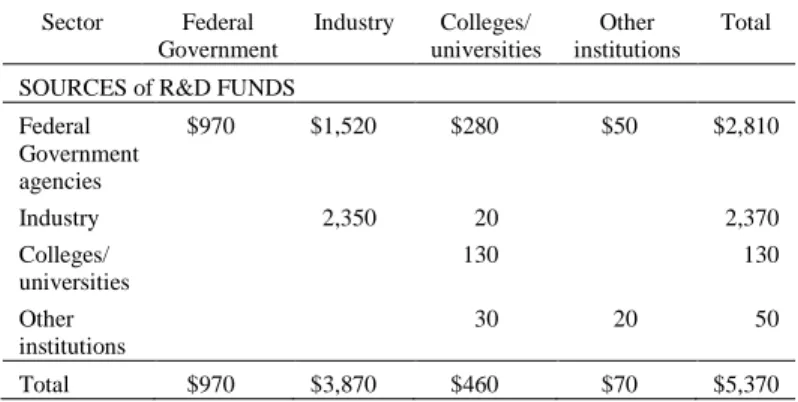
One basic statistics among the statistics collected with the manual was a figure on the “national science budget”, or Gross Domestic Expenditures on R&D (GERD). The statistics served two purposes. One was controlling the public expense on science, the growth of which was too high according to some budget bureaus. The other purpose, more positive, was setting targets for the support and development of science, technology and innovation, and this was used by policy departments. It gave rise to the GERD/GDP ratio as a measure of the intensity or efforts of a country or economic sector. Among the benefits believed to accrue from science, technology and innovation, two have been particularly studied at the OECD: economic growth (through productivity) and competitiveness. These
17 D. Stone (1996), Second-Hand Dealers in Ideas, in D. Stone (ed.), Capturing the Political Imagination: Think Tanks and the Policy Process,
gave rise to two frameworks. The framework on economic growth and productivity embodies a very simple (and again linear) story: research leads to economic growth and productivity. Consequently, the more investment, the more growth. This story is often framed within an input-output semantics: inputs → research activities → outputs (→ outcomes) (chapter 3). The accounting framework discussed above is precisely framed into such a semantics. The origins of the framework on economic growth and productivity can be traced back to the economic literature on technological unemployment in the 1930s, in which “technological change” was equated with changes in factors of production (input) and measured via changes in productivity (output). This equation is now known as the “production function”. Used extensively by economists in the mid-1950s and subsequently to study science, technology and innovation and its relationship to the economy, the economists’ framework immediately offered official policy-makers a useful conceptual framework. This was due to the fact that the framework was perfectly aligned with the policy discussions at the time on the “efficiency” (productivity) of the science system.
Certainly, the issue of productivity in science has a long history18
18 B. Godin, (2009), The Value of Science: Changing Conceptions of
Scientific Productivity, 1869-circa 1970, Social Science Information, 4, Forthcoming; B. Godin (2007), From Eugenics to Scientometrics: Galton, Cattell and Men of Science, Social Studies of Science, 37 (5): 691-728; B. Godin (2006), On the Origins of Bibliometrics, Scientometrics, 68 (1): 109-133.
. It emerged among scientists themselves (Table 2). In the nineteenth century, the British statistician Francis Galton, followed in the twentieth century by James McKeen Cattell, the US psychologist and editor of Science for fifty years, started respectively computing the number of children scientists had and the number of scientists a nation (or state) produced. The numbers were called measures of productivity, or productiveness. Subsequently, productivity came to mean the scientific production of the scientists, above all the number of scientific papers they published. From the 1920-30s onward,
historians and psychologists were early producers of numbers on productivity defined as such. However, it was governments and their statistical bureaus that really developed this meaning after World War II. Finally, productivity in science matters came to examine not only the scientists and the science system, but the effects of science on the economy, above all economic productivity.
Table 2. Evolving Conceptions of Productivity in Science
Productivity as Reproduction
Key authors: F. Galton, J. M. Cattell
Issue: civilization, then advancement of science Statistics: great men; men of science
Productivity as Output
Key authors: organizations (and their consultants: C. Freeman)
Issue: efficiency
Statistics: money spent on R&D
Productivity as Outcome
Key authors: economists (D. Weintraub, R. Solow) Issue: economic growth
Statistics: productivity
Economic growth and productivity have been studied at the OECD since the very early years of science policy. They got increased attention in the early 1990s, following the Technology and Economy Programme (TEP), and then in the 2000s with the Growth project, where an explicit framework – the New Economy – was used to explain differences between member countries. The United States had the characteristics of a new economy, which means above all that it was innovative and it made more extensive and better use of new technologies, particularly information and communication technologies (chapter 4).
The other benefit of an economic type that was studied at the OECD was industrial competitiveness19
We now come to a third generation of conceptual frameworks. These arose through a synergy among academics, governments and international organizations. The OECD, with the collaboration of economists as consultants, developed new frameworks for policy-making. The frameworks were generally constructed as alternatives to the linear model. One of the first such frameworks was the National Innovation System (chapter 7). The framework suggests that the research system’s ultimate goal is innovation, and that it is part of . The story behind the framework is that science and technology have become a factor of leadership among countries. Like economic growth and productivity, industrial competitiveness has been discussed at the OECD from very early on. This led to a major study published at the end of the 1960s on technological gaps between countries, particularly between European countries and the United States. Technological gaps were considered signals that Europe was not performing well. The study developed a methodology for ranking countries based on multiple statistical indicators. Then, in the 1980s, the issue of industrial competitiveness gave rise to the concept of high technology and the role of new technologies in international trade (chapter 5). High technology came to be seen as a major factor contributing to international trade, and a symbol of an “advanced economy”. Statistics measuring the performances of countries with regard to the technological intensity of their industries were constructed and further developed to measure how countries maintain or improve their position in world trade. Then a framework on globalization was suggestted in the 1990s, as was a methodological manual for measuring globalization. Globalization was said to be a source of competitiveness for firms and countries, and gained widespread popularity in science, technology and innovation policy (chapter 6).
19 B. Godin (2002), Technological Gaps: An Important Episode in the
Construction of Science and Technology Statistics, Technology in
a larger system composed of sectors like government, university and industry and their environment. Briefly stated, research and innovation do not come from the university sector alone, so the story goes. The framework emphasizes the relationships between the components or sectors, as the “cause” that explains the performance of innovation systems.
Most authors agree that this framework was developed by researchers like C. Freeman, R. Nelson and B.-A. Lundvall. In fact, however, the “system approach” in science policy owes its existence rather to the OECD and its very early works beginning in the 1960s, although the organization did not use the term National Innovation System as such. From the very early beginning of the OECD, policies were encouraged promoting to greater relationships among the component of the research system at five levels: between economic sectors (like university and industry), between types of research (basic and applied), between government departments, between countries, and between the research system and the economic environment. The Frascati manual itself was specifically framed in a system approach. As we mentioned above, the manual computed and aggregated the R&D expenditures of the sectors composing a research system into the GERD indicator, but also suggested constructing a matrix for measuring the flows of research funds between the sectors (sources of funds and research performers).
Then in the 1990s the OECD launched a research program on National Innovation Systems, with B.-A. Lundvall as Deputy Director. Many studies were published in the same spirit as that of the early system approach. Certainly there were more sources of innovation studied, more types of relationships were examined, and a different role was assigned to government. However, the industrial sector and the firm still held central place in the innovation system.
By then, the Oslo manual on measuring innovation had become the emblem of this framework at the OECD20
The other new framework is that on the knowledge-based economy or society (chapter 8). The origins of the concept of a knowledge economy come from economist Fritz Machlup in the early 1960s, and the concept re-emerged at the OECD in the 1990s as an alternative, or competitor, to that on the National Innovation System. The latter was believed by many to be more or less relevant to policy-makers. The work at the organization was entrusted to the French economist Dominique Foray. The story on the knowledge-based economy suggests that societies and economies rely more and more on knowledge, hence the need to support knowledge in all its forms: tangible and intangible, formal and tacit. The framework suggests that we examine (and measure) the production, diffusion and use of knowledge as the three main dimensions of the knowledge economy.
.
In reality, the concept of knowledge is a fuzzy concept, and these three dimensions are very difficult to measure. More often than not, the concept is an umbrella-concept, that is, it synthesizes policy issues and collects existing statistics concerned with science, technology and innovation under a new label. A look at the statistics collected in measuring the concept is witness to this fact: existing statistics are simply shifted to new categories.
The last framework in the third generation is that on the information economy or information society (chapter 9). The information economy was one of the key concepts invented in the 1960-70s to explain structural changes in the modern economy. It has given rise to many theories on society, conceptual frameworks for policy, and statistics for measurement. The story behind the framework suggests that information, particularly information and communication technologies (ICT), is the main driver of growth.
20 B. Godin (2002), The Rise of Innovation Surveys: Measuring a Fuzzy Concept, Project on the History and Sociology of Statistics on Science,
This preoccupation with information has a long history. The growth and management of scientific publications was the very first step toward the construction of the concept of the information economy. Through time, the concept evolved from an understanding of information as knowledge, to information as commodity or industrial activity, then information as technology.
Like knowledge, information is a difficult concept. For example, it took three decades to develop a methodological manual, or guide to measuring the information economy, at the OECD. What helped finally was politics. First, internal politics, like the efforts of the Working Party (on measuring the information society) done to raise its own visibility within the OECD. Second, ministers’ interests as manifested during summits and conferences. Ultimately it seems that the emergence of a political issue often leads to its measurement. Measurement in turn helps crystallize concepts and issues.
The framework on the information economy relies on other frameworks. In fact, most frameworks build on other frameworks. The OECD policy discourse relies on a cluster of frameworks that feed on each other. One such cluster is composed of third-generation frameworks: information economy and knowledge-based economy, coupled with new economy. Another cluster consists of those of the second generation: accounting, growth and productivity and industrial competitiveness, all three framed into an input-output semantics. Furthermore, this second generation, particularly the stories involved, feeds the third generation, giving the whole discourse a continuity and a coherent rationale. Metaphors often help here. A metaphor has important organizational properties: it is prescriptive and normative in that it generates a vision, and it unifies elements of reality because of its fluidity and flexibility (polysemy). A metaphor is both constructive (of meaning) and productive (of action). Briefly stated, it is both intellectually and socially useful. A metaphor serves a variety of worldviews. This is the role played by the information economy. Information and communication technologies are everywhere: it explains the knowledge-based economy, as well as globalization, the new economy and, of course,
the information economy. A network of interrelated concepts and frameworks thus feed each other.
THE LOGIC (RHETORIC?) OF NARRATIVES
I have suggested that conceptual frameworks in science, technology and innovation policies are usually constructed in the form of a story or narrative21
1. Premise: science, technology and innovation are good for you and for society.
. A narrative gives meaning to science, technology and innovation, and to policy actions. It helps put science, technology and innovation on the political agenda. A typical narrative goes like this:
2. Something new is happening in society (CHANGE) and it is quite different from the past.
3. Let’s call this change … (NEW NAME).
4. The new phenomenon or event will generate big effects, rewards/returns.
5. Let’s collect STATISTICS as evidence. 6. It is essential that policies be developed. 7. Let’s imagine a FRAMEWORK to this end.
Let’s look at each step. A major premise or assumption lies behind each framework, namely that science, technology and innovation are good for you and for society. This is a premise no official narrative has ever questioned. For example, no one would imagine, and in fact there was never a framework developed that opposed or suggested getting rid of new technologies and their bad consequences. New science and new technologies are to be placed under control, but
21 I use the term narrative here as including any of the following, which a
literary critic would probably distinguish: argument, plot, storyline, story, tale.
never eliminated. As US sociologist William F. Ogburn once put it: “the control of invention (…) is generally interpreted as meaning their promotion not their denial”22
A narrative on science, technology and innovation starts with suggesting that something new is happening in the economy, that an important change is underway. This change is then contrasted to the past. Certainly, continuity is usually mentioned, with “arguments from qualification”, like “there is a new situation, but it is different only from a perspective of scale or form”; “things are changing,
however it is only a matter of intensity or acceleration”
.
23
This is exactly what characterizes the framework on the knowledge-based economy. According to the OECD, knowledge and its production, diffusion and use is what defines today’s society. Certainly, knowledge has always been present and important in past economies and societies, but today it is more influential than ever: “although knowledge has always been a central component in economic development, the fact that the economy is strongly dependent on the production, distribution and use of knowledge is now being emphasized”
. The narrative generally suggests that it is difficult to draw a boundary between the current era and the past. But this specification, or qualification, is rapidly forgotten. Indeed, the newness is less that of a change in society or economy than a change in the interest of policy-makers and politicians. Be that as it may, dichotomies reign: the future will be different from the past. Change is what counts here: its nature, its size, its rate.
24
22 W. F. Ogburn and N. M. Nimkoff (1940), Sociology, Boston: Houghton
Mifflin, p. 916.
. How can the organization develop such a
23 This rhetorical move is similar to the “argument from limitations”, as
discussed in B. Godin (2005), Measurement and Statistics on Science and
Technology: 1920 to the Present, Chapter 9, London: Routledge. 24 OECD (1996), Science, Technology and Industry Outlook: Part V,
Special Theme: The Knowledge-Based Economy, DSTI/IND/STP (96) 5,
vision? With a very broad concept of knowledge, one that embraces things previously separated or put aside in previous analyses – R&D, intangibles, learning – measuring them and adding the numbers together. The effect of the concept is to attract the attention of as many policy-makers (and experts) as possible in the field of science, technology and innovation policies.
Naming and classification are central features of conceptual frameworks. They offer labels that are easily memorized. As catchwords, labels are often “mere labeling without yielding anything but the label”, as H. Blumer suggested decades ago25. Be that as it may, these labels gain the attention of many people, which helps them to reproduce or diffuse. Such is the role of names or terms given to frameworks, like knowledge-based economy or information society. Such is also the role of concepts like networks, clusters, social capital, as well as technological systems and its affiliates26, and many others like the Triple-Helix and the New Production of Knowledge (Mode1/Mode2)27
Economics of Knowledge, Cambridge (Mass.); MIT Press; N. Stehr
(2005), Knowledge Politics, Boulder (London): Paradigm Publishers.
.
24 H. Blumer (1930), Science Without Concepts, reprinted in H. Blumer
(1969), Symbolic Interactionism: Perspective and Method, Berkeley: University of California Press, p. 153-170. On the fuzziness of concepts, see also: W. B. Gallie (1956), Essentially Contested Concepts,
Proceedings of the Aristotelian Society, p. 167-198
25 H. Blumer (1930), Science Without Concepts, reprinted in H. Blumer
(1969), Symbolic Interactionism: Perspective and Method, Berkeley: University of California Press, p. 153-170. On the fuzziness of concepts, see also: W. B. Gallie (1956), Essentially Contested Concepts,
Proceedings of the Aristotelian Society, p. 167-198.
26 Technological regime, technological guideposts, technological or
techno-economic paradigms, techno-techno-economic networks.
27 For more labels, see J. R. Beniger (1986), The Control Revolution: Technological and Economic Origins of the Information Society,
Cambridge (Mass.): Harvard University Press. For critical analyses of academic frameworks, see: B. Godin (1998), Writing Performative History: The New “New Atlantis”, Social Studies of Science, 28 (3), p. 465-483; T. Shinn (2002), The Triple Helix and New Production of Knowledge: Prepackaged Thinking in Science and Technology, Social
The conceptual framework on the National Innovation System is a recent example of labelling. As we mentioned above, a system approach has always characterized the OECD work on science, technology and innovation since the 1960s. Then, in the early 1990s, a label came to be applied to such an approach – National Innovation System – and a research program developed. Certainly, as we have suggested, differences exist between the early system approach and the latter. Nevertheless, the National Innovation System brought an explicit framework to the field of science, technology and innovation policy, putting the firm at the center of the system, whereas the early system approach was instead concerned with the central role of governments and policies in the system. Only historical myopia leads some to think that the framework is new.
A similar rhetorical move (renaming something old for political purposes) also occurred with the concept of “high technology”28
Studies of Science, 32 (4), p. 599-614; R. Miettinen (2002), National Innovation System: Scientific Concept or Political Rhetoric?, Helsinki:
Edita. Some labels, like postmodern science, strategic science, or co-produced science, had much less fortune than the more popular ones discussed. See respectively: S. Funtowicz and J. Ravetz (1999), Post-Normal Science – an Insight Now Maturing, Futures, 31(7), p. 641-646; A. Rip (2002), Regional Innovation System and the Advent of Strategic Science, Journal of Technology Transfer, 27 (1), p. 123-131; M. Callon (1999), The Role of Lay People in the Production and Dissemination of Scientific Knowledge, 4 (1), p. 81-94. These three examples are cited in C. Freeman and L. Soete (2007), Developing Science, Technology and
Innovation Indicators: What We Can Learn from the Past, UNU-MERIT,
Working Paper Series, Maastricht, p. 11 (footnote 6).
. In the mid-1980s, the term high technology began to be used concurrently with, or in place of, the terms research intensity and technology intensity. Nothing had really changed with regard to the definition of the concept (by way of statistics), or at least not yet. But a valued and prestigious label (high) was now assigned to it. Technology trade had now gained strategic importance in the
28 B. Godin (2008), The Moral Economy of High Technology Indicators, in
H. Hirsch-Kreinsen and D. Jacobson (eds.), Innovation in Low Tech
economic and political context of the time: research or technology-intensive industries were expanding more rapidly than other industries in international trade, so went the story and its numbers, and these industries were believed be an important policy option for economic progress. High technology would thereafter be the label for these industries, and would become a well-known and much-used label in the field of science, technology, and innovation policy. As narrative, a conceptual framework generally suggests that the new phenomenon or event will generate big rewards/returns, as well as leadership potential for those at the forefront. It also suggests that if no action is taken, bad consequences could follow. Crisis stands on the horizon! Usually, the narrative is either in the form of hype, hyperbole or utopia, suggesting that enormous outcomes are looming, or in the form of dramatization, with metaphors on disease, defeat and decline, such as that there is too little investment in science, technology and innovation, which imperils economic performance. One then arrives at the next element of a narrative: statistics. Briefly stated, a narrative suggests that it is necessary to know more about the change – in order to get more from it. More research is needed, particularly statistical work. In the case of frameworks, statistics helped to strengthen the narrative. How does narrative work here? Over the years, the OECD has developed a “formula” in three steps, and the framework on economic growth and productivity is the best evidence to document the strategy. First, the organization looks at academic work and synthesizes the results. These results generally concern specific national economies, and have to be placed in a comparative perspective with other countries. Second, the OECD internationalizes the numbers, more often than not based on the American experience (in fact, the frameworks used at the OECD are regularly those suggested by the United States delegation. This is where the value-added of the OECD lies: internationalizing statistics. The organization is rarely an innovator in the matter of theories and concepts. Generally, the organization has needed exemplars or models that it then standardizes and conventionalizes, generalizes and diffuses. This is the case for its methodological manuals, produced as
standards to be used by member countries for the collection of national data. However, collecting national statistics and placing them in an international frame is the task of the OECD.
As a third step, the organization identifies best practices/performers using indicators, rankings and benchmarking29
Other tools or devices used as evidence in narratives are visual aids like boxes, tables, figures and graphs. Visual devices are essential, since numbers often do not or cannot demonstrate the results conclusively, like the OECD’s early work on technological gaps, and the more recent work on the new economy, on globalization and on the knowledge-based economy. In this latter case, for example, the OECD could measure only part of the phenomenon – the production of knowledge, not its diffusion and use (except for information and communication technologies) – because of a lack of data. Equally, the OECD had difficulties “proving” the emergence of a new economy in other countries: “Ten years or so from now, it should be easier to assess, for instance, the impacts on growth deriving from information and communication technologies, other new technologies and changes in firm organization”
. Coming first, or pride of first place, is what drives the exercises in measurement and its statistical comparisons. The results are published in what the OECD calls scoreboards, among others.
30
Pictorial devices generally help persuade the reader of the seriousness and empiricism of the organization, despite the limitations of the data. The physical space these devices occupy is sometimes even greater than that given to the text itself, as was the case for the project
. But at the time, such an assessment was impossible. Nevertheless, the organization concluded that more science, technology and innovation policies should be developed to bring economies closer to a new economy.
29
B. Godin, B. (2003), The Emergence of Science and Technology Indicators: Why Did Governments Supplement Statistics with Indicators?, Research Policy, 32 (4): 679-691
30 OECD (2001), Drivers of Growth: Information Technology, Innovation
on economic growth and productivity (new economy). It is worth recalling here that as early as 1919 the US economist W. C. Mitchell suggested presenting narratives to policy-makers with statistics precisely as such31
Secure a quantitative statement of the critical elements in an official’s problem, draw it up in concise form, illuminate the tables with a chart or two, bind the memorandum in an attractive cover tied with a neat bow-knot (…). The data must be simple enough to be sent by telegraph and compiled overnight.
:
Apart from visual devices, an important strategy is black-boxing the limitations of statistics32
Let’s conclude this section by mentioning that one of the major factors responsible for the success (use) of official statistics is their regularity. Individual researchers rarely have the resources to produce surveys year after year that would enable the measurement of trends. They certainly contribute in the very early development stages: they originate new statistics and methodologies. But they do not have the resources to conduct the surveys themselves, and many shift rapidly to another object of study, or become simple users of statistics produced by officials. Only governments and their statistical bureaus have sufficient resources to conduct annual surveys and produce
. This is done by using footnotes, appendices or separate manuals (like the so-called metadata), where the limitations are discussed, but without effect on the core of the text and its conclusions. The “argument from limitations” (the form of which is like “the data are incomplete, but this does not affect the results”) is also a recurrent tool of the strategy.
31 W. C. Mitchell (1919), Statistics and Government, Journal of the American Statistical Association, 125, March, p. 223-235.
32 B. Godin (2005), Measurement and Statistics on Science and Technology,
regular statistics. This gives them a relative monopoly and allows them to impose their vision (statistical) of science.
THE POLICY (POLITICAL?) PROCESS
A narrative generally ends with policy recommendations. In order to benefit from a new context, a series of policy objectives is defined, obstacles and conditions are identified, and targets suggested. The policy recommendations conclude the narrative. They, more often than not, are lists of fads, recurring from year to year, like increasing the industrial share of R&D in the national budget, improving the relevance of public research, need for structural adjustment (through adoption of new technologies). To these, the organization adds a little something new in every periodic publication or review, generally specific to a new technology or to a public issue. Over history, the most popular and regular policy formulas were magic ratios like the GERD/GDP ratio of 3% suggested as early as the 1960s, and a basic/applied research ratio of 10-20% basic research, first suggested by the French statistician Condorcet33
In general, the development of frameworks at the OECD proceeds as follows. Work proposals come either from the Secretariat (in collaboration with committees composed of national delegates) or from the ministers (often under the influence of a specific country). Studies are then conducted by the Secretariat, with a view to presentation to a ministerial conference. The conference, in turn, generally under the advice of the OECD officials themselves, asks for more work. This is how projects extend and build on previous ones. To contribute to its work as a think tank, the OECD develops the following activities:
.
33 On basic research, see: B. Godin (2003), Measuring Science: Is There
Basic Research Without Statistics?, Social Science Information, 42 (1): 57-90.
- Organizing conferences and workshops to discuss policy issues.
- Setting up specific committees and working groups composed of national delegates.
- Sharing workload with member countries.
- Inviting or hiring national bureaucrats and researchers to join the organization.
The work is motivated by several factors, two of which deserve mention. Linked as it is to the political process, the OECD has to feed ministers regularly for their meetings. An easy way to do this is to turn readily-available academic fads into keywords (or buzzwords), then into “synthetic, attractive and readily understandable” narratives34
A second factor explaining the OECD strategy is the publication process, or the rush to publish. As think tank, the OECD publishes biannual, yearly and biennial reports, among them those for ministers’ conferences, where time frames are very tight. Publication drives policy: there is a need for a new issue at every conference, and in every new publications of the organization, such as Science,
Technology and Industry Scoreboard or Science, Technology and Industry Outlook, both published every two years. Umbrella concepts
like that on the knowledge-based economy are thus very fertile for producing documents. They synthesize what is already available, what comes from day-to-day work conducted in other contexts and, above all, what is fashionable, often at the price of original work.
in order to catch the attention of policy-makers. Buzzwords and slogans help sell ideas: they are short, simple, and easy to remember.
Academics are regularly enrolled in these activities. They are consulted or invited to participate in various OECD forums to “enlighten” bureaucrats and share ideas, as researchers from SPRU
34 OECD (1998), Possible Meeting of the CSTP at Ministerial Level:
did in the 1970s-80s. They are also employed as deputy directors by the organization, like D. Foray to work on the knowledge-based economy, or B. A. Lundvall on the national innovation system. In the end, academics are “accomplices”. Many of them use the same labels and narratives in their papers, and few of them develop fundamental criticisms of the frameworks.
PART
I
CHAPTER ONE
THE LINEAR MODEL OF INNOVATION: THE HISTORICAL CONSTRUCTION OF AN
ANALYTICAL FRAMEWORK
One of the first conceptual frameworks developed for understanding science, technology, and innovation, and its relation to the economy has been the “linear model of innovation”. The model postulates that innovation starts with basic research, then adds applied research and development, and ends with production and diffusion:
Basic research → Applied research → Development → (Production and) Diffusion
The model has been very influential. Academic organizations, as a lobby for research funds1, and economists, as expert advisors to policy-makers2, have disseminated the framework, or the understanding based thereon, widely, and have justified government support to science using this framework. As a consequence, science policies carried a linear conception of innovation for many decades3
1 National Science Foundation (1957), Basic Research: A National Resource, Washington: National Science Foundation.
, as did ademics studying science and technology. Very few people
2 R. R. Nelson (1959), The Simple Economics of Basic Scientific
Research, Journal of Political Economy, 67: 297-306.
3 D. C. Mowery (1983), Economic Theory and Government Technology
defend such an understanding of innovation anymore: “Everyone knows that the linear model of innovation is dead”, claimed N. Rosenberg4
In order to answer this question, one must first trace the history of the framework to the present. The precise source of the linear model of innovation remains nebulous, having never been documented. Several authors who have used, improved or criticized the model in the last fifty years have rarely acknowledged or cited any original source. The model was usually taken for granted. According to others, however, it comes directly from, or is advocated clearly in V. Bush’s Science: The Endless Frontier (1945)
and others. But is this really the case?
5
In this chapter, I trace the history of the model, suggesting that it developed in three (overlapping) stages. The first, from the beginning of the twentieth century to circa 1945, was concerned with the first two terms, basic research and applied research. This period was . One would be hard pressed, however, to find anything but a rudiment of this model in Bush’s manifesto. Bush talked about causal links between science (namely basic research) and socio-economic progress, but nowhere did he develop a full-length argument based on a sequential process broken down into its elements, or one that suggests a mechanism whereby science translates into socioeconomic benefits.
4 N. Rosenberg (1994), Exploring the Black Box: Technology, Economics, and History, New York: Cambridge University Press, p. 139.
5 J. Irvine and B. R. Martin (1984), Foresight in Science: Picking the Winners, London: Frances Pinter, p. 15; C. Freeman (1996), The
Greening of Technology and Models of Innovation, Technological
Forecasting and Social Change, 53, p. 27-39; D. A. Hounshell (1996),
The Evolution of Research in the United States, in R. S. Rosenbloom and W. J. Spencer (eds.), Engines of Innovation: US Industrial Research at
the End of an Era, Boston: Harvard Business School, p. 43; D. C.
Mowery (1997), The Bush Report after Fifty Years – Blueprint or Relic?, in C. E. Barfield (ed.), Science for the 21st Century: The Bush Report Revisited, Washington: AEI Press, p. 34; D. E. Stokes (1997), Pasteur’s Quadrant: Basic Science and Technological Innovation, Washington:
Brookings Institution, p. 10; P. Mirowski and E.-M. Sent (2002), Science
Bought and Sold: Essays in the Economics of Science, Chicago:
characterized by the ideal of pure science, and people began developing a case for a causal link between basic research and applied research. This is the rhetoric in which Bush participated. Bush borrowed his arguments directly from his predecessors, among them industrialists and the US National Research Council. The second stage, lasting from 1934 to circa 1960, added a third term to the discussion, namely development, and created the standard three-stage model of innovation: Basic research → Applied research → Development. Analytical as well as statistical reasons were responsible for this addition. Analysis of this stage constitutes the core of this chapter. The last stage, starting in the 1950s, extended the model to non-R&D (not research and development-related) activities like production and diffusion. Business schools as well as economists were responsible for this extension of the model.
The main thesis of this chapter is that the linear model owes little to Bush. It is rather a theoretical construction of industrialists, consultants and business schools, seconded by economists. The paper also argues that the long survival of the model, despite regular criticisms, is due to statistics. Having become entrenched with the help of statistical categories for counting resources and allocating money to science, technology, and innovation, and standardized under the auspices of the OECD and its methodological manuals, the linear model functioned as a “social fact”. Rival models, because of their lack of statistical foundations, could not easily become substitutes.
This chapter is divided into four parts. The first discusses the core of the linear model and its source, that is, the political rhetoric, or ideal of pure science, that made applied research dependent on basic research. The second part discusses the first real step toward the construction of the model by looking at the category and the activity called “development” and its place in industrial research. The third part documents the crystallization of the standard three-stage model via statistics. It argues that statistics has been one of the main factors explaining why the model gained strength and is still alive, despite criticisms, alternatives and a proclaimed death. The last part
documents how economists extended the standard model to include innovation.
The chapter focuses on the United States, although it draws on material from other countries in cases where individuals from those countries contributed to the construction of the model or to the understanding of the issue. Two factors explain this focus. First, American authors were the first to formalize the linear model of innovation and to discuss it explicitly in terms of a sequential model. Second, the United States was the first country where the statistics behind the model began to be systematically collected. Although limited, this focus allows one to balance D. Edgerton’s recent thesis that the linear model does not exist: “the linear model is very hard to find anywhere, except in some descriptions of what it is supposed to have been”, claims Edgerton (p. 32)6
A POLITICAL RHETORIC
. To Edgerton, the model does not exist in Bush’s writings, and here Edgerton and the present author agree, but neither does it exist elsewhere. As this chapter implies, only if one looks at the term itself can one supports Edgerton’s thesis. The model, whatever its name, has been THE mechanism used for explaining innovation in the literature on technological change and innovation since the late 1940s.
From the ancient Greeks to the present, intellectual and practical work have always been seen as opposites. The ancients developed a hierarchy of the world in which theoria was valued over practice.
6 D. Edgerton (2004), The Linear Model did not Exist, in K. Grandin, N.
Worms, and S. Widmalm (eds.), The Science-Industry Nexus: History,
Policy, Implications, Sagamore Beach: Science History Publications,
This hierarchy rested on a network of dichotomies that were deeply rooted in social practice and intellectual thought7
A similar hierarchy existed in the discourse of scientists: the superiority of pure over applied research. The concept of pure research originated in 1648, according to I. B. Cohen
.
8
. It was a term used by philosophers to distinguish between science or “natural philosophy”, which was motivated by the study of abstract concepts, and the mixed “disciplines” or subjects, like mixed mathematics, that were concerned with concrete concepts9
The ideology of pure science has been widely documented in the literature, and will not be discussed here
. The term came into regular use at the end of the nineteenth century, and was usually accompanied by the contrasting concept of applied research.
10
7
H. Arendt (1958), The Human Condition, Chicago: Chicago University Press; G. E. R. Lloyd (1966), Polarity and Analogy: Two Types of
Argumentation in Early Greek Thought, Cambridge: Cambridge
University Press; N. Lobkowicz (1967), Theory and Practice: History of
a Concept From Aristotle to Marx, London: University of Notre Dame.
. Suffice it to say that pure science was opposed to applied science on the basis of motive (knowledge for its own sake). The dichotomy was a rhetorical resource used by scientists, engineers and industrialists for defining, demarking and controlling their profession (excluding amateurs), for financial support (to scientists), for raising the status of a discipline (as engineers did), and for attracting scientists (as industrialists did). It was also a rhetoric, particularly present in Great Britain, that referred to the ideal of the freedom of science from interference from
8
I. B. Cohen (1948), Science Servant of Men, Boston: Little, Brown and Co., p. 56.
9 R. Kline (1995), Construing Technology as Applied Science: Public
Rhetoric of Scientists and Engineers in the United States, 1880-1945, Isis, 86: 194-221.
10
G. H. Daniels (1967), The Pure-Science Ideal and Democratic Culture,
Science, 156, p. 1699-1705; E. T. Layton (1976), American Ideologies of
Science and Engineering, Technology and Culture, 17 (4), p. 688-700; D. A. Hounshell (1980), Edison and the Pure Science Ideal in 19th Century
the State, with an eye to the counter-reference and negative experiences in Nazi Germany and to some extent in the Soviet Union11
Although generally presented as opposing terms, however, basic and applied research were at the same time being discussed as cooperating: basic research was the seed from which applied research grew: “to have the applications of a science, H. A. Rowland argued, the science itself must exist”
.
12
Industrial research underwent expansion after World War I. Several big firms became convinced of the necessity of investing in research,
. Certainly, the relationship was one-way (from basic to applied research), but it gave rise to a whole rhetoric in the early twentieth century, one supported by the industrialists, among others.
and began building laboratories for the purpose of conducting research13
11 Congress for Cultural Freedom (1955), Science and Freedom, London:
Martin Secker & Warburg.
. Governments accompanied them in these efforts. In Great
12 H. A. Rowland (1902), A Plea for Pure Science, in The Physical Papers of Henry Augustus Rowland, Baltimore: Johns Hopkins University Press,
p. 593-613, p. 594; N. Reingold and A. P. Molella (1991), Theorists and Ingenious Mechanics: Joseph Henry Defines Science, in N. Reingold (ed.), Science: American Style, New Brunswick: Rutgers University Press, p. 127-155.
13
On the emergence of industrial research, see: National Research Council (1941), Research: A National Resource (II): Industrial Research, National Resources Planning Board, Washington: USGPO; G. Wise (1985), W. R. Whitney, General Electric, and the Origins of US Industrial
Research, New York: Columbia University Press; L. S. Reich (1985), The Making of American Industrial Research: Science and Business at GE and Bell, 1876-1926, New York: Cambridge University Press; D. A.
Houndshell and J. K. Smith (1988), Science and Corporate Strategy: Du
Pont R&D, 1902-1980, New York: Cambridge University Press; A.
Heerding (1986), The History of N. V. Philips’ Gloeilampenfabriken, New York: Cambridge University Press; J. Schopman (1989), Industrious Science: Semiconductor Research at the N. V. Philips’ Gloeilampenfabriken, 1930-1957, Historical Studies in Physical and
Biological Sciences, 19 (1), p. 137-172; M. B. W. Graham and B. H.
Britain, for example, the Department of Scientific and Industrial Research aided and funded industries in their efforts to create industrial research organizations14
Alcoa, New York: Cambridge University Press; J. K. Smith (1990), The
Scientific Tradition in American Industrial Research, Technology and
Culture, 31 (1), p. 121-131; M. A. Dennis (1987), Accounting for
Research: New Histories of Corporate Laboratories and the Social History of American Science, Social Studies of Science, 17, p. 479-518; D. Mowery (1984), Firm Structure, Government Policy, and the Organization of Industrial Research: Great Britain and the United States, 1900-1950, Business History Review, p. 504-531; G. Meyer-Thurow (1982), The Industrialization of Invention: A Case Study from the German Chemical Industry, ISIS, 73, p. 363-381; T. Shinn (1980), The Genesis of French Industrial Research, 1880-1940, Social Science
Information, 19 (3), p. 607-640. For statistical analyses, see: D. C.
Mowery and N. Rosenberg (1989), The US Research System Before 1945, in D. C. Mowery and N. Rosenberg, Technology and the Pursuit of
Economic Growth, New York: Cambridge University Press; D. C.
Mowery (1983), Industrial Research and Firm Size: Survival, and Growth in American Manufacturing, 1921-1946: An Assessment, Journal of
Economic History, 63 (4), p. 953-980; D. E. H. Edgerton and S. M.
Horrocks (1994), British Industrial Research and Development Before 1945, Economic History Review, 67 (2), p. 213-238; S. M. Horrocks (1999), The Nature and Extent of British Industrial Research and Development, 1945-1970, ReFresh, 29, Autumn, p. 5-9; D. C. Mowery (1986), Industrial Research, 1900-1950, in B. Elbaum and W. Lazonick (eds.), The Decline of the British Economy, Oxford: Clarendon Press; D. E. H. Edgerton (1993), British Research and Development After 1945: A Re-Interpretation, Science and Technology Policy, April, p. 10-16; D. E. H. Edgerton (1987), Science and Technology in British Business History,
Business History, 29 (4), p. 84-103; M. Sanderson (1972), Research and
the Firm in British Industry, 1919-1939, Science Studies, 2, p. 107-151.
. In the United States, it was the newly created National Research Council of the National Academy of Science that gave itself the task of promoting industrial research. The close links between the National Research Council and industry go back to the preparations for war (1916). Industrialists were called upon for the World War I research efforts coordinated by the National Research Council. After the war, the National Research
14 Committee on Industry and Trade (1927), Factors in Industrial and Commercial Efficiency, Part I, chapter 4, London: Majesty’s Stationery
Office; D. E. H. Edgerton and S. M. Horrocks (1994), British Industrial R&D Before 1945, op. cit., p. 215-216.
Council, “impressed by the great importance of promoting the application of science to industry (…), took up the question of the organization of industrial research, (…) and inaugurated an Industrial Research Division to consider the best methods of achieving such organization (…)”15. “In the 1920s, the division had been a hotbed of activity, preaching to corporations the benefits of funding their own research”16. The division conducted special studies on industrial research, arranged visits to industrial research laboratories for executives, organized conferences on industrial research, helped set up the Industrial Research Institute – an organization that still exists today17 – and compiled a biennial repertory of laboratories from 1920 to the mid 1950s18
In Europe as well as in North America, industrialists reproduced the nineteenth-century discourses of scientists on the utility of science: pure research was “of incalculable value to all the industries”
.
19
15 A. L. Barrows, The Relationship of the NRC to Industrial Research, in
National Research Council (1941), Research: A National Resource II: Industrial Research, op. cit. p. 367.
. The
Reprint and Circular Series of the National Research Council in the
late 1910s and 1920s was witness to this rhetoric by industrialists. J. J. Carty, vice-president, ATT, was a typical purveyor of the rhetoric. In 1924, speaking before the US Chamber of Commerce, he proclaimed, “The future of American business and commerce and
16 G. P. Zachary (1997), Endless Frontier: Vannevar Bush, Engineer of the American Century, Cambridge (Mass.): MIT Press, 1999, p. 81.
17 The Institute was launched in 1938 as the National Industrial Research
Laboratories Institute, renamed the next year as the Industrial Research Institute. It became an independent organization in 1945.
18 See A. L. Barrows (1941), The Relationship of the NRC to Industrial
Research, op. cit; R. C. Cochrane (1978), The National Academy of
Sciences: The First Hundred Years 1863-1963, Washington: National
Academy of Sciences, p. 227-228, 288-291, 288-316; National Research Council (1933), A History of the National Research Council, 1919-1933, Reprint and Circular Series of the National Research Council, No. 106, Washington, p. 44-48.
19 J. J. Carty (1916), The Relation of Pure Science to Industrial Research, Reprint and Circular Series, No. 14, National Research Council, p. 8.