Deciphering the Relationship between Objective and Subjective Aspects of Recollection in Healthy Aging
Adrien Folville1, Arnaud D’Argembeau1 & Christine Bastin1
1 University of Liège
Author note:
Adrien Folville, GIGA-CRC In-Vivo Imaging, University of Liège, Liège, Belgium; Department of Psychology, Psychology and Neuroscience of Cognition Research Unit, University of Liège; Arnaud D’Argembeau, GIGA-CRC In-Vivo Imaging, University of Liège, Liège, Belgium;
Department of Psychology, Psychology and Neuroscience of Cognition Research Unit, University of Liège; Christine Bastin, GIGA-CRC In-Vivo Imaging, University of Liège, Liège, Belgium;
Department of Psychology, Psychology and Neuroscience of Cognition Research Unit, University of Liège.
Corresponding author: Adrien Folville, GIGA-CRC In vivo Imaging, University of Liège, Allée du 6 Août, 8, B30, 4000 Liège, Belgium,
phone: ++ 32 (0)4 366 23 62, Fax: ++ 32 (0)4 366 29 46, Email: [email protected]
This work was supported by the Fund for Research in Human Science and the National Fund for Scientific Research (FRESH/FRS-FNRS) and a grant from the Alzheimer’s Association (2016-NIRG-394141). The authors wish to thank Christian Monseur for his help in data analysis.
Christine Bastin and Arnaud D’Argembeau are, respectively, Research Associate and Senior Research Associate at the F.R.S.-FNRS.
Abstract
Although healthy aging has been related to a decline in recollection as indexed by objective measures, the subjective experience of recollection sometimes remains stable. To date, however, these age-related differences have only been examined using aggregated data across trials. In the current study, we investigated the relationship between subjective and objective measures of recollection on a trial-by-trial basis to determine whether the magnitude of this relationship was similar in young and older adults. Young and older participants were presented with pictures that were associated with descriptive labels at encoding. At retrieval, they were cued with the labels and were asked to rate the vividness of their memory for the associated picture and to recall as many details of the picture as possible. On average, older adults assigned higher vividness ratings but recalled fewer episodic details than young adults. Mixed-effects modeling revealed that the relationship between subjective (vividness) and objective (number of recalled details) recollection across trials was stronger in young than in older participants. These findings provide evidence that older adults not only retrieve fewer episodic details but also rely on these details to a lesser extent than young adults for judging the subjective quality of their memories.
Keywords: episodic memory; aging; recollection; vividness; subjective remembering
Deciphering the Relationship between Objective and Subjective Aspects of Recollection in Healthy Aging
Recollection designates the capacity to retrieve and reinstate contextual details of a past episode (Yonelinas, 2002). A first way to operationalize recollection is to collect
introspective reports on the phenomenological experience accompanying episodic
reminiscence. This subjective dimension of recollection is often measured using “Remember” judgements in recognition paradigms or vividness ratings in recall tasks (Johnson, Hashtroudi, & Lindsay, 1993; Gardiner, Ramponi, & Richardson-Klavehn, 1998; Yonelinas, 2002). A second way to measure recollection is by assessing the objective accuracy of contextual information or specific details reported during memory retrieval. In this case, source memory—which requires participants to retrieve the encoding context associated with an item—or free-recall tasks are commonly used (Duarte, Henson, & Graham, 2008; Duarte, Ranganath, Trujillo, & Knight, 2006; Mitchell & Johnson, 2009). Objective and subjective aspects of recollection are often measured separately in episodic memory tasks, so that little is known about their relationship.
Understanding to what extent subjective judgements map onto reactivated details is important, particularly because introspective reports are deemed to reflect the richness of recollection.
When remembering the past, the objectively reactivated memory details are weighted by monitoring processes to give rise to a subjective sense of recollection (Bastin et al., 2019). Aging is associated with an impairment in both the retrieval of episodic details and in how these details are monitored (Wong et al., 2012), while, somewhat surprisingly, the subjective
age-related changes in the relationship between reactivated memory contents and subjective vividness is warranted. In the current study, we aimed to investigate age-related differences in the relationship between subjective vividness and the objective recall of details during episodic recollection.
Age-related changes in objective and subjective recollection
It is widely accepted that recollection is particularly age-sensitive (Koen & Yonelinas, 2014). Studies that evaluated objective and subjective recollection within a single task
documented a discrepancy between subjective memory experience and the objective retrieval of episodic details in older individuals. For instance, young and older adults displayed similar rates of subjective Remember judgements in spite of older adults performing significantly worse on objective source memory measures (Mark & Rugg, 1998; Duarte et al. 2006; 2008). Other evidence pointed out that older adults subjectively rated their autobiographical memory as being as detailed as young adults did, despite their poorer source memory accuracy (Gallo, Korthauer, McDonough, Teshale & Johnson, 2011; McDonough & Gallo, 2013). Furthermore, older adults were found to report similar or even higher subjective ratings than young adults for the amount of details and the vividness of past events (De Brigard et al., 2016; Comblain,
D’Argembeau, & Van Der Linden, 2005), even when they retrieved quantitatively fewer episodic details (Hashtroudi, Johnson, & Chrosniak, 1990; Robin & Moscovitch, 2017).
McDonough and colleagues proposed two hypotheses to explain the dissociation between subjective and objective measures of recollection in older adults (McDonough,
Cervantes, Gray, & Gallo, 2014). The recollection quantity hypothesis1 suggests that older adults
retrieve less information and recalibrate their subjective judgments to this lower amount of details, perhaps because of age-related changes in metamemory monitoring processes (St-Laurent, Abdi, Burianová, & Grady, 2011; Wong et al. 2012). In contrast, the recollection quality
hypothesis proposes that older adults retrieve the same overall amount of information as
young adults (thus leading to similar subjective ratings), but that some retrieved elements are distorted, different, or irrelevant, and hence less diagnostic for an objective memory evaluation (thus leading to inaccurate source memory).
To test these hypotheses, McDonough et al. (2014) examined subjective memory reports and the neural reactivation of sensory-perceptual details during cued recollection of scenes using fMRI. They found that young and older participants subjectively rated their memories as equally detailed, but activity in sensory-perceptual brain regions was reduced in older adults, suggesting that they actually recollected fewer details (in line with the recollection quantity hypothesis). However, to our knowledge, no behavioral study has investigated the subjective/objective dissociation as well as the recollection quantity and quality hypotheses in detail.
One limitation of previous behavioral studies is that they examined age-related
differences separately for objective and subjective measures within the same task. Comparing
1We refer to recollection quantity to designate the number of details retrieved within an event (i.e., the number of recalled details in a free-recall task) while recollection quality refers to the type or the nature of retrieved details (i.e., correct vs. incorrect details or visual details vs. thoughts). This differs from the study of Wong et al. (2012) in which recollection quantity designated the number of correctly remembered items (which corresponds to a measure of hits) while recollection quality referred to the number of features/details retrieved for each item (which corresponds to what we refer to as recollection quantity).
mean values of vividness and free-recall across participants allows to examine whether participants who, on average, emit high vividness ratings also recall more episodic details. However, this does not in itself provide any insight about the relationship between the
subjective experience of remembering and the actual amount of information retrieved about a particular event. Addressing this issue requires to examine the relationship between objective and subjective recollection on a trial-by-trial basis: are variations in vividness ratings across trials predicted by the associated number of recalled episodic details? Mixed-effects modeling is particularly valuable to address this question (Baayen, Davidson, Bates, 2008). Rather than aggregating data into means values, mixed-effects models can describe the relationship between a response variable and independent variables on a trial-by-trial basis while treating subjects and items as random effects. Therefore, mixed-effects modeling would allow to test whether vividness judgments are predicted by the amount of information retrieved across trials and to determine whether this relationship is similar in young and older adults.
The current study
The main purpose of the current study was to investigate age-related changes in subjective and objective recollection, using a behavioral memory task that directly compares the two recollection aspects with a trial-by-trial approach. To do so, we created an episodic memory task inspired by McDonough et al.’s (2014) study. Pictures were associated with labels at encoding and these labels were then used as retrieval cues in a cued recollection task. At retrieval, on each trial, we combined old/new recognition memory of the labels with a subjective memory evaluation of recollection (vividness ratings of pictures cued by the label)
and two measures of objective recollection (source memory and free recall). In light of previous findings, we expected similar or even higher subjective recollection judgments in older than in younger adults (Gallo et al., 2011; Hashtroudi et al., 1990; Robin & Moscovitch, 2017; St-Laurent, Abdi, Bondad, & Buchsbaum, 2014). The objective recollection measure was first operationalized with a source memory assessment about spatial (left or right position on the screen) and temporal (first or second encoding set) information. We hypothesized that group differences would be greater for temporal than spatial information. Indeed, while spatial source memory is not necessarily age-sensitive (Parkin et al. 1995), there is evidence that aging
negatively impacts memory for temporal information (Kausler, Salthouse & Saults, 1988; Parkin et al. 1995; Bastin & Van der Linden, 2005). Mixed-effects modeling was used to evaluate the relationship between vividness and the accuracy of spatial and temporal source memory on a trial-by-trial basis. In addition to source memory, a free recall task of the content of the picture was used as a second objective recollection measure in order to assess whether young and older individuals retrieved similar amounts of details. Again, mixed-effects modeling was used to evaluate the relationship between vividness and the amount of details recalled on a trial-by-trial basis. If the quantity hypothesis is true, we should observe a stronger relationship between vividness and free recall in young than in older adults since this hypothesis posits that older adults’ subjective ratings do not map onto the actual amount of information they retrieve.
Because the quality hypothesis posits that older adults may consider distorted or incorrect details in the weighing of their subjective remembering experience, an evaluation of the accuracy of the retrieved details would also be informative. Thus, the current study aimed to assess age-related differences in the accuracy of the details recalled by participants. If the
quality hypothesis is true, we should observe a similar relationship between vividness and the
amount of details reported at free-recall in the two age groups when incorrect details are taken into account (i.e., details should predict vividness to the same extent in both groups, when taking into account that some details retrieved by older adults may be distorted).
In addition to episodic memory deficits, age-related differences in non-episodic mechanisms that are spontaneously engaged during a memory task could potentially inflate observed age-differences in recollection. For instance, compared to young adults, older adults verbally describe less information about an event even when episodic memory mechanisms are not necessary to perform the task, suggesting that age-related narrative changes could account for some of the variance observed in free-recall tasks (Gaesser, Sacchetti, Addis, & Schacter, 2011; Madore, Gaesser, & Schacter, 2014). Moreover, age-related changes in available cognitive resources such as executive functioning might also impact objective recollection performance in such a way as to increase age-related differences (Gallo et al., 2011). Because both source memory and free-recall are related to executive functioning (Glisky, Polster, & Routhieaux, 1995; Henkel, Johnson, & De Leonardis, 1998; Guler & Mackovichova, 2018) and given the age-related decline in executive abilities (Drag & Bieliauskas, 2010), one may wonder whether observed age-related differences in objective recollection measures could be amplified by age-differences in executive functioning. Because of the potential effects of these
confounding variables, the participants’ descriptions during free-recall may not mirror the actual level of richness of their memory representations, which could in turn impact the trial-by-trial relationship between vividness and free-recall. Thus, the current study aimed at controlling for these potentially confounding variables (narrative style and executive
functioning) to age-related differences in objective recollection and its relationship with subjective vividness.
Methods Participants
Thirty-four young adults (16 men; 19–28 years; M = 23.61; SD = 1.81) and 34 older adults (12 men; 60–87 years; M = 70.97; SD = 6.29) participated in this study. This sample size was determined a priori (G-Power 3.0; Faul, Erdfelder, Lang, & Buchner, 2007) in order to have a statistical power of 80% (alpha value of .05) to detect well-established age-related changes in recollection (effect size of Cohen’s d = .75; Koen & Yonelinas, 2014) and a significant
relationship between source memory and executive functioning level (r = .46; Glisky et al., 1995). Furthermore, this sample size has been shown to be sufficient to provide unbiased estimates of regression coefficients and their standard errors in multilevel modeling (Maas & Hox, 2005). All participants were native French speakers and were recruited in the Liège area of Belgium. None reported past or current psychiatric or neurological disorders and the groups did not differ in terms of education. Older participants’ general cognitive functioning was assessed with the Dementia Rating Scale (Mattis, 1976) and all participants performed within the norms (Pedraza et al., 2010). On the Mill-Hill vocabulary questionnaire (Deltour, 1993), scores
indicated slightly better performance in older adults. Participants’ characteristics are shown in Table 1. All participants gave written informed consent and the study was approved by the Ethics Committee of the Faculty of Psychology of the University of Liège, Belgium.
Table 1
Demographics and Executive Test Scores.
Young (n = 34) Older (n = 34) Group difference t p Age (years) 23.61 (1.80) 70.97 (6.29) Education (years) 15.88 (1.14) 15.08 (2.73) 1.56 .123 Mill-Hill score (/33) 26.55 (2.46) 28.11 (3.89) -1.97 .052 Mattis DRS score / 138.25 (2.89) N-back score 26.91 (1.52) 25.61 (2.03) 2.97 .004 Stroop score 0.57 (0.27) 1.04 (0.46) -5.18 <.001 Plus-Minus score 23.31 (14.44) 29.33 (20.94) -1.38 .172 Executive index 0.35 (0.51) –0.35 (0.75) 4.66 <.001 Standard deviations are in parentheses. DRS = Dementia Rating Scale
Materials
The stimuli for the memory task were 40 colored pictures selected from the
International Affective Picture System (IAPS) (Lang & Bradley, 2007) and from a previous study (Koehler, Guo, Zhang, & Eckstein, 2014)2. Only neutral pictures (valence ranged from 4.2 to 6.2)
were selected from the IAPS. Because we wanted the memory processes engaged in the task to
be as close as possible to those engaged in real-life situations, we selected pictures that depict daily-life environments (e.g., pictures showing single objects such as a spoon or a mug were excluded), resulting in the selection of 17 pictures from the IAPS. Twenty-three additional pictures were selected from Koehler et al.’s (2014) set. Selected images depicted outdoor (garden, parking) or indoor (living room, bedroom, kitchen) environments. As in McDonough et al.’s (2014) study, each picture was associated with a descriptive label (one to three words). Forty additional lure labels for the cued recollection task were created and each of these lures was paired with one of the studied labels in terms of length and lexical properties. For example, the studied label playground was paired with a lure gymnasium.
Procedure
Participants were tested individually. The stimuli were presented on a laptop computer and the task was programmed using the E-prime software (Psychology Software Tools,
Pittsburgh, PA). The memory task began with an encoding session in which participants saw the 40 pictures together with their corresponding labels for 10 seconds each (see Figure 1). Half of the pictures were presented on the left side of the screen and the other half on the right side (for subsequent spatial source memory), with a fixation cross in the center of the screen and the label below the cross. Each picture presentation was followed by a blank screen for 1000 ms and the order of presentation of left and right stimuli was randomized. The encoding session was divided into two equal parts with a 20-second break in between (for subsequent temporal source memory). Spatial and temporal manipulations at encoding were
were intentional, so participants knew that they would subsequently have to retrieve a mental representation of the picture from the label. However, participants were unaware of the subsequent source memory assessment.
Figure 1.
Figure 1. Schematic representation of the procedure in Experiment 1. A. At encoding, each label
and its corresponding image were presented at the same time for 10 seconds and images were displayed on either the left or the right side of the screen. Each image and label presentation was followed by a blank screen for 1 second. The encoding phase was divided by a 20-second pause into two equal parts consisting of 20 images each. B. At retrieval, each trial began with a yes/no recognition judgment of the label. For each label judged to be old, participants answered a source memory question (spatial or temporal), were prompted to rate the vividness of their memory of
the picture and were asked to recall as many details of the picture as they could. When a label was judged to be new, the next trial began immediately.
Following the encoding session, participants had to count backward during one minute (from 197 in steps of -3). Instructions regarding the cued recollection session were then provided and care was taken to ensure that the participants fully understood each part of the retrieval phase. In the cued recollection task, each trial began with the presentation of a label. Participants had to decide whether they had previously seen this label associated with a picture (nold = 40) or not (nnew = 40). When the label was judged to be new, the next trial began
immediately. If the label was considered old, further memory questions were asked. First, participants had to answer either a spatial (n = 20 when the participant recognized every old label as such) or temporal (n = 20) source memory question regarding the picture associated with the label. Spatial questions corresponded to the position of the picture on the screen (left or right) while temporal questions asked whether the picture was presented in the first or second part of the encoding session. Since participants provided a source memory response for one modality (spatial or temporal) for each label, the attribution of a label to a source question was counterbalanced across participants.
After the source memory questions, participants were asked to rate the vividness of their memory for the picture encoded with the associated label on a Likert scale ranging from 0 (no memory of the picture) to 5 (extremely vivid). Then they were invited to orally recall as
many details of the picture as they could. Their responses were audio-recorded. When participants had completed their recall for one trial, they pressed any key to move on to the next trial. No time limit was imposed for the source memory, vividness, and free recall tasks.
Non-episodic mechanisms
After the memory task, participants were presented with two pictures on the computer screen that they were asked to describe (see Gaesser et al., 2011, for a similar approach). To characterize participants’ spontaneous narrative style, the general instructions merely required participants to describe each picture without any further guidelines. The picture description was also audio-recorded and self-paced.
After the memory task and picture description task, participants’ executive functioning was assessed using three tasks (N-back, Stroop, Plus-Minus) considered to respectively tap each of the main executive functions: updating, inhibition and shifting (see Table 1) (Angel et al., 2016; Miyake et al., 2000). A detailed description of each task can be found in the
Supplementary material. To obtain a global executive functioning measure, we averaged z-scores of each subtest (Angel et al., 2016). Group comparisons revealed that young adults performed better than older adults on the N-Back task and the Stroop test, whereas there was no group difference on the Plus-Minus test. Overall executive functioning as indexed by the composite z-score was higher in young than in older adults (see Table 1).
Narrative Scoring
For each participant, the content of the free recall of each picture was transcribed. To evaluate participants’ recall content in depth, we used a narrative coding system that classified the content of each episodic detail in terms of different components (Dede et al., 2016;
Hashtroudi et al., 1990; Lancaster & Barsalou, 1997). Eight categories were created and each detail of the recall of each picture was classified according to its content: person (each person or animal mentioned by the participant); object (objects, rooms, natural elements such as trees or hills); perceptual (perceptual information specifying the color, size or texture of a person or an object); spatial (spatial positioning of a person or an object in the picture); quantity
(reporting any amount: 4 chairs, 3 men, and so forth); thought (a thought experienced during encoding and reported at recall); comment (personal statements that are not directly related to the recall of the content of the picture: e.g., “There was a cat. I do not like cats.” or attribution of what the people depicted on the picture could think, plan to do or have done: “The man was next to the boat propeller, he has probably finished to clean it before the picture was taken”); and repetition (recurrence of a detail in participant’s recall). Our eight scoring categories were not mutually exclusive: each detail could include components from several categories. For example: the detail “A white car was on the right side” includes an object component (the car), a perceptual component (white color) and a spatial component (right side). Furthermore, errors (a detail that is not depicted in the picture or that is not as the participant describes it: e.g., “There was a white car” when the car was blue) were scored separately and each error was classified according to whether it referred to a person, object, perceptual feature or spatial location. Each error was classified in only one category because no error involved multiple
component categories in the recall protocols. A similar coding procedure was applied to the picture descriptions but the thought and error categories were not used.
The content of the recall of each label/image was coded by the first author. A second trained rater, blind to participant’s age, scored a randomly selected 20% of the data of each group. Across participants, Intraclass Correlation Coefficients (ICCs) between raters were excellent regarding the total number of components, ICC = .98; and the number of person components, ICC = .93; object components, ICC = .97; perceptual components, ICC = .92; spatial components, ICC = .92; and comments, ICC = .90. ICCs were good for thoughts, ICC = .80; and the number of errors, ICC = .79; and were moderate for quantities, ICC = .65; and repetitions,
ICC = .73; (Koo & Li, 2016). Similar interrater reliability analyses were conducted for the picture
descriptions, and the results can be found in the Supplementary material.
Results
Cued Recollection Task
Table 2 presents mean label recognition performance, source memory scores, vividness ratings and free recall scores in the two age groups. Participants in both groups displayed comparable hits, t(66) = –0.65, p = .518, and false alarms, t(66) = –0.49, p = .622, and were able to discriminate between targets and lure labels as efficiently (hit minus false alarms: t(66) = – 0.57, p = .569). False alarm rates were not analyzed further because they were very low in both age groups. Similarly, source memory, vividness and free-recall responses associated with false alarms were not included in the following analyses.
Table 2
Mean memory performance.
Young Older
Hits (%) 83.97 (11.06) 85.59 (9.42)
False alarms (%) 0.37 (1.08) 0.51 (1.34)
Spatial source memory 70.55 (17.17) 69.04 (13.85)
Temporal source memory 70.66 (9.80) 62.80 (13.64)
Vividness 2.87 (0.64) 3.30 (0.80)
Number of correct
components
7.09 (2.44) 5.65 (1.62)
Standard deviations are in parentheses.
Objective recollection
With regard to source memory performance (number of correct responses divided by number of correctly recognized labels), there was no significant difference between young and older participants in spatial source memory, t(66) = 0.40, p = .692, while there was a significant group difference in temporal source memory, t(66) = 2.72, p = .008. To assess the possibility that participants’ performance on objective recollection measures was partly determined by executive functioning, we conducted hierarchical multiple regressions (see Supplementary materials). Briefly, we found that neither executive functioning nor age predicted spatial source memory. In contrast, executive functioning but not age predicted temporal source memory.
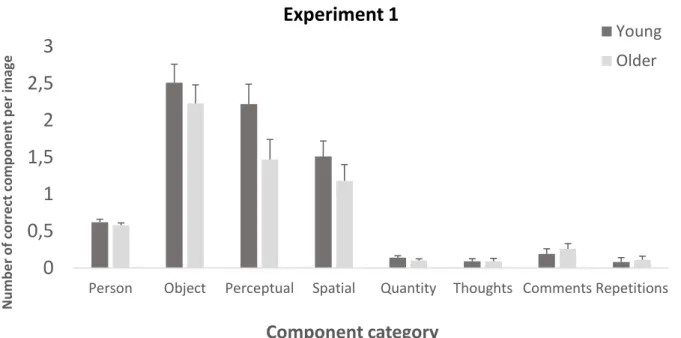
Correct responses in the free recall task were analyzed using a 2 (Group: young vs. older adults) x 8 (Category: person vs. object vs. perceptual vs. spatial vs. quantity vs. thought vs. comment vs. repetition) repeated-measures ANOVA on the number of details3. The analyses
revealed a main effect of Group, F(1, 66) = 6.02, p = .016, = .08, a main effect of Category,
F(1.64, 108.35) = 387.684, p < .001, = .85, as well as a significant Group x Category
interaction, F(1.64, 108.35) = 9.22, p < .001, = .12. Follow-up analyses revealed that young adults recalled more components in the perceptual category than older adults (Tukey test, p < .001), while there were no significant Group differences in the remaining categories (all ps > .177; see Figure 2). Both narrative style (i.e., the number of described perceptual components) and executive functioning predicted the amount of recalled perceptual components, but age still explained a significant part of the variance in the number of recalled perceptual
components when these variables were taken into account (see Supplementary materials). So the age-related decline in the ability to recall perceptual components could not be simply attributed to lower executive functioning or to age-related changes in narrative style. Figure 2.
3 Free-recall data (both recordings and transcriptions) are in French but can be obtained upon request. 4 We applied Greenhouse-Geisser corrections because the sphericity assumption was violated.
2 p
2 p
2 p
Figure 2. Mean number of components recalled per image for each component category in young
and older adults. Error bars represent 95% confidence intervals.
Errors in free recall were analyzed using a 2 (Group: young vs. older adults) x 4 (Error category: person vs. object vs. perceptual vs. spatial) repeated-measures ANOVA on error rates. There was a main effect of Group, F(1, 66) = 19.63, p < .001, = .23, a main effect of Error category, F(1.84, 119.57) = 61.02,3 p < .001, = .50, and a significant Group x Error category
interaction, F(1.84, 119.57) = 5.73, p = .006, = .08, indicating that older adults (M = 0.13) made more errors than young adults in the object category (M = 0.07; Tukey test, p < .001), while there was no Group difference for the remaining categories (all ps > .672).
0
0,5
1
1,5
2
2,5
3
Person Object Perceptual Spatial Quantity Thoughts Comments Repetitions
N u m b e r o f c o rr e ct co m p o n e n t p e r im ag e Component category
Experiment 1
Young Older 2 p
2 p
2 p
Subjective recollection
Analyses of vividness ratings revealed that, on average, older adults rated their subjective memory for the picture as more vivid than young adults, t(66) = –2.44, p = .017 (Table 1).
Relationship between objective and subjective recollection
To investigate the relationship between subjective (vividness ratings) and objective (free recall and source memory) recollection on a trial-by-trial basis, we used mixed-effects modeling using the lme4 package (Baayen, Davidson, Bates, 2008) implemented in the R software (R Core Team, 2017). Trials were modelled as level 1 units and participants as level 2 units. Subjects and items were modelled as crossed random effects. More specifically, the model included random intercepts for both subject and item, and by-subject random slopes (Baayen, Davidson, Bates, 2008). The dependent variable was vividness ratings in all analyses.
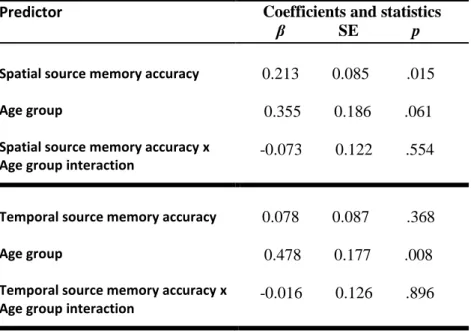
To examine the relationship between spatial source memory and vividness, Spatial source memory accuracy on each trial was added as first-level predictor, Group as second-level predictor, and the Spatial source memory accuracy x Group cross-level interaction was also added to investigate potential age differences in the relationship between vividness and the accuracy of the spatial source memory response. This mixed-effects analysis included trials of the spatial source memory task as level 1 units (n= 1150) and participants as level 2 units (n=68). The results revealed that the accuracy of Spatial source memory was a significant predictor of vividness, showing that correct Spatial source memory responses were associated
with higher vividness ratings (see Table 3 top). The effect of Group and the Group x Number of components interaction were not significant.
A similar mixed-effects analysis was conducted with Temporal source memory accuracy as predictor, the other variables being the same (level 1 units = 1155; level 2 units = 68). This analysis revealed that the accuracy of Temporal source memory did not predict vividness (see Table 3 bottom). Group significantly predicted vividness ratings, indicating that higher vividness ratings were given by older than young adults, while the Temporal source memory x Group interaction was not significant.
Table 3. Mixed-effects modeling assessing the relationship between source memory and
vividness. Predictor
Coefficients and statistics
β SE p
Spatial source memory accuracy
Age group Spatial source memory accuracy x
Age group interaction
0.213 0.085 .015 0.355 0.186 .061 -0.073 0.122 .554
Temporal source memory accuracy
Age group Temporal source memory accuracy x
Age group interaction
0.078 0.087 .368 0.478 0.177 .008 -0.016 0.126 .896 Note: Vividness is the outcome variable in all analyses.
Next, we examined the relationship between vividness and free-recall. To assess the recollection quantity hypothesis, the total number of correct components recalled (i.e., the sum of persons, objects, spatial, perceptual, quantity and thoughts) was added as first-level
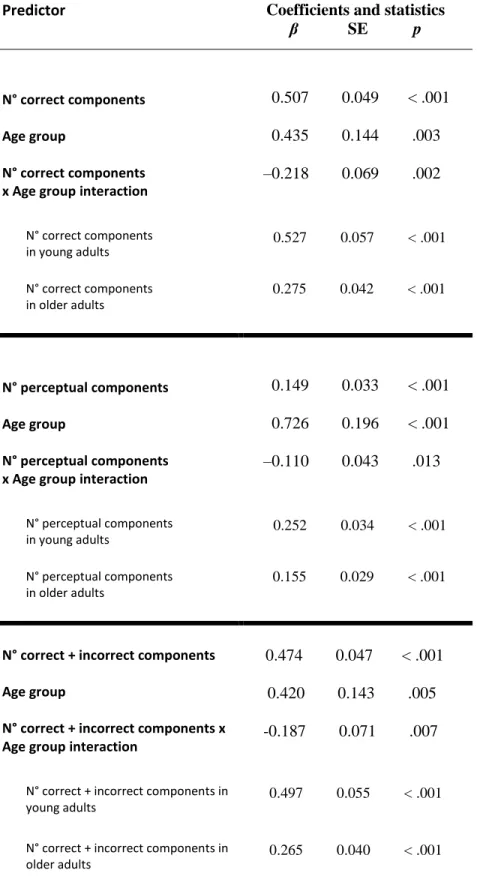
predictor, Group as second-level predictor, and the Number of components x Group cross-level interaction was also added to investigate age differences in the relationship between vividness and the number of recalled components. This mixed-effects analysis included all trials as level 1 units (n= 2305) and participants as level 2 units (n=68). The results revealed that the number of components recalled was a significant predictor of vividness, showing that trials that received higher vividness ratings were characterized by more recalled components (see Table 4 top). Group was also a significant predictor of vividness ratings. Finally, the Group x Number of components interaction was significant. Follow-up mixed-effects analyses for each group revealed that the number of components recalled was a significant predictor of vividness ratings in both groups but was stronger in young adults than in older participants. In other words, the relationship between the subjective and objective aspects of recollection on a trial-by-trial basis was more pronounced in younger than in older adults. Similar results were obtained when measures of executive functioning and narrative style were entered in the model, indicating that age-related differences in the relationship between objective and subjective recollection cannot be simply explained by these variables.
We also conducted a similar mixed-effects analysis with the number of recalled
perceptual components as first-level predictor. Again, this analysis yielded a significant Group x Number of perceptual components interaction (see Table 4 middle), showing that the amount of recalled perceptual components predicted subjective vividness to a greater extent in young than in older adults.
Table 4. Mixed-effects modeling assessing the relationship between free-recall and vividness.
Predictor Coefficients and statistics
β SE p
N° correct components Age group
N° correct components x Age group interaction
0.507 0.049 < .001 0.435 0.144 .003 –0.218 0.069 .002 N° correct components in young adults 0.527 0.057 < .001 N° correct components in older adults 0.275 0.042 < .001 N° perceptual components Age group N° perceptual components x Age group interaction
0.149 0.033 < .001 0.726 0.196 < .001 –0.110 0.043 .013 N° perceptual components in young adults 0.252 0.034 < .001 N° perceptual components in older adults 0.155 0.029 < .001
N° correct + incorrect components
Age group N° correct + incorrect components x
Age group interaction
0.474 0.047 < .001 0.420 0.143 .005 -0.187 0.071 .007
N° correct + incorrect components in
young adults
0.497 0.055 < .001
N° correct + incorrect components in
older adults
0.265 0.040 < .001
Finally, to assess the recollection quality hypothesis, we ran a similar mixed-effects analysis with the total number of components recalled (correct and incorrect) as first-level predictor. The results were the same as those reported in the analysis with the correct
components (see Table 4 bottom). In other words, the relationship between vividness and free-recall was more pronounced in younger than in older adults, even when incorrect details were taken into account in the analysis.
Discussion
Several studies have reported that older adults subjectively rate their recollection of events as being as vivid and detailed as young adults do, even though they objectively recollect the source and specific details of these events less accurately (Hashtroudi et al. 1990; Duarte et al. 2006; 2008; Gallo et al. 2011; Robin & Moscovitch, 2017). However, previous studies have yielded only indirect evidence for a dissociation between objective and subjective recollection measures because they compared aggregated data on the two measures in young and older participants. To our knowledge, this study is the first to address the relationship between subjective and objective recollection more directly by investigating the two aspects of
recollection on a trial-by-trial basis. In the following paragraphs, we will first discuss results on objective and subjective recollection, and then we will address the extent to which our findings provide support to the recollection quantity and/or quality hypothesis.
Objective recollection
Objective recollection, as operationalized by source memory, revealed an age difference that was specific to temporal source memory, whereas no age-difference was found for spatial source memory (Bastin & Van der Linden, 2005; Henkel et al., 1998; McDonough & Gallo, 2013). There have been conflicting findings regarding age-related changes in spatial source memory: some studies showed an age-related difference (Cooper et al., 2017; Duarte et al., 2006; Parkin, Hunkin, & Walter, 1995), while others did not (Cooper et al., 2017). In this latter report, age-related differences were found for source memory of items presented within scene
backgrounds while no group difference was shown for items presented on both sides of a fixation cross (Cooper et al., 2017). Given that aging affects the capacity to bind items and their corresponding (notably spatial) features (Chalfonte & Johnson, 1996), it might be more difficult for older individuals to retrieve the location of an item within a complex picture (Cooper et al. 2017) than the left-right location of the picture itself as in our study. In contrast, a substantial body of research has shown that temporal source memory is less accurate in older than in young participants (Bastin & Van der Linden, 2005; Gallo et al., 2011; Parkin et al., 1995). This age-related deficit for temporal source memory might be due to a failure to reconstruct the temporal context from information associated with the item, a process that requires the
implementation of efficient memory retrieval strategies (Bastin & Van der Linden, 2005; Bastin, Van der Linden, Michel, & Friedman, 2004). Consistently with previous work, age-related differences in temporal source memory were mediated by changes in executive functions (Parkin et al., 1995), which highlights that age-differences in source memory performance
might be, at least partly, determined by the extent to which the assessed source memory dimension requires the implementation of executive functioning processes.
Free recall data revealed that older adults retrieved fewer perceptual details than young adults, in line with a previous study on memories for real-life events (Hashtroudi et al., 1990). This pattern of result is also consistent with McDonough et al.’s (2014) study, which showed that memory reinstatement in older adults was associated with weaker brain activity in visual regions responsible for the processing of perceptual information. Interestingly, the finding that the age-difference in free-recall remained significant after controlling for executive functioning and narrative style suggests that this difference relates primarily to changes in episodic memory mechanisms.
Our design allowed us to specifically assess the accuracy of these recollected details and revealed that older adults indeed retrieved more incorrect details than young adults. One might suggest that these errors could be due to distortions in stored memory representations.
Alternatively, because errors often consisted in recalling a non-present object that was plausible for the scene (e.g., a bed in a picture showing only chests of drawers and toys in a child’s bedroom), this could reflect a biased reconstruction of the scene from general
knowledge elicited by the label. Indeed, the use of the label to cue the retrieval of a complex picture may activate conceptual and schematic knowledge related to the scene (Wing, Ritchey, & Cabeza, 2015), which could bias remembering experience. This schematic knowledge account may explain why older adults made more object errors than young participants since aging has been associated with an overreliance on pre-existing schematic knowledge while remembering (Hess & Slaughter, 1990; Umanath & Marsh, 2014).
Age-related differences in subjective recollection and its relationship with objective recollection
The main aim of this study was to investigate whether age-related memory changes in objective recollection would be accompanied by similar variations in the subjective
remembering experience. Consistent with previous findings (Comblain et al., 2005; Johnson et al., 2015; Robin & Moscovitch, 2017), aging was not associated with reduced subjective recollection. Thus, taken separately, measures of source memory, free recall and vividness showed a dissociation between objective and subjective recollection in aging. The novel aspect of our study is the use of mixed-effects modeling to shed light on the relationship between these two aspects of recollection on a trial-by-trial basis.
Mixed-effects modeling first revealed that spatial, but not temporal, source memory accuracy predicted subjective vividness ratings. This result suggests that being able to reinstate the spatial context of a scene may contribute to the subjective quality of memories. In contrast, our results suggest that temporal source memory is not used for judging memory vividness, perhaps because subjective vividness judgements in the current study were mainly based on visual features. Interestingly, spatial source memory accuracy predicted vividness to a similar extent in both age-groups, suggesting that the extent to which the reinstatement of spatial context contributes to subjective vividness does not change with aging.
The hypotheses proposed by McDonough et al., (2014) were tested by examining the trial-by-trial relationship between vividness judgments and the details produced during the free-recall task. As a reminder, the recollection quantity hypothesis posits that older adults
retrieve less information than young adults and recalibrate their subjective ratings, whereas the
recollection quality hypothesis proposes that older adults can calibrate their subjective memory
ratings as precisely as young adults do, but that the retrieved details they rely on are distorted, different or less diagnostic.
Our findings are more in line with the recollection quantity hypothesis. Older adults provided higher vividness ratings than young adults, which suggests that, overall, they overestimated their subjective memory experience with regard to the amount of retrieved episodic details (recollection quantity hypothesis). This latter hypothesis was supported by the finding that the amount of retrieved (especially perceptual) details better predicted vividness ratings in young than older adults, a difference that could not be simply attributed to age-differences in narrative style or free-recall. These results echo with previous work showing that the relationship between subjective confidence and memory accuracy was stronger in young than older adults (Wong et al. 2012). The authors attributed older adults’ poorer confidence calibration to the reduced amount of retrieved details and/or age-related impairments in memory monitoring processes: a reduction in the amount of episodic details could make the discrimination between targets and lures challenging because fewer diagnostic features would be available (Wong et al. 2012). Support for this hypothesis comes from a study showing that when memory performance was equated between age-groups, older adults did not differ in the resolution of their Feeling-of-Knowing judgements relative to young adults. So it seems that older adults can calibrate their subjective ratings when the corresponding memory traces are sufficiently strong (Hertzog, Dunlosky & Sinclair, 2010). Therefore, the older adults’ poorer vividness calibration observed in the current study could result from a lower number of
retrieved (perceptual) episodic details. Remembering few episodic details might make it difficult to differentiate between a poor and a rich subjective experience of remembering, which would reduce objective-subjective memory calibration.
Alternatively, older adults’ poorer vividness calibration could be explained by age-related metamemory changes. With increasing age, people might have difficulties determining what constitutes a highly vivid episodic memory experience and might therefore erroneously consider an impoverished memory representation to be rich and detailed. In a related vein, it has been proposed that older adults lower their vividness criterion, such that they content themselves with a reduced amount of details and, consequently, overestimate the subjective richness of their memory representations (St-Laurent et al., 2011).
On the other hand, the recollection quality hypothesis posits that young and older adults rely on different types of information to make vividness judgements, with older adults using more erroneous or distorted information (McDonough et al., 2014). However, we found that when incorrect details were taken into account, the relationship between free-recall and vividness was still stronger in young than in older adults. In other words, older adults were still less calibrated than young adults in their subjective memory ratings when erroneous details were included in the free-recall measure. This suggests that older adults’ poorer calibration of subjective vividness cannot be attributed to the inclusion of distorted/incorrect details in their judgements.
Although the current study does not provide support for the recollection quality hypothesis, we cannot rule out the possibility that older adults relied on episodic details that were not captured by the current paradigm. For instance, Koutstaal (2003) suggested that older
adults do not give as much importance or weight to the retrieval of perceptual features (color, size, texture) of objects as young adults do. Rather, they tend to rely preferentially on gist-based information when making memory judgments (Koutstaal & Schacter, 1997). Therefore, older adults could base their vividness ratings on gist information retrieved from the descriptive label rather than on specific details from the picture, which might partly explain why the
amount of episodic details predicted their subjective memory experience to a lesser extent. Alternatively, older adults could relate picture stimuli to personal memories or autobiographical knowledge to a greater extent than young adults during encoding and they could subsequently rely on these internal sources to judge the subjective quality of their memories (Mitchell & Johnson, 2009). Young and older adults may thus spontaneously weight different kinds of information (that they initially experience to a different degree during memory encoding) when remembering, which might impact how they judge the subjective quality of their memories (Johnson et al., 2015).
Mitchell and Hill (2019) recently examined whether age-related changes in source memory performance and subjective memory judgements could be attributed to the fact that young and older adults focus on different types of information during episodic encoding. While seeing pictures, young and older adults were asked to focus on three types of features for which they judged the subjective vividness (i.e., the visual details, emotion, and personal memories/thoughts evoked by the pictures). They were further instructed to mentally visualize half of the pictures and to make one subjective judgement (visual details or emotion or
personal thought) per picture. Subsequently, a source memory test asked whether each picture was encoded and then mentally visualized or was only encoded. Results revealed that the
subjective ratings made when seeing and mentally visualizing the pictures did not differ
between age-groups, while source memory performance was reduced in older adults (Mitchell & Hill, 2019). Interestingly, however, the intensity of the subjective judgements made when mentally visualizing the pictures correlated with the accuracy of subsequent source memory in both age-groups. These results suggest that when young and older adults presumably focus on the same features during encoding, these features are judged at a similar level of vividness and become equally diagnostic for source memory decisions in both age-groups, although older adults perform less well than young adults (which may be attributed to age-related changes in memory monitoring processes; Mitchell & Hill, 2019). This highlights that older adults can process and use the same details as young adults for their memory decisions, at least when they are encouraged to focus on these details. Asking young and older participants to focus on the same types of features during memory encoding is thus a promising approach for future studies to shed further light on the types of features that give rise to a subjective sense of remembering in young and older individuals.
One last factor that might in part account for the present results relates to older
participants’ memory self-efficacy, that is, one’s beliefs about the weaknesses and strengths of one’s memory capacities (Hultsch et al., 1988). Specifically, it could be that older adults realized that they did not remember some pictures (i.e., missed trials) and to compensate for this, they might assign high vividness judgements to remembered images so as to make them feel better regarding their memory self-efficacy (e.g.,”I know that I forgot some images but the ones I remember, I recollect them very well”).
Finally, a limitation of the current study is that although we took care to select neutral pictures, some of the pictures that were used were not pre-tested for emotion and arousal ratings. Given the emotional bias occurring during remembering in older individuals (Kensinger, 2009), our findings should be replicated with pictures that would be validated for both young and older adults. Besides, a validation of the labels used to cue recollection (i.e., to ensure that they match with their corresponding pictures both for young and older participants) would also strengthen our conclusions.
Conclusion
In conclusion, this study replicates previous findings that older adults show an impoverished capacity to retrieve specific contextual information and details from complex scenes. The age-related decline in retrieving specific –perceptual – details from a scene persisted even after controlling for the effects of executive functioning and narrative style, suggesting that the decline might be underpinned by episodic memory changes. In contrast, older participants rated their memories as more vivid than young adults. We found that the capacity to recollect the spatial context from scenes significantly predicted the associated subjective vividness judgements in both age-groups. Although a significant relationship between the subjective experience of remembering and the objective amount of perceptual episodic information retrieved was also observed in both groups, this relationship was stronger in young than in older adults. In other words, older adults do not only retrieve fewer specific episodic details but also rely on these details to a lesser extent to calibrate their subjective
memory ratings. Future work should attempt to understand how the weighting of episodic details gives rise to the subjective experience of recollection across the lifespan. This would provide important insights into how the human cognitive system generates subjective recollection judgments and how these judgments evolve with age.
References
Angel, L., Bastin, C., Genon, S., Salmon, E., Fay, S., Balteau, E., … Collette, F. (2016). Neural correlates of successful memory retrieval in aging: Do executive functioning and task difficulty matter? Brain Research, 1631, 53–71. doi:10.1016/j.brainres.2015.10.009 Baayen, R. H., Davidson, D. J., & Bates, D. M. (2008). Mixed-effects modeling with crossed
random effects for subjects and items. Journal of memory and language, 59(4), 390-412. https://doi.org/10.1016/j.jml.2007.12.005
Bastin, C., Besson, G., Simon, J., Delhaye, E., Geurten, M., Willems, S., & Salmon, E. (2019). An Integrative Memory model of recollection and familiarity to understand memory deficits. Behavioral and Brain Sciences, 1-66. doi:10.1017/S0140525X19000621 Bastin, C., & Van der Linden, M. (2005). Memory for temporal context: effects of ageing,
encoding instructions, and retrieval strategies. Memory, 13, 95–109. doi:10.1080/09658210344000611
Bastin, C., Van der Linden, M., Michel, A. P., & Friedman, W. J. (2004). The effects of aging on location-based and distance-based processes in memory for time. Acta Psychologica,
116, 145–171. doi:10.1016/j.actpsy.2003.12.014
Chalfonte, B. L. & Johnson, M. K. (1996). Feature memory and binding in young and older adults. Memory & cognition, 24(4), 403-416. https://doi.org/10.3758/BF03200930 Comblain, C., D’Argembeau, A., & Van Der Linden, M. (2005). Phenomenal characteristics of
autobiographical memories for emotional and neutral events in older and younger adults. Experimental Aging Research, 31, 173–189. doi:10.1080/03610730590915010 Cooper, E., Greve, A., & Henson, R. N. (2017). Assumptions behind scoring source versus item
memory: Effects of age, hippocampal lesions and mild memory problems. Cortex, 91, 297–315. doi:10.1016/j.cortex.2017.01.001
De Brigard, F. De, Giovanello, K. S., Stewart, G. W., Amber, W., Brien, M. M. O., Spreng, R. N., … Stewart, G. W. (2016). Characterizing the subjective experience of episodic past, future, and counterfactual thinking in healthy younger and older adults. Quarterly Journal of
Experimental Psychology, 69, 2358–2375. doi:10.1080/17470218.2015.1115529
Dede, A. J., Wixted, J. T., Hopkins, R. O., & Squire, L. R. (2016). Autobiographical memory, future imagining, and the medial temporal lobe. Proceedings of the National Academy of
Sciences, 113(47), 13474-13479.
Deltour, J. J. (1993). Echelle de vocabulaire de Mill Hill de J. C. Raven. Adaptation française et
normes comparées du Mill Hill et du Standard Progressive Matrice (PM 38): Manuel.
Braine-le-Château, France: Editions l’application des techniques modernes.
Drag, L. L., & Bieliauskas, L. A. (2010). Contemporary review 2009: Cognitive aging. Journal of
Geriatric Psychiatry and Neurology, 23, 75–93. doi:10.1177/0891988709358590
Duarte, A., Henson, R. N., & Graham, K. S. (2008). The effects of aging on the neural correlates of subjective and objective recollection. Cerebral Cortex, 18, 2169–2180.
doi:10.1093/cercor/bhm243
Duarte, A., Ranganath, C., Trujillo, C., & Knight, R. T. (2006). Intact recollection memory in high-performing older adults: ERP and behavioral evidence. Journal of Cognitive
Neuroscience, 18, 33–47. doi:10.1162/089892906775249988
Faul, F., Erdfelder, E., Lang, A.-G., & Buchner, A. (2007). G*Power: A flexible statistical power analysis program for the social, behavioral, and biomedical sciences. Behavior Research
Methods, 39, 175–191. doi:10.3758/BF03193146
Gaesser, B., Sacchetti, D. C., Addis, D. R., & Schacter, D. L. (2011). Characterizing age-related changes in remembering the past and imagining the future. Psychology and aging, 26(1), 80.
Gallo, D. A., Korthauer, L. E., McDonough, I. M., Teshale, S., & Johnson, E. L. (2011). Age-related positivity effects and autobiographical memory detail: Evidence from a past/future source memory task. Memory, 19, 641–652. doi:10.1080/09658211.2011.595723 Gardiner, J. M., Ramponi, C., & Richardson-Klavehn, A. (1998). Experiences of remembering,
knowing, and guessing. Consciousness and Cognition, 7, 1–26. doi:10.1006/ccog.1997.0321
Glisky, E. L., Polster, M. R., & Routhieaux, B. C. (1995). Double dissociation between item and source memory. Neuropsychology, 9, 229–235. doi:10.1037/0894-4105.9.2.229 Guler, O. E., & Mackovichova, S. (2018). The role of executive function in autobiographical
memory retrieval: does the type of cue word matter?. Memory, 1-8. doi: 10.1080/09658211.2018.1513040.
Hashtroudi, S., Johnson, M. K., & Chrosniak, L. D. (1990). Aging and qualitative characteristics of memories for perceived and imagined complex events. Psychology and Aging, 5, 119– 126. doi:10.1037/0882-7974.5.1.119
Henkel, L. A., Johnson, M. K., & De Leonardis, D. M. (1998). Aging and source monitoring: Cognitive processes and neuropsychological correlates. Journal of Experimental
Psychology: General, 127, 251–268. doi:10.1037//0096-3445.127.3.251
from the quality of original encoding. Memory & cognition, 38(6), 771-784. doi: 10.3758/MC.38.6.771
Hess, T. M., & Slaughter, S. J. (1990). Schematic knowledge influences on memory for scene information in young and older adults. Developmental Psychology, 26, 855–865. doi:10.1037/0012-1649.26.5.855
Hultsch, D. F., Hertzog, C., Dixon, R. A., & Davidson, H. (1988). Memory knowledge and self-efficacy in the aged. In Cognitive development in adulthood (pp. 65-92). Springer, New York, NY.
Johnson, M. K., Hashtroudi, S., & Lindsay, D. S. (1993). Source monitoring. Psychological
Bulletin, 114, 3–28. doi:10.1037/0033-2909.114.1.3
Johnson, M. K., Kuhl, B. A., Mitchell, K. J., Ankudowich, E., & Durbin, K. A. (2015). Age-related differences in the neural basis of the subjective vividness of memories: Evidence from multivoxel pattern classification. Cognitive, Affective, and Behavioral Neuroscience, 15, 644–661. doi:10.3758/s13415-015-0352-9
Kausler, D. H., Salthouse, T. A., & Saults, J. S. (1988). Temporal memory over the adult lifespan.
The American journal of psychology, 207-215. doi: 10.2307/1422835
Kensinger, E. A. (2009). How emotion affects older adults’ memories for event details. Memory,
17(2), 208-219.
Koehler, K., Guo, F., Zhang, S., & Eckstein, M. P. (2014). What do saliency models predict?
Journal of Vision, 14, 14. doi:10.1167/14.3.14
Koen, J. D., & Yonelinas, A. P. (2014). The effects of healthy aging, amnestic mild cognitive impairment, and Alzheimer’s disease on recollection and familiarity: A meta-analytic
review. Neuropsychology Review, 24, 332–354. doi:10.1007/s11065-014-9266-5 Koo, T. K., & Li, M. Y. (2016). A guideline of selecting and reporting intraclass correlation
coefficients for reliability research. Journal of Chiropractic Medicine, 15, 155–163. doi:10.1016/j.jcm.2016.02.012
Koutstaal, W., & Schacter, D. L. (1997). Gist-based false recognition of pictures in older and younger adults. Journal of Memory and Language, 583, 555–583.
doi:10.1006/jmla.1997.2529
Koutstaal, W. (2003). Older adults encode—but do not always use—perceptual details: Intentional versus unintentional effects of detail on memory judgments. Psychological
Science, 14(2), 189-193. https://doi.org/10.1111/1467-9280.01441
Lancaster, J. S., & Barsalou, L. W. (1997). Multiple organizations of events in memory, Memory,
5, 569–599. doi:10.1080/741941478
Lang, P., & Bradley, M. M. (2007). The International Affective Picture System (IAPS) in the study of emotion and attention. In J. A. Coan & J. J. B. Allen (Eds.), Handbook of emotion
elicitation and assessment (pp. 29–46). New York: Oxford University Press.
Levine, B., Svoboda, E., Hay, J. F., Winocur, G., & Moscovitch, M. (2002). Aging and
autobiographical memory: Dissociating episodic from semantic retrieval. Psychology and
Aging, 17, 677–689. doi:10.1037//0882-7974.17.4.677
Maas, C. J., & Hox, J. J. (2005). Sufficient sample sizes for multilevel modeling. Methodology,
1(3), 86-92. https://doi.org/10.1027/1614-2241.1.3.86
Madore, K. P., Gaesser, B., & Schacter, D. L. (2014). Constructive episodic simulation:
in young and older adults. Journal of Experimental Psychology: Learning, Memory, and
Cognition, 40, 609–622. doi:10.1037/a0034885
Mark, R. E., & Rugg, M. D. (1998). Age effects on brain activity associated with episodic memory retrieval. An electrophysiological study. Brain: a journal of neurology, 121(5), 861-873. https://doi.org/10.1093/brain/121.5.861
Mattis, S. (1976). Mental status examination for organic mental syndrome in the elderly
patients. In L. Bellak & T. Karasu (Eds.), Geriatric psychiatry: A handbook for psychiatrists
and primary care physicians (pp. 77–121). New York: Grune and Stratton.
McDonough, I. M., Cervantes, S. N., Gray, S. J., & Gallo, D. A. (2014). Memory’s aging echo: Age-related decline in neural reactivation of perceptual details during recollection.
NeuroImage, 98, 346–358. doi:10.1016/j.neuroimage.2014.05.012
McDonough, I. M., & Gallo, D. A. (2013). Impaired retrieval monitoring for past and future autobiographical events in older adults. Psychology and Aging, 28, 457–466. doi:10.1037/a0032732
Mitchell, K. J., & Hill, E. M. (2019). The Impact of Focusing on Different Features During
Encoding on Young and Older Adults’ Source Memory. Open Psychology, 1(1), 106-118. Mitchell, K. J., & Johnson, M. K. (2009). Source monitoring 15 years later: What have we learned
from fMRI about the neural mechanisms of source memory? Psychological Bulletin, 135, 638–677. doi:10.1037/a0015849
Miyake, A., Friedman, N. P., Emerson, M. J., Witzki, A. H., Howerter, A., & Wager, T. D. (2000). The unity and diversity of executive functions and their contributions to complex “frontal lobe” tasks: A latent variable analysis. Cognitive Psychology, 41, 49–100.
doi:10.1006/cogp.1999.0734
Parkin, A. J., Hunkin, N. M., & Walter, B. M. (1995). Relationships between normal aging, frontal lobe function, and memory for temporal and spatial information. Neuropsychology, 9, 304–312. doi:10.1037/0894-4105.9.3.304
Pedraza, O., Lucas, J. A., Smith, G. E., Petersen, R. C., Graff-Radford, N. R., & Ivnik, R. J. (2010). Robust and expanded norms for the Dementia Rating Scale. Archives of Clinical
Neuropsychology, 25, 347–358. doi:10.1093/arclin/acq030
R Core Team (2017). R: A language and environment for statistical computing. R Foundation for Statistical Computing,Vienna, Austria. URL https://www.R-project.org/.
Robin, J., & Moscovitch, M. (2017). Familiar real-world spatial cues provide memory benefits in older & younger adults. Psychology and Aging, 32, 210–219. doi:10.1037/pag0000162 St-Laurent, M., Abdi, H., Bondad, A., & Buchsbaum, B. R. (2014). Memory reactivation in healthy
aging: Evidence of stimulus-specific dedifferentiation. Journal of Neuroscience, 34, 4175–4186. doi:10.1523/JNEUROSCI.3054-13.2014
St-Laurent, M., Abdi, H., Burianová, H., & Grady, C. L. (2011). Influence of aging on the neural correlates of autobiographical, episodic, and semantic memory retrieval. Journal of
Cognitive Neuroscience, 23, 4150–4163. doi:10.1162/jocn_a_00079
Umanath, S., & Marsh, E. J. (2014). Understanding how prior knowledge influences memory in older adults. Perspectives on Psychological Science, 9, 408–426.
doi:10.1177/1745691614535933
Wing, E. A., Ritchey, M., & Cabeza, R. (2015). Reinstatement of individual past events revealed by the similarity of distributed activation patterns during encoding and retrieval. Journal
of Cognitive Neuroscience, 27, 679–691. doi:10.1162/jocn
Wong, J. T., Cramer, S. J., & Gallo, D. A. (2013). Age-related reduction of the confidence-accuracy relationship in episodic memory: Effects of recollection quality and retrieval monitoring. Psychology and Aging, 27, 1053–1065. doi:10.1037/a0027686
Yonelinas, A. (2002). The nature of recollection and familiarity: A review of 30 years of research.
Deciphering the Relationship between Objective and Subjective Aspects of Recollection in Healthy Aging
Adrien Folville1, Arnaud D’Argembeau1 & Christine Bastin1
Picture Description Task
The content of the description of each image was coded by the first author. A second trained rater, blind to participant’s age, scored a randomly selected 20% of the data of each group. Across participants, Intraclass Correlation Coefficients (ICCs) between raters revealed excellent interrater agreement regarding the total number of components, ICC = .99; object components, ICC = .99; perceptual components, ICC = .98; spatial components, ICC = .93; quantities, ICC = .93; and comments, ICC = .90. Good agreement was found for repetitions, ICC = .77; and moderate agreement for the number of person components, ICC = .52.
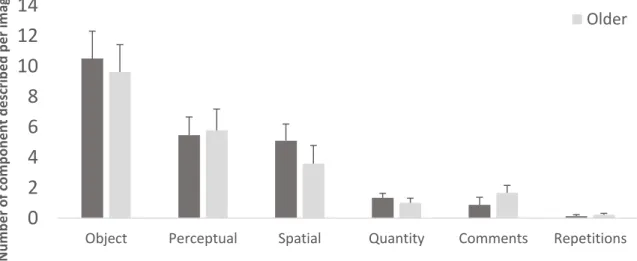
We conducted a 2 (Group: young vs. older adults) x 6 (Category: object vs. perceptual vs. spatial vs. quantity vs. comment vs. repetition) repeated-measures ANOVA on the picture description task5. There was a main effect of Category, F(1.75, 115.69) = 148.146, p < .001, =
.69 (Figure S1), but no main effect of Group, F(1, 66) < 1, p = .61, = .01, and no Group x Category interaction, F(1.75, 115.69) = 1.88, p = .16, = .03.
5 Because the ICC was low regarding the person components category, we decided not to include it in the subsequent analysis. Note that when it was included, the pattern of result did not change.
6 We applied Greenhouse-Geisser corrections because the sphericity assumption was violated.
2 p
2 p
2 p
Figure S1. Mean number of components described per image for each component category in young and older adults. Error bars represent 95% confidence intervals.
Executive Functioning
Participants’ executive functioning was assessed using the N-back, Stroop and Plus-Minus tasks that respectively measure updating, inhibition and shifting functions.
N-back task (Jaeggi, Buschkuehl, Perrig, & Meier, 2010). The experimenter orally presented a series of 30 letters. For each letter, the participant had to decide whether it was the same as the letter presented two steps before. The total number of correct answers was the key measure.
0
2
4
6
8
10
12
14
Object Perceptual Spatial Quantity Comments Repetitions
N u m b e r o f c o m p o n e n t d e scr ib e d p e r im ag e Component category Young Older
Stroop test (Stroop, 1935). The color and interference subtests were used to measure participants’ inhibitory abilities. An interference score was calculated as follows: ([number of correct responses for 45 seconds in color subtest] – [number of correct responses for 45 seconds in interference subtest]) / (number of correct responses for 45 seconds in color subtest).
Plus-Minus task (Hull, Martin, Beier, Lane, & Hamilton, 2008). This test comprised three written subtests (addition, subtraction, alternation). In the first subtest, participants had to add 3 to each number. In the second, they had to subtract 3 from each number. In the last, they had to alternate between additions and subtractions of 3. For each participant, an alternating score could be computed as follows: (time in alternation) – (time in addition + time in subtraction)/2.
Relationship between non-episodic mechanisms and objective recollection
To assess the possibility that participants’ performance on objective recollection measures was partly determined by their executive functioning, we conducted hierarchical multiple regressions (see Table S1). Our variable of interest – executive functioning – was entered in first step while age was entered in second step. We found that executive functioning did not significantly predict spatial source memory performance. When age was then loaded, it did not significantly predict spatial source memory performance. We also found that executive functioning was a significant predictor of temporal source memory performance, whereas age did not improve the model.
Next, to evaluate the extent to which participants’ executive functioning and narrative style predicted the number of perceptual components recalled, we conducted a multiple