HAL Id: hal-02876675
https://hal.archives-ouvertes.fr/hal-02876675
Submitted on 21 Jun 2020
HAL is a multi-disciplinary open access
archive for the deposit and dissemination of
sci-entific research documents, whether they are
pub-lished or not. The documents may come from
teaching and research institutions in France or
abroad, or from public or private research centers.
L’archive ouverte pluridisciplinaire HAL, est
destinée au dépôt et à la diffusion de documents
scientifiques de niveau recherche, publiés ou non,
émanant des établissements d’enseignement et de
recherche français ou étrangers, des laboratoires
publics ou privés.
Kostiantyn Nechay, Alexandru Mereuta, Cyril Paranthoën, Gaëlle Brévalle,
Christophe Levallois, Mehdi Alouini, Nicolas Chevalier, Mathieu Perrin,
Grigore Suruceanu, Andrei Caliman, et al.
To cite this version:
Kostiantyn Nechay, Alexandru Mereuta, Cyril Paranthoën, Gaëlle Brévalle, Christophe
Leval-lois, et al..
Low threshold 1550 nm emitting QD optically pumped VCSEL. IEEE
Photon-ics Technology Letters, Institute of Electrical and ElectronPhoton-ics Engineers, 2021, 33 (2), pp.69-72.
�10.1109/LPT.2020.3044457�. �hal-02876675�
Abstract—We report high-power second-harmonic generation of 760 nm laser light from optically-pumped vertical-external-cavity surface-emitting laser based on quantum dot active medium. The laser generates ~1.2 W in fundamental transverse mode with fixed linear polarization. The emission wavelength can be continuously tuned from 738 to 778 nm by using an intra cavity birefringent filter for fundamental radiation without readjustment of phase-matching angle of the nonlinear crystal. The result constitutes a viable alternative for applications requiring broadly tunable high brightness lasers in the 700-800 nm range.
Index Terms— Optical harmonic generation, semiconductor growth, surface emitting lasers, quantum dot lasers.
I. I
NTRODUCTIONERTICAL
-external-cavity
surface-emitting
lasers
(VECSELs) have attracted attention due to their capability
of producing high-power high-brightness emission across vast
wavelength ranges [1]. Intrinsic wavelength versatility of
semiconductor gain coupled with the open resonator enables
achieving fundamental and frequency converted emissions
spanning from ultraviolet to mid-IR [2]. However,
technological development of VECSELs has not been equally
distributed across all wavelength regions, leaving certain
spectral windows poorly covered with reliable approaches. An
example is the 700-800 nm range, which has recently gained
interest due to applications in biophotonics [3], medical [4] and
spectroscopy field [5]. Furthermore, frequency doubling of this
wavelength range opens new avenues to UV emission, where
atomic molecular and optical physics can benefit from
narrow-linewidth tunable lasers for applications in atom cooling and
isotope separation [6].
The first VECSEL addressing 700-800 nm wavelength region
was composed of InP quantum dot (QD)-based gain region and
has delivered 52 mW of output power tunable over 716-755 nm
Manuscript received October 30, 2019. The work is part of the Academy of Finland Flagship Programme PREIN #320168, Agence Nationale de la Recherche (ANR) and Swiss National Science Foundation (SNSF) (ANR-SNSF IDYLIC project, grant ANR-15-CE24-0034-01).
K. Nechay and M. Guina are with Optoelectronics Research Centre, Physics Unit, Tampere University, Tampere, 33720 Finland (e-mail: [email protected]).
band [7]. As another alternative, VECSEL utilizing Raman
shifting in diamond allowed to obtain 82 mW at 736-750 nm
[8]. Watt-level emission was achieved by means of intracavity
frequency-doubling of the 1500-1580 nm wafer-fused
structures, yielding 1 W at 780 nm [9] and 1.5 W at 750 nm
[10]. To date, the record VECSEL results at this wavelength
region have been demonstrated with direct-emitting
AlGaAs-based QW VECSELs resulting in output powers of 3.25 W and
tunable over 741-773 nm [11], and 4.24 W tunable over
747-788 nm [12]. Despite these notable achievements, the
state-of-the-art AlGaAs-based direct emitting structures possess a set of
drawbacks, namely, low laser lifetime, and polarization
peculiarities degrading the output beam at high power [11].
In this Letter, we report second-harmonic generation (SHG)
based on new type of gain mirrors recently proposed for
emission at 1550 nm [13]. In particular, we demonstrate ~1.2 W
of output power at the 760 nm from intracavity frequency
conversion of QD-based VECSEL. The emission wavelength
can be tuned from 738 to 778 nm.
II. E
XPERIMENTAL SETUPA. Gain mirror and cavity
The QD gain mirror structure is comprised of an InP-based
active region employing InAs QDs wafer fused to a
GaAs-based GaAs/AlAs DBR. Complete characterization details for
fundamental operation are provided in [13] (including PL
measurements). Intracavity heatspreader thermal management
scheme was employed by utilizing an uncoated diamond with a
thickness of 0.3 mm. Cavity configuration for the intracavity
frequency doubling is shown in Fig. 1. The gain mirror was
pumped by a 980 nm fiber-coupled diode. All mirrors used in
the resonator had high transmission (>95%) at 760 nm and high
reflectivity (>99.8%) at 1.5 µm. A BiBO nonlinear crystal with
a length of 5 mm was chosen for the type I critical phase
matching and was placed at the mode waist inside the resonator.
A. Mereuta and E. Kapon are with École Polytechnique Fédérale de Lausanne, Laboratory of Physics of Nanostructures, Institute of Physics, 1015 Lausanne, Switzerland.
C. Paranthoen, G. Brévalle, C. Levallois, M. Alouini, N. Chevalier and M. Perrin are with Univ Rennes, CNRS, Institut FOTON - UMR 6082, F-35000 Rennes, France.
G. Suruceanu and A. Caliman are with LakeDiamond SA, Rue Galilée 7, 1400 Yverdon-les-Bains, Switzerland.
High-power 760 nm VECSEL based on
quantum dot gain mirror
K. Nechay, A. Mereuta, C. Paranthoen, G. Brévalle, C. Levallois, M. Alouini, N. Chevalier, M. Perrin,
G. Suruceanu, A. Caliman, E. Kapon, and M. Guina
Fig. 1. Cavity schematics of the frequency-doubled QD VECSEL.
III. R
ESULTS AND DISCUSSIONA. Preliminary polarization investigation
Before SHG experiment additional structure characterization
in terms of polarization behavior at the fundamental wavelength
was performed. To fix laser polarization a 2 mm thick fused
silica plate was inserted inside the cavity at the Brewster angle
and was adjusted to ensure laser operation either at P- or
S-polarization.
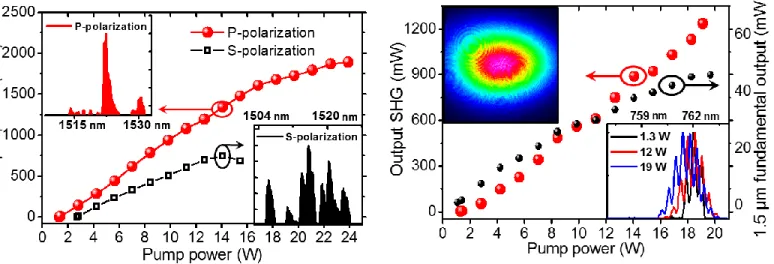
Fig. 2. Power at fundamental frequency recorded as a function of incident pump power at two orthogonal polarization orientations. Inset shows spectra of the corresponding polarization modes.
Polarization selectivity was provided by a different amount
of intracavity reflection losses at fused silica interface for the
different polarization orientations. Unlike to a birefringent
filter, the fused silica plate did not narrow down the output
spectra, although it introduced additional Fabry-Perot etalon
with a very small free spectra range of 0.5 nm. Fig. 2 shows
power characteristics of the VECSEL separately operating with
P- and S-polarizations. As it can be observed, operations at the
orthogonal polarizations exhibit different slope efficiencies,
threshold values and output spectra. The higher performance
obtained for P-polarization is attributed to the anisotropy of the
gain mirror, which is expected for QD heterostructures [14].
provide maximum efficiency in the SHG setup, where fixed
orientation of a birefringent filter (placed at the Brewster angle)
dictated laser polarization. Usage of birefringent filter was
instrumental in achieving a good SHG efficiency; the free
running QD emission spectra has a FWHM of about 14 nm
whereas the acceptance bandwidth of the BiBO crystal is
~7 nm.
B. SHG Results
Fig. 3 shows the power characteristics for the SHG (left axis)
and fundamental emission (right axis) as a function of incident
pump power. The output power of SHG was combined from the
two outputs and resulted in 1.23 W under 19 W of incident
pump power at 14 °C of coolant temperature through the
heatsink (effective temperature of the heatsink slightly
increases with the pump power). Notably, QD-based active
region exhibited lower temperature dependent spectral
shift [15], avoiding the need to readjust the birefringent filter
and the position of the nonlinear crystal under increased pump
power. No measurable degradation of output power was
observed during the experiments.
Fig. 3. Output power of SHG (left axis) and fundamental output through a HR mirror (right axis) as a function of incident pump power. Insets show beam profile recorded at 19 W of incident pump power and spectra as functions of incident pump power.
C. Tuning characteristics of SHG QD VECSEL
Tuning characteristic of the laser was obtained by means of
rotating the birefringent filter (with a thickness of 0.5 mm)
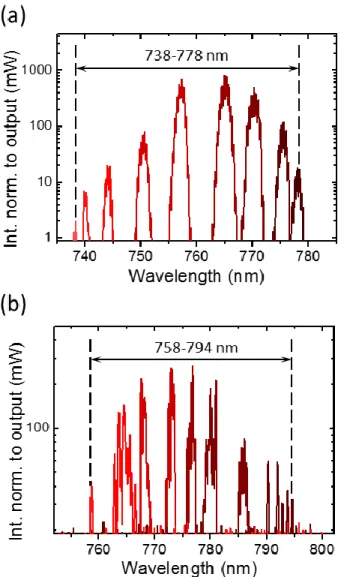
around the axis normal to its surface. Ten separate spectra under
13 W of incident pump power were recorded for ten azimuthal
orientations of the birefringent filter and were combined in the
graph shown in Fig. 4(a). Thus, SHG of the QD-based VECSEL
demonstrated broad continuous tuning of 40 nm (738-778 nm),
when no adjustments of nonlinear crystal or cavity mirrors had
been done in order to optimize the phase-matching angle.
Fig. 4. Output spectra recorded at different azimuthal orientations of the birefringent filter, which were then normalized to the corresponding output power values and combined into one graph, where: (a) QD VECSEL and (b) QW VECSEL
D. Comparison to the SHG QW VECSEL
In comparison, we show tuning characteristics of the SHG for
a QW-based VECSEL (Fig. 4(b)), with an active region
structure similar to the one reported in [9] and with a DBR
identical to the one used in this QD VECSEL, and with identical
thermal management. The QW-based VECSEL, investigated in
the same cavity, has shown inferior tuning characteristic under
pump power of 13 W, both in terms of maximum output power
of 290 mW, and tuning curve width, shown in Fig. 4(b).
However, the QW VECSEL without the intracavity birefringent
filter has yielded 2.3 W of SHG under 25 W of incident pump
power at 770 nm, which may be explained by the lack of
polarization losses caused by birefringent filter, present in
previous measurement.
IV. C
ONCLUSIONWe demonstrate 1.2 W of output power from frequency
doubling of QD-based VECSEL with emission at 760 nm and
continuous wavelength tunability of 40 nm. Considerably
smaller temperature-dependent spectral shift of QD gain media
allowed avoiding the necessity of readjustment of the nonlinear
crystal or cavity mirrors under the increased pump power.
Investigation of the preferred polarization orientation of the
structure allowed obtaining higher efficiency and wider tuning
characteristics of the SHG with the birefringent filter inside the
cavity in comparison to the tunability features achieved with a
QW gain media in the same cavity. Further optimization of QD
gain medium can lead to even broader wavelength tuning
characteristics surpassing those of QW-based devices. The laser
did not exhibit any visible degradation of output power: in this
respect, SHG VECSELs are superior to direct emitting
VECSELs at the same wavelength range.
R
EFERENCES[1] M. Kuznetsov, F. Hakimi, R. Sprague, and A. Mooradian “High-power (>0.5-W CW) diode-pumped vertical-external-cavity surface-emitting semiconductor lasers with circular TEM/sub 00/ beams,”IEEE Photon. Technol. Lett., vol. 9, no. 8, pp. 1063–1065, Aug. 1997.
[2] M. Guina, A. Rantamäki, and A. Härkönen, “Optically pumped VECSELs: review of technology and progress,” J. Phys. D: Appl. Phys., vol. 50, no. 38, pp 1–37, Aug. 2017.
[3] M. Heilemann, S., van de Linde, M. Schüttpelz, R. Kasper, B. Seefeldt, A. Mukherjee, P. Tinnefeld, and M. Sauer, “Subdiffraction‐ Resolution Fluorescence Imaging with Conventional Fluorescent Probes,” Chem.,
Int. Ed. Engl., vol. 47, no. 33, pp. 6172–6176, Jul. 2008.
[4] P. Agostinis, K. Berg, K. A. Cengel, T. H. Foster, A. W. Girotti, S. O. Gollnick, S. O., M. Hahn, M. R. Hamblin, A. Juzeniene, D. Kessel, M . Korbelik, J. Moan, P. Mroz, D. Nowis, J. Piette, B. C. Wilson, and J. Golab, “Photodynamic therapy of cancer: An update,” CA-Cancer J.
Clin., vol. 61, no. 4, pp. 250–281, May 2011.
[5] L. Gianfrani, R. W. Fox, and L. Hollberg, “Cavity-enhanced absorption spectroscopy of molecular oxygen,” J. Opt. Soc. Am. B, vol. 16, no. 12, pp. 2247–2254, Dec. 1999.
[6] T. Mazur, B. Klappauf, and M. Raizen, “Demonstration of magnetically activated and guided isotope separation,” Nat. Phys., vol. 10, pp. 601– 605, Jun. 2014.
[7] P. Schlosser, J. Hastie, S. Calvez, A. B. Krysa, and M. D. Dawson, “InP/AlGaInP quantum dot semiconductor disk lasers for CW TEM_00 emission at 716–755 nm,” Opt. Express, vol. 17, no. 24, pp. 21782– 21787, Nov. 2009.
[8] P. Schlosser, D. Parrotta, V. Savitski, A. J. Kemp, and J. E. Hastie, “Intracavity Raman conversion of a red semiconductor laser using diamond,” Opt. Express, vol. 23, no. 7, pp. 8454–8461, Apr. 2015. [9] A. Rantamäki, J. Rautiainen, J. Lyytikäinen, A. Sirbu, A. Mereuta, E.
Kapon, and O. G. Okhotnikov, “1 W at 785 nm from a frequency-doubled wafer-fused semiconductor disk laser,” Opt. Express, vol. 20, no. 8, pp. 9046–9051, Apr. 2012.
[10] E. Saarinen, J. Lyytikäinen, S. Ranta, A. Rantamäki, V. Iakovlev, E. Kapon, and O. G. Okhotnikov, “750 nm 1.5 W frequency-doubled semiconductor disk laser with a 44 nm tuning range, ” Opt. Lett., vol. 40, no. 19, pp. 4380–4383, Sep. 2015.
[11] H. Kahle, K. Nechay, J.-P. Penttinen, A. Tukiainen, S. Ranta, and M. Guina, “AlGaAs-based vertical-external-cavity surface-emitting laser exceeding 4 W of direct emission power in the 740–790 nm spectral range,” Opt. Lett., vol. 43, no. 7, pp. 1578–1581, Mar. 2018.
[12] K. Nechay, H. Kahle, J.-P. Penttinen, P. Rajala, A, Tukiainen, S. Ranta, and M. Guina, “AlGaAs/AlGaInP VECSELs With Direct Emission at 740–770 nm,” IEEE Photon. Technol. Lett., vol. 31, no. 15, pp. 1245– 1248, Aug. 2019.
[13] K. Nechay, A. Mereuta, C. Paranthoen, G. Brévalle, C. Levallois, M. Alouini, N. Chevalier, M. Perrin, G. Suruceanu, A. Caliman, M. Guina,
light sources,” Semicond. Sci. Technol., vol. 26, no. 1, pp. 1–9, Aug. 2010. [15] T. D. Germann, A. Strittmatter, J. Pohl, U. W. Pohl, D. Bimberg, J. Rautiainen, M. Guina, and O. G. Okhotnikov, “Temperature-stable operation of a quantum dot semiconductor disk laser,” Appl. Phys. Lett., vol. 93, no. 5, pp. 1-3, Aug. 2008.
Mr. Kostiantyn Nechay received B.Sc degree in electrical engineering from
Zaporizhzhya National Technical University, Zaporizhzhya, Ukraine, in 2014 and the M.Sc. in technical physics from Lappeenranta University of Technology, Lappeenranta, Finland in 2016. He is currently pursuing the D.Sc. degree in optoelectronics at the Optoelectronics Research Centre, Tampere University, Tampere, Finland.
From 2015 to 2016 he was a Research assistant with the Optoelectronics Research Centre, Tampere University of Technology, Tampere, Finland. His research interest includes the development of semiconductor disk lasers, exploring new wavelength ranges for the number of applications in quantum technology, biophotonics and medicine.
Dr. Alexandru Mereuta obtained the Ph.D. degree in electronic engineering
from the Institute of Applied Physics, Chisinau, Moldova, in 1993. Currently he is with the Laboratory of Physics of Nanostructures of Ecole Polytechnique Fédérale de Lausanne, Switzerland, and is involved in the epitaxial growth of new materials and photonic devices. Before, he was employed by BeamExpress SA, Switzerland, to work on the design, epitaxial growth and fabrication of long wavelength VCSELs. Earlier, 1990-2001, Alexandru activated as research engineer/scientist at CNRS (Laboratoire de Photonique et de Nanostructures), France, France Telecom (Laboratoire de Bagneux) and Optoelectronics Laboratory of Technical University of Moldova, respectively, where he was involved in the design, epitaxial growth, study and development of GaAs and InP-based QW laser diodes and VCSELs. He is co-author of about 150 peer-reviewed publications and 2 patents.
Dr. Cyril Paranthoen received his PhD degree in physics and optoelectronic
from INSA Rennes engineering school, Rennes, France in 2001. From 2001 to 2003 he joined Pr Ilegems and A. Fiore group at EPFL, Lausanne, Switzerland, where he conducted researches on MBE growth and processing of 1,3 µm emitting quantum dot lasers and single photon emittors. Since 2003, he is an associate professor at INSA Rennes and institut FOTON. His main centers of interests are related to the investigation of InP based quantum nanostructures such as quantum dashes and dots in edge emitting lasers , VCSELs and tunable VCSELs. He has authored and coauthored more than 50 peer reviewed scientific papers. C. Paranthoen is also in charge of the CNRS Nanorennes technological Platform.
Gaëlle Brévalle received the Engineering Diploma in material science from the
Ecole polytechnique universitaire de Lille, Lille, France, in 2016. She is currently pursuing the Ph.D. degree in photonics within the Institut FOTON, Rennes, France.
Her research focuses on the characterization of III-V nanostructures and VECSELs.
Prof. Christophe Levallois received the PhD degree in physics and
optoelectronics from the INSA (National Institute of Applied Sciences), Rennes, France, in 2006.
During his thesis work, he studied Vertical Cavity Surface Emitting Lasers (VCSEL) based on InP materials. After a postdoctoral position in the field of optoelectronics and micro-optics in the Photonic group of the CNRS-LAAS in Toulouse, he joined the CNRS-FOTON laboratory located at the INSA in Rennes in 2008, where he was engaged as an associate professor. Currently, he is mainly involved in cleanroom activities on III-V semiconductors. His research interests include the design, the processing of photonics devices (VCSEL, lasers, solar cells), the electro-optic characterization of III-V semiconductors and photonic devices.
Prof. Christophe Levallois has authored or co-authored more than 50 papers published in scientific journals and conference proceedings.
Prof. Mehdi Alouini received the M.S. degree in Optics and Photonics form
the University of Paris XI, Orsay, France, in 1997. After having graduated from Ecole Supérieure d’Optique, Orsay, France, in 1997, he received the Ph.D. degree in laser physics from the University of Rennes in 2001.
Optics and Photonics Department of Institut de Physique de Rennes. He is now deputy director of Institut FOTON and, in parallel, scientific advisor for Thales. His research activities cover microwave and THz photonics, laser physics, and advanced imaging.
Prof. Alouini is member of the European Optical Society, IEEE Photonics and the Optical Society of America. He serves on the board of the French Optical Society.
Prof. Nicolas Chevalier received a pre-doctorate diploma in thin film materials
deposition techniques from the Louis Pasteur University, Strasbourg, France, in 2004. From 2005 to 2007, he was a contractual engineer in the field of development and characterization of nanostructured and hyperporous materials for fuel cells In 2007, he joined the institute FOTON as an engineer, and is in charge of a gas source molecular beam epitaxy reactor for the growth of InP based optoelectronic compounds, semiconductor lasers, VCSEL and solar cells. He is co-authored of more than 20 scientific papers.
Prof. Mathieu Perrin earned the degree of Ingénieur de l’Ecole Polytechnique
in 2001, followed by a Master in physics from Université Paris Sud in 2002. He completed a PhD in physics on microcavity polaritons under the supervision of Jacqueline Bloch in 2006.
He then started as a Postdoctoral Fellow in the group of Carlos Silva at Université de Montréal for 2 years, where he set up a femtosecond laser facility to do time resolved photoluminescence spectroscopy on inorganic (InGaN) as well as organic (oligothiophene) samples. Since 2008, he is an Associate Professor at INSA Rennes in France. After studying the spectroscopy of nanostructures on GaP, he is now interested in InAs/InP quantum dots for VECSELs applications.
Prof. Perrin is a member of the French Société française d’optique and Société française de physique.
Mr. Grigore Suruceanu received a Master’s degree in Physics with
specialization in Optoelectronics & Microelectronics from Moldova State University. He has more than 29 years of work experience in R&D as well as manufacturing of the edge emitting semiconductors lasers/VCSELs and different optoelectronics systems for optical data communications as well as laser scanning projection systems.
He worked for companies BeamExpress SA, Synova SA, Lemoptix SA and Intel. He is a co-author of 4 patents, 3 patent’s applications and more than 70 scientific communications published in specialized scientific journals and presented at different conferences.
Currently Mr. Suruceanu is working on development of diamond-based high-power IR lasers at LakeDiamond SA.
Mr. Andrei Caliman received a Master’s degree in Solid State Physics from
Moldova State University in 1983. He has more than 30 years of work experience in R&D as well as manufacturing of semiconductor devices: edge emitting semiconductors lasers, VCSELs and VECSEL for different applications like gas sensing and optical data communications.
Since 2002 he was involved in developing and fabrication of long wavelength wafer fused VCSELs and VECSELS at LPN Laboratory EPFL, Switzerland, BeamExpress SA, Switzerland, and LakeDiamond SA, Switzerland. He is a coauthor of 2 patents and more than 100 scientific papers and conference communications. Currently, Mr. Caliman is working on development and fabrication of diamond-based high-power IR disc lasers at LakeDiamond SA.
Prof. Eli Kapon, director of Laboratory of Physics of Nanostructures (LPN) at
the Ecole Polytechnique Fédérale de Lausanne (EPFL), Switzerland, received his PhD in Physics from Tel Aviv University in Israel in 1982. After a postdoctoral period at Caltech (1982-1984) and work at the Applied Research of Bellcore, New Jersey (1984-1993), he joined EPFL as professor, and conducted research mainly on semiconductors quantum nanostructures, including fabrication, physics and applications in optoelectronic devices, as well as vertical cavity surface emitting lasers (VCSELs). In 2001 he founded BeamExpress for developing industrial applications of VCSELs emitting at telecommunication wavelengths. Prof. Kapon is Fellow of the Optical Society of America and the American Physical Society, a recipient of a Humboldt Research Award and was an IEEE Photonics Society Distinguished Lecturer in 2015-2107. He authored or coauthored >400 article in refereed journals.
Prof. Mircea Guina obtained the PhD degree in physics in 2002 at the Tampere
optoelectronics since 2008 and currently leads the Optoelectronics Research Centre team, a research group part of the Faculty of Natural Sciences and Engineering at the Tampere University. He conducts research on several major topics including molecular beam epitaxy of novel optoelectronic compounds, development of semiconductor lasers and high-efficiency solar cells, photonic integration, and use of lasers in medicine, LIDAR, and sensing.
He has published more than 180 journal papers, several book chapters, has given more than 35 invited talks at major international conferences, and holds four international patents.
Prof. Guina has an outstanding track record in initiating and leading large-scale research projects extending from basic science to technology transfer. He is a current recipient of an ERC Advanced Grant for development of high efficiency solar cell technology (AMETIST). He is also co-founder and Chairman of three start-ups related to laser technologies (Vexlum Oy, Reflekron Oy, and Picophotonics Oy). Prof. Guina is a Topical Editor for the Optics Letters journal and the Journal of European Optical Society. Recently, he was awarded the OSA Fellow and SPIE Fellow distinctions for his work on various optoelectronics and laser technologies.