HAL Id: hal-00572999
https://hal.archives-ouvertes.fr/hal-00572999
Submitted on 2 Mar 2011
HAL is a multi-disciplinary open access
archive for the deposit and dissemination of
sci-entific research documents, whether they are
pub-lished or not. The documents may come from
teaching and research institutions in France or
abroad, or from public or private research centers.
L’archive ouverte pluridisciplinaire HAL, est
destinée au dépôt et à la diffusion de documents
scientifiques de niveau recherche, publiés ou non,
émanant des établissements d’enseignement et de
recherche français ou étrangers, des laboratoires
publics ou privés.
An intelligent system for the interactions analysis in a
collaborative design process
Alain-Jérôme Fougères, Egon Ostrosi, Reza Movahed-Khah, Michel Ferney
To cite this version:
Alain-Jérôme Fougères, Egon Ostrosi, Reza Movahed-Khah, Michel Ferney. An intelligent system for
the interactions analysis in a collaborative design process. Virtual Concept 2006, Nov 2006, Playa Del
Carmen, Mexico. pp.1-8. �hal-00572999�
An intelligent system for the interactions analysis in a
collaborative design process
Alain-Jérôme Fougères1, Egon Ostrosi1, Reza Movahed-Khah2, Michel Ferney1
(1) : Laboratory M3M, University of Technology of Belfort-Montbéliard (UTBM)
rue du château Sévenans – 90010 BELFORT - France
E-mail: {alain-jerome.fougeres,egon.ostrosi,michel.ferney}@utbm.fr
(2) : Laboratory QSF, Institut des Sciences et Techniques de l'Ingénieur d'Angers (ISTIA)
62, avenue Notre Dame du Lac - 49000 Angers
E-mail: [email protected]
Abstract: During the collaborative design process, the
co-operation between actors is variable and fluctuating. This paper proposes an agent-absed system for analyzing those interactions. The system reacts graphically according to the verbal exchanges between various actors. From this point of view, the system makes it possible to follow the privileged relations in a group and to make simulation of the self-organization inside this group. Our objectives are to provide each agent with some capacities of interpretation of the exchanges. In that case, we could be able to refine the deductions on the interactions between actors, by adjusting the functions of interpretations.
Key words: collaborative design process, interactions
analysis, agent-based system, emergence of properties in collaborative design process.
1- Introduction
The collaborative and distributed design is a complex process. This complexity results from the conjugation of a great number of heterogeneous data (discipline, actors, organization, methods) interacting between them. Moreover, the variety of the points of view results in pursuing multiple goals during the design process [OF1]. The interaction between the actors during the collaborative and distributed design shows that this one is a key variable. Interaction indicates that actors are affected by the other actors in pursuing their goals and executing their tasks. The interaction, with its forms, coordination and cooperation, defines the complexity of the conception. The purpose of coordination is to achieve or avoid states of design process that are considered as desirable or undesirable by one or several actors. In the case of cooperation, several actors work together and draw on the broad collection of their knowledge and capabilities to achieve a common goal [W1]. In this context, the interaction is not only necessary, but again forms really the design process and exercise an influence on the development of the final product. From interactions,
different forms of auto organization and integration emerge and domains are integrated to finally constitute the body and the mechanism of the design.
The results ensuing from the interactions during design process must be consensual in order to be accepted. Under these conditions, the final solution of the design process can result only from the reached consensus on the different elements of this solution. The comprehension of the convergence towards an overall acceptable solution requires an overall modelling of the variables set intervening during the interactions between the various actors, and the goals and the relations that they maintain during the design process. In this paper, we propose modelling of an agent-based system approach for interaction analysis starting from the real experiences during the cooperative collaborative and distributed design process. In the second section, an approach for the process of cooperative and distributed design modelling and analysis is proposed. In the third section, based on this analysis, a formal model for agent-based systems is proposed. The forth section shows the outlines of an application. In the last section, the conclusion shows some interest of the proposed approach.
2- Searching properties in collaborative design process
Recently, several researches explored the problem of communication. From the analysis of interactions between actors, several relative interesting notions to the experience of design process have been put in evidence by [MO4]. So, in a process of design, actors organize themselves automatically to solve a particular problem. This auto-organization is obviously a consequence of the micro-groups emergence within a team of design project. The auto-organization during the process of collaborative design
process is dynamic is noted in [MO4]. The dynamics is the result of the variation of micro-groups formation. Therefore, in every new discussion emerges a new micro-groups characterized by the force of cohesion. Besides, the process of design articulates around of one or several key actors. The relations within each micro-group and between micro-group permitted to distinguish different types of cooperation. Moreover, discussions during design process are conceptually similar. As internal properties of every discussion, [MO4] observed (a) the formation of micro-group, characterized by the force of cohesion; (b) the articulation of interactions around key actors and (c) different types of cooperation.
Here, our goal is to search and understand some properties of the collaborative design process through the interactions. For that, we privilege an approach of analysis of the collaborative design process centered on the communicative traces: messages generated by actors. A message represents the unit of communication between actors. In this section, our objective is therefore to analyze the collaborative design process during communications between actors. For this, we analyse in a corpus, issued from the observation of a collaborative design process, different forms of interactions between actors and we try to express the dynamic relations during these interactions by different indicators of cooperation.
2.1- Approach for searching properties in collaborative design process
Addressing can be defined as a mode of communication between actors, receptors and emitters, in which the emitter emits one or several messages on the channels of communication while receptors are to monitoring. In addition, we consider communications as mental representations of subjects to treat on one hand, and resulted interactions of the conversation between actors in a process of design, on the other. Therefore, the representation of these interactions between actors depends on the definition of the unit of the communication between these actors. In our analysis, an intervention represents one or several units of communication. Every unit is defined as a set of concepts emitted between actors, taking in account the semantics of this set. The flowchart (Figure 1) shows the different stages of the proposed approach. It performs in two levels: the first one is the detailed level and the second is the global level. The detailed level is developed based on the hypothesis that for the implementation of agent-based systems to assist collaborative and distributed design process, it is necessary to observe, to model and to analyze this process to the finer levels of granularities. This paper will focalise in this level. The detailed analysis follows three stages. The first level is the decomposition of the collaborative process design. The second level is the proposition of a formal approach for searching the properties of the collaborative design process. Finally, the third one is the analysis of interactions.
2.1.1- Decomposition of collaborative and distributed design process
During the observation of a collaborative and distributed design process experience and after the reading of the corresponding corpus, we noted that an experience of a design
process can be represented as a set of discussions. Indeed, actors exchange messages that represent blocks of knowledge linked with their own registers of reference. In every intervention, we can distinguish different concepts defined like a set of related keys words. From these defined concepts, we can represent the corpus like a series of discussions noted C = (D1, D2,…, Dy). This decomposition can be done by a software agent, as well as by an expert within the team of actors [MO3]. This expert can be an observer or the chief of project, who know details of progress of the design process.
Modelling of interactions between actors based on
graph theory Corpus of a computer supported
collaborative design process experience
Matrix representation of interactions for each discussion
Modelling of interactions between actors based on addressing diagrams
Communication indicators computing Micro groups discovering for each
discussion
Discussions cluster discovering based on taxonomic analysis Key actors discovering for each
discussion
Comparison between detailed and global approches
Discussion based corpus
decomposition by a human expert decomposition by an intelligent agent Discussion based corpus Detailed Analysis Global Analysis
Communication indicators computing
Discovering of micro groups and key actors for
each discussion
Properties discovering of computer supported collaborative design process
Observation of a computer supported collaborative design process experience
Figure 1- Seaching properties in collaborative and distributed design process [M2]
2.1.2- Formal approach for searching the properties
We define a message as a communication unit of emission or reception between two or several actors, if and only if the concepts in the message concern the registers of reference of these actors. Thus, a message transmitted to actors can contain information, questions, etc. …, relative to a problem. We call this type of message: emission message. On the other hand, information, answers, etc., relative to an emission message are called response message.
Let us consider the D discussion in the corpus C. Then, the interaction between two actors can be represented by the diagram of interactions (Figure 2) where :
• Ai represents the set of nodes, where every node represents an actor;
• L is the set of arcs, where every arc represents an
interaction between actor Ai and actor Aj. There is an interaction between two actors if and only if a part of this intervention concerns both actors;
• F is an attribute F=(n,X) where n represents the
number of intervention, and X={R,E} represents the type of message: response (R) and emission (E).
Figure 2- Addressing Diagram of interactions
2.1.3- Analysis of interactions
The analysis of interactions follows the following stages: 1) Matrix representation of interactions for each
discussion;
2) Matrix representation of interactions for the set of discussions (corpus).
2.1.3.1- Matrix representation of interactions for each discussion
Figure 3- Quantitative matrix E*(eij*), R*(rij*) and ER*(erij*)
To analyze interactions between actors, we first propose the building of three matrixes, called respectively, the emission matrix E(eij), the response matrix R(rij) and the emission-response matrix ER(erij). These matrixes are built from the diagram of interactions. Thus, each row i, i=1,…q, respectively each column j, j=1,…q, of each matrix represents an actor Ai,
respectively Aj. An element eij of the matrix E represents the emision messages of the actor Ai toward the actor Aj, an element rij of the matrix R represents the response messages of the actor Ai to the actor Aj and finally an element erij is defined as a union of emission messages eij and response messages rij.
To measure interactions between actors through the emission messages and the response messages, we transform these matrixes in quantitative matrixes. An element e*ij, respectively r*ij of the matrix quantitative E*(e*ij), respectively R*(r*ij) is defined like e*ij=card{eij}, respectively r*ij=card{rij}.
2.1.3.2- Matrix representation of interactions for the set of discussions (corpus)
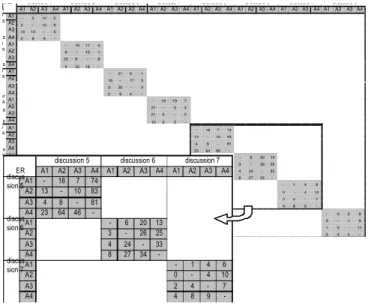
So the corpus C can be represented by the discussion(x)-discussion(x) diagonal matrix. For example, the corpus C=(D1,…, D8) is represented by the matrix of discussions (Figure 4).
Discours 1 Discours 2 Discours 3 Discours 4 Discours 5 Discours 6 Discours 7 Discours 8
ER A1A2 A3A4A1A2A3A4 A1A2A3A4 A1A2A3 A4A1A2A3A4A1A2A3A4 A1A2A3A4A1A2A3A4 A1 - 5 12 5 A2 3 - 13 9 A3 10 13 - 5 Dis co urs A4 2 8 9 A1 - 19 11 4 A2 9 - 10 1 A3 22 8 - 8 Dis co urs A4 5 32 18 A1 - 21 6 1 A2 16 - 17 3 A3 3 20 - 3 Dis co urs A4 2 9 4 A1 - 19 19 7 A2 21 - 5 3 A3 21 3 - 2 Dis our s 4 A4 10 2 5 A1 - 18 7 74 A2 13 - 10 83 A3 4 8 - 81 Dis co urs A4 23 64 46 A1 - 6 20 13 A2 3 - 26 25 A3 4 24 - 33 Dis co urs A4 8 27 34 A1 - 1 4 6 A2 0 - 4 10 A3 2 4 - 7 Dis co urs A4 4 8 9 A1 - 0 2 9 A2 0 - 1 9 A3 1 0 - 11 Dis co urs A4 5 4 4 -A1 A2 A3 A4 A1 A2 A3 A4 A1 A2 A3 A4 A1 - 18 7 74 A2 13 - 10 83 A3 4 8 - 81 A4 23 64 46 -A1 - 6 20 13 A2 3 - 26 25 A3 4 24 - 33 A4 8 27 34 -A1 - 1 4 6 A2 0 - 4 10 A3 2 4 - 7 A4 4 8 9 -discus sion 7 discus sion 5 discus sion 6 discussion 7 discussion 5 discussion 6 ER
Figure 4- Matrix Z(zij) of discussions
2.1.4- Emergence of micro-groups
For searching the micro-groups, we introduce the notion of the coefficient of strong relationship between actors within a group, noted a0. It is called the coefficient of cohesion. In a collaborative and distributed design process, the coefficient of cohesion represents the measure of the solidity and the interdependence between actors belonging to one or several micro-groups.
Thus, for searching of micro-groups, we used the Z(zij matrix) where zij = er*ij + er*ji. This matrix, is transformed in a fuzzy matrix where each element is defined according to relation zij=zij/max(zij) (Figure 5). The decomposition of this matrix, using the coefficient of cohesion, will yield the formation of different micro-groups. For example, for a coefficient of cohesion a0=0.5, the decomposition of the fuzzy matrix Z(zij) shows the formation of two micro-groups during the sixth discussion of the collaborative and distributted design process. These micro-groups are {A1, A2,
A3} and {A4}. zij A1 A2 A3 A4 A1 - 0.13 0.36 0.31 A2 - 0.75 0.78 A3 - 1.00 A4
-Figure 5- Fuzzy Matrix Z(zij) for the 6th discussion
2.1.5- Emergence of key actor
Let us given two micro-groups X={A1,A2, …} and Y={A1,A2, …}. Then, the overlapping between the two micro-groups X and Y defines the key actors of the design process. For example, using the matrix fuzzy Z(zij) of the sixth discussion, figure 6 shows the relationship between the variation of the coefficient of cohesion a0 and the variation of the micro-groups formation. We note that, by varying the coefficient of cohesion a0, the formation of micro-group can also vary. Let us consider the following interval, 0,36 <=a0 <0,75, for searching the key actor. The variation of the micro-groups formation shows that cooperation between actors in the micro-group {A2,A3,A4} is always strong. Therefore, the solidity and the interdependence between actors, belonging to this micro-group is a proof of existence of a complete cooperation within the group. Hence, for the interval, 0,13 <=a0 <0,31, we note the formation of two micro-groups ({A2,A3,A4} and {A1,A3,A4}). The overlapping between these two micro-groups defines two key actors: A3 and A4.
N° Intervalle 0,0<=α0<0,13 { A1,A2,A3,A4} - -0,13<=α0<0,31 { A2,A3,A4} { A1,A3,A4} -0,31<=α0< 0,36 { A2,A3,A4} { A1,A3} -0,36<=α0<0,75 { A2,A3,A4} { A1} -0,75<=α0<0,78 { A3,A4} { A2,A4} { A1} 0,78<=α0<1 { A3,A4} { A2} { A1} α0: coefficient de cohésion
Microgroupe 1 Microgroupe 2 Microgroupe 3
Figure 6- The influence of the variation of a0 on the determination of the key actor
2.2- A model for agent-based system
The principal interest of the agent-based systems (ABS) is that they make it possible to distribute the components of a system using agents. An agent is a communicating, autonomous, reactive, and qualified entity ([F1], [S1]). To carry out a ABS according to these criteria, it is necessary to design each agent
with the three following properties: independence,
communication and intelligence (expertise, know-how). We also must define the architecture of the agents (cognitive functions and interactions) and structure the knowledge necessary for their various activities.
The definition of our agents is adapted from the model of the operator of Rasmussen (three kinds of behaviors: skill-based, rules-based and knowledge-based [R1]). We interpreted it as process model of the agents whose behaviors are adapted to the tasks that they carry out:
ABS ::= <Agents, Environment, Interactions>. Agent ::= <Communication, Perception, Intentions, Decision,
Memory, Actions/Reactions>.
2.2.1- Agent structure
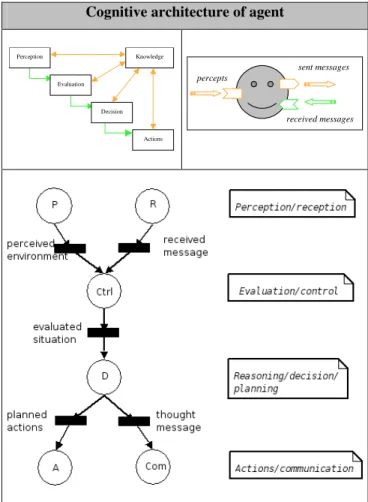
In [F3] we proposed the general architecture of a cognitive agent, respecting the three properties of independence, communication and intelligence. This one, inspired by the theory of modularity of Jerry Fodor [F2] (Figure 7) . It is composed of five modules which manage the knowledge, the perception, the communication, the control and the reasoning of the agent. We also proposed Petri Nets model of it [F3]. Like said it Herbert Simon [S2], the decision is design (problem resolution) and the decision is intelligence (comprehension). This is translated, in the world of autonomous agents, by the design of two types of behaviors:
• causal (reactive), due to a transformation of the
external environment (situation) perceived or due to a received message;
• intentional (teleological), due to a transformation of
the internal environment of agent (cognitive architecture), of a mental state, in particular at the time of the definition or the folowing of a goal.
Cognitive architecture of agent
Perception Evaluation Actions Decision Knowledge sent messages received messages percepts
Figure 7. Modular architecture of a cognitive agent
The agents being heterogeneous entities with various modes of interactions and complex behaviors. So it is necessary to
define their type of organization, and their capacity of evolution.
2.2.2- Knowledge and agents
We have just stated that the general architecture of a cognitive agent is made up of five modules managing knowledge, perception, communication, control and reasoning of the agent. In a more precise way, the cognitive module manage the specific knowledge to each agent: the accointances (knowledge on the other agents), competences (knowledge on the rules of operation and the state of the system), as well as the intentions (personal motivations of the agent).
Def Knowledge = {objects, relations, facts, rules, plans}
Knowledge of an agent is represented by relational structures of objects, actions and decisions (in the form of frames) and by rules of inference. The form of the rules corresponds to model
ECA (Event, Conditions, Actions) which we translate by:
WHEN <event> IF <conditions> THEN <actions>.
2.2.3- Communicating agents
The communication is the principal mechanism of interactions of an agent with the community of the agents (see Figure 8).
Communication Cooperation Coordination cognitive agent social faculties
Figure 8. The triangular relation of interactions between agents
To communicate between them (dialogue), the agents express their intentions according to KQML (Knowledge Query and Manipulation Language [FF1]), derived from the theory of the speech acts. The general shape of an act of language was described by John Searle (read in [CL1]) under the F(p) expression, with
F = {Affirm, Ask, Promise, Express, Declare, etc.}, and p a proposition.
The format that we use is defined by the quintuplet <intention, sender, receiver, [language], message>. The field language can be optional if the language used is always the same one. This format makes it possible to represent the context, the intention, and the message of the communication.
Thus, an exchange of communication acts of question/answer type will take the form:
(ask (reply
:sender agenti, :sender agentJ,
:content (query), :content (answer),
:receiver agentJ :receiver agenti
) )
The canonical diagram of communication proposed by Abraham Moles [M1] contains the elements intervening in the communication act: intentionnality and reciprocal communication. The knowledge representation of agent worked out in a context of communication/dialogue is carried out in the form of a diagram of beliefs. This one consists of a frames network with levels of beliefs/knowledge, established during the communication.
2.2.4- Co-operating agents
The systems of co-operative work consist of distributed, heterogeneous and autonomous components. Then, the systems developed in distributed artificial intelligence are well adapted (in particular the ABS). The potential contribution of the agents concerns:
• the management of repetitive actions and the
delegation of tasks without interest for the user,
• the decision-making by the comprehension of the
context of use (relevance),
• the personalization of information (preferences,
goals and capacities of the user),
• more natural interactivity (methods, form and
presentation).
The individual and co-operative behaviors of the agents are varied: initializations, planning of actions, emission and reception of documents, information or document retrieval, supervision of procedures, etc. Each one of these services corresponds to a competence.
2.2.5- The process of agentification
The agents are entities having competences which enable them to play one or more roles in an organization. They are grouped within a ABS organized according to a hierarchical structure (three kinds of agents: specialists, mediators and supervisors). For the specification of the ABS we retain proposions made in the definition of the language A_UML [O1], like our own methodological proposals [F4, F5] (schematized in Figure 9):
1. to design the use case diagram (services provided by the system), and for each identified use carried out 3 following phases;
2. to design the classes diagram connecting the agents concerned with the use (we can also use the collaboration diagram);
3. to define behavior of each agent with a states diagram or an activities diagram;
4. on the basis of scenario of use, to design the sequence diagrams which specify the exchanges of messages between agents (and their scheduling).
Communication Storage User Reception Communication Initialize Communicate Finish
:hostA :comA_B :hostB
Talking
“Meeting of design"
: Participant
1) Use case diagram
2) Class diagram
4) Sequency diagram: a scenario of use 4) Activity diagram: agent behaviour
Figure 9. Methodology proposed for agent software design.
3- Application
In the preceding section we described an approach for the process of collaborative and distributed design modelling, as well as a framework of modeling and design of agent-based system. Now we present a prototype of system of design acts analysis in conformity with the models suggested.
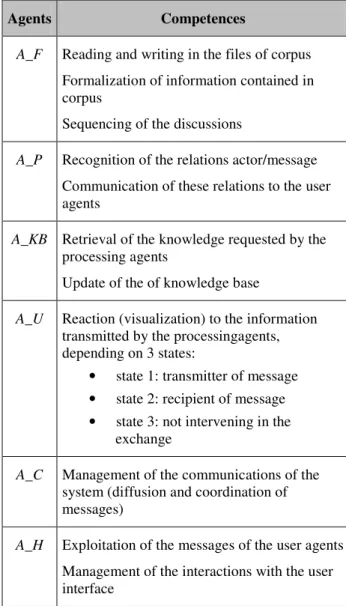
The system that we developed to analyze the interactions between actors of a products design is an agent-based system which we named ISIAD (Intelligent System of Interactions Analysis in Design). The development of ISIAD respects the process of agentification presented above (§2.2.5). Its architecture is schematized on figure 10. ISIAD has a double objective: to analyze the design acts of course, but also to analyze the phenomena of auto-organization in the collaborative design process. For the design of this system we identified then defined 6 kinds of agents. The following table (Table 1) enumerates functional competences of these 6 agents.
KQML is used as a protocol for exchanging information and knowledge. The semantic of the message is defined by three fields : <language, ontology, content>. The :language defines the language in which the message is expressed. The frames are used in ISIAD. The sender and receiver must understand the agent communication language being used. The ontology provides a shared virtual world that can serve as basis of communication [HS1]. Hence, the ontology is being created. In KQML, :ontology represent the vocabulary of the words in message. The ontology of ISIAD and its components: classes, instances, relationships and functions are being developed based on a frame-based knowledge representation system [MH1]. The :content represents the message itself. Other arguments of the basic protocol of the KQML, including :sender, :receiver, are parameters of message passing.
Agents Competences
A_F Reading and writing in the files of corpus
Formalization of information contained in corpus
Sequencing of the discussions
A_P Recognition of the relations actor/message
Communication of these relations to the user agents
A_KB Retrieval of the knowledge requested by the
processing agents
Update of the of knowledge base
A_U Reaction (visualization) to the information
transmitted by the processingagents, depending on 3 states:
• state 1: transmitter of message
• state 2: recipient of message
• state 3: not intervening in the
exchange
A_C Management of the communications of the
system (diffusion and coordination of messages)
A_H Exploitation of the messages of the user agents
Management of the interactions with the user interface
Co-conception activity Filter ABS KB Expertise A_F A_KB A_C A_U1 A_Un A_H A_P Discussioni
With: A_F : agent of files A_KB : agent of knowledge base A_C : agent of communication
A_P : agents of processing A_Ui : agent for useri A_H : agent for HCI
Visualization/ observation
Figure 10. Architecture of the intelligent system of interactions analysis in design process (ISIAD)
The following figure (Figure 11) illustrates the potentialities of use of ISIAD. Indeed, starting from a selected discussion (here discussion 4) extracted from a given corpus, it is possible to visualize the interactions between actors of a collaborative design which was observed.
• [1] : by a set of colors corresponding to the states
defined in table 1 (blue: state 1; yellow: state 2; white state 3) it is possible to follow the communication interactions between actors (cf §2.1.3);
• [2] : the fact that some actors take part in a discussion,
makes it possible to visualize the micro-groups (cf §2.1.4);
• [3] : the key actor (cf §2.1.5) is clearly visible on the
graphical representation of interactions.
Figure 11. Screen view of our system of design acts analysis
4- Conclusion
This paper proposes agent-based system for analysis of interaction during collaborative and distributed design process. The formal approach for analysis and understanding real interactions during design process is centered on the communication traces. Based on this approach and on the background of the intelligent systems modelling, an Intelligent System for Interactions Analysis in Design (ISIAD) is proposed. Through ISIAD, the phenomena such as auto-organisation, the dynamics of formation of micro-groups, the emergence of key-actors can be analysed and interpreted. As we continue our research, our aim is the development of ISIAD to consider the industrial cases using the platform of Visio-Concept. We currently complete an ontological work on the process of design in order to generalize our approach. This will enable us to consolidate our objectives of assistance. What we regard as a change of level (knowledge level [N1]) is made possible by the paradigm agent and to the cognitive capacities of the agents
5- References
[BG1] Brissaud D. and Garro O. An approach to concurrent
engineering using distributed design methodology.
International Journal of Concurrent Engineering: Research and Applications, Vol.4, n°3, pp 303-311, 1996.
[BT1] Brissaud D. and Tichkiewitch S. Innovation and
manufacturability analysis in an integrated design context. Computers in Industry, Vol.43, pp111-121, 2000.
[C1] Chiu M. An organizational view of design
communication in design collaboration. Design Studies, Vol. 23, Issue 2: 187-210, 2002.
[CL1] Cohen P.R. and Levesque H.J. Intention is Choice
with Commitment. Artificial Intelligence, 42, p.213-261, 1990.
[1] [2]
[F1] Ferber J. Multi-Agent Systems: towards a collective
intelligence, Addison-Wesley, Reading, 1998.
[F2] Fodor J. The Modularity of the Mind, Cambridge, Mass,
MIT Press, 1983.
[F3] Fougères, A.-J. Model of cognitive agents to simulate
complex information systems, IEEE International Conference on Systems, Man and Cybernetic, Hammamet, 2002.
[F4] Fougères A.-J., Agents to cooperate in distributed design.
IEEE International Conference on Systems, Man and Cybernetic, The Hague, Netherlands, October 10-13 2004.
[F5] Fougères A.-J., Agent-based micro-tools development for
a co-operative design platform. ITI 3rd International
Conference on Information and Communication Technology, (ICICT’05), pp. 715-730, Cairo, Egypt, December 5-6 2005.
[FF1] Finin T., Fritzson R., Mc Kay D., Mc Entire R. KQML
as an agent communication language. Proceedings of CIKM’94, ACM Press, 1994.
[HS1] Huhns M., Singh M.: Agents on the Web: Ontologies
for Agents. IEEE Internet Computing 1(6): 81-83, 1997.
[LM1] Legardeur J., Merlo C. and Franchistéguy I.
Coordination et Coopération dans les processus de conception. AIP-PRIMCA, Cd-rom, La Plagne, 2003.
[M1] Moles A. Théorie Structurale de la communication et
société. Publié par Masson, 1986.
[M2] Movahed-Khah R. Contribution à l’analyse du processus
de conception collaborative et distribuée, en vue du développement des systèmes multi-agents. Thèse de doctorat, UTBM, Belfort, France 2006.
[MH1] Mahalingam K. and Huhns M. Ontology Tools for
Semantic Reconciliation in Distributed Heterogeneous
Information Environments. Intelligent Automation and Soft Computing (special issue on Distributed Intelligent Systems, Mohamed Kamel and Mohammad Jamshidi, editors), vol. 6, no. 3, pp. 1-8, 2000.
[MO3] Movahed-Khah R., Ostrosi E. and Garro O. Analyse
des processus de conception mécanique distribuée à l’aide d’émergence des concepts. CFM (17 ème Congrès Français de Mécanique), Université de technologie de Troyes du 29 août au 2 septembre 2005.
[MO4] Movahed-Khah R., Ostrosi E. and Garro O. A Cluster
Based Approach for Collaborative Design Process Analysis. In Advances in Design, Published by Springer-Verlag UK, ISBN: 1846280044, Nov 2005.
[N1] Newell A. The Knowledge Level. Artificial Intelligence,
18, 1982
[O1] Odell, J., Parunak, H.V.D. and Bauer, B. Extending UML
for agents. In Proceedings of the AOIS Workshop at the 17th Nat. conf. on Artificial Intelligence. Austin, Texas, 2000
[OF1] Ostrosi E. and Ferney M. Collaborative and distributed
design process analysis for intelligent agents’ implementation. Proceedings of the 11th ISPE International conference on Concurrent Engineering (CE2004), 26-30 july 2004, Beijing, P.R. China, published in Concurrent Engineering – The Worldwide Engineering Grid, (Edited by Michel Sobolewski and Jianzhong Cha, ISBN-7-302-08802-0, Published by Tsinghua University Press and Springer-Verlag.) 215-222, 2004.
[PS1] Perry M. and Sanderson D. Coordinating joint design
work: the role of communication and artefacts. Design Studies, Vol. 19, Issue 4, pp. 273-288, 1998.
[R1] Rasmussen J. Skills, rules, and knowledge ; signals,
signs, and symbols, and other distinctions in human performance models. IEEE Transactions on Systems, Man, and Cybernetics, SMC-13, 257-266, 1983.
[S1] Shoham Y. Agent Oriented Programming, Artificial
Intelligence, 60(1), p. 51-92, 1993.
[S2] Simon H.A. The Sciences of the Articial. Prentice Hall:
Englewoods Cliff. 1969.
[SB1] Stempfle J. and Badke-Schaub P. Thinking in design
teams- an analysis of team communication. Design studies 23: 473-496, 2002.
[TB1] Tichkiewitch S. and Brissaud D. Co-ordination
between product and process definitions in a concurrent engineering environment. CIRP Annals, v. 49, 75, Sydney, Australy, 2000.
[W1] Weiss G. Multiagent systems a modern approach to
![Figure 1- Seaching properties in collaborative and distributed design process [M2]](https://thumb-eu.123doks.com/thumbv2/123doknet/7999311.268056/3.892.471.813.295.810/figure-seaching-properties-collaborative-distributed-design-process-m.webp)
![Figure 8. The triangular relation of interactions between agents To communicate between them (dialogue), the agents express their intentions according to KQML (Knowledge Query and Manipulation Language [FF1]), derived from the theory of th](https://thumb-eu.123doks.com/thumbv2/123doknet/7999311.268056/6.892.110.398.569.756/triangular-interactions-communicate-intentions-according-knowledge-manipulation-language.webp)