HAL Id: tel-01448733
https://hal-lirmm.ccsd.cnrs.fr/tel-01448733
Submitted on 30 Jan 2017
HAL is a multi-disciplinary open access archive for the deposit and dissemination of sci-entific research documents, whether they are pub-lished or not. The documents may come from teaching and research institutions in France or abroad, or from public or private research centers.
L’archive ouverte pluridisciplinaire HAL, est destinée au dépôt et à la diffusion de documents scientifiques de niveau recherche, publiés ou non, émanant des établissements d’enseignement et de recherche français ou étrangers, des laboratoires publics ou privés.
Copyright
Formalizing and Studying Dialectical Explanations in
Inconsistent Knowledge Bases
Abdallah Arioua
To cite this version:
Abdallah Arioua. Formalizing and Studying Dialectical Explanations in Inconsistent Knowledge Bases. Artificial Intelligence [cs.AI]. Université de Montpellier, 2016. English. �tel-01448733�
In the beginning, like all PhD students I set out to be a genius, but mercifully laughter intervened.
Abdallah1
Acknowledgments
First and foremost, I thank the persons to whom I owe my existence and my success! Mother and Father, who have always been my friends and guides. I thank my whole family, my brother and my sisters, for their incredible support, I could have never achieved so much without them.
When I started my thesis I was a blank page. I learned a lot from Madalina, she was always on my side with her advices and ideas and I will never forget her comprehensiveness. I felt blessed and lucky to have her as one of my supervisors, in fact that’s what everybody has told me :). Away from the thesis, I remember all those insightful discussions about interesting philosophical, personal and career matters, I really appreciate it. I thank also my two other supervisors, Patrice Buche who was always kind to me and comprehensive, he was a source of motivation to me. And J´erˆome Fortin who helped me a lot by his incredible talent in formalizing ideas.
I would like to express my deepest gratitude to Anthony Hunter, Nico-las Maudet, Leila Amgoud and Juliette Dibie for making me the honor of accepting to evaluate my thesis.
I would like to thank everybody in my two research teams UMR IATE AXE 5 and GraphIK, they made me feel like home during our lunches and coffee breaks. It should be noticed that this thesis would have not been possible without the funding from the ANR DUR-DUR project and CEPIA INRA department of INRA, which allowed me to stay completely focused on my research during those three years. I thank all those with whom I collaborated in the project, It was an incredible experience to be in touch with experts from different fields, I learned a lot.
Special thanks go to my friend Nouredine Tamani, he was like a brother to me, he helped me a lot during my thesis by his ideas and advices, I don’t think that I’ll be able to return his favors one day. Special thanks go to my friend Hichem Debbi who inspired me with his courage and patience during his thesis, I owe him big time. I would also like to thank my friends in Algeria for their support. And, I will never regret the new friends I met here in Montpellier. Those friends are far from being forgotten, they have their places in my heart and memory. We had three years of fun, craziness and adventures, a special thanks goes to those with whom I traveled and had my best trips seeing the world, they are real men, it would have been a big loss If I had not met them.
I would like to thank all the people who helped me during my thesis and all those that I have met in the conferences, workshops and social events.
Abstract:
Knowledge bases are deductive databases where the machinery of logic is used to represent domain-specific and general-purpose knowledge over existing data. In the existential rules framework, a knowledge base is com-posed of two layers: the data layer which represents the factual knowledge, and the ontological layer that incorporates rules of deduction and negative constraints. The main reasoning service in such framework is answering queries over the data layer by means of the ontological layer. As in classi-cal logic, contradictions trivialize query answering since everything follows from a contradiction (ex falso quodlibet). Recently, inconsistency-tolerant approaches have been proposed to cope with such problem in the existential rules framework. They deploy repairing strategies on the knowledge base to restore consistency and overcome the problem of trivialization. However, these approaches are sometimes unintelligible and not straightforward for the end-user as they implement complex repairing strategies. This would jeopardize the trust relation between the user and the knowledge-based sys-tem. In this thesis we answer the research question: “How do we make query answering intelligible to the end-user in presence of inconsistency?”. To answer the question we consider the general framework of argumentation and we propose three types of explanations: (1) One-shot Argument-based Explanations, (2) Meta-level Dialectical Explanations, and (3) Object-level Dialectical Explanations. The first one is a set of arguments in favor or against the query in question. The two others take the form of a dialogue between the user and the reasoner about the entailment of a given query. We study these explanations in the framework of logic-based argumentation and dialectics and we study their properties and their impact on users.
Keywords: Argumentation, Inconsistency, Explanation, Dialogue Games, Existential Rules, Datalog±.
R´esum´e:
Les bases de connaissances sont des bases de donn´ees d´eductives o`u la logique est utilis´ee pour repr´esenter des connaissances de domaine sur des donn´ees existantes. Dans le cadre des r`egles existentielles, une base de connaissances est compos´ee de deux couches : la couche de donn´ees qui repr´esentent les connaissances factuelle et la couche ontologique qui incor-pore des r`egles de d´eduction et des contraintes n´egatives. L’interrogation des donn´ees `a l’aide des ontologies est la fonction de raisonnement principale dans ce contexte. Comme dans la logique classique, les contradictions posent un probl`eme `a l’interrogation car d’une contradiction, on peut d´eduire ce que l’on veut (ex falso quodlibet).
R´ecemment, des approches d’interrogation tol´erantes aux incoh´erences ont ´et´e propos´ees pour faire face `a ce probl`eme dans le cadre des r`egles existentielles. Elles d´eploient des strat´egies dites de r´eparation pour restau-rer la coh´erence. Cependant, ces approches sont parfois inintelligibles et peu intuitives pour l’utilisateur car elles mettent souvent en œuvre des strat´egies de r´eparation complexes. Ce manque de compr´ehension peut r´eduire l’utilisabilit´e de ces approches car elles r´eduisent la confiance entre l’utilisateur et les syst`emes qui les utilisent. Par cons´equent, la probl´ematique de recherche que nous consid´erons est comment rendre intelligible `a l’utilisateur l’interrogation tol´erantes aux incoh´erences. Pour r´epondre `a cette ques-tion de recherche, nous proposons d’utiliser deux formes d’explicaques-tion pour faciliter la compr´ehension des r´eponses retourn´ees par une interrogation tol´erante aux incoh´erences. La premi`ere est dite de niveau m´eta et la seconde de niveau objet. Ces deux types d’explication prennent la forme d’un dia-logue entre l’utilisateur et le raisonneur au sujet des d´eductions retourn´ees comme r´eponses `a une requˆete donn´ee. Nous ´etudions ces explications dans le double cadre de l’argumentation fond´ee sur la logique et de la dialec-tique formelle, comme nous ´etudions leurs propri´et´es et leurs impacts sur les utilisateurs en termes de compr´ehension des r´esultats.
Keywords: Argumentation, Incoh´erence, Explication, Jeux de Dialogues, R`egles Existentielles, Datalog±.
Contents
1 Introduction 1
1.1 Knowledge Representation and Reasoning . . . 1
1.2 Inconsistency Tolerance . . . 3
1.3 Research Problem . . . 7
1.3.1 Contribution 1: One-shot Argument-based Explanations 10 1.3.2 Contribution 2: Meta-level Dialectical Explanations . . . 12
1.3.3 Contribution 3: Object-level Dialectical Explanations . . 13
1.4 Thesis Structure . . . 14
2 Abstract Argumentation 17 2.1 Introduction . . . 17
2.2 Abstract Argumentation Frameworks . . . 18
2.3 Justification State . . . 23
2.4 Coincidence between Semantics . . . 24
2.5 Conclusion . . . 31
3 Logic-based Argumentation 33 3.1 Introduction . . . 33
3.2 Logical Language: Existential Rules Framework . . . 34
3.2.1 The language, facts and queries . . . 35
3.2.2 Adding rules and negative constraints . . . 38
3.2.3 Consistent query answering . . . 45
3.3 Instantiating Dung’s Abstract Framework . . . 48
3.3.1 Arguments and attack . . . 49
3.3.2 Outputs of logic-based argumentation . . . 55
3.3.3 Characterizing the outputs . . . 59
3.3.4 Properties . . . 63
3.3.5 Postulates satisfaction . . . 67
3.3.6 Relation with consistent query answering . . . 70
CONTENTS
4 Meta-level Dialectical Explanations 75
4.1 Introduction . . . 75
4.2 Universal Acceptance Dialectical Proofs . . . 77
4.3 Example . . . 86
4.4 Properties . . . 90
4.4.1 Finiteness, soundness and completeness . . . 90
4.4.2 Dispute complexity . . . 93
4.5 Effects of Meta-level Dialectical Explanations . . . 99
4.5.1 Method . . . 99
4.5.2 Results and analysis . . . 101
4.5.3 Post-hoc analysis . . . 107
4.6 Conclusion . . . 112
5 Object-level Dialectical Explanations 115 5.1 Introduction . . . 115
5.2 Motivating Example . . . 119
5.3 Walton’s Dialogue Model of Explanation . . . 121
5.4 The EDS Dialogue Model of Explanation . . . 123
5.4.1 Protocol’s syntax . . . 125
5.4.2 Protocol’s semantics . . . 132
5.4.3 Commitment and understanding stores . . . 136
5.4.4 Termination and success . . . 140
5.4.5 The global picture . . . 141
5.5 Argumentative Explanation Dialogues . . . 142
5.6 Dialogue Example . . . 144
5.7 Use-case: Object-level Dialectical Explanations . . . 146
5.8 Conclusion . . . 151
6 Application 155 6.1 Dur-Dur and the Durum Wheat Knowledge Base . . . 155
6.1.1 The authoring . . . 156
6.1.2 The structure . . . 160
6.2 The DALEK Prototype: Explain! . . . 166
6.2.1 Graphical user interface . . . 168
6.2.2 Configuration structure . . . 169 6.2.3 Stores . . . 169 6.2.4 Dialogue manager . . . 169 6.2.5 Semantics structure . . . 170 6.2.6 Dialogue planner . . . 170 6.2.7 Logical model . . . 171
CONTENTS
6.3 Conclusion . . . 171
7 Conclusion and Perspectives 173
7.1 Conclusion . . . 173 7.2 Future work . . . 175
8 Appendix 179
8.1 Chapter 3 . . . 179
List of Figures
2.1 The corresponding argument graph of Example 2.2.1. . . 19
2.2 Empty stable extensions. . . 21
2.3 The inclusion relation between the semantics. . . 23
2.4 Coherent argumentation framework. . . 26
2.5 Non-coherent argumentation framework. . . 26
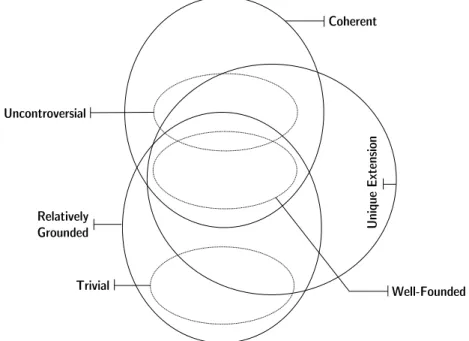
2.6 Inclusion between classes of coherent argumentation frame-works. . . 30
2.7 Relation between major classes of argumentation frameworks. 30 3.1 Pick any two. . . 53
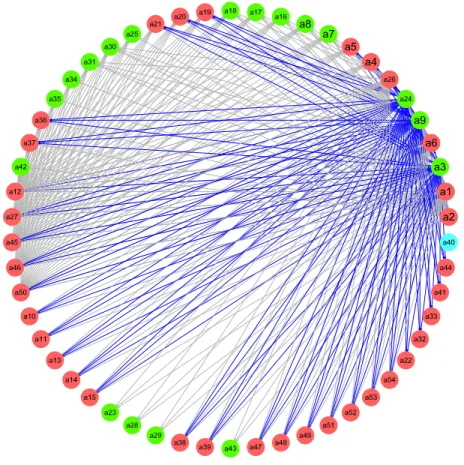
3.2 The argumentation framework. Green vertices belong to ex-tension E3. The blue edges represent range+(E3) where it shows the conflict-freeness and defense of E3. The blue vertex is the skeptically accepted argument. . . 55
3.3 Plausible conclusions are not always skeptical. The gray-colored arguments are the supporting arguments of the query Q = animal(T ). . . 57
3.4 Relation between arg∃ and other classes. . . 67
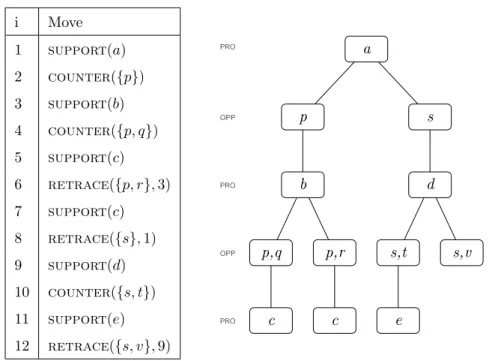
4.1 The left table presents the dialogue, the right figure shows its associated dialogue tree. . . 85
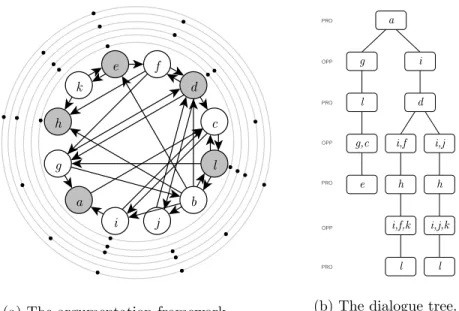
4.2 The circles are the extensions presented in an increasing order with E1 being the inner circle. . . 89
4.3 The associated dialogue tree. . . 89
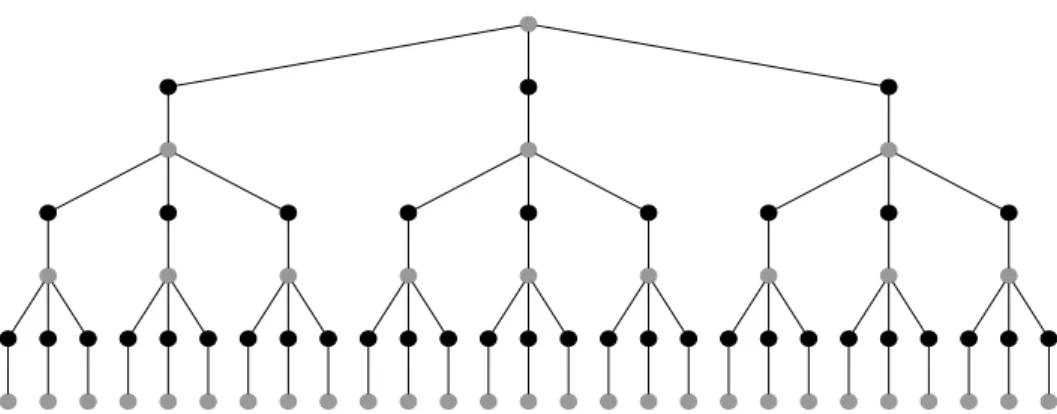
4.4 A worst-case associated dialogue tree with k = 3. Gray-colored nodes are support move nodes while black-Gray-colored nodes are counter move nodes. . . 97
4.5 The two associated dialogue trees. . . 99
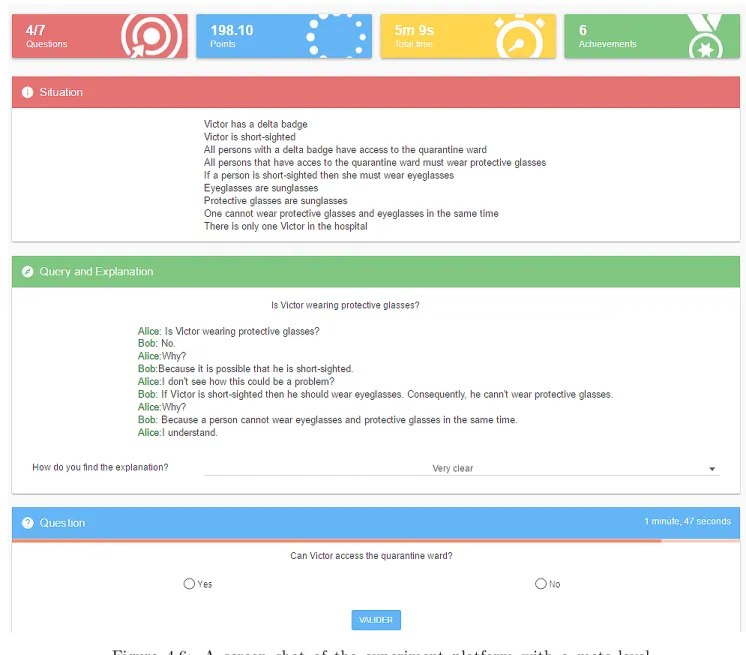
4.6 A screen shot of the experiment platform with a meta-level dialectical explanation (Group DE). Note that the platform is originally in French. . . 102
LIST OF FIGURES
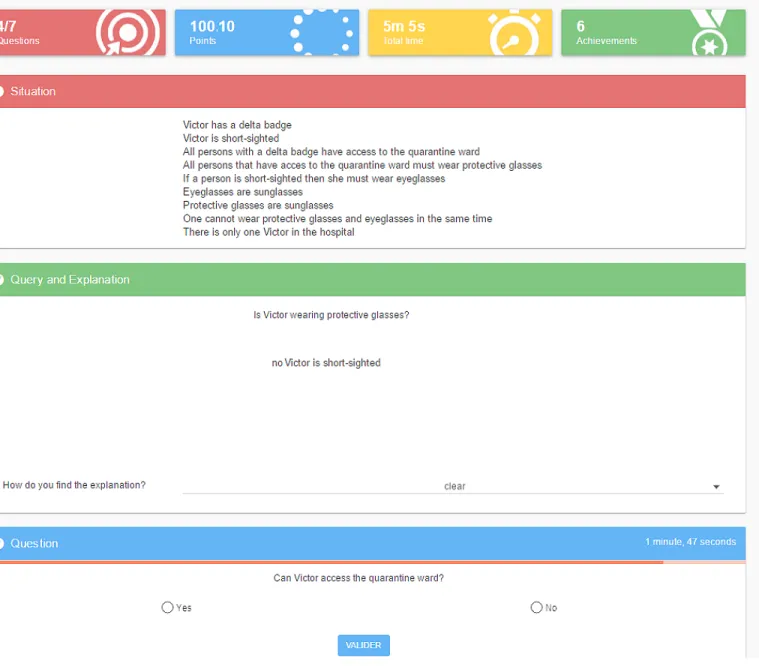
4.7 A screen shot of the experiment platform with a one-shot
argument-based explanation (Group OE). . . 103
4.8 The bar-chart of the evaluation of explanations for Group DE and Group OE. . . 107
4.9 Box plot for each group where points represent justification’s length. Precisely, each point is the length of a justification for a test query. Total data entries for each group is N=119. The dashed line is the mean 89.31 for Group DE and 64.92 for Group OE. . . 108
4.10 A bar-chart showing averages of justification length per test query for each group. The averages are computed over a total data entries of N=119 for each group. . . 110
5.1 The reply relation R over the locutions. The direction of the arrows are read as “replies to”. . . 126
5.2 Explanation according to Deductive-Nomological Model of Hempel (1965). . . 133
5.3 A screen shot of a small section of one of the forms (French). 148 6.1 The different tasks of the Dur-Dur project. The knowledge tasks aims at integrating multidisciplinary knowledge from other tasks. . . 156
6.2 An overview of the Durum Wheat knowledge base. The cir-cles contain knowledge examples represented in the concep-tual graph framework. . . 157
6.3 Some structured data about Durum Wheat varieties. . . 159
6.4 Description of how to cultivate Durum Wheat. . . 159
6.5 Concept and relation types hierarchy. . . 161
6.6 The set of facts (d) about fungal diseases and fungus. . . 162
6.7 The rule (b) in the CGs framework. . . 164
6.8 The negative constraint (c) in the CGs framework. . . 165
6.9 Layered architecture of dalek. . . 166 6.10 The GUI of dalek while carrying out a dialogue with a user. 167
List of Tables
2.1 Semantics with respect to criteria. × means the criterion is satisfied. . . 24 2.2 Computational complexity of certain decision problems. H is
an argumentation framework, x is an argument and S a set of arguments. Results taken from Dunne and Bench-Capon (2002); Dunne and Wooldridge (2009). . . 25 2.3 Classes of argumentation frameworks studied in the
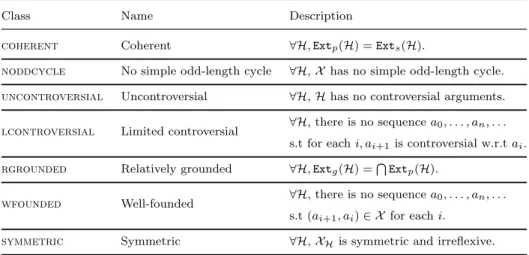
litera-ture. Note that these classes are with respect to those argu-mentation frameworks that contain at least one argument. p and s refers to preferred and stable respectively. . . 29
3.1 The arguments of E3. There is 54 arguments in A. . . 54
4.1 A dialectical proof for the query Q. For space reasons s(), c() and r() denote support(), counter() retrace() respectively. 87 4.2 A dialectical proof for the non-universal acceptance of Q0.
Note that we omit ∆i as it is always empty in this example. . 88
4.3 Average accuracy per subject for each group. Please note that the experimental design is between-subjects that means the accuracies in the same row are for different subjects. . . . 105 4.4 Contingency table of accuracy for Group DE and Group OE. 106 4.5 Situation 5 with some samples of justifications. The seconds
refer to the taken time to write the justification by the sub-jects of Group OE). . . 109
5.1 The three dialogues from (Walton and Krabbe, 1995, p. 66). Note that Explanation dialogue does not figure in the topol-ogy. . . 117 5.2 Examples showing the differences between the four types of
LIST OF TABLES
5.3 Speech acts in the Explan model. The replies refer to the entry number of the speech acts that reply to the one in ques-tion. . . 123 5.4 Interpretation of utterances. . . 129 5.5 The replies and their semantic conditions. K is the
back-ground knowledge, F is a fact, E is an explanation and i, t are natural numbers. . . 135 5.6 The new utterances and their meaning alongside to their
ef-fects on the stores. x ∈ {U, R} and CSix is the commitment store of x at stage i. . . 144 5.7 New replies and their semantic conditions. If x ∈ {U, R} then
x ∈ {U, R} \ {x}. j > i and H = (A, X ) is the corresponding argumentation framework of K. . . 145 5.8 The formalization of Example 5.2.1. Note that 7’-10’ belong
to Example 5.2.2 and the apostrophe is used to distinguish stages of different examples. . . 147 5.9 An snippet of a partially filled form that shows a dialectical
explanation between Expert 1 and the Reasoner along side to the decision. The expert here does not agree with the content of the query. . . 149 5.10 The gain of new knowledge for Expert 1 and Expert 2. . . 150 5.11 The percentage of revised decisions and revised relevance
val-ues. . . 151 5.12 Comparison between EDS and Explan. √ means that the
feature is available in the dialogue model, × means that it is unavailable. (√) means it is available within the logical setting but not within the dialogue model. . . 153
8.1 Arguments from 1 to 45. . . 180 8.2 Arguments from 46 to 54. . . 181
1
Introduction
This thesis presents an original research in the field of Knowledge Represen-tation and Reasoning, a central Artificial Intelligence issue. The knowledge representation we consider is the existential rules framework (Datalog±), a family of logical languages to represent ontologies introduced in Cal`ı et al. (2009a,b); Chein and Mugnier (2009). This language is widely-used in the Ontology-Based Data Access (OBDA) paradigm introduced in Poggi et al. (2008) where an ontology on top of an existing and potentially incon-sistent data is used to enrich the querying process. The contribution of the thesis is the proposal of a formal model of explanation based on logic-based argumentation to explain query answers in presence of inconsistency. The model’s goal is to improve the usability of knowledge-based systems that use existential rules formalism.
This chapter is structured as follows. In Section 1.1 we start by in-troducing the general context of the thesis and the line of development of the existential rules framework. Next in Section 1.2 we shift to a narrower context where we present how inconsistency is handled within the existen-tial rules framework under the OBDA paradigm. Then, in Section 1.3 we present the research problem of the thesis alongside to our contributions on this regard. Finally, in Section 1.4 we conclude the chapter by highlighting the structure of the thesis.
1.1 Knowledge Representation and Reasoning
Knowledge Representation and Reasoning (KRR) is one of the main issues in Artificial Intelligence (AI). It deals with the problem of representing real-world knowledge in order to achieve human-level intelligence and reasoning faculties. The biggest dilemma in Knowledge Representation and Reasoning is the tradeoff between expressiveness and computational tractability of a given formalism (Levesque and Brachman, 1987). In fact, the difficulty of
CHAPTER 1. INTRODUCTION
reasoning increases proportionally with the expressive power of the underly-ing logical language. With the rapid growth of data in the last two decades, an emergent need for tractable but yet expressive logical languages has been raised. This has particularly appeared within the intersection of Knowl-edge Representation and Database Systems where Deductive Databases have been firstly introduced as a logic-based formalism to improve the querying facility of classical databases with deductive functionalities (i.e. more ex-pressiveness) (Gallaire and Nicolas, 1987; Ceri et al., 2012). It is in fact the fruit of combining logic programming with relational databases which pro-vides a framework that is more expressive than relational databases but less expressive than logic programming systems. In a deductive database, data is represented as a set of facts written within a first-order language (Prolog-like syntax). Alongside the data, rules are added to enrich the vocabulary of the data and allow the deduction of new facts. Datalog is a rule-based language that is often used as an underlying expressive representation and tractable reasoning machinery for Deductive Databases (Ceri et al., 1989). According to (Ramakrishnan and Ullman, 1995, p. 2), it is the adaptation of “...Prolog, which has a “small-data” world view of the world to a “large-data” world”. This logical language has been recently extended to Datalog± to fulfill the need of the Semantic Web movement where more expressiveness is needed. Datalog± extends Datalog with (mainly) the capacity of coping with incomplete knowledge by introducing existentially quantified variables in the facts and the head of the rules, this makes it possible to refer to un-known individuals as “the person x has a mother whose name is unun-known”. As opposed to Datalog, Datalog± comes with another type of formulas called negative constraints which captures some sort of logical negation by forbid-ding certain combinations of facts. These extensions (alongside to others) make Datalog± general enough to capture a variety of Description Logics families (Cali et al., 2010) which are the underpinning logical formalisms for OWL/OWL2 languages. This generality promotes Datalog± as an adequate language to represent ontologies as shown in Cal`ı et al. (2012). For historical accuracy, the logical interpretation of Conceptual Graphs of Sowa (1976) in Chein and Mugnier (2009) has yielded the same formalism as Datalog± but under the name of existential rules framework. In the thesis we may use the two names interchangeably.
Nowadays, the existential rules framework is widely-used in the paradigm of Ontology-based Data Access (OBDA) where it provides satisfactory re-sults with respect to the reasoning issue on how to query data while tak-ing ontological knowledge. However, under this paradigm the problem of data inconsistency emerges and manifests itself as logical contradictions,
1.2. INCONSISTENCY TOLERANCE
namely in form of constraints violations in the factual part. Since OBDA is mainly used in data exchange and data integration, inconsistency is more likely to occur in the data part rather than the ontological part (rules and constraints) since the ontology is assumed to be well-written by domain ex-perts. On top of that, the size of the ontology is rather small when compared to the size of the data.
The problem of inconsistency has challenged the KRR formalisms. New approaches to tolerate and cope with inconsistency became a must. In the next section we give a brief introduction on the main approaches.
1.2 Inconsistency Tolerance
Inconsistency management is a well-established research discipline in KRR that motivated and challenged the KRR community for decades. In fact, it dates since the pre-Socratic Greek era where the concept of logical con-tradictions appeared in the sayings of Parmenides of Elea as reported by Plato:
The great Parmenides from beginning to end testified...“Never shall this be proved - that things that are not are”. (Plato, Sophist, 237A)
The problem is in fact due to the principle of explosion in logic (ex falso quodlibet) which states that “from contradiction, anything follows”. Consequently, given an inconsistent knowledge base K in a logical language L then one can deduce every sentence from the knowledge base according to Classical Logics, more precisely, If one assumes that ψ and ¬ψ are both true then one can say that any formula φ is true. This can be proven as follows: ψ ∨ φ is true because ψ is true (by assumption). But ¬ψ is also true by assumption, therefore, for ψ ∨ φ to be true φ must be true, hence φ is true.
In KRR several approaches to handle inconsistency have been proposed in the literature. The two main approaches are Coherence-based approaches and Dung-style Logic-based Argumentation. Please notice that this domain of research is vivid and full of approaches. In this introduction we limit ourselves to the above-mentioned approaches as the main problem of the thesis is not inconsistency management.1
1
For more details on the subject we refer the reader to Martinez et al. (2013); Bertossi et al. (2005).
CHAPTER 1. INTRODUCTION
In the Coherence-based approaches (firstly introduced in Rescher and Manor (1970)), maximal consistent subsets (MCSs) of the knowledge base are constructed and new non-classical consequence relations are defined to infer from the knowledge base. A formula is a universal consequence of the knowledge base if and only if it is the logical consequence of all MCSs. A formula is a credulous consequence of the knowledge base if and only if it is the consequence of at least one MCS. Different maximality criteria (set-inclusion or cardinality) give rise to different types of non-classical con-sequence relations. In the same line of research, other approaches such as Benferhat et al. (1993, 1995) appeal to a primal concept of argumentation in order to define new consequence relations that are mainly based on the idea of MCSs but differ in their productivity (they may validate more or less formula compared to the universal consequence relation).
Dung-style Logic-based Argumentation approaches (also called Coali-tion approaches in Bertossi et al. (2005)) have been widely used to reason in presence of inconsistency. An argumentation framework `a la Dung (1995) is defined as a set of arguments and an attack relation among them. The logic-based version of Dung’s framework regards an argument as a tuple of a hypothesis and conclusion built from a given knowledge base K over a base logic. The approach proceeds by computing from K the set of all arguments. Next, it computes the attack relation among them (which is grounded on inconsistency), then it produces coalitions of arguments called extensions (i.e. sets of non-conflicting arguments that defend one another). From the extensions, inconsistency-tolerance is defined as follows: a formula is entailed from K if and only if there exists an argument that belongs to all extensions and whose conclusion entails the formula in question. In Cayrol (1995) it has been shown that by picking a specific attack relation (attack on the hypothesis, i.e. undercut ) Dung-style Logic-based Argumentation ap-proaches generalize the Coherence-based apap-proaches of Rescher and Manor (1970). The work in Amgoud and Besnard (2013); Vesic (2013) generalizes this result for any logic-based argumentation framework that is grounded on a Tarskian logic.
Despite their equivalence, the Coherence-Based approaches of Rescher and Manor (1970) have gained an enormous interest in the field of Database Systems where the concept of Maximal Consistent Subsets took the name of Data Repairs and the Universal Consequence took the name of Consistent Query Answering semantics (CQA) (Arenas et al., 1999; Calvanese et al., 2005; Bertossi, 2006; Chomicki, 2007; Bertossi, 2011).2 The reason that the
1.2. INCONSISTENCY TOLERANCE
Coherence-based approaches have gained interest is due to their construc-tiveness. Put differently, they are not in rupture with Classical Logics as much as the other approaches such as Paraconsistent Logics (Priest, 1979), Default Logics (Reiter, 1980), etc. In fact constructing maximal consistent subsets over an inconsistent knowledge base is an attempt to restore con-sistency by eliminating inconsistencies as less as possible. The reason to do so is to be able to reuse Classical Logics machinery in reasoning as the universal consequence relation, or any other coherence-based consequence relations, will be defined in terms of the classical consequence relation.
Later on, Data Repairs and the Consistent Query Answering seman-tic were adapted to suit the OBDA setting in Lembo et al. (2010) where Description Logics is used as a representation formalism for the ontology. On the same line of research, Lukasiewicz et al. (2012) handled the case of OBDA where the ontology is represented within Datalog±.
To clarify how CQA works, let us give an informal example. Please notice that the example is for illustration purposes to introduce the intuition behind the approach. Formal examples will be introduced in future chapters. Example 1.2.1. Consider the following inconsistent knowledge base K about a hotel. Following the existential rules framework it is composed of a set of facts, set of rules and set of negative constraints. Imagine that we have only these information and there are no means by which we can verify their truthfulness and reliability. And imagine that we are interested in knowing whether there was a person in Room 1408 or not at 8pm.
We have the following set of facts:
(F1): The light was On in Room 1408 at 8pm.
(F2): John has seen Alice in Room 1480 at 8pm.
(F3): John was in vacation the whole month.
(F4): There was no electricity in Room 1408 at 8pm.
(F5): Video footages at 8pm have shown Alice in Room 1408.
And the following set of rules:
(R1): If the light was On in room x at a given time y then there was a person
in room x at time y.
(R2): If there was no electricity in room x at a given time y then there was
no person in room x at time y.
CHAPTER 1. INTRODUCTION
(R3): If video footages show a person at a given time y in room x then there
was a person in room x at time y.
(R4): If someone has seen another person in room x at a given time y then
this person was in room x at time y. And the following set of constraints:
(N1): It is impossible that the light was On in room x and there was no
electricity in room x.
(N2): It is impossible for a person x to see someone in a place z at a given
time y given that x was not in the same place as z at time x.
Inconsistency is syntactically defined as the violation of one of the con-straints.3 One can see that K is inconsistent because F1 and F4 violate
together the constraint N1 and F2 and F3 violate together N2. Now the
user may be interested in querying the knowledge base K using the queries:
• “Q1: was there a person in Room 1408 at 8pm?”
• “Q2: was there no person in Room 1408 at 8pm?”
The problem is that under the classical query answering in OBDA we would get a yes answer to Q1 because F1 and R1 allows the deduction of such
answer. However, we get a yes answer too for Q2 using F4 and R2. As one
can see, this is a clear contradiction.
To cope with such problem, the CQA semantics constructs data repairs on the set of facts. In OBDA it is assumed that the facts are less reliable than the rules and constraints whose reliability is taken for granted. It is the reason why data repairs are built only over the facts.
Repair P1= {F1, F2, F5}:
The light was On in Room 1408 at 8pm. John has seen Alice in Room 1480 at 8pm. Video footages at 8pm have shown Alice in Room 1408.
Repair P2= {F1, F3, F5}:
The light was On in Room 1408 at 8pm. John was in vacation the whole month. Video footages at 8pm have shown Alice in Room 1408.
3
This is equivalent to the non-existence of a model for K in the model-theoretic inter-pretation.
1.3. RESEARCH PROBLEM
Repair P3= {F4, F3, F5}:
There was no electricity in Room 1408 at 8pm. John was in vacation the whole month. Video footages at 8pm have shown Alice in Room 1408.
Repair P4= {F4, F2, F3}:
There was no electricity in Room 1408 at 8pm. John has seen Alice in Room 1480 at 8pm. Video footages at 8pm have shown Alice in Room 1408.
To answer the queries CQA uses the following reasoning strategy:
• If a query Q has a yes answer over all repairs then the answer to the query Q under the CQA semantics is yes (Q is accepted under CQA).
• If a query Q has at least one no answer over all repairs then the answer to the query Q under the CQA semantics is no (Q is not accepted under CQA).
Following CQA, the query Q1 has a yes answer whereas the query Q2
has a no answer.
It seems that with such semantics, inconsistency is dealt with to a certain degree. However, another problem not as much as addressed as inconsistency emerges. It is when the user asks “why Q1 has a yes answer” or “why Q2
has a no answer?” under CQA. The user here is asking for an explanation about the answers of some queries under the inconsistency-tolerant seman-tics CQA. The next section is devoted to present this problem in details.
1.3 Research Problem
The problem of inconsistency is not the only problem that faces Ontology-based Data Access. Another important issue is to explain query answering under inconsistency-tolerant semantics. This is motivated by the fact that reasoning using these approaches in the context of OBDA is a complex pro-cedure that deploys different repairing strategies that may not seem intuitive for the user when querying the knowledge base. Indeed the user may think that a query should have a specific answer while the inconsistency-tolerant semantics cuts off this answer as it is deemed inconsistent. For instance, the user may have thought that there was no person in Room 1408, so he/she wants to know why the answer was “yes there was a person in Room
CHAPTER 1. INTRODUCTION
1408 at 8pm”. In case of absence of explanations, the usability of OBDA is jeopardized and the trust in the inconsistency-tolerant semantics is at stake (McGuinness and Patel-Schneider, 1998).
We focus on the notion of explanation in the context of one particular approach of the coherence-based approaches in OBDA, namely the CQA semantics. We restrict ourselves to the CQA semantics for the following reasons:
• CQA semantics is a widely-used, well-developed and thoroughly-investigated semantics that lies in the intersection of many disciplines. Most no-tably: KRR, Database Systems and Semantic Web.
• All coherence-based approaches in the OBDA setting are variants of CQA. In fact the other approaches are attempts to reduce its compu-tational intractability:
– Intersection semantics (Bienvenu, 2012; Lembo et al., 2010). – Lazy semantics (Lukasiewicz et al., 2012).
– k-defeater and k-supporter (Bienvenu and Rosati, 2013).
– Preferred and Cardinality-Based semantics (Bienvenu et al., 2014). – Non-objection (Bouraoui et al., 2016).
This fact has been confirmed in the unifying framework of Baget et al. (2016) which incorporates all the approaches in one framework. • It has a tight relation with other formalisms such as Default Logics
(Arioua et al., 2015b) and Logic-Based Argumentation in existential rules (Croitoru and Vesic, 2013).
So the research problem we consider in this thesis is:
Research problem
How do we make Consistent Query Answering intelligible to the end-user?
The answer to this research problem is:
Solution
We do so by providing explanations to facilitate the understanding of Consistent Query Answering.
1.3. RESEARCH PROBLEM
The claim of the thesis is:
Claim
Formal Argumentation can serve as a solution to this problem. More-over, it provides an added explanatory value with respect to the state-of-the-art approaches.
One may be tempted to tackle such research problem by adapting clas-sical methods of explanation in KRR, especially from Description Logics (DLs). In what follows we give the state-of-the-art approaches and we show why they are not suitable to solve this research problem.
Approaches in McGuinness and Borgida (1995); Borgida et al. (2000); Schlobach et al. (2003) are close to our research problem. Precisely, they tackle the problem of explaining “why the knowledge base is inconsistent?” as opposed to “why the query Q is (not) accepted?”. The solutions proposed for their problem is to compute the so-called Minimal Inconsistent Subsets which are those sets of formulas that are responsible for the inconsistency. To explain why the knowledge base of Example 1.2.1 is inconsistent, these solutions would give the following explanation (S1 and S2 counts as one
explanation):
S1: The light was On in Room 1408 at 8pm. There was no
electricity in Room 1408 at 8pm.
S2: John was in vacation the whole month. John has seen Alice
in Room 1480 at 8pm.
To show that this solution is not suitable for our problem consider the query:
• “Q3: was John in vacation the whole month?”
The answer to this query is “no”under the CQA semantics. The expla-nation above would fail to answer the question “why the query Q3 has a no
answer?” because S1 is completely irrelevant as an explanation of the query
Q3. In addition, the explanation lacks elaboration which is an important aspect when interacting with users. It is important to say that we are not implying the futility of these approaches, but rather we are delineating their area of impact.
Other works in DLs such as Baader et al. (2007); Schlobach (2005) fo-cused on explaining why a concept is subsumed (implied) by another con-cept using Axiom Pinpointing and Concon-cept Pinpointing. This is done by
CHAPTER 1. INTRODUCTION
computing minimal subsets of formulas (i.e. concepts and axioms) from the knowledge base that entails the formula in question. This approach has been adapted for existential rules in Arioua et al. (2014a) where an explanation is defined as a deduction path that starts from a minimal set of facts and rules and ends with the query to be explained. This approach suffers from the following shortcoming:
• Soundness: consider the query Q1 which has a yes answer under
CQA. If we look for a minimal subset of the knowledge base that allows the entailment of Q1 one could point out directly the set of
formulas {F1, R1}. However, this is not true because the real reason
behind is in fact the minimal subset {F5, R3}. Put differently, under
the CQA semantics the query should be entailed from all repairs and F1 is not in all repairs, hence {F1, R1} is not a correct explanation.
On the contrary, F5 is in all repairs therefore {F5, R3} is the actual
explanation.
The first contribution of the thesis aims at overcoming this shortcoming.
1.3.1 Contribution 1: One-shot Argument-based Explanations
As we have stated in Section 1.2, Coherence-based approaches and Dung-style Logic-based Argumentation are equivalent. Recently, this result has been confirmed by Croitoru and Vesic (2013) for CQA semantics and Dung-style Logic-based Argumentation under existential rules within OBDA. This equivalence relation is very interesting as argumentation is well-known for its explanatory power as stated by Modgil and Caminada (2009a).
In Dung’s abstract model of argumentation (Dung, 1995), arguments acquire a justification state (according to a semantics). An argument is skeptically accepted if it belongs to all extensions. It is credulously accepted if it belongs to at least one extension. In the logical instantiation of this model, the arguments are usually seen as tuples of logical formulas called hypothesis and conclusion. In this case another type of justification state is introduced. We say that a formula is skeptically accepted if it is the conclusion of a skeptically accepted argument and it is credulously accepted if it is the conclusion of a credulously accepted argument. In Amgoud et al. (2008) a new acceptance called universal has been introduced that states that a conclusion is universally accepted if it is the conclusion of different arguments that are distributed over all extensions. This universal acceptance in the existential rules framework is shown by Croitoru and Vesic (2013) to be exactly the same as CQA semantics for queries in OBDA as a consequence
1.3. RESEARCH PROBLEM
of a deeper equivalence result that states that a bijection exists between extensions and repairs. However, there were no exact characterizations of why a query could be universally accepted and not skeptically accepted, or vice-versa. This in fact appears to be very important to introduce and define formally the concept of explanations.
In Chapter 3 we follow Croitoru and Vesic (2013) and investigate the formal properties of their instantiation. We show that it enjoys interesting properties that are very important for the other contributions of this thesis. We characterize universal acceptance in terms of what we call blocks and proponent sets:
• Proponent set: a proponent set is a minimal set of arguments in favor of the query that contains an argument from each extension. A query is universally accepted if and only if it has a proponent set (Arioua and Croitoru, 2016c; Arioua et al., 2015a).
• Block: a block is an admissible set of arguments that attacks all the supporters of the query. A query is not universally accepted if and only if it has a block (Arioua and Croitoru, 2016c; Arioua et al., 2015a).
Since finding blocks or proponent sets are necessary and sufficient reasons to determine universal acceptance, consequently CQA entailment, we use them as explanations to show why a query has a yes or no answer under CQA. It worth noticing that this approach has been investigated separately at the same time by Bienvenu et al. (2016) using another framework. The approach relies on the concept of a cause which is a minimal set of facts that entails the query. Then CQA explanations are defined as set of causes with certain properties. It is clear that causes here are the counterpart of arguments in our framework and explanations are equivalent to blocks and proponent sets. From now on we may refer to our solution to mean the two. As we discovered during the thesis, this solution, as beneficial as it seems to be, could be improved to overcome the following issues:
1. Computational burden: computing all extensions is inefficient and computationally hard. This makes computing explanations inherently hard as it takes the extensions as an input.
2. Lack of interactiveness: these explanations are one-shot. They are presented to the user as a set of arguments with no further elaboration. In fact, they cannot handle user’s expectation failure. In this condition the user may have some expectations about the query, or some prior
CHAPTER 1. INTRODUCTION
knowledge that may made him/her think that the query should have a yes (resp. no) answer under CQA. Therefore, he/she maybe interested in asking follow-ups. In other words, he/she may be interested in an explanation that takes the form of a dialogue, i.e. a dialectical explanation.4
The solution to these two issues should:
• Allow the computation of blocks on the fly instead of computing the extensions first.
• Provide an added explanatory value with respect to interactiveness as opposed to One-shot Argument-based Explanations.
• Be engaging to the point that it allows the user to be involved in the process of discovering the answer of the query.
In the next section we describe the second contribution of the thesis regarding these issues.
1.3.2 Contribution 2: Meta-level Dialectical Explanations
Dialectical proof theories in argumentation (Modgil and Caminada, 2009b) are common ways to prove the justification state of an argument without passing through the process of computing extensions. Dialectical proofs are dialogues between two fictitious players, one is called PRO and tries to establish the justification state of an argument (skeptical state for instance) and the other is called OPP and tries to refute such state. Dialectical proofs provide a procedural description of how the argument would acquire its justification state (i.e. they are explanations). And since they take the form of dialogues between two players, the user can be engaged in such dialogue by taking the role of one of the players. However, to the best of our knowledge there is no dialectical proof theory for universal acceptance in logic-based argumentation in general and logic-based argumentation within the extensional rules framework.
In Chapter 4 we propose a dialectical proof theory for universal accep-tance and we prove its completeness and soundness. The significance of this contribution is twofold:
4
dialectics: the art of investigating or discussing the truth of opinions. dialectical: relating to the logical discussion of ideas and opinions. The Oxford English Dictionary. http://www.oxforddictionaries.com/definition/english/dialectic. (08/07/2016).
1.3. RESEARCH PROBLEM
• It handles an unsolved problem in Dung-style Logic-based Argumen-tation frameworks under the existential rules framework.
• It handles the issues that face one-shot argument-based explanations.
These two claims shed light on our experimental hypothesis with respect to this contribution:
Meta-level dialectical explanations enjoy an added explanatory value when compared to one-shot argument-based (a.k.a cause-based) ex-planations with respect to Consistent Query Answering Explanation.
To validate this hypothesis we present in Chapter 4 an experimental evaluation on the impact of one-shot argument-based explanation and meta-level dialectical explanation on users. The result is significant and promising as a validation.
Meta-level dialectical explanations are referred to as meta-level for a reason. Their goal is to get the user to understand why the query has a yes or no answer under CQA. It is more justificatory in the sense that it tries to convince or persuade the user that the answer under the CQA semantics is justified. Therefore, the object of the explanation is in fact the semantics itself not the content of the query. Consequently, Meta-level Dialectical Explanations are content-independent. This makes them not suitable for “educative” explanations. Those explanations that answer the questions “What is a video footage?” or “Why the sky is blue?”, etc. And even if they can answer “why” questions they are unable to provide the user with appropriate locutions within the dialogue such as declaring whether he/she understands or not the explanation. Moreover, it does not give the reasoner the possibility to track the state of understanding of the user to stay coherent and precise.
In the next section we present the last contribution of the thesis on this regard.
1.3.3 Contribution 3: Object-level Dialectical Explanations
In this contribution (Chapter 5) we introduce Object-level Dialectical Ex-planations which complement meta-level dialectical exEx-planations on the ed-ucative part. The motivation of this contribution stems from an application problem.
CHAPTER 1. INTRODUCTION
The DUR-DUR project aims at improving the French Durum Wheat quality while reducing pesticides and fertilizers. The project is multidis-ciplinary with different partners from different disciplines. Our task was to integrate knowledge that comes from different parties in one knowledge base about Durum Wheat then make it available for the parties for querying about Durum Wheat related knowledge. As the project is multidisciplinary, those who work, for instance on pasta transformation, may find difficulties in understanding Durum Wheat related knowledge as it lies out of their exper-tise. Another problem was the difficulty to acquire knowledge from experts as they are not expert in existential rules formalism and find it hard to ex-plore a knowledge base written in a logical language. Therefore, extending meta-level dialectical explanations to the object-level is indeed needed, in particular for the following reasons:
• It would facilitate the communication between different experts in dif-ferent disciplines.
• It would improve knowledge acquisition as the content of the knowl-edge base would be better exposed when the reasoner explains in a goal-directed and rule-governed way. This would consequently help in reducing inconsistencies.
In this contribution we propose a dialogue model of explanation that is based on Walton’s dialogue model of explanation; Walton (2004, 2007, 2011, 2016). We define its syntax and semantics and we instantiates it on the existential rules framework.
The significance of our work lies within the following points:
• It shows how argumentation theory can go beyond other approaches in handling usability issues in knowledge-based systems.
• It attempts to solve a practical problem and shows the significance of Formal Dialectics as an important discipline in formal argumentation.
We present in Chapter 5 a use case with Agronomy experts on the utility of using object-level dialectical explanations in knowledge acquisition that shows promising results for their utility.
1.4 Thesis Structure
In addition to this chapter which provides the context of our research, the thesis contains seven chapters.
1.4. THESIS STRUCTURE
• Chapter 2 introduces necessary preliminaries on Dung’s abstract model of argumentation proposed in his seminal paper Dung (1995). It ex-plains the different semantics proposed by Dung, namely, admissible, complete, stable, preferred and grounded and their coincidence. We present the relations established in the literature among these classes. Exploring such relation is very important to investigate the gain in terms of computational complexity. It explains how an argument can be regarded as skeptically, credulously accepted, or rejected under a given semantics.
• Chapter 3 presents the study of Dung-style logic-based argumentation in the existential rules framework. First, we start by introducing the logical language of existential rules. Then, we proceed by presenting the instantiation of Dung’s abstract model on this logical language by Croitoru and Vesic (2013). We prove that this instantiation enjoys interesting properties, i.e. finiteness, coherence, relative groundedness and non-triviality. The chapter also presents the first contribution of the thesis where One-shot Argument-based Explanations are intro-duced as a precise characterization of the universal acceptance. It fur-ther investigates the satisfaction of the recent postulates proposed in Amgoud (2014) and recalls the representation theorem established by Croitoru and Vesic (2013); Vesic (2013) between preferred/stable ex-tensions and data repairs of Lembo et al. (2010); Bienvenu (2012). This chapter builds upon works published in Arioua and Croitoru (2016c); Arioua et al. (2015a).
• Chapter 4 is about the second contribution of the thesis where we propose Meta-level Dialectical Explanations by solving the problem of universal and non-universal acceptance in logic-based argumenta-tion framework through a dialectical proof theory (dialogue game). We prove the soundness and completeness of the dialectical proof the-ory and we study the dispute complexity of dialectical proofs along-side other interesting properties. We empirically evaluate the effect of meta-level dialectical explanations on users with respect to different criteria. We report how they impact the accuracy of users when faced with inconsistent situations. Moreover, we investigate how the users evaluate meta-level dialectical explanations with respect to clarity and intelligibility. This chapter builds upon the work published in Arioua and Croitoru (2016c) and parts from Arioua and Croitoru (2016b); Arioua et al. (2014c,b).
CHAPTER 1. INTRODUCTION
• Chapter 5 is about Object-level Dialectical Explanations. As opposed to Meta-level Dialectical Explanations, Object-level Dialectical Ex-planations are domain-specific exEx-planations which are meant to use the domain knowledge stored in the knowledge base to answer the user’s requests for explanations. It presents how the state-of-the-art explanatory dialogue model fails to capture certain desirable aspects. For that matter, we propose a dialogue model for explanations called EDS. We formally define its protocol’s syntax and semantics and we investigate the role of commitments in such dialogue and their relation to termination and success. We discuss how this dialogue model can be extended with argumentative faculties so that it can account for user’s objections against explanations. We present a use case within the DUR-DUR project that shows how object-level dialectical expla-nations can be used in knowledge acquisition and inconsistency reso-lution. This chapter builds upon the work published in Arioua and Croitoru (2015).
• Chapter 6 presents another contribution with respect to the DUR-DUR project which consists of the construction of a domain-specific knowledge base about Durum Wheat under the existential rules frame-work. It presents the implementation of a prototype called dalek (DiALectical Explanations in Knowledge bases) that implements One-shot Argument-based Explanation, Object-level Dialectical Explana-tions and certain aspects of Meta-level Dialectical ExplanaExplana-tions. This chapter describe the work published in Arioua and Croitoru (2016a).
• Chapter 7 concludes the thesis and presents a number of interesting future research problems.
2
Abstract Argumentation
In this chapter we provide an introduction to Dung’s abstract model of argumentation proposed in his seminal paper Dung (1995) through an in-troductory example. Next, in Section 2.2 we recall the formal definitions of the semantics proposed by Dung, namely, admissible, complete, stable, pre-ferred and grounded. It turns out that these semantics may coincide. Their coincidence gives birth to different argumentation classes. In Section 2.4 we present the relations between these classes. Exploring such relation is very important to investigate the gain in terms of complexity.
Different semantics give different interpretations of argument acceptabil-ity and justification state. In Section 2.3 we conclude the chapter by recalling how an argument can be regarded as skeptically, credulously accepted, or rejected.
2.1 Introduction
Humans are always concerned with debating and arguing as it constitutes an important part of our day-to-day communications. Alongside to other types of dialogues, argumentation dialogues are of great impact on our lives. It is within which opinions are confronted against each other and arguments are advanced to support them. It turns out that this complex process of arguing comes down, as Dung has concluded, to a very simple principle: “The one who has the last word laughs best”. To better illustrate the point consider the following example from Dung (1995), where two persons I and A whose countries are at war about who is responsible for blocking negotiation in their region.1
I: My government cannot negotiate with your government because your government doesn’t even recognize my government.
CHAPTER 2. ABSTRACT ARGUMENTATION
A: Your government doesn’t recognize my government either.
The person I here tries to give an argument that supports the point that the one who blocks the negotiation is A’s government because it doesn’t recognize I’s government. A in its turn uses the same argument to counter attack I’s argument using the same way of reasoning. At this stage, neither I nor A can claim victory in the debate. Consider the following continuation:
I: But your government is a terrorist government.
This argument presents another attack on I’s argument. If the exchange stops here, then I clearly has the “last word”, which means that he has successfully argued that A’s government is responsible for blocking the ne-gotiation (Dung, 1995, pp. 322).
The goal of Dung’s work was to give a scientific account of this basic principle: “The one who has the last word laughs best”, and to explore possible ways for implementing this principle on computers.
2.2 Abstract Argumentation Frameworks
The model of Dung is an abstract model where the structure of arguments and the type of attack is not defined. It takes as input a set of arguments and a pre-constructed binary relation that represents attack between arguments. De nition 2.2.1 (Argumentation framework). An argumentation framework is a pair H = (A, X ) where A is a set of arguments and X is a binary relation over A. Given two arguments a, b ∈ A we denote by aX b or (a, b) ∈ X that the argument a attacks b.
Remark 2.2.1. If A is finite then H is called a finite argumentation frame-work. H is called finitary if each argument a ∈ A is attacked by a finite set of arguments. Note that in finitary argumentation frameworks the set of arguments could be infinite.
An argumentation framework can be seen as a directed graph where vertices represent arguments and edges represent attack between arguments. Example 2.2.1 (Dung (1995)). The exchange between I and A can be rep-resented by an argumentation framework H = (A, X ) as follows: A = {i1, i2, a} and X = {(i1, a), (a, i1), (i2, a)} with i1 and i2 denoting the first
and the second argument of I, respectively, and a1 denoting the argument of
A. The figure 2.1 represents the argumentation framework (a.k.a argument graph).
2.2. ABSTRACT ARGUMENTATION FRAMEWORKS
Figure 2.1: The corresponding argument graph of Example 2.2.1.
De nition 2.2.2. We say a set of arguments S attacks an argument b if there exists an argument a ∈ S such that (a, b) ∈ X . If there is an argument c ∈ S such that (b, c) ∈ X and S attacks b we say that S defends c. We also the use following notations:
• range+(a) = {b | (a, b) ∈ X }.
• range−(a) = {b | (b, a) ∈ X }.
• range+(S) =S
a∈Srange+(a).
• range−(S) =S
a∈Srange−(a).
Example 2.2.2 (Cont'd). {i1, i2} attacks a.
A rational agent accepts only arguments for which she has a rational rea-son to do so. This rearea-son is called acceptability condition, which stipulates that a rational agent accepts only arguments which she can defend from all possible attacks. This condition is defined with respect to the concept of ar-gumentation semantics. The latter refers to a set of criteria applied on a set of arguments. Two different methods are proposed in the literature to define semantics, extension-based of Dung (1995) and labeling-based of Caminada (2006). The latter is based on labeling the arguments with specific labels, namely, in, out, und meaning that the argument is accepted, rejected and undecided respectively. In this thesis we focus on the extension-based ap-proaches which is more declarative. It defines explicitly what an acceptable argument means under some specific criteria. Examples of these semantics, the admissible, complete, grounded, preferred and stable semantics due to Dung (1995). Other semantics such as prudent, recursive, semi-stable and ideal (among others) can be found in Baroni and Giacomin (2009). We limit the scope of the thesis to those semantics which are defined in Dung (1995).
CHAPTER 2. ABSTRACT ARGUMENTATION
Any extension-based semantics is based on the principle of conflict-freeness which translates the idea that for a set of arguments to be con-sidered as an extension it should be able to stand together. That means there is no attack between the elements of the same extension.
De nition 2.2.3 (Con ict-freeness). We say a set of arguments S is conflict-free if and only if there are no a, b ∈ S such that (a, b) ∈ X .
Example 2.2.3 (Cont'd). {i1, i2} is conflict-free.
A set of non-conflicting arguments can be seen as an agent’s position. In fact, it does not correspond exactly to a position, since a position should stand on its own Baroni and Giacomin (2009). This means that a set of non-conflicting arguments S should counterattack any outside attack by means of arguments only from S. This corresponds to the notion of acceptability and admissibility in Dung (1995).
De nition 2.2.4 (Admissibility). Given an argumentation framework H = (A, X ).
• An argument a ∈ A is acceptable with respect to a set of arguments S ⊆ A if and only if ∀b ∈ A; if (b, a) ∈ X then S attacks b.
• A conflict-free set of arguments S is admissible if and only if every argument a ∈ S is acceptable with respect to S.
Acceptability is defined with respect to the defense criteria. Admissibil-ity is based on acceptabilAdmissibil-ity and conflict-freeness, therefore an admissible set of arguments is a set of non-conflicting arguments that defends all its elements. That means that all arguments of S are acceptable with respect to S. Such set is called an admissible extension.
Example 2.2.4. In Example 2.2.1 we have 3 admissible extensions: ∅, {i1},{i2},
{i1, i2}. But {a} is not an admissible extension since it does not defend itself
from i2.
Note that every argumentation framework has at least one admissible set, the empty set.
De nition 2.2.5 (Complete semantics). Given an argumentation framework H = (A, X ). An admissible set of arguments S ⊆ A is a complete extension if and only if ∀a ∈ A if S defends a then a ∈ S.
Example 2.2.5 (Cont'd). The set {i1, i2} is a complete extension. {i1} and
{i2} are not.
2.2. ABSTRACT ARGUMENTATION FRAMEWORKS
Figure 2.2: Empty stable extensions.
A more refinement of the admissible and complete semantics is the stable semantics where aggressiveness is imposed.
De nition 2.2.6 (Stable semantics). Given an argumentation framework H = (A, X ). A set of arguments S ⊆ A is a stable extension if and only if S is conflict-free and for all a ∈ A such that a /∈ S, S attacks a.
This means S attacks all arguments outside of S. One can observe that in Example 2.2.5 where the set {i1, i2} is a stable extension. Because of
the aggressive behavior an argumentation framework may have no stable extension.
Example 2.2.6. Consider the argumentation framework H = (A, X ) of Fig-ure 2.2 where A = {a, b, c} and X = {(c, b), (b, a), (a, a)}. It is clear that H has no stable extension, however the sets ∅ and {c} are admissible and complete.
To avoid the problem of having no extension under the stable semantics (i.e. extension emptiness), the aggressiveness criterion is relaxed in the preferred semantics where a preferred extension is a maximal admissible set.
De nition 2.2.7 (Preferred semantics). Given an argumentation framework H = (A, X ). A set of arguments S ⊆ A is a preferred extension if and only if S is a maximal (w.r.t set-inclusion) admissible extension of H.
Example 2.2.7. {c} in the previous example is a preferred extension. In Example 2.2.1 the set {i1, i2} is a preferred extension which is the superset
of the admissible extensions {i1} and {i2}.
An argument may be accepted with respect to an extension and rejected with respect to another. Dung has proposed another semantics which is
CHAPTER 2. ABSTRACT ARGUMENTATION
called the grounded semantics. This semantics is a unique-extension se-mantics, meaning that an argumentation framework has only one grounded extension and an argument can be either accepted or rejected by this unique extension.
De nition 2.2.8 (Grounded semantics). The grounded extension of an argu-mentation framework H is the least (w.r.t set-inclusion) complete extension. Example 2.2.8. Consider the following argumentation framework.
The admissible extensions are {d}, {a}, {a, d}, {a, c}. The complete ex-tensions are {a}, {a, c} and {a, d}. The preferred exex-tensions are {}, {a, c} and {a, d}. Observe that the least complete extension of the complete exten-sions is {a} which is the grounded extension. And finally we have one stable extension {a, d}.
One can see that there is a strong relation between the semantics. For instance, in the previous example all complete extensions are admissible ex-tensions but not vice versa, and all preferred exex-tensions are complete but not vice versa. In what follows we show the relation between the aforementioned semantics.
Theorem 2.2.2 (Dung (1995)). Given an argumentation framework H = (A, X ). The following hold:
• Every stable extension is preferred.
• Every preferred extension is complete.
• Every grounded extension is complete.
• Every complete extension is admissible.
We conclude the following properties about the grounded, admissible and preferred semantics.
Theorem 2.2.3 (Dung (1995)). Let H = (A, X ) be an argumentation frame-work. The following hold:
2.3. JUSTIFICATION STATE
Figure 2.3: The inclusion relation between the semantics.
• H has at least one preferred extension.
• H has a unique grounded extension (which may be empty).
• The grounded extension of H is a subset of any preferred extension of H.
• For each admissible set S of H, there exists a preferred extension E of H such that S ⊆ E.
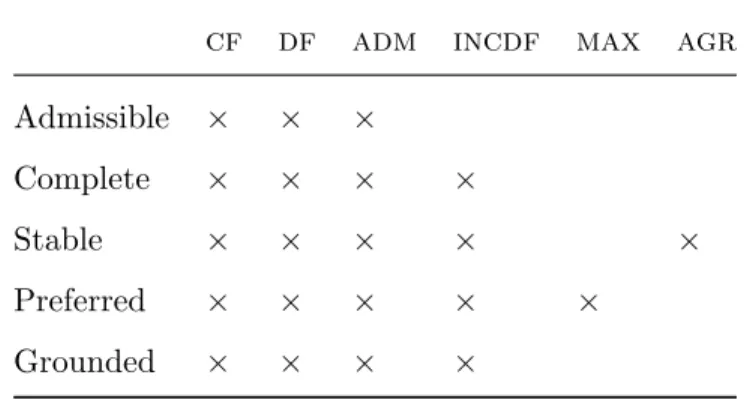
Table 2.1 summaries the semantics and their essential criteria. The cri-teria are as follows: cf means the extensions are conflict-free, df means they defend all their elements, incdf means they include what they defend, max means they are maximal w.r.t ⊆, agr refers to aggressiveness and it means they attack all what is outside and adm refers to admissibility. Please note that since the table is only for illustration purposes the criteria are not completely dependent, some of them are derivable from others ( for instance, adm from cf and df).
2.3 Justification State
Argumentation frameworks take as an input a set of arguments and an attack relation, they give as an output a set of extensions under a specific semantics. Taking into account this output, arguments can be classified with respect to their membership in the resulting extensions. Therefore, we distinguish the following three justification state.
De nition 2.3.1 (Justi cation state). Given a semantics x and argumenta-tion framework H. Let Extx(H) denote the set of all extensions of H under
CHAPTER 2. ABSTRACT ARGUMENTATION
cf df adm incdf max agr
Admissible × × ×
Complete × × × ×
Stable × × × × ×
Preferred × × × × ×
Grounded × × × ×
Table 2.1: Semantics with respect to criteria. × means the criterion is satisfied.
• Skeptically accepted if and only if a ∈T Ei, such that Ei∈ Extx(H).
• Credulously accepted if and only if a ∈S Ei, such that Ei ∈ Extx(H).
• Rejected if and only if it is not credulously accepted.
A skeptically accepted argument is an argument that is accepted from all possible standpoints (extensions), whereas a credulously accepted argu-ment that may be accepted in some extensions and rejected in others. A rejected argument is referred to as an overruled argument. It is clear that every skeptically accepted argument is also credulously accepted but not vice versa.
Example 2.3.1 (Cont'd Example 2.2.8). Under the preferred semantics, the argument a is skeptically accepted and the arguments d and c are credulously accepted. The argument b is rejected.
Note that the justification state can change with respect to the semantics under consideration.
2.4 Coincidence between Semantics
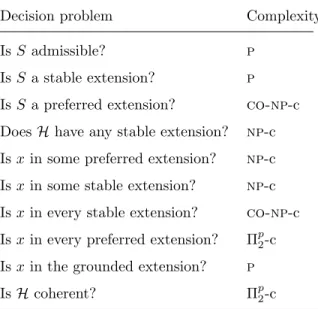
In general, reasoning with abstract argumentation frameworks is hard (Dunne and Wooldridge (2009); Dimopoulos et al. (1999)). However, this task be-comes easier when certain properties are verified. Namely, the preferred and stable semantics coincide (coherence), the coincidence between intersection of preferred extensions and the grounded extension (relative groundedness),
2.4. COINCIDENCE BETWEEN SEMANTICS
Decision problem Complexity
Is S admissible? p
Is S a stable extension? p
Is S a preferred extension? co-np-c
Does H have any stable extension? np-c
Is x in some preferred extension? np-c
Is x in some stable extension? np-c
Is x in every stable extension? co-np-c
Is x in every preferred extension? Πp2-c
Is x in the grounded extension? p
Is H coherent? Πp2-c
Table 2.2: Computational complexity of certain decision problems. H is an argumentation framework, x is an argument and S a set of arguments. Results taken from Dunne and Bench-Capon (2002); Dunne and Wooldridge (2009).
coincidence between complete, grounded, preferred and stable with a unique extension (well-foundedness) and the existence of one empty preferred exten-sion (triviality). In this section we recall each property and show the main sufficient conditions for such coincidence proved in Dung (1995); Dunne and Bench-Capon (2002); Doutre (2002).
Let us start with the coherence property of Dung (1995). One significant benefit of coherence has been shown in Vreeswik and Prakken (2000) where a proof mechanism for establishing skeptical acceptance has been provided for coherent argumentation frameworks. Therefore, satisfying such property in certain argumentation frameworks comes with that benefit. In addition, as it is know from Dunne and Bench-Capon (2002) the computational com-plexity of the skeptical membership problem is co-NP-complete for stable and Πp2-complete for preferred. In this case, an enormous reduction in com-plexity is gained where we jump from the the second level of the polynomial hierarchy Πp2-complete to the first level Πp1-complete (i.e. co-NP-complete). To plot a full picture about the computational benefit, Table 2.2 shows the computational problems with their computational complexities.
CHAPTER 2. ABSTRACT ARGUMENTATION
Figure 2.4: Coherent argumentation framework.
Figure 2.5: Non-coherent argumentation framework.
coherent if and only if all its preferred extensions are stable extensions. We denote by coherent the class of argumentation frameworks that are coher-ent.
Example 2.4.1. Figure 2.5 presents an argumentation framework H that is not coherent, observe that Extp(H) = {{a, d}, {e}} which is not equal to
Exts(H) = {{a, d}}. The argumentation framework H0 of 2.4 is coherent
where Extp(H0) = Exts(H0) = {{a, c, e}}.
The problem is how one can tell from looking at the graph whether a given argumentation framework is coherent? Unfortunately, according to Dunne and Bench-Capon (2002) there is no tractable procedure (unless P=NP) that can preform such check. However, certain classes of argumen-tation frameworks for which there are efficiently testable properties that suffice to guarantee coherence are identified in the literature.
Dung identified the classes uncontroversial and limited controversial ar-gumentation frameworks for which coherence is verified. These two classes are based on two simple concepts called indirect defense/attack.
De nition 2.4.2 (Indirect defense/attack).
• We say an argument b indirectly attacks a if there exists a finite sequence (a0, . . . , a2n+1) such that (1) a0 = a and b = a2n+1 and (2)
for each i, 0 ≤ i ≤ 2n, ai+1 attacks ai.
• We say an argument b indirectly defends a if there exists a finite sequence (a0, . . . , a2n) such that (1) a0 = a and b = a2n and (2) for
each i, 0 ≤ i ≤ 2n, ai+1 attacks ai.