HAL Id: hal-01370322
https://hal.inria.fr/hal-01370322
Submitted on 22 Sep 2016
HAL is a multi-disciplinary open access
archive for the deposit and dissemination of
sci-entific research documents, whether they are
pub-lished or not. The documents may come from
teaching and research institutions in France or
L’archive ouverte pluridisciplinaire HAL, est
destinée au dépôt et à la diffusion de documents
scientifiques de niveau recherche, publiés ou non,
émanant des établissements d’enseignement et de
recherche français ou étrangers, des laboratoires
Using finite transducers for describing and synthesising
structural time-series constraints
Nicolas Beldiceanu, Mats Carlsson, Rémi Douence, Helmut Simonis
To cite this version:
Nicolas Beldiceanu, Mats Carlsson, Rémi Douence, Helmut Simonis. Using finite transducers for
describing and synthesising structural time-series constraints. Constraints, Springer Verlag, 2016, 21
(1), pp.19. �10.1007/s10601-015-9200-3�. �hal-01370322�
Constraints manuscript No. (will be inserted by the editor)
Using Finite Transducers for Describing and Synthesising
Structural Time-Series Constraints
Nicolas Beldiceanu · Mats Carlsson · Rémi Douence · Helmut Simonis
July 30, 2015
Abstract We describe a large family of constraints for structural time series by means of function composition. These constraints are on aggregations of features of patterns that occur in a time series, such as the number of its peaks, or the range of its steepest ascent. The patterns and features are usually linked to physical properties of the time series generator, which are important to capture in a constraint model of the system, i.e. a conjunction of constraints that produces similar time series. We formalise the patterns using finite transducers, whose output alphabet corresponds to semantic values that precisely describe the steps for identifying the occurrences of a pattern. Based on that description, we automatically synthesise automata with accumulators, as well as constraint checkers. The description scheme not only unifies the structure of the existing 30 time-series constraints in the Global Constraint Catalogue, but also leads to over 600 new constraints, with more than 100,000 lines of synthesised code.
Keywords global constraint · time series · Global Constraint Catalogue · constraint synthesis · finite transducer
1 Introduction
A time series is here a sequence of integers, corresponding to measurements taken over a time interval. Time series are ubiquitous in many application areas. In our current
Nicolas Beldiceanu
TASC (CNRS/INRIA), Mines Nantes, FR – 44307 Nantes, France E-mail: [email protected]
Mats Carlsson
SICS, P.O. Box 1263, SE – 164 29 Kista, Sweden E-mail: [email protected]
Rémi Douence
ASCOLA (CNRS/INRIA), Mines Nantes, FR – 44307 Nantes, France E-mail: [email protected]
Helmut Simonis
Insight Centre for Data Analytics, University College Cork, Ireland E-mail: [email protected]
min width peak 0 1 2 3 4 5 6 7 8 9 10 11 12 13 14 15 16 17 4 4 2 2 3 5 5 6 3 1 1 2 2 2 2 2 2 1 = > = < < = < > > = < = = = = = > < < << == << >> >> << == == == == == >> 5 6 5 4 5 6 7 8 11 12 13 14 15 16
time series:sequenceinput (I) signature sequence (II) e-occurrencess-occurrences (III) feature sequence (IV)output:aggregationfeature
4 4 2 2 3 5 5 6 3 1 1 2 2 2 2 2 2 1 5 6
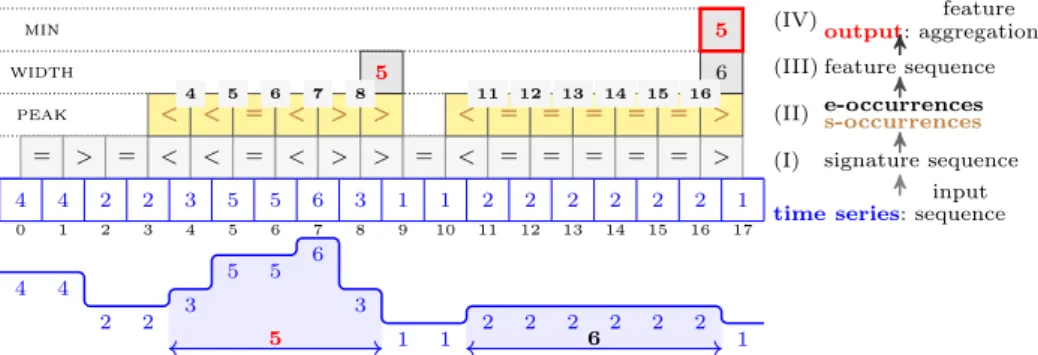
Fig. 1 Describing time-series constraints as a function composition, exemplified on the min_width_peak(5, h4, 4, 2, 2, 3, 5, 5, 6, 3, 1, 1, 2, 2, 2, 2, 2, 2, 1i) constraint instance of Exam-ple1in Section2.1: (I) building the signature sequence by comparing adjacent input values; (II) finding all occurrences of the peak pattern, i.e., maximal words matching the regular expression < (= | <)⇤(>| =)⇤>, and computing the corresponding e-occurrences; (III)
com-puting the width feature of each peak from the e-occurrences; and (IV) aggregating the feature values using the Min aggregator.
work for example, we use them to model the power output of electric power stations over multiple days, to describe environmental data (temperature, humidity, CO2level) in building management, or to model the capacity of a hospital clinic for each day over a period of years. These type of time series are constrained by physical or organizational (in general structural) limits, which restrict the evolution of the series. We use the term structural in the sense of [18], which defines “A structural time series model is one which is set up in terms of components which have a direct interpretation.”. In our view these components are constraints, which we express as a combination of patterns, features and aggregators.
We have identified a set of, at the moment, 20 patterns that capture important structural information about the time series. For example, a peak is a maximal sub-sequence of non-strict increases followed by non-strict decreases, delimited to the left and right by a strict increase and a strict decrease, respectively.
A feature is obtained by applying a total function to a pattern occurrence. For example, the width is the number of elements of the pattern occurrence.
The aggregation of the features of all the occurrences of the same pattern in a time series is obtained by reducing the feature sequence through another total func-tion, such as the minimum. For example, the time series given by the integer values
40, 41, 22, 23, 34, 55, 56, 67, 38, 19, 110, 211, 212, 213, 214, 215, 216, 117, where the indices give
the positions within the sequence, contains two peaks, namely 34, 55, 56, 67, 38 and
211, 212, 213, 214, 215, 216, of widths 5 and 6 respectively, so that the narrowest peak
has width5, as illustrated in Figure1.
Research on time series has a long tradition. Classical research focuses on extracting meaningful statistics towards predicting future values or mining the time series [13,
23]. More recently, the keen interest of data science for a better understanding of user behaviour gave renewed relevance to building models from time series [17,21]. From a constraint programming perspective, work on time series was initiated by [16] in the context of mining. More recently, some30time-series constraints were introduced in the Global Constraint Catalogue [3,6] in order to use them as a vocabulary, or bias, for learning constraint models from electricity production curves [8].
Thecontribution of this paper is twofold. First, we provide a systematic way to describe structural time-series constraints using one main ingredient, which we call a seed transducer. Informally, a seed transducer is a finite-state transducer [11,24], that is a finite-state automaton that produces an output sequence from its input sequence, where the output alphabet consists of letters that describe the phases of finding a pattern. Second, we show how to use a seed transducer to synthesise new time-series constraints automatically for the Global Constraint Catalogue: we synthesise a checker and a very small automaton with accumulators [2], typically with at most5states, for each constraint, as well as the meta data used in the catalogue, so that our synthesised time-series constraints can be directly used by the Constraint Seeker [9] and Model Seeker [10]. Synthesising fast checkers goes back to the work on Rabbit [19], and there is recent work on synthesising propagators for the table constraint [15] as well as CSP-solvers [25].
In Section2, we show how to describe a variety of structural time-series constraints via a description made of four layers. In Section3, we then introduce the notion of seed transducer used for describing how all occurrences of a pattern are found for a time series. For the two classes of time-series constraints presented in Section4, we explain in Section5how to synthesise automatically an automaton with accumulators [2]. In Section6, we provide use cases in the context of learning constraint models on time series. Finally, we conclude in Section7.
2 A Four-Layered Description of Time-Series Constraints
Our focus is on time-series constraints that are defined as total-function constraints [4] on a sequence of variables. We first give the intuition of how to describe concisely a class of such structural time-series constraints by a four-layered scheme. We then formally define the notion of pattern, which is a key ingredient for describing time-series constraints.
2.1 Intuition: Signature, Pattern, Feature, and Aggregation
Given a pattern and a time series x0, x1, . . . , xn 1of integer constants, called the input valuesand forming the input sequence, a single integer is computed in four consecutive steps, which we now describe:
I. Compare each pair of adjacent input values in order to build a sequence s0, s1, . . . , sn 2 of signature values over the alphabet {<,=, >}, as follows: (xi < xi+1 , si=‘<’)^(xi=xi+1, si=‘=’)^(xi> xi+1, si=‘>’). The signature values
form the signature sequence.
II. Within the signature sequence, find all maximal words [1], or s-occurrences, match-ing a regular expression correspondmatch-ing to the pattern of interest. For example, a peak (as defined in Section 1) matches ‘< (= | <)⇤(> | =)⇤ >’. In Sec-tion 2.2, we will call e-occurrence the input index subsequence that yields an s-occurrence. For example, the peak <0, <1,=2, <3, >4, >5for the input sequence
20, 31, 52, 53, 64, 35, 16 has[[1..5]], short for1, 2, 3, 4, 5, as e-occurrence.
III. For each found pattern occurrence, compute an integer feature value, so that we ob-tain a feature sequence. The features we currently consider are one, width, surface,
pattern regular expression r before b after a increasing < 0 0 increasing_sequence < (<| =)⇤<| < 0 0 increasing_terrace < =+< 1 1 summit (<|(< (= | <)⇤<)) (>|(> (= | >)⇤>)) 1 1 plateau < =⇤> 1 1 proper_plateau < =+> 1 1 strictly_increasing_sequence <+ 0 0 peak < (=| <)⇤(>| =)⇤ > 1 1 inflexion < (<| =)⇤> | > (> | =)⇤< 1 1 steady = 0 0 steady_sequence =+ 0 0 zigzag (<>)+(<| <>) | (><)+ (>| ><) 1 1 Table 1 Pattern list; by permuting the symbols ‘<’ and ‘>’ in the regular expressions, we get decreasing, decreasing_sequence, decreasing_terrace, gorge, plain, proper_plain, strictly_decreasing_sequence, and valley as counterparts of the first eight patterns, so that there are twenty patterns in total.
min, max, and range, and correspond for the given e-occurrence, denoted e, to, re-spectively, the value1, to the number |e| of elements of e, toPi2exi, tomini2exi,
tomaxi2exi, and tomaxi2exi mini2exi.
IV. Aggregate the values of the feature sequence into a single integer value. The ag-gregators we currently consider are summing up (Sum), taking the minimum (Min), and taking the maximum (Max). The feature one only makes sense with the Sum aggregator.
As a convention we define a name of the constraint which is the concatenation of the aggregator function, the feature name and the pattern. For the combination of aggregator function Sum, and the feature one, which counts the occurrences of a pattern, we use the notation nb_.
Example 1 We consider the min_width_peak constraint from Figure1, which con-strains the minimum width of the peaks of a time series. The given time series reveals two peaks, with e-occurrences[[4..8]] and[[11..16]]of widths5and 6respectively, so that the minimum width is5.
2.2 Patterns and Occurrences
Patterns describe the topological aspect of subsequences of a time series, as only adja-cent values of the time series are compared.
Definition 1 (Pattern) A pattern p over the alphabet {<,=, >} is a triple hr, b, ai, where r is a regular expression over {<,=, >} that is only matched by non-empty words, while b and a are two non-negative integers, whose role will be explained in Definition2.
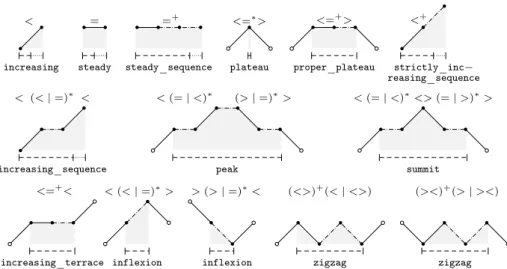
In Definition 1, b and a are intended to delete parts of the pattern that are used to detect the start and end of a pattern, but which should not be part of the feature computation. The20patterns we consider are provided in Table1, with illustrations in Figure2.
increasing < steady = steady_sequence =+ plateau <=⇤> proper_plateau <=+> strictly_inc reasing_sequence <+ increasing_sequence < (<| =)⇤ < peak < (=| <)⇤ (>| =)⇤> summit < (=| <)⇤<> (=| >)⇤> increasing_terrace <=+< inflexion < (<| =)⇤> inflexion > (>| =)⇤< zigzag (<>)+(< | <>) zigzag (><)+(> | ><)
Fig. 2 Illustration of the patterns of Table1, with time on the horizontal axis and the mea-surements on the vertical axis: only the relative vertical positions of adjacent points matter, not their magnitudes. An i-occurrence is shown with a dashed line; its extension, when it exists, to the e-occurrence is shown with a dotted line: filled points are part of the e-occurrence, but not the hollow points. Dash-dotted lines include an arbitrary number of points. Grey-shaded areas approximate the pattern surface.
Definition 2 (s-occurrence, i-occurrence, e-occurrence) Given an input sequence x0, x1, . . . , xn 1, its signature sequence S= s0, s1, . . . , sn 2, a pattern hr, b, ai, and a non-empty signature subsequence si, si+1, . . . , sj, with 0 i j n 2,
form-ing a maximal word that matches r, the s-occurrence (i..j) is the index sequence i, i+ 1, . . . , j; the i-occurrence [(i+b)..j] is the index sequence i+b, . . . , j; and the e-occurrence [[(i+b)..(j+ 1 a)]]is the index sequence i+b, . . . , j+ 1 a.
Thus, an s-occurrence identifies an occurrence of a pattern in a signature sequence. An i-occurrence identifies an occurrence of a pattern in an input sequence. Note that i-occurrences of the same pattern of Table 1 never overlap: e.g., i-occurrences of increasing or steady never overlap since they consist of a single index, while i-occurrences of plateau or proper_plateau never overlap since their regular expres-sions start with a symbol that is not repeated within the regular expression. This property will be used in Section4.1to design a constraint that links a time series with the indices of all occurrences of a pattern.
An e-occurrence is used for computing the feature value of a pattern occurrence of Table1(as seen in Section2.1), and may differ from the i-occurrence.
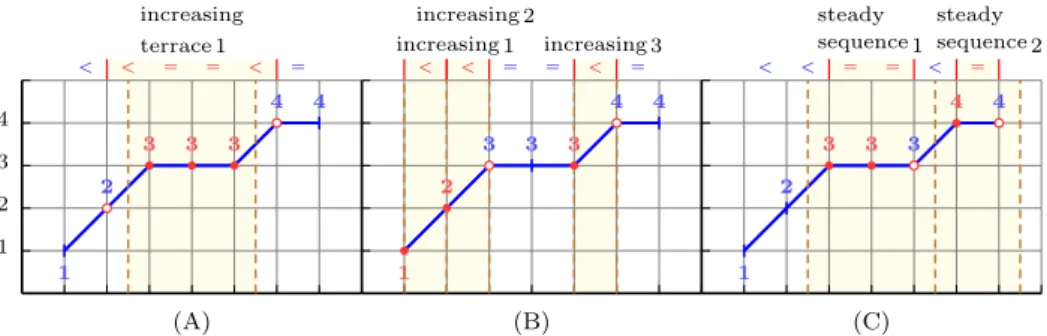
Example 2 Consider the input sequence10, 21, 32, 33, 34, 45, 46and its signature sequence
<0, <1, =2, =3, <4, =5:
– The increasing_terrace pattern has ‘<=+<’ as regular expression. There is one
terrace, namely <1, =2, =3, <4. The attributes b = 1 = a exclude the first and
last input values, namely21 and 45, for its i-occurrence and e-occurrence, which thus are[2..4]and[[2..4]]corresponding to the flat part of the pattern as shown in Part (A) of Figure3.
– The increasing pattern has ‘<’as regular expression. There are three increases, namely<0, and<1, and<4 as shown in Part (B). Since the attribute b is equal to
< < = = < = increasing terrace 1 1 2 3 4 1 2 3 3 3 4 4 (A) < < = = < = increasing 1 increasing 2 increasing 3 1 2 3 3 3 4 4 (B) < < = = < = sequence 1 steady sequence 2 steady 1 2 3 3 3 4 4 (C)
Fig. 3 Illustrating the three patterns of Example2: s-occurrence are shown on top of each sub-figure, i-occurrence are shown with plain circles, e-occurrences correspond to those plain and hollow circles that are located in the yellow parts between (or crossing) two consecutive dashed lines.
zero, the i-occurrences match the s-occurrences, and are therefore[0..0],[1..1], and
[4..4]. To compute the feature values correctly, as the attributes b and a are both zero, both the first and the second input values corresponding to the increases are included for their e-occurrences, which thus are[[0..1]],[[1..2]], and[[4..5]]. – The steady_sequence pattern has‘=+’as regular expression. There are two steady
sequences, namely=2, =3 and=5 as shown in Part (C). The attributes b= 0 =a
include the first and last input values corresponding to the steady sequences for their e-occurrences, which therefore are[[2..4]]and[[5..6]], while their i-occurrences are just[2..3]and[5..5], matching the s-occurrences.
3 Seed Transducers
Recall that a deterministic finite transducer [24] is a tuple hQ, ⌃, ⌃0, , q
0, Ai, where Q is the set of states, ⌃ the input alphabet, ⌃0 the output alphabet, :Q⇥ ⌃ ! Q ⇥ ⌃0
the transition function, which must be total, q02 Q the start state, and A ✓ Q the set of accepting states. When (q, ) =hq0, 0i, there is a transition from state q to state q0 upon reading symbol in the input of the transducer and writing the symbol 0to the
output of the transducer: we write this as q :! q0 0. A deterministic finite automaton (DFA) is a transducer without an output alphabet. In a graphical representation of a transducer or automaton, we indicate the start state by an arrow coming from nowhere. Each pattern of Table1is represented by what we call a seed transducer, whose aim is to describe the way the i-occurrences are found for an input sequence x0, x1, . . . , xn 1. A seed transducer actually reads the corresponding symbolic [26] signature sequence s0, s1, . . . , sn 2 and produces a sequence ⌧0, ⌧1, . . . , ⌧n 2 of symbols, whose purpose is to guide the synthesis of code for the constraint classes we will give in Section 4. Before defining the notion of seed transducer, we introduce the symbols of its output alphabet, called the semantic alphabet:
– ⌧i=foundmeans that index i is inside a new i-occurrence, which may have started
before i and may continue after i.
– ⌧i =foundendmeans that index i is inside a new i-occurrence, which may have
– ⌧i=maybebeforemeans that index i may belong to an i-occurrence, but that this
must be confirmed by producing a ‘found’ or ‘foundend’ while reading si+1, . . . , sn 2. – ⌧i=outresetwith ⌧i k=⌧i k+1=· · ·=⌧i 1=maybebefore (i=k_ ⌧i k 16=
maybebefore) means that index i is outside any i-occurrence and that indices from i kto i 1are also outside any i-occurrence.
– ⌧i=inmeans that index i is inside an i-occurrence for which a ‘found’ was already
produced.
– ⌧i = maybeafter means that index i may belong to an i-occurrence for which
a ‘found’ was already produced, but that this must be confirmed by producing maybe⇤afterinwhile reading a prefix of si+1, . . . , sn 2.
– ⌧i=outaftermeans that index i is outside any i-occurrence, but that an i-occurrence
has ended at index i 1.
– ⌧i=outmeans that index i is outside any i-occurrence and that ⌧i 1is neither a maybebeforenor a maybeafter.
For conciseness, the subscripts ‘after’, ‘before’, ‘end’, and ‘reset’ will be abbreviated by their first letters. Examples will be given after the next definition.
Definition 3 (Seed Transducer) A seed transducer is a transducer with output alphabet {found, founde, in, maybeb, maybea, out, outa, outr}, input alphabet {<
,=, >}, and only accepting states.
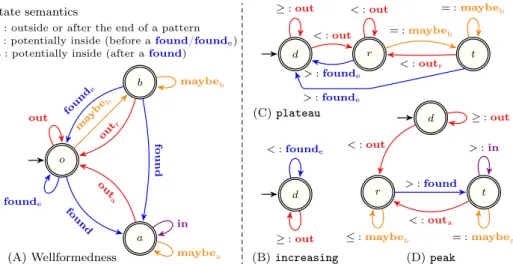
Example 3 See Parts B, C, and D of Figure4for seed transducers of the increasing, plateau, and peak patterns of Table1. The latter works as follows: one starts from state dand stays there until an increase (<) transits to state r; one stays in state r until a de-crease (>) transits to state t and signals that a peak was found; one stays in state t until an increase transits back to state r; for the input sequence40, 41, 22, 23, 34, 55, 56, 67, 38,
19, 110, 211, 212, 213, 214, 215, 216, 117, the transitions are as follows:
d 4=4:out! d 4>2:out! d 2=2:out! d 2<3:out! r 3<5:maybe! rb 5=5:maybe! rb 5<6:maybeb
! r 6>3:found! t 3>1:in! t 1=1:maybe! ta 1<2:out! ra 2=2:maybe! rb 2=2:maybeb
! r 2=2:maybe! rb 2=2:maybe! rb 2=2:maybe! rb 2>1:found! t The two ‘found’ correspond to two peaks: the first peak corresponds to the word from the first ‘maybeb’ to the first ‘in’ (i.e., the word ‘maybe3bfound in’) and its
i-occurrence is [4..8]; the second peak corresponds to the word from just after the last ‘outa’ to the last ‘found’ (i.e., the word ‘maybe5bfound’) and its i-occurrence is [11..16].
Definition 4 (t-occurrence) Given a seed transducer S and a signature sequence s, the t-occurrence of S for s consists of the indices of the semantic letters of a max-imal word within the transduction of s that matches one of the regular expressions ‘maybe⇤
bfounde’ and ‘maybe⇤bfound(maybe⇤ain+)⇤’.
Definition 5 (Seed Transducer Wellformedness) A seed transducer S is well-formed with respect to a pattern pat if the following conditions hold:
o b a out founde ma yb eb found maybeb out r found e found in maybea out a (A) Wellformedness state semantics
o :outside or after the end of a pattern b :potentially inside (before afound/founde) a :potentially inside (after afound)
d < :founde :out (B) increasing d r t :out < :out < :out = :maybeb > :founde = :maybeb < :outr > :founde (C) plateau d r t :out < :out :maybeb > :found > :in = :maybea < :outa (D) peak
Fig. 4 (A) DFA defining the output language of a well-formed seed transducer. (B,C,D) Seed transducers, involving all eight letters of the semantic alphabet, of the increasing, plateau, and peak patterns, with regular expressions ‘<’, ‘<=⇤>’, and ‘< (= | <)⇤(> | =)⇤ >’
respectively; a self-loop labelled by (respectively ) is a shortcut for two self-loops labelled by > and = (respectively < and =).
– The t-occurrence of S for any input sequence x coincides with the i-occurrence of pattern pat for x.
Example 4 The seed transducer in Figure4D of the peak pattern is well-formed since (1) its output language is a subset of the language of the DFA in Figure4A, and (2) its input language producing ‘maybe⇤
bfound(maybe⇤ain+)⇤’, namely ‘(<|=)⇤ >((>
|=)⇤ >+)⇤’, is equivalent to the regular expression associated with the peak pattern in Table1, namely ‘< (=| <)⇤(> |=)⇤ >’, from which we remove the first letter since peak has b= 1.
Seed transducers will be used in Section5to synthesise automata with accumulators for the constraint classes that the next section introduces.
4 Constraint Classes
We now introduce the two main constraint classes we associate to a pattern. Both are defined as total functions on a sequence. Since we are describing constraints rather than ground instances thereof, we now switch from values to variables, and from functions to total-function constraints.
The first class allows identifying the i-occurrences of a pattern in a sequence (e.g., it allows identifying the i-occurrences of a peak). The second class computes a result from the e-occurrences of pattern in a sequence (e.g., it computes the minimum width of the peaks of a sequence as illustrated in Example1). Other constraints such as the minimum or maximum distance between consecutive i-occurrences of a pattern or the comparison of feature values of consecutive e-occurrences of a pattern have also been introduced but are outside the scope of this paper due to space limits. Altogether these
constraint classes allow us to cover28of the30time-series constraints of the Global Constraint Catalogue1 and to synthesise them in a systematic way leading to more than600time-series constraints.
4.1 Footprint Constraint
Footprint constraints allow us to state constraints on the occurrence or non-occurrence of a pattern in a specific time interval. For instance, in the context of energy production, it is quite common to identify time intervals where we know that there will be a production peak balancing a known consumption peak. Footprint constraints also allow reporting precisely time intervals where anomalies like a zigzag pattern occur. Definition 6 The footprint(pat,hx0, x1, . . . , xn 1i, hp0, p1, . . . , pn 1i)constraint, where pat is the name of one of the patterns of Table1, x0, x1, . . . , xn 1is a sequence of integer variables, and p0, p1, . . . , pn 1 is a sequence of integer variables between0 and n, holds if:
– pk = 0if index k does not occur in any i-occurrence of pattern pat in the input
sequence x0, x1, . . . , xn 1,
– pk =j >0if index k belongs to the jth i-occurrence of pattern pat when reading
the sequence x0, x1, . . . , xn 1.
Example 5 If we consider the time series introduced in Example1, the corresponding footprint(peak,h40,41,22,23,34,55,56,67,38,19,110,211,212,213,214,215,216,117i, h0,0,0,0,1,1,1,1,1,0,0,2,2,2,2,2,2,0i)constraint holds since:
– Within the third argument, the first stretch of five 1s corresponds to the first i-occurrence of peak, namely[4..8].
– The second stretch of six2s coincides with the second i-occurrence of peak, namely
[11..16].
4.2 Constraint on the Aggregation of Pattern Features
Definition 7 The aggregate_feature_pattern(pat, f, g, res,hx0, x1, . . . , xn 1i) constraint, where pat is one of the pattern names of Table1, f 2 {one, width, surface, min, max, range} is a feature, g 2 {Min, Max, Sum} is an aggregator, res is an integer variable, and x0, x1, . . . , xn 1is a sequence of integer variables, holds if the following two conditions hold:
– If pattern pat does not occur in x0, x1, . . . , xn 1, then res is the default value defaultg,f associated with the pair hg, fi in Table B of Figure 6.
– Otherwise, res is the aggregation with respect to g of the feature values of the occurrences of pattern pat in x0, x1, . . . , xn 1.
For a given triple hpat, f, gi, the aggregate_feature_pattern constraint is named by concatenating the aggregation operator name g, the feature name f, and the pattern name pat, like we did in Example 1 with the min_width_peak(res,hx0, x1, . . . , xn 1i)constraint.
1 In fact, all existing time-series constraints except big_peak and big_valley [6] fit into
our framework. For these two constraints, our seed transducers must be extended with guarded transitions.
5 Synthesising Footprint Constraint and Aggregation Constraint of Pattern Feature
Based on the transducers of the patterns, we synthesise several hundred constraints, which are all represented as automata with accumulators [2], as well as their corre-sponding checkers as Prolog programs.
The key idea for doing such a synthesis is to use what we call a decoration table, which is independent from the seed transducers we consider. The decoration table introduces a set of accumulators with their initial values and defines for each letter of the semantic alphabet how to update these accumulators. Then the synthesis process replaces the semantic letter of each transition of a seed transducer by the accumulator update instructions.
Following [5], we first recall the notion of automata with accumulators. We then provide the decoration tables associated with the footprint constraint and the ag-gregation constraint of pattern feature. For the later case we prove that the generated automaton with accumulators returns the expected result.
5.1 Background: Automata with Accumulators
We here define a memory-DFA (mDFA) with a memory of k 0 accumulators as a tuple hQ, ⌃, , q0, I, A, ↵i, where Q, ⌃, q0, and A are as in a DFA, while the transition function has signature(Q⇥Zk)⇥ ⌃ ! Q ⇥Zk, and similarly for its extended version b. Let ⌃⇤ denote the infinite set of words built from ⌃ (⌃={<,=, >} in our case),
including the empty word, denoted ✏. The extended transition functionb:Q⇥ ⌃⇤! Q for words (instead of symbols) is recursively defined by b(q, ✏) = q and b(q, w ) = (b(q, w), )for a word w and symbol . A word w is accepted if b(q0, w)2 A. On a transition, there can be a guard, that is a comparison between accumulators or variables, which may enable or disable the transition [12, page 452]. Further, I is the k-tuple of initial values of the variables in the memory. Finally, ↵:A⇥Zk ! Z is called the acceptance function and transforms the memory of an accepting state into an integer. Given a word w, the mDFA returns ↵(b(hq0, Ii, w))if w is accepted. Note that ,b, and ↵ are total functions.
5.2 Synthesising Footprint Constraints
To get the footprint constraint of a pattern pat, i.e., an automaton with accumulators, from its seed transducer Spat we replace the semantic annotations of each transition
of Spat by using Table A of Figure5. Table A provides for each type of semantic letter
the corresponding replacement, where C is an accumulator used for identifying each occurrence of pattern pat:
– When the ithsemantic letter ⌧
iis out, outr, or outa, index i cannot belong to an
i-occurrence, and consequently pi is set to0.
– When ⌧i is maybeb(respectively maybea), indices i and i+ 1either belong both
to the same i-occurrence or do not both belong to any i-occurrence, depending on whether they are followed or not by a found or founde (respectively in).
initialisation C 0 return pn= 0 semantic letters annotations guard update of C out pi= 0 outr pi= 0 outa pi= 0 maybeb pi= pi+1 maybea pi= pi+1 founde pi= C + 1 C C + 1 found pi= C + 1 C C + 1 in pi= C (A) d {C 0} r t ,{pi= 0} <,{pi= 0} , {pi= pi+1} >, ⇢ pi= C + 1, C C + 1 >,{pi= C} =,{pi= pi+1} <,{pi= 0} (B) = > = < < = < > > = < = = = = = > d d d d r r r r t t t r r r r r r t o o o o mbmb mb f in ma oa mb mbmb mb mb f 0 0 0 0 0 0 0 1 1 1 1 1 1 1 1 1 2 p0 =0 p1 =0 p2 =0 p3 =0 p4 = p5 p5 = p6 p6 = p7 p7 =1 p8 =1 p9 =p 10 p10 = 0 p11 = p12 p12 = p13 p13 = p14 p14 = p15 p15 = p16 p16 = 2 p17 = 0 4 4 2 2 3 5 5 6 3 1 1 2 2 2 2 2 2 1 0 1 2 3 4 5 6 7 8 9 10 11 12 13 14 15 16 17 xi si qi ⌧i Ci 0 0 0 0 (C)
Fig. 5 (A) Decoration table for synthesising the footprint automaton from the semantic letters attached to the transitions of the seed transducer, (B) Footprint automaton of the peak pattern obtained by replacing the output semantic letters of the seed transducer of the seed automaton of the peak pattern (see Part D of Figure4) by the corresponding annotations given by the decoration table in (A), (C) Illustrates the execution of the footprint automaton of the peak pattern where xi, si, qi, ⌧i, Ci are the sequence, signature, state, semantic, and accumulator
variables; the tiny 0 in the left lower corners corresponds to the index of the corresponding variable, and o, mb, f, ma, oaare shortcuts for out, maybeb, found, maybea, outa.
– When ⌧iis found or founde, index i belongs to a new i-occurrence. Consequently
piis set to C+1and we increment the number of i-occurrences already encountered.
– When ⌧iis in, index i belongs to the Cthi-occurrence.
Part (B) of Figure5shows the generated constraint for the peak pattern. 5.3 Synthesising Aggregation of Pattern Feature Constraints
Similarly to what we did for generating footprint constraints, Table C of Figure6gives the decoration table for synthesising aggregation of pattern feature constraints with respect to a feature f 2 {one, width, surface, max, min} and an aggregation operator g2 {Max, Min, Sum} for patterns for which the after attribute is set to1 (see the last column of Table1).2 Note that from Definition 2, if theafter attribute is set to1,
2 A very similar decoration table for handling the case when theafter attribute is set to 0
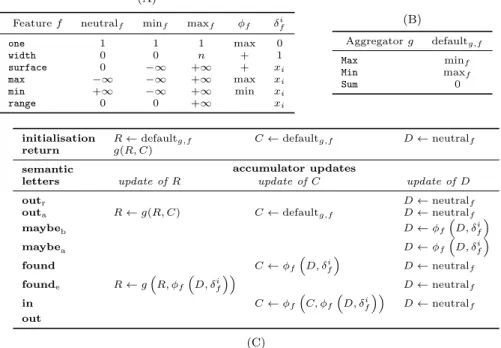
Feature f neutralf minf maxf f if one 1 1 1 max 0 width 0 0 n + 1 surface 0 1 +1 + xi max 1 1 +1 max xi min +1 1 +1 min xi range 0 0 +1 xi (A) Aggregator g defaultg,f Max minf Min maxf Sum 0 (B)
initialisation R defaultg,f C defaultg,f D neutralf
return g(R, C)
semantic
letters update of R update of C update of D
outr D neutralf
outa R g(R, C) C defaultg,f D neutralf
maybeb D f ⇣ D, i f ⌘ maybea D f ⇣ D, if ⌘ found C f ⇣ D, if ⌘ D neutralf founde R g⇣R, f ⇣ D, i f ⌘⌘ D neutralf in C f ⇣ C, f ⇣ D, i f ⌘⌘ D neutralf out accumulator updates (C)
Fig. 6 (A) Features: their neutral, minimum, and maximum values, and the function fvi f(fvi 1, if)used for computing the feature value of the feature f while reading variable xiof
its e-occurrence ( i
fprovides the contribution of xiwith respect to feature f); (B) Aggregation
operators with their corresponding default values; (C) Decoration table used for synthesising the feature automaton from its seed transducer and from an aggregation operator g and a feature f different from range (a slightly different function f and different decoration table
is used for range).
then e-occurrences and i-occurrences coincide. The initialisation row declares three accumulators R, C, and D, and their default values defined in Part B of Figure6:
– R records the aggregated value of the features of the e-occurrences that were already completed, i.e., a founde or an outawas encountered.
– C stores the feature value of the current e-occurrence on which we did not yet reach the end, i.e., a found was encountered but we are still waiting for an outa.
– D contains the feature value of the current potential part of an e-occurrence, i.e., the current semantic letter is a maybebor a maybea.
The return row of Table C of Figure 6 provides the final result returned by the automaton (denoted as a green box in the generated graphs), the aggregation between the aggregated value R of the feature values of the e-occurrences already completed, and the feature value C of the current e-occurrences. Finally, the other rows of Table C give for each semantic letter of the output alphabet of a transducer the corresponding accumulator updates of R, C, and D:
– ⌧i=outrindicates we are just after a maybeband that index i is not part of an
e-occurrence. We reinitialise the potential feature accumulator D.
– ⌧i= outa means we discover the end of an e-occurrence, i.e., we are just after a
accumulator R in order to take into account the current feature value C, and we reinitialise the current feature and the potential feature values C and D.
– ⌧i = maybeb (respectively maybea) means we are on a potential part of an
e-occurrence. Using the f function of Table A, we update the potential
fea-ture value D associated with the start (respectively the end) of the potential e-occurrence by taking into account xi.
– ⌧i = found means we just found an e-occurrence but do not know yet its end.
We are copying the potential feature value D corresponding to the seen maybeb
(taking also into account the current position xi) to the current feature value C,
and we reinitialise D.
– ⌧i= founde means we just found an e-occurrence and we know that we reached
its end. Using the aggregation operator g we update the result accumulator R with respect to the potential feature value D associated with the start of the potential e-occurrence corresponding to a sequence of maybeb, and reinitialise D. Note that
Cdoes not need to be reinitialised since it was kept untouched while producing the maybeb.
– ⌧i =in means that the current e-occurrence is extended. We update the current
feature value C taking into account both the potential feature accumulator D as well as xi, and reinitialise D to the neutral element of f.
– ⌧i = out means we are just after a founde, an out, an outa, or an outr that
is not part of any e-occurrence. We do not generate any accumulator updates since founde and outa already took care of the update with respect to the end
of an e-occurrence, and since outrtook care of the update of D with respect to a
maybeb.
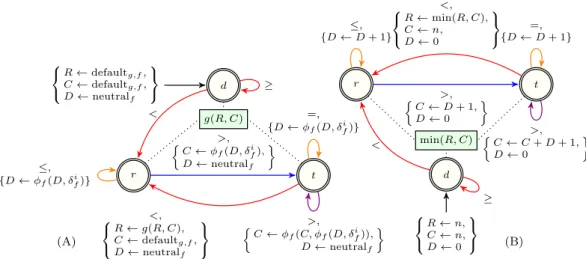
Example 6 Part A of Figure 7 provides the parameterised automaton obtained by applying Table C of Figure6to the transducer of the peak pattern defined in Part D of Figure4, while Part B of Figure7instantiates the parameterised automaton to the automaton of the min_width_peak constraint.
Constraint checkers are synthesised by generating a big switch with respect to the states of the generated automata and the symbols of the input alphabet {<,=, >}, where each case of the switch corresponds to a transition of the automaton.
Proposition 1 (Computation correctness) Given (1) a well-formed seed trans-ducer S, (2) a feature f 2 {one, width, surface, min, max}, (3) an aggregator g 2 {Sum, Min, Max}, (4) a time series x0, x1, . . . , xn 1 of integer constants and (5) the corresponding signature sequence s = s0, s1, . . . , sn 2, the decoration table given in Part (C) of Figure6computes the aggregation with respect to g of feature f applied on the t-occurrences of S for s.
Proof The proof consists of three elements: Two nested inductions over the input word and a case analysis for the concrete features and aggregators. The inner induction, based on the t-occurrence of Definition 4, checks that feature computations are ini-tialised correctly and that the feature value inside a single occurrence of a pattern is computed correctly (see Lemmas1,2,3), the outer induction checks that the aggrega-tion of multiple occurrences computes the aggregated value correctly (see Lemma4). The third part demonstrates that the abstract feature operations compute the correct values for the concrete features (see Lemma5). ut
g(R, C) d 8 < : R defaultg,f, C defaultg,f, D neutralf 9 = ; r t < , {D f(D, fi)} >, ⇢ C f(D, fi), D neutralf >, ⇢ C f(C, f(D, if)), D neutralf =, {D f(D, if)} <, 8 < : R g(R, C), C defaultg,f, D neutralf 9 = ; (A) min(R, C) d 8 < : R n, C n, D 0 9 = ; r t < , {D D + 1} >, ⇢ C D + 1, D 0 >, ⇢ C C + D + 1, D 0 =, {D D + 1} <, 8 < : R min(R, C), C n, D 0 9 = ; (B) Fig. 7 (A) Aggregation of pattern features automaton of the peak pattern with respect to the aggregation operator g applied to feature f, (B) corresponding concrete automaton for g = min and f = width for the min_width_peak(result, hx0, x1, . . . , xn 1i) constraint obtained by
using Tables A and B of Figure6.
Notation 1 To simplify the reading we use in the following Lemmas the n-ary notation for function f, e.g. f( f(a, b), c)is denoted by f(a, b, c). The empty word is denoted
by ✏.
Lemma 1 (state of counter D just before entering a t-occurrence) Just before entering a t-occurrence, the counter D is set toneutralf.
Proof According to Definition 4, a t-occurrence corresponds to the indices of the reg-ular expressions ‘maybe⇤
bfounde’ and ‘maybe⇤bfound(maybe⇤ain+)⇤’ used to
com-pute the corresponding feature value. From the wellformedness hypothesis of the seed transducer S, a t-occurrence is (1) either located at the very start of a time series, (2) or immediately preceded by one of the following semantic letters: out, outr, outa,
founde.
– In case (1) the initialisation statement of the decoration table given in part (C) of Fig.6sets counter D to the value indicated by Lemma1.
– – In case (2) assume that the immediately preceding semantic letter is outr,
outaor founde. Then the initialisation statement of the decoration table resets
counter D to the value indicated by Lemma1.
– In case (2) assume that the immediately preceding semantic letter is out. Then from the wellformedness of S we have that the preceding semantic letter will be itself preceded by a word of the form ‘(outr|outa|founde|✏)out⇤’. The part
(outr|outa|founde|✏)resets counter D to the value indicated by Lemma1and the out⇤leaves counter D unchanged. ut
Lemma 2 (feature value for a t-occurrence of the form ‘maybe⇤
bfounde’)
Given a t-occurrence of the form ‘maybe⇤
bfounde’ starting at position i and ending
at position j, the computed feature value is f(neutralf, fi, fi+1, . . . , j f).
Proof
•First, just before entering a t-occurrence, by Lemma1, counter D is assigned value neutralf.
•Second, from the entry of the decoration table attached to maybeb, we have that
just after the last maybeb of the t-occurrence, counter D will be assigned value f(neutralf, if, if+1, . . . ,
j 1
f ).
•Finally, from the entry of the decoration table attached to founde, the feature value
is f(D, jf)(i.e. the second argument of the aggregation operator g), which taking
into account the value of D leads to the expected value f(neutralf, if, if+1, . . . , j f).
u t
Lemma 3 (feature value for a t-occurrence ‘maybe⇤
bfound (maybe⇤ain+)⇤’)
Given a t-occurrence of the form ‘maybe⇤
bfound(maybe⇤ain+)⇤’ starting at position
iand ending at position j, the computed feature value is f(neutralf, fi, fi+1, . . . , j f).
Proof
•First, by Lemma1, the counter D is assigned value neutralf just before entering a
t-occurrence.
•Second, from the entry of the decoration table attached to maybeb, we have that
just after the last maybeb of the t-occurrence the counter D will be assigned value f(neutralf, if, if+1, . . . ,
k 1
f ), where k is the position of the last maybeb.
• Third, from the entry of the decoration table attached to found, we have that
counter C will be assigned value f(neutralf, fi, fi+1, . . . , k
f)and D will be reset to
value neutralf.
• Fourth, assume we are at stage ‘maybe⇤bfound(maybea⇤in+)⇤maybe⇤a’. We have that counter C will be assigned value f(neutralf, if, if+1, . . . ,
k1
f ) and D will be
assigned value f(neutralf, fk1+1, fk1+2, . . . , fk2), where k1 and k2 are respectively the length of the words ‘maybe⇤
bfound(maybe⇤ain+)⇤’ and ‘maybe⇤a’. This stems
from the entry of the decoration table attached to maybea and from the fact that
counter D is reset to neutralf both after a found and after an in.
•Fifth, assume we are at stage ‘maybe⇤bfound(maybea⇤in+)⇤maybe⇤ain’. Then counter Cwill be assigned value f(neutralf, fi, fi+1, . . . ,
`
f)and D will be reset to neutralf,
where ` is the length of ‘maybe⇤
bfound(maybe⇤ain+)⇤maybe⇤ain’. This stems from
the entry of the decoration table attached to in, which transfers the content of D (corresponding to a stretch of maybea) to C. ut
Lemma 4 (aggregation of feature values) The aggregation of the feature values is sound.
Proof Depending on whether we have a t-occurrence of the form ‘maybe⇤
bfounde’ or
of the form ‘maybe⇤
bfound(maybe⇤ain+)⇤’ the aggregation takes place respectively
at:
1. A founde where counter R is updated wrt the current feature value f(D, fj),
where j is the last position of the current t-occurrence.
2. An outa (see the automaton defining the wellformedness given in Part (A) of
Figure 4) or when exiting the automaton (i.e. see the return statement of the decoration table). In both cases the counter R is updated wrt the current feature value that is recorded in C (see Lemma3).
Finally, note that the counter C contains its default value defaultg,fwhen we encounter
a founde and consequently does not need to be reset to defaultg,f when we are on a
founde. This is because counter C is only used when we have a found (and on an in
after a found) and is reset to its default value while exiting the corresponding pattern on an outa. ut
Lemma 5 (soundness of the computation of concrete features) The computa-tion of concrete features is sound.
Proof Each row of Table (A) of Figure 6 defines the computation of one given con-crete feature. Given a t-occurrence that is defined from position i to position j the computation of a concrete feature value starts by initialising counter D to the neutral element neutralfof feature f as defined by the second column of Table (A). On the first
position i of the t-occurrence we get the feature value f(neutralf, if), respectively
equal to 1,1, xi, xi, xi, which are the expected results for a t-occurrence involving
only one single position depending on whether f is equal to one, width, surface, max or min. On the last position j of the t-occurrence we get the feature value1, j i+ 1,
P
k2[i,j]xk,maxk2[i,j]xk,mink2[i,j]xk, which are the expected feature values. ut
A relevant question is how efficient our synthesised automata and checkers are com-pared to the manually written code already in the catalogue. To answer that question, we selected a few constraints, and for each one, we perform 100 runs for the manually defined and for the synthesised versions by
– generating a sequence of 1,000 domain variables with random domains, posting the automaton with a fixed aggregated feature value, searching for a solution with a 10s time limit, repeating until a solution is found,
– generating a sequence of 10,000,000 integers and letting the checker compute the aggregated value,
In Table2, µgAand gAdenote the geometric mean and standard deviation ofsynthesisedmanual
automata run time, and µgC and gC similarly for checker run time. The last column
indicates the bounds of the input sequence. The experiments were run in SICStus Pro-log 4.3.1 on a quad core 2.8 GHz Intel Core i7-860 machine with 8MB cache per core, running Ubuntu Linux.
Table 2 Run-Time Performance Evaluation for Selected Constraints
constraint µgA gA µgC gC domain
nb_peak 1.14 0.18 2.66 0.01 1..3
nb_inflexion 1.19 0.05 2.73 0.02 1..3
min_surf_peak 1.09 0.06 1.10 0.03 1..10
max_range_increasing_sequence 0.30 0.06 1.54 0.02 1..10
For the nb_peak constraint, the generated automaton constraint propagator is 14% slower than the manually generated code, while the checker is 2.66 times slower. The results indicate that the overhead of generated code compared to manually defined propagators is quite limited, while the overhead of the generated checkers is higher, but not prohibitive. This overhead can be further reduced by applying code simplification
techniques on the generated code. In particular, for certain combinations of pattern, feature and aggregator we can collapse certain nodes in the automaton, eliminate some counters completely, and simplify the updates of the remaining counters.
6 Examples of Use
A natural use of the time-series constraints is descriptive, using them to generate features for some further analysis, for example clustering [20] or similarity analysis [16,
22]. But they can also be used actively, to generate new time series from existing ones. We now discuss a few examples.
6.1 Generation of Similar Curves
Our previous work on time series [8] was motivated by an application problem from EDF, the largest French electricity supplier. We used the daily power output curves of each power station to generate a model of the capability of the generator for inclusion in the Unit Commitment Model, which optimises the overall generation cost. At the moment, the manual definition and maintenance of these generator specific models is both resource consuming and a potential source of errors. For the earlier work, we had manually generated 30 time series constraints to capture important properties of the series. As part of the analysis of the results obtained, the end-users described sev-eral additional constraints that should be considered. For example, for some generator types, when the power output reaches a peak, that level should be maintained at least for a certain number of time periods. Instead of adding more constraints by hand, we decided on a more systematic reconstruction of potential time-series constraints. For the constraint mentioned, the min_width_plateau constraint captures the required behaviour. In the EDF use case, we use the constraint checkers to detect properties that are similar during most days of a time period. We then can use the generated constraint model to generate similar time series that satisfy other properties, like total cost or required overall capacity.
In a different application, we use time-series constraints to capture the capacity of irregularly run clinics in a hospital. Many clinics are run with a regular pattern, like Tuesday of every second week, but others are run on a more ad-hoc basis. When simulating the hospital capacity, we can use the extracted constraint model to repeat-edly generate typical, but different, run patterns for these clinics, without knowing the exact future timing of the events.
6.2 Data Correction: Identifying and Fixing Problems in Data
In the context of a European project about energy management for buildings 3, we use our time-series constraints to detect and correct errors in the input data collected from data sensors. For some wireless temperature sensors in one of the buildings for example, typical failure modes are either a stuck value, where the same temperature value is returned in multiple consecutive time periods, or a sudden drop in value from
one time period to the next. We use the footprint constraints to identify the terrace or gorge pattern, and the overall constraint model to repair the time series with plausible values, only introducing variables for time periods where a problem was detected. The use of constraint models to describe and (partially) repair faulty sensor data is a more declarative and flexible solution than the ad-hoc code that is used in most existing building management systems, while being simpler than other methods to estimate missing values in time series [14].
7 Conclusion
By using the concept of seed transducer, we have shown how to synthesise systemi-cally a variety of time-series constraints. From20patterns and their seed transducers, which were created manually, we have synthesised over600constraints, which combine systematically pattern, feature and aggregation operators. This is achieved by provid-ing for each class of constraints, two of which are shown in this paper, a decoration table that maps the semantic letters of the output alphabet of the seed transducer to accumulator updates of the synthesised automaton-based constraints. This work con-tributes, in the context of time-series constraints, to the systematic reconstruction of the Global Constraint Catalogue that we have previously advocated [7]. These con-straints are not only useful to describe properties of time series, but can be used in a wide range of applications to generate (parts of) new time series based on previously observed samples.
Acknowledgements
The first author was partially supported by the Gaspard-Monge program that initially motivated this research. The first and third authors were partially supported by the European H2020 FETPROACT-2014 project “GRACeFUL”. The last author was par-tially supported by a senior researcher chair by the Région Pays de la Loire and by the EU FET grant ICON (project number 284715). We thank Pierre Flener for very actively helping clarifying the different notions of pattern occurrences introduced in the paper and the reviewers for their suggestions.
References
1. Abney, S.: Partial parsing via finite-state cascades. Natural Language Engineering 2(4), 337–344 (1996)
2. Beldiceanu, N., Carlsson, M., Debruyne, R., Petit, T.: Reformulation of global constraints based on constraints checkers. Constraints 10(4), 339–362 (2005)
3. Beldiceanu, N., Carlsson, M., Demassey, S., Petit, T.: Global constraint catalogue: Past, present and future. Constraints 12(1), 21–62 (2007)
4. Beldiceanu, N., Carlsson, M., Flener, P., Pearson, J.: On the reification of global con-straints. Constraints 18(1), 1–6 (2013)
5. Beldiceanu, N., Carlsson, M., Flener, P., Rodríguez, M.A.F., Pearson, J.: Linking prefixes and suffixes for constraints encoded using automata with accumulators. In: O’Sullivan, B. (ed.) Principles and Practice of Constraint Programming (CP 2014). LNCS, vol. 8656, pp. 142–157. Springer (2014)
6. Beldiceanu, N., Carlsson, M., Rampon, J.X.: Global constraint catalog, 2nd edition (re-vision a). Tech. Rep. T2012-03, Swedish Institute of Computer Science (2012), current version available athttp://sofdem.github.io/gccat/
7. Beldiceanu, N., Flener, P., Monette, J.N., Pearson, J., Simonis, H.: Toward sustainable development in constraint programming. Constraints 19(2), 139–149 (2014)
8. Beldiceanu, N., Ifrim, G., Lenoir, A., Simonis, H.: Describing and generating solutions for the EDF unit commitment problem with the ModelSeeker. In: Schulte, C. (ed.) Princi-ples and Practice of Constraint Programming (CP 2013). LNCS, vol. 8124, pp. 733–748. Springer (2013)
9. Beldiceanu, N., Simonis, H.: A constraint seeker: Finding and ranking global constraints from examples. In: Lee, J. (ed.) Principles and Practice of Constraint Programming (CP 2011). LNCS, vol. 6876, pp. 12–26. Springer (2011)
10. Beldiceanu, N., Simonis, H.: A model seeker: Extracting global constraint models from positive examples. In: Milano, M. (ed.) Principles and Practice of Constraint Programming - 18th International Conference, CP 2012, Québec City, QC, Canada, October 8-12, 2012. Proceedings. Lecture Notes in Computer Science, vol. 7514, pp. 141–157. Springer (2012), http://dx.doi.org/10.1007/978-3-642-33558-7_13
11. Berstel, J.: Transductions and Context-Free Languages. Teubner (1979)
12. Carlsson, M., et al.: SICStus Prolog User’s Manual. Swedish Institute of Computer Sci-ence, 4.3.1 edn. (November 2014), current version available athttps://sicstus.sics.se/ sicstus/docs/latest4/pdf/sicstus.pdf
13. Fu, T.: A review on time series data mining. Engineering Applications of Artificial Intel-ligence 24(1), 164 – 181 (2011),http://www.sciencedirect.com/science/article/pii/ S0952197610001727
14. Fung, D.S.C.: Methods for the Estimation of Missing Values in Time Series. Master’s thesis, Edith Cowan University, Perth, Australia (2006)
15. Gent, I.P., Jefferson, C., Linton, S., Miguel, I., Nightingale, P.: Generating custom prop-agators for arbitrary constraints. Artificial Intelligence 211, 1–33 (2014)
16. Goldin, D.Q., Kanellakis, P.C.: On similarity queries for time-series data: Constraint spec-ification and implementation. In: Montanari, U., Rossi, F. (eds.) Principles and Practice of Constraint Programming (CP 1995). LNCS, vol. 976, pp. 137–153. Springer (1995) 17. Guns, T., Nijssen, S., De Raedt, L.: Itemset mining: A constraint programming perspective.
Artificial Intelligence 175(12–13), 1951–1983 (2011)
18. Harvey, A.: Forecasting, Structural Time Series Models and the Kalman Filter. Cambridge University Press (February 1991)
19. Laurière, J.L.: Constraint propagation or automatic programming. Tech. Rep. 19, IBP-Laforia (1996), in French, available at https://www.lri.fr/~sebag/Slides/Lauriere/ Rabbit.pdf
20. Liao, T.W.: Clustering of time series data - a survey. Pattern Recognition 38(11), 1857– 1874 (2005),http://dx.doi.org/10.1016/j.patcog.2005.01.025
21. Nhon, D.T., Wilkinson, L.: TimeExplorer: Similarity search time series by their signa-tures. In: Bebis, G., Boyle, R., Parvin, B., Koracin, D., Li, B., Porikli, F., Zordan, V.B., Klosowski, J.T., Coquillart, S., Luo, X., Chen, M., Gotz, D. (eds.) 9th International Sym-posium on Advances in Visual Computing (ISVC 2013). LNCS, vol. 8033, pp. 280–289. Springer (2013)
22. Perng, C.S., Wang, H., Zhang, S.R., Parker, D.S.: Landmarks: A new model for similarity-based pattern querying in time series databases. In: 16th International Conference on Data Engineering (ICDE 2000). pp. 33–42. IEEE (2000)
23. Ratanamahatana, C., Lin, J., Gunopulos, D., Keogh, E., Vlachos, M., Das, G.: Min-ing time series data. In: Maimon, O., Rokach, L. (eds.) Data MinMin-ing and Knowledge Discovery Handbook, pp. 1049–1077. Springer US (2010),http://dx.doi.org/10.1007/ 978-0-387-09823-4_56
24. Sakarovitch, J.: Elements of Language Theory. Cambridge University Press (2009) 25. Smith, D.R., Westfold, S.J.: Toward the synthesis of constraint solvers. Tech. Rep.
TR-1311, Kestrel Institute (2013), available athttp://www.kestrel.edu/home/people/smith/ pub/CW-report.pdf
26. Veanes, M., Hooimeijer, P., Livshits, B., Molnar, D., Bjørner, N.: Symbolic finite state transducers: algorithms and applications. In: Field, J., Hicks, M. (eds.) Proceedings of the 39th ACM SIGPLAN-SIGACT Symposium on Principles of Programming Languages, POPL 2012, Philadelphia, Pennsylvania, USA, January 22-28, 2012. pp. 137–150. ACM (2012)