HAL Id: hal-00180513
https://hal.archives-ouvertes.fr/hal-00180513
Submitted on 19 Oct 2007
HAL is a multi-disciplinary open access
archive for the deposit and dissemination of
sci-entific research documents, whether they are
pub-lished or not. The documents may come from
teaching and research institutions in France or
abroad, or from public or private research centers.
L’archive ouverte pluridisciplinaire HAL, est
destinée au dépôt et à la diffusion de documents
scientifiques de niveau recherche, publiés ou non,
émanant des établissements d’enseignement et de
recherche français ou étrangers, des laboratoires
publics ou privés.
Improving Constraint-Based Testing with Dynamic
Linear Relaxations
Tristan Denmat, Arnaud Gotlieb, Mireille Ducassé
To cite this version:
Tristan Denmat, Arnaud Gotlieb, Mireille Ducassé. Improving Constraint-Based Testing with
Dy-namic Linear Relaxations. the 18th IEEE International Symposium on Software Reliability
Engineer-ing (ISSRE’07), Nov 2007, France. pp.00-00. �hal-00180513�
Improving Constraint-Based Testing with Dynamic Linear Relaxations
Tristan Denmat Arnaud Gotlieb Mireille Ducass´e
IRISA / INSA / INRIA
35042 Rennes Cedex, France
Tristan.Denmat,Arnaud.Gotlieb,Mireille.Ducasse @irisa.fr
Abstract
Constraint-Based Testing (CBT) is the process of gen-erating test cases against a testing objective by using con-straint solving techniques. In CBT, testing objectives are given under the form of properties to be satisfied by pro-gram’s input/output. Whenever the program or the proper-ties contain disjunctions or multiplications between vari-ables, CBT faces the problem of solving non-linear con-straint systems. Currently, existing CBT tools tackle this problem by exploiting a finite-domains constraint solver. But, solving a non-linear constraint system over finite do-mains is NP hard and CBT tools fail to handle properly most properties to be tested. In this paper, we present a CBT approach where a finite domain constraint solver is en-hanced by Dynamic Linear Relaxations (DLRs). DLRs are based on linear abstractions derived during the constraint solving process. They dramatically increase the solving ca-pabilities of the solver in the presence of non-linear con-straints without compromising the completeness or sound-ness of the overall CBT process. We implemented DLRs within the CBT tool TAUPO that generates test data for programs written in C. The approach has been validated on difficult non-linear properties over a few (academic) C programs.
1 Introduction
A trend in program testing is to combine static and dy-namic analysis through the usage of the constraints technol-ogy. Constraint-Based Testing (CBT) was introduced fif-teen years ago, in the context of mutation testing [9], to generate test cases by using constraint solving techniques. Since then it has been continuously developed to cover sev-eral application areas including hardware verification [16], test data generation [13, 10, 19, 22, 21], counter-example generation [15, 3], or software verification [6]. In many
works, the need for improving constraint propagation capa-bilities of current constraint solvers was early recognized. Indeed, it appeared that most interesting properties could not be easily checked without enumerating a large portion of the search space which was unreasonable in the presence of large-sized integers or floats. Typically, one cannot enu-merate all triplets of 32-bit integers in a reasonable amount of time. Among the tools that implement the CBT approach, InKa [10], ATGen [18] and PathCrawler [19] are automated test data generators based on constraint propagation over finite domains. These tools extract a constraint program from the source code to be tested and then exploit constraint propagation and backtracking to find test data that cover a selected element (path, branch or statement) within the pro-gram. CBT faces a number of technical difficulties, includ-ing iterative constructs [10], pointers and dynamically al-located structures [24, 19], floating-point computations [2], and so on. Among them, dealing efficiently with nonlinear expressions (disjunctions, multiplication over variables, ...) is particularly challenging as these constructs are ubiquitous in programs and properties.
In this paper we focus on the problem of nonlinear ex-pressions over integers in CBT. Though the general the-ory of nonlinear integer constraint solving is undecideable, CBT tools based on finite domains constraint solvers han-dle nonlinear computations by bounding the variation do-main of program variables. Note that in imperative lan-guages such as C or Java, variables of primitive types are intrinsically bounded. When they are used to refute prop-erties, CBT tools fall very easily into the worst case and computation times become prohibitive. Indeed, in that case, CBT tools try to show that a constraint system formed of the negation of a property and a set of constraints extracted from the program (called verification constraints) is unsat-isfiable, which is a NP-hard problem over finite domains.
The main contribution of the article is to gather existing techniques from various research fields (Constraint-Based Testing, Linear Programming and Abstract Interpretation)
to design a hybrid constraint solver for solving verification
constraints. On-demand abstraction, or relaxation, is used
during the constraint solving process. We call this on-the-fly relaxation a Dynamic Linear Relaxation (DLR). The re-laxations are linear and then the simplex algorithm can be used to reason on the abstraction. In this sense, the lin-ear relaxations we use have much to do with the Abstract Interpretation on polyhedra [7]. Using DLRs does not com-promise the completeness or soundness of the overall CBT process. Information computed thanks to the abstraction is seen as extra-information communicated to the initial non-linear constraint system, which remains the problem to solve. DLRs have been implemented within TAUPO, a constraint-based automatic test data generation for C pro-grams and our first experimental results of checking diffi-cult non-linear properties are presented.
Section 2 illustrates our approach over a small-sized (but non trivial) C program and three non-linear properties to be checked. Section 3 gives some background on Verification Constraints generation and constraint solving. Section 4 ex-plains how to relax non-linear constructs that can be found in imperative programs and details the notion of Dynamic
Linear Relaxations. Section 5 describes our implementation
called TAUPO and first experimental results. We conclude in Section 6.
2 Motivating example
int divide(long n) {
int r,i = 0; int j = 0;
int A1, S1 = 0; int A2, S2 = 0; while(i++ < n && 2*S1 < n*n) { A1 = S1; S1 = A1 + 2*n - 2*i + 1; } r = i - 1; while(j++ < n && 2*S2 < n*n) { A2 = S2; S2 = A2 + 2*j - 1; }
printf(‘‘r: %d, A1: %d, A2: %d’’,r,A1,A2); return r; }
Figure 1. The program divide
Nonlinear properties of interest include numerical prop-erties extracted from the specifications of the program under test. As an example, consider the C program of Fig.1 that solve the following ancient mathematical problem:
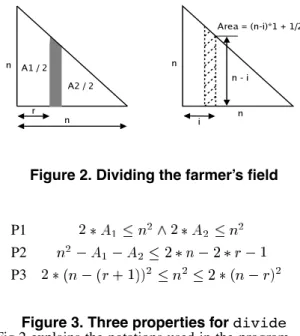
A farmer owns a field that is a rectangular isosceles tri-angle. He wants to divide it into two fields of equal area, following a line that is parallel to a side of the triangle. The division can only be performed by whole numbers of feet and there must be a free strip of width at least one between the two new fields to plant some trees.
Figure 2. Dividing the farmer’s field
P1 P2 P3
Figure 3. Three properties for divide
Fig.2 explains the notations used in the program. Note that areas A1 and A2 correspond to twice the actual areas, in order to avoid non-integer variables.
Three properties (given in Fig.3) describe quite naturally the intended behaviour of the program: (P1) each area must be less than or equal to half the area of the original triangle ; (P2) the splitting error (the overall area minus the sum of the two field areas) is not bigger than a strip of width 1 ; (P3) the theoretical line of splitting is located in the free area. This latter property is stated as follows: the area on the right is less than or equal to half the whole area and this area plus the free zone is bigger than half the whole area.
Such properties and programs, although simple, are in fact representative of more industrial C code and speci-fications, which typically employ multiplication, division, modulo, polynomial expressions, disjunction, negation, and bit-to-bit operations to form non-linear expressions.
Constraint-Based Testing of the divide program may consist in showing that the constraint systems built upon the negation of the properties and any path of the program, is unsatisfiable. Our CBT method first inserts assertions cor-responding to the three properties at the end of the divide program. Then, the program and the assertions are trans-lated into a set of constraints by using the verification con-straints generation process (see Sec.3). Finally, the resulting constraint system is solved with the hybrid constraint solver based on Dynamic Linear Relaxations (see Sec.4.2). On this example, our system automatically shows that no solution exist to the verification constraints1in 10.2s of CPU time on an Intel Pentium M 2Ghz with 1Gb of RAM. Whilst by using classical finite domain constraint solving, as im-plemented within the TAUPO test data generator, checking these nonlinear properties requires 53.3s of CPU time. This corresponds to a speedup of more than 5.
3 Background on Verification Constraints
For the sake of clarity, in the rest of the paper, we will as-sume programs only contain basic statements: integer dec-larations (T x), integer expressions and assignments (x := e), statement sequences ( ), and conditional statements (if(b) else ). We suppose that loops have been elim-inated by replacing them with a given number of condition-als. Dealing with general loops in CBT is possible and has been described elsewhere [10]. We will also assume that properties to check appear in the source code as assertions (assert e). This facilitates our presentation without compro-mising its generality. Programs satisfying these restrictions, although quite simple, suffice to encounter difficulties re-lated to non-linear expressions. Note however that our CBT tool also handles complex C programs that include pointer variables and dynamic structures [12, 5], function calls and floating-point variables [2] but this is outside the scope of the paper.This section briefly describes how to generate
Verifica-tion Constraints (VCs) that are constraints to be solved in
order to get a test case that violates an assertion. When one shows that VCs have no solution then the corresponding as-sertion is satisfied. Note that this process is inspired from the Verification Conditions generation of the weakest pre-condition calculus of E. Diksjtra.
The first step of VCs generation consists in building the static single assignment form [8] of a program. In this equivalent form, each variable is assigned exactly once in the source code. For example, the piece of code
is translated into . A program under static single assignment is free of destructive assign-ments.
The second step consists in generating two sets: and . is a constraints set whose solutions cor-respond to program inputs on which statement either ter-minates normally or violates an assertion. In other words, solutions of correspond to possible executions (nor-mal and erroneous) of the program. is a constraints set whose solutions correspond to program inputs on which execution of violates an assertion. Some of these solu-tions might also not satisfy constraints of and, thus, do not correspond to possible executions of the program. Hence, erroneous executions of a program are those de-scribed by both and . Consequently, a program will be free of assertion violations iff
where denotes the set of integer solutions of a constraint set. On the contrary, any integer solution of
S E(S) V(S)
false false
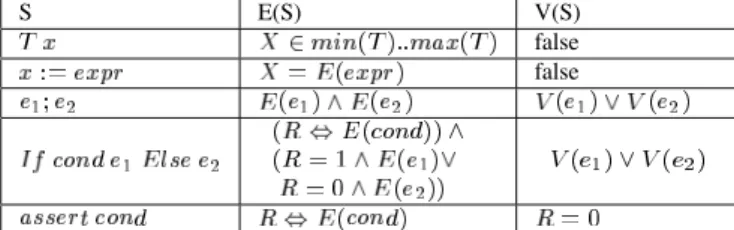
Figure 4. Verification Constraint Generation
will be interpreted as a counter-example of an assertion of the program.
Fig.4 shows how to generate both sets and for the statements of our language. Program variables un-der static single assignment form are translated into math-ematical variables. To distinguish them, we capitalize the mathematical variables on which constraints can be added. A variable declaration is translated into a domain constraint by using its type. For example, the declaration of a signed short integer leads to the constraint
, where denotes all the integers in be-tween and . The generation of and for ex-pressions ( ) and conditions ( ) is trivial so it is left apart to save space. Note that variable declaration and as-signment statements cannot violate any assertion. Hence,
and . A
se-quence of statements leads to generate a conjunction of con-straints in while it leads to generate a disjunction in . Indeed, an assertion is violated in iff it is vi-olated in OR in . For generating and on conditionals and assertions, we use the notion of constraint reification. This process consists in associating a boolean variable to the truth value of a constraint. This is noted where denotes any basic constraint. This process is interesting as it avoids computing explicitly the negation of constraint which can be complex in the presence of non-elementary constraints. Reification deduces informa-tion on both sides: if the reificainforma-tion variable is equal to (resp. ) then is true (resp. false) and then is added to the constraint set while if constraint is shown to be true (resp. false) then (resp. ) is added to the con-straint set. This process helps reasoning on the control flow of the program and on the violation of assertions.
In our approach, we build a hybrid solver based on Finite Domains constraint solving together with Dynamic Linear Relaxations that exploits Linear Programming tech-niques. The following gives a brief overview of these two paradigms.
3.2.1 Local filtering
The fundamental idea in finite domains constraint solving is to prune the domain of the variables by using each con-straint in turn as a filter. By considering a single concon-straint and its associated variables, one can infer that some values of the domains of these variables cannot be part of a solu-tion. For example, consider the constraint with
, and , where denotes
the domain of . As all variables are positive, the following inference rules apply :
(1) (2) (3) Note that inference rules depend on constraint and domains. If variables were not positive, inference rules would be more complicated. Using rule 1, a finite domains solver infers that and, thus, remove values 7 and 8 from . With rule 2 the solver removes from . Rule 3 leads to and thus domains is pruned to , is pruned to , while is pruned to . At this point, the process has reached a fixpoint which is a state where no more value can be removed. Note that local filtering is incomplete in the sense that some values that are not part of a solution are not necessarily removed. In the example, there are no values for and such that .
3.2.2 Constraint propagation
Constraint propagation is the process that permits to deal with conjunction of constraints by propagating domain pruning information through the constraint store. Fig.5 shows a simplified version of the constraint propagation al-gorithm that is used in many finite domains solvers. The algorithm takes as inputs a constraint store and an ini-tial set of domains . Then, it iteratively applies the infer-ence rules associated to each constraint of until a fixpoint is reached. As a result, the algorithm produces a new set of tighter domains such that no more pruning is possi-ble. Note that contains all the solutions of the initial constraint problem. By adding a constraint to the previous example, we get the constraint store
. Domains are unchanged:
. As previously seen, the first constraint
leads to . Then, second
constraint leads to . Applying the first constraint
again leads to which
corresponds to the single solution . Actually, the set of domains that is returned by the propagation algorithm is not necessarily reduced to a single
Input: , a constraint store and a set of domains
Output: such that and propagation(C,D)
repeat
forall do until
return
Figure 5. Constraint propagation algorithm
point. During the propagation, if a domain becomes empty, the constraint store is shown to be unsatisfiable: there is no solution. If the domains are neither empty nor reduced to a single point, one must resort to enumerate all the remain-ing possible values of the domains to find a solution. This process, called labelling, is used to guide the search toward a solution. A variable is arbitrarily labelled to a value from its domain and the constraint is added to the constraint store. Constraint propagation is then restarted. If the constraint store is shown to be unsatisfiable under the hypothesis then is removed from the domain of and another value is tried. This process is repeated until either all the variables are labelled (a solution is found) or the domain of one variable becomes empty which shows the unsatisfiability of the constraint store.
Linear Programming encompasses a set of techniques aiming at finding the optimal value of a linear expression in-volving variables constrained by linear inequations [23]. A linear program is as follows : under the con-straints where is a (m,n)-matrix of values over . is a vector of (rational) variables and is a vector of rational values. is a linear expression with coefficients in . Though it has an exponential worst case complexity, the simplex algorithm is commonly used to solve linear pro-grams as it performs well in practice. Note that satisfiability of a set of linear constraints can also be decided using the simplex as its first step aims at finding a solution to the linear inequations [23].
4 Solving the Verification Constraints
In this section, we focus on how to efficiently solve veri-fication constraints generated from a program and a prop-erty to be checked. It is worth noticing that even if fi-nite domains constraint propagation handles non-linear con-straints, it behaves poorly on some trivial linear problems.
We start by giving such an example. Consider the following program:
VC generation for program gives:
Solving leads to solve
with . Unfortunately, in this example, constraint propagation without labelling does not remove any value from the domains. Thus, one must resort to enumerate all values from the domain of one variable before concluding that the constraint system is unsatisfiable and the assertion is verified.
In CBT problems, variable domains are potentially very large and constraint systems often have a few solutions only. This means that labelling has to be avoided as much as pos-sible. Consequently, we suggest enriching constraint prop-agation with more precise deduction rules, by propagating also linear relationships among the variables.
The principle of Linear Relaxation is to generate a lin-ear program over rationals that encapsulates all the solu-tions of a nonlinear problem over integers [17]. In this tech-nique, each nonlinear constraint is decomposed in binary or ternary constraints by introducing additional temporary variables. Then, each basic constraint over integers is over-approximated with linear inequalities over rationals by tak-ing the variation domain of variables into account. As a result, the unsatisfiability of the linear program over ratio-nals implies the unsatisfiability of the nonlinear constraints over integers.
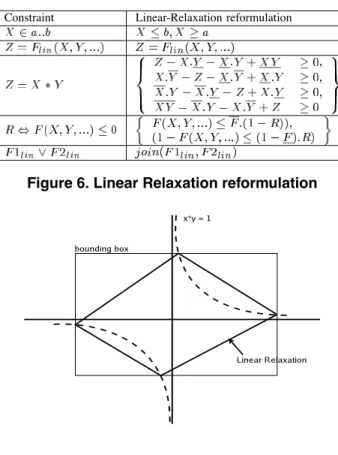
In our framework, we tuned the Linear Relaxation tech-nique to deal with the Verification Constraints. Fig.6 de-scribes the Linear relaxation of some basic constraints that are encountered in the VCs. In the Figure, denotes the lowest integer value of while denotes its greatest integer value. Constraints on the left column of the array hold over integers while constraints on the right column hold over .
Constraint Linear-Relaxation reformulation
Figure 6. Linear Relaxation reformulation
Figure 7. Relaxation of multiplication
4.1.1 Handling multiplication
The formula of Fig.6 for multiplication directly follows from the four following trivial inequalities:
In [1], it is proved that these inequalities are the smallest linear relaxation of . Fig.7 shows a slice of the relaxation where . Here, the rectangle corresponds to the bounding box of variables and , the dashed curve represents exactly , while the four solid lines correspond to the inequalities of the relaxation.
4.1.2 Handling division, modulo and logical operators
Expressions built on division and modulo that are found in the VCs can be treated with the Linear Relaxation reformu-lation of the multiplication. The constraint
Similarly, where denotes the Euclidian remainder rewrites to
We applied the same principle for logical operators by studying the semantics of operators of the C programming language. The constraint where denotes the “logical and” operator rewrites to
The constraint where denotes “logical or” rewrites to
while ˜ where ˜denotes “logical not” rewrites2to
4.1.3 Handling reification
As said previously, reified constraint associates a boolean variable to the truth value of a constraint . Without any loss of generality, let suppose that is of the form and the function is bounded3, meaning
that there exist and such that
. Then rewrites to the conjunction
For example, consider the constraint , then
, , , and the
reified constraint rewrites to
Note that these inequations are interpreted over . As a consequence, the boolean variable is interpreted as a ra-tional over the continuous set . Hence, as already said, the set of solutions of these constraints (over-) approximates only the solutions over integers.
4.1.4 Handling disjunctions
We use a special constraint for disjunctions that was first introduced in [10]. The principle of this constraint is to prove that one of the two disjuncts is unsatisfiable with the rest of the constraints and, thus, replace the overall disjunc-tion by the other disjunct. When this case-based reason-ing fails, the union of domains is computed. For example,
2In C, any non-null integer value is understood as true 3We consider finite domains and continuous functions only
from the disjunctive constraint with
domains , if one cannot
prove that one of the disjunct is implied by current infor-mation in the constraint store then it is easy to deduce that
.
In our framework, we propose to extend the union prin-ciple with linear relations. For example, considering
with domains we
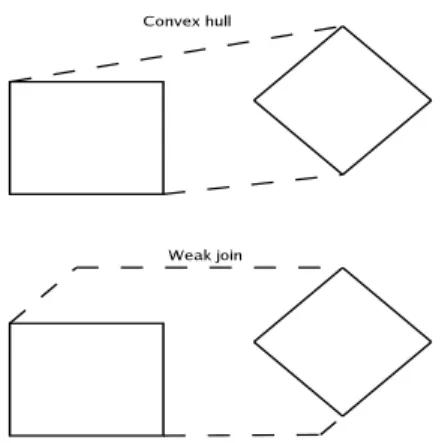
deduce that while the above reason-ing over domains would not have deduce anythreason-ing new on the domains. The smallest linear relaxation of the disjunc-tion of two linear inequadisjunc-tions subsets is the convex hull of the corresponding polyhedra. Unfortunately, computing the convex hull of two polyhedra when they are given under the form of inequations is exponential in the number of dimen-sions of the polydra. Consequently, as originally proposed in the Abstract Interpretation community [20], we compute only an (over-)approximation of the convex hull by using a special operator called the weak-join operator. Roughly speaking, the weak-join of two sets of inequations consists in 1) enlarging the first polyhedron without changing the slope of the lines until it encloses the second polyhedron ; 2) enlarging the second polyhedron in the same way ; 3) returning the intersection of these two new sets of inequa-tions. Fig.8 shows the difference between the convex hull and the weak join of two polyhedra and . Formally, let be the set of inequations that appear in or in . Let suppose that each inequation in is of the form where is a vector of coefficients, is a vector of variables and is a rational number. For each inequation in do
denotes a call to the simplex algo-rithm that computes the maximum value of expression
under the linear constraints . Then,
. Based on the simplex, this algorithm performs well in practice.
Previous section presented the notion of linear relaxation within a bounding box. Here, we describe how to integrate these linear relaxations within the constraint propagation process through Dynamic Linear Relaxations (DLRs). The term “dynamic” is justified by the fact that linear relaxations depend on domains that are refined during the constraint solving process.
Figure 8. Weak Join vs Convex Hull
4.2.1 Constraint propagation with DLRs
As shown previously, the linear relaxations we consider are over-approximations of binary or ternary constraints com-puted with the current domains of variables. These linear relaxations are then considered by a dedicated linear solver based on the simplex. As a first result, the linear solver can sometimes report on the detection of inconsistency of the original nonlinear problem. Unlike constraint propagation, the linear solver is complete with respect to inconsistency detection, meaning that if the relaxed linear program is in-consistent then this will be discovered. In this case, the non-linear constraint system is shown to have no solution mean-ing that the correspondmean-ing assertion is verified. Recall that our primary goal is to avoid as much as possible the costly enumeration step to prove inconsistency.
Fig.9 shows the fixpoint algorithm that combines con-straint propagation and DLRs. Function DLR(C,D’) calls the dedicated linear solver and tests the satisfiability of the relaxed linear problem. When the relaxed linear problem contains solutions, one can still benefit from the simplex-based linear solver to prune the variation domains of vari-ables. This process, called enclose, projects the current polyhedron over each variable and compares the resulting domain with the current domain of variable, as explained below.
4.2.2 The enclose process
The enclose process computes an integer bounding box that includes all the integer solutions of the linear relaxed prob-lem. The box can also include integer points that are no part of the polyhedron, as shown in Fig.10.
Fig.11 details the algorithm of the process. This algorithm performs two calls to the simplex algorithm per variable appearing in the linear relaxation, one call for each bound. Then, it prunes the current domain of variable by
Input: a constraint store and a set of domains
Output: such that and propagation DLR(C,D)
repeat
until return
Figure 9. Constraint propagation with DLRs
Figure 10. The process: the grey box contains all the integer points inside the polyhedron
updating its (rational) bounds. Finally, integer rounding shaves the domain to fit with integer solutions only. For ex-ample, if a call to the simplex returns as an upper bound for , then variable has to be lower or equal to . The al-gorithm of Fig.9 computes a fixpoint by successively apply-ing constraint propagation and domain prunapply-ing via DLRs. We describe this process on the following example.
VC generation for gives:
For the sake of simplicity, suppose that the domains of variables , and have been pruned to . The same reasoning applies if one keeps the original domains. When solving , constraint propagation leads to
and by using
Input:
, a set of linear inequalities
Output:
A set of integer intervals defining an hypercube that contains all the integer solutions of
enclose( )
forall do
;
Figure 11. Algorithm for the process
leads to:
The enclose process prunes the domains of and to while keeping . Then, con-straint propagation is restarted and leads to
. A more precise linear relaxation is built, taking into account these new domains and the process de-duces . Then, constraint propagation is restarted and leads to . Finally, the linear relaxation is built on these domains and detects inconsis-tency of the linear relaxation problem. On this example, this is only the combination of constraint propagation and DLRs that shows the inconsistency of the constraint system. As a result, the assertion is shown to be satisfied.
5 Experimental results
We implemented DLRs within the test data generator TAUPO. This tool implements a technique originating from the INKA test data generator [10]. TAUPO handles a non-trivial subset of the C programming language, including floating point numbers [2], pointer variables [11], function calls, dynamic structures. But, the tool does not currently handle unconstrained pointer arithmetic, function pointers, and non-trivial type casting.
Firstly, TAUPO translates a C program into static sin-gle assignment form. In addition, this process normalizes the expressions in 3-addresses code and associates boolean variables to the truth value of conditions (reification). Sec-ondly, the tool generates the Verification Conditions from
the code annotated with the assertions that come from prop-erties, as described in Sec. 3.1. TAUPO exploits the follow-ing constraint libraries:
1. the clpfd library of Sicstus Prolog [4] which imple-ments a finite domains constraint solver ;
2. the clpq library [14] that implements a linear program-ming solver based on simplex.
We made the two solvers cooperate by implementing our own constraint propagation queue and by building a dedi-cated constraint propagation solver.
For our experiments, we selected several programs from the literature and compared our implementation with and without DLRs. All the results have been computed using an Intel Pentium M 2Ghz with 1Gb of RAM.
Tritype
The first program is the Tritype program, which comes from the Software Testing folklore. An implementa-tion of this program can be found in [6]. The program takes three unsigned short integers as input and checks whether these three numbers can be interpreted as the lengths of the sides of an isoscele, an equilateral or a scalene triangle. Al-though quite simple, this program is considered as difficult to analyze as it contains many non-feasible paths (more than forty over fifty-seven). Moreover, it contains many nested conditionals and disjunctions that both introduce non-linear constraints. We evaluated our approach based on DLRs by checking several assertions extracted from [6]. We describe our results for the following:
((i+j <= k)||(j+k<=i)||(i+k<=j))
==> result == 4 !((i+j <= k)||(j+k<=i)||(i+k<=j)) &&
(i==j) && (j==k) ==> result == 3 The first property states that when the three inputs , and
verify the condition, the corresponding figure is not a tri-angle while the second states that the tritri-angle is equilat-eral. Checking these properties with TAUPO (with DLRs) requires 5sec of CPU time for the first and 0.5s of CPU time for the second while it requires more than 10 min of CPU time if one disconnects the DLRs in TAUPO. Thanks to the DLRs, the properties are checked without launching any enumeration step, which explains this remarkable re-sult.
product
The second program implements the function:
and non-linear expressions (multiplication over variables). We exploited TAUPO to show that the program returns only non-negative values. Using DLRs, this check requires less than 0.3sec of CPU time. Indeed, DLRs infer that each ab-solute value is positive and, thus, that the product is also positive. Without DLR no such information are deduced during constraint propagation and a costly enumeration step is required. For domains restricted to , the enumer-ation step takes 192 sec. Note that the enumerenumer-ation pro-cess requires a time proportional to the size of the domain whereas the deductions performed with DLRs are indepen-dent from this size. Thus, on this example, the benefits of DLRs can be made as important as desired and we limited our experience to a small domain for . Although quite sim-ple, this experience validates the idea presented in this pa-per: relaxing non-linear constraints can drastically speed up the constraint solving process in the context of Constraint-Based Testing.
divide
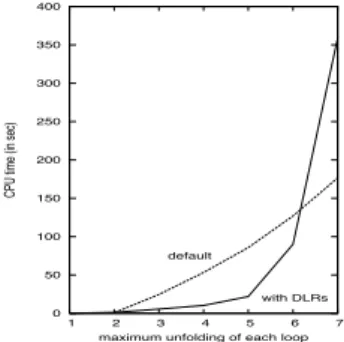
Our third example is the divide program shown in Fig. 1. Fig. 12 presents the total CPU time required for checking the three properties given in the first section of the paper (see Fig. 3) in function of the maximum number of loop unfolding. Recall that this parameter corresponds to the conversion of while loops into conditionals. In both
0 50 100 150 200 250 300 350 400 1 2 3 4 5 6 7
CPU time (in sec)
maximum unfolding of each loop with DLRs default
Figure 12. CPU time required for the divide program
cases of this example, the CPU time required to detect in-consistency is exponential w.r.t. the number of loop unfold-ing. From the value , the overhead introduced by the com-putations of DLRs makes the approach less interesting. But, for smallest values of this parameter, the tight overhead is undoubtly rewarded by the gain it makes on deductions dur-ing constraint propagation.
with DLRs with enumeration 0.15s 0.05s
0.81s 1.39s 1.91s 5.53s 24.8s 138s
Table 1. Execution time of the solving pro-cess in presence of a slow convergence
The algorithm presented on Figure 9 implements a fix point computation that interleaves calls to the simplex algo-rithm with classic propagation. On some examples, a slow convergence phenomenon appears. For example, consider the code
and the following Verification Constraints are
. Suppose that variables and are in the domain and that and have domains corre-sponding to the int type. With these domains, constraint propagation does not prune the domain of and . On the contrary, when we compute the linear relaxations of these constraints and call function , and are re-duced to . If we recomputed the approxima-tion and recall funcapproxima-tion , domains are reduced to . And this phenomenon continues until domains become empty. This examples exhibits a slow convergence phenomenon that can compromise the interest of DLRs on some specific cases. However, without the DLRs a full enu-meration of the domain of is required to detect the in-consistency of the system. Table 1 shows the CPU time re-quired to detect the inconsistency in function of the interval
in both cases.
6 Conclusion
In this paper, we introduced Dynamic Linear Relax-ations (DLRs) as an improvement of constraint propaga-tion in Constraint-Based Testing techniques. We showed that DLRs boost our current implementation called TAUPO on several programs extracted from the literature. We also pointed out that our approach could be responsible of a slow convergence phenomenon. DLRs are general and could be integrated within other Constraint-Based Testing tools. The price to pay is a tight overhead that is rewarded by more precise deductions during constraint propagation.
References
[1] F. A. Al-Khayyal and J. E. Falk. Jointly constrained bi-convex programming. Mathematics if Operations Research,
8(2):273–286, 1983.
[2] B. Botella, A. Gotlieb, and C. Michel. Symbolic execution of floating-point computations. The Software Testing,
Verifi-cation and Reliability journal, 16(2):pp 97–121, June 2006.
[3] M. D. C. Pasareanu and W. Visser. Finding feasible abstract counter-examples. International Journal on Software Tools
for Technology Transfer, 5(1), 2003.
[4] M. Carlsson, G. Ottosson, and B. Carlson. An open–ended finite domain constraint solver. In Proc. of Programming
Languages: Implementations, Logics, and Programs, 1997.
[5] F. Charreteur, B. Botella, and A. Gotlieb. Modelling dy-namic memory management in constraint-based testing. In
AIC-PART (Testing: Academic and Industrial Conference),
Windsor, UK, Sep. 2007.
[6] H. Collavizza and M. Rueher. Exploration of the capabili-ties of constraint programming for software verification. In
Tools and Algorithms for the Construction and Analysis of Systems (TACAS’06), pages 182–196, 2006.
[7] P. Cousot and N. Halbwachs. Automatic discovery of linear restraints among variables of a program. In Proceedings of
Symp. on Principles of Programming Languages, pages 84–
96. ACM, 1978.
[8] R. Cytron, J. Ferrante, B. Rosen, M. Wegman, and F. Zadeck. Efficently computing static single assignment form and the control dependence graph. ACM
Transac-tions on Programming Language and Systems, 13(4):451–
490, Oct. 1991.
[9] R. DeMillo and J. Offut. Constraint-based automatic test data generation. IEEE Transactions on Software
Engineer-ing, 17(9):900–910, September 1991.
[10] A. Gotlieb, B. Botella, and M. Rueher. Automatic test data generation using constraint solving techniques. In Proc. of
ISSTA’98, pages 53–62, Clearwater Beach, FL, USA, March
1998.
[11] A. Gotlieb, T. Denmat, and B. Botella. Constraint-based test data generation in the presence of stack-directed point-ers. In 20th IEEE/ACM International Conference on
Au-tomated Software Engineering (ASE’05), Long Beach, CA,
USA, Nov. 2005. 4 pages.
[12] A. Gotlieb, T. Denmat, and B. Botella. Goal-oriented test data generation for pointer programs. Information and
Soft-ware Technology, 49(9-10):1030–1044, Sep. 2007.
[13] N. Gupta, A. Mathur, and M. Soffa. Automated Test Data Generation Using An Iterative Relaxation Method. In
Foun-dations on Software Engineering, Orlando, FL, Nov. 1998.
ACM.
[14] C. Holzbaur. OFAI clp(q,r) Manual. Austrian Research In-stitutefor Artificial Intelligence, Vienna, 1.3.3 edition. [15] D. Jackson and M. Vaziri. Finding bugs with a constraint
solver. In Proc. of ISSTA’00, pages 14–25, 2000.
[16] D. Lewin, L. Fournier, M. Levinger, E. Roytman, and G. Shurek. Constraint satisfaction for test program gener-ation. In IEEE International Phoenix Conference on
Com-munication and Computers, 1995, 1995.
[17] G. P. McCormick. Computability of global solutions to fac-torable nonconvex programs: Part 1 - convex underestimat-ing problems. Mathematical Programmunderestimat-ing, 10:147–175, 1976.
[18] C. Meudec. ATGen: automatic test data generation using constraint logic programming and symbolic execution.
Soft-ware Testing, Verification and Reliability, 11(2):81–96, June
2001.
[19] P. M. N. Williams, B. Marre and M. Roger. Pathcrawler: Automatic generation of path tests by combining static and dynamic analysis. In In Proc. Dependable Computing
-EDCC’05, pages 281–292, 2005.
[20] S. Sankaranarayanan, M. A. Col`on, H. Sipma, and Z. Manna. Efficient strongly relational polyhedral analysis. In Proc. of VMCAI’06, pages 115–125, 2006.
[21] B. Seljimi and I. Parissis. Using clp to automatically gener-ate test sequences for synchronous programs with numeric inputs and outputs. In Proc. of ISSRE’06, pages 105–116, 2006.
[22] K. Sen, D. Marinov, and G. Agha. Cute: a concolic unit testing engine for c. In Proc. of ESEC/FSE-13, pages 263– 272. ACM Press, 2005.
[23] G. Sierksma. Linear and Integer Programming. Dekker, 1996.
[24] S. Visvanathan and N. Gupta. Generating test data for func-tions with pointer inputs. In Proceedings of the 17th IEEE
Int. Conf. on Automated Software Engineering (ASE’02),