AI for energy: a bright and uncertain future ahead
“Recent” changes in AI: 1. Deep neural nets
A deep-learning neural network (DNN) is an artificial neural network (ANN) with multiple layers between the input and output layers. No universally agreed upon threshold of depth separates shallow learning from deep learning, but most researchers agree that deep learning involves a chain of transformations from input to output higher than 2.
1. Outperform supervised learning algorithms but more tuning is often
necessary as well as much higher computational costs for training.
2. Dedicated hardware architectures have been developed for training
and executing those networks (e.g., GPU networks).
3. Open-source software libraries for designing and training DNNs are
available and very well created. The most popular ones include:
Examples of Photorealistic GAN-Generated Faces.Taken from Progressive Growing of GANs for Improved Quality, Stability, and Variation, 2017
Left: The architecture of a GAN used for a wind/solar generation scenario.
Below: Generated scenarios versus real-life ones.
Agent
Environment
state
reward
action
numerical value
Lee Sedol, is a former South Korean professional Go player with a 9 dan ranking.
He was defeated by the computer program AlphaGo (based on RL algorithms combined with DNN) in a series in March 2016.
On 19 November 2019, Lee announced his retirement from professional play as artificial intelligence had created an opponent that "cannot be defeated."
The battery
controller
State: (i) the battery
level (ii)
Everything you know
about the market
Reward: The money
you make during the
market period.
The battery setting
for the next market
period.
+ the energy
market
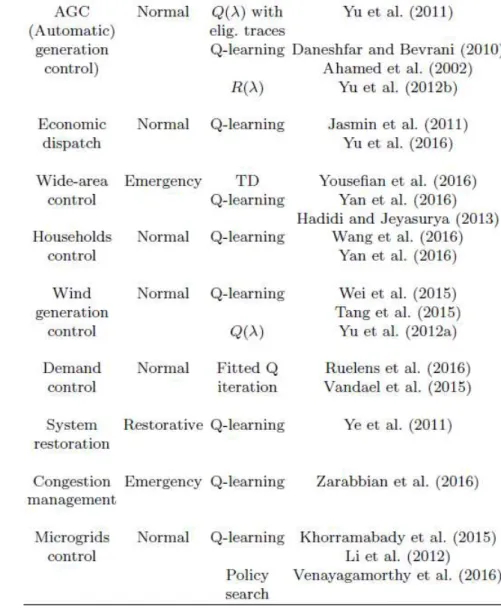
Table taken from: “Reinforcement Learning for Electric Power System Decision and Control: Past Considerations and Perspectives”. M. Glavic, R. Fonteneau and D. Ernst. Proceedings of the 20thIFAC World Congress.
Learning:
Exploration/exploitation: Do not
always take the action that is believed
to be optimal to allow exploration.
Generalisation: Generalise the
experience gained in certain states
to other states.
Learning phase
Effect of the resulting control policy
First control law for stabilizing power systems every computed using reinforcement learning. More at: “Reinforcement Learning Versus Model Predictive Control: A Comparison on a Power System Problem”. D. Ernst, M. Glavic, F.Capitanescu, and L. Wehenkel. IEEE Transactions on Syestems, Man, An Cybernetics—PART B: Cybernetics, Vol. 39, No. 2, April 2009.
RL for trading flexibility in the intraday market
Taken from: “A Deep Reinforcement Learning Framework for Continuous Intraday Market Bidding”. Ioannis Boukas et al., 2020.
Very complex decision-making problem.
Good results could be obtained by using the RL
Fitted Q Iteration algorithm (FQI) combined with
DNNs.
Trajectories generated artificially on the order the
book.
1.5% increase in profit!
“A critical present objective is to develop deep RL
methods that that can adapt rapidly to new tasks.”
Synaptic
plasticity
modulation
Neuro-Walking: a meta-RL problem solved
through synaptic plasticity and
Classical architecture for solving meta-RL problems:
Benchmark description: The RL agent has to navigate on a plane to reach the blue target that leads to high rewards. The environments differ through the positions of the target.
Results: Blue curve represents the neuromodulated neural net. Orange curve represents the classical
What types of power system problems can one resolve with machine learning?
We could potentially address them all, but I fear that the power system community will not address many of them in the future. Why? Because the power system community will never be able to attract enough bright
machine-learning scientists who prefer the high-paying salaries of major companies and corporations (e.g., Facebook, Google) or working on
problems related to robotics that they believe are ‘fancier’. The power
system community should therefore scale back its ambitions to build a very intelligent grid and focus on the building of grids which do not require a lot of intelligence to be effectively operated.