HAL Id: hal-02471152
https://hal.archives-ouvertes.fr/hal-02471152
Submitted on 7 Feb 2020
HAL is a multi-disciplinary open access
archive for the deposit and dissemination of sci-entific research documents, whether they are pub-lished or not. The documents may come from teaching and research institutions in France or abroad, or from public or private research centers.
L’archive ouverte pluridisciplinaire HAL, est destinée au dépôt et à la diffusion de documents scientifiques de niveau recherche, publiés ou non, émanant des établissements d’enseignement et de recherche français ou étrangers, des laboratoires publics ou privés.
Phase-locking and delay-induced instabilities in a
dual-frequency fiber laser
Marie Guionie, Aurélien Thorette, Marco Romanelli, Anthony Carré,
Goulc’Hen Loas, Emmanuel Pinsard, Laurent Lablonde, Benoît Cadier, Mehdi
Alouini, Marc Vallet, et al.
To cite this version:
Marie Guionie, Aurélien Thorette, Marco Romanelli, Anthony Carré, Goulc’Hen Loas, et al.. Phase-locking and delay-induced instabilities in a dual- frequency fiber laser. International Symposium on Physics and Applications of Laser Dynamics 2019 (IS-PALD 2019), Nov 2019, Metz, France. �hal-02471152�
Phase-locking and delay-induced instabilities in a
dual-frequency fiber laser
M. Guionie,1 A. Thorette,1 M. Romanelli,1* A. Carré,1 G. Loas,1 E. Pinsard,2 L. Lablonde,2 B. Cadier,2 M. Alouini,1 M. Vallet,1 and M. Brunel1
1 Univ Rennes, CNRS, Institut FOTON UMR 6082, F-35000 Rennes, France 2 iXblue Photonics, F-22300 Lannion, France
*corresponding author: [email protected]
Abstract We show that the polarization modes of a dual-frequency fiber laser can be efficiently phase-locked using optical frequency-shifted feedback, leading to a stable optically-carried microwave clock signal. We also show that a delay-induced instability, characterized by periodic pulses in the envelope of the beat-note signal, takes place inside the phase-locking range. This observation agrees with the prediction of a delayed rate equation model.
Dual-frequency fiber lasers (DFFL) are attractive thanks to their compactness, ruggedness, and ease of integration. In particular, they are attractive sources for microwave photonics. Indeed, because of the birefringence induced by the UV photo-inscription of the Bragg gratings, these lasers can oscillate on two polarization modes with a frequency splitting in the GHz range.. This produces RF beatings in the emitted optical power having a good spectral purity (typically the instantaneous linewidth of the RF beat signal is of a few kHz in the free-running regime).
For applications such as the generation and distribution of a clock signal, further stabilization of the beating is mandatory. We have shown recently that it can be obtained with an optical phase-locked-loop using the pump power as an actuator [1]. In this contribution, we present another locking scheme, namely a passive scheme (in the sense that no active electronic control is required) based on optical feedback and taking advantage of the laser synchronization dynamics.
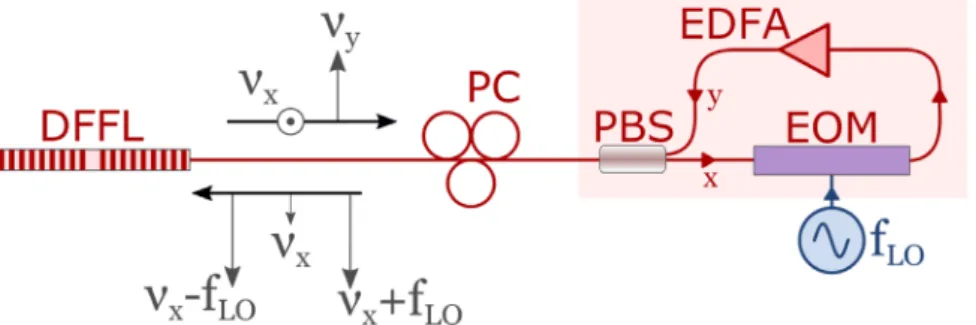
Figure 1: Frequency-shifted feedback scheme. Modulation sideband fed back at νx + fLO interacts with νy mode
The experimental setup is sketched in Fig.1. The DFFL is a 33 mm-long Er3+-doped fiber into which phase-shifted Bragg grating was photo-induced. The intensity transmission coefficients of the resulting mirrors are estimated to be –34 dB and –57 dB, respectively. The laser is pumped at 976 nm through a pump/signal combiner (not shown in the Figure), and emits at 1547 nm two orthogonally-polarized fields at frequencies νx and νy, with a total output power of about 100 µW. The frequency difference is measured to be close to 1 GHz. The optical feedback loop is composed of a polarization controller (PC), a fibered polarization-maintaining polarizing beam splitter (PBS), an electro-optical modulator (EOM), and an erbium-doped fiber amplifier (EDFA). The EOM is driven by a low-noise microwave synthesizer oscillating at the frequency fLO, such that the sideband at frequency νx + fLO is almost resonant with the νy mode. Under suitable conditions, the νy mode locks to the optically injected sideband; as a result, the beating at frequency νy– νx locks to the master oscillator signal at frequency fLO.
We have observed that such a passive locking scheme produces robust phase-locking, with a large locking range (typically around 4 MHz). The width of the locking range is such that phase-locking is maintained over several days in a laboratory environment. The phase-locked beating has a sub-Hz linewidth; its phase noise is limited at low frequency by the phase noise of the master oscillator, and the measured phase noise level was –104 dBc/Hz at 1 kHz offset from the 1 GHz carrier.
Furthermore, we have found that a dynamical instability takes place in this system. As shown in Fig. 2, it is experimentally found that for small, positive detunings, the amplitude of the RF oscillations is no longer constant: strong amplitude modulation develops, resulting in periodic self-pulsing of the envelope of the RF signal. A noticeable feature of this instability is that it occurs inside the phase-locking range: as the detuning between the master oscillator and the natural beating frequency is further increased, phase-locking is recovered. These features are well reproduced by a delayed rate-equation model [2]. The numerical analysis indicates that the time delay associated to the feedback loop, even if it is small compared to the laser intrinsic timescale, is essential in inducing the bifurcation to the self-pulsing regime. Furthermore, the Henry α factor [2] must also be taken into account, as is suggested by the asymmetric behaviour with respect to the detuning.
Figure 2: (a) Experimental spectrogram of the RF beating. The frequency fLO of the local oscillator is scanned from 1.012
GHz to 1.018 GHz. The frequency of the free-running beating is slightly below 1.015 GHz. (b) Corresponding numerical simulation. The free-running beating is shifted to 6 MHz for convenience. (c) Periodic self-pulsing of the beat-note envelope occurring in the instability region (numerical simulation).
In conclusion, we have demonstrated that a stabilization loop based on frequency-shifted optical feedback is effective in order to lock a DFFL on an external local oscillator, thus achieving a high-spectral purity optically-carried microwave clock. Perspectives for future works include scaling the device to higher carrier frequencies, with or without an external oscillator. We have also shown that an interesting dynamical instability takes place inside the phase-locking range. The analysis of this instability needs to be refined, for instance by analyzing the role of noise.
The authors acknowledge the financial support of DGA (ANR-16-ASTR-0016), and of Région Bretagne, FEDER, Rennes Metropole (CPER SOPHIE-Photonique).
References
[1] M. Guionie et al., “Beat note stabilization in dual-polarization DFB fiber lasers by an optical phase-locked loop”, Opt. Express 26, 3483-3488 (2018).
[2] A. Thorette et al., “Linewidth enhancement factor measurement based on FM-modulated optical injection: application to rare-earth-doped active medium”, Opt. Lett. 42, 1480-1483 (2017).