
SF2A 2007
J. Bouvier, A. Chalabaev, C. Charbonnel (eds)
SEISMIC STUDY OF THE ALPHA CENTAURI BINARY SYSTEM USING THE
MINIMISATIONALGORITHM OF LEVENBERG-MARQUARTH.
N. Ozel
1, M.-A. Dupret and A. Baglin
Abstract.
Thanks to the CoRoT mission, we are going to get seismic data of very high precision for many stars. Throughout the method of asteroseismology these data will allow us to constrain the physical description of stellar interiors with unprecedented precision. In this context, we have developed a general tool which allows us to find stellar models fitting a set of seismic constraints (the oscillations frequencies) and non-seismic constraints (e.g. the luminosity, the effective temperature, ...). This tool follows the algorithm of Levenberg-Marquarth which seeks the fundamental parameters of the stellar model (e.g. the mass, the age, the helium abundance, the mixing-length parameter,. . .). We apply it to a specific case: the α Cen binary system. Taking into account all observational constraints available for this binary system, we succeed to find models entering between the one or two sigma error box of the observational constraints.
1 Introduction
In the framework of asteroseismology and in particular of CoRoT, we aim to improve our physical knowledge of stellar interiors. To achieve this goal, tools allowing to exploit all the seismic informations are needed. Because of the number of informations and free parameters, the search of the best model best reproducing the observational constraints must be made in an automatic way. We present briefly a tool that we have developed to achieve this goal in Sect. 2. Next, we apply it as a test case to the α Cen system. In Sect. 3 we present the observations used in our study. The physics included in the stellar evolution code is summarized in Sect. 4. And finally, the results of the χ2minimization obtained for different set of seismic and non-seismic observations
are presented in Sect. 5.
2 The Levenberg-Marquarth Algorithm
The Levenberg-Marquarth algorithm is a method allowing us to minimize a general χ2of the form :
χ2= N ! i=1 (yth,i− yobs,i)2 σ2 (2.1)
This algorithm is a compromise of the two well known Method of Newton and of the Steepest Descent. By an iterative procedure, this algorithm determines the values of the parameters which minimize the χ2. As
one approches the solution, the algorithm is close to the Newton Method. When the convergence towards the solution is more difficult it behaves more like the Steepest Descent Method. The algoritm proceeds by iteration until it reaches the minimum of the multidimensional χ2 function.
3 Application to α Cen
Due to the binarity of the α Cen system, its proximity, and the detection of solar-like oscillation in both components which yield a precise determination of the fundamental parameters, it provides a unique opportunity to test our physical assumptions on the stellar evolution, as shown by different seismic studies ( Eggenberger et al. 2004; Miglio & Montalb´an 2005). The algorithm and the study presented in this paper are very similar to the one of Miglio & Montalb´an (2005), allowing us to test and compare our tools and physical assumptions.
1 Observatoire de Paris, CNRS UMR 8109, 92195 Meudon, France
c
2 SF2A 2007
3.1 Observations
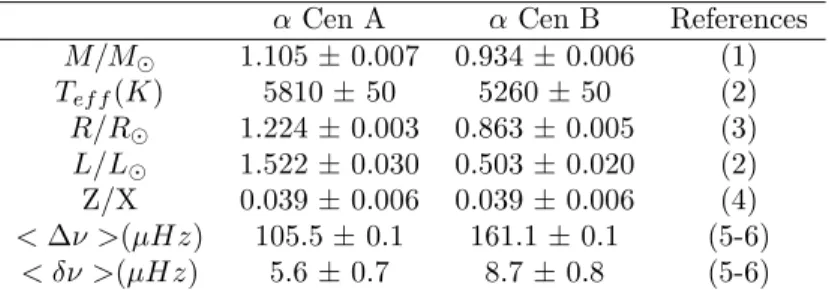
Many seismic and non-seismic observations of the α Cen binary system have been performed. The observations used as constraints in our study are summarized in Table 1. The oscillation spectrum shows a regular pattern in which appear two well known separations: the large separation (∆νn,!= νn,!− νn−1,!) and the small separation
(δνn,!= νn,!− νn−1,!+2)
Table 1. Observational constraints for α Cen A and B. References: (1) Analysis of the binary system by Pourbaix et al. (2002), (2) Compromise between different calibrations proposed by Eggenberger et al. (2004), (3) Interferometric determination of the radii by Kervella et al. (2003), (4) spectroscopic determination of the metallicity by Neuforge & Magain (1997), (5) and (6) Mean values of ∆ν and δν deduced from the frequencies detected by Bouchy & Carrier (2002) (A component) and Carrier & Bourban (2003) (B component).
α Cen A α Cen B References M/M" 1.105 ± 0.007 0.934 ± 0.006 (1) Tef f(K) 5810 ± 50 5260 ± 50 (2) R/R" 1.224 ± 0.003 0.863 ± 0.005 (3) L/L" 1.522 ± 0.030 0.503 ± 0.020 (2) Z/X 0.039 ± 0.006 0.039 ± 0.006 (4) < ∆ν >(µHz) 105.5 ± 0.1 161.1 ± 0.1 (5-6) < δν >(µHz) 5.6 ± 0.7 8.7 ± 0.8 (5-6)
3.2 Stellar models and oscillation code
The stellar models used in our study were computed with the stellar evolution code CESAM (Morel 1997). The models are initialized at the homogeneous ZAMS. The physics adopted here is the following: standard MLT for convection calculations (B¨ohm-Vitense 1958), the OPAL opacities (Iglesias & Rogers 1996) completed at low temperatures with the opacities of Alexander & Ferguson (1994), the OPAL equation of state, and Eddington atmospheres as boundary conditions and no microscopic diffusion. A standard adiabatic pulsation code (Boury et al. 1975) is used for the computation of the theoretical oscillation frequencies of each model. In comparison, Miglio & Montalb´an (2005) used the code CLES (Code Li´egeois d’Evolution Stellaire). A detailed comparison between the two codes was performed in the framework of ESTA (Montalb´an et al., in press) which shows that with the same physical prescription the models are very close. Small differences originate mainly from the interpolation of opacity tables. In some of their calibrations, they use the same opacity tables, equation of state, and treatment of convection, including or not diffusion. They used Kurucz atmosphere models and initialized their models on the Hayashi line.
3.3 Results
We performed different calibrations of the two components of the α Cen system, assuming that they have the same age and the same chemical composition. These calibrations differ in the choice of the observables and free parameters included in the χ2 fitting function, allowing us to determine the sensitivity and the importance of
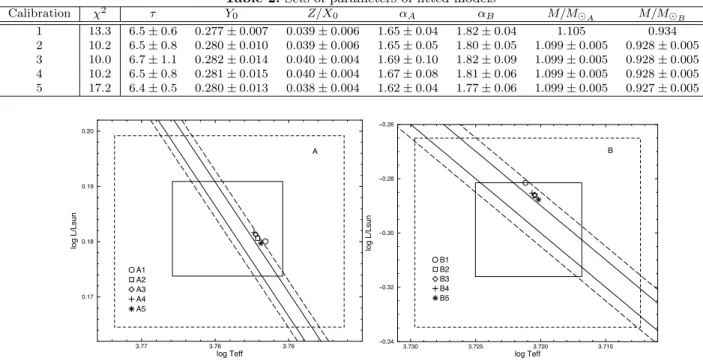
each of them. In Table 2 we list all the fitted parameters with standart confidence interval for five different calibrations of the binary system α Cen. A first calibration was performed including in the χ2 function the
luminosity, the radii as well as the average large and small frequency separations for each component (M and Z/X are fixed to the observed values). In the calibrations 2 to 5, the masses were considered both as parameter and constraint (with the error bars of Table 1). The readjustment of parameters leads to a decrease of the masses of A and B of 1 σ smaller than the observations. This permits to obtain slightly smaller radii (closer to the observed one) while preserving the large separation value (∆ν ∝ (M/R3)1/2). In the calibrations 3 to
5, Z/X was considered both as parameter and constraint (with the error bars of Table 1). While the mass and the effective temperature of α Cen A are close to solar ones, the chemical composition is different from the solar one and the evolution of a convective is not necessarily the same. Furthermore, the mass of α Cen A lies very close to the boundary between models with and without a convective core. In this context, we have
Seismic Study of the Alpha Centauri Binary System 3
Table 2. Sets of parameters of fitted models
Calibration χ2 τ Y 0 Z/X0 αA αB M/M!A M/M!B 1 13.3 6.5± 0.6 0.277± 0.007 0.039± 0.006 1.65± 0.04 1.82± 0.04 1.105 0.934 2 10.2 6.5± 0.8 0.280± 0.010 0.039± 0.006 1.65± 0.05 1.80± 0.05 1.099± 0.005 0.928± 0.005 3 10.0 6.7± 1.1 0.282± 0.014 0.040± 0.004 1.69± 0.10 1.82± 0.09 1.099± 0.005 0.928± 0.005 4 10.2 6.5± 0.8 0.281± 0.015 0.040± 0.004 1.67± 0.08 1.81± 0.06 1.099± 0.005 0.928± 0.005 5 17.2 6.4± 0.5 0.280± 0.013 0.038± 0.004 1.62± 0.04 1.77± 0.06 1.099± 0.005 0.927± 0.005 3.76 3.76 3.77 log Teff 0.17 0.18 0.19 0.20 log L/Lsun A1 A2 A3 A4 A5 A 3.715 3.720 3.725 3.730 log Teff !0.34 !0.32 !0.30 !0.28 !0.26 log L/Lsun B1 B2 B3 B4 B5 B
Fig. 1. Location of our 5 calibrated models of α Cen A (left) and B (right) in the HR diagram. The errors boxes for Tef f, logL/L!, and radii correspond to 1σ (solid line) and 2σ (dashed line).
included overshooting in α Cen A in the fourth calibration. The parameters resulting from the fitting are not significantly changed. For the calibration 5, instead of the mean δν, we use six observational values of the ratio r02 = δνn,0/∆νn,2 as seismic constraints for the A component, (following Roxburgh & Vorontsov (2004). For
the B component, we keep the mean small separation as seismic constraint. Our models minimizing the χ2are
in agreement with the seismic constraints. Concerning the non-seismic constraints, the radii of our solution are in agreement with the interferometric results of Kervella et al.(2003) since they are only 0.4% and 0.8% larger than the observed radii for α Cen A and B, and remain in the 2σ error bars (see Fig. 1). Concerning the free mixing length parameter of α Cen B, we find a value typically 10% larger than for α Cen A. This result is quantitatively consistent with the one obtained by Miglio & Montalb´an (2005) and by Eggenberger et al. (2004). Nevertheless, while Miglio & Montalb´an (2005) have performed their calibration with the stellar evolution code CLES, Eggenberger et al. (2004) were used the Geneve stellar evolution code.Our results are in good agreement with those found by these two other groups. In the comparison of our study with the one of Miglio & Montalb´an (2005), we suspect that the very small differences found for α and Y originate from different boundary conditions adopted in our models. Our models better reproduce the large separation compared to Miglio & Montalb´an who found values around 106.6 µHz for the A component. Finally, we emphasize that for all our calibrated models, we always found < δν > around 10.1 µHz for the B component, which corresponds exactly to the new observational value (10.1 µHz) by Kjeldsen & Bedding (2004).
4 Conclusion
To test the tools developed for the seismic interpretation of the CoRoT data, we performed here a calibration of the binary system α Cen (with both seismic and non-seismic constraints) by means of the Levenberg-Marquarth minimisation algorithm. It appears that adding the seismic information to the classical ones makes an important improvement to our knowledge of the structural parameters of the star. Using the CESAM evolutionary code (without including diffusion), we could find models for α Cen binary system agreeing with both the seismic and non-seismic observed constraints. In particular, the agreement is perfect for the average large separations
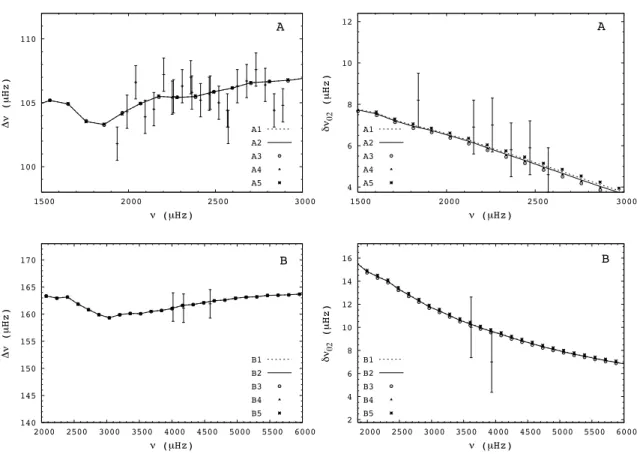
4 SF2A 2007 100 105 110 1500 2000 2500 3000 ! " ( µ Hz) " (µHz) A A1 A2 A3 A4 A5 4 6 8 10 12 1500 2000 2500 3000 #" 02 ( µ Hz) " (µHz) A A1 A2 A3 A4 A5 140 145 150 155 160 165 170 2000 2500 3000 3500 4000 4500 5000 5500 6000 ! " ( µ Hz) " (µHz) B B1 B2 B3 B4 B5 2 4 6 8 10 12 14 16 2000 2500 3000 3500 4000 4500 5000 5500 6000 #" 02 ( µ Hz) " (µHz) B B1 B2 B3 B4 B5
Fig. 2. Large (left) and small (right) separations for the A (top) and B (bottom) components of the α Cen system. Observations are given with 2σ error bars. All these curves give the values obtained for the 5 different calibrations considered here. For clarity, only % = 1 theoretical large seperations are shown.
of both components. Concerning the average small separation of B component, our theoretical models predict values about 16% larger than the observations by Carrier & Bourban (2003) while fitting exactly the value obtained by Kjeldsen & Bedding (2004).
References
Alexander, D. R., & Ferguson, J. W. 1994, ApJ, 437, 879 B¨ohm-Vitense, E. 1958, Zeitschrift Astrophys., 46, 108 Bouchy, F., & Carrier, F. 2002, A&A, 390, 205
Boury, A., Gabriel, M., Noels, A., et al. 1975, A&A, 41, 279 Carrier, F., Bourban, G. 2003, A&A, 406, L23
Eggenberger, P., Charbonnel, C., Talon, S., et al. 2004, A&A, 417, 235 Iglesias, C. A., Rogers, F. J. 1996, ApJ, 464, 943
Kervella, P., Th´evenin, F., S´egransan, D., et al. 2003, A&A, 404, 108 Kjeldsen, H., Bedding, T. R. 2004, in ESA SP-559: SOHO 14
Helio- and Asteroseismology: Towards a Golden Future, 101 Miglio, A., Montalb´an, J. 2005, A&A, 615, 629
Montalb´an, J. Lebreton, Y., Miglio, A., et al. in press, ApSS Morel, P., 1997, A&AS, 124, 597
Neuforge-Verheecke, C., & Magain, P. 1997, A&A, 328, 261
Pourbaix, D., Nidever, D., McCarthy, C., et al. 2002, A&A, 386, 280 Roxburgh, I. W., & Vorontsov, S. V. 2003, A&A, 411, 215
![[DOC] Formation complet Microsoft Windows serveur 2008 | Cours informatique](data:image/gif;base64,R0lGODlhAQABAIAAAP///wAAACH5BAEAAAAALAAAAAABAAEAAAICRAEAOw==)