Institut Montefiore
Systematic Cooperation in P2P Grids
Th`ese pr´esent´ee par
Ann´ee Acad´emique Cyril Briquet
2008-2009 en vue de l’obtention du grade de Docteur en Sciences (orientation Informatique)
P2P Grid computing seeks the convergence of Grid and P2P technologies. De-ploying a P2P Grid middleware on a set of computers enables an organization to automatically barter computing time with other Internet-connected organizations. Such P2P exchanges of computing time enable individual Peers, i.e. organizations, to transparently aggregate large amounts of computational power with minimal infrastructure requirements or administrative cost.
Challenges arise from the requirement for scalability and robustness. Individual worker nodes are unreliable, as P2P Grids operate on unmanaged desktop com-puters. A specificity of P2P Grids is that each Peer can reclaim at any time the computational power of worker nodes supplied to other Peers, leading to bursts of execution preemption. These are the major contributions of our dissertation:
• Firstly, we propose a new P2P Grid architecture, the Lightweight Bartering Grid (LBG). Through systematic cooperation between Grid nodes, the reli-ability of execution of computational requests is greater than the sum of the reliabilities of worker nodes.
• Secondly, we propose a highly scalable data transfer architecture. It is based both on the BitTorrent P2P file sharing protocol and on the removal of the temporal cost of downloading redundant copies of input data files.
• Thirdly, besides a middleware implementation of LBG, we also provide an implementation of a discrete-event simulator. Its originality resides in the weaving of the simulator code into the bartering code of the middleware, which is made possible through the virtualization of Grid nodes. This enables reproducible testing and accurate performance evaluation of the bartering policies because the Peers of a simulated Grid make the same bartering decisions as Peers deployed on real computers.
The LBG architecture exhibits the following remarkable features:
• The scheduling model supports the queueing of external requests and the ar-chitecture enables a flexible study of bartering policies.
• The architecture is open, flexible, lightweight and facilitates software engineer-ing. It enables the easy development, testing, evaluation and deployment of combinations of scheduling policies.
Le domaine du calcul en grille pair-`a-pair (P2P) a pour but la convergence entre les technologies de calcul en grille et d’organisation P2P. D´eployer un middleware de grille P2P sur un r´eseau d’ordinateurs permet `a une organisation d’´echanger au-tomatiquement du temps de calcul avec d’autres organisations bas´ees sur Internet. De tels ´echanges P2P de temps de calcul offrent `a chaque pair, i.e. organisation, la possibilit´e d’agr´eger de mani`ere transparente une grande puissance de calcul, sans lourdeur administrative ou d’infrastructure.
Les imp´eratifs de robustesse et de r´esistance aux facteurs d’´echelle posent plusieurs d´efis. Les noeuds de calcul sont peu fiables, ´etant donn´e que les grilles P2P sont d´eploy´ees sur des PC de bureau ou domestiques. Une sp´ecificit´e des grilles P2P est que chaque pair peut r´ecup´erer `a tout instant l’usage de ses noeuds de calcul qui sont prˆet´es `a d’autres pairs, ce qui conduit `a des rafales de pr´eemption d’ex´ecution. Les contributions les plus significatives de notre th`ese sont les suivantes:
• Premi`erement, nous proposons une nouvelle architecture de grille P2P, la grille de troc l´eg`ere, Lightweight Bartering Grid (LBG). Grˆace `a une coop´eration syst´ematique entre les noeuds de la grille, la fiabilit´e d’ex´ecution des requˆetes de calcul est plus grande que la somme des fiabilit´es des noeuds de calcul. • Deuxi`emement, nous proposons une architecture de transferts de donn´ees
ex-trˆemement r´esistante aux facteurs d’´echelle. Elle est bas´ee sur le protocole de transfert de fichiers BitTorrent et sur la suppression du coˆut temporel des transferts de copies redondantes de fichiers de donn´ees.
• Troisi`emement, en plus de fournir une impl´ementation de LBG sous forme de middleware, nous fournissons ´egalement une impl´ementation sous forme d’un simulateur `a ´ev´enements discrets. L’originalit´e de celui-ci provient d’un fin tissage du code de simulation sur celui du middleware, qui est rendu possible par la virtualisation des noeuds de la grille. Cela permet de r´ealiser des tests reproductibles ainsi que des ´evaluations de performance pr´ecises des politiques de troc, ´etant donn´e que les pairs d’une grille simul´ee prennent les mˆemes d´ecisions de troc que des pairs d´eploy´es sur des ordinateurs r´eels.
L’architecture LBG a les caract´eristiques remarquables suivantes:
• Le mod`ele d’ordonnancement supporte la mise en file d’attente des requˆetes externes et l’architecture permet une ´etude flexible des politiques de troc. • L’architecture est ouverte, flexible, l´eg`ere et facilite l’ing´enierie logicielle. Elle
permet un d´eveloppement, une ´evaluation et un d´eploiement ais´es de com-binaisons de politiques d’ordonnancement.
I would like to thank:
Professor P.A. de Marneffe, my advisor, for his trust and support, for sharing the art of teaching and - most importantly - for creating an enjoyable workplace. Members of the jury, Professors B. Boigelot, G. Leduc, P. Manneback, L. Moreau, M. Quinson for kindly contributing time to read this dissertation.
Three colleagues who greatly shaped my years at the Algorithmics lab: S´ebastien Jodogne, one long-time friend, for our joint research work and for his enthusiasm and continuous support for all those years; G´erard Dethier for our joint research work, for reading this dissertation so systematically and for being a trusted pillar; Xavier Dalem first for being a great student to co-advise, then for our joint, geeky research work and the excellent Java code contributed to the LBG middleware. Val´erie Leroy, Thomas Leuther and C´edric Thiernesse for all the great moments. Simon Balon, Hassan Bougrine, Raff and Amandine Brancaleoni, Jorge Cham, S´ebastien Charlier, Delphine Daxhelet, David Detry, Anne Falier, Jean-Marc Fran-¸cois, Pierre and Lisiane Holzemer, Djenaba Kante, Delphine Kirkove, Danielle Lange, Axel Legay, Jean Lepropre, Sylvain Martin, Claire Monti, Christophe No¨el, Marie-Th´er`ese Ratz, S´ebastien Reginster, Pascale Renders, Philippe Rigo, Krzysztof Rzadca, Fabien Scalzo, and Rosette Vandenbroucke for the positive im-pact they had on my work. The EECS (Professors B. Boigelot, P.A. de Marneffe and F.X. Litt, sysadmins A. Bodart and M. Fr´ed´eric), Math (Professors P. Lecomte and M. Rigo, sysadmin S. Delsemme) and Chemical Engineering (Prof. P. Mar-chot) departments for letting me enlist up to 125 CPU cores in my HPC exper-iments, at no extra cost to our alma mater. The OurGrid team for opening the way in P2P Grids.
Claire Kopacz and Elisabeth Spilman for their thorough linguistic review - that I’m sure may have caused some headaches - of my publications.
My parents, close friends and family, as well as my swordmaster for their contin-uous support, presence and encouragements through the years.
Cover Page . . . i
Abstract . . . iii
R´esum´e . . . iv
Acknowledgements . . . vii
Contents . . . ix
List of Figures . . . xvii
List of Tables . . . xx
Typographic Conventions . . . xxii
Chapter 1: Introduction . . . 1
1.1 A Brief History of Grid Computing . . . 1
1.1.1 What is the Grid? . . . 2
1.1.2 Expectations on Resource Sharing . . . 3
1.1.3 Towards Scalable Resource Sharing Mechanisms . . . 4
1.1.4 P2P Grid Computing . . . 5
1.2 Dissertation Statement . . . 7
1.3 Our Contributions to the P2P Grids Domain . . . 8
1.3.1 Cooperation between Robust Scheduling Policies . . . 9
1.3.2 Cooperation between Software Implementations . . . 10
1.3.3 Cooperation Between P2P Technologies . . . 11
1.4 Overview of the Dissertation . . . 12
Chapter 2: Lightweight Bartering Grid Architecture . . . 14
2.1 Grid Nodes . . . 15
2.1.1 Resources . . . 15
2.1.2 Peers . . . 16
2.1.4 Search Engine . . . 18
2.1.5 Data Caches . . . 18
2.2 LBG Architecture Overview . . . 18
2.3 Related Work - How to Share Resources? . . . 23
2.3.1 The Grid Economy and Market-Based Methods . . . 23
2.3.2 Bartering as a Simplified Form of Grid Economy . . . 25
2.3.3 Expectations and Free Riding in Bartering Systems . . . 28
2.3.4 Network of Favors Model . . . 30
2.3.5 Multi-Agent Systems . . . 34
2.4 Grid Application Types . . . 34
2.4.1 Bag of Tasks Applications . . . 35
2.4.2 Workflow Applications . . . 35
2.4.3 Iterative Stencil Applications . . . 36
2.5 Related Work - Lightweight Grids . . . 36
2.5.1 Classification of Lightweight Grids . . . 37
2.5.2 P2P Grid Middlewares . . . 39
2.5.3 Comparison of LBG and OurGrid . . . 46
2.6 Grid Application Model . . . 47
2.6.1 Taxonomy of Tasks . . . 47
2.6.2 Taxonomy of Bags of Tasks . . . 48
2.6.3 Grid Application Programming . . . 50
2.7 Resource Middleware . . . 51
2.7.1 Task Execution . . . 51
2.7.2 Task Preemption and Cancellation . . . 52
2.7.3 Resource Life Cycle . . . 53
2.7.4 Resource Protection . . . 54
2.7.5 Resource Data Management . . . 56
2.7.6 Resource Management System (Peer Middleware) . . . 56
2.8 Grid Node Messaging Protocol . . . 57
2.9 Peer Middleware . . . 59 2.9.1 Typical Interactions . . . 59 2.9.2 Peer Service . . . 60 2.9.3 Bartering Model . . . 61 2.9.4 Scheduling Model . . . 65 2.9.5 Negotiation Model . . . 69
2.9.6 Internal Events Processor . . . 73
2.9.7 Concurrency Management . . . 76
2.9.8 Peer Data Management . . . 78
Chapter 3: Software Engineering and Simulation of P2P Grids . . 80
3.1 A Simulator of P2P Grid . . . 81
3.1.1 Purpose and Benefits of Simulation . . . 81
3.1.2 Software Engineering Challenges in P2P Grids . . . 82
3.1.3 Design Objectives of a P2P Grid Simulator . . . 82
3.1.4 Expected Use Cases . . . 83
3.2 Related Work . . . 85
3.2.1 Virtualization Levels . . . 85
3.2.2 Discrete-Event System Simulation . . . 86
3.2.3 Review of Existing Grid Simulators . . . 88
3.3 Grid Nodes Virtualization . . . 92
3.3.1 Grid Nodes Messaging Virtualization . . . 92
3.3.2 Resource Virtualization . . . 94
3.3.3 Peer Virtualization . . . 95
3.3.4 User Agent Virtualization . . . 98
3.4 Simulator Implementation . . . 98
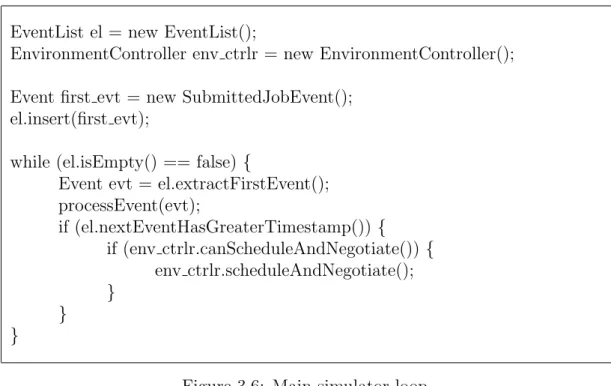
3.4.1 Main Simulator Loop . . . 98
3.4.2 Simulator Events . . . 99
3.4.3 Time Management . . . 103
3.4.4 Limits of the Current Implementation . . . 103
3.5 Simulation Description Language . . . 104
3.5.1 Simulation Description Language . . . 104
3.5.2 User Agents Configuration . . . 106
3.5.3 Grid Configuration . . . 106
3.5.4 Peers Policies Configuration . . . 107
3.5.5 Simulation Configuration . . . 108
3.6 Experimental Results . . . 108
3.6.1 Simulator Accuracy . . . 108
3.6.2 Simulation Bias . . . 111
3.6.3 Simulator Performance . . . 112
3.6.4 Simulator and Middleware Co-Development . . . 114
3.6.5 Comparison of Software Engineering Practices . . . 115
3.7 Summary of the Contributions . . . 117
Chapter 4: Bartering Guidelines . . . 119
4.1 Local Tasks Scheduling . . . 121
4.2 Supplying Tasks Scheduling . . . 121
4.3 Supplying Tasks Filtering . . . 122
4.4 Metrics for Consumption Tasks Scheduling . . . 123
4.4.1 Requirements for Metadata . . . 123
4.4.2 Bartering-related Metadata . . . 124
4.4.3 Task-Related Metadata . . . 127
4.4.5 Resource-related Metadata . . . 128
4.4.6 Metadata Storage . . . 128
4.5 Consumption Tasks Scheduling Policies . . . 130
4.5.1 Reliability-Aware Consumption Tasks Scheduling . . . 130
4.5.2 NoF-Aware Consumption Tasks Scheduling . . . 131
4.5.3 Reciprocity-Aware Consumption Tasks Scheduling . . . 132
4.5.4 Performance-Aware Consumption Tasks Scheduling . . . 132
4.5.5 Data-Aware Consumption Tasks Scheduling . . . 133
4.5.6 Resource Ranking . . . 133
4.5.7 Summary of Consumption Tasks Scheduling Policies . . . 133
4.6 Related Work . . . 134
4.6.1 Acquisition of Metadata . . . 134
4.6.2 Fault-Tolerance . . . 135
4.6.3 Fault-Avoidance . . . 135
4.7 Supplying Tasks Preemption Policies . . . 136
4.7.1 Preemption of Running Supplying Tasks . . . 136
4.7.2 Fault-Prevention Through Adaptive Preemption . . . 137
4.7.3 Dequeueing of Waiting Supplying Tasks . . . 139
4.7.4 Summary of Supplying Tasks Preemption Policies . . . 140
4.8 Experimental Results . . . 140
4.8.1 Methodology . . . 140
4.8.2 Evaluation of Strategies (4-Peers Base Scenario) . . . 142
4.8.3 Evaluation of Strategies (4x10-Peers Scenario) . . . 149
4.9 Summary of the Contributions . . . 153
4.9.1 Discussion . . . 153
4.9.2 Guidelines . . . 154
Chapter 5: P2P Data Transfers . . . 155
5.1 Related Work . . . 157
5.1.1 Data Replication . . . 157
5.1.2 Data Reuse . . . 158
5.1.3 Task Execution Parallelism . . . 159
5.1.4 Overview of BitTorrent . . . 159
5.1.5 Why BitTorrent Is Relevant . . . 161
5.1.6 Why GridFTP Is Not Relevant . . . 163
5.1.7 BitTorrent Support in Existing Grid Middlewares . . . 164
5.1.8 Other Group-based Data Transfer Mechanisms . . . 167
5.2 Data Transfer Architecture . . . 167
5.2.1 Data Scheduling . . . 168
5.2.2 Data Managers . . . 168
5.2.3 Data Preprocessing . . . 169
5.2.4 Data Paths . . . 170
5.2.6 Data Trackers . . . 174
5.2.7 Scalability of the Data Transfer Architecture . . . 174
5.3 Task Scheduling . . . 175
5.3.1 Task Selection . . . 176
5.3.2 Resource Selection . . . 178
5.3.3 Supplier Peer Selection . . . 179
5.3.4 Data Transfer Protocol Selection . . . 180
5.4 Proactive Data Replication . . . 182
5.4.1 Bartering Bandwidth with Idle BitTorrent Nodes . . . 182
5.4.2 Replicating Data to Idle Resources . . . 183
5.5 Experimental Results . . . 185
5.5.1 Useful Metrics . . . 185
5.5.2 Deployment . . . 186
5.5.3 Varying Data Protocol, Task Selection, Caching . . . 188
5.5.4 Varying Data Protocol and Data Configuration . . . 190
5.5.5 Inter-Task Data Sharing, Varying Task Selection . . . 192
5.5.6 Inter-BoT Data Sharing, Varying Resource Selection . . . . 192
5.5.7 Scalability of the Data Transfer Architecture . . . 195
5.6 Discussion . . . 196
5.6.1 A Network of Technologies . . . 196
5.6.2 Impact of Computations . . . 200
5.6.3 Recommended Deployment Options . . . 200
5.7 Summary of the Contributions . . . 200
Chapter 6: Non-expected P2P Grid Applications . . . 202
6.1 Advanced Deployment Options . . . 203
6.1.1 Distributed Simulation . . . 203
6.1.2 Self-Bootstrapping . . . 205
6.1.3 Distributed Peer Deployment . . . 206
6.1.4 Experimental Results . . . 207
6.2 LBG-SQUARE . . . 208
6.2.1 Iterative Stencil Applications . . . 209
6.2.2 Deploying an Iterative Stencil on a P2P Grid . . . 211
6.2.3 Fault-Tolerance for Iterative Stencils . . . 214
6.2.4 Generating Management Graphs of LB Simulations . . . 216
6.2.5 Implementation of LBG-SQUARE . . . 218
6.2.6 Experimental Results . . . 220
6.2.7 Supplementary Fault-Tolerance Mechanisms . . . 223
6.3 Summary of the Contributions . . . 224
Chapter 7: Conclusions . . . 225
7.1 Summary of the Contributions . . . 226
7.1.2 Data Transfers . . . 226
7.1.3 Software Engineering and Testing . . . 226
7.1.4 Deployment . . . 227
7.2 Open Questions . . . 228
7.2.1 Scheduling and Negotiation Models . . . 228
7.2.2 Data Transfer and Persistence . . . 228
7.2.3 Simulation and Architecture . . . 229
7.3 General Conclusion . . . 229
References . . . 232
Appendix A: Application and Service Interfaces . . . 259
A.1 Grid Application Interface . . . 259
A.2 Grid Node Service Interfaces . . . 259
Appendix B: Configuration Languages and Parameters . . . 262
B.1 Job Description Language . . . 262
B.1.1 JDL BNF Grammar . . . 262
B.1.2 Job Description File Example . . . 263
B.2 Simulation Description Language . . . 263
B.2.1 SDL BNF Grammar . . . 263
B.2.2 Simulation Description File Example . . . 267
B.3 Nodes Configuration Language . . . 268
Appendix C: Peer Middleware Internals . . . 270
C.1 Peer Components Dependencies . . . 270
C.2 Peer Events to Policies Mapping . . . 271
C.3 Peer Internal Events Processing . . . 273
C.3.1 Frequency of Internal Events Processing . . . 273
C.3.2 Storage of Internal Events (Negotiation) . . . 273
C.3.3 Storage of Internal Events (Task Control) . . . 273
C.3.4 Multithreading of Internal Events Processing . . . 274
Appendix D: Virtual Organizations . . . 275
D.1 Virtual Organizations . . . 275 D.1.1 What is a VO? . . . 275 D.1.2 VO Formation . . . 276 D.2 Peer Discovery . . . 276 D.3 Bartering Policies . . . 278 D.3.1 Philanthropy . . . 278 D.3.2 Mutualism . . . 278 D.3.3 Individualism . . . 279 D.3.4 Network of Favors . . . 280 D.3.5 Out-of-Grid Compensations . . . 280
D.3.6 Autonomous VO Management . . . 281
Appendix E: Resource Negotiation . . . 283
E.1 Negotiation Protocols . . . 283
E.2 Standard Grid Protocols . . . 284
E.3 Negotiation Objects . . . 285
E.4 Negotiation Objectives . . . 285
Appendix F: Future Work . . . 287
F.1 Scheduling Model . . . 287
F.1.1 Task Replication . . . 287
F.1.2 Other Metrics for Consumption Tasks Scheduling . . . 287
F.1.3 Batch-Mode Scheduling . . . 288
F.1.4 Automatic Tuning of Task Control Parameters . . . 288
F.1.5 Classes of Priority and Urgent Computing . . . 288
F.1.6 Exploration of the Grid Architecture Design Space . . . 289
F.2 Negotiation Model . . . 289
F.2.1 Reservations and QoS . . . 289
F.2.2 Peer Discovery . . . 290
F.3 Task Model . . . 290
F.3.1 Inter-Task Communications . . . 290
F.3.2 Checkpointing and Migration . . . 290
F.3.3 Grid Application Development . . . 290
F.4 Data Transfer . . . 291
F.4.1 Scalability of the Data Transfer Architecture . . . 291
F.4.2 Cache Replacement Policy . . . 291
F.4.3 Estimation of the Storage Reliability of Suppliers . . . 291
F.4.4 Performance of BitTorrent Data Transfers . . . 292
F.4.5 Performance of BitTorrent and FTP Data Transfers . . . 292
F.4.6 Performance of GNMP Data Transfers . . . 293
F.4.7 Data-Aware Negotiation . . . 293
F.4.8 Proactive Data Replication . . . 293
F.5 Data Persistence . . . 293
F.5.1 Input Data, Output Data and Jar Files Persistence . . . 293
F.5.2 Peer Register Persistence . . . 294
F.5.3 Checkpointing . . . 295
F.6 Simulation . . . 295
F.6.1 Simulation of Data Transfers . . . 295
F.6.2 Simulation of Multithreading . . . 295
F.6.3 Simulation of Additional Sources of Failure . . . 295
F.6.4 Simulation Standards . . . 296
F.7 Security . . . 296
F.7.2 Firewall/NAT Traversal . . . 296
F.7.3 Security of Execution . . . 297
Index . . . 299
1.1 Transparent resource sharing beyond the boundaries of organizations. 4
1.2 Structure of the dissertation. . . 12
2.1 Symbols representing Grid nodes, and their storage capacity. . . 16
2.2 P2P Grid. . . 16
2.3 Scheduling to one’s own Resource vs. scheduling to another Peer. . 19
2.4 Example of two Search Engines, thus two P2P Grids. . . 20
2.5 Example of negotiation. . . 20
2.6 Example of preemption/cancellation of Task execution. . . 21
2.7 Reciprocating vs. free riding. . . 29
2.8 Bartering can reduce the response times; work times are invariant. . 29
2.9 Network of Favors accounting. . . 31
2.10 Grid application types. . . 35
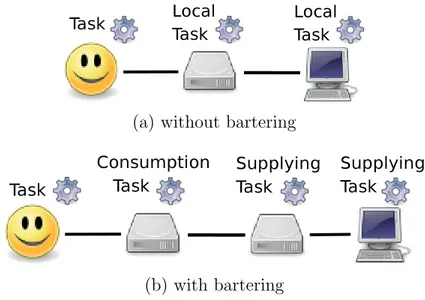
2.11 Tasks types (a) without bartering (b) with bartering. . . 49
2.12 The controller VM launches and controls a runner VM for each Task. 55 2.13 Handle/Service pattern. . . 57
2.14 Handles/Services types. . . 58
2.15 External events service model. . . 61
2.16 States of Tasks of an accepted BoT (i.e. a BoT which is either in the set of waiting BoTs or in set of BoTs with scheduled Tasks). . . 63
2.17 Queue of Local BoTs (in a Peer, + interactions with User Agents). 63 2.18 Queue of Supplying BoTs (in a Peer, + interactions with con-sumers); each Supplying BoT is composed of exactly 1 Task. . . 63
2.19 Peer bartering states (in function of the length of BoTs queues). . . 64
2.20 Scheduling model. . . 66
2.21 Scheduling model (fault-prevention mechanisms). . . 66
2.22 Scheduling model (fault-avoidance mechanisms). . . 67
2.23 Scheduling model (fault-tolerance mechanisms). . . 68
2.24 Typical bartering sequence between two Peers, with negotiation. . . 71
2.25 Negotiation model. . . 71
2.26 Threading model of Peer middleware. . . 77
3.1 Diagram of the discrete-event simulator of P2P Grid. Simulated User Agents, Peers and Resources, as well as the event processor, event list, environment controller and simulation clock are all run
within the main simulator thread, on a single computer. . . 84
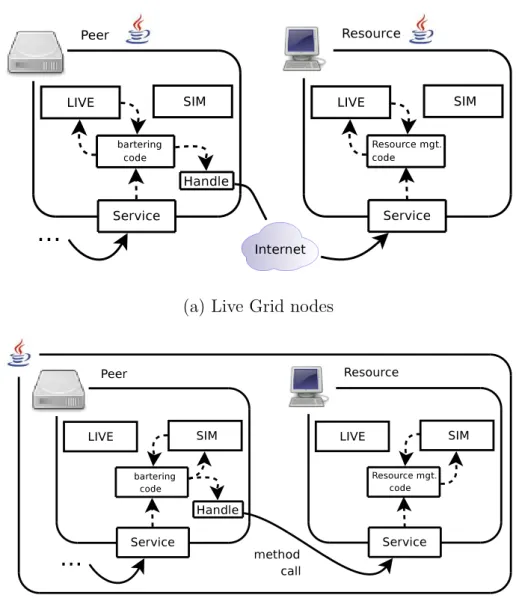
3.2 Event processor and event list (with 7 events stored at 3 timestamps). 87 3.3 Peer-to-Resource interaction illustrating the difference in execution paths between (a) live Grid nodes, (b) virtualized (simulated) Grid nodes. . . 93
3.4 (a) Middleware, (b) simulator implementation of Peer threads. . . . 96
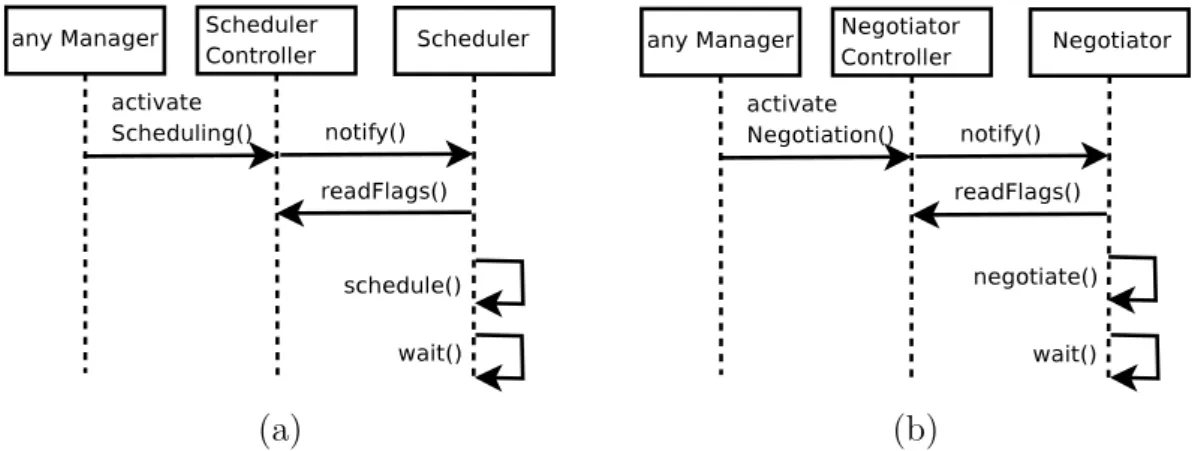
3.5 (a) Scheduler-related, (b) Negotiator-related Environment Controller operations. . . 97
3.6 Main simulator loop. . . 100
3.7 Processing of simulator events: (a) simulated job submission, (b) sim-ulated Task execution completion, (c) simsim-ulated Task execution fail-ure, (d) simulated internal event. . . 102
3.8 BNF grammar of a simulation description file. . . 105
3.9 Power repartition algorithm for a simulated Peer. . . 107
3.10 Grid topology for simulator accuracy experiments. . . 109
4.1 Typical interactions leading to the preemption of a Supplying Task. 120 4.2 Decide-interact-memorize loop. Decisions are made by the Con-sumption Tasks scheduling PDP, based on information collected from completed interactions. . . 124
4.3 Strategy matrix (each line is a combination of policies). . . 141
4.4 MBRT of Consumption Tasks scheduling policies for the 4-Peers scenario. . . 143
4.5 MBRT of Supplying Tasks scheduling policies for the 4-Peers scenario.145 4.6 MBRT of Local Tasks scheduling policies for the 4-Peers scenario. . 145
4.7 MBRT of Supplying Tasks filtering policies for the 4-Peers scenario. 146 4.8 MBRT of running Supplying Tasks preemption policies for the 4-Peers scenario. . . 148
4.9 MBRT of waiting Supplying Tasks dequeueing policies for the 4-Peers scenario. . . 148
4.10 MBRT of emission of supplying requests policies for the 4-Peers scenario. . . 150
4.11 MBRT of evaluation of supplying requests policies for the 4-Peers scenario. . . 150
4.12 MBRT of Consumption Tasks policies for the 4x10-Peers scenario. . 151
4.13 Scheduling model. . . 153
5.2 A Grid Peer (top) shares a file with 3 Resources. (a) With FTP data sharing, only the network links with the Grid Peer are exploited. (b) With BitTorrent data sharing, the 4 BitTorrent nodes (1 Grid Peer + 3 Resources) cooperate with one another: Network links between all downloaders are also exploited, leading to file download
times essentially independent of the number of downloaders. . . 162
5.3 Possible data paths for the transfer of a single file from a consumer Peer (top left) to a supplier Peer (top right) and finally to a Resource of the latter. . . 171
5.4 Scheduling model (extended version of Figure 2.20). . . 176
5.5 Tasks of BoT θ (here with 1 input data file per Task) are grouped into data-equal subsequences, which are sorted by decreasing length | ¯σs(θ)|. . . 178
5.6 Data transfer protocol selection algorithm for one file. . . 181
5.7 Grid topologies for P2P data transfer experiments. . . 187
5.8 Data-equal Tasks of submitted BoTs are ordered as far as possible from one another, so that FIFO Task selection results in temporal ungrouping of data-equal Tasks. . . 187
5.9 Varying data protocol, Task selection, caching. . . 189
5.10 Varying data protocol and data configuration. . . 190
5.11 Inter-Task data sharing, varying Task selection. . . 193
5.12 Inter-BoT data sharing, varying Resource selection. . . 194
5.13 Algorithms and protocols dependencies. . . 196
6.1 Bag of SimTasks run on a P2P Grid. . . 205
6.2 Lattices: (a) 3D, 19 sites (focus on central site) and (b) 2D, 9 sites. 209 6.3 LaBoGrid architecture. . . 210
6.4 Organization of LBG-SQUARE. . . 212
6.5 Checkpoint/restart mechanism. . . 214
6.6 Resource graph of a P2P Grid. . . 217
6.7 Management graphs of LB simulations. . . 217
6.8 LB Controller flowchart. . . 220
A.1 Peer handle/service class hierarchy. . . 261
C.1 Peer components. . . 270
D.1 Structure of Virtual Organizations: (a) Multiple VO membership, (b) Multiple VO membership, with Recursive VO. . . 275
2.1 Lightweight Grid - expected requirements, features vs. actual support. 37
2.2 Architectural and scheduling features of P2P Grid middlewares. . . 45
2.3 Negotiation features of P2P Grid middlewares. . . 45
2.4 Security features of P2P Grid middlewares. . . 45
2.5 Data features of P2P Grid middlewares. . . 46
2.6 Technology features of P2P Grid middlewares. . . 46
3.1 Key features of reviewed Grid simulators. . . 90
3.2 Mean BoT response times for both scenarios for simulated LBG runs (simulated time), live LBG runs (real time) and live OurGrid runs (real time). . . 110
3.3 Simulator runtimes and mean BoT completion runtimes for multiple scenarios derived from the base scenario. . . 113
3.4 Comparison of OurGrid (full version, version without unit testing code), and Lightweight Bartering Grid. . . 116
4.1 Local Tasks Scheduling Policies. . . 121
4.2 Supplying Tasks Scheduling Policies. . . 122
4.3 Supplying Tasks Filtering Policies. . . 123
4.4 Consumption Tasks Scheduling Policies. . . 134
4.5 Adaptive Supplying Tasks preemption policy. . . 138
4.6 Running Supplying Tasks Preemption Policies. . . 140
4.7 Running Supplying Tasks Dequeueing Policies. . . 140
5.1 Software deployed with Data Managers of Grid Peers and Resources. Grid Peers acting in a supplier role do not make use of the deployed software. . . 169
5.2 Varying data protocol, Task selection, caching. . . 189
5.3 Varying data protocol and data configuration. . . 191
5.4 Inter-Task data sharing, varying Task selection. . . 193
5.5 Inter-BoT data sharing, varying Resource selection. . . 194
6.1 Simulation runtimes and mean BoT response times achieved with scenario randomizer applied to the 4-Peers scenarios (a) with, (b)
with-out bartering. . . 208
6.2 LBDAs deployment times. . . 221
6.3 Performance penalty coefficient due to state replication. . . 222
6.4 Execution time with Failures. . . 222
A.1 Grid application interface. . . 259
A.2 User Agent Service interface. . . 259
A.3 Resource Service interface. . . 260
A.4 Peer Service interface. . . 260
C.1 Peer components dependencies. . . 271
C.2 (a) External events to Peer operations mapping, (b) internal events to Peer operations mapping. . . 272
• terms that are defined are emphasized
• quoted text chunks are both emphasized and surrounded by a pair of quotes • important text chunks are typeset with a bold typeface, or underlined • paragraphs typeset with a Sans Serif typeface describe related work only • paragraphs typeset with a Monospace typeface present code-level examples
Introduction
Trust is a peculiar resource which is increased, rather than depleted, through use.
- suggested by Diego Gambetta
1.1
A Brief History of Grid Computing
This dissertation takes its root in the distributed computing domain. The concept of distributed computing exists since the deployment of high speed networks in the 1970s [276]. Large-scale distributed computing has emerged with the Information Wide-Area Year [110] (I-Way). Temporary links between 11 research centers were established just before and during the Supercomputing ’95 conference, which was an occasion to demonstrate an experimental software prototype used to harness new amounts of computing power. In the continuity of metacomputing [152] re-search, this successful early experiment in large-scale distributed computing has led to funding from the Defense Advanced Research Projects Agency (DARPA). This research work produced the Globus Toolkit software [159], the first Grid mid-dleware.1
With large amounts of computational power increasingly available from large clus-ter farms and, increasingly, from a myriad of compuclus-ters at the edge of the Inclus-ternet, aggregating computational resources at large-scale both within and between ad-ministrative domains has become a possibility within reach.
Globus was first released in 1997 and the term Grid appeared at a seminar at the Argonne National Laboratory. The term Grid was selected as an analogy to the electrical power grid because the vision of Grid computing [161] is that of a com-puting utility service that transparently provides comcom-puting power everywhere. In 1998, Foster and Kesselman published the first edition of what is considered as the 1 Middleware = Software “communication layer that allows applications to interact across
reference book of the domain of Grid computing: The Grid: Blueprint for a New Computing Infrastructure, followed by a second edition in 2004 [149].
1.1.1
What is the Grid?
Grid computing is a form of distributed processing. Grid computing is about “coordinated resource sharing and problem solving in dynamic, multi-institutional collaborations.” [221] An important motivation for Grid computing is to run large-scale applications: “Grid computing typically involves using many resources [. . .] to solve a single, large problem that could not be performed on any one resource.” [221] A Grid may be defined as “a number of computers linked together via the Internet so that their combined power may be harnessed to work on difficult problems” [236], but this is not sufficient. Foster has informally proposed the following list of criteria [151] to determine if a distributed system is a Grid:
1. Decentralized coordination of resources from multiple administrative do-mains;
2. Use of standard, open, general-purpose protocols and interfaces;
3. Delivery of nontrivial quality of service, e.g. the reliability offered by a Grid is greater than the sum of the reliabilities of Grid resources.
The Grid is the (currently nonexistent) global interconnection of all the world Grids running on the Internet with standard, open and general-purpose protocols and interfaces like, for example, those proposed by the Open Grid Forum [231]. It can be compared to the Internet, that interconnects all the world networks. The main goal of distributed computing is to help Grid participants to cope with peaks in their request environment by enabling them to dynamically consume (e.g. through bartering, borrowing, buying, . . .) the resources of other participants. The removal of a centralized point of control is essentially what distinguishes Grid computing from classic distributed computing.
An additional goal of Grid computing is to help Grid participants to cope with the instability of the resource environment. A Grid is expected to provide higher levels of availability, reliability, autonomicity [27],. . . than the sum of its resources. It should be able to tolerate individual resource failures by dynamically negotiating resource sharing arrangements with other participants.
1.1.2
Expectations on Resource Sharing
Resource Sharing as a Performance Enabler
Resource sharing allows Peers to cope with variability in the submitted computa-tional requests and in the availability [119] of Resources from other Peers. The response time of a computational request is the total time elapsed between the submission of a computational request to a Peer and its completion. Resource sharing can potentially speed up the response time of computational requests or solve large problems that cannot be solved with one’s own Resources only.
Synchronized consumption by a given Peer of multiple Resources belonging to other Peers (i.e. nontrivial QoS in Foster’s well known 3-point checklist [151]) may dramatically accelerate computations by temporally aggregating a great number of external Resources, leading to substantial reductions in response times of com-putational requests.
Resource sharing can enable to shorten the computing time required to pro-cess requests by aligning the available computing power with the peaks of computational requests.
Resource Sharing as a Reliability Enabler
The request environment of a Peer is set by User Agents, but its Resource environ-ment can be stabilized: Resource sharing can provide reliability in the completion of execution either through consumption of computing time from Peers estimated to be reliable, or through redundant2 consumption of computing time.
Automated Resource Sharing in a Non-dedicated Environment
In the recent years, in the wake of the early concept of Network of Worksta-tions [37], so-called Volunteer Grid computing [11, 72] and Desktop Grid comput-ing [230, 139] have emerged as possible, and relevant, answers to the need to gather computational power in large amounts without having to support the prohibitively high costs typically associated with supercomputers or clusters.
This need has become, in the current computing environment, a need to run ar-bitrary computations on a set of inexpensive, not-necessarily-reliable, Internet-connected computers. . . beyond the boundaries of organizations (such as illustrated on Figure 1.1). With Grid Volunteer computing and Desktop Grid computing, it 2Redundant consumption, e.g. through task replication [86, 308], requires extra work time.
Figure 1.1: Transparent resource sharing beyond the boundaries of organizations. can be argued that the benefits of the gathering of computational power go to a small set of selected organizations. However, this does not fulfill the requirement to enable Resource sharing between organizations.
The flocking mechanism of the Condor middleware [91] meets, to a certain ex-tent, this new need. However, to the best of our current knowledge, there is no enforcement of reciprocity between organizations (i.e. pools in Condor lingo). Fur-thermore, a Condor deployment requires some involvement of the human system administrators and users: Not only the peering relationships must be manually configured, but some knowledge of the configuration of one another’s deployment is required. Even though advances brought distributed management of resource sharing to the Condor middleware, it is far from being fully automated.
This lack of automation calls for the use of a scalable resource sharing mechanism to automate large-scale deployments (say, thousands of organizations and even more worker nodes) from both the human system administrators and users’ per-spective. Indeed, although it an be useful in some specific contexts to be able to detail very specific requirements when deploying a system or submitting compu-tational requests to this system, most human users typically want to use a simple submission interface that do not require any special knowledge of the underlying computing system.
1.1.3
Towards Scalable Resource Sharing Mechanisms
Historically, resource sharing arrangements were centrally coordinated3, with a
central component playing an arbitration role. However, a centralized organization 3Unicore [299], UC Grid [298], XtremWeb [318], Koala [190], Condor [91] and MOAB [219] are
introduces a single point of failure and is not intrinsically scalable for a very large system size.
Resource sharing mechanisms have thus evolved towards decentralized coordina-tion4 where software agents autonomously (from one another, and from human
administrators) act on behalf of Grid participants, e.g. evaluate the reliability of the supplying behavior of one another [148, 58] to make scheduling decisions. A decentralized organization offers high fault-tolerance, scalability and autonomicity but maintaining fairness in resource sharing is more challenging.
With either a totally stable resource environment or instantaneous and perfect in-formation about it, centralized coordination could generate better overall utility. On the other hand, it is unlikely to achieve the same level of scalability and fault-tolerance as fully decentralized coordination.
Two distributed and fully automated mechanisms for the sharing of Grid resources between multiple organizations have been proposed, with practical relevance, in the recent years:
• The so-called Grid economy [67, 41, 68, 66, 297] and market-based methods are semi-centralized as they assume the presence of a central banking component (needed to enforce the control of the monetary mass).
• Bartering [13, 266, 265, 82, 59] consists of non-monetary exchanges of comput-ing time. It can be organized in a fully decentralized fashion.
1.1.4
P2P Grid Computing
The very recent Peer-to-Peer (P2P) Grid computing [233, 13, 84, 286] subdomain is essentially founded on a fully decentralized organization of resource sharing that is based on bartering, i.e. pure exchange, of computing time.
Grids and P2P systems have “emerged in the past few years, both claiming to ad-dress the problem of organizing large-scale computational societies.” [147] P2P has been defined by Foster and Iamnitchi as a “class of applications that takes advan-tage of resources [. . .] available at the edge of the Internet.” A P2P network can be defined as a network of edge computers (called Peers) exchanging resources (files, computing time, . . .) without central control or management. P2P networks and applications may be conceptually as old as the Internet itself [289] but they have become well-known with the widespread use of popular file sharing applications. 4gLite [158], the Globus Toolkit [159], GridBus [164], SimGrid [278], Condor [91] and MOAB [219]
The first P2P network rose to existence in June 1999 following the initial public release of Napster [222], which can retrospectively be characterized as a P2P file sharing application (of MP3-encoded music files) with centralized Peer discovery. Combining Grid and P2P technologies has the potential to lead to the develop-ment of large-scale computational Grids based on edge resources (i.e. common desktop PC) with built-in fault-tolerance. In a P2P Grid, each Peer:
• Can act both as consumer of computing time supplied by other Peers, and as supplier of computing time to other Peers;
• Autonomously makes its own resource sharing decisions;
• Cooperates5 with other Peers by exchanging computing time but, as
an autonomous entity, seeks to achieve its own objectives.
From this perspective, P2P Grid computing, which seeks the convergence of Grid and Peer-to-Peer technologies, could be defined as computational resource sharing in Grids organized into P2P networks. A P2P Grid is defined as a transient Virtual Organization [150] (see Appendix D.1.2) that emerges in a bottom-up fashion, out of exchanges of computing time between participants (i.e. Peers) connected together through a P2P network. In this dissertation, 2-levels P2P Grids are considered, i.e. each Peer (first level) manages a set of worker nodes (second level). Moreover, the considered worker nodes are edge computers, i.e. heterogeneous, low cost, possibly unreliable, standard computers.
The partial and intermittent nature of resources is also a defining feature of a P2P Grid. Indeed, because of the fully decentralized nature of a P2P Grid, the resources involved are typically “partial and intermittent” [119], i.e. often ex-hibiting degraded performance and intermittent availability.
The informational opacity between Peers is another defining feature of a P2P Grid. Indeed, the amount and contents of control messages emitted and received by Peers should be minimal for two reasons:
• The full decentralization precludes Peers to exchange a lot of metadata, because the architecture should remain scalable.
• The full decentralization also precludes Peers to consider the metadata received from other Peers as trustworthy: Indeed, we hypothesize that there is enough trust between Peers to enable their cooperation, but not enough to fully trust one another’s behavior.
5Cooperation in P2P Grids should be understood as emergent cooperation, i.e. there is no
P2P Grid computing is very recent. If a milestone had to be selected, a good choice would be a paper by Foster and Iamnitchi [147] published in 2003 that discussed and called for the convergence between the domains of Grid computing and Peer-to-Peer technologies.
1.2
Dissertation Statement
Human users of computing systems are increasingly interested in running an ever larger number of computational tasks. A challenge of high practical interest con-sists of composing a user-friendly Grid that automates every operation required to complete sets of independent6 computational tasks (so-called
Bags of Tasks). This implies the opportunistic use of additional resources as they become available, the graceful recovery of operation as some resources become unavailable and the automatic placement and transfer of data files.
The goal is to hide the complexity of the Grid behind a simple submission interface so that human users only have to wait for the results of their computa-tional tasks to be automatically retrieved from the Grid. Furthermore, from the point of view of a typical human user, the wait time should be as short as possible, even if there is no QoS guarantee; a useful metric that should be minimized is thus the mean Bag of Tasks response time (MBRT). An additional requirement is to respect the natural tendency of human activities to be structured into separate organizations. This calls for a set of distributed mechanisms to enable the sharing of computational time between separate orga-nizations.
Our dissertation addresses this challenge.
• We claim that bartering is a mechanism that allows software agents, called Peers, to share in an autonomous and scalable way the resources of the human organizations they represent. Such mechanism promotes the opportunistic use of resources supplied by other Peers but comes at the price of a lack of control over these resources and of transparency of other Peer’s operations. • Task execution failures are common events due to preemption, as Peers can
re-claim for their own use the computational power they have supplied to other Peers. To mask failures, we claim that Peers can be organized around queues of tasks, so that preempted tasks do not necessarily have to be cancelled. We propose a scheduling model that structures the scheduler of each Peer into policy decision points, enabling to control the scheduling process. 6Examples of intended use cases are provided in Section 2.4.
• Another issue is the massive size and amount of data files to be transferred across the Grid (so-called data deluge). The massive amount of data can appear even for one small file because the same file processed by multiple tasks of a Bag of Tasks may have to be replicated to several worker nodes. In practice, indeed, the data files often present repetitive patterns. For example, some human users will want to repeatedly process the same set of files over time, while other human users will want to process the same set of files in a variety of ways. We claim that a fully decentralized data transfer architecture, based on BitTorrent and designed to take advantage of the repetitive patterns in sets of data files can address these requirements. It is also designed so that worker nodes can collaborate beyond Peer boundaries to enable scalable data transfers.
These proposals are realized through the Lightweight Bartering Grid (LBG) archi-tecture [55], a fully decentralized P2P Grid archiarchi-tecture to build 2-level Grids organized in a Peer-to-Peer fashion, where each Peer controls a set of worker nodes (so-called Resources) and is totally independent from - and opaque to - other Peers. A middleware implementation of LBG that can run arbitrary ap-plications coded in Java has been produced. Furthermore, it has been shown that it can run tightly-coupled sets of tasks that require co-allocation, which are not typically run on a P2P Grid. Finally, we also claim that accurate and repro-ducible simulation can and should be used as a software engineering tool to build P2P Grids. Finding efficient combinations of scheduling policies is challenging because of the massive number of possible combinations that are made possible by the open nature of the scheduling model. To debug and evaluate in a reproducible way a massive number of combinations of scheduling policies, we propose to weave a discrete-event simulator into the code of a virtualized version of the middleware.
1.3
Our Contributions to the P2P Grids Domain
Our work is mainly focused on the collective (top) layer of the Grid architec-ture [150]. The state of the-art P2P Grid middleware, OurGrid [233, 84, 286], has solved several important issues, notably protection against free-riding and accu-rate accounting of exchanged computing time. However, given the recency of the domain of P2P Grids, many research issues are still open.
An initial observation is that the supplying side of bartering has been well stud-ied, while the consumption side has received less attention. With OurGrid, a Peer splits between its users the computing time consumed from other Peers (see Ap-pendix 2.5.3).
Therefore, OurGrid’s scheduling model does not allow a Peer to adaptively select the Peers from which to consume computing time; it also does not support queue-ing of computational requests from other Peers.
The benefits of queueing support for computational requests of other Peers are: • Scheduling can be either online or batch-mode;
• A preempted computational request of another Peer (e.g. following the crash of a worker node) can be requeued and subsequently rescheduled a few moments later, instead of being cancelled and sent back to the other Peer;
• The input data files of the preempted and subsequently rescheduled computa-tional request may still be available, while they would probably have been unavailable had it been cancelled and scheduled to another supplier Peer.
Peers in any P2P Grid act in their own interest, which leads them to cooper-ate through the bartering of computing time. We hypothesize that cooperation is beneficial at several other levels in a P2P Grid architecture. We have identi-fied several areas of a P2P Grid architecture where our contributions would be original, timely and valuable: scheduling policies, software engineering and data transfers. Moreover, although the selected Grid application model targets sets of independent computational requests, we have been able to demonstrate how heavily-communicating applications can be run on a P2P Grid.
1.3.1
Cooperation between Robust Scheduling Policies
Guaranteeing the robust execution of computational requests is absolutely critical in the unreliable computing environment of P2P Grids. Beyond execution failures due to worker failures, preemption of the execution of external computational re-quests is a major and frequent cause of failure in P2P Grids. Indeed, some Peers may choose to preempt the execution of external computational requests in order to reclaim for their own, immediate use of the computational power of their worker nodes.
Regarding the robustness of execution, we would rather use the more general term fault-management rather than fault-tolerance to cover fault-tolerance itself, as well as fault-avoidance and fault-prevention. We combine several original as well as existing fault-management mechanisms.
We first propose to support two middleware-level fault-tolerance mechanisms that enable a P2P Grid to continue operating in presence of faults: reexecution, and control of computational requests. The former is a widespread mechanism that
consists of reexecuting failed requests until they successfully complete. Control of computational requests consists of preempting computational requests that take an unusually long time to complete. We also propose a variant of existing middleware-level fault-avoidance mechanisms: ranking and blacklisting of suppliers of comput-ing time. We then introduce a new middleware-level fault-prevention mechanism that is complementary to the proposed fault-avoidance mechanism: adaptive pre-emption. It consists of adaptively deciding whether to requeue or not a preempted computational request (in order to prevent it from experiencing long queueing de-lays), and whether or not to give the computational request a short grace period during which it can try to complete its execution before being preempted.
Finally, we introduce a variant of an existing application-level fault-tolerance mech-anism that enables a robust and scalable execution of heavily-communicating - thus tightly interdependent - computational requests. This is of high practical interest because this type of application is not expected to run on P2P Grids, as it re-quires the continuous, i.e. without interruption, co-allocation of a large number of resources.
These fault-management mechanisms operate independently from one another and it is their cooperation that provides a robust execution of computational requests. An important benefit of our approach is that runtime estimates of the computa-tional requests are not required; this has however the side effect of limiting the information available to the scheduling policies.
1.3.2
Cooperation between Software Implementations
There are two consequences to the distributed and unreliable nature of a P2P environment: Implementing P2P Grid middleware is difficult and evaluating the performance of new scheduling policies is difficult.
As P2P Grid software is distributed and asynchronous in nature, as well as in-tended to run in unstable environments that are hard to reproduce, it is challeng-ing to test and debug. Apart from a few rare experience reports [52], the software engineering of P2P Grids has received little attention so far.
Performance evaluation is typically done with discrete-event system simulation, in order to reduce the time span of the evaluation. The LBG architecture, that is implemented as a middleware, might thus also be implemented as a simulator sepa-rate from the middleware. However, a drawback is that the differences between the middleware implementation and the simulator implementation inevitably decrease the accuracy of the simulation measured as a the distance between simulated and real values of performance metrics, e.g. completion time of computational requests.
Instead, we propose to virtualize Grid nodes, in the sense of virtualizing their im-plementation, not in the sense of running them in a Virtual Machine. The code of a discrete-event simulator is weaved into the code of the virtualized middleware at boundaries between Grid nodes and their environment. Most of the code of the middleware is reused in the simulator implementation, which we refer to as code once, deploy twice. This enables the execution of a whole P2P Grid in a control-lable and reproducible way on a single computer, thus allowing full observation and facilitating the testing and debugging of the common code, notably schedul-ing policies. Moreover, Peers of a simulated P2P Grid make the same barterschedul-ing decisions as when deployed on real computers, leading to high simulation accuracy. Only the contemporarily proposed GRAS component [253] of the SimGrid [78, 278] middleware introduces a mechanism of similar nature. Both approaches are in-tended as tools to facilitate software engineering but differ in some of their use cases and features. GRAS/SimGrid is designed to be generic (bottom-up ap-proach) while the LBG simulator is specifically tailored to the LBG middleware (top-down approach). The LBG simulator offers a simulation description language in which the configuration of Peer policies can be easily expressed. This tight inte-gration enables to rapidly evaluate new combinations of scheduling policies [59, 63]. The simulation of multithreaded code (of the LBG middleware) constituted a re-quirement of the LBG simulator, while it is only recently [78] that support for it was added to GRAS/SimGrid through the SimIX component. Had we started our research in 2008, GRAS/SimGrid would have constituted a good starting point to enable the virtualization and simulation of LBG.
1.3.3
Cooperation Between P2P Technologies
Data transfers of large input data files can constitute a major bottleneck [19], de-laying the completion of computational requests. The data transfer mechanisms commonly used are centralized, thus not scalable and leading to an unbalanced network load over Grid nodes. Existing mechanisms to reduce data transfers are based on data reuse, and do not simultaneously enable data reuse and parallelism of the execution of multiple computational requests.
We introduce a scalable data transfer architecture based on a transparent increase of the number of download sources. The architecture is intended to spread the load caused by data transfers, across the P2P Grid. Grid nodes are equipped with data caches and data transfer (download) as well as data sharing (upload) softwares. To enable execution parallelism for computational requests with some redundancy in their required input data files, we propose to use a P2P data transfer mechanism
to transfer data, specifically the BitTorrent P2P file sharing protocol. BitTorrent is intrinsically more scalable than direct data transfer mechanisms, e.g. FTP. We propose to use a combination of novel and existing data-aware scheduling poli-cies to support the data transfer architecture. The combination of BitTorrent and these scheduling policies ensures an efficient download of uncached data: Every input data file must obviously be downloaded at least once into the P2P Grid, but our algorithms are designed to reduce the cost of downloading identical - i.e. re-dundant - copies of input data files, be they needed simultaneously or over time.
1.4
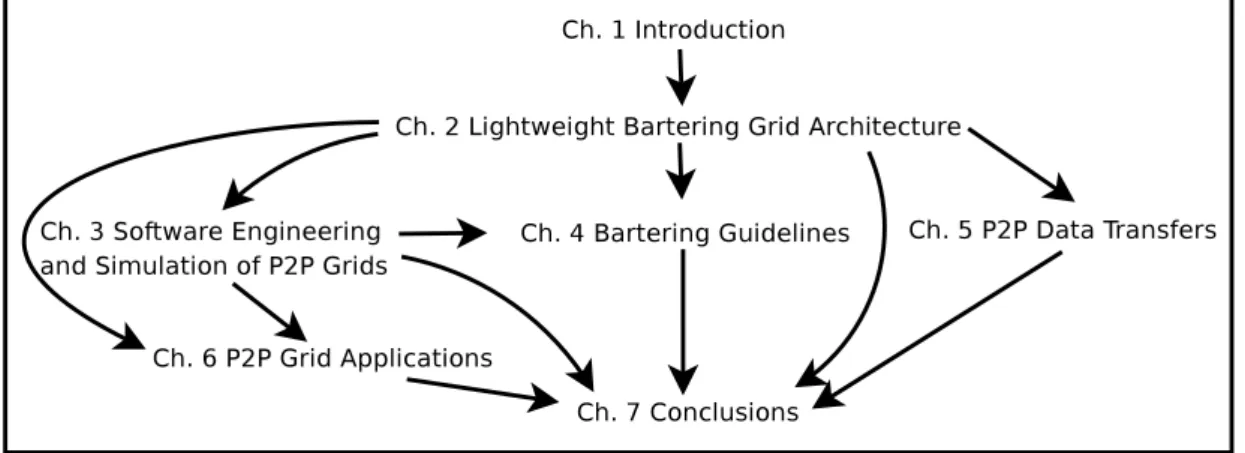
Overview of the Dissertation
Figure 1.2 illustrates the structure of this dissertation as well as the dependencies between the chapters. The review of the state of the art and the related work devoted to specific areas of P2P Grids is distributed among the relevant chapters.
Figure 1.2: Structure of the dissertation.
Chapter 2 introduces our proposed P2P Grid architecture, the Lightweight Barter-ing Grid, the middleware implementation of which is also discussed. Basic concepts in the domain of P2P Grids are defined and the state of the art in resource sharing methods and P2P Grid software is reviewed.
Chapter 3 discusses tools to facilitate the software engineering of P2P Grid soft-ware. It explains how to virtualize Grid nodes and implement a discrete-event P2P Grid simulator that also instantiates our proposed P2P Grid architecture. Chapter 4 discusses guidelines for bartering policies, notably taking into account the reliability of supplier Peers.
Chapter 5 introduces a scalable data transfer architecture, and proposes to com-bine P2P Grid and P2P file sharing technologies.
Chapter 6 reviews applications that, non-expectedly, can be structured as sets of independent computational Tasks to be run on P2P Grids.
Chapter 7 puts the contributions of this dissertation into perspective. Beyond these main chapters, several appendices complete this dissertation. Appendix A describes the application and service interfaces of the Lightweight Bartering Grid architecture.
Appendix B defines the job description language that is used to submit Bags of Tasks to Peers. It also defines the simulation description language.
Appendix C provides complementary notes on Peer middleware internals and im-plementation notes.
Appendix D provides complementary notes on Virtual Organizations.
Appendix E provides complementary notes on resource negotiation and standard Grid protocols.
Lightweight Bartering Grid
Architecture
Take what you need, give what you don’t need.
The middleware implementation of the Lightweight Bartering Grid architecture pro-vides a software that can autonomously share computing time between separate organizations in a totally decentralized way, respecting the hypothesis of informa-tional opacity between Peers. The middleware relies on a bartering mechanism based on the existing Network of Favors (NoF) model to do so. The reclaiming of computational power by a Peer for its own use, i.e. preemption, considerably increases the unreliability of an already unreliable environment. The flow of com-putational requests through a Peer is organized around the management of queues of computational requests, as well as several fault-management mechanisms. To mitigate the impact of preemption, an original feature of the associated scheduling model is to support the queueing of external computational requests. This enables to completely mask Task execution failures to the other Peers that submitted them.
Basic concepts of P2P Grids are provided in Sections 2.1-2.2. Each type of Grid nodes (Peer, Resource, User Agent, Search Engine) is introduced in Section 2.1. Basic mechanisms of a P2P Grid are introduced in Section 2.2. The state of the art in Resource sharing that is relevant to P2P Grids is then presented in Section 2.3. A classification of Grid application types is given in Section 2.4. In Section 2.5, a classification of lightweight Grids is proposed and the state-of-the-art P2P Grid middlewares are subsequently reviewed.
Our proposed P2P Grid architecture, Lightweight Bartering Grid [59] (LBG), en-ables to build 2-levels1 P2P Grids based on bartering2 where Peers autonomously
12-levels = each Peer (1st level) manages a set of worker nodes (2nd level).
act and model their environment. The LBG architecture is described in Sec-tions 2.6-2.9; its middleware implementation is also commented.
Software gridification, i.e. how to enable a software application to run on the Grid, is first briefly considered. The Grid application model of LBG is introduced in Section 2.6, The LBG middleware is fully implemented [55] in Java and targets Grid applications that are also implemented in Java.
Computer gridification is then considered. Making the computational power of a (worker node) computer available to the Grid is the purpose of the LBG Re-source middleware, described in Section 2.7. Completing computational requests submitted by users and bartering computing time through the sharing of the com-putational power of worker nodes are the purposes of the LBG Peer middleware, described in Section 2.9. The communication protocol used to transmit control messages between Grid nodes is also described, in Section 2.8.
2.1
Grid Nodes
The term Grid node is introduced to name any networked computer that is inside or at the edge of a Grid: User Agents, Peers, Resources and Search Engines. This term is introduced to easily designate all the computers connected to a Grid and to facilitate the discussion of network communications within, and at the edge of, a Grid. Figure 2.1 introduces the symbols that are used to visually represent Grid nodes and their storage capacity in the remainder of this dissertation.
The definitions of Resource, Peer and User Agent that are given in this section do not exclude the situation where one given computer simultaneously runs more than one type and/or instance of Grid middleware3. For instance, a User Agent, a Peer and a pair of Resources could be deployed on the same multi-core computer, while additional Resources are deployed on other computers. Figure 2.2 represents a typical P2P Grid composed of 4 sites, with multiple Grid nodes interacting to-gether: 2 User Agents, 4 Peers and 8 Resources.
2.1.1
Resources
There exist many types of resources: computational devices (desktop PC, super-computer, laptop), storage devices, networking devices, mobile devices (e.g. smart phone, PDA, . . .), sensors, . . . The scope of our research encompasses typical office
fully decentralized fashion, as introduced in Section 1.1.3, and as discussed in Section 2.3.2.
Resource Peer User Agent Search Engine data cache Figure 2.1: Symbols representing Grid nodes, and their storage capacity.
Figure 2.2: P2P Grid.
or home computers connected to the Internet - so-called edge computers. There-fore, the term Resource designates heterogeneous, low cost, possibly unreliable, standard computers with standard Internet connectivity, with some storage ca-pacity and a Java Virtual Machine (J2SE 5.0 [178]) available.
The Resource middleware is the software that makes a computer part of a Grid. In the following, the context will make it clear whether the term Resource refers to the Resource middleware or to the computer itself.
2.1.2
Peers
A site is a set of heterogeneous (in terms of hardware and software) Resources (possibly of small size, i.e. consisting of 1 or even 0 Resource 4) of an
administra-tively independent organization. Several sites are independent from one another. The administrators of a site group the Resources under their control to aggregate computational power for the human users of the site. The Resources of a site are all within the same administrative control. Local management of the Resources of a site is controlled by the human site administrators.
The following concept of the Peer-to-Peer domain is introduced to refer to the computer and associated Grid middleware controlling a given site on behalf of its human administrators. A Peer is a standard networked computer (i.e. similar in capacity to a Resource) of a site, designated to control the Resources of a site. There is one and only one Peer associated to each site. It acts on behalf of the site administrators, i.e. it autonomously uses and shares the Resources of a site. The purpose of a Peer is to complete as fast as possible the computational requests submitted by the human users of a site.
The Peer middleware is the software - organized as a software agent - that enables a computer to control the Resources of the site. In the following, the context will make it clear whether the term Peer refers to the Peer middleware that runs on the computer, or only to the computer itself.
We now point out a difference in our proposed definitions from commonly available definitions. A Grid Resource Management System (RMS) has sometimes been de-fined as “the subsystem of a Grid that identifies requirements, matches resources to applications, allocates, schedules, monitors Grid resources over time in order to run Grid applications as efficiently as possible.” [221] Our definition of a Peer matches this definition. But, in our view, the term RMS refers only to the spe-cialized software component of a Peer that manages Resources (i.e. control and handling of every communication with the Resources) along other Peer software components that handle other operations (e.g. scheduling, queueing, . . .).
2.1.3
User Agents
The term User Agent refers to the standard networked computer that is used by human users of a site to interact with the Peer of the site, e.g. submitting compu-tational requests, retrieving computed results.
The User Agent middleware is the software that enables a human user to interact with a Peer. It is essentially an interface to submit computational requests to the P2P Grid. In the following, the context will make it clear whether the term User Agent refers to the User Agent middleware that runs on the computer, or only to the computer itself. Human users are referred to as such (prefixed with “human”, with lower case u).
2.1.4
Search Engine
Peer discovery is the mechanism enabling the Peers of a P2P network, in particular of a P2P Grid, to become aware of other Peers. The LBG architecture relies on existing results for the Peer discovery mechanism, as it has been widely studied in the P2P domain.
A Search Engine keeps track of the Peers that are online. Each Peer proactively registers itself with a Search Engine, typically as it comes online, to eventually become visible to others. Peers can connect to a Search Engine to download the location data of other Peers. To ensure the freshness of its database, the Search Engine periodically checks that registered Peers are still online. In response to a Peer discovery request, a Search Engine provides location data of an arbitrary number of randomly selected Peers, as well as a timestamp. This timestamp can be used in the next Peer discovery request to ask only for Peers that were regis-tered afterwards; Peer clocks thus do not need to be synchronized as only the time of the Search Engine is involved [99]. This mechanism based on Search Engines is similar to the Rendezvous Point [327] mechanism, with out-of-Grid deployment. Rendezvous Point has been shown to be more efficient under high load than pure propagation-based mechanisms.
Peer discovery is discussed essentially in Sections 2.8 and 2.9.5, with complemen-tary information provided in Appendix D.2. One can therefore safely assume that, in this dissertation, the term Grid node does not encompass Search Engines.
2.1.5
Data Caches
The term data cache refers to the storage component of an internal Grid node. In the following, the context will make it clear whether the term data cache refers to the hardware capacity5 considered alone or together with the middleware-level software components that make it controllable by a Grid node.
2.2
LBG Architecture Overview
The goal of LBG is to enable Peers to autonomously and reliably run sets of independent computational tasks submitted by human users. The User Agent is introduced as a submission interface to the Peer; it completely hides the complexity of the P2P Grid to the human users.
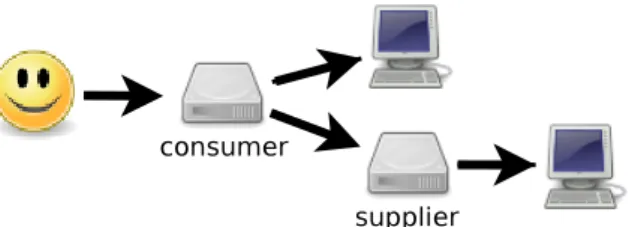
To process computational requests submitted by User Agents, a Peer has 2 options (see Figure 2.3):
• to schedule and run computational requests on its own Resources; • to submit computational requests to other Peers, that accept to supply
some computing time of some of their Resources.
The second option of consuming computing time from other Peers is par-ticularly interesting at peak, when a given Peer has no available Resources to run concurrently all the computational requests submitted by User Agents.
Figure 2.3: Scheduling to one’s own Resource vs. scheduling to another Peer. The terms consumer and supplier (also illustrated on Figure 2.3) refer to the roles (dynamically) assumed by Peers sharing Resources. A consumer Peer is a Peer consuming computing time of a Resource of another Peer. A supplier Peer is a Peer supplying computing time of one of its Resources to another Peer. Every Peer can act both as a consumer and as a supplier of computing time. Periods of consumption and supplying of a given Peer are typically alternating but may overlap under certain circumstances.
The responsibility of a Resource is to execute computational tasks. A Peer can schedule (steps 3 and 7 of Figure 2.6) and preempt (step 5 of Figure 2.6) the execution of a computational task to any of the Resources under its control. The execution of a computational task on a Resource is sandboxed (as will be illustrated on Figure 2.12 in Section 2.7.4) so that the computational task cannot compromise or interfere with the computer host.
If computational tasks remain to be scheduled and none of its Resources is available, a Peer can request the supplying of computing time from other Peers. Potential supplier Peers are located using a Search Engine. The role of the Search Engine is to provide location information of other Peers (as illustrated on Figure 2.4). Using this information, the Peer can contact the located Peers to negotiate the supplying of computing time from their Resources (as illustrated on Figure 2.5, which occurs between step 1 and step 2 of Figure 2.6).
Figure 2.4: Example of two Search Engines, thus two P2P Grids.
The purpose of the negotiation process is to prevent consumer Peers to submit computational tasks where they would face long waiting times. The contacted Peers can reply with consumption grants. The negotiation needs not be complex and does not involve counter-bids. The decision of the contacted Peers to accept to supply computational power is based on the availability of their own Resources.
Figure 2.5: Example of negotiation.
Upon successful negotiation, the Peer can then schedule computational tasks to the supplier Peers that have sent the consumption grants (step 2 of Figure 2.6). The supplier Peers will first filter the submitted compu-tational tasks before actually accepting their submission. Negotiation (i.e. the initial request) and filtering (of the actual submission of computational tasks) are kept separate. Thanks to this separation, negotiation is non-binding, which precludes any requirement for stateful negotiations. As negotiation is non-binding, computational tasks submitted to a supplier Peer (which thus has previ-ously sent consumption grants) may be rejected. This is not an issue as the Peer repeatedly negotiates with other Peers as long as computational tasks remain to be completed.
Figure 2.6: Example of preemption/cancellation of Task execution.
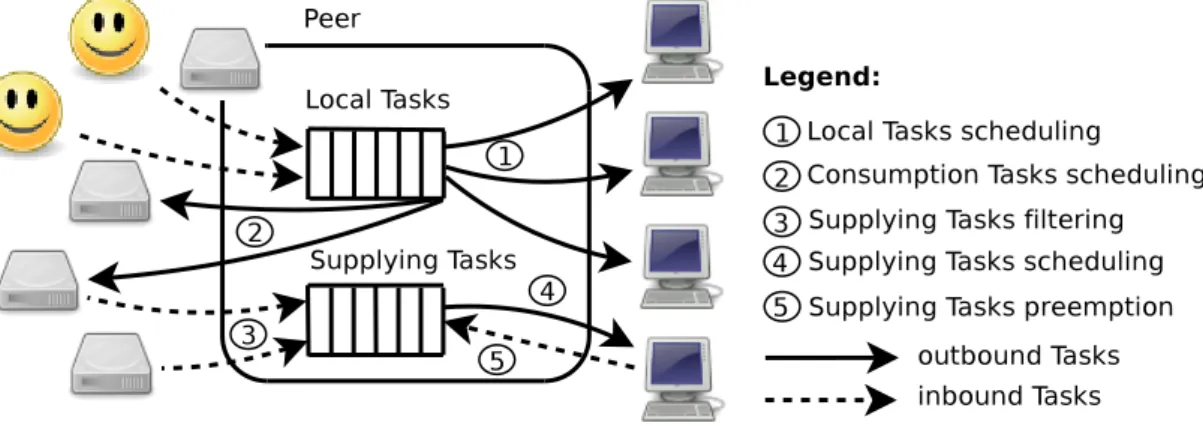
When Resources are available and all of its computational tasks are scheduled (either to Resources under its control or to other Peers), a Peer sched-ules to its Resources the computational tasks submitted by other Peers (step 3 of Figure 2.6).
If new computational tasks are submitted by its User Agents (step 4 of Figure 2.6), a Peer can consider to reclaim the computational power of those of its Resources that are supplied to other Peers. In practice, this translates into the preemption of the execution of computational tasks submitted by other Peers (as illustrated on Figure 2.6). Execution failures of compu-tational tasks are thus a common occurrence in a P2P Grid, as they can originate from preemption of execution, in addition to Resource failure.
After the preemption of a computational task submitted by a consumer Peer, a Peer can decide to cancel the computational task, i.e. to notify the con-sumer Peer that the execution will not be completed (step 6’ of Figure 2.6). A Peer could also decide to mask the execution failure of a computational task to the consumer Peers by requeueing the preempted execution failure (step 6 of Figure 2.6 is not performed). Doing so removes the need for the consumer Peer to locate another willing supplier Peer. In order to mask execution fail-ures of computational tasks, a supplier Peer maintains a queue of the computational tasks submitted by other Peers, similarly to the queue of computational tasks that is maintained to mask execution failures to User Agents.