HAL Id: dumas-01219304
https://dumas.ccsd.cnrs.fr/dumas-01219304
Submitted on 22 Oct 2015HAL is a multi-disciplinary open access
archive for the deposit and dissemination of sci-entific research documents, whether they are pub-lished or not. The documents may come from teaching and research institutions in France or abroad, or from public or private research centers.
L’archive ouverte pluridisciplinaire HAL, est destinée au dépôt et à la diffusion de documents scientifiques de niveau recherche, publiés ou non, émanant des établissements d’enseignement et de recherche français ou étrangers, des laboratoires publics ou privés.
Assessment of a Yucatan black howler monkey
population reintroduction
Fanny Tricone
To cite this version:
Fanny Tricone. Assessment of a Yucatan black howler monkey population reintroduction. Agricultural sciences. 2015. �dumas-01219304�
AGROCAMPUS OUEST CFR Angers
□
CFR Rennes Année universitaire : 2014-2015 Spécialité : Génie de l’EnvironnementSpécialisation (et option éventuelle) : Préservation et aménagement des milieux – Ecologie quantitative
Mémoire de Fin d'Études
d’Ingénieur de l’Institut Supérieur des Sciences agronomiques, agroalimentaires, horticoles et du paysage
□
de Master de l’Institut Supérieur des Sciencesagronomiques, agroalimentaires, horticoles et du paysage
□
d'un autre établissement (étudiant arrivé en M2)Par : Fanny TRICONE
Soutenu à Rennes le 18/09/2015
Devant le jury composé de : Président : Ivan BERNEZ
Maître de stage : Paul WALKER - non présent Enseignant référent : Yannick OUTREMAN
Autres membres du jury Alban LEMASSON, éthologiste
Assessment of a Yucatan black howler monkey
population reintroduction
Les analyses et les conclusions de ce travail d'étudiant n'engagent que la responsabilité de son auteur et non celle d’AGROCAMPUS OUEST
i
Synthèse en français du mémoire
Introduction
Les primates du néotropique sont menacés par la disparition des forêts tropicales et la chasse
des animaux sauvages pour le trafic illégal des animaux de compagnies. La réintroduction
d’espèces est une des mesures de lutte contre la perte de biodiversité et elle vise à rétablir des
populations autosuffisantes et viables dans des milieux où les espèces ont disparu. Cependant,
il a été montré que l’évaluation du succès des réintroductions n’était pas possible pour environ
la moitié des projets, à cause d’un manque de suivis et d’évaluation après remise en liberté des
animaux.
Alouatta pigra, ou Hurleur du Guatemala, est une espèce en voie d’extinction. Des projets
de réintroductions ont été mis en place depuis les années 80 sur cette espèce de singes hurleurs.
La répartition géographique de l’espèce s’étend de la péninsule du Yucatan au Mexique, au
Belize et au Nord-est du Guatemala. Au Belize, Wildtracks détient le seul Centre de
Réhabilitation de Primates du pays et participe à la réhabilitation d’anciens animaux de
compagnie et au transfert d’individus sauvages pour les réintroduire et rétablir une population
dans un site où l’espèce a disparu depuis environ 70 ans. Après chaque remise en liberté, un
suivi de 3 mois est mis en place pour assurer la survie des individus en milieu sauvage. De Juin
2011 à Juin 2014, 28 singes hurleurs ont ainsi été relâchés. Après ces 4 années de remises en
liberté, un projet de 6 mois a été mis en place en 2015 pour effectuer un bilan sur l’état actuel
des individus relâchés et de leur réintroduction. Les but principaux de ce projet étaient de
localiser le plus d’individus possible, de déterminer la composition des groupes et leur
condition, ainsi que leur domaine vital actuel pour conduire une évaluation de la réintroduction
de l’espèce à ce jour.
Dans cette optique, ce mémoire a été divisé en quatre parties. La première partie est une
étude démographique établissant les caractéristiques de la population telles que la taille des
troupes et leur composition, la densité de population et l’identification des individus. La
seconde partie est une étude des domaines vitaux pour localiser les singes relâchés et évaluer la
taille et l’utilisation de leur domaine vital. La troisième partie est une étude sur les ressources
alimentaires, pour améliorer les connaissances sur les plantes nourricières présentes sur les
lieux de remise en liberté et améliorer la recherche de nouveaux sites de lâcher. Finalement, la
dernière partie est une étude du statut actuel des singes libérés selon des critères d’évaluation
établis dans le rapport, ainsi qu’une étude statistique sur la survie.
ii
Méthodes
Site d’étude et population étudiée
La réintroduction des singes pris en charge par le Centre de Réhabilitation s’effectue sur
deux sites contigus, situés au Nord-Est du Belize, dans la région de Corozal : Fireburn Reserve
et Kakantulix Archaeological Reserve. 20 singes réhabilités ont été relâchés à Fireburn Reserve
et 8 singes transférés ont été relâchés à Kakantulix Archaeological Reserve. Le choix de séparer
singes réhabilités et singes transférés a été fait pour permettre aux singes réhabilités d’apprendre
à vivre en milieu sauvage sans pression par des individus sauvages expérimentés.
Localisation des troupes et future sites de remise en liberté
Les troupes et les individus ont été localisés en suivant leurs hurlements et en explorant les
Réserves. La méthode d’exploration a été établie en analysant d’anciennes études faites sur la
végétation présentes à Fireburn Reserve et ainsi définir des zones de recherche prioritaires
(habitats propices à l’établissement de singes hurleurs). L’exploration a débutée dans ces zones
prioritaires, en commençant par surveiller les sites de lâchers et les aires explorées par les
troupes lors du suivi de trois mois effectué après remise en liberté.
Pendant l’exploration, les aires explorées ont été cataloguées en 3 types de zones en fonction
de la présence ou non d’espèce nourricières, la connectivité et la hauteur de la canopée : « site
potentiel de lâchers », « corridor potentiel » et « non favorable pour les lâchers ». Cela a permis
de cartographier l’aire totale explorée au cours de l’étude pour aider à la localisation de
nouveaux sites de lâchers pour les futures remises en liberté.
Identification des troupes et des individus
Chaque individu a été identifié par le nom, le sexe et l’âge. Chaque individu ayant une forme
unique de pigmentation sur leurs parties génitales, l’identification des individus a été faite à
l’aide de photographies faciales mais également à l’aide de photographies du postérieur des
individus. La photographie faciale a permis l’identification par le nom des individus en
comparant cette photographie avec des photographies des individus relâchés prises quand ils
étaient encore présents au Centre de Réhabilitation. Une clef d’indentification a été mise en
place pour aider à l’identification des individus et des troupes, présentant chaque individu par
le nom, une photographie faciale et une photographie du postérieur.
Collection et analyse des données
iii
Chaque individu a été identifié par le sexe une classe d’âge : adulte, sub-adulte, juvénile ou
nourrisson. L’âge des singes a été estimé grâce à l’âge hypothétique des singes à l’admission
au Centre de Réhabilitation. Les densités de population ont été exprimées par individu au
kilomètre carré.
Localisation GPS
La localisation des individus et des troupes, et l’analyse de leurs déplacements a été faite
grâce à un GPS. Il a été relevé par points GPS où les singes se reposaient durant la journée,
dormaient la nuit et hurlaient durant les suivis. Cela a été réalisé pour permettre la localisation
de leurs sites préférés sur leur domaine vital et pour évaluer si les singes réhabilités étaient
capables de défendre leur territoire grâce aux hurlements. Ces informations géographiques ont
été traitées à l’aide de cartes sur ArcMap 10.1, et une méthode de polygones numérisés a été
utilisée pour évaluer la taille des domaines vitaux.
Plantes nourricières
Les singes hurleurs sont connus pour être une espèce colonisatrice, capable d’adapter leur
régime alimentaire lors de transfert dans de nouveaux habitats. Peu est connu sur le régime
alimentaire de l’espèce dans le site de réintroduction utilisé par le Centre de Réhabilitation,
l’espèce ayant disparu du site il y a environ 70 ans.
Les espèces alimentaires ont été identifiées à l’aide de photographies. Pour chaque espèce,
il a été noté si les singes se nourrissaient des jeunes feuilles, des feuilles matures, des fruits, des
fleurs ou des pétioles, et si ils s’en nourrissaient pendant plus ou moins de 5 minutes. Pour
évaluer les variations de la disponibilité en fruit du site de réintroduction, le mois où les fruits
d’une espèce ont été consommés a été relevé. De plus, le comptage du nombre de fois où une
espèce a été enregistrée pour l’alimentation a été effectué pour déterminer les espèces
consommées préférentiellement.
Critères d’évaluation
Des animaux réhabilités et élevés en captivité n’atteignent pas le même niveau de
compétences que des animaux sauvages. Le programme du Centre de Réhabilitation devant
permettre la survie des animaux une fois relâchés en milieu sauvage, il était important d’évaluer
leurs comportements pour s’assurer qu’ils agissaient comme des animaux sauvages et planifier
ou non des interventions. Pour évaluer le statut actuel des individus relâchés et de leur
réintroduction, plusieurs critères ont été choisis :
- Trouvé : l’individu a été trouvé ou non lors de l’étude (ceci permet une estimation
minimale du taux de survie).
iv
-
Réponse à la présence d’humains : l’individu ignore, s’énerve, est attiré par la présence
d’être humain.
- Vu sur le sol : l’individu a été vu ou non sur le sol.
- En bonne santé : L’individu parait en bonne santé ou non (visuellement observé par la
qualité de la fourrure et du poids).
- Reproduction : la présence de nouveaux nés ou des comportements reproducteurs ont
été observés ou non.
- Cohésion à une troupe : l’individu appartient à une troupe ou non.
- Domaine vital établi : l’individu a établi un domaine vital ou non.
Etude de la survie
Une étude statistique a été faite sur la survie (trouvé, non trouvé) pour chercher si certains
facteurs avaient une influence sur le fait de trouver ou non les individus après lâchers. Ces
facteurs étaient :
-
L’origine (sauvage ou animal de compagnie).
-
Le sexe
-
L’âge à l’admission au centre de réhabilitation
-
L’âge à la remise en liberté
-
Le degré d’humanisation au moment des lâchers
-
Le temps réhabilité et le temps vu après lâchers dans le milieu sauvage.
La variable à expliquer est une variable binomiale. Un modèle linéaire généralisé de famille
d’erreur la famille binomiale, et pour fonction de lien la fonction logit, a été choisi pour
effectuer cette étude.
Résultats
Etude démographique des singes hurleurs relâchés
Caractérisation des troupes et de la population
24 singes ont été trouvés au cours de l’étude, dont 3 nouveaux nés. La population observée
était constituée de 9 males, 12 femelles et 3 nouveaux nés. Cinq troupes ont montré une
cohésion et l’établissement d’un domaine vital.
La densité moyenne de la population était 14,2 indiv/km². La densité de population était de
24,3 indiv/km² à Fireburn Reserve et de 4,2 indiv/km² à Kakantulix Archaeological Reserve.
L’âge à la première naissance des femelles était d’environ 4,4 ans.
v
L’identification des individus par le nom a été possible pour tous les individus trouvés lors
de l’étude, et la clef d’identification a été réalisée pour tous ces individus ainsi que les individus
présents au Centre de Réhabilitation au moment de l’étude, sauf pour les jeunes pour lesquels
seuls des soigneurs spécifiques ont accès.
Evolution de la composition des troupes depuis remise en liberté
La comparaison de la constitution des troupes au moment des lâchers avec celle trouvée lors
de l’étude a permis d’étudier l’évolution et la stabilité des troupes. Quatre troupes sont restées
soudées (sans tenir compte des individus manquants et des nouveaux nés présents). Une
nouvelle troupe a été déterminée, constituée de trois individus provenant de trois troupes
initiales différentes. Cinq individus ont été observés sans troupe stable à Kakantulix
Archaeological Reserve et interagissant entre eux ou avec des individus de troupes
nouvellement relâchées en 2015.
Etude des domaines vitaux des singes hurleurs relâchés
Localisation des troupes et futurs sites de remise en liberté
Une aire d’environ 640 hectares a été explorée et cartographiée durant cette étude. Tous les
singes trouvés ont été localisés dans des aires classifiées comme « site potentiel de lâchers ».
Tous les individus ont été trouvés autour de leur site de lâchers, hormis Bonnie, une femelle qui
a migré de Fireburn Reserve à Kakantulix Archaeological Reserve. La cartographie de l’aire
explorée a été utilisée pour rechercher des sites de remises en liberté pour 2015.
Utilisation et tailles des domaines vitaux
Une étude des domaines vitaux a été réalisé sur les troupes et individus qui ont pu être suivis
pour un minimum de trois jours. La taille des domaines vitaux étudiés variait de 2,6 à 11,6
hectares. Chaque domaine vital possédait un chevauchement d’en moyenne 18.6% de sa taille
totale avec les domaines vitaux voisins.
Des hurlements ont été enregistrés pour toutes les troupes de singes réhabilités trouvés lors
de l’étude. Ces hurlements ont eu lieu à la jonction entre deux domaines vitaux. Des arbres et
des sites favoris des singes, utilisés pour se reposer et passer la nuit ont été cartographiés sur
chacun des domaines vitaux.
Etude alimentaire des singes hurleurs relâchés
Un total de 32 espèces et de 14 familles de plantes alimentaires ont été identifiés au cours de
ce projet. Les cinq mêmes espèces favorites ont été trouvées chez les singes étudiés pour se
nourrir pendant plus ou moins de cinq minutes, ces espèces étant : Cecropia peltata, Ficus sp.,
vi
Protium copal, Leucaena leucocephala et Vitis tiliifolia. Un minimum de trois différentes
espèces de fruits consommées a été relevé par mois de Mars à Août.
Evaluation des remises en liberté
Durant ce projet, un total de six singes n’a pas été retrouvé et un autre individu avait été
trouvé mort en 2014. 87,5% des singes sauvages transférés et 70% des singes réhabilités ont
été retrouvés. Tous les singes retrouvés ont été évalués en bonne santé, et 34% ont montré des
capacités de reproduction. 71% des singes appartenaient à une troupe stable, et 76% avaient
établis un domaine vital. 86% des singes ont montré une réponse adaptée à la présence d’êtres
humains et n’ont pas été vu sur le sol.
Pour l’étude statistique sur la survie, le nombre de données était trop faible pour calculer les
coefficients du modèle linéaire généralisé. Une étude graphique des effets significatifs a alors
été réalisée, montrant l’influence de l’origine (animal de compagnie ou sauvage) et du temps
vu après lâchers dans le milieu sauvage (plus ou moins d’un an) sur la probabilité de trouver ou
non l’individu.
Discussion
Analyse des résultats
Caractéristiques démographiques
La densité de population moyenne trouvée dans cette étude était similaire à celle référencée
dans la littérature. La population observée a juste commencé à se reproduire. De ce fait, les
densités de population observée devraient augmenter dans les années futures, ainsi que grâce
aux nouvelles remises en liberté.
Cohésion des troupes
Les troupes trouvées étaient stables. Les problèmes d’instabilité rencontrés à Kakantulix
Archaeological Reserve pourraient être attribués au fait que des individus, et non uniquement
des troupes, ont été relâches sur ce site. Ces individus chercheraient à établir des troupes et
interagiraient avec les femelles présentes sur le site. De nouveaux changements sont à prévoir
avec les nouveaux lâchers et la recolonisation du milieu à venir.
A cause de ces changements de troupes et du fait que les visages des singes changent en
grandissant, la clef d’identification devra être mise à jour régulièrement dans le futur.
Nouveaux sites de remise en liberté
Les aires les plus importantes qui ont été trouvées favorables aux lâchers étaient déjà habitées
par des singes hurleurs. Pour trouver de nouveaux sites de remise en liberté, il est important de
vii
vérifier que l’emplacement est suffisamment éloigné des troupes établies. De plus, les nouvelles
remises en liberté ne doivent pas se faire dans des habitats saturés, pour ne pas compromettre
la population déjà établie.
Dans ce rapport il a donc été conseillé de ne pas faire de nouveaux lâchers dans Fireburn
Reserve du fait que toutes les aires classifiées comme « potentiel site de lâchers » étaient déjà
occupés par des troupes, que la densité de population dans cette Réserve était élevée et que la
population établie à cet endroit avait commencé à se reproduire. La densité de population à
Kakantulix Archaeological Reserve était suffisamment basse pour permettre les lâchers de
2015, et il a été décidé d’y effectuer les nouvelles remises en liberté.
De nouvelles aires de remise en liberté devraient être recherchées pour les futurs lâchers car
les sites de remises en liberté utilisés actuellement seront bientôt saturés.
Caractéristiques des domaines vitaux et utilisation
Une étude faite sur Alouatta pigra a montré que des troupes récemment transférées
établissaient généralement leur domaine vital six mois après remise en liberté, et continuaient
d’explorer leur habitat un an après remise en liberté. Les individus trouvés dans cette étude ont
été relâchés au moins un an avant ce bilan. De ce fait, il a pu être montré que l’établissement
des domaines vitaux pouvait prendre plus d’un an.
La taille moyenne des domaines vitaux pour l’espèce est de 9,2 hectares, ce qui est supérieur
à ce qui a été trouvé dans cette étude. Or, la taille des domaines vitaux est inversement
proportionnelle à l’abondance de nourriture et à la densité de population. La densité de
population trouvée à Fireburn Reserve était supérieure à la densité moyenne de l’espèce et
pourrait expliquer ce résultat. Grâce à l’identification des espèces nourricières, une étude sur
l’abondance de ces espèces sur le domaine vital de chaque troupe pourrait être faite à l’avenir
pour évaluer si la taille des domaines vitaux serait également corrélée avec l’abondance de
nourriture.
Le recouvrement des domaines vitaux chez les singes hurleurs peut atteindre environ 30%.
Ces connections entre domaines vitaux permettraient la reproduction d’individus de troupes
différentes et donc le maintien d’une diversité génétique au sein de la population.
Chez les singes hurleurs, la défense des territoires est faite à l’aide de hurlements dissuasifs
pour informer les adversaires du nombre de mâles adultes dans la troupe et éviter des combats
couteux en énergie. A Fireburn Reserve, la stratégie semblait efficace, aucun combat n’ayant
été observé. Cependant cela pourrait également être dû au fait qu’il n’y ait encore que peu de
mâles adultes dans la Réserve.
viii
L’étude sur les aires de repos a confirmé l’idée selon laquelle les singes hurleurs avaient des
sites préférentiels pour se reposer et passer la nuit. La localisation de ces sites permettra une
localisation plus aisée des troupes dans le futur.
Capacité nourricière des zones de remise en liberté
Alouatta pigra consomme en moyenne 23 espèces et 11 familles de plantes. La comparaison
avec les résultats trouvés dans cette étude a montré que les singes se nourrissaient avec succès
dans leur nouvel environnement et que cet environnement fournissait suffisamment de
ressources pour leur survie.
L’espèce a été décrite comme étant aussi frugivore que possible et aussi folivore que
nécessaire. De Mars à Août, l’étude sur les espèces nourricières fruitières a permis de montrer
que le site de remise en liberté permettait aux singes de se fournir en fruits sans interruption
durant cette période.
Cette étude soutient les efforts du Centre de Réhabilitation pour mettre davantage l’accent
sur la production d’espèces locales présentes sur les sites de remise en liberté pour nourrir les
singes réhabilités, en fournissant une identification des espèces nourricières favorites
consommées par les singes sur les sites de réintroduction.
Evaluation du statut et de la réintroduction des singes relâchés
Tous les singes transférés, sauf un dont le squelette a été retrouvé avant ce bilan, étaient en
vie un an au moins après remise en liberté. La survie à long terme des singes réhabilités était
d’au moins 70%. En effet, ne pas trouver un individu ne signifie pas qu’il est mort. L’individu
en question pourrait avoir migré dans des aires non surveillée ou pourrait ne pas avoir été
localisé du fait des difficultés visuelles pour détecter un singe dans la canopée. Deux individus
manquants ont cependant été identifiés à haut risque de décès. Une cause probable de décès
serait une mort naturelle par prédation. La présence de prédateurs naturels des singes hurleurs
a été mise en évidence par des pièges photos sur les Réserves au cours de ce projet.
95% des singes relâchés ont été estimés être sexuellement matures durant ce projet. D’autres
individus que ceux trouvés lors de l’étude pourraient se reproduire avec succès, mais les
nouveaux nés n’auraient pas été trouvés. En effet, la mortalité infantile chez les singes hurleurs
peut atteindre environ 21-35%, et la plupart des femelles relâchées (ex-animal de compagnie)
n’ont jamais vu d’autres femelles s’occuper de nouveaux nés. On pourrait donc s’attendre à ce
que ce pourcentage soit plus élevé dans la population étudiée. De même, les singes relâchés ne
savent probablement pas comment détecter des prédateurs et protéger leurs congénères.
ix
Aucun des facteurs inhérent au Centre de Réhabilitation n’aurait une influence sur la survie
des individus après remise en liberté. Si l’individu n’a pas été vu un an après remise en liberté,
ses chances de ne pas être retrouvé par la suite seraient de 100%. Autrement, ses chances d’être
trouvé seraient élevées, d’autant plus si l’individu était d’origine sauvage. Le fait que le singe
ait été un animal de compagnie n’influence pas de façon significative la probabilité de survie.
Limites du projet
Comme le but principal de ce projet était de trouver le plus d’individus possible, le temps de
terrain a été consacré en priorité à l’exploration des sites de remise en liberté. Par conséquent
le temps passé à suivre chaque troupe et individu nécessiterait d’être augmenté pour avoir des
résultats plus pertinents sur les domaines vitaux et l’alimentation.
L’utilisation des domaines vitaux dépend de la disponibilité en nourriture et donc varie de
façon mensuelle. Par conséquent, les troupes n’utilisent pas tout leur domaine vital au même
moment de l’année. De ce fait, les études sur les domaines vitaux et les espèces nourricières
devraient être faites sur une année complète.
La connaissance sur les espèces nourricières utilisées au cours d’une année permettrait de
trouver des sites de remise en liberté de bonne qualité, comme ils doivent fournir des ressources
alimentaires à travers toutes les saisons.
Des échantillons de plantes ne pouvaient pas être collectés durant cette étude. La collecte
d’échantillons aurait pu permettre d’identifier plus précisément les plantes consommées par les
singes.
Les singes transférés n’ont pas pu être suivis pendant trois jours consécutifs. Du fait de leur
réponse négative à notre présence, les singes n’ont pas pu être trouvés le jour suivant. De ce
fait, l’étude du domaine vital des troupes n’a pas pu être effectuée sur les individus transférés.
L’étude statistique faite sur la survie nécessitait plus de données. Cette étude pourrait être
refaite dans le futur, lorsque plus de singes auront été relâchés. De nouveaux effets significatifs
pourraient alors apparaitre.
Conclusion
Le but de ce projet était de faire un bilan sur l’état et la réintroduction de singes hurleurs
pour évaluer le ré-établissement d’une population où l’espèce a disparu. Cela a été effectué en
évaluant la survie, la reproduction, l’établissement des domaines vitaux, la cohésion des
troupes, la réponse des singes à la présence d’humains, la présence des singes au sol et leur
condition de santé visuelle, ainsi qu’en étudiant l’utilisation de leur domaine vital et la présence
d’espèces nourricières sur les sites de remise en liberté.
x
En 2015, la population a pu être caractérisée et 75% des singes relâchés ont été trouvés en
bonne santé, identifiés et localisés après au moins un an passé en milieu sauvage. Dans d’autres
études, le taux de survie atteint seulement un maximum de 40%. Dans cette étude, 76% des
singes relâchés avait établi un domaine vital et 71% appartenait à une troupe stable. Les singes
réhabilités étaient capable de se nourrir et de défendre leur territoire comme des singes
sauvages. De plus, 24% de la population a commencé à se reproduire avec succès, et 32 espèces
alimentaires ont été identifiées au cours de l’étude.
Les difficultés pour trouver des singes dans la canopée, la migration d’individus vers des
zones non surveillées et la prédation ont été les explications les plus probables pour la
disparition des individus.
Il a été montré dans cette étude que les singes hurleurs semblent avoir des sites préférentiels
pour passer la nuit et se reposer. Peu d’étude ont porté sur l’analyse spatiale de la distribution
de ces sites. Ce rapport pourrait être un point de départ pour étudier ce sujet, comme cela a été
réalisé avec les singes araignées.
L’étude statistique sur la survie a permis de montrer l’importance de faire des suivis sur plus
d’un an pour évaluer correctement la survie des individus.
Le but des réintroductions étant de ré-établir une population viable et autosuffisante, leur
évaluation devrait être effectuée jusqu’à la reproduction réussie de la descendance de la
génération réintroduite. Par conséquent, des bilans futurs seront nécessaires pour évaluer les
taux de reproduction de la population réintroduite. Chez les Gibbons, des projets de
réintroduction ne relâchent des troupes qu’une fois qu’elles se reproduisent. Cette approche
pourrait être abordée par le Centre de Réhabilitation pour améliorer la reproduction de la
population réintroduite.
xi
Table of Contents
Synthèse en français du mémoire ...i
Table of Contents ... xi
List of figures and tables ... xiii
Acknowledgements ... xiv
1
INTRODUCTION ... 1
2
METHODS ... 2
2.1 Study site and study population ... 2
2.2 Location of the troops and future release sites... 4
2.2.1 Location by the howls ... 4
2.2.2 Location by exploration ... 4
2.2.3 New release sites ... 5
2.3 Identification of the troops and individuals ... 6
2.4 Data collection ... 6 2.4.1 Population characterisation ... 6 2.4.2 GPS locations ... 7 2.4.3 Feeding plants ... 7 2.4.4 Evaluation criteria ... 8 2.5 Data analysis ... 9
2.5.1 Home range study ... 9
2.5.2 Survival study ... 9
3
RESULTS ... 9
3.1 Demographic study of the released howler monkeys ... 9
3.1.1 Population and troop characteristics ... 10
3.1.2 Identification of the individuals ... 11
3.1.3 Evolution of the troops’ composition since release ... 11
xii
3.2.1 Location of the troops and future release locations ... 12
3.2.2 Home range uses and size of the released monkeys ... 13
3.3 Feeding study of the released howler monkeys ... 14
3.4 Evaluation of the releases ... 17
3.4.1 Survival and status of the released howler monkeys ... 17
3.4.2 Influence of different factors on survival ... 18
4
DISCUSSION ... 19
4.1 Analysis of the results... 19
4.1.1 Demographic characteristics... 19
4.1.2 Troop cohesion after release ... 19
4.1.3 New release location ... 20
4.1.4 Home range characteristics and uses ... 21
4.1.5 Feeding capacity of the release sites ... 22
4.1.6 Evaluation of the status and the reintroduction of the released monkeys ... 22
4.1.7 Factors influencing survival ... 23
4.2 Limits of the project ... 23
5
CONCLUSION ... 24
6
BIBLIOGRAPHY ... 26
xiii
List of figures and tables
Figure 1: Protected areas and corridors of Belize, and location of the release sites 3 Figure 2: Classification for the exploration method in the Fireburn Reserve 5
Figure 3: Abstracts from the identification key 11
Figure 4: Map of the area explored 12
Figure 5: Home ranges and howls at Fireburn Reserve 13
Figure 6: Map of the sleeping and resting sites 14
Figure 7: Graphics of the influence of Source (A) and Released (B) on the survival 18
Table 1: List of the released rehabilitated howler monkeys 3
Table 2: List of the released translocated howler monkeys 4
Table 3: Time spent tracking each troop and individual during the study 9
Table 4: Howler monkeys detected during the study 10
Table 5: Estimations of ages for the infants (A) and the monkeys that reproduced (B) 10
Table 6: Troop composition before and after release 11
Table 7: Home range size and overlaps 13
Table 8: List of the feeding plants identified 15
Table 9: List of the browses eaten by the released monkeys 16
Table 10: List of the fruits and flowers used each month of the feeding study by the released monkeys 17
Table 11: Success and failure of the releases 17
Table 12: Evaluation table of the status of the released howler monkeys and of their reintroduction 18
xiv
Acknowledgements
I sincerely thank Paul and Zoe Walker from Wildtracks who allowed me to work on this project and for facilitating the research.
I am very grateful to Rudy Castellanos for his help in the field. This project would not have been possible without his assistance. He shared with me his knowledge on howler monkey tracking and local tree identification, and made each day of field work an unforgettable experience thanks to his constant good mood and to his interest in my work. I couldn’t hope for a better co-worker.
I also want to thank Michael G. Starkey and Pablito Pena, for their help when Rudy wasn’t available, and Lincoln’s family members from the Fireburn Community, for their warm welcome and their kindness throughout this project.
I gratefully acknowledge Steven Brewer and Paul Walker for their help in the identification of the feed species considering the difficulties of the identification by photography. This part of the project wouldn’t have been possible without their help.
I want to show my gratitude to Lauren Nerfa, Paul Walker and Amanda Deardeuff for the correction of the English mistakes and their comments on the write-up of this report.
Finally, I thank the staff and the volunteers of Wildtracks for their support and encouragement in my project.
1
1 I
NTRODUCTION
Neotropical primates are threatened by the loss of tropical forest due to human activities (Chapman & Peres, 2001) and hunting pressure for consumption or sale for the pet trade (Horwich, 1998). Conservation efforts for primates are discussed in the scientific literature, such as habitat conservation and protection against international primate trade (Konstant & Mittermeier, 1982,; Mittermeier et al., 1989). Species reintroduction is another measure to fight against the loss of biodiversity and it aims to re-establish a viable, self-sustainable population in the wild inside its indigenous range from which it has disappeared (IUCN/SSC, 2013,; Baker, 2002). Guidelines have been published to ensure that everything goes smoothly in reintroduction projects (IUCN/SSC, 2013,; Baker, 2002,; Armstrong & Seddon, 2008,; Beck et al., 2007)). Despite all these measures, a study assessing the results of 20 years of reintroduction projects showed that it wasn’t possible to evaluate the success or the failure of around half of the projects (Fischer & Lindenmayer, 2000). Generally, this may be due to historical lack of monitoring in the projects, negligence in the implementation of the evaluation and monitoring after release and/or reluctance to report the failures (Sarrazin & Barbault, 1996,; Cheyne, 2009a). A study showed that only a third of rehabilitation centers assessed the success of releases (Guy et al., 2013). Assessments should include behavioural, demographic, and ecological studies and take into account other factors such as social changes (for example, group stability and intergroup interactions), health, reproductive behaviour and success and mortality (Baker, 2002).
Alouatta pigra, or Yucatan black howler monkey, is one of the 11 species of the genus Alouatta to be listed on the IUCN red list which catalogues and evaluates the status of
threatened species. Alouatta pigra is endangered and ranges from the Yucatán Peninsula in Mexico, Belize and the Northern and central Guatemala (Marsh et al., 2008). Reintroduction projects have been conducted on this species since the 1980s (Horwich et al., 1993). Howler monkeys are folivorous, florivorous, and frugivorous, and the consumption of fruits represents around 38.5% of their diet (Dias & Rangel-Negrin, 2015). Therefore, the conservation of howler monkeys is essential for the forests as they are important seed dispersers (Arroyo-Rodriguez et al., 2015). In Belize, around a quarter of the national territory is under some form of conservation management, and the pet trade of this species is illegal. Wildtracks, a non-governmental organization, hosts the only Primate Rehabilitation Centre in Belize and participates in the rescue of injured monkeys in the wild, translocation and confiscation of illegal pets in partnership with the Forest Department of Belize. The rescued monkeys receive care and enter a rehabilitation programme to allow them to be released back into the wild.
Between June 2011 and May 2015, Wildtracks has released 28 howler monkeys. These included rehabilitated monkeys from the pet trade and also translocations of wild monkeys. A
2
post release monitoring period of 3 months has been applied to each released troop of rehabilitated howler monkeys, to ensure their survival in the wild. After four years of releases, Wildtracks decided to start a 6 month project to determine the current status of the released Yucatan black howler monkeys and of reintroduction into their former range to re-establish a viable sub-population. The main goals of this project were to locate as many of the released howler monkeys as possible, determine group composition, condition, and current territories in order to conduct evaluation of species re-introduction to date.For that purpose this study was divided in four parts to conduct the assessment of the population reintroduction. The first part was a demographic study, analysing the characteristics of the population such as troop size and composition, population density and individual identification. The second part was a home range study to locate the released monkeys and evaluate the size and home range use of established monkeys. The third part was a feeding study to improve the knowledge of the feeding species used by the released monkeys and to improve the search for suitable release sites. And finally, the last part was an evaluation of the status of the released monkeys, including health condition, reproduction, troop cohesion and establishment, and a statistical study of survival.
2 M
ETHODS
2.1 S
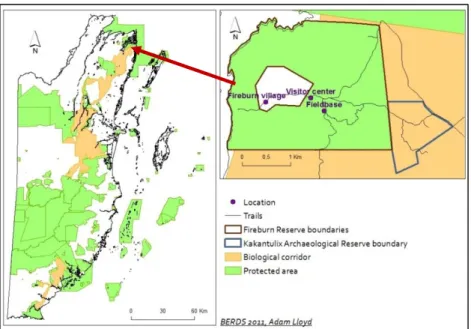
TUDY SITE AND STUDY POPULATIONReintroduction and translocation of rehabilitated and wild monkeys occurred in two contiguous sites: the Fireburn Reserve and the proposed Kakantulix Archaeological Reserve. These sites are located on the Eastern shore of the Shipstern Lagoon, in the Corozal District of north-eastern Belize (Figure 1). These two release sites are within the historical range of
Alouatta pigra, and are protected and free of historical threats, which is conducive to the
establishment of a new population of black howler monkeys (Konstant & Mittermeier, 1982). Therefore, they fulfill the requirements of the reintroduction guidelines (IUCN/SSC, 2013,; Baker, 2002. Moreover, the Fireburn Reserve was studied in 2005 to ensure that there were suitable areas for howler monkey releases, in terms of food abundance and canopy structure (Fanigliulo, 2005).
3
Figure 1: Protected areas and corridors of Belize, and location of the release sites
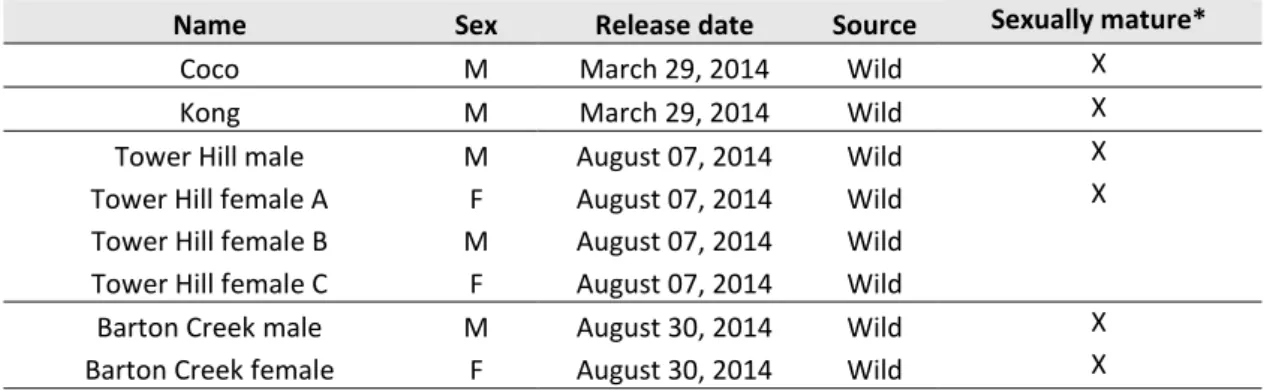
The study population is constituted by 21 howler monkeys, of which 12 were estimated sexually mature at release (Table 1 and 2, Appendix XII).
Rehabilitated monkeys were released into the Fireburn Reserve (Appendix X): a 736 hectare protected area that is part of the North-East Biological Corridor of Belize. The Reserve surrounds the Fireburn Community and is jointly managed by Wildtracks and the Community. To date, 20 rehabilitated howler monkeys (6 troops) have been released at the Fireburn Reserve since 2011 (Table1). These troops included both wild monkeys and those confiscated from homes and kept as pets through the illegal pet trade.
Table 1: List of the released rehabilitated howler monkeys
Name Sex Release date Source
Sexually
mature* Name Sex Release date Source
Sexually mature*
Agatha F May 10, 2011 Pet Richie F June 14, 2013 Pet
Bonnie F May 10, 2011 Pet Fern F June 14, 2013 Pet
Clyde M May 10, 2011 Pet Charlie M June 14, 2013 Pet
Holly F May 10, 2011 Pet Mia F June 14, 2013 Wild
Dudley M June 15, 2012 Pet X Sultan M June 16, 2014 Pet X
Eden F June 15, 2012 Pet Livvy F June 16, 2014 Wild X
Igor M June 15, 2012 Pet Kofi F June 16, 2014 Pet X
Minnie F June 15, 2012 Pet Paz M June 16, 2014 Pet
Mo F June 15, 2012 Pet *At release
Nicky M June 13, 2013 Pet
Willow F June 13, 2013 Pet X
Hazel F June 13, 2013 Pet X
Translocated monkeys were released adjacent to the Fireburn Reserve, in the proposed Kakantulix Archaeological Reserve (Appendix X). This site is currently undergoing the process of becoming included within Belize’s protected area network (Walker, P. pers. comm.). In order to give the rehabilitated monkeys time and space to establish their territory and learn how to
4
defend it, the decision was made to not release rehabilitated monkeys and wild monkeys in the same location. To date, 8 translocated howler monkeys (2 troops and 2 individuals) have been released since 2011 (Table 2).Table 2: List of the released translocated howler monkeys
Name Sex Release date Source Sexually mature*
Coco M March 29, 2014 Wild X
Kong M March 29, 2014 Wild X
Tower Hill male M August 07, 2014 Wild X
Tower Hill female A F August 07, 2014 Wild X
Tower Hill female B M August 07, 2014 Wild Tower Hill female C F August 07, 2014 Wild
Barton Creek male M August 30, 2014 Wild X
Barton Creek female F August 30, 2014 Wild X
*At release
2.2 L
OCATION OF THE TROOPS AND FUTURE RELEASE SITESFrom March 03 to August 06, 88 days were spent in the field surveying the primate population. Troops and/or individuals were located by one of two methods: tracking their howls and by exploring the reserves.
2.2.1 LOCATION BY THE HOWLS
Following previous methods of population survey on howler monkeys (Estrada et al., 2002,; Estrada et al., 2004,; Rosales Meda et al., 2008), when howls where heard, the troop was located on the map by triangulation, using a compass and a GPS. Detected troops were reached by utilising existing trails then exploring the forest.
2.2.2 LOCATION BY EXPLORATION
When new individuals could not be found, a new method of exploration was established. This method of exploration consisted of walking in zig-zag formations in unexplored areas. To ensure parallel transect lines, a GPS and compass were used to navigate an area consisting of approximately 60 meters between the two transects. During exploration, the biggest trees were checked attentively. The scent of fecal matter, leftovers from meals (i.e. fruit and/or vegetation), and noise in branches were actively sought out.
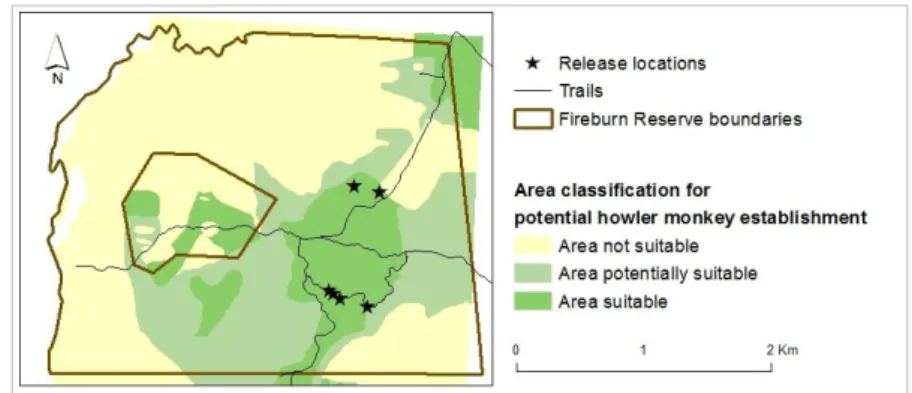
The exploration method was established in the Fireburn Reserve. A map of the vegetation and land use in the Fireburn Reserve (Maskell, 2000) was studied by M. Fanigliulo in 2005 (Appendix VI) to estimate the availability of possible release sights (Fanigliulo, 2005). Five habitats were kept, based on food abundance, size and canopy height: “dense cohune”, “lowland moist forest with cohune”, “medium sized lowland moist forest”, “secondary growth – pioneer species” and “shorter lowland moist forest” (Figure3). The results from the study by M. Fanigliulo were used to classify the suitability of the area for the howler monkey establishment and therefore define priorities for the exploration:
5
- Potentially suitable areas: “shorter lowland moist forest” habitat, defined as a lesssuitable release site based on the low food abundance (Fanigliulo, 2005).
- Suitable: “dense cohune”, “lowland moist forest with cohune”, “medium sized lowland moist forest” and “secondary growth – pioneer species.
The small patches of habitat were integrated into the main classes of vegetation around them, and a new map was created.
Figure 2: Classification for the exploration method in the Fireburn Reserve
The habitat suitability results were then used to define priorities of habitat exploration outside of the Fireburn Reserve.
The suitable habitat for the establishment of the monkeys, based on the map of vegetation and land use, was first checked. The location of the release cages and the location of the troops during their post-release monitoring were also used as a baseline to start the exploration of these areas.
2.2.3 NEW RELEASE SITES
One of the factors which can lead to failure or the success of reintroduction is the selection of release sites (Griffith et al., 1989,; Cheyne, 2006).
Howler monkeys rarely jump to negotiate discontinuities in the canopy ((Youlatos & Giollot, 2015). Therefore, it is important to check the connectivity of the canopy to find new release sites, mostly for rehabilitated monkeys whose climbing skills are not expected to be as good as for wild monkeys.
While using the exploration method to find new howler monkeys, data were recorded on the canopy height (>10m or <10m, assumed high enough to avoid predation), canopy connectivity, the presence of food species (Ficus sp. and Brosimum alicastrum, used by Wildtracks to find new release locations), and the reason of the turnaround between two transects. These data were used to create a map classifying the explored area:
- Potential release area: presence of food species, canopy height > 10m and good connectivity of the canopy.
- Potential corridor: canopy height enough, good connectivity of the canopy, absence of the feed tree species.
6
And to explain the limits of the map:- Vegetation not suitable past this limit: low areas, no presence of feed species. - Not explored past the limit: lake of time, too far outside the Reserves boundaries.
2.3 I
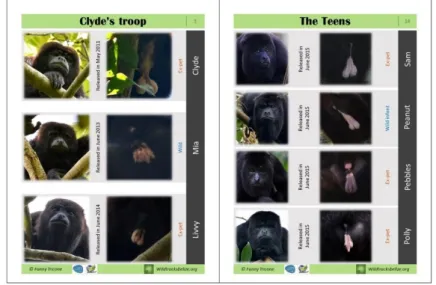
DENTIFICATION OF THE TROOPS AND INDIVIDUALSThe identification of the rehabilitated monkeys was done by both photos of faces and posteriors. The monkeys were identified by comparing photos of their faces with old photos of the individuals when they were staying at the Primate Rehabilitation Centre. Based on the observation that monkey faces can change a lot during maturation, and the difficulty of viewing their faces in the canopy, only the initial identification was conducted using facial photos and further identification was conducted using photos taken of their posteriors. After observing in the Primate Rehabilitation Centre that each monkey has a unique pink shape on their posterior (Horwich, 1983b), this method proved to be more practical as has been shown to be the case by spider monkey biologist (Denise, A. pers. com.). Photos of the faces and of the posteriors of the monkeys still present at the Primate Rehabilitation Centre were also collected to help with the identification of individuals for the future releases. The photos of the faces were taken from the front side and the photos of the rears were taken to show the continuity between anus, perineum and urogenital.
With the photos of both face and rear, an identification key was created to help the future studies. Photos were taken of the released monkeys found and the monkeys present at the Primate Rehabilitation Centre. The individuals were grouped by troops. The troops found at the Fireburn Reserve were named by the name of the alpha male. The current status of the individuals and their intake information were noted.
The intake information was classified as:
- Ex-pet: was originally kept as a pet (after capture from the wild). Rehabilitation needed.
- Wild: was injured and taken from the wild as an adult. Rehabilitation needed. - Wild infant: was rescued from the wild (usually victim of an infanticidal attack) as an
infant. Rehabilitation needed.
- Translocated: was removed from an unsuitable area. No rehabilitation needed (beyond quarantine and de-parasitizing).
- No intake: individual has not been at Wildtracks.
2.4 D
ATA COLLECTION2.4.1 POPULATION CHARACTERISATION
Individuals were identified by sex and age class. Age was classified as either adult, subadult, juvenile or infant (Rumiz, 1990). Infants were not counted in reproductive troop size. The age of the monkeys was estimated based on the hypothetical age of the monkeys at intake in the Primate Rehabilitation Centre (Appendix XII). Gestation of howler monkeys lasting six
7
months (Van Belle & Bicca-Marques, 2015), and the age of the monkeys when they successfully reproduced were calculated. Population density was expressed as indiv/km² and was calculated in the potential release areas (cf. part 2.2.3) in Fireburn Reserve and in Kakantulix Archaeological Reserve.2.4.2 GPS LOCATIONS
When a troop or an individual was located, the geographical location was recorded using a GPS. The troop or individual was followed for a minimum of three days when possible, to check on the establishment of their home range. This allowed for the collection of GPS locations, identifying range of home ranges through their travels, and the use of their home range by identifying areas where the individuals slept, rest and howled.
For the rehabilitated monkeys, howling areas were recorded to check their ability to defend their territory (Van Belle et al., 2014). When a male was howling at another male, both location and identification were recorded for the different troops.
Howler monkeys have preferred sleeping sites (Chivers, D.J., 1969,; Jardim, M.M.A., 1997). Therefore, the sleeping sites found during this study were recorded by GPS to more easily locate the troops in the future. These sites were defined when a troop was resting in the evening and found in the same location the next morning. The resting sites were defined when a troop was inactive for more than 30 minutes in the same tree.
2.4.3 FEEDING PLANTS
Alouatta pigra has been identified as a coloniser species, due to its dietary flexibility (Silver
et al., 1998). Moreover, this species can add new species to its diet when translocated in a new habitat (Silver & Marsh, 2003).Howler monkeys disappeared around 70 years ago from the release sites used in this study. Little is known about the diet of the howlers in this area. Therefore, data was collected to identify the feed species used by the monkeys after release to help the search of new release locations in the future and assess the food richness of the release sites.
When tracking the monkeys, photos of the feed plants were taken for identification at a later date. The date and the part of the plant eaten: young leaves, mature leaves, fruits, flowers and petioles (Silver & Marsh, 2003) was also recorded. Two feeding behaviors were observed when tracking: “snacking” and “feeding”. Snacking consisted of the monkeys quickly moving and then stopping for less than five minutes to eat, whereas feeding consisted of the monkey stopping for more than five minutes to eat. The identification of feed species was used to improve the knowledge of the plants sought out by the foraging monkeys in their home range. The feed plants were first identified by local assistants. Then, the photos of the plants remaining were sent to S. Brewer, plant ecologist, for identification.
As the availably of the fruits varies with the season, the months were noted to determine how the fruit consumption varied. It was assumed that browse would be available for the
8
duration of the study. Each species, and the number of times the monkeys ate each species, was recorded to estimate their browse preference. The time spent tracking each troop was similar as not to bias the results.2.4.4 EVALUATION CRITERIA
Ex-pet individuals don’t acquire the same level of skills and autonomy to survive in the wild after release as wild animals (Cheyne, 2009a). Therefore an evaluation of the status of the howler monkeys and of their reintroduction was conducted to assess their capacity to survive in the wild and to plan intervention if necessary. First it was evaluated whether the individual was found or not. This allowed an estimation of the survival rate. For the monkeys which were not found, information was collected about the last time that they had been seen in the wild by the trackers, and a risk assessment for mortality was conducted: low, medium or high; based on the skills of the individual at release.
Then for the individuals found, several criteria were chosen:
- Seen attracted to people: all of the monkeys released spent at least one month in the
Primate Rehabilitation Centre for quarantine and health assessment and may be apt to approach people (Baker, 2002). Released monkeys should not interact with people anymore (Baker, 2002), therefore, it was checked if the individual showed positive interest in human presence or not. Curiosity leading to the individual going lower in trees to look at humans, or attempt at positive interaction with people (like play) was recorded. Negative interaction (like howls towards people, excretion of feces) was not counted as a sign of attraction.
- Seen on the ground: Wild howler monkeys should live in the canopy whilst they are
known to descend to the ground to cross gaps between trees (Pozo-Montuy & Serio-Silva, 2008), they should generally avoid doing so because of increased risk of predation. During rehabilitation, monkeys are accustomed to being on or near the ground at the Primate Rehabilitation Centre because of the time spent in cages. It was important to make sure that when released, the monkeys stay in the canopy to avoid predation.
- Healthy: The health condition of the individuals was checked in case some monkeys
needed to go back to the Centre.
o Good condition: Dense and fluffy fur with good sheen, and good weight. o Poor condition: Fur and/or weight below optimal.
- Reproduction: Reproductive success was assessed by identifying presence of wild
born baby monkeys as well as observation of mating behavior (Van Belle & Bicca-Marques, 2015,; Horwich, 1983a).
- Troop cohesion: As problems in troop cohesion can lead to high mortality rates and
9
- Established home range: it was checked if the individual had established a homerange since release.
2.5 D
ATA ANALYSIS2.5.1 HOME RANGE STUDY
The location of the travels of each troop was studied using ArcMAP10.1. To calculate the home range of the troops, digitized polygons were used as described by Ostro et al. (1999b), to use the same method as previous studies done on Alouatta pigra (Fortes et al., 2015) and allow comparison of the results found in this study. Maps of the territories were made, showing where the troops were sleeping at night, resting and howling, whenever it occurred.
2.5.2 SURVIVAL STUDY
With the help of a study on the evaluation of the reintroduction of Gorillas (King et al., 2012), different factors which could influence the survival (Found/Not found) were defined. These factors are the explanatory variables and are qualitative variables, represented by categories:
- Source : Pet/Wild - Sex : Male/Female
- Age at intake : Infant/Juvenile/Subadult/Adult - Age at released: Infant/Juvenile/Subadult/Adult - Degree of humanisation at release: Low/Medium/High - Time rehabilitated: <1 year/1-2 years/>2 years
- Time seen after release in the wild: <1 year/>1 year
The variable that needs to be explained is a binomial variable: Found/Not found.
The influence of these factors was studied using a generalized linear model in the software R 3.1.1, with the error family being the binomial family, and with the link function the function logit.
3 R
ESULTS
3.1 D
EMOGRAPHIC STUDY OF THE RELEASED HOWLER MONKEYSTable 3: Time spent tracking each troop and individual during the study
Group Name Time tracking (h)
A Dudley 35.2 B Charlie 34.9 C Nicky 32.1 D Clyde 38.2 E Paz 25.9 F Tower Hill 6.4 G Barton Creek male 2.7
H Kong 12.5
I Barton Creek female 4.08 J Bonnie 7.27
10
During this study, an average of 33.3 hours were spent tracking each troop of the rehabilitated monkeys and of 9.5 hours for the translocated ones (Table 3). For the translocated monkeys, the average was calculated on Kong, Barton Creek male and Tower Hill’s troop because Bonnie and Barton Creek female were tracked with either Kong or Barton Creek male, and Coco was not tracked.3.1.1 POPULATION AND TROOP CHARACTERISTICS
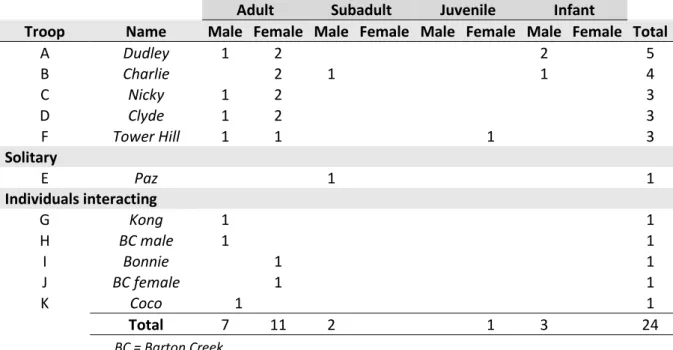
Table 4: Howler monkeys detected during the study
Adult Subadult Juvenile Infant
Troop Name Male Female Male Female Male Female Male Female Total
A Dudley 1 2 2 5 B Charlie 2 1 1 4 C Nicky 1 2 3 D Clyde 1 2 3 F Tower Hill 1 1 1 3 Solitary E Paz 1 1 Individuals interacting G Kong 1 1 H BC male 1 1 I Bonnie 1 1 J BC female 1 1 K Coco 1 1 Total 7 11 2 1 3 24 BC = Barton Creek
24 monkeys have been found during this study (Table 4). The observed population consisted of 9 males, 12 females, and 3 infants. A, B, C, D and F were established in troops during the studies, but switches between the individuals G, H, I, and J have been seen.
The mean size of reproductive troops was 3. All the troops were unimale.
The population density was on average 14.2 indiv/km² and range from 4.2 indiv/km² at Kakantulix Archaeological Reserve to 24.3 indiv/km² at Fireburn Reserve.
Table 5: Estimations of ages for the infants (A) and the monkeys that reproduced (B)
A
B
Estimate age of the infants
Age at first birth
Age at successful copulation
Minnie 3 months the 23/02/15 Minnie 4.3-4.4 years 3.8-3.9 years Mo 4 months the 23/02/15 Mo 4.3-4.4 years 3.8-3.9 years
Fern 2-2,5 months the 06/03/15 Dudley - 5.4 years
Fern 4.4 years 4.0 years
Charlie - 3.1-3.2 years
The age of the infants was evaluated by Paul Walker (Table 5 A), allowing the calculation of the age at first birth for the females and the age when the monkeys were sexually mature
11
by calculating when they copulated successfully (Table 5 B). The age at first birth for the females was found to be approximately 4.3-4.4 years. The females were found to be sexually mature at 3.8-3.9 and 4.0 years old, and the males at 3.1-3.2 and 5.4 years old. 20 of the 21 monkeys found in this study were estimated to be sexually mature in June 2015 (Appendix XII).3.1.2 IDENTIFICATION OF THE INDIVIDUALS
All the individuals found were successfully identified. The identification key was created with the 24 monkeys found in the wild and the howler monkeys which were present at the Primate Rehabilitation Centre from March 2015 to May 2015, except for the infants in the Nursery Unit, where only dedicated carers have access (Figure 5 and Appendix XIV).
Figure 3: Abstracts from the identification key
3.1.3 EVOLUTION OF THE TROOPS’ COMPOSITION SINCE RELEASE
Table 6: Troop composition before and after release
Released groups from 2011 to 2014 Groups found in 2015
Group 1 Group 4 Group 8 Group A Group D Group H
Clyde Charlie Paz Dudley Clyde Barton Creek male
Holly Fern Kofi Mo Mia
Bonnie Richie ? Livvy Group I
Agatha Mia Group 9 Mo's baby Bonnie
Tower Hill male ?'s baby Group E
Group 2 Group 5 Tower Hill female A Paz Group J
Dudley Coco Tower Hill female B Group B Barton Creek female
Igor Tower Hill female C Charlie Group F
Eden Group 6 Fern Tower Hill male Group K
Mo Kong Group 10 Richie Tower Hill female A Coco
Minnie Barton Breek male Fern's baby Tower Hill female C
Group 7 Barton Creek female
Group 3 Sultan Group C Group G
Nicky livvy Nicky Kong
Willow Hazel
12
The Table 5 shows the evolution of troop composition after release. Based on the released monkeys found, at the Fireburn Reserve only two females, Mia and Livvy, switched troops after release to create a new troop with the male Clyde. The Barton Creek monkeys were not found together during the study, showing that they separated after release. Only two troops were found with new monkeys. Group A had two male infants and group B had one male infant.On May 3rd, Barton Creek male was found with Bonnie. On May 11th, Kong was found with Barton Creek female. On May 19th, the Tower Hill monkeys were found and entered into a fight with Kong who was alone. On July 10th, Barton Creek male was seen joining one of the new troops released in June 2015 (called the Teens), to mate with the females. The same day, Bonnie was seen alone, calling for the Barton Creek male. On July 14th and 15th, Kong was found with Bonnie. On August 6th, Coco was seen with Bonnie.
3.2 H
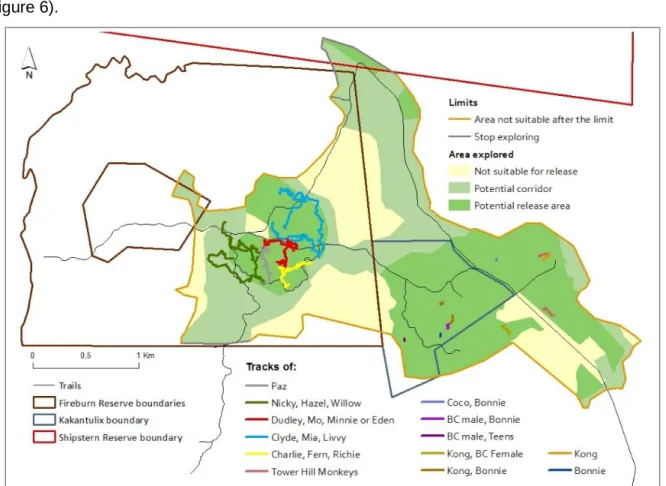
OME RANGE STUDY OF THE RELEASED HOWLER MONKEYS 3.2.1 LOCATION OF THE TROOPS AND FUTURE RELEASE LOCATIONSDuring this study, an area of 638 ha was explored to find the released howler monkeys (Figure 6).
Figure 4: Map of the area explored
All the monkeys were found in the area classified as “potential release area”, which were defined as suitable for the monkey establishment. Only Nicky’s troop was found using a “potential corridor” area in his home range.
13
All the monkeys were found in the area they were released, except Bonnie, who moved from Fireburn Reserve to Kakantulix Archaeological Reserve.The analysis of the area explored for new release sites was used for the releases of 2015 (Appendix VII).
3.2.2 HOME RANGE USES AND SIZE OF THE RELEASED MONKEYS
Figure 5: Home ranges and howls at Fireburn Reserve
This study was possible only on the troops and individuals that have been successfully tracked for a minimum of three days. Therefore, only the monkeys found at Fireburn Reserve were studied here.
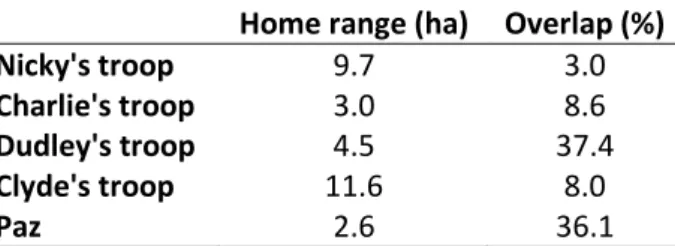
Table 7: Home range size and overlaps
Home range (ha) Overlap (%)
Nicky's troop 9.7 3.0
Charlie's troop 3.0 8.6
Dudley's troop 4.5 37.4
Clyde's troop 11.6 8.0
Paz 2.6 36.1
In the Fireburn Reserve, the size of the home ranges of the troops found, using digitized polygons (Appendix V), ranged from 2.6 ha to 11.6 ha (Table 6), with an average of 6.3 ha. Each home range overlapped with other troops’ home range. The average of the overlap was 18.6% and range from 3.0% to 37.4%.
At Fireburn Reserve, all the troops were recorded howling at another troop during this study, except for the individual Paz. The howls appeared to occur at the border of their home range and mostly at the proximity between two troops’ territories (Figure 7). Non-aggressive chasing was seen between Dudley and Clyde for the use of a Ficus tree (see Fig tree on Figure 6).
14
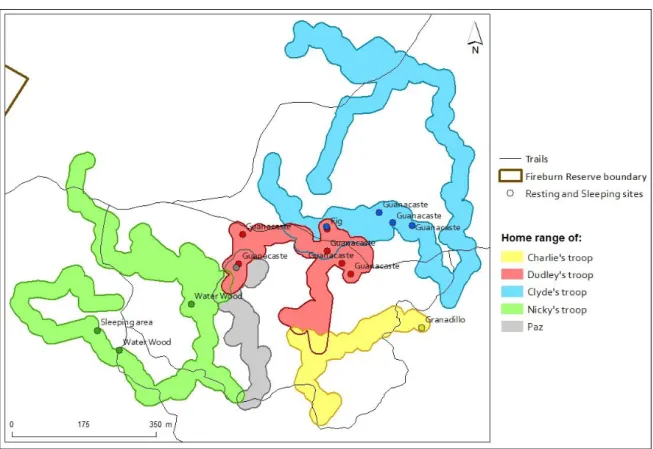
Figure 6: Map of the sleeping and resting sites
After the regular tracking of each troop and individual to find their home range establishment, the monkeys were found again several times in particular areas, sleeping and resting (Appendix IV). It appeared that the monkeys preferred the biggest trees on their home range. These trees and particular sites have been mapped in Figure 8. Paz and Dudley’s troop were found using the same Guanacaste tree when the other one was absent. The same way, Clyde and Dudley shared the same Fig tree.
3.3 F
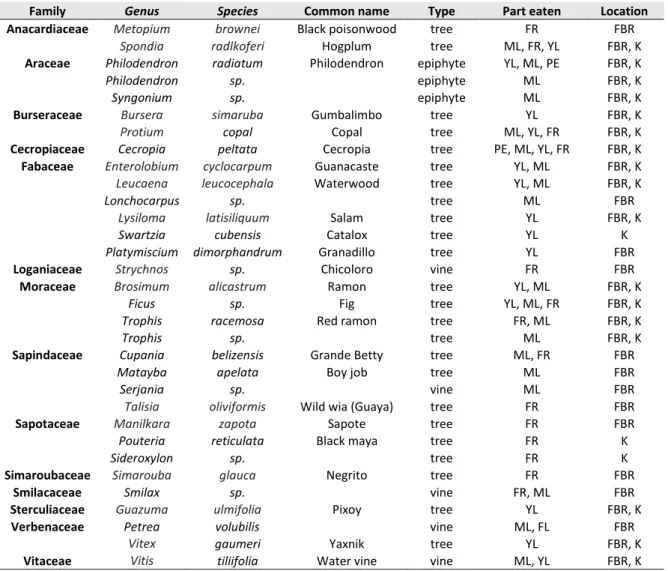
EEDING STUDY OF THE RELEASED HOWLER MONKEYSA total of 32 species and 14 families have been identified as feeding plants during this study (Table 6).
15
Table 8: List of the feeding plants identified
Family Genus Species Common name Type Part eaten Location Anacardiaceae Metopium brownei Black poisonwood tree FR FBR
Spondia radlkoferi Hogplum tree ML, FR, YL FBR, K
Araceae Philodendron radiatum Philodendron epiphyte YL, ML, PE FBR, K
Philodendron sp. epiphyte ML FBR, K
Syngonium sp. epiphyte ML FBR, K Burseraceae Bursera simaruba Gumbalimbo tree YL FBR, K
Protium copal Copal tree ML, YL, FR FBR, K
Cecropiaceae Cecropia peltata Cecropia tree PE, ML, YL, FR FBR, K Fabaceae Enterolobium cyclocarpum Guanacaste tree YL, ML FBR, K
Leucaena leucocephala Waterwood tree YL, ML FBR, K
Lonchocarpus sp. tree ML FBR
Lysiloma latisiliquum Salam tree YL FBR, K
Swartzia cubensis Catalox tree YL K
Platymiscium dimorphandrum Granadillo tree YL FBR
Loganiaceae Strychnos sp. Chicoloro vine FR FBR
Moraceae Brosimum alicastrum Ramon tree YL, ML FBR, K
Ficus sp. Fig tree YL, ML, FR FBR, K
Trophis racemosa Red ramon tree FR, ML FBR, K
Trophis sp. tree ML FBR, K Sapindaceae Cupania belizensis Grande Betty tree ML, FR FBR
Matayba apelata Boy job tree ML FBR
Serjania sp. vine ML FBR
Talisia oliviformis Wild wia (Guaya) tree FR FBR
Sapotaceae Manilkara zapota Sapote tree FR FBR
Pouteria reticulata Black maya tree FR K
Sideroxylon sp. tree FR K
Simaroubaceae Simarouba glauca Negrito tree FR FBR
Smilacaceae Smilax sp. vine FR, ML FBR
Sterculiaceae Guazuma ulmifolia Pixoy tree YL FBR, K
Verbenaceae Petrea volubilis vine ML, FL FBR
Vitex gaumeri Yaxnik tree YL FBR, K
Vitaceae Vitis tiliifolia Water vine vine ML, YL FBR, K
FBR= Fireburn Reserve, K= Kakantulix Archaeological Reserve, ML= Mature Leaf, YL= Young Leaf, FR= Fruit, PE= Petiol
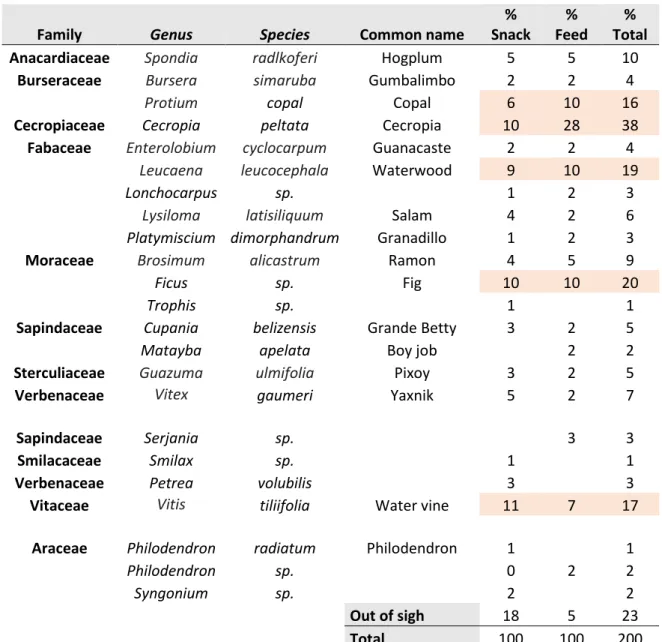
From March to July 2015, a total of 162 records have been collected for browses, where 102 were identified as snacking behavior and 60 as feeding behavior. Regarding the number of records on each species for snacking, feeding and the total of records, the five favourite browses used by the howlers at Fireburn Reserve were the same: Cecropia peltata, Ficus sp.,
Protium copal, Leucaena leucocephala and Vitis tiliifolia (Table 7).