DEMAND SIDE MANAGEMENT IN THE SMART GRID
GIUSEPPE TOMMASO COSTANZO D´EPARTEMENT DE G´ENIE ´ELECTRIQUE ´
ECOLE POLYTECHNIQUE DE MONTR´EAL
M´EMOIRE PR´ESENT´E EN VUE DE L’OBTENTION DU DIPL ˆOME DE MAˆITRISE `ES SCIENCES APPLIQU´EES
(G´ENIE ´ELECTRIQUE) NOVEMBRE 2011
c
´
ECOLE POLYTECHNIQUE DE MONTR´EAL
Ce m´emoire intitul´e:
DEMAND SIDE MANAGEMENT IN THE SMART GRID
pr´esent´e par: COSTANZO, Giuseppe Tommaso
en vue de l’obtention du diplˆome de: Maˆıtrise `es Sciences Appliqu´ees a ´et´e dˆument accept´e par le jury d’examen constitu´e de:
M. MALHAM´E, Roland, Ph.D., pr´esident
M. ZHU, Guchuan, Doct., membre et directeur de recherche M. ANJOS, Miguel F., Ph.D., membre et codirecteur de recherche M. SAVARD, Gilles, Ph.D., membre
`
A mes tr`es cher grand parents Angela, Tomaso et Giuseppe qui n’ont pas v´ecu assex pour voir ce memoire.
ACKNOWLEDGEMENTS
I would like to express my sincere gratitude to my research directors Prof. Guchuan Zhu at ´Ecole Polytechnique de Montr´eal, Prof. Luca Ferrarini at Politecnico di Milano and my research codirector Prof. Miguel F. Anjos at ´Ecole Polytechnique de Montr´eal for their continuous guidance, suggestions and essential encouragement during my graduate studies.
The experimental study presented in this thesis have been supported by DERri (Dis-tributed Energy Resource Research Infrastructure as a part of a collaboration between Po-litecnico di Milano and DTU - Danish Technical University. The author is particularly grateful to the staff of the Intelligent Energy Systems department of RISØ DTU for not only the precious help and advice during the experiments, but also for a great hospitality.
These last two years in Montreal have been so dense of experiences and so many people left their footprint in my memories that I wish everyone could have such privilege like I had. Particularly, thank you Annick for your precious advice upon my arrival and during my studies in Montreal, Matti and Ire for your essential contribution in the composition and revision of the French summary, Melanie, Ramin, Sean, Nicolette and Heather for proof-reding my english.
Thank you Amir, my Iranian brother, for being the best roomate ever and most sincere friend.
Thanks to my university collegues and friends, such stressing studies have turned into the most enjoyable and amazing adventure: Hani, Jean-Philippe, Sergio, Davide, Matthew, Jacopo, Francesca, Kayla, Paula, Cecilia. Thank you Jan for your friendship and relevant contribution in our first conference paper, you’re a brilliant engineer and the most hard-working collegue I had!
Thank you Jessica and Roberto for sharing with me your passion for Tango and teaching me such marvellous dance and life style.
Thank you my coll`egues alcooliques Eddy and Lucas, and all the AECSP group for the uncountable parties and outgoings together.
Finally, and most importantly, I am deeply grateful to my beloved family for always loving, encouraging and supporting me: my parents Luciano and Enza, my little sister Angela and my grandmother Lina.
I address a special thought to my grandparents Tomaso, Angela and Giuseppe, whose humanity, honesty and love for culture have always been for me reference points.
R´ESUM´E
L’objectif du pr´esent projet est de d´evelopper des solutions pour am´eliorer l’efficacit´e ´energ´etique dans les r´eseaux ´electriques. L’approche adopt´ee dans cette recherche est bas´ee sur un con-cept nouveau dans le Smart Grids (r´eseaux ´electriques intelligents), l’optimisation du De-mand/Response, qui permet la mise en œuvre de la gestion autonome de la demande de ´
energie pour une grande vari´et´e de consommateurs, des les maisons `a les bˆatiments, usines, centres commerciaux, les campus, les bases militaires, et mˆeme les micro-r´eseaux.
La premi`ere partie de cette th`ese pr´esente le th`eme de la Smart Grid et ´evalue l’´etat de l’art par rapport aux port´ees du projet. Ensuite, nous introduisons une architecture pour la gestion autonome de la charge du cˆot´e de la demande. Cette architecture est compos´ee par trois couches principales, dont deux, l’ordonnancement en ligne et l’ordonnancement au moindre coˆut, sont pleinement pris en compte, tandis que la troisi`eme couche, la Demande/Response, est laiss´e comme une extension future. Une telle architecture tire profit de la s´eparation des des ´echelles de temps de la consommation d’´energie, et elle est ´evolutif et flexible. La deuxi`eme partie de ce projet est ax´e sur la mise en œuvre de l’architecture propos´ee dans Matlab/Simulink, apr`es une preuve de concept est donn´ee par des simulations et r´esultats exp´erimentaux.
Mots-cl´es: programmation optimale de la charge, nivelement de la charge de pointe, Demand-Side Management (DSM) autonome, bˆatiments intelligents, Demand/Response, ef-ficacit´e ´energ´etique.
ABSTRACT
The objective of the present project is to develop solutions to improve energy efficiency in electric grids. The basic approach adopted in this research is based on a new concept in the Smart Grid, namely Demand/Response Optimization, which enables the implementation of the autonomous demand side energy management for a big variety of consumers, ranging from homes to buildings, factories, commercial centers, campuses, military bases, and even micro-grids.
The first part of this thesis presents the topic of the Smart Grid and assesses the state of the art with respect to the scopes of the project. Afterward, we introduce an architecture for autonomous demand side load management composed of three main layers, of which two, online scheduling and minimum-cost scheduling, are fully addressed, while the third layer, Demand/Response, is left as future extension. Such architecture takes advantage of time-scale separation of energy consumption. It is scalable and flexible. The second part of this project is focused on the implementation of the proposed architecture in Matlab/Simulink and a proof of concept is given through simulations and experimental results.
Keywords: Optimal load scheduling, Peak-load shaving, Autonomous Demand-Side Man-agement (DSM), Smart Buildings, Demand/Response, Energy efficiency.
CONDENS´E EN FRANCAIS
Introduction
Le r´eseau ´electrique intelligent (the Smart Grid) est une technologie ´emergente dans le do-maine des syst`emes de production, transmission et utilisation de l’´energie. Ceci aura un impact profond sur la vie de nombreux consommateurs au cours de ce si`ecle. Les progr`es dans ce domaine apporteront ´egalement de multiples avantages ´economiques, sociaux et en-vironnementaux dans notre soci´et´e. Pour faire face `a ce d´efi, non seulement la communaut´e scientifique mais aussi de nombreux partenaires industriels et publics prennent des mesures pour moderniser les infrastructures du r´eseau ´electrique et des technologies connexes, afin d’assurer la production et la distribution d’´energie dans le si`ecle prochain.
Cette recherche a pour but d’apporter des instruments pour une gestion efficace de l’´energie ´electrique, qui peut ˆetre ´etendue `a diff´erents niveaux de la Smart Grid (comme `
a la maison, dans le bˆatiment ou le district). Ce travail se concentre en particulier sur l’optimisation des charges ´electrique de consommateurs en vue de favoriser l’utilisation des sources renouvelables dans les r´eseaux de distribution et de permettre une consommation intelligente de l’´energie.
Les R´eseaux ´Electriques Inteligents
D’apr`es la d´efinition de F.L. Bellifemine, le Smart Grid est “un r´eseau ´electrique capable d’int´egrer toutes les actions des clients et des producteurs branch´es au fin de distribuer l’´energie ´electrique de mani`ere efficace, durable, `a bas prix et en toute s´ecurit´e.”[Bellifemine, F.L. et al. (2009)]. Le mot Smart Grid exprime “une vision combin´ee qui utilise le r´eseau d’information pour am´eliorer le fonctionnement du r´eseau d’´electricit´e.”[V. Pothamsetty and S. Malik (February 2009)].
Par rapport aux r´eseaux ´electriques traditionnels, la Smart Grid peut g´erer des flux bidi-rectionnels d’´electricit´e et d’information. Cette caract´eristique joue un rˆole cl´e pour une participation active des consommateurs dans le march´e ´energ´etique. L’union entre les infras-tructures du r´eseau ´electrique et des technologies disponibles dans le domaine des commu-nications permettra la programmation de la consommation, la pr´evision de charge et le niv-ellement des pics de charge dans le r´eseau de distribution ce qui am´eliorera consid´erablement l’efficacit´e du r´eseau.
Le contrˆole des charges du consommateur et son interfa¸cage vers la grille visent `a une am´elioration de l’efficacit´e ´energ´etique. Les sujets d’int´erˆet de ce domaine comprennent:
• Compteurs intelligents: appareils capables de mesurer des grandeurs diff´erentes en temps r´eel, d’analyser les donn´ees et de les rapporter grˆace `a des syst`emes de commu-nication. Ces dispositifs peuvent ˆetre int´egr´es dans une structure de mesure avanc´ee (Advanced Metering Infrastructure) qui fournit des types d’informations diff´erents et de services pour les clients et les fournisseurs d’´energie.
• Appareils intelligents et domotique: ce secteur concerne la modernisation des appareils ´
electrom´enagers afin de communiquer et ajuster leur fonctionnement aux besoins des usagers en vue d’optimiser la consommation ´electrique.
• Gestion dynamique et pr´evision des consommations: ceci permettrait aux clients une meilleure programmation des activit´es `a domicile d´ependament du prix de l’´energie. Pour les fournisseurs, en revanche, cette gestion serait extrˆemement utile pour l’optimisation de la production de l’´energie.
• Int´egration et optimisation des sources d’´energie renouvelables: l’augmentation des cen-trales de g´en´eration distribu´ee et la forte p´en´etration des ressources renouvelables dans le march´ee ´energ´etique, repr´esente un grand d´efi pour l’augmentation de la stabilit´e du reseau et de l’efficacit´e ainsi que la baisse des ´emissions de CO2. Par ailleurs, la
participation des clients dans le march´e ´energ´etique `a travers la coop´eration des pays, l’int´egration des nouvelles technologies, la standardisation, l’augmentation de fiabilit´e et les nouveaux investissements dans les pays de l’Union Europ´eenne et de l’Am´erique du Nord sont facteurs importants pour la construction des Smart Grids.
• Optimisation du “demand/response” et la tarification dynamique de l’´energie, qui per-mettra un contrˆole intelligent des charges selon le prix de l’´energie. De cette mani`ere les clients peuvent r´egler leurs consommations en temps r´eel selon le tarif.
• Cyber s´ecurit´e: aujourd’hui les r´eseaux ´electriques peuvent offrir un bon niveau de s´ecurit´e informatique contre les attaques des pirates informatiques grˆace `a des standards et des r´eseaux de communication d´edi´es, ainsi que des syst`emes de contrˆole redondantes. Il ne reste qu’`a v´erifier si le passage au Smart Grid rendra les pays plus vuln´erables aux attaques informatiques.
Une architecture pour la gestion automatis´ee de la charge ´electrique
La distribution intelligente de l’´energie serait une application directe des compteurs intel-ligents. Ces premiers permettront une consommation optimis´ee en coordonnant tous les dispositifs afin de minimiser les coˆuts. Commerce et tarification de l’´energie en temps r´eel,
choix ´eco durables, gestion du CO2, ne sont que quelques applications possibles dans le
domaine de l’automatisation des bˆatiments.
L’architecture du syst`eme propos´e pour le DSM (Demand Side Management) consiste en trois niveaux principaux (figure 0.1): Admission Control (AC), Load Balancing (LB) et Demand/ Response Manager (DRM). AC est le niveau inf´erieur qui interagit avec les appareils intelligents pour le contrˆole de la consommation en temps r´eel. Dans ce travail, l’approche adopt´ee pour le contrˆole des appareils utilise des strat´egies de planification en ligne inspir´ee de la technique d’ordonnancement dans les syst`emes informatiques embarqu´es (voir, par exemple, [Buttazzo (2005)] et les r´ef´erences cit´ees).
L’introduction d’un mod`ele d’appareil ´electrom´enage g´en´erique permet la planification des activit´es et de la consommation de fa¸con syst´ematique. Le niveau sup´erieur, le DRM, est l’entr´ee du syst`eme DSM et repr´esente une interface `a la Smart Grid. Il est possible de mettre au point plusieurs strat´egies de tarification de l’´energie comme la tarification de pointe critique ou la tarification de temps d’utilisation. Le niveau interm´ediaire (LB) coordonne les activit´es du niveau sup´erieur (DRM) et inf´erieur (AC) et ´equilibre la consommation `a travers un algorithme qui r´epartit la charge en minimisant les couts ´energ´etiques. L’´equilibrage de charge entraˆıne un probl`eme d’optimisation qui sera r´esolu avec les instruments de la programmation lin´eaire. Le LB fournit ´egalement au DRM des informations importantes concernant le taux de rejet des demandes, un param`etre de performance requis pour la gestion effective du Demand/Response. Les charges ´electriques sont class´ees selon leurs caract´eristiques intrins`eques en trois cat´egories diff´erentes:
1. La charge de base est une consommation ´electrique requise n´ecessaire des appareils qui sont activ´es imm´ediatement `a n’importe quel moment ou pour le maintien dans l’´etat de “stand by”. Cette cat´egorie comprend l’´eclairage, les ordinateurs, les syst`emes de communication et tous les autres dispositifs dont la valeur commerciale ne permet pas l’installation d’une intelligence comme le s`eche cheveux, le toaster ou le chargeur. 2. La charge r´eguli`ere est la puissance requise par les ´electrom´enagers qui sont toujours
en fonction pendant une longue p´eriode de temps, comme la climatisation, le chauffage ou le r´efrig´erateur.
3. La charge de pointe est propre aux appareils dont le cycle d’op´eration a une dur´ee fixe. Cette cat´egorie comprend, par exemple, le s`eche linge, le lave-vaisselle, la machine `
a laver ou le four. Souvent les pics d’absorption sont caus´ees par l’accumulation des charges de pointe avec des charges r´eguli`eres. Par cons´equent, une gestion attentive de la charge de pointe devient fondamentale pour la r´eduction des coˆuts de l’´energie.
Load Balancer D/R Manager Load Forecaster REQUEST REJECT ACCEPT Consumption Information Available Capacity Predicted Demand Burst Load Smart Grid
Smart Grid Interface
DSM System Capacity/Price Regular Load Schedule Admission Controller Capacity Limit Baseline Load Predicted Load A p p lia n c e I n te rf a c e S m a rt M e te r
Figure 0.1 Architecture propos´e pour le syst´eme de g´estion des charges.
Dans cette recherche, les appareils ´electrom´enagers intelligents sont suppos´es ˆetre capables de communiquer avec le gestionaire d’´energie et de garantir un contrˆole ad´equat au niveau des dispositifs. La communication au sein du syst`eme DSM doit ˆetre suffisamment fiable et les retards doivent ˆetre n´egligeables par rapport `a la dynamique des appareils. Le r´eseau de communication se base sur des technologies filaires et sans fil [Drake et al. (2010),Li et Sun (2010)] et utilise des interfaces sp´eciales pour communiquer avec les ´electrom´enagers intelligents.
Une telle architecture se base sur la division temporelle des dynamiques li´ees `a la gestion des charges domestiques.
Mise en œuvre avec Matlab/Simulink
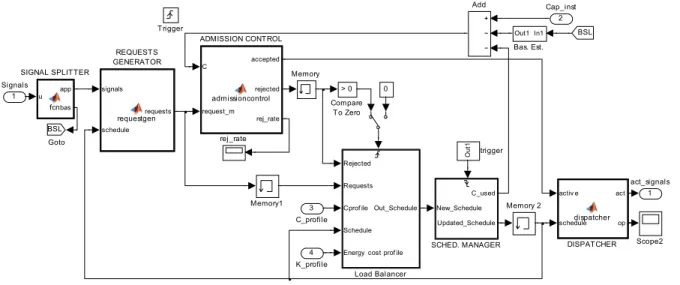
Cette section pr´esente la mise en œuvre de l’architecture propos´ee avec Matlab/Simulink, ainsi que des ´etudes de simulation pour le syst`eme de gestion des charges r´esidentielles. Le sch´ema Simulink du syst`eme envisag´e est montr´e dans la figure 0.2, o`u chaque composant peut ˆ
etre facilement identifi´e dans l’architecture pr´esent´ee `a la section du DSM (sec. 3.2). Notez que, mˆeme si dans la simulation les appareils sont repr´esent´es par des mod`eles simplifi´es, l’architecture propose´e dans cette recherche est con¸cue ind´ependamment de la pr´ecision du
mod`ele des appareils. Les performances de la gestion de la charge dans l’impl´ementation r´eelle seront effectivement influenc´ees par les mod`eles des appareils. La p´eriode de simulation
1 act_signals O ut 1 trigger rej_rate Scope2 u app bas fcn SIGNAL SPLITTER New_Schedule C_used Updated_Schedule SCHED. MANAGER signals schedule requests requestgen REQUESTS GENERATOR Memory1 Memory 2 Memory Rejected Requests Cprof ile Schedule Energy cost prof ile
Out_Schedule Load Balancer BSL Goto activ e schedule act op dispatcher DISPATCHER > 0 Compare To Zero In1 Out1 Bas. Est. Add C request_m accepted rejected rej_rate admissioncontrol ADMISSION CONTROL BSL 0 Trigger 4 K_profile 3 C_profile 2 Cap_inst 1 Signals
Figure 0.2 Sc´ema Simulink de l’Home Energy Manager
est normalis´ee `a 100 unit´es de temps qui peuvent ˆetre ´etendues ou r´euites en fonction du comportement des appareils dans un environnement d’application r´eelle. Les dynamiques thermiques des appareils sont fix´ees pour repr´esenter un comportement plausible dans l’ ´
echelle de temps envisag´ee.
La configuration comprend trois charges r´eguli`eres: les chauffages dans deux chambres et le r´efrig´erateur, alors que les trois charges de pointe sont la machine `a laver, le lave-vaisselle et la s´echoir. La charge de base est mod´elis´ee comme une consommation d’´energie constante dans un laps de temps donn´e (20 unit´es de puissance pendant 20 unit´es de temps).
Les appareils intelligents sont mod´elis´es avec le Stateflow ToolboxTMde Simulink et chaque
appareil est en mesure de d´efinir la quantit´e d’´energie n´ecessaire pour accomplir sa tˆache. Une telle information permet au syst`eme d’´equilibrage de charge (LB) de calculer le temps restant n´ecessaire pour compl´eter chaque tˆache. La valeur heuristique pour des charges r´eguli`eres est lin´earis´ee entre 0 et 1 `a l’int´erieur des limites sup´erieures et inf´erieures des zones de confort, tandis que pour les charges de pointe ce valeur est calcul´ees de fa¸con lineaire envisageant le temps restant pour amorcer. Le mod`ele d’appareil est compl´et´e par le couplage de la machine `
a ´etats finis dans la figure 3.5 avec l’interface de communication pr´esent´ee dans la figure 4.4. Le bloc de Contrˆole d’Admission (Admission Control) re¸coit deux informations: demandes provenant des charges intelligentes et la capacit´e disponible `a chaque p´eriode. De cette mani`ere l’AC permet de d´emarrer une s´erie d’appareils dont la consommation totale respecte la limite de charge. Les demandes sont class´ees selon la valeur heuristique d´ecroissante et
sont fournie `a l’algorithme de contrˆole d’admission. Notez que les tˆaches non-pr´eemptives ne seront pas arrˆet´ees jusqu’`a ce qu’elles soient termin´ees. Par contre, chaque fois que l’AC est invoqu´e, les tˆaches pr´eemptives pourraient ˆetre interrompues en faveur de tˆaches avec une priorit´e plus ´elev´ee.
Le Load Balancer est impl´ement´e comme une fonction Matlab imbriqu´ee (embedded func-tion) sur Simulink et il est invoqu´e dans la simulation comme une fonction extrins`eque. L’outil de programmation entier binaire est utilis´ee pour r´esoudre le probl`eme d´efini dans la section 3.5. Cette fonction utilise l’outil Matlab de programmation lin´eaire (PL) avec un algorithme de recherche de solutions bas´e sur la technique de branch-and-bound. La strat´egie de recherche de nœud est bas´ee sur la recherche en profondeur (depth-first search), qui choisit un nœud enfant au niveau inf´erieur dans l’arbre si ce nœud n’a pas d´ej`a ´et´e explor´e. Sinon, l’algorithme se d´eplace vers le nœud d’un niveau sup´erieur dans l’arbre et poursuit la recherche [The Mathworks Inc. (2011)].
Le r´epartiteur de tˆaches (dispatcher) est activ´e toutes les 10-2 unit´es de temps et fournit
aux appareils les signaux de contrˆole pour l’op´eration. Toutes les dix unit´es de temps le gestionnaire du plan (Schedule Manager) fournit au r´epartiteur la liste d’op´erations pour les dix unit´es de temps suivantes.
R´esultats de simulation
Consommation d’´energie sans nivellement des charges. Dans la premi`ere simulation, toutes les demandes arrivent simultan´ement et aucune limite n’existe sur la consommation (limite de capacit´e). Nous pouvons alors observer dans la figure 3(a) que la consommation d’´energie de pointe atteint 120 unit´es. L’´etat d’activation des appareils pendant l’op´eration aussi bien que l’´evolution de la temp´erature des trois charges r´eguli`eres sont indiqu´es respec-tivement dans les figures 3(c) et 3(d).
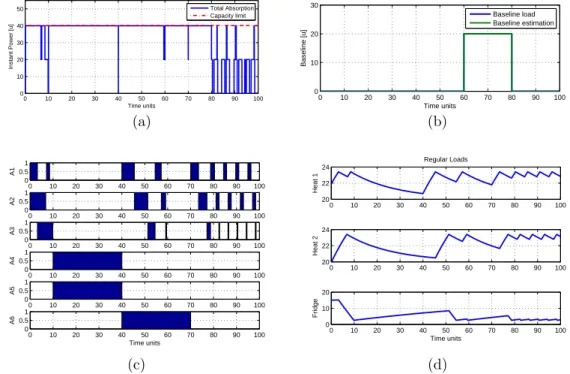
Nivellement des pointes de charge par le contrˆole d’admission. Le deuxi`eme cas est con¸cu pour v´erifier la performance du syst`eme DSM en utilisant uniquement la planification en ligne des op´erations (c’est `a dire au seul moyen du contrˆole d’admission). Dans la simula-tion, la limite de capacit´e est fix´ee `a 40 unit´es, ce qui correspond `a 1/3 de la consommation ´
electrique maximale de pointe. On peut voir dans la figure 4(a) que le pic de puissance consomm´ee a ´et´e nivel´e afin de respecter la contrainte sur la capacit´e. Cependant, on peut remarquer dans la figure 4(c) que les trois d´elais relatifs aux charges de pointe (40, 40 et 70 unit´es de temps) n’ont pas ´et´e respect´es. Cette probl´ematique est caus´ee par l’algorithme de gestion en ligne, qui est sous-optimal.
0 10 20 30 40 50 60 70 80 90 100 0 20 40 60 80 100 120 Time units
Instant Power [u]
(a) 0 10 20 30 40 50 60 70 80 90 100 0 10 20 30 Baseline [u] Time units Baseline load Baseline estimation (b) 0 10 20 30 40 50 60 70 80 90 100 0 0.5 1 A1 0 10 20 30 40 50 60 70 80 90 100 0 0.5 1 A2 0 10 20 30 40 50 60 70 80 90 100 0 0.5 1 A3 0 10 20 30 40 50 60 70 80 90 100 0 0.5 1 A4 0 10 20 30 40 50 60 70 80 90 100 0 0.5 1 A5 0 10 20 30 40 50 60 70 80 90 100 0 0.5 1 A6 Time units (c) 0 10 20 30 40 50 60 70 80 90 100 20 25 Heat 1 Regular Loads 0 10 20 30 40 50 60 70 80 90 100 20 25 Heat 2 0 10 20 30 40 50 60 70 80 90 100 0 10 20 Fridge Time units (d)
Figure 0.3 Op´eration sans gestion de la charge: (a) consommation totale; (b) ´etats d’activation des appareils el´ectrom´enag`ers; (c) ´evolution de la temp´erature; (d) charge de base. 0 10 20 30 40 50 60 70 80 90 100 0 10 20 30 40 50 60 Time units
Instant Power [u]
Total Absorption Capacity limit (a) 0 10 20 30 40 50 60 70 80 90 100 0 10 20 30 Baseline [u] Time units Baseline load Baseline estimation (b) 0 10 20 30 40 50 60 70 80 90 100 0 0.5 1 A1 0 10 20 30 40 50 60 70 80 90 100 0 0.5 1 A2 0 10 20 30 40 50 60 70 80 90 100 0 0.5 1 A3 0 10 20 30 40 50 60 70 80 90 100 0 0.5 1 A4 0 10 20 30 40 50 60 70 80 90 100 0 0.5 1 A5 0 10 20 30 40 50 60 70 80 90 100 0 0.5 1 A6 Time units (c) 0 10 20 30 40 50 60 70 80 90 100 20 22 24 Heat 1 Regular Loads 0 10 20 30 40 50 60 70 80 90 100 20 22 24 Heat 2 0 10 20 30 40 50 60 70 80 90 100 0 10 20 Fridge Time units (d)
Figure 0.4 Gestion de la charge par contrˆole d’admission: (a) consommation totale; (b) charge de base (c) ´etats d’activation des appareils el´ectrom´enag`ers; (d) ´evolution de la temp´erature.
Nivellement des pointes par le contrˆole d’admission et l’´equilibrage de charge. Nous allons maintenant montrer que, en utilisant l’´equilibrage de charge, le syst`eme est capable de g´erer les charges de pointe en respectant les delais fix´es et, par cons´equent, il produit un ordonnancement optimal. La figure 5(a) confirme que la contrainte sur la capacit´e limite `a ´et´e respect´ee. L’´etat d’activation dans la figure 5(c) montre que les contraintes sur les d´elais pour les charges de pointe ont ´et´e respect´ees.
0 10 20 30 40 50 60 70 80 90 100 0 10 20 30 40 50 Time units
Instant Power [u]
Total Absorption Capacity limit (a) 0 10 20 30 40 50 60 70 80 90 100 0 10 20 30 Baseline [u] Time units Baseline load Baseline estimation (b) 0 10 20 30 40 50 60 70 80 90 100 0 0.5 1 A1 0 10 20 30 40 50 60 70 80 90 100 0 0.5 1 A2 0 10 20 30 40 50 60 70 80 90 100 0 0.5 1 A3 0 10 20 30 40 50 60 70 80 90 100 0 0.5 1 A4 0 10 20 30 40 50 60 70 80 90 100 0 0.5 1 A5 0 10 20 30 40 50 60 70 80 90 100 0 0.5 1 A6 Time units (c) 0 10 20 30 40 50 60 70 80 90 100 20 22 24 Heat 1 Regular Loads 0 10 20 30 40 50 60 70 80 90 100 20 22 24 Heat 2 0 10 20 30 40 50 60 70 80 90 100 0 10 20 Fridge Time units (d)
Figure 0.5 Gestion de la charge par contrˆole d’admission et ´equilibrage de charge: (a) con-sommation totale; (b) charge de base (c) ´etats d’activation des appareils el´ectrom´enag`ers; (d) ´evolution de la temp´erature.
´
Etude exp´erimentale
Dans cette section nous pr´esentons les r´esultats obtenus dans la configuration exp´erimentale `
a RISO DTU. Cette institution, grˆace au projet Derri, a donn´e acc`es `a tous les ´equipements n´ecessaires pour compl´eter les exp´eriences afin de tester l’architecture d´evelopp´ee dans le cadre de cette recherche.
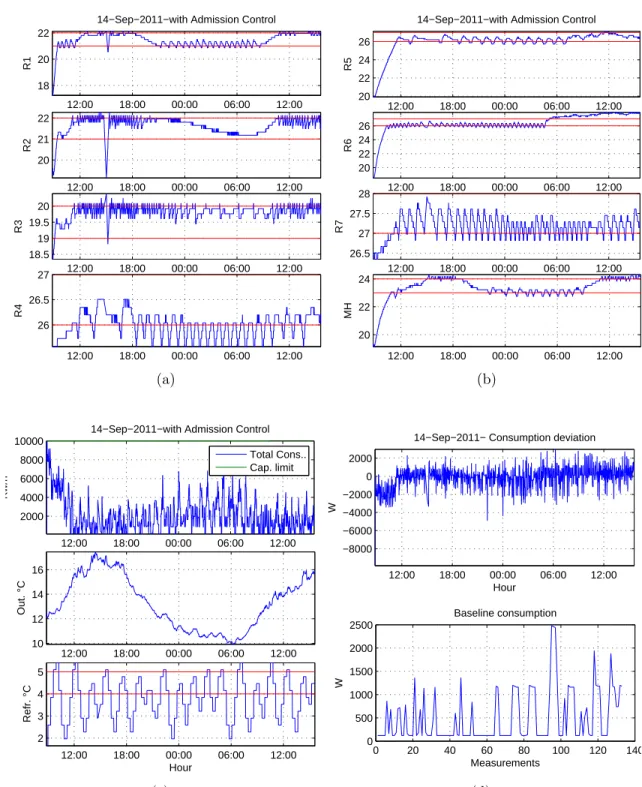
Fonctionnement sans gestion de la charge. Cette exp´erience vise `a montrer comment la superposition de la charge r´eguli`ere cause des pics d’absorption ´elev´es. Pendant la phase d’initialisation du syst`eme de contrˆole, comme la temp´erature de nombreuses chambres se
trouvent hors de la zone de confort, un grand nombre de demandes arrivent au mˆeme moment. Puisq’il n’y a pas de limitation sur la consommation de puissance, l’AC accepte toutes les requˆetes re¸cues. L’ ´evolution de la temp´erature et les zones de confort relatives aux chambres de 1 `a 8 (R1, R2,..., R8) sont indiqu´ees dans les figures 6(a) et 6(b). La consommation totale de puissance, la temp´erature ext´erieure et la temp´erature interne du r´efrig´erateur sont pr´esent´ees dans la figure 6(c).
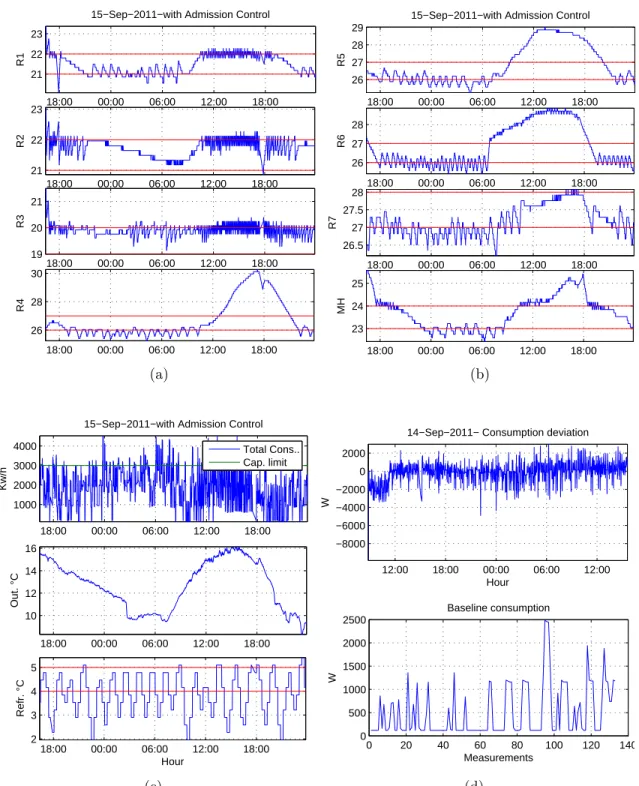
Gestion de la charge via le contrˆole d’admission. Dans l’exp´erience rapport´ee ici, l’AC utilise une limite de capacit´e constante de 3000W pour la gestion des charges, en utilisant l’algorithme pr´esent´e dans la section 3.4.
Nous pouvons observer dans les figures 7(a) et 7(b) que la temp´erature est maintenue dans la zone de confort dans toutes les chambres grˆace `a l’air conditionn´e. Tandis que le surchauffage des salles sans air conditionn´e est, par fois, inevitable pendant la journ´ee. La temp´erature interne du r´efrig´erateur est maintenue malgr´e le fait que les pics d’absorption ont ´
et´e r´eduits (figure 7(c)). Toutefois la limite de capacit´e de 3000W n’est pas toujours respect´ee. En fait, le point culminant est mesur´e `a 4520W et est caus´e par diff´erents facteurs, tels que l’incertitude sur les mod`eles des appareils (qui est bas´e sur la consommation de puissance nominale) et les variations de la charge de base.
N´eanmoins, le syst`eme DSM montre ses avantages en termes de r´eduction des pointes de consommations. La r´eduction est de 61,8% sur la consommation nominale (de 11860W `a 4520W), de 54,5% en ce qui concerne le pire cas de consommation exp´erimentale (au d´ebut de l’exp´erience, `a partir de 9940W `a 4520W), et de 37,2% pendant le fonctionnement en r´egime permanent (de 7200W `a 4520W).
12:00 18:00 00:00 06:00 12:00 18
20 22
R1
14−Sep−2011−with Admission Control
12:00 18:00 00:00 06:00 12:00 20 21 22 R2 12:00 18:00 00:00 06:00 12:00 18.5 19 19.5 20 R3 12:00 18:00 00:00 06:00 12:00 26 26.5 27 R4 (a) 12:00 18:00 00:00 06:00 12:00 20 22 24 26 R5
14−Sep−2011−with Admission Control
12:00 18:00 00:00 06:00 12:00 20 22 24 26 R6 12:00 18:00 00:00 06:00 12:00 26.5 27 27.5 28 R7 12:00 18:00 00:00 06:00 12:00 20 22 24 MH (b) 12:00 18:00 00:00 06:00 12:00 2000 4000 6000 8000 10000 Kw/h
14−Sep−2011−with Admission Control Total Cons.. Cap. limit 12:00 18:00 00:00 06:00 12:00 10 12 14 16 Out. °C 12:00 18:00 00:00 06:00 12:00 2 3 4 5 Hour Refr. °C (c) 12:00 18:00 00:00 06:00 12:00 −8000 −6000 −4000 −2000 0 2000
14−Sep−2011− Consumption deviation
Hour W 0 20 40 60 80 100 120 140 0 500 1000 1500 2000 2500 Measurements W Baseline consumption (d)
Figure 0.6 Op´eration sans gestion de la charge (EXP): (a) ´Evolution de la temp´erature dans les chambres de 1 `a 4; (b) ´evolution de la temp´erature dans les chambres de 5 `a 8; (c) temp´erature ext´erieure et temp´erature interne du r´efrig´erateur; (d) ´ecart de consommation et charge de base.
18:00 00:00 06:00 12:00 18:00 21
22 23
R1
15−Sep−2011−with Admission Control
18:00 00:00 06:00 12:00 18:00 21 22 23 R2 18:00 00:00 06:00 12:00 18:00 19 20 21 R3 18:00 00:00 06:00 12:00 18:00 26 28 30 R4 (a) 18:00 00:00 06:00 12:00 18:00 26 27 28 29 R5
15−Sep−2011−with Admission Control
18:00 00:00 06:00 12:00 18:00 26 27 28 R6 18:00 00:00 06:00 12:00 18:00 26.5 27 27.5 28 R7 18:00 00:00 06:00 12:00 18:00 23 24 25 MH (b) 18:00 00:00 06:00 12:00 18:00 1000 2000 3000 4000 Kw/h
15−Sep−2011−with Admission Control Total Cons.. Cap. limit 18:00 00:00 06:00 12:00 18:00 10 12 14 16 Out. °C 18:00 00:00 06:00 12:00 18:00 2 3 4 5 Hour Refr. °C (c) 12:00 18:00 00:00 06:00 12:00 −8000 −6000 −4000 −2000 0 2000
14−Sep−2011− Consumption deviation
Hour W 0 20 40 60 80 100 120 140 0 500 1000 1500 2000 2500 Measurements W Baseline consumption (d)
Figure 0.7 Gestion de la charge par contrˆole d’admission: (a) ´evolution de la temp´erature dans les chambres de 1 `a 4; (b) ´evolution de la temp´erature dans les chambres de 5 `a 8; (c) temp´erature ext´erieure et temp´erature interne du r´efrig´erateur; (d) ´ecart de consommation et charge de base.
Conclusions.
L’architecture propos´ee est ´evolutive, flexible et int´egrable avec divers algorithmes de contrˆole. Ces caract´eristiques permettent un contrˆole hi´erarchique `a partir des niveaux plus ´elev´es, per-mettant ainsi de poursuivre des objectifs plus ´elabor´es en mati`ere de gestion de l’´energie dans les maisons intelligentes, y compris ceux qui peuvent atteindre `a long terme des performances optimales.
Les ´etudes de simulation et les r´esultats exp´erimentaux ont prouv´e le bon fonctionnement du concept concernant le syst`eme DSM propos´e et ´eclairent ses limites. Par ailleurs l’efficacit´e du syst`eme de nivellement des pointes de charge est li´ee aux mesures et aux mod`eles des appareils ´electrom´enagers.
TABLE OF CONTENTS
DEDICATION . . . iii
ACKNOWLEDGEMENTS . . . iv
R´ESUM´E . . . v
ABSTRACT . . . vi
CONDENS´E EN FRANCAIS . . . vii
TABLE OF CONTENTS . . . xix
LIST OF FIGURES . . . xxi
LIST OF ANNEXES . . . xxiii
LIST OF ABBREVIATIONS . . . xxiv
CHAPTER 1 INTRODUCTION . . . 1
CHAPTER 2 DEMAND-SIDE ENERGY MANAGEMENT IN THE SMART GRID 3 2.1 An introduction to the Smart Grid . . . 3
2.2 Demand-Side Management (DSM) . . . 7
2.2.1 Smart Meters . . . 7
2.2.2 Demand/Response . . . 9
2.2.3 Paradigms of load control . . . 11
2.2.4 Smart Appliances and Home Automation Network (HAN) . . . 12
2.2.5 Energy demand forecasting . . . 13
2.2.6 Zero Net Energy Buildings (ZNEBs) . . . 15
2.2.7 Concluding remarks . . . 17
CHAPTER 3 ARCHITECTURE FOR AUTONOMOUS DEMAND-SIDE LOAD MANAGEMENT . . . 18
3.1 Introduction . . . 18
3.2 DSM System Architecture . . . 19
3.4 Admission Control . . . 26
3.5 Load Balancing . . . 29
3.6 Demand/Response Manager and Load Forecasting module . . . 31
3.7 Concluding remarks . . . 32
CHAPTER 4 DSM IMPLEMENTATION AND CASE STUDY . . . 33
4.1 Implementation in Matlab/Simulink . . . 33
4.1.1 Smart Appliances . . . 34
4.1.2 Admission Control . . . 36
4.1.3 Load Balancing . . . 38
4.1.4 Schedule Manager and Dispatcher . . . 38
4.2 Case Study . . . 39
4.2.1 Power consumption without load management . . . 39
4.2.2 Peak load shaving via Admission Control . . . 39
4.2.3 Peak load shaving via Admission Control and Load Balancing . . . . 40
4.2.4 Failure due to excessive request . . . 40
4.3 Conclusion . . . 42
CHAPTER 5 EXPERIMENTAL STUDY . . . 44
5.1 Context . . . 44
5.2 The experimental setup: FlexHouse at RISØ DTU . . . 44
5.3 Experimental Results . . . 47
5.3.1 Power consumption without load management . . . 47
5.3.2 Peak load shaving via Admission Control . . . 47
5.3.3 Load management via Admission Control and baseline estimation . . 50
5.4 Conclusions . . . 51
CHAPTER 6 CONCLUSIONS AND FUTURE WORK . . . 53
REFERENCES . . . 55
LIST OF FIGURES
Figure 0.1 Architecture propos´e pour le syst´eme de g´estion des charges. . . x
Figure 0.2 Sc´ema Simulink de l’Home Energy Manager . . . xi
Figure 0.3 Op´eration sans gestion de la charge . . . xiii
Figure 0.4 Op´eration avec gestion de la charge par AC . . . xiii
Figure 0.5 Op´eration avec gestion de la charge par AC et LB . . . xiv
Figure 0.6 Op´eration sans gestion de la charge (EXP) . . . xvi
Figure 0.7 Op´eration avec gestion de la charge par AC (EXP) . . . xvii
Figure 2.1 Energy production, transportation and distribution grid . . . 3
Figure 2.2 Power, Communication and Control layers . . . 4
Figure 2.3 Smart Grid structure . . . 5
Figure 2.4 Energy and information fluxes in Smart Grid . . . 6
Figure 2.5 Advanced Metering Infrastructure . . . 8
Figure 2.6 Inner-layer and cross-layer control in Smart Grids . . . 9
Figure 2.7 Smart Home Automation Network . . . 12
Figure 2.8 Smart Building concept . . . 16
Figure 3.1 Home energy management system . . . 19
Figure 3.2 Domestic loads classification . . . 20
Figure 3.3 Proposed architecture for demand side load management system. . . 21
Figure 3.4 Time-scale decomposition and triggering of HEM layers. . . 23
Figure 3.5 Appliance finite state machine. . . 24
Figure 3.6 Appliance interface. . . 25
Figure 4.1 DSM system implementation in Simulink . . . 33
Figure 4.2 Home Energy Manager implementation in Simulink. . . 34
Figure 4.3 Smart Appliance implementation with the Stateflow Toolbox (heating) 35 Figure 4.4 Smart Appliance interface . . . 35
Figure 4.5 Example of scheduling operation . . . 37
Figure 4.6 Schedule manager . . . 38
Figure 4.7 Case without load management . . . 40
Figure 4.8 Peak load shaving via online scheduling . . . 41
Figure 4.9 Peak load shaving via online scheduling (increased capacity) . . . 41
Figure 4.10 Peak load shaving via online scheduling and load balancing . . . 42
Figure 4.11 Failure due to excessive requests . . . 43
Figure 5.2 FlexHouse layout & state monitor . . . 45 Figure 5.3 FlexHouse livingroom . . . 46 Figure 5.4 FlexHouse and PV installation at RISØ DTU . . . 46 Figure 5.5 Case without load management . . . 48 Figure 5.6 Peak load shaving via admission control . . . 49 Figure 5.7 Baseline estimation . . . 50 Figure 5.8 Peak load shaving via admission control and baseline estimation . . . 52
LIST OF ANNEXES
Annexe A MATLAB CODE OF ADMISSION CONTROL BLOCK . . . 59 Annexe B MATLAB CODE OF LOAD BALANCER BLOCK . . . 62 Annexe C MATLAB CODE OF LOAD BALANCER BALGORITHM . . . 63 Annexe D MATLAB CODE OF REQUEST GENERATOR . . . 67 Annexe E MATLAB CODE OF SCHEDULE MANAGER . . . 68 Annexe F MATLAB CODE OF DISPATCHER . . . 69 Annexe G MODEL PARAMETERS INITIALIZATION . . . 70
LIST OF ABBREVIATIONS
AC Access Control
AMI Advanced Metering Infrastructures API Application Programming Interface DG Distributed Generation
D/R Demand/Response
DSM Demand-Side Management FSM Finite State Machine
HAN Home Automation Network HEM Home Energy Manager
HVAC Heating, Ventilating and Air Conditioning ICT Information and Communication Technologies IrDA Infrared Data Association
LB Load Balancer
LEED Leadership in Energy and Environmental Design LFM Load Forecasting Module
OPF Optimal Power Flow
PHEV Plug-In Hybrid Electric Vehicle PLC Power Line Carrier
PUC Personal Universal Controller RES Renewable Energy Sources WLAN Wireless Local Area Network SAI Smart Appliance Intelligence ZNEB Zero Net Energy Buildings
CHAPTER 1
INTRODUCTION
The scope of this research deals with demand side optimization in the Smart Grid, which is an emerging technology that will affect the structure of power grids by integrating advanced communication technologies. In many countries in the EU and in the United States, coal and nuclear plants provide the majority of energy production [European Commission (2011), Simon et Belles (2009)], while peak absorption is matched by regulation plants and power exchange between grids. Throughout the last two decades, factors, such as increased global energy demand, speculation of fossil fuels, and global warming have generated a high interest in renewable energy sources. Nevertheless, energy sources, such as wind and solar power, have an intrinsic variability that can seriously affect the power grid stability if they account for a high percentage of the total generation.
To face these challenges, the scientific community, as well as many industrial sectors, are taking steps to upgrade electrical network infrastructures and related technologies to en-sure energy production and delivery through the next century. In this scenario, Smart Grid technologies interests different actors in the power systems sector such as utilities, trans-port and distribution companies, customers, equipment manufacturers, services providers, or electricity traders.
Motivation
At the moment, production of solar and wind power is not large enough to threaten the grid stability, but if governments pursue green energy policies, structural and technological updates will be necessary in the next decade. Customers will also participate in conserving the grid stability by adjusting energy consumption contingent on the grid status.
In this context, there is a large interest in funding research in economic fields such as power systems, electronics, mechanics, and information technology.
Research objectives and contribution
This project aims to put forward an original point of view on energy management for the consumption side of the Smart Grid as a tool to support decisions concerning investments in sustainable energy and electricity market policies. The research objective is to address the problems of demand side optimization and propose a system design that can handle
this problem autonomously. Such a DSM system enables efficient energy management in Smart Buildings and offers the means for effective load shedding, dynamic energy pricing, users aggregation, and energy trading. Another objective of this research is to maintain the scalability and flexibility of the architecture, so that energy management can be addressed at different levels of the Smart Grid.
The contribution of this research is the harmonization of different scheduling and opti-mization techniques in a way that can take advantage of the time scale separation of energy requests in dwellings. In this context, the architecture is layered and each module operates in different time scales and with different triggering policies. The whole system has three main layers, which deal respectively with requests handling at run-time, optimal scheduling, and energy trading. In this way it is possible to manage energy requests and have flexibility with respect to environmental changes, while maintaining a high level of optimality.
We aim to propose such architecture as a self-standing approach for autonomous demand side load optimization, always considering that improvements can be made at every level, refining the algorithms and augmenting the computational capabilities of the system.
Thesis plan
This thesis includes a summary in French, after which is placed the introduction chapter. Chapter 2 introduces the Smart Grid, and presents the technologies that are being assessed to deal with problems facing electric grids in the coming years. The same chapter presents the Smart Grid as the natural evolution of the actual electric grids paradigm in a way that acts as the literature review for this research. Chapter 3 presents the architecture for autonomous demand side load management and a detailed description of the main components of such a system. Chapter 4 sketches out a software implementation of the proposed system and presents case studies from simulations. Chapter 5 reports some experimental results of the proposed system for residential energy management, while Chapter 6 outlines the conclusions and potentially subsequent developments in this field.
CHAPTER 2
DEMAND-SIDE ENERGY MANAGEMENT IN THE SMART GRID
2.1 An introduction to the Smart Grid
A serious event that rose up concerns about the reliability of electric grids in North America was the blackout in August 14, 2003, which affected 55 millions of consumers in the Northeast of United States and in some areas of Canada (see [Schneider Electric corp. (2010)]) causing an economic impact estimated between 7 and 10 billion US dollars [IFC Consulting (Feb. 2009)]. By that occasion, U.S. government realized the necessity and the urgency to upgrade the national energy infrastructures and policies.
Figure 2.1 : Simple diagram of energy production, transport and distribution grid 1
The spread of distributed generation plants and the high penetration of renewable re-sources are putting the existing grids, which were designed to meet market’s needs based on the centralized carbon-based production(Fig. 2.1), to face challenges such as increasing the energy transit and efficiency while decreasing carbon emissions. Moreover, the participation of customers in the energy market, the integration of new technologies through standard-ization and interoperability, the need for high reliability and the new investments in many European Union member countries are important factors leading to the building of Smart Grids in Europe.
Although upgrade of the whole grid can be very costly, its benefit has already been demon-strated by recent achievements in this area. For example, thanks to Distributed Generation
(DG) and Renewable Energy Sources (RES) integration, nowadays it is possible to produce and consume energy within the same area of the power grid, enabling utilities to supply electricity in case of higher demand without upgrading centralized production and increasing transmission capability. Nevertheless, to integrate technologies such as DG, RES, PHEVs and to enable energy conservation in the next decades, utilities have to move toward a new grid architecture, behind which there is a galaxy of different possible developments at both hardware and software levels.
The Smart Grid is a vision of the future electric energy system. In [Bellifemine, F.L. et al. (2009)] the Smart Grid is described under a functional point of view as “an electric network able to integrate all the branched customers’ and producers’ actions to distribute electric energy efficiently, sustainably, at low operating costs and safely.”. On the same line of thought, Schneider Electric defines the Smart Grid as “an electric network that can intelli-gently integrate the actions of all users connected to it: generators, consumers and those that do both, in order to efficiently deliver sustainable, economic and secure electricity supplies” [Schneider Electric corp. (2010)]. In a business case study of CISCO [V. Pothamsetty and S. Malik (February 2009)] more emphasis is put on roles the information infrastructure plays in such a system by describing the Smart Grid as “the combined view that uses the infor-mation network to enhance the functioning of the electricity grid”. From the “Power System View,” the power grid is an electric network integrating power generation, transmission, and distribution to support costumers’ requests.
CONTROL LAYER
POWER LAYER COMMUNICATION
LAYER
Figure 2.2 : Power, Communication and Control layers.
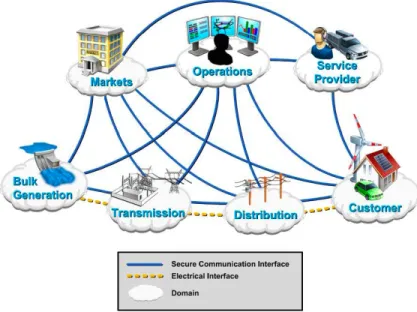
From “Information System View,”(Fig. 2.2) the operation of such a system is enabled by a communication infrastructure that connects everything from everywhere in the grid. Nevertheless, there is a need of control systems at every level of the grid to make this integration functional, efficient, and effective. A complement of the power and information views is then the “Control System View” based on which a Smart Grid can be seen as a
system of systems (Fig. 2.3).
Figure 2.3 : Smart Grid structure. 2
In accordance with such a viewpoint, J. McDonald pointed out that the Smart Grid is essentially a control problem including [McDonald (2010)]:
• delivery optimization; • demand optimization; • asset optimization; • reliability optimization;
• renewable resources integration and optimization;
This will lead to a more efficient, reliable, and sustainable energy infrastructures which will provide [McDonald (2010)]:
• operational efficiency: with distributed generation, network optimization, remote mon-itoring, improved assets utilization, and preventive maintenance;
• energy efficiency: with reduced system and line losses, improved reactive load con-trol, peak-load shaving, and accomplishment with governmental policies about energy saving;
• customer satisfaction: as the grid will improve the communication between producers and consumers, the Smart Grid will enable customers self-service;
• CO2 emission reduction: via demand-side load management and integration of
renew-able energy sources and PHEVs, and by decreasing the usage of supplementary (and high polluting) support plants.
A distinguishing characteristic of the Smart Grid, if compared to classical electric grids, is the two-way flow of electricity and data (Fig. 2.4). This is a key feature allowing the active collaboration of consumers. In fact, with existing grid infrastructures and currently available IT technologies, one can largely improve energy efficiency of the whole grid by consumption scheduling, load forecasting and peak shaving at consumer side.
Figure 2.4 : Energy and information fluxes in Smart Grid.
Based on the previous considerations, this research focuses on the control of electric consumption at customer-side and the interface customers and the Smart Grid, in order to achieve a substantial energy efficiency enhancement. Under this scope, the topics of interest include:
• smart metering
• smart appliance and home automation
• dynamic load management and forecasting, peak-load shaving • integration and optimization of renewable energy sources • demand/response optimization, energy dynamic pricing
• cyber security
The scope of applications of such practice can range from smart houses to micro-grids, capturing such ones as zero net energy buildings.
2.2 Demand-Side Management (DSM)
A strategy enabling rise of solar and wind supply is to adjust the consumption so as to match the supply. Such practice require communication between customers and utilities, as well as computating capabilities at customer side. In this context, two key technologies enabling demand-side load optimization are [Flynn (2008)]:
• building automation; • smart metering.
Intelligent energy dispatching among users in the Smart Grid would be a direct applica-tion of smart meters and an optimal consumpapplica-tion profile would benefit from a home energy management system (able to manage the devices and perform a cost optimization above operations). Energy pricing, green-power choices, CO2 management, usage pattern moni-toring and load side voltage changing detection are only some of the possible applications of building automation one can think about. The presence of distributed generation (solar, wind, biomass, geothermal, cogeneration) and storage facilities (batteries, fuel cells, PHEVs, compressed air) will help to create zero net energy buildings and districts [Kleissi et Agarwal (2010)].
2.2.1 Smart Meters
A Smart Meter is a device able to collect measurements of heterogeneous type, analyze data and report readings in real-time. Such devices offer more complex services than automated metering reading (AMR), such as power quality monitoring, remote customer debranching, dynamic service tarification, etc. Such devices (or a less evoluted version of them) can be integrated in an Advanced Metering Infrastructure (AMI), providing utilities and customers with different type of information and services (see Fig. 2.5).
Implementing smart metering involves complex communication technologies and may lead to relevant social, economical, and environmental benefits. The social benefits of smart metering is the main argument investigated by Neenan in [Neenan (2008)], who affirms that: “attributing intelligence, which implies value, to these technologies begs the question on how to measure the gains to realize from making such investments. Not surprisingly, making
Figure 2.5 : Advanced Metering Infrastructure.
devices smarter is not by itself sufficient to produce benefits to exceed their costs.”. This latter argument encompasses the core problem on which is focused the article, making this work to be more focused on the market and social impact rather than on the technological framework of Smart Meters. It is clearly stated that the actions undertaken by customers are generating benefits the evaluation and measure of which “is not without ambiguity.” In this context, a framework for characterizing and quantifying social benefits is proposed and the salient aspects such as service reliability enhancement, feedback, demand/response, new products, services and macroeconomic impacts are discussed.
In [S. Karnouskos et al. (2007)] is presented a general overview on Smart Meters, together with an analysis of the funtionalities they should implement and the evolved services they should support. We can imagine a new business model where the internet of “things” may let to trade electric energy, thermal energy, gas and oil, which are seen as commodities in the same marketplace. The smart meters should be connected to the home gateway, that would integrate the home automation network (communication with appliances and devices) with internet (data exchange with utilities). Smart Meters should be multi-utilities (electric & thermal energy and natural gas) and give the support for a deregulated energy market. They should also have a layered structure (Programmable HW, Embedded Middleware, Execution environment API, Services Layer) to support general purpose code implemented by third parties. At the end of the article, the authors present a possible business model for the integration of hardware providers, service providers, and end-users of Smart Meters.
At the Smart Grid level, simple and advanced measurement techniques will help in keep-ing track of transformers and lines temperature, oil moisture, computkeep-ing thermo images of electrical devices, and determining the load capability and insulation aging factor. These precautions can reduce by 2.5 times the failure risk, enabling preventive maintenance [Flynn (2008)].
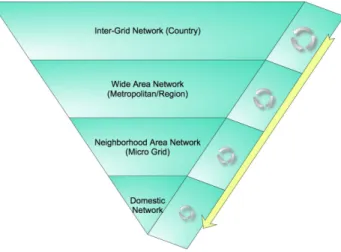
Regarding energy dispatch issues associated with AMI (Advanced Metering Infrastruc-ture, see Fig. 2.5), a mathematical approach for distributed-optimal power-flow computation using smart meters, distributed generation facilities and remote load control, is presented in [S. Bruno et al. (2009)]. Here the possibility for the utilities to reduce customers load with remote signals is investigated. Such a modified OPF (Optimal Power Flow) is capable of taking into account the possibility to buy energy from different distributed providers and deliver it to customers with different needs. The optimization is carried out with respect to the minimization of operating costs for distribution companies and includes two eligible strategies: shedding the amount of energy to ensure the generation/load balance, or evaluate the amount of energy to be bought from distributed generators to balance the demand under the hypothesis of partial load shedding among selected customers. This latter study gives a taste of how the upper layers in the Smart Grid may provide information and control to lower layers as shown in Fig. 2.6.
Figure 2.6 : Inner-layer and cross-layer control in Smart Grids.
2.2.2 Demand/Response
Shaping the demand, in order to smooth the load factor during peak hours, can greatly enhance efficiency in power networks and reduce operational costs. One enabling technol-ogy for intelligent control from grid to houses is the demand/response approach, in which the energy price is dynamic and customers can adjust the demand in response to supply conditions. Since this latter argument has been widely explored in literature, we refer to [Utilipoint (2010)] for an exhaustive list of references.
In a D/R-based market-clearing price, the energy supply is inelastic and the utility oper-ates the peak shaping basing on a supply function bidding scheme. Basically every customer
sends a supply function to the utility which, based on the bids of customers, decides the energy price. Therefore the customer is price-taking and commits to shedding or increasing its consumption according to its bid and the energy price [Klemper et Meyer (1989)]. This latter research shows that in a market where customers are price-taking, a global equilib-rium that maximizes the social welfare is achieved. Conversely, citing [Lijun Chan et Doyle (2010)], “in an oligopolistic market where customers are price-anticipating and strategic, the system achieves a unique Nash equilibrium 3 that maximizes another additive, global objective
function.”
In [Zhong (2010)] a framework for distributed D/R with user adaptation is presented, and techniques assessed in telecommunication network decongestion are applied to the electricity market. Here the energy price depends on the network load and is the only information available to the end user. Such scheme is based on the proportionally fair price (PFP) presented in [F.Kelly et D.Tan (1998)], in which each user declares a willing-to-pay price per unit for his flow. In this sense the network capacity is shared among the users in proportion to the price they pay. In such a model each user tries to maximize a utility function, which depends on the willing to pay price and the capacity request. With such a model, users that pay more, get more capacity share. Such framework is particularly suitable for the DSM architecture proposed in this thesis, since in both studies utilities and users are supposed to be elastic about the energy price.
The above-mentioned Demand/Response scheme requires bi-directional communication between customers and the utility company. Nevertheless, the setting up of an AMI is a task in which costs can be justified only under the hypothesis of active customers participation. In the distribution level of the Smart Grid smart meters are essential units which, in presence of energy management systems, enable demand-side load management. In a Smart Home, for eample, the Home Energy Manager is the middle layer between physical devices and the Smart Grid and, thanks to information on energy price or emergency situations, enables optimal consumption scheduling. Further details on D/R paradigm are presented in Section 3.6.
In such context a big effort is needed from governments in deregulation of the energy market, while the setup of the communication layer and its integration with the electric layer is a utilities’ duty. Strategic alliances with telecommunication companies and manufacturers of telecommunication devices are key factors for a successful market entry strategy of Smart Grids.
3In game theory, Nash equilibrium (named after John Forbes Nash, who proposed it in [John F. Nash (1951)]) is a solution of a non-cooperative game involving two or more players, in which each player is assumed to know the strategies of the other players. An equilibrium is represented by a set of strategies such that no player has anything to gain by changing only his own strategy unilaterally.
2.2.3 Paradigms of load control
The demand-side load control is an issue that has been studied since the beginning of 90s. Wacks presented in [Kenneth P. Wacks et al. (1991)] the general philosophy of demand-side load management for adjusting energy demand/offer balance. Toward this scope, the energy utilities developed different strategies for load control that are classified as: local control, direct control, and distributed control. Note that all of them need real time access to information from utilities, computer-based intelligence inside houses, home automation communication network and appliances that can reduce their power consumption.
Local control consists in voluntary cooperation of customers to reduce load peaks through taking into account different energy tariffs depending on the daytime. Therefore customers with heavy and not urgent power-consuming activities are encouraged to shift them in peak-off pricing time. Although this strategy is cheap and simple to implement for utilities, it may have limited success since the customers barely understand the kilowatt-hour consumption and related costs of each appliance, in a way that they may not operate efficiently their choices.
Direct control is based on appliances-forced remote switching. After receiving financial inducement, the customers allow the utilities to install in their homes some remote-controlled switches, which would control the load when needed by disconnecting selected appliances. This implies that the air conditioning is turned on and off basing of the outside temperature, daytime and utilities needs. In the same way the water heater would reduce his operation, for example, in the hottest hours of the day.
Decentralized control is a mixed approach relying on customers’ cooperation and com-munication with utilities. The utility has the opportunity to change energy price in real-time according to the energy market and grid load status, while the customer is called to adjust its consumption basing his decisions with respect the tarification. In this scenario home automation takes a fundamental role. As for example, an appliance like dishwasher, connected with the HEM (Home Energy Manager), can provide the customer with the choice to run the cycle when requested or shift it of a certain amount of time with a economic benefit. The article of Wacks concludes with explaining how important is home automation to reach power load control and how should smart appliances be redesigned to this scope. This study, carried out in 1991, summarizes the basic ideas that nowadays are leading toward Smart Homes and Smart Grids.
2.2.4 Smart Appliances and Home Automation Network (HAN)
The home communication network can be implemented with diverse wired and wireless tech-nologies or carrier waves in electrical power lines [Drake et al. (2010); Li et Sun (2010)] (Fig. 2.7). In a similar manner, communication between the grid and the DSM system should also be handled by an appropriate interface.
Ideally, the communication system for supporting smart appliances should be based on what is already existing in the house. The technologies that match this vision range from wired PLC-Power Line Communication to diverse wireless technologies, such as Bluetooth, 802.11b (WiFi), ZigBee, IrDA. In [N. Kushiro et al. (2003)], the authors analyze technolo-gies that converge in a residential gateway controller designed for home energy management. Although all technologies carry pro and cons and have different costs, the PLC seems to be the most interesting one. The reason of such preference is due to the reliability and low electromagnetic impact of a wired channel over a wireless one, together with data safety, channel flexibility, and scalability. In Chia-Hung Lien et al. (2008) we find a real implemen-tation of a PLC communication system with an improved Orthogonal Frequency Multiplex algorithm to limit narrow-band noises interfering with the carrier signal. In [Yu-Ju Lin et al. (2002)] and [N. Kushiro et al. (2003)] we find simulations for home communication network based on PLC technology, where security and data consistency issues are also investigated. In [Yu-Ju Lin et al. (2002)] a layered-architecture is proposed to overcome the problems of signals synchronization, data exchange, and channel reliability.
C C C
S Home Automation System
Security System
Multimedia & Entertainnment
Telecommunication System Home A u to m a tio n N e tw o rk G a te w a y
Figure 2.7 : Smart Home Automation Network.
About the issue of how to communicate with appliances, J.Nichols et al. (2002) presents a universal appliances interface that enables to design a controller with different type of interfaces for a wide range of common use appliances. This approach could be adapted in
developing “appliance adaptors” for home energy management systems. A self-programming interface is developed for PUC (Personal Universal Controller), which offers to users a com-plete appliance interface in one single device. In fact, once the appliance is able to receive and send commands (a feature offered by a hardware adaptor and a communication proto-col), the PUC can interrogate the appliance about the available functions and generates an intuitive and user-friendly interface. Since the interface is generated basing on the appliance structure, the controller is completely universal. The hypothesis for this scenario is that appliance description must be sufficiently detailed to allow the PUC to generate an adequate interface. An efficient approach to do that is to define a set of state variables, commands, and labels for each appliance and group them in a relational tree. Then, another structure called “Dependency Information” will express all the relations between the appliance state variables, commands, and labels (just think that in a certain state only a subset of the total commands is available). The interesting information found in this work is mainly about the logic behind how to establish communication with appliances and how to define an interface for sending and retrieving data.
2.2.5 Energy demand forecasting
Once established communication between appliances and home energy manager, one of the most interesting features the energy manager may enable for both customers and utilities is the energy consumption profiling. In fact on customer side, such information would allow to better schedule the home activities considering the energy price. On utilities side, it would be extremely useful for the optimization of energy dispatch. As a fact, such topic is one of the most investigated in energy management practice since late 70s. A lot of references can be found in this field and it seems that this problem has been studied using completely different approaches capable to enlighten different aspects and provide solutions accordingly. Buildings consumption can be divided into electrical and thermal energy. The forecast-ing process can use top-down or bottom-up approaches, as explained in [Lukas G. Swan et al. (2009)]. The first approach uses data coming from energy suppliers about regional con-sumption and treats the users as energy sinks; while the second starts from the user level information and goes up in the modeling process to fit the aggregate data provided by energy suppliers. With a top-down approach it is not trivial to disaggregate and forecast the single user consumption because of the merge of historical data with macroeconomic indicators (income, oil price, etc...), technological development peace, and climate [Lukas G. Swan et al. (2009)]. The advantage of this technique lies in its simplicity, which needs only widely available aggregated data. Moreover the historical data give some kind of “inertia” to the model. As drawbacks we find the incapability to catch technological or climate
“discon-tinuities” more than the impossibility to extrapolate single user consumption information. Nevertheless, this approach provides reliable forecasts for long-term energy consumption in wide areas.
It seems that bottom-up is a more practical approach, which comprehends statistical and engineering methods. These approaches use data coming from individual end-users, group of houses or communities in order to extrapolate the model of an entire region or even a country based on the representativeness of the groups or sub-groups of customers used during modelling process. The bottom-up approach use both statistics and engineering methods. Statistical models rely on historical data and use different types of regression to attribute dwelling energy consumption to particular end uses. Once the relationship between end-uses and energy consumption has been established, the model is used to estimate the energy consumption of dwellings representative of the residential stock. Among statistical methods one can find regression, conditional demand analysis and neural networks. For more details, we refer to [Lukas G. Swan et al. (2009)] and references therein.
Engineering methods, instead, try to model energy consumption according to thermal characteristics of houses, consumption profiles of appliances (together with statistical data about market penetration of most common appliances), and behaviour of householders. Among the engineering methods the most relevant are distributions, archetypes, and samples [Lukas G. Swan et al. (2009)]. Archetypes technique consists in classifying the dwellings by vintage, size, house type, etc. Then it is possible to aggregate data and characteristics on appliances to set up the model. The more archetypes are available, the more detailed and ad-herent to the reality can be the energy consumption estimation for a given region. This latest technique seems to be a suitable choice to extend the Home Energy Manager functionality since the consumption of each appliance is available and only the dwelling characteristics may have to be added.
Common input data for bottom-up approaches include the dwelling geometry, equipment and appliances presence, indoor and outdoor temperatures, occupancy schedule. Such high level of detail is a strong point of the bottom-up approach and gives ability to model techno-logical advances in society. Nevertheless the bottom-up approach could be so detailed that it may underestimate the building energy consumption due to unmodeled illogical household-ers’ behaviour. This latest aspect represents the weak point of engineering methods, the high dependency on householder habits.
It may be interesting to follow an approach that disaggregate the consumption data and classify it by appliances and by day type (weekday, weekend, Sunday, etc.). To this end, Bayesian inference can be performed to set up a prediction model for the dwelling energy
consumption (note that this approach is presented in an article that under review). In [Raaij et Verhallen (1983)], the authors present a behavioural model of residential energy use. Their approach belongs more to psychology science than engineering. However their study is useful to explain and interpret measurement data.
An interesting advancement of the latter approach is presented by A. Capasso in [A. Capasso et al. (1994)], where a user-customized bottom-up approach is developed. The au-thors merge the statistical and the engineering philosophy together with Monte Carlo-based consumption simulations and show how the model can reasonably predict the household en-ergy need along the day. Although this study has been conducted for the Italian enen-ergy market and takes into account Italian householders’ lifestyle and appliances ownership, this model is extendable to other countries given the necessary data coming from surveys. Again, this approach may be easily merged with the scheduling approach for home energy manage-ment given the HEM can provide appliances use information and statistics as well as home occupancy information.
C.S. Chen in [C.S. Chen et al. (1997)] proposes an approach to define the user load pattern basing on energy consumption measurements that enable to assign a proper energy tarification to the user (statistical top-down method). This would lead to more fair tariffs according to the energy production, transmission and distribution costs. This study has been tailored on Taiwan situation where the carrying factors for time-based energy tariffs are the operational costs of power grid (that depend by the network congestion: peak time).
In summary, energy consumption profiling could be a key feature for a home energy manager, since it may enable the consumption prediction for optimal scheduling and useful data for aggregators in providing ancillary services. Customized billing profile, efficient energy bidding mechanisms, building tenants co-operational models are only few features that an efficient energy profiling system could allow to implement. To reach this objective the bottom-up approach is more attractive than the top-down, and much attention has to be put on modelling the behaviour of householders.
2.2.6 Zero Net Energy Buildings (ZNEBs)
Going one level up, the architecture for energy management in this research work can be extended to smart buildings and micro-grids (Fig. 2.8). One of the most investigated scenarios that smart building technologies would enable is the design of Zero Net Energy Buildings (ZNEBs).
D. Crawlery in [Drury Crawlery et Torcellini (2009)] define a Zero Net Energy Building as a “building that offset all its energy use from renewable energy sources available within the footprint.” This imply that all this kind of buildings have to reduce their energy
con-sumption at first and then produce on site at least as much energy as they require in a year using demand-side load control and renewable energy technologies, such as daylight heating, advanced HVAC, solar panels, insulation, ground-source heating pumps, ocean water cooling, evaporative cooling, etc. In this article is pointed out that, even though many simulations and studies support the feasibility of a ZNEB, in general the majority of these dwellings achieve to be “near” to the zero-net energy buildings. This is mainly due to optimistic assumptions about the tenants’ lifestyle and the solar radiation level. The penetration of ZNEBs addresses also a stability issue on power networks because, during low solar radiation, the energy peak-consumption in ZNEBs is even more pronounced than in typical buildings [Drury Crawlery et Torcellini (2009)]. Therefore, energy storage facilities should be integrated to limit this problem.
References such as [Iqbal (2004)] and [Kadam (Spring 2001)] offer an economic feasibility point of view of ZNEBs, presenting studies for Newfoundland and Florida regions respectively, while E. Musall et al. (2010) summarizes the state-of-the-art in regulations and active projects on ZNEBs. This latter reference is particularly interesting because it is up to date with the latest information coming from the 2010 European Commission directives on Smart Buildings.
Figure 2.8 : Smart Building concept 4.
2.2.7 Concluding remarks
In conclusion, many challenges regard not only technologies but also standards and regula-tions about Smart Grids. To this end, the IEEE has established the “IEEE P2030 Smart Grid Interoperability Standards” committee, which “will provide a knowledge base for un-derstanding and defining smart grid interoperability of the electric power system with end-use applications and loads.” [IEEE-P2030 (2011)]. It is common understanding among utilities and governments that proper actions toward a global standardization in energy production and distribution matter is necessary to make Smart Grids ready-to-implement and cost ef-fective.