CARBOFURAN SEED COATINGS AS
CONTROLLED
RELEASE FORMULATION
B. C.
SCHIFFERS(1),
Ph
.
DREZE(2),
J.
FRASELLE(1)
and M.C.
GASIA(2)
(1)(2)
Chaire
de Phytopharmacie
Chaire de Physique
et C.A
.
M
.
J.R.A.
Faculté
des
Sciences
Agronomiques
de l'Etat,
B
-
5800
GEMBLOUX (Bclgium).
SUMMARY
Theincorporation ofsystemicinsecticides inseed<oatings is a combined operation (sowing and treatment) whichallows toreduce the dose applied perha and/or increases efficiency time. Carbofuran incorporated in corn coated-seeds, atthe rate 013 mg activeingredient /seed(about 300g a.i./ha), reducedmarlledly the numberofwireworms attacks. Incorporation in field baan coated seeds ofcarboluran atthe rate of 3 mg a.i. /seed reduces up to 980;' stem nematode populations in plants 4 months alter sowing. As might be expected for a systemic pesticide incorporated to the soil, carbofuran has no effect against pollinators and pes1's predators or parasites.The controlled-release effect01 ailthese formulations has baen characterized using radioisotopic techniques. ln alaboratory test,carbofuran appearedto bereleased up to 3 times more slowly from coatings thanwhen formulatedas commercialmicrogranules.
RESUME
Enrobaoe ~ semencesR.llcarbofuran.a.Y.§.l;.lUlfJo!rmulation ~
L'incorporation d'insecticides systémiques dans les enrobages de semences es1une opération combinée(semiset traitement) quipermet la réductiondela dose appliquée
à
l'hectare et quipeut augmenter la persistance d'action du pesticide. Le carbofuran incorporé aux enrobages de semences de maïsà la dose de 3 mg/ semence (soit300 9 m.a./ha) a réduit très fortement les attaques detaupins. Demême, l'application de 3 mg de carbofuran par semence de féverole a diminuéde 98% lespopulationsdenématodesdes tiges trouvés dansles plantes 4 mois après le semis. Incorporé au sol, lecarbofuran, qui est un insecticide-nématicide systémique, n'a pas d'elfet négat~ sur les auxilliares et lespollinisateurs.L'effetdelibération lente a été caractérisé enTable 1
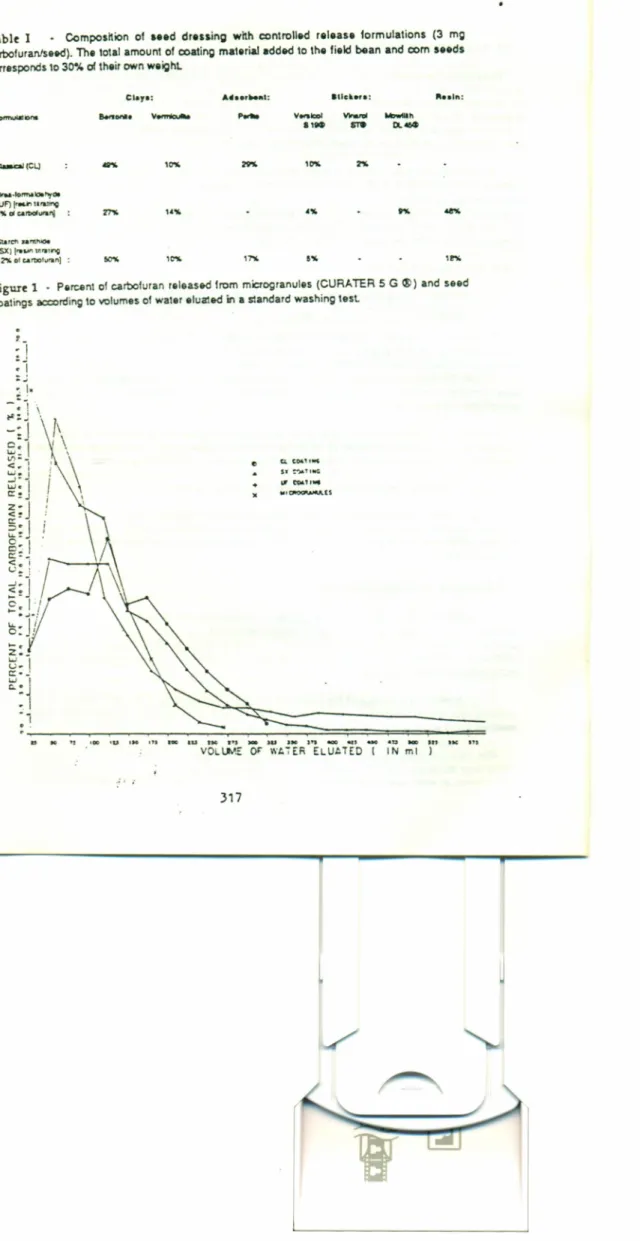
Composition0
1
aud dressing with controlled reluse formulations(
3
mg carboluranlseed). The lotal amounl01
coating mate rial added to the field bean and œrn suds corresponds to3
~
.4
oftheirownweighlClay.: Ail ••,,,,,,,: auc•.•,.:
"
..
.
,,:FOfTftI,JIltd~ &.<t ••••• v_
-
V ••• 1ooI-
_h
.
,
'*
STe OL_ OaaaI(Cl.),~
'
0'1'
2'4u.u.Io""" •••..,.CIo (UF)
l'
''
''tI.
aImg.'" elc:al'bOh,""Ii 27Yo
,
..•
.
.
.•
.
K Ae'!I.SUrct\ xartU\1OI
(SXII~1M'Ilnra1ng
12'%01c.arbo!unan) 50'!1. 'C'!I. '7'11. $'" '!'!I.
Figur
e 1
_ Percent01carboluran rilleased lrom mic:rogranuilis (CURATER 5 G~) and seedcoatings according 10volumes01water eluated in a s1andardwashing tesl
e
"
l6 t'Ol'I'"
"I~(S
l.U ne .', )CIO su no '" ecc .a' <UO ICI> ln ne su
VOLW!
o
r
wt.iER ELuATED ( lN ml ).z,
22. STANDARDWASHING TEST
To evaluats Ihe release performance of the seed coalings. a slandard washing tast was used
(SCHIFFERS.1986).Thisinvotvod placing 5 soods on a sand bec!of 100 g in a Büchnerfunne! (7.5
an diameler x7 an). IIIlaining 25 or 30 mlofdislillalod waler in Ihe funnel for 24 hours and Ihen
drainingoff.The elualed volume was nolod and 1 ml ofthe çlua:e was then mixed with 10 mlof a
scintillalion mix1ure (lUMAGEl-lUMAC) 10 msasure the radioaClivity by counting.AI the end ofthe
test.radioactiv~yremaininginthe sseds and ths sand was measured.
To compare contrclled release of se8d coalinl/S with a commercial granular formulalion of
carbofuran (CURATER 5 G ~). Ihe slandard washing lesl was also used with a weighl of
microgranules conlaining Ihe same amount ofchemical thanIhe 5 coaled
se
eds,The amcunl ofcarbofuran re:easedfrom microgranules was also enraCled from elualod waler and measured by
go:s chtcrnatoçr aphy. Some samples of Ihe radioactive eluale were also analyzed by gas
chrornatoçraphy 10 identify radioaClivily as carbofuran.
2.3. F!ELD EXPERIMENTS
2.3.1. Portecllon Igllnst field bun aphlds and n.mltod •• CDI1ylenchus
dlpucD
The sxpsrirnent wasofrandomised blor.k design. consisling of4 Irealments (unlreated ônd 3
formulations: Cl. UF.SX)and 4 blocks.A plothad fitly 1.5 m rows 0.25 m apart. Field bsan seeds
were sownon 3May ineachrow10obtaina sowing density of40 seeds pe'square meter.Each plot
was divided:25 rowswere setaside foryield estimation andin Ihe ether 25 rows field beanplants
were sampled for nematode extraclions. At the lastda:e. w::hering offield bsan plants slopped
multiplicationofstem nemalodes.
FornematodeextraClion.stem bases of 10 field baanplants collected at randomwere cleaned.
cho~ vp,weighed andextraC1edby IhemixIH-centri1ugal-flotation lechnique already describ6d (COOLEN
t
l
.
a
l
..
1984) andadapled 10our Iaboralory conditions (SCHIFFERSil
.
al
..
1985).2.3.2. Port.cllon .gllnst corn wlr.worms (Agrl01u Ip.)
The uperiment was of latinsquare design. consisling of 4 lreatmenls (Control, Microgranules
and Seed'Coating -Cl,Coating.w~h 3 and 6 mg carbofuran Iseed) and 4 blocks.A plothas six 2.5
m rows0.80 mapart.Microgranules (CURATER 5 G ~) were appIied ovsr Ihe seed furrows (GOO9
carbofuran /ha).
3
.
B
.
f
.
S
1
l1
.
.I
5
Ab
1
l
Pl S
C
USSIQ
"J
#1Previous studies (SCHIFFERS
i
l
.
al
.
.
l986) showed that the roliing technique is able todistribUleonanaverage the desireddose ofcarbofuran on the seods witha variaion fromseed to
anelher that depends onthe amounlofcoating rnatarials on seed (iinsar correlation coefficients:
.0.85 and .O.~ torCl andUF lormulations). CarboIL:ran degradation in coatingmaterials does not
occurbefore al least 12 months.
#1The rslease performance of the seed coatings was studied using a lab test. Hesults of the
washing test are expressed in percent of the total weighl of carbofuran released !rom seed
coalingsatlhe end oflhe washinglssl and givenin Figure 1.
Ths rsleass performance of coatings and microgranules can be compared using the
percontage of Ihetotal amounl remaining in formulations when microgranules are used up(A°;').
and volumesofwater needed 10reloase 50.75 and ~5"l1.ofcarbofuran. Arelease·ralÎO(Rr)canbe
establishedas • Rr - CXlatingsVgS' microgranulesVgS •(Table II).
Table
n
-
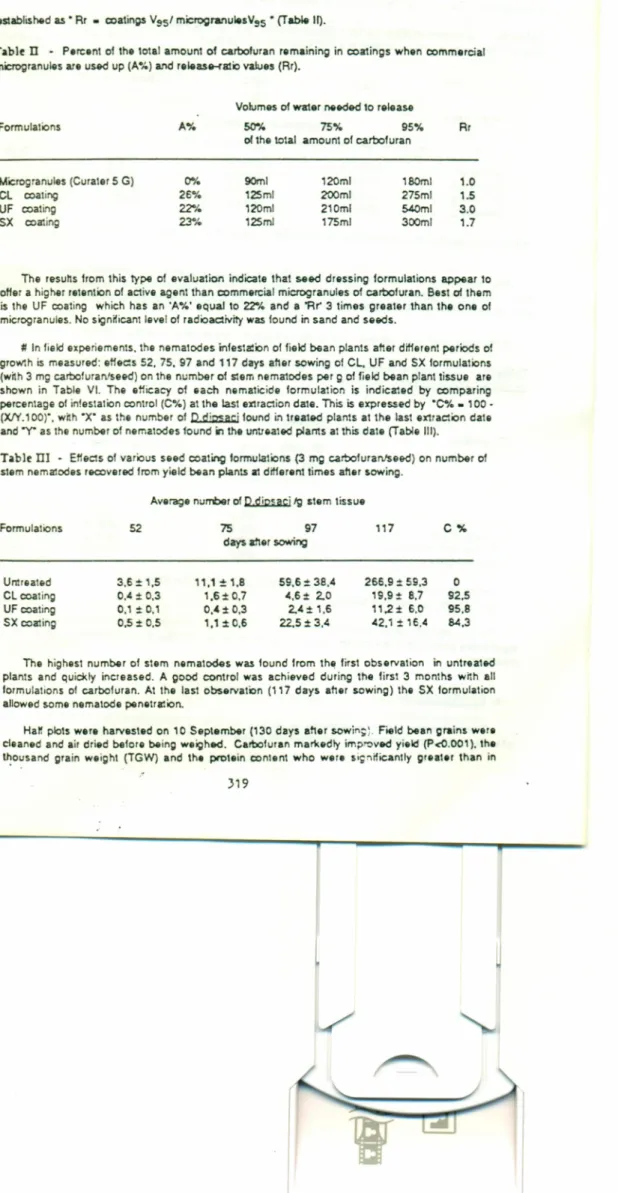
Percent ofthetotal amount of carboluran remaining ineoatinçs when comrnarcialmic:rogranulesareused up (A".4)andreleas~a1io values (Rr).
Volumesofwater needed torelease
Formulations A% ~1. 75% 95% Rr
01 thetotal amount ofcarboluran
Microgranules(Curater 5G) 0"1. 9Om1 120ml 18Om1 1.0
Cl CXlating 26% 12Sml 200ml 275ml 1.5
UF CXlating 22"/. 120ml 210ml S40ml 3.0
SX CXlating 23% 12Sml 175ml 300ml 1.7
The resuhs Iromthis type of evaluation indicate that seed dressing formulations appear to offerahigher retentionofactive agentthan commercial microgranules of carboluran. Bestalthem is the UFCXlatingwhich has an'A%' equal to 22% and a 'Ar' 3 times greater than the one 01
microgranules. No sign~icantlevel01radioactivity wasfound in sand and seeds.
# ln lield experisments. thenematodes inlestmion 01 lield beanplants afterdillerent periods 01
groWlh is measured:effeés 52.75. 97 and 117 days after sowing 01Cl. UF and SXlormulations
(with 3 mgcarboluranlseed) on the nurnbsr 01stemnematodes per9 01 field bean plant tissue are shown in Table VI. The efficacy 01 each nematicide lormulation is indicated by CXlmparing percentage01infestationcontrol (C%) atthe lastextractiondate.This is expressed by ·C"I._ 100
-(X/Y.100r. with·X· as the number 01
p
diosaci lound i;l treated plants at the lastextraction dateand"Y"as the number01nematodes !ound in the unlreated plants atthis date (Table III). Table
Il
l - Elfects 01 various seed CXlating formulations (3 mg carboluranlseed) on number 01stem nematodes recoveredlrom yield bsan plants aldifferent times aftersowing.
Average numberof
P
diosacj.tg stem tissue Formulations 52 7S 97 117 C% days aller5O'NÏng Untrsated 3.6 = 1.5 11.1: 1.B 59.6: 3B.4 266.9±
59.3 0 Clcoating 0.4 = 0.3 1.6:0.7 4.6±
2.0 19.9= B.7 92.5 UFcoating 0.1=0.1 0.4:1 0.3 2.4:1 1.6 11.2:1 6.0 95.B SXCXlating 0.5:t 0.5 1,1:10.6 22.5:13.4 42,' = 16.4 84.3The highest numbsr 01stem nematodes waslound lrom th" lirst observation inuntreated plants andquickly increassd. A good control was achieved during the lirst 3 months with ail
formulations 01carboluran. At the last observation (117 days alter sowing) the SX lormulation allowed somenematode penetration.
Ha~plots were harve.sted on 10 Sept.m~r (130 days alter sowin;;). Field bean grains were
dun.d and airdried belorll ~ing weighed. Carboluran marXedly impr:.wed yillld (P<O.001).the
~ousand grain weight (TGW) and th. protein CXlntentwho were siç:-ülicantly greater than in
unlrnled plolS (Table IV).AIlvalues given inTable IVare signHicanlly ditfefenl (p<O.05).
Table IV . Influence 01 diHerenllormulalions 01 carboluran on Ihe yield, Ihe tbousand grain weighl (TGW) and the prolein conlenl 01a lield bun crop (ev.Exelle)
YI8Id
(g1m2)T&N (g)
Prolein content (.~) Formulalions
(Averages 014 repelhions)
Un\reated Cl coaling UFcoating SX coaling 402.8 a 604.7 b 636.4 b 563.9 b 320.7 a 397.5 b 412.9 b 387.0 b 24.2 a '25.7 b 26.1b '25.7 b
aand b:dilribu:ion 01means lollowing IhQ NEWMAN and KEUlS me!hod lor
c
r
•
0.05%. #The coating etlicacy has bae;"!also evaluated againsl corn wireworms anacks (Table V). Aher elC1rac\ion, resiclues 01carboluran inI
l
our
01harvasted grain:; were -:lelermined by a gas·liquicl chromalographie melhod (SCHIFFERSil â1
.,
'
985).Residues anained O." ppm or 0.38 ppm lor plants trealed .••tilh a dasscal (Cl) ora urea·lormaldehyde (UF) ~ormulalion, respec\ively.Table V . Influence 01differenl carboluran trsatmeras on Ihe number 01 corn planls aner anacks by wireworms anc onthe yield.
Treatmants
Numbar alplants
'6 104
days afler sowing
(average 014repelitions)
YIll
I
d
(starch in g/m2) Unlrnled Microgranules Cl coaling(3 mg/seed) Cl coaling(6 mg/seed) 7.7 a 11.1 b 10.7 b 11.4 b 4.2 a 6.3 c 6.7 c 6.8 c 920 a '587c
'626 c 173' caand b:ditribution 01me anslollowing IhQ NEWMAN and KEUlS melhod lor
c
r
•
0.05·~; c: lor C • O.O'·~.! The number 01planls surviving wireworms damo:ge are similar lor ail tr e atmants and
signHicanlly grealer Ihan Ihe control. No ditlerence belween a haH-<lose 01 carboluran and othars traatrnents.
!
(
.
CO
!
\]
.
U
SI
O'\
'
S
The controlled-tslease pertormancs 01 coaling and microgranules lormulalion~ has been
charac\eriz.d using radioisolOpe lechnique. ln a laboralory lesl, carboluran .appeared 10 be
!
released up to 3 times more slowly Irom coatings than when lormulated as commercial microgranules. lnanothar axperimant with 14C<:arboluran (SCHIFFERS
ti
AI.,1 987), it appeared thataccumulation 01carboluran andits metabolitas oc:cursinoldest parts 01 plants and carboluran raleasaIrom S8ad coatings provides a higher proportion 01 chemical in plant tissues that giva6 to the active agantalongertime 01efficacy.Carboluran reduces markadly tha number 01 stem nematodes lound in lield bean plants 4 months al1ar sowing. 3 mg 01carboluran per seed correspond to 0.9-1.2 kg a.i./ha according to sowing density.Thelong persistence 01 nematicide activity lor such a quantity 01 a.i.is obtained by the slow relaase of carboluran Irom seed coatings as characterized in a standard washing test.
Seed drassing with the UF lormulation provides the best protection against
p
diosacj (95.8% 01 control4 months aller sowing)and the oost yield (+58%). SX lormulation has a shorter activity than the others, but theinfestation is nevertheless prevented during sensitive blossoming period (until 15July). Therefore, yields 01SX lormulation are not significantiy smaller than lor the other treatments. Rasidues ofcarboluran atharvest wera aJways lound below the authorized level (0.50 ppm),but thedifference 01residueslevels between the ·Cl· and the ·UF" lormulation iIIustrates the risk01overprolonging therelaase period.Carboluran appliedto corn saads at the rata of 3 mg a.i.lseed, or about 300 9 a.iJha, has a similar efficacy than coatings or microgranules at600 9 carboluranlha, tha! allows a chemical
redudion 0150%. .
Seed coating canalso be used lor microorganism incorporation to the soil, and some ofthem -suchasRhizobium· can be associated with carboluran (SCHIFFERS !lAI., 1982).
5.
ACKNOWLEDGEMTh'TS
We thank Mr.DERENNE, Plant Breeding Station (Gembloux), for halplul discussions, Mrs DONIS andMrJAUMIN lortechnical assistance, Mr.VINCINAUX (Bayar Belgium SA), MrPILATE (Vermiculite alPertite SibliS.A.), and Alliee! Colloids Belgium. We also thank IRSIA (Belgium) lor linancial support.
6. UTIRADJRE
o
:Il
l2
COOlEN, W.A., HENDRICKX, J., GOORIS, J., D'HERDE, C.J., 1984. The
mixer-cenlrilugal-flotalion 01 nemalodes lrom plants,soit and organie substrat es.
.Min.Agr.St.Agric.Res.Cent.,Gent, 9 p.
FRASELlE, J., SCHIFFERS, B., 1982. l'enrobage des semences en tant que vecteur phytosanitaire pourune protection àlongterme.
Mad.Fac.landbouww. Rijksuniv.Gent,~ 665-673. JEFFS,KA, 1978. Seed Treatment.
CIPAC Monograph2.HeffersPrintsrs Lld,Cambridge. England, 99 p. LONGDEN,P.C.,1975. SugarBeetSeed Pelleting.
ADAS Ou.artertyReview,
l
a
.
73·80.SCHIFFERS,B., CORNET,D., FRASElLE,J., BALANDI MBOKA-UNDA., 1982. Etude de rassocialion du Rhizobiym etderinsecticide carboluran dans 16 pralinage des semences de soja.
Parasitica, ~2, 55-63.
SCHIFFERS, B.C.,FRASELLE, J.,GASIA M.-Ch., DR EZE Ph.,1986.L'enrobage des semences
entantqueformulation
à
libération programmée: mise au pointetévaluation par les techniquesradioisotopiques.
IAEA-TECDOC- 404,40-41.
SCHIFFERS, B.C., FRASELLE, J., JAUMIN L.,1985. Comparaison d'efficacité contre le
pilylenchus ~ de 4 traitements nematicides incorporés aux enrobages de semences de
féverole ~
1lûa1
.
.
)
.
Mad.Fac.Landbouww. Rijksuniv. Gent,.s.cL3à.797-807.
SCHIFFERS, B.C., FRASELLE, J., GASIA M.-Ch., DREZE Ph., 1987. Seed dressing with
conlrolled release formulations.
Intemationai Symposium FAO/IAEA, Münich,24-27 novembre 1987.
SUETT, D.L.,1 986.Accelerated degrad3lion of carboturan in previously-treatad field soilsin the
United Kingdom.
Crop Protection, ~ 165-169.
THOMPSON A.A.,SUETT D.L.and PERCIVALL L.,1980.Pr019dion of radish :rom cabbage rool
IIy damage by seed trealments wilhorganophosphorus and carbamale insecticides.
Ann. app! Biol.,i4, 1-10.
TOMS,A.M., 1983.New Techniqu6s in Seed Ttaarments.
EPPO Bull...u,3, 471-474.
WHITEHEAD, A.G., TITE,D.J., FRASER, J.E., 1983.Control of stem narnatod« by aldicarb and
resistant crop plants.
Ann. appl. Biol.,~ ,291-299.