HAL Id: hal-00417733
https://hal.archives-ouvertes.fr/hal-00417733
Submitted on 16 Sep 2009HAL is a multi-disciplinary open access archive for the deposit and dissemination of sci-entific research documents, whether they are pub-lished or not. The documents may come from teaching and research institutions in France or abroad, or from public or private research centers.
L’archive ouverte pluridisciplinaire HAL, est destinée au dépôt et à la diffusion de documents scientifiques de niveau recherche, publiés ou non, émanant des établissements d’enseignement et de recherche français ou étrangers, des laboratoires publics ou privés.
Anchor points for bilingual lexicon extraction from small
comparable corpora
Emmanuel Prochasson, Emmanuel Morin, Kyo Kageura
To cite this version:
Emmanuel Prochasson, Emmanuel Morin, Kyo Kageura. Anchor points for bilingual lexicon extraction from small comparable corpora. Machine Translation Summit, Aug 2009, France. pp.8. �hal-00417733�
Anchor Points for Bilingual Lexicon Extraction
from Small Comparable Corpora
Emmanuel Prochasson Emmanuel Morin LINA CNRS UMR 6241 Université de Nantes 2 rue de la houssinière 44322 Nantes cedex 3 {prochasson-e, morin-e} @univ-nantes.fr Kyo Kageura
Graduate School of Education University of Tokyo 7–3–1 Hongo, Bunkyo-ku
Tokyo 113–0033, Japan [email protected]
Abstract
We examine the contribution of reliable ele-ments in French– and English–Japanese align-ment from comparable corpora, using translit-erated elements and scientific compounds as anchor points among context-vectors of ele-ments to align. We highlight those eleele-ments in context-vector normalisation to give them a higher priority in context-vector comparison. We carry out experiments on small compara-ble corpora to show that those elements can efficiently be used to improve the quality of the alignment.
1 Introduction
We are currently working on French- and English-Japanese term alignment from comparable corpora. Much work has been carried out on bilingual lex-icon extraction, used to automatically update lin-guistic resources. This is especially interesting for specialised vocabulary and is needed by translators since regular bilingual dictionaries can not catch up with the growth of terminology. More specifically since the 90s, studies have focused on extraction from comparable corpora (Rapp, 1999; Fung, 1998). This is partly because there is a lack of parallel cor-pora, especially for language pairs not involving En-glish. This holds even for language pairs such as French and Japanese, both of which have substantial number of speakers. In contrast, comparable cor-pora, defined as “sets of texts in different languages that are not translations of each other" (Bowker and Pearson, 2002), are more readily available for wider range of language pairs. It is therefore natural to ex-plore comparable corpora for bilingual term align-ment.
For comparable corpora, the standard approach is the lexical context mapping using dictionaries (Rapp, 1999; Fung, 1998; Peters and Picchi, 1998), but the performance is generally lower than the per-formance using parallel corpora because there are much fewer clues for alignment. For language pairs not involving English, the situation is aggravated by the fact that fewer dictionary resources are available and the coverage of available dictionaries tend to be lower than bilingual dictionaries involving English. Moreover, alignments using small comparable cor-pora (about 250,000 words in our case) lead to lower quality results than with bigger corpora (several mil-lion words) used in many case. We try to circumvent these issues by relying on a particular vocabulary to improve the discriminative strength of the context of the terms we want to characterise and align.
We study two kinds of vocabulary: transliter-ated units in Japanese (and their English/French matches) and scientific compounds (words built on Latin/Greek roots, in English and French, and their translations into Japanese). These two are important lexical classes in specialised discourse. Indeed, they are relevant regarding corpora topics, automatically identifiable and stable (no polysemy). Thus, we ex-pect that they would contribute to the improvement of the term alignment process, using the direct ap-proach (Fung, 1998; Rapp, 1999).
The remainder of this paper is organised as fol-lows. In Section 2, we describe the process for lex-icon alignment and the improvement we propose. Section 3.2 presents anchor points we have chosen, describing their interesting features and the method for their automatic detection. Finally, we present the experiments and a discussion in section 4.
2 Lexicon alignment from comparable corpora
2.1 Direct approach
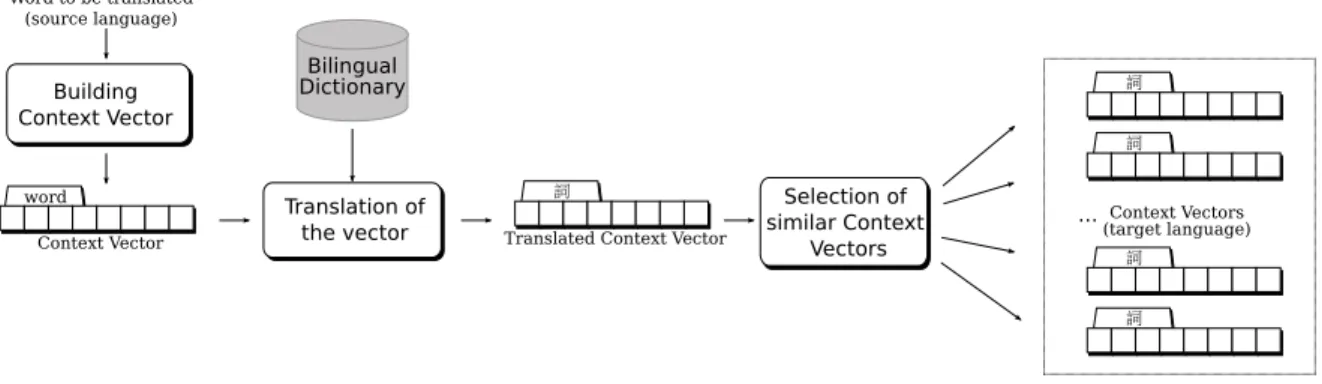
Our alignment program makes use of the direct ap-proach (Fung, 1998; Rapp, 1999). Figure 1 synthe-sises the different steps of this process.
Our implementation consists of the following four steps:
1. Building Context-Vector For each lexical unit
i, we collect all lexical units in its context and
count the number of times these lexical units appear in a window of n word around i. We
obtain, for each lexical uniti of the source and
the target languages, a context-vectorviwhich
collects the set of co-occurring unitsj
associ-ated with the number of times thatj and i occur
together.
2. Normalisation of Context-Vector In order to identify specific words in the lexical context and to reduce word frequency artifacts, we normalise context-vectors using an association score. Context-vectors therefore record the as-sociation pattern of a word and its neighbours.
3. Translation of the vector Using a bilingual dictionary, we translate the lexical units of the source context-vector. If the bilingual dictio-nary provides several translations for a lexical unit, we consider all of them but we weight the different translations by their frequency in the target language.
4. Selection of similar Context-Vector For a lex-ical unit to be translated, we compute the simi-larity between the translated context-vector and all target vectors through vector distance mea-sures (Manning and Schütze, 1999).
The candidate translations of a lexical unit are the target lexical units closest to the translated context-vector according to context-vector distance measure.
Association measures Computed at the second step in the alignment process, they give, for every element of a context-vector, the importance of its re-lation to the head elements of the vector. We use the
j ¬j
i a = occ(i, j) b = occ(i, ¬j) ¬i c = occ(¬i, j) d = occ(¬i, ¬j)
Table 1: Contingency table for termsi and j
Log Likelihood, eq. 1 (Dunning, 1993), computed
from a contingency table (see table 1).
λ(i, j) =
a log(a) + b log(b) + c log(c) + d log(d) +(a + b + c + d) log(a + b + c + d) −(a + b) log(a + b) − (a + c) log(a + c) −(b + d) log(b + d) − (c + d) log(c + d) (1)
2.2 Results of the direct approach
It is not an easy task to compare results obtained by different published studies, due to the differences between the corpora used (especially concerning the way they were built and their size), but also due to the coverage and relevance of bilingual resources used at the second step of the alignment process. As far as we know to date, there is no reference exper-iment and no reference set of resources (corpus or dictionary) available.
The results of the direct approach are evaluated on the number of correct candidates, found in the
x first candidates output by the alignment process
(the T opX). Rapp (1999) obtains 72% correct
re-sults for the T op1 and 89% for the T op10,
work-ing on a 135 million word corpus of English and 163 million of German. He used a bilingual dictio-nary of 16,380 entries (single word terms – SWT). Chiao and Zweigenbaum (2002), using a medical, French/English corpus composed of 600,000 words (for each part) and a specialised dictionary of 18,437 entries, obtained 20% correctness forT op1and 60%
for T op20. Those results are much lower than
Rapp’s, but can be easily explained by the different sizes of the comparable corpora. We focus here on single word terms, but other papers present studies about multi-word term alignment (Daille and Morin, 2005).
Figure 1: Direct alignment
3 Anchor points in comparable corpora
3.1 Context
We explored the Web in order to compile an En-glish/French/Japanese comparable corpus. Docu-ments selected refer to diabetes and nutrition and are all of scientific discourse (“experts addressing experts"; Pearson (1998), p. 36). Documents were manually extracted, following search engine results or using PubMed1for the English part.
We converted those documents into text and cleaned them (manually removing non-informative parts such as References, frequent in scientific doc-uments). We obtained 257,000 token words for the French corpus, 235,000 for the Japanese corpus and 250,000 words for the English corpus.
3.2 Specialised vocabulary as anchor points
To be usable in the automatic process of bilingual lexicon extraction, anchor points need to have these three properties :
1. They must be easily identified.
2. They must be relevant, regarding corpora top-ics.
3. They should not be ambiguous (no polysemy).
1http://www.ncbi.nlm.nih.gov/PubMed/,
query was "Diabetes Mellitus/diet
therapy"[MeSH] OR "Diabetes
Mellitus/etiology"[MeSH] OR "Diabetes Mellitus/prevention and control"[MeSH]) AND ("nutrition" OR "feeding") with limit to "English language"
We propose the hypothesis that we can rely on those words to improve the discriminative strength of context-vector and therefore improve the quality of results obtained with the direct approach on small corpora. The first property allows us to use them in an automatic process. Second and third properties ensure that those anchor points are relevant, in other word, able to characterise efficiently the specialised terms we are trying to translate. They also ensure that no additional ambiguities are introduced.
Starting from the corpora presented in section 3.1, we observed two classes of vocabulary that satisfy these features. They are Japanese transliterations and English/French scientific compounds.
We call transliteration a loan term, from one source languages, that has been adapted to fit the target language speech sound and scripts (by ex-tent, we call transliteration the relation between the source term and the target term). (Prochasson et al., 2008) shows that translitteration are proem-inent in Japanese language, and that they provide many links between Japanese and other languages, especially concerning English and French. Further-more, they show that Japanese transliterations re-flect specialised vocabulary used in document. Fi-nally, Japanese transliteration are easy to identify, since they are written using a set of symbols mostly dedicated to foreign terms, the katakanas. Japanese transliteration are for the most adapted from En-glish, but can be aligned with French term, since French and English share a large common vocabu-lary. For example, the Japanese term インスリン /
i-n-su-ri-ncan be aligned with English insulin and with French insuline.
We also studied scientific compounds. They are word, in French and in English, built with specifics roots (Namer, 2005). (Claveau, 2007), studying au-tomatic translation of medical vocabulary observe that biomedical terms are built on common Greek and Latine roots, and their derivations are consistent. These compounds are characteristic of a specialised vocabulary, especially in medical documents (Lo-vis et al., 1997; Namer and Zweigenbaum, 2004). Therefore, they seem to be relevant anchor points in the corpora we are using. Moreover, they can easily be identified from their morphology in French and English.
3.3 Improvement
The main idea of this paper is to introduce depth in flat context-vectors, relying on selected terms that are more relevant than others, i.e., anchor points. We highlight those elements in context-vectors, in or-der to give them more importance when comparing context-vectors (step 3 in section 2.1). Therefore, the context-vector comparison step relies in priority on anchor points, then on other elements.
One way to do so is to dispatch association scores of non-highlighted terms on highlighted terms. That means we lower non-highlighted element scores and give it back to highlighted elements in order to keep a balanced overall score among context-vectors, see equation 2 to 4. In these equations, AP is the set
of anchor points used (|AP |lthe number of anchor
points found in the context-vectorl and |¬AP |lthe
number of other elements),assocl
jis the association
measure of elementj in the context-vector l.
assoc_weightedl
j := assoclj+β, if j ∈ AP (2)
assoc_weightedl
j := assoclj−of f setl, if j /∈ AP
(3)
of f setl:=
|AP |l
|¬AP |l
× β (4)
The β parameter is used to calibrate the
impor-tance given to the highlighted elements. Thus, over-all weight (sum of over-all association scores for over-all items
of a given vector) is equal before and after balanc-ing. This modification of association measures im-plies that, if a pair of anchor points (source term and its translation) is to be found between two compared vectors, their similarity score will increase. On the other hand, if an anchor point is to be found in only one of two compared vectors, their similarity score will decrease.
Anchor points must be translations pairs. In-deed, the last step of the direct approach is to com-pare translated source context-vectors with target context-vectors. If an anchor points is not transfered from source language to target language at the trans-lation step, its discriminative power will be lost at the similarity computation step.
3.4 Anchor points detection 3.4.1 Transliteration detection
We adopted a tool to perform automatic transliter-ation between English and Japanese language (Tsuji et al., 2005). This tool, based on the Markov chains, gives good results for English/Japanese; it generates a set of potential transliterations for a given katakana or English input. Output is then compared with tar-get vocabulary in the comparable corpora.
Although direct French–Japanese transliterations are quite rare, a lot of English–Japanese transliter-ations can also be aligned with French vocabulary, due to cognate relations between French and En-glish. We first used a specialised French–Japanese transliteration detection tool but obtained poor re-sults (especially concerning false-positive align-ments). We eventually decided to fall back on the tool used for English/Japanese. Before processing, we withdrew every diacritic specific to the French language.
Using this tool, we obtained 589 pairs of transliteration for English/Japanese and 526 for French/Japanese. In order to have valuable anchor points (that is, able to be transfered from one lan-guage to another at the translation step of the direct approach), we added detected transliteration to bilin-gual resources (see Section 4.1).
3.4.2 Identifying scientific compounds
We extracted scientific compounds using a list of 606 medical suffixes and prefixes used in
En-glish2. The process is quite simple: we compile reg-ular expressions for every suffix and prefix and have them matched on the bilingual dictionaries used (see section 4.1). Words extracted are kept with their Japanese translation. Such pairs are then used as an-chor points in the alignment process. This list, ded-icated to the English language can easily be adapted to French (in accordance with the Claveau (2008) observation). We draw our inspiration from this work to write some simple conversion rules. For ex-ample, the -ysuffix in English (as in psychology) corresponds to the-iesuffix in French (as in
psy-chologie). After adapting rules to the French
lan-guage, we performed the same extraction process than with English on the French dictionary, with the converted list of prefixes/suffixes.
Some suffixes and prefixes are very productive (especially the a- prefix) and corresponding ex-tracted terms are not necessarily built from this root. All suffixes and prefixes generating more than 1,000 pairs on bilingual resources were therefore with-drawn. They are however quite rare, only 12 have been discarded for English, and 17 for French.
We obtained 17,210 scientific compounds in En-glish (60,341 pairs of translation, linguistic re-sources often give more than one translation for a given word) and 8,254 in French (24,240 pairs of translations). The difference comes from the na-ture of linguistic resources for English and French. When projected onto our corpora vocabulary, we ob-tained 604 scientific compounds for English (1,197 pairs of translation) and 819 for French (822 pairs of translation).
Unlike transliterations, scientific compounds can not be matched in Japanese using morphological or phonetical clues. That is why they are extracted di-rectly from bilingual resources. That also ensure that extracted scientific compound pairs are translation.
4 Experiments and results
In order to evaluate the influence of anchor points, three kinds of experiments were carried out on En-glish/Japanese and French/Japanese alignments.
(a) direct approach (control experiment)
2
http://www.medo.jp/a.htm
(b) taking into account automatically detected transliterations
(c) taking into account automatically extracted sci-entific compounds
All experiments were run on the same set of context-vectors (before normalisation process, which is experiment-dependent), and comparisons were made between results obtained with equivalent parameters (same window size for building context-vectors, same similarity measure and equivalent as-sociation measure). We used the Cosine measure (equation 5) for similarity and the Log-Likelihood (equation 1) for the association measure (Dunning, 1993). The term frequency limit is set to three for all experiments (it means that a word must appears three times or more in the neighbourhood of a term to be a part of its context-vector). The term lists used for evaluation, introduced in Section 4.1, are the same for all experiments.
4.1 Material
The corpora that we used have already been intro-duced in Section 3.1. The French-Japanese bilingual dictionary required for the translation phase is com-posed of four dictionaries freely available from the Web3, and of a French-Japanese Scientific Dictio-nary (1989). It contains 173,156 entries, of which 114,461 are single word terms (SWT), with an aver-age of 2.1 translations per entry. We used the JMDict for English/Japanese4which is freely available un-der a Creative Commons (By-SA) licence. We com-pleted it with lists of technical terms from different domains: a list of technical terms compiled by the Japanese Ministry of Education and the National In-stitute of Informatics (Tokyo)5and the Dictionary of
Technical Terms (Kotani and Kori, 1990). Overall, it
contains 589,946 entries (unique words) with an av-erage of 2.3 translations per entry and only 49,208 SWT. 3 http://kanji.free.fr; http:// quebec-japon.com/lexique/index.php?a= index&d=25; http://dico.fj.free.fr/index. php;http://quebec-japon.com/lexique/index. php?a=index&d=3 4http://www.csse.monash.edu.au/~jwb/j_ jmdict.html 5http://sciterm.nii.ac.jp/cgi-bin/ reference.cgi
Cosine(Vs, Vt) = P iVs[i] × Vt[i] q P iVs[i] 2qP jVt[j] 2 (5) experiment a b c En/Jp (T op1) 17.1% 20.2% [18.2%] 20.2% [18.2%] En/Jp (T op10) 36.3% 39.3% [ 8.2%] 40.4% [11.2%] Fr/Jp (T op1) 20.4% 20.4% [ 0.0%] 22.4% [10.0%] Fr/Jp (T op10) 36.7% 37.8% [ 2.8%] 38.8% [ 5.6%]
Table 2: Alignment results for French/Japanese and English/Japanese (β = 8)
To evaluate the quality of our method, we built lists of known translations. We selected the most frequent French words (Nocc > 50) for which a
Japanese translation was available. Among those translations, we selected the most frequent Japanese words (Nocc > 50) in order to obtain a 98
ele-ments test list. We proceeded in the same way with English/Japanese corpora and obtained an 99 ele-ments test list. This protocol for building an evalu-ation term list is quite similar to the one presented in (Chiao and Zweigenbaum, 2002). They used
Nocc > 100 for the source language, and Nocc > 60
for the target language, in order to compile a test set of 95 words in an English/French comparable cor-pus.
4.2 Results
Results shown here are the best that we obtained with the control experiments, compared with other experiments with the same set of parameters.T opX
indicates the number of correct translations found in theX first candidates output by the alignment
pro-cess. Table 2 shows T op1 and T op10 results for
(a), (b) and (c) experiments (improvement between brackets).
Results for control experiment (exp. a) are quite similar to those obtained by Chiao and Zweigen-baum (2002), see section 2.2. In the case of English, the improvement when using anchor points is im-portant: it reaches 18.2% when using transliteration (exp. b – T op1) and scientific compounds (exp. c
–T op1). The improvement is not that important in
the case of French/Japanese alignment. It is null for
T op1 when using transliterations and reaches 10%
when using scientific compounds. This can be easily explained by the lowest quality of automatically
ex-tracted anchor points, especially concerning translit-erations between Japanese and French.
We think that it is not relevant to combine in-formation brought by transliterations with informa-tion brought by scientific compounds. Indeed, those classes are barely related and are taken into account for specific, independent reasons. However, we still ran experiment using both classes as anchor points and observed that the improvement is slightly the same than when using scientific compounds alone.
4.3 Influence of anchor points
We showed that using anchor points can lead to im-provement of the direct approach method, forT op
1 and 10. The figure 2 displays the evolution of re-sults, between the control experiment and the experi-ment using scientific compounds in French/Japanese alignment. This figure shows all correct translations found in both experiments functions of their rank (fromT op1toT op100 – ordinate) and their
similar-ity score (on the abscissa).
In figure 2, hollow triangle indicate translations that were found in control experiment and can not be found with anchor points. On the contrary, black tri-angle indicate translations found with anchor points that were not found in control experiment. Each thin arrow displays the evolution of a translation found in both experiments. The beginning is the position of the translation in control experiment, the end indi-cate its position when using anchor points. Finally, thick arrows display the sum of all evolution, for each band indicated by horizontal dot lines (T op 1
to 10, 10 to 20, 20 to 50 and 50 to 100).
Results shown here are interesting : they show that there are pretty much as many missing transla-tions than new translatransla-tions introduced between both
0.0 0.2 0.4 0.6 0.8 1.0 0 20 40 60 80 100 similarity rank
Figure 2: Rank and similarity score of correct translation for French/Japanese alignment, with and without anchor points (scientific compounds –β = 8.
experiments. Moreover, arrows shows that there is an average improvement of correct translation rank-ing. This is especially the case for initially badly ranked translations (T op50 toT op100). Their rank
is highly improved, as indicate the sum of evolution for this band. This observation is available for other band, although it is less impressive. However, ini-tially well-ranked translation are less likely to be im-proved, but they are not penalised (even though their similarity score decrease).
These observations complete results shown in section 4.2: they show that correct translation can-didates are re-ordered to better ranks when using anchor points, even though T op1 and T op10
im-provement are not that impressive. We ran a t-test (Harris, 1998) on those results. We settle as a null hypothesis that using anchor points does not lead to improvement in ranking correct translation can-didates. Results of the t-test (t = 1, 8694; p = 0, 0333) allows us to reject the null hypothesis with
a 95 % confidence (Wilcoxon test return a p-value of
0.032). Those statistical tests also allow us to reject
the null hypothesis in the cases of English/Japanese alignment, using transliterations and scientific com-pound, but not in the case of French/Japanese align-ment using transliterations. This is once again
prob-ably due to the bad quality of automatically detected transliterations.
5 Conclusion
We proceed the issue of bilingual lexicon extraction from comparable corpora, working on small, spe-cialised corpora. We have put forward a new hy-pothesis. Due to particular features, it was expected that giving particular importance to trusted vocabu-lary would lead to improvement in the direct align-ment process. This hypothesis has been confirmed by experiments: we improved the quality of the lex-icon extraction results and showed the influence of anchor points highlighting on those results.
Some work still need to be done. On the one hand, we would like to improve the anchor points detection and characterisation: indeed, the transliter-ation detection process can be highly improved. On the other hand, the exploitation of anchor points can also be reconsidered: the method we propose here is consistent with the hypothesis, but other methods for taking anchor points into account in the process should be explored, especially concerning the use of different and consistent association measures. Fi-nally, it would be worth to examine the influence of anchor points in context-vectors from a qualitative
point of view, in order to identify new kinds of reli-able anchor points.
References
Lynne Bowker and Jennifer Pearson. 2002. Working
with Specialized Language: A Practical Guide to Us-ing Corpora. Routledge, London/New York.
Yun-Chuang Chiao and Pierre Zweigenbaum. 2002. Looking for candidate translational equivalents in spe-cialized, comparable corpora. In Proceedings of the
19th International Conference on Computational Lin-guistics (COLING’02), pages 1208–1212.
Vincent Claveau. 2007. Inférence de règles de réécriture pour la traduction de termes biomédicaux. In Actes
de la conférence Traitement Automatique des Langues Naturelles (TALN’07), pages 111–120.
Vincent Claveau. 2008. Automatic Translation of Biomedical Terms by Supervised Machine Learning. In Proceedings of the 6th edition of the Language
Re-sources and Evaluation (LREC’08), pages 684–691.
Béatrice Daille and Emmanuel Morin. 2005. French-English Terminology Extraction from Comparable Corpora. In Proceedings of the 2nd International
Joint Conference on Natural Language Processing (IJ-CLNP’05), pages 707–718.
Ted Dunning. 1993. Accurate Methods for the Statistics of Surprise and Coincidence. Computational
Linguis-tics, 19(1):61–74.
Pascale Fung. 1998. A statistical view on bilingual lexi-con extraction: From parallel corpora to non-parallel corpora. In David Farwell, Laurie Gerber, and Ed-uard H. Hovy, editors, Proceedings of the 3rd
Confer-ence of the Association for Machine Translation in the Americas (AMTA’98), pages 1–17.
Mary B. Harris. 1998. Basic Statistics for Behavioral
Science Research. Allyn & Bacon, 2nd edition.
Takuya Kotani and Atsuhiko Kori. 1990. Dictionary of
Technical Terms. Kenkyusha.
C. Lovis, R. Baud, P. A. Michel, J. R. Scherrer, and A. M. Rassinoux. 1997. Building medical dictionaries for patient encoding systems: A methodology. Lecture
Notes in Computer Science, 1211:373–380.
Christopher D. Manning and Hinrich Schütze. 1999.
Foundations of Statistical Natural Language Process-ing. MIT Press, Cambridge, MA, United States of
America.
Fiammetta Namer and Pierre Zweigenbaum. 2004. Ac-quiring meaning for french medical terminology: con-tribution of morphosemantics. In Marius Fieschi, En-rico Coiera, and Yu-Chuan Jack Li, editors, Studies
in Health Technology and Informatics, volume 107,
pages 535–539.
Fiammetta Namer. 2005. Morphosémantique pour l’appariement de termes dans le vocabulaire médi-cal: approche multilingue. In Actes de la
con-férence Traitement Automatique des Langues Na-turelles (TALN’05), pages 63–72.
Jennifer Pearson. 1998. Terms in Context. John Ben-jamins publishing company.
Carol Peters and Eugenio Picchi. 1998. Cross-language information retrieval: A system for comparable cor-pus querying. In Gregory Grefenstette, editor,
Cross-language information retrieval, pages 81–90. Kluwer
Academic Publishers.
Emmanuel Prochasson, Kyo Kageura, Emmanuel Morin, and Akiko Aizawa. 2008. Looking for translitera-tions in a trilingual english, french and japanese spe-cialised comparable corpus. In Proceedings of the 1st
Workshop on Building and Using Comparable Cor-pora, Language Resources and Evaluation Conference (LREC’08), pages 83–86.
Reinhard Rapp. 1999. Automatic Identification of Word Translations from Unrelated English and German Cor-pora. In Proceedings of the 37th Annual Meeting of the
Association for Computational Linguistics (ACL’99),
pages 519–526.
Keita Tsuji, Satoshi Sato, and Kyo Kageura. 2005. Eval-uating the effectiveness of transliteration and search engines in bilingual proper name identifications. In
The 11th Annual Meeting of the Association for Natu-ral Language Processing, pages 352–355.