1State Key Laboratory of Fluid Power and Mechatronic Systems, Zhejiang University, Hangzhou 310027, China
2GRASP, Physics Department B5, University of Li`ege - B-4000 Li`ege, Belgium 3Institute of Marine Science and Technology, Shandong University, Qingdao 266237, China
(Received xx; revised xx; accepted xx)
We investigate the conditions that determine the detachment of a water drop from di↵erent vibrating textured plates by using vertical vibrations. The plate surfaces were patterned by a lattice of pillars of di↵erent shapes with di↵erent geometrical arrange-ments. The acceleration threshold for the water droplet to bounce o↵ the surfaces was measured as a function of the excitation frequency. In each case, the acceleration threshold presents a minimum at the natural frequency of the droplet. The minimum acceleration required for the take-o↵ is larger for small droplets than for large droplets. Namely, one finds that the value of the threshold depends on the size of the droplet and on the maximum apparent contact area between the droplet and the substrate. The theoretical model takes into account the energy necessary to break the capillary bridges between the droplet and the pillars of the surface. This model captures the main ingredients explaining the drop size dependence of the acceleration threshold for the take-o↵. Key words:
1. Introduction
Super-hydrophobicity is a property that is more often than not desired by surface engineers regarding the large panel of applications: self-cleaning, anti-icing, corrosion protection (Khojasteh et al. (2016)). Classically, the superhydrophobicity property of the surface is obtained by gathering two elements: the natural water repellency due to the chemical nature of the solid and the texturation of the surface by a microstructure pattern. This controlled rugosity allows to enhance the chemical hydrophobic property of the substrate (de Gennes et al. (2008)). When a droplet interacts with a superhydrophobic substrate, according to the energy involved in the impact process, two main scenarii are observed: either the droplet remains in one piece for low speeds or the droplet splashes for high speeds. In the end, one is interested in the final state. Does the liquid adhere or not to the surface? Indeed, the droplets are found only in two states after the impact: the droplet may stick to the surface (Wenzel state) or remain very mobile (Cassie-Baxter state) (Qu´er´e & Reyssat (2008)). In the latter, the droplet remains at the top of the structure and in the former, the droplet is impaled in the microstructure of the surface. In the Cassie-Baxter state, even if the contact is minimized which confers the high mobility to the droplet, the adhesion to the structure remains an issue in many applications (Smith
† Email address for correspondence: [email protected]
et al. (2013); McBride et al. (2018)). On the superhydrophobic surfaces, the bouncing of the droplet is observed for low impact speeds. The droplet does not split and can rebound on the surface. This process has been largely investigated since the seminal work by Richard et al (Richard & Qu´er´e (2000)). In this regime, the water drop actually touches only the top of the pillars making the rugosity. The liquid-solid contact being minimum, the dissipation significantly decreases, leading to a high restitution coefficient (⇠ 0.9) that is defined as the ratio between the speeds before and after the collision (Richard et al. (2002)). Let us note that without any liquid-solid contact, the restitution coefficient is found as large as⇠ 0.95 (de Ruiter et al. (2014, 2015)); the situation is very similar to the bouncing droplet on a vertically vibrating oil bath (Couder et al. (2005); Gilet et al. (2008)). The restitution coefficient decreases for less hydrophobic surfaces, since the impalement is more and more possible increasing the solid-liquid contact area and thus increasing the dissipation (Mao et al. (1997); Bartolo et al. (2005)). To test the mobility or to confer some mobility to the droplet, one strategy is to vibrate the substrate. This strategy also applies to bubble (Zawala et al. (2011)). Horizontal vibrations can be used as an energy source in order to manipulate water droplets on the solid surfaces, even uphill (Daniel et al. (2005); Brunet et al. (2007)). On the other hand, vertical vibrations can be used to deform the droplet according to its di↵erent eigenmode (Noblin et al. (2004)). On top of that, the vertical vibrations allow controlling the mixing of the liquid inside the water droplet (Kim & Hee-Chang (2015)). On the whole, the vertical vibrations remain an interesting mechanism to detach a droplet from the substrate. In Ref. (Boreyko & Chen (2009); Wei et al. (2014)), droplets in Wenzel state on a substrate were vertically shaken. When the vibration amplitude is sufficient, the transition from Wenzel to Cassie-Baxter state quickly leads to the detachment of droplets. The acceleration threshold for the transition is found to depend on the excitation frequency and is found to be minimum at the natural resonance mode of the droplet. However, the acceleration remains large, about 3 times the Earth gravity. This large acceleration probably screens the transition from Cassie-Baxter to bouncing. This statement is supported by a recent paper by Raufaste et al, concerning the catapulting of water drops out of a superhydrophobic plate when the drops are initially in Cassie-Baxter state (Raufaste et al. (2017)). Indeed, the adhesion of the droplet and the plate is so small (let us remind that the coefficient of restitution is about 0.95) that an acceleration slightly over the Earth gravity should be sufficient for the take-o↵ (Richard & Qu´er´e (2000)). On top of that, Raufaste et al demonstrated that the droplet can also benefit from a resonant mechanism with the waves generated during the acceleration to take o↵. In this paper, we study what should be the vertical acceleration of the plate required to see a droplet detaching from a superhydrophobic substrate when the droplet is initially in the Cassie-Baster state. Indeed, starting with a droplet in the Cassie-Baxter state allows to determine the role of the adhesion between the droplet and the top of the pillars. The acceleration threshold that is responsible for the transition between Cassie-Baxter to bouncing is to be determined in various conditions: the size of the droplet is tuned and di↵erent substrates are tested. Then, we classically model the droplet as a spring to explain the observations.
2. Experimental results
The droplet with a controlled and determined diameter D between 2.02 and 2.62 mm was gently released at the surface of the substrate. The shaker was driven by a sinusoidal signal with a controlled frequency f . The amplitude A of the plate was measured by a Laser Displacement Sensor (LK-G30, Keyence, Japan). The maximum acceleration of the plate is basically given by = 4⇡2f2A. Before shaking, the droplet was first
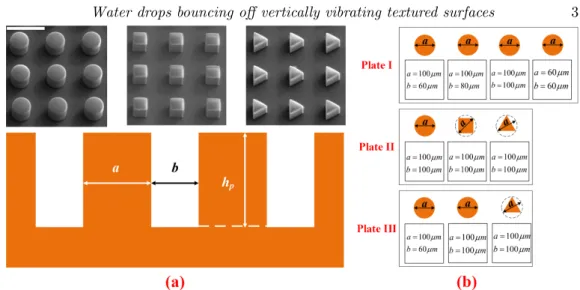
Figure 1. (a) Sketch of the micro-pillar patterns. The parameter a, b and hpare the diameter of circumscribed circle to the pillar section, the distance between two neighboring pillars and the height of a pillar, respectively. The inserted pictures in (a) show the micro-pillars from the top (circular, squared and triangle). The scale bar is 200 µm. (b) Arrangement of the three plates. studied on the substrate in a static mode in order to measure the contact diameter d and the contact angle ✓. We tested three textured plates (Plate I, II and III) in the experiments, as shown in Fig. 1(b). These three plates were produced by Jiangsu In-situ Chip Technology Co., Ltd, China. Note that, Plate I and II were made of PDMS with the contact angle ✓0=105 , while Plate III was a textured silicon plate coated
with hydrophobic membrane. According to the manufacturer, the contact angle of the hydrophobic membrane is ✓0=113 . The structural parameters of the lattice were tuned
by varying the distance b between the pillars and the size a of the pillar. This latter parameter represents the diameter of the circumscribed circle to the pillar shape. The height hpof the pillars was fixed to 100 µm for all the presented cases. Detailed parameters
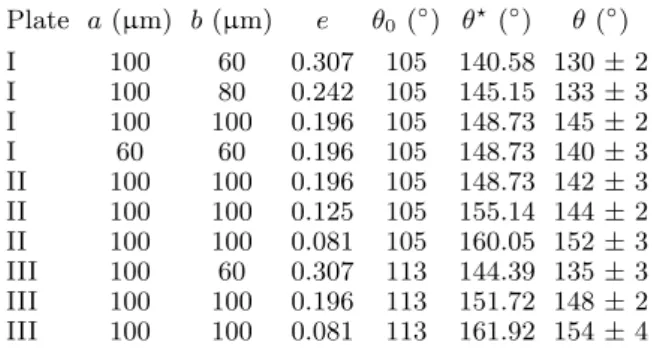
are presented in Table I. Concerning Plate I, four patterns with circular pillars were tested to investigate the influence of the area fraction e, i.e. the ratio between the top area of the pillars sp and that of the corresponding lattice cell sc=(a + b)2. On Plate II,
three patterns with circular, squared and triangle pillars were implemented to show the influence of the pillar shape. The SEM pictures of the micro-pillars are shown in Fig. 1(a). The top area of one pillar wasp3a2/4, a2and ⇡a2/4 for the circular, squared and
triangle pillar, respectively. Finally, on Plate III, 3 patterns with di↵erent area fractions and pillar shapes were tested to see the influence of the contact angle of the material ✓0. Moreover, the theoretical apparent contact angle ✓?was calculated using the formula
cos ✓?= 1 + e(1 + cos ✓
0) (Cassie & Baxter (1944)) and the actual contact angle ✓ was
measured by analyzing the captured static images. In total, we conducted experiments on ten di↵erent patterned substrates.
3. Results
A typical experiment consisted in releasing a droplet on the substrate that was fixed to the shaker. Starting at rest, the frequency was fixed, the amplitude A of the shaker was slowly increased. For low amplitudes, (Type I) the contact line remains pinned on the surface, while the water drop deforms at the frequency of the shaker. The contact angle cyclically changes during the deformation of the droplet. For larger amplitudes, (Type II)
Plate a (µm) b (µm) e ✓0 ( ) ✓?( ) ✓ ( ) I 100 60 0.307 105 140.58 130± 2 I 100 80 0.242 105 145.15 133± 3 I 100 100 0.196 105 148.73 145± 2 I 60 60 0.196 105 148.73 140± 3 II 100 100 0.196 105 148.73 142± 3 II 100 100 0.125 105 155.14 144± 2 II 100 100 0.081 105 160.05 152± 3 III 100 60 0.307 113 144.39 135± 3 III 100 100 0.196 113 151.72 148± 2 III 100 100 0.081 113 161.92 154± 4 Table 1. Detailed parameters of the textured substrates
Figure 2. Di↵erent behaviors of the water drop (D = 2.02 mm) on the vibrating textured surface at 60 Hz. (I) The contact line remains pinned while the water drop deforms with oscillating contact angle; d is constant. (II) The contact line oscillates with a constant amplitude; d oscillates. (III) The water drop bounces o↵ the textured surface; d goes to zero. The scale bar indicates 1mm. dcis the maximal contact diameter before the separation. Note that, as we focus on the deformation of the water drop, position of the textured surface does not represent the actual height.
the contact area increases and decreases at the same frequency as the forced oscillation. The definitions of Type I and Type II follow these of Ref.(Noblin et al. (2004)). Let us note that, the droplet remains in the first mode of deformation. Finally, (Type III) the water drop bounces o↵ the textured surface as A reaches a critical value Ac. The
three regimes are illustrated in Fig. 2 for a droplet of 2.02 mm of diameter and at a frequency f =60 Hz. In the following, we focus on the transition between Type II and Type III. More precisely, for each experimental set of parameters (droplet size, substrate, frequency), one measured the minimum acceleration c that allows the droplet to bounce
o↵ the plate. Indeed, let us note that when the droplet is bouncing, if the amplitude is decreased, the droplet still bounces even below the acceleration threshold cbecause the
restitution coefficient is large exactly like in the bouncing ball problem.
Figure 3. Dynamics of the water drop on the vibrating textured surface. (a) Time evolution of the water drop shape at the forced vibration frequency f =40Hz.Here h? and H? are the dimensionless height normalized by the diameter of the droplet D. The blue dashed line is the fitted function graph in the form of a trigonometric function. The black dashed line is used for guide. (b) Time evolution of the droplet apparent diameter of contact d with the plate and vertical extension of the droplet h normalized by the diameter of the droplet D=2.02mm. The frequency of excitation was 60 Hz. Three cases are presented from bottom to top =10.54, 15.62 and 18.74 m/s2 that correspond to Type I, Type II and Type III, respectively. (c) Schematic drawing of water drop dynamics under the resonant vibration frequency, where dcis the maximal contact diameter before the separation and X is the position of the plate with X=0 indicating the initial position.
measured the time evolution of the water drop height h. The dynamics of the textured surface was obtained by measuring the position H of the plate. The trajectory of the plate H?=H/D and the trajectory of the drop height h?=h/D bouncing on a surface vertically,
excited at 40 Hz are presented in Fig. 3(a). The drop diameter was D = 2.62 mm and the textured surface was made of triangle top face pillars characterized by e = 0.081. The trajectory of the textured surface was fitted by a trigonometric function (the blue dashed lines in the picture). One can see that the droplet impacted the plate once per period; this is the first bouncing mode. Figure 3(b) presents the evolution of the normalized droplet apparent diameter of contact d?= d/D with the plate and the normalized droplet height
h?= h/D. The frequency was then fixed at 60 Hz. Three situations are presented on the
Figure, i.e. for three accelerations of the plate = 4⇡2Af2=10.54 (Type I), 15.62 (Type II) and 18.74 m/s2 (Type III) for the bottom, middle and top curves, respectively. One
can see that, for the Type I, d?remains constant while the droplet deforms in phase with
the plate. For the Type II, The contact line oscillates and consequently d?. One notes that
d?and h?oscillate at opposite phase, this is the first eigenmode of the droplet. Finally, for
its highest shown acceleration, d? went to zero. This is the signature of the detachment
(Type III). To summarize, one proposes a schema that stands for the phenomenology of the bouncing (Fig. 3(c)). When the water droplet height reaches the minimum (or the maximal deformation), the water droplet velocity is equivalent to the textured surface. At the resonance, the water droplet reaches the maximal deformation when the textured surface moves upwards with the highest speed. In this way, the water droplet can pick up the maximal kinetic energy during one vibration period. Subsequently, the water droplet retracts and undergoes a vertical elongation. At last, the water droplet evolves into a sphere ball and rightly separates with the textured surface at the lowest position. At this point, the textured surface has the highest upward acceleration which drives the water droplet to vertically deform till the maximal deformation.
The dependence of the acceleration threshold for the take-o↵ was studied on the triangle pillar with e = 0.081, i.e. for the lowest tested value of the parameter e. Under this condition, the contact area between the droplet and the substrate is minimized. The values of the thresholds are reported in Fig. 4(a) for di↵erent sizes of droplets (between D=2.02 and 2.62 mm) as a function of the excitation frequency. The horizontal dashed
line represents the Earth gravity acceleration. The critical acceleration for the take-o↵ of the droplet as a function of the frequency follows parabolic shape curves that are characteristic of resonant behavior (Hubert et al. (2015)). The minimum occurs at a frequency fc and an acceleration value c = 4⇡fc2Ac where Ac is the critical amplitude
of the oscillation for which the droplet takes o↵. In the inset of Fig. 4(a), one reports the resonant frequency fc as a function of the droplet diameter for di↵erent surfaces
made of PDMS in a log-log plot. The solid line corresponds to a slope of 3/2, that means that one finds that fc ⇠ D 3/2. This is in good agreement with the scaling of the
eigenfrequency of the droplet mode (Rayleigh (1879)). Moreover, the resonant frequency was found to increase with the area fraction. In Fig. 4(b), the normalized threshold amplitude A?c=Ac/D is reported as a function of the frequency f normalized by the
experimental critical frequency fc. One finds that all the data collapse on a same curve,
meaning that Ac / D. The dashed curve (Fig. 4(b)) corresponds to a fit using Eq. (8) in
Ref. (Hubert et al. (2015)). All in all, the critical acceleration cdepends on the diameter
of the droplet as D 2, i.e. the larger the droplet, the smaller the acceleration required for
the take-o↵, as shown in Fig. 4(a). Surprisingly, it is easier to make a big droplet to take o↵ than a small one. A priori, two mechanisms should lead to the opposite conclusion: a viscous mechanism (the larger droplets dissipate more than the smaller) (de Ruiter et al. (2015)) and the adhesion force (a large droplet touches the plate with a larger area than the smaller one) (Olin et al. (2013); Butt et al. (2017)). On the other hand, the large droplet deforms much more easily than the small ones and allows the take-o↵ even for accelerations below g. Figure 4(c) shows the critical acceleration as a function of the frequency for five di↵erent surfaces that di↵er from the pattern structure of the pillars and from the distance between the pillars for the circular patterns. The size D of the drop was 2.62 mm. The di↵erent substrates are here summarised by the only parameter e. The shapes of the pillars (circular, squared or triangle) are represented by symbols that have the same shape. The critical acceleration for the take-o↵ of the droplet again follows parabolic shape curves characteristic of the resonance. One measured that both cand fc
increase with the solid fraction e. In Ref. (Sharp et al. (2011); Sharp (2012)), the resonant frequency of a sessile droplet whose mass is fixed is found to increase when the contact angle decreases in the hydrophobic case (i.e. ✓ > 90 ). In our case, we measured that when the solid fraction e is increased from 0.081 to 0.307 the contact angle decreases from 150 to 130 . According to Ref.(Sharp et al. (2011)), using Eq.(4), one finds that the resonant frequency of a sessile droplet is proportional top(cos3✓ 3 cos ✓ + 2)/✓3. Consequently,
the ratio of the resonant frequencies corresponding to contact angles of 150 to 130 is found to be 1.19 which is not far from the ratio found from our measurements 46/40=1.15 . In total, we can understand the resonant frequency shift towards higher values when e increases, see the inset of Fig. 4(a).
As for c, its value decreases with the solid fraction e. That strongly suggests that
the adhesion is proportional to the contact area. On the one hand, one finds that c is
lower than the gravity acceleration for e = 0.081. Such low accelerations for the take-o↵ are only possible because of the deformation of the droplet (Hubert et al. (2015)). On the other hand, one can infer that the threshold is related to the energy required to break all the capillary bridges between the droplet and the textured surface. In Fig. 5, snapshots present the separation between the water and the textured surface. For the sake of observation, we captured the dynamics of a water drop bouncing o↵ the static textured surface. The corresponding drawings indicate the time evolution of the capillary bridge which are believed to dominate the energy dissipation (Olin et al. (2013); Butt et al. (2017)). As the water drop retracts, the contact angle first decreases. A capillary bridge still links the droplet to the pillar before the contact line slips o↵ the top face of the
Figure 4. (a) The critical acceleration required for the water drop bouncing o↵ the textured surface as a function of the frequency for 5 di↵erent sizes of droplet. The arrows indicate the minima and the corresponding frequencies are the resonant frequencies. These data were obtained using the texture surface with triangle top face (a=100 µm, e=0.081). The black dashed line indicates the value of the gravity acceleration g. Inset: Dependance of the resonant frequency against the drop diameter. The solid line indicates fc ⇠ D 3/2. (b) Normalized threshold amplitude vary with the frequency f divided by the experimental resonant frequency fc. The dashed curve corresponds to a fit coming from Hubert et al. (2015). (c) Critical acceleration for take-o↵ as a function of the frequency for 5 di↵erent surfaces characterized by the parameter e. Circular, square and triangle pillars surfaces were investigated and are represented by symbols of the corresponding shape. The frequency fcand the acceleration 4⇡f2Acat which the minimum occurs are found to increase with the solid fraction e.
Figure 5. Experimental images and schematics of the evolution of a capillary bridge. Pinch-o↵ of the capillary bridge leaves a tiny water drop on the top face of the micro-pillar. Meanwhile, a capillary wave is generated and penetrates upwards, undergoing viscous dissipation.
micro-pillar. Then the bridge pinches o↵, leaving a tiny water drop on the micro-pillar and giving rise to a capillary wave which undergoes viscous dissipation. In total, the energy stored in the capillary bridge is dissipated, instead of being converted into kinetic energy (Olin et al. (2013); Butt et al. (2017)). Considering the high restitution coefficient of the bouncing water drop, viscous dissipation caused by the drop deformation should be negligible (Richard & Qu´er´e (2000); de Ruiter et al. (2014, 2015)). Moreover, the restitution coefficient of bouncing water drop is significantly lower than 1 because of the drop oscillation after lift-o↵ (Richard & Qu´er´e (2000)). Under the presented conditions, especially at resonance, the water drop detaches from the substrates almost in the shape of a sphere, see Fig. 2 (Type III) and the drawing in Fig. 3(c).
The capillary bridge is modelled by a linear spring. The adhesion energy Eadhdepends
on the maximum extension mof the bridge before breaking and the maximum number
N of pillars that the droplet covers during one oscillation. The elastic energy Ee stored
in one bridge is given by Ee ⇠ 2, where and are the surface tension of water
and the extension of the capillary bridge, respectively. The maximal extension before the pinch-o↵ is proportional to the diameter of the micro-pillar, i.e. m⇠ a cos2(✓0/2) (Butt
et al. (2017)). The total number N of capillary bridges to overcome is given by ⇡d2 ce/4sp
, where dcis the maximal diameter of the apparent contact area between the droplet and
the substrate (as shown in Fig. 2 (Type III)). Thus the adhesion energy Eadh = N Ee
for the detachment scales with d2
ce cos4(✓0/2). To determine dc, one considers that the
maximum of deformation occurs when the textured surface accelerates upwards, leading to the vertical deformation of the water droplet. A similar phenomenon has been reported in the previous literature (Raufaste et al. (2017); Clanet et al. (2004)). Considering that the droplet has a cylinder shape with a height h, one finds that hd2
c ⇠ D3. When
submitted to gravity solely, the droplet height h is given by 2`csin ✓/2 where `c=p /⇢g
(de Gennes et al. (2008)). Here, one takes into account the maximum acceleration of the droplet during the oscillations, i.e. 4⇡2f2
cAc and one defines the e↵ective capillary length
is `c =p /⇢(g + 4⇡2fc2Ac). In the range of the considered parameters, one can neglect
(see later) the role of g keeping solely the dependence of the adhesion with the acceleration of the plate and with the diameter of the droplet, i.e. h = 2p /⇢(4⇡2f2
cAc) sin ✓/2.
Although deviations can be observed between ✓? and ✓, we still prefer to express the
contact angle as cos ✓ = 1 + e(1 + cos ✓0) (Cassie & Baxter (1944)). This latter relation
can be injected into the expression of h after some trigonometric manipulations. One obtains h = 2 r 4⇡2f2 c⇢Ac r 1 e 2(1 + cos ✓0)
both the kinetic energy provided by the plate Ek ⇠ ⇢D fcAc and by the energy stored
in the surface of the droplet Es. Analogous to the impacting drop on a solid surface,
the stored surface energy should be Es ⇠ ⇢D3fc2A2c . Thus the total energy of the
water drop is Ew= Ek+ Es⇠ ⇢D3fc2A2c. Balancing Ew= Eadh,we obtain the critical
condition for the water drop bouncing o↵ the textured surface fcA3/2c ⇠ C✓( /⇢)1/2with
the constant C✓= e[1 e(1 + cos✓0)/2] 1/2cos4(✓0/2). Consequently, since we have that
the critical frequency scales with the eigenfrequency of the fundamental droplet mode p
/⇢D3, one finds
Ac⇠ C✓2/3D (3.1)
other parameters being non-dimentional pre-factors. The later expression is independent of the surface tension. Let us note that, if we keep the dependence of g in the e↵ective capillary length, one finds that the relationship between Ac and D starts to slightly
deviate from the linear behaviour for large diameters . As the range of investigated droplet diameters is reduced, it is not possible to evidence this slight non linear behaviour. In addition, the eigenfrequency of the droplet increases when the volume of the droplet increases. As a consequence, the scaling presented in Eq. (3.1) works very well for small droplets as the critical acceleration increases making the influence of the gravity less and less important. In Fig. 6(a), the values of Ac are plotted as a function of the diameter of
the droplet D and that for the di↵erent tested configuration. The data sets concerning the same value of e aligns and can be fitted by the proposed scaling Ac = D. The
proportional factor is found to be about 5 % for the substrate made of PDMS with e=0.081. That means that, at resonance, the droplet detaches when the amplitude of the shaker surpasses 5% of the droplet diameter. The value of are reported as a function of C✓2/3 in Fig. 6(b). The data points again align confirming the prediction Eq.(3.1). The linear dependence of Acwith the diameter of the droplet D is only logical since one needs
to inject more energy (/ A2f2) to make the droplet to detach when the droplet is large.
On the other hand, the critical frequency is related to the eigenmode frequency of the droplet and scales like D 3/2. The acceleration of the plate depends on f2and then the
critical acceleration on D 3. In consequence, a larger acceleration of the plate is required
to excite the eigenmode of the droplet and to reach the critical amplitude. Small droplets are more difficult to take o↵ regarding the maximum acceleration.
4. Conclusion
The dynamics of a water drop detaching from the vibrating textured surfaces has been studied. Experiments were conducted on textured surfaces made of pillar patterns of di↵erent shapes and of di↵erent geometrical arrangements. The results allow to determine the acceleration threshold required to detach a droplet that was initialized in the Cassie-Baxter state. The acceleration threshold of the plate to allow the take-o↵ depends on the frequency, the pattern configuration of the substrate and the droplet diameter. The minimal acceleration for the take-o↵ was found to be larger for small droplets than for large droplets. Moreover, this minimal acceleration occurs at a critical frequency that scales with the eigenmode of the vibration of the droplet. On the other hand, the
Figure 6. (a) Threshold for detaching a water drop from the textured surface. Experimental results are fitted with the corresponding dashed lines Ac= D. (b) Relationship between and C✓2/3 . To distinguish the three coincident cases with e=0.196, the corresponding symbols are presented in di↵erent sizes.
threshold for the amplitude of vibration was found to be proportional to the diameter of the droplet. The developed model is based on the energy required to break the capillary bridges between the micro-pillars and the droplet. Giving the solid fraction e and the contact angle ✓0 on the smooth surface, this simple model allows to explain why small
droplets required a larger acceleration to take-o↵ than larger one.
5. Acknowlegements
We acknowledge support from the National Natural Science Foundation (Grant No. 51875507). S. Dorbolo is a Senior Research Associate F.R.S.-FNRS. Special thanks to Prof. Jinyou Shao and Dr. Chunhui Wang of Xi’an Jiaotong University, for the design and manufacture of the textured surfaces. The authors also thank I. Ashraf and C. Marique for the careful reading of the text.
REFERENCES
Bartolo, D., Josserand, C. & Bonn, D. 2005 Retraction dynamics of aqueous drops upon impact on non-wetting surfaces. Journal of Fluid Mechanics 545 (-1), 329.
Boreyko, J. B. & Chen, C. H. 2009 Restoring superhydrophobicity of lotus leaves with vibration-induced dewetting. Physical Review Letter 103 (17), 174502.
Brunet, P., Eggers, J. & Deegan, R. D. 2007 Vibration-induced climbing of drops. Physical Review Letter 99 (14), 144501.
Butt, H. J., Gao, N., Papadopoulos, P., Steffen, W., Kappl, M. & Berger, R. 2017 Energy dissipation of moving drops on superhydrophobic and superoleophobic surfaces. Langmuir 33 (1), 107–116.
Cassie, A. B. D. & Baxter, S. 1944 Wettability of porous surfaces. Transactions of the Faraday Society 40 (0), 546–551.
Clanet, C., B´EGuin, C., Richard, D. & Qu´ER´E, D. 2004 Maximal deformation of an impacting drop. Journal of Fluid Mechanics 517, 199–208.
Couder, Y., Fort, E., Gautier, C. H. & Boudaoud, A. 2005 From bouncing to floating: noncoalescence of drops on a fluid bath. Physical Review Letter 94 (17), 177801. Daniel, S., Chaudhury, M. K. & De Gennes, P. G. 2005 Vibration-actuated drop motion
on surfaces for batch microfluidic processes. Langmuir 21 (9), 4240–4248.
de Gennes, P. G., Brochard-Wyart, F. & Qu´er´e, D. 2008 Capillary and wetting phenomena. Springer, New York .
hydrophobic surface. The Journal of Physical Chemistry B 119 (22), 6740–6746. Mao, T., Kuhn, D. CS & Tran, H. 1997 Spread and rebound of liquid droplets upon impact
on flat surfaces. AIChE Journal 43 (9), 2169–2179.
McBride, S. A., Dash, S. & Varanasi, K. K. 2018 Evaporative crystallization in drops on superhydrophobic and liquid-impregnated surfaces. Langmuir 34 (41), 12350–12358. Noblin, X., Buguin, A. & Brochard-Wyart, F. 2004 Vibrated sessile drops: transition
between pinned and mobile contact line oscillations. The European Physical Journal E 14 (4), 395–404.
Olin, P., Lindstrom, S. B., Pettersson, T. & Wagberg, L. 2013 Water drop friction on superhydrophobic surfaces. Langmuir 29 (29), 9079–89.
Qu´er´e, D. & Reyssat, M. 2008 Non-adhesive lotus and other hydrophobic materials. Philosophical Transactions of the Royal Society A 366 (1870), 1539–1556.
Raufaste, C., Chagas, G. R., Darmanin, T., Claudet, C., Guittard, F. & Celestini, F. 2017 Superpropulsion of droplets and soft elastic solids. Physical Review Letter 119 (10), 108001.
Rayleigh, Lord 1879 Vi. on the capillary phenomena of jets. Proceedings of the Royal Society of London 29 (196-199), 71–97.
Richard, D., Clanet, C. & Qu´er´e, D. 2002 Surface phenomena: Contact time of a bouncing drop. Nature 417 (6891), 811.
Richard, D. & Qu´er´e, D. 2000 Bouncing water drops. EPL (Europhysics Letters) 50 (6), 769. de Ruiter, J., Lagraauw, R., van den Ende, D. & Mugele, F. 2014 Wettability-independent bouncing on flat surfaces mediated by thin air films. Nature Physics 11 (1), 48–53.
de Ruiter, J., Lagraauw, R., Mugele, F. & van den Ende, D. 2015 Bouncing on thin air: how squeeze forces in the air film during non-wetting droplet bouncing lead to momentum transfer and dissipation. Journal of Fluid Mechanics 776, 531–567.
Sharp, J. S. 2012 Resonant properties of sessile droplets; contact angle dependence of the resonant frequency and width in glycerol/water mixtures. Soft Matter 8 (2), 399–407. Sharp, J. S., Farmer, D. J. & Kelly, J. 2011 Contact angle dependence of the resonant
frequency of sessile water droplets. Langmuir 27 (15), 9367–71.
Smith, J. D., Dhiman, R., Anand, S., Reza-Garduno, E., Cohen, R. E., McKinley, G. H. & Varanasi, K. K. 2013 Droplet mobility on lubricant-impregnated surfaces. Soft Matter 9 (6), 1772–1780.
Wei, L., Zhihai, J., H., Jichang, C., Taimin & Gang, W. 2014 Vibration-induced wenzel-cassie wetting transition on microstructured hydrophobic surfaces. Applied Physics Letters 104 (18), 181601.
Zawala, J., Dorbolo, S., Terwagne, D., Vandewalle, N. & Malysa, K. 2011 Bouncing bubble on a liquid/gas interface resting or vibrating. Soft Matter 7 (14), 6719–6726.