ÉCOLE DE TECHNOLOGIE SUPÉRIEURE UNIVERSITÉ DU QUÉBEC
THESIS PRESENTED TO
L’ÉCOLE DE TECHNOLOGIE SUPÉRIEURE
IN PARTIAL FUFILLMENT OF THE REQUIREMENTS FOR A MASTER’S DEGREE IN ELECTRICAL ENGINEERING
M.Eng.
BY
Hoang Cuong TRUONG
INDENTIFYING PROBLEMATIC DIALOG IN A HUMAN-COMPUTER DIALOG SYSTEM
MONTREAL, DECEMBER 10 2010 © Copyright 2010 reserved by Hoang Cuong Truong
THIS THESIS HAS BEEN EVALUATED BY THE FOLLOWING BOARD OF EXAMINERS
Mr. Pierre Dumouchel, Thesis supervisor
Professeur titulaire, département de génie logiciel et des TI à l’École de technologie supérieure
Mrs. Narjes Boufaden, Thesis co-supervisor
Professeure associée à l’ÉTS et chercheure au Centre de Recherche Informatique de Montréal
Mrs. Sylvie Ratté, President of the Board of Examiners
Professeure, département de génie logiciel et des TI à l’École de technologie supérieure
Mr. Stéphane Coulombe, Manager Structural Evaluation
Professeur titulaire, département de génie logiciel et des TI à l’École de technologie supérieure
THIS THESIS HAS BEEN PRESENTED AND DEFENDED BEFORE A BOARD OF EXAMINERS AND PUBLIC
December 3 2010
REMERCIEMENTS
Le travail de ma maîtrise, dans le cadre du programme de maîtrise en génie concentration avec mémoire de l'École de technologie supérieure (ÉTS), a été effectué au sein du Centre de recherche informatique de Montréal (CRIM).
J'aimerais, en premier lieu, exprimer mes sincères remerciements à mon directeur de recherche Monsieur Pierre Dumouchel, professeur à l'ÉTS et vice-président scientifique du CRIM, pour son encadrement, sa disponibilité et son soutien pendant tout le long de ce projet. Je n'aurais vraiment pas pu terminer mes études et mes travaux de recherche sans son aide.
Je voudrais également remercier Madame Narjes Boufaden, ma co-directrice, professeure associée à l’ÉTS et chercheure au CRIM, pour ses conseils et ses recommandations productives.
J'aimerais aussi remercier tous les membres du Jury pour leur évaluation du projet.
Finalement, j'aimerais remercier ma famille, mes amis au Vietnam et à Montréal qui m'ont grandement encouragé durant ces deux dernières années.
IDENTIFICATION DES DIALOGUES PROLÉMATIQUES DANS UN SYSTÈME DE PERSONNE-MACHINE
Hoang Cuong TRUONG RÉSUMÉ
Dans ce mémoire, nous présentons le développement d'un système automatique qui permet d'identifier les dialogues problématiques dans le contexte d'un système de dialogue personne-machine. Le système que nous développons est un type d'application dans le domaine de Reconnaissance de formes et inspection (Pattern Classification). Dans ce travail, nous proposons une approche probabiliste qui permet de prédire la satisfaction de l’usager à chaque tour de parole dans un dialogue parlé. Pour ce faire, toutes les caractéristiques utilisées dans notre système sont automatiquement extraites de l'énoncé. Un modèle de Markov caché (HMM) est utilisé pour construire notre système. Afin d'évaluer la performance du système, nous faisons l'expérimentation sur deux corpus publiquement distribués par le Linguistic Data Consortium (DARPA Communicator 2000 et DARPA Communicator 2001). La validation croisée est utilisée comme méthode d’évaluation. Nos résultats montrent que le système pourrait être appliqué à des problématiques réelles.
Mots-clés: dialogue problématique, identificateur de dialogues problématiques, système de dialogue personne-machine, forage de données, apprentissage machine, classification de dialogue.
IDENTIFYING PROBLEMATIC DIALOGS IN A HUMAN-COMPUTER DIALOG SYSTEM
Hoang Cuong TRUONG ABSTRACT
In this thesis, we present the development of an automatic system that identifies problematic dialogues in the context of a Human-Computer Dialog System (HCDS). The system we developed is a type of application in Pattern Classification domain. In this work, we propose a probabilistic approach that predicts user satisfaction for each turn of dialogue. To do so, all the features used in our system are automatically extracted from the utterance. A robust and fast machine learning scheme, Hidden Markov Model (HMM) is used to build our desired system. In order to evaluate the system performance, we experimented on two publicly distributed corpora: DARPA Communicator 2000 and 2001. We evaluated the system using a 10-fold stratified cross-validation. Our results show that the system could be used in real life applications.
Keywords: problematic dialog, problematic dialog identification, human-computer dialog system, data mining, machine learning, dialog classification.
TABLE OF CONTENTS
Page
CHAPTER 1 INTRODUCTION ... 1
1.1 Problem ... 1
1.2 Objective ... 2
CHAPTER 2 LITERATURE REVIEW ... 4
2.1 Theoretical framework ... 4
2.2 Related works on dialog classification ... 5
2.2.1 Related works experimented on DARPA 2000 & 2001 Corpora ... 9
2.3 Pattern Classification ... 12
2.3.1 Pattern Classification Perception ... 12
2.4 Hidden Markov Model ... 15
2.4.1 Markov chain ... 15
2.4.2 Hidden Markov Model ... 18
2.4.3 Three basic problems of HMM ... 20
2.5 HTK Overview ... 21
2.5.1 HTK Architecture ... 21
2.5.2 HTK functionalities ... 23
CHAPTER 3 METHODOLOGY ... 26
3.1 Problematic dialogue definition ... 26
3.2 Dialog classification features ... 27
3.2.1 Selection of features ... 28
3.2.2 The dynamic programming algorithm ... 29
3.2.3 The emotional salience ... 31
3.3 Selection of machine learning method ... 31
3.4 Corpus Collection ... 33
3.4.1 DARPA 2000 Communication corpus (Walker et al., 2002) ... 33
3.4.2 DARPA 2001 Communication corpus (Walker et al., 2002) ... 34
3.5 Labeling corpus ... 35
CHAPTER 4 DESIGN AND IMPLEMENTATION ... 37
4.1 System design ... 37
4.1.1 The parser ... 39
4.1.1.1 DARPA 2000 Communicator ... 41
4.1.1.2 DARPA 2001 Communicator ... 41
4.1.2 Feature extractor ... 43
4.1.2.1 Determination of negative and positive words ... 47
4.1.3 The classifier ... 49
4.2.1 Data preparation tool ... 51 4.2.2 Training tool... 51 4.2.3 Classifying tool ... 52 CHAPTER 5 EXPERIMENTATION ... 53 5.1 Experiment protocol ... 53 5.1.1 Holdout method ... 53
5.1.2 K-fold cross-validation method ... 53
5.1.3 Leave-one-out cross-validation ... 54
5.2 Evaluation measure ... 54
5.3 Data validation ... 56
5.4 Experimentation ... 57
5.5 Results and Interpretation ... 59
5.5.1 Effect of using the different topologies in HMMs ... 59
5.5.2 Effect of using the Gaussian mixture in HMMs ... 64
5.5.3 Selection of feature ... 70
CHAPTER 6 CONCLUSION ... 73
6.1 Conclusion ... 73
6.2 Future work ... 74
ANNEX I FORWARD ALGORITHM ... 75
ANNEX II BACKWARD ALGORITHM ... 80
ANNEX III VITERBI ALGORITHM ... 83
ANNEX IV FORWARD-BACKWARD ALGORITHM ... 88
LIST OF TABLES
Table 2.1 Result from work done by (Langkidle et al., 1999) ... 7
Table 2.2 Accuracy % results of Walker in 2001 ... 8
Table 2.3 Result from work of (Boufaden et al., 2007) ... 8
Table 2.4 State of the art results from (Helen Wright Hastie et al., 2002) ... 10
Table 2.5 State of the art result on (Truong Le Hoang, 2008) ... 11
Table 3.1 Summary of DARPA 2000 and DARPA 2001 ... 35
Table 3.2 Likert-scale and Inversed Likert-scale ... 36
Table 4.1 Example of input and output of the parser ... 38
Table 4.2 Example of input and output of the feature extractor ... 39
Table 4.3 Method of determining positive and negative word ... 48
Table 5.1 Confusion matrix for 2-class classification problem ... 55
Table 5.2 Statistic on DARPA 2000 and 2001 corpora ... 57
Table 5.3 Summarization of three types of HMM used in our system ... 58
Table 5.4 Experiment result on the 1-state HMM ... 60
Table 5.5 Experiment result on the 2-state half ergodic HMM ... 61
Table 5.6 Experiment result on the 3-state half ergodic HMM ... 62
Table 5.7 Standard deviation in accuracy ... 63
Table 5.8 Result of using Gaussian mixture on 1-state HMM ... 67
Table 5.10 Result of using Gaussian mixture ... 69 Table 5.11 Results in comparison with those of state of art ... 70 Table 5.12 Result of evaluating each feature ... 71
Figure 1.1 Human-Computer Dialog System. ... 2
Figure 2.1 PARADISE’s structure of objectives for spoken dialog performance. ... 5
Figure 2.2 Examples of patterns. ... 13
Figure 2.3 Concept of pattern classification. ... 13
Figure 2.4 Main components in pattern classification system. ... 15
Figure 2.5 Markov chain for the Dow Jones Industrial average. ... 17
Figure 2.6 Hidden Markov model for the Dow Jones Industrial average. ... 19
Figure 2.7 HTK Software architecture. ... 22
Figure 2.8 HTK Processing stages. ... 24
Figure 3.1 Concept of new approach using HMM. ... 33
Figure 4.1 Overall architecture of dialog classification system. ... 37
Figure 4.2 Illustration for the parser function. ... 40
Figure 4.3 Illustration for the text file format in DARPA 2000. ... 42
Figure 4.4 Illustration for the text file format in DARPA 2001. ... 42
Figure 4.5 Illustration for the feature extractor function. ... 43
Figure 4.6 Using HMMs for dialog classification. ... 50
Figure 4.7 HMM topology for dialog classification. ... 50
Figure 5.1 Deviation Graph on DARPA 2000 and DARPA 2001. ... 64
LIST OF ABBREVIATIONS AND ACRONYMS
ASR Automatic Speech Recognition CART Classification and Regression Tree
CRIM Centre de recherche informatique de Montréal DARPA Defense Advanced Research Projects Agency DCS Dialog Classification System
DM Dialog Manager
DT Decision Tree
ÉTS École de technologie supérieure GMM Gaussian Mixture Model
HMM Hidden Markov Model HMIHY How May I Help You
HTK Hidden Markov Model ToolKit kNN k-Nearest-Neighbour LOOCV Leave-one-out Cross Validation NLU Natural Language Understanding
PARADISE PARAdigm for DIalog System Evaluation PDI Problematic Dialog Identifier
PR Pattern Recognition
RIPPER Repeated Incremental Pruning to Produce Error Reduction
SLU Spoken Language Understanding SVM Support Vector Machine
INTRODUCTION
1.1 Problem
In commercial world, everyone knows that the customer satisfaction is a key element to ensure the survival and development of a company. So many solutions were proposed to assure the customer satisfaction. One of these proposals is the use of call centers to support the customer’s demands and especially those who need a remote assistance. Unfortunately, there are many companies whose call centers have to process thousands of phone calls per day and are required to operate 24/7. Therefore, dialog systems in which a machine agent instead of a human operator would answer the incoming calls were suggested as a solution for this kind of problem. However, these systems have their own limitations which usually cause frustration and annoyance for the customer. Such limitations are performance errors related to the natural language understanding (NLU) component and the automatic speech recognition (ASR) component. Thus, there is a question raised that is how we treat these limitations to improve the quality of such systems.
In our research, we’re interested in automatically detecting problematic dialogs in real call centers. A dialog is considered problematic if the customer falls into one of two following situations (Langkilde et al., 2000; Hastie et al., 2002):
• He fails in doing the tasks he desires.
• His desired task is successful but he isn’t satisfied with his interaction with the machine agent.
Premature detection of a problematic dialog allows us to have various strategies for the management of the failure dialog:
• Process the call as a priority by redirecting to a human operator in case the problem persists.
• Recall the customers who prematurely ended the telephone dialog in order to reduce their unsatisfaction.
• Apologize and appease the customer by a soft human voice.
Our problem is a part of the project named “Managing emotions in Human-Computer Dialogs” which aims to enhance Human-Computer dialog system capabilities to maximize user satisfaction. This is a project of ÉTS and CRIM in collaboration with Bell Canada Corp. The project includes two main parts (Figure 1.1), namely Emotion Detection and Dialog Classification.
Figure 1.1 Human-Computer Dialog System.
1.2 Objective
In the previous work of our colleague (Truong Le Hoang, 2008), he introduced an approach to automatically classify a spoken human-machine (computer) dialog into problematic dialog (BAD dialog) and non-problematic (GOOD dialog). The approach is based on observing whole-dialog-level information (such as TaskSuccess, TimeOnTask, TurnOnTask…) which
will be described later in the next chapter. His results proved to be useful and could be used in a real application of automatic human-machine dialog classification.
In this thesis, we also have the same purpose that is to automatically classify a spoken human-machine dialog. However, our work will differ from his in two aspects. First, as input of our system, we will work with information extracted at the utterance level instead of the dialog level. By doing so, our system will have the possibility to react more quickly to problematic dialog. Second, we will use a different classification paradigm i.e. Hidden Markov Model (HMM) instead of decision trees (Truong Le Hoang, 2008) to model the dependencies between successive turns.
Our thesis is structured as follows. Chapter 1 is an introduction which depicts the problem and our objectives in this work. Chapter 2 will give some definitions concerning the state of art of the problem and theories used to solve the problem. Chapter 3 describes the methodology used in this project. Chapter 4 demonstrates the design and the implementation of our system. And then, Chapter 5 describes the results and their interpretation. Finally, the last section will be the conclusion and the future work.
LITERATURE REVIEW
In this chapter, we introduce a theoretical framework, named PARADISE (Walker et al., 1997), which describes the parameters that could be used to evaluate a spoken dialog. Then, we summarize the latest work related to dialog classification and present the state of art of our problem. We then briefly review Hidden Markov Models and the main algorithms that will be used in our solution to the problem.
2.1 Theoretical framework
PARADISE which stands for PARAdigm for DIalog System Evaluation is a general framework whose objective is to evaluate spoken dialog agents (in this section, spoken dialog agents indicate human-machine dialog systems). This is a result of the work which was published by Marilyn A. Walker, Diane J. Litman and their colleagues (Walker et al., 1997). This framework has been used to support comparisons among the dialog strategies and allows the calculation of performance over dialogs as well.
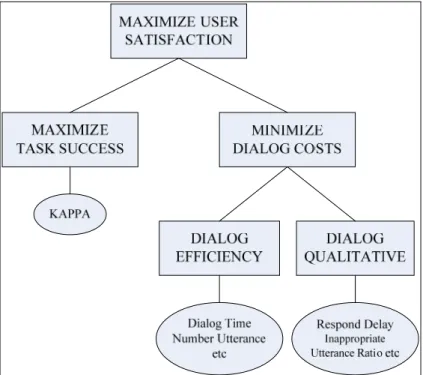
The PARADISE model suggests that dialog performance correlates with external criterion which can be measured by user satisfaction. In other words, we can evaluate spoken dialog agents using user satisfaction measurement. The model further suggests that user satisfaction can be measured through two types of factors called “task success” and “dialog costs”. The latest one consists of dialog efficiency and dialog qualitative. Figure 2.1 illustrates PARADISE model.
According to PARADISE, user satisfaction maximization includes both task success maximization and dialog costs minimization. To do so, all the factors have appropriate measures which are:
• Task success measure: Kappa coefficient (Carletta, 1996; Siegel and Castellan, 1988) is used to measure the agreement between two individuals. In PARADISE, the coefficient is calculated from the confusion matrix which summarizes how well a machine agent collects the required information of a particular task.
• Efficiency measure: is calculated from the following feature: number of utterances, dialog time, number of time user and agents talk at the same time, average duration of system turns, and average duration of user turns.
• Qualitative measure: is evaluated through features which could be: agent response delay time, inappropriate utterance ratio, agent repair ratio.
Figure 2.1 PARADISE’s structure of objectives for spoken dialog performance.
From Walker (1997)
2.2 Related works on dialog classification
human-machine dialogs. To do so, we will review several papers chronologically.
Firstly, Litman, Walker and Kearns published a paper (Litman et al., 1999) titled “Automatic Detection of Poor Speech Recognition at the Dialogue Level”, in which they showed that a “good” or “bad” dialog is a result of “good” or “bad” speech recognition performance. Their work was carried on a corpus of 544 dialogs collected from three different systems, namely ANNIE (an agent for voice dialing and messaging), ELVIS (an agent for accessing email) and TOOT (an agent for accessing online train schedules). A set of 23 features based on five types of knowledge sources: Acoustic Features, Dialogue Efficiency Features, Dialogue Quality Features, Experimental Parameter Features and Lexical Features were extracted directly from system logs. Finally, they adopted the learning machine program RIPPER in order to build a classification model which was tested by the method of cross-validation with 25 folds. RIPPER stands for Repeated Incremental Pruning to Produce Error Reduction. RIPPER (like other learning programs e.g., C5.0 and CART) is a fast and efficient rule learning system described in more detail in (Cohen, 1995) and (Cohen, 1996). The best result achieved was 77.40% on accuracy rate. They also did several experiments using a subset of features or primitive features to evaluate the features’ role through classification performance.
In the same year, a group from AT&T Labs-Research published a paper (Langkidle et al., 1999) which addressed the automatic prediction of problematic Human-Computer dialogues with their system ‘How May I Help You?’ HMIHY is a spoken dialogue system for customer care at AT&T Labs that provided them a corpus of 4774 dialogues used in their experiments. In this work, Langkidle defined problematic dialogue as a dialog where a customer is unable to complete his desired task. Their feature set was derived from four different sources: ASR component, NLU component, Dialog Manager Component and Hand-Labeled component. They also had two feature sets which are subset of the original set. The first one, called Automatic features, includes all features described above except the Hand-Labeled features and the reverse-order-utterance-id (among the Dialog Manager features). The second subset, called Auto & Task-Independent, keeps only features that are available at runtime and independent of the HMIHY task. They took the machine learning program RIPPER to build a
classification model and used a 5-fold cross-validation in order to evaluate their system’s performance. Since they were interested in predicting problematic dialogues, they used only features extracted from exchange 1 or exchange 1 and exchange 2 in the dialogue in order to test their system. Their result is shown in the below table.
Table 2.1 Result from the work done by Langkidle in 1999
Features Used Accuracy
Exchange 1 Auto features
Auto & Task-Independent features
72.3% 71.6% Exchange 1&2 Auto features
Auto & Task-Independent features
79.8% 78.4% Full dialog Auto features
Auto & Task-Independent features Full features
87.0% 86.7% 88.5%
One year later, (Walker et al., 2000) continued to enhance the previous work from Langkidle by adding a new hand-labeled feature, named ‘rsuccess’. This feature was used to verify whether the NLU module correctly identifies the task that user was asking HMIHY to perform. Their system’s performance was improved by 4% of accuracy (92.3% in comparison with 88.5%) but wasn’t useful for real-time application since the new feature is a hand-labeled one.
Then, (Walker et al., 2001) proposed a method to automatically generate the hand-labeled feature ‘rsuccess’ (auto-SLU-success). Their results are shown in Table 2.2.
Table 2.2 Accuracy % results of Walker in 2001
Features Exchange 1 Exchange 1&2 Whole dialog
Baseline 67.10 67.10 67.10
Auto (no auto-SLU-success) 70.10 78.10 87.00
Auto + auto-SLU-success 69.60 79.20 84.90
Auto, Task-Independent (no
auto-SLU-success) 70.10 78.40 83.40
Auto, Task-Independent +
auto-SLU-success 69.20 80.30 85.40
Auto + SLU-success 75.60 85.70 92.90
ALL (Auto + Hand labeled) 77.10 86.90 91.70
In 2007, Narjes Boufaden, Truong Le Hoang and Pierre Dumouchel published a paper (Boufaden et al., 2007) in which they studied the detection and prediction of user satisfaction in Human-Machine spoken dialogs. The features used in their work are a combination of Dialog Efficiency features with two new features, Named Entities and Acknowledgement Words respectively. Three learning machine algorithms including Support Vector Machine, k-Nearest-Neighbour and Decision Tree were applied in this work. Their experiments were tested on the corpus of DARPA 2001 Communicator using the method of 10-fold cross validation. Their results (Table 2.3) show that Named Entities and Acknowledgment Words are a good indicator for prediction of user satisfaction in the beginning of the dialog and they also improved baseline classification performance.
Table 2.3 Result from the work of Boufaden in 2007
Features used SVM kNN DT
Baseline 50.00% 50.00% 50.00%
Dialog Efficiency 61.26% 91.41% 85.75%
Dialog Efficiency + Name Entities +
In 2008, (Schmitt et al., 2008) employed an alternative machine learning method, SLIPPER, which stands for Simple Learner with Iterative Pruning to Produce Error Reduction. Their corpus comprises 69,296 calls from a commercially deployed recent call center recorded between Dec 3rd, 2007 and Dec 14th, 2007. The feature set is made up by ASR features, NLU features and Dialog Manager features. In this work, they achieved a very good result which shows that their model can identify problematic calls after only five caller turns with an accuracy of over 90%.
2.2.1 Related works experimented on DARPA 2000 & 2001 Corpora
The comparison of the systems presented earlier is made difficult by the fact that researchers do not use the same data in their study. Therefore, in this subsection, we will review one paper and one thesis which both did the research of spoken dialog classification on the same corpus as ours. We’re thus able to compare their results with ours and evaluate our achievement as well.
The first one is a paper by Helen Wright (Helen Wright Hastie et al., 2002) which developed a problematic dialogue identification system and tested it on DARPA 2001 Communicator Corpus. The corpus is composed of 1242 dialogues. All kinds of the features, used in this work, which are defined in PARADISE framework, consist of TaskSuccess Measure, Efficiency Measures and DATE. The two latter kinds of features are automatically extracted, whereas the former is obtained by two methods, namely hand-labelled and automatic. The learning scheme they applied is CART (Classification and Regression Tree) implemented by Wagon software. Their results are given in the following table:
Table 2.4 State of the art results from Hastie in 2002
Task Completion Dialogue Recall Precision Fmeasure
Hand-labelled Hand-labelled Good Bad (Problematic) 90.00% 54.50% 84.50% 66.70% 87.16% 59.98% Automatic Automatic Good Bad (Problematic) 88.50% 66.70% 81.30% 58.50% 84.74% 62.33%
The second work presented for comparison is a master thesis (Truong Le Hoang, 2008) which also developed software whose main goal is to automatically identify problematic dialogs. In this work, he used exactly the same corpora as ours (DARPA Communicator 2000 and 2001) in order to test his system performance. The feature set that he took is a combination of Task Success measure, Efficiency measures with two new features, namely NumNegativeACKwords (that number of negative words: NO, NOP, FALSE, INCORRECT, WRONG, ERASE in a dialog) and NumRepetitions (that number of times the agent repeats the same utterance). All the features are automatically extractable. Decision Tree is the learning scheme he chose to build his system. Of many different decision tree algorithms, he developed the Basic C4.5 Tree by himself. The other learning algorithms presented in Table 2.5 are from the library WEKA (Waikato Environment for Knowledge Analysis) which was developed by many machine learning experts from the University of Waikato. The table below shows his best results.
Table 2.5 State of the art result from the master thesis of Truong Le Hoang in 2008
Decision Tree Algorithm
DARPA 2000 DARPA 2001
Accuracy Fmeasure on BAD Accuracy Fmeasure on BAD
His own C4.5 Tree 72.00% 70.00% 64.00% 60.00%
Logistic Regression Model 78.60% 75.00% 69.52% 61.00%
One-Rule Algorithm 77.06% 71.00% 58.23% 52.00%
C4.5 Tree 76.87% 74.00% 68.11% 60.00%
Boosted C4.5 Trees 73.19% 71.00% 65.63% 60.00%
Logistic Model Tree 78.60% 75.00% 69.52% 61.00%
Through reviewing seven articles and one master thesis concerning the problem of telephonic human-machine dialogue classification, we found out the following points:
• Most of the works used the rule learning machine schemes and their variants such as: RIPPER, SLIPPER, and Decision Trees except for Boufaden et al,. who tried two other learning machine methods: k-NN and SVM.
• The features used for all the works are extracted from three knowledge sources: Automatic Speech Recognition (ASR) component, Natural Language Understanding (NLU) component and Dialog Manager (DM) component. Most of the features are automatically extractable while a few are hand-labeled. The features are mostly calculated based on the whole dialog level.
• Although the works were tested on many different corpora, their results are on range of 70%-85% of accuracy under the condition that we only consider the results experimented with the automatically extractable features.
Therefore, in this thesis, we not only address to build a dialog classification system using new approaches as described in section 1.2 but also try to reach the performance of the state of art.
2.3 Pattern Classification
Nowadays, information technology becomes very popular and there are a lot of applications in most of the fields such as science and society also. Many of these technologies that were and are studied and developed rapidly in the laboratory in general and the industry in particular are the ones based on machine learning techniques.
2.3.1 Pattern Classification Concepts
Pattern classification (or also known as Pattern recognition) is “the act of taking in raw data taking an action based on the category of the pattern” (Duda, 1999). This definition sounds pretty abstract and somewhat difficult to understand. But before explaining pattern classification more simply and in easy-to-understand way we should know several common terminologies used in pattern classification as follow:
• Pattern: according to the Japanese professor, Satoshi Watanabe (Watanabe, 1985): “A
pattern is opposite of a chaos: it is an entity vaguely defined, that could be given a name”. We can also understand that a pattern could be a process, an event or an abstract
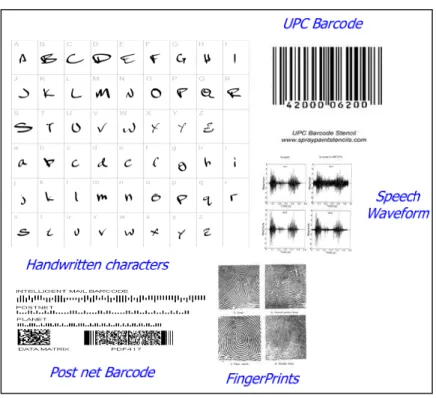
object, such as a set of measurements describing a physical object. Figure 2.2 shows some examples of patterns.
• Feature (or attribute): is an intrinsic trait or characteristic of a pattern that we can use to discriminate a pattern from another one. There are generally two kinds of features including nominal feature (e.g. windy, rainy and so on) and numeric feature (e.g. length, age, weight and so on).
• Class or pattern class is a set of patterns that has the same set of common features.
• Training set (or labeled set) is a set of patterns that have been classified or described. Recognition systems usually learn how to recognize a pattern based on these training set.
Figure 2.2 Examples of patterns.
Pattern classification generally is a process (illustrated as Figure 2.3) whose principal goal is to classify objects (or patterns) into categories (or classes) based on features extracted from the patterns.
Figure 2.3 Concept of pattern classification.
Pattern recognition is divided into two main methods: supervised learning and unsupervised learning. Supervised learning is a problem in which classes are known beforehand and data samples (or called training data) of each class are also available. Unsupervised learning is a
problem in which we don’t have any information about classes as well as number of classes before solving such a problem so that we must infer the information from the data.
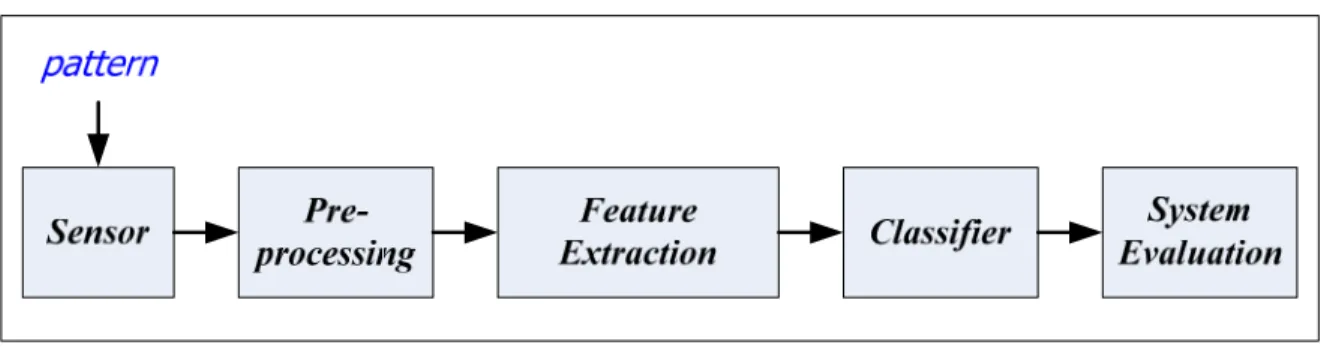
A complete pattern classification system usually includes five components (Figure 2.3) in which each part undertake a specific task.
• Sensor is the first component of a pattern recognition system. The only duty of this component is to gather the pattern’s observations needed in recognition processing. Depending on the object that the system wants to identify, the observations could be images, digital signals, or waveforms. Thus, a corresponding sensor could be a camera or a signal recording device.
• Pre-processing is used to refine observations collected in the previous phase. This also helps our system to reduce noises that we can meet while collecting data about the pattern. For specific problems concerning image processing, the goal of pre-processing becomes solving the typical sub-problems such as image digitization or segmentation and so on.
• Feature extraction receives data collected and adjusted by the two previous components to create a set of feature values (or called a feature vector).
• Classifier is the most important and essential component of a PR system. We thus need to determine the most suitable PR method among many different ones (e.g. hidden Markov model, neural network, support vector machine or Bayesian decision theory). Building a classifier consists of optimizing its parameters on a training dataset and testing it on a distinct testing dataset.
• System evaluation is an indispensable component of the PR systems. This component evaluates the overall performance of the system and helps us seek effective methods to improve the performance.
Figure 2.4 Main components of a pattern classification system.
2.4 Hidden Markov Model
HMM (Hidden Markov Model) is a statistical model which can model best the observed data samples of a discrete-time series. HMM has been frequently applied for pattern classification of time-varying data sequences. Thus, HMM is used in different domains such as speech, handwriting, and gesture recognition and gene prediction (Huang et al., 2002).
In the next subsection, we will describe how HMM works and how we train it.
2.4.1 Markov chain (Huang et al., 2002)
HMM is derived from Markov chain. This chain is a discrete random process which has the property that the next state is only dependent on the current state. Andrei Markov, a Russian mathematician, whose best known work is the theory of stochastic processes, invented the Markov chain.
To start the Markov chain, we firstly define X =X1,X2,...Xn as a sequence of random variables and according to the Bayes rule, we have
∏
= − = n i i i n P X P X X X X X P 2 1 1 1 2 1, ,..., ) ( ) ( | ) ( (2.1) where 1 1 2 1 1− = , ,... i− i X X XX . In the Markov model chain, we have an important assumption (called Markov assumption) which states: the probability of the random variable at a given
time depends only on the value at the preceding time. This assumption means that: ) | ( ) | ( 1 1 1− = i i− i i X P X X X P (2.2)
Apply the assumption to equation (2.1), we have
∏
= − = n i i i n P X P X X X X X P 2 1 1 2 1, ,..., ) ( ) ( | ) ( (2.3)Equation (2.3) gives us an idea that we can use the Markov chain to model time-invariant events by ignoring the time index i, and considering:
) ' | ( ) ' | (X s X 1 s P s s P i = i− = = (2.4)
Now, if we assign Xi to a state, the Markov chain becomes a finite state process with
transition between states specified by the probability function P(s|s’). Of course, the Markov
assumption mentioned in the equation (2.2) is restated to the following: the probability that a
Markov chain will be in a particular state at a given time depends only on the state of the Markov chain at the previous time.
Generally, a Markov chain having N distinct states namely {1,…,N} fully includes the following parameters (note that the state at time t in the Markov chain denoted as st):
N j i i s j s P aij = ( t = | t−1 = ) 1≤ , ≤ (2.5) N i i s P i = ( 1 = ) 1≤ ≤ π (2.6) where:
• aij is the transition probability from state i to state j
• πi is the initial probability that the Markov chain will start in state i
1 1 1 1 = ≤ ≤ =
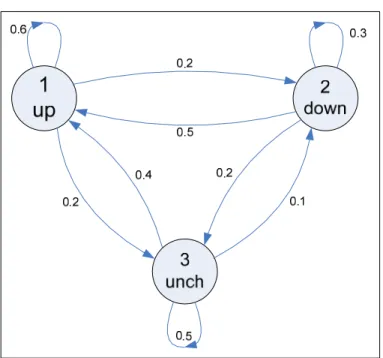
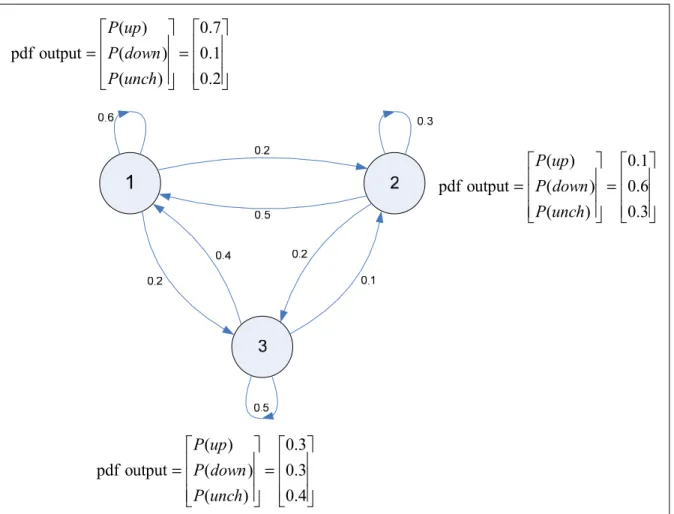
= N j j N j ij i N a π (2.7)Let’s consider a specific example so as to understand much more about Markov chain. Thereby, we explain why the Markov chain above is also called the observable Markov. This example is a simple three-state Markov chain used to describe the Dow Jones Industrial average. In this model, each state represents a situation of the Dow Jones average at the end of a day which can be one of the following states:
• State 1 – up (in comparison to the index of previous day) • State 2 – down (in comparison to the index of previous day) • State 3 – unchanged (in comparison to the index of previous day)
Figure 2.5 Markov chain for the Dow Jones Industrial average. From Huang (2002, p. 377)
• A transition probability matrix = = 5 . 0 1 . 0 4 . 0 2 . 0 3 . 0 5 . 0 2 . 0 2 . 0 6 . 0 } {aij A
• An initial probability matrix μ ={μi}=
[
0.5 0.2 0.3]
The output of the process at each time instance t is a specific event which we can deterministically observe. It means that for each observable event sequenceX = X1,X2,...Xn, we always determine a correspondent Markov chain state sequenceS=S1,S2,...Sn. Example: A sequence of events “up-up-down-unchanged-down” of Dow Jones has a correspondent sequence of states “S1-S1-S2-S3-S2” and the probability will
be
P(“up-up-down-unchanged-down”) = P(S1,S1,S2,S3,S2)
= μ1a11a12a23a32 =0.5×0.6×0.2×0.2×0.1=0.0012
2.4.2 Hidden Markov Model
In the previous section, each state of the Markov chain corresponds to a deterministically observable event. Before advancing to the definition of the Hidden Markov Model, we should first take a look at Figure 2.6 which is also used to predict the variance of the Dow Jones Industrial average. In comparison with the Markov chain (Figure 2.5), there is a difference that each state doesn’t represents a fixed event anymore. In this new model, the output of a state is hidden and depends on the probabilistic function of a correspondent state. In other words, a state in HMM could rather be in one of three modes (up, down and unchanged) based following a probability density function. That’s why we call this model Hidden Markov Model which can be viewed as a double-embedded stochastic process with an underlying stochastic process not directly observable.
= = 2 . 0 1 . 0 7 . 0 ) ( ) ( ) ( output pdf unch P down P up P = = 4 . 0 3 . 0 3 . 0 ) ( ) ( ) ( output pdf unch P down P up P = = 3 . 0 6 . 0 1 . 0 ) ( ) ( ) ( output pdf unch P down P up P
Figure 2.6 Hidden Markov model for the Dow Jones Industrial average. From Huang (2002, p. 378)
Generally, a hidden Markov model is defined by a set of parameters as below: • A set of output observations O={o1,o2,....,oM}.
• A set of states Ω={1,2,...,N}.
• A transition probability matrixA={aij}, where aij is the probability of transiting from
state i to state j.
• An output probability matrixB={ kbi( )}, where bi(k) is the probability of emitting
• An initial state distribution π ={πi}.
Since aij, bij(k) and πi are all probabilities, they must satisfy the following conditions:
k j i k b aij ≥0, i( )≥0, πi ≥0 ∀ , , (2.8) 1 1 =
= N j ij a (2.9) 1 ) ( 1 =
= M k i k b (2.10) 1 1 =
= N i i π (2.11)From now on, note that we will use either the notation Φ={A,B,π}or the symbol Φ only to indicate the whole parameter set of an HMM to avoid ambiguity.
2.4.3 Three basic problems of HMM (Rabiner, 1989)
In order to apply HMM to real-world applications, we firstly need to address three basic problems of HMM and clearly understand their solutions as well:
1. The Evaluation Problem: Given a model Ф and a sequence of observationsX =
(
X1,X2,...,XT)
, how to compute the probabilityP( )
XΦ that generates the observations?2. The Decoding Problem: Given a model Φ and a sequence of observationsX =
(
X1,X2,...,XT)
, how to find out the best state sequenceS=(
s1,s2,...,sT)
in the model that generates the corresponding observation sequence?
3. The Learning Problem: Given a model Φ and a set of observation sequences (training data), how to adjust the HMM parameter set to maximize the joint likelihood
probability
∏
( )
ΦX
X
P ?
The solutions to these problems are described in annexes I, II, III and IV. In the next subsection, we will briefly mention a tool which implements the HMM algorithms very efficiently.
2.5 HTK Overview
HTK which stands for Hidden Markov Model Toolkit is a tool popularly used to build and manipulate hidden Markov models. The principal idea of HMM is to model any time series event and the core of HTK also have same general purpose. Firstly, HTK was created to address the demands of speech recognition research and a lot of infrastructures in HTK are designed for this task. However, it has been useful for numerous applications such as speech synthesis research, character recognition and DNA sequencing research. Nowadays, HTK becomes very popular and is used at hundreds of sites over the world.
HTK is actually a set of library modules developed by C programming language. The software fully provides the most necessary facilities for speech analysis, HMM training, testing and result analysis. In addition, we can adjust HMM components easily to optimize the HMM’s performance. Both continuous density mixture Gaussians and discrete distribution are supported in HTK. Of course, a complex HMM system can be built as expected by using HTK.
For more details about this toolkit, please refer to http://htk.eng.cam.ac.uk/docs/history.shtml
2.5.1 HTK Architecture
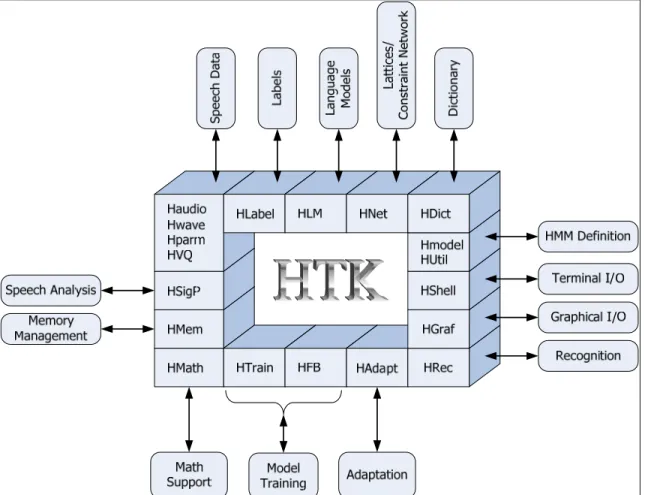
HTK is built into the library modules which make sure that every tool can interface to the outside world in exactly the same way. Each module, which consists of many tools, undertakes a specific task. The figure 2.7 illustrates the HTK architecture.
Figure 2.7 HTK Software architecture. From Young (2006, p. 15)
HTK totally comprises 20 library modules:
1. HShell controls user input/output and interaction with operation of HTK.
2. HMem undertakes all management of memory.
3. HSigP is to process the signal operations needed for speech analysis.
4. HMath provides mathematical support.
5. HLabel is responsible for interaction with label files. 6. HLM is for language model files.
7. HNet is used for network and lattice operations. 8. HDict is dedicated to dictionary.
9. HVQ is for Vector Quantization codebooks. 10. HModel specializes in HMM definitions.
11. HWave is a library module that processes all speech input and output at the waveform level.
12. HParm is similar to HWave but at the parameterized level.
13. HAudio is a HTK utility which takes input directly from audio files.
14. HGraf has the same utility as the HAudio but is more interactive by using a graphical interface.
15. HWave in cooperation with HLabel provide multiple format files that allow data to be imported from other systems.
16. HUtil support a number of utilities so as to manipulate HMMs. 17. HTrain and HFB provide the various HTK training tools. 18. HAdapt contains support for the various HTK Adaptation tools. 19. HRect processes the recognition operations.
2.5.2 HTK functionalities
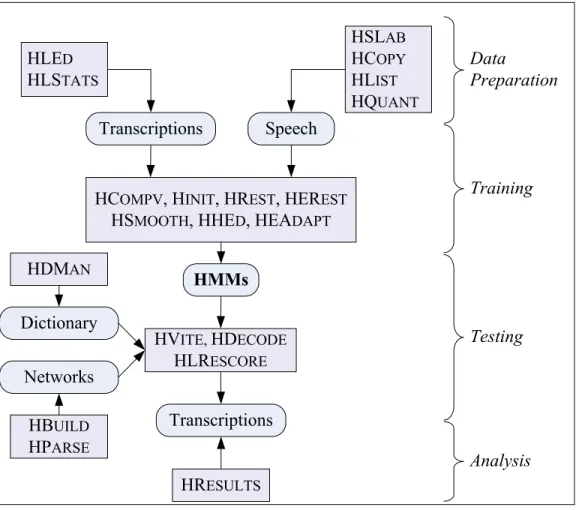
HTK fully provides the necessary tools so that we can build a HMM based continuous speech recognizer which usually involves in the processing steps: data preparation, training, testing and analysis. Relationship between these steps and HTK tools is shown in the Figure 2.8.
HCOMPV, HINIT, HREST, HEREST HSMOOTH, HHED, HEADAPT HLED HLSTATS HSLAB HCOPY HLIST HQUANT Transcriptions Speech HMMs HVITE, HDECODE HLRESCORE Transcriptions HRESULTS Networks Dictionary HDMAN HBUILD HPARSE Data Preparation Training Testing Analysis
Figure 2.8 HTK Processing stages.
• Data preparation phase: A set of speech data files and their associated transcription are required for training a speech recognizer. But before they can be used in training step, we must convert the speech files into the appropriate parametric form and format its associated transcription in exactly the same way required by HTK. The tools such as HSLAB, HCOPY, HLIST, and HQUANT… are provided to work with speech file whereas the tools such as HLED and HLSTATS are used to annotate transcription.
• Training phase: is the most important step which involves building HMMs for recognizer using Baum-Welch re-estimation. HEREST is tool performing this algorithm. In this
phase, a set of tools are provided by HTK to adjust HMMs training with the purpose of optimizing recognition. These are HCOMPV, HINIT, HREST, HSMOOTH, HHED and HEADAPT.
• Testing phase: is step for speech recognition. For this purpose, HTK provide a tool called HVITE which does recognition using language models and lattices. Another tool, HDECODE, which supports the same task, is also available as an extension to HTK. And HLRECORE is a tool that accompanies HVITE (or HDECODE) to apply a more complex language model. Besides, HTK supplies the dictionary management tool HMAN which helps us construct large dictionaries. The final task in this phase which is to create grammar networks is assisted by the tools HBUILD and HPARSE.
• Analysis phase: Once the HMM based speech recognizer has been built, it is necessary to evaluate its performance by using itself to transcribe some pre-recorded utterances. After that, we will match the recognizer output with the correct reference transcription to see how well the recognizer works. This is done by the tool named HRESULTS which is also provided by HTK.
METHODOLOGY
3.1 Problematic dialogue definition
In Chapter II, we saw that there are several different methods to label a problematic dialogue in situation of a spoken Human-Computer dialogue. The labeling depends on the purpose of dialog management system.
• First, Litman et al correlated a problematic dialogue with the performance of the ASR module (Litman et al., 1999). According to the opinion, a dialogue is considered problematic if the ASR module produces a poor performance on it.
• Then, Langkilde et al made another definition of problematic dialogue (Langkilde et al., 2000). On the basis of task success, problematic dialogue is a dialogue in which user is unable to do what he/she desires.
• Finally, Hastie et al relied on user satisfaction in order to define a problematic dialogue (Hastie et al., 2002). In this definition, problematic dialogue is a dialogue in which user is unsatisfied with the conversation. Otherwise, non problematic dialogue is a dialogue that always assures the user satisfaction although the task that user desires to do would be probably uncompleted.
In this work, we choose the method of labeling a problematic dialogue based on user satisfaction because:
• Our work is a part of the project whose aim is to address enhancing the quality of spoken Human-Computer dialog using emotion management.
• The corpus we use throughout the thesis provides user satisfaction rating which will be described more details in Section 3.5.
3.2 Dialog classification features
This section describes briefly the set of features which has been frequently used in researches concerning dialog classification or problematic dialog identification. The dialog features used in the work that we described in section 2.2 are often divided into four subsets based on their own origination as follow:
• Acoustic/ASR Features: output of the speech recognizer, number of words in the recognizer output, duration in seconds of the input to the recognizer, flag for touchtone input, input modality expected by the recognizer, grammar used the recognizer, and actual modality of the user utterance.
• NLU Features: confidence measure for all possible call types, intra-utterance measure of the consistency between services that user appears to be requesting, measure of coverage of the utterance by salient grammar fragments, measure of the shift in context between utterances, call-type task with the highest confidence score, call-type task with the second highest confidence score, difference in value between the top and the next-to-top confidence scores.
• Dialog Manager Features: number of utterances, number of prompts, percent of re-prompt, number of confirmation, percent of confirmation, utterance duration in second, entire dialog duration in second.
• Hand-Labeled Features: human transcripts of each user utterance, age and gender of each user, a cleaned transcript with non-word noise information-removed, the number of words that occurred only in the clean transcript.
We have just taken a look at the overview of different dialog feature types that we can extract from the human-machine dialog system. In the next section, we will introduce the features we chose to use in our research.
3.2.1 Selection of features
This work aims to design a completely automatic system of dialog classification. To achieve this, the dialog features that we use must be automatically extractable. In addition, since we want to give a quick response, we will work on utterance basis instead of a paragraph basis. Therefore, the dialog features here are derived from each utterance. Consequently, we adapted the features defined in the PARADISE framework to make them applicable at the turn level. The set of features used in our system comprises the following:
• Utterance Position: position of each utterance in a whole dialog (e.g. second utterance) • Utterance Duration: duration in second of the utterance.
• Number of Phonemes: number of phonemes of the utterance.
• Inverse Speech Rate: inversion of measure of the speed that the utterance is spoken in second.
• Num Negative Words: number of negative acknowledgment words such as cancel, wrong, erase and so on.
• Num Positive Words: number of positive acknowledgment words such as yes, thanks, welcome and so on.
• Response Waiting Time: waiting time expressed in second between two consecutive utterances.
• Silence Time: duration of silence of the speaker.
• Repetition Rate: level of similarity between two consecutive utterances from the same speaker.
• ASR Accuracy Rate: measure of precision of ASR component when recognizing each user utterance.
Of these features, the last one (ASR Accuracy Rate) is the only one we are unable to automatically extract because we need corresponding transcript for each utterance in order to compute it. Otherwise, we can realize that all other features belong to the type of dialog costs (dialog efficiency and dialog qualitative) according to PARADISE framework.
In Chapter 4, we will describe how each of these feature parameters is extracted. In the next section, we mention how a HMM can be used to detect the satisfaction of the user. In the next subsection, we will describe the algorithm and the technique used in processing the features extraction.
3.2.2 The dynamic programming algorithm
The dynamic programming is a popular algorithm (Cheriet, 1997) which solves complex problems by breaking them down into simpler sub-problems. This algorithm saves much more time than naive one. Based on algorithm approach, dynamic programming is basically divided into two types as follow:
• Top-down dynamic programming is to store the results of calculations which are re-used after because the same calculation is a sub-problem in a larger calculation.
• Bottom-up dynamic programming is to formulate a complex calculation as a recursive series of simpler calculations.
There are a number of algorithms that use dynamic programming. Here we list some common algorithms:
• The dynamic time warping algorithm for computing the global distance between two time series.
• The algorithms used in bioinformatics, including sequence alignment, structure alignment and RNA structure prediction.
• The Viterbi algorithm in hidden Markov models. • Fibonacci sequence.
• Sequence alignment.
In our research we use the dynamic programming to measure optimal distance between two given strings of character. Suppose that we have an n-character string
n
X X X
X = 1, 2,..., where X denotes the ii th character in the string X. Similarity, we also have an m-character stringY =Y1,Y2,...,Ym. And the dynamic programming algorithm that we use to solve our own problem is the following:
Step 1: Initialization D[0,0] = 0 for i = 1,2,…,n {D[i,0] = ∞} for i = 1,2,…,m {D[0,m] = ∞} Step 2: Iteration for i = 1,2,…,n { for i = 1,2,…,m {
[ ]
[
]
[
]
(
)
[
]
(
)
+ − = + − − = − − + − = ) ( 1 ] 1 , [ ) ( ! 1 1 , 1 ) ( 1 , 1 ) ( 1 , 1 min , insertion j i D n subtitutio Y X if j i D match Y X if j i D deletion j i D j i D j i j i (3.1) } } Step 3: Termination3.2.3 The emotional salience (Lee et al., 2002)
The emotional salience is an approach used in emotion detection to improve the recognition performance. This technology is based on the information-theoretic concept of salience to search salient words in each utterance. A salient word with respect to a category is one which appears more often in that category than at in other parts of the corpus. To find the salient words, we need a method to measure relation between the words and emotions in the speech corpus. Therefore, the emotional salience is created as a measure of the amount of information that a specific word implies about the emotion category. The emotional salience
( )
wsalek of a word w for emotion category ek is defined as mutual information between a
specific word and an emotion class
( ) (
k)
( )
k(
k)
e w I E e W w Pe wi w e sal k = = ; = = , (3.2) where( )
e wP k is the posterior probability that word w implies emotion class ek.
(
)
( )
( )
k k k e P w e P e wi , =log2 is the self mutual information. (3.3)
( )
ekP is the prior probability of the emotion ek.
The meaning of the emotional salience is that the bigger the emotional salience is, the higher the correlation between a specific word and an emotion category is.
3.3 Selection of machine learning method
In pattern classification field, it is not easy to know beforehand which learning scheme will work best for any given problem. The approach called “trial-and-error” is usually used to determine an appropriate scheme.
In the section of related work, we saw that two schemes, namely RIPPER and DT (Decision Tree), are often employed in the dialog classification problem. But our research approaches this problem with a different method. We attempted to mine only information exchanged between user and system for dialog classification at the utterance level and then model the user satisfaction through the dialog utterance. So, it is necessary to have an appropriate algorithm for this approach. HMM is our choice due to the following reasons:
• HMM is a robust and strong algorithm used widely in the field of temporal pattern recognition such as speech recognition, gesture recognition, and gene prediction. Hence, we also believe that this model will work well on our problem.
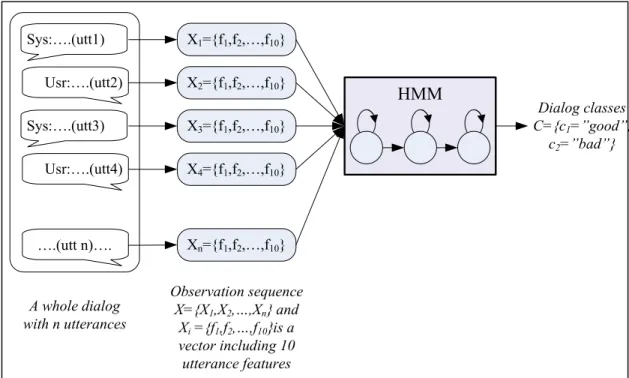
• Besides, we realize that HMM is very suitable to model our problem. Since if we consider an utterance sequence of dialog as an observation sequence in HMM illustrated like the Figure 3.1. This offers us an easier way to process modeling than the conventional algorithms such as RIPPER and DT.
• In addition, the ASR component of the Human-Computer dialogue system also works on a HMM framework. Thus, using HMM in dialogue classification is compatible with the ASP component in order to facility the fusion of both information.
• Finally, HMM provides us many means to improve and refine the algorithm performance. Simply, we can adjust number of states or work on the topology of states in order to improve the system’s performance. Using Gaussian Mixture Model for the probability density function of each HMM state could be made to enhance the classification of dialogue. In case of limitation of training data, HMM is still able to adapt to this situation using the parameter tying.
Usr:….(utt2) Sys:….(utt1) Sys:….(utt3) Usr:….(utt4) ….(utt n)…. X1={f1,f2,…,f10} X2={f1,f2,…,f10} X3={f1,f2,…,f10} X4={f1,f2,…,f10} Xn={f1,f2,…,f10} HMM Dialog classes C={c1=”good”, c2=”bad”} A whole dialog with n utterances Observation sequence X={X1,X2,…,Xn} and Xi={f1,f2,…,f10}is a vector including 10 utterance features
Figure 3.1 Concept of new approach using HMM.
3.4 Corpus Collection
This section briefly presents the data collection used for our experiments. The collection includes two corpora: DARPA 2000 Communication Corpus, and DARPA 2001 Communication Corpus. They were publicly distributed by Linguistic Data Consortium (LDC). Firstly they were collected to serve the DARPA Communication project whose object is to support development of multi-modal speech-enabled dialog systems with advanced conversational capabilities.
During 2000 and 2001, the two data sets were collected, in which users used the Communicator systems built by the research groups to plan their travel trip.
3.4.1 DARPA 2000 Communication corpus (Walker et al., 2002)
DARPA 2000 corpus was collected by nine systems from AT&T, BBN, University of Colorado, Carnegie Mellon University, IBM, Lucent Bell Labs, MIT, MITRE and SRI. The
collection was conducted as a controlled experiment in which the subjects, who were recruited in prior, called each of the nine different automated travel-planning systems over three 3-day periods to make simulated flight reservation.
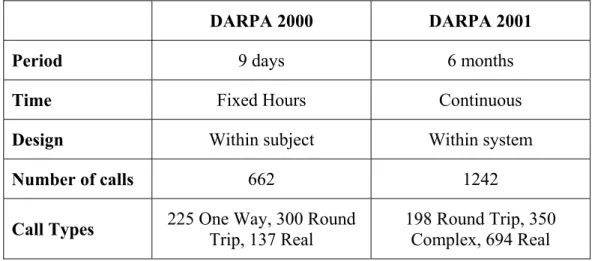
The experiment had been carried out over nine days at the fixed hours. The subjects talked to the systems in order to complete seven fixed tasks (which included three domestic one way trips, two domestic round trips, and two international round trips) and two open tasks that were to plan an intended business trip and vacation.
As a result, this experiment produced 662 calls in which there were 225 calls for one way trip reservation, 300 calls to make a round trip reservation. And the remaining 137 ones are about the real trip.
3.4.2 DARPA 2001 Communication corpus (Walker et al., 2002)
DARPA 2001 corpus was collected by only eight systems because the system from MITRE didn’t participate in this project anymore. In 2001, the collection was more natural than the one in 2000 because they conducted a within-system rather than a within-subject experiment. They did exclude the subject recruitment for the experiment. The object of this is to allow users to learn their new interactive paradigm and allow systems to adapt to their users.
Unlike the experiment in 2000, the one in 2001 had taken place for a long time (6 months) and the user could be continuously accessible to systems via a toll-free number. Besides, the experiment’s scenarios were more complex and realistic. Multi flight trip was required to be made in such a corpus. Moreover, they might require user to make car and hotel arrangement as well.
After this experiment, they collected 1242 calls in total. This number consisted of 198 calls for round trip reservation, 350 calls within complex scenario. And the remaining 694 calls are about real trip.
Table 3.1 Summary of DARPA 2000 and DARPA 2001
DARPA 2000 DARPA 2001
Period 9 days 6 months
Time Fixed Hours Continuous
Design Within subject Within system
Number of calls 662 1242
Call Types 225 One Way, 300 Round Trip, 137 Real 198 Round Trip, 350 Complex, 694 Real
3.5 Labeling corpus
In order to label the dialogues from the corpora of DARPA 2000 and DARPA 2001, we rely on the points that the user answers to a question set. The questions are given to the user after his dialogue is completed. The answers help us assess the customer satisfaction towards the spoken Human-Computer dialogue system. Below is the question set raised in the DARPA 2000 and 2001 corpus:
• Task Success: Is user’s task completed successfully? (Yes / No)
• Task Ease – (A): In this conversation, it was easy to get the information that user wanted? • TTSPerf (Text To Speech Performance) – (B): In this conversation, user found it easy to
understand what the system said?
• User Expertise – (C): In this conversation, user knew what to say or to do at each point in the dialogue?
• Expected Behavior – (D): In this conversation, the system worked the way user expected it to?
• Future Use – (E): In this conversation, based on user’s experience using this system to get travel information, user would like to use this system regularly?
five questions are taken for customer satisfaction rating. In this work, we focus on these five questions because we address problematic dialogue on the basis of the customer satisfaction as mentioned in section 3.1. For each question, user will give a score whose value varies from 1 to 5 based on Likert-scale that is a multi-item scale. The Liker-scale format is presented in the Table 3.2.
Table 3.2 Likert-scale and Inversed Likert-scale Likert-scale Strongly Disagree Somewhat Disagree Neutral Somewhat Agree Strongly Agree Normal 1 2 3 4 5 Inversed 5 4 3 2 1
After summing up the scores of these five answers, we have a score that expresses the actual user satisfaction. We call such score UserRating, and use it to define problematic dialog as follow: log Dia Bad Threshold UserRating <
Since we have two different corpora using two types of scale, namely Normal Likert-scale and Inversed Likert-Likert-scale (Table 3.2), the Thresholds that we choose to label dialogs have a little difference as follows:
• In DARPA 2000, the Inversed Likert-scale is used, so determining problematic dialog (Bad dialog) follows the condition below
Dialog Bad
UserRating > 12
• Otherwise, in DARPA 2001, the Normal Likert-scale is used, so determining problematic dialog (Bad dialog) follows the condition below
Dialog Bad
DESIGN AND IMPLEMENTATION
4.1 System design
The dialog classification system that we develop is also a pattern classification system which usually has three main components, namely preprocessing, extraction, and classification. Our system is not an exception and Figure 4.1 illustrates the overall architecture of the dialog classification system. Parser Training Classifier Feature Extractor Machine-human dialog in form of a text file
(log file) Training Data (DARPA 2000 & DARPA 2001) Parser Classifier Feature Extractor Classifier
Training phase Testing phase
Dialog category {Good, Bad} Java modules HTK modules
As shown in the Figure 4.1, DCS includes three main components as follow:
• Parser: this component plays the role as the preprocessing. Since the input of DCS is a dialog in form of a text file recording what the user and the machine agent communicated and the time when the dialog took place. The task of the preprocessing component is to parse the text file to pick up dialog information. This is why this component is called parser in our system. We develop the parser component using the Java programming language. An example about the task of the parser component is shown in the table below.
Table 4.1 Example of input and output of the parser
Input of parser Parser Output of parser
Fri Jul 7 2000 at 12:21:44.71: New user turn began. Fri Jul 7 2000 at 12:21:44.71: User started speaking.
User audio file: ASR0_112644.VOX
Fri Jul 7 2000 at 12:21:47.13: User finished speaking.
Recognizer heard: I KNOW THAT'S ROUND User said: UH NO THAT'S WRONG
=> => => => => User 12:21:44.71 12:21:47.13
I KNOW THAT'S ROUND UH NO THAT'S WRONG
• Feature Extractor: this component takes input from the output of the parser component in order to produce a set of features used in the next component, namely classifier. Similarity to the parser component, the feature extractor is developed by the Java programming language. Table 4.2 is an example of what the feature extractor component does in our system. In this example, some features (such as Utterance Position, Silence Time and Repetition Rate) are calculated based on the previous utterance.
Table 4.2 Example of input and output of the feature extractor Input of Extractor Extractor Output of Extractor
User
12:21:44.71 12:21:47.13
I KNOW THAT'S ROUND UH NO THAT'S WRONG
Utterance Position : 4 Utterance Duration : 2.42 Number of Phonemes : 10 Inverse Speech Rate : 0.22 Number of Negative Words : 0 Number of Positive Words : 0 Response Waiting Time : 0.2
Silence Time : 0.0
Repetition Rate : 0.0 ASR Accuracy Rate : 0.5
• Classifier: this component classifies dialog into one of two classes {Good, Bad} based on a set of features. For the component, we use HTK ToolKit to build the classifier.
Each component will be described in detail in Section 4.1.1, Section 4.1.2 and Section 4.1.3.
4.1.1 The parser
Parser is the first component of our system. It receives a dialog transcript in form of a text file as input. The main task of parser is to pick up important information that the feature extractor needs. To do so, the parser must parse the text file and remove noise and unnecessary information from the text file. Only useful information is kept before sending them to the feature extractor. The output of the parser is composed of the following fields for each user turn and system turn in the dialog:
• Starting time: is the time when the user (or the system) starts their own turn. • Finishing time: is the time when the user (or the system) finishes their own turn.
• Utterance: here, we have two types of utterance. The first one is the user utterance which is transcribed in the text file by the ASR (Automatic Speech Recognition) component of the human-machine dialog system. The second one is the system utterance. For this utterance, the system simply saves to the text file what it said to the user. We thus realize that the user utterance could be incorrect due to limited capacity of the ASR component. • Human transcription: this field contains a human transcription of exactly what the user
said to the ASR system. This task is done by the human agent who listened to the audio file recording the corresponding dialog and rewrote out what they heard to the text file. Of course, this information only exists in the user turn.
Figure 4.2 summarizes the input and output of the parser.
FINISH TIME START TIME UTTERANCE TRANSCRIPT IS SYSTEM
PARSER
Dialog in form of text file (log file)Figure 4.2 Illustration for the parser function.
In our research, we have two different corpora whose text file formats varied. So, we need two parsers, namely the one for the DARPA 2000 and the other one for the DARPA 2001.
We will describe how they parse text files of two DARPA corpora in the next subsections.
4.1.1.1 DARPA 2000 Communicator
The text file of the DARPA 2000 corpus has a format as displayed the Figure 4-3. According to this format, parser will:
• Determine if this is a user turn or system by searching the key word “system turn began” or “user turn began”.
• Extract start time of system or user by searching the key word “System started speaking” or “User started speaking” respectively.
• Extract finish time of system or user by searching the key word “System finished speaking” or “User finish speaking” respectively.
• Extract system utterance by searching the key word “System said”. • Extract user utterance by searching the key word “Recognizer heard”. • Extract transcript by searching the key word “User said”.
4.1.1.2 DARPA 2001 Communicator
The text file of the DARPA 2001 corpus has a format as displayed in Figure 4-4. This format is simpler than the one of DARPA 2000. Each turn lies in one line only. And the format of each turn is:
[User/system] [Start time] [Finish time] [ASR: utterance] <Transcr: Transcript: > The last information is optional and exists in the user turn only. For this corpus, the parser needs to parse text file to pick up line by line, after that it will:
• Determine if this line contains the key word “system” than this is a system turn, whereas this is user turn.
• Extract one by one the remaining fields based on the order of each field as mentioned above.
Figure 4.3 Illustration for the text file format in DARPA 2000.