A TWO SPEED MIND?
FOR A HEURISTIC INTERPRETATION OF DUAL-PROCESS THEORIES (L'ESPRIT À DEUX VITESSES?
POUR UNE INTERPRÉTATION HEURISTIQUE
DES THÉORIES
À
PROCESSUS DUAUX)MÉMOIRE PRÉSENTÉ
COMME EXIGENCE PARTIELLE
À
LA MAÎTRISE EN PHILOSOPHIEPAR
GUILLA UME BEAULAC
Avertissement
La diffusion de ce mémoire se fait dans le respect des droits de son auteur, qui a signé le formulaire Autorisation de reproduire et de diffuser un travail de recherche de cycles supérieurs (SDU-522 - Rév.01-2006). Cette autorisation stipule que «conformément
à
l'article 11 du Règlement no 8 des études de cycles supérieurs, [l'auteur] concèdeà
l'Université du Québecà
Montréal une licence non exclusive d'utilisation et de publication de la totalité ou d'une partie importante de [son] travail de recherche pour des fins pédagogiques et non commerciales. Plus précisément, [l'auteur] autorise l'Université du Québecà
Montréalà
reproduire, diffuser, prêter, distribuer ou vendre des copies de [son] travail de rechercheà
des fins non commerciales sur quelque support que ce soit, y compris l'Internet. Cette licence et cette autorisation n'entraînent pas une renonciation de [la] part [de l'auteur]à
[ses] droits moraux nià
[ses] droits de propriété intellectuelle. Sauf ententè contraire, [l'auteur] conserve la liberté de diffuser et de commercialiser ou non ce travail dont [il] possède un exemplaire.»Je souhaitais d'abord me consacrer à des questions liées à la philosophie de l'éducation, mais j'ai vite constaté qu'une telle réflexion ne pouvait se détacher de questions liées à la connaissance, à l'apprentissage et à la pédagogie et, plus largement, à des questions touchant aux fondements des sciences cognitives et à de complexes problèmes de nature politique. La démarche de ce mémoire s'inscrit dans un seul de ces aspects, soit les fondements d'une théorie en sciences cognitives. Les autres aspects demeurent toutefois bien présents, comme motivation et, surtout, comme assises de ce travail.
Je tiens à remercier toutes les personnes que j'ai croisées durant mon épopée uqamienne. Je tiens aussi à remercier, plus particulièrement: Pierre Poirier, mon directeur de recherche, professeur de philosophie à l'UQAM, pour ses importantes contributions à l'ensemble du travail réalisé ici, mais aussi pour son rôle conune guide et critique; Murray Clarke, mon co directeur, professeur de philosophie à l'Université Concordia ; Luc Faucher et Serge Robert, membres du jury, professeurs de philosophie à l'UQAM ; Normand Baillargeon, professeur au département d'éducation et de pédagogie de l'UQAM ; Mathieu Marion, professeur de philosophie à l'UQAM ainsi que les personnes formidables avec qui j'ai eu un plaisir dingue à organiser la quatrième La nuit de la philosophie, Sindy Brodeur, Eve-Lyne Couturier, Marianne Di Croce, Jean-François Landry, Frédéric Legris, Annie Locat, Philippe Marchand et Simon Tremblay-Pepin. Je remercie enfin le CRSH (2008-2009) et le FQRSC (2009-2010) pour le soutien financier dont j'ai pu bénéficier tout au long de mes études de maîtrise.
Merci aussi à celles et celui qui me rappellent qu'il y a de la vie hors des murs de l'université: Roch Beaulac et Linda Charron, mes parents, ainsi que ma soeur Amélie, merci pour le soutien que seule une famille peut offrir. Je dédie ce mémoire à Evelyn McDuff. Tu l'as subi du début à la fin, c'est la moindre des choses que je puisse t'offrir en échange!
AVANT-PROPOS iii
TABLE OF CONTENTS : iv
LIST OF FIGURES vi
LIST OF TABLES vii
RÉSUMÉ viii
ABSTRACT ix
INTRODUCTION 1
0.1 Outline of this dissertation 5
0.2 Viewing the mind evolutionarily: the framework 9
CHAPTERI
DOES THE MIND WORK THAT WAY? MODULARITY AND ITS LIMITS Il
1.1 Fodor's modularity 13
1.2 Evolutionary Psychology, massive modularity and the many definitions of
'module' 18
1.3 Carruthers' account of massive modularity: strong central modularity and weak
modules 21
lA Samuels' account of massive modularity: weak central modularity and stronger
modules 27
1.5 Conclusion 30
CHAPT ER II
CAN THE MIND BE DIVIDED INTO (ONLY) TWO SYSTEMS? A CRITICAL
OVERVIEW OF DUAL-PROCESS THEORIES: 32
2.1 Brief overview of dual-process theories 33 2.2 Carruthers and the multiple iterations of System 1 processes 40
2.3 Lieberman on neurological and deep functional differences 46
2.4 Unsystematic systems 50
2.4.1 Stanovich's three minds 51
2.4.2 Evans' Type 3 processes 53
2.5 Conclusion 54
CHAPTER III
CONCEPTUAL SPACE AND THE TYPE 1/ TYPE 2 DISTINCTION AS A HEURISTIC:
ANOTHER ACCOUNT OF DUAL-PROCESS THEORIES 56
3.1 From 'Systems' to 'Types': going beyond 58
3.2 Continua, conceptual space, frontiers and some grey areas 61
3.2.1 One continuum or multiple continua? 65
3.2.2 What is n's value? 68
3.2.3 Frontiers and clusters 71
3.2.4 Type 1 and Type 2 as a heuristic distinction 74
3.3 Sorne advantages of this view 77
3.3.1 Crossovers: mixing characteristics 79
3.3.2 The modularization of Type 2 processes 80
3.3.3 Working with a conceptual space 83
3.4 Conclusion 85
CONCLUSION 87
AFTERWORD
WHY SHOULD WE CARE ABOUT DUAL-PROCESS THEORIES? 91
5.1 Dual-Process Epistemology? 93
Figure Page
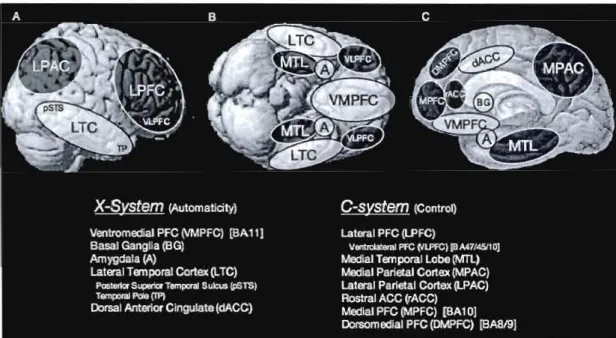
2.1 Hypothesized neural correlates of the C-system supporting reflective social cognition and the X-system supporting reflex ive social cognition displayed on a canonical brain rendering from (A) lateral,
(B) ventral, and (C) media! views. (From Lieberman, 2007, 262) 47
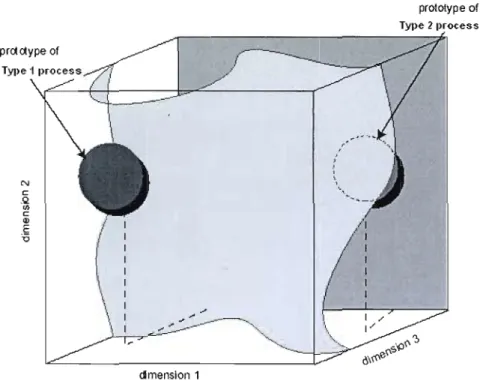
3.1 Prototypes of Type 1 and 2 processes and frontier in a three dimensional conceptual space. (Adapted from Bickle, Mandik and
Landreth, 2010, Figure 3) 73
3.2 Illustration of a projection of the position of various processes (one shown) along a given continuum (e.g. automatic / controlled,
where 0% is not controlJed at ail, and 100% is fully controlled) in the conceptual space with their classification as Type 1 or Type 2 process,
Table Page 2.1 Labels attached to dual-processes in the literature, aligned on the
assumption of a generic dual-system theory. (From Evans, 2008, 257) ... 34 2.2 Clusters of attributes associated with dual systems of thinking. (From
Evans, 2008, 257) 34
2.3 Characteristics of the X-system and C-system. (From
Ce mémoire est consacré aux théories à processus duaux, abondamment discutées dans la littérature récente en sciences cognitives. L'auteur y propose une version fortement amendée de l'approche défendue par Samuels (2009), remplaçant la distinction entre 'Systèmes' par une distinction entre 'Types de processus', qui permet de critiquer à la fois les approches (uniquement) modularistes et les approches décrivant une différence profonde entre deux systèmes ayant chacun leurs spécificités (fonctionnelles, phénoménologiques, neurologiques). Cependant, dans la version des théories à processus duaux défendue ici, la distinction entre 'Types de processus' n'est considérée a priori que comme une distinction heuristique permettant aux chercheuses et chercheurs de mieux comprendre l'esprit et d'en expliquer certaines propriétés. L'idée centrale défendue dans ce mémoire est que les processus cognitifs devraient y être distingués selon leur position dans un espace conceptuel multidimensionnel permettant de considérer l'ensemble des caractéristiques et des spécificités attribuées à un processus, cela étant préférable à les forcer dans l'un ou l'autre des 'Systèmes' ou des 'Types' identifiés dans les approches les plus influentes (cf. Evans, 2008). Une fois ce programme de recherche entamé, il sera alors possible de réviser la définition des concepts et des catégories utilisés pour refonder certaines notions présentes dans la littérature ('module', 'Système 1/2', etc.). L'argument se déroule en trois temps: 1) Le premier chapitre vise à clarifier la notion de 'module' très utilisée en sciences
cognitives. Contre les approches visant à affaiblir cette notion afin que tous les processus de l'esprit soient considérés comme étant des modules, l'auteur - suivant notamment Faucher et Poirier (2009) et Samuels (2006) - jette le doute sur l'emploi qui est fait de cette notion par plusieurs auteurs très influents, notamment en psychologie évolutionniste (par exemple, Barrett, Carruthers, Cosmides, Tooby).
2) L'objectif du second chapitre est de présenter, examiner et critiquer plusieurs théories à
processus duaux et de suggérer qu'aucune théorie actuellement discutée n'est adéquate pour décrire l'architecture de l'esprit. Les approches, particulièrement influentes ou représentatives, défendues par Stanovich (1999; 2004; 2009), par Evans (2008; 2009), par Lieberman (2007; 2009) et par Carruthers (2006; 2009) y sont abordées.
3) Dans le troisième chapitre, l'auteur critique le cadre développé par Samuels (2009), puis développe son approche des théories à processus duaux en montrant certains de ses avantages.
Mots clés: philosophie des sciences, sciences cognitives, psychologie, neurosciences, théorie à processus duaux, modularité, module, heuristique, biais, pensée critique, naturalisme.
This dissertation is devoted to dual-process theories, widely discussed in the recent literature in cognitive science. The author argues for a significantly modified version of the account suggested by Samuels (2009), replacing the distinction between 'Systems' with a distinction between 'Types of processes,' which allows a critique of both the (only) modularist accounts and the accounts describing a deep difference between two systems each having their specificities (functional, phenomenological and neurological). In the account of dual-process theories developed here, the distinction between 'Types of processes' is considered, a priori, only as a heuristic distinction allowing to better understand the mind and
to explain sorne of its properties. The main idea defended in this dissertation is that cognitive processes should be distinguished by their position in a multidimensional conceptual space allowing researchers to consider ail of the characteristics and peculiarities attributed to a process, which is preferable to accounts forcing the process into either 'System' or either 'Type' identified in the most influential approaches (cf. Evans, 2008). Once this research program is in place, it will become possible to revise the concepts used and the categories defined to ground anew sorne of the notions we find in the literature ('module,' 'System 112,' etc.). The argument is made in three steps:
1) The first chapter aims at a clarification of the notion of 'module' commonly used in cognitive science. Against the accounts aiming at a weakening of the notion in order to classify ail of the mind's processes as modular, the author - following most notably Faucher and Poirier (2009) and Samuels (2006) - casts doubt on how this notion is used by many influential authors, particularly in evolutionary psychology (e.g. Barrett, Carruthers, Cosmides, Tooby).
2) The objective of the second chapter is to present, examine and cntlclze many dual process theories and to suggest that no theory currently discussed is adequate to describe the architecture of mind. The accounts, especially influent or representative, suggested by Stanovich (1999; 2004; 2009), by Evans (2008; 2009), by Lieberman (2007; 2009) and by Carruthers (2006; 2009), are examined.
3) In the third chapter, the author criticizes the framework developed by Samuels (2009) before developing his own account of dual-process theories and discussing sorne of its advantages.
Keywords: philosophy of science, cognitive science, psychology, neuroscience, dual-process theory, modularity, module, heuristic, bias, critical thinking, naturalism.
Much of the philosophical tradition conceives the human mind as a unified and rational entity that confers human beings superiority over other animaIs. This view has been, and is still, tremendously influential in many phi losophical debates, including in many accounts of education and of critical thinking.
For instance, in h is 2005 book Petit cours d'autodéfense intellectuelle, Normand Baillargeon has two goals: to make people aware of the importance of thinking critically, and to teach this skill by offering a guided tour of the diverse skills necessary to achieve the difficult task of thinking critically. Teaching critical thinking, the hardest goal of his book, seems simple and is presented as such: first, we teach logic, notions about denotation and connotation in language, arguments, fallacies, mathematics, statistics, and so on. Then, the students practice these newly acquired skills. The idea of this program is that it will be sufficient for them to develop an acute esprit critique and that they will become human beings acting and thinking within the standards of rationality if they wish to do so. In other words, these tools will allow them to be critical thinkers who can avoid being tricked by publicity or fallacies.
The very attractive picture underlying Baillargeon's implementation of his second goal is, sadly, flawed. Moreover, although Baillargeon's implementation, in the end, does not produce the results we would want to see, it is representativeof the way critical thinking is usually understood. For example, Bailin and Siegel (2003) suggest there are two aspects to
critical thinking: the ability and the disposition to think critically, the former referring to the acquisition of a skill and the latter, to the virtues possessed by a subjed.
What these thinkers generally neglect is that acquiring this skill is far more complex than what traditional critical thinking and logic textbooks make us bel ieve. Indeed, rational thinking is hard for human beings; for example, as the heuristics and biases literature shows, it is difficult to apply formai rules or to think along the lines of what is considered rational even when we know how (and are disposed) to do it (cf. Gilovich, Griffin and Kahneman, 2002). Nevertheless, even though his methods for teaching it look unpromising to contemporary cognitive scientists, Baillargeon's second goal - teaching critical thinking - is a very important one and should be investigated further.
Baillargeon's error, 1 believe, is that he takes for granted that, with practice, it is easy to apply the rules once we know them. However, many researchers have shown that the problem is not only the lack of knowledge of the rules, but also the lack of knowledge that intuitions lead us astray in sorne cases: we must realize we need cognitive tools in certain contexts. The idea underlying this dissertation is that not only do we need to properly teach how to apply formai rules to a problem, but we also need to make students aware of how the mechanisms of the mind processes information in order to make it easier for learners to identify and characterize situations in which they must use cognitive tools to override their intuitions (and this insight has sorne experimental evidence; e.g. Houdé et al., 2000). Stanovich and West (2008) suggested an insightful model of reasoning where they include not only the possession of the correct cognitive tools, but also the importance of knowing when to apply these mies - what they cali override detection. Explicitly learning this 'override detection' is only the first step: the students then need to practice and automatize this ability and their use of the appropriate cognitive tools (in the right situation).
l "The primary disposition consists in valuing good reasoning and being disposed to seek reasons, to assess them, and to govem beliefs and actions on the basis of such assessment. In addition, most theorists outline a subset of dispositions that are also necessary for critical thinking, including open mindedness, fair-mindedness, independent-mindedness, an inquiring attitude, and respect for others in group inquiry and deliberation." (Bailin and Siegel, 2003, 183) .
In order to tackle this hypothesis, and explain why only knowing the rules and how to apply them is not enough, there are sorne important issues to consider first as we can both understand why we are unable to find the solution to this kind of task easily and how we can learn to use the tools of critical thinking adequately. The goal of this dissertation is to elucidate one important aspect that serves as a foundation for the framework used by, among others, Stanovich and West (2008) to think about these problems and this type of solution. Their hypothesis did not appear ex nihilo: their model of reasoning is based upon a family of
theories becoming very popular in cognitive science: dual-process theories.
Offering insights into teaching critical thinking is the focal point of my personal overall reflections in cognitive science and the philosophies of mind and education, but what 1 will discuss here will be in the philosophies of cognitive science and of mind by developing a framework in which we can, 1 will argue, 'rethink' dual-process theories. A better grasp of cognitive processes should allow us to devise better methods to teach critical thinking. In other words, to see how these mechanisms function we need, first, to understand how the mind works, and this is precisely the goal of this dissertation, which 1 will achieve by evaluating different frameworks allegedly offering a model of the architecture ofmind.
As mentioned, Stanovich and West's (2008) model is based on a specific account of dual-process theories (cf. Stanovich, 2009). These theories are an important family of hypotheses that are helpful to understand cognition, and that can help understanding many problems encountered in heuristics and biases psychology (Kahneman and Frederick, 2002; Stanovich, 2009; Stanovich, Toplak and West, 2008). For instance, they allow us to understand why sorne biases are systematic. And why they can ultimately be corrected. Yet, while important and influential in cognitive science, these theories have a number of theoretical problems l wish to examine in this dissertation.
1 will develop an account of the mind that could be described as a massive modularity hypothesis, influenced by Carruthers' (2006; 2009) vie~. However, most authors, including Carruthers, assume that there is at least one other type of processes at work: they suggest that there are sorne features of the mind that are not well captured by the idea of a mind strictly composed of 'Fodor-modules' (cf. 1.1 for roy definition of this notion), including Fodor himself (cf. Fodor, 2000). Dual-process theorists (e.g. Evans, Sioman and Stanovich may be the first proponents of the contemporary forro of dual-process theories; for a review, cf. Evans, 2008; for an historiai account, cf. Frankish and Evans, 2009), a forrn of weak central modularity hypothesis (cf. 1.4), usually speak in terms of System 1 (SI) and System 2 (S2), where SI 's processes are evolutionarily old, cognitively-c1osed, autonomous, automatic and function in paral1el, and S2's processes are evolutionariJy recent, seriai, are not cognitively closed and have the capability of inhibiting the automatic response of SI (cf. Table 2.2 for more details).
For some, like Carruthers, the SI / S2 distinction is a good way to think about the processes of the mind, although it does not pick up any deep functional difference3 between the two systems. Consequently, after discussing the massive modularity view and the basics of dual-process theories, 1 will examine how Type 2 processes are realized. This question is indeed a matter of sorne controversy as Carruthers (2006, chapter 4; 2009) views S2 as being realized by multiple iterations of SI 's modules, while Lieberman (2007; 2009) suggests that there are two systems, c1early divided (which he caUs 'X-system' and OC-system'), both anatoroical1y / neurologically and functionally (what 1 will identify as 'deep functional difference'). My own view will be in between, as 1 will suggest that both Carruthers' and Lieberman's views do not offer a satisfactory explanation of sorne of the data.
2 This approach to massive modularity is less restrictive than many other accounts; for example,
Carruthers (2006, chapter 1) argues that Fodor's (1983) definition is too restrictive, while Samuels (2006) argues that Carruthers' account is not restrictive enough.
3 By 'deep functional difference,' 1 mean a difference in the functional architecture of the system
ln short, 1 will argue, following, then modifying importantly, a suggestion made by Samuels (2009), that a dual-process theory using the notion of 'system' cannot be adequate. 1 will then suggest we should rather conceive dual-process theories as series of continua of the different characteristics usually attributed to each system (e.g. automatic / controlled, nonverbal/ language bound, associative / rule based). But, even if 1 do not agree with the identification of specific systems (and sorne of their attributed characteristics, a subject 1 will not discuss here), 1 think there are at least two broadly defined types of processes at work,
being functionally different. However, those are not fixed: Type 2 processes can become
Type 1 (cf. 3.3.2). This is one reason the current dual-process theories, including Samuels' (2009), could not explain every cognitive process: we need a more comprehensive model to integrate ail of the diversity and to explain the complexity of the mind.
0.1 Outfine ofthis dissertation
The ideas behind this dissertation are shaped by many discussions in philosophy and cognitive science about the architecture of mind, especially evolutionary psychology and the psychology of reasoning. The dual-process theories mentioned previously are now widely discussed in this literature and, as Evans (2008) observes, most researchers in cognitive science seem to suppose - at least impl icitly - one version or another of this type of theories. Indeed, many examples are present in the cognitive science literature of the last 30 years. In Fodor (1983; 2000), Stanovich (1999; 2004; 2009), Evans (1989; 2008), Sioman (1996; 2002), Samuels (2009), Frankish (2004) and even, to a certain extent, Carruthers (2006; 2009), to name a few from phiJosophy and from psychology, we can find the idea of a mind having two types of processes, or two systems, to explain how the mind, or certain processes of the mind, works. These theories have different names, and they are not ail identical, but the general idea remains: accounts of the mind that are entirely modular or entirely domain-general, i.e. accounts explaining the mind as having only one type of processes, are not explanatorily adequate.
The aim of this dissertation is to defend a particular account of dual-process theories, i.e. an analysis of the mind as composed of different types ofprocesses4 rather than composed
5
of two distinct systems , or of two groups of processes having predetermined characteristics6, as most accounts in the literature do (Evans, 2008). 1 will argue that my account solves many of the problems currently encountered by these dual-process accounts of the mind.
In my first chapter, 1 will discuss the notion of'module' widely used in cognitive science as the discussions of modularity in general, but mostly the discussions around the nature of central modularity, offer interesting insights about what these two parts of the mind might be. Sorne of these discussions about modules are very close to many debates on dual-process theories, especially the nature of SI or Type 1 processes (moreover, Fodor defends a version of dual-process theories). 1 will explain Fodor's (1983) modularity of mind thesis and see
4 In this dissertation, the term 'process' is meant as a general term that refers to any causal
sequence that produces a certain output (the 'product'). Sorne processes are not functional, viz. one cannot say that it is their function to produce their outputs (e.g. plate tectonics as a process who se product is the current geological structure of the earth). Many processes are, of course, functional: those made up by humans (e.g. word processing) and those 'designed' by evolution (e.g. digestion or respiration). Of course, the processes of concern here will be cognitive processes, viz. processes that manipulate, store and transform information in order to help organisms behave adaptively or intelligently in their environment.
In this context, a 'type of processes' refers to a set of processes grouped together because they share one or more characteristic that make them theoretically or explanatorily relevant: while each process is a token, sorne authors (e.g. Evans, 2008; Samuels, 2009; Stanovich, 2009) argue it is possible to regroup sorne of these processes into either one of two types - associated with the characteristics usually attributed to System 1 or System 2.
5 A 'system' is any causally interconnected set of components, from which interaction emerges
(as described by Wimsatt, 1986) a property or capacity (the systemic property or capacity). The parts are interconnected the way they are and the systems have these properties they have for causal reasons; for example, in most frameworks under scrutiny here, they have these properties for evoJutionary reasons. Systems have a specifie structure (their parts and the way they are interconnected) and a certain behavior (way(s) of processing information). Of concern here the dual emergent properties of types of cognitive (sub)systems, dubbed 'System l' (automatic, fast, paraIJel, etc.) and 'System 2' (controlled, slow, seriai, etc.). In 2.1, 1 will describe how dual-process theories use the notion of 'system' in more details.
6 This could be the case if the SI / S2 or Type 1 / Type 2 distinction identified natural kinds. 1 hope to show we currently do not have sufficient evidence to conciude that they are.
how this is an account of dual-process theory where central cognition is not (at ail) modular. Then 1 will explore how this notion of 'module' has been used by evolutionary psychologists to explain parts of central cognition. Next, 1 will present a recent, more encompassing7, account of central modularity, where the mind is entirely modular, defended most notably by Carruthers (2006, chapter 1). 1 will finally introduce some of Carruthers' critics and defend Samuels' (2006) weak central modularity hypothesis.
ln my second chapter, 1 will discuss the basics of dual-process theories and argue that one consequence of the debates around massive modularity is to adopt one type or another of dual-process account of the mind, even for its most ardent defenders8. However,
Carruthers (2009) takes another path by suggesting that S2 results from the multiple iterations of capacities implemented in SI systems. For him, there is no deep functional difference between the SI and S2, there are only differences in how the output of a systemfeels like to the organism that has the system and how the system is realized. For Carruthers, explaining S2 as multiple iterations of capacities implemented in SI systems implies that there are no deep functional differences between a cognitive system with only SI capacities and one with S2 capacities, but there are differences in how it works (these multiple iterations are different than a single iteration of one of SI 's capacities). Moreover, it is this '(shallow) functional difference,' how a given process works, what gives rise to phenomenological differences. Carruthers' version of the SI versus S2 distinction will be contrasted with Lieberman's position: Lieberman believes there are deep functional differences between SI and S2 (Cohen and Lieberman, 2010; Lieberman, 2007; 2009; Satpute and Lieberman, 2006; see also its presentation by Evans, 2008, 270). He believes that SI and S2 are well-defined systems we can c1early identify to specifie neuronal activation patterns, and goes as far as to attribute some cognitive capacities to specifie brain
7 The characteristics Carruthers attributes to modules are weaker, which makes his account - a
strong central modularity thesis - a more encompassing account of the modularity ofmind.
8 1 wiJi also highlight that the weak central modularity thesis is more plausible than the 'strong' version.
regions. Both Carruthers' and Lieberman's account are unsatisfying as they fall short of explaining a nurnber of cognitive processes. Still, other dual-process theorists are not more successful in tempting to describe and explain processes that do not fall in either SI or S2 - 1 will be interested in accounts defended by Stanovich (2009) and by Evans (2009).
ln my third chapter, 1 will develop my own account. Contra Carruthers and Lieberman, 1
will suggest we should cease to use the notion of 'System' altogether when talking about this difference (more or less in line with Samuels', 2009 suggestion), and instead speak of Type 1 and Type 2 processes. However, the characteristics attributed to each 'Type' do not align as
Samuels (2009) pretends, viz. the dichotomies identified in Table 2.2 do not necessarily co-vary and it is possible to find, for example, automatic and controlled processes or others that are nonverbal and conscious: for this reason we need a framework where we can take this important fact into account. In a nutshell, my view is that to understand the mind, we need a series of continua, one for each of the different characteristics posited by dual-process theorists, thereby creating a n-dimensional conceptual space (where n is the number of
characteristics considered) we can use to situate every cognitive process according to its own properties. The Type 1 / Type 2 division would thus simply be a shortcut to locate regions in this conceptual space where most processes c\uster when their characteristic are plotted in the space.
After arguing for this view, 1 will discuss its three main advantages: it allows us (i) to posit complex processes having both Type 1 and Type 2 characteristics (such as one discussed by Evans, 2009, but 1 will provide other examples), (ii) to account, conceptually at least, for the possibility of processes becoming modularized, i.e. for a Type 2 process to
acquire some (and even most) characteristics of Type 1 processes (exploring thereby an idea suggested, among others, by Karmiloff-Smith, 1992 and also providing a framework for Dreyfus and Dreyfus', 1986 observations) and, finally, the conceptual space my view introduces (iii) could be very useful for further research.
ln the end, this emphasis makes this dissertation an essay in the philosophy of cognitive science, especiaily in the philosophy of psychology, more than one concerning the philosophy of education. 1 strongly believe that the discussion presented more generally in
this dissertation should not be neglected if we are to make useful recommendations about what, when, how and why we are to teach children (or adults!) as knowing more about the architecture of the mind can only help us in devising new and better tools.
0.2 Viewing the mind evolutionarily: the framework
The argument developed in this dissertation relies, first and foremost, on an evolutionary framework. The human body is seen as the result of a long and complex evolutionary process, and this claim is not very controversial. For example, sorne features of the human body are clear examples of bad (i.e. not optimal) design (retinal blind spot, spine not ideal for
upright position, esophagus can cause choking, and so on). On this basis, the idea of the mind as a unified and rational entity has been challenged, for instance by Marcus (2008). For him, not only the human body is a kluge: the human mind also is one. A kluge, in the vocabulary
of engineers, is a functioning but "clumsy or inelegant" (Marcus, 2008, 2) solution to a complex problem.
In the case of the mind, its engineer, the process of natural selection over small genetic
mutations, has no goals, a fortiori no goal such as an optimal or elegant solution: only
survival and reproduction matter to her. If an inelegant solution is efficient, it will be passed on. Moreover, as Jacob (1970) observed, natural selection can only work with what it has at hand: it cannot redesign a system from scratch. Therefore, the mind is the product of an evolutionary development that always occurs on top ofwhat was already there: Marcus talks
about layers of 'technology,' with the upper layer working with what is in place in the layers undemeath. The mind is then viewed as the product of an evolutionary process and, this is a key to evolutionary explanations as Dawkins (1986) argues. The structures or capacities added might allow for more efficient process, but these processes might be Iimited (or, at least, Iimited in certain cases or in certain environments). When studying the mind, understood as the result of an evolutionary process, we must then question the assumption that a given cognitive process is optimal, or even that the process in question is perfectly adapted to its task (as it could be only a by-product, or it could only be partially adapted): it
must be proven. Additionally, an elegant architecture cannot be presupposed: such a discovery is possible (but improbable) but, here again, it cannot be taken for granted.
Such a view is important because it offers a new insight on what seems to be limitations of our mind discussed by psychologists, such as Wason, Evans, Kahneman, Tversky and many others (e.g. Bishop and Trout, 2005; Cosmides and Tooby, 2000; Gilovich et al., 2002; Marcus, 2008; Stanovich, 1999; 2004; 2009; Stanovich et al., 2008; Stanovich and
West, 2008). Indeed, this view of the mind as a kluge is in line with the evolutionary approaches in psychology by holding that cognition is the product of evolution. The mind is made, at least partly, of many modules; as Gigerenzer, Todd and the ABC Research Group (1999) suggested. It is an assembly of systems functioning with simple heuristics that are good enough in ecological environments, but that produce suboptimal outputs in some situations9.
In the Iiterature, such a framework has appeared under the label of 'evolutionary psychology,' and these researchers made much progress to understand the characteristics of the human mind. In practice however, their program focuses on the idea ofmodules in a more or less Fodorian sense, often without elaborating on other types of processes (cf. 1.2). Many researchers question this view and explain cognition with a more flexible framework, and it is at the center of this dissertation. Dual-process theories are indeed an alternative much discussed in the literature (Carruthers, 2006; Evans and Frankish, 2009; Stanovich, 2004; 2009) and my goal is to offer an account that cou Id potentially solve most of its current difficulties (as identified by e.g. Evans, 2008; Keren and Schul, 2009; Machery, forthcoming, section 8; Samuels, 2009) without 10sing its explanatory power.
9 Gigerenzer (2007) seems to argue that these situations are scarce; 1 do not agree with this
position since the environment in which these heuristics are activated is now very different from the environment in which this heuristic evolved. It does not mean in any way that these heuristics lost their usefulness or their accuracy in a great deal of contexts; it only means that, in many situations, we cannat rely on these natural heuristics alone. There are many cultural heuristics (meta-heuristics, cf. Wimsatt, 2007) that can help us when these automatic processes go astray (cf. Afterword).
DOES THE MIND WORK THAT WAY? MODULARITY AND ITS LIMITS
What exactly is a module and what does the modularity hypothesis explain is subject to a large amount of controversy. 1 will begin by presenting Fodor's (1983) account of modules before assessing what modularity can and cannot explain (Fodor, 2000) by looking at discussions about modules in the evolutionary psychology literature. Fodor's influential proposai was interpreted in diverse ways, but the most discussed of these is most probably the interpretation of modularity made by Evolutionary PsychologistsJ
o.
Their suggestion is that central cognition is, at least partly, modular. They introduced, with the massive modularity hypotheses, what Samuels (2006) called central modularity hypotheses, and which exist in different degrees:
Strong central modularity: All central systems are domain specifie and/or encapsulated,
and there are a great many of them.
Weak central modularity: There are a number of domain specifie and/or encapsulated
central systems, but there are also nonmodular - domain general and unencapsulated central systems as weil. (Samuels, 2006, 42)
10 Here, l am mostly referring to the so-called 'Santa Barbara evolutionary psychology school'
around Cosmides and Tooby, those who Buller calls Evolutionary Psychologists (capital 'E' and 'P,'
This distinction is essential to understand the debates over the nature of modularity. Fodor's (1983) account of modularity is different from that of Evolutionary Psychologists on many grounds (cf. Faucher and Poirier, 2009), and this is a crucial point. Many Evolutionary Psychologists argue that the mind is massively modular, i.e. that most of cognition, including a large part of central cognition, is modular. It is important to note that, although there might be literally thousands of modules according to sorne of them, they are not suggesting that there is nothing else besides modules (cf. Cosmides and Tooby, 1994; Clarke, 2004,
chapter 1). At least a part of central cognition is modular: they defend an account of weak central modularity.
In the literature on modules however, there are sorne who defend strong central modularity hypotheses, su ch as Barrett (2009; Barrett and Kurzban, 2006) and Carruthers(2006; 2009). For them, as Samuels explains, there is nothing other than modules that make up the mind. While this might seem implausible given Fodor's characterization of modules (cf. 1.1), their strategy - and the initial strategy adopted by Evolutionary Psychologists - is to redefine what 'module' means by removing sorne of the characteristics Fodor ascribed to them. The general idea is that weaker notions of module can expJain sorne aspects of central cognition, up to the point where, even in central cognition, there is nothing else besides modules.
For his part, Fodor insists that modularity can only explain peripheral cognition, viz. that it cannat explain any aspect of central cognition (e.g. our capacity to do abduction). In other words, for Fodor (1983; 2000), central cognition is not modular to any extent.
After explaining what Fodor means by 'module,' 1 will explore the strong central modularity hypotheses of Barrett (and sorne Evolutionary Psychologists) and Carruthers. 1 will then criticize Carruthers' account, and suggest that dual-process theories might answer many of the problems ofmassively modular accounts of the mind.
1.1
Fodor's modularity
Fodor-modules have nine properties: their operation is domain specifie, mandatory once activated (and they are automatic), fast, informationally encapsulated, their processes are not eentrally accessible (only their output is), they have shallow outputs, exhibit specifie 'breakdown patterns' and characteristic pace and sequencing (they have an ontogenetie timetable, viz. specifie developmental eharaeteristics), and finally they are associated with a fixed neural architecture.
In
this dissertation, 1 will use the notion of 'Fodor-module' to refer to any module possessing ail these nine characteristics. However, it is crucial to remember that Fodor states explicitly that modules may miss sorne of these characteristics, as it will be critical when 1 will diseuss dual-process theories in Chapter II. In other words, Fodor is not explicitly defending a dual-process aeeount where there are only Fodor-modules and central / higher cognition; he rnight allow sorne modules with only sorne of the nine charaeteristics presented in the preceding paragraph. Furthermore, my goal is not to present each of these characteristics in detail (especially since some of these are linked - possibly causal1y - to others) but only sorne of them, those that are important to the thesis 1 will develop in this dissertation.The idea l want to emphasize below is simple: Fodor's account is interesting to explain sorne cognitive processes, but certainly not ail of them. Of course, he limits his account to peripheral cognition ", mostly input systems, by specifying that "[e]ven if input systems are domain specifie, there must be sorne cognitive mechanisms that are not" (Fodor, 1983, 101), but even those input systems, as 1 will argue, might be more diverse than his strong modularity account allows, viz. sorne input systems exhibit sorne non-modular traits (and many central processes or systems have modular traits).
Il As Prinz (2006, 22) notes: "The book would have been more aptly, if less provocatively, called
One of the best known and most discussed characteristic of modules is their domain specificity. Modules, according to Fodor, are specialized to respond to certain inputs, and usually have their own sensory transducers. They are limited to a particular type of inputs, and this would be why they are as efficient as they arel2 . Understood in this way, domain
specificity is problematic on a number of levels.
The way to determine how many modules there are in the mind depends mostly on what is considered to be a domain, Le. it depends on the grain used to analyze, and it also depends on what modules are considered to be (Can we identify and distinguish modules functionally?, Are modules natural kinds?, etc.). And, once the proper grain is found (if there is a way to do so; cf. Prinz, 2006, 27-30 for a sceptical outlook), the jury might still be out to find the proper description of a given process (Atkinson and Wheeler, 2004). Vision, for example, likely needs an important number of modules to do its task, but should we count horizontal line detectors and vertical line detectors as two types of modules, or is it more interesting to use the more general c1ass of edge detectors? The description of the visual
system will likely change in important ways depending of the answer we give here. The general idea still remains important: a module answers to (or is activated by) a certain classes of inputs, and determining how to find the proper way and the correct level of analysis is
largely up to empirical research13 .
Modules are automatic and mandatory: visu al or auditory illusions provide a good example of this characteristic. If the appropriate stimulus is presented and seen or heard, the illusion will be seen or heard (the McGurk effect, cf. McGurk and Macdonald, 1976, is a nice
12 An Evolutionary Psychologist would say the input system evolved for solving an evolutionary
problem, and this is why a given module is specialized (cf. Carruthers, 2006, chapter 1) an idea Fodor would probably try to resist (cf. Fodor, 2000; Fodor and Piattelli-Palmarini, 2010).
13 For instance, Machery (2009) argues that 'concept' is not a natural kind, i.e. it is not a useful
generalization in psychology. For him, there are different kinds of structure, different types of modules we might say, that are used to do the different tasks traditionally attributed to a more general process. Machery's contribution is to show that there are very good reasons to distinguish between 'prototype concepts,' 'exemplar-concepts' and 'theory-concepts' and, for him, they are different modular processes.
example of senses combination). Fodor presents three examples to illustrate his idea: first, if someone hears a given utterance in a known language, she will hear a sentence and give it meaning; second, any object perceived is perceived in a three-dimensional space; third, touching a surface entails feeling it. The first example he gives, as we will see, might be problematic (cf. 3.3.2), but this characteristic is otherwise pretty straight forward: it is not possible for an unimpaired subject not to see when his eyes are opened, not to feel when he touches an object, not to hear when a noise or not to taste or smell when certain molecules come in contact with the appropriate receptors, and the same goes for other types of higher level modules such as speech recognition (if 1 hear French, 1 will attribute meaning to the utterance).
Modules are fast: once activated, a module usually produces its output weil un der a quarter of a second. The two important aspects this reveals according to Fodor (1983,63) are the contrast between the speed of the modules' processes as opposed to how slow central processes can be, and the strong link between speed and their mandatory operation.
As Fodor explains, sorne of the computational problems we solve automatically, such as being able to identify an object against its background, are not necessarily easier or harder computational problerns per se than solving a long mathematical equationl4 . He even goes
further by suggesting that "[t]his dissimilarity between perception and thought is surely so adequately robust that it is unlikely to be an artefact of the way that we individuate cognitive achievements" (Fodor, 1983, 63), something Carruthers disagrees with (cf. 2.2). The second idea, that "processes of input analysis are fast because they are mandatory" (Fodor, 1983, 64), is related to the fact that an automatic process does not involve any
14 The Hrst case can be extremely difficult ta implement in artificial agents, but it is easy to do for
decision making processl5 • Reflexes are faster than deciding to do a given action because, simply put, "making your mind up takes time" (Fodor, 1983,64).
The outputs of Fodor-modules are shallow. The notion of shallowness, as applied to modules, is ambiguous, both in Fodor (1983, 86-97) and in the literature more generally. He sees it as the difference between "observation and inference" (1983, 86), shallow outputs being those directly observable whereas non-shallow (deep?) outputs being those that can be inferred (e.g. we can directly observe that a traffic signal is red but can only infer that it is meant to signal the obligation of stopping). However, he remains vague as to exactly what he means by this, and Fodor's vagueness has given rise to a number of distinct interpretations.
Prinz, for instance, rejects the idea that "[s]hallow outputs are outputs that do not require a lot of processing" (2006, 25) because it is not precise enough to create any meaningful categorization (what is 'a lot' is not c1ear). Carruthers prefers to understand the idea that outputs of modules are shallow as meaning that they are nonconceptual (Carruthers, 2006, 4), and this is certainly a strange interpretation of shallowness (e.g. Fodor wou Id probably not agree with this idea, as even the most basic categories, the primitives, are 'concepts' for him; cf. Fodor, 1998, chapter 2). Faucher and Poirier prefer to explain shallowness in terms of 'basic categories,' viz. categories that do not use background knowledge, categories that are simpler representations (Faucher and Poirier, 2009, 287). This view is less controversial, and more in line with Fodor's project generally (e.g. Fodor, 1998). This means that we should understand shallowness as meaning that the modules' outputs are not theoretically charged which seems an interesting way to understand modules' shallowness in the contemporary context. By combining aspects of the three views discussed above, we obtain an account of shallowness as the fact that the outputs of modules involve no reconceptualization using background know1edge because the processes are strongly encapsulated, and this absence of reconceptualization is the reason the outputs of module do not require much processing.
15 "Because these processes are automatic, you save computation (hence time) that would
otherwise have to be devoted to deciding whether, and how, they ought to be performed." (Fodor, 1983,64)
Modular processes are not centrally accessible, V1Z. we do not have introspective
knowledge of their workings. Only their outputs are accessible to other modules or to central cognition. This latter characteristic is analogous to informational encapsulation: the inaccessibility characteristic specifies that the representations within a module are not accessible to central processes, while informational encapsulation tells us that modules cannot have (direct) access to the content of central cognition (or that of other modules). For example, visual modules do not have access to our knowledge that a given picture is an optical illusion (and we cannot consciously affect the inner workings of the module), hence the illusion persists and there is no direct way of affecting it.
Fodor argues modules might be associated with fixed neural architectures (Fodor, 1983,98), and that these modules also exhibit specifie ontogenetic sequencing. Indeed: during development, sorne capacities appear at specifie moments and in characteristic ways. Language acquisition is the best known case, but there seems to be such developmental constancy in folk physics, folk psychology, mathematics, etc. Piaget's work is the best known on sorne of these questions and, even if his framework is opposed to domain specificity, the neopiagetians' framework is not (e.g. Gopnik and Meltzoff, 1996; Gopnik, Meltzoff and Kuhl, 200016).
As l already mentioned, many processes have these characteristics according to Fodor, but the modularity of mind applies on1y to peripheral cognition. He argues, and insists on this idea, that central processes are not and couJd not be modular. For example, central processes are argued to be quinean, viz. processes of the central system are taken to be potentially sensitive to the whole set of beliefs held by the subject (holism), making these processes unencapsulated. Fodor's account is widely debated and many disagree with his view, stating it is too restrictive (Carruthers, 2006; Samuels, 2006), sometimes going as far as rejecting modularity altogether (Prinz, 2006).
16 Another example is Karmiloff-Smith's (1992) work, where she offers an interesting perspective
Another account of modularity is however possible: Evolutionary Psychologists began to argue for the massive modularity hypothesis, in which even central cognition might be, at least partially, modular, an idea against which Fodor argued in his 2000 book. An important point is however rarely mentioned: many of these debates are about how to define 'module' rather than about modularity itself.
1.2 Evolutionary Psychology, massive modularity and the many deflnitions
of 'module'
Evolutionary Psychologists use the notion of module in the framework of the massive modularity hypothesis. The idea, against Fodor's (1983, 2000), is that there is more to 'the modularity of mind' than just an explanation of the peripheral systems. Most Evolutionary Psychologists adopt one form or another of a central modularity hypothesis. Here we must appeal to the distinction made between strong and weak accounts of central modularity at the beginning of this chapter. In this section and in the next, 1will discuss the strong central modularity account before suggesting we adopt a weaker central modularity hypothesis in 1.4.
If, in many cases, the weak central modularity thesis seems to be preferred to the more restrictive accounts (e.g. Clarke, 2004, chapter 1), according to Barrett, the only essential
characteristic we should consider when defining 'module' is functional specificity (Barrett, 2009, 779). If Barrett's definition is accepted, any process of the mind, if it has one (or more) specific function, will be counted as a module, without further consideration as to how it works. This, of course, might be seen as problematic since the notion of module would thereby lose its very substance: 'module' would then become an uncontroversial notion that does not add anything to traditional 'boxology' in psychology (Faucher and Poirier, 2009).
The problem encountered here is the difficulty of defining what a 'module' is. It remains hard to define this term as it is central to many theories, and this difficulty appears c1early with Barrett's minimal characterization.
This notion is used to talk about a large number of cognitive phenomenon and "not only have authors used the term modular to refer to different concepts, but even explicit definition of the term by some researchers has been insufficient to avoid subsequent misunderstandings by others" (Barrett and Kurzban, 2006, 642). Moreover, there seems to be "no agreement on a workable characterization of modules for evolutionary psychology" (Downes, 2008, section 3). Still, in aIl instances, modules are seen by Evolutionary Psychologists as "adaptations, specific to a domain most of the time" (Faucher and Poirier, 2009, 296, my translation). They were selected, through natural selection, for solving adaptive problems such asdetecting cheaters in social exchange and recognize kin (these are sorne of the most corn mon and discussed examples).
If the view of modules as merely adaptations were general1y agreed upon by Evolutionary Psychologists, the notion of module, as defined in this functional account, would lack the explanatory power of a richer notion of module. A very general characterization of module will encompass many distinct processes, but, once we identifY one such process as a module, we will have very few details on the process in question. A richer account however would provide us with mu ch more information once a module is identified. The analogy 1 have in mind is the fol1owing: in chemistry, if we identifY a substance as a non-metal, we will be able to know sorne of its characteristics, but if we identifY the same substance as oxygen, which has a richer definition (including its precise chemical structure), we will know a good deal more about the substance in question.
Of course, as Barrett and Kurzban indicate, modularity in general can help "direc[t] the search for specialization," especially in a framework where evolution has a role to play, as it "constrains the hypothesis space regarding plausible functions" (2006, 643). Yet, this notion is far from the one we began this discussion with and it has nothing left in common with Fodor-modules (or even Fodor's account more generally).
These various changes in the definition of the notion of 'module' used by Evolutionary Psychologists might be mostly explained by diverse debates that occurred around Fodor's
The Mind Doesn 't Work That Way, a clear attack on Pinker's (1997) massive modularity hypothesis in the context of Evolutionary Psychology, but also around critical studies of the
underlying principles of Evolutionary Psychologists' theories and their assumptions (e.g. Buller, 2005; Samuels, 1998). The original research program put fOlward by Tooby and Cosmides (199217 ) was ambiguous, to say the least, about what modules are and this lead to a series of discussions culminating in a complete dissociation with Fodor's (1983) notion in order to adopt a notion closer to Barrett's (2009):
[. 00] Fodor's (1983) concept of a module is neither useful nor important for evolutionary psychologists. For evolutionary psychologists, the original sense of module - a program organized to perform a particular function is the correct one, but with an evolutionary twist on the concept of function. (Ermer, Cosmides and Tooby, 2007, 153)
In other words, on this account 'module' does not mean much more than a process that has a particular function. If it is the case, and evidence suggests it is, Faucher and Poirier propose to Evolutionary Psychologists that they should "sim ply stop talking about massive modu!arity, and rather talk in terms of a mind massively constituted of adaptive structures"
(2009, 307, my translation and emphasis) because the mainstream use of 'module' ln cognitive science still refers to Fodor-modules or similar structures (with less and / or modified characteristics). Modules, as defined by Barrett (2009) and by Ermer et al. (2007),
have a lot less explanatory power and this is an important loss if we are to explain how the mind works.
Carruthers however has developed an interesting account of modules, where he develops another kind of strong central modularity to defend Evolutionary Psychologists against Fodor's arguments but does not do so by removing ail substance to the notion of 'module,' as is the case with Barrett.
17 While this article in particular, and more generally, the 1992 book (Barkow, Cosmides and Tooby, 1992), might not be the absolute tirst presentation of the Evolutionary Psychologists' framework, it is arguably its flfst detailed account, and certainly the most influential one (e.g. over 2000 citations according to Google Scholar). The earliest presentation of their position is most probably Cosmides and Tooby's 1987 article. The primer published online (Cosmides and Tooby, 2000) is a more recent presentation of this same research program, where they (still) remain vague about what 'module' refers to, although they explicitly refer to Fodor-modules.
1.3 Carruthers' account of massive modularity: strong central modularity
and weak modules
Fodor is clear: we should not (and we could not) understand the m!nd as being only modularl8 . Nonetheless, Carruthers (2006; 2009) suggests that, with a weaker account of
what a module is, we can have a framework where the mind is only composed ofmodules. Of course, he agrees that peripheral cognition is modular, but he goes further by arguing that central cognition also is entirely modular. A major difference between Carruthers' approach and many of the accounts previously discussed is that he argues for massive modularity, without relying on an insubstantial characterization such as Barrett's, clearly identifying many traits of modules. Moreover, he defends Evolutionary Psychologists by providing a philosophically plausible approach to modularity.
His account is related to the strong central modularity thesis; in fact, in his massive modularity account, al! cognitive processes are either modular or emerge from the interaction of modular processes. To do so in a plausible way, he weakens the notion of 'Fodor-module' by removing sorne of its characteristics and redefining others. In fact, even if his notion is richer than Barrett's (2009), the notion he ends up with is so inclusivethat Samuels (2006) and Prinz (2006) are not convinced it could be of much use (cf. lA).
Brief1y, for Carruthers, modules are processing systems, usually associated with a functional domain, that are frugal in their operations and are more or less strongly encapsulated (he introduces the wide-scope versus narrow-scope distinction, which 1 explain below), and by and large, only the outputs of a modular process will be available to other processes (Carruthers, 2006, 62-63). However, his account is mostly liberal and allows a lot of variability in each of the characteristics attributed to modules.
Carruthers begins by rejecting some of the characteristics of Fodor-modules, since they would be incompatible with any account of central modularity. The shallowness of the output is the first rejected by Carruthers, but he also discards speed. Following these modifications, he takes as plausible domain-specificity, the mandatory and innate character of modules and the neural specificity characteristics, before modifying what is meant by encapsulation and, then, add ing frugality.
Carruthers rejects the shallowness of modules' outputs for an obscure reason. He states that if the mind is massively modular as the strong central modularists posit, then there will have to be 'conceptual modulesI9., Then, it will be necessary to explain the outputs of
'conceptual modules,' since only such outputs can provide the "fully conceptual thoughts or beliefs" (Carruthers, 2006, 8) conceptual modules wou Id produce as outputs. He is not clear as to why this is implied: we could easily imagine conceptually shallow content related to a module Carruthers identifies as conceptual, such as kin recognition: recognizing as kin those you have seen for long periods of time during childhood can be done 'shallowly.' 1 believe the same goes for more complex outputs. Of course, ultimately, conceptual content would have to come into the picture, but Carruthers has, 1 believe, to have a solution for this in his own framework (cf. 2.2). Of course, if we understand shallowness in terms of nonconceptuality (Carruthers, 2006, 4), Carruthers' point can be made easily because it then becomes somewhat absurd to characterize ail modules as shallow, and such shallowness would not even be compatible with Fodor's own account of what a concept is (cf. Fodor, 1998).
The rejection of 'speed' as a characteristic is clearer: modules are fast, according to Fodor, but this characterization only makes sense when the modules' speed is compared to the speed of central processes, viz. modules are faster than central cognition. Without any such comparison, since both peripheral and central cognition are entirely modular for
19 Conceptual modules are, for Carruthers, modules dealing with common-sense physlcs or
biology, or modules used for kin recognition or cheater-detection in social exchanges. As 1pointed out previously, mentions ofthese modules are the most commonly found in the literature.
Carruthers, it makes little sense of maintaining that modules are fast (or slow) (Carruthers, 2006, 9).
At first sight, it seems domain specificity might also need to go because, in a massively modular architecture, sorne modules would need to receive inputs of aJ1 kinds: Carruthers' example is practical reasoning (cf. Carruthers, 2004), and such a module could not be 'domain specifie.' In this context, one could understand domain specificity in functional terms (modular processes are restricted to a domain) instead of in terms of content (modules have domain specifie content but domain-general processes) as it is usually done20 . We would
obtain a notion of modularity similar to Barrett's (2009), but more precise (as it possesses other characteristics). Although Carruthers agrees modules are systems with "a distinctive function, or set of functions" (2006, 62), he prefers to keep domain specificity and he states that it is possible to understand practical reasoning as being "underpinned by a whole host of different [modular] systems" (Carruthers, 2006, 8), each ofwhich would be domain specifie. Still, he is not firm on the necessity ofthis characteristic: while most modules are likely to be domain specifie, sorne ofthem could be domain-general (or more general, similar as what he suggests for encapsulation, as discussed below).
Carruthers sees sorne modules, even central ones, as being mandatory since they will automatically process any input they receive. Just as it is the case for the perception of one line as being longer than the other in the Müller-Lyer illusion, we cannot 'turn off most of our faculties. For Carruthers, "most (if not ail) of the component systems that make up the human mind are mandatory in this sense [they can't be lurned off al wU!]" (2006, 9), but it also leaves the possibility that, for sorne of the components (probabJy just a few), it could be possible to interrupt their operation. The exampJe he provides for the mandatory character of 'higher' modules is mind-reading: seeing an actor being sad on stage gives the impression he is sad, even ifwe know he is not.
20 Content domain specificity allows Samuels (1998) to argue for the plausibility of the Iibrary