Regional Activity Centre for Specially Protected Areas (RAC/SPA)
Boulevard du Leader Yasser Arafat | B.P. 337 - 1080 Tunis Cedex -Tunisiaphone: +216 71 206 649 / +216 71 206 485 / +216 71 206 851 / +216 71 206 765 Fax: +216 71 206 490
E-mail: [email protected]
Centre d’Activités Régionales pour les Aires Spécialement Protégées (CAR/ASP)
Boulevard du Leader Yasser Arafet - B.P. 337 - 1080 - Tunis Cedex - TunisieTéléphone: +216 71 206 649 / +216 71 206 485 / +216 71 206 851 / +216 71 206 765 Fax: +216 71 206 490 E-mail: [email protected] web: www.rac-spa.org R A C / S P A
PROCEEDINGS OF THE
5th
MEDITERRANEAN SYMPOSIUM
ON MARINE VEGETATION
Portorož, Slovenia, 27-28 October 2014
ACTES DU
5
èmeSYMPOSIUM
MÉDITERRANÉEN SUR LA
VÉGÉTATION MARINE
Portorož, Slovenie, 27-28 octobre 2014
© Sa ndr in e R ui tto n
October 2014
Avec le support du projet MedKeyhabitats Finance par la fondation MAVA With the support of MedKeyhabitats project Financed by the MAVA Foundation
PROCEEDINGS OF THE
5th
MEDITERRANEAN SYMPOSIUM
ON MARINE VEGETATION
Portorož, Slovenia, 27-28 October 2014
ACTES DU 5
èmeSYMPOSIUM
MÉDITERRANÉEN SUR LA
VÉGÉTATION MARINE
The finding interpretation and the presentation of the material, expressed in this publication are entirely those of authors and should not be attributed to UNEP.
Les informations et la présentation des données, qui figurant dans cette publication sont celles des auteurs et ne peuvent être attribuées au PNUE.
Copyright :
© 2014 United Nations Environment Programme, Mediterranean Action Plan, Regional Activity Center for Specially Protected Areas (RAC/SPA)
© 2014 Programme des Nations Unies pour l’Environnement, Plan d’Action pour la Méditerranée, Centre d’Activités Régionales pour les Aires Spécialement Protégées (CAR/ASP) This publication may be reproduced in whole or in part, and in any form for educational or non-profit purposes, without special permission from the copyright holder, provided acknowledgement of the source is made. No use of this publication may be made, for resale or for any other commercial purpose whatsoever, without permission in writing from UNEP.
La présente publication peut être reproduite en totalité ou en partie, et sous n’importe quelle forme, dans un objectif d’éducation et à titre gracieux, sans qu’il soit nécessaire de demander une autorisation spéciale au détenteur du copyright, à condition de faire mention de la source. La présente publication ne peut être utilisée, pour la revente ou à toutes fins commerciales, sans un accord écrit préalable du PNUE.
Citation :
UNEP/MAP – RAC/SPA, 2014. Proceedings of the 5th Mediterranean Symposium on Marine Vegetation (Portorož, Slovenia, 27-28 October 2014). LANGAR H., BOUAFIF C., OUERGHI A., edits., RAC/SPA publ., Tunis: 251 p.
PNUE/PAM – CAR/ASP, 2014. Actes du 5ème Symposium Méditerranéen sur la Végétation Marine (Portorož, Slovénie, 27-28 octobre 2014). LANGAR H., BOUAFIF C., OUERGHI A., édits., CAR/ASP publ., Tunis :251 p.
Suite aux recommandations du Plan d’action pour la conservation de la végétation marine en mer Méditerranée (adopté par les Parties contractantes à la Convention de Barcelone, en 1999), du Plan d'action pour la conservation du coralligène et des autres bio-constructions de Méditerranée (adopté par les Parties contractantes à la Convention de Barcelone, en 208), du Plan d’Action pour la conservation des habitats et espèces associés aux monts sous-marins, aux grottes et canyons sous-marins, aux fonds durs aphotiques et aux phénomènes chimio-synthétiques en mer Méditerranée (Plan d'action pour les habitats obscurs) (adopté par les Parties contractantes à la Convention de Barcelone, en 2013) et dans le but du développement des connaissances, une série de symposiums scientifiques, dédiée à ces habitats, a été initiée en 2000 par l’organisation du 1er symposium Méditerranéen sur la végétation marine. Ces initiatives visent
essentiellement à faire le point sur les données scientifiques disponibles et à promouvoir la coopération entre les spécialistes qui travaillent en Méditerranée.
Cette année, avec la mise en œuvre du projet de Cartographie des habitats marins clés de la Méditerranée et la promotion de leur conservation par l’établissement d’Aires Spécialement Protégées d’Importance Méditerranéenne (ASPIM) « Projet Medkeyhabitats » financé par la fondation MAVA, l’opportunité s’est présentée pour organiser ensemble les symposiums suivants:
- 5ème Symposium Méditerranéen sur la Végétation Marine
- 2ème Symposium Méditerranéen sur la conservation du Coralligène et autres
Bio-concrétions
- 1er Symposium Méditerranéen sur la conservation des Habitats Obscurs
Suite à l’offre de « the institute of the republic of Slovenia for nature conservation » lors du quatrième symposium organisé à Yasmine-Hammamet (Tunisie) du 2 au 4 décembre 2010 d’abriter la 5ème édition du même symposium, il a été convenu de les organiser ensemble back to
back à Portorož, Slovenie, du 27 au 31 octobre 2014 comme suit :
- 5ème Symposium Méditerranéen sur la Végétation Marine du 27 au 28 octobre 2014
- 2ème Symposium Méditerranéen sur la conservation du Coralligène et autres
Bio-concrétions du 29 au 30 octobre 2014)
- 1er Symposium Méditerranéen sur la conservation des Habitats Obscurs le 31 octobre
2014
Cette édition a vu l’inscription de plus de 140 participants en provenance de 17 pays Méditerranées, ce ne sont pas moins de 126 communications orales et posters qui devraient y être présentés.
Cette édition sera aussi l’occasion d’aborder des sujets d’actualités tels que les invasions biologiques, le réchauffement global, et leurs impacts sur les habitats clés de Méditerranée et de renforcer les liens entre les scientifiques et entre les institutions scientifiques.
Khalil ATTIA
CONTENTS / SOMMAIRE
PROGRAMME (EN) ... 1 PROGRAMME (FR) ... 5
KEYNOTE CONFERENCE / CONFERENCE INTRODUCTIVE ... 9 Charles F. BOUDOURESQUE, RUITTON S., BIANCHI C.N.,
CHEVALDONNÉ P., FERNANDEZ C., HARMELIN-VIVIEN M., OURGAUD M., PASQUALINI V., PEREZ T., PERGENT G., THIBAUT T.,
VERLAQUE M. ... 11
TERRESTRIAL VERSUS MARINE DIVERSITY OF ECOSYTEMS. AND THE WINNER IS: THE MARINE REALM
ORAL COMMUNICATIONS / COMMUNICATIONS ORALES ... 26 Laura AIROLDI, BALLESTEROS E., BUONUOMO R., VAN BELZEN J.,
BOUMA T.J., CEBRIAN E., DE CLERK O., ENGELEN A.H., FERRARIO F., FRASCHETTI S., GIANNI F., GUIDETTI P., IVESA L., MANCUSO F.P., MICHELI F., PERKOL-FINKEL S., SERRAO E.A.,
STRAIN E.M., MANGIALAJO L. ... 28
MARINE FORESTS AT RISK: SOLUTIONS TO HALT THE LOSS AND PROMOTE THE RECOVERY OF MEDITERRANEAN CANOPY-FORMING SEAWEEDS
Samy ALAMI, BONACORSI M., CLABAUT P., JOUET G.,
PERGENT-MARTINI C., PERGENT G., STERCKEMAN A. ... 34
ASSESSMENT AND QUANTIFICATION OF THE ANTHROPIC IMPACT ON THE POSIDONIA OCEANICA SEAGRASS MEADOW
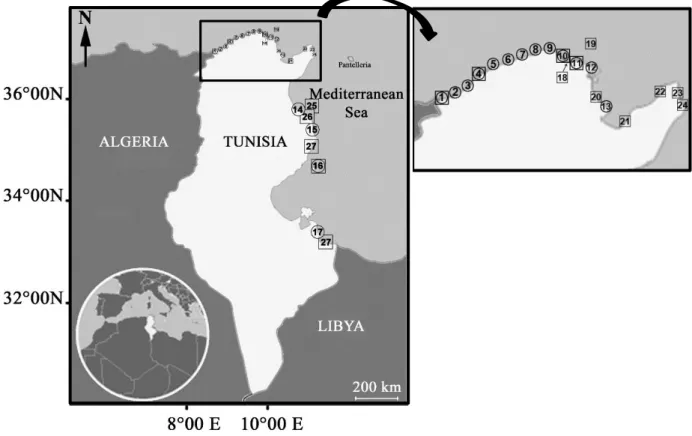
Ahmed BEN HMIDA, SHILI A., SGHAIER Y.R., RAIS C. ... 40
IMPACT DE LA PÊCHE PAR MINI-CHALUT BENTHIQUE SUR LES HERBIERS À POSIDONIA OCEANICA DANS LE SECTEUR NORD-EST DES ÎLES KERKENNAH (TUNISIE)
Sylvain BLOUET, DUPUY DE LA GRANDRIVE R., CHERE E., NOEL C.,
VIALA C., MARCHETTI S., BAUER E., TEMMOS J.M., BOISSERY P... 46
APPLICATION DE LA SISMIQUE UHR POUR LE SUIVI DE L’ETAT DE CONSERVATION DES HERBIERS A POSIDONIA OCEANICA
Cyrine BOUAFIF, OUERGHI A., LANGAR H. ... 52 CYSTOSEIRA SEDOIDES (DESFONTAINES) C. AGARDH DES COTES
Charles F. BOUDOURESQUE, BONHOMME D., ASTRUCH P.,
BONHOMME P., GOUJARD A., THIBAUT T. ... 58
INSIGHT INTO THE TYPOLOGY OF REEF FORMATIONS OF THE MEDITERRANEAN SEAGRASS POSIDONIA OCEANICA
Boris DANIEL, LAMOUREUX A. ... 64
ANALYSE CRITIQUE DE L’ÉVALUATION DE L’ÉTAT DE CONSERVATION DE L’HERBIER DE POSIDONIE DANS LE CADRE DU PROGRAMME DE CARTOGRAPHIE DES HABITATS MARINS – CARTHAM
Vasileios GERAKARIS, PANAYOTIDIS P., TSIAMIS K., NIKOLAIDOU A.,
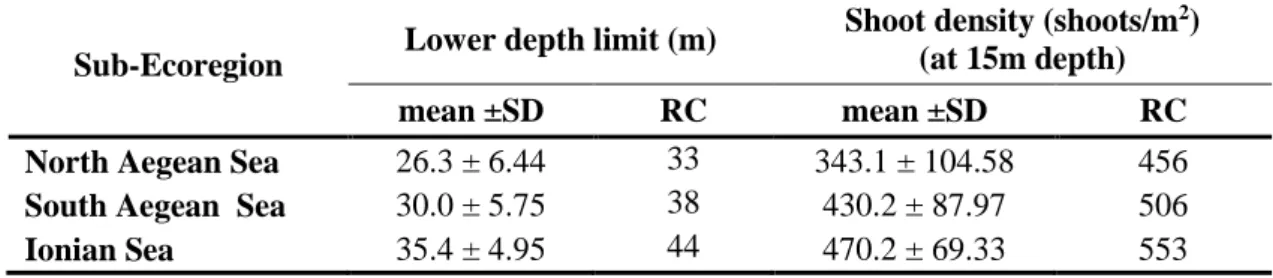
ECONOMOU-AMILLI A. ... 70 POSIDONIA OCEANICA MEADOWS IN GREEK SEAS: LOWER DEPTH
LIMITS AND MEADOW DENSITIES
Fabrizio GIANNI, MANGIALAJO L. ... 74
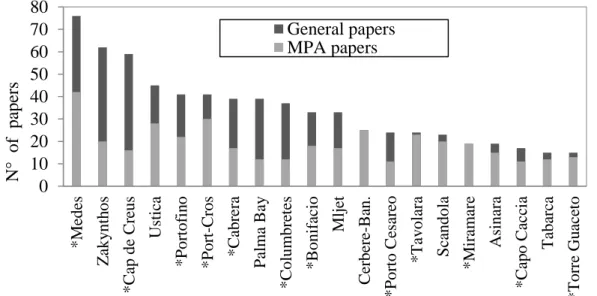
ARE MEDITERRANEAN MPAs PROTECTING MARINE FORESTS?
Ivan GUALA, NIKOLIĆ V., IVEŠA L., JAKL Z., ŠIJAN M., PRVAN M.,
KRSTINIĆ P., BRUNDU G., DI CARLO G., RAJKOVIĆ Z. ... 80
DEVELOPMENT OF THE NATIONAL MONITORING PROTOCOL FOR
POSIDONIA OCEANICA MEADOWS IN CROATIA: A PILOT PROJECT Bernat HEREU, CAPDEVILA P., CEBRIAN E., DÍAZ D., GARRABOU J.,
KERTING D. LINARES C., NAVARRO L., PAUNER O., TEIXIDO N. ... 86
ECOLOGY AND PERTURBATIONS OF MEDITERRANEAN DEEP-WATER ALGAL COMMUNITIES: LINKING POPULATION BIOLOGY AND COMMUNITY ECOLOGY FOR CONSERVATION
Florian HOLON, BOCKEL T., BOISSERY P., DETER J. ... 92
ASSESSING POSIDONIA OCEANICA BEDS REGRESSIONS USING ANTHROPOGENIC PRESSURES MAPS ALONG A FRENCH COASTAL REGION
Florian HOLON, DELARUELLE G., GUILBERT A., DETER J.,
BOISSERY P., DESCAMP P. ... 98
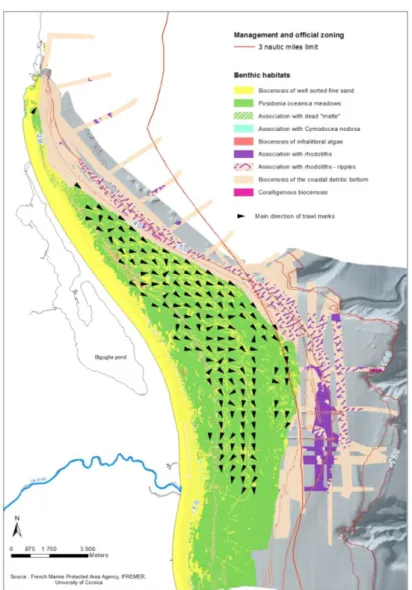
FIRST CONTINUOUS SEABED MAP IN FRANCE USED FOR THE CREATION OF A MANAGEMENT TOOL PROTECTING POSIDONIA OCEANICA
Ljiljana IVEŠA, DEVESCOVI M. ... 102
DISTRIBUTION AND COMPOSITION OF CYSTOSEIRA STANDS ALONG THE WEST ISTRIAN COAST (NORTHERN ADRIATIC, CROATIA) AND COMPARISON WITH HISTORICAL DATA
Marlene JAHNKE, SERRA I.A., BERNARD G., PROCACCINI G. ... 107
THE IMPORTANCE OF GENETIC MAKE-UP FOR RESTORATION SUCCESS - A CASE STUDY OF THE SEAGRASS ZOSTERA NOLTII HORNEM IN A MEDITERRANEAN LAGOON
Gloria MISSON, VACCHI M., MONTEFALCONE M., ARCHETTI R.,
BIANCHI C.N., FERRARI M. ... 114
MODELLING THE REFERENCE CONDITIONS OF THE UPPER LIMIT OF POSIDONIA OCEANICA MEADOW
Alice OPRANDI, MONTEFALCONE M., VACCHI M., COPPO S.,
DIVIACCO G., MORRI C., FERRARI M., BIANCHI C.N. ... 119
COMBINING MODELLING AND HISTORICAL DATA TO DEFINE THE STATUS OF POSIDONIA OCEANICA MEADOWS
Melike İdil ÖZ, YAĞLI H., AK İ. ... 125
PRELIMINARY STUDY ON THE DISTRIBUTION OF POSIDONIA OCEANICA ALONG THE DARDANELLE STRAIT
Gérard PERGENT, BEIN A., BLANFUNE A., DEDEKEN M., OBERTI P.,
ORSINI A., PERGENT-MARTINI C., RUITTON S., SHORT F. ... 131
MONITORING AND EXPANSION OF POSIDONIA MONITORING NETWORKS ALONG CORSICAN COASTLINE
Christine PERGENT-MARTINI, SALIVAS-DECAUX M., LANGAR H., PERGENT G., AKÇALI B., ALVAREZ-PÉREZ E., APOSTOLAKI E., BAKRAN-PETRICIOLI T., BELBACHA S., BORG J., BUIA C., CASALTA B., CELEBI B., FERNANDEZ-TORQUEMADE Y., HADJICHRISTOFOROU M., LLAGOSTERA I., LIPEJ L., LOPEZ Y ROYO C., MARCOU M., MAVRIC B., PANZALIS P., ROMERO J., SEMROUD R., SKOUFAS G., TURK R., WEITZMANN B.,
ZAPATA-SALGADO F.J. ... 137
ARSENIC CONCENTRATIONS IN SEAGRASS AROUND THE MEDITERRANEAN COAST AND SEASONAL VARIATIONS
Dimitris POURSANIDIS, BARNIAS A., LYMBERAKIS P. ... 143
ASSESSMENT OF THE CONSERVATION STATUS OF POSIDONIA
OCEANICA MEADOWS IN THE SAMARIA NATIONAL PARK, AN MPA
IN CRETE, GREECE
Jonathan RICHIR, GOBERT S. ... 149
THE CONCEPTUALIZATION OF TRACE ELEMENT FLOWS WITHIN
POSIDONIA OCEANICA MEADOWS: A COLLABORATIVE PROPOSAL
TO FILL KNOWLEDGE GAPS
Fabio RINDI, PEZZOLESIL., HERNANDEZ-KANTUN J.J., FALACE A.,
KALEB S., PONTI M., CERRANO C. ... 155
DISTRIBUTION AND GENETIC VARIATION OF TWO BIOCONSTRUCTOR CORALLINE ALGAE (LITHOPHYLLUM BYSSOIDES (LAMARCK) FOSLIE AND L. STICTAEFORME (ARESCHOUG) HAUCK) ALONG THE ITALIAN COASTS
Stewart T. SCHULTZ, BAKRAN-PETRICIOLI T., KRUSCHEL C.,
PETRICIOLI D. ... 161
MONITORING OF POSIDONIA MEADOWS UNDER THE EC HABITATS DIRECTIVE: VEHICULAR VIDEOGRAPHY CAN ESTIMATE TRENDS IN COVERAGE AT LOW COST AND HIGH PRECISION
Yassine Ramzi SGHAIER, ZAKHAMA-SRAIEB R., CHARFI-CHEIKHROUHA F. ... 167
EFFECTS OF THE INVASIVE SEAGRASS HALOPHILA STIPULACEA ON THE NATIVE SEAGRASS CYMODOCEA NODOSA
Abdessalem SHILI, BACCAR L., BEN MAÏZ N., BOUDOURESQUE C.F. ... 172
DYNAMICS OF BENTHIC MACROPHYTES IN THE SOUTHERN TUNIS LAGOON (TUNISIA, MEDITERRANEAN SEA)
Abdessalem SHILI, BEN HMIDA A., BEN MAÏZ N., BOUDOURESQUE C.F. ... 178
DISTRIBUTION AND HABITAT REQUIREMENTS OF ZOSTERA NOLTEI ALONG THE NORTHERN COAST OF JERBA ISLAND (SOUTHERN TUNISIA, MEDITERRANEAN SEA)
Rym ZAKHAMA-SRAIEB, SGHAIER Y.R., BEN HMIDA A.,
CHARFI-CHEIKHROUHA F. ... 184
MERCURY CONTAMINATION IN POSIDONIA OCEANICA IN A HARBOUR AREA OF THE EASTERN COAST OF TUNISIA
POSTERS ... 188 Yelda AKTAN, GÜREŞEN A. ... 190
COMPOSITION OF THE FUNCTIONAL MACROALGAL GROUPS ON
POSIDONIA OCEANICA (L.) DELILE LEAVES
Nassima AMAROUCHE, SEMROUD R., OUNADI F. ... 192
BIOACCUMULATION DU MERCURE, DU ZINC ET DU CUIVRE CHEZ
POSIDONIA OCEANICA : COMPARAISON AVEC UN SITE DE REFERENCE Joana ARAGAY SOLER, GÓMEZ GARRETA A., RIBERA SIGUAN M.A.,
RULL LLUCH J. ... 194
NEW DATA ABOUT THE PHENOLOGY AND THE DISTRIBUTION OF
DICTYOTA CYANOLOMA TRONHOLM ET AL. IN THE MEDITERRANEAN
IBERIAN COASTS
Tatjana BAKRAN-PETRICIOLI, PETRICIOLI D., SCHULTZ S.,
FEDEL K. ... 196
RESEARCH OF CIRCULAR PATTERN DAMAGE TO POSIDONIA MEADOWS ALONG THE EASTERN ADRIATIC SEA
Tatjana BAKRAN-PETRICIOLI, SCHULTZ S., PETRICIOLI D.,
KRUSCHEL C. ... 198
APPLICABILITY OF MEDITERRANEAN BASELINES OF POSIDONIA
OCEANICA DESCRIPTORS FOR THE ASSESSMENT OF ITS
CONSERVATION STATUS ALONG THE EASTERN PART OF THE ADRIATIC SEA
Hocein BAZAIRI, LIMAM A., RIBI M., BENHOUSSA A., NAVARRO-BARRANCO C., GONZALEZ R., MAESTRE M., ALCÁNTARA J.P.,
GARCIA-GOMEZ J.C., ESPINOSA F. ... 200
VERS UNE NOUVELLE AIRE MARINE PROTEGEE MAROCAINE EN MEDITERRANEE : LE CAP DES TROIS FOURCHES
Stefano COPPO, DIVIACCO G., TUNESI L., PIBOT A., SIBILOTTE M.,
TAMBUTTE E., SIMONET R., VISSIO A. ... 202
THE COMMON PROCESS OF IDENTIFICATION OF ECOLOGICALLY OR BIOLOGICALLY SIGNIFICANT MARINE AREAS IN THE RAMOGE AREA – A PILOT INITIATIVE OF TRANSBOUNDARY COOPERATION
Berrin DURAL ... 204
MONITORING POSIDONIA OCEANICA IN THE GULF OF IZMIR BETWEEN 2000 AND 2003: THE KARABURUN PENINSULA AS A REFERENCE AREA
Reda EL KAMCHA, JEBBAD R., BOUOUAROUR O., BAZAIRI H.,
LIMAM A., BENHOUSSA A., NAVARRO-BARRANCO C.,
GONZALEZ R., MAESTRE M., GARCIA-GOMEZ C., ESPINOSA F. ... 206
CONTRIBUTION A L’ETUDE DES CRUSTACES PERACARIDES ASSOCIES A L’ALGUE CORALLINA ELONGATA ET AUX HERBIERS DE
CYMODOCEA NODOSA AU CAP DES TROIS FOURCHES (MAROC,
MEDITERRANEE)
Yasser Ali GENEID ... 208
DESIGNING AND ESTABLISHING OF MPA IN SALLUM AREA (SOCIOECONOMIC PERSPECTIVE)
Vasileios GERAKARIS, TSIAMIS K., PANAYOTIDIS P. ... 210
DOES ZOSTERA MARINA EXIST IN GREECE?
12. Sylvie GOBERT, RICHIR J. ... 212
TRACE ELEMENT BIOACCUMULATION AND COMPARTMENTALIZATION IN THE INVASIVE ALGAE CAULERPA RACEMOSA VAR. CYLINDRACEA FROM THE CALVI BAY, CORSICA
Antonio GÓMEZ GÓMEZ, PERALTA POCH B., RIERA RIBAS F.,
GÓMEZ GARRETA A., RIBERA SIGUAN M.A., RULL LLUCH J. ... 214
ON TWO PADINA SPECIES UNNOTICED IN THE BENTHIC MARINE FLORA OF THE IBERIAN PENINSULA
Micheline GRIGNON-DUBOIS, REZZONICO B. ... 216
INFRASPECIFIC GEOGRAPHICAL VARIABILITY IN THE FLAVONOID CONTENT OF ZOSTERA NOLTEI
Micheline GRIGNON-DUBOIS, REZZONICO B. ... 218
PHENOLIC CHEMISTRY OF THE NATIVE MEDITERRANNEAN SEAGRASSES
Micheline GRIGNON-DUBOIS, REZZONICO B., LAABIR M., CECCHI P.,
MASSERET E. ... 220
CHEMICAL WARFARE IN COASTAL ECOSYSTEMS: ZOSTERA VERSUS
ALEXANDRIUM
Mathieu IMBERT, BONHOMME P. ... 222
ETUDE DU MILIEU MARIN EN PALMES MASQUE TUBA - GUIDE METHODOLOGIQUE
Genti KROMIDHA, DEDEJ Z... 224
MAPPING OF MARINE HABITTAS IN PORTO PALERMO BAY TO SUPPORT ESTABLISHMENT AND ZONING OF FUTURE MPA
Filippo LUZZU, DI MAIDA G., TOMASELLO A., PIRROTTA M., SCANNAVINO A., BELLAVIA C., BELLISSIMO G., COSTANTINI C.,
ORESTANO C., SCLAFANI G., CALVO S. ... 226
MAPPING POSIDONIA OCEANICA LOWER LIMIT COMBINING HIGH RESOLUTION INSTRUMENTS (SSS AND MBS)
Yosr MEZGUI, DJELLOULI S.A, BEN HASSINE O.K. ... 228 POSIDONIA OCEANICA AND CAULERPA RACEMOSA VAR. CYLINDRACEA
CO-EFFECTS ON PHENOLOGICAL PARAMETERS
Augusto NAVONE, DEIANA A., PANZALIS P., HOLON F., ROVERE A.,
PARRAVICIN V. ... 230
NEW BIONOMIC MAP OF PROTECTED MARINE AREA "TAVOLARA - PUNTA CODA CAVALLO", SARDINIA, ITALY, WEST MEDITERRANEAN
Mélanie OURGAUD, HARMELIN-VIVIEN M., RUITTON S.,
BOUDOURESQUE C.F., BUSTAMANTE P., CHURLAUD C., WAFO E. ... 232
WHICH CONTAMINATION OF THE SEAGRASS POSIDONIA OCEANICA ALONG THE PROVENCE COAST (FRANCE, NW MEDITERRANEAN SEA)?
Željka RAJKOVIĆ, ROGIĆ I., KRSTINIĆ P. ... 234
DEVELOPMENT OF A MEDITERRANEAN MPAS NETWORK THROUGH THE BOOSTING OF MPAS CREATION AND MANAGEMENT (MEDMPANET) - PILOT PROJECT CROATIA
Antonino SCANNAVINO, PIRROTTA M., TOMASELLO A., DI MAIDA G., LUZZU F., BELLAVIA C., BELLISSIMO G., COSTANTINI C.,
ORESTANO C., SCLAFANI G., CALVO S. ... 236
BIODEGRADABLE ANCHOR MODULAR SYSTEM FOR TRANSPLANTING
POSIDONIA OCEANICA CUTTINGS
Halima SERIDI ... 238
LES MACROALGUES COMME INDICE DE QUALITE POUR L’EVALUATION DE L’ETAT ECOLOGIQUE DE LA COTE ALGERIENNE
Yassine Ramzi SGHAIER, LIMAM A., SAMAHA L., BITAR G., KHALAF G., SAMAHA Z., EL-SHAER H., FORCADA A., OCAÑA O.,
VALLE C., RAMOS ESPLÁ A. ... 240 CYMODOCEA NODOSA DISTRIBUTION ALONG THE LEBANASE
COAST
Stefania TONIN, LUCARONI G. ... 242
UNDERSTANDING RESIDENTS’ PERCEPTION OF MARINE
BIODIVERSITY AND THEIR ATTITUDES TOWARDS BIODIVERSITY CONSERVATION INSTRUMENTS: THE CASE OF THE VENETIAN TEGNÙE
Konstantinos TSIAMIS, GERAKARIS V. ... 244
ON SOME PECULIAR MACROALGAL COMMUNITIES FROM GREECE
Sedat Vahdet YERLI, SÜ U., KORKMAZ M., MANGIT F. ... 246
ECOLOGICAL QUALITY CLASSIFICATION OF AEGEAN AND MEDITERRANEAN SEAS IN TERMS OF INVASIVE FISH SPECIES
Rym ZAKHAMA-SRAIEB, SGHAIER Y.R., BEN HMIDA A.,
CHARFI-CHEIKHROUHA F. ... 248
COMARATIF STUDY OF TRACE METAL DISTRIBUTION IN
POSIDONIA OCEANICA, CYMODOCEA NODOSA AND SEDIMENTS
FROM EL KANTAOUI (EAST OF TUNISIA)
SPREAKERS LIST / LISTE DES ORATEURS ... 250 SCIENTIFIC COMMITTEE MEMBERS / MEMBRES DU COMITÉ
SCIENTIFIQUE ... 254 ORGANISING COMMITTEE MEMBERS / MEMBRES DU COMITÉ
PROGRAMME
Monday 27 October 20148:00-9:00 Participants welcome and registration 9:00-10:00 Opening of the Symposium
• Welcome speech by Khalil ATTIA, RAC/SPA Director
• Welcome Speech by Martina Kačičnik Jančar from Institute of the Republic of Slovenia for Nature Conservation, on behalf of the director of the Institute
• Opening presentation: Slovenian Coastal Sea: The Ark of Noah by Pr. Lovrenc Lipej from National Institute of Biology, Marine Biology Station Piran
10:00-10:30 Coffee break
10:30-11:30 Keynote conference: Terrestrial versus marine diversity of ecosystems. And the winner is: the marine realm by Pr. Charles F. BOUDOURESQUE, RUITTON S., BIANCHI C.N., CHEVALDONNÉ P., FERNANDEZ C., HARMELIN-VIVIEN M., OURGAUD M., PASQUALINI V., PEREZ T., PERGENT G., THIBAUT T., VERLAQUE M.
Session 1: Mediterranean Marine Vegetation: population, biology, ecology and dynamics – Marine "macroalgae"
Chair: Charles F. BOUDOURESQUE, Rapporteur: Amelia Gomez GARETTA 11:30-11:45 "Marine forests at risk: solutions to halt the loss and promote the recovery of
Mediterranean canopy-forming seaweeds" by Laura AIROLDI, BALLESTEROS E., BUONUOMO R., VAN BELZEN J., BOUMA T.J., CEBRIAN E., DE CLERK O., ENGELEN A.H., FERRARIO F., FRASCHETTI S., GIANNI F., GUIDETTI P., IVESA L., MANCUSO F.P., MICHELI F., PERKOL-FINKEL S., SERRAO E.A., STRAIN E.M., MANGIALAJO L.
11:45-12:00 "Cystoseira Sedoides (desfontaines) C. Agardh des côtes tunisiennes : état actuel des connaissances" by Cyrine BOUAFIF, OUERGHI A., LANGAR H.
12:00-12:15 "Ecology and perturbations of Mediterranean deep-water algal communities: linking population biology and community ecology for conservation" by Bernat HEREU, CAPDEVILA P., CEBRIAN E., DÍAZ D., GARRABOU J., KERTING D. LINARES C., NAVARRO L., PAUNER O., TEIXIDO N.
12:15-12:30 "Distribution and composition of Cystoseira stands along the west Istrian coast (northern Adriatic, Croatia) and comparison with historical data" by Ljiljana IVEŠA, DEVESCOVI M.
12:30-12:45 "Distribution and genetic variation of two bioconstructor coralline algae (Lithophyllum byssoides (Lamarck) Foslie and L. stictaeforme (Areschoug) Hauck) along the Italian coasts" by Fabio RINDI, PEZZOLESI L.,
HERNANDEZ-KANTUN J.J., FALACE A., KALEB S., PONTI M., CERRANO C. 12:45-13:00 Discussion
Session 2: Mediterranean Marine Vegetation: population, biology, ecology and dynamics – Marine Magnoliophytes
Chair: Rachid SEMROUD, Rapporteur: Robert TURK
14:00-14:15 "Insight into the typology of reef formations of the Mediterranean seagrass
Posidonia oceanica" by Charles F. BOUDOURESQUE, BONHOMME D., ASTRUCH P.,
BONHOMME P., GOUJARD A., THIBAUT T.
14:15-14:30 "Posidonia oceanica meadows in greek seas: lower depth limits and meadow densities" by Vasileios GERAKARIS, PANAYOTIDIS P., TSIAMIS K., NIKOLAIDOU A., ECONOMOU-AMILLI A.
14:30-14:45 "The importance of genetic make-up for restoration success - a case study of the seagrass Zostera noltii hornem in a mediterranean lagoon" by Marlene JAHNKE, SERRA I.A., BERNARD G., PROCACCINI G.
14:45-15:00 "Modelling the reference conditions of the upper limit of Posidonia oceanica meadow" by Gloria MISSON, VACCHI M., MONTEFALCONE M., ARCHETTI R., BIANCHI C.N., FERRARI M.
15:00-15:15 "Preliminary study on the distribution of Posidonia oceanica along the Dardanelle Strait" by Melike İdil ÖZ, YAĞLI H., AK İ.
15:15-15:30 "Effects of the invasive seagrass Halophila stipulacea on the native seagrass
Cymodocea nodosa" by Yassine Ramzi SGHAIER, ZAKHAMA-SRAIEB R.,
CHARFI-CHEIKHROUHA F.
15:30-15:45 "Distribution and habitat requirements of Zostera noltei along the northern coast of Jerba Island (Southern Tunisia, Mediterranean sea)" by Abdessalem SHILI, BEN HMIDA A., BEN MAÏZ N., BOUDOURESQUE C.F.
15:45-16:00 "Dynamics of benthic macrophytes in the Southern Tunis Lagoon (Tunisia, Mediterranean Sea)" by Abdessalem SHILI, BACCAR L., BEN MAÏZ N., BOUDOURESQUE C.F.
16:00-16:15 Discussion
16:15-16:45 Coffee break
16:45-18:00 Poster Session
18:00-19:00 Side event
One day in Albania coastline by Violeta ZUNA, Eno DODBIBA
Tuesday 28 October 2014
Session 3: Mapping, monitoring and management of Mediterranean marine vegetation Chair: Gérard PERGENT, Rapporteur: Marina BONACORSI
8:30-8:45 "Assessment of the conservation status of Posidonia oceanica meadows in the Samaria National Park, an MPA in Crete, Greece" by Dimitris POURSANIDIS, Antonios BARNIAS, LYMBERAKIS P.
8:45-9:00 "Application de la sismique UHR pour le suivi de l’etat de conservation des herbiers a Posidonia Oceanica" by Sylvain BLOUET, DUPUY DE LA GRANDRIVE R., CHERE E., NOEL C., VIALA C., MARCHETTI S., BAUER E., TEMMOS J.M., BOISSERY P.
9:00-9:15 "First continuous seabed map in france used for the creation of a management tool protecting Posidonia oceanica" by Florian HOLON, DELARUELLE G., GUILBERT A., Julie DETER, BOISSERY P., DESCAMP P.
9:15-9:30 "Development of the national monitoring protocol for Posidonia Oceanica meadows in Croatia: a pilot project" by Ivan GUALA, NIKOLIĆ V., IVEŠA L., JAKL Z., ŠIJAN M., PRVAN M., KRSTINIĆ P., BRUNDU G., DI CARLO G., RAJKOVIĆ Z.
9:30-9:45 Discussion
9:45-10:00 "Combining modelling and historical data to define the status of Posidonia
oceanica meadows" by Alice OPRANDI, MONTEFALCONE M., VACCHI M.,
COPPO S., DIVIACCO G., MORRI C., FERRARI M., BIANCHI C.N.
10:00-10:15 "Monitoring and expansion of Posidonia monitoring networks along Corsican coastline" by Gérard PERGENT, BEIN A., BLANFUNE A., DEDEKEN M., OBERTI P., ORSINI A., PERGENT-MARTINI C., RUITTON S., SHORT F.
10:15-10:30 "Monitoring of Posidonia meadows under the EC habitats directive: vehicular videography can estimate trends in coverage at low cost and high precision" by Stewart T. SCHULTZ, BAKRAN-PETRICIOLI T., KRUSCHEL C., PETRICIOLI D. 10:30-10:45 Discussion
10:45-11:15 Coffee break
11:15-11:30 "A rapid and non-destructive assessment of your Posidonia meadow" by Gérard PERGENT
11:30-12:15 Poster Session
Session 3: Mapping, monitoring and management of Mediterranean marine vegetation (continued) Chair: Gérard PERGENT, Rapporteur: Marina BONACORSI
12:15-12:30 "Analyse critique de l’évaluation de l’état de conservation de l’herbier de posidonie dans le cadre du programme de Cartographie des Habitats Marins – CARTHAM" by Boris DANIEL, LAMOUREUX A.
12:30-12:45 "Are Mediterranean MPAs protecting marine forests?" by Fabrizio GIANNI, MANGIALAJO L.
12:45-13:00 Discussion
13:00-14:00 Lunch
Session 4: Mediterranean vegetal assemblages: Impact and disturbance
Chair: Christine PERGENT-MARTINI, Rapporteur: Sandrine RUITTON
14:00-14:15 "Impact de la pêche par mini-chalut benthique sur les herbiers à Posidonia
oceanica dans le secteur nord-est des îles Kerkennah (Tunisie) " by Ahmed BEN
HMIDA, SHILI A., SGHAIER Y.R., RAIS C.
14:15-14:30 "Assessment and quantification of the anthropic impact on the Posidonia Oceanica seagrass meadow" by Samy ALAMI, BONACORSI M., CLABAUT P., JOUET G., PERGENT-MARTINI C., PERGENT G., STERCKEMAN A.
14:30-14:45 "Assessing Posidonia oceanica beds regressions using anthropogenic pressures maps along a French coastal region" by Florian HOLON, BOCKEL T., BOISSERY P., DETER J.
14:45-15:00 "Arsenic concentrations in seagrass around the Mediterranean coast and seasonal variations" by Christine PERGENT-MARTINI, SALIVAS-DECAUX M., LANGAR H., PERGENT G., AKÇALI B., ALVAREZ-PÉREZ E., APOSTOLAKI E., BAKRAN-PETRICIOLI T., BELBACHA S., BORG J., BUIA C., CASALTA B., CELEBI B., FERNANDEZ-TORQUEMADE Y., HADJICHRISTOFOROU M., LLAGOSTERA I., LIPEJ L., LOPEZ Y ROYO C., MARCOU M., MAVRIC B., PANZALIS P., ROMERO J., SEMROUD R., SKOUFAS G., TURK R., WEITZMANN B., ZAPATA-SALGADO F.J.
15:00-15:15 "The conceptualization of trace element flows within Posidonia oceanica meadows: a collaborative proposal to fill knowledge gaps" by Jonathan RICHIR, GOBERT S. 15:15-15:30 "Mercury contamination in Posidonia oceanica in a harbour area of the eastern coast
of Tunisia" by Rym ZAKHAMA-SRAIEB, SGHAIER Y.R., BEN HMIDA A., CHARFI-CHEIKHROUHA F.
15:30-15:45 Discussion
15:45-16:15 Coffee break
16:15-17:00 Poster Session
17:00-17:30 Awards for best poster
Jury: Charles F. BOUDOURESQUE, Rachid SEMROUD, Gérard PERGENT and Christine PERGENT-MARTINI, Secretaries: Cyrine BOUAFIF and Habib LANGAR
PROGRAMME
Lundi 27 octobre 20148:00-9:00 Accueil et inscription des participants 9:00-10:00 Ouverture du symposium
• Mot de bienvenue par Khalil ATTIA, Directeur du CAR/ASP
• Mot de bienvenue par Martina Kačičnik Jančar de l'Institut de la République de Slovénie pour la conservation de la nature, au nom du directeur de l’institut
• Présentation d’ouverture : Slovenian Coastal Sea: The Ark of Noah par Pr. Lovrenc Lipej de l’Institut National de Biologie, Station de Biologie Marine Piran
10:00-10:30 Pause café
10:30-11:30 Conférence introductive : Terrestrial versus marine diversity of ecosystems. And the winner is: the marine realm par Pr. Charles F. BOUDOURESQUE, RUITTON S., BIANCHI C.N., CHEVALDONNÉ P., FERNANDEZ C., HARMELIN-VIVIEN M., OURGAUD M., PASQUALINI V., PEREZ T., PERGENT G., THIBAUT T., VERLAQUE M.
Session 1 : Végétation marine de Méditerranée: population, biologie, écologie et dynamique – "Macroalgues" marines
Président : Charles F. BOUDOURESQUE, Rapporteur : Amelia Gomez GARETTA 11:30-11:45 "Marine forests at risk: solutions to halt the loss and promote the recovery of Mediterranean canopy-forming seaweeds" par Laura AIROLDI, BALLESTEROS E., BUONUOMO R., VAN BELZEN J., BOUMA T.J., CEBRIAN E., DE CLERK O., ENGELEN A.H., FERRARIO F., FRASCHETTI S., GIANNI F., GUIDETTI P., IVESA L., MANCUSO F.P., MICHELI F., PERKOL-FINKEL S., SERRAO E.A., STRAIN E.M., MANGIALAJO L.
11:45-12:00 "Cystoseira Sedoides (desfontaines) C. Agardh des côtes tunisiennes : état actuel des connaissances" par Cyrine BOUAFIF, OUERGHI A., LANGAR H.
12:00-12:15 "Ecology and perturbations of Mediterranean deep-water algal communities: linking population biology and community ecology for conservation" par Bernat HEREU, CAPDEVILA P., CEBRIAN E., DÍAZ D., GARRABOU J., KERTING D. LINARES C., NAVARRO L., PAUNER O., TEIXIDO N.
12:15-12:30 "Distribution and composition of Cystoseira stands along the west Istrian coast (northern Adriatic, Croatia) and comparison with historical data" par Ljiljana IVEŠA, DEVESCOVI M.
12:30-12:45 "Distribution and genetic variation of two bioconstructor coralline algae (Lithophyllum byssoides (Lamarck) Foslie and L. stictaeforme (Areschoug) Hauck) along the Italian coasts" par Fabio RINDI, PEZZOLESI L.,
HERNANDEZ-KANTUN J.J., FALACE A., KALEB S., PONTI M., CERRANO C. 12:45-13:00 Discussion
Session 2 : Végétation marine de Méditerranée : population, biologie, écologie et dynamique – Magnoliophytes marines
Président : Rachid SEMROUD, Rapporteur : Robert TURK
14:00-14:15 "Insight into the typology of reef formations of the Mediterranean seagrass
Posidonia oceanica" par Charles F. BOUDOURESQUE, BONHOMME D.,
ASTRUCH P., BONHOMME P., GOUJARD A., THIBAUT T.
14:15-14:30 "Posidonia oceanica meadows in greek seas: lower depth limits and meadow densities" par Vasileios GERAKARIS, PANAYOTIDIS P., TSIAMIS K., NIKOLAIDOU A., ECONOMOU-AMILLI A.
14:30-14:45 "The importance of genetic make-up for restoration success - a case study of the seagrass Zostera noltii hornem in a mediterranean lagoon" par Marlene JAHNKE, SERRA I.A., BERNARD G., PROCACCINI G.
14:45-15:00 "Modelling the reference conditions of the upper limit of Posidonia oceanica meadow" par Gloria MISSON, VACCHI M., MONTEFALCONE M., ARCHETTI R., BIANCHI C.N., FERRARI M.
15:00-15:15 "Preliminary study on the distribution of Posidonia oceanica along the Dardanelle Strait" par Melike İdil ÖZ, YAĞLI H., AK İ.
15:15-15:30 "Effects of the invasive seagrass Halophila stipulacea on the native seagrass
Cymodocea nodosa" par Yassine Ramzi SGHAIER, ZAKHAMA-SRAIEB R.,
CHARFI-CHEIKHROUHA F.
15:30-15:45 "Distribution and habitat requirements of Zostera noltei along the northern coast of Jerba Island (Southern Tunisia, Mediterranean sea)" par Abdessalem SHILI, BEN HMIDA A., BEN MAÏZ N., BOUDOURESQUE C.F.
15:45-16:00 "Dynamics of benthic macrophytes in the Southern Tunis Lagoon (Tunisia, Mediterranean Sea)" par Abdessalem SHILI, BACCAR L., BEN MAÏZ N., BOUDOURESQUE C.F.
16:00-16:15 Discussion
16:15-16:45 Pause café
16:45-18:00 Session Posters
18:00-19:00 Evènement parallèle
One day in Albania coastline par Violeta ZUNA, Eno DODBIBA
Mardi 28 octobre 2014
Session 3 : Cartographie, surveillance et gestion de la végétation marine de Méditerranée Président : Gérard PERGENT, Rapporteur : Marina BONACORSI
8:30-8:45 "Assessment of the conservation status of Posidonia oceanica meadows in the Samaria National Park, an MPA in Crete, Greece" par Dimitris POURSANIDIS, Antonios BARNIAS, LYMBERAKIS P.
8:45-9:00 "Application de la sismique UHR pour le suivi de l’etat de conservation des herbiers a Posidonia Oceanica" par Sylvain BLOUET, DUPUY DE LA GRANDRIVE R., CHERE E., NOEL C., VIALA C., MARCHETTI S., BAUER E., TEMMOS J.M., BOISSERY P.
9:00-9:15 "First continuous seabed map in france used for the creation of a management tool protecting Posidonia oceanica" par Florian HOLON, DELARUELLE G., GUILBERT A., Julie DETER, BOISSERY P., DESCAMP P.
9:15-9:30 "Development of the national monitoring protocol for Posidonia Oceanica meadows in Croatia: a pilot project" par Ivan GUALA, NIKOLIĆ V., IVEŠA L., JAKL Z., ŠIJAN M., PRVAN M., KRSTINIĆ P., BRUNDU G., DI CARLO G., RAJKOVIĆ Z.
9:30-9:45 Discussion
9:45-10:00 "Combining modelling and historical data to define the status of Posidonia
oceanica meadows" par Alice OPRANDI, MONTEFALCONE M., VACCHI M.,
COPPO S., DIVIACCO G., MORRI C., FERRARI M., BIANCHI C.N.
10:00-10:15 "Monitoring and expansion of Posidonia monitoring networks along Corsican coastline" par Gérard PERGENT, BEIN A., BLANFUNE A., DEDEKEN M., OBERTI P., ORSINI A., PERGENT-MARTINI C., RUITTON S., SHORT F.
10:15-10:30 "Monitoring of Posidonia meadows under the EC habitats directive: vehicular videography can estimate trends in coverage at low cost and high precision" par Stewart T. SCHULTZ, BAKRAN-PETRICIOLI T., KRUSCHEL C., PETRICIOLI D. 10:30-10:45 Discussion
10:45-11:15 Pause café
11:15-11:30 "Une évaluation rapide et non destructive de votre herbier de Posidonie" par Gérard PERGENT
11:30-12:15 Session Posters
Session 3: Cartographie, surveillance et gestion de la végétation marine deMéditerranée (suite) Président : Gérard PERGENT, Rapporteur : Marina BONACORSI
12:15-12:30 "Analyse critique de l’évaluation de l’état de conservation de l’herbier de posidonie dans le cadre du programme de Cartographie des Habitats Marins – CARTHAM" par Boris DANIEL, LAMOUREUX A.
12:30-12:45 "Are Mediterranean MPAs protecting marine forests?" par Fabrizio GIANNI, MANGIALAJO L.
12:45-13:00 Discussion
13:00-14:00 Déjeuner
Session 4 : Impact et nuisances menaçant les formations végétales de Méditerranée Président : Christine PERGENT-MARTINI, Rapporteur : Sandrine RUITTON 14:00-14:15 "Impact de la pêche par mini-chalut benthique sur les herbiers à Posidonia
oceanica dans le secteur nord-est des îles Kerkennah (Tunisie) " par Ahmed BEN
HMIDA, SHILI A., SGHAIER Y.R., RAIS C.
14:15-14:30 "Assessment and quantification of the anthropic impact on the Posidonia Oceanica seagrass meadow" par Samy ALAMI, BONACORSI M., CLABAUT P., JOUET G., PERGENT-MARTINI C., PERGENT G., STERCKEMAN A.
14:30-14:45 "Assessing Posidonia oceanica beds regressions using anthropogenic pressures maps along a French coastal region" par Florian HOLON, BOCKEL T., BOISSERY P., DETER J.
14:45-15:00 "Arsenic concentrations in seagrass around the Mediterranean coast and seasonal variations" par Christine PERGENT-MARTINI, SALIVAS-DECAUX M., LANGAR H., PERGENT G., AKÇALI B., ALVAREZ-PÉREZ E., APOSTOLAKI E., BAKRAN-PETRICIOLI T., BELBACHA S., BORG J., BUIA C., CASALTA B., CELEBI B., FERNANDEZ-TORQUEMADE Y., HADJICHRISTOFOROU M., LLAGOSTERA I., LIPEJ L., LOPEZ Y ROYO C., MARCOU M., MAVRIC B., PANZALIS P., ROMERO J., SEMROUD R., SKOUFAS G., TURK R., WEITZMANN B., ZAPATA-SALGADO F.J.
15:00-15:15 "The conceptualization of trace element flows within Posidonia oceanica meadows: a collaborative proposal to fill knowledge gaps" par Jonathan RICHIR, GOBERT S. 15:15-15:30 "Mercury contamination in Posidonia oceanica in a harbour area of the eastern coast of Tunisia" par Rym ZAKHAMA-SRAIEB, SGHAIER Y.R., BEN HMIDA A., CHARFI-CHEIKHROUHA F.
15:30-15:45 Discussion
15:45-16:15 Pause café
16:15-17:00 Session Poster
17:00-17:30 Remise de prix pour le meilleur poster
Jury : Charles F. BOUDOURESQUE, Rachid SEMROUD, Gérard PERGENT and Christine PERGENT-MARTINI, Secrétaires : Cyrine BOUAFIF and Habib LANGAR
KEYNOTE
CONFERENCE
**************************CONFERENCE
INTRODUCTIVE
Charles F. BOUDOURESQUE, RUITTON S., BIANCHI C.N., CHEVALDONNÉ P., FERNANDEZ C., HARMELIN-VIVIEN M., OURGAUD M., PASQUALINI V., PEREZ T., PERGENT G., THIBAUT T., VERLAQUE M.
Aix-Marseille University and Toulon University, Mediterranean Institute of Ocea-nography (MIO), CNRS/IRD UM 110, University campus of Luminy, 13288 Marseille cedex 9, France.
E-mail: [email protected]
TERRESTRIAL VERSUS MARINE DIVERSITY OF ECOSYTEMS.
AND THE WINNER IS: THE MARINE REALM
Abstract
The concept of biodiversity encompasses a wide range of scales and metrics, from genetic and species diversity to functional and ecosystem diversity. Ecosystems can be characterized by a number of descriptors, such as species richness, type of primary production (where present), e.g. photosynthesis and chemosynthesis, production and biomass of primary producers (where pre-sent), the balance between nutrients and primary production (HNLC, HNHC, LNLC and LNHC systems), fate of primary production (e.g. herbivores vs detritivores), type of the primary produc-tion recycling (slow vs. rapid), producproduc-tion and biomass of secondary producers structure and length of food webs, dominant control (bottom-up, wasp-waist or top-down), import of organic matter from adjacent ecosystems, export of organic matter to other ecosystems and the carbonate cycle. Comparison of a number of marine ecosystems (Posidonia oceanica meadows, Cystoseira forests, Macrocystis forests, coralligenous constructions, coral reefs, underwater sea caves and hydrothermal vents), with some terrestrial ecosystems (temperate and tropical forests, matorral and grasslands), evidences an obviously higher functional ecosystem diversity in the marine realm. Similarly, marine phyletic diversity is far higher than the terrestrial, whose higher species diversity is virtually due to a few phyla. This is consistent with the fact that Life originated in the oceans, ~3.8 Ga ago, while the conquest of land by Life occurred comparatively in recent times, ~0.5 Ga ago.
Key-words: Ecosystem diversity, ecosystem functioning, marine ecosystems, terrestrial eco-systems
Introduction
The concept of biodiversity encompasses a wide range of scales and metrics, from genetic and species diversity to functional and ecosystem diversity, from the sample and local scale to global scale, in addition to the distribution of individuals among species (hetero-geneity diversity or evenness). Biodiversity is therefore a multidimensional concept that is impossible to assess with a single measure (Gray, 2000; Sala & Knowlton, 2006; Bou-douresque, 2011a).
At the species level, the diversity of the marine realm is much lower than that of the terrestrial realm: only 13-15% of the ~2 000 000 currently described species (Bianchi & Morri, 2000; Sala & Knowlton, 2006; Boeuf, 2011; Mora et al., 2011). In contrast, marine diversity is higher at phylum level: nearly all of the 31 phyla of metazoans are present in the marine realm and 12 of them are exclusively marine (Boeuf, 2011).
In contrast to the taxonomic diversity, from the species level to high-level taxa such as phyla, little attention has been paid to the ecosystem diversity of the marine vs. the ter-restrial realms. Here, we consider the marine and terter-restrial realms proper, excluding in-termediate habitats and ecosystems such as coastal lagoons, mangroves, lakes, rivers, peat bogs and underground more or less flooded caves. We compare the characteristics (spe-cies richness and functioning) of a number of marine ecosystems, such as the Mediterra-nean Posidonia oceanica meadow, the MediterraMediterra-nean Cystoseira forests and barren grounds, the Mediterranean coralligenous, the Macrocystis forests, coral reefs, underwa-ter sea caves and deep-sea hydrothermal vents, with characunderwa-teristics of underwa-terrestrial ecosys-tems, such as temperate and tropical forests, matorrals and grasslands.
Ecosystem descriptors
An ecosystem can be defined as a unit of biological organization made up of all the or-ganisms in a given area (that is ‘community’), interactions between these oror-ganisms (i.e. symbioses: mutualism,parasitism,predation, etc.) and interactions between organisms and the abiotic environment (habitat), so that a flow of energy leads to a characteristic trophic structure and material cycles within the system (Odum, 1969; Likens, 1992; Frontier, 1999).
Ecosystems can be characterized by a number of descriptors, such as species richness, type of primary production (where present), production and biomass of primary producers (where present), the balance between nutrient availability and primary production, the fate of primary production, type of the primary production recycling, production and bi-omass of secondary producers, structure and length of food webs, dominant types of con-trol (bottom-up, wasp-waist or top-down), import of organic matter from adjacent eco-systems, export of organic matter to other ecoeco-systems, and the carbonate cycle (where present).
(i) Species richness is the mean number of species by sample (point diversity) and the
cumulative number of species at the ecosystem level (diversity) and regional scale ( anddiversity) (Whittaker, 1972; Gray, 2000; Boudouresque, 2011a). The former can be relatively high while the latter is relatively low and vice versa (Boudouresque, 2011a).
(ii) Type of primary production (where present) is photosynthesis versus
chemosyn-thesis. In photosynthesis, the source of energy is sunlight. Classically, 3 types of photo-synthesis are recognized: C3, C4 and CAM. In C3 primary producers (PPs), the RuBisCO enzyme fixes the incoming CO2 into a 3-carbon molecule. In C4 PPs, which typically dwell in warm and dry terrestrial climates, the CO2 is first fixed into a 4-carbon molecule. CAM PPs are roughly viewed as a mix of C3 and C4 PPs, adapted to very dry terrestrial environments, although this is an oversimplification (Dodd et al., 2002). In chemosyn-thesis, the conversion of inorganic carbon molecules (carbon dioxide or methane) and nutrients into organic matter uses the oxidation of inorganic molecules (e.g. hydrogen sulphide), rather than sunlight, as a source of energy (Campbell et al., 2008; Bertrand et
al., 2011).
(iii) Production and biomass of primary producers (where present). Primary production
is the synthesis of organic compounds via photosynthesis and chemosynthesis, per surface area and time interval; it is distinguished as either net (NPP; Net Primary Production) or gross (GPP; Gross Primary Production), the former accounting for the losses due to res-piration, maintenance, production of volatile compounds and offspring. The NPP there-fore roughly corresponds to the biomass increase, due to growth, per time interval.
(iv) Balance between nutrients and primary production. Four categories of ecosystem
can be distinguished on the basis of nutrient availability (proxy: nitrogen N) and primary production (proxy: chlorophyll), both roughly distinguished into low (L) and high (H) levels (Fig. 1): LNLC (e.g. Mediterranean pelagic ecosystems and terrestrial forests), HNLC (e.g. Antarctic pelagic ecosystems), LNHC (e.g. coral reefs and Mediterranean
P. oceanica meadows) and HNHC (e.g. upwelling pelagic ecosystems and agricultural
systems). When two types of PPs are present, as in seagrass meadows, the plant can be LNHC while the leaf epibionts can be HNHC under eutrophication conditions.
(v) Fate of primary production. The primary production can be directly consumed by
herbivores (browsers or grazers). However, if PPs are protected by chemical and/or phys-ical defences, or if herbivores are scarce (Lawrence, 1975; Rhoades & Cates, 1976; Bou-douresque & Verlaque, 2013), consumption may be low and the products of PPs end up in the litter, in a carbon sink, or are exported toward adjacent ecosystems. If not seques-trated in a sink, the organic matter coming from PPs ends up in the detritus-feeder path-way, within either the producing or adjacent ecosystems.
Fig. 1: The 4 categories of ecosystems based upon the relation between availability of nutrients (e.g. N) and abundance of chlorophyll (a proxy of primary pro-duction).
(vi) Type of primary production recycling.
Mag-noliophyta (seagrasses and land plants; kingdom Archaeplastida) produce material hard to degrade that requires months or years to enter the detritus food webs (slow recycling). ‘Macroalgae’, a polyphy-letic group of organisms belonging to Chlorobionta, Rhodobionta (green and red algae; Archaeplastida) and Phaeophyceae (brown algae; kingdom Stramenopiles), are easier to degrade (weeks or months) and quickly enter the food webs (rapid recycling). Most terrestrial ecosystems rely on the first type of primary producers while most benthic photophilous marine ecosystems are based upon the second. The combination of two sets of PPs is a very rare feature, met with in seagrass ecosystems and mangroves (the latter not considered here) (Boudouresque et al., 2006).
(vii) Production and biomass of secondary producers. Secondary producers encompass
a suite of trophic levels, from consumers of primary producers, detritus-, filter- and sus-pension-feeders, to top-predators. Secondary production is usually very low as compared with primary production.
(viii) Structure and length of food webs. Food webs are generally not a linear suite of
species, from the prey to the predator, but a complex network of relationships. As a result, counting trophic level number is not an easy task, especially when omnivores and detri-tus-feeders are involved. Due to the relatively low ecological efficiency of the energy transfer from one level to the next, especially in the terrestrial environment, the number of trophic levels rarely exceeds 4 in terrestrial ecosystems and cannot exceed 7 in marine systems (Fenchel, 1988; Ricklefs & Miller, 2005)
(ix) Dominant control. The control of the ecosystem functioning can be bottom-up,
top-down or wasp-waist (Cury et al., 2003). Bottom-up control means that the lowest level, that of primary producers, controls the higher levels, via the nutrient supply. Top-down control means that the highest trophic level (top predators) controls the lowest lev-els, via a sort of cascade effect (‘the enemy of my enemy is my friend’; Holt, 2000).
Finally, in the wasp-waist control, the population dynamics of an intermediate trophic level controls the others, both downwards and upwards. In the real world, the control is rarely (or never) of only one type; rather, there is a full gradient between e.g. mainly top-down and mainly bottom-up controls.
(x) Import of organic matter from adjacent ecosystems. Some ecosystems, especially
in the terrestrial realm, are self-sufficient, i.e. they totally, or almost totally, depend upon the autochthonous PPs. Other ecosystems depend, in part or totally, on imported organic matter.
(xi) Export of organic matter to other ecosystems. Some ecosystems export a greater
or lesser part of the organic matter coming (directly or indirectly) from PPs, in the form of e.g. carcasses, faeces and detritus, to other ecosystems. This feature, related to gravity or hydrodynamics, is common in marine ecosystems.
(xii) The carbonate cycle. Precipitation of calcium (and/or magnesium) carbonate,
mainly in the form of calcite and aragonite, by living organisms, has a high energetic cost. It often corresponds to a defence strategy. Calcified organisms, mostly represented among the marine biota, are generally less palatable than fleshy ones, although some species, such as sea urchins and fish, do graze them. Precipitation of calcium carbonate may result in a sink of carbon, whatever the source of this carbon.
Examples of marine and terrestrial ecosystems
A small number of marine and terrestrial ecosystems were chosen for this comparative approach (Tab. 1).
Posidonia oceanica is a seagrass endemic to the Mediterranean Sea (Boudouresque &
Verlaque, 2008). It dwells from the sea level down to 35-45 m depth and is the ecosystem engineer of an ecosystem that plays a major role in the Mediterranean coastal zone (Bou-douresque et al., 2006, 2009; Pergent et al., 2012; Personnic et al., 2014).
Sub-littoral rocky substrates of the Mediterranean harbour an ecosystem that can occur under multiple ‘stable’ states (MSS) (see e.g. Boudouresque et al., 2005, for the MSS concept), the functioning of two of these MSS is so contrasted that we will treat them hereafter as two different ecosystems: (i) The ‘forest’ state, dominated by long-living species of the Cystoseira genus (Phaeophyceae, Stramenopiles), here mainly C.
brachy-carpa. (ii) The barren grounds, where overgrazing by sea urchins, fish and other
macro-herbivores removes the layer of Cystoseira and other MPO (Multicellular Photosynthetic Organisms), leaving a more or less bare rocky substrate covered with encrusting coral-lines (calcareous red algae) and ‘invertebrates’ (Sala et al., 2011, 2012; Boudouresque & Verlaque, 2013)
Macrocystis pyrifera is a pseudo-perennial giant (up to 40 m tall) brown alga
(Phae-ophyceae, Stramenopiles) that mainly thrives in southern hemisphere cold waters, with isolated stations in the northern hemisphere, in California. It builds impressive underwa-ter forests, with leaves spreading at the sea surface (Dayton et al., 1992; Steneck et al., 2002).
The Mediterranean coralligenous is a complex of ecosystems. It is characterized by basal calcareous concretions of biogenic origin and by a canopy of large sessile filter- and sus-pension-feeders (gorgonians and sponges). The biogenic concretion is produced by the accumulation of encrusting red macro-algae (order Corallinales, Rhodobionta, Archae-plastida) and calcareous metazoans (bryozoans, serpulid annelids, etc.) growing in dim light conditions, between 20 and 120 m depth. Accretion of the concretions results from
a positive balance between bio-constructing organisms and bio-erosion by e.g. sponges, cyanobacteria and grazers (Ballesteros, 2006).
Sub-littoral marine caves are found in a wide variety of rocks, from sedimentary (e.g. karst caves) to metamorphic and igneous rocks. Here, only caves with a sub-littoral en-trance, either horizontal or descending (the latter resulting in the trapping of cold water), are considered. With the exception of the dim-light entrance, they are characterized by more or less total darkness. Caves constitute a functional unit, although extending along a sharp gradient of light, food availability, confinement and communities, from the en-trance to the most remote zones (e.g. Laborel & Vacelet, 1958; Bianchi & Morri, 1994; Vacelet et al., 1994; Rastorgueff et al., 2011).
Coral reefs are inter-tropical and sub-littoral biogenic formations. Accretion is due to a positive balance between bio-constucting organisms, mainly scleractinians (metazoans), but also to e.g. calcareous red algae and molluscs, and bio-erosion by e.g. cyanobacteria, Chlorobionta, sponges, molluscs, and grazing fish (Tribollet & Payri, 2001). Scleractini-ans have a mutualistic relationship with unicellular Dinobionta of the genus
Symbio-dinium, living within the host cells. A unique process of nitrogen recycling between
scleractinians and Dinobionta enables coral reefs to develop a lush ecosystem in highly oligotrophic waters.
Deep-sea hydrothermal vents are oases of microbial and metazoan life, associated with deep thermal springs occurring at ocean ridge spreading centres (2-3 km deep) and which are based upon chemosynthesis. Metazoans utilize chemosynthesis performed by sulphur-oxidizing prokaryotes to derive most or all of their energy supply, rather than photosyn-thesis, at depths where light cannot penetrate (Corliss et al., 1979).
Mediterranean matorral is a thermophilous bushy formation dominated by shrubs such as
Arbutus unedo, the dwarf oak Quercus coccifera and the rosemary Rosmarinus offici-nalis. It is furthered by fire and its long-term fate, in the framework of the succession and
without fire recurrence, is generally to evolve into an evergreen oak forest.
The evergreen Quercus spp. forest, the deciduous oak forest (Quercus spp. and Fagus
sylvatica) and the tropical rain forest are climax forests in Mediterranean, temperate
Eu-rope and inter-tropical areas, respectively. They are characterised by long-lived trees (at least several centuries) that act as ecosystem engineers. The tropical rain forest is an eco-system type that occurs within the inter-tropical zone. It experiences high average tem-perature and rainfall. Rain forests exhibit high levels of species diversity and very high primary production (Clark et al., 2011).
The Pinus nigra ssp. laricio (Corsican pine, lariciu) (also known as P. nigra ssp.
salz-mannii var. corsicana: its taxonomy is a much debated question) forest is an emblematic
ecosystem of the Corsican mountains (Gamisans, 1975, 2010).
Plain grasslands of Western Europe can be regarded as a stage in the succession towards climax oak or Fagus forests, artificially maintained by farmers and cattle rearing. How-ever, it can also be considered that cattle just take the place of large herbivores, driven to extinction by Humans during the Holocene, such as Przewalski’s horse Equus ferus
prze-walskii and the European bison Bison bonasus. These grasslands could therefore
consti-tute a natural climax ecosystem.
Calibration of the ecosystem descriptors used
We calibrated the selected ecosystem descriptors on a 5-step semi-quantitative scale (very low to very high; changed into 1 through 5 for statistical treatment). Where not applicable (e.g. descriptors defined by presence-absence only), this scale was simplified into a
2-step scale (very low or 1 vs. very high or 5) (Tab. 2). Some of the above-mentioned de-scriptors, e.g. C3 vs. C4 and CAM photosynthesis, were not taken into consideration here. For clarity, we kept hereafter the numbering of the descriptors used previously, even when descriptors were split or non-retained.
(i) Species richness (SR): point diversity. Here, we only considered the number of
species of MPOs per sample (SR-MPO) and the number of species of metazoans per sam-ple (SR-M) (Tab. 2). MPOs are a functional polyphyletic group of taxa belonging to Em-bryophyta, Chlorobionta, Rhodobionta (kingdom Archaeplastida) and Phaeophyceae (kingdom Stramenopiles); see Boudouresque (2011b) for taxonomic treatment. SR-MPO can usually be found in phytosociological relevés (Coppejans & Boudouresque, 1975). The minimal area usually constitutes a convenient proxy for point diversity (see Bou-douresque, 1974; Panayotidis, 1979). Sample size differs between taxa, e.g. between in-sects, fish and birds, so that the value for the descriptor SR-M is a rough cumulative estimate.
(iii-a) Photosynthetic primary production (PPP): DM (dry mass) of NPP per m² per
year (SI symbol for year: a): DM m-2 a-1. (iii-b) Chemosynthetic primary production (CPP): NPP as DM m-2 a-1. Where sessile metazoans with mutualistic symbiosis with chemosynthetic prokaryotes draw their mass from this relationship, these metazoans were considered as PPs. (iii-c) Biomass of photosynthetic primary producers (B-PPP): DM m². In terrestrial ecosystems, it includes root biomass, which can be higher than above-ground biomass (Crouzet, 1973), but is unfortunately often poorly known. Where living organisms incorporate calcium (and sometimes magnesium) carbonate (calcite or arago-nite), we considered the non-calcified mass only. However, the non-calcified mass is of-ten not available from literature data, especially when calcification is inconspicuous. When biomass fluctuates over the year, e.g. is high during the spring blooms and low in autumn when dead leaves are shed, we considered the highest annual value (DM m-2).
(iii-d) Ratio between primary production and biomass (PP/B).
(iv) Balance between nutrients and primary production (HNLC, HNHC, LNLC and
LNHC systems). Here, according to the ecosystems taken into account, i.e. in the absence of agricultural systems and pelagic ecosystems, only LNHC was considered (Tab. 2).
(v) Fate of the primary production. (v-a) The herbivore pathway (HP) corresponds to
the percentage of direct consumption of the primary production (PPP or CPP). (v-b) The detritus-feeder pathway (DP) corresponds to the percentage of the primary production that is consumed in the form of dead products within the producer ecosystem. (v-c) The carbon sink (CS) corresponds to the mass of organic matter (DM m-2 a-1) that is durably (i.e. at the geological timescale) sequestrated within the ecosystem. That means that the temporary sequestration within biomass, which only lasts the lifespan of organisms (gen-erally PPs), possibly centuries in trees (in the form of wood), is not a true sink; some authors and politicians erroneously consider the temporary sequestration of carbon within biomass as a sink, in the framework of the attempts to mitigate climate change.
(vi) The primary production recycling can be slow (vi-a: PP-SR), rapid (vi-b: PP-RR)
or both (vi-c: PP-SRR). No metric was associated with these descriptors (Tab. 2).
(vii) Production and biomass of secondary producers. Here, only the biomass (B-SP)
will be considered, as data on production are not available in the literature for most eco-systems. As for PPP, we intended to consider the non-calcified mass only.
(viii) Structure and length of food webs (FW). Only the length, i.e. the number of
trophic levels, was considered here (Tab. 2). Data are generally not available in the liter-ature and were therefore mostly derived from the interpretation by the authors of pub-lished food webs, and from the authors’ expertise.
(ix) Dominant control. Wasp-waist control was not considered, since it is mainly
known in some pelagic ecosystems not taken into account here. The metric was the esti-mated ratio between the top-down and the bottom-up control (TDC) (Tab. 2).
(x) Import of organic matter from adjacent ecosystems (IM). The metric was the
per-centage of the organic matter (OM) of allochthonous origin consumed by secondary con-sumers.
(xi) Export of organic matter to adjacent ecosystems (EX). The metric was the
per-centage of the primary and secondary production that is exported to other ecosystems, as e.g. dead leaves, migrant individuals leaving the ecosystem, faeces and carcasses.
(xii) The carbonate cycle (CA). Here, we consider the precipitation of carbonates
(DM m-2 a-1), without taking into consideration bio-erosion.
Possible flaws and biases
Most ecosystems, in the terrestrial realm, are known from a descriptive point of view: typology, spatial structure (e.g. stratification), list of taxa. Primary production and bio-mass are more rarely tackled, and if so only few taxa (such as embryophytes) are consid-ered. Secondary production and biomass are often ignored. Available studies generally deal with a single compartment (e.g. soil, embryophytes, fungi in a customary meaning, birds). Functional characteristics of the ecosystem are therefore often difficult to obtain. The same is true for the marine realm, although to a lesser extent. In both realms, a com-prehensive approach going beyond a few well-studied taxa (e.g. embryophytes, birds, fish) and taking into account the real diversity (including bacteria, archaea and unicellular eukaryotes such as excavates, alveolates and Rhizaria, and assessing their crucial func-tional role), is often lacking. To fill the table 3, the authors were therefore often reduced to relying on their intuitions and their own experience (expert judgement).
We here intended to consider theoretical ‘natural ecosystems’. But what is a natural eco-system? First, there is probably no ecosystem on Earth, including deep Amazonia and offshore oceans, which has not been more or less strongly impacted by modern Humans. Overfishing in the marine realm, massive extinctions in Europe and Asia during the Hol-ocene, massive extinctions in America and Australia just after the arrival of humans (the ‘blitzkrieg’), profoundly changed the functioning of ecosystems (Planhol, 2004; Zalasiewicz et al., 2011). What would European terrestrial ecosystems be with large wan-dering herds of Przewalski’s horses, European bison, maybe mammoths, in addition to high density of bears, wolves, etc.? Second, the baseline of ecosystem functioning is not only generally unknown, in the absence of reliable ancient data (Tegner & Dayton, 1997; Sáenz-Arroyo et al., 2005), but constantly shifting with natural climate oscillations (Le Roy-Ladurie, 2004; Martrat et al., 2004; Kuhlemann et al., 2008), in addition, of course, to the climate change induced by man (Stott et al., 2000; Lejeusne et al., 2010).
Finally, the choice of the 7 marine ecosystems and the 6 terrestrial ecosystems (more exactly: types of ecosystem) considered here is subjective (Tab. 1). These ecosystems hardly account for the much broader diversity spectrum of Earth ecosystems. Sandy sub-littoral bottoms and deep abyssal ecosystems in the marine realm, tundra and deserts in the terrestrial realm, prone to increasing the functional diversity, are obviously lacking.
The choice of the 19 considered ecosystem descriptors (Tab. 2) is probably less subjec-tive. However, they should be weighed: does magnoliophytes species richness play the same role in ecosystem functioning as the import of organic carbon and the fate of the primary production? Here, we chose not to weight the descriptors. Preliminary attempts to weight descriptors did not result in obvious changes in the MDS (see below) of the ecosystem diversity (results not shown).
Main functional traits of the considered ecosystems and ecosystem diversity
Some ecosystem functioning traits of the considered ecosystems (Tab. 3) are shared by several ecosystems, whether terrestrial or marine; others are mainly shared by terrestrial ecosystems or by marine ecosystems. Finally, some functioning traits are distinctive of a single or few ecosystems.
The huge precipitation of carbonates is specific to coral reefs, although it also occurs in the Mediterranean coralligenous. The occurrence of an important carbon sink is specific to the Posidonia oceanica meadow and coral reefs, via two different pathways, the or-ganic carbon and the carbonates, respectively. Massive importation of oror-ganic carbon is specific to the Macrocystis pyrifera forest and to marine caves. Chemosynthetic primary production characterizes hydrothermal vents. Juxtaposition of slow and rapid recycling of the primary production characterizes the Posidonia oceanica ecosystem. Overall, it seems that more functional traits are unique to marine than to terrestrial ecosystems. We compared the functioning diversity of marine and terrestrial ecosystems by means of an MDS (Multidimensional scaling) analysis, using S17 Bray-Curtis similarity index (Clarke & Warwick, 1994; Clarke & Gorley, 2006). Grouping, based on a complete link-age clustering, was superimposed on the ordination plot. This ordination analysis was followed by a PERMANOVA on S17 Bray-Curtis similarity index (Anderson et al., 2008) (Figs. 2, 3). The results showed marine and terrestrial ecosystems as clearly sepa-rated, which was far from unexpected. Interestingly, marine ecosystems were more spread out on the MDS space than terrestrial ones (Fig. 2). Cluster analysis evidenced three main groups (Fig. 3). Marine ecosystems gathered into two clusters (clusters 1 and 2; Fig. 2), while terrestrial ecosystems constituted only one cluster (cluster 3; Fig. 2); cluster 1 seemed to correspond to cases where photosynthetic PPs are absent or inconspicuous (un-expectedly including the Mediterranean coralligenous), while cluster 2 corresponds to high photosynthetic primary production.
The P. oceanica ecosystem has been claimed to be ‘the most terrestrial of marine ecosys-tems’ (Boudouresque et al., 2006), due to a set of characters supposed to be unique in the marine realm, while more common on land, such as the relatively high biomass of PPs, the low herbivore pressure and the importance of the detritus-feeder pathway. This was consistent with the continental origin of seagrasses. However, this relationship was not confirmed by the present analyses (Figs. 2, 3).



![Fig. 4 : [Gauche] extraction de la carte mosaïque sonar réalisée en 2010 pour CARTHAM et [droite] cartographie de l’herbier de Posidonie d’une partie du site Natura 2000 du Cap](https://thumb-eu.123doks.com/thumbv2/123doknet/5845827.141798/81.892.118.781.124.406/gauche-extraction-mosaïque-réalisée-cartham-cartographie-posidonie-natura.webp)