© Eloïse Dupuis, 2020
Potentiel de conversion bioénergétique des bois feuillus
dégradés
Mémoire
Eloïse Dupuis
Maîtrise en sciences forestières - avec mémoire
Maître ès sciences (M. Sc.)
Potentiel de conversion bioénergétique des bois feuillus
dégradés
Mémoire
Éloïse Dupuis
Sous la direction de :
Evelyne Thiffault, directrice de recherche
Julie Barrette, codirectrice de recherche
ii
R
ÉSUMÉ
Le potentiel de réduction des émissions de gaz à effet de serre (GES) est l’argument principal motivant l’implantation de nouvelles technologies bioénergétiques utilisant la biomasse forestière. Les bois dégradés sont abondants dans les peuplements feuillus et mixtes à feuillus durs du Québec. Ces bois ne sont pas récoltés en raison de la qualité de leur fibre qui ne satisfait pas les critères de l’industrie forestière conventionnelle. Notre étude avait comme objectif d’évaluer le potentiel de conversion biochimique et thermochimique des bois feuillus dégradés. Pour ce faire, nous avons évalué l’impact de la dégradation du bois sur ses propriétés chimiques et physiques, puis nous avons conduit deux tests de conversion : i) l’analyse du rendement de digestibilité enzymatique pour la voie biochimique; ii) l’évaluation de la stabilité et de l’efficacité de la combustion pour la conversion thermochimique. Une analyse d’ADN nous a permis de déterminer, pour chacun des échantillons, la proportion de l’abondance relative des champignons de pourriture blanche par rapport à l’ensemble des saprotrophes du bois. Les propriétés physiques et chimiques ont réagi de façon différente à l’augmentation du niveau de dégradation. L’ensemble de ces propriétés a cependant été maintenu dans l’intervalle de variations permettant au bois de rester propre à la conversion en bioénergie. Nous avons observé deux tendances selon lesquelles le rendement de digestibilité enzymatique ainsi que la performance de la combustion seraient améliorés par une augmentation de la proportion de pourriture blanche. Les résultats de notre étude démontrent que la matière première dégradée pourrait être utilisée au même titre que la matière première saine pour la conversion bioénergétique.
iii
T
ABLE DES MATIÈRES
RÉSUMÉ ... II TABLE DES MATIÈRES ... III LISTE DES FIGURES ... V LISTE DES TABLEAUX ... VI REMERCIEMENTS...VII AVANT-PROPOS ... VIII
INTRODUCTION GÉNÉRALE ... 1
MISE EN CONTEXTE ... 1
LA BIOÉNERGIE ... 3
VOIES DE CONVERSION BIOÉNERGÉTIQUES ... 4
Voie biochimique ... 4
Voie thermochimique ... 6
BUT ET OBJECTIFS ... 6
HYPOTHÈSE ... 7
CHAPITRE 1: BIOENERGY CONVERSION POTENTIAL OF DECAYING HARDWOODS ... 8
RÉSUMÉ ... 8
ABSTRACT ... 8
INTRODUCTION ... 8
METHODOLOGY ... 11
Material, physical properties and fundamental biomass characteristics ... 11
DNA analysis... 15
Enzymatic hydrolysis and sugar recovery ... 15
Thermogravimetric analysis ... 16
Data analysis ... 17
RESULTS ... 18
Effects of wood decay processes on physical properties and fundamental characteristics ... 18
Decaying fungal organisms and effect on the wood composition ... 19
Biochemical conversion test ... 23
Thermochemical conversion test ... 25
DISCUSSION ... 26
CONCLUSION ... 30
iv
CONCLUSION GÉNÉRALE ... 31
RÉSULTATS SAILLANTS ET RETOUR SUR L’HYPOTHÈSE ... 31
LIMITES MÉTHODOLOGIQUES ... 32
IMPLICATIONS DE L’ÉTUDE ... 33
v
L
ISTE DES
F
IGURES
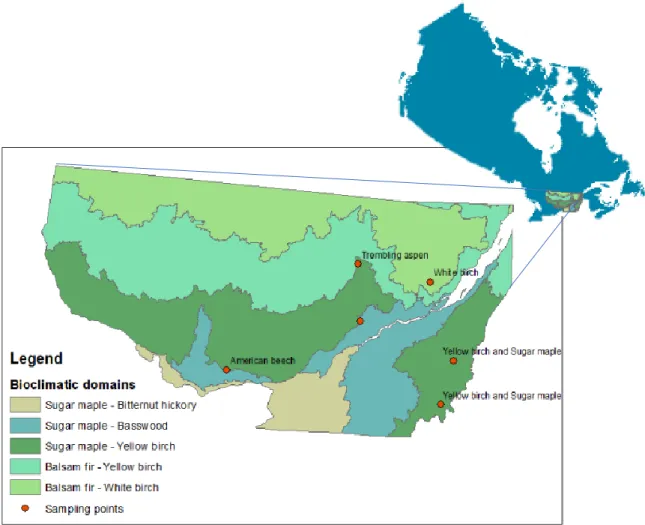
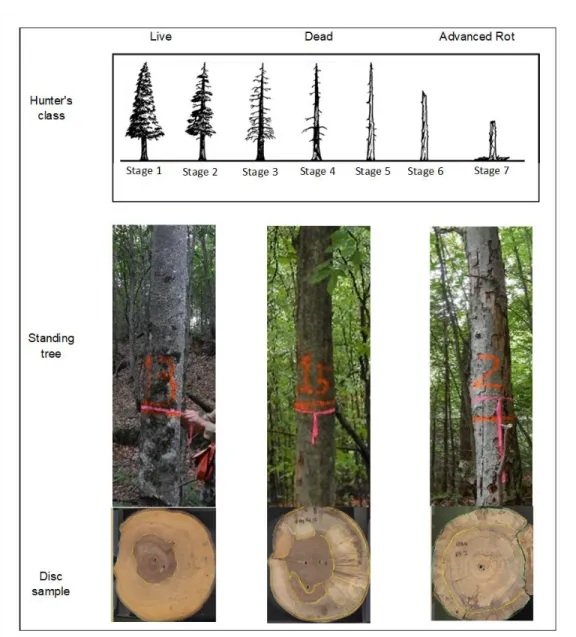
Figure 1 : Matière première, voies, procédés de conversion et produits bioénergétiques ... 4 Figure 2: Quebec's bioclimatic domains and sampling points... 11 Figure 3: Example of a standing tree and sampled disc for each decay level. ... 13 Figure 5: Beta diversity between decay levels (a) and alpha diversity expressed by the number of observed OTUs between decay level (b) and species (c). Different letters indicate significant means difference, according to Tukey’s multiple comparisons of means test, with a 95% family-wise confidence interval. ... 21 Figure 6 : Distribution of the fungal diversity and relative abundance of fungi for different decay levels ... 22 Figure 7 : Digestibility yield attained by each analyzed sample. ... 23 Figure 8 : Relation between lignin content (a), proportion of white-rot (b) and digestibility yield of carbohydrates. ... 24 Figure 9 : Variation of combustion characteristic parameters with lignin content and proportion of white-rot. ... 26
vi
L
ISTE DES
T
ABLEAUX
Table 1: Description of sampled material. ... 12 Table 2: Physical properties, fundamental biomass characteristics and conversion test response of interest ... 14 Table 3: Physical properties and fundamental characteristics of hardwoods at different decay levels ... 19 Table 4: Combustion characteristics parameters of hardwoods at different decay level ... 25
vii
R
EMERCIEMENTS
Je tiens tout d’abord à remercier Evelyne Thiffault, ma directrice de recherche. Merci pour tes précieux conseils, ta confiance, ton optimisme contagieux. Merci également de m’avoir fourni l’opportunité de suivre un stage de recherche en Australie à l’été 2019. Je souhaite aussi remercier ma codirectrice, Julie Barrette, pour sa disponibilité et pour m’avoir guidé dans plusieurs étapes méthodologiques.
Je souhaite aussi souligner l’importance du travail ayant été accompli par les différents collaborateurs du projet. Merci à Kokou Adjallé de m’avoir accueillie dans les laboratoires de l’INRS, de m’avoir guidée lors des analyses d’hydrolyse enzymatique, puis conseillée pour l’interprétation des résultats. Merci à Christine Martineau et son équipe au Centre de foresterie des Laurentides d’avoir conduit les analyses d’ADN. Vos contributions ont été essentielles à la mise à terme de ce projet.
Je tiens aussi à remercier l’équipe de soutien des laboratoires des Pavillon Gene-H.-Kruger et Abitibi-Price. Merci à Yves Bédard pour son aide dans le laboratoire de chimie du bois, à Alain Brousseau, ainsi qu’à Daniel Bourgault et Luc Germain pour leur assistance à la menuiserie. Merci également à Paul Desaulniers de m’avoir accompagné lors de l’échantillonnage sur le terrain. Cristina Vasquez et Gabriel Landry, merci pour votre temps et votre dévouement.
Merci aussi à mes collègues Émilie, Alex, Anne, Marie-Laure, Léo et tous les autres Amie-s de l’AFOR pour les pauses-café, pour les 5 à 7 (et ceux qui se sont étirés), puis pour tous ces petits moments qui ont rendu l’expérience des plus agréables. Finalement, merci à Olivier, mon amoureux, de m’avoir amenée jouer dehors quand la tête n’y était plus.
viii
A
VANT
-
PROPOS
Ce mémoire prend la forme d’un article scientifique rédigé en anglais, ainsi que d’une introduction et une conclusion générales rédigées en français. L’article a été rédigé dans le but d’être soumis pour publication dans un numéro spécial de la revue Energies sur la biomasse forestière. J’ai été responsable de la collecte des échantillons, des analyses en laboratoire, des analyses statistiques, de l’interprétation des données et de la rédaction du manuscrit. Je serai donc première auteure de l’article. Ma directrice de recherche Evelyne Thiffault a été impliquée dans l’élaboration du projet, des objectifs et hypothèses de recherche. Elle a également révisé et commenté le mémoire. Elle sera deuxième auteure. Ma codirectrice, Julie Barrette, a révisé, commenté le mémoire et les analyses statistiques. Elle m’a également conseillé à plusieurs étapes de la méthodologie. Elle sera troisième auteure. Kokou Adjallé m’a apportée une aide précieuse pour l’étape de l’hydrolyse enzymatique et l’interprétation de ces résultats. Il sera quatrième auteur.
1
I
NTRODUCTION GÉNÉRALE
M
ISE EN CONTEXTEL’augmentation des émissions de gaz à effet de serre (GES) à l’échelle globale et les conséquences qui en sont perceptibles sur le climat poussent la communauté internationale à se doter d’objectifs communs en matière d’atténuation des changements climatiques. À la suite de la 21e
Conférence sur le climat qui s’est tenue à Paris en 2015, 195 pays se sont engagés à définir des cibles nationales de réductions de GES afin de maintenir le réchauffement sous la limite de 2 ̊C par rapport au climat préindustriel. Suivant les recommandations émises par le Groupe d’experts intergouvernemental sur l’évolution du climat (GIEC) et de la Convention-cadre des Nations Unies sur les changements climatiques (CCNUCC), le Québec s’est engagé à contribuer à ces efforts en réduisant ses émissions de l’ordre de 80 à 95% par rapport au niveau de 1990, et ce d’ici 2050. À plus court terme, cela représente une réduction de 37,5% d’ici 2030, toujours en référence au niveau de 1990. Plus récemment, en octobre 2018, le GIEC a exprimé une préoccupation, dans un rapport spécial, quant aux conséquences négatives qui seraient engendrées par un réchauffement de 1,5°C en référence au climat préindustriel. Limiter le réchauffement à 1,5°C plutôt qu’à 2°C procurerait évidemment des avantages pour les écosystèmes naturels, mais permettrait aussi d’améliorer l’équité au sein des sociétés (Allen et al. 2018). Dans un communiqué de presse publié à la suite de l’acceptation de ce rapport spécial, le GIEC exprime que : «pour limiter le réchauffement planétaire à 1,5 ̊C, il faudrait modifier rapidement, radicalement et de manière inédite tous les aspects de la société » (GIEC 2018). Il est admis dans ce communiqué que des mesures nécessaires pour que le réchauffement soit limité à 1,5 ̊C sont déjà mises en place, à travers le monde. L’accent est cependant mis sur l’importance d’accélérer le rythme. Les émissions de GES étant étroitement liées à l’utilisation des énergies fossiles, il devient nécessaire de se tourner vers des alternatives énergétiques renouvelables. La bioénergie fait partie de la gamme des produits énergétiques renouvelables qui doivent être mieux développés et commercialisés afin de limiter la dépendance aux énergies d’origine fossile.
À l’échelle québécoise, dans le plan d’action 2017-2020 de la Politique énergétique 2030, il est spécifié sous l’Orientation 3 que la province souhaite diversifier et augmenter sa production de bioénergie, incluant les biocarburants (Gouvernement du Québec 2017). L’abondance de la biomasse forestière dans les forêts québécoises soulève l’opportunité de substituer les combustibles et carburants fossiles par la bioénergie. Cette voie de solution est soutenue par le programme Biomasse forestière résiduelle de Transition énergétique Québec, qui offre de l’aide financière aux entreprises,
2
municipalités et institutions qui s’engagent à réduire durablement leur consommation de combustibles fossiles par une conversion énergétique à la biomasse forestière résiduelle.
Les forêts feuillues et mixtes à feuillus durs québécoises ont été fortement perturbées par des pratiques sylvicoles inadéquates. Les années 1960 à 1980 ont été marquées par l’application de coupes sélectives à diamètre limite qui ont dégradé la qualité et diminué le potentiel des peuplements. Au début des années 1980, le Québec commence à aménager les forêts feuillues avec des coupes de jardinage, un traitement qui vise à récolter périodiquement des arbres choisis individuellement, de manière à laisser sur pied des tiges de qualité de toutes les classes de diamètre et de favoriser l’installation de la régénération des essences désirées. Cependant, d’un point de vue opérationnel, une inversion des critères de sélection des tiges a été observée et la récolte a visé les tiges de bonne qualité, contribuant encore à la rupture des stocks de qualité (Coulombe et al. 2004). Les mesures mises en place pour réhabiliter les forêts feuillues passent par une gestion écosystémique adaptée à la dynamique des perturbations naturelles et un martelage des tiges les moins vigoureuses. De plus, sans toutefois mentionner la bioénergie, la Commission d’étude sur la gestion de la forêt publique québécoise a identifié la mise en place d’une stratégie afin de trouver des débouchées pour les bois de moindre qualité comme l’un des principes piliers de sa recommandation 6.6 : «Que le Ministère mette en œuvre un vaste programme de réhabilitation des forêts feuillues» (Coulombe et al. 2004).
Plus récemment, le Bureau du Forestier en chef a émis un avis en décembre 2017 (Bureau du Forestier en chef 2017) dans lequel l’utilisation de la biomasse forestière comme source énergétique est identifiée comme une solution à la problématique d’aménagement des peuplements dont les bois sont sans preneurs. Les bois sans preneurs sont définis comme étant des essences non désirées et de moindre qualité. Les peuplements feuillus dégradés par des pratiques forestières passées inadéquates ou par des infestations d’insectes et de pathogènes sont en effet peu intéressants pour la récolte dans un contexte de production de bois d’œuvre, et de faible demande pour la production de pâte. Cependant, ne pas les récolter a des conséquences. Dans l’immédiat, on observe une diminution du volume de bois transformé, ce qui est nocif pour l’industrie forestière. À moyen terme, on peut craindre une diminution des possibilités forestières due à une perte de superficies productives. En effet, sans intervention sylvicole, il est très difficile d’augmenter la qualité de ces peuplements dont les bois sont sans preneurs. Finalement, on remarque une complexification de la planification des interventions forestières puisque le territoire réellement disponible pour l’aménagement forestier est inférieur à celui prévu par les calculs de la possibilité forestière. De plus, mieux exploiter les forêts du sud de la province pourrait permettre de diminuer la pression de récolte en forêt boréale. C’est pourquoi le Bureau du Forestier en chef recommande de : « Changer la définition de la biomasse
3
forestière notamment dans la Loi sur l’aménagement durable du territoire forestier et dans la Politique énergétique du Québec pour y considérer les bois marchands sans preneurs au même titre que la biomasse résiduelle » (Bureau du Forestier en chef 2017) .
Les forces du marché montrent une tendance en faveur de l’expansion de l’utilisation des alternatives énergétiques qui ont un impact réduit sur l’environnement et pour les énergies renouvelables. Malgré cette expansion, le marché des biocombustibles et biocarburants est toujours en phase de développement (Benali et al. 2015). Il sera primordial de rendre les procédés de fabrication plus compétitifs en termes de coûts de production, afin qu’ils puissent prendre une plus grande part dans le marché. Pour ce faire, nous avons besoin d’une matière première peu coûteuse et de procédés de transformation efficaces (Chundawat et al. 2011; Himmel et al. 2007).
Considérant cela, il est pertinent de chercher à savoir si l’utilisation des arbres dégradés pouvait permettre l’optimisation des procédés de transformation bioénergétique, et ainsi contribuer à la fois à la réduction des émissions de GES dans l’atmosphère et à la remise en production des forêts feuillues dégradées. Cette optimisation pourrait se faire par l’identification de combinaisons d’essences et de niveau de dégradation permettant l’expression de propriétés physiques et chimiques optimales pour chacun des procédés.
L
A BIOÉNERGIELa bioénergie est produite à partir de tissus végétaux issus du processus de photosynthèse; la biomasse. La matière première utilisée pour la conversion en énergie peut provenir de plusieurs sources. Parmi celles-ci, on compte les résidus forestiers et agricoles, les plantations d’arbres à croissance rapide, les cultures énergétiques et les déchets urbains organiques (GIEC 2011). La biomasse forestière, qui est d’intérêt pour ce mémoire, est défini comme étant les arbres, parties d’arbres, sous-produits du bois et bois recyclés. Il est possible de subdiviser la biomasse forestière en quatre catégories : i) les résidus primaires, qui sont les sous-produits des activités de récolte forestière et d’aménagement; ii) les résidus secondaires, soit les sous-produits de la transformation du bois; iii) les résidus tertiaires qui englobent les bois post-consommation; iv) le bois rond qui pourrait être récolté en surplus des taux de récoltes actuels, tout en restant sous le seuil de récolte durable, et qui rentre dans la catégorie des surplus de croissance forestière (Smeets et al. 2007). C’est dans cette dernière catégorie que l’on retrouve les tiges sur pied sans preneur industriel, dont les tiges feuillues de mauvaise qualité. Les bois feuillus sans preneurs sont disponibles en abondance dans les forêts
4
méridionales du Québec et leur utilisation comme matière première pour la bioénergie a un potentiel intéressant pour renforcer la chaine de valeur des forêts québécoises (Durocher et al. 2018).
Une grande variété de produits énergétiques peut être produite par différents procédés de conversion, qui sont regroupés en deux voies de conversion principales : la voie biochimique et la voie thermochimique. La Figure 1, basée sur les travaux de McKendry (2002) illustre les bioproduits énergétiques et les procédés de transformation les plus communs des deux voies de conversion qui sont associés à la transformation de la biomasse forestière.
V
OIES DE CONVERSION BIOÉNERGÉTIQUESLes deux principales voies de conversion de la biomasse sont la voie biochimique et la voie thermochimique. Les défis soulevés par la conversion de la biomasse lignocellulosique ne sont pas les mêmes pour ces deux ensembles de procédés.
Voie biochimique
La voie biochimique englobe les procédés qui impliquent un processus naturel (qui peut être induit de façon artificielle) de dégradation, par l’action d’enzymes ou de bactéries. Cela inclut notamment la production de bioéthanol par hydrolyse enzymatique et fermentation. Le principal défi soulevé par la conversion biochimique de la biomasse lignocellulosique est relié à son caractère récalcitrant. La propriété de récalcitrance est définie comme étant la résistance naturelle de la paroi
5
cellulaire végétale à la dégradation microbienne et enzymatique, ou comme étant la résistance de la plante à libérer ses sucres afin de les rendre disponibles pour la fermentation et la valorisation (Himmel et al. 2007; Lynd et al. 1999). Cette propriété s’explique par la présence de barrières physiques et chimiques. Parmi les barrières physiques, on peut penser aux cires épicuticulaires, à l’arrangement et à la densité des faisceaux vasculaires, à l’abondance des tissus de sclérenchyme (Himmel et al. 2007) et à la structure cristalline de la cellulose (Alvira et al. 2010; Hall et al. 2010; Zhao et al. 2012). La teneur en lignine considérablement élevée de la biomasse lignocellulosique constitue la principale barrière chimique (Dashtban et al. 2009). Tous ces obstacles empêchent les enzymes lignocellulosiques de pénétrer la paroi cellulaire et de dégrader les hémicelluloses et la cellulose pour en libérer les sucres (Dashtban et al. 2009). Les prétraitements de la biomasse lignocellulosique permettent de surmonter son caractère récalcitrant (Chundawat et al. 2011; Saha 2003). Ces techniques sont cependant souvent très énergivores et certaines d’entre elles génèrent des inhibiteurs de l’hydrolyse enzymatique et de la fermentation (Behera et al. 2014; Saini et al. 2016).
En nature, plus de 14 000 espèces fongiques thermophiles produisant des enzymes lignocellulosiques (cellulases, hémicellulases et ligninases) ont été répertoriées. Cependant, ce ne sont pas toutes ces espèces qui sont en mesure de produire les trois types d’enzymes en quantité suffisante pour surmonter la récalcitrance de la paroi cellulaire. Le facteur limitant est souvent l’efficacité des ligninases, soit les enzymes dégradant la lignine. Certaines espèces vont produire des inhibiteurs à la fermentation. Les champignons de pourriture blanche, comme Coriolus versicolor,
P.chrysoporium, T. versicolor, et Fomes ignarius sont les organismes les plus efficaces pour dégrader
la lignine (Dashtban et al. 2009). Ils sont également des organismes efficaces lorsqu’utilisés comme prétraitement biologique de la biomasse lignocellulosique (Fang et al. 1987; Alvira et al. 2010).
Il devient donc intéressant de chercher à savoir si la modification des propriétés chimiques et physiques du bois qui est induite par l’action des champignons de dégradation permettrait de faciliter la conversion biochimique de la matière lignocellulosique en bioéthanol. En effet, les champignons de pourriture blanche sont la cause principale de la dégradation du peuplier faux-tremble (MacLeod et al. 1982) et il a été démontré que les peupliers affectés par la pourriture blanche offraient de meilleurs rendements en sucres suite à l’hydrolyse enzymatique que les arbres sains (Knoll et al. 1993). Il est cependant à noter que le processus de dégradation du bois en l’absence de pourriture blanche tend à faire augmenter la teneur relative en lignine jusqu’à 110% de la proportion observée dans le bois sain (Knoll et al. 1993).
6
Voie thermochimique
La voie de conversion thermochimique comprend l’ensemble des procédés de conversion qui utilisent la chaleur comme vecteur de décomposition de la matière première. Cela inclut la conversion de la biomasse en énergie thermique par les processus de pyrolyse et de combustion. La compréhension des processus de décomposition thermique et la détermination des températures d’ignition et de combustion de la biomasse sont essentielles pour améliorer l’efficacité des processus thermochimiques (Mar’yandyshev et al. 2015). On s’intéresse à la décomposition thermique, car elle est dépendante de la composition de la biomasse en cellulose, hémicelluloses et lignine (Slopiecka et al. 2011). En effet, les trois composantes principales du bois ne sont pas consumées à la même température. La lignine, comparativement aux deux autres composantes qui se consument sur un intervalle de température court et précis, se décompose tout au long de la conversion (de 453- 1173 K) (Slopiecka et al. 2011). Étant la composante la plus énergétiquement dense, une diminution de sa concentration, par l’action de la pourriture blanche par exemple, pourrait affecter négativement l’efficacité des procédés de conversion thermochimique. Puisque la décomposition thermique est influencée par la composition de la biomasse, on peut croire que la dégradation du bois modifiera les patrons de combustion et l’expression des différents paramètres régissant l’efficacité de la combustion et de la pyrolyse.
B
UT ET OBJECTIFSLe but poursuivi par le projet est d’être en mesure d’identifier les combinaisons d’essence feuillue et de niveau de dégradation qui répondent le mieux aux différentes voies de conversion bioénergétiques. L’objectif général est de déterminer si l’efficacité des procédés de conversion biochimique et thermochimique est influencée par le niveau de dégradation du bois.
Les objectifs spécifiques sont les suivants :
1) Mesurer l’impact de la dégradation du bois sur ses différentes propriétés physiques et chimiques ;
2) Déterminer le rendement énergétique de la biomasse dégradée :
o en étudiant l’hydrolyse enzymatique de la biomasse dégradée (voie biochimique). o en étudiant le patron de combustion de la biomasse dégradée par analyses
thermogravimétriques (TGA) (voie thermochimique) .
Un objectif secondaire à ce projet a aussi été exploré, soit la détermination par une analyse d’ADN des types de communautés fongiques présents dans les arbres dégradés. Ce projet s’intéresse
7
plus précisément aux espèces feuillues, en raison de la problématique importante de mise en valeur qui est induite par la dégradation des forêts du sud du Québec.
H
YPOTHÈSENotre hypothèse est que l’augmentation du niveau de dégradation du bois par l’action des organismes de pourriture blanche sera en corrélation positive avec la quantité d’énergie récupérée lors de conversion biochimique, tandis qu’elle y sera corrélée négativement lors de la conversion thermochimique.
La matière première dégradée verra sa teneur en lignine diminuer, ou augmenter, dépendamment des types d’organismes fongiques qui la colonisent. Dans les procédés biochimiques, une diminution de la teneur en lignine signifie que les enzymes lignocellulosiques seront en mesure de convertir plus efficacement la cellulose et les hémicelluloses en sucres. À l’inverse, puisque la lignine est plus dense énergétiquement que les autres composantes du bois, nous posons l’hypothèse qu’une teneur en lignine moindre contribuera à diminuer l’efficacité de conversion des procédés thermochimiques. Cependant, sans l’action des champignons de pourriture blanche, les procédés de conversion thermochimique sont avantagés par l’augmentation de la concentration en lignine induite par le processus de dégradation.
8
C
HAPITRE
1:
B
IOENERGY CONVERSION POTENTIAL OF
DECAYING HARDWOODS
R
ÉSUMÉLes bois dégradés sont abondants dans les peuplements feuillus et mixtes à feuillus durs du Québec. Ces bois ne sont pas récoltés en raison de la qualité de leur fibre qui ne satisfait pas les critères de l’industrie forestière conventionnelle. Notre étude avait comme objectif d’évaluer le potentiel de conversion biochimique et thermochimique des bois feuillus dégradés, par: i) l’évaluation de l’impact de la dégradation du bois sur les propriétés chimiques et physiques; ii) l’analyse du rendement de digestibilité enzymatique; iii) l’évaluation de la stabilité et de l’efficacité de la combustion. Les résultats ont démontré que l’ensemble des propriétés des bois dégradés est maintenu dans l’intervalle de variations leur permettant de rester propres à la conversion en bioénergie. Nous avons observé deux tendances selon lesquelles le rendement de digestibilité enzymatique ainsi que la performance de la combustion seraient améliorés par une augmentation de la proportion de pourriture blanche.
A
BSTRACTThe potential for climate change mitigation of renewable energy sources motivates the implementation of new forest-based bioenergy technologies. Unharvested hardwoods are abundant in eastern Canada, due to the low quality of their fibre and the high standards of conventional wood transformation industries. The objective of this study was to assess the biochemical and thermochemical energy conversion potential of decaying hardwoods. To do so, we characterized how wood-decay processes altered the physical properties and fundamental characteristics of biomass than we performed two conversion tests: i) the assessment of the digestibility yield for the biochemical pathway; ii) the assessment of the performance to three integrated indexes of stability and efficiency of combustion for the thermochemical pathway. DNA analysis on wood samples was also performed to determine the proportion of the relative abundance of white-rot compared to that of other saprotrophs. We found no significant difference in the physical and chemical properties that are crucial for energy production between wood from live trees and wood samples in an advanced stage of decay. Different physical and chemical properties reacted differently to the increased level of decay. All of these properties have, however, been maintained within the range of variations allowing it to remain suitable for conversion into bioenergy. We observed two trends according to which the enzymatic digestibility yield, as well as the combustion performance, would be improved by an increase in the proportion of white-rot. These results show that the utilization of low-quality hardwoods instead of biomass from live trees for bioenergy production should not alter the conversion efficiency, and hence, support their use as feedstock for bioenergy production.
I
NTRODUCTIONThe Intergovernmental Panel on Climate Changes (IPCC) has identified forest biomass as an important source of renewable energy in the context of GHG mitigation goals (Nabuurs et al. 2007). The use of whole trees for energy generation is limited by ecological and carbon balance constraints (Lamers & Junginger 2013). However, pulp-quality logs that have no other market have been considered as part of sustainable biomass feedstock for bioenergy (Cintas et al. 2017). Moreover, IPCC recognizes that biomass from trees affected by natural disturbances can contribute to the overall
9
technical potential of forest biomass (Chum et al. 2011). On the other hand, recent work has shown that harvesting operations of degraded wood in naturally disturbed stands for wood pellet production were not economically profitable, and suggested that the production of high-value bioenergetic products could raise operational profitability (Barrette et al. 2017).
The conversion of forest biomass (i.e. lignocellulosic biomass) to high-value bioenergetic products can follow the biochemical or the thermochemical pathway. The biochemical conversion pathway includes processes that involve natural degradation (that can be induced artificially) through the action of enzymes or bacteria, such as bioethanol production via enzymatic hydrolysis and fermentation or anaerobic digestion (McKendry 2002). The main obstacle to biochemical conversion success is biomass recalcitrance, which is defined as the natural resistance of the plant to enzymatic and microbial degradation (Himmel et al. 2007). Biomass recalcitrance resides in the plant physical structure (pore size and volume, specific surface area, cellulose crystallinity) and chemical composition (high lignin concentration and acetyl group). Overcoming biomass recalcitrance is possible by the application of pretreatments that alter the physical structure and chemical composition of biomass and enhance the accessibility of cellulose and hemicelluloses to enzymatic digestibility (Zhao et al. 2012). Pretreatments are responsible for a significant proportion of the conversion costs (McAloon et al. 2000; Mosier et al. 2005), and it is difficult to achieve good bioethanol yield without high energy inputs (Zhu et al. 2010). The high cost of the conversion process restricts bioethanol production at an industrial scale (Liu et al. 2013). Some pretreatment technologies also lead to the denaturation of sugars that will inhibit the fermentation process (Behera et al. 2014) and therefore lower the conversion efficiency. Furthermore, some pretreatment technologies produce acidic or alkaline wastewater that needs to be treated before being released in the environment (Keller et al. 2003).
Fungal and microbial treatments have been suggested as an environmentally friendly and cost-competitive alternative to traditional pretreatment in order to enhance enzymatic hydrolysis. The biological pretreatment employ microorganisms such as white-rot fungi to degrade lignin and hemicelluloses extensively, but leave cellulose mostly untouched (Alvira et al. 2010). The downsides of this method are the long residence period and the loss of carbohydrates (hemicelluloses and, to a lesser extent, cellulose) that reduce the overall conversion efficiency (Wang et al. 2012). However, evidence showed that natural wood degradation processes associated with fungi, insects or fire, has the potential to reduce recalcitrance and enhance enzymatic digestibility (Knoll et al. 1993; Luo et al. 2010; Pan et al. 2008).
10
The thermochemical conversion pathway includes processes that use heat as a vector of decomposition of the raw material. The most studied conversion technologies are combustion, pyrolysis and gasification (McKendry 2002). The energy content per mass unit, expressed by the calorific value (or higher heating content, HHV), is the most important parameter that influences the quality of thermochemical fuels. Also, since lignin has a higher calorific value (23.26 to 25.58 MJ/kg) than the other wood components such as cellulose and hemicelluloses (18.60 MJ/kg), HHV of biomass is strongly correlated to the lignin content of the biomass (Demirbas 2001; White 1987). The presence of lignin-decomposing fungi such as white-rot could negatively affect the HHV of decaying biomass, whereas degradation caused by other types of saprotrophs (which actions affect other wood components) could have a neutral or a positive impact.
Unharvested volumes of hardwoods are abundant in Quebec (Canada) (Durocher et al. 2018). These volumes are not harvested either because they are comprised of species that are not traditionally wanted by the wood-processing industry, or due to the low quality of their fibre induced by past unsustainable management techniques or the attack of fungus and insects. Bioenergy production from surplus forest growth (i.e. volumes that could be harvested in addition to the current harvesting level, while staying under the sustainable harvesting rate (Smeets et al. 2007) of unharvested low-quality woods could potentially contribute to meet renewable energy goals as well as the restoration of degraded forests.
The main objective of this study was to assess the biochemical and thermochemical energy conversion potential of decaying and unharvested hardwoods. First, we characterized the impact of wood degradation and fungus type on the expression of wood physical properties and fundamental characteristics. Then, the conversion response of decaying hardwoods to energy via the biochemical and thermochemical pathways was determined using enzymatic hydrolysis and thermogravimetric analysis, respectively.
11
M
ETHODOLOGYMaterial, physical properties and fundamental biomass characteristics
Five different species, indigenous to the province of Quebec, including sugar maple (Acer
saccharum Marshall), yellow birch (Betula alleghaniensis Britt.), white birch (Betula papyrifera
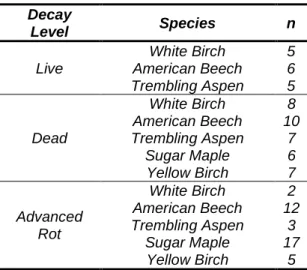
Marshall), American beech (Fagus grandifolia Ehrh.) and trembling aspen (Populus tremuloides Michx.), were sampled in different study areas across Quebec’s temperate hardwood forest and the southern limit of the boreal forest. Sampling sites were spread across the following bioclimatic domains: sugar maple-basswood, sugar maple-yellow birch and balsam fir-white birch (Figure 2). Trees with a diameter at breast height ranging from 10 to 40 cm were selected to represent different stages of degradation according to Hunter’s visual classification (Hunter 1990). We modified Hunter’s classification and grouped stages into three primary decay levels: Live (stages 1-2), Dead (stages 3-4) and Advanced rot (stages 5-6-7). The number of sampled trees within each combination of species and the level of decay is specified in Table 1.
12
Table 1: Description of sampled material.
A 30 cm thick disc was collected in each tree at breast height (1.3 meters). Figure 3 represents an example of a standing tree and a sampled disc for each decay level and associated Hunter’s class of American beech. The discs were stored at -5 ˚C until further analysis.
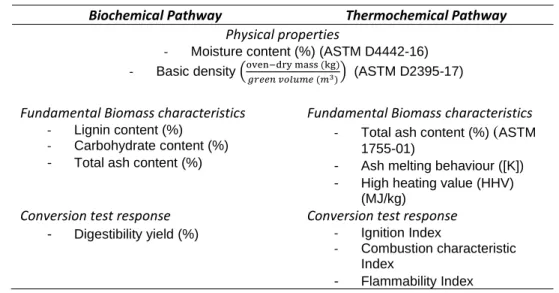
The physical properties of biomass were assessed by the determination of moisture content and basic density, which are relevant to both conversion pathways. Generally, moisture content varies widely because it depends on harvesting and storage methods; moisture content can also be easily manipulated with proper pretreatment and conditioning practices (Thiffault et al. 2018). Basic density is influenced by other factors such as environmental conditions, growth rate, wood defects, and compression wood. We applied the standard methods from ASTM International to determine moisture content (ASTM D4442-16) and basic density (ASTM D2395-17).
Decay Level Species n Live White Birch 5 American Beech 6 Trembling Aspen 5 Dead White Birch 8 American Beech 10 Trembling Aspen 7 Sugar Maple 6 Yellow Birch 7 Advanced Rot White Birch 2 American Beech 12 Trembling Aspen 3 Sugar Maple 17 Yellow Birch 5
13
The fundamental biomass characteristics cannot be modified as easily by pretreatment and have a potential influence on bioenergy conversion efficiency. They could, however, be influenced by wood decay and wood defects. In order to assess the bioenergy conversion potential for biochemical and thermochemical pathways, we used specific fundamental characteristics and conversion tests (Annevelink et al. 2015) (Table 2). As an indicator of performance for the biochemical pathway, we tested bioethanol production by enzymatic hydrolysis. For the thermochemical pathway, we chose to test the combustion process with thermogravimetric analysis.
14
Table 2: Physical properties, fundamental biomass characteristics and conversion test response of interest
Samples were oven-dried at 60˚C for 72 hours, debarked, and a section of the discs was milled into 0.5 mm particles and stored in hermetic bags at room temperature until further analysis. The relative content of cellulose, hemicelluloses, lignin and extractives were measured by the sequential method using neutral and acid detergents from Van Soest, Robertson, & Lewis (1991) and commented by Godin (2011).
Ash content was determined by weighing samples in porcelain crucibles, before and after spending 6 hours at 600 ˚C, following the standard procedure of ASTM E1755-01(2015). We used the potassium concentration in ash as a modified alkali index (Annevelink et al. 2015). The concentration of alkali metals in ash indicates the risk of slagging and fouling in the reactor, with a higher index or a higher K concentration representing greater risk. The remaining ashes were then mixed with chloric acid, heated to allow dissolution, and filtered. The resulting liquid was transferred for analysis of major elements using inductively coupled plasma optical emission spectrometry IPC-OES (Agilent 5110).
The higher heating value (HHV), defined as the energy content per mass unit (MJ/kg), was measured with a bomb calorimeter (Parr 6400), which was calibrated with benzoic acid. Approximately 0.7 g of ground wood sample was pressed into a tablet before being burnt in the presence of oxygen. Combustion in the bomb calorimeter was induced by a cotton thread attached to the platinum ignition wire in contact with the sample tablet.
Biochemical Pathway Thermochemical Pathway
Physical properties
- Moisture content (%) (ASTM D4442-16) - Basic density (oven−dry mass (kg)
𝑔𝑟𝑒𝑒𝑛 𝑣𝑜𝑙𝑢𝑚𝑒 (𝑚3)) (ASTM D2395-17) Fundamental Biomass characteristics
- Lignin content (%) - Carbohydrate content (%)
- Total ash content (%)
Fundamental Biomass characteristics
- Total ash content (%) (ASTM 1755-01)
- Ash melting behaviour ([K])
- High heating value (HHV) (MJ/kg)
Conversion test response Conversion test response
- Digestibility yield (%) - Ignition Index
- Combustion characteristic Index
15
DNA analysis
The DNA analysis was carried out in the Microbiome and Genomics laboratory of the Laurentian Forest Center (Canadian Forest Service, Quebec City, Qc, Canada). The DNA analysis was used to identify the different fungal Operational Taxonomic Units (OTUs) colonizing each sample. In the context of this study, OTUs were used to determine the trophic status of the organisms responsible for wood decay.
The material stored at -5˚C was used for this analysis. The procedure for DNA analysis included sample preparation steps to reduce the disc in powder without letting it thaw. A coarse powder was collected from each disc using an electric hand router tool, and it was then crushed into fines particles (about 0.5 mm) with a mortar and pestle in liquid nitrogen. DNA extraction from wood samples was performed on 100 mg of wood, with the PowerSoil® DNA Isolation Kit, using the manufacturer’s instructions (n = 92). During the extraction process, cells are broken down mechanically and chemically. The assay of the extracted DNA was performed in a 0.5% dimethylsulfoxide (DMSO) solution. Readings were carried out on a Qubit® 3.0 Fluorometer. Polymerization chain reaction (PCR) was used to amplify the target DNA of fungal origin with PCR Master Mix (Taq Polymerase and ITS – Internal transcripted sequence) and separate it from the vegetal DNA. After each PCR cycle, the target DNA is doubled. Forthy (40) cycles of heating and cooling were performed automatically, using a thermal cycler. The success of the PCR is validated by gel electrophoresis. DNA is then purified using magnetic particles in order to keep amplified fungal DNA only. DNA samples are indexed so that multiple libraries can be pooled and sequenced simultaneously. Dual-indexed libraries for Illumina allows generating 96 uniquely tagged libraries. A second purification is performed before samples are pooled together and sequenced by the Illumina
sequencing system. Following DNA sequencing, bioinformatic analysis were carried out with Qiime
1 software. The rarefaction curve was fixed at 3100 sequences per sample, which allowed us to keep 91 of the 92 analyzed samples.
Enzymatic hydrolysis and sugar recovery
We performed the enzymatic hydrolysis at INRS Centre Eau, Terre et Environnement (QC, Canada). The digestibility yield, calculated from the glucose content of the substrate for the fermentation process, was selected as the indicator of the biochemical conversion potential. Three samples were selected within each species, including, if available, one live and two decayed (n = 15). Biomass was oven-dried to reach a moisture content below 5%, in order to limit the error due to evaporation. The protocol was based on Danisco US Inc. (2007) and Miller (1959). Enzymatic
16
hydrolysis of the wood was conducted using the commercial enzyme ACCELLERASE® DUET™ manufactured by DuPont Industrial Biosciences.
Hydrolysis
Prehydrolyzates of 125 ml at 100 g/L were prepared by adding 116 ml of the 0.05 M/L buffer solution (pH 4.8), 2 ml of cycloheximide and 4 ml of tetracycline to 12.5 g of wood sample. Hydrolyzates were then placed into a shaking incubator (55˚C, 180 rpm). Samples were collected after 24, 48, 72 and 96 hours of the enzymatic hydrolysis reaction. Hydrolyzate Samples were stored at 4˚C until the measurement of reducing sugars.
Digestibility yield calculation
Glucose concentration and wood composition data of each hydrolyzed sample allowed digestibility yield calculation (Equation 1). Glucose concentration is expressed in mg/ml, and we systematically used the value after 96 hours of the reaction process.
(1)
𝑦𝑖𝑒𝑙𝑑 (%) =
[𝐺𝑙𝑢𝑐𝑜𝑠𝑒 (𝑚𝑔 𝑚𝑙)]∗ 12.5𝑔 𝑠𝑎𝑚𝑝𝑙𝑒 ⁄ 𝑀𝑎𝑠𝑠 𝐶𝑒𝑙𝑙𝑢𝑙𝑜𝑠𝑒 (𝑔) + 𝑀𝑎𝑠𝑠 𝐻𝑒𝑚𝑖𝑐𝑒𝑙𝑙𝑢𝑙𝑜𝑠𝑒𝑠 (𝑔)Thermogravimetric analysis
Thermogravimetric analysis (TGA) was used to assess the thermochemical conversion potential. This type of analysis makes it possible to determine the thermal degradation pattern of biomass. The ignition (Ti) and burnout (Te), along with the ignition index (Di), combustion
characteristic index (S) and the flammability index (C) of biomass, can be deduced from the thermogravimetric results. The comparison of the different parameters expressed by thermal degradation patterns allows determining which type of biomass has the highest heat transfer and combustion efficiency (Agrawal & Chakraborty 2013; Magdziarz & Wilk 2013; Zhao et al. 2018).TGA analysis was performed on Mettler Toledo TGA. The number of analyzed samples within each species/decay level combination is indicated in Table 4.
The crucible was heated to red before and between the analysis of each sample. Approximately 0.15g of ground material was placed in the crucible. Air was used as a carrier gas, with a flow rate of 50 ml/min. The samples were heated from room temperature to 105˚C at a heating rate of 30˚C/min and kept at 105˚C for 10 minutes to remove moisture entirely from the samples. In the third heating segment, samples were heated from 105˚C to 800˚C, at a rate of 30˚C/min. Thermogram (TGA) curve and its first derivative (DTG) curve, presented in the relative weight scale, were used to determine ignition and burnout temperature using the intersection method (IM)
17
described by Lu & Chen (2015). The ignition temperature refers to the minimum temperature at which the fuel (i.e. biomass sample) ignites spontaneously in the absence of an external source of ignition. The importance of the ignition temperature is mostly related to its safety in storage. The burnout temperature, defined as the temperature at which the fuel is almost entirely consumed, or at which 99% of the conversion is completed, is an indicator of the fuel’s reaction degree (Lu & Chen 2015). In order to have a better overview of the different combustion characteristics, three integrated indexes were developed (Chen et al. 2018; Song et al. 2017). The ignition index (Di) is calculated
using Equation 2, where (𝑑𝑊 𝑑𝑡⁄ )
𝑚𝑎𝑥 is the maximum combustion rate. Ti is the ignition
temperature, and Te is the burnout temperature. The larger the ignition index gets, the better is the
performance of ignition.
(2) 𝐷𝑖 =(𝑑𝑊 𝑑𝑡
⁄ )
𝑚𝑎𝑥
𝑇𝑖∗ 𝑇𝑒
The combustion characteristic index (S), first proposed by Cheng & Sun (1987), arises from Arrhenius Law. The larger the combustion index is, the better is the fuel’s combustion. The combustion characteristic index is expressed by Equation 3.
(3) 𝑆 =(𝑑𝑊 𝑑𝑡⁄ )𝑚𝑎𝑥∗ (𝑑𝑊 𝑑𝑡⁄ )𝑚𝑒𝑎𝑛
𝑇𝑖2∗ 𝑇𝑒
Where (𝑑𝑊 𝑑𝑡⁄ )
𝑚𝑎𝑥 is the maximum combustion rate, (𝑑𝑊 𝑑𝑡⁄ )𝑚𝑒𝑎𝑛 is the average
combustion rate, 𝑇𝑖 is the ignition temperature and 𝑇𝑒 the burnout temperature.
The flammability index (C) expresses the combined influence of the maximum combustion rate and ignition temperature. A large flammability index value indicates good combustion stability (Chen et al. 2018). The flammability index is expressed by Equation 4.
(4) 𝐶 = (𝑑𝑊 𝑑𝑡⁄ )𝑚𝑎𝑥
𝑇𝑖2
Data analysis
Two-way factorial analysis of variance, using decay level and species as independent variables, and physical properties, fundamental characteristics and conversion test results as response
18
variables, were performed with R software version 3.6.1. Multiple comparison tests for determining differences between interaction effects or individual levels were performed using Tukey contrasts. The assumptions of the normality of residuals and homoscedasticity were tested beforehand. In order to keep a balanced experimental design, observations from sugar maple and yellow birch were not taken into consideration in these analyses since there no Live wood sample for these species.
Simple linear regression allowed us to assess the effect of the lignin content and the proportion of white-rot on biochemical and thermochemical conversion. Ordination and diversity of the taxonomic data were analyzed with the Metacoder R package (Foster et al. 2017).
R
ESULTSEffects of wood decay processes on physical properties and fundamental
characteristics
Results from the ANOVA suggested that the effect of the interaction of species x decay level was different between the various physical properties and fundamental characteristics (Table3).
The standard deviation of moisture content and basic density showed a considerable variation within each combination of species x decay level. Moisture content was significantly affected by the interaction of species x decay level (p-value: >0.0001), but no clear pattern among species was detected. However, both trembling aspen and American beech in the advanced rot stage had significantly lower moisture content than other combinations. On the other hand, the effect of species and decay level was not significant for basic density (p-value: 0.3903).
19
Table 3: Physical properties and fundamental characteristics of hardwoods at different decay levels
Relative lignin content was significantly affected by the interaction of species and decay levels (p-value: 0.0041). However, no clear pattern of the effect of decaying processes on lignin was detected. The relative carbohydrate content (cellulose + hemicelluloses) was also significantly influenced by species and decay levels (p-value: 0.0003). Hardwoods in the Live and Dead stage had a higher carbohydrate content than the ones in the Advanced rot stage. However, the effect was not detectable on the white birch sample in the Advanced rot stage.
Decaying processes significantly enhanced the ash content (p-value: 0.0029). The concentration of K in ash was not affected by decay level but differed between species (p-value: 0.0085): Tukey contrast showed that American beech presented a significantly higher concentration of K than white birch. High heating values (HHV) were significantly affected by the interaction effect species x decay level (p-value: 0.0230), although the variations were maintained within a narrow interval (19.18 for American beech in the Advanced rot stage and 20.08 for trembling aspen in Advanced rot).
Decaying fungal organisms and effect on the wood composition
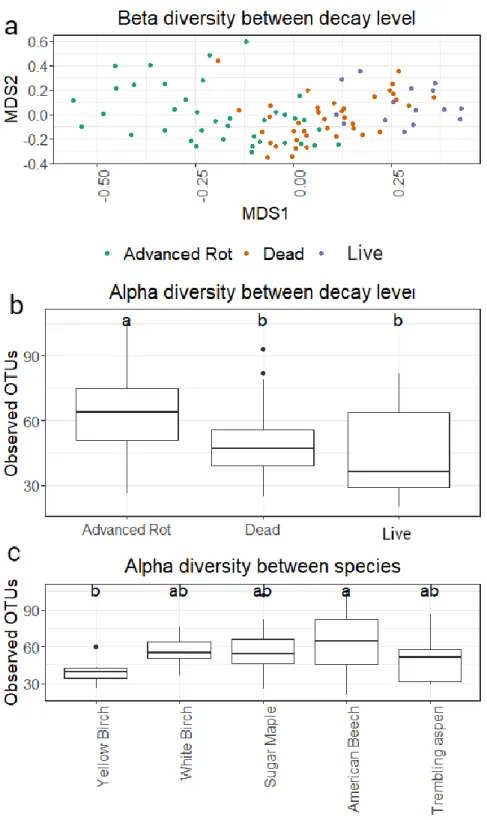
Results from DNA analysis suggested that fungal communities were different within decay levels (Figure 4a), but not between species. The abundance of OTUs colonizing each tree increased
Decay Level Species n
Moisture content (%) Basic Density (kg/m3) [K] (ppm)1 HHV (MJ/kg) Ash (%) n Lignin (%) Carbo-hydrates (%) White Birch 5 75.47ab (16.44) 426 (54) 478.5b (180.7) 19.55ab (0.14) 0.26b (0.0008) 5 13.92b (1.19) 79.94a (1.63) Live American Beech 6 57.02abc (18.45) 609 (322) 1711.5a (1166.5) 19.29b (0.28) 0.78ab (0.006) 4 15.30ab (2.94) 79.45a (2.46) Trembling Aspen 5 99.47a (24.12) 493 (64) 600.2ab (193.0) 19.34ab (0.34) 0.48ab (0.001) 5 12.98b (1.98) 79.04a (2.82) White Birch 8 65.30ab (20.51) 485 (236) 670.3b (721.7) 19.59ab (0.34) 0.34b (0.003) 7 15.56ab (2.49) 78.32a (4.01) Dead American Beech 10 45.25b (17.39) 499 (210) 1493.2a (774.0) 19.31b (0.27) 0.87ab (0.007) 6 18.58a (2.54) 76.15a (2.09) Trembling Aspen 7 98.58a (34.02) 609 (141) 1132.4ab (600.6) 19.40ab (0.19) 0.63ab (0.002) 6 13.54b (0.85) 77.43a (1.11) White Birch 2 69.23abc (3.32) 409 (12) 653.5b (259.2) 19.30b (0.28) 0.44ab (0.001) 2 13.25b (0.92) 79.45a (1.34)
Advanced Rot American
Beech 12 23.70b (11.21) 491 (191) 1883.4a (1916.7) 19.18b (0.26) 1.16a (0.007) 1 15.90ab NA 75.90ab NA Trembling Aspen 3 46.39b (40.26) 286 (170) 2249.1ab (853.9) 20.08a (1.05) 1.59a (0.008) 3 15.57ab (1.89) 67.67b (5.86)
Values in parenthesis show standard deviation
**For a given property or characteristic, different letters indicate significant means difference between interaction effects, according to Tukey’s multiple comparisons of means test, with a 95% family-wise confidence interval. Note that means that are not significantly different are not to be judged to be the same.
20
with the severity of rot (Figure 4b). The abundance of different OTUs (alpha diversity) also differs between species (Figure 4c). Using ANOVA and Tukey contrasts, we observed a significant difference between the alpha diversity of yellow birch and American beech (p-value: 0.0022).
A total of 286 different taxonomic units (OTUs) were identified among the 91 samples tested. Over 20% of the overall fungal diversity (in terms of the total number of OTUs) was represented by organisms belonging to the agaricomycete class, which are the most efficient decaying fungi. Agaricomycetes exhibit two main modes of plant cell wall decomposition: i) white-rot, which will digest lignin first and; ii) brown-rot, which will digest carbohydrates first (Krah et al. 2018). Our results showed that the relative abundance of agaricomycetes was higher within Advanced Rot samples than within Dead and Live samples (Figure 5). The relative abundance of white-rot was also significantly higher in Advanced Rot samples than in Live and Dead samples (p-value: 0.0009).
The DNA analysis was useful to determine the trophic status of each OTU colonizing our wood samples. The presence of white-rot was evaluated using the relative abundance of white-rot fungi compared to the abundance of all saprotrophs as a proxy. Our results revealed no significant impact of the proportion of white-rot on wood composition. Nevertheless, samples with a higher proportion of white-rot fungi tended to have a higher relative lignin content (p-value: 0.180). The increment of the proportion of white-rot was associated with a lower carbohydrate content (p-value: 0.075), but the linear model was very weak (R2 = 0.032).
21
Figure 4:Beta diversity between decay levels (a) and alpha diversity expressed by the
number of observed OTUs between decay level (b) and species (c). Different letters indicate significant means difference, according to Tukey’s multiple comparisons of means test, with a 95% family-wise confidence interval.
22
Figure 5 : Distribution of the fungal diversity and relative abundance of fungi for different decay levels
23
Biochemical conversion test
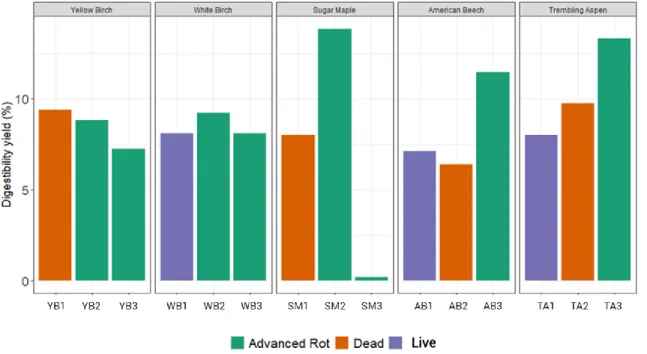
Digestibility yield of cellulose and hemicelluloses varied in the different samples that we selected for enzymatic hydrolysis (Figure 6). There was no detectable pattern, among all species, of the influence of decay level on digestibility yield. The digestibility yield of trembling aspen increased with the severity of rot. Sample SM3 presents a yield of approximately 0%, probably due to an experimental mistake.
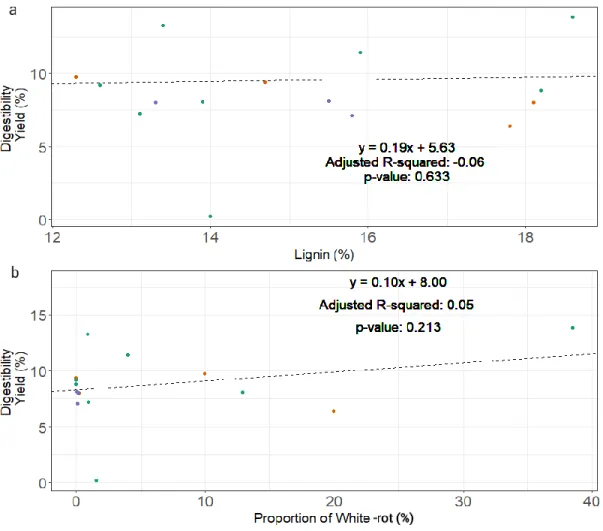
Our results did not suggest that lignin content in biomass drives the digestibility yield of carbohydrates (p-value: 0.633) (Figure 7a). A slight, although non-significant (p-value: 0.213), a trend indicated that the enzymatic reaction could be associated with a higher digestibility of carbohydrates when the proportion of white-rot is higher (Figure 7b).
24
Figure 7 :Relation between lignin content (a), proportion of white-rot (b) and digestibility
25
Thermochemical conversion test
The variations in the combustion characteristic parameters of white birch, American beech and trembling aspen suggested that they cannot directly be explained by decaying processes. The interaction between species and decay level was not significant for burnout temperature (Te), ignition
index (Di), combustion characteristic index (S) and flammability index (C). The ANOVA result
detected a significant effect of species x decay level on the ignition temperature (Ti) (p-value: 0.0036).
Therefore, a multiple comparison test was performed on Ti, which did not reveal a clear pattern among
decay levels or species (Table 4), although Ti tended to be lower for American beech and trembling
aspen at a more advanced decay level.
Table 4: Combustion characteristics parameters of hardwoods at different decay level
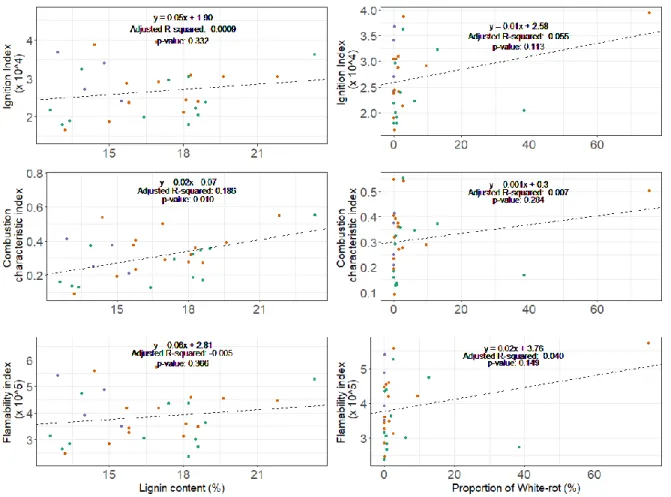
The combustion parameters appeared to be related to the lignin content of biomass (Figure ). Most of the relations were not statistically significant, but the trends suggested an increment of ignition index and flammability index with an increase of lignin content. The combustion characteristic index was significantly affected by the lignin content of biomass (p-value: 0.0098); a higher lignin content increased (i.e. improved) the characteristic combustion index, which is an indicator of good fuel combustion. The linear relationships between the proportion of white-rot and the thermochemical indexes were all non-significant.
Decay Level Species n (°C) Ti (°C)Te (x 10Di 4)
S (x 107) C (x 105) White Birch 2 273.90a (0.44) 396.59 (0.57) 2.56 (0.21) 3.71 (0.30) 0.23 (0.03) Live American Beech 2 269.70abc (1.48) 391.50 (1.35) 3.70 (0.50) 5.36 (0.71) 0.45 (0.12) Trembling Aspen 2 273.35a (4.21) 396.80 (1.58) 3.55 (0.19) 5.15 (0.38) 0.39 (0.03) White Birch 2 273.98a (0.57) 398.25 (0.24) 2.34 (0.05) 3.40 (0.06) 0.20 (0.04) Dead American Beech 4 270.38ab (1.56) 396.48 (3.80) 3.46 (0.76) 5.08 (1.13) 0.46 (0.23) Trembling Aspen 2 267.84abc (4.92) 394.75 (3.32) 2.23 (0.80) 3.28 (1.14) 0.17 (0.11) White Birch 2 272.46a (1.53) 396.09 (2.60) 2.71 (0.74) 3.95 (1.13) 0.27 (0.15)
Advanced Rot American
Beech 2 260.41bc (2.56) 397.5 (1.45) 1.70 (0.33) 2.59 (0.49) 0.12 (0.04) Trembling Aspen 2 260.08c (6.71) 392.24 (3.29) 1.95 (0.07) 2.95 (0.15) 0.13 (0.003)
Ti = ignition temperature; Te = burnout temperature; Di = ignition index; S = combustion characteristic index; C =
flammability index.
Values in parenthesis show standard deviation
**For Ti, different letters indicate significant means difference between interaction effects, according to Tukey’s multiple
comparisons of means test, with a 95% family-wise confidence interval. Note that means that are not significantly different are not to be judged to be the same.
26
D
ISCUSSIONWe did not find evidence that decaying processes can improve or significantly influence physical properties and fundamental characteristics of forest biomass related to their bioenergy conversion performance. Nevertheless, our results suggest that decayed wood at least maintains suitable properties for both thermochemical and biochemical pathways.
Moisture content can easily be manipulated with pretreatment and conditioning of biomass (Thiffault et al. 2018). Still, our results showed that hardwoods in an advanced stage of decay have a lower moisture content, which is generally an advantage for thermochemical conversion technologies. For example, combustion cannot be carried out on feedstock with over 50% of moisture content (McKendry 2002). The fast pyrolysis process requires a maximum moisture content of 10% to be efficient (Bridgwater 2004). The use of decaying trees with naturally lower moisture content is, therefore, a non-negligible advantage in comparison with live trees, because it makes it possible to
Figure 8 :Variation of combustion characteristic parameters with lignin content and proportion of
27
reduce or eliminate the drying stage. On the other hand, biomass with high moisture content is more suitable for biochemical conversion technologies, especially anaerobic digestion (McKendry 2002). The basic density of decaying hardwoods, averaging 479 kg/m3
, is slightly lower than the typical
value from live stem wood of broadleaved species, which has an average of 549 kg/m3 (Annevelink
et al. 2016). A higher basic density means less volume for the same mass of feedstock. It is advantageous in the different steps of handling and transportation to have a material that is as dense as possible. In that way, decaying trees are not the most effective type of feedstock for bioenergy conversion. The relation that we found between specie, decay level and basic density was, however, not significant.
For their part, feedstock relative contents of lignin and carbohydrates are fundamental characteristics of interest for biochemical conversion technologies that cannot be manipulated. They were both influenced by wood-decaying processes and tree species, but those two parameters did not satisfactorily explain the observed variations. Another factor of influence is the type of fungal organisms responsible for decay. Our results suggested that the lignin content in hardwoods colonized by white-rot fungi tended to be higher in the presence of a higher proportion of white-rot fungi. This is in opposition with observations from the literature (Kumar & Wyman 2009; Shi et al. 2008). In our experiment, the average value for the relative lignin content of hardwoods in the Dead and Advanced rot stages of decay was 15.4%. This is still considerably lower than the average value of 20.8% observed by Annevelink et al. (2016) in broadleaved species. According to the indicators established by the S2Biom project, the proportion of lignin that we measured in this study was within the ̏ Standard ̋ range of suitability for biochemical conversion. Moreover, the carbohydrate content of our decaying hardwoods tends to be lowered by the higher proportion of white-rot. Still, the average carbohydrate content of our decaying wood samples can be classified as ̏Highly desirable ̋ (Annevelink et al. 2015) for biochemical conversion and is higher than the average value generally observed in live wood (Annevelink et al. 2016).
The ash content was significantly increased by decay processes. Higher ash content is less profitable for both biochemical and thermochemical conversion because it cannot be converted to energy; feedstock with high ash content tends to foul reactors, and energy has to be consumed to dispose of them. However, in comparison with agricultural biomass, forest biomass typically has a low ash content. Also, different parts of the tree have different ash contents. It has been reported that the ash content in the bark was higher in comparison to stem wood, i.e. 1.6-2.8% vs. 0.3-1.0%, respectively (Annevelink et al. 2016). Since decaying trees tend to lose their bark, it might be beneficial for high-value bioenergy production (Barrette et al. 2014). Nevertheless, the ash contents
28
that we measured still fall in the range of the ̏ Ideal ̋ and ̏ Desirable ̋ categories, for both thermochemical and biochemical conversion, according to Annevelink et al., (2015).
Ash agglomeration is a potential problem that could lead to slagging and fouling in thermal conversion reactors. The higher the K concentration, the higher is the risk of slagging and fouling. The K concentration that we measured was not influenced by the level of decay; hence there is no evidence that using decaying trees would increase the risk of fouling.
Knoll et al. (1993) observed that decayed aspen had a calorific value that was 40% higher than sound aspen. However, they attributed this variation to the extractives (wood degradation products) and not to the lignin content. On the other hand, Nguyen et al. (2016) did not detect any significant differences in HHV between sugar maple and yellow birch trees of different vigour status (including dying trees). Our results showed that the variations of the calorific value of hardwoods at different decay levels are maintained in a narrow interval, which is within the interval observed in live wood by Annevelink et al. (2016).
No statistical analysis was performed on the biochemical conversion test due to the low number of observations (n =15) and the absence of replicates. The restrictive impact of high lignin content on enzymatic digestibility is well known and documented (Chundawat et al. 2011; Himmel et al. 2007; Li et al. 2016). Yet, the exploratory results that we produced do not confirm our hypothesis of an increase of digestibility in the presence of white-rot, although there was a slight trend that will have to be validated by further observation. Enzymatic hydrolysis of decaying hardwoods without pretreatment resulted in very low glucose content (4.84 to 9.80 mg/g wood) and digestibility yield (7.11 to 13.3 % of cellulose and hemicelluloses hydrolyzed). Our results are in opposition to previous research that showed that the natural wood degradation process has the potential to reduce recalcitrance and enhance enzymatic digestibility. Knoll et al. (1993) discovered that the disrupted structure of decaying aspen wood would allow enzymatic hydrolysis of cellulose and hemicelluloses to yield a higher percentage of sugars, without pretreatment. Similarly, the subsequent fungal degradation that followed mountain pine beetle (Dendroctonus ponderosae) attack on lodgepole pine (Pinus contorta Douglas ex Loudon) resulted in a higher enzymatic digestibility and ethanol yield than sound wood, after sulfite or organosolv process pretreatment (Luo et al. 2010; Pan et al. 2008). The conversion test that we carried out in this study was more adapted for combustion conversion technologies since it was performed in an air atmosphere. We observed that the ignition temperature of decaying hardwoods would vary from 260 to 274˚C. The values of ignition temperature for hardwoods are typically between 250 and 310˚C (Babrauskas 2002), and 235˚C for