TH `
ESE
TH `
ESE
En vue de l’obtention du
DOCTORAT DE L’UNIVERSIT´
E DE TOULOUSE
D´elivr´e par : l’Universit´e Toulouse 3 Paul Sabatier (UT3 Paul Sabatier)
Pr´esent´ee et soutenue le 30 juin 2016 par :
Nicolas Verstaevel
Self-organization of robotic devices through demonstrations
JURY
Marie-Pierre GLEIZES Professeur, Universit´e de Toulouse
Directrice
Fabrice Robert Responsable Innovation, Sogeti High Tech
Co-Encadrant
Christine R ´EGIS Maˆıtre de conf´erences, Universit´e de Toulouse
Co-Encadrante
St´ephane DONCIEUX Professeur, Universit´e Pierre et Marie Curie
Rapporteur
Jean-Paul JAMONT Maˆıtre de conf´erences HDR, Universit´e Grenoble Alpes
Rapporteur
Patrick REIGNIER Professeur, Institut National Polytechnique de Grenoble
Examinateur
Philippe RAVIX Directeur Innovation, Sogeti High Tech
Invit´e
´
Ecole doctorale et sp´ecialit´e :
MITT : Domaine STIC : Intelligence Artificielle
Unit´e de Recherche :
Institut de Recherche en Informatique de Toulouse
Directrices de Th`ese :
Marie-Pierre GLEIZES et Christine R ´EGIS
Rapporteurs :
T
HESIS
presented at
Universit´e Paul Sabatier - Toulouse III
U.F.R. MATHEMATIQUES´ , INFORMATIQUE ETGESTION
to obtain the title of
DOCTEUR DE L’UNIVERSITE DE´ TOULOUSE
delivered by
UNIVERSITE´ PAUL SABATIER - TOULOUSEIII
Mention INTELLIGENCE ARTIFICIELLE
by
N
ICOLAS
V
ERSTAEVEL
Doctoral school: Informatique et T´el´ecommunication
Laboratory: Institut de Recherche en Informatique de Toulouse Team: Syst`emes Multi-Agents Coop´eratifs
Self-Organization of Robotic Devices
Through Demonstrations
JURY
Marie-Pierre GLEIZES Professor, Universit´e de Toulouse (Supervisor) Fabrice ROBERT R&D and Innovation Manager, Sogeti High Tech (Co-Supervisor)
Christine R ´EGIS Assistant Professor, Universit´e de Toulouse (Co-Supervisor) St´ephane DONCIEUX Professor, Universit´e Pierre et Marie Curie (Examiner)
Jean-Paul JAMONT Assistant Professor, Universit´e Grenoble Alpes (Examiner)
Patrick REIGNIER Professor, Grenoble INP (Supervisor)
Nicolas Verstaevel
A
UTO-O
RGANISATION DED
ISPOSITIFSR
OBOTIQUES PARD
ÉMONSTRATIONSDirectrice de thèse : Marie-Pierre Gleizes, Professeur, Université de Toulouse Co-Directeurs : Christine Régis, Maître de conférences, Université de Toulouse
Fabrice Robert, Responsable Innovation, Sogeti High Tech
Résumé
La théorie des AMAS (Adaptive Multi-Agent Systems) propose de résoudre des problèmes complexes par auto-organisation pour lesquels aucune solution algorithmique n’est connue. Le comportement auto-organisateur des agents coopératifs permet au système de s’adapter à un environnement dynamique pour maintenir le système dans un état de fonctionnement adéquat. Dans cette thèse, cette approche a été appliquée au contrôle dans les systèmes ambiants, et plus particulièrement à la robotique de service.
En effet, la robotique de service tend de plus en plus à s’intégrer à des environnements ambiants, on parle alors de robotique ambiante. Les systèmes ambiants présentent des caractéristiques, telles que l’ouverture et l’hétérogénéité, qui rendent la tâche de contrôle particulièrement complexe. Cette complexité est accrue si l’on prend en compte les besoins spécifiques, changeants et parfois contradictoires des utilisateurs. Les travaux de cette thèse proposent d’utiliser les principes de l’auto-organisation, pour concevoir un système multi-agent capable d’apprendre en temps réel à contrôler un système à partir des démonstrations faites par un tuteur. C’est l’apprentissage par démonstration. En observant l’activité de l’utilisateur et en apprenant le contexte dans lequel l’utilisateur agit, le système apprend une politique de contrôle pour satisfaire les utilisateurs.
Nous proposons un nouveau paradigme de conception des systèmes robotiques sous le nom d’Extreme Sensitive Robotics. L’idée de base de ce paradigme est de distribuer le contrôle au sein des différentes fonctionnalités qui composent un système et de doter chacune de ces fonctionnalités de la capacité à s’adapter de manière autonome à son environnement. Pour évaluer l’apport de ce paradigme, nous avons conçu ALEX (Adaptive Learner by EXperiments), un système multi-agent adaptatif dont la fonction est d’apprendre, en milieux ambiants, à contrôler un dispositif robotique à partir de démonstrations. L’approche par AMAS permet la conception de logiciels à fonctionnalités émergentes. La solution à un problème émerge des interactions coopératives entre un ensemble d’agents autonomes, chaque agent ne possédant qu’une vue partielle de l’environnement. L’application de cette approche nous conduit à isoler les différents agents impliqués dans le problème du contrôle et à décrire leurs comportements locaux. Ensuite, nous identifions un ensemble de situations de non coopération susceptibles de nuire à leurs comportements et proposons un ensemble de mécanismes pour résoudre et anticiper ces situations. Les différentes expérimentations ont montré la capacité du système à apprendre en temps réel à partir de l’observation de l’activité de l’utilisateur et ont mis en évidence les apports, les limitations et les perspectives offertes par notre approche à la problématique du contrôle de systèmes ambiants.
Nicolas Verstaevel
S
ELF-O
RGANIZATION OFR
OBOTICD
EVICEST
HROUGHD
EMONSTRATIONSSupervisor: Marie-Pierre Gleizes, Professor, Université de Toulouse Co-Supervisors: Christine Régis, Assistant Professor, Université de Toulouse
Fabrice Robert, Innovation Manager, Sogeti High Tech
Abstract
The AMAS (Adaptive Multi-Agent Systems) theory proposes to solve complex problems for which there is no known algorithmic solution by self-organization. The self-organizing behaviour of the cooperative agents enables the system to self-adapt to a dynamical environment to maintain the system in a functionality adequate state. In this thesis, we apply the theory to the problematic of control in ambient systems, and more particularly to service robotics.
Service robotics is more and more taking part in ambient environment, we talk of ambient robotics. Ambient systems have challenging characteristics, such as openness and heterogeneity, which make the task of control particularly complex. This complexity is increased if we take into account the specific, changing and often contradictory needs of users. This thesis proposes to use the principle of self-organization to design a multi-agent system with the ability to learn in real-time to control a robotic device from demonstrations made by a tutor. We then talk of learning from demonstrations. By observing the activity of the users, and learning the context in which they act, the system learns a control policy allowing to satisfy users.
Firstly, we propose a new paradigm to design robotic systems under the name Extreme Sensitive Robotics. The main proposal of this paradigm is to distribute the control inside the different functionalities which compose a system, and to give to each functionality the capacity to self-adapt to its environment.
To evaluate the benefits of this paradigm, we designed ALEX (Adaptive Learner by Experiments), an Adaptive Multi-Agent System which learns to control a robotic device from demonstrations. The AMAS approach enables the design of software with emergent functionalities. The solution to a problem emerges from the cooperative interactions between a set of autonomous agents, each agent having only a partial perception of its environment. The application of this approach implies to isolate the different agents involved in the problem of control and to describe their local behaviour. Then, we identify a set of non-cooperative situations susceptible to disturb their normal behaviour, and propose a set of cooperation mechanisms to handle them.
The different experimentations have shown the capacity of our system to learn in real-time from the observation of the activity of the user and have enable to highlight the benefits, limitations and perspectives offered by our approach to the problematic of control in ambient systems.
To in nity and beyond... Vers l'in ni et au delà...
Q
UELLE aventure ! Parfois véritable chemin de croix, où tel un Sisyphe des temps modernes, il nous faut faire preuve d’une dévotion sans faille pour franchir les obstacles inhérents à tout travail scientifique, cette aventure tient souvent place d’agora, faite d’échanges et de rencontres, de débats technologiques et philosophiques, échanges réciproques de passions et de raison, transformant un périple en une quête initiatrice d’un profond changement de l’individu qui l’entreprend.Mais un travail de thèse ne se résume pas à l’aventure d’un seul individu. Dans son mouvement, la thèse entraine tout une dynamique sociale, où elle se nourrit et s’enrichit des multiples interactions avec un environnement composé d’individus toujours plus singuliers. Après tout, que serait l’agent sans son environnement ?
Alors que ces mots sont les derniers que je couche, il me paraît naturel que ceux-ci le soient pour exprimer toute la reconnaissance que je porte à cet environnement, à sa richesse et sa complexité, notamment à ces individus qui le composent, et à l’importance que furent et que continueront d’être ces interactions, véritable vivier duquel ce manuscrit est peut être le résultat le plus facilement observable, mais n’en est pas la seule expression, tant ces trois années ont profondément changé l’homme que je suis devenu, et qui lira demain ces lignes avec la nostalgie d’un sincère amour.
Face à la complexité de cet environnement, il m’est impossible d’être exhaustif dans ces remerciements. Il me faudrait dresser la liste de toutes ces rencontres qui m’ont influencé, consciemment ou non, et ce, du petit Nicolas, au (presque) docteur d’aujourd’hui. Face à cette immensité, un mot, simple et sincère : "Merci", que je ne peux m’empêcher ici de décliner.
Aussi je tiens à remercier Stéphane Doncieux et Jean-Paul Jamont d’avoir pris le temps de lire et de commenter mes travaux. Au moment où je fixe ces mots, c’est avec beaucoup de joie que je me prépare à un moment d’échanges que nous partagerons avec Patrick Reignier que je remercie également.
Merci à Philippe Ravix de m’avoir fait confiance pour mener ces travaux. Sogeti High Tech fût aussi une composante importante de l’environnement de cette thèse et la source de nombreuses rencontres. C’est pourquoi j’adresse aussi un merci à mes collègues de Sogeti High Tech qui m’ont accompagné dans ce voyage.
Un voyage qui aurait put être une Odyssée, si ce n’était sans compter sur l’expérience, la patience, la pédagogie et souvent le réconfort que j’ai pu trouver auprès de mes encadrants. Les résultats de ces travaux sont tout autant vôtres. Je tiens tout d’abord à remercier Marie-Pierre Gleizes, qui aura su faire germer en moi la passion des AMAS et de m’avoir accordé la confiance et la liberté qui m’ont permis de m’épanouir, ainsi que pour l’énergie et la passion que tu mets chaque jour à oeuvrer pour l’équipe et pour l’université. Vient ensuite Fabrice Robert, dont le pragmatisme m’a amené à tout remettre en question. Je retiendrai nos discussions, parfois houleuses, toujours sincères, qui m’ont tant aidé à la construction de mon discours et m’ont amené, je l’avoue, à voir le monde différemment. Toi aussi, tu m’as fait confiance et je t’en remercie. Merci à toi Christine Régis, véritable phare dans l’océan des doutes que peut parfois être la thèse. J’admire ta quiétude qui m’a tant de fois réconforté. Tout ce voyage me m’aurait paru bien trouble sans tes conseils, toujours bienveillants, et ce sourire que tu as toujours arboré. Enfin, merci à toi, homme de l’ombre dont je tairais le nom
puisque tu n’aimes pas les honneurs. Ce fut un plaisir de débattre et d’échanger avec toi. Ton énergie et ta passion dévorante pour les AMAS est contagieuse, et en grand patriarche des AMAS, tu sais nous guider, nous interroger, et souvent nous bousculer et ce, afin que l’on puisse toujours offrir le meilleur de nous-même. Cette thèse aurait été parfaite s’il ne m’avait manqué quelques notes d’harmonica...
Évidemment, je ne vous oublie pas, vous les SMACkers. Permanents, docteurs, doctorants, stagiaires, vous êtes si nombreux qu’il me faudrait encore 180 pages pour dire tout le bien (et le mal) que vous méritez. Soyez sûrs que du sens des mots, aux "oui mais", en passant par les poneys et les idéaux révolutionnaires, j’emporte un peu de chacun, et beaucoup de tous. Mon seul regret (mais ainsi va la vie) est de ne pas pouvoir passer encore un peu de temps à vos côtés.
Alors qu’approche la fin de ces remerciements, j’ai une pensée particulière pour ma famille. Dans la pudeur qui me caractérise, je n’exprime que peu ce que je ressens, mais dans votre cas, les mots sont bien pauvres pour exprimer ma gratitude.
Et enfin à toi Flora, à qui il me faudra emprunter les mots d’un autre pour dire tout mon amour :
Parmi les étoiles admirées, mouillées Par des fleuves différents et par la rosée, J’ai seulement choisi l’étoile que j’aimais et depuis ce temps-là je dors avec la nuit.
Parmi les vagues, une vague, une autre vague, vague de verte mer, branche verte, froid vert,
j’ai seulement choisi l’unique et seule vague et c’est la vague indivisible de ton corps.
Vers moi toutes les gouttes toutes les racines et tous les fils de la lumière sont venus.
Je n’ai voulu que ta chevelure pour moi. Et de toutes les offrandes de la patrie Je n’ai choisi que celle de ton coeur sage.
[Pablo Neruda, La Centaine d’amour]
Contents
General Introduction 1
Contribution of the Thesis . . . 1
Manuscript Organization . . . 2 I Thesis context 5 1 Ambient Robotics 7 1.1 Ambient Systems . . . 7 1.2 Control Theory . . . 7 1.2.1 Dynamical Systems . . . 8 1.2.2 Control Loops . . . 8
1.3 Control in Ambient Systems . . . 10
1.4 Towards Ambient Robotics . . . 10
1.5 The Integrator Problem . . . 11
1.6 Extreme Sensitive Robotics . . . 12
1.7 Thesis Objectives . . . 15
II State of the art 17 2 Learning a Control Policy 19 2.1 Behaviourism - Mind is a Black-box . . . 21
2.1.1 Reinforcement Learning . . . 23
2.1.1.1 Q-Learning . . . 23
2.1.1.2 SARSA . . . 23
2.1.2 Analysis . . . 24
2.2 Cognitivism - Opening the Black-box . . . 24
2.3.1 Artificial Neural Networks . . . 26
2.3.1.1 Perceptron . . . 26
2.3.1.2 Multilayer Perceptron . . . 27
2.3.1.3 Learning through backpropagation . . . 28
2.3.2 Self-Organizing Maps . . . 28 2.3.3 Deep Learning . . . 29 2.3.4 Analysis . . . 30 2.4 Evolutionism . . . 30 2.4.1 Genetic Algorithms . . . 31 2.4.2 Analysis . . . 32 2.5 Constructivism . . . 33 2.5.1 Schema-Based Learning . . . 35 2.5.1.1 Initial formalisation . . . 35 2.5.1.2 Evolutions . . . 36 2.5.2 Analysis . . . 37
2.6 Other and Hybrid Approaches . . . 37
2.6.1 Learning Classifier Systems . . . 37
2.6.2 Case-Based Learning . . . 39
2.7 Synthesis . . . 40
3 Learning from Demonstration 41 3.1 Imitation: From Natural to Artificial . . . 42
3.1.1 Imitation in Nature . . . 42
3.1.2 Defining Imitation . . . 42
3.1.3 Big Five Questions . . . 44
3.1.4 Imitation in Artificial Systems : Motivations . . . 45
3.2 Imitation as a Learning Paradigm: Learning from Demonstration . . . 45
3.2.1 Problem Statement . . . 45
3.2.2 The Correspondence Problem . . . 46
3.2.3 Designing Imitation . . . 47
3.2.3.1 Gathering the Examples . . . 47
3.2.3.2 Deriving a Policy . . . 48
3.3 Some Applications of the LfD Paradigm . . . 51
Contents III Contribution 55 4 Designing Emergence 57 4.1 Emerging Phenomena . . . 57 4.2 Multi-Agent Systems . . . 59 4.2.1 The Agent . . . 59 4.2.2 The Environment . . . 61
4.2.3 Properties of Multi-Agent Systems . . . 62
4.2.4 self-organization in MAS . . . 62
4.3 Designing the Emergence: the AMAS Approach . . . 63
4.3.1 Interaction and Cooperation . . . 63
4.3.2 Functional Adequacy . . . 64
4.3.3 Adapting the System Trough its Parts . . . 64
4.3.3.1 Non Cooperative Situations . . . 65
4.3.4 The ADELFE Methodology . . . 66
4.3.5 AMAS Applications . . . 66
4.4 Control and Learning with an AMAS . . . 67
5 ALEX, Show Me And I Learn 69 5.1 Objectives . . . 69
5.2 Environment . . . 70
5.3 Nominal Behaviours . . . 71
5.3.1 ALEX Nominal Behaviour . . . 71
5.3.1.1 Observing the Environment . . . 72
5.3.1.2 Analysing the Environment State . . . 72
5.3.1.3 Applying the Adequate Control Action . . . 72
5.3.1.4 Synthesis . . . 72
5.3.2 Agents Nominal Behaviours . . . 73
5.3.2.1 Percept Agent Nominal Behaviour . . . 73
5.3.2.2 Context Agent Nominal Behaviour . . . 74
5.3.2.3 Input Agent Nominal Behaviour . . . 75
5.3.2.4 Synthesis . . . 76
5.4 Non Cooperative Situations . . . 77
5.4.1 Introducing the Tutor . . . 77
5.4.2 NCS 1: Incompetence of the Input Agent . . . 78
5.4.2.2 NCS 1.b: No Action Available . . . 78
5.4.3 NCS 2: Conflict of the Input Agent . . . 78
5.4.4 NCS 3: Conflict Between Context Agents and the Input Agent . . . 79
5.4.4.1 NCS 3.a: Action Available . . . 79
5.4.4.2 NCS 3.b: No Action Available . . . 79
5.4.5 NCS 4: Concurrence of a Context Agent . . . 80
5.4.5.1 NCS 4.a: Action Available . . . 80
5.4.5.2 NCS 4.b: No Action Available . . . 80
5.4.6 NCS 5: Incompetence of a Context Agent . . . 80
5.4.7 NCS 6: Uselessness of a Context Agent . . . 81
5.4.8 NCS 7: Uselessness of a Percept Agent . . . 81
5.4.9 NCS 8: Incompetence of a Percept Agent . . . 82
5.4.10 Synthesis . . . 82
5.5 Implementation . . . 84
5.5.1 Adaptive Value Trackers . . . 84
5.5.2 Adaptive Value Range Trackers . . . 85
5.5.3 Validity Ranges . . . 87
5.5.4 Confidence Value . . . 89
5.5.5 Context Agent Initialisation . . . 91
5.5.6 Percept Agent Neighbourhood . . . 91
5.5.7 Agent Scheduling . . . 92
5.6 Algorithms . . . 92
5.6.1 Percept Agent Behaviour . . . 93
5.6.2 Input Agent Behaviour . . . 93
5.6.3 Context Agent Behaviour . . . 93
5.7 ALEX Differences with Other Approaches . . . 95
5.7.1 Differences with Learning Classifiers . . . 95
5.7.2 Differences with Cased-Based Reasoning . . . 95
5.7.3 Differences with Artificial Neural Networks . . . 96
5.7.4 Differences with Schema-Learning . . . 96
5.8 Synthesis . . . 96
5.8.1 Self-Organization and ALEX . . . 97
5.8.2 And What About the Emergence? . . . 98
Contents
6.1 The Mountain Car Problem . . . 100
6.1.1 Problem Description . . . 100
6.1.2 Motivations and Objectives . . . 101
6.1.3 Experimental Process . . . 102
6.1.3.1 Introducing the Tutors . . . 102
6.1.3.2 Experiment Implementation . . . 103
6.1.4 Analysis . . . 104
6.1.4.1 Learning from a Virtual Tutor . . . 104
6.1.4.2 Learning from a Human Tutor . . . 107
6.1.5 Synthesis of the Experiment . . . 109
6.2 Teach Robots Yourselves Experiment . . . 111
6.2.1 General Description . . . 111
6.2.2 Motivations and Objectives . . . 112
6.2.3 Implementation Details . . . 113
6.2.4 Analysis . . . 114
6.2.4.1 First Experiment . . . 114
6.2.4.2 Second Experiment . . . 117
6.2.5 Synthesis of the Experiments . . . 118
6.3 Incremental Design Experiment . . . 120
6.3.1 Description of the Case Study . . . 121
6.3.2 The Case Study: Iterative Design Process . . . 122
6.3.2.1 Initial Architecture . . . 122
6.3.2.2 First Experiment: Navigation with a Distance Sensor . . . 123
6.3.2.3 Second Experiment: Adding Wheel Speed as an Observation 124 6.3.2.4 Third Experiment: Adding a Camera . . . 125
6.3.2.5 Final Experiment: Adding a Motor to the Door . . . 127
6.3.3 Synthesis of the Experiments . . . 128
6.4 Discussion on ALEX Usage in the Context of Industry 4.0 . . . 129
6.4.1 Requirements for Using ALEX . . . 129
6.4.2 ALEX and the Collaborative Robotic Arm : Proposals and Open Questions . . . 130
6.4.2.1 What Are the Actions? . . . 130
6.4.2.2 What to Observe? . . . 131
6.4.2.3 Who is the Tutor? . . . 132
6.5 General Synthesis . . . 133
6.5.1 Compliance with the Criteria . . . 133
6.5.1.1 Task Independancy Criterion . . . 133
6.5.1.2 User-Centered Criterion . . . 134
6.5.1.3 On-Line Criterion . . . 134
6.5.1.4 Openness . . . 135
6.5.2 Discussions . . . 135
6.5.2.1 Instantiation Cost and Parametrization . . . 135
6.5.2.2 The Scalability . . . 136
6.5.2.3 The Noise . . . 137
IV Conclusion & Perspectives 139 7 Conclusion and Perspectives 141 General Conclusion . . . 141
Contribution . . . 143
Contribution to Robotics . . . 143
Contribution to Machine Learning . . . 143
Contribution to AMAS . . . 144
Perspectives . . . 144
Self-Observation . . . 144
The Context-Learning Pattern . . . 145
The Scientific Lock of Non Finality . . . 146
Own Bibliography 149
Bibliography 149
General Introduction
S
INCE our very first breath, and until our last, at every moment of our life, we learn. During all our life, we interact with the world surrounding us, and, consciously or not, learn from those interactions. This capacity to learn is natural and allows each individual to adapt itself to its environment. While it is so natural, and often unconscious, for humans to constantly learn and adapt to their environment, transferring this capacity to learn to robots is a particularly complex task. However, this capacity is more and more becoming a requirement. Indeed, the rapid increase of hardware capacities, and their decreasing costs, have enable to populate our environment with heterogeneous intelligent robotic devices. Artificial Intelligence, once restrained in personal computers, is now distributed in our environment making those environments truly ambient. Those devices may adopt various forms, such as intelligent flower pots that follow lights, to more complex robots, such as humanoids, composed of many sensors and motors. However, the expectations generated by these devices are the same: we expect from them that they meet with our specific needs, facilitating our daily life. A such objective involves that all the devices, which are physically distributed in the environment, collaborate to satisfy us.Those systems are truly complex: they are composed of a potentially huge number of devices, each device having an autonomous activity and providing services to multiple users, each user having its own and specific needs. Those factors make the ad hoc design of a controller supervising the activity of such system more and more prohibitive. A challenge and the main motivation of this thesis is then to give to each device the ability to learn and adapt to its environment and to human activity.
Contribution of the Thesis
In this thesis, we explore the problematic of control in ambient systems, with a particular interest for applications to service robotics. A first contribution is made with the Extreme Sensitive Robotic paradigm, an integrative approach of autonomous robotic components where each component dynamically learns its own control policy. This approach relies on a local self-adaptation of each robotic component to the environment and its users.
To enable each component to self-adapt to the specific and changing needs of its users, we propose to use the Learning From Demonstration paradigm. However, the usage of the Learning From Demonstration in the context of ambient systems implies to design an innovative learning approach to face the complexity inherent to these systems.
By applying the Adaptive Multi-Agent System approach, we designed ALEX (Adaptive Learner by EXperiments), an Adaptive Multi-Agent System designed to learn to control a
robotic device from demonstrations in the context of ambient systems. The Adaptive Multi-Agent System approach is an approach to design systems with emergent functionalities. The solution to a problem emerges from the cooperative interactions between a set of agents, which only possess a partial view of the environment. In accordance with the Adaptive Multi-Agent Systems approach, we isolate the different agents involved in the problem and describe their local behaviour. Then, we identify a set of Non-Cooperative Situations (NCSs) susceptible to disturb their normal behaviour, and propose a set of cooperation mechanisms to handle them.
We evaluate our approach on a set of experiments, each experiment testing different hypothesis. From the analysis of the result, we highlight the advantages and limitations of our approach and point out the perspective offered by this work.
Manuscript Organization
This manuscript is structured as follows:
3 Chapter 1: In this chapter, the context of the work and motivations are introduced: the problematic of control in ambient robotics is presented to formulate the problematic of the integration of robotic components. In a second part, we propose the Extreme Sensitive Robotic paradigm as a new paradigm to face those challenges and we outline its requirements. With this approach, each component is seen as autonomous and has to locally learn its own control policy. Lastly, the thesis objectives are exposed.
3 Chapter 2: With this chapter, we explore the different approaches and hypothesis of the machine learning field, seeking for an approach with the capacity to learn a control
policy. Such approach has to respect the requirements of the Extreme Sensitive Robotics. In order to do so, we explore the notion of learning in artificial systems, and present the main learning families. From this exploration we outline the proposal to learn from interactions with human.
3 Chapter 3: This chapter describes the Learning from Demonstration paradigm, a paradigm which proposes to learn a policy from the demonstration performed by a human. In a first part, we highlight the inspirations and motivations of the Learning from Demonstration paradigm. Then, we present its usage from an engineering perspective, presenting the state of the art approaches. At last, we draw the requirement for enabling Learning From Demonstration in Ambient Robotics.
3 Chapter 4: This chapter introduces the key concepts of emergence and self-organization to face complexity. It presents the Agent paradigm and the Adaptive
Multi-Agent Systemsapproach. This chapter shows the adequacy of the AMAS approach for our application.
3 Chapter 5: The chapter 5 describes our main contribution: ALEX (Adaptive Learner by EXperiments), an Adaptive Multi-Agent System designed to learn to control a robotic device from demonstrations. Its design and the behaviours of its agents are explained and the chapter concludes with a positioning in regards with other approaches.
General Introduction
3 Chapter 6: This last chapter discusses of the evaluations of ALEX in three different experimentations. For each experimentation, we present the hypothesis to test, the motivations and we discuss the results we obtained. This chapter ends with a general synthesis pointing out ALEX properties and limitations.
Self-Organization of Robotic Devices
Through Demonstrations
1
Ambient Robotics
In this chapter, the context of the work and motivations are introduced: the problematic of control in ambient robotics is presented to formulate the problematic of the integration of robotic components. In a second part, we propose the Extreme Sensitive Robotic paradigm as a new paradigm to face those challenges and we outline its requirements. With this approach, each component is seen as autonomous and has to locally learn its own control policy. Lastly, the thesis objectives are exposed.
1.1
Ambient Systems
We are living at a time where technologies evolve every day becoming cheaper and more powerful. As an illustration of such evolution, the price of a Raspberry Pi (a nano-computer) as switched from 25$ (Model A+) in 2012 to 5$ (Raspberry Pi Zero) in 2015. Intelligence, once restrained in personal computers, is now distributed in our environments under many forms encouraged by the Do it yourself revolution. Anyone can now afford to buy electronic components to equip and transform its environment. Those systems are ambient and work in concert to support people in carrying out their everyday life [Ramos et al.,
2008]. Internet of things, wearable sensors, robotics, home automation are illustrations of the ubiquitous computing revolution [Weiser,1991]. As software and hardware become ever more elaborated, intelligence is now embedded in objects. Those devices can recognize the situational context of users and provide adequate and personalised services in a transparent way. A consequence is that we now have at our disposal libraries of various components offering different kind of services. For example, smart cameras can produce data from image recognition algorithms or every day objects can play a role in the human-system interaction. Each of those components is autonomous and designed independently. Immersed in the environment, they have to work in collaboration to pro-actively satisfy users. The design of an intelligent system is then a matter of integration and a recurrent challenge is how to control all those intelligent things to collaborate to provide services to its users whereas they have an autonomous activity.
1.2
Control Theory
Control is a notion studied in many domains of application from mathematics to biology. From the most general point of view, the usual objective of control theory is to control
1
dynamical systems refereed as plants. In this section, we present the general concepts of control theory and its application to ambient systems.
1.2.1 Dynamical Systems
Control theory sees a system by its functional aspect as a set of inputs on which a control can be applied through effectors, and a set of outputs, which can be measured through sensors. It focuses on the information flow from inputs to outputs and the processes of transformation that occurs between these two. A system with only one input and one output is a SISO system (Simple-Input and Simple-Output), and a system with several inputs and outputs is a MIMO (Multiple-Input and Multiple-Output) system.
The concept of evolution in time is central to the theory of dynamical systems. A system is said to have a linear evolution if it respects the superposition property which states that the net response at a given place and time caused by two or more stimuli is the sum of the responses which would have been caused by each stimulus individually. Systems with this property are governed by a function f that takes as argument of the system state x (the value of inputs and outputs) and the control inputs u:
dx
dt = f(x, u)
The system is said to be linear. Such system is relatively simple to control due to the absence of relative minimum on f .
Systems affine in the control evolve linearly regarding to the control input and non-linearly regarding to their current state [Sontag and Boyd,1995]:
dx
dt = f(x) +g(x)u
where f and g are potentially non-linear functions. While being harder than linear system to control, the usage of mathematical methods of linearisation eases their control.
On contrary, non-linear systems do not follow the principle of superposition. Their evolution is not determined only by their current state and control inputs. Non linearity is one of the criterion defining the class of complex systems. In such systems, some mechanisms can be difficult or impossible to identify a priori and some parts of the system or the environment can be uncertain or inaccessible. Providing explanations or anticipation to non-linear events requires complex modelling and several hypothesis on the system and its environment.
1.2.2 Control Loops
The role of a controller is to transform an input reference into a control signal. The input reference corresponds to the desired output value of the process (the system to control) and the control signal corresponds to the action to perform on the controller to produce the adequate output.
The easiest way to control a process is to perform an open-loop control (Figure 1.1). The controller directly transforms an input reference into a control signal which is sent to the
1.2. Control Theory
1
Figure 1.1 — Open-loop control.
process. A simple example of open-loop control is a TV remote control. When the user push a button (the input reference) on the remote, a control signal (basically an infra-red signal) is sent to the TV (which acts as the process) and the channel (the output value) is switched.
It results in a generic definition of control : the control of a system is the adequate adjustment of its inputs in accordance with the desired reference output. However, with an open-loop control, the controller does not have information about the process. For example, when you adjust the timer of your microwave to defrost food, the controller has no clue if your food is really unfrozen at the end of the timer and the microwave will stop itself no matter if your food is still frozen or not. The behaviour of the controlled system is influenced by the controller but the controller behaviour is independent of the controlled system.
To enable a system to adjust its control, the cybernetics (a theory of communication and control focusing on information flows) defined the notion of feedback [Norbert, 1948] as the action produced by a phenomenon routed back on its own causes. The system can then be said to feed back into itself as its outputs are routed back as inputs. A feedback is said positive if it increases a phenomenon, and negative otherwise. In closed-loop control, a feedback is added to evaluate the error to the desired objective. The controller is influenced by the difference between the desired output and the one observed by a sensor (Figure 1.2). Then, the behaviour of the controlled system influences the behaviour of the controller and reciprocally. The two systems are coupled.
The coupling between the controller and the process has been studied by the cybernetics. The term variety was introduced by W. Ross Ashby to denote the count of the total number of states of a system [Ashby et al.,1956]. This term is analogous to complexity: the more the system’s variety is rich, the more complex the system is. The law of Requisite Variety states that "if a system is to be stable, the number of states of its control mechanism must be greater than or equal to the number of states in the system being controlled". A controller has to drive and
1
maintain a system into a desired state. In order to do so, each state of the controlled system needs to correspond to a state of the controller able to deal with it. If such condition is not respected, the controller could find itself in novel situations where it is unable to control the process, leading to an inversion of control. The law of requisite variety illustrates the complexity to design ad hoc controller in complex systems.
1.3
Control in Ambient Systems
Ambient systems have properties that make them particularly difficult to control. According to the definition of [Russell and Norvig, 1995], the environments of ambient systems are:
3 Inaccessible: each device composing the system has a partial observation of the environment.
3 Continuous: considering applications in the real world, the number of observations and actions is not discrete.
3 Non-deterministic: consequences of performed actions in the real world could not be determined in advance with certainty.
3 Dynamic: system’s actions, user activity, appearance and disappearance of devices may change the environment.
Ambient systems are systems thought to be tailored to their users’ needs. However, users have specific needs that may change, sometimes contradictorily. Then, adaptivity to users needs is a fundamental requirement of ambient systems: they have to change their behaviour to continuously satisfy their users.
Ambient systems are open, devices can appear and disappear, adding or removing sensors and effectors. To not affect user satisfaction, those appearance and disappearance must be treated at runtime.
Designing an ad hoc controller of an ambient system supervising the whole activity involves having a lot of knowledge on the system dynamics, including the anticipation of user needs and the appearance or disappearance of devices. As ambient systems are highly dynamic, any unanticipated change in their composition implies re-performing the whole design process meaning that sustainability of such systems is a challenging task.
1.4
Towards Ambient Robotics
The field of robotics has not escaped the ambient revolution. Since their beginning, robots become ever more elaborated both in terms of hardware and software. It may be considered that those systems are truly complex, complexity increased by their necessary adaptation to the high dynamics of their environment (including humans) and a dynamical coordination with other robots or artificial ambient systems. A robot for a particular
1.5. The Integrator Problem
1
application consists in the aggregation of the necessary components to satisfy its objectives. Those components are no longer restricted to be set up in the robot body but could also be distributed in its environment. The collective of components has to interact and collaborate to perform an adequate global activity.
The development of service robots is an upcoming area in robotic research with the idea to design robotic components providing services to users rather than mechanical automata achieving a particular task. Service robotics differs from its industrial version where robots are retained in steel cages in factories to perform automatic manipulation tasks. Those cages are both a protection for humans evolving inside factories and a way to ensure the stability of the robot environment. On contrary, service robotics deals with robot evolving in our every day life, among humans. In factories, Robots now become CoBots (Collaborative roBots), which means that robots are intended to physically interact with humans in a shared workspace, providing assistance and services to workers in a natural and transparent way. Those robots are parts of an ambient system providing a set of functionalities (such as mobility or prehension) and perceptions (using real-time image analysis, embedded sensors,...), working in collaboration with other robots, electronic devices and humans.
The emergence of those cyber-physical systems into factories is seen as the fourth industrial revolution, tagged with the term Industry 4.0 [Jazdi, 2014]. The first industrial revolution was a period from 1760 to 1840 that mobilised the mechanization of production using water and steam power. The second industrial revolution was a period from the final third of the 19th century to the beginning of the 20th which introduced mass production with the help of electric power and division of labor. The third revolution was the digital revolution with the use of electronics and IT to further automate production. The fourth revolution will be the massive usage of cyber-physical systems, Internet of Things and Big Data. The expectations of this revolution are as great as its challenges are complicated. Decentralization, modularity, real-time capabilities and service orientation are some of these challenge.
This shift from robot to ambient robotics leads to a radical change in the way we design and control those robots putting users in the center of the design process. On this thesis, we propose to consider robots as part of ambient systems and to apply the same hypothesis than the one applied to ambient systems. We take the perspective of a robotic integrator. Robotic integrators are companies that analyse your robotic system needs, provide a plan for automation, and put the automation into production. They traditionally follow a design process that goes from the expression of needs to the design of the solution. However, the ambient paradigm puts these designers face to a problem we named the integrator problem.
1.5
The Integrator Problem
The evolution of technologies, both in terms of hardware and software, makes available libraries of various components realizing functions rather than objectives. Internet of things [Perera et al.,2014] is the perfect illustration of such a possibility. Designers of those systems have to aggregate different functions to build a system providing services to its users. Those functions are provided by electronic devices (basically by effectors) and each device controls
1
Figure 1.3 — The integrator problem. Each modification in the needs or the system’s
composition involves re-performing the whole design process
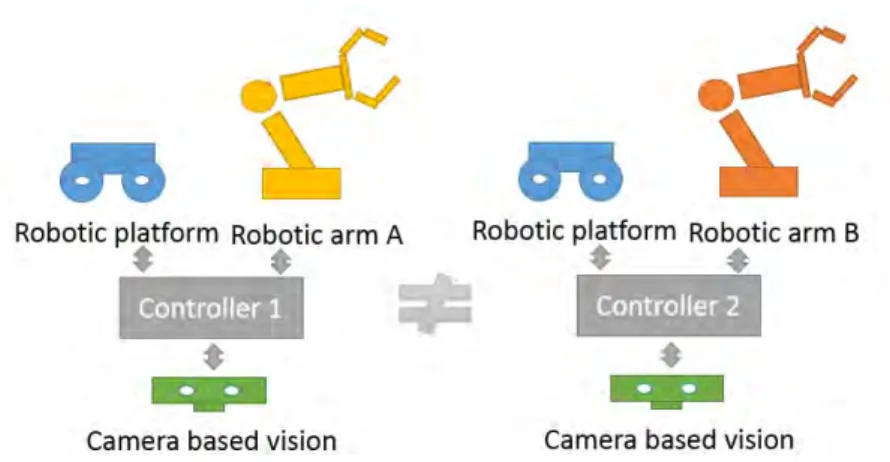
a particular functionality. For example, a particular device can control the activation of an electric shutter and another one can control lights. Robots are part of those systems and propose a set of functionality, which can include mobility. A mobile robotic platform equipped with a robotic arm then provides two functionalities: the ability to move and the ability to grab objects. The integration of those different robotic components in order to provide service to humans is a complex task. Let’s consider the case of a designer who wants to integrate a robotic arm from one constructor and a mobile platform from another constructor, while using image processing algorithms from a third provider to perform a collecting task. The design of an ad hoc controller for such application is complex and requires a lot of expertise on each component, but also on its environment (which includes human activity). If for any reason, a component is replaced with another one (even if this new component provides the same functionality), the whole design process has to be performed again. This is time greedy and involves high cost of maintenance and evolution. However, the same system composition (one robotic arm, one camera based vision and a robotic platform) could be used in different kind of applications. For example, one could want to use it for turning valves in a factory or the other for cleaning a room in a nuclear power plant. Each new application involves designing a new controller (Figure 1.3).
The main motivation of this thesis is to propose to designers to profit from a system capable of self-adapting to both the environment and users’ needs without requiring reprogramming any system’s component. This is the postulate made by Extreme Sensitive Robotics.
1.6
Extreme Sensitive Robotics
The Extreme Sensitive Robotic paradigm [Verstaevel et al.,2015], studied in this thesis, proposes a change in the way we design robots by considering that a robot is the aggregation of the necessary functions to satisfy user’s needs, but a group of robots has to be considered exactly in the same way: a set of macro-functions (each robot) working in coordination. An Extreme Sensitive Robot is made of simpler Extreme Sensitive Functions, each of these functions having the ability to self-adapt to what it can perceive from its environment.
1.6. Extreme Sensitive Robotics
1
Figure 1.4 — An illustration of two braintenberg vehicles. A difference of connection
produces a radically different behaviour.
Thereby, the overall activity results from local interactions between Extreme Sensitive Functions and the environment. Extreme Sensitive Robotics proposes that interactivity of ambient systems is more related to an autonomous observation of the dynamics of the surrounding environment (including the consequences of its own mobility) than the explicit communication between system entities. The absence of this explicit communication reduces the need for a priori knowledge on the system and allows each functionality to be designed separately. Self-observation capacities make the system extremely sensitive to its environment allowing it to integrate changes in its environment into its decision process.
The architecture of a robot is globally composed of functions of perception, action and decision. A robot that performs well has to permanently make cooperate these three functions in association with a loop-back correlating the consequences of its own actions with the observation of changes on its surrounding environment. This is what [Brooks,1990] expressed as the Physical Grounding Hypothesis. In opposition to the classical reductionist approach, the Physical Grounding Hypothesis postulates that physical interactions with the environment are the primary source of constraints for the design of intelligent systems. Thus, there is no need of symbolic representation of the environment leading to a complex decision making. On the contrary, the system’s behaviour is a reaction to a stimulus coming from its environment. Brooks’s subsumption architecture [Brooks et al.,1986] is the origin of behaviour-based robotics. In Brooks’s architecture, a robot controller is built layer by layer, each layer responsible for one behaviour. The subsumption architecture enables the robot to select the most adequate layer in reaction to what it perceives from its surrounding environment. The postulate that can be made of Brooks’s work is that direct interactions with the environment have a strong influence on the robot’s decision process. Making an Extreme Sensitive Robot consists in making it sensible to variations in the perception of its surrounding environment and not to an internal state representation. Extreme Sensitive Robotics is all about to sense, not to model.
Pioneering work of Walter Grey [Walter,1951] in early 50s has shown that even without any form of computational intelligence, a machine can produce a behaviour that one can consider as a smart behaviour, even showing some learning skills. In Grey’s robots, an active interaction between sensors and actuators allows a strong interaction with the surrounding environment and the emergence of a behaviour. Braitenberg [Braitenberg,1986] proposed a set of vehicles where sensors are in direct interaction with actuators. The sensors could have an exciting or inhibitory influence on the actuators. With an exciting influence, more the
1
sensor is excited more the actuator is excited. On the contrary, with an inhibitory influence, more the sensor is excited, less the actuator is excited. Depending of the type of influence and how sensors and actuators are connected, the same robot (same actuators and same sensors) could perform radically different behaviours (Figure 1.4). The only difference lies in how sensors and actuators are connected. It results that the robotic entity is not only influenced by its surrounding environment but also by the nature of the influence between sensors and actuators. Making an Extreme Sensitive Robot is then considering what occurs both outside and inside the robot’s body.
Pfeifer [Pfeifer and Bongard, 2006] has named the relation between an entity and its environment as the embodiment relation. Pfeifer postulates that the behaviour of an entity is highly influenced by the environment in which it is immersed but also by its own body. To illustrate this phenomenon, Pfeifer proposed the following experiment: looking at the trajectory of an ant walking on rocks, one could say that the behaviour of the ant is smart. Indeed, as the ant is avoiding obstacles, the trajectory appears to be complex. However, if this ant was a thousand times larger, the ant would not be blocked by stones anymore and would then walk in a straight line. The same observer would then say that the ant behaviour is not smart any more. Whereas there has been no change on the ant’s mind or on the environment, the observed behaviour differs. A change in the ant body has changed the effect its body produces on the environment. This philosophical experiment shows that any changes in the body could radically change the relation between an entity and its environment. The same idea has to be applied to robotics because some parts of a robot could disappear (for example, a sensor failure) or functionalities added during robot’s activity. Even two robots with the same architecture can have electronic differences such as a motor rotating faster than the other does. These modifications of robot’s body could have a strong impact on consequences of robot actions on the environment. Making an Extreme Sensitive Robot consists in making it sensitive to the effects that its actions have on the environment.
Thus, building an extremely sensitive robot is then to make it sensitive and adaptive to:
3 How its environment evolves, including changes in user activity,
3 How its functionalities interact,
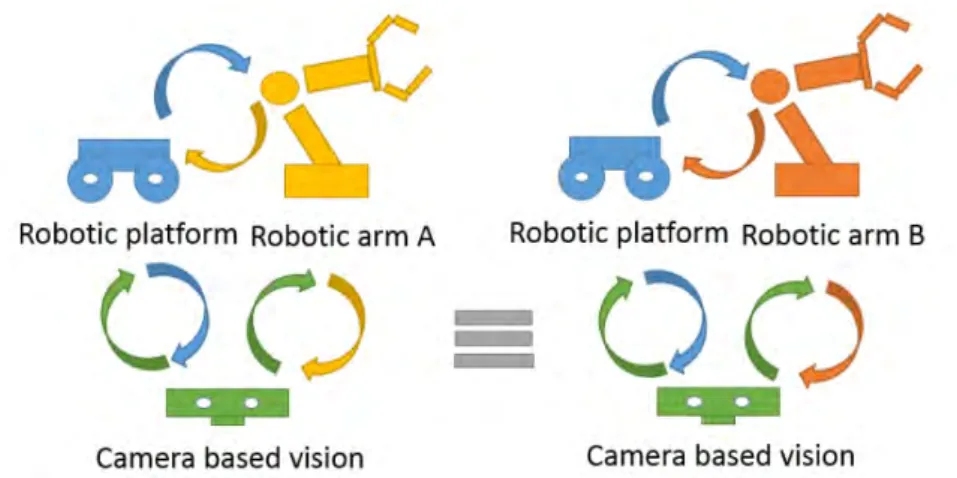
3 Appearance or disappearance of functionalities and their effects on the environment. Unlike traditional robotic approach, which consists in building robust controllers for robotic platforms, the Extreme Sensitive Robotic approach deals with functionalities. Each functionality is thought and designed to be self-adaptive where the self-adaptation process is driven by a local observation of the environment. Thus, the control is distributed within each of these functionalities. A consequence is that problematic of self-organization is strictly local to each functionality, reducing its complexity. The initial Integrator Problem is thereby solved by the autonomous self-organization of its components (Figure 1.5).
To truly enable the Extreme Sensitive Robotic paradigm in the context of Ambient Robotics, we need a learning technique enabling the self-adaptation of its functionalities that respects the following properties:
1.7. Thesis Objectives
1
Figure 1.5 — The same problem through the scope of Extreme Sensitive Robotics. As each
device is designed to be self-adaptive, the two systems are an equivalent problem.
3 Task Independent: to be applicable on any kind of devices, the learning technique must not be task dependant.
3 User-Centered: since an ambient system is thought to be tailored to its users, users have to be the center of the learning approach.
3 On-line: in order to constantly self-adapt to its users, the learning technique must be performed in real-time.
3 Openness: due to the high dynamics of ambient environments, the learning technique must deal with the appearance or disappearance of devices.
This set of criterion is going to be used to evaluate the different learning approaches found in the scientific literature (see chapter 2) and the contribution (see section 6.5.1).
1.7
Thesis Objectives
The main objective of this thesis is to assess the relevance and evaluate benefits of the Extreme Sensitive Robotic paradigm through the design of a system with the ability to control a functionality in the context of ambient robotics. The design of this system must be made in accordance with both the requirements imposed by the Extreme Sensitive Robotic paradigm and the properties of ambient systems.
Thus, the system has to satisfy two major criteria:
3 Its control policy has to be continually updated in order to stay in accordance with the dynamic needs of its users. This implies that the system must be able to interact and adapt with its users.
3 The system must be usable to control different kinds of robotic devices, in different kinds of environments. The heterogeneity of the control devices and environments involves to minimize the assumptions made on the system environment, and so, in order to maximize its usability.
1
The expected benefits are at two levels:
3 Benefits for end-users by enabling end-users to express their needs and interact with the system in a natural way.
3 Benefits for designers by facilitating the task of designing control systems in an ambient context and reducing the time to release and maintenance costs.
Self-Organization of Robotic Devices
Through Demonstrations
2
Learning a Control Policy
With this chapter, we explore the different approaches and hypothesis of the machine learning field, seeking for an approach with the capacity to learn a control policy. Such approach has to respect the requirements of the Extreme Sensitive Robotics. In order to do so, we explore the notion of learning in artificial systems, and present the main learning families. From this exploration we outline the proposal to learn from interactions with human.
L
EARNING capacities are required to build intelligent robots with the ability to act with humans. Learning and Intelligence definitions are intrinsically linked as learning is often seen as a sufficient condition for the expression of intelligence. To give a universal definition of those terms and what makes a machine intelligent is a complex task [Legg and Hutter,2007]. On this chapter, we highlight the general concepts from machine learning and draw a parallel with our application.
To give agents the capacity to learn is one of the main topic studied in Artificial Intelligence. Machine learning is used to solve tasks that are too complex for traditional algorithms in a variety of domain, with a variety of approaches. But defining learning is a tricky task that often depends on the field in which it is studied [Legg and Hutter, 2007]. From sociology to informatics, each domain came with its own view of what is learning and by extension, how to build a machine that learns. Here is a non exhaustive list of attempts to define learning:
3 "Learning is any change in a system that allows it to perform better the second time on repetition of the same task or another task drawn from the same population" [Simon,
1983]
3 "Learning is making useful changes in mind" [Minsky,1983] 3 "Learning is the organization of experience" [Fiol and Lyles,1985]
3 "Learning is constructing or modifying representations of what is being experience" [Michalski,1993]
[Mitchell,2006] defines the field of machine learning as the science seeking to answer to the questions "How can we build computer systems that automatically improve with experience, and what are the fundamental laws that govern all learning processes". For [Mitchell,2006], a machine is said to learn with respect to a particular task T, performance metric P, and type of experience E, if the system reliability improves its performance
2
P at task T, following experience E. This definition is interesting as it highlights three fundamental concepts.
The first one is that learning is learning to do something. A learning process is highly dependent of the task T to be achieved. A robot in a maze learns to navigate. A chess player learns to play chess. A financial algorithm learns to predict market state. Some examples of tasks could be identification, approximation, prediction or improvement of previously existing knowledge. Thus, learning can only be observed through the performance of a task.
Secondly, learning is not a static process. There is no learning without evolution. However, everything that evolves is not necessarily learning. For example, water evolves from ice to liquid, but can we say that ice is learning to melt? Learning means evolving in a good way, increasing the capacity of the system to perform its task. To determine if either or not the evolution leads to an amelioration, we need to define a performance metric P. This performance metric is intrinsically linked to the task to evaluate. A system learns if it improves its performance metric P between two observations, which means if the system is better at performing T. A system adapts if it managed to maintain a performance metric value while the environment has changed. This means that learning (and by extension adaptation) is only observable, measurable by an external observer in regard with the task T. The evolution of the process is called a "learning process". Those metrics can be based on error rate, on the consequences of error or an evaluation of the cost of treatment. Another implication of evolution is the need for memory. Learning and memory are closely related concepts. While learning is often seen as the acquisition process of skill or knowledge, memory can be seen as the expression of what have been learned. Learning is not only increasing a performance metric but also the capacity to reuse what have been learnt.
The last concept is the concept of experience E. How is the learner going to learn? With what kind of data? Experience is about describing the interactions between the learner and its environment.
Depending on how we specify T, P and E, the learning task may have different names such as data mining, predictive learning, programming by example, etc. The comparison of machine learning algorithms is only possible if T, P and E have the same nature.
The field of machine learning is usually distinguished in three categories [Russell and Norvig,1995] [Cornuéjols and Miclet,2011] based on how the experiment E is performed:
supervised learning, unsupervised learning and reinforcement learning.
3 Supervised learning algorithms infer a function from labelled data provided by an oracle. Each data is a pair of (input,output) values. The algorithm then has to infer a mapping function in order to be able to correctly associate to each new input its correct output. When the algorithm maps inputs to a discrete output space, we speak of a classification problem. When the output is continuous, it is a regression problem. The learning is traditionally off-line, as those algorithms need to be trained on data example before being able to correctly label new data.
3 On contrary, unsupervised learning algorithms try to find hidden structure in unlabelled data. They use no function of evaluation or labelling of a training data set.
2.1. Behaviourism - Mind is a Black-box
2
Their goal is to learn to split data, establish correlations or to learn natural components of unlabelled data. Like supervised learning, this learning is traditionally performed
off-line.
3 At last, reinforcement learning algorithms focus on the relation between the learner and its environment. Those algorithms learn from the interaction between the learner and its environment to optimise a utility function. It is an on-line learning based on the evaluation of the gain of the performance of an action on the current environment.
However, such categorisation is based on technical aspects and does not allow to highlight the fundamental differences between algorithms, and this categorisation can even be ambiguous. Indeed, [Russell and Norvig, 1995] express that supervised learning and reinforcement learning can be seen as a same form of learning, as those two approaches use an external entity to learn. Their difference is the expressiveness of the information provided by this external entity, which is richest in the case of supervised learning by providing directly the expected solution. As learning is studied in many sciences from psychology to informatics [Leonard,2002], machine learning has been influenced by the different views of learning and how the learner and its environment interact. This interest in learning has led to many learning theories, each having its own hypothesis. Instead of studying machine learning algorithms only from their technical differences, we first propose a list of learning theories that have influenced machine learning. For each of those theories, we describes some of the algorithms that emerged from it. This list does not intend to be exhaustive but rather be an illustration of how our conception of what learning is influences our way to design artificial learning systems. This categorisation enables to position the work presented in this thesis in regard to the highlighted approaches. More precisely, we put a focus on the criterion that has been defined with the Extreme Sensitive Robotics approach in section 1.6.
2.1
Behaviourism - Mind is a Black-box
→Learning is the modification of the observed behaviour of an individual due to the modification of an answer associated to an external stimuli
Behaviourism is an approach to psychology that focuses on an observable individual behaviour [Skinner, 2011]. A behaviourist believes that, as human are biological machines, they do not have their actions determined by thoughts, feelings, intentions or mental processes. What is inside the mind is unobservable: the mind is a black-box [Friedenberg and Silverman,2011]. This black-box is composed of inputs and outputs. Inputs describe what the entity perceives of its environment and outputs describe what it does. The black-box starts tabula rasa and the behaviour is a product of conditioning, a reaction to stimuli associating to a particular instance of input the adequate output. Then, behaviourists see learning has a modification of the observed behaviour due to the modification of the strength of an answer associated to an external stimuli (external environment) or to an internal stimuli (internal environment) of an organism. From the behaviourist point of view, three forms of learning can occur: classical conditioning, operant conditioning and observational learning.
2
the concept of classical conditioning [Pavlov, 1941]. Classical conditioning is a learning process in which an unconditioned response to an unconditioned stimulus comes to be elicited to a previously neutral stimulus. Pavlov realised an experiment with dogs where the dog is presented with a neutral stimulus such as a light or a sound, and then food is placed in the dog’s mouth. Whenever the dog see food, it salivates as an unconditioned response to the food unconditioned stimulus. After a few repetition of the sequence, the simple presence of the sound or light caused the dog to salivate even with the absence of actual food. The sound or light is now a conditioned stimulus leading the dog to salivate.
Operant Conditioning is based on Thorndike’s "law of effect" which stipulates that responses that produce a satisfying effect in a particular situation become more likely to occur again in that situation, and responses that produce a discomforting effect become less likely to occur again in that situation [Thorndike, 1927]. Learning occurs through reinforcement and punishment [Skinner, 1938]. Reinforcement is any event that increases the behaviour it follows. On the other hand, punishment is the presentation of an adverse event or outcome that causes a decrease in the behaviour it follows. Reinforcement and Punishment can be either positive or negative:
3 A positive reinforcer is a favourable event or outcome that is presented after the behaviour. The behaviour is strengthened by the addition of something, such as praise or a direct reward.
3 A negative reinforcer involves the removal of an unfavourable event or outcome after the display of a behaviour. The behaviour is strengthened by the removal of something considered unpleasant.
3 Positive punishment involves the presentation of an unfavourable event or outcome in order to weaken the response it follows.
3 Negative punishment occurs when an favourable event or outcome is removed after a behaviour occurs.
The last form of learning is observational learning which has been introduced by Bandura during its famous Bobo Doll experiment [Bandura et al.,1961]. Bandura proposed to study if social behaviours can be acquired by observation and imitation. For that, he realises an experiment in which children where individually put in a room with toys and a Bobo Doll. Children where demonstrated by an adult with two different kinds of behaviour. For some, the adult demonstrates an aggressive behaviour by hurting the Bobo doll with hands and objects. For other, the adult demonstrates a non-aggressive behaviour playing nicely with the Bobo doll. After 10 minutes, the adult leaves the room. Children who observed the aggressive model made far more imitative aggressive responses than those who were in the non-aggressive or control groups. Results of the experiment goes beyond this simple fact but the experiment clearly shows the importance of imitation in the learning process and introduces a social dimension to learning. This experiment leads to the proposal of a social learning theory [Bandura and McClelland,1977].
2.1. Behaviourism - Mind is a Black-box
2
2.1.1 Reinforcement Learning
Reinforcement learning is an area of machine learning inspired by the behaviourist psychology. The aim of a reinforcement algorithm is to maximize some notions of cumulative reward. Initially, the algorithm has no a priori knowledge on the effects of actions. In an exploratory phase, the algorithm has to determined, through experimentation, the gain of performing a particular action in a particular situation. Then, in an exploitation phase, the algorithm uses its previously acquired knowledge to choose actions that maximise gain expectancy. The model constructed by a reinforcement algorithm is called a policy. It determines which action has to be realised depending on the current state. As exploration and exploitation are performed in parallel, reinforcement learning algorithms are on-line learning approaches. On this section, we present two variants of reinforcement learning algorithm: Q-Learning and SARSA.
2.1.1.1 Q-Learning
The Q-Learning algorithm [Watkins,1989] is based on the dependency between a utility function and actions to learn an optimal behaviour. The aim is to correctly evaluate from past experiments the utility function Q(s, a)that computes the utility of an action a in the state s.
The utility function is evaluated from the immediate reward r obtained after the realisation of an action a through the following iterative process :
Q(s, a) ←Q(s, a) +α[r+γmax
a0∈AQ(s
0, a0) −Q(s, a)]
where Q(s, a)is the estimated utility of the action a if this action is performed in the state s, A is the set of actions, s0 is the reached state from s with the action a, max
a0∈AQ(s
0, a0)is the
estimated utility of the best action a0 to perform in s0, and α and γ two parameters defined by the designer.
The algorithm must alternate between phases of exploration (which means applying an action independently of its utility) and phases of exploitation (which means selecting the best action to perform). This is made with an e-greedy policy. In this policy, the action is selected greedily with respect to the Q-value estimates a fraction (1−e) of the time (where eis a fraction between 0 and 1), and randomly selected among all actions a fraction e of the time.
As the next action is selected among the set of all possible actions, the Q-Learning algorithm is said to be "off-policy". This ensures the convergence of the algorithm assuming that all system states are visited infinitely often.
2.1.1.2 SARSA
The SARSA (State-Action-Reward-State-Action) algorithm is an "on-politic" variant of the Q-Learning algorithm. Instead of selecting the action maximizing the utility, the action is selected in accordance with a policy π provided by the designer [Sutton, 1996]. This
2
involves that the iterative update of the utility function is no more based on the best action to perform but on the next action recommended by the policy π:
Qπ(s, a) ←Qπ(s, a) +α[r+
γQπ(s0, a0) −Qπ(s, a)]
where Qπ(s, a)is the estimated utility of the action a if this action is performed in the current
state s by following the policy π, r the immediate reward, s0 is the reached state from s with the action a, Qπ(s0, a0)is the estimated utility of the action a0recommended by the policy π,
and α and γ two parameters defined by the user. The name of the algorithm comes from the parameters s,a,r,s0,a0.
Similarly to the Q-Learning algorithm, an e parameter allows to determine the probability of performing a random action.
2.1.2 Analysis
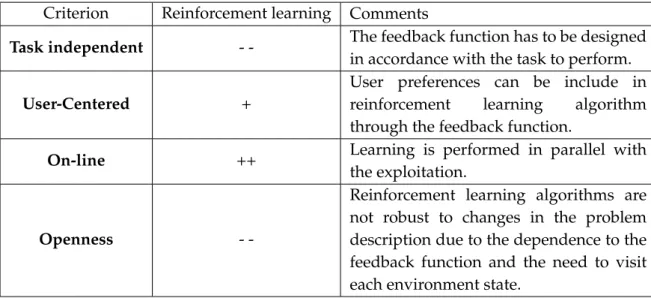
There have been a lot of works on reinforcement learning algorithm and they have shown interesting results in simulation and robotics [Kober and Peters, 2012]. Reinforcement learning promotes an approach where learning is the result of an active coupling between an agent and its environment. However, for our application, reinforcement learning presents some limitations. Reinforcement learning algorithms have an on-line learning property and the capacity to optimise a politic. In order to do so, they need a feedback function which enables the algorithm to evaluate the utility of the performance of an action in the current situation. The design of such function is a well-known complex task which has to be set up in regard of the desired objective to optimise. Q-learning and SARSA are limited to environments which can be modelled by a Markov decision process and needs a discrete model of environment states which could not be guaranteed in real world applications. Furthermore, the algorithm needs to explore the different actions to evaluate their utility. A large number of cycles is necessary to reach an adequate behaviour. This exploration can lead to the irreversible degradation of the controlled system.
2.2
Cognitivism - Opening the Black-box
→Learning is making useful changes in mind
One major critics to behaviourism came with Chomsky [Chomsky,1959] which states that behaviourist models of language learning (through conditioning by "action-reaction-repetition") cannot explain various facts about language acquisition, such as the rapid acquisition of language by young children. In opposition to the "action-reaction-repetition" view of learning, Chomsky states that children have the capacity to produce sentences that they have never heard before. He answers that such capacity involves that the mind does not only "repeat" what they have heard but that they process information in their mind and extract rules which they then apply to create new sentences. Then, Chomsky argue that to study behaviour it is necessary to study the underlying mechanisms, which means open the box and study what is between inputs and outputs. This is the congnitivist postulate.