HAL Id: hal-00802365
https://hal.archives-ouvertes.fr/hal-00802365
Submitted on 20 Mar 2013
HAL is a multi-disciplinary open access
archive for the deposit and dissemination of
sci-entific research documents, whether they are
pub-lished or not. The documents may come from
teaching and research institutions in France or
abroad, or from public or private research centers.
L’archive ouverte pluridisciplinaire HAL, est
destinée au dépôt et à la diffusion de documents
scientifiques de niveau recherche, publiés ou non,
émanant des établissements d’enseignement et de
recherche français ou étrangers, des laboratoires
publics ou privés.
An EAP ID-Based authentication method for wireless
networks
Aymen Boudguiga, Maryline Laurent
To cite this version:
Aymen Boudguiga, Maryline Laurent. An EAP ID-Based authentication method for wireless networks.
ISTP ’11 : International Workshop on Information Security, Theory and Practice, Dec 2011, Abu
Dhabi, United Arab Emirates. pp.232-239. �hal-00802365�
An EAP ID-Based Authentication Method for
Wireless Networks
Aymen Boudguiga, Maryline Laurent
Institut TELECOM, TELECOM SudParis, CNRS Samovar UMR 5157
9 rue Charles Fourier, 91011 Evry, France
Email: {Aymen.Boudguiga, Maryline.Laurent}@it-sudparis.eu
Abstract—This paper proposes an ID-Based authen-tication method for the Extensible Authenauthen-tication Pro-tocol (EAP), as an alternative to methods relying on PKI (Public Key Infrastructure), to provide nodes with private and public keys. It proposes to derive the public key from the node’s identity directly. As such, there is no need for deployment of CA (Certification Author-ity) and the burdensome management of certificates is removed. The presented authentication method is resistant to the Key Escrow Attack. In addition, the results from implementation tests are given and prove how efficient the ID-Based cryptography might be for use in wireless networks.
I. Introduction
Nowadays, most of the authentication schemes proposed for wireless networks rely on the 802.1X standard [1]. The 802.1X standard was designed to integrate EAP (Extensible Authentication Protocol) into IEEE 802 wired networks. It gave also birth to the IEEE 802.11i [2] which is more specific to wireless networks but still refers to similar authentication methods. The 802.11i standard is the main standard used to secure 802.11 WLAN [3] and IEEE wireless mesh networks specified in the 802.11s standard [4].
The authentication methods proposed by the 802.1X stan-dard are based either on the verification of a secret shared between two stations or a signature mechanism that lies on certificates to prove the ownership of a public key and a signature for proving knowledge of the associated pri-vate key. The management of public/pripri-vate key requires deploying CAs to control the generation, revocation and duration of certificates. This system is disadvantageous in wireless environments, such as ad-hoc and wireless sensor networks, where stations may have some power and memory constraints and where CA reachability is not guaranteed.
In this paper, we present a new EAP authentication method adapted to wireless networks and using ID-Based Cryptography (IBC). IBC considers the station identity as its public key, and makes it possible to derive a corre-sponding private key. This derivation function, as well as the secure transmission of the private key to its owner are performed by the Private Key Generator (PKG). Note that IBC requires lightweight implementations at the client level. Compared to PKI certificate management, it
does not need any special space for certificate storage, and the key revocation operation is simpler. Key revocation in IBC is bound to a validity period which is defined either by the PKG or the connecting station. Please refer to the article [5] for a good comparison between PKI and IBC. Our authentication method is useful when a station ini-tially joins the network. It serves to mutually authenticate with the authentication server. At the end of this first authentication, the station gets its ID-Based private and public keys and use them to authenticate to its peers. That is, a station needs to authenticate with the authentication server only during the initial connection. Then, it can use any signature based authentication scheme to mutually authenticate itself with its neighbors.
Our article is organized as follows. First, the ID-based en-cryption and signature mechanisms are introduced. Then, our EAP ID-Based Authentication method (EAP-IBA) is presented with a security discussion. Finally, the im-plementation of some ID-based signature and encryption schemes gives performance results in terms of computation time and memory capacity related to pairing functions. By the way, the ID-based signature schemes are presented comparatively to the famous RSA and ECDSA perfor-mances.
II. ID-Based Cryptography
ID-Based Cryptography (IBC) was initially introduced by A. Shamir [6] to provide entities with public/private key pairs with no need for certificates, Certification Authority (CA) and PKI. Shamir assumes that each entity uses a pair of its identifiers as its public key. These identifiers have to be unique. In addition, he assigned the private key generation function to a special entity which is called Private Key Generator (PKG). That is, before accessing the network, every entity has to contact the PKG to get back a smart card containing its private key. This private key is computed so it is bound to the public key of the entity.
During the last decade, IBC has been enhanced by the use of the Elliptic Curve Cryptography (ECC) [7]. As a consequence, new ID-Based encryption and signature schemes emerged and they differ from Shamir’s method in that the PKG does not rely on smart cards to store the private key and the ciphering information.
clients. Compared to PKI certificate management, there is no need for storing certificates, and the key revocation operation is much simpler. Key revocation in IBC is bound to a validity period which is defined by the PKG or chosen by the station and acknowledged by the PKG.
Sometimes, certificates are considered as IBC as they bind the user’s public key to his identity. In this paper, note that IBC is considered as the cryptographic schemes where the public key is computationally derived from the identity. That is, the public key is the output of a function (mostly a hash function) that takes as input the user’s identity. There are many existing types of IBC schemes but this article has only interest in the ones using pairing functions. Interested readers can refer to the article of Cocks [8] for getting description of the ID-based encryption scheme that is based on the computational difficulty of integer factorisation and the quadratic residuosity problem. In the following sections, we present the key generation processing for IBC. Furthermore, we introduce some well known ID-Based Encryption and Signature (IBE and IBS) schemes which have been verified secure with the random oracle model [9].
A. ID-Based key generation
When a station needs a private key, it provides the PKG with the identity �� intended to be used for its private key computation. The PKG then derives the node’s private key using some parameters which must be defined with respect to the Bilinear Diffie-Hellman problem [10]. For generating these parameters, the PKG runs a Probabilistic Polynomial Time algorithm which takes as input a security
parameter � and outputs the groups G1, G2 and G� and
the pairing function ˆ�from G1× G2in G�. G1and G2are
additive groups of prime order � and G� is a multiplicative
group of the same order �. Note that the order � is defined
with respect to � such that � > 2�. Generally, G
1 and
G2 are subgroups of the group of points of an Elliptic
Curve (EC) over a finite field and G� is a subgroup o
f a multiplicative group of a related finite field.
The pairing function ˆ�has to be bilinear, non degenerate
and efficiently computable. The non degeneracy property
means that for all points � ∈ G1, ˆ�(�, 1G2) = 1GT. In
addition, for all points � ∈ G2, ˆ�(1G1, �) = 1GT. If we
consider a generator � of G1and a generator � of G2, the
value ˆ�(�, �) = � is equal to the generator of G�. Paterson
defined three types of pairing functions in [11] that can be divided into two families:
1) Symmetric pairing: it verifies G1= G2.
2) Asymmetric pairing: it verifies G1 ̸= G2. This
pairing function can be further classified based on the existence (or not) of an efficient homomorphism
ã: G2⊗⊃ G1.
The point � is used to compute another point ����.
Practically this kind of bilinear mapping is derived from the Weil or Tate pairing (or any efficient pairing) [12]. In addition to the definition of groups, some hash functions need to be defined in accordance to the IBE or IBS schemes
Fig. 1. ID-Based key generation.
that are going to be used. For example, a hash function
� that verifies � : ¶0, 1♢* ⊃ G1 is defined in order to
transform the node’s identity into an EC point. Generally, the public key of a station is computed as a hash of one of its identities and it is either a point of an elliptic curve or
a positive integer. The list containing the groups G1 and
G2, the bilinear mapping ˆ�, the points � and ���� and
the hash functions form the public elements. These public
elements are distributed by the PKG to the network users
because they are needed during the public key derivation and the cryptographic operations.
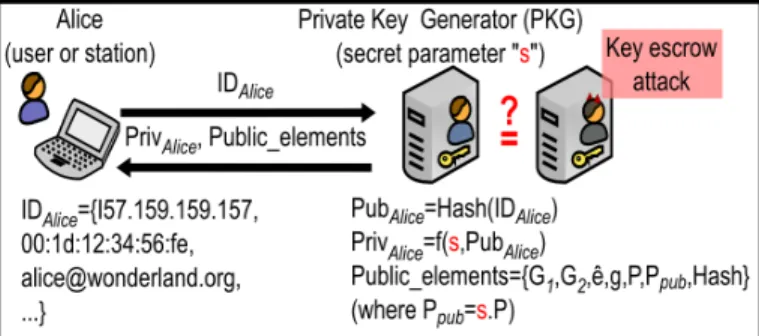
The key derivation operation starts when the PKG re-ceives the �� of the node that is requesting a private key (Figure 1). First, the PKG computes the user’s public
key as � ���� = �(��). Then, the PKG generates the
corresponding private key using a local secret value � ∈ Z*
�.
Note that the private key is computed as: � ����� =
�(�, � ����). In the most common cases, � ����� = � ≤
� ����where � ����∈ G1. The secret value � is also used
for ���� derivation from � : ���� = � ≤ � . As such, the
public elements are ¶G1, G2, �,�, �, �, �ˆ ���, �1, . . . , ��♢.
It is clear from the aforementioned key derivation scheme that the PKG knows every private key it generates itself, and as such it is able to impersonate as a private key owner by illegally generating signature or deciphering encrypted traffic. To mitigate the key escrow attack, a strong assumption is made necessary that the PKG is a trustworthy entity.
In the following, we present some IBE and IBS schemes.
B. Boneh and Franklin encryption scheme
Boneh and Franklin (BF) proposed in 2001 an IBE scheme using ECC and a symmetric pairing function [12].
They define two hash functions �1 and �2 such that:
�1 : ¶0, 1♢* ⊃ G*1 and �2 : G2 ⊃ ¶0, 1♢�. So BF public
elements are ¶G1, G2, �, ˆ�, �, � , ����, �1, �2♢. The PKG
computes the user’s public key as � ���� = �1(��). Then,
the PKG generates the corresponding private key using a
local secret value � ∈ Z*
�.
To encrypt a message � ∈ ¶0, 1♢� using the public key
� ����, a user generates a secret random � ∈ Z*� and
computes the ciphertext � as � = (�, � ) = (� ≤ �, � ⊕
�2(ˆ�(� ����, ����)�)).
The decrypting entity deciphers the received message as follows: � = � ⊕ �2(ˆ�(� �����, �)).
C. Paterson signature scheme
Paterson proposed in 2002 an IBS scheme using ECC and a symmetric pairing function [13]. He defines three
hash functions �1, �2 and �3 such that: �1 : ¶0, 1♢* ⊃
G1, �2 : ¶0, 1♢* ⊃ Z�* and �3 : G1 ⊃ Z*�. So,
Paterson public elements are ¶G1, G2, �, ˆ�, �, � , ����,
�1, �2, �3♢. The PKG computes the user’s public key
as � ���� = �1(��). Then, the PKG generates the
corresponding private key using a local secret value � ∈ Z*
�.
To compute the signature of a message � , a user generates
a secret random � ∈ Z*� and computes its signature as
the pair (�, �) ∈ G1 × G1 where: � = � ≤ � , � =
�⊗1(�2(� ) ≤ � + �3(�) ≤ � �����).
The signature verifier has only to compare ˆ�(�, �) to
(ˆ�(�, � )�2(� )
≤ˆ�(����, � ����)�3(�)). The two values must
be equal in order to consider the signature as valid. III. EAP ID-Based Authentication method The Extensible Authentication Protocol (EAP) was originally defined as an extension to the Point to Point Protocol [14] in order to provide a mechanism for the selec-tion of authenticaselec-tion methods. Then it has evolved to be-come the standard that is used for station authentication in the existing networks. Particularly, it has been adapted to the 802.11 networks architectures in the IEEE 802.11i standard [2] which extends the IEEE 802.1X specification [1]. The IEEE 802.1X defines the EAP over LAN protocol (EAPOL).
When a station (STA) joins the network for the first time or after being disconnected for a while, it authenticates itself to one of its 1 hop neighbors that acts as an authen-ticator. That is, through the exchange of some request and response messages, the authenticator and the supplicant negotiate the authentication method which is going to be used [15]. When the authenticator does not support the authentication method proposed by the supplicant STA, it acts as a passthrough server to transmit STA authenti-cation messages to a backend Authentiauthenti-cation Server (AS). Generally, AS implements the most known authentication methods. At the end of an authentication, AS transmits to STA the result of the authentication using authentication success and authentication failure messages.
To mitigate the disadvantages of PKI while keeping usage of public/private keys, we propose a new EAP authentica-tion method that applies ID-Based cryptography for STA’s public/private keys derivation. AS is assumed to act as PKG but it generates only the public elements that STAs use to derive their private/public keys. In order to decrease the risk of a key escrow attack, we make every STA generate its own private key locally while AS computes a
token which contains pieces of information that are bound
to STA private key. In addition, we assume that AS and STA share a secret value (i.e. a password) that they use with IBC to mutually authenticate.
After a successful initial authentication, STA computes its private key corresponding to its ID-Based public key, as described in section III-A. For later authentications
Fig. 2. EAP ID-Based Authentication method (EAP-IBA).
to other STAs, STA can use its token and any existing authentication scheme based on asymmetric cryptography.
A. EAP ID-Based Authentication method (EAP-IBA)
EAP-IBA is used by a STA when it joins the network for the first time or after being disconnected for a while. To perform an authentication, STA must first get the public
elements that are published by AS (acting in our proposal
as a PKG which only computes these public elements). Then STA authenticates itself to AS using a preshared secret. The secret may be a password, and is noted as pwd in our authentication method.
Note that the public elements are defined according to the selected IBE and IBS schemes that are going to be used between the different STAs. For example, if we consider that we are using BF encryption scheme and Paterson signature algorithm during the protocol execution, the public elements that AS has to generate are: ¶G1, G2, �,�, �, �, �ˆ ���, �1, �2, �3, �4♢ where: �1 :
¶0, 1♢* ⊃ G*
1, �2 : G2 ⊃ ¶0, 1♢�, �3 : ¶0, 1♢* ⊃ Z*�
and �4: G1⊃ Z*�.
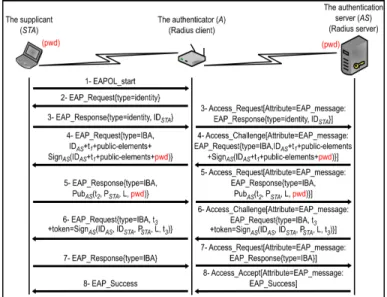
When STA wants to authenticate to AS, it sends an
EAPOL-Start to its authenticator (message 1 in Figure 2).
Upon receiving this message, the authenticator responds with an EAP request of type identity to recover the STA identity (message 2). Consequently, STA responds with an EAP response of the same type containing its identity
���� �(message 3). The authenticator transfers then the
message 3 to AS which starts an EAP authentication of type EAP-IBA with STA.
When AS receives ���� � in message 3, it searches in
its password database for the password corresponding to this STA. Then it generates message 4. The password is included in this message in order to authenticate the AS with its public elements. The message 4 is an EAP
request of type EAP-IBA. It contains the identity of
and a signature of the previous fields after concatenat-ing them to the password (���). For example, if AS uses the Paterson signature scheme, AS signature is the
following: (�, �) ∈ G1 × G1 such that � = � ≤ � ,
� = �⊗1(�
3(����♣♣�1♣♣public elements♣♣���) ≤ � + �4(�) ≤
� �����) where � is a random integer.
Upon receiving message 4, STA gets from the public
elements the hash function in use for the public key
computation (�1in our example). It computes the public
key of AS as � ���� = �1(����). It concatenates the
password ��� to ����, �1and the public elements to form
the message that has been signed. At this point, STA uses
the computed � ���� to verify the received signature. In
our example, the signature verification consists in com-paring ˆ�(�, �) to (ˆ�(�, � )�3(��AS♣♣�1♣♣public elements♣♣���)
≤ ˆ
�(����, � ����)�
4(�)
). If the signature verification is suc-cessful, STA authenticates AS and the public elements. Otherwise, STA stops the authentication.
If the signature is valid, STA has to authenticate itself to AS using the preshared secret and creating the mes-sage 5 (the EAP response which corresponds to mesmes-sage
4). The latter contains the encryption with � ���� of a
timestamp �2, a point ��� �= ��� �≤ � , a lifetime � and
the password ���. The point ��� � is used to avoid the
key escrow attack. Its usage is detailed in the upcoming
section III-B. It is computed using a secret value ��� �
which is randomly selected in Z*
�. This secret ��� �enables
STA to compute its own private key � ����� � such that
� ����� �= (��� �≤ � ���� �). As such, STA does not rely
any longer on the PKG (namely AS) to compute its private key. The lifetime � refers to the validity duration that
STA wishes to acquire for its ��� �. It indicates also the
lifetime that STA chooses for its own private key � ����� �
because � ����� � is bound to ��� � through t he secret
value ��� �. For example, if BF encryption algorithm is
selected, the encrypted message is � = (�, � ) = (� ≤
�,(�2♣♣��� �♣♣�♣♣���) ⊕ �2(ˆ�(� ����, ����)�)) where � is
a random number.
Upon receiving this fifth message, AS uses its private
key � ����� for deciphering. In our case, AS makes
the following operation � = �2♣♣��� �♣♣�♣♣��� = � ⊕
�2(ˆ�(� �����, �)). In addition, AS authenticates STA by
verifying the value of password ���. If AS succeeds in authenticating STA, it generates message 6. This message
contains a timestamp �3and a token. The token represents
the signature of AS over the following fields: the identity
of AS (����), the identity of STA (���� �), the lifetime
� and the timestamp �3. The validity of the private key
� ����� �starts at �3 for � duration.
At the reception of message 6, STA verifies the AS sig-nature over the token. If the verification is valid, STA responds to AS with an empty EAP response of type EAP-IBA to acknowledge the good reception of the message 6. Finally, the AS sends to STA an EAP success packet to indicate the success of their mutual authentication.
B. Security discussion
In this section, we present informally how the aforemen-tioned EAP authentication protocol removes some attacks. We use an ’active saboteur’ attacker model as defined by Dolev and Yao in [16]. That is, an attacker might be a user of the network and can have access to all the traffic. We suppose also that the ID-Based signature and encryption algorithms used for our EAP-IBA scheme have been already verified secure in the random oracle. That is, we will be only interested in discussing the security properties of the exchanged messages.
∙ Replay attack: For avoiding replay attacks, we make
use of timestamps �1, �2 and �3. However, timestamp
usage assumes that all the stations in the network are synchronized. This can be done with the Beacon frames received by a STA from its 1-hop neighboring APs in 802.11 or 1-hop peer STAs in 802.11s. These Beacons include time information about their senders’ clock values. In addition, they contain a certain value ∆ which is a time interval used for the verification of message freshness. The timestamp Delta value ∆ is chosen by the network administrator and is used as follows: During the execution
of IBA, the first timestamp �1 is included by the AS in
message 4, the receiving supplicant STA compares the
reception time (������) of the message to the timestamp �1
using ∆ as follows: ♣������⊗ �1♣< ∆. If this inequality does
not hold, STA rejects the received message. In addition, every STA stores the last reception time and timestamp values received from its peers for future timestamp verifi-cation.
∙ Collision attack: An attacker can try making a collision over the second message in order to get the password or to impersonate as the AS. If the collision attack is successful, he gains access to STA secret information and original password. Thanks to the known birthday attack,
it is known that 2�/2 attempts are necessary for getting a
collision over a �-bit length hash.
This attack may be avoided by changing the password periodically to decrease the risk of collision. However, the best solution in practice is to use a one-time password. That is, AS and STA share a master session key which is used to derive a new password for each authentication session.
∙ Key escrow attack: During the initial authentication, we supposed that each STA is generating its own private key
� ����� �based on the use of a secret ��� �. This secret is
also used to compute a point ��� �= ��� �≤ � . The point
��� �is included into the token generated by AS on behalf
of STA. Consequently, AS (acting as the PKG) is not able to make a key escrow attack because it has not generated
STA’s private key (� ����� �). In addition, the only way
to recover STA’s private key would be to compute ��� �
from ��� �= ��� �≤ � which is equivalent to solving the
Elliptic Curve Discrete Logarithm Problem (ECDLP) [7]. The risk of a key escrow attack is reduced to the unique case where STA is offline and AS generates a fake ����� on behalf of STA for impersonation of it. Note that this
issue is common to any ID-Based cryptograms as the PKG can always impersonate as an offline legitimate STA. During IBA execution, we made each STA generate its own
� ����� �. So, STA does not rely any longer on AS to derive
its private key. However, it has to prove the ownership
of � ����� � to AS and to other STAs. Consequently, we
decided to introduce the point ��� � to justify a key
ownership by a STA. ��� � is computed by STA using
the same secret ��� � that has been used for � ����� �
computation. The point ��� �is then authenticated by AS
when it is received with the ��� in message 5. It is included
in the ����� of STA and signed by AS. This point ��� �
has to replace ���� when ciphering a message addressed
to STA or when verifying a signature from STA. In fact,
we are not going to use ���� for all the STA but only
when verifying AS signatures or when ciphering a message for AS. For the other STAs, we use the corresponding
point ��� �. For example, when STA1 receives a signature
from STA2, it has to use ��� �2 and � ���� �2 to verify
the signature. STA1 authenticates ��� �2 because it is
included in the ������� �2 which is signed by the AS. In
addition, STA1 gets � ���� �2 by hashing ���� �2.
Through the encryption or the signature of a message,
STA has to prove the association between its � ����� �and
the computed ��� � which is signed by AS. This
associa-tion implies directly that STA is the owner of the private
key � ����� � and that it has been initially authenticated
by AS. For example, if we are using the aforementioned Paterson signature scheme, the public elements generated by AS are: ¶G1, G2, �,ˆ�, �, �, ���� = � ≤ �, �1, �2, �3♢
and � ����� = � ≤ � ���� where � ���� = �1(����).
The signature of a message � by the AS is the pair
(�, �) ∈ G1× G1 where: � = � ≤ � , � = �⊗1(�2(� ) ≤
� + �3(�) ≤ � �����) and � is a random article. The
verification of this signature consists in comparing ˆ�(�, �)
to (ˆ�(�, � )�2(� ) ≤ˆ�(����, � ����)� 3(�) ). The verification holds because: ˆ �(�, �) = ˆ�(� ≤ �, �⊗1(� 2(� ) ≤ � + �3(�) ≤ � �����)) =⇒ ˆ�(�, �) = ˆ�(�, � )�2(� )≤ ˆ �(�, � �����)�3(�) =⇒ ˆ�(�, �) = ˆ�(�, � )�2(� )≤ ˆ�(�, � ≤ � �� ��)�3(�) =⇒ ˆ�(�, �) = ˆ�(�, � )�2(� )≤ ˆ�(� ≤ �, � �� ��)�3(�) =⇒ ˆ�(�, �) = ˆ�(�, � )�2(� )≤ ˆ�(� ���, � ����)�3(�)
If STA wants to make the same signature, it uses the point
��� � and its private key (� ����� � = ��� �≤ � ���� �)
instead of the ����and � ����� when signing a message
us-ing the Paterson signature algorithm. The signature
veri-fier has to get ��� �from the token, and then it has to
com-pare ˆ�(�, �) to (ˆ�(�, � )�2(� )
≤ˆ�(��� �, � ���� �)�3(�)).
∙ Denial of service attack (DoS): To avoid an attacker making a DoS attack against AS by sending a big amount of Start authentication messages, we decided to limit at the AS the number of authentication requests to a threshold � . That is, the authenticator accepts only one authentication request per supplicant STA. Then STA has to wait for the AS response. In addition, the AS limits the number of authentication requests coming from the same authenticator to � . When the number of authentication
TABLE I
IBS and IBE elementary operations.
IBS or IBE scheme GT Exp Pt/scalar mul Pairings
Paterson signature 0 4 0
Paterson verification 2 0 3
Hess signature 1 2 1
Hess verification 1 0 2
Barreto et al. signature 1 1 0
Barreto et al. verification 1 1 1
BF encryption 1 1 1
BF decryption 0 0 1
BB encryption 1 3 0
BB decryption 0 0 2
Chen et al. encryption 1 1 0
Chen et al. decryption 0 0 1
requests exceeds � , the AS drops all the upcoming packets received from that authenticator.
IV. Implementations and results
In this section, we present the implementation results related to our authentication scheme. We focus on the time performance of our EAP-IBA method. That is, we have noticed that EAP-IBA performance depends mostly on the time consumption of the used signature and encryption algorithms in messages 4 and 5. Consequently, we decided to evaluate the time performance of a set of IBS and IBE in order to elect the most suited IBS and IBE for our IBA. First, we show how to evaluate the security level of an ID-Based signature or encryption scheme. That is, the studied IBS and IBE performances are compared at the same security level. In the sequel, we present results of the comparison of the time performances of different ID-Based signature and encryption algorithms. The studied IBS are compared by the way to RSA and ECDSA. Finally, we study the gain in memory that STAs realize when our IBA replaces the usage of certificates. We show that ID-Based Cryptography is more efficient in terms of memory consumption than classical PKI where certificates are used and need to be stored.
A. Security level equivalence between schemes
To compare the performances of IBS or IBE schemes, a first analysis of the number of mathematical operations
can be done. In [17], Barreto et al. used G�
exponenti-ations, scalar point multiplications (Pt/scalar mul) and pairing computation operations to evaluate the signature scheme performances. Table I presents a comparison of Paterson signature, Barreto et al. signature and Hess signature [18] based on elementary operations as in [17]. In addition, it presents a comparison of the following encryption schemes: BF, Boneh and Boyen (BB) [19] and Chen et al [20]. For a fair comparison between an IBS and an existing signature scheme like RSA, we need defining the security level of each scheme and making the comparison for the same security level.
In cryptography, the security level of a symmetric en-cryption algorithm is defined as the number of operations needed to break the algorithm when a �-bit key is used.
TABLE II
Equivalent key sizes for the same security level (in bits).
k RSA key length ECC key length
80 1024 160
112 2048 224
128 3072 256
192 7680 384
256 15360 512
For example, the number of elementary operations needed to break a block cipher encryption scheme is equal to
2� [11]. In asymmetric cryptography, the security level of
an algorithm is defined with respect to the hardness of solving the Discrete Logarithm Problem (DLP) either in a multiplicative group (the case of RSA) or an additive group (the case of ECDSA). This concept of security level sets the length in bits of RSA keys and EC keys. Table II presents the equivalence between the lengths of RSA and EC keys respectively to the security level
�, where � corresponds to the security level of a �-bit
length symmetric key. The security level of an ID-Based cryptographic scheme depends on the security level of the
pairing function in use ˆ�: G1× G2⊗⊃ G�. However, the
security level of ˆ�is related to the hardness of solving the
DLP in the groups G1, G2 and G�, and as such is closely
related to the groups being selected as some of them make the DLP easier. To understand how to define this security
level in practice, investigation of the structures of G1, G2
and G� is necessary.
Let �(F�) denote the elliptic curve defined over the finite
prime field F�. G1 and G2 correspond mostly to the
q-torsion subgroups of �(F�) and �(F�k) where � is the
embedding degree of the curve �(F�) relatively to �.
Meanwhile, G� is a multiplicative subgroup of F�kof order
� [7]. For example, assume that the prime order � of F�
is 512 bits long, the order � is 160 bits length while the
embedding degree relatively to � of the curve �(F�) is 2.
The pairing function ˆ�is then defined over the subgroups
G1, G2and G� of order �. The security level of ˆ�is defined
respectively to the hardness of solving DLP in G�. As G�
is a subgroup of F�2 which has an order of 1024 bits, DLP
hardness in G� is defined respectively to this 1024 bits
order. That is, ˆ� security level is equivalent to an RSA
key of 1024 bits length, and so, with respect to Table II, to a security level of 80 bits.
B. Time performances
As the time performance of EAP-IBA is mostly de-pending on the time consumption of the signature and encryption algorithms in use, a comparison is established between the time consumption of some IBS and IBE algorithms. The three signature schemes selected are the following: Paterson signature, Barreto et al. signature [17] and Hess signature [18]. For illustration, we also include time consumption of the RSA and ECDSA signature algorithms. In addition, we compared BF encryption to BB encryption [19] and Chen et al. encryption algorithm [20].
TABLE III
Signature generation and verification times (in ms).
Security level 80 112 128
Signature generation time
RSA 2.995 14.650 38.585
ECDSA 1.585 2.809 2.835
Paterson 17.316 59.288 123.116
Hess 24.889 91.835 204.757
Barreto et al. 6.715 22.106 57.677
Signature verification time
RSA 0.113 0.329 0.623 ECDSA 1.884 3.352 3.363 Paterson 24.135 106.804 264.832 Hess 13.232 60.985 155.714 Barreto et al. 33.791 119.080 313.702 Encryption time BF 13.157 51.919 122.760 BB 18.031 62.644 129.770 Chen et al. 7.044 23.128 47.845 Decryption time BF 6.937 29.730 75.844 BB 13.020 58.707 149.972 Chen et al. 6.959 30.095 75.357
Pairing computation time
Type A 6.097 28.890 74.265
Type D 13.653 50.429 136.738
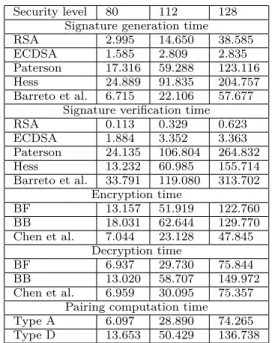
Our implementation is based on the PBC library for IBS and IBE schemes, and on the OpenSSL library for the RSA and ECDSA algorithms. Times for RSA and ECDSA are just given as an information, not for an accurate comparison. We make use of two different pairing functions. The first type of pairing is symmetric (it is referred to as Type A pairing in [21]). The second type is asymmetric and is used into Barreto et al. signature (it is referred to as Type D pairing in [21]). 1000 samples serve to evaluate the signature generation and verification times. All the tests were performed on an Intel(R) Core 2 Duo machine running at 800 MHz each. Table III summarizes the comparison results (in milliseconds).
>From table III, it is clear that pairing based signa-tures and encryption algorithms are slower than RSA and ECDSA. This is due to today’s available pairing functions that are more complex. Their computation takes more time than an exponentiation in a multiplicative subgroup or a scalar multiplication in a subgroup of elliptic curve. We notice from table I that Barreto et al. signature and Chen et al. encryption should be respectively the fastest signature and encryption schemes, as they contain only one pairing function for the signature verification and decryption phases. Their performance efficiency is due to the use of the Sakai-Kasahara key construction scheme,
i.e. the private key is computed as: � ����� = � ��I D1 +��.
From Table III, we can confirm, through practical mea-surements, that Chen et al. encryption is the fastest ID-Based encryption algorithms among the studied one. How-ever, Paterson signature verification is faster than Barreto et al. signature verification, although the Barreto et al. verification needs one pairing operation while Paterson verification needs three. This result is explained by Barreto et al. signature using the asymmetric type D pairing which is slower than the symmetric type A pairing used by
TABLE IV
Times for certificate generation and request (in ms).
STA key key_gen cert_req CA_cert_gen
RSA-1024 96.809 2.462 15.205 RSA-2048 650.728 12.874 15.490 RSA-3072 2336.758 34.984 15.744 EC-160 4.840 1.829 18.441 EC-224 7.902 3.038 18.479 EC-256 7.889 3.066 18.500 TABLE V
Time for PKG initialization and public element generation (in ms).
Sec_level Pairing type Pairing_gen PE_gen Key_gen
80 Type A 6.097 28.677 18.044 112 Type A 28.890 116.299 91.643 128 Type A 74.265 295.527 249.392 80 Type D 13.653 175.589 1.820 112 Type D 50.429 551.537 7.160 128 Type D 136.738 1453.174 18.217
Paterson, as given in the last 2 lines of Table III.
We conclude from Table III that IBS or IBE time perfor-mances mostly depend on the number and type of pairing functions in use. Thanks to the work done by Beauchat et al. [22] leading to defining the fastest existing pairing in less than 1 millisecond, we are confident that very efficient IBC schemes will emerge in the next few years.
C. Benefits of not using certificates and CA
In this section, we first study the different generation times related to the creation of certificates and to the generation of IBC public elements. Then, we show how IBC increases the storage capacity of STA unlikely to certificates.
For better highlighting interest for IBC against RSA/EC schemes in wireless networks, we start by presenting some results in Table IV related to public key certificate creation using the OpenSSL library. We evaluate the time for STA to generate its key pair (key_gen) and to make a request for a certificate from the CA (cert_req), and also the time needed for CA to accept or reject the request and to issue a certificate (CA_cert_gen). CA is assumed to have a 2048 RSA key to sign the certificates. During the simulation, we used three elliptic curves that are referred to as ’NID_secpxxxk1’ in OpenSSL.
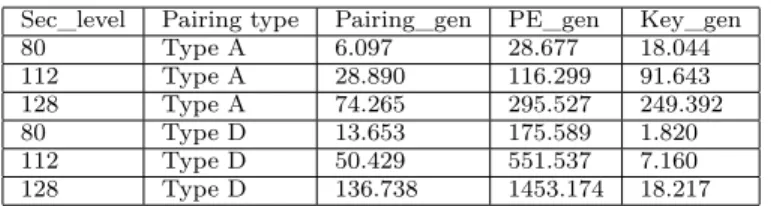
Table V gives time results for the STA to get IBC keys. These times include the times for generating the pairing function (Pairing_gen), the public elements (PE_gen) and the key (Key_gen). Our simulations are considering the
public elements defined by Paterson in [13] and by Barreto
et al. in [17] as they use different pairing functions. Note that using IBC instead of CA and certificates enables saving for each STA the time for generating a certificate request. From Tables IV and V, we can deduce that generation of pairing functions and public elements can take lot of time, especially for higher level of security. However, public elements can be generated offline thus saving time at the PKG. The key generation time is smaller for IBC than for RSA, but is of the same order
TABLE VI
Certificate size (in bytes).
STA key cert_size
RSA-1024 1046 RSA-2048 1224 RSA-3072 1399 EC-160 1062 EC-224 1131 EC-256 1164 TABLE VII
Public element size (in bytes).
Pairing type Fp_size G1_size sec_level PE_size
Type A 512 160 80 1303 Type A 1024 224 112 2534 Type A 1536 256 128 3767 Type D 175 167 ≥80 2184 Type D 347 332 ≥112 4219 Type D 522 514 ≥128 6254
or at least 25% slower than EC depending on the type of the pairing function in use. For example, Paterson public
elements make the key generation time slower than for EC
as the Paterson scheme requires the complex operation of hashing the identity to a point of an elliptic curve, and it refers to the private and public keys as two points of an elliptic curve. Also, the Barreto et al. scheme gives similar key generation times than EC keys because the key generation requires the multiplication of an elliptic curve point by a scalar, and only one of the public or private keys is a point of an elliptic curve.
Let’s move to storage capacities evaluation. It is clear that IBC selection enables STA to save memory space as the same public elements serve for all the STAs, unlikely to the CA deployment where each STA needs to store the certificates of its peers and the corresponding Certificate Revocation List (CRL). Our simulations with OpenSSL give the size (in bytes) of RSA or EC key certificates in Table VI, and the size (in bytes) of the public elements (PE_size) according to the pairing function type in Table
VII. The order sizes of F� (F�_size) and G1 (G1_size)
are expressed in bits. A direct comparison between Table VI and Table VII shows that one certificate takes less space than the public elements in a STA memory. However, in practice, a network contains more than 1 STA, and for a fair comparison, we need considering a network of
� STAs, with each STA communicating to the other
� ⊗ 1. If certificates are used, each STA has to store
(� + 1) × ����_���� + ���_����. That is, each STA has to store � ⊗ 1 certificates corresponding to its peers, the CA certificate and its own certificate. However, if
EAP-IBA is used, each �� �� has to store only � ���_���� +
� �_���� + ������_���� + ︁� ⊗1�=1,�̸=�×(���� �i_���� +
��� �i_���� + ��_����). That is, �� �� stores its own
password (shared with the AS), its own token, the public
elements and the information recovered from the tokens
of the successfully authenticated �� ��, i.e. the identity of
its peer ���� �i, its p ublic point ��� �i and the lifetime
0 10 20 30 40 50 60 70 80 90 100 110 10 20 30 40 50 60 70 80 90 100
Memory consumption (in Kbytes)
STAs number
RSA certificate EC certificate Type A pairing Type D pairing
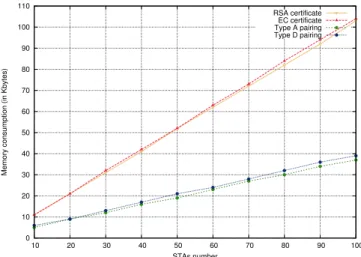
Fig. 3. Memory consumption according to the number of users
(security level=80 bits).
formulas, we next evaluate the memory consumption of a STA according to the number of STAs (� ) in the network, or according to the level of security. We can deduce from Figure 3 that memory consumption for a fixed 80 bits security level is smaller for EAP-IBA than for RSA or EC certificates. Similar results can be deduced for various security levels and a fixed number of peer STAs.
As such, EAP-IBA method consumes less memory than certificate based scheme. It also reduces the bandwidth consumption as there is no need to send certificate requests and responses including a large certificate. We conclude that our proposed authentication method is more suitable than classical PKI for networks where STA has memory constraints and good computation capacities.
V. Conclusion
In this paper, we presented a new EAP authentication method relying on IBC. We informally discussed the se-curity limits of this protocol. We are actually working on the formal verification of EAP-IBA with the ProVerif tool and we hope to publish our verification results as soon as possible. In addition, the article presented some implementation results leading to the conclusion that IBC is of great interest for wireless networks where storage capacities within STAs are limited. Furthermore, through implementations and testing, ID-Based signature genera-tion and verificagenera-tion are shown to be at least 25% slower than RSA or ECDSA. However, we are confident that fastest pairing functions will emerge in the future, thus making the ID-Based cryptography and signature scheme adequate for use in any types of networks.
References
[1] IEEE Std 802.1X-2004: Port Based Network Access Control, IEEE Standard, dec 2004.
[2] IEEE Std 802.11i-2004 - IEEE Standard for Local and
Metropolitan Area Networks - Specific requirements-Part 11-Amendment 6: Medium Access Control (MAC) Security En-hancements, IEEE Standard, 2007.
[3] IEEE Std 802.11-2007: Part 11: Wireless LAN MAC and
Phys-ical layer specifications, IEEE Standard, Rev. Revision of IEEE
Std 802.11-1999, jun 2007.
[4] IEEE P802.11s/D2.06: Part 11: Wireless LAN MAC and
Physi-cal layer specifications. Amendment 10: Mesh networking, IEEE
Working Draft Proposed Standard, Rev. 2.06, jan 2009. [5] K. G. Paterson and G. Price, “A comparison between traditional
public key infrastructures and identity-based cryptography,” Royal Holloway University of London, Tech. Rep., 2003. [6] A. Shamir, “Identity-based cryptosystems and signature
schemes,” in Proceedings of CRYPTO 84 on Advances in
cryp-tology. New York, NY, USA: Springer-Verlag New York, Inc., 1985, pp. 47–53.
[7] J. Silverman, The arithmetic of elliptic curves, ser. Graduate
texts in mathematics. Springer, 2009.
[8] C. Cocks, “An identity based encryption scheme based on quadratic residues,” in Cryptography and Coding, vol. 2260. Springer Berlin-Heidelberg, 2001, pp. 360–363.
[9] M. Bellare and P. Rogaway, “Random oracles are practical: a paradigm for designing efficient protocols,” in Proceedings of the
1st ACM conference on Computer and communications security,
ser. CCS ’93. New York, NY, USA: ACM, 1993, pp. 62–73.
[10] J. Baek, J. Newmarch, R. Safavi-naini, and W. Susilo, “A survey of identity-based cryptography,” in Proc. of Australian Unix
Users Group Annual Conference, 2004, pp. 95–102.
[11] S. D. Galbraith, K. G. Paterson, and N. P. Smart, “Pairings for cryptographers,” Discrete Applied Mathematics, vol. 156, no. 16, pp. 3113 – 3121, 2008, applications of Algebra to Cryptography. [Online]. Available: http://www.sciencedirect. com/science/article/pii/S0166218X08000449
[12] D. Boneh and M. K. Franklin, “Identity-based encryption from the weil pairing,” in Proceedings of the 21st Annual
Interna-tional Cryptology Conference on Advances in Cryptology, ser.
CRYPTO ’01. London, UK: Springer-Verlag, 2001, pp. 213–
229.
[13] K. G. Paterson, “Id-based signatures from pairings on elliptic curves,” Electronics Letters, vol. 38, no. 18, pp. 1025–1026, 2002. [14] W. Simpson, “The Point-to-Point Protocol (PPP),” RFC 1661 (Standard), Internet Engineering Task Force, Jul. 1994, updated by RFC 2153.
[15] B. Aboba, L. Blunk, J. Vollbrecht, J. Carlson, and H. Levkowetz, “Extensible Authentication Protocol (EAP),” RFC 3748 (Pro-posed Standard), Internet Engineering Task Force, Jun. 2004, updated by RFC 5247.
[16] D. Dolev and A. Yao, “On the security of public key protocols,”
Information Theory, IEEE Transactions on, vol. 29, no. 2, pp.
198 – 208, mar 1983.
[17] P. Barreto, B. Libert, N. McCullagh, and J.-J. Quisquater, “Efficient and provably-secure identity-based signatures and signcryption from bilinear maps,” in Advances in Cryptology
-ASIACRYPT 2005, ser. Lecture Notes in Computer Science,
B. Roy, Ed., vol. 3788. Springer Berlin / Heidelberg, 2005, pp. 515–532.
[18] F. Hess, “Efficient identity based signature schemes based on pairings,” in SAC ’02: Revised Papers from the 9th Annual
International Workshop on Selected Areas in Cryptography.
London, UK: Springer-Verlag, 2003, pp. 310–324.
[19] D. Boneh and X. Boyen, “Efficient selective-id secure identity-based encryption without random oracles,” in Advances in
Cryptology - EUROCRYPT 2004, vol. 3027. Springer Berlin-Heidelberg, 2004, pp. 223–238.
[20] L. Chen, Z. Cheng, J. Malone-Lee, and N. Smart, “Efficient id-kem based on the sakai-kasahara key construction,” vol. 153, pp. 19–26, 2006.
[21] B. Lynn, “On the implementation of pairing-based cryptosys-tems,” Ph.D. dissertation, STANFORD UNIVERSITY, 2007. [22] J.-L. Beuchat, J. E. González-Díaz, S. Mitsunari, E. Okamoto,
F. Rodríguez-Henríquez, and T. Teruya, “High-speed software implementation of the optimal ate pairing over barreto-naehrig curves,” in Proceedings of the 4th international conference on
Pairing-based cryptography, ser. Pairing’10. Berlin, Heidelberg: