1
An Analytical Framework for Rapid Estimate of Rain Rate
1
during Tropical Cyclones
2
Reda Snaiki, Teng Wu
*3
Department of Civil, Structural and Environmental Engineering, University at Buffalo, State
4
University of New York, Buffalo, NY 14126, USA
5
*Corresponding author. Email: [email protected]
6
Abstract: An analytical framework for rapid estimate of rain rate during a translating tropical
7
cyclone was proposed in this study. The efficient analysis framework for rain field is based on the
8
observation that rain-induced momentum flux at Earth’s surface cannot be ignored. The total
9
surface stress results mainly from momentum flux contributions of wind and rain. A
height-10
resolving wind field was utilized during the model construction leading to a linear, analytical
11
solution of the surface rain rate. The obtained rain rate model explicitly depends on parameters for
12
a typical tropical cyclone wind field simulation, namely storm location, approach angle, translation
13
speed, radius of maximum wind, pressure profile, surface drag coefficient, and turbulent
14
diffusivity. Hence, it could be readily implemented into state-of-the-art tropical cyclone risk
15
assessment using the Monte Carlo technique. The rainbands in the proposed methodology were
16
simulated using a local perturbation scheme. Sensitivity analysis of the rainfall field to the
17
abovementioned parameters was comprehensively conducted. The results generated by the present
18
analytical framework for rapid estimate of rain rate during tropical cyclones are consistent with
19
field measurements.
20
Keywords: Tropical cyclone, rain rate, wind field simulation, rain-induced stress.
21 22
2
1. Introduction
23
Tropical cyclones are responsible for the substantial part of natural hazard-induced economic and
24
life losses through high winds, torrential rain and wind-driven storm surge. Among these, the
25
rainfall-induced inland flooding contributes to a significant portion of the tropical cyclone related
26
damages (e.g., Landsea 2000; Rappaport 2000). Therefore, the rain field simulation inside the
27
tropical cyclone has attracted interest of a number of researchers for a better rainfall hazard
28
assessment. While there have been considerable advances in improving the simulation accuracy
29
of tropical cyclone rain field based on high-fidelity numerical weather prediction models, they are
30
not practical for risk assessment due to their high computational demands. Usually, the rainfall
31
distribution can be efficiently characterized based on probabilistic, parametric or physically-based
32
schemes.
33
The probabilistic models give good insights on the exceedance rate of specific rainfall
34
intensities, and are often used to predict the extreme rain rates. The development of this type of
35
models usually suffer from a lack of a large number of historical data that are needed to fit the
36
selected distributions. In addition, they are generally unable to represent the most important
37
physics governing the rain field inside the tropical cyclone (e.g., sea surface temperature, moisture
38
distribution, vertical wind shear, hurricane intensity and translational velocity). Actually, no
39
physical justification has been provided for the use of the popular distributions such as lognormal,
40
mixed-exponential and Gamma curves to fit the data (e.g., Woolhiser and Roldan 1982; Groisman
41
et al. 1999; Wilson and Toumi 2005).
42
The construction of the parametric models also requires a huge amount of rain field
43
measurements. Recently, the Tropical Rainfall Measuring Mission (TRMM) (Huffman et al.,
3
2010), a joint satellite mission of the National Aeronautics and Space Administration (NASA) and
45
the Japan Aerospace Exploration Agency (JAXA), has released a significant amount of tropical
46
cyclone rainfall data. The goal of TRMM is to provide good estimates of global precipitation using
47
satellite observations. TRMM contains several instruments, namely the TRMM Microwave
48
Imager (TMI), the Precipitation Radar (PR), the Visible Infrared Scanner (VIRS), the Lightning
49
Imaging Sensor (LIS), and the Clouds and Earth's Radiant Energy System (CERES). Details of the
50
TRMM instruments are given in Kummerow et al. (1998). Several empirical models have been
51
developed based on the TRMM database. For example, Lonfat et al. (2004) acquired the spatial
52
distribution of the rain field over the ocean using the TMI data from 1998 to 2000. The rain rates
53
were found to be heavily dependent on the sustained surface wind speed. The rain rate achieved
54
the maximum value near the radius of maximum winds and then decayed exponentially. According
55
to the hurricane intensities grouped into three categories, i.e., tropical storms, category 1-2 tropical
56
cyclones, and category 3-5 tropical cyclones, different radial variations of the rain rate were
57
obtained. Based on the findings from Lonfat et al. (2004) together with the surface rain gauge data,
58
Tuleya et al. (2007) proposed the Rainfall Climatology and Persistence (R-CLIPER) model. In this
59
parametric model, the rain rate presented a Rankine-like profile with a linear variation from the
60
tropical cyclone center to the radius of maximum rain rate, followed by an exponential decay. In
61
addition, it has been proved using the findings of Kaplan and DeMaria (1995) that the hurricane
62
rain rates and wind speeds are always highly correlated before/after landfall. While the R-CLIPER
63
model could be employed over both the ocean and land, it assumed a symmetric distribution of the
64
rain rate inside the tropical cyclone. Lonfat et al. (2007) improved the spatial variation of the rain
65
field by introducing a modified version of the R-CLIPER model known as the Parametric
66
Hurricane Rainfall Model (PHRaM) with consideration of the wind shear effects. However, both
4
the R-CLIPER and PHRaM models were found to underestimate the maximum rain rate since they
68
are based on the ensemble averages of numerous hurricanes (Tuleya et al. 2007).
69
Very few physics-based rain rate models have been introduced in the technical literature.
70
In the theoretical model proposed by Langousis and Veneziano (2009a), it is assumed that all the
71
upward moisture flux at the top of the tropical cyclone boundary layer is converted into rainfall.
72
The vertical moisture flux was evaluated from the vertical winds at a reference height, generated
73
by a modified version of the wind field model proposed by Smith (1968), along with the
depth-74
averaged temperature and saturation ratio. Although observations from Hurricane Frances
75
presented a maximum correlation (around 0.85) between the surface rain and vertical wind at an
76
elevation of 2-3 km, more comprehensive data may be necessary for the selected reference height.
77
Also, it is not easy to implement the modified version of Smith’s non-linear model in the Monte
78
Carlo technique with a large number of simulations needed. While the model by Langousis and
79
Veneziano (2009a) has been demonstrated to provide good estimates of the tropical cyclone rain
80
rate, it cannot account for post landfall scenarios.
81
In this study, a new, analytical framework for tropical cyclones rain rate estimate will be
82
developed for high-efficiency simulations. The rain rate analysis framework is based on the
83
observation that rain-induced momentum flux at Earth’s surface cannot be ignored (e.g., Caldwell
84
and Elliot 1971; 1972; Zhao et al. 2013). The total surface stress results mainly from momentum
85
flux contributions of wind and rain. A general formula of the rain intensity has been first derived
86
in which the iteration approach was utilized in the computation. The proposed methodology is able
87
to effectively integrate an efficient wind field model for rapid estimation of rain intensity during
88
tropical cyclones. Specifically, a height-resolving scheme recently developed by Snaiki and Wu
89
(2017a; 2017b) was utilized leading to a linear, analytical solution of the surface rain rate. The
5
rainbands in the proposed methodology were simulated using a local perturbation scheme (e.g.,
91
Samsury and Zipser 1995; Holland et al. 2010; Li and Wang 2012). Sensitivity analysis of the
92
rainfall field to several essential parameters in the rain rate simulation was comprehensively
93
conducted. The present analytical framework for rapid rain rate estimation has been validated
94
using observation data obtained from various hurricanes.
95
2. An analytical framework for rain rate estimation
96The heat and moisture fluxes that are considered as the fuel and the surface stress contributing to
97
the dissipation essentially govern the intensity of a tropical cyclone (Chen et al. 2007), as
98
illustrated in Fig. 1.
99
100
Fig. 1. Major processes governing tropical cyclone intensity
101 102
In this study, the modeling of rain intensity is based on the dissipation process of tropical cyclones
103
where the total momentum flux is decomposed into several stress contributions. The general
104
practice to consider the total surface shear stress or equivalently the momentum flux density is
105
based on the following parameterization (Andreas 2004; Donelan et al. 2004; Jarosz et al. 2007;
106 Huang 2012): 107 2 * au effective (1) 108
6
where u*effective= effective frictional velocity during rain; and a = air density. This
109
parameterization has been used in a number of applications such as the Fifth-generation
110
Pennsylvania State University–National Center for Atmospheric Research Mesoscale Model
111
(MM5) and the fully coupled atmosphere–wave–ocean model (AWO) (e.g., Chen et al. 2013).
112
Furthermore, the effective frictional velocity can be related to the effective drag coefficient
113
, d effective
C and the wind speed Vwindbased on the following formula:
114
2 2
* effective d effective wind,
u C V (2)
115
Therefore, the total shear stress can be expressed as:
116 2 , aCd effective windV (3) 117
The square law as indicated in Eq. (3) has been comprehensively validated, especially at high wind
118
speeds, with a number of observations (Garratt 1977).
119
Various factors may contribute to the total surface stress, namely the turbulent fluxes, rain
120
effects, spray, airborne sediment (Saltation theory) and convection-induced stress. It is assumed
121
here that no airborne sediment exists, therefore its momentum flux contribution is disregarded as
122
well as the convection-induced stress (Huang 2012). The spray actually does not add extra
123
momentum to the system but redistributes the wind stress near the surface (Andreas 2004). Since
124
the droplets around the spray evaporate quickly (Emanuel 1995), its contribution is typically
125
negligible (e.g., Wu 1973; Fairall et al. 1994). On the other hand, the rain-induced momentum flux
126
can be significant as the raindrops interact with the near-surface wind and transfer momentum to
127
the surface (Caldwell and Elliot 1971; 1972). Zhao et al. (2013) compared the rain-induced
128
horizontal stress and the wind stress at various wind speeds and rain rates. It was demonstrated
7
that the horizontal stress by rain can have the same order of magnitude with that by wind.
130
Therefore, it is important to consider the rain-induced stress contribution to the total stress near
131
the surface. The total stress is then partitioned between two momentum contributions as:
132
a r
(4)
133
where a = momentum flux contribution from wind; and r= momentum flux contribution from
134
rain. The wind stress a can be expressed, in a similar way as in Eq. (3), in terms of the drag
135
coefficient C without rain effects: d
136
2 a aC Vd wind
(5)
137
A widely used parametrization of the rain stress relates it to the rain rate and wind speed as
138
(Caldwell and Elliott 1971; 1972):
139
r r r windV R
(6)
140
where r= density of rainwater; = empirically determined factor varying between 0.8 and 0.9; r
141
and R = rain rate. In this study r 0.85 will be adopted (Caldwell and Elliott 1971; Wong and
142
Toumi 2016). The parameterization of Eq. (6) has been incorporated in several models, e.g., the
143
one-dimensional mixed-layer model developed by Clayson and Kantha (1999), the bulk
144
parametrization outlined by Fairall et al. (1996), and the Regional Ocean Modelling System
145
(ROMS). Equations (3), (4), (5) and (6) lead to the following formula of the rain rate:
146
2 2
,
a d effective wind a d wind
r r wind C V C V R V
(7) 147It is interesting to note that the obtained rain rate formula implies that the rain-induced stress is
148
proportional to the wind-induced one. The wind stress is well known to be responsible to maintain
8
the observed wind velocity profile in the atmospheric boundary layer (Taylor 1916). Since the
150
wind and rain horizontal velocities are proportional to each other (e.g., Guo et al. 2001; Fu et al.
151
2015), the relation between wind and rain-induced stresses indicated in Eq. (7) is reasonable. The
152
effective drag can be related to the roughness length based on the logarithmic law of wind profile
153
in the vicinity of the surface as (Meng et al. 1995; Bryant and Akbar 2016):
154 2 , 2 10 0, ln d effective effective C z z (8) 155
where
= von Karman coefficient; z0,effective= the effective roughness length; andz10 10m.156
Similarly, the drag coefficient C (no rain effects) can be expressed in terms of the roughness d
157 length z as 0 2 2 10 0 ln d z C z . 158
The studies of characterizing the rain-induced roughness length over land are very limited.
159
On the other hand, the logarithmic profile well representing the lower part of the boundary-layer
160
winds over both the ocean and land as indicate by a large number of field measurements (e.g.,
161
Powell et al. 2003; Vickery et al. 2009; Tse et al. 2013, Shu et al. 2017) provides a good approach
162
for the estimation of the effective frictional velocity. As a result, the effective drag coefficient
163
, d effective
C may be obtained through the least squares fit of the measured or simulated (considering
164
rain effects) vertical wind speed profile in the linear logarithmic space (e.g., Powell et al. 2003;
165
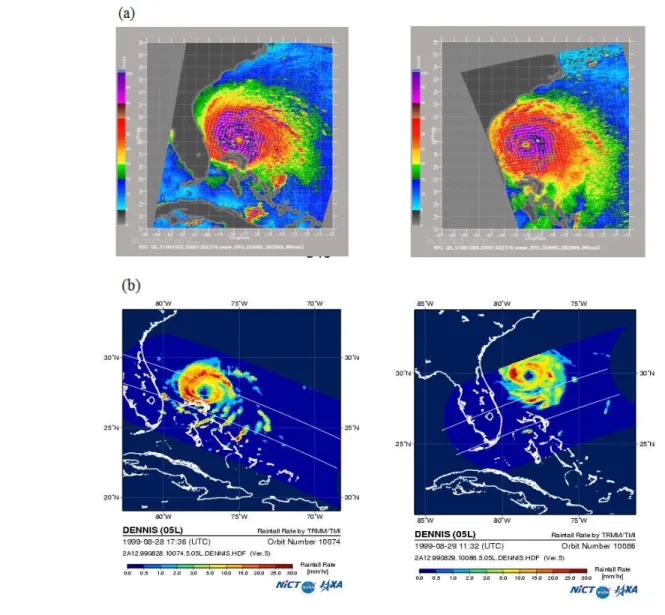
Holthuijsen et al. 2012; Vickery et al. 2009; Bell et al. 2012). In this study, the height-resolving,
166
wind-rain interaction model developed by Snaiki and Wu (2017c) (see Appendix A) is utilized.
167
Since the rain rate is a necessary input to take the rain effects into account, the iteration technique
168
is employed in the simulation as illustrated by Fig. 2.
9 170
Fig. 2. Flow chart of the rain intensity simulation methodology
171 172
The initial guess of the rain profile could be based on an empirical model as follows (Snaiki and
173 Wu 2017c): 174 0.5 exp 1 b b m m rm r r R R r r (9) 175
where Rrm= maximum rain rate located at the radius of maximum wind rm; r = radial distance
176
from the tropical cyclone center; and b = scaling parameter that adjusts the profile shape and
177
depends on the radial extent of the tropical cyclone rain field. The maximum rain rate Rrm was
178
estimated with an empirical formula available in literature (Tuleya et al. 2007):
179
1 35 33 rm m R a b V (10) 18010
where a and b = constants from the least squares fit of the TRMM radial rainfall rates; and Vm=
181
maximum wind speed. Although the iterative calculation is required in the analysis, it converges
182
quite rapidly. With a good initial guess of the rain profile based on Eq. (9), two or three iterations
183
are needed with a prescribed threshold ɛ= 5% for all simulations in the present study. The
first-184
order closure of the rain rate simulation in Fig. 2 results in a simplified model of Eq. (7):
185 wind,modified wind a m a m r r wind dV dV k k dz dz R V (11) 186
where k = 100 mm 2/s is the eddy viscosity;
wind,modified
V = modified wind speed due to the rain effects.
187
In the case of the marine conditions, the effective roughness length z0,effective could be
188
expressed as a combination of the aerodynamic roughness length z and the rain-induced one 0 z0,r
189 (Kumar et al. 2009): 190 0,effective 0 o r, z z z (12) 191
Several formulas have been proposed in the literature to characterize the rain-induced roughness
192
lengthz over ocean. For instance, Kitaigorodskii [referred in Houk and Green (1976)] defined 0,r
193 0,r z as: 194 , 0.03 o r z (13) 195
where
is the standard deviation of the experimentally obtained mean water level:196 kD g (14) 197
11
where = a constant of 0.01; D = drop diameter; g = gravitational acceleration;
= kinematic198
viscosity of water; and k is the rain kinetic energy flux that can be related to the rain intensity R
199
and the terminal velocity of the rain drop V : t
200 2 2 t RV k (15) 201
As a result, the rain-induced roughness can be expressed as:
202 2 0, 0.015 t r DV R z g
(16) 203Accordingly, the rain rate over ocean can be calculated as:
204 2 2 2 10 10 0 0, 0 ln ln a wind r r r z z V z z z R (17) 205
It should be noted that the use of Eq. (17) requires an iteration process since the rain-induced
206
roughness length z depends on the rain intensity.0,r
207
3. Wind field model
208The proposed analytical framework for rapid estimate of the rain rate requires the horizontal wind
209
speed components as input. A recently developed height-resolving model by Snaiki and Wu
210
(2017a; 2017b) is utilized here due to its high efficiency to obtain the wind field. A brief discussion
211
of the wind field model is presented in this section for the sake of completeness. The governing
212
equation of the wind field is described as follows:
12 1 . t a p f v v v k v F (18) 214
where f = Coriolis parameter; p = pressure; k = unit vector in the vertical direction; and F =
215
frictional force. In order to solve Eq. (18), the decomposition method is used where the wind
216
velocity (v) is expressed as:
217
g
v v v' (19)
218
where
v
g= gradient wind in the free atmosphere; andv'
= frictional component near the ground219
surface. The solution of the gradient wind speed could be solved straightforwardly in the
220
cylindrical coordinate system (Georgiou 1986; Meng et al. 1995):
221
2 1/ 2 2 4 g a csin fr csin fr r p v r (20) 222where = approach angle (counter clockwise positive from the East); c = translation speed of the
223
tropical cyclone; and = azimuthal angle. The radial velocity
0 1r g rg v dr r v
obtained from the224
continuity equation is usually disregarded due to its insignificant effects (Meng et al. 1995).
225
To obtain the frictional wind speed component, the nonlinear governing equation is first
226
simplified using the scale analysis approach, and then linearized leading to the following frictional
227
wind speed formulas as:
228
1/2
( 0 ) (1 ) ( 1 )
0 1 1 ( , ) q z q z i q z i u
z
Real A e A e A e (21a) 229
( 0 ) ( 1 ) ( 1 )
0 1 1 ( , ) q z q z i q z i v z Imag A e A e A e (21b) 23013
where
u v
', '
= frictional components of the wind velocity; q1 (1 i) 1/2;231 1/2 1 (1 ) q i ; q0
1/ 4; 1 2 g m k ; 1 2 ag m k ; 2 g g v f r is the 232absolute angular velocity; ag g g
v
v
f
r
r
is the vertical component of absolute vorticity of the233 gradient wind;
1
2
gv
K r
; 1 2 g v Kr ; and z’= new vertical coordinate used as the base of the
234
computation scheme where z’=0 is located above z (i.e., the 10 m height above the mean height 10
235
of roughness elements) (Meng et al. 1995). The other necessary parameters needed for the
236
simulation can be acquired in Snaiki and Wu (2017a; 2017b).
237
4. Model validation
238The necessary parameters needed for the tropical cyclone wind field simulation are:
approach239
angle; c translation velocity of the hurricane; p central pressure; c p central pressure difference;
240
max
R radius of maximum winds; B Holland’s parameter; latitude; and
longitude. These wind241
parameters can be obtained from the National Hurricane Center’s North Atlantic Hurricane
242
Database (HURDAT). On the other hand, the tropical cyclone rainfall data can be acquired from
243
the high-fidelity numerical weather prediction models, the Tropical Rainfall Measuring Mission
244
(TRMM) database or the Radar observations.
245
4.1. Comparison with MM5 model
246
In this section, the ensemble average of 12 surface rain fields corresponding to hurricane Frances
247
(2004) in the period from 29th August to 1st September 2004 (6-h intervals) were simulated based
14
on the Fifth-Generation Pennsylvania State University/NCAR Mesoscale Model (MM5)
249
(Langousis and Veneziano 2009a). A resolution of 1.67 km was used to generate the azimuthally
250
averaged rain rates in the MM5 simulations. The rain rates obtained from MM5 were compared
251
with those based on the proposed analytical framework, where the necessary parameters for the
252
rain intensity simulation were extracted from the HURDAT database (Table 1). As shown in Fig.3,
253
a good agreement between the MM5 and present simulation results is achieved.
254
Table 1. Tropical cyclones characteristics of the selected 12 rain fields
255
Hurricane Center
Mon|Day|h Latitude (deg) Longitude (deg) Storm Speed (m/s) Storm Direction (deg) (m/s) Vmax (hpa) Δp (km) Rmax
08|29|00 18.1 -52.9 4.0 145 59.2 948 31 08|29|06 18.4 -53.6 3.8 156 59.2 948 31 08|29|12 18.6 -54.4 4.0 165 59.2 948 31 08|29|18 18.8 -55.0 3.5 161 56.6 948 31 08|30|00 18.9 -55.8 3.9 172 54.0 954 32 08|30|06 19.0 -56.8 4.9 174 51.4 958 33 08|30|12 19.2 -58.1 6.4 171 51.4 956 33 08|30|18 19.4 -59.3 5.9 170 56.6 948 31 08|31|00 19.6 -60.7 6.9 171 56.6 946 31 08|31|06 19.8 -62.1 6.9 171 59.2 950 32 08|31|12 20.0 -63.5 6.9 171 61.7 949 32 08|31|18 20.3 -65.0 7.4 168 64.3 942 30 256 257
Fig. 3. Comparison of the azimuthally-averaged, rain-rate radial profile of Hurricane Frances
258 259 0 50 100 150 200 250 300 R (km) 0 5 10 15 20 25 30 35 40 45 50 MM5 simulation Present simulation
15
4.2. Comparison with PR/TRMM rain fields
260
To validate the proposed analysis framework for rapid rain rate estimation during tropical
261
cyclones, 38 PR/TRMM rain frames with a spatial resolution of 5 km5 km were utilized. The
262
parameters of the data collected from the PR/TRMM rain frames are summarized in Table 2
263
(Langousis and Veneziano 2009b). These 38 frames were selected from eight tropical cyclones
264
that cover a wide range of storm intensities. Fig. 4(a) represents a scatterplot of the ratios between
265
the PR/TRMM and simulated rain intensities iPR /i . A total number of 73819 points were sim
266
selected from the 38 TRMM frames, covering a wide range of tropical cyclone spatial locations.
267
All the necessary parameters for the rain rate simulation are taken from Table 2 (Langousis and
268
Veneziano 2009b).
269
A large dispersion similar to the finding of Langousis and Veneziano (2009a) is observed in
270
Fig. 4(a). It mainly results from the significant small-scale variability of rain rate due to the
271
rainbands and local intensifications. Figure 4(b) depicts the local average and standard deviation
272
of the ratio iPR /i with a moving window of 2000 points. Clearly, the simulation based on the sim
273
proposed analyses framework of rain field is unbiased since the moving average is close to unity.
274
The moving standard deviation on the other hand is quite large highlighting the significance of the
275
small-scale variability of the tropical cyclone rain field (Powell 1990; Molinari et al. 1994;
276
Langousis and Veneziano 2009a).
277
278
279
16 281
Table 2. Tropical cyclones characteristics of the PR/TRMM rain fields (Langousis and Veneziano 2009b)
282 Hurricane Center Hurricane Name Latitude (deg) Longitude (deg) Storm Speed (m/s) Storm Direction (deg) Vmax (m/s) Rmax (km) TRMM Frame Storm Intensity Floyd 1999 21.7 -61.6 4.9 143 48.8 41 10290 CAT2 23.5 -68.7 4.8 169 64.0 37 10317 CAT4 23.7 -70.6 5.8 171 69.3 37 10321 CAT4 Lili 2002 23.6 -87.2 9.0 162 51.5 20 27826 CAT2 24.4 -88.4 6.2 141 56.5 20 27830 CAT2 28.4 -91.4 10.1 117 54.0 20 27842 CAT4 29.0 -91.9 5.4 124 41.1 20 27845 CAT2 Frances 2004 12.6 -43.7 10.9 158 23.1 37 38646 TS 15.7 -49.8 5.4 139 51.4 19 38667 CAT3 17.0 -51.3 5.3 139 54.0 28 38677 CAT3 17.9 -52.6 4.3 144 59.1 28 38682 CAT4 19.0 -57.3 4.9 180 51.4 28 38708 CAT3 21.2 -68.5 6.1 162 61.7 28 38739 CAT4 Ivan 2004 8.9 -38.9 7.6 184 25.7 37 38789 TS 10.7 -50.6 12.2 185 57.5 28 38814 CAT4 11.2 -53.4 8.1 173 51.4 28 38820 CAT3 12.3 -64.1 8.3 166 61.7 19 38845 CAT4 12.7 -66.2 7.3 164 61.7 20 38851 CAT4 17.4 -77.3 4.1 194 66.8 28 38892 CAT4 17.7 -78.4 4.4 153 64.3 28 38897 CAT4 25.6 -87.4 5.5 112 61.7 46 38954 CAT4 Jeanne 2004 27.4 -70.6 5.5 0 38.6 42 39045 CAT1 25.5 -69.5 1.1 207 41.1 37 39079 CAT2 26.5 -74.3 7.4 173 43.7 60 39106 CAT2 26.5 -75.6 6.5 180 46.3 46 39110 CAT2 Karl 2004 11.5 -35.3 7.1 176 26.7 37 38987 TS 17.3 -45.5 2.0 166 57.8 32 39033 CAT3 19.1 -47.4 5.9 121 64.0 32 39048 CAT4 22.9 -48.6 8.2 112 54.0 28 39059 CAT3 25.7 -49.5 6.8 117 48.8 28 39063 CAT3 Katrina 2005 24.6 -85.6 2.1 153 51.5 56 44357 CAT3 25.0 -86.2 3.5 146 56.5 50 44361 CAT3 26.9 -89.0 5.5 135 75.0 38 44373 CAT5 Rita 2005 24.3 -85.9 5.7 189 61.7 28 44743 CAT4 24.9 -88.0 3.9 166 77.1 19 44754 CAT5 25.4 -88.7 4.3 153 72.0 19 44758 CAT5 26.8 -91.0 5.5 135 59.1 37 44770 CAT4 27.4 -91.9 4.8 143 59.1 37 44773 CAT4 283
17 284
Fig. 4. Comparison of the PR/TRMM and simulated rain rates: (a) Scatter plot of iPR /isim; (b) Local average and
285
standard deviation of iPR/isim
286 287
4.3. Comparison with TMI/TRMM and radar observations
288
The rain distribution of hurricane Dennis (1999) obtained from TMI/TRMM (Lonfat et al. 2004)
289
was compared with the simulation result from the present methodology. As shown in Fig. 5, a
290
good agreement between the simulations and observations is highlighted except in some local
291
intensification regions caused by rainbands. TMI measurements are known to be more accurate
292
for rainfall estimates over ocean than land. On the other hand, the Hydro-Next-Generation Doppler
293
Radar system can measure the rainfall distribution over both ocean and land with very good
294
accuracy (Lin et al. 2010). Hurricane Isabel (2003) was employed here to validate rain field
295
simulation over land based on the present analysis framework. Isabel made landfall in North
296
Carolina on 18 September 2003 as a category 2 tropical cyclone and caused widespread damages
297
from storm surge flooding, wind and riverine flooding (Lin et al. 2010). Figure 6 presents a good
298
agreement between the simulated and observed rainfall distribution up to 200 km radius. The
299
orographic enhancement of rainfall due to the interaction between the tropical cyclone and the
18
complex terrain conditions of the central Appalachians Mountains, not considered in the present
301
model, resulted in large differences beyond the range of 200 km (Lin et al. 2010).
302
303
Fig. 5. Comparison of the azimuthally-averaged, rain-rate radial profile of Hurricane Dennis
304 305
306
Fig. 6. Comparison of the azimuthally-averaged, rain-rate radial profile of Hurricane Isabel
307
5. Rainband simulation
308Tropical cyclones exhibit significant rain rate in the eyewall and a set of rainbands (Willoughby
309
et al. 1984; Willoughby 1988). The complicated underlying mechanisms governing the rainbands
310
make their pattern vary from one tropical cyclone to another (Houze et al. 2006). Hence, it is
311
extremely challenging to systematically simulate these rainbands. The rainbands outside the
312
eyewall are usually characterized by secondary horizontal wind maxima (Samsury and Zipser
313 R ai n ra te ( m m /h )
19
1995). A number of field measurements indicate that the local boundary-layer wind maxima in the
314
rainbands are typically associated with pressure perturbations (e.g., Powell 1990; Yu and Tsai
315
2010; Lin et al. 2010; Sitkowski et al. 2011; Li and Wang 2012). Since the wind field here is
316
simulated by a large-scale model (Snaiki and Wu 2017a; 2017b) and hence does not account for
317
local intensifications, considerable differences between the simulated and observed rain rates are
318
typically observed in the rainband regions as discussed in the preceding sections.
319
A good approach to improve the simulation would be based on a proper perturbation of the
320
original wind profile that could characterize the rainbands. The rain rate heavily depends on the
321
wind speed, hence, a perturbation in the wind field will generate a corresponding perturbation in
322
the rain rate and hence the local maxima of the rain intensity (local perturbation scheme). This
323
approach can be more convenient to be implemented by introducing a perturbation in the pressure
324
profile that will generate a corresponding wind perturbation (Holland et al. 2010). To illustrate the
325
adopted scheme, the rain field of hurricane Dennis (Fig. 5) was revisited to incorporate the
326
contribution of the rainbands. The rainband locations were first identified from the TMI imagery
327
[Fig. 7(b)]. Then, the simulated wind speeds at a 10-meter height were compared with those from
328
the Remote Sensing System QuikScat (version-4) data [Fig. 7(a)] (Ricciardulli and Wentz, 2015)
329
to obtain the perturbation values. Table 3 compares and presents the observed and simulated wind
330
speeds in three different rainband regions. The consideration of perturbations in the wind field
331
leads to an improved rain rate, as shown in Fig. 8. A good agreement between the observed and
332
simulated profiles is observed. Figure 9 presents a comparison of the simulated rain rates of
333
Hurricane Dennis with and without considerations of the rainbands. The corresponding correlation
334
coefficients between the observations and simulations are 0.96 and 0.92, respectively. While the
335
results demonstrate that the rain intensities predicted by both approaches match reasonably well
20
with the measured data, the simulation accuracy is certainly improved by integrating the rainband
337 effects. 338 339 340 341 342 343 344 345 346 347
Fig. 7. Hurricane Dennis (1999) wind and rain fields: (a) Surface wind speed distribution obtained from QuikScat on
348
August 28 (left) and August 29 (right); (b) Surface rain rate provided by TMI/TRMM on August 28 (left) and
349 August 29 (right) 350 351 352 353
21
Table 3. Comparison between the observed (QuikScat) and simulated surface wind speed of Hurricane Dennis in the
354
rainband regions
355
r (km) θ (deg) UQuikScat (m/s) Usimulated (m/s)
133 90 25.70 22.20
137 60 25.00 22.25
236 194 16.00 12.00
356
357
Fig. 8. Comparison of the improved, azimuthally-averaged, rain-rate radial profile of Hurricane Dennis
358
359
360
Fig. 9. Comparison of the azimuthally-averaged rain rates of Hurricane Dennis
361 362 363 100 200 300 400 R (km) 0 2 4 6 8 10 12 14 16
Observed rain rate Simulated rain rate
Si m ul at ed r ai n ra te ( m m /h )
22
6. Sensitivity analysis
364
Numerous studies have demonstrated based on field measurements and numerical simulations that
365
the rainfall distribution varies with a number of environmental factors (e.g., roughness) and
366
inherent tropical cyclone features (e.g., intensity and translation speed) (Lonfat et al, 2004). The
367
present rain rate analysis framework explicitly depends on these parameters. Figure 10 illustrates
368
the sensitivity of the rain intensity to several selected parameters, namely B Holland parameter,
369
m
r radius of maximum wind, c translation speed, p central pressure difference, k turbulent m
370
diffusivity, and z equivalent roughness length. The base case scenario is taken as:0 B1,
371
30
m
r km,
c
10 /
m s
, p 70hpa, 50 2/m
k m s, and z0 0.001m. The radial profile of the
372
rain rate was taken at
0
(counterclockwise positive from the East) for all simulations.373
As indicated in Fig. 10, the central pressure difference
p
, translational tropical cyclone374
speed c and surface roughness z have significant effects on the rain rate. Actually, it has been 0
375
widely reported that the surface roughness can substantially alter the rain intensity (e.g., Trenberth
376
et al. 2007; Langousis and Veneziano 2009a; and Lin et al. 2010). Also, a higher value of
p
,377
corresponding to a larger maximum wind v (Holland et al. 2010), leads to more intense rain. This m
378
result agrees with the observations and findings of the literature (e.g., Lonfat et al. 2004; Tuleya
379
et al. 2007; Langousis and Veneziano 2009a). Similarly, an increase of the translational tropical
380
cyclone speed results in the enhancement of the total precipitation. Figure 10 also implies that the
381
smaller radius of maximum wind is associated with a more peaked profile shifted to the tropical
382
cyclone center. The Holland’s parameter B mainly modifies the decay rate of the rainfall intensity
383
profile and presents small effects on the maximum rain rate. In addition, low sensitivity of the rain
384
rate to the vertical turbulent diffusivity is noted in the figure.
23 386
Fig. 10. Sensitivity analysis of the rain rate at
0387
388
The spatial distribution of the rain intensity was investigated based on the following case
389
study parameters: B = 1.2; c = 3 m/s; rm = 40 km; Δp = 60 hpa; z0 0.01m. Figures 11(a) and
390
11(b) depict the three-dimensional shaded surface of the rain intensity and their corresponding
391
contours, respectively. Due mainly to the tropical cyclone motion, the rain field is asymmetric.
392
This result conforms with the finding of Langousis and Veneziano (2009a), highlighting the
393
maximum rain rate location near the radius of maximum winds in the eyewall region (Lonfat et al.
394 2004; Tuleya et al. 2007). 395 0 10 20 30 40 50 rm=30km rm=40km rm=50km 0 10 20 30 40 50 B=1 B=1.2 B=1.4 0 10 20 30 40 50 p=50hpa p=70hpa p=90hpa 0 10 20 30 40 50 c=0m/s c=10m/s c=20m/s 100 200 300 r (km) 0 10 20 30 40 50 60 70 z0=0.001 z0=0.005 z0=0.01 100 200 300 r (km) 0 10 20 30 40 50 km=40m2/s km=50m2/s km=60m2/s
24 396
397
Fig. 11. Spatial distribution of the rain rate: (a) Three-dimensional shaded surface of the rain intensity; (b) Contours
398
of the rain rate
399 400
7. Concluding remarks
401A new, analytical framework for rapid rain rate estimation was proposed in this study. The rain
402
rate formula was essentially developed based on the observation that rain-induced momentum flux
403
at the surface cannot be ignored. The total surface stress results mainly from momentum flux
404
contributions of wind and rain. The obtained results indicate that the spatial distribution of the
405
rainfall field is governed by the wind field inside the tropical cyclone. This observation confirms
406
the findings of several previous studies in which the rain intensity is shown to be highly correlated
407
with the horizontal wind speed. A recently developed, height-resolving wind field model was
408
utilized during the model construction leading to a linear, analytical solution of the surface rain
409
rate. The obtained analysis framework for rain field explicitly depends on parameters for a typical
410
tropical cyclone wind field simulation, namely storm location, approach angle, translation speed,
411
radius of maximum wind, pressure profile, surface drag coefficient, and turbulent diffusivity. The
25
sensitivity analysis was extensively carried out to investigate the effects of several tropical cyclone
413
and environmental parameters on the rain rate. It has been demonstrated that the rain rate heavily
414
depends on the central pressure difference, translational tropical cyclone speed and surface
415
roughness. The proposed analysis framework for the rain field is based on the large-scale
416
horizontal wind field, therefore, it does not account for local rainfall intensifications due to
417
rainbands. A plausible approach based on the local perturbation scheme was introduced to simulate
418
the rain rates inside the rainband regions. The present analytical framework for rapid estimate of
419
rain rate offers good simulation results that are consistent with tropical cyclone observations. It
420
can be readily used in conjunction with the Monte Carlo techniques for risk analysis of tropical
421 cyclone hazards. 422 423 Acknowledgments 424
The support for this project provided by the NSF Grant # CMMI 15-37431 is gratefully
425
acknowledged.
426
427
26
Appendix A
429
The drag force fi exerted by one raindrop on air in the horizontal direction is introduced:
430 2 , 1 ( ) 2
i aC Vd r rel rain wind rd
f V V (A.1)
431
where
C
d r, = drag coefficient for a raindrop of radius rd; Vrain= raindrop horizontal velocity; Vwind432
= wind velocity in the horizontal direction; and Vrel= the total relative speed of the raindrop. As a
433
result, the total drag force fd applied on a tiny volume of air V A z can be obtained as follows:
434 , 3 ( ) 4 a d r R C V d rain wind d V V f (A.2) 435
where d = the raindrop diameter. The total drag force is then integrated into the governing equation
436
of the wind velocity [Eq. (18)]. With several mathematical manipulations, one can obtain the
437
gradient wind speed as follows (Snaiki and Wu 2017c):
438 2 2 2 2 2 1/ 2 2 2 2 2 2 2 2 2 sin 1 2 1 sin 4 1 1 2 1 ag ag g ag ag ag a ag ag c A A f r v A r c A A p A f r r r A r (A.3) 439 where 2 , 1 2 d r d C Nr A ; and 3 3 4 d R N r
is the number of raindrops per second on a unit area. On
440
the other hand, the frictional wind speed components can be obtained as follows (Snaiki and Wu
441
2017c):
27
' 1cos( ) 2sin( ) az r v Ye W bz W bz (A.4a) 443
' 2cos( ) 1sin( ) az v e W bz W bz (A.4b) 444 where Y pq ; 1 2 m g p k ; 1 2 m ag q k ; 2 , 2 2 d r d NC rA . The variables a and b are defined
445 as: 446 2 2 4 2 m m A A pq k k a (A.5a) 447 2 2 4 2 m m A pq A k k b (A.5b) 448
The variables W1 and W2 are determined form the boundary conditions and presented as follows:
449
1 2 1 rg g a Z Z v Z v b Y Y W a Z b (A.6a) 450
2 2 1 rg a g Z v Z Z v Y Y b W a Z b (A.6b) 451 where Cd a, vs kb ; r r a R Z bk
; and vs= total wind velocity near the ground surface.
452
Hurricane Katrina (2005) is employed here for the validation purpose. The anemometer
453
was located on the 42003 station at (26°0'25" N, 85°38'54" W). The 10-min averaged time was
28
used for the observed wind data at approximately 10 m height. As shown in Fig. 12, the results
455
generated by the present model are consistent with hurricane Katrina wind field observations.
456
457
458
Fig. 10. Observed and simulated wind speeds (top) and directions (bottom) of Hurricane Katrina 459 460 461 8/27-00Z10 8/27-06Z 8/27-12Z 8/27-18Z 8/28-00Z 8/28-06Z 15 20 25 30 Time (hour) W in d sp ee d (m /s )
Observed wind speed Simulated wind speed
8/27-00Z0 8/27-06Z 8/27-12Z 8/27-18Z 8/28-00Z 8/28-06Z 90 180 270 360 Time (hour) W in d di re ct io n (° )
Observed wind direction Simulated wind direction
29
References
462
Andreas, E.L., 2004. Spray stress revisited. Journal of Physical Oceanography, 34(6), pp.1429-1440.
463
Bryant, K.M. and Akbar, M., 2016. An Exploration of Wind Stress Calculation Techniques in Hurricane Storm Surge
464
Modeling. Journal of Marine Science and Engineering, 4(3), 58.
465
Bell, M.M., Montgomery, M.T. and Emanuel, K.A., 2012. Air–sea enthalpy and momentum exchange at major
466
hurricane wind speeds observed during CBLAST. Journal of the Atmospheric Sciences, 69(11), pp.3197-3222.
467
Caldwell, D.R. and Elliott, W.P., 1971. Surface stresses produced by rainfall. Journal of Physical Oceanography, 1(2),
468
pp.145-148.
469
Caldwell, D.R. and Elliott, W.P., 1972. The effect of rainfall on the wind in the surface layer. Boundary-Layer
470
Meteorology, 3(2), pp.146-151.
471
Chen, S.S., Zhao, W., Donelan, M.A., Price, J.F. and Walsh, E.J., 2007. The CBLAST-Hurricane program and the
472
next-generation fully coupled atmosphere–wave–ocean models for hurricane research and prediction. Bulletin of
473
the American Meteorological Society, 88(3), pp.311-317.
474
Chen, S.S., Zhao, W., Donelan, M.A. and Tolman, H.L., 2013. Directional wind–wave coupling in fully coupled
475
atmosphere–wave–ocean models: Results from CBLAST-Hurricane. Journal of the Atmospheric
476
Sciences, 70(10), pp.3198-3215.
477
Clayson, C.A. and Kantha, L.H., 1999. Turbulent kinetic energy and its dissipation rate in the equatorial mixed
478
layer. Journal of physical oceanography, 29(9), pp.2146-2166.
479
Donelan, M.A., Haus, B.K., Reul, N., Plant, W.J., Stiassnie, M., Graber, H.C., Brown, O.B. and Saltzman, E.S., 2004.
480
On the limiting aerodynamic roughness of the ocean in very strong winds. Geophysical Research Letters, 31(18),
481
L18306.
482
Emanuel, K.A., 1995. Sensitivity of tropical cyclones to surface exchange coefficients and a revised steady-state
483
model incorporating eye dynamics. Journal of the Atmospheric Sciences, 52(22), pp.3969-3976.
484
Fairall, C.W., Kepert, J.D. and Holland, G.J., 1994. The effect of sea spray on surface energy transports over the
485
ocean. Global Atmos. Ocean Syst, 2(2-3), pp.121-142.
486
Fairall, C.W., Bradley, E.F., Rogers, D.P., Edson, J.B. and Young, G.S., 1996. Bulk parameterization of air‐sea fluxes
487
for tropical ocean‐global atmosphere coupled‐ocean atmosphere response experiment. Journal of Geophysical
488
Research: Oceans, 101(C2), pp.3747-3764.
489
Fu, X., Li, H.N. and Yi, T.H., 2015. Research on motion of wind-driven rain and rain load acting on transmission
490
tower. Journal of Wind Engineering and Industrial Aerodynamics, 139, pp.27-36.
491
Garratt, J.R., 1977. Review of drag coefficients over oceans and continents. Monthly weather review, 105(7),
pp.915-492
929.
493
Georgiou, P.N., 1986. Design Wind Speeds in Tropical Cyclone-prone Regions. PhD Thesis University of Western
494
Ontario, London, Ontario, Canada.
495
Groisman, P.Y., Karl, T.R., Easterling, D.R., Knight, R.W., Jamason, P.F., Hennessy, K.J., Suppiah, R., Page, C.M.,
496
Wibig, J., Fortuniak, K. and Razuvaev, V.N., 1999. Changes in the probability of heavy precipitation: important
497
indicators of climatic change. In Weather and Climate Extremes (pp. 243-283). Springer Netherlands.
498
Guo, J.C., Urbonas, B. and Stewart, K., 2001. Rain catch under wind and vegetal cover effects. Journal of Hydrologic
499
Engineering, 6(1), pp.29-33.
30
Holland, G.J., Belanger, J.I. and Fritz, A., 2010. A revised model for radial profiles of hurricane winds. Monthly
501
Weather Review, 138(12), pp.4393-4401.
502
Holthuijsen, L.H., Powell, M.D. and Pietrzak, J.D., 2012. Wind and waves in extreme hurricanes. Journal of
503
Geophysical Research: Oceans, 117, C09003.
504
Houk, D. and Green, T., 1976. A note on surface waves due to rain. Journal of Geophysical Research, 81(24),
pp.4482-505
4484.
506
Houze Jr, R.A., Cetrone, J., Brodzik, S.R., Chen, S.S., Zhao, W., Lee, W.C., Moore, J.A., Stossmeister, G.J., Bell,
507
M.M. and Rogers, R.F., 2006. The hurricane rainband and intensity change experiment: Observations and
508
modeling of Hurricanes Katrina, Ophelia, and Rita. Bulletin of the American Meteorological Society, 87(11),
509
pp.1503-1521.
510
Huang, C.H., 2012. Modification of the Charnock wind stress formula to include the effects of free convection and
511
swell. In Advanced Methods for Practical Applications in Fluid Mechanics. InTech, pp.47-71.
512
Huffman, G.J., Adler, R.F., Bolvin, D.T. and Nelkin, E.J., 2010. The TRMM multi-satellite precipitation analysis
513
(TMPA). In Satellite rainfall applications for surface hydrology (pp. 3-22). Springer Netherlands.
514
Jarosz, E., Mitchell, D.A., Wang, D.W. and Teague, W.J., 2007. Bottom-up determination of air-sea momentum
515
exchange under a major tropical cyclone. Science, 315(5819), pp.1707-1709.
516
Kaplan, J. and DeMaria, M., 1995. A simple empirical model for predicting the decay of tropical cyclone winds after
517
landfall. Journal of applied meteorology, 34(11), pp.2499-2512.
518
Kumar, R.R., Kumar, B.P. and Subrahamanyam, D.B., 2009. Parameterization of rain induced surface roughness and
519
its validation study using a third generation wave model. Ocean Science Journal, 44(3), pp.125-143.
520
Kummerow, C., Barnes, W., Kozu, T., Shiue, J. and Simpson, J., 1998. The tropical rainfall measuring mission
521
(TRMM) sensor package. Journal of atmospheric and oceanic technology, 15(3), pp.809-817.
522
Landsea, C.W., 2000. Climate variability of tropical cyclones: past, present and future. Storms. Routledge, New York,
523
pp.220-241.
524
Langousis, A. and Veneziano, D., 2009a. Theoretical model of rainfall in tropical cyclones for the assessment of long‐
525
term risk. Journal of Geophysical Research: Atmospheres, 114, D02106.
526
Langousis, A. and Veneziano, D., 2009b. Long‐term rainfall risk from tropical cyclones in coastal areas. Water
527
resources research, 45, W11430.
528
Li, Q. and Wang, Y., 2012. Formation and quasi-periodic behavior of outer spiral rainbands in a numerically simulated
529
tropical cyclone. Journal of the Atmospheric Sciences, 69(3), pp.997-1020.
530
Lin, N., Smith, J.A., Villarini, G., Marchok, T.P. and Baeck, M.L., 2010. Modeling extreme rainfall, winds, and surge
531
from Hurricane Isabel (2003). Weather and Forecasting, 25(5), pp.1342-1361.
532
Lonfat, M., Marks Jr, F.D. and Chen, S.S., 2004. Precipitation distribution in tropical cyclones using the Tropical
533
Rainfall Measuring Mission (TRMM) microwave imager: A global perspective. Monthly Weather
534
Review, 132(7), pp.1645-1660.
535
Lonfat, M., Rogers, R., Marchok, T. and Marks Jr, F.D., 2007. A parametric model for predicting hurricane
536
rainfall. Monthly Weather Review, 135(9), pp.3086-3097.
537
Meng, Y., Matsui, M. and Hibi, K., 1995. An analytical model for simulation of the wind field in a typhoon boundary
538
layer. Journal of Wind Engineering and Industrial Aerodynamics, 56(2-3), pp.291-310.
31
Molinari, J., Moore, P.K., Idone, V.P., Henderson, R.W. and Saljoughy, A.B., 1994. Cloud‐to‐ground lightning in
540
Hurricane Andrew. Journal of Geophysical Research: Atmospheres, 99(D8), pp.16665-16676.
541
Powell, M.D., 1990. Boundary layer structure and dynamics in outer hurricane rainbands. Part I: Mesoscale rainfall
542
and kinematic structure. Monthly Weather Review, 118(4), pp.891-917.
543
Powell, M.D., Vickery, P.J. and Reinhold, T.A., 2003. Reduced drag coefficient for high wind speeds in tropical
cy-544
clones. Nature, 422(6929), pp.279-283.
545
Rappaport, E.N., 2000. Loss of life in the United States associated with recent Atlantic tropical cyclones. Bulletin of
546
the American Meteorological Society, 81(9), pp.2065-2073.
547
Ricciardulli, L. and Wentz, F.J., 2015. A scatterometer geophysical model function for climate-quality winds:
548
QuikSCAT Ku-2011. Journal of Atmospheric and Oceanic Technology, 32(10), pp.1829-1846.
549
Samsury, C.E. and Zipser, E.J., 1995. Secondary wind maxima in hurricanes: Airflow and relationship to
550
rainbands. Monthly weather review, 123(12), pp.3502-3517.
551
Shu, Z.R., Li, Q.S., He, Y.C. and Chan, P.W., 2017. Vertical wind profiles for typhoon, monsoon and thunderstorm
552
winds. Journal of Wind Engineering and Industrial Aerodynamics, 168, pp.190-199.
553
Sitkowski, M., Kossin, J.P. and Rozoff, C.M., 2011. Intensity and structure changes during hurricane eyewall
554
replacement cycles. Monthly Weather Review, 139(12), pp.3829-3847.
555
Smith, R.K., 1968. The surface boundary layer of a hurricane. Tellus, 20(3), pp.473-484.
556
Snaiki, R. and Wu, T., 2017a. Modeling tropical cyclone boundary layer: Height-resolving pressure and wind fields.
557
Journal of Wind Engineering and Industrial Aerodynamics, 170, pp.18-27.
558
Snaiki, R. and Wu, T., 2017b. A linear height-resolving wind field model for tropical cyclone boundary layer. Journal
559
of Wind Engineering and Industrial Aerodynamics, 171, pp.248-260.
560
Snaiki, R. and Wu, T., 2017c. Dynamic Interaction of Wind and Rain Fields in the Boundary Layer of a Tropical
561
Cyclone. Proceedings of Engineering Mechanics Institute Conference 2017 (EMI 2017), May, 2017, San Diego,
562
CA, USA.
563
Taylor, G.I., 1916. Skin friction of the wind on the earth's surface. Proceedings of the Royal Society of London. Series
564
A, Containing Papers of a Mathematical and Physical Character, 92(637), pp.196-199.
565
Trenberth, K.E., Davis, C.A. and Fasullo, J., 2007. Water and energy budgets of hurricanes: Case studies of Ivan and
566
Katrina. Journal of Geophysical Research: Atmospheres, 112(D23106).
567
Tse, K.T., Li, S.W., Chan, P.W., Mok, H.Y. and Weerasuriya, A.U., 2013. Wind profile observations in tropical
568
cyclone events using wind-profilers and doppler SODARs. Journal of Wind Engineering and Industrial
569
Aerodynamics, 115, pp.93-103.
570
Tuleya, R.E., DeMaria, M. and Kuligowski, R.J., 2007. Evaluation of GFDL and simple statistical model rainfall
571
forecasts for US landfalling tropical storms. Weather and forecasting, 22(1), pp.56-70.
572
Vickery, P.J., Wadhera, D., Powell, M.D. and Chen, Y., 2009. A hurricane boundary layer and wind field model for
573
use in engineering applications. Journal of Applied Meteorology and Climatology, 48(2), pp.381-405.
574
Willoughby, H.E., Marks Jr, F.D. and Feinberg, R.J., 1984. Stationary and moving convective bands in
575
hurricanes. Journal of the Atmospheric Sciences, 41(22), pp.3189-3211.
576
Willoughby, H.E., 1988. The dynamics of the tropical cyclone core. Australian Meteorological Magazine, 36,
pp.183-577
191.
32
Wilson, P.S. and Toumi, R., 2005. A fundamental probability distribution for heavy rainfall. Geophysical Research
579
Letters, 32, L14812.
580
Wong, B. and Toumi, R., 2016. Effect of extreme ocean precipitation on sea surface elevation and storm
581
surges. Quarterly Journal of the Royal Meteorological Society, 142(699), pp.2541-2550.
582
Woolhiser, D.A. and Roldan, J., 1982. Stochastic daily precipitation models: 2. A comparison of distributions of
583
amounts. Water resources research, 18(5), pp.1461-1468.
584
Wu, J., 1973. Spray in the atmospheric surface layer: Laboratory study. Journal of Geophysical Research, 78(3),
585
pp.511-519.
586
Yu, C.K. and Tsai, C.L., 2010. Surface pressure features of landfalling typhoon rainbands and their possible
587
causes. Journal of the Atmospheric Sciences, 67(9), pp.2893-2911.
588
Zhao, D., Ma, X., Liu, B. and Xie, L., 2013. Rainfall effect on wind waves and the turbulence beneath air-sea interface.
589
Acta Oceanologica Sinica, 32(11), pp.10-20.