VALIDATION OF STANDARDIZED CREATININE AND CYSTATIN C
GFR ESTIMATING EQUATIONS IN A LARGE MULTICENTRE
EUROPEAN COHORT OF CHILDREN
Jonas Björk1,2 • Ulf Nyman3• Ulla Berg4 • Pierre Delanaye5 • Laurence Dubourg6 • Karolien Goffin7 • AndersGrubb8 •
Magnus Hansson9 • Karin Littmann9 • Kajsa Åsling-Monemi4 • Arend Bökenkamp10 • Hans Pottel11
1 Division of Occupational and Environmental Medicine, Lund University, Lund, Sweden 2 Clinical Studies Sweden, Forum South, Skåne University Hospital, Lund, Sweden
3 Department of Translational Medicine, Division of Medical Radiology, Lund University, Malmö, Sweden
4 Department of Clinical Science, Intervention and Technology, Division of Paediatrics, Karolinska Institutet, Karolinska University Hospital
Huddinge, Stockholm, Sweden
5 Nephrology-Dialysis-Transplantation, University of Liège, CHU Sart Tilman, Liège, Belgium
6 Néphrologie, Dialyse, Hypertension et Exploration Fonctionnelle Rénale, Groupement Hospitalier Edouard Herriot, Hospices Civils de Lyon,
Université Claude Bernard Lyon 1, and Laboratory ofTissue Biology and Therapeutic Engineering, UMR 5305 CNRS, Université Claude Bernard Lyon 1, Lyon, France
7 Department of Nuclear Medicine & Molecular Imaging, University Hospital Leuven, Leuven, Belgium 8 Department of Clinical Chemistry, Skåne University Hospital, Lund, Lund University, Lund, Sweden
9 Department of Laboratory Medicine, Division of Clinical Chemistry, Karolinska Institutet, Karolinska University Hospital Huddinge, Stockholm,
Sweden
10 Emma Children’s Hospital, Amsterdam UMC, Vrije Universiteit Amsterdam, Amsterdam, The Netherlands 11 Department of Public Health and Primary Care, KU Leuven Campus Kulak Kortrijk, Kortrijk, Belgium
Jonas Björk and Ulf Nyman share first authorship
Arend Bökenkamp and Hans Pottel share senior/last authorship
KEYWORDS Children; Chronic kidney disease; Glomerular filtration rate; Kidney function tests; Renal failure
ABSTRACT
Background Most validations of paediatric glomernlar filtration rate (GFR) estimating equations using standardized ceatinine (CR) and cystatin C (CYS) assays have comprised relatively small cohorts, which makes accuracy across subgroups of GFR, age, body mass index (BMI) and gender uncertain. To overcome this, a large cohort of children referred for GFR determination has been established from several European medical centres.
Methods Three thousand four hundred eight measurements of GFR (mGFR) using plasma clearance of exogenous substances were performed in 2218 children aged 2-17 years. Validated equations included Schwartz-2009CR/2012CR/CYS/CR+CYS, FASCR/CYS/CR+CYS,LMRCR, Schwartz-LyonCR, BergCYS, CAPACYS,CKD-EPICYS, AndersenCR+CYS and
arithmetic means of the best single-marker equations in explorative analysis. Five metrics were used to compare the performance of the GFR equations: bias, precision and three accuracy measures including the percentage of GFR estimates (eGFR) within ± 10% (P10) and ± 30% (P30) of mGFR.
Results Three of the cystatin C equations, BergCYS, CAPACYS and CKD-EPICYS, exhibited low bias and generally
satisfactory accuracy across all levels of mGFR; CKD-EPICYS had more stable performance across gender than the two
other equations. Among creatinine equations, Schwartz-LyonCR had the best performance but was inaccurate at
mGFR < 30 mL/min/1.73 m2 and in underweight patients. Arithmetic means of the best creatinine and cystatin C
equations above improved bias compared to the existing composite creatinine+cystatin C equations.
Conclusions The present study strongly suggests that cystatin C should be the primary biomarker of choice when estimating GFR in children with decreased GFR. Arithmetic means of well-performing single-marker equations improve accuracy further at most mGFR levels and have practical advantages compared to composite equations. Electronic supplementary material The online version of this article (https://doi.org/10.1007/s00467-018-4185-y) contains supplementary material, which is available to authorized users.
Introduction
Accurate assessment of glomerular filtration rate (GFR) in children is essential for correct classification and management of chronic kidney disease (CKD) and for adjusting drug dosage to avoid toxic effects from certain cytostatic drugs, antibiotics and radiographic contrast media. Measuring GFR (mGFR) in terms of clearance of exogenous substances is relatively costly, inconvenient in daily clinical practice and even unavailable in many hospitals, making equations based on plasma/serum concentrations of creatinine or cystatin C to estimate GFR (eGFR) a necessary alternative to evaluate renal function in many situations.
Most validation studies regarding paediatric GFR equations based on standardized creatinine and cystatin C assays have been small, typically with fewer than 400 GFR measurements and with small numbers of patients with decreased GFR [1-13]. Therefore, the accuracy of even commonly used GFR equations in clinical practice is largely unknown across subgroups of GFR, age, body mass index (BMI) and sex.
The aim of the present study was to validate commonly used GFR equations calibrated to International Federation of Clinical Chemistry and Laboratory Medicine (IFCC)- standardized creatinine and cystatin C assays in a large cohort of children pooled from several medical centres across Europe.
Material and methods
DATA SOURCES AND PARTICIPANTS
A new European work group named “European Kidney Function Consortium” (EKFC) has recently been set up at two meetings (Malmö on September 25, 2017 and Copenhagen on May 26, 2018). EKFC took the initiative to collect retrospective data on subjects referred for GFR measurement including sCr, sCys, age, sex, height and weight. For this study, we selected a subset of all available data from this database, restricted to children 2 to 17 full years of age. Five different cohorts (see descriptions in Supplementary Material including Table S1) used in ongoing or published cross-sectional studies between 2004 and 2016 were included from the Netherlands (Amsterdam [7, 14-17]), Belgium (Leuven [13]), France (Lyon [12, 13]) and Sweden (Lund [7] and Stockholm). Common reasons for determination of mGFR were congenital malformations, hereditary disorders, glomerulopathies, tubular diseases, vascular disorders, malignancies, urinary tract infections, liver diseases, transplantation follow-up and to dose drugs cleared by the kidneys. A study database, fully anonymous and without personal information, was pooled and centralized for the present study at Lund University, Sweden, comprising 3408 measurements of GFR in 2218 children with complete data on sCr, sCys, age, gender, height and weight. All procedures involving subjects and data agreed with the ethical principles for medical research involving human subjects established in the World Medical Association Declaration of Helsinki of 1975, as revised in 2000. The study was reviewed and approved by the Regional Ethical Board in Lund, Sweden.
LABORATORY ASSAYS
All centres used creatinine assays traceable to isotope dilution mass spectrometry (IDMS). The cystatin C assays were calibrated against the international cystatin C reference material, ERM-DA471/IFCC, except for Lyon before April 2011 where the values were multiplied by 1.11 [13] and for Amsterdam before December 2012 where the values were multiplied by 1.174 [18] for conversion. For the data originating from the Caucasian, Asian, Paediatric and Adult (CAPA) cohort (Lund and part of Amsterdam cohort), extra care was undertaken to assure that the cystatin C assay used was commutable with regard to the reference material [7]. All assays for cystatin C and creat-inine for the CAPA cohort were run on the same instrument (Architect ci8200) at one laboratory (Uppsala University Hospital, Sweden). An external quality assessment system (Equalis AB, Sweden) was used to monitor these analyses as well as those from Stockholm.
Details of clearance methods and creatinine and cystatin C assays used in Amsterdam, Leuven, Lund and Lyon have been published earlier (see references in Supplementary Material and Table S1), while unpublished techniques used in Stockholm are described in more detail in Supplementary Material. External quality control was provided by Equalis AB (Uppsala, Sweden, www.equalis.se/en) regarding the iohexol measurements in Lund and Stockholm.
GFR EQUATIONS
1. Creatinine-based, general-purpose équations: The Full Age Spectrum based on age (FAS-AgeCR) and height
(FAS-HtCR) [12, 13, 19] and the Lund-Malmo revised equation (LMRCR) [20], which was developed for adults but has
also been validated in children [21]
2. Creatinine-based, paediatric equations: Schwartz- 2009CR [1], Schwartz-2012CR [3] and Schwartz-LyonCR [4]
3. Cystatin C-based, general-purpose equations: CAPACYS [7], FASCYS [13] and the Chronic Kidney Disease
Epidemiology collaboration equation (CKD-EPICYS) [22], which was developed for adults but has also been
validated in children [7]
4. Cystatin C based, paediatric equations: BergCYS [9] and Schwartz-2012CYS [3]. For the latter, the cystatin C values
were divided by 1.174 to make the equation suitable for cystatin C values compatible with the international calibrator [18]
5. Composite creatinine and cystatin C-based, general- purpose equations: FAS-AgeCR+CYS and FAS-HtCR+CYS [13]
6. Composite creatinine and cystatin C-based, paediatric equations: Schwartz-2012CR+CYS [3] and AndersenCR+CYS
[5], the latter with absolute values normalized to 1.73-m body surface area
STATISTICAL EVALUATION
All statistical evaluations were conducted using IBM SPSS Statistics (version 25; IBM Corp.), STATA (version 14.2; StataCorp), PROC QUANTREG in SAS 9.4, (SAS Institute Inc., Cary, NC, US) and Microsoft Excel (Microsoft Corporation, Redmond, WA, USA). Five performance metrics were used:
Bias: Median individual differences eGFR - mGFR (mL/ min/1.73 m2)
Precision: Interquartile range (IQR) of the differences eGFR - mGFR
Accuracy: Median absolute percentage error (100 ∙|eGFR - mGFR| / mGFR) and the percentage of estimates within ±10 and ± 30 % of mGFR (labelled P10 and P30). P30 accuracy above 75% is considered “sufficient for
good clinical decision-making” but the benchmark is to reach P30 > 90% [23]
Main results are presented stratified for mGFR below and above 75 mL/min/1.73 m2, as abnormal GFR in children
has been regarded to start below this threshold [24], and by gender. Quantile regression with linear and quadratic fractional polynomials was used to model the relation between age or mGFR and the 50th percentile of eGFR-mGFR (i.e., median bias). Non-parametric and asymptotic 95% confidence intervals (CI) were calculated for the main results as measures of the statistical uncertainty in medians and proportions (P10 and P30). We used McNemar’s
exact test for pairwise comparisons of P30 across different equations for the main results.
In explorative analysis, we evaluated the performance of the arithmetic means of the most accurate creatinine and cystatin C equations compared to composite equations using a more detailed stratification of mGFR (< 30, 30-44, 45-59, 60-74, 75-89, 90-119 and ≥ 120 mL/min/1.73 m2).
As supplementary results, we restricted the analysis to one randomly chosen measurement per patient in order to obtain statistically independent observations. We also stratified results by age (2-7, 8-12 and 13-17 full years) and by age- and gender-specific BMI percentiles (< 5% underweight, 5 to <85% healthy weight, 85 to <95% over-weight and ≥ 95% obese) [25] representative for Dutch children [26]. LMS values (L curve, skewness; M curve, median; and S curve, coefficient of variation) from reference [26] were converted into BMI percentiles via the z
score which is calculated from Z =(y / M)L - 1 / (S x L) when L ≠ 0. The corresponding percentile was obtained
from the standard normal distribution, e.g., z = - 1.96 corresponds to the 2.5th percentile, z = 0 to the 50th percentile and z = + 1.96 to the 97.5th percentile. We also present results stratified by organ transplantation and individual cohorts.
Results
Patient characteristics for the entire cohort (n = 3408 measurements) are presented in Table 1 and split by partici-pating centres in Supplementary Material (Table S2). The proportion of organ transplant recipients was substantially higher in patients with mGFR below 75 mL/min/1.73 m (26 versus 4.2%). Patients with mGFR <75 mL/min/1.73m2 tended to be older than those with mGFR ≥ 75 mL/min/1.73 m2 (median age 13.0 versus 11.9
years), while there were no important differences in gender distribution, weight or height. There was no marked difference in mGFR distribution between boys and girls at any age. Boys and girls also had similar sCr and sCys values overall until puberty. In boys aged 13 to 17 years, however, both sCr and sCys concentrations were about 15% higher in boys than in girls of the same age.
Table 1Patient characteristics of children 2 to < 18 years of age with descriptive measures given as median values (2.5 and 97.5 percentiles) if not stated otherwise. The numbers (n) and percentages (%) refer to GFR measurements/unique children Variables All (n = 3408/2218) mGFR <75 mL/min/1.73 m2 (n = 1068/558) mGFR ≥ 75 mL/min/1.73 m2 (n = 2340/1806) Girls (n = 1411/924) Boys (n = 1997/1294) Girls, number (%) 1411/924 (41/42) 425/232 (40/42) 986/751 (42/42) NA NA Transplants, number (%) 378/140 (11/6.3) 279/99 (26/18) 99/63 (4.2/3.5) 127/49 (9.0/5.3) 251/91 (13/7.0) Age (years) 12.3 (2.6-17.8) 13.0 (3.1-17.7) 11.9 (2.5-17.8) 12.0 (2.6-17.8) 12.5 (2.6-17.7) Weight (kg) 41 (13-86) 42 (14-86) 40 (13-86) 40 (13-80) 42 (14-88) Height (cm) 148 (90-184) 149 (91-183) 148 (90-185) 147 (90-176) 150 (90-186) Body surface area (m2) 1.31 (0.57-2.0) 1.33 (0.57-2.02) 1.29 (0.56-2.06) 1.29 (0.56-1.91) 1.33
(0.57-2.10) Body mass index (kg/m2) 18 (14-29) 18 (14-31) 18 (14-29) 18 (13-29) 18 (14-30) Plasma creatinine µmol/L) 57 (21-189) 90 (39-328) 48 (19-91) 54 (21-179) 60 (21-201) Plasma cystatin C (mg/L) 1.00 (0.62-3.00) 1.55 (0.94-4.00) 0.90 (0.60-1.39) 0.95 (0.60-2.89) 1.05 (0.64-3.16) Measured GFR(mL/min/1.73 m2) 90 (23-165) 56 (15-74) 103 (77-172) 90 (24-165) 91 (23-164) Measured GFR, number (%) ≥120 mL/min/1.73 m2 607 (18) NA 607 (26) 244 (17) 363 (18) 90-119 mL/min/1.73 m2 1149 (34) NA 1149 (49) 485 (34) 664 (33) 75-89 mL/min/1.73 m2 584 (17) NA 584 (25) 257 (18) 327 (16) 60-74 mL/min/1.73 m2 449 (13) 449 (42) NA 176 (12) 273 (14) 45-59 mL/min/1.73 m2 285 (8.4) 285 (27) NA 121 (8.6) 164 (8.2) 30-44 mL/min/1.73 m2 185 (5.4) 185 (17) NA 75 (5.3) 110(5.5) <30 mL/min/1.73 m2 149 (4.4) 149 (14) NA 53 (3.8) 96 (4.8) mGFR measured glomerular filtration rate, NA not applicable
MAIN RESULTS
CREATININE EQUATIONS
The paediatric Schwartz-LyonCR equation exhibited the best or second-best results among the creatinine equations
in terms of bias, precision and all three accuracy measures both below and above an mGFR of 75 mL/min/1.73 m2
(Table 2). The P30 accuracy at mGFR <75 mL/min/1.73 m2 was significantly higher than for all other creatinine
equations (p <0.001) except for Schwartz-2012CR (p = 0.35). Schwartz-LyonCR also exhibited the most stable
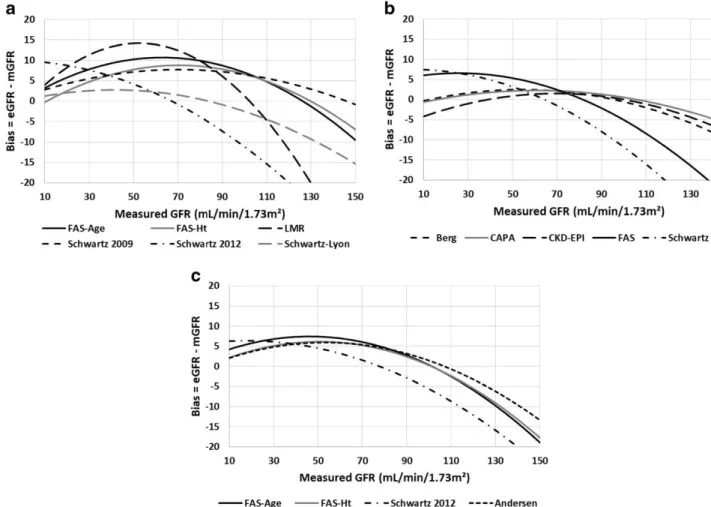
performance across the whole spectrum of mGFR, especially at the lowest and highest mGFR intervals (Supplementary Material and Table S3). Underestimations exceeding 20 mL/min/1.73 m were noted for Schwartz-2012CR at mGFR >120 mL/min/1.73 m2 and for LMRCR at mGFR >130 mL/min/1.73 m2 (Fig. 1a). All creatinine
equations, however, had poor performance at mGFR < 30 mL/min/1.73 m2 with P30 values ≤ 60% (Supplementary
Material and Table S3).
CYSTATIN C EQUATIONS
Both the general-purpose (CAPACYS, CKD-EPICYS and FASCYS) and the paediatric (BergCYS and Schwartz-2012CYS)
cystatin C equations had P30 accuracy close to 80% at mGFR < 75 mL/min/1.73 m2 and between 84 and 89% ≥ 75
mL/min/1.73 m2 (Table 2). However, Schwartz-2012CYS markedly underestimated mGFR ≥ 75 mL/min/1.73 m2,
resulting in higher absolute percentage error and lower P10 compared to the other cystatin C equations.
Underestimation exceeding 20 mL/min/1.73 m was noted for Schwartz- 2012CYS at mGFR > 120 mL/min/1.73 m2
but also for FASCYS at mGFR > 135 mL/min/1.73 m2 (Fig. 1b). BergCYS, CAPACYS and CKD-EPICYS exhibited low bias and
generally satisfactory accuracy across all levels of mGFR, while Schwartz-2012CYS and FASCYS had noticeably poor
performance at mGFR <30 mL/min/1.73 m2 with P30 < 40% (Supplementary Material and Table S3).
COMPOSITE CREATININE AND CYSTATIN C EQUATIONS
The composite creatinine and cystatin C equations were consistently more precise than the single-marker equations at all mGFR levels. However, at mGFR < 75 mL/min/1.73 m2, all composite equations had a positive bias (Fig. 1c).
Therefore, accuracy was not superior to the most accurate single-marker equations at mGFR <75 mL/min/1.73 m2
(Table 2). All composite equations had poor P30 accuracy at mGFR <30 mL/ min/1.73 m (Supplementary Material
and Table S3). P30 accuracy of all composite equations exceeded 90% at mGFR ≥ 75 mL/min/1.73 m2, which was
higher than for any of the single-marker equations (Table 2). Underestimations exceeding 20 mL/min/1.73 m were noted for Schwartz-2012CR+CYS at mGFR > 140 mL/min/1.73 m2 (Fig. 1c).
Fig. 1Quantile regression for the relation between mGFR and median bias (50th percentile of eGFR-mGFR) in mL/min/1.73 m2 of a creatinine equations, b cystatin C equations and c composite creatinine and cystatin C equations. eGFR estimated glomerular filtration rate, mGFR measured glomerular filtration rate, CAPA Caucasian, Asian, Paediatric and Adult equation, CKD-EPI Chronic Kidney Disease Epidemiology collaboration equation, FAS
Full Age Spectrum equation, Ht height, LMR Lund-Malmo revised equation
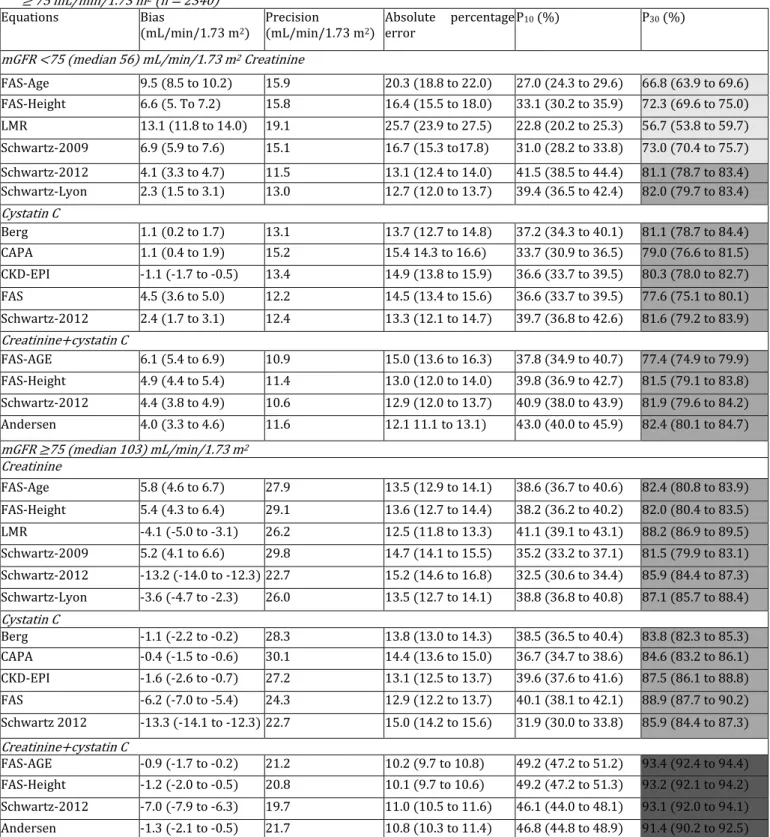
Table 2 Bias, precision and accuracy (95% confidence intervals) of GFR estimating equations based on creatinine, cystatin C and their combinations in children 2 to < 18 years (n = 3408 measurements) and stratified for measured GFR < 75 (n = 1068) and ≥ 75 mL/min/1.73 m2 (n = 2340) Equations Bias (mL/min/1.73 m2) Precision (mL/min/1.73 m2) Absolute percentage error P10 (%) P30 (%)
mGFR <75 (median 56) mL/min/1.73 m2 Creatinine
FAS-Age 9.5 (8.5 to 10.2) 15.9 20.3 (18.8 to 22.0) 27.0 (24.3 to 29.6) 66.8 (63.9 to 69.6) FAS-Height 6.6 (5. To 7.2) 15.8 16.4 (15.5 to 18.0) 33.1 (30.2 to 35.9) 72.3 (69.6 to 75.0) LMR 13.1 (11.8 to 14.0) 19.1 25.7 (23.9 to 27.5) 22.8 (20.2 to 25.3) 56.7 (53.8 to 59.7) Schwartz-2009 6.9 (5.9 to 7.6) 15.1 16.7 (15.3 to17.8) 31.0 (28.2 to 33.8) 73.0 (70.4 to 75.7) Schwartz-2012 4.1 (3.3 to 4.7) 11.5 13.1 (12.4 to 14.0) 41.5 (38.5 to 44.4) 81.1 (78.7 to 83.4) Schwartz-Lyon 2.3 (1.5 to 3.1) 13.0 12.7 (12.0 to 13.7) 39.4 (36.5 to 42.4) 82.0 (79.7 to 83.4) Cystatin C Berg 1.1 (0.2 to 1.7) 13.1 13.7 (12.7 to 14.8) 37.2 (34.3 to 40.1) 81.1 (78.7 to 84.4) CAPA 1.1 (0.4 to 1.9) 15.2 15.4 14.3 to 16.6) 33.7 (30.9 to 36.5) 79.0 (76.6 to 81.5) CKD-EPI -1.1 (-1.7 to -0.5) 13.4 14.9 (13.8 to 15.9) 36.6 (33.7 to 39.5) 80.3 (78.0 to 82.7) FAS 4.5 (3.6 to 5.0) 12.2 14.5 (13.4 to 15.6) 36.6 (33.7 to 39.5) 77.6 (75.1 to 80.1) Schwartz-2012 2.4 (1.7 to 3.1) 12.4 13.3 (12.1 to 14.7) 39.7 (36.8 to 42.6) 81.6 (79.2 to 83.9) Creatinine+cystatin C FAS-AGE 6.1 (5.4 to 6.9) 10.9 15.0 (13.6 to 16.3) 37.8 (34.9 to 40.7) 77.4 (74.9 to 79.9) FAS-Height 4.9 (4.4 to 5.4) 11.4 13.0 (12.0 to 14.0) 39.8 (36.9 to 42.7) 81.5 (79.1 to 83.8) Schwartz-2012 4.4 (3.8 to 4.9) 10.6 12.9 (12.0 to 13.7) 40.9 (38.0 to 43.9) 81.9 (79.6 to 84.2) Andersen 4.0 (3.3 to 4.6) 11.6 12.1 11.1 to 13.1) 43.0 (40.0 to 45.9) 82.4 (80.1 to 84.7) mGFR ≥75 (median 103) mL/min/1.73 m2 Creatinine FAS-Age 5.8 (4.6 to 6.7) 27.9 13.5 (12.9 to 14.1) 38.6 (36.7 to 40.6) 82.4 (80.8 to 83.9) FAS-Height 5.4 (4.3 to 6.4) 29.1 13.6 (12.7 to 14.4) 38.2 (36.2 to 40.2) 82.0 (80.4 to 83.5) LMR -4.1 (-5.0 to -3.1) 26.2 12.5 (11.8 to 13.3) 41.1 (39.1 to 43.1) 88.2 (86.9 to 89.5) Schwartz-2009 5.2 (4.1 to 6.6) 29.8 14.7 (14.1 to 15.5) 35.2 (33.2 to 37.1) 81.5 (79.9 to 83.1) Schwartz-2012 -13.2 (-14.0 to -12.3) 22.7 15.2 (14.6 to 16.8) 32.5 (30.6 to 34.4) 85.9 (84.4 to 87.3) Schwartz-Lyon -3.6 (-4.7 to -2.3) 26.0 13.5 (12.7 to 14.1) 38.8 (36.8 to 40.8) 87.1 (85.7 to 88.4) Cystatin C Berg -1.1 (-2.2 to -0.2) 28.3 13.8 (13.0 to 14.3) 38.5 (36.5 to 40.4) 83.8 (82.3 to 85.3) CAPA -0.4 (-1.5 to -0.6) 30.1 14.4 (13.6 to 15.0) 36.7 (34.7 to 38.6) 84.6 (83.2 to 86.1) CKD-EPI -1.6 (-2.6 to -0.7) 27.2 13.1 (12.5 to 13.7) 39.6 (37.6 to 41.6) 87.5 (86.1 to 88.8) FAS -6.2 (-7.0 to -5.4) 24.3 12.9 (12.2 to 13.7) 40.1 (38.1 to 42.1) 88.9 (87.7 to 90.2) Schwartz 2012 -13.3 (-14.1 to -12.3) 22.7 15.0 (14.2 to 15.6) 31.9 (30.0 to 33.8) 85.9 (84.4 to 87.3) Creatinine+cystatin C FAS-AGE -0.9 (-1.7 to -0.2) 21.2 10.2 (9.7 to 10.8) 49.2 (47.2 to 51.2) 93.4 (92.4 to 94.4) FAS-Height -1.2 (-2.0 to -0.5) 20.8 10.1 (9.7 to 10.6) 49.2 (47.2 to 51.3) 93.2 (92.1 to 94.2) Schwartz-2012 -7.0 (-7.9 to -6.3) 19.7 11.0 (10.5 to 11.6) 46.1 (44.0 to 48.1) 93.1 (92.0 to 94.1) Andersen -1.3 (-2.1 to -0.5) 21.7 10.8 (10.3 to 11.4) 46.8 (44.8 to 48.9) 91.4 (90.2 to 92.5) Median bias (eGFR - mGFR) and precision (interquartile range) expressed in mL/min/1.73 m2 and accuracy expressed as median absolute percentage
error (100 ˙ |eGFR - mGFR|/ mGFR) and P10 and P30 accuracy (percentage of GFR estimates within ± 10 and ± 30% of mGFR). □P30 < 75%, □P30 75 to
< 90%, □P30≥90%
CAPA Caucasian, Asian, Paediatric and Adult, CKD-EPI Chronic Kidney Disease Epidemiology collaboration, FAS Full Age Spectrum, LMR Lund- Malmo revised, eGFR estimated glomerular filtration rate, mGFR measured glomerular filtration rate
STRATIFICATION FOR GENDER
Most creatinine equations had equal performance in girls and boys both below and above an mGFR of 75 mL/min/1.73 m (Table 3). Notably, Schwartz-LyonCR, a modification of Schwartz-2009CR with a lower k factor (32.5
instead of 36.5) in all girls and in boys < 13 years, performed better than Schwartz-2009CR both below and above an
mGFR of 75 mL/ min/1.73 m2. CKD-EPICYS, the only cystatin C equation with a gender factor, exhibited equal
performance among girls and boys both below and above mGFR 75 mL/min/1.73 m2, while the other cystatin
C-based equations had lower P30 accuracy in girls compared to boys at mGFR <75 mL/min/1.73 m (Table 3). The
improvement in performance of the composite equations at mGFR ≥ 75 mL/min/1.73 m was noted in both boys and girls.
ARITHMETIC MEANS OF CREATININE AND CYSTATIN C EQUATIONS
In the explorative analysis, the performance of the arithmetic means of the most accurate creatinine and cystatin C equations was evaluated; Schwartz-LyonCR combined with BergCYS, CAPACYS or CKD-EPICYS (Supplementary Material,
Table S3 and Fig. S1). All three performed similarly, generally with decreased bias irrespective of mGFR level and improved P30 accuracy below 45 mL/min/1.73 m compared to the composite equations. The P30 accuracy was equal
or higher than for any of the three corresponding cystatin C equations at all mGFR levels ≥ 30 mL/min/1.73 m2.
SUPPLEMENTARY RESULTS
Restricting the analysis to one randomly chosen measurement per patient did not change overall results markedly but reduced statistical precision. As an example, P30 for Schwartz- LyonCR was 79.0% (95% CI 75.3 to 82.6%) among
480 unique patients with mGFR < 75 mL/min/1.73 m2 compared with 82.0% (95% CI 79.7 to 83.4%) among all
measurements (Table 2). Corresponding figures for 1738 unique patients with mGFR > 75 mL/min/1.73 m2 were
85.7% (95% CI 84.0 to 87.3%) compared with 87.1% (95% CI 85.7 to 88.4%) among all measurements.
STRATIFICATION FOR AGE
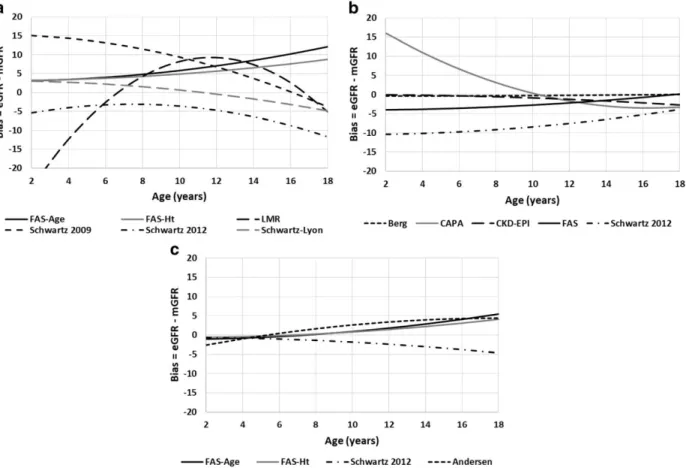
Schwartz-LyonCR, BergCYS and CKD-EPICYS had relatively stable and adequate performance in all age groups both
below and above mGFR of 75 mL/min/1.73 m2 (Fig. 2a-c, Supplementary Material and Table S4). The improvement
in performance for the composite equations at an mGFR ≥ 75 mL/min/1.73m2 was seen across all age groups. The
arithmetic means of Schwartz-LyonCR combined with BergCYS, CAPACYS or CKD-EPICYS had a stable performance across
all age groups except for the combination with CAPA below the age of 6 years (Supplementary Material and Fig. S2).
STRATIFICATION FOR BMI
In general, all creatinine equations had a marked positive bias in underweight patients both below and above mGFR of 75 mL/min/1.73 m2, while bias of the cystatin C equations was lower (Supplementary Material and Table S5A
and B). Despite this, none of the cystatin C equations had P30 accuracy above 75% in underweight patients at mGFR
<75 mL/min/1.73 m2, while this was the case at mGFR > 75 mL/min/1.73 m2 and in obese patients irrespective of
mGFR level.
PATIENTS WITH ORGAN TRANSPLANTS
All equations performed at least as well in transplanted as in the other patients, both at mGFR below and above 75 mL/ min/1.73 m2 (Supplementary Material and Table S6).
RESULTS IN INDIVIDUAL COHORTS
Bias and P30 accuracy of the various GFR equations in the individual cohorts are presented in Supplementary
Material (Table S7A and B). In general, the bias of the cystatin C equations varied more across the cohorts compared with the creatinine equations. Of note, in the Lund Cohort, all cystatin C equations had a negative bias at mGFR ≥ 75 mL/min/1.73 m2. The cohort from Leuven had only 16 measurements below 75 mL/min/1.73 m2 and
Table 3 Bias and accuracy (P30) of GFR estimating equations based on creatinine, cystatin C and their combinations in children 2 to < 18 years old (n = 3408 measurements) and stratified by gender and measured GFR < 75 and (n = 1068) ≥ 75 mL/min/1.73 m2 (n = 2340)
Equations Creatinine Cystatin C Creatinine and cystatin C
n (%) Median mGFR (mL/min / 1.73 m2) FAS Age FAS Height LMR Sch- wart z 2009 Sch- wartz 2012 Sch- wartz Lyon Berg CAPA CKD- EPI FAS Schwartz 2012 FAS Age FAS Height Schwartz 2012 Andersen mGFR <75 mL/min/1.73 m2 Bias Girls 425 (40) 55 10.0 7.5 9.3 8.9 5.6 2.5 4.0 4.1 0.1 7.4 5.4 8.4 6.7 6.5 5.8 Boys 643 (60) 56 8.9 5.5 16.0 5.1 2.3 2.1 -0.9 -0.7 -1.8 2.3 0.6 4.8 3.6 2.8 2.5 P30 (%) Girls 65 73 70 71 78 83 77 74 80 72 79 72 78 78 80 Boys 68 72 48 75 83 81 84 82 81 81 84 81 84 85 84 mGFR ≥ 75 mL/min/1.73 m2 Bias Girls 986 (42) 102 7.1 7.0 -6.4 9.3 10.6 -2.5 4.7 5.7 -0.3 -2.0 -9.1 2.2 1.6 -3.5 3.1 Boys 1,354 (58) 103 4.6 4.3 -1.7 2.4 -15.1 -4.2 -5.2 -4.9 -2.6 -9.4 -16.2 -3.6 -3.4 -10.0 -4.0 P30 (%) Girls 82 83 89 81 90 87 81 84 87 89 89 92 92 94 89 Boys 83 81 88 82 83 87 86 85 88 89 84 94 94 92 93
Median bias (eGFR - mGFR) expressed in mL/min/1.73 m and P30 accuracy as percentage of GFR estimates within ±30% of mGFR. □P30 < 75%,
□P30 75 to < 90%, □P30≥90%
CAPA Caucasian, Asian, Paediatric and Adult, CKD-EPI Chronic Kidney Disease Epidemiology collaboration, FAS Full Age Spectrum, LMR Lund- Malmô revised, eGFR estimated glomerular filtration rate, mGFR measured glomerular filtration rate
Fig. 2 Quantile regression for the relation between age and median bias (50th percentile of eGFR-mGFR) in mL/min/1.73 m2 of a creatinine equations, b cystatin C equations and c composite creatinine and cystatin C equations. eGFR estimated glomerular filtration rate, mGFR measured glomerular filtration rate, CAPA Caucasian, Asian, Paediatric and Adult equation, CKD-EPI Chronic Kidney Disease Epidemiology collaboration equation, FAS
Discussion
Three cystatin C equations, i.e. BergCYS, CAPACYS and CKD- EPICYS, had low bias and generally satisfactory accuracy
across all levels of mGFR. By contrast, the creatinine equations were generally hampered by substantial overestima-tion and lack of accuracy in children with decreased renal foncoverestima-tion. Only the paediatric Schwartz-LyonCR equation
had satisfactory performance at all mGFR levels ≥ 30 mL/min/1.73 m2. Arithmetic means ofthese best-performing
creatinine and cystatin C equations generally lead to further improvement in accuracy at all mGFR levels ≥ 30 mL/min/1.73 m2.
The present, multi-centre study is the largest validation of GFR equations in children conducted to date. The cohort represents children, mainly of Caucasian descent, from several European countries and covers the age span between 2 and 17 full years of age, both girls and boys and with a broad spectrum of diagnoses. Therefore, the findings are applicable in daily clinical practice and extend beyond the populations where the various GFR equations were developed. Importantly, both creatinine and cystatin C were analyzed using IFCC standards at all participating centres.
The varying results for the cystatin C equations across the different cohorts suggest that residual differences remain in calibration despite the international standard [27-29]. In the Lund cohort, all cystatin C equations had a marked negative bias at mGFR ≥ 75 mL/min/1.73 m2, although a meticulous technique was used to make the cystatin C
assay traceable to the international calibrator in this cohort [7]. This may indicate that the cystatin C assays used when developing BergCYS, CKD-EPICYS, FASCYS and Schwartz-2012CYS were suboptimized in relation to the
international calibrator. Although the Lund cohort was used for the development CAPACYS, it also had a marked
negative bias. This may be explained by the fact that the Lund paediatric cohort formed only a minor part of the entire development cohort, which was dominated by Swedish and Japanese adults. This may have affected the coefficients of CAPACYS and resulted in the negative bias in children observed in our study. It should also be noted
that roughly 20% of the included measurements were used previously in the development or internal validation of CAPACYS, Schwartz-LyonCR and the FAS equations, which may have favored the performance of these equations.
Blood urea nitrogen was not available in all cohorts so that the most elaborate CKiD-3 equation [3] could not be tested. The choice of the arithmetic mean equations was driven by the results for the single-marker equations. This may have favored the performance of arithmetic means when compared to the composite creatinine-cystatin C equations.
The present study adds substantial evidence suggesting that cystatin C is a more reliable filtration marker than creatinine for GFR estimations in children with decreased GFR. CKD-EPICYS was originally developed for adults [22]
but nevertheless exhibited surprisingly stable performance across all levels of GFR in the present cohort of children. Although the CKD-EPICYS did not outperform some of the paediatric cystatin C equations with simpler formula
expressions, it has the advantage of covering the whole age spectrum from childhood to adulthood, which may prove attractive for direct eGFR reporting by clinical laboratories. This also applies to CAPACYS and FASCYS, although
overestimation was an issue with FASCYS in patients with mGFR below 45 mL/ min/1.73 m2.
The CKD-EPICYS equation has a factor of 0.932 for females, which to some extent accounts for the lower cystatin C
values among girls than boys during puberty at the same GFR in the present study. Gender-specific differences in cystatin C concentrations during puberty have also been observed by others [30, 31]. The other cystatin C equations do not include separate gender factors, which may explain why they generally perform less well in girls with decreased GFR. Based on our findings, inclusion of a—possibly age-dependent—gender factor appears to be a straightforward modification for some of the cystatin C- based equations, which would most likely improve their performance in the future.
The best-performing creatinine equation Schwartz- LyonCR is a paediatric equation with a simplistic formulation
based on creatinine and height only. It confirms the concept that the age dependence of creatinine can be accounted for in most cases by inclusion of height in the estimation, at least when mGFR is above 30 mL/min/1.73 m2.
Schwartz-LyonCR equation uses a lower k value for boys under the age of 13 and for all girls and clearly outperforms
Schwartz-2009CR. As the Schwartz-2009CR equation—in contrast to the original formulation of the Schwartz
equation [32]—does not account for specific differences in body composition, this suggests that gender-specific differences in creatinine production need to be accounted for in order to assure optimal performance. LMRCR was originally developed for adults [20] and has been shown to outperform the CKD-EPI creatinine equation
(CKD-EPICR) in several adult cohorts, both overall and across important subgroups [33-38]. While CKD- EPICR is
unsuitable in children [21], the present study demonstrates that LMRCR performs quite well in children with mGFR
all ages irrespective of GFR level [13, 12]. This approach eliminates the discontinuous course of eGFR at the transition from adolescence to adulthood due to the change of equation, e.g. from a Schwartz- equation to CKD-EPI [39, 40]. As FAS-AGECR, like LMRCR, does not require height data, eGFR can be reported automatically by the
laboratories. Consistent with a previous study [13], we find satisfactory bias and accuracy for all FAS equations in children with normal GFR but overestimation in children with decreased GFR. Validation studies in adults with CKD have shown substandard accuracy of the FAS equations [12, 38], however. The FASCR equation corrects for
dif-ferences in sCr levels with respect to gender (starting at adolescence), age and height. The formula assumes a simplistic inverse relationship between GFR and sCr/Q. While this seems to work well within a certain range of normal sCr values, the relation is probably more complex when sCr becomes too high. This is not surprising when looking at most modern GFR equations, which were built using linear regression analysis following logarithmic transformation [41]. In a similar way, the concept of FASCYS is based on average GFR and cystatin C for a healthy
population. It thus seems that the FAS equations in their present form can only be recommended in patients with normal or mildly impaired renal function and need to be reformulated in patients with low GFR.
Previous studies have shown improved GFR estimation performance when creatinine and cystatin C are combined in children [1, 3, 5, 42]. The present study extends on these results by showing that this improvement is not evident in children with decreased GFR when existing composite equations are applied. However, our explorative results suggest that improvement in performance can be obtained at most levels of mGFR if an arithmetic mean of the best- performing creatinine and cystatin C equations is used. This is in line with previous studies showing that the simple arithmetic means of existing single-marker equations tend to perform as well as more complex formulations that include both markers [21, 43, 44]. This approach also alerts the clinician to situations where one of the two GFR markers fails such as creatinine in spina bifida patients or cystatin C during high-dose glucocorticoid treatment [43, 45, 46].
Conclusion
The present study strongly suggests that cystatin C should replace creatinine as the primary biomarker of choice when estimating GFR in children with moderately to severely decreased GFR. Arithmetic means of well-performing creatinine and cystatin C equations can be expected to improve accuracy at most mGFR levels and have practical advantages compared to composite equations. However, if high precision is required, e.g. in patients with severely decreased GFR, GFR measurement by exogenous clearance markers is recommended. EKFC and its data resources offer an excellent opportunity for refining GFR equations further, both among children and adults. Development of full-age-spectrum equations and estimation strategies that utilize both creatinine and cystatin C applicable for both children and adults irrespective of their GFR level would greatly facilitate direct eGFR reporting by the clinical laboratory and solve the problem of abrupt jumps in eGFR during the transition from child- to adulthood due to the changes from a paediatric to an adult GFR equation.
COMPLIANCE WITH ETHICAL STANDARDS
Conflict of interest The authors declare that they have no conflict of interest.
Ethical approval All procedures performed in studies involving human participants were in accordance with the ethical standards of the institutional and/or national research committee and with the World Medical Association Declaration of Helsinki of 1975, as revised in 2000.
Informed consent For this type of retrospective study, all extracted data were fully anonymous without any personal information, why informed consent was not required according to the regional ethical board approval in, Lund, Sweden, which approved the study.
Publisher's note Springer Nature remains neutral with regard to jurisdictional claims in published maps and institutional affiliations.
References
1. Schwartz GJ, Munoz A, Schneider MF, Mak RH, Kaskel F, Warady BA, Furth SL (2009) New equations to estimate
GFR in children with CKD. J Am Soc Nephrol 20:629-637
2. Bacchetta J, Cochat P, Rognant N, Ranchin B, Hadj-Aissa A, Dubourg L (2011) Which creatinine and cystatin C
equations can be reliably used in children? Clin J Am Soc Nephrol 6:552-560
3. Schwartz GJ, Schneider MF, Maier PS, Moxey-Mims M, Dharnidharka VR, Warady BA, Furth SL, Munoz A (2012)
Improved equations estimating GFR in children with chronic kidney disease using an immunonephelometric determination of cystatin C. Kidney Int 82:445-453
4. De Souza VC, Rabilloud M, Cochat P, Selistre L, Hadj-Aissa A, Kassai B, Ranchin B, Berg U, Herthelius M, Dubourg
L (2012) Schwartz formula: is one k-coefficient adequate for all children? PLoS One 7:e53439
5. Andersen TB, Jodal L, Boegsted M, Erlandsen EJ, Morsing A, Frokiaer J, Brochner-Mortensen J (2012) GFR
prediction from cystatin C and creatinine in children: effect of including body cell mass. Am J Kidney Dis 59:50-57
6. Gao A, Cachat F, Faouzi M, Bardy D, Mosig D, Meyrat BJ, Girardin E, Chehade H (2013) Comparison of the
glomerular filtration rate in children by the new revised Schwartz formula and a new generalized formula. Kidney Int 83:524-530
7. Grubb A, Horio M, Hansson LO, Björk J, Nyman U, Flodin M, Larssson A, Bökenkamp A, Yasuda Y, Blufpand H,
Lindström V, Zegers I, Althaus H, Blirup-Jensen S, Itoh Y, Sjöström P, Nordin G, Christensson A, Klima H, Sunde K, Hjort-Christensen P, Armbruster D, Ferrero C (2014) Generation of a new cystatin C- based estimating equation for glomerular filtration rate by use of 7 assays standardized to the international calibrator. Clin Chem 60: 974-986
8. Chehade H, Cachat F, Jannot AS, Meyrat BJ, Mosig D, Bardy D, Parvex P, Girardin E (2014) New combined serum
creatinine and cystatin C quadratic formula for GFR assessment in children. Clin J Am Soc Nephrol 9:54-63
9. Berg UB, Nyman U, Bäck R, Hansson M, Monemi KA, Herthelius M, Björk J (2015) New standardized cystatin C
and creatinine GFR equations in children validated with inulin clearance. Pediatr Nephrol 30:1317-1326
10. de Souza V, Cochat P, Rabilloud M, Selistre L, Wagner M, Hadj-Aissa A, Dolomanova O, Ranchin B, Iwaz J,
Dubourg L (2015) Accuracy of different equations in estimating GFR in pediatric kidney transplant recipients. Clin J Am Soc Nephrol 10:463-470
11. Deng F, Finer G, Haymond S, Brooks E, Langman CB (2015) Applicability of estimating glomerular filtration
rate equations in pediatric patients: comparison with a measured glomerular filtration rate by iohexol clearance. Transl Res 165:437-445
12. Pottel H, Hoste L, Dubourg L, Ebert N, Schaeffner E, Eriksen BO, Melsom T, Lamb EJ, Rule AD, Turner ST,
Glassock RJ, De Souza V, Selistre L, Mariat C, Martens F, Delanaye P (2016) An estimated glomerular filtration rate equation for the full age spectrum. Nephrol Dial Transplant 31:798-806
13. Pottel H, Delanaye P, Schaeffner E, Dubourg L, Eriksen BO, Melsom T, Lamb EJ, Rule AD, Turner ST, Glassock RJ,
De Souza V, Selistre L, Goffin K, Pauwels S, Mariat C, Flamant M, Ebert N (2017) Estimating glomerular filtration rate for the full age spectrum from serum creatinine and cystatin C. Nephrol Dial Transplant 32:497-507
14. Blufpand HN, Tromp J, Abbink FC, Stoffel-Wagner B, Bouman AA, Schouten-van Meeteren AY, van Wijk JA,
Kaspers GJ, Bökenkamp A (2011) Cystatin C more accurately detects mildly impaired renal function than creatinine in children receiving treatment for malignancy. Pediatr Blood Cancer 57:262-267
15. Blufpand HN, Westland R, van Wijk JA, Roelandse-Koop EA, Kaspers GJ, Bökenkamp A (2013)
Height-independent estimation of glomerular filtration rate in children: an alternative to the Schwartz equation. J Pediatr 163:1722-1727
16. Westland R, Abraham Y, Bokenkamp A, Stoffel-Wagner B, Schreuder MF, van Wijk JA (2013) Precision of
estimating equations for GFR in children with a solitary functioning kidney: the KIMONO study. Clin J Am Soc Nephrol 8:764-772
18. Mueller L, Pruemper C (2016) Performance in measurement of serum cystatin C by laboratories participating
in the College of American Pathologists 2014 CYS Survey. Arch Pathol Lab Med 140:207-208
19. Hoste L, Dubourg L, Selistre L, De Souza VC, Ranchin B, Hadj- Aissa A, Cochat P, Martens F, Pottel H (2014) A
new equation to estimate the glomerular filtration rate in children, adolescents and young adults. Nephrol Dial Transplant 29:1082-1091
20. Björk J, Grubb A, Sterner G, Nyman U (2011) Revised equations for estimating glomerular filtration rate based
on the Lund-Malmö Study cohort. Scand J Clin Lab Invest 71:232-239
21. Leion F, Hegbrant J, den Bakker E, Jonsson M, Abrahamson M, Nyman U, Björk J, Lindström V, Larsson A,
Bökenkamp A, Grubb A (2017) Estimating glomerular filtration rate (GFR) in children. The average between a cystatin C- and a creatinine-based equation improves estimation of GFR in both children and adults and enables diagnosing Shrunken Pore Syndrome. Scand J Clin Lab Invest 77: 338-344
22. Inker LA, Schmid CH, Tighiouart H, Eckfeldt JH, Feldman HI, Greene T, Kusek JW, Manzi J, Van Lente F, Zhang YL,
Coresh J, Levey AS (2012) Estimating glomerular filtration rate from serum creatinine and cystatin C. N Engl J Med 367:20-29
23. K/DOQI clinical practice guidelines for chronic kidney disease (2002) Evaluation, classification, and
stratification. Part 5. Evaluation of laboratory measurements for clinical assessment of kidney disease. Guideline 4. Estimation of GFR. Am J Kidney Dis 39:S76-S92
24. Pottel H, Hoste L, Delanaye P (2015) Abnormal glomerular filtration rate in children, adolescents and young
adults starts below 75 mL/min/1.73 m(2). Pediatr Nephrol 30:821-828
25. Barlow SE (2007) Expert committee recommendations regarding the prevention, assessment, and treatment of
child and adolescent overweight and obesity: summary report. Pediatrics 120(Suppl 4): S164-S192
26. Fredriks AM, van Buuren S, Wit JM, Verloove-Vanhorick SP (2000) Body index measurements in 1996-7
compared with 1980. Arch Dis Child 82:107-112
27. Eckfeldt JH, Karger AB, Miller WG, Rynders GP, Inker LA (2015) Performance in measurement of serum cystatin
C by laboratories participating in the College of American pathologists 2014 CYS survey. Arch Pathol Lab Med 139: 888-893
28. Bargnoux AS, Pieroni L, Cristol JP, Kuster N, Delanaye P, Carlier MC, Fellahi S, Boutten A, Lombard C, Gonzalez-
Antuna A, Delatour V, Cavalier E (2017) Multicenter evaluation of cystatin C measurement after assay standardization. Clin Chem 63:833-841
29. Nordin G (2017) Cystatin C-incremental improvement in measurement and understanding of results. Clin Chem
63:802-803
30. Groesbeck D, Kottgen A, Parekh R, Selvin E, Schwartz GJ, Coresh J, Furth S (2008) Age, gender, and race effects
on cystatin C levels in US adolescents. Clin J Am Soc Nephrol 3:1777-1785
31. Yata N, Uemura O, Honda M, Matsuyama T, Ishikura K, Hataya H, Nagai T, Ikezumi Y, Fujita N, Ito S, Iijima K,
Saito M, Keneko T, Kitagawa T (2013) Reference ranges for serum cystatin C measurements in Japanese children by using 4 automated assays. Clin Exp Nephrol 17:872-876
32. Schwartz GJ, Brion LP, Spitzer A (1987) The use of plasma creatinine concentration for estimating glomerular
filtration rate in infants, children, and adolescents. Pediatr Clin North Am 34: 571-590
33. Björk J, Jones I, Nyman U, Sjöström P (2012) Validation of the Lund-Malmo, Chronic Kidney Disease
Epidemiology (CKD-EPI) and Modification of Diet in Renal Disease (MDRD) equations to estimate glomerular filtration rate in a large Swedish clinical population. Scand J Urol Nephrol 46:212-222
34. Evans M, van Stralen KJ, Schon S, Prutz KG, Stendahl M, Rippe B, Jager KJ (2013) Glomerular filtration
rate-estimating equations for patients with advanced chronic kidney disease. Nephrol Dial Transplant 28:2518-2526
35. Björk J, Grubb A, Gudnason V, Indridason OS, Levey AS, Palsson R, Nyman U (2017) Comparison of glomerular
filtration rate estimating equations derived from creatinine and cystatin C: validation in the Age, Gene/Environment Susceptibility- Reykjavik elderly cohort. Nephrol Dial Transplant 33:13891388
36. Ebert N, Loesment A, Martus P, Jakob O, Gaedeke J, Kuhlmann M, Bartel J, Schuchardt M, Tolle M, Huang T, van
disease-sampling time matters. Nephrol Dial Transplant 30:1307-1314
37. Nyman U, Grubb A, Larsson A, Hansson LO, Flodin M, Nordin G, Lindström V, Björk J (2014) The revised
Lund-Malmo GFR estimating equation outperforms MDRD and CKD-EPI across GFR, age and BMI intervals in a large Swedish population. Clin Chem Lab Med 52:815-824
38. Björk J, Bäck SE, Ebert N, Evans M, Grubb A, Hansson M, Jones I, Lamb EJ, Martus P, Schaffner E, Sjöström P,
Nyman U (2018) GFR estimation based on standardized creatinine and cystatin C: a European multicenter analysis in older adults. Clin Chem Lab Med 56:422-435
39. Selistre L, De Souza V, Cochat P, Antonello IC, Hadj-Aissa A, Ranchin B, Dolomanova O, Varennes A, Beyerle F,
Bacchetta J, Dubourg L (2012) GFR estimation in adolescents and young adults. J Am Soc Nephrol 23:989-996
40. Ng DK, Schwartz GJ, Schneider MF, Furth SL, Warady BA (2018) Combination of pediatric and adult formulas
yield valid glomerular filtration rate estimates in young adults with a history of pediatric chronic kidney disease. Kidney Int 94:170-177
41. den Bakker E, Gemke R, Bökenkamp A (2018) Endogenous markers for kidney function in children: a review.
Critical reviews in clinical laboratory sciences 55:163-183
42. Nyman U, Björk J, Lindström V, Grubb A (2008) The Lund-Malmo creatinine-based glomerular filtration rate
prediction equation for adults also performs well in children. Scand J Clin Lab Invest 68: 568-576
43. Björk J, Grubb A, Larsson A, Hansson LO, Flodin M, Sterner G, Lindström V, Nyman U (2015) Accuracy of GFR
estimating equations combining standardized cystatin C and creatinine assays: a cross-sectional study in Sweden. Clin Chem Lab Med 53:403-414
44. den Bakker E, Gemke R, van Wijk JAE, Hubeek I, Stoffel-Wagner B, Bökenkamp A (2018) Combining GFR
estimates from cystatin C and creatinine—what is the optimal mix? Pediatr Nephrol 33: 1553-1563
45. Grubb A (2010) Non-invasive estimation of glomerular filtration rate (GFR). The Lund model: simultaneous use
of cystatin C- and creatinine-based GFR-prediction equations, clinical data and an internal quality check. Scand J Clin Lab Invest 70: 65-70
46. van Roij KG, van der Horst HJ, Hubeek I, van Wijk JA, Bökenkamp A (2017) Discrepant results of serum