arXiv:1308.4260v5 [math.CO] 26 Dec 2013
Acyclic, connected and tree sets
1
Val´
erie Berth´
e
1, Clelia De Felice
2, Francesco Dolce
3, Julien Leroy
4,
Dominique Perrin
3, Christophe Reutenauer
5, Giuseppina Rindone
3 1CNRS, Universit´
e Paris 7,
2Universit`
a degli Studi di Salerno,
3
Universit´
e Paris Est, LIGM,
4Universit´
e du Luxembourg,
5
Universit´
e du Qu´
ebec `
a Montr´
eal
2December 30, 2013
1 h 36
3Abstract
4
Given a set F of words, one associates to each word w in F an
undi-5
rected graph, called its extension graph, and which describes the possible
6
extensions of w in F on the left and on the right. We investigate the
7
family of sets of words defined by the property of the extension graph of
8
each word in the set to be acyclic or connected or a tree. We prove that
9
in a uniformly recurrent tree set, the sets of first return words are bases
10
of the free group on the alphabet. Concerning acyclic sets, we prove as a
11
main result that a set F is acyclic if and only if any bifix code included
12
in F is a basis of the subgroup that it generates.
13
Contents
14 1 Introduction 2 15 2 Preliminaries 4 16 2.1 Recurrent sets . . . 4 17 2.2 Free groups . . . 5 18 2.3 Bifix codes . . . 6 192.4 Automata and groups . . . 7
20
3 Strong, weak and neutral sets 10
21
3.1 Strong, weak and neutral words . . . 10
22
3.2 Return words . . . 12
23
4 Acyclic, connected and tree sets 14
24
4.1 Extension graphs . . . 14
25
4.2 Two examples . . . 15
26
4.3 Generalized extension graphs . . . 18
5 Return words in tree sets 21
28
5.1 Stallings foldings of Rauzy graphs . . . 22
29
5.2 Return words and bases of free groups . . . 24
30
6 Bifix codes in acyclic sets 26
31
6.1 Freeness and Saturation Theorems . . . 26
32
6.2 Incidence graph . . . 28
33
6.3 Coset automaton . . . 30
34
6.4 Proof of the main results . . . 31
35
1
Introduction
36
This paper studies properties of classes of sets which occur as the set of factors of
37
infinite words of linear factor complexity. It is part of a series of papers devoted
38
to this subject initiated in [3]. These classes of sets, called acyclic, connected
39
or tree sets, are defined by a limitation to the possible two-sided extensions of
40
a word of the set. We will see that Sturmian sets are tree sets (by Sturmian we
41
mean the sets of factors of strict episturmian words, also called Arnoux-Rauzy
42
words). Moreover, the sets obtained by coding a regular interval exchange set
43
are also tree sets (see [5]). Any word w in a tree set is neutral in the sense that
44
the number of pairs (a, b) of letters such that awb ∈ F is equal to the number
45
of letters a such that aw ∈ F plus the number of letters b such that wb ∈ F
46
minus 1. We express this property saying that it is a neutral set.
47
We study sets of first return words in a tree set F . For this, we use Rauzy
48
graphs, which are restrictions of a de Bruijn graph to the set of vertices formed
49
by the words of given length in a set F . We first show that if F is a recurrent
50
connected set, the group described by any Rauzy graph of F containing the
51
alphabet A, with respect to some vertex is the free group on A (Theorem5.2).proposition3
52
Next, we prove that in a uniformly recurrent connected set containing A, the
53
set of first return words to any word in F generates the free group on A
(Theo-54
remtheoremJulien5.6). Next, we prove that if F is a uniformly recurrent tree set containing
55
A, the set of first return words to any word of F is a basis of the free group on
56
A (CorollarycorollaryJulien5.8). The proof uses the fact that in a uniformly recurrent neutral
57
set F containing the alphabet A, the number of first return words to any word
58
of F is equal to Card(A), a result obtained in [1].
59
Our main result is that a set F is acyclic if and only if any bifix code
60
contained in F is a basis of the subgroup that it generates (Theorem6.1 referredbasisTheorem
61
to as the Freeness Theorem). This is related to the main result of [3], referred to
62
as the Finite Index Basis Theorem, proving that, in a Sturmian set F , a finite
63
bifix code is F -maximal of F -degree d if and only if it is a basis of a subgroup
64
of index d. This result is generalized in [5] to uniformly recurrent tree sets. The
65
proof uses the results of this paper and, in particular Corollary5.8. In the casecorollaryJulien
66
of an acyclic set, the subgroup generated by a bifix code need not be of finite
67
index, even if the bifix code is F -maximal (and even if the set F is uniformly
68
recurrent, see ExampleexampleBasisJulien6.4).
We also prove a more technical result. We say that a submonoid M of the
70
free monoid is saturated in a set F if the subgroup H of the free group generated
71
by M satisfies M ∩ F = H ∩ F . We prove that if F is acyclic, the submonoid
72
generated by a bifix code contained in F is saturated in F (Theorem6.2 referredsaturationTheorem
73
to as the Saturation Theorem). This property plays an important role in the
74
proof of the Finite Index Basis Theorem.
75
Our paper is organized as follows.
76
In Section2 we present the definitions and basic properties used in the paper.sectionPreliminaries
77
In Section 3, we introduce strong, weak and neutral sets. We prove a re-sectionNeutrality
78
sult on the cardinality of sets of first return words (Theorem 3.6) which is atheoremCardReturn
79
generalization of a result from [1].
80
In Section4, we define the extension graph of a word with respect to a set F .sectionAcyclic
81
We define acyclic, connected and tree sets by the corresponding property of the
82
extension graph of each word in the set to be acyclic, connected or a tree. We
83
also introduce more general extension graphs where left (resp. right) extensions
84
are relative to a finite suffix (resp. prefix) code. We prove that in acyclic sets,
85
these more general extension graphs are also acyclic (Proposition4.7).PropStrongTreeCondition
86
In Section sectionReturnTreeSets5, we study sets of first return words in tree sets. We first show
87
that if F is a recurrent connected set, the group described by any Rauzy graph
88
of F containing the alphabet A, with respect to some vertex is the free group
89
on A (Theorem5.2). Next, we prove that in a uniformly recurrent connectedproposition3
90
set F containing A, the set of first return words to any word of F generates
91
the free group on A (TheoremtheoremJulien5.6). We use Theorem3.6 to prove that if F istheoremCardReturn
92
additionally acyclic, then every set of first return words is a basis of the free
93
group on A (Corollary5.8).corollaryJulien
94
In Section sectionMainResult6 we state and prove our main results (Theorem6.1 and Theo-basisTheorem
95
remsaturationTheorem6.2). The proof uses the notion of incidence graph of a bifix code (already
96
introduced in [3]).
97
Bifix codes and Sturmian words [3]
Acyclic, connected and tree sets
Two-sided Rauzy induction [8]
The finite index basis property [5]
Maximal bifix decoding [6]
Natural coding of linear involutions[7]
Some results used in this paper are proved in our first paper [3]. In turn, the
98
results of this paper are used in other papers in preparation on similar objects.
99
We include for clarity the logical dependency between these papers.
Ackowledgement This work was supported by grants from Region
Ile-de-101
France and ANR project Equinocs.
102
2
Preliminaries
103
sectionPreliminaries
In this section, we first recall some definitions concerning words, codes and
104
automata (see [4] for a more complete presentation). We give the definition of
105
recurrent and uniformly recurrent sets of words. We also give the definitions
106
and basic properties of bifix codes (see [3] for a more detailed presentation).
107
We define basic notions concerning automata. We present the class of reversible
108
automata and its connection with the Stallings automaton of a subgroup of a
109
free group.
110
2.1
Recurrent sets
111Let A be a finite nonempty alphabet. All words considered below, unless stated
112
explicitly, are supposed to be on the alphabet A. We denote by A∗ the set of
113
all words on A. We denote by 1 or by ε the empty word. We denote by |x|
114
the length of a word x. A set of words is said to be factorial if it contains the
115
factors of its elements.
116
For a set X of words and a word u, we denote
117
u−1X = {v ∈ A∗| uv ∈ X}.
the right residual of X with respect to u.
118
Let F be a set of words on the alphabet A. For w ∈ F , we denote
119
L(w) = {a ∈ A | aw ∈ F }
R(w) = {a ∈ A | wa ∈ F }
E(w) = {(a, b) ∈ A × A | awb ∈ F }
and further
120
ℓ(w) = Card(L(w)), r(w) = Card(R(w)), e(w) = Card(E(w)).
A word w is right-extendable if r(w) > 0, left-extendable if ℓ(w) > 0 and
biex-121
tendable if e(w) > 0. A factorial set F is called right-essential (resp.
left-122
essential, resp. biessential ) if every word in F is right-extendable (resp.
left-123
extendable, resp. biextendable).
124
A word w is called right-special if r(w) ≥ 2. It is called left-special if ℓ(w) ≥
125
2. It is called bispecial if it is both right and left-special.
126
A set of words F is recurrent if it is factorial and if for every u, w ∈ F there
127
is a v ∈ F such that uvw ∈ F . A recurrent set F 6= {1} is biessential.
128
A set of words F is said to be uniformly recurrent if it is right-essential and
129
if, for any word u ∈ F , there exists an integer n ≥ 1 such that u is a factor of
130
every word of F of length n. A uniformly recurrent set is recurrent.
A morphism f : A∗→ B∗ is a monoid morphism from A∗ into B∗. If a ∈ A
132
is such that the word f (a) begins with a and if |fn(a)| tends to infinity with
133
n, there is a unique infinite word denoted fω(a) which has all words fn(a) as
134
prefixes. It is called a fixpoint of the morphism f .
135
A morphism f : A∗ → A∗ is called primitive if there is an integer k such
136
that for all a, b ∈ A, the letter b appears in fk(a). If f is a primitive morphism,
137
the set of factors of any fixpoint of f is uniformly recurrent (see [13] Proposition
138
1.2.3 for example).
139
An infinite word is episturmian if the set of its factors is closed under reversal
140
and contains for each n at most one word of length n which is right-special
141
(see [3] for more references). It is a strict episturmian word if it has exactly
142
one right-special word of each length and moreover each right-special factor u
143
is such that r(u) = Card(A).
144
A Sturmian set is a set of words which is the set of factors of a strict
epis-145
turmian word. Any Sturmian set is uniformly recurrent (see [3]).
146
exampleFibonacci147 Example 2.1 Let A = {a, b}. The Fibonacci morphism is the morphism f :
A∗→ A∗ defined by f (a) = ab and f (b) = a. The Fibonacci word
148
x = abaababaabaababaababa . . .
is the fixpoint x = fω(a) of the Fibonacci morphism. It is a Sturmian word
149
(see [17]). The set F (x) of factors of x is the Fibonacci set.
150
exampleTribonacci151 Example 2.2 Let A = {a, b, c}. The Tribonacci word x = abacabaabacababacabaabacaba · · ·
is the fixpoint x = fω(a) of the morphism f : A∗ → A∗ defined by f (a) = ab,
152
f (b) = ac, f (c) = a. It is a strict episturmian word (see [14]). The set F (x) of
153
factors of x is the Tribonacci set.
154
2.2
Free groups
155In this section, we fix our notation concerning free groups (see [18] for example).
156
We denote by A◦ the free group on the alphabet A. It is the set of all
157
words on the alphabet A ∪ A−1 which are reduced, in the sense that they do
158
not have any factor aa−1 or a−1a for a ∈ A. Note that the exponent −1 used
159
here should not be confused with the one used to define the residual of a set
160
of words. We extend the bijection a 7→ a−1 to an involution on A ∪ A−1 by
161
defining (a−1)−1= a.
162
For any word w on A ∪ A−1 there is a unique reduced word equivalent to
163
w modulo the relations aa−1 ≡ a−1a ≡ 1 for a ∈ A. If u is the reduced
164
word equivalent to w, we say that w reduces to u and we denote w ≡ u. We
165
also denote u = ρ(w). The product of two elements u, v ∈ A◦ is the reduced
166
word w equivalent to uv, namely ρ(uv). If w = a1· · · an with ai ∈ A ∪ A−1
167
is a reduced word, its inverse is the reduced word denoted w−1 and defined by
168
w−1= a−1
n · · · a−11 . It is easy to verify that indeed ww−1≡ w−1w ≡ 1.
169
For a set X of reduced words, we denote X−1= {x−1| x ∈ X}.
2.3
Bifix codes
171A prefix code is a set of nonempty words which does not contain any proper
172
prefix of its elements. A suffix code is defined symmetrically. A bifix code is a
173
set which is both a prefix code and a suffix code.
174
We denote by X∗ the submonoid generated by a set X of words. The
175
submonoid M generated by a prefix code satisfies the following property: if
176
u, uv ∈ M , then v ∈ M . Such a submonoid is said to be right unitary. The
177
definition of a left unitary submonoid is symmetric and the submonoid generated
178
by a suffix code is left unitary. Conversely, any right unitary (resp. left unitary)
179
submonoid of A∗ is generated by a prefix code (resp. a suffix code) (see [4]).
180
A coding morphism for a prefix code X ⊂ A+ is a morphism f : B∗ → A∗
181
which maps bijectively B onto X (Note that in this paper we use ⊂ to denote
182
the inclusion allowing equality).
183
Let F be a set of words. A prefix code X ⊂ F is F -maximal if it is not
184
properly contained in any prefix code Y ⊂ F .
185
A set X ⊂ F is right F -complete if any word of F is a prefix of a word in
186
X∗.
187
For a factorial set F , a prefix code is F -maximal if and only if it is right
188
F -complete (Proposition 3.3.2 in [3]).
189
Similarly a bifix code X ⊂ F is F -maximal if it is not properly contained in
190
a bifix code Y ⊂ F . For a recurrent set F , a finite bifix code is F -maximal as a
191
bifix code if and only if it is an F -maximal prefix code (see [3], Theorem 4.2.2).
192
For a uniformly recurrent set F , any finite bifix code X ⊂ F is contained in a
193
finite F -maximal bifix code (Theorem 4.4.3 in [3]).
194
A parse of a word w with respect to a bifix code X is a triple (v, x, u) such
195
that w = vxu where v has no suffix in X, u has no prefix in X and x ∈ X∗.
196
We denote by δX(w) the number of parses of w. By definition, the F -degree of
197
X, denoted dF(X), is the maximal number of parses of a word in F . It can be
198
finite or infinite.
199
Let X be a bifix code. The number of parses of a word w is also equal to
200
the number of suffixes of w which have no prefix in X and to the number of
201
prefixes of w which have no suffix in X (see Proposition 6.1.6 in [4]).
202
The set of internal factors of a set of words X, denoted I(X) is the set of
203
words w such that there exist nonempty words u, v with uwv ∈ X.
204
Let F be a recurrent set and let X be a finite bifix code. By Theorem 4.2.8
205
in [3], X is F -maximal if and only if its F -degree d is finite. Moreover, in this
206
case, a word w ∈ F is such that δX(w) < d if and only if it is an internal factor
207
of X, that is
208
I(X) = {w ∈ F | δX(w) < d}.
In particular, any word of X of maximal length has d parses.
209
exampleUniform210 Example 2.3 Let F be a recurrent set. For any integer n ≥ 1, the set F ∩ An
is an F -maximal bifix code of F -degree n.
2.4
Automata and groups
212sectionAutomata
We denote A = (Q, i, T ) a deterministic automaton with a set Q of states, i ∈ Q
213
as initial state and T ⊂ Q as set of terminal states. For p ∈ Q and w ∈ A∗, we
214
denote p · w = q if there is a path labeled w from p to the state q and p · w = ∅
215
otherwise. The automaton is finite when Q is finite.
216
The set recognized by the automaton is the set of words w ∈ A∗ such that
217
i · w ∈ T .
218
All automata considered in this paper are deterministic and we simply call
219
them ‘automata’ to mean ‘deterministic automata’.
220
The automaton A is trim if for any q ∈ Q, there is a path from i to q and a
221
path from q to some t ∈ T .
222
An automaton is called simple if it is trim and if it has a unique terminal
223
state which coincides with the initial state. The set recognized by a simple
224
automaton is a right unitary submonoid. Thus it is generated by a prefix code.
225
An automaton A = (Q, i, T ) is complete if for any state p ∈ Q and any letter
226
a ∈ A, one has p · a 6= ∅.
227
For a nonempty set L ⊂ A∗, we denote by A(L) the minimal automaton of
228
L. The states of A(L) are the nonempty residuals u−1L for u ∈ A∗. For u ∈ A∗
229
and a ∈ A, one defines (u−1L) · a = (ua)−1L. The initial state is the set L itself
230
and the terminal states are the sets u−1L for u ∈ L.
231
Let X be a prefix code and let P be the set of proper prefixes of X. The
232
literal automaton of X∗ is the simple automaton A = (P, 1, 1) with transitions
233
defined for p ∈ P and a ∈ A by
234 p · a = pa if pa ∈ P , 1 if pa ∈ X , ∅ otherwise.
One verifies that this automaton recognizes X∗. Thus for any prefix code X ⊂
235
A∗, there is a simple automaton A = (Q, 1, 1) which recognizes X∗. Moreover,
236
the minimal automaton of X∗is simple. Note that the literal automaton is not
237
minimal in general (see ExampleexampleLiteral2.4).
238
exampleLiteral239 Example 2.4 Let X = {aa, ab, bba, bbb}. The literal and the minimal automata
of X∗are represented in Figure2.1 (the initial state is indicated by an incomingfigLiteralMinimal
240
arrow and the terminal states by an outgoing one).
a 1 b bb a a, b b b a, b 2 1 3 a a, b b b
Figure 2.1: The literal and the minimal automata of X∗. figLiteralMinimal
A simple automaton A = (Q, 1, 1) is said to be reversible if for any a ∈ A, the
242
partial map ϕA(a) : p 7→ p · a is injective. This condition allows to construct
243
the reversal of the automaton as follows: whenever q · a = p in A, then p · a = q
244
in the reversal automaton. The state 1 is the initial and the unique terminal
245
state of this automaton. Any reversible automaton is minimal [20]. The set
246
recognized by a reversible automaton is a submonoid generated by a bifix code.
247
A simple automaton A = (Q, 1, 1) is a group automaton if for any a ∈ A
248
the map ϕA(a) : p 7→ p · a is a permutation of Q. Thus in particular, a group
249
automaton is reversible. A finite reversible automaton which is complete is a
250
group automaton.
251
The following result is from [20] (see also Exercise 6.1.2 in [4]). We denote
252
by hXi the subgroup of the free group A◦ generated by X.
253
lemmaExercise612254 Proposition 2.5 Let X ⊂ A+ be a bifix code. The following conditions are
equivalent.
255
(i) X∗= hXi ∩ A∗;
256
(ii) the minimal automaton of X∗ is reversible.
257
The following example shows that for a bifix code X, the minimal automaton
258
of X∗ is not reversible in general.
259
Example 2.6 Let X = {aa, ab, ba, bbb}. Then X is a bifix code. The minimal
260
automaton of X∗ is represented in Figure2.2. It is not reversible since 2 · a =figNonReversible
2 1 3 4 a a, b b a b b
Figure 2.2: The minimal automaton of X∗ figNonReversible
261
3·a = 1. Condition (i) of PropositionlemmaExercise6122.5 is not either true since bb = ba(aa)−1ab
262
is in hXi ∩ A∗ but not in X∗.
263
Let A = (Q, i, T ) be a deterministic automaton. A generalized path is a
264
sequence (p0, a1, p1, a2, . . . , pn−1, an, pn) with ai ∈ A ∪ A−1 and pi ∈ Q, such
265
that for 1 ≤ i ≤ n, one has pi−1·ai= piif ai∈ A and pi·a−1i = pi−1if ai∈ A−1.
266
The label of the generalized path is the reduced word equivalent to a1a2· · · an.
267
It is an element of the free group A◦. The set described by the automaton is
268
the set of labels of generalized paths from i to a state in T . Since a path is a
269
particular case of a generalized path, the set recognized by an automaton A is
270
a subset of the set described by A.
271
The set described by a simple automaton is a subgroup of A◦. It is called
272
the subgroup described by A.
1 2 a
b
a
Figure 2.3: A simple automaton describing the free group on {a, b}. figDescribed
exGroupRecognized274 Example 2.7 Let A = (Q, 1, 1) be the automaton represented in Figure 2.3.figDescribed
The submonoid recognized by A is {a, ba}∗. Since {a, ba} is a basis of the free
275
group on A, the subgroup described by A is the free group on A.
276
The following result is Proposition 6.1.3 in [3].
277
propGeneratedGroup278 Proposition 2.8 Let A be a simple automaton and let X be the prefix code generating the submonoid recognized by A. The subgroup described by A is
279
generated by X. If moreover A is reversible, then X∗= hXi ∩ A∗.
280
For any subgroup H of A◦, the submonoid H ∩ A∗ is right and left unitary
281
and thus it is generated by a bifix code (see [4], Example 2.2.6). A subgroup
282
H of the free group on A is positively generated if there is a subset of A∗which
283
generates H. In this case, the set H ∩ A∗generates the subgroup H. Let X be
284
the bifix code which generates the submonoid H ∩ A∗. Then X generates the
285
subgroup H. This shows that, for a positively generated subgroup H, there is
286
a bifix code which generates H.
287
A subgroup of finite index of the free group is positively generated. This is
288
well-known (see e.g. Proposition 6.1.6 in [3]) but it can be verified directly as
289
follows.
290
Indeed let H be a subgroup of finite index of the free group. Let ψ be the
291
morphism from A◦ onto the finite group G which is the representation of A◦
292
on the cosets of H. Let ϕ be the restriction of ψ to A∗. Since G is finite, and
293
since any submonoid of a finite group is a subgroup, ϕ is surjective. Let us show
294
that H is generated by the set X = H ∩ A∗. Consider a reduced word w ∈ H.
295
If w contains no occurrence of a letter in A−1, then w is in X. Otherwise,
296
set w = ua−1v for a ∈ A and u, v reduced words. Since ϕ is surjective, there
297
exist words r, s ∈ A∗ such that ϕ(r) = ψ(u)−1 and ϕ(s) = ψ(v)−1. Arguing by
298
induction on the number of occurrences of letters in A−1, we may assume that
299
ur, sv ∈ hXi. But sar = svw−1ur and w = ur(sar)−1sv. The first equality
300
shows that sar ∈ H and consequently sar ∈ X. The second one thus implies
301
w ∈ hXi.
302
The following result is contained in Proposition 6.1.4 and 6.1.5 in [3].
303
propStallings304 Proposition 2.9 For any positively generated subgroup H of the free group on A, there is a unique reversible automaton A such that H is the subgroup
305
described by A. The subgroup is of finite index if and only if this automaton is
306
a finite group automaton.
307
The reversible automaton A such that H is the subgroup described by A is
308
called the Stallings automaton of the subgroup H. It can also be defined for a
subgroup which is not positively generated (see [2] or [15]).
310
The Stallings automaton of the subgroup H generated by a bifix code X ⊂
311
A∗can be obtained as follows. Start with the minimal automaton A = (Q, 1, 1)
312
of X∗. Then, if there are distinct states p, q ∈ Q and a ∈ A such that p·a = q ·a,
313
merge p, q (such a merge is called a Stallings folding). Iterating this operation
314
leads to a reversible automaton which is the Stallings automaton of H (see [15]).
315
A subgroup H of the free group has finite index if and only if its Stallings
316
automaton is a finite group automaton (see Proposition2.9). In this case, thepropStallings
317
index of H is the number of states of the Stallings automaton.
318
Example 2.10 Let X = {aa, ab, ba}. The minimal automaton of X∗ is
rep-319
resented in Figure 2.4 on the left. It is not reversible because 2 · a = 3 · a.figReversible
320
Merging the states 2 and 3, we obtain the reversible automaton of Figure2.4 onfigReversible
321
the right. It is actually a group automaton, which is the Stallings automaton
322
of the subgroup H = hXi. Since the automaton describes the group Z/2Z, we
2 1 3 a a, b b a 1 2 a, b a, b
Figure 2.4: A Stallings folding. figReversible
323
conclude that the subgroup generated by X is of index 2 in the free group on
324
A.
325
3
Strong, weak and neutral sets
326
sectionNeutrality
In this section, we introduce strong, weak and neutral sets. We first prove some
327
results concerning the factor complexity of acyclic, connected and tree sets. We
328
prove a result on the cardinality of sets of first return words (Theorem 3.6)theoremCardReturn
329
which is a generalization of a result from [1].
330
3.1
Strong, weak and neutral words
331Let F be a factorial set. For a word w ∈ F , let
332
m(w) = e(w) − ℓ(w) − r(w) + 1.
We say that, with respect to F , w is strong if m(w) > 0, weak if m(w) < 0 and
333
neutral if m(w) = 0.
334
A biextendable word w is called ordinary if E(w) ⊂ a × A ∪ A × b for some
335
(a, b) ∈ E(w) (see [9], Chapter 4). If F is biessential any ordinary word is
336
neutral. Indeed, one has E(w) = (a × (R(w) \ b)) ∪ ((L(w) \ a) × b) ∪ (a, b) and
337
thus e(w) = ℓ(w) + r(w) − 1.
exSturmianIsOrdinary339 Example 3.1 In a Sturmian set, any word is ordinary. Indeed, for any bispecial word w, there is a unique letter a such that aw is right-special and a unique
340
letter b such that wb is left-special. Then awb ∈ F and E(w) = a × A ∪ A × b.
341
We say that a set F is strong (resp. weak, resp. neutral ) if it is factorial and
342
every word w ∈ F is strong or neutral (resp. weak or neutral, resp. neutral).
343
The sequence (pn)n≥0with pn = Card(F ∩An) is called the factor complexity
344
(or complexity) of F . Set k = Card(F ∩ A) − 1.
345
propComplexityNeutral346 Proposition 3.2 The factor complexity of a strong (resp. weak, resp. neutral) set F is at least (resp. at most, resp. exactly) equal to kn + 1.
347
Given a factorial set F with complexity pn, we denote sn = pn+1− pn the
348
first difference of the sequence pn and bn= sn+1− sn its second difference. The
349
following is from [11] (it is also part of Theorem 4.5.4 in [9, Chapter 4]).
350
lemmaEnum351 Lemma 3.3 We have
bn = X w∈An∩F m(w) and sn= X w∈An∩F (r(w) − 1) for all n ≥ 0. 352
Proof. Since F is factorial, we have for all n
353 X w∈An ∩F e(w) = pn+2, X w∈An ∩F ℓ(w) = X w∈An ∩F r(w) = pn+1. Thus 354 X w∈An∩F m(w) = X w∈An∩F (e(w) − ℓ(w) − r(w) + 1) = pn+2− pn+1− pn+1+ pn= sn+1− sn = bn,
giving the first formula. Next
355
X
w∈An∩F
(r(w)−1) = X
w∈An∩F
(Card(wA∩F )−1) = Card(F ∩An+1)−Card(F ∩An)
giving the second formula.
356
Proposition3.2 follows easily from the following lemma.propComplexityNeutral
357
lemmasn358 Lemma 3.4 If F is strong (resp. weak, resp. neutral), then sn ≥ k (resp.
sn≤ k, resp. sn= k) for all n ≥ 0.
359
Proof. Assume that F is strong. Then m(w) ≥ 0 for all w ∈ F and thus, by
360
LemmalemmaEnum3.3, the sequence sn is nondecreasing. Since s0= k, this implies sn≥ k
361
for all n. The proof of the other cases is similar.
362
We now give an example of a set of complexity 2n + 1 on an alphabet with
363
three letters which is not neutral.
exampleChacon365 Example 3.5 Let A = {a, b, c}. The Chacon word on three letters is the
fixpoint x = fω(a) of the morphism f from A∗into itself defined by f (a) = aabc,
366
f (b) = bc and f (c) = abc. Thus x = aabcaabcbcabc · · · . The Chacon set is the
367
set F of factors of x. It is of complexity 2n + 1 (see [13] Section 5.5.2).
368
It contains strong, neutral and weak words. Indeed, F ∩A2= {aa, ab, bc, ca, cb}
369
and thus m(ε) = 0 showing that the empty word is neutral. Next E(abc) =
370
{(a, a), (c, a), (a, b), (c, b)} shows that m(abc) = 1 and thus abc is strong.
Fi-371
nally, E(bca) = {(a, a), (c, b)} and thus m(bca) = −1 showing that bca is weak.
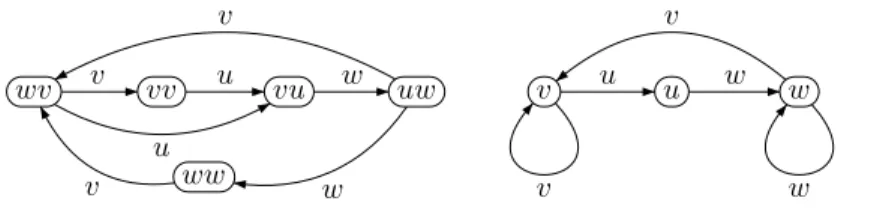
372
3.2
Return words
373
Let F be a set of words. For w ∈ F , let
374
ΓF(w) = {x ∈ F | wx ∈ F ∩ A+w} and Γ′F(w) = {x ∈ F | xw ∈ F ∩ wA+}
be respectively the set of right return words and of left return words to w. If F
375
is recurrent, the sets ΓF(w) and Γ′F(w) are nonempty. Let
376
RF(w) = ΓF(w) \ ΓF(w)A+ and RF′ (w) = Γ′F(w) \ A+Γ′F(w)
be respectively the set of first right return words and the set of first left return
377
words to w. Note that wRF(w) = R′F(w)w.
378
Note that a recurrent set F is uniformly recurrent if and only if the set
379
RF(w) is finite for any w ∈ F . Indeed, if N is the maximal length of the words
380
in RF(w) for a word w of length n, then two successive occurrences of w in a
381
word of F are separated by a word of length at most N − n. Thus any word in
382
F of length N + n contains an occurrence of w. The converse is obvious.
383
The following result has been proved for neutral sets in [1].
384
theoremCardReturn385 Theorem 3.6 Let F be a uniformly recurrent set containing the alphabet A. If
F is strong (resp. weak, resp. neutral), then for every w ∈ F , the set RF(w)
386
has at least (resp. at most, resp. exactly) Card(A) elements.
387
We will consider rooted trees with the usual notions of root, node, child and
388
parent. The following lemma is well-known as a lemma on trees relating the
389
number of its leaves to the sum of the degrees of its internal nodes.
390
lemmaArity391 Lemma 3.7 Let F be a prefix-closed set. Let X be a finite F -maximal prefix
code and let P be the set of its proper prefixes. Then Card(X) = 1+P
p∈P(r(p)−
392
1).
393
The following lemma is also well known.
394
lemmaCombinat395 Lemma 3.8 Let T be a finite tree with root r and a set P of leaves, let π be a function assigning to each node an integer such that for each internal node n,
396
π(n) ≤P π(m) where the sum runs over the children of n. Then Pn∈Pπ(n) ≥
397
π(r).
A symmetric statement holds if π is such that π(n) ≥P π(m) for each
in-399
ternal node n with the conclusion thatP
n∈Pπ(n) ≤ π(r).
400
401
Proof of Theorem3.6. For a word x, we denote π(x) = r(x) − 1 and for a set XtheoremCardReturn
402
of words, π(X) =P
x∈Xπ(x).
403
Assume first that F is strong. Let w ∈ F and let n = |w|. Set S = F ∩ An.
404
By Lemmas3.3 andlemmaEnum3.4, and since F contains A, we have π(S) ≥ Card(A) − 1.lemmasn
405
For s ∈ S, let Ps be the set of proper prefixes of wRF(w) ending with s.
406
For each s ∈ S, the set Ps is a suffix code. Indeed, since a word of Ps is a
407
proper prefix of wRF(w) of length at least equal to the length of w, the word w
408
occurs in a word of Psexactly once and as a prefix. Let p, q ∈ Ps with p suffix
409
of q, we have q = tp. Then p = wv and thus q = twv. Since the only occurrence
410
of w in q is as a prefix, we have t = 1. Thus Psis a suffix code.
411
Since F is uniformly recurrent, the set Psis finite. We apply Lemma
lemmaCombinat
3.8 to
412
the tree Ts formed of the suffixes of Ps ending with s, considering each word
413
z ∈ Tsas the father of az for a ∈ A. The root of the tree is s. Since each t ∈ Ts
414
is strong or neutral, we have
415 X a∈L(t) π(at) = X a∈L(t) (r(at) − 1) = e(t) − ℓ(t) ≥ π(t).
Thus we have π(Ps) ≥ π(s) by Lemma
lemmaCombinat
3.8.
416
Let P = ∪s∈SPs. Since the sets Ps are pairwise disjoint, we have π(P ) =
417
P
s∈Sπ(Ps). Thus π(P ) ≥ π(S).
418
Let Q be the set of proper prefixes of RF(w) and set G = w−1F . Since F
419
is recurrent, the set RF(w) is a G-maximal prefix code. Thus we may apply
420
Lemma 3.7 to the prefix-closed set G and the G-maximal prefix code RlemmaArity F(w).
421
Since for any letter a, xa ∈ G if and only if wxa ∈ F , we obtain Card(RF(w)) =
422
1 + π(wQ).
423
Next, P = wQ. Indeed, if q ∈ Q then wq ∈ P , hence wQ ⊂ P . Conversely,
424
each word in P has the form wq with q ∈ Q, so P ⊂ wQ.
425
We conclude that
426
Card(RF(w)) − 1 = π(P ) ≥ π(S) ≥ Card(A) − 1.
If F is weak, then by Lemma3.4, π(S) ≤ Card(A) − 1. The dual of Lemmalemmasn 3.8lemmaCombinat
427
gives π(Ps) ≤ π(s) and thus π(P ) ≤ π(S). Thus
428
Card(RF(w)) − 1 = π(P ) ≤ π(S) ≤ Card(A) − 1.
429
The following example shows that in a set of complexity kn + 1 the number
430
of first right return words need not be equal to k + 1.
431
Example 3.9 Let F be the Chacon set (see Example3.5). We have RexampleChacon F(a) =
432
{a, bca, bcbca} but RF(ab) = {caab, cbcab}.
4
Acyclic, connected and tree sets
434
sectionAcyclic
We introduce in this section the notion of extension graph of a word. We
de-435
fine acyclic (resp. connected, resp. tree) sets by the fact that all the extension
436
graphs of its elements are acyclic (resp. connected, resp. trees). We give
ex-437
amples showing that a uniformly recurrent acyclic set may not be a tree set
438
(Example exampleJulienAcyclic4.4) and that a uniformly recurrent neutral set may not be acyclic
439
(Example 4.5). We introduce a generalization of the extension graphs calledexampleJulien
440
generalized extension graphs. We give conditions under which generalized
ex-441
tension graphs are acyclic (Proposition4.7).PropStrongTreeCondition
442
4.1
Extension graphs
443Let F be a set of words. For a word w ∈ F , we consider an undirected graph
444
G(w) called its extension graph in F and defined as follows. The set of vertices
445
is the disjoint union of L(w) and R(w) and its edges are the pairs (a, b) ∈ E(w).
446
Example 4.1 Let F be the Tribonacci set (see Example2.2). The graphs G(ε)exampleTribonacci
447
and G(ab) are represented in Figure4.1.figureExtension
448 a b c a b c a b c a
Figure 4.1: The extension graphs G(ε) and G(ab) in the Tribonacci set. figureExtension
We say that F is an acyclic (resp. a connected, resp. a tree) set if it
449
is biessential and if for every word w ∈ F , the graph G(w) is acyclic (resp.
450
connected, resp. a tree). Obviously, a tree set is acyclic and connected.
451
Note that a biessential set F is acyclic (resp. connected) if and only if the
452
graph G(w) is acyclic (resp. connected) for every bispecial word w. Indeed, if
453
w is not bispecial, then G(w) ⊂ a × A or G(w) ⊂ A × a, thus it is always acyclic
454
and connected.
455
If the extension graph G(w) of w is acyclic, then m(w) ≤ 0. Thus w is weak
456
or neutral. More precisely, one has in this case, m(w) = −c + 1 where c is the
457
number of connected components of the graph G(w).
458
Similarly, if G(w) is connected, then w is strong or neutral. Thus, if F is
459
an acyclic (resp. a connected, resp. a tree) set, then F is a weak (resp. strong,
460
resp. neutral) set.
461
Example 4.2 A Sturmian set F is a tree set. Indeed, any word w ∈ F is
462
ordinary (Example3.1), which implies that G(w) is a tree.exSturmianIsOrdinary
463
Since a tree set is neutral, we deduce from Proposition propComplexityNeutral3.2 the following
464
statement, where k = Card(F ∩ A) − 1.
Proposition 4.3 The factor complexity of a tree set is kn + 1.
466
One may wonder whether the notion of a tree set is of a topological or of
467
a measure-theoretic nature for the associated symbolic dynamical system. In
468
particular, one may wonder if uniformly recurrent tree sets have the property
469
of unique ergodicity, which means that they have a unique invariant probability
470
measure (see [3] or [9] for the definition of these notions). An element of answer
471
is provided by interval exchange sets. Regular interval exchange sets form a
472
special case of uniformly recurrent tree sets (see [5]).
473
It is well-known since [16] that there exist regular interval exchange sets
474
that are not uniquely ergodic. This shows that the tree property does not imply
475
unique ergodicity. However having complexity pn = kn + 1, which is a priori
476
of a topological nature, implies information on invariant measures. Indeed,
477
according to [10], a minimal symbolic dynamical system for which lim inf pn/n ≤
478
k is such that there exist at most k ergodic invariant measures. The bound can
479
even be refined to k − 2 [19] by a careful inspection of the evolution of the Rauzy
480
graphs. For k ≤ 2, that is for an alphabet of size at most 3 in our case, one
481
gets the following [10]: a minimal symbolic system such that lim sup pn/n < 3
482
is uniquely ergodic. We thus conclude that any uniformly recurrent word whose
483
set of factors is a tree set on an alphabet of size at most 3 is uniquely ergodic.
484
4.2
Two examples
485
sectionExamples
We present two examples, due to Julien Cassaigne [12]. The first one is a
486
uniformly recurrent acyclic set which is not a tree set.
487
exampleJulienAcyclic488 Example 4.4 Let A = {a, b, c, d} and let σ be the morphism from A∗into itself
defined by
489
σ(a) = ab, σ(b) = cda, σ(c) = cd, σ(d) = abc.
Let F be the set of factors of the infinite word σω(a) (see Figure4.3 on the left).figureCassaigne
490
Since σ is primitive, F is uniformly recurrent. The graph G(ε) is represented in
491
FigurefigureGepsilonJulien4.2. It is acyclic with two connected components (and thus m(ε) = −1).
a a
b b
c c
d d
Figure 4.2: The graph G(ε). figureGepsilonJulien
492
We will show that for any nonempty word w ∈ F , the graph G(w) is a tree. This
493
will prove that F is acyclic. We will use some properties of the set X = σ(A).
494
Observe first that X is a suffix code. It has even the stronger property that
495
distinct words of X end with distinct letters. The set X is not a prefix code
496
but satisfies the following weaker property. If x, x′, y ∈ X and y′ ∈ X∗ are such
497
that xy is a prefix of x′y′, then x = x′ (the set X said to be weakly prefix ).
a b c d b c c a d a c d a d b a b c a d a b a b a c b c c d 1 2 3 2 3 2 3 1 2 3 1 3 1 2 3 3 1 2 1 2 3 2 3 1
Figure 4.3: The words of length at most 4 of the sets F and G. figureCassaigne
As a third property, the set X has synchronizing pairs. A pair u, v of words is
499
synchronizing if for all words p, q, if puvq ∈ X∗, then pu, vq ∈ X∗. For example
500
(c, a) is a synchronizing pair.
501
Note that if (r, s) and (u, v) are synchronizing pairs, then qrstuvw ∈ X∗
502
implies stu ∈ X∗.
503
We first show the following properties.
504
1. If a left-special word of length at least 5 begins with a (resp. c), it begins
505
with abcda (resp. cdabc).
506
2. If a right-special word of length at least 5 ends with a (resp. c), it ends
507
with abcda (resp. cdabc).
508
Indeed, the left-special words of length at most 5 beginning with a are the
509
prefixes of abcda. This implies that any left-special word of length at least 5
510
beginning with a begins with abcda.
511
The three other assertions can be proved in an analogous way.
512
Let us now show that for any nonempty bispecial word w ∈ F the graph
513
G(w) is a tree. We use an induction on the length of the word to prove that
514
the graph of a nonempty bispecial word is, according to its first and last letter,
515
equal to one of the eight graphs of Figure4.4. The assertion is true for wordsfigureGraphs
516
of length at most 4 since a, c, abc and cda are the bispecial words of length at
517 most 4. 518 (a, a) c d b c c d b c (a, c) c d d a c d d a (c, a) a b b c a b b c (c, c) a b d a a b d a
Figure 4.4: The graphs of bispecial words, according to their first and last letter. figureGraphs
Assume that v is a bispecial word of length at least 5. Assume first that v
519
begins and ends with a. As seen previously, v begins and ends with abcda.
c w b c ❅❅❅❅ cd ab ab cda cd u d w c d ❅❅ abc ab ab cd abc u
Figure 4.5: A bispecial word beginning and ending with a. figureBispecial
Set v = ucda. Since (d, ab) and (b, cd) are synchronizing and since cducda ∈
521
F , we have u ∈ X∗. Since X is a suffix code, there is a unique w ∈ F such
522
that u = σ(w) and moreover cw ∈ F (see Figure4.5 on the left). Since cv ∈ F ,figureBispecial
523
and since (c, a) is synchronizing, we have also abcv ∈ F . Thus dw ∈ F (see
524
Figure4.5 on the right).figureBispecial
525
Next, we have vb ∈ F . Since (d, a) is synchronizing, we have wcd ∈ F and
526
vbc ∈ F (see Figure4.5 on the right). Similarly, since vc ∈ F , we have wbc ∈ FfigureBispecial
527
and vcd ∈ F (see Figure 4.5 on the left). Thus w is a bispecial word shorterfigureBispecial
528
than v which begins and ends with a. By induction hypothesis, the graph of
529
w is equal to one of the two first graphs of Figure4.4. In both cases, we havefigureGraphs
530
cwb, dwc ∈ F and thus dvc, cvb ∈ F . Next dwb ∈ F if and only if cvc ∈ F . Thus
531
G(w) is one of the graphs if and only if G(v) is the other one. This proves the
532
property in this case.
533
The other cases are treated similarly.
534
We have thus shown that all extension graphs in F are acyclic and more
535
precisely that G(ε) is a union of two trees and all other graphs are trees. This
536
shows, in view of Lemma3.3 that blemmaEnum0= −1 and bn= 0 for all n ≥ 1. Accordingly,
537
the complexity pn of F is given by p0= 1 and pn= 2n + 2 for n ≥ 1.
538
The second example is a uniformly recurrent set which is neutral but is not
539
a tree set (it is actually not even acyclic).
540
exampleJulien541 Example 4.5 Let B = {1, 2, 3} and let τ : A∗→ B∗ be defined by
τ (a) = 12, τ (b) = 2, τ (c) = 3, τ (d) = 13.
Let G = τ (F ) where F is the set of Example4.4 (see FigureexampleJulienAcyclicfigureCassaigne4.3 on the right).
542
Thus G is also the set of factors of the infinite word τ (σω(a)).
543
The set Y = τ (A) is a prefix code. It is not a suffix code but it is weakly
544
suffix in the sense that if x, y, y′ ∈ X and x′ ∈ X∗ are such that xy is a suffix
545
of x′y′, then y = y′.
546
Let g : {a, c}A∗∩ A∗{a, c} → B∗ be the map defined by
547 g(w) =
3τ (w) if w begins and ends with a
3τ (w)1 if w begins with a and ends with c
2τ (w) if w begins with c and ends with a
2τ (w)1 if w begins with c and ends with c
It can be verified, using the fact that Y is a prefix and weakly suffix code, that
548
the set of nonempty bispecial words of G is the union of 2, 31 and of the set
g(S) where S is the set of nonempty bispecial words of F . One may verify that
550
the words of g(S) are neutral. Since the words 2, 31 are also neutral, the set G
551
is neutral.
552
It is uniformly recurrent since F is uniformly recurrent and τ is a nontrivial
553
morphism. The set G is not a tree set since the graph G(ε) is neither acyclic
554
nor connected (see Figure4.6).GepsilonJC
1 1 2 2 3 3
Figure 4.6: The graph G(ε) for the set G. GepsilonJC
555
4.3
Generalized extension graphs
556Let F be a set. For w ∈ F , and U, V ⊂ F , let U (w) = {ℓ ∈ U | ℓw ∈ F } and
557
let V (w) = {r ∈ V | wr ∈ F }. The generalized extension graph of w relative
558
to U, V is the following undirected graph GU,V(w). The set of vertices is made
559
of two disjoint copies of U (w) and V (w). The edges are the pairs (ℓ, r) for
560
ℓ ∈ U (w) and r ∈ V (w) such that ℓwr ∈ F . The extension graph G(w) defined
561
previously corresponds to the case where U, V = A.
562
Example 4.6 Let F be the Fibonacci set. Let w = a, U = {aa, ba, b} and let
563
V = {aa, ab, b}. The graph GU,V(w) is represented in Figure
figureStrongTree 4.7. b ba ab b
Figure 4.7: The graph GU,V(w). figureStrongTree
564
The following property shows that in an acyclic set, not only the extension
565
graphs but, under appropriate hypotheses, all generalized extension graphs are
566
acyclic.
567
PropStrongTreeCondition568 Proposition 4.7 Let F be an acyclic set. For any w ∈ F , any finite suffix
code U and any finite prefix code V , the generalized extension graph GU,V(w) is
569
acyclic.
570
The proof uses the following lemma.
571
lemmaTree572 Lemma 4.8 Let F be a biessential set. Let w ∈ F and let U, V, T ⊂ F . Let
ℓ ∈ F \ U be such that ℓw ∈ F . Set U′ = (U \ T ℓ) ∪ ℓ. If the graphs G
U′,V(w) 573
and GT,V(ℓw) are acyclic then GU,V(w) is acyclic.
Proof. Assume that GU,V(w) contains a cycle C. If the cycle does not use a
575
vertex in U′, it defines a cycle in the graph G
T,V(ℓw) obtained by replacing each
576
vertex tℓ for t ∈ T by a vertex t. Since GT,V(ℓw) is acyclic, this is impossible.
577
If it uses a vertex of U′ it defines a cycle of the graph G
U′,V(w) obtained
578
by replacing each possible vertex tℓ by ℓ (and suppressing the possible identical
579
successive edges created by the identification). This is impossible since GU′,V(w)
580
is acyclic. Thus GU,V(w) is acyclic.
581
Proof of Proposition 4.7. We show by induction on the sum of the lengths ofPropStrongTreeCondition
582
the words in U, V that for any w ∈ F , the graph GU,V(w) is acyclic.
583
Let w ∈ F . We may assume that U = U (w) and V = V (w) and also that
584
U, V 6= ∅. If U, V ⊂ A, the property is true since F is acyclic.
585
Otherwise, assume for example that U contains words of length at least 2.
586
Let u ∈ U be of maximal length. Set u = aℓ with a ∈ A. Let T = {b ∈ A | bℓ ∈
587
U }. Then U′= (U \ T ℓ) ∪ ℓ is a suffix code and ℓw ∈ F since U = U (w).
588
By induction hypothesis, the graphs GU′,V(w) and GT,V(ℓw) are acyclic. By
589
lemmalemmaTree4.8, the graph GU,V(w) is acyclic.
590
We prove now a similar statement concerning tree sets.
591
propStrongTreeConditionBis592 Proposition 4.9 Let F be a tree set. For any w ∈ F , any finite F -maximal suffix code U ⊂ F and any finite F -maximal prefix code V ⊂ F , the generalized
593
extension graph GU,V(w) is a tree.
594
The proof uses the following lemma, analogous to Lemma4.8.lemmaTree
595
lemmaTreeBis596 Lemma 4.10 Let F be a biessential set. Let w ∈ F and let U, V ⊂ F . Let
ℓ ∈ F \ U be such that ℓw ∈ F and Aℓ ∩ F ⊂ U . Set U′ = (U \ Aℓ) ∪ ℓ. If the
597
graphs GU′,V(w) and GA,V(ℓw) are connected then GU,V(w) is connected.
598
Proof. Since F is left essential, there is a letter a such that aℓw ∈ F and thus
599
aℓ ∈ U (w). We proceed by steps.
600
Step 1. As a preliminary step, let us show that for each b ∈ A such that
601
bℓw ∈ F , and each v ∈ V (ℓw), there is a path from bℓ to v in GU,V(w). Indeed,
602
since the graph GA,V(ℓw) is connected there is a path from b to v in this graph.
603
Thus, since bℓ ∈ U (w), there is a path from bℓ to v in GU,V(w).
604
Step 2. As a second step, let us show that for any m ∈ U′(w) \ ℓ and
605
v ∈ V (w), there is a path from m to v in GU,V(w). Indeed there is a path from
606
m to v in GU′,V(w). For each edge of this path of the form (ℓ, s), s is also in
607
V (ℓw) and thus, by Step 1, there is a path from aℓ to s in the graph GU,V(w).
608
Thus there is a path from m to v in GU,V(w).
609
Step 3. For each b ∈ A such that bℓ ∈ U (w), for each v ∈ V (w), there is
610
a path from bℓ to v in GU,V(w). Indeed, since GA,V(ℓw) is connected, there is
611
a path from b to a in GA,V(ℓw), thus a path from bℓ to aℓ in GU,V(w). Then
612
there is a path from ℓ to v in GU′,V(w) and, in the same way as in Step 2, there
613
is a path from aℓ to v in GU,V(w).
Consider now m ∈ U (w) and v ∈ V (w). If m /∈ Aℓ, then m ∈ U′(w) \ ℓ and
615
thus, by Step 2, there is a path from m to v in GU,V(w). Next, assume that
616
m = bℓ with b ∈ A. By Step 3, there is a path from m to v in GU,V(w). This
617
shows that the graph GU,V(w) is connected.
618
Proof of Proposition4.9. The fact that GpropStrongTreeConditionBisU,V(w) is acyclic follows from
Propo-619
sition4.7.PropStrongTreeCondition
620
We show by induction on the sum of the lengths of the words in U, V that
621
for any w ∈ F , the graph GU,V(w) is connected.
622
Assume first that U (w), V (w) ⊂ A. Since U is an F -maximal suffix code, we
623
have U (w) = L(w). Similarly, V (w) = R(w). Thus the property is true since F
624
is a tree set.
625
Otherwise, assume for example that U (w) contains words of length at least
626
2. Let u ∈ U (w) be of maximal length. Set u = aℓ with a ∈ A. Then
627
U′ = (U \ Aℓ) ∪ ℓ is an F -maximal suffix code and ℓw ∈ F since aℓ ∈ U (w).
628
Moreover, we have Aℓ ∩ F ⊂ U since U is an F -maximal suffix code. Thus ℓ
629
satisfies the hypotheses of Lemma4.10.lemmaTreeBis
630
By induction hypothesis, the graphs GU′,V(w) and GA,V(ℓw) are connected.
631
By Lemma4.10, the graph GlemmaTreeBis U,V(w) is connected.
632
Let F be a factorial set and let f be a coding morphism for a finite bifix
633
code X ⊂ F . The set f−1(F ) is called a bifix decoding of F . When X is an
634
F -maximal bifix code, it is called a maximal bifix decoding of F .
635
decodingAcyclic636 Theorem 4.11 Any biessential set which is the bifix decoding of an acyclic set is acyclic.
637
Proof. Let F be an acyclic set and let f : B∗ → A∗ be a coding morphism
638
for a finite bifix code X ⊂ F such that f−1(F ) is biessential. Let u ∈ f−1(F )
639
and let v = f (u). Since X is a finite bifix code, it is both a suffix code and
640
a prefix code. Thus the generalized extension graph GX,X(v) is acyclic by
641
Proposition4.7. Since G(u) is isomorphic with GPropStrongTreeCondition X,X(v), it is also acyclic. Thus
642
f−1(F ) is acyclic.
643
The previous statement is not satisfactory because of the assumption that
644
f−1(F ) is biessential which is added to obtain the conclusion. The following
645
example shows that the condition is necessary.
646
exampleNotEssential647 Example 4.12 Let F be the Fibonacci set and let f be the coding morphism
for X = {aa, ab} defined by f (u) = aa, f (v) = ab. Then f−1(F ) is the
fi-648
nite set {u, v, vu, vv, vvu} and thus not biessential. Note however that for any
649
biextendable w ∈ f−1(F ), the graph G(w) is acyclic.
650
One may verify that a sufficient condition for f−1(F ) to be biessential is that
651
X is an F -maximal prefix code and an F -maximal suffix code.
652
The following result is a consequence of Proposition4.9.propStrongTreeConditionBis
InverseImageTree654 Theorem 4.13 Any maximal bifix decoding of a recurrent tree set is a tree set. Proof. Let f : B → X be a coding morphism for a finite F -maximal bifix
655
code X. Since F is recurrent, it is biessential. It implies that f−1(F ) is also
656
biessential. Indeed, let u ∈ f−1(F ) and let v = f (u). Let r, s be words of F
657
longer than all words of X such that rvs ∈ F . Let r′ (resp. s′) be the suffix
658
of r (resp. the prefix of s) which is in X. Then f−1(r′)uf−1(s′) is in f−1(F ).
659
This shows that f−1(F ) is biessential.
660
Let u ∈ f−1(F ) and let v = f (u). Since F is a tree set, it satisfies
Propo-661
sition4.9. Since F is recurrent and X is a finite F -maximal bifix code, X ispropStrongTreeConditionBis
662
both an F -maximal suffix code and an F -maximal prefix code. Thus the graph
663
GX,X(v) is a tree. Since G(u) is isomorphic with GX,X(v), it is also a tree.
664
Thus f−1(F ) is a tree set.
665
We have no example of a maximal bifix decoding of a recurrent tree set which
666
is not recurrent.
667
exampleF2668 Example 4.14 Let F be the Fibonacci set and let X = A2∩ F = {aa, ab, ba}.
Let B = {u, v, w} and let f be the coding morphism for X defined by f (u) = aa,
669
f (v) = ab and f (w) = ba. Then the set f−1(F ) is a recurrent tree set which
670
is actually a regular interval exchange set (see [5]). Part of the set f−1(F ) is
671
represented in FigurefigureSetF4.8.
u v w w u v v w v w w u u v v v v v w w w u u v
Figure 4.8: The set of words of f−1(F ) of length at most 4. figureSetF
672
5
Return words in tree sets
673
sectionReturnTreeSets
We study sets of first return words in tree sets. We first show that if F is a
674
recurrent connected set, the group described by any Rauzy graph of F
con-675
taining the alphabet A, with respect to some vertex is the free group on A
676
(Theorem5.2). Next, we prove that in a uniformly recurrent tree set containingproposition3
677
A, the set of first return words to any word of F is a basis of the free group on
678
A (Theorem5.6).theoremJulien
5.1
Stallings foldings of Rauzy graphs
680sectionRauzyGraphs
We first introduce the notion of a Rauzy graph (for a more detailed exposition,
681
see [9]). Let F be a factorial set. The Rauzy graph of F of order n ≥ 0 is the
682
following labeled graph Gn(F ). Its vertices are the words in the set F ∩ An.
683
Its edges are the triples (x, a, y) for all x, y ∈ F ∩ An and a ∈ A such that
684
xa ∈ F ∩ Ay.
685
propositionRauzy686 Proposition 5.1 Let u ∈ F ∩ An. For any word w such that uw ∈ F , there is
a path labeled w in Gn(F ) from u to the suffix of length n of uw.
687
Conversely, the label of any path of length at most n + 1 in Gn(F ) is in F .
688
Proof. We prove the first assertion by induction on the length of w. It is true if
689
w is empty. Next, set w = w′a with a ∈ A and let v′ be the suffix of length n
690
of uw′. By induction hypothesis, there is a path labeled w′ in G
n(F ) from u to
691
the suffix v′. By definition, there is an edge from v′ to the suffix of length n of
692
v′a, whence the conclusion.
693
Next, let w be the label of a path of length n + 1 from x to y in Gn(F ). Set
694
w = ua with a ∈ A. Then we have a path from x to u labeled u and an edge
695
from u to y labeled a. Thus ua ∈ F by definition of Gn(F ).
696
When F is recurrent, all Rauzy graph Gn(F ) are strongly connected. Indeed,
697
let u, w ∈ F ∩ An. Since F is recurrent, there is a v ∈ F such that uvw ∈ F .
698
Then there is a path in Gn(F ) from u to w labeled vw by Proposition
propositionRauzy
5.1.
699
The Rauzy graph Gn(F ) of a recurrent set F with a distinguished vertex
700
v can be considered as a simple automaton A = (Q, v, v) with set of states
701
Q = F ∩ An (see Section2.4).sectionAutomata
702
Let G be a labeled graph on a set Q of vertices. The group described by G
703
with respect to a vertex v is the subgroup described by the simple automaton
704
(Q, v, v). We will prove the following statement.
705
proposition3706 Theorem 5.2 Let F be a recurrent connected set containing the alphabet A. The group described by a Rauzy graph of F with respect to any vertex is the free
707
group on A.
708
A morphism ϕ from a labeled graph G onto a labeled graph H is a map
709
from the set of vertices of G onto the set of vertices of H such that (u, a, v) is
710
an edge of H if and only if there is an edge (p, a, q) of G such that ϕ(p) = u and
711
ϕ(q) = v. An isomorphism of labeled graphs is a bijective morphism.
712
The quotient of a labeled graph G by an equivalence θ, denoted G/θ, is the
713
graph with vertices the set of equivalence classes of θ and an edge from the class
714
of u to the class of v labeled a if there is an edge labeled a from a vertex u′
715
equivalent to u to a vertex v′ equivalent to v. The map from a vertex of G to
716
its equivalence class is a morphism from G onto G/θ.
717
We consider on a Rauzy graph Gn(F ) the equivalence θnformed by the pairs
718
(u, v) with u = ax, v = bx, a, b ∈ L(x) such that there is a path from a to b
719
in the extension graph G(x) (and more precisely from the vertex corresponding
to a to the vertex corresponding to b in the copy corresponding to L(x) in the
721
bipartite graph G(x)).
722
propRauzyGraphs723 Proposition 5.3 If F is connected, for each n ≥ 1, the quotient of Gn(F ) by
the equivalence θn is isomorphic to Gn−1(F ).
724
Proof. The map ϕ : F ∩ An → F ∩ An−1 mapping a word of F of length n
725
to its suffix of length n − 1 is clearly a morphism from Gn(F ) onto Gn−1(F ).
726
If u, v ∈ F ∩ An are equivalent modulo θ
n, then ϕ(u) = ϕ(v). Thus there
727
is a morphism ψ from Gn(F )/θn onto Gn−1(F ). It is defined for any word
728
u ∈ F ∩ Anby ψ(¯u) = ϕ(u) where ¯u denotes the class of u modulo θ
n. But since
729
F is connected, the class modulo θn of a word ax of length n has ℓ(x) elements,
730
which is the same as the number of elements of ϕ−1(x). This shows that ψ is a
731
surjective map from a finite set onto a set of the same cardinality and thus that
732
it is one-to-one. Thus ψ is an isomorphism.
733
Let G be a strongly connected labeled graph. Recall from Section2.4 that asectionAutomata
734
Stallings folding at vertex v relative to letter a of G consists in identifying the
735
edges coming into v labeled a and identifying their origins. A Stallings folding
736
does not modify the group described by the graph with respect to some vertex.
737
Indeed, if p−→ v, pa −→ r and qb −→ v are three edges of G, then adding the edgea
738
q−→ r does not change the group described since the path qb −→ va −−→ pa−1 −→ r hasb
739
the same label. Thus merging p and q does not add new labels of generalized
740
paths.
741
742
Proof of Theorem5.2. The quotient Gproposition3 n(F )/θncan be obtained by a sequence of
743
Stallings foldings from the graph Gn(F ). Indeed, a Stallings folding at vertex v
744
identifies vertices which are equivalent modulo θn. Conversely, consider u = ax
745
and v = bx, with u, v ∈ F ∩ An and a, b ∈ A such that a and b (considered as
746
elements of L(x)), are connected by a path in G(x). Let a0, . . . ak and b1, · · · bk
747
with a = a0and b = akbe such that (ai, bi+1) for 0 ≤ i ≤ k−1 and (ai, bi) for 1 ≤
748
i ≤ k are in E(x). The successive Stallings foldings at xb1, xb2, . . . , xbk identify
749
the vertices u = a0x, a1x, . . . , akx = v. Indeed, since aixbi+1, ai+1xbi+1 ∈
750
F , there are two edges labeled bi+1 going out of aix and ai+1x which end at
751
xbi+1. The Stallings folding identifies aix and ai+1x. The conclusion follows by
752
induction.
753
Since the Stallings foldings do not modify the group described, we deduce
754
from Proposition5.3 that the group described by the Rauzy graph GpropRauzyGraphs n(F ) is the
755
same as the group described by the Rauzy graph G0(F ). Since G0(F ) is the
756
graph with one vertex and with loops labeled by each of the letters, it describes
757
the free group on A.
758
Example 5.4 Let F be the tree set obtained by decoding the Fibonacci set into
759
blocks of length 2 (see Example4.14). Set u = aa, v = ab, w = ba. The graphexampleF2
760
G2(F ) is represented on the left of Figure
figFiboBlocks
5.1. The classes of θ2 are {wv, vv}
761
{vu} and {ww, uw}. The graph G1(F ) is represented on the right.
wv vv vu uw ww v u w v w v u v u w v u w w v
Figure 5.1: The Rauzy graphs G2(F ) and G1(F ) for the decoding of the
Fi-bonacci set into blocks of length 2. figFiboBlocks
The following example shows that PropositionpropRauzyGraphs5.3 is false for sets which are not
763
connected.
764
Example 5.5 Consider again the Chacon set (see Example3.5).exampleChacon
765
The Rauzy graph G1(F ) corresponding to the Chacon set is represented in
766
Figure figChacon25.2 on the left. The graph G1(F )/θ1 is represented on the right. It is
767
not isomorphic to G0(F ) since it has two vertices instead of one.
a b c a b c a b b a b c
Figure 5.2: The graphs G1(F ) and G1(F )/θ1. figChacon2
768
5.2
Return words and bases of free groups
769We will prove the following result.
770
theoremJulien771 Theorem 5.6 Let F be a uniformly recurrent connected set containing the
al-phabet A. For any w ∈ F , the set RF(w) generates the free group on A.
772
Proof. Since F is uniformly recurrent, the set RF(w) is finite. Let n be the
773
maximal length of the words in wRF(w). In this way, any word in F ∩ An
774
beginning with w has a prefix in wRF(w). Moreover, recall from Proposition
propositionRauzy
5.1
775
that the label of any path of length n + 1 in the Rauzy graph Gn(F ) is in F .
776
Let x ∈ F be a word of length n ending with w. Let A be the simple
777
automaton defined by Gn(F ) with initial and terminal state x. Let X be the
778
prefix code generating the submonoid recognized by A. Since the automaton A
779
is simple, by PropositionpropGeneratedGroup2.8, the set X generates the group described by A.
780
We show that X ⊂ RF(w)∗. Indeed, let y ∈ X. Since y is the label of a
781
path starting at x and ending in x, the word xy ends with x and thus the word
782
wy ends with w. Let Γ = {z ∈ A+ | wz ∈ A∗w} and let R = Γ \ ΓA+. Then R
783
is a prefix code and Γ ∪ 1 = R∗, as one may verify easily. Since y ∈ Γ, we can
784
write y = u1u2· · · umwhere each word uiis in R. Since F is recurrent and since