HAL Id: hal-03042471
https://hal.archives-ouvertes.fr/hal-03042471
Submitted on 6 Dec 2020HAL is a multi-disciplinary open access archive for the deposit and dissemination of sci-entific research documents, whether they are pub-lished or not. The documents may come from teaching and research institutions in France or abroad, or from public or private research centers.
L’archive ouverte pluridisciplinaire HAL, est destinée au dépôt et à la diffusion de documents scientifiques de niveau recherche, publiés ou non, émanant des établissements d’enseignement et de recherche français ou étrangers, des laboratoires publics ou privés.
Experimental characterization of Magneto-Rheological
Elastomers for constitutive model parameters
identification
L Bodelot, J.-P Voropaieff
To cite this version:
L Bodelot, J.-P Voropaieff. Experimental characterization of Magneto-Rheological Elastomers for constitutive model parameters identification. 2018 SEM Annual Conference and Exposition on Exper-imental and Applied Mechanics, Jun 2018, Greenville, South Carolina, United States. �hal-03042471�
Experimental characterization of Magneto-Rheological Elastomers
for constitutive model parameters identification
L. Bodelot
1, J.-P. Voropaieff
11
Solid Mechanics Laboratory, Ecole Polytechnique, Université Paris-Saclay, 91128 Palaiseau, France
INTRODUCTION
Magneto-Rheological Elastomers (MREs) are composite materials made of magnetizable metallic particles embedded in an elastomeric matrix [1]. They belong to the class of smart materials since some of their properties, in particular their stiffness, can be modified by the application of an external stimulus, a magnetic field in their case. In the presence of a magnetic field, they can also exhibit large deformations, thus standing as promising candidates for a large number of engineering applications linked to tunable damping, non contact actuation or biological implants (valves, artificial muscles). The simplest form of MRE samples are isotropic due to a homogeneous dispersion of magnetizable spherical particles in their matrix, but curing these composites under magnetic fields can impart them with anisotropic properties through the creation of particle chains in the direction of the curing field. Early experimental works mainly focused on formulation and fabrication [2,3] and on the influence of a magnetic field on the damping properties of MREs [4,5]. To our knowledge, there is still no precise and comprehensive characterization of the fully-coupled magneto-mechanical response of MREs, which prevents the further design of MRE-based devices as well as the validation of magneto-mechanical models. Hence, the purpose of the present work is to develop a coupled experimental/numerical methodology for characterizing and modeling the coupled magneto-mechanical behavior of isotropic and anisotropic soft MREs that can sustain large deformations. Here, we focus on the experimental aspects of the work. We first discuss the fabrication of both isotropic and anisotropic soft MREs before addressing the question of sample shape and of interfacial adhesion under both mechanical and magnetic loadings. The experimental setup developed in order to characterize the behavior of isotropic and anisotropic MREs under coupled magneto-mechanical mechanical loading is then introduced and experimental results presented for MREs exhibiting different micro-architectures.
SAMPLES
The elastomer used to fabricate the samples is a two-part addition-cured system Ecoflex 00-20 from Smooth-On Inc., USA and the particles are Carbonyl Iron Powder (CIP) SM from BASF, having a median diameter of 3.5 μm. Particles are first mixed within Part A before adding Part B. The mix is mechanically mixed for 5 min, degassed in a vacuum chamber and then poured into a mold of the desired shape. In our case, heating resistances are directly mounted onto the mold in order to allow for curing within an electromagnet. According to the position of the molds within the magnetic field, we obtain transverse isotropic samples for which the particles remain aligned as chains along the selected principal direction of the sample. When the magnetic field is turned off during curing, we simply obtain isotropic samples.
For mechanical characterization, sample shapes are designed so that the quantities to probe are uniform in the gage area, thus leading to the well-known dog-bone shape samples that either have rectangular cross-sections or circular ones. When the sample is additionally submitted to a magnetic field, one must check that the magnetization is also uniform. In the case of a dog-bone shape sample with a rectangular cross-section, numerical simulations conducted with FE software ANSYS revealed that the magnetization is not uniform within the gage area. In the case of a dog-bone shape sample with a circular cross-section, magnetization is uniform within the gage area but the heads of the sample exhibit strong gradients of magnetization. These were shown to contribute heavily to the stress experienced in the gage area. Hence we designed a new sample, whose overall geometry matches the one of a dog-bone shape sample with a circular cross-section but it is made of a nearly ellipsoidal MRE central part attached to two non-magnetic 3D-printed plastic heads (see Figure 1). Within such a sample, the mechanical quantities are uniform in the gage area while the magnetization is also uniform in the MRE body of
Figure 1. Sample geometry designed to obtain uniform mechanical quantities within the gage area along with an overall uniform magnetization in the MRE body of the sample (dimensions are in mm).
The material of interest being a composite made of a soft matrix filled with hard micron-sized particles, we investigated whether interfacial adhesion was good enough within the sample to prevent debonding. We found that debonding occurred only marginally under purely mechanical testing and that the critical stretch threshold at which debonding occurred decreased with increasing particle content [6]. But more interestingly, we found that purely magnetic loadings were leading to rapid and strong debonding, even though they induce stretches that would not cause debonding if they were obtained by a purely mechanical loading [7]. Hence, a silane primer treatment of the particles was conducted prior to sample fabrication for the samples submitted to coupled magneto-mechanical loadings in order to enhance interfacial adhesion between the particles and the matrix.
SETUP
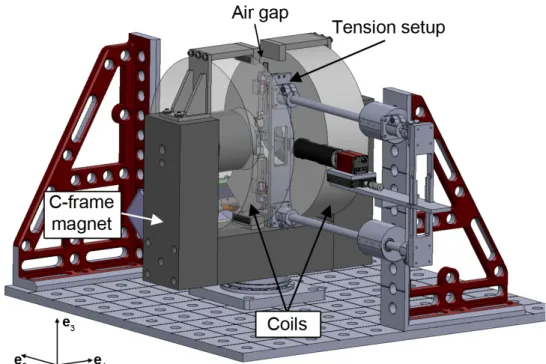
The experimental setup for coupled tests revolves around a C-frame electromagnet made of two coils yielding a uniform magnetic field of up to 0.8 T across the 82 mm air gap between the poles. Within this gap, one can slide in a custom-made non-magnetic symmetric tensile machine that can be either displacement- or load-controlled (see Figure 2). The load cells of the machine give access to the load exerted on the sample. The three principal stretches are measured via in-situ optical extensometry. The magnetic quantities within the samples are measured throughout the test thanks to two Hall probes that initially come nearly in contact with the back and side of the sample. As the sample deforms during loading the data from the probe is corrected via a theoretical derivation in order to account for the distance between the sample and the probes.
Figure 2. Magneto-mechanical characterization setup made of a C-frame electromagnet and a tensile setup that brings the sample in the middle of the uniform magnetic field generated by the magnet.
EXPERIMENTS
Magneto-mechanical coupled tests were performed on MRE samples containing 8.7% of particles and exhibiting different microstructures. The force was maintained at 0 N within the setup so as to impose traction free boundary conditions and simulate a sample hanging free in a uniform magnetic field. The applied field varied between 0 and 0.8 T during 10 pre-conditioning cycles at 0.01 Hz followed by 3 cycles at 0.001 Hz. Note here that following the notations reported in Figure 2, the magnetic field is applied along e1 while the load and the sample long axis are both along e3. If the sample is
field-structured along e2, we observe a rotation of the body of the sample about e3. This corresponds to a macroscopic instability of
the sample as the chains of particles try to align themselves along the lines of the magnetic field because of the compass effect [8] (here the role of the elongated body is played by particles chains). The rotation angle attains 90° at a field of 99 mT and remains stable as the field continues to increase. If the sample is field-structured along e3, we also observe a macroscopic
instability of the sample: for a field of 120 mT, the sample bends in the direction of the applied field, again due to the compass effect. Finally, only the isotropic sample and the transverse isotropic sample that is field-structured along e1 do not
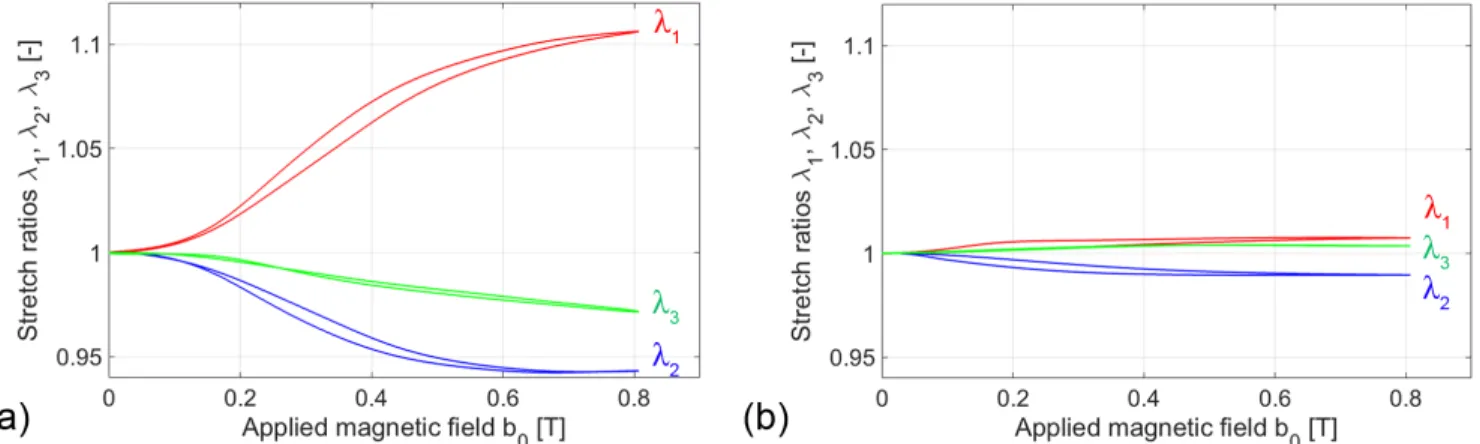
exhibit macroscopic instability under the applied field. In both cases, we observe (in the 3rd stabilized cycle) a deformation
induced by the magnetic field for both the isotropic (Figure 3a) and the transverse isotropic sample (Figure 3b). For the isotropic sample (Figure 3a), the particles try to align along the lines of the magnetic field thus leading to the largest stretch along the field direction. The other two transverse directions exhibit contractions, which corresponds to a transformation of the originally circular cross-section into a quasi-elliptic one. In contrast, the measured principal stretches are much smaller in the transverse isotropic sample (Figure 3b) for which the particles have already reached their stable configuration within the magnetic field during curing.
Figure 3. Magneto-mechanical coupling induced by the magnetic field: principal stretches measured in (a) the isotropic sample and (b) in the sample field-structured along e1.
In parallel of these experimental developments, we built a phenomenological constitutive model describing the magneto-mechanical coupled behavior of an isotropic medium. This model is based on a coupled energy density function whose parameters will be identified thanks to the coupled data obtained in the experiments.
KEYWORDS:
elastomers, magnetorheological elastomers, magneto-mechanical couplings, experimentalcharacterization, constitutive behavior
BIBLIOGRAPHY
[1] Rigbi Z, Jilken L, The response of an elastomer filled with soft ferrite to mechanical and magnetic influences, J Magn Magn Mater, 37, 267–276, 1983.
[2] Farshad M, Benine A, Magnetoactive elastomer composites, Polym Test, 23, 347–353, 2004.
[4] Jolly MR, Carlson JD, Muñoz BC, Bullions TA, The magnetoviscoelastic response of elastomer composites consisting of ferrous particles embedded in a polymer matrix, J Intell Mater Syst Struct, 7, 613–622, 1996.
[5] Ginder JM, Nichols ME, Elie LD, Clark SM, Controllable- stiffness components based on magnetorheological elastomers. SPIE's 7th Annual International Symposium on Smart Structures and Materials, 2000.
[6] Pössinger T, Bolzmacher C, Bodelot L, Triantafyllidis N, Influence of interfacial adhesion on the mechanical response of magneto-rheological elastomers at high strain, Microsyst Technol, 20, 803–814, 2014.
[7] Bodelot L, Voropaieff J.P., Pössinger T, Experimental investigation of the coupled magneto-mechanical response in magnetorheological elastomers, Exp Mech, 58, 207–221, 2018.
Filename: SEM_2018_Bodleot_Voropaieff.docx Directory: /Users/Laurence/Library/Containers/com.microsoft.Word/Data/Docu ments Template: /Users/Laurence/Library/Group Containers/UBF8T346G9.Office/User Content.localized/Templates.localized/Normal.dotm Title: Subject: Author: Laurence Keywords: Comments: Creation Date: 06/12/2020 18:40:00 Change Number: 2
Last Saved On: 06/12/2020 18:40:00 Last Saved By: Microsoft Office User Total Editing Time: 0 Minutes
Last Printed On: 06/12/2020 18:40:00 As of Last Complete Printing
Number of Pages: 4 Number of Words: 1 613