HAL Id: hal-01059198
https://hal.archives-ouvertes.fr/hal-01059198
Submitted on 29 Aug 2014
HAL is a multi-disciplinary open access
archive for the deposit and dissemination of
sci-entific research documents, whether they are
pub-lished or not. The documents may come from
teaching and research institutions in France or
abroad, or from public or private research centers.
L’archive ouverte pluridisciplinaire HAL, est
destinée au dépôt et à la diffusion de documents
scientifiques de niveau recherche, publiés ou non,
émanant des établissements d’enseignement et de
recherche français ou étrangers, des laboratoires
publics ou privés.
Trust Evaluation of a System for an Activity with
Subjective Logic
Nagham Alhadad, Yann Busnel, Patricia Serrano-Alvarado, Philippe Lamarre
To cite this version:
Nagham Alhadad, Yann Busnel, Patricia Serrano-Alvarado, Philippe Lamarre. Trust Evaluation of
a System for an Activity with Subjective Logic. TrustBus, Sep 2014, Munich, Germany. pp.48-59.
�hal-01059198�
Subjective Logic
Nagham Alhadad1,2, Yann Busnel1, Patricia Serrano-Alvarado1, Philippe Lamarre3
1 LINA/Universit´e de Nantes – France 2
LIG/Universit´e de Grenoble Alpes – France
3 LIRIS/INSA Lyon – France
Abstract. Recently, trust emerged as a momentous aspect to evaluate resources, services or persons. In our work, the trust notion focuses on a system as a whole and from the point of view of a particular user to do a particular digital activity as editing a document, mailing, chatting, etc. Our general goals are (i) to enable users to have a personal comparison of applications allowing them to do an ac-tivity such that they can choose the one satisfying their personal expectations and
(ii)to know how trustworthy their system is to do a particular activity (all ap-plications together). We consider a system as a graph composed of paths where the source is a person and the target is a final application or data. We consider that trust in a system depends on its architecture and we identify two problems
(i)how to evaluate trust in a graph having dependent paths i.e., paths having com-mon nodes, and (ii) how to express and deal with uncertainty in evaluating trust in a system. Concerning the first problem, trust approaches based on graphs have been proposed in the domain of social networks. Their solution for dependent paths is either removing paths or just choosing one of them what causes loss of information. Considering the second problem, subjective logic emerged to ex-press trust as a subjective opinion with a degree of uncertainty. In this paper we present SUBJECTIVETRUST, an approach that relies on subjective logic to evalu-ate trust in distributed systems. It proposes two solutions to treat dependent paths and takes into account the shape of the system architecture in trust evaluation. We analyze SUBJECTIVETRUSTin a series of experiments that show its accuracy.
1
Introduction
When users need to choose a system to perform a digital activity, like editing a docu-ment or mailing, they face several available options. To choose a system, they evalu-ate many criteria as functionality, ease of use, QoS, or economical aspects. Trust also emerged as a momentous aspect of choice [13]. Evaluating trust in a system is complex and becomes more challenging when systems use distributed architectures. Our general goals are (i) to enable users to have a personal comparison of applications allowing them to do an activity such that they can choose the one satisfying their personal expec-tations and (ii) to know how trustworthy their system is to do a particular activity (all applications together). We argue that studying trust in the separate entities that compose a system does not give a picture of how trustworthy a system is as a whole. Indeed, the trust in a system depends on its entities but also on its architecture. More precisely, on the way the entities, the users depends on to do their activities, are organized.
Trust has been studied from different points of views [5,6,17] and to evaluate it metrics vary from binary, scalar to probabilistic approaches [13,18]. As users hardly have all information to provide a dogmatic opinion on something or someone, subjective
logic[10], an extension of classical probability, emerged to express trust as a subjective opinion with a degree of uncertainty.
We consider a system as a graph [3] composed of paths where the source is a per-son and the target a final application or data. Intermediary nodes are entities (software) allowing to achieve the activity. Each path is a way to do a given activity. Trust ap-proaches based on graphs [7,9,11,12,14,16] are especially used in the context of social networks where the main idea to derive trust is to propagate it through a path then
through a social graph[1]. Their solution for dependent paths is either removing paths or just choosing one of them in such a way the obtained graph has only independent paths what causes loss of information.
In a former work, we proposed SOCIOTRUST, an approach to evaluate trust based on probability theory [4]. In this paper, we aim to take advantage of the benefits of subjective logic and we present SUBJECTIVETRUST, an approach to evaluate trust in distributed system architectures that relies on subjective logic. The goal is to allow a person to evaluate her trust in a system for an activity from her potentially uncertain trust in each node of the system graph. Although our approach relies on a graph, like in the social network domain, the interpretation of the graph is different. For us, a graph represents a system for a digital activity and not a social network. This assumption plays an important role in the operations we apply and in the results we interpret. SUB -JECTIVETRUSTestimates trust at two levels of granularities, namely, trust in a path and
trust in a system. We address the problem of dependent paths in a graph and we propose two solutions. We evaluate SUBJECTIVETRUSTin a series of experiments that compare the proposed solutions and analyze their accuracy.
This paper is organized as follows. Section 2 gives a quick overview of subjective logic and presents related works. Section 3 introduces SUBJECTIVETRUST. We present the experiments that validate our approach in Section 4 before concluding in Section 5.
2
Background and related works
Subjective logic has been proposed recently as a formalism to express uncertainty [10]. In this paper we do not propose enhancements to this logic, we just adopt it to the context of personal evaluation of trust in a system for an activity. Next section gives an overview of subjective logic (cf. Section 2.1). We then explicit the problem of dependent paths in graph-based trust approaches and present related works (cf. Section 2.2). 2.1 Overview of subjective logic
Several metrics have been proposed to evaluate trust. In binary metrics, trust values are only trust or distrust [8]. In simple metrics, trust values are scaled intervals formed from relatively simple methods of computation like a multiplication or a weighted av-erage [7]. In probabilistic metrics, a trust value represents the probability of how much likely a trustor will perform actions as the trustee expects. In these metrics, a given
person cannot express her ignorance or her degree of uncertainty about a proposition because there is no value that means “I do not know” or “I am not sure”. This idea led researchers to look for mathematical formalisms to express uncertainty.
Subjective logic [10], an extension of classical probability, proposes a solution to this problem. It is a probabilistic logic that uses opinions as input and output vari-ables. Opinions explicitly express uncertainty about probability values, and can ex-press degrees of ignorance about a proposition. In the terminology of subjective logic, an opinion held by an individual P about a proposition x is the ordered quadruple Ox = (bx, dx, ux, ax), where bx(belief) is the belief that x is true, dx(disbelief) is
the belief that x is false, and ux (uncertainty) is the amount of uncommitted belief,
bx, dx, ux∈ [0..1] and bx+ dx+ ux = 1. The last value ax∈ [0..1] is called the base
rate. In the absence of any specific evidence about a given party, the base rate determines the default trust. An opinion’s probability expectation value, which can be determined as E(Ox) = bx+ axux, is interpreted as a probability measure indicating how x is
expected to behave in the future. More precisely, axdetermines how uncertainty shall
contribute to the probability expectation value E(Ox). Subjective logic consists of a set
of logical operations which are defined to combine opinions.
– Conjunction operator (∧) represents the opinion of a person on several propositions. – Disjunction operator (∨) represents the opinion of a person on one of the
proposi-tions or any union of them.
– Discounting operator (⊗) represents the transitivity of the opinions.
– Consensus operator (⊕) represents the consensus of opinions of different persons. In this work, we use subjective logic to evaluate trust.
2.2 Graph-based trust approach
Trust approaches based on graphs [1,8,11,12,15,16] are especially used in social net-works where the main idea of trust derivation is to propagate it between two nodes in a graph that represents the social network. A social network is a social structure com-posed of a set of persons (individuals or organizations) and a set of relations among these persons. It can be represented as a graph where the nodes are the persons and the edges are the relations between them. Trust between two persons in a social network can be evaluated based on this graph where the source node is the trustor, the target node is the trustee and the other nodes are the intermediate nodes between the trustor and the trustee. Values are associated with the edges to represent the trust value attributed by the edge source node towards the edge target node. Figure 1 shows an example of trust relationships in a social network. For instance, B trusts C with the value0.8.
Trust propagation focuses on finding a trust value from a person towards another given person through the multiple paths that relate them. For instance, in Figure 1, how much A trusts E knowing that there are two paths that relate A with E? The paths are: path1= {A, B, C, E}, and path2 = {A, B, D, E}. In [1], authors propose a general
approach for graph-based trust. They divide the process of trust evaluation into two steps:
A E D C B 0.7 0.8 0.6 0.9 0.5 ⊗ average ⊗ multiplication ⊕ maximum ⊕ comultiplication Relation 1: Relation 1: TEA= 0.825 TEA= 0.623 Relation 2: Relation 2: TEA= 0.8 TEA= 0.64
Fig. 1: The different obtained results of Relations 1, 2 by applying an example of dis-crete metrics and continuous metrics on a simple graph
1. Trust combination through a path: the main idea is to combine the trust values among the intermediate edges of a path to obtain a trust value though this path. Several operators are employed ranging from basic operators like the minimum to new operators like the discounting operator of subjective logic.
2. Trust combination through a graph: the main idea is to combine the several trust values through the multiple paths, which relate the source with the target, to obtain a single trust value through the whole graph. Several operators are employed to combine trust through a graph, ranging from basic operators like the average to new ones like the consensus operator of subjective logic.
In [11,12], Jøsang et al. raised a problem of graph-based trust approaches if trust is evaluated through the previous two steps. They argue that some metrics do not give exact results when there are dependent paths i.e., paths that have common edges in the graph. To explain this problem, we give a simple example shown in Figure 1. We need to evaluate TEAcorresponding to A’s trust value in E. The paths between A and E are:
path1= {A, B, C, E} and path2= {A, B, D, E}. There is a common edge between
these two paths which is A−→ B. Let ⊗ be the operator of trust combination through a path and⊕ be the operator of trust combination through a graph. To evaluate TA
E, the
A’s trust value in E:
TEA= TA
B ⊗ ((TCB⊗ TEC) ⊕ (TDB⊗ TED)) (1)
However, if we apply the previous two steps, TEAis computed as follows:
TEA= (TBA⊗ TCB⊗ TEC) ⊕ (TBA⊗ TDB⊗ TED) (2)
Relations 1, 2 consist of the same two paths path1and path2, but their combined
structures are different. TA
B appears twice in Relation 2. In some metrics, the previous
two equations produce different results. For instance, when implementing⊗ as binary logic “AND”, and⊕ as binary logic “OR”, the results would be equal. However, when implementing⊗ and ⊕ as probabilistic multiplication and comultiplication respectively, the results would be different. If⊗ is the minimum function and ⊕ is the average func-tion, the results are also different. Figure 1 shows the application of different operators on the example of our simple graph and the different obtained results of Relations 1 and 2.
In graph-based trust approaches, this problem is either ignored [16], either simple solutions are proposed like choosing one path in a graph [15], or removing the paths
that are considered unreliable [8,12]. In [12], Jøsang et al. propose a method based on graph simplification and trust derivation with subjective logic named, Trust Network Analysis with Subjective Logic (TNA-SL). They simplify a complex trust graph into a graph having independent paths by removing the dependent paths that have a high value of uncertainty. The problem of the previous solution is that removing paths from a graph could cause loss of information. To solve this problem, in [11], authors propose to transform a graph that has dependent paths into a graph that has independent paths by duplicating the edges in common and splitting the associated opinions to them.
In SOCIOTRUST[4], a graph-based trust approach based on probability theory to evaluate trust in a system for an activity, the problem of dependent paths is solved using
conditional probability. In SOCIOTRUST, trust values are considered as the probability by which a trustor believes that a trustee behaves as expected [13]. SOCIOTRUST is an approach that works perfectly in full-knowledge environments. However, in uncer-tain environments, users might not be in possession of all the information to provide a dogmatic opinion and traditional probability cannot express uncertainty.
NA: In this paper, we rely on a graph to evaluate trust like in the social network domain, but the interpretation of the graph is different. For us, a graph represents a sys-tem for a digital activityand not a social network. This assumption plays an important role in the operations we apply for trust evaluation. For instance, in social network, to evaluate trust through a path using subjective logic, the operator of discounting (⊗) is used to compute the transitivity through a path, whereas, in our work evaluating trust in a path is the trust in the collection of the nodes that form this path. In the same man-ner, to evaluate trust through a graph in social network, the operator of consensus (⊕) is used to evaluate the consensus of opinions of different persons through the different paths that form the graph, whereas, in our work, paths represent the ways a user follows to achieve an activity so evaluating trust in a graph is the trust in one of the paths or any union of them.
Next Section presents SUBJECTIVETRUST, the contribution of this paper that is based on subjective logic to deal with uncertainty. It faces the problem of dependent paths by proposing two methods, Copy and Split. We provide these methods with the necessary formalisms and algorithms to be applied to the context of our work.
3
S
UBJECTIVET
RUSTIn this approach, the graph represents an architecture allowing an activity to be achieved. The source node in a graph is the user who performs an activity and the target node is a data instance or an application that is related to this activity [3]. Each path between the source node and the target node represents a way to achieve the activ-ity through a system. User’s opinions are associated with the nodes and not the edges as in social networks because they represent the local user’s opinions on these nodes. Whereas in social networks the associated values to the edges represent the trust be-tween the nodes related by the edges4.
4For more details about obtaining a graph of a system allowing an activity to be achieved, see
We aim to evaluate trust towards a whole graph that represents an activity achieved through a system. To do that, we pass through two steps opinion on a path (cf. Sec-tion 3.1) and opinion on a system (cf. SecSec-tion 3.2), both for an activity achieved by a user. In our graph, dependent paths are the ones that have common nodes and not common edges because opinions are associated with nodes in our approach. To solve the problem of dependent paths, we propose two methods named, Copy and Split with their necessary formalisms and algorithms to be applied to the context of our work. In both, we consider duplicating the common nodes in order to obtain two independent opinions associated with them. In Copy, we also duplicate the opinions associated with the common nodes. Split is inspired from [11], after duplicating the common nodes, the associated opinions to them are also split. In the following sections, we denote a path by σ and a system by α. A path in our graph does not consider the source and the target node.
3.1 Opinion on a path for an activity
When a user needs to achieve an activity through a path, she needs to pass through all the nodes composing this path. Hence, an opinion on a path is a composition of the opinions on all the nodes composing this path.
The conjunction operator in subjective logic represents the opinion of a person on several propositions. If OPx = (bPx, dPx, uPx, aPx) is P ’s opinion on x and OyP =
(bP
y, dPy, uPy, aPy) is P ’s opinion on y, OPx∧y represents P ’s opinion on both x and y.
Thus, the conjunction operator is the appropriate operator to compute an opinion on a path from the opinions on the nodes.
Let σ = {N1, N2, . . . , Nn} be a path that enables a user P to achieve an
ac-tivity. P ’s opinion on the nodes {Ni}i∈[1..n] for an activity are denoted by ONi =
(bNi, dNi, uNi, aNi). P ’s opinion on the path σ for achieving an activity, denoted
by Oσ = (bσ, dσ, uσ, aσ) can be derived by the conjunction of P ’s opinions
on {Ni}i∈[1..n]. Oσ={N1,...,Nn} = V{ONi}i∈[1..n]. Given the following relations
from [10], we have: Ox∧y = bx∧y= bxby dx∧y = dx+ dy− dxdy ux∧y = bxuy+ uxby+ uxuy ax∧y=bxuyabyx+buy+uyuxxabyx+u+uxxuaxyuyay (3)
We obtain the following generalization for the opinion on a path σ:
Oσ={N1,...,Nn}= bσ={N1,...,Nn}= bV{Ni}i∈[1..n] =Qni=1bNi dσ={N1,...,Nn}= dV{Ni}i∈[1..n] = 1 − Qn i=1(1 − dNi) uσ={N1,...,Nn}= uV{Ni}i∈[1..n]= Qn i=1(bNi+ uNi) − Qn i=1(bNi) aσ={N1,...,Nn}= aV{Ni}i∈[1..n]= Qni=1 (bN i+uNiaNi)− Qni=1 (bN i) Qni=1(bN i+uNi)− Qni=1(bN i) (4)
Due to space constrains, proofs of Relation 4 and the verifications of the correction (i.e., bσ+ dσ+ uσ= 1, 0 < bσ, dσ, uσ, aσ<1) are not presented here. The interested
reader is invited to read the companion paper to the present work where all our proofs are developed [2].
3.2 Opinion on a system for an activity
A system, which often contains several paths, represents the several ways a user can achieve her activity. After building opinions on all paths, an opinion on a system can be built. An opinion on a system is the opinion of a person on one of the paths or any union of them.
The disjunction operator in subjective logic represents the opinion of a person on one or several propositions. If OP
x = (bPx, dPx, uPx, aPx) is P ’s opinion on x and OPy =
(bP
y, dPy, uPy, aPy) is P ’s opinion on y, Ox∨yP represents P ’s opinion on x or y or both.
Thus, the disjunction operator is the appropriate operator to evaluate an opinion on a system. In the following, we show how to build an opinion on a system when (i) there are not common nodes among paths and (ii) there are common nodes among paths. Opinion on a system having independent paths: let{σ1, σ2, . . . , σm} be the paths
that enable a user P to achieve an activity. The user opinion on the paths{σi}i∈[1..m]for
an activity are denoted by Oσi = (bσi, dσi, uσi, aσi). The user opinion on the system
α for achieving the activity, denoted by Oα = (bα, dα, uα, aα) can be derived by the
disjunction of P ’s opinions on{σi}i∈[1..m]. Oα=W{Oσi}i∈[1..m]. Given the following
relations from [10]: Ox∨y = bx∨y= bx+ by− bxby dx∨y = dxdy ux∨y= dxuy+ uxdy+ uxuy
ax∨y =uxax+uuyxa+uy−by−bxuyxuayy−b−byyuuxxa−ux−uxuxyaxuyay
(5)
We obtain the following generalization for the opinion on a system α::
Oα={σ1,...,σm}= bα={σ1,...,σm}= bW{σi}= 1 − Qm i=1(1 − bσi)
dα={σ1,...,σm}= dW{σi}=Qmi=1dσi
uα={σ1,...,σm}= uW{σi}=Qmi=1(dσi+ uσi) −Qmi=1(dσi)
aα={σ1,...,σm}= aW{σi}=
Qm
i=1 (dσi +uσi )−Qmi=1 (dσi +uσi −uσi aσi )
Qmi=1(dσi +uσi )−Qmi=1(dσi )
(6)
The proofs of Relation 6 and the verifications of the relations: bα+ dα+ uα= 1,
0 < bα<1, 0 < dα<1, 0 < uα<1 and 0 < aα<1 are developed in [2].
Opinion on a system having dependent paths: in subjective logic as in probabilistic logic, the disjunction is not distributive over the conjunction, i.e., we have Ox∧ (Oy∨
Oz) 6= (Ox∧ Oy) ∨ (Ox∧ Oz). This is due to the fact that opinions must be assumed
to be independent, whereas distribution always introduces an element of dependence. In SOCIOTRUST[4], this problem has been resolved by using conditional probability. Then when there are common nodes among paths, Relations 4 and 6 cannot be applied directly. In order to apply subjective logic for evaluating trust in a system, we propose to transform a graph having dependent paths to a graph having independent paths. Once this transformation is made, we can apply the Relations 4 and 6. To do that, two methods are proposed Copy and Split.
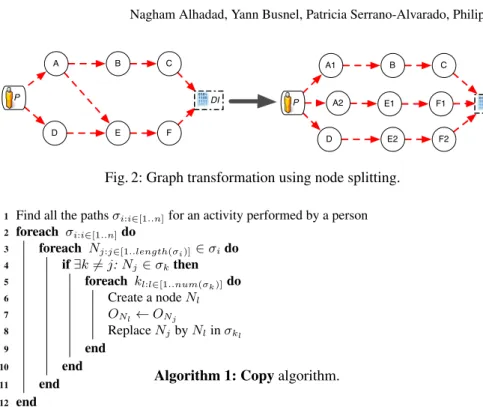
A B C F E D A1 B C F2 E2 D A2 E1 F1 DI P DI P
Fig. 2: Graph transformation using node splitting.
1 Find all the paths σi:i∈[1..n]for an activity performed by a person 2 foreach σi:i∈[1..n]do 3 foreach Nj:j∈[1..length(σi)]∈ σido 4 if∃k 6= j: Nj∈ σkthen 5 foreach kl:l∈[1..num(σk)]do 6 Create a node Nl 7 ONl← ONj 8 Replace Njby Nlin σkl 9 end 10 end 11 end 12 end
Algorithm 1: Copy algorithm.
Copy: this method is achieved by duplicating a common node into several different nodes as illustrated in Figure 2. The left side of this figure shows an example of a graph that has three dependent paths. The source node is P and the target node is DI. The dependent paths are: σ1= {A, B, C}, σ2= {A, E, F } and σ3= {D, E, F }. The
com-mon nodes are A, E and F . For instance, A is a comcom-mon node between σ1and σ2. By
applying Copy, A becomes A1, A2such that in the new graph, A1∈ σ′1= {A1, B, C}
and A2∈ σ′2= {A2, E, F }, so is the case for the nodes E and F . The right part of
Fig-ure 2 shows the new graph after duplicating the common nodes. The new graph contains the paths σ′1= {A1, B, C}, σ′2= {A2, E1, F 1} and σ′3= {D, E2, F 2}. Concerning
opinions, we keep the same opinion associated with the original node on the duplicated nodes. This method is based on the idea that the new produced path σ′ maintains the same opinion of the original path σ. In this case Oσ1 = Oσ′1 and Oσ2 = Oσ′2. This
method is shown in Algorithm 1.
Split: similar to Copy, nodes are duplicated to obtain independent paths as shown in Figure 2. In order to maintain the opinion on the global system, we split the opinion on the dependent node into independent opinions, such that their disjunction produces the original opinion. Formally speaking, if node A is in common between σ1and σ2and
the opinion on A is OA, A is duplicated into A1 ∈ σ′1and A2 ∈ σ′2and the opinion
OA is split into OA1 and OA2 where OA1 and OA2 satisfy the following relations:
^ nOA1∨ . . . ∨ OAn= OA OA1= . . . = OAn ⇒ bA1= bA2= . . . = bAn= 1 − (1 − bA) 1 n dA1= dA2= . . . = dAn= d 1 n A uA1= uA2= . . . = uAn= (dA+ uA) 1 n− d 1 n A aA1= aA2= . . . = aAn =(1−bA) 1 n −(1−bA−aAuA)n1 (dA+uA)n −dA1 n1 (7)
The proofs of Relation 7 are developed in [2]. Split algorithm is made by replac-ing Line 7 in Copy Algorithm by: “ONjk ← opinion resulted from Relation 7”.
4
Experimental evaluation
In this section, we compare Copy and Split to a modified version of TNA-SL [12], that is based on simplifying the graph by deleting the dependent paths that have high value of uncertainty (cf. Section 2.2). In TNA-SL, after the graph simplification, trust is propagated. In our work, trust is not propagated and a comparison to a propagation approach has no sense. Thus, we modify TNA-SL such that trust evaluation is made by applying Relations 4 and 6 introduced in Section 3. We call this method a modified TNA-SL (mTNA).
The objectives of the experiments are (i) to compare Copy and Split to mTNA to verify their behavior and observe the differences among the results, and (ii) to eval-uate their accuracy. Next sections present the experiments, their results, analysis and interpretation.
4.1 Comparing the proposed methods
To tackle the first objective, we experiment with a graph that contains only indepen-dent paths. The three methods, mTNA, Copy and Split give the same exact results as expected because the three of them follow the same computational model when graphs contain only independent paths. Then, we experiment on a graph that has relatively high rate of common nodes and dependent paths.75% of the paths of the chosen graph are dependent paths and60% of nodes are common nodes.
In our experiments, random opinions ON = (bN, dN, uN, aN) are associated with
each node, and the opinion’s probability expectation value of the graph, E(Oα) = bα+
aαuαis computed using the three methods, mTNA, Copy and Split. This experiment
is repeated50 times where each time represents random opinions of a person associated with the different nodes that compose the graph. We analyze the opinion’s probability expectation values of the graph, E(Oα) = bα+aαuαand not all the opinion parameters
Oα= (bα, dα, uα, aα).
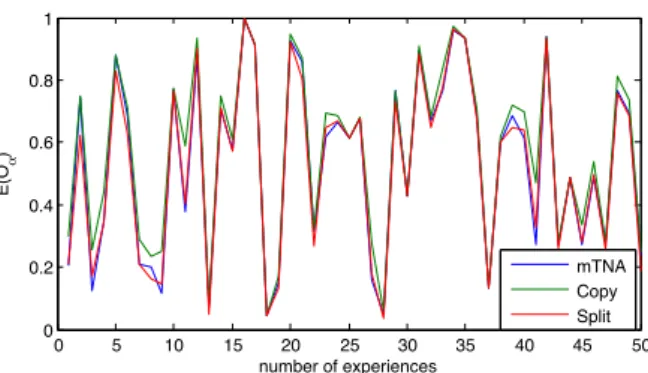
Figure 3 shows obtained results. We notice that the three methods almost have the same behavior, when the E(Oα) increases in one method it increases in the other
meth-ods, and vice versa. We also observe some differences among the three methods that are not always negligible like at experience9 and 40 in Figure 3. This observation led us to the question: which of these methods give the most accurate results? To evaluate the accuracy of Split, Copy and mTNA, we conduct other experiments explained in the next section.
0 5 10 15 20 25 30 35 40 45 50 0 0.2 0.4 0.6 0.8 1 number of experiences E(O α ) mTNA Copy Split
Fig. 3: Value of E(Oα) for 50 persons using the three methods mTNA, Copy and Split.
4.2 Studying the accuracy of the proposed methods
SOCIOTRUST[4], that uses theory of probability to evaluate trust in a system, has the advantages that it has no approximations in case there are dependent paths thanks to conditional probability (cf. Section 2.2). Thus it works perfectly if users are sure of their judgments of trust i.e., the values of uncertainty are equal to0.
Subjective logic is equivalent to traditional probabilistic logic when b+ d = 1 such that u = 0, i.e., the value of uncertainty is equal to 0. When u = 0, the operations in subjective logic are directly compatible with the operations of the traditional probabil-ity. In this case the value of E(O) = b + au = b corresponds to the value of probabilprobabil-ity. Since SOCIOTRUSTis based on probability theory, the obtained results by applying subjective logic if u = 0 should be equal to the ones using probability theory. We can evaluate the accuracy of the proposed methods by setting u = 0 and comparing the value of bα = E(Oα) resulted from applying the three methods to the trust value
obtained by applying SOCIOTRUST.
The experiments are conducted on the graph of Section 4.1. Random opinions ON = (bN, dN,0, aN) are associated with each node, and the probability expectation
of the graph E(Oα) = bα+ aαuα= bαis computed.
For simplicity, the notations TST, TMTNA, TCOPY, TSPLITrespectively denote system’s
trust value resulting from applying SOCIOTRUSTand system’s opinion probability ex-pectation resulting from applying mTNA, Copy and Split.
To make our comparision of TST versus TMTNA, TCOPY, TSPLIT, we simply compute
the subtractions between them i.e., TST − TMTNA, TST − TCOPY, TST − TSPLIT. The
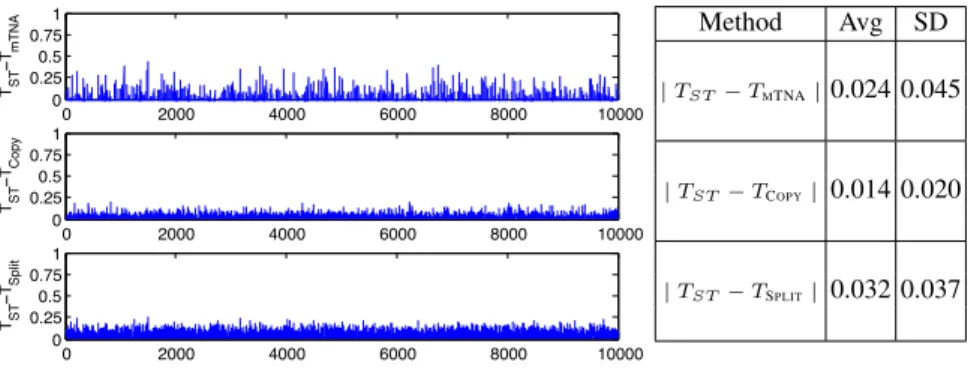
average of each of the previous values are computed through 10000 time to give a reliable average. The standard deviation(SD) is also computed to show how much variation from the average exists in the three cases. Figure 4 shows obtained results.
As we notice from Figure 4, Copy is the method that gives the closest results to SOCIOTRUST, the average of the difference of its result when u= 0 and the result of traditional probability over10000 times is equal to 0.014, which is an indication that this method gives the nearest result to the exact result and its average error rate is around 1.4%.
The average error rate of mTNA (2.4%) is less than Split (3.2%), but the standard deviation of mTNA is0.045 where in Split, it is 0.037. That means that in some cases,
0 2000 4000 6000 8000 10000 0 0.25 0.5 0.75 1 TST − TmTNA 0 2000 4000 6000 8000 10000 0 0.25 0.5 0.75 1 TST − TCopy 0 2000 4000 6000 8000 10000 0 0.25 0.5 0.75 1 TST − TSplit Method Avg SD | TST− TMTNA|0.024 0.045 | TST− TCOPY| 0.014 0.020 | TST− TSPLIT| 0.032 0.037
Fig. 4: The difference between the opinion’s probability expectation of a graph E(Oα)
using mTNA, Copy and Split when u = 0 and the trust value resulting from using SOCIOTRUST.
mTNA can give results that are farther than Split from the exact results. Thus, Split shows a more stable behavior than mTNA.
Copy shows the most convincing result. The average error rate is around0.014 and the standard deviation is0.02.
The objective of this experiment is not criticizing the proposed methods in the liter-ature for the problem of dependent paths. These methods are proposed to deal with the problem of trust propagation through a graph, whereas, in our work we focus on eval-uating trust towards the whole graph. The employed operators in our case are different from the employed operators in trust propagation. TNA-SL or any proposed method in the literature can work properly in their context.
In this experiment, we show that Copy, our new proposed method, is the method the more adaptable to be used with respect to the context of our work. Extensive simulations on different types of graphs are provided in [2] and follow the same behavior presented above.
5
Conclusion and perspectives
This paper presents SUBJECTIVETRUST, a graph-based trust model to evaluate user’s trust in a system for an activity from their trust in nodes in the system graph. SUBJEC -TIVETRUSTuses subjective logic to allow users to express their uncertainties in their jugement of trust. We propose two methods to face the problem of dependent paths in a graph for evaluating trust and through our experiments we show their accuracy in our contexte.
Our previous work [4], named SOCIOTRUST, that uses traditional probability, was confronted to real users through a real case-study. In SOCIOTRUST, 25% of users were not satisfied of the obtained results because they were not able to express their uncer-tainties about trust values using the traditional probability. SUBJECTIVETRUSTallows users to express their uncertainty because it is based on subjective logic. In a future work, we aim to confront SUBJECTIVETRUST approach to real users through a real case-study.
References
1. I. Agudo, C. Fernandez-Gago, and J. Lopez. A Model for Trust Metrics Analysis. In
Pro-ceedings of the 5th international conference on Trust, Privacy and Security in Digital Busi-ness (TrustBus), pages 28–37, 2008.
2. N. Alhadad, Y. Busnel, P. Serrano-Alvarado, and P. Lamarre. Graph-Based Trust Model for Evaluating Trust Using Subjective Logic. Technical Report hal-00871138, LINA – CNRS : UMR6241, Oct. 2013.
3. N. Alhadad, P. Lamarre, Y. Busnel, P. Serrano-Alvarado, M. Biazzini, and C. Sibertin-Blanc. SocioPath: Bridging the Gap between Digital and Social Worlds. In Proceedings of the 23rd
International Conference on Database and Expert Systems Applications (DEXA), pages 497– 505, 2012.
4. N. Alhadad, P. Serrano-Alvarado, Y. Busnel, and P. Lamarre. Trust Evaluation of a System for an Activity. In Proceedings of the 10th International Conference on Trust, Privacy &
Security in Digital Business, (TrustBus), pages 24–36, 2013.
5. K. Cook. Trust in Society. New York: Russell Sage Foundation, 2001.
6. D. Gambetta. Can we Trust Trust. Trust: Making and breaking cooperative relations, pages 213–237, 2000.
7. J. Golbeck. Computing and Applying Trust in Web-based Social Networks. PhD thesis, Department of Computer Science, University of Maryland, 2005.
8. J. Golbeck and J. A. Hendler. Inferring Binary Trust Relationships in Web-Based Social Networks. ACM Transactions on Internet Technology, 6(4):497–529, 2006.
9. C.-W. Hang, Y. Wang, and M. P. Singh. Operators for Propagating Trust and their Evaluation in Social Networks. In Proceedings of the 8th International Conference on Autonomous
Agents and Multiagent Systems (AAMAS), pages 1025–1032, 2009.
10. A. Jøsang. A Logic for Uncertain Probabilities. International Journal of Uncertainty,
Fuzzi-ness and Knowledge-Based Systems, 9(3):279–311, 2001.
11. A. Jøsang and T. Bhuiyan. Optimal Trust Network Analysis with Subjective Logic. In
Proceeding of the 2nd International Conference on Emerging Security Information, Systems and Technologies (SECURWARE), pages 179–184, 2008.
12. A. Jøsang, R. Hayward, and S. Pope. Trust Network Analysis with Subjective Logic. In
Proceedings of the 29th Australasian Computer Science Conference (ACSC), pages 85–94, 2006.
13. A. Jøsang, R. Ismail, and C. Boyd. A Survey of Trust and Reputation Systems for Online Service Provision. Decision Support Systems, 43(2):618–644, 2007.
14. L. Li and Y. Wang. A Subjective Probability Based Deductive Approach to Global Trust Evaluation in Composite Services. In Proceedings of the 9th IEEE International Conference
on Web Services (ICWS), pages 604–611, 2011.
15. G. Liu, Y. Wang, M. Orgun, and E. Lim. Finding the Optimal Social Trust Path for the Se-lection of Trustworthy Service Providers in Complex Social Networks. Services Computing,
IEEE Transactions on, PP(99):1, 2011.
16. M. Richardson, R. Agrawal, and P. Domingos. Trust Management for the Semantic Web. In Proceedings of the 2nd International Semantic Web Conference (ISWC), pages 351–368, 2003.
17. E. M. Uslaner. The Moral Foundations of Trust. Cambridge, UK: Cambridge University Press, 2002.
18. P. Zhang, A. Durresi, and L. Barolli. Survey of trust management on various networks. In Proceedings of the 5th International Conference on Complex, Intelligent and Software