HAL Id: hal-01209845
https://hal.archives-ouvertes.fr/hal-01209845
Submitted on 3 Jun 2020
HAL is a multi-disciplinary open access
archive for the deposit and dissemination of
sci-entific research documents, whether they are
pub-lished or not. The documents may come from
teaching and research institutions in France or
abroad, or from public or private research centers.
L’archive ouverte pluridisciplinaire HAL, est
destinée au dépôt et à la diffusion de documents
scientifiques de niveau recherche, publiés ou non,
émanant des établissements d’enseignement et de
recherche français ou étrangers, des laboratoires
publics ou privés.
Spontaneous co-assembly of proteins for encapsulation of
a hydrophilic vitamin.
Anne Laure Chapeau, Guilherme Miranda-Tavares, Pascaline Hamon,
Thomas Croguennec, Said Bouhallab, D Poncelet
To cite this version:
Anne Laure Chapeau, Guilherme Miranda-Tavares, Pascaline Hamon, Thomas Croguennec, Said
Bouhallab, et al.. Spontaneous co-assembly of proteins for encapsulation of a hydrophilic vitamin..
23.International Conference on Bioencapsulation, Sep 2015, Delft, Netherlands. 2015. �hal-01209845�
SPONTANEOUS CO-ASSEMBLY OF PROTEINS
FOR ENCAPSULATION OF A HYDROPHILIC VITAMIN.
Chapeau A.L.1,2., Tavares M.G.1,2,3., Hamon P. 1,2, Croguennec T.1,2., Poncelet D. 4, Bouhallab S.* 1,2
1INRA, UMR1253 STLO, 35042 Rennes, France ([email protected]).
INTRODUCTION AND OBJECTIVES
Encapsulation of bioactive compounds such as vitamins and micronutrients is a great challenge to develop new functional foods. There is a growing demand from consumers for food products offering health benefits such as products enriched with vitamins. At the same time, consumers tend to favor natural food or products with minimal amount of additives. The encapsulation of bioactives usually resorts to extraneous components that are not natural constituents of the targeted food product. It could therefore be relevant to seek to encapsulate bioactive molecules by means of intraneous components that are natural constituents of the targeted food product.
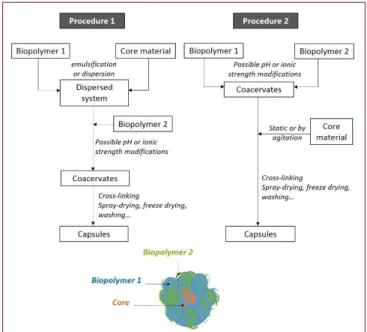
Among food constituents, food proteins are biopolymers that appear suitable for the transport and protection of several bioactives. Recent studies have reported the ability of two oppositely charged milk proteins, beta-lactoglobulin (BLG) and lactoferrin (LF), to spontaneously co-assemble to form heteroprotein complexes called “coacervates” (Anema et al., 2014; Tavares et al., 2015). Complex coacervation is a well-known phase separation between two oppositely charged macromolecules, into a concentrated phase of coacervates and dilute phase. It can be used as an encapsulation technique. In the literature, two general procedures can be found to encapsulate a compound by the complex coacervation of two biopolymers.
The objective of this work is to investigate the potentialities of coacervates entirely made from food proteins to encapsulate a bioactive compound according to these procedures. We investigated the potentiality of BLG-LF coacervates to encapsulate the hydrophilic vitamin B9 (B9).
MATERIAL AND METHODS
Encapsulation of B9 by BLG-LF co-assembly.
LF and BLG were mixed with B9 following the encapsulation procedure by coacervation (Fig. 1). B9 was mixed either with BLG or LF at a certain ratio and controlled pH. After ten minutes, the other protein was added to the system either at the same initial pH or after a drop of pH. All systems were mixed at room temperature. A range of mixing ratios, and pH conditions were tested according to a screening experimental plan in order to determine the ratios and pH conditions that lead to B9-BLG-LF co-assembly.
Characterization of the B9-BLG-LF co-assembly. Co-assembly of B9-BLG-LF was assessed by turbidity measurements. Co-assembly formation and final shapes of the encapsulated systems were followed by phase contrast microscopy (micrographs) and live phase contrast microscopy (films).
B9 loading capacity of B9-BLG-LF co-assembly. Mixed systems of B9-BLG-LF were centrifuged at 28 000g for 30 min. Concentrations of B9, BLG and LF in the supernatants were determined by RP-HPLC and used to determine the remaining concentrations into the pellet by subtraction. These fractions were used to calculate two key parameters of the co-assembly, the co-assembly formation and its loading capacity for B9, according to the following equations:
Co-assembly formation = Mco-assembly / Minitial [1]
= (MB9+MLF+MBLG)pellet / (MB9+MLF+MBLG)initial
B9 Loading capacity = (MB9)pellet / Mco-assembly [2]
= (MB9)pellet / (MB9+MLF+MBLG)pellet
RESULTS AND DISCUSSION
Effect of initial pH and mixing ratio on B9-BLG-LF co-assembly.
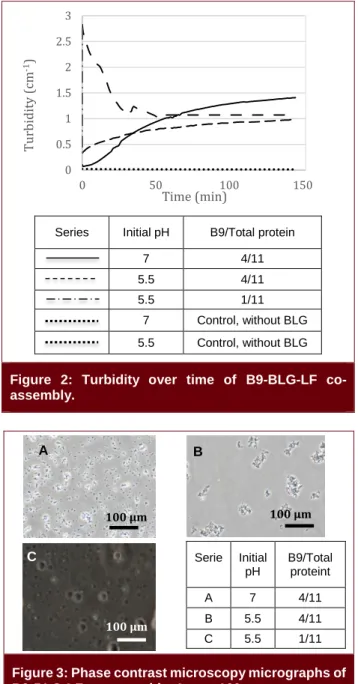
Turbidity measurements presented three different kinetics profiles according to pH conditions and mixing ratio (Fig. 2): two profiles where turbidity increased over time up to a maximum and one profile where turbidity is maximum with BLG introduction and then decreased. In addition, the control series show no turbidity. This suggests that, the increase of turbidity may be associated with BLG and LF spontaneous co-assembly in presence of B9.
According to the micrographs of the three turbid systems (Fig. 3), we identified three different types of B9-BLG-LF co-assembly: small aggregates (A), large aggregates (B) and microspherical coacervates (C). Linking micrographs with turbidity profiles, it can be deduced that B9-BLG-LF self-aggregation has a rather low kinetics compared to B9-BLG-LF complex coacervation which happened spontaneously with BLG introduction and lead to the formation of microsphere coacervates. As the turbidity decreased, the coacervate phase is probably unstable.
Figure 1: General procedures used to encapsulate a core molecule by the complex coacervation of two biopolymers.
Series Initial pH B9/Total protein 7 4/11 5.5 4/11 5.5 1/11 7 Control, without BLG 5.5 Control, without BLG
Figure 2: Turbidity over time of B9-BLG-LF co-assembly.
B9-BLG-LF microspheres formation by complex coacervation.
Co-assembly by complex coacervation is a spontaneous phenomenon which occurs through electrostatic interactions between two oppositely charged biopolymers and can lead, depending on the system, to microspheres formation (Yan et al., 2013). Micrographs in Fig. 4 showed the microspheres formation by complex coacervation resulting from adding
BLG to a mixed system of LF and B9. We evidenced the growth of microspheres over time, until 5 µm diameter for the smallest and 25 µm diameter for the biggest within 5min.
Loading capacity of B9-BLG-LF microspheres.
Table 1: Co-assembly formation and B9 loading capacity of B9-BLG-LF co-assembly in situation of microspheres formation. B9/Total protein Co-assembly formation B9 Loading capacity 4/3 0.87 0.64 6/3 0.89 0.73 10/3 0.92 0.81 4/11 0.93 0.60 6/11 0.94 0.70 10/11 0.95 0.91
Table 1 evidenced that for a fixed total protein content, microspheres formation by co-assembly [1] was promoted by an increase of B9. Loading capacity of microspheres [2] ranged from 0.60 to 0.91 depending on the B9/total protein ratios. The higher loading capacity is obtained for the higher microspheres formation. This indicates that, B9-BLG-LF microspheres co-assembly may be viewed as a viable loading system to encapsulate B9.
CONCLUSION AND PERSPECTIVES
BLG and LF are able to spontaneously co-assemble with B9 into aggregates or coacervates depending on the mixing ratio and pH. Coacervates are obtained by the complex coacervation process and lead to the formation of microspheres. B9-BLG-LF microspheres present a high loading capacity for B9. These results demonstrate that BLG-LF microspheres can be used to encapsulate a hydrophilic bioactive compound by complex coacervation. Now, the stability of these structures has to be investigated. These co-assembly has potential to improve the nutritional characteristics of a food product while ensuring its naturality as whey proteins are used as encapsulating agents.
REFERENCES
Anema S.G. and de Kruif C.G., 2014. Complex
coacervates of lactotransferrin and β-lactoglobulin. J.
Colloid Interface Sci. 430, 214–220.
Tavares G.M., Croguennec T., Hamon, P., Carvalho A.F., Bouhallab S., 2015. Selective coacervation between
lactoferrin and the two isoforms of beta-lactoglobulin.
Food Hydrocoll. 48, 238–247.
Yan Y., Kizilay E., Seeman D., Flanagan S., Dubin P.L., Bovetto L., Donato L., Schmitt C., 2013. Heteroprotein
Complex Coacervation: Bovine β-Lactoglobulin and Lactoferrin. Langmuir 29, 15614–15623.
Acknowledgement and Full address
We thank BBA association, UMR STLO, Regional councils of Brittany and Pays de la Loire who funded this work through PROFIL project, carried out by « Pole Agronomique Ouest ».
2Agrocampus Ouest, UMR1253, 35042 Rennes, France. 3Laboratory Research in Milk Products, 36570 Vicosa, Brazil. 4ONIRIS, UMR CNRS GEPEA 6144, 44322 Nantes, France.
Serie Initial pH B9/Total proteint A 7 4/11 B 5.5 4/11 C 5.5 1/11
Figure 3: Phase contrast microscopy micrographs of B9-BLG-LF co-assembly, 1cm = 100µm.
Figure 4: B9-BLG-LF microspheres formation by live phase contrast microscopy, 1cm=25µm.
A B C 100 µm 100 µm 100 µm 0 0.5 1 1.5 2 2.5 3 0 50 100 150 T urbid ity (cm -1) Time (min)