Science Arts & Métiers (SAM)
is an open access repository that collects the work of Arts et Métiers Institute of
Technology researchers and makes it freely available over the web where possible.
This is an author-deposited version published in:
https://sam.ensam.eu
Handle ID: .
http://hdl.handle.net/10985/18656
To cite this version :
Emmanuel RICHAUD, Ludmila AUDOUIN, Xavier COLIN, BRUNO FAYOLLE, Jacques VERDU
-New Developments in the Field of Radiochemical Ageing of Aromatic Polymers - 2012
Any correspondence concerning this service should be sent to the repository
Administrator :
[email protected]
New Developments in the Field of
Radiochemical Ageing of Aromatic Polymers
Emmanuel Richaud, Ludmila Audouin,
Xavier Colin, Bruno Fayolle and Jacques Verdu
Arts et
Metiers ParisTech, CNRS, PIMM,
France
1.
Introduction
Polymers having an aromatic backbone polymers have a high mechanical strength and a high modulus. Their aromaticity increases their resistance for use in relatively severe conditions especially in aerospace and nuclear industry for which lifetime prediction is a key issue. For example, a challenge for nuclear plants is to extend lifetime from the initially planned 40 years duration to 50 or 60 years, which makes necessary to determine lifetime by a non-empirical method. Since polymers mechanical failure originates from chain scission or crosslinking of the backbone, the ideal method of lifetime prediction would first involve the elaboration of a kinetic model for chain scission and
crosslinking. Then, the changes of molecular mass would be related to the changes of mechanical properties using the available laws of polymers physics. Lifetime would be then determined using a pertinent lifetime criterion. A noticeable difficulty comes here from the fact that oxidation, which plays a key major role in chain scission, is diffusion controlled and thus heterogeneously distributed in sample thickness. It is crucial, indeed, to determine experimentally and to predict this depth distribution of chain scission and crosslinking because it will play a key role on fracture properties. This chapter will be henceforward devoted to the effect of aromaticity on radiostability, the effect on temperature on the chain scission/crosslinking competition, the diffusion limited oxidation (which will be illustrated by the effect of dose rate, atmosphere and sample thickness), then some concluding remarks on oxidative stability of aromatic polymers and the possible link with the absence of macromolecular mobility below Tg.
We will start by some basics of radiochemistry which are necessary for the good understanding of this paper, and especially the quantitative treatment for crosslinking and chain scission.
2.
Basics of radiochemical degradation
Let us first consider the reaction:
A + h B
The radiochemical yield is defined as the number of B molecules that are generated per absorbed joule:
7 17 Av n N 1 G' 10 .G E' N E (1.6 10 ) (1) where:
- G’ is the radiochemical yield expressed in mol J-1,
- n is the number of moles of B which is formed by the radiochemical reaction, - E’ is the amount of absorbed energy in J,
- E is the amount of absorbed energy in 100 eV, - N is the number of B molecules,
- NAv is the Avogadro’s number,
- G is the yield in molecules per 100 eV absorbed.
Since the absorbed dose (denoted by and expressed in Gy) is defined as the amount of received energy (in J) per kilogram of polymer, the following equation can be derived:
7 n 10 .G.δ m (2) So that: 7 dc r 10 .G.I dt (3)
r being the rate of a radiochemical event (in mol l-1 s-1), I the dose rate in Gy s-1 and c the
concentration of reacted or generated species (in mol kg-1 even if one often considers that it
is the same than in mol l-1).
2. Mathematical treatment for chain scission and
crosslinking
Irradiation can provoke both chain scission and crosslinking, the relative proportion of these phenomena depending on many factors which will be presented in the following. The radical coupling may lead to trifunctionnal or tetrafunctionnal crosslinking noduli called respectively Y- and H-crosslinkings (Fig. 1):
° ° H-crosslinking ° ° Y-crosslinking
Fig. 1. Reaction of H- and Y- crosslinking.
The radiochemical yields for chain scissions G(s) and crosslinking G(x) in thick samples can be tentatively assessed using
- The Charlesby-Pinner’s (Charlesby, 1960) from an analysis of the residual soluble fraction after beginning of sol-gel transition,
- Saito’s equations (Saito, 1958) describing the average molar mass changes for soluble polymers before the sol-gel transition.
The corresponding mathematical treatment of these theories differs for Y- and H- crosslinking:
1. In the case of H- crosslinking mode:
7 H H N N0 1 1 s x 10 . G (s) G (x) .δ M M (4) 7 H H W W0 1 1 s G (s) 2x 10 . 2G (x) .δ 2 2 M M (5) 7 1/2 H S S W0 H H G (s) 10 w w 2G (x) M .G (x).δ (6)2. In the case of Y- crosslinking mode:
7 Y Y N N0 1 1 s x 10 . G (s) G (x) .δ M M (7) 7 Y Y W W0 1 1 s G (s) x 10 . G (x) .δ 2 2 M M (8) 7 1/2 Y S N0 Y Y 2G (s) 1.93 10 1 3w G (x) M .G (x).δ (9) where:- wS = 1 - wI is the soluble fraction,
- GH(s), GH(x), GY(s), and GY(x) are the radiochemical yields expressed for 100 eV
respectively for chain scissions and crosslinking for an H- and a Y- crosslinking mechanism,
- is the dose (Gy)
- MN0 and MW0 are respectively the initial number and weight average molar mass (kg
mol-1).
3.
Effect of aromaticity on radiostability
The degradation of aromatic polymers was studied by many authors: 1. By monitoring mechanical properties (Sasuga et al., 1985, see Table 1):
These results give a first indication on the relative radiostability of aromatic polymers. Let us first mention that these lethal doses are considerably greater than those compiled by Wilski for polymer having an aliphatic backbone (Wilski, 1987). It can be attributed to the well-known stabilizing effect of aromatic groups which was first observed on methyl methacrylate-styrene copolymers (Alexander & Charlesby, 1954, Kellman et al., 1990,
Thominette et al., 1991). However, the results of these studies cannot be directly used in kinetic models for aromatic polymers.
Polymer 50% 20% Kapton 500 10 90 Upilex 35 60 Ultem 1.5 4 A-Films 15 25 A-Paper 20 30 PEEK non-cryst 20 50 PEEK cryst 8 30 U-polymer 0.5 2 Udel-Polysulphone 0.75 1 PES 0.5 0.75
Noryl (modified PPO) 0.75 1.5
Table 1. Dose for reducing strain at break to 50% and 20% of initial value for various aromatic polymers submitted to 5.103 Gy s-1 in air (sample thickness ~ 0.1-0.2 mm) (Sasuga
et al., 1985).
2. By radical appearance measured by Electron Spin Resonance spectroscopy (Heiland et al., 1996, see Fig. 2):
0 2 4 6 8 10 12 14 16 0 5 10 15 20 25 30 35 10 -1 7.[ R °] (spin g -1) dose (kGy)
Fig. 2. Concentration in radicals versus dose measured in PPO (), Kevlar (), PSU (), PEPO (), Ultem (), Kapton (), PEEK () in aromatic polymers under 1 - 5 kGy h-1 dose
rate at 77 K (Heiland et al., 1996).
Data presented in Fig. 2 permit the yield in radical build-up to be calculated according to the simplified scheme for radiochemical degradation in the absence of oxygen:
Polymer (PH) + h P° ri P° + PH PH + P° kP P° P° + s kR P° + P° P–P + x kC P° + P° F + PH kD Initiation: Propagation: -scission: Termination by coupling: Termination by disproportionnation:
Where F is a double bond. The rate of radical formation is:
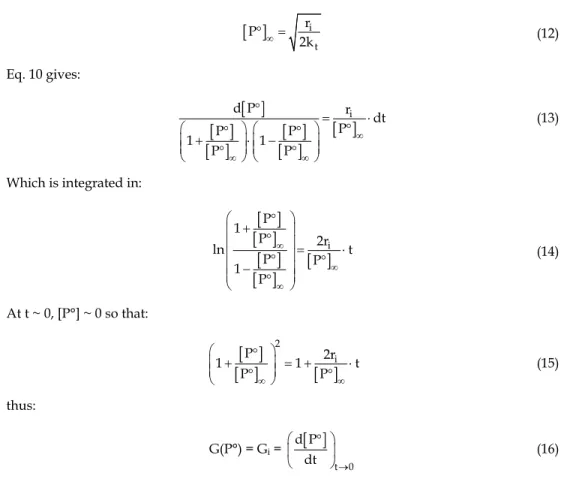
2 i t d P r 2k P dt (10) with: kt = kC + kD (11)Fig. 2 indicates the existence of an asymptote characterizing a steady-state at which the concentration in radicals is:
i t r P 2k (12) Eq. 10 gives:
i d P r dt P P P 1 1 P P (13)Which is integrated in:
i P 1 P 2r ln t P P 1 P (14) At t ~ 0, [P°] ~ 0 so that:
2 i P 2r 1 1 t P P (15) thus: G(P°) = Gi =
t 0 d P dt (16)The corresponding yields for radical build-up are given in Table 2.
Let us first mention that Table 1 results correspond to degradation under air, meanwhile Table 2 results correspond to degradation in inert environment, the possible influence of oxygen being discussed in the following. However, it can be checked that the lethal dose (or dose to reach an arbitrarily chosen threshold for a mechanical property) varies oppositely with the estimated G(P°) values.
Polymer G(P°) PPO 1.35 Kevlar® 1.25 PSU 0.75 Bis-A-PEPO 0.55 Ultem 0.50 Kapton® 0.40 PEEK 0.25
Table 2. Yields for radical build-up for aromatic polymers irradiated under 1 - 5 kGy h-1 dose
rate at 77 K.
- By gas yield emission:
Concerning the yield for total gas emission, it can be checked that there is no great difference between gamma, proton and electron-beam irradiation (Hegazy et al., 1992b, Hill & Hopewell, 1996) and that these values are considerably lower than those measured for aliphatic polymers such as PE or PP (Schnabel, 1978). An example is worth to be mentioned (Schnabel, 1978): aliphatic polysulfones have a gas emission yield equal to 39 (poly butene-1-sulfone) or 71 (poly hexene-1-butene-1-sulfone) meanwhile PES or PSU gas emission yields are lower than 1, illustrating here the protective effect by aromatic rings. However, the relative proportion of each emitted gas can vary due to some differences in temperature rising under irradiation. As it will be seen below, this difference due to irradiation nature has a lower influence on the radio induced degradation of polymer than temperature, nature of environment atmosphere and oxygen gradient in sample thickness.
I (kGy h-1
) Gaz Kapton Upilex-R Upilex-S PEEK-c PEEK-a PES U-PS U-Polymer
Total 24.0 22.0 91.0 39.0 54.0 46.0 150.0 480.0 H2 3.2 0.4 7.5 - 14.0 7.1 39.0 72.0 N2 5.1 9.7 14.0 6.4 - - - -CO 5.4 2.4 1.4 12.0 6.0 16.0 19.0 220.0 CO2 8.1 4.8 15.0 4.3 24.0 19.0 25.0 180.0 CH4 1.0 0.1 0.3 0.2 0.3 0.3 16.0 12.0 SO2 - - - 12.0 13.0 -Total 25.0 17.0 18.0 31.0 39.0 69.0 210.0 460.0 H2 4.9 1.3 2.4 10.0 12.0 19.0 62.0 80.0 N2 0.2 0.1 2.8 - - - -CO 3.4 2.2 2.4 5.1 5.5 8.3 32.0 220.0 CO2 10.0 3.9 8.8 9.5 16.0 16.0 16.0 120.0 CH4 0.8 - 0.3 0.2 0.2 0.4 13.0 32.0 SO2 - - - 23.0 43.0 -10 6120
3. Let us turn to the radiation-induced crosslinking observed in PEEK and PSU.
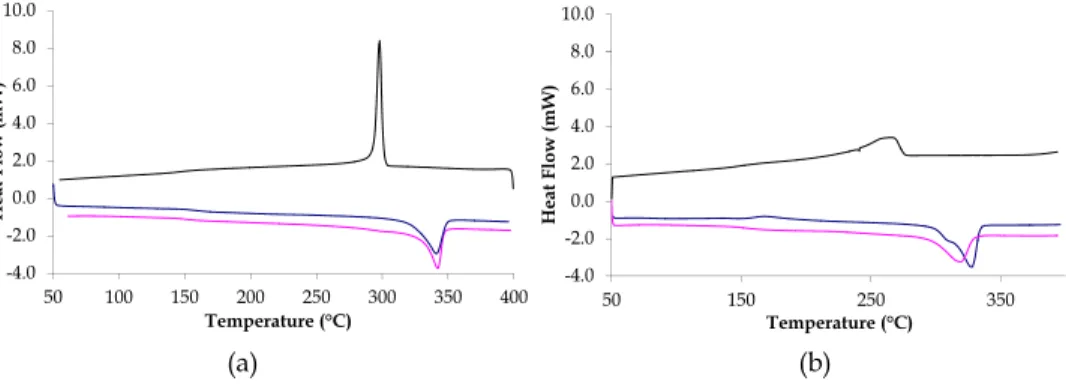
Fig. 3 depicts the changes in thermal behavior which are induced by radio-ageing for a thick PEEK sheath under air (Richaud et al., 2010a). As it will be seen later, the observed behavior is comparable to the one obtained for an irradiation under vacuum. Virgin and degraded samples were characterized by DSC heating-cooling-heating cycle.
- In the case of virgin sample, melting endotherms for the first and the second heating ramps are very comparable (peak temperature and enthalpy). The crystallization from molten state is characterized by a sharp exotherm at c.a. 300°C.
- In the case of 30.7 MGy irradiated sample, melting endotherm for the second heating ramp and crystallization exotherm are shifted to the lower temperatures with a lower transition enthalpy. -4.0 -2.0 0.0 2.0 4.0 6.0 8.0 10.0 50 100 150 200 250 300 350 400 He at F lo w ( m W ) Temperature (°C) -4.0 -2.0 0.0 2.0 4.0 6.0 8.0 10.0 50 150 250 350 H eat Flow ( m W) Temperature (°C) (a) (b)
Fig. 3. Heating-cooling-heating cycle by DSC for non-irradiated (a) and 30.7 MGy irradiated PEEK sample.
During irradiation of semi-crystalline polymers, chain scission and crosslinking occur only in amorphous phase, the crystalline phase undergoes only small changes so that melting characteristics remain almost unchanged at the first heating scan. After a first melting however, the sample is homogenized, and the changes of molar mass, branching ratio or crosslink density resulting from irradiation affect melting and crystallization. Irradiation effects become then observable by DSC. Here, the decrease of crystallization temperature and enthalpy is explained by the occurrence of radiation-induced crosslinking (Sasuga, 1991). This latter disfavors crystallization because it lowers the transport rate of chain segments from the melt to growing crystals. As a consequence, the degree of crystallinity and the lamellae thickness are decreased that explains the observed decrease of melting point and melting enthalpy.
Comparable data were obtained by Hegazy (Hegazy et al., 1992c). Tg values from this study
are reported (Fig. 4):
It is well known that for a linear polymer, Tg is an increasing function of molar mass.
According to Fox and Flory (Fox & Flory, 1950): FF g g0 N k T T M (17)
Where:
- Tg0 is the Tg of a virtual infinite polymer (K).
- MN is the number average molar mass (kg mol-1).
- kFF is a constant characteristic of the chain chemical structure (K kg mol-1).
y = 0.2792x + 143 R2 = 0.9846 y = 0.551x + 151 R2 = 0.8428 142 144 146 148 150 152 154 156 158 0 2 4 6 8 10 dose (MGy) Tg (°C )
Fig. 4. Tg changes for PEEK amorphous () and semi-crystalline () samples irradiated
under vacuum.
For a network, Tg is an increasing function of crosslink density. According to Di Marzio
(DiMarzio, 1964): gl g DM A T T 1 k .F. (18) Where:
- Tgl is the Tg of a virtual linear polymer containing all the structural units of polymer
except crosslinks (K).
- F is a flex parameter linked to chain stiffness (kg mol-1).
- A is the concentration in elastically active chains, which is calculated from crosslinks
concentration (mol kg-1).
Under vacuum, chain scission is generally negligible. Above gel point, it seems to us that Tg
changes are given by combining Fox-Flory relationship and Saito’s equation (assuming first that s << x): g g 7 FF dT dT dx 10 .G(x).k dδ dx dδ (19) One obtains:
- G(x) ~ 0.012 for amorphous PEEK, - G(x) ~ 0.023 for semi-crystalline one.
It seemed to us interesting to compare radio-induced gelation for PEEK, PSU and PES (Fig. 5).
(a) (b) Fig. 5. Gel formation for PSU at 210°C (), 180°C (), 100°C (), 60°C (), room
temperature () from Murakami & Kudo, 2007, Richaud et al., 2011), and PEEK (: 24 kGy h-1, ,,: 60 MGy h-1 for 3 different initial crystalline microstructures) samples irradiated
at several temperatures (Vaughan & Stevens, 1995 , Richaud, 2010a).
From the above given mechanistic scheme where chain scission results from radical rearrangement and crosslinking results from radical coupling scheme, the following stationary rate expressions can be derived:
- Rate of chain scission:
ds dt = 1/2 R i C D k r 2 k k (20) - Rate of crosslinking: C i C D k dx r dt2 k k (21)
Assuming that disproporationation is negligible compared to coupling for polymers under study, it comes:
i dx r
dt 2 (22)
So that : Gi = 2G(x) in the absence of oxygen.
It seems that this relationship disagrees with experimental results in the case of aromatic polymers which will be discussed next.
As a conclusion of this short review of experimental results, it is clear that aromatic polymers belong the family of relatively radiostable polymers because primary radiochemical events, presumably radiolytic chain scissions of C-H bonds, have a radiochemical yield less than 0.5, i.e. 5 to 50 times lower than for aliphatic polymers. Aromatic groups are actually able to dissipate a great part of the absorbed energy into reversible processes (fluorescence, phosphorescence...). Data militate in favour of the following ranking:
N C C C N C O O O O O C O N H C O C CH3 CH3 S O O > > > >
A comparison of the rate of gel content increase (Fig. 4) for samples irradiated at various temperatures and dose rates shows that gelation is more sudden in the case of PSU and more progressive in PEEK which means that radiation generated radicals would be more reactive for PSU than PEEK.
Data also show unambiguously:
- The protective effect of aromaticity: Kapton®, which is the most aromatic polymer, presents a very limited degradation, or even no significant degradation (Kang et al., 2008, Richaud et al, 2010b).
- The role of SO2 moiety: experimental results for radiochemical yields values (Horie &
Schnabel, 1984) shows that aliphatic polysulfones are among the less stable polymers with G(s) values on the order of 10. High yields of SO2 emission are also observed
indicating thus the probable existence of the weak (Li & Huang, 1999, Molnár et al., 2005) carbon-sulfone bond cleavage. It seems reasonable to suppose that such events occur also in PSU even though the yield is considerably lower owing to the well-known protective effect of aromatic nuclei illustrated for instance in studies on isobutylene-styrene.
- The role of isopopylidene group: gelation is undoubtedly due to the coupling of alkyl radicals. The difference in gelation rate would be explained by the nature of radicals: in PEEK, only aryl radicals can react meanwhile both aryl and primary methyl radical can react in PSU.
°
°
C CH3 CH2° C CH2° CH3 C CH3 CH2 CH2 C CH3Theoretically, it seems that yields in gas emission G(gas) is half of yield radicals G(P°) as illustrated by proposal of degradation mechanisms below:
1. In isopropylidene containing materials: C CH3 CH3 C CH2° CH3 C CH3 + H° ° + CH3°
Then radicals react by coupling to give a gaseous molecule: H° + H° H2
CH3° + H° CH4
CH3° + CH3° C2H6
2. In sulfone containing polymer:
S O O S O O ° ° S O O ° ° + SO2
Analogous mechanisms could lead to carbon monoxide formation from PEEK. Data for Kapton®, PEEK and PSU (Table 1 and Table 2) seem also to show that:
G(P°) >> 2G(x) and 2G(gas)
PEEK and PSU values gathered in this work are compared with those for polyethylene (Khelidj 2006), and those compiled for cyclohexane and benzene (Ferry, 2008) in Table 4:
thickness
T (K)
dose rate
atmosphere
50%(MGy)
gel(MGy)
G (gas)
298
> 0.3
423
> 0.15
463
0.1
503
0.1
298
3
0.025
373
1.25
0.07
453
0.5
0.17
483
< 0.25
2
100 µm
50 µm
0.1 kGy s
-1He
vacuum
1.7 Gy s
-1Table 4. Yields for radicals, gas emission, crosslinking and double bond formation (corresponding to disproportionnation process). *: G(H2) is expected to be close to G(gas),
These results call for the following comments:
1. The effect of aromaticity on radiostability is confirmed.
2. The ratio G(P°)/G(gas) is surprisingly lower than 1 for cyclohexane, is fairly close to 2 for benzene and PE, but increases for PSU and PEEK.
A possible explanation is the existence of very stable radicals that would be detected by ESR but would contribute neither to gas emission nor to crosslinking (see later) as for example:
O O
°
Let us also note that the absence of contribution to gas emission seems easily explainable because the probability for generating a short and volatile segments from such macroradicals is very low.
3. The ratio G(P°)/(G(x)+G(F)) is also clearly greater than 2 for PSU and particularly for PEEK meanwhile it is close to 1 in PE and in cyclohexane. The comparison with benzene suggests that this behaviour is due to the macromolecular structure of radicals preventing them to react by coupling to give crosslinking.
In fact, even if a negative concavity is observed in Fig. 1 and indicates the existence of a termination process even at 77 K, the relatively low value of G(x) indicates that segmental mobility would be reduced below Tg, which will be discussed in a first section dedicated to
temperature effect and another one dealing with oxidizability.
4. Effect of temperature
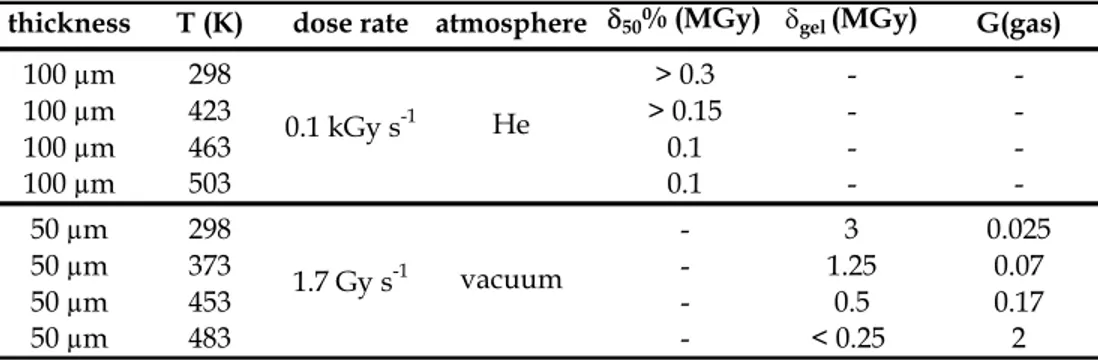
Data in Table 5 confirm that lethal dose (here. the necessary dose to half the initial elongation at break) and gel dose vary oppositely with temperature meanwhile gas emission yield would increase.
thickness T (K) dose rate atmosphere 50% (MGy) gel (MGy) G(gas)
100 µm 298 > 0.3 - -100 µm 423 > 0.15 - -100 µm 463 0.1 - -100 µm 503 0.1 - -50 µm 298 - 3 0.025 50 µm 373 - 1.25 0.07 50 µm 453 - 0.5 0.17 50 µm 483 - < 0.25 2 0.1 kGy s-1 1.7 Gy s-1 He vacuum
Table 5. Effect of temperature on lethal dose for PES (Sasuga & Hagiwara, 1987 and Murakami & Kudo, 2007).
As previously suggested, the only knowledge of changes in macroscopic (engineering) properties does not permit to ascribe the right cause of failure. Yields in chain scission and crosslinking permit to elucidate the degradation mechanism.
215
217
219
221
223
225
227
229
231
233
235
0
500
1000
1500
2000
2500
dose (kGy)
T
g(°C
)
Fig. 6. Change in Tg for PES submitted to electron beam irradiation at room temperature ()
or 230°C () (Li et al., 2006).
Before sol-gel transition, Tg changes are given by combining Fox-Flory law (Fox & Flory,
1950) with Saito’s equation (Saito, 1958) irrespectively of H- or Y-crosslinking mode:
7 g g0 FF FF N N0 1 1 T T k . 10 .k . G(s) G(x) . M M (23) It turns into:- for a pure crosslinking mechanism:
g 7 FF dT 10 .k .G(x) d (24)
- for a pure chain scission mechanism:
g 7 FF dT 10 .k .G(s) d (25)
Results presented in Fig. 5 indicate that crosslinking predominates above Tg, whereas chain
scission predominates below Tg. Comparable exploitation can be done from other published
results (Murakami & Kudo, 2007, Brown & O’Donnell, 1979):
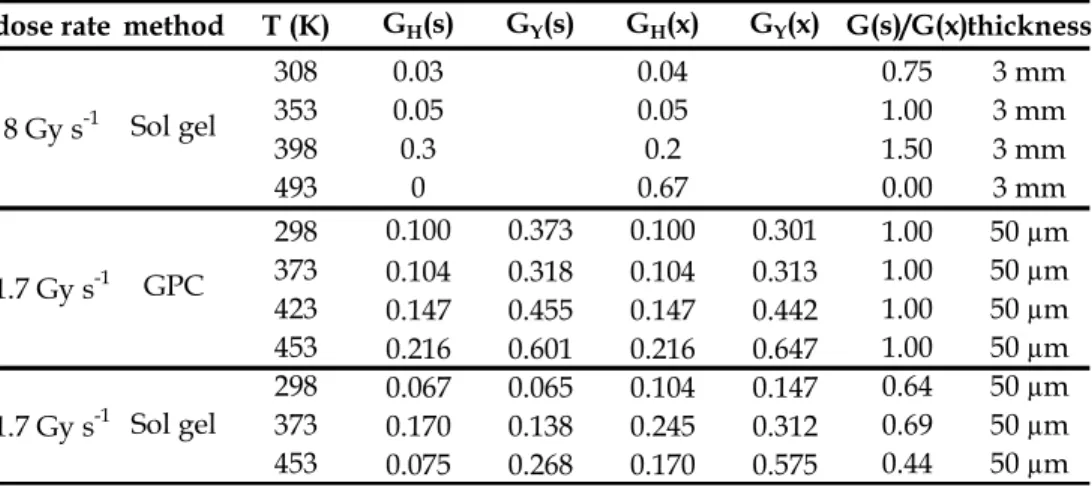
All data converge towards the fact that G(x) increases with temperature. Despite some scattering, it also suggests that G(s)/G(x) decreases with temperature. According to Brown and O’Donnell (Brown & O’Donnell, 1979), it falls to 0 above Tg.
The results in Table 6 can be explained as follows: irradiation creates macroradicals. At low temperature, they react by an unimolecular process which generates a chain scission (possibly accompanied by gas emission). At high temperature, macromolecular mobility is sufficient to permit macroradicals to react by coupling to give a crosslinking. According to Zhen (Zhen, 2001) most polymers can only crosslink above their melting point.
dose rate method T (K) GH(s) GY(s) GH(x) GY(x) G(s)/G(x)thickness 308 0.03 0.04 0.75 3 mm 353 0.05 0.05 1.00 3 mm 398 0.3 0.2 1.50 3 mm 493 0 0.67 0.00 3 mm 298 0.100 0.373 0.100 0.301 1.00 50 µm 373 0.104 0.318 0.104 0.313 1.00 50 µm 423 0.147 0.455 0.147 0.442 1.00 50 µm 453 0.216 0.601 0.216 0.647 1.00 50 µm 298 0.067 0.065 0.104 0.147 0.64 50 µm 373 0.170 0.138 0.245 0.312 0.69 50 µm 453 0.075 0.268 0.170 0.575 0.44 50 µm GPC 8 Gy s-1 Sol gel 1.7 Gy s-1 1.7 Gy s-1 Sol gel
Table 6. Effect of temperature on radiochemical yields in chain scissions and crosslinking (envisaging the possibility of H- or Y- crosslinking mode) (Murakami & Kudo, 2007, Brown & O’Donnell, 1979).
Let us now discuss of the possibility of Y- and H-crosslinking.
- At 150°C, Hill (Hill et al., 1998) unambiguously showed that PSU crosslinks in Y-mode. A comparable analysis was performed by Li (Li et al., 2006). A proposal of mechanism is shown below: C CH3 CH2° C CH3 CH2 °
- Kudo (Murakami & Kudo, 2007) proposed a Y-mechanism also. However, by reexaminating his results using the above equations, his conclusion is questioned. - Richaud (Richaud et al., 2011) proposed a H- crosslinking mechanism at 60°C, basing on
the observation that if isopropopylidene groups are generated, the C–CH2° group is
considerably more reactive than aryl one and should react by coupling to give C–CH2-CH2-C crosslinking bridges corresponding more to a H- crosslinking
mechanism.
As a conclusion, it seems that elevating the temperature promotes the crosslinking. However, the nature of this latter and presumably the role of temperature remain unclear.
5.
Effect of atmosphere and sample thickness
Results in Fig. 7 (Sasuga & Hagiwara, 1987) clearly show that oxygen accelerates the degradation of aromatic polymers.
(a) (b)
Fig. 7. Residual elongation as a function of dose for PSU (a) and PES (b) submitted to g-rays under air () or 0.7 MPa oxygen ().
The nature of the responsible process is suggested in a study on the degradation of PET films monitored by Tg measurements (Burillo et al., 2007): a strong Tg decrease is observed in air at
the beginning and is certainly due to chain scission whereas a moderate Tg decrease is
observed for irradiation under vacuum. As proposed by Sasuga (Sasuga, 1988), polymer radio-degraded under anaerobic conditions would undergo mainly crosslinking meanwhile they would undergo chain scissions when they are degraded under aerobic (oxidative) conditions. The effect of atmosphere nature and the effect of thickness have the same origin linked to oxygen diffusion: thick samples present a diffusion limited oxidation (DLO), i.e. that their surface undergoes an oxidative degradation leading to chain scission meanwhile bulk undergoes an anaerobic radio-ageing generating radicals reacting only by coupling.
This effect was quantified by comparing the degradation of thin and thick samples by means of GPC (for molar mass assessment and subsequently chain scission and crosslinking yields assessment) and Tg (Richaud et al., 2011). Tg decreases for both 2 mm and 200 µm
thick samples, but more significantly for thin films (Fig. 8) which is not surprising since Tg
decreases with chain scissions and increases with crosslinking.
1. Case of thin films
Thin films undergo certainly a “pure” random chain scissions process. A graphical estimation (Fig. 5) gave for the thin samples (using kFF ~ 220 K kg mol-1 for PSU):
g dT dδ ~ g g 6 T (0 MGy) T (5.0 MGy) 5.0 10 = 3.210-6 K Gy-1 from which one obtains G(s) ~ 0.15
2. Case of thick samples
Here, the simultaneous crosslinking compensates partially chain scissions consequences on Tg changes. For ideal networks having no dangling chains, the effect of crosslinking on Tg
obeys the DiMarzio’s law (DiMarzio,1964 – equation (18)) with: - Tgl ~ 473 K
- FPSU = 0.1105 kg mol-1
- kDM is the DiMarzio’s constant: kDM is close to 1
- is the elastically active chains concentration. For ideal tetrafunctional networks:
= 2.x (26)
x being the concentration of crosslinks events. Supposing that DiMarzio’s equation can be applied for non-ideal networks, Eq. 23 turns into the Fox-Loshaek (Fox & Loshaek, 1955) equation for low conversion of the crosslinking process:
Tg = Tgl + kFL.x (27)
with the Fox-Loshaek constant kFL being equal to:
kFL = 2.Tgl.F.kDM (28)
so that: kFL ~ 104 K mol kg-1
Finally, the global changes of Tg would be given by:
g g g dT T ds T dx . . dδ s dδ x dδ (29) so that:
g 7 FL FF dT 10 k .G(x) k .G(s) dδ Using G(s) ~ 0.15, one can simulate the experimental Tg decrease:
g dT
d = 15.610
-7 K Gy-1
with G(x) ~ 0.15.
In other words, effect of sample thickness is explained by the effect of oxygen diffusion (which will be developed in the next section): irradiation generates radicals. In the absence of oxygen (i.e. for the core a bulk sample), these later react together by coupling which gives a crosslinking phenomenon. When oxygen is present (which is the case for thin samples or
the superficial layer of a bulk sample), it orientates the degradation towards an oxidative mechanism with the formation of peroxy radicals POO°, and POOH of which decomposition induces chain scissions.
6. Effect of dose rate
This effect is illustrated by some results by Tavlet (Tavlet, 1997) presented in Fig. 9:
0
1
10
100
1000
0
1
10
100
dose (MGy)
St
re
ng
th (
M
Pa
)
o
r d
efo
rm
a
tio
n
(%
)
Fig. 9. Radiation degradation in an epoxy resin on strain (,), stress (,). Open symbols correspond to long term (low dose rate) ageing (Tavlet, 1997).
There are two effects to be distinguished:
- An increase in temperature involved by enhancing the dose rate,
- A physical and chemical effect linked to Diffusion Limited Oxidation, which will be described below.
From a simplified theory of diffusion controlled oxidation (Audouin et al, 1994), a rough estimation of oxygen consumption rate rOX in films or superficial layers of thick samples can
be done: O2 2 S OX 2 D .[O ] r TOL (30) where:
- TOL is the thickness of oxidized layer (m),
- DO2 is the oxygen diffusion coefficient in polymer amorphous phase (m2 s-1),
- [O2]S is the equilibrium concentration under atmospheric pressure given by Henry’s law:
[O2] = sO2PO2 (31)
sO2 being the solubility coefficient of oxygen in polymer amorphous phase.
PH + h P° + ½ H2 ri
P° + O2 P° k2
POO° + PH POOH + P° k3
POO° + POO° inact. prod. + O2 k6
ki being the rate constants (expressed in l mol-1 s-1).
The oxidation rate for oxygen consumption can be expressed as:
2 OX d O r dt = - k2.[P°][O2] + k6.[POO°]2 (32)Using the classical steady-state assumption:
k2.[P°][O2] = ri + k3.[POO°].[PH] (33) ri = 2k6.[POO°]2 (34) it comes:
i i OX 3 6 r r r k PH 2 2k (35)knowing that: rOX = 10-7.G(P°).I
I denoting the dose rate. Consequently, if: - I is very high i OX r r 2 (36) rOXI (37) TOL I-1/2 - I is moderate i
OX 3 6 r r k PH 2k (38) 1/2 OX r I (39) TOL I-1/4 (40)It is thus demonstrated that radiothermal oxidation is characterized by a skin-core structure: superficial layers are oxidized meanwhile bulk not. Results by Tavlet (Tavlet, 1997) are thus explained as follows: for irradiation performed under a relatively elevated dose rate, only a very thin polymer layer is degraded and time for drop of elongation at break is longer than for irradiation performed under a moderate dose rate. This reasoning is confirmed by the comparison of a bulk sample (4 mm) for which no dose rate effect is observed undoubtedly because the thickness of degraded superficial layer is negligible compared to the total thickness of bulk material. Examples of Oxidized layers measured for radiochemical degradation of aromatic polymers (Richaud et al., 2010a) are presented in Fig. 10 and confirm the existence of a Diffusion Limited Oxidation.
0.00 0.05 0.10 0.15 0.20 0.25 0 50 100 150 200 depth (µm) DO 3320
Fig. 10. Oxidation profiles in PEEK sheaths submitted to 10 MGy (), 20 MGy (), 30.7 MGy () -rays exposure (Richaud et al., 2010a).
7. On the radio-induced oxidizability of aromatic polymers
It seemed to us interesting to compare the k32/k6 ratio estimated from radiodegradation of
aromatic polymers with polypropylene or polyethylene ones. Let us recall that k32/k6
describes the oxidizability of a polymer irrespectively of the oxidation mode (i.e. photo, thermo- or radio-induced). k32/k6 can be calculated from Eq. (32) using:
- [PH] = /M, being the polymer density and M the molar mass of repetitive unit, - ri = 10-7.G(P°).I from Heiland’s results (Table 2),
- rOX from TOL measured for example in FTIR mapping mode (Eq (30)).
One can use with a good approximation the values of oxygen permeation of BisPhenol A Polycarbonate values for in PEEK and PSU (Van Krevelen & Te Nijenhuis, 2009) at 60°C : - DO2 = 8.110-8 m² s-1
- sO2 = 410-8 mol l-1 Pa-1
For samples exposed under 1.5 bar oxygen, TOL were found close to: - 100 µm in PSU (Richaud et al., 2011),
- 70 µm in PEEK (Fig. 10).
TOL rOX Gi ri [PH] BDE k32/k6 k3 k6
(m) (mol l-1 s-1
) (mol/100 eV) (mol l-1 s-1) (mol l-1) (kJ mol-1) (l mol-1 s-1) (l mol-1 s-1) (l mol-1 s-1) PEEK 1.00E-04 5.2E-06 0.25 1.7E-07 12.9 460 1.8E-06 1.0E-04 5.6E-03
PSU 7.00E-05 1.1E-05 0.75 5.0E-07 5.6 410 1.3E-05 9.5E-03 6.8E+00
Table 7. Kinetic parameters of PEEK and PSU estimated from DLO theory. so that one can calculate (Table 6):
- k32/k6 = 1.310-5 l mol-1 s-1 for PSU
- k32/k6 = 1.810-6 l mol-1 s-1 for PEEK
These orders of magnitude are surprisingly on comparable or higher than values reported in PP (Richaud et al., 2006) and PE (Khelidj, 2006). k3 can be conveniently estimated from the
paper by Korcek (Korcek et al., 1972) using the relations: log k3s-POO° = 16.4 - 0.2BDE(C-H) at 30°C
log k3t-POO° = 15.4 - 0.2BDE(C-H) at 30°C
E3s-POO° = 0.55.(BDE(C-H) – 65)
E3t-POO° = 0.55.(BDE(C-H) – 62.5)
s-POO° and t-POO° representing respectively secondary and tertiary peroxy radicals. Given the difference in Bond Dissociation Energies for C-H (denoted by BDE(C-H)) in benzene (Davico et al., 1995) or in -CH3 (Korcek et al., 1972), it is clear that:
k3(PEEK) < k3(PSU) < k3(PE) < k3(PP)
Thus, it suggests that (Table 7):
k6(PEEK, PSU) << k6(PE, PP)
From a chemical point of view, the reactivity of aryl or primary peroxy radicals is not low enough to justify such values (Table 6). A possible explanation is that the termination between two POO° radicals is a process involving two rare species. The mobility of segments favouring the coupling could thus control the kinetics of the reaction. The low order of magnitude below Tg could be hence justified. Aromatic polymers could be
interesting substrate for studying the Waite’s theory: 2 0 A 0 r dC 4 N r D 1 C dt πDt (41) where:
- r0 is the cage radius, which corresponds to the maximal distance permitting the
reaction: It would be on the order of r0 ~ 1-10 nm (Emanuel & Buchachenko, 1990),
- D is the diffusion coefficient of radical species. On the order of D ~ 10-22 – 10-20 m2 s-1
(Emanuel & Buchachenko, 1990), - NA is Avogadro’s number.
According to this theory, kinetic constant depends on the diffusivity of a radical and in other words of macromolecular mobility.
8. Conclusions
A comparison of yields for gas emission, gel dose or critical dose for reaching an unacceptable level of mechanical properties shows that aromatic polymers radiochemical behaviour can be first explained by their aromatic character which is doubly favourable: - Yield for radical formation is very low compared with aliphatic polymers, because
aromatic groups are able to dissipate a great part of the absorbed energy into reversible processes (fluorescence, phosphorescence...).
- In the case of radio-oxidation, the propagation rate constant of hydrogen abstraction by peroxy radicals (k3) is a decreasing function of the C-H bond dissociation energy, that
takes a high value for aromatic hydrogen.
These positive effects are partially counterbalanced by the relatively low termination rate linked to the low segmental mobility in glassy state. It is noteworthy that P° + P° termination (which leads to crosslink when oxygen is lacking) is more efficient than expected because P° radicals can diffuse independently of segmental mobility by the valence migration process (P1° + P2H P1H + P2°).
This chapter also illustrates the effect of dose rate, thickness and oxygen concentration in polymers layers, which are linked by the theory of Diffusion Limited Oxidation: chain
scissions predominate in aerobic degradation (i.e. thin sample, and low dose rate) and crosslinking in case of anaerobic degradation (thick sample, high dose rate). The effect of temperature can be considered as not partially understood.
9. References
Alexander A. & Charlesby A. (1954). Energy Transfer in Macromolecules Exposed to Ionizing Radiations. Nature, Vol.173, No.4404, (1954), pp. 578-579, ISSN 0028-0836
Audouin, L.; Langlois, V.; Verdu, J., de Bruijn, J.C.M. (1994). Role of oxygen diffusion in polymer ageing: kinetic and mechanical aspects. Journal of Materials Science, Vol.29, No.3, (January 1994), pp. 569-583, ISSN 0022-2461
Brown, J.R. & O’Donnell, J.H. (1979). Effect of gamma radiation on two aromatic polysulfones II. A comparison of irradiation at various temperatures in air-vacuum environments. Journal of Applied Polymer Science, Vol.23, No.9, (May 1979), pp. 2763-1775, ISSN 0021-8995
Burillo, G.; Tenorio, L.; Bucio, E.; Adem, E. & Lopez, G.P. (2007). Electron beam irradiation effects on poly(ethylene terephthalate). Radiation Physics and Chemistry, Vol.76, No.11-12, (November-December 2007), pp. 1728-1731, ISSN 0969-806X
Charlesby, A. (1960) Atomic Radiation and Polymer, Pergamon Press, Oxford, UK
Davico, G.E.; Bierbaum, V.M.; DePuy, C.H.; Ellison, G.B. & Squires, R.R. (1995). The C-H Bond Energy of Benzene. Journal of American Chemical Society, 1995, Vol.117, No.9, March 1995, pp. 2590–2599, ISSN 0002-7863
DiMarzio, E.A. (1964). On the second-order transition of a rubber. Journal of Research of the National Bureau of Standards-A. Physics and Chemistry, Vol .68A, No.6, 1964, pp 611-617, ISSN 0091-0635
Emanuel, N.M. & Buchachenko A.L. (1987). Chemical Physics of Polymer Degradation and Stabilization (New Concepts in Polymer Science), VNU Science Press, ISBN 978-9067640923, Utrecht, The Netherlands
Ferry, M. (2008). Comportement des verres cyclohexane/benzène et des copolymères éthylène/styrène sous rayonnements ionisants: Transferts d’énergie et d’espèces entre les groupements aliphatiques et aromatiques, Thèse. Université de Caen
Fox, T.G. & Flory, P.J. (1950). Second-Order Transition Temperatures and Related Properties of Polystyrene. I. Influence of Molecular Weight. Journal of Applied Physics, Vol.21, No.6, (1950), pp. 581-591, ISSN 0021-8979
Fox, T.G. & Loshaek S. (1955). Influence of molecular weight and degree of crosslinking on the specific volume and glass temperature of polymers. Journal of Polymer Science, Vol.15, No.80 , (February 1955), pp. 371-390, ISSN 1099-0518
Hegazy, E.S.A.; Sasuga, T.; Nishii, M. & Seguchi, T. (1992a). Irradiation effects on aromatic polymers: 1. Gas evolution by gamma irradiation. Polymer, Vol.33, No.14, (1992), pp. 2897-2903, ISSN 0032-3861
Hegazy, E.SA.; Sasuga, T.; Nishii, M. & Seguchi, T. (1992b). Irradiation effects on aromatic polymers: 2. Gas evolution during electron-beam irradiation. Polymer, Vol.33, No.14, (1992), pp. 2904-2910, ISSN 0032-3861
Hegazy, E.S.A.; Sasuga, T. & Seguchi, T. (1992c). Irradiation effects on aromatic polymers: 3. Changes in thermal properties by gamma irradiation. Polymer, Vol.33, No.14, (1992), pp. 2911-2914, ISSN 0032-3861
Heiland, K.; Hill, D.J.T.; Hopewell, J.L.; Lewis, D.A., O'Donnell, J.H., Pomery, P.J. & Whittaker A.K. (1996). Measurement of Radical Yields To Assess Radiation Resistance in Engineering Thermoplastics, In: Polymer Durability, R.L. Clough, N.C. Billingham, K.T. Gillen, (Ed.), 637-649, American Chemical Society, ISBN 9780841231344, Washington DC, USA
Hill, D.J.T. & Hopewell, J.L. (1996). Effects of 3 MeV proton irradiation on the mechanical properties of polyimide films. Radiation Physics and Chemistry, Vol.48, No.5, (November 1996), pp. 533-537, ISSN 0969-806X
Hill, D.J.T.; Lewis, D.A.; O'Donnell, J.H. & Whittaker, A.K. (1998). The crosslinking mechanism in gamma irradiation of polyarylsulfone: evidence for Y-links. Polymers for Advanced Technologies, Vol.9, No.1, (January 1998), pp. 45–51, ISSN 1042-7147
Horie, K. & Wolfram Schnabel, W. (1984). On the kinetics of polymer degradation in solution: Part XI—Radiolysis of poly(olefin sulfones). Polymer Degradation and Stability, Vol.8, No.3, (1984), pp. 145-159, ISSN 0141-3910
Kang, P.H; Jeon, Y.K.; Jeun, J.P.; Shin, J.W. & Nho, Y.C. (2008). Effect of electron beam irradiation on polyimide film. Journal of Industrial and Engineering Chemistry, Vol.14, No.5, (September 2008), pp. 672-675, ISSN 1226-086X
Kellman, R.; Hill, D.T.J.; Hunter, D.S.; O'Donnell, J.H. & Pomery, P.J. (1991). Gamma Radiolysis of Styrene-co-Methyl Acrylate Copolymers. An Electron Spin Resonance Study, In: Radiation Effects on Polymers, R.L. Clough, S.W. Shalaby(Ed.), 119-134, American Chemical Society, ISBN 9780841221659, Washington DC, USA
Khelidj, N. (2006). Vieillissement d’isolants de câbles en polyéthylène en ambiance nucléaire, Thèse ENSAM de Paris
Korcek, S.; Chenier, J.H.B.; Howard, J.A. & Ingold, K.U. (1972). Absolute Rate Constants for Hydrocarbon Autoxidation. XXI. Activation Energies for Propagation and the Correlation of Propagation Rate Constants with Carbon–Hydrogen Bond Strengths. Canadian Journal of Chemistry, (1972), Vol.50, No.14, pp. 2285-2297, ISSN 0008-4042
Li, X.G. & Huang, M.R. (1999). Thermal degradation of bisphenol A polysulfone by high-resolution thermogravimetry. Reactive and Functional Polymers, Vol.42, No.1, (September 1999), pp. 59-64, ISSN 1381-5148
Li, J.; Oshima, A.; Miura, T. & Washio, M. (2006). Preparation of the crosslinked polyethersulfone films by high-temperature electron-beam irradiation. Polymer Degradation and Stability, Vol.91, No.12, (December 2006), pp. 2867-2873, ISSN 0141-3910
Molnár, G.; Botvay, A.; Pöppl, L.; Torkos, K.; Borossay, J.; Máthé, Á. & Török, T. (2005). Thermal degradation of chemically modified polysulfones. Polymer Degradation and Stability, Vol.89, No.3, (September 2005), pp. 410-417, ISSN 0141-3910
Murakami, K. & Kudo, H. (2007). Gamma-rays irradiation effects on polysulfone at high temperature. Nuclear Instruments and Methods in Physics Research Section B: Beam
Interactions with Materials and Atoms, Vol.265, No.1, (December 2007), pp. 125-129, ISSN 0168-583X
Richaud, E. ; Farcas, F. ; Bartoloméo, P. ; Fayolle, B. ; Audouin, L. & Verdu, J. (2006). Effect of oxygen pressure on the oxidation kinetics of unstabilised polypropylene. Polymer Degradation and Stability, Vol.91, No.2, (February 2006), pp. 398-405, ISSN 0141-3910
Richaud, E.; Ferreira, P.; Audouin, L.; Colin, X.; Verdu, J. & Monchy-Leroy, C. (2010a). Radiochemical ageing of poly(ether ether ketone). European Polymer Journal, Vol.46, No.4, (April 2010), pp. 731-743, ISSN 0014-3057
Richaud, E.; Audouin, L.; Colin, X.; Monchy-Leroy, C. & Verdu, J. 2010. Radiochemical Ageing of Aromatic Polymers PEEK, PSU and Kapton®. AIP Conference Proceedings, Vol.1255, (June 2010), pp. 10-12, ISSN 1551-7616
Richaud, E.; Colin, X.; Monchy-Leroy, C.; Audouin, L. & Verdu, J. (2011). Diffusion-controlled radiochemical oxidation of bisphenol A polysulfone. Polymer International, Vol.60, No.3, (March 2011), pp. 371–381, ISSN 0959-8103
Saito, O. (1958). On the Effect of High Energy Radiation to Polymers I. Cross-linking and Degradation. Journal of the Physical Society of Japan, Vol.13, No.2, (February 1958), pp. 198-206, ISSN 0031-9015
Sasuga, T.; Hayakawa, N.; Yoshida, K. & Hagiwara, M. (1985). Degradation in tensile properties of aromatic polymers by electron beam irradiation. Polymer, Vol.26, No.7, (July 1985), pp.1039-1045, ISSN 0032-3861
Sasuga, T. & Hagiwara, M. (1987). Radiation deterioration of several aromatic polymers under oxidative conditions. Polymer, Vol.28, No.11, (October 1987), pp. 1915-1921, ISSN 0032-3861
Sasuga, T. (1988). Oxidative irradiation effects on several aromatic polyimides. Polymer, Vol.29, No.9, (September 1988), pp. 1562-1568, ISSN 0032-3861
Sasuga, T. (1991). Electron irradiation effects on dynamic viscoelastic properties and crystallization behaviour of aromatic polyimides. Polymer, Vol.32, No.9, (1991), pp. 1539-1544, ISSN 0032-3861
Schnabel, W. (1978). Degradation by High Energy Irradiation, In: Aspects of Degradation and Stabilization of Polymers, H.H.G. Jellinek (Ed.), 149-190, Elsevier, ISBN13 978-0444415639, Oxford and New York
Tavlet, M. (1995). Aging of organic materials around high-energy particle accelerators. Nuclear Instruments and Methods in Physics Research Section B: Beam Interactions with Materials and Atoms, Vol.131, No.1-4, (August 1997), pp. 239-244, 0168-583X
Thominette, F.; Metzger, G.; Dalle, B. & Verdu, J. (1991). Radiochemical ageing of poly(vinyl chloride) plasticized by didecylphthalate. European Polymer Journal, Vol.27, No.1, (1991), pp. 55-59, ISSN 0014-3057
Van Krevelen, D.W. & Te Nijenhuis, K. (2009). Properties of polymers, their correlation with chemical structure; their numerical estimation and prediction from additive group contributions, 4th Edition, Elsevier, ISBN 978-0-08-054819-7, Amsterdam, The Netherlands
Vaughan, A.S. & Stevens, G.C. (1995). On crystallization, morphology and radiation effects in poly(ether ether ketone). Polymer, Vol.36, No.8, (1995), pp. 1531-1540, ISSN 0032-3861
Wilski, H. (1987). The radiation induced degradation of polymers. Radiation Physics and Chemistry, Vol.29, No.1, (1987), pp. 1-14, ISSN 0969-806X
Zhen, S.J. (2001). The effect of chain flexibility and chain mobility on radiation crosslinking of polymers. Radiation Physics and Chemistry, Vol.60, No.4-5, (2001), pp. 445-451, ISSN 0969-806X